Last updated: October 22, 2026
Quick Answer
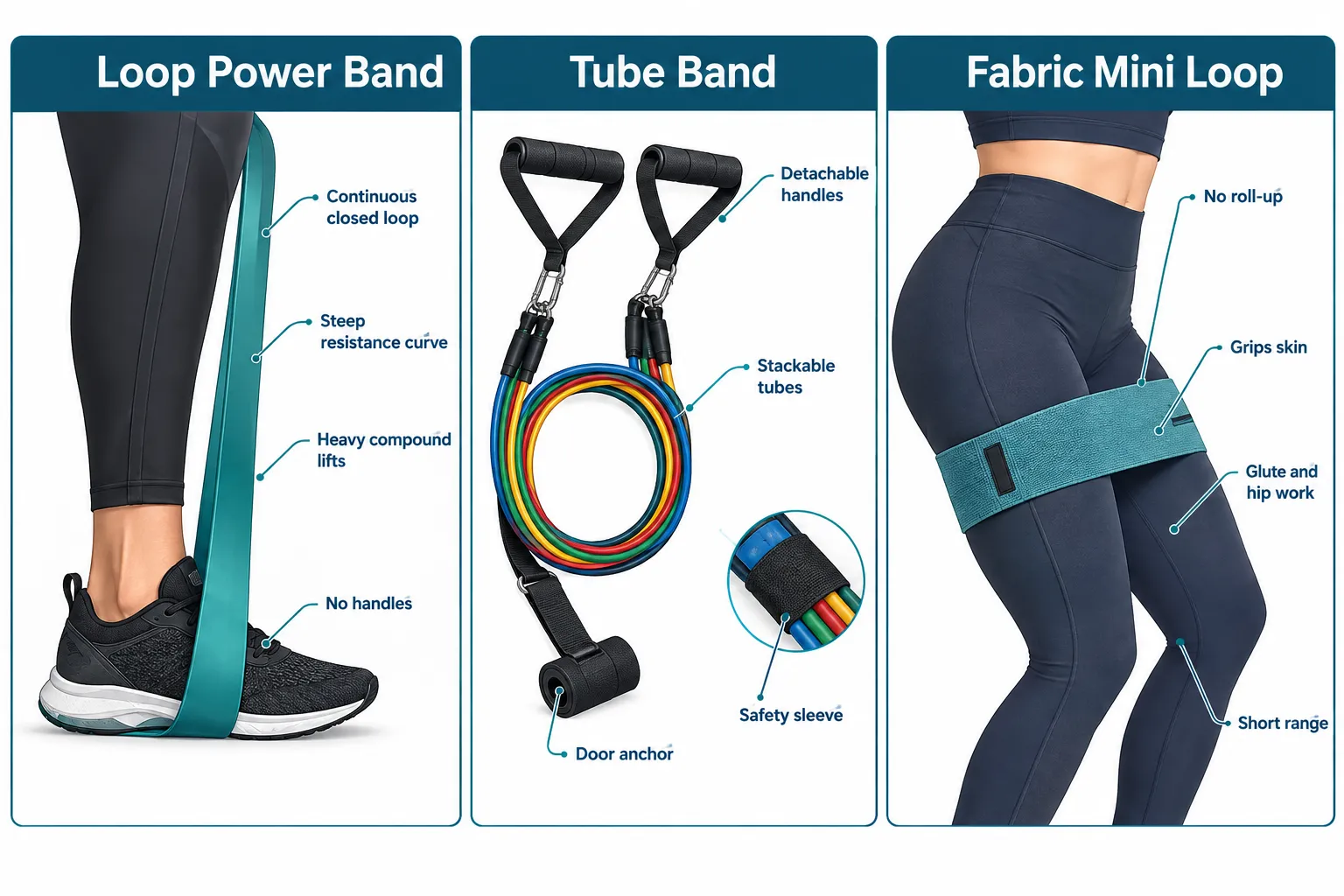
The best resistance bands for adults over 40 who want to build muscle are not one product but a three-part kit: a heavy continuous loop band set for compound lifts, a stackable tube system with handles and a door anchor for multi-angle upper-body work, and a fabric mini-loop set for hips and glutes. Expert round-ups in 2026 repeatedly land on this combination because loop bands supply heavy loading, tube systems supply anchoring versatility and grip comfort, and fabric loops stay put during lower-body work [1][2]. Therapy-style bands like TheraBand are excellent for rehab and warm-ups but too light (roughly 3-7 pounds of pull) to drive hypertrophy on their own [3][4][5].
Key Takeaways
- Loop bands (closed latex loops, roughly 6-250 lb across a full set) handle squats, hinges, presses, and assisted pull-ups [1].
- Tube bands with detachable handles and a door anchor cover rows, pulldowns, curls, and chest presses in a small space; stacked sets reach roughly 125 lb [2].
- Fabric mini-loops don't roll, pinch, or slide, which makes them the better pick for glute and hip strength after 40 [6].
- Bands build real muscle when you train close to failure, 2-4 sessions per week per muscle group, and progressively increase tension.
- Pick your starting level by rep feel, not by color: the right band lets you hit 10-12 solid reps with 2 left in the tank.
- Bands are generally gentler on joints because tension is lowest where joints are most vulnerable and highest where muscles are strongest.
- Cheap bands can work, but thin latex under heavy load is the main failure point, prioritize durability and consistent tension [12-style lab testing is reflected in reviews at [1]].
- Latex loses elasticity over time; expect to replace heavily used bands every 12-24 months.
What's the difference between loop bands and tube resistance bands?
Loop bands are one continuous circle of layered latex with no handles; tube bands are hollow rubber tubes with clips, handles, and ankle straps. The practical difference is how you load and anchor them. Loop bands excel at heavy compound work because you can stand on them, wrap them around a rack, or double them over for more tension. Tube bands excel at pulling angles, rows, pulldowns, chest flyes, because a door anchor gives you a fixed point at any height [2].
| Feature | Loop (power) bands | Tube bands with handles | Fabric mini-loops |
|---|---|---|---|
| Resistance curve | Steep; tension climbs fast | Moderate, more linear feel | Short, sharp at end range |
| Anchoring | Rack, door, foot, body | Door anchor, handles, ankle cuffs | Worn on limbs, no anchor |
| Grip comfort | Latex in bare hands can bite | Best, padded handles [7][8] | Not applicable |
| Top resistance | Highest (heavy sets) [1] | Stackable, mid-to-heavy [2] | Light |
| Best use | Squats, hinges, pull-up assist | Rows, presses, curls, pulldowns | Glutes, hips, balance |
Decision rule: if you have arthritis or weak grip, start with a handled tube set, reviewers consistently name handled systems like Bodylastics as easier to hold than bare latex loops [7][8].
Can you actually build muscle with resistance bands if you're over 40?
Yes. Muscle responds to mechanical tension and effort, not to the shape of the object creating it. Bands are described by trainers as a safe and effective strength option for older adults and people with mobility limits, and modern sets now span extra-light to extra-heavy specifically so they can support long-term strength programs rather than just rehab [9].
What matters after 40:
- Effort level. Stop sets 1-2 reps short of failure. A band that feels "easy" at rep 8 isn't building much.
- Protein and recovery. Muscle gain slows with age, so sleep and adequate protein carry more weight than band brand.
- Progression. You must make sets harder over time. Without that, bands become maintenance tools.
Common mistake: training only with light therapy bands for months. Senior-focused reviews praise TheraBand for trustworthiness but note standard sets top out around 3-6.7 pounds, fine for rehab and prep, not for hypertrophy [3][4][5].
How do I know what resistance level to start with, and what size band should I get?
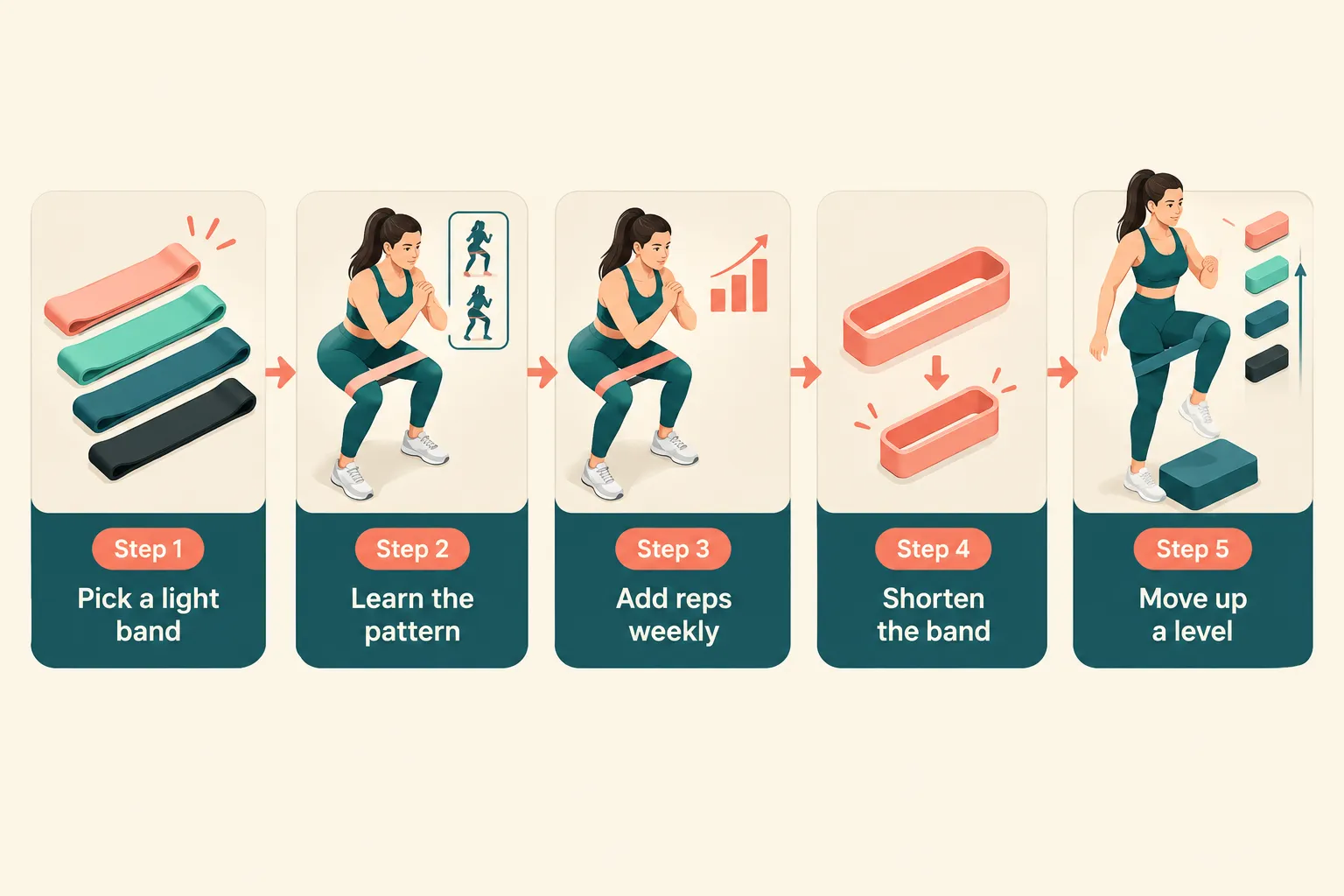
Pick the band that lets you complete 10-12 controlled reps with about two reps left in reserve. Color codes vary by brand, so always test by feel.
A simple starting kit for a healthy adult over 40:
- Light loop band for warm-ups, face pulls, and pull-apart work.
- Medium loop band (your main upper-body band) for rows and presses.
- Heavy loop band for squats, hinges, and pull-up assistance, legs are far stronger than arms and need much more tension.
- Stackable tube set so you can clip 2-3 tubes together as you get stronger [2].
For band length: 41-inch continuous loops are the standard for strength training because they stretch far enough for full squats and overhead presses. Short 12-inch mini-loops are for hips and shoulders only.
Edge case: very tall lifters (6'2"+) often find mid-weight 41-inch loops too slack when standing on them, step wider or double the band to restore tension.
Are resistance bands better than weights for joints?
For many people over 40, yes, at least at vulnerable joint angles. Bands provide variable resistance: tension is lowest at the bottom of a movement, where the shoulder or knee is most compressed, and highest near lockout, where muscles have the best leverage [1][9]. That curve reduces peak joint stress while still loading the strongest part of the range.
Bands also fail safely. A dumbbell that slips lands on you; a band that gets too hard just stops moving. The trade-off: bands make the bottom of a squat or bench press almost unloaded, which can under-train the stretched position where a lot of growth happens. Fix that by pausing at the bottom and anchoring the band lower.
Do adjustable resistance bands work better than fixed ones?
Adjustable (stackable) tube systems are better for long-term progression; fixed loop bands are better for heavy, simple loading. Adjustable sets let you add one tube at a time, so jumps in resistance are small, which matters because fixed bands often jump 20-30 pounds between levels.
- Choose adjustable tubes if you want fine-grained progression, a compact setup, and padded handles. WHATAFIT and GoFit Pro Grade sets are the two most frequently recommended stackable options for home muscle-building, with full stacks around 125 lb and roughly 20-70 lb respectively [2].
- Choose fixed loop bands if you want maximum load, pull-up assistance, or rack-anchored compound work. Living.Fit's loop set is named top overall in several 2026 reviews, with a range spanning roughly 6-250 lb [1].
Most people over 40 who are serious about muscle end up owning both.
Can I build muscle with just resistance bands, or do I need weights too?
Bands alone can build noticeable muscle for beginners and returning lifters, especially in the first 12-18 months. Intermediate and advanced lifters usually need to add some external load, dumbbells, a kettlebell, or a weighted vest, because band tension becomes hard to increase in small, measurable steps once you're strong.
A practical hybrid: bands for pulling, pressing, and hip work; a pair of adjustable dumbbells or a single heavy kettlebell for loaded squats, carries, and Romanian deadlifts. That combination covers the stretched positions bands handle poorly.
Which resistance band exercises build the most muscle?
The highest-return band exercises are compound movements anchored so the band resists the full working range.
- Banded squat or split squat (band under both feet, over shoulders), quads, glutes.
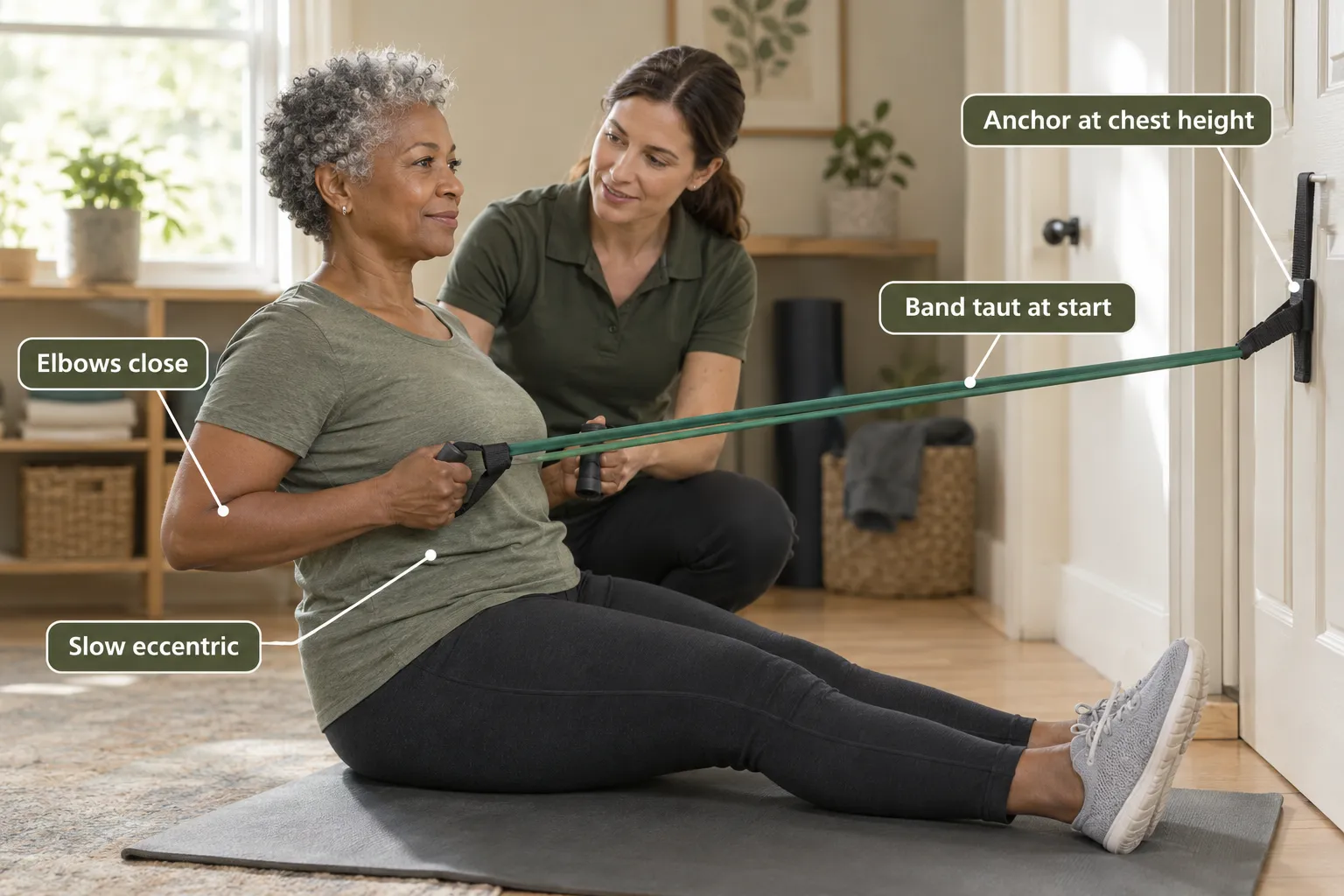
- Seated or bent-over row (door anchor or feet), lats, mid-back.
- Standing chest press with anchor behind you, chest, triceps.
- Lat pulldown with a high door anchor, lats, biceps.
- Romanian deadlift with a heavy loop, hamstrings, glutes.
- Overhead press standing on the band, shoulders.
- Banded hip thrust and lateral walk with a fabric mini-loop, glute medius, hip stability, which supports balance and fall prevention [6].
Run 3-4 sets of 10-20 reps on each, and slow the lowering phase to 3 seconds, that's the easiest way to add difficulty without a heavier band.
What are the best resistance bands for someone with bad shoulders or knees?
For cranky shoulders, use handled tube bands with a door anchor so you can set the pull angle below shoulder height and keep the arms in front of the body. For knees, use fabric mini-loops plus a light-to-medium loop band for partial-range squats and step-ups, progressing depth before adding tension.
- Bad shoulders: cable-style tube rows, chest presses at sternum height, band pull-aparts, external rotations. Avoid deep behind-the-neck or wide-flared pressing.
- Bad knees: glute bridges, hip abduction walks, box squats to a chair, hamstring curls with an ankle cuff.
- Arthritic hands: handled tubes with thick ergonomic grips and secure carabiners keep training volume up without squeezing bare latex [7][8].
TheraBand remains the most trusted therapy-style brand for this prep phase; graduate to heavier loop or tube systems once movement patterns feel solid [4][5].
How often should I use resistance bands to see muscle growth, and how long does it take?
Train each major muscle group 2-3 times per week, with 10-20 hard sets per muscle group per week spread across those sessions. Three full-body sessions of 30-40 minutes is the simplest schedule that works for most adults over 40.
Realistic timeline (general training expectation, not a measured study figure):
- Weeks 1-4: strength and coordination improve fast; little visible size change.
- Weeks 6-12: noticeable firmness, better posture, clothes fit differently.
- Months 4-9: visible muscle gain if protein, sleep, and progression are consistent.
- Year 1+: progress slows; this is when adding external load or heavier bands matters most.
What's the biggest mistake people make with resistance bands?
The biggest mistake is not progressing, using the same band for the same 12 reps for months. Bands make this easy to miss because there's no number on the handle.
Other frequent errors:
- Starting with slack. If the band is loose at rep one, half the range is unloaded. Step wider or shorten the anchor.
- Rushing the lowering phase, which throws away most of the tension benefit.
- Anchoring in a door that opens toward you, or over a sharp edge that abrades the band.
- Buying only light bands because colors looked friendly.
- Stretching a band past roughly 2.5 times its resting length, which both distorts the resistance curve and shortens band life.
Track progression: log band color, reps, tempo, and anchor distance. Those four numbers are your equivalent of plate weight.
Are expensive resistance bands worth it, or can cheap ones work?
Cheap bands work fine for light and medium tension; premium bands matter most at heavy loads. Lab-style testing and expert reviews focus on consistency of resistance and uniform stiffness across a set, because uneven tension raises injury risk and makes progression unreliable [1][5]. Entry-level loop sets such as Fit Simplify and handled sets from Black Mountain are widely recommended as accessible starting points [7][8].
Spend more when:
- You're loading 80+ pounds on a loop band.
- You're using the band for pull-up assistance (a snap under bodyweight is genuinely dangerous).
- You want continuous-layer latex rather than glued or bonded seams.
Save money when: buying mini-loops, light warm-up bands, or a first starter set to test consistency.
Do resistance bands lose elasticity over time?
Yes. Latex degrades with UV light, heat, sweat, ozone, and repeated over-stretching. Expect a gradual drop in tension and eventually surface cracking or whitening.
Care checklist:
- Store in a drawer or bag, away from sunlight and radiators.
- Wipe sweat off after use and let them dry fully.
- Never stretch over a rough rack edge, use a towel or sleeve.
- Inspect before every heavy session: small nicks become tears.
- Replace heavily used heavy bands every 12-24 months; light bands often last longer.
FAQ
Are loop bands or tube bands better for building muscle after 40?
Loop bands are better for heavy compound lifts; tube bands with handles are better for rows, presses, and curls. Most people over 40 get the best results using both.
How much resistance do I need to build muscle?
Enough that 10-12 reps feels genuinely hard. For legs that often means 60+ pounds of band tension; for arms and shoulders, 15-30 pounds is plenty.
Can resistance bands replace a gym membership?
For general strength, muscle maintenance, and moderate muscle gain, yes. For maximal strength or advanced hypertrophy, you'll eventually want added external load.
Are fabric bands better than latex?
For hips and glutes, yes, fabric loops don't roll or pinch during squats and lateral walks [6]. For heavy full-body lifts, layered latex loops are better.
Is TheraBand good for muscle building?
TheraBand is the most trusted therapy-style brand for older adults but its standard tensions are too light for hypertrophy; use it for rehab and warm-ups [3][4][5].
How do I anchor bands safely at home?
Use a purpose-made door anchor on a door that opens away from you, closed and latched. Alternatively loop around a sturdy post, rack upright, or under both feet.
Should I use bands every day?
Light mobility band work is fine daily. Hard muscle-building sessions need 48 hours of recovery per muscle group.
What if a band feels too hard at the top but too easy at the bottom?
That's the normal band resistance curve. Pause at the bottom, add a slight pre-stretch, or combine the band with a light dumbbell to even out the load.
Conclusion
The sensible buying strategy for adults over 40 who want visible muscle is a layered kit rather than a single purchase: one heavy loop band set for compound lifting, one stackable tube system with padded handles and a door anchor for upper-body angles, and one fabric mini-loop set for hips and glutes [1][2][6]. Judge any product on four things, consistency of tension, anchoring options, grip comfort, and durability under load, because those determine whether you can keep progressing.
Next steps:
- Test your current strength with one band to find the level that gives 10-12 hard reps.
- Buy the three-part kit (heavy loops, stackable tubes, fabric mini-loops) rather than one bargain bundle.
- Set a three-day-per-week full-body schedule built on the seven compound band exercises listed above.
- Log band color, reps, tempo, and anchor distance every session.
- Re-test in six weeks and move up a tension level wherever you clear 15 clean reps.
References
- Best Resistance Bands. garagegymreviews.com.
- Best Resistance Bands Home Workouts 2026. theconsumers.guide.
- Resistance Bands for Seniors. healthline.com.
- Best Resistance Bands. healthline.com.
- Best Resistance Bands 4157960. verywellfit.com.
- Best Resistance Bands Seniors. silverstrength.club.
- Best Resistance Bands for Seniors. elderlydaily.com.
- Best Resistance Bands Seniors. silverbloomhealth.com.
- Strength Training Products Seniors. cnn.com.
