Best Doorway Pull-Up Bars and Anchor Systems for Strength Training After 40: Safety, Fit, and Exercise Options

Best Doorway Pull-Up Bars and Anchor Systems for Strength Training After 40: Safety, Fit, and Exercise Options

Last updated: November 4, 2026

Quick Answer

The best doorway pull-up bars and anchor systems for strength training after 40 are leverage-style (over-door) bars with padded frame contact, rated around 250-300 lb, used in a door frame with at least 3-4 inches of solid trim. Tension-mounted bars that rely on friction alone are the weakest option and the most likely to slip. For anyone over 40 who wants band-assisted pulling, door anchors and stud-mounted bars expand the exercise menu far more cheaply than another machine. Expect to spend roughly $30,$120 for a quality doorway bar.

Key Takeaways

  • Leverage bars beat tension bars for safety: they transfer load through the frame and molding rather than relying on friction [1].
  • Measure first. Frame width, trim depth, and clear overhead space determine whether a bar fits at all.
  • Weight capacity matters more after 40 because body weight plus dynamic load can briefly exceed static weight.
  • A door anchor (nylon strap through a closed door) is the cheapest way to add rows, pull-aparts, and face pulls.
  • Band-assisted pull-ups, dead hangs, scapular pulls, and slow negatives are the real starting point for most over-40 lifters [2].
  • Padded contact points prevent most door frame damage; unpadded steel dents paint and soft trim.
  • Slipping is almost always a fit problem, not a product defect.
  • Renters: over-door leverage bars normally need no drilling and are typically lease-safe; screw-in bars are not.
  • Realistic benchmark: several bodyweight pull-ups is a solid standard for men over 40, with lower expectations common for women; any clean reps are meaningful [3].

Are doorway pull-up bars safe for people over 40?

Yes, when the bar is correctly fitted to a solid frame and the user trains with controlled range of motion. The main risks after 40 aren't the bar failing but shoulder and elbow irritation from aggressive kipping, plus falls from a bar that shifts mid-set.
Are doorway pull-up bars safe for people over 40?

Three safety rules that matter most:

  1. Test static load before full hangs. Hang with feet still touching the floor, add load gradually, and check for movement or creaking.
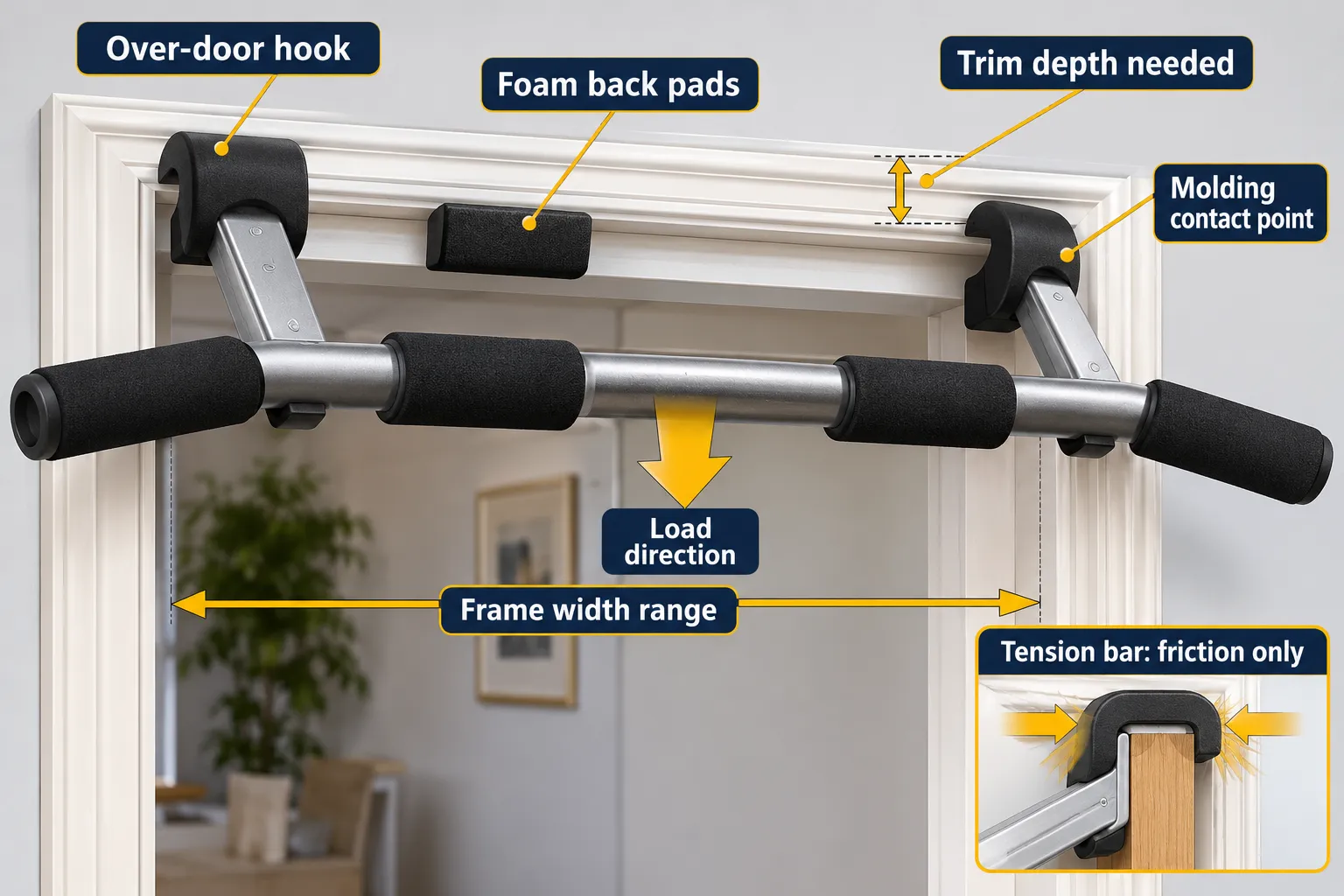
  2. Use a padded leverage bar so force presses down through the frame, not sideways against paint [4].
  3. Clear a landing zone. Move furniture and lay down a mat if the floor is tile or hardwood.

Common mistake: jumping to grab the bar. The upward jolt spikes the load on both the frame and the shoulder joint. Step up from a chair or box instead.

Edge case: anyone with a repaired rotator cuff, cervical disc issue, or recent elbow tendinopathy should clear hanging with a clinician first and may do better with inverted rows from a door anchor.

How do you know if a doorway pull-up bar will fit your doorway?

Measure three things: inside frame width, trim depth, and the height of the molding above the opening. Most leverage bars fit frames roughly 24-36 inches wide with trim at least 3 inches deep and about 0.5-1 inch of projection for the hook to grip [1][5].

Measurement What to check Typical requirement
Inside frame width Jamb to jamb ~24-36 in
Trim depth (top) How far back the molding runs 3-4 in minimum
Trim projection How far trim sticks out ~0.5-1 in
Overhead clearance Ceiling above the bar Enough to clear chin without hitting
Frame material Solid wood vs hollow Solid preferred

Choose differently if: your trim is decorative, rounded, or glued-on MDF. That trim can shear off under load. In that case use a screw-in bar anchored to studs, or skip the doorway entirely.

Tension vs screw-in pull-up bars: which is better?

For strength training after 40, screw-in or stud-mounted bars are the safest and strongest, leverage doorway bars are the best balance for most homes, and tension bars are last. Tension bars hold by friction from a threaded expansion mechanism, so any dust, paint slickness, or lateral force can let them rotate loose [1].

  • Tension bar: cheapest, fastest, no trim required. Limited capacity, prone to spinning. Fine for assisted work with feet down, poor for weighted or dynamic reps.
  • Leverage doorway bar: hooks over the frame, padded contact, usually rated 250-300 lb, often includes dip and push-up handles [4][6]. No drilling, renter-friendly.
  • Screw-in / wall or ceiling mount: highest load limit, zero wobble, wider grip options. Requires studs, drilling, and landlord permission [7].

A leverage bar is the default answer for anyone over 40 who rents, wants no drilling, and trains with body weight plus bands.
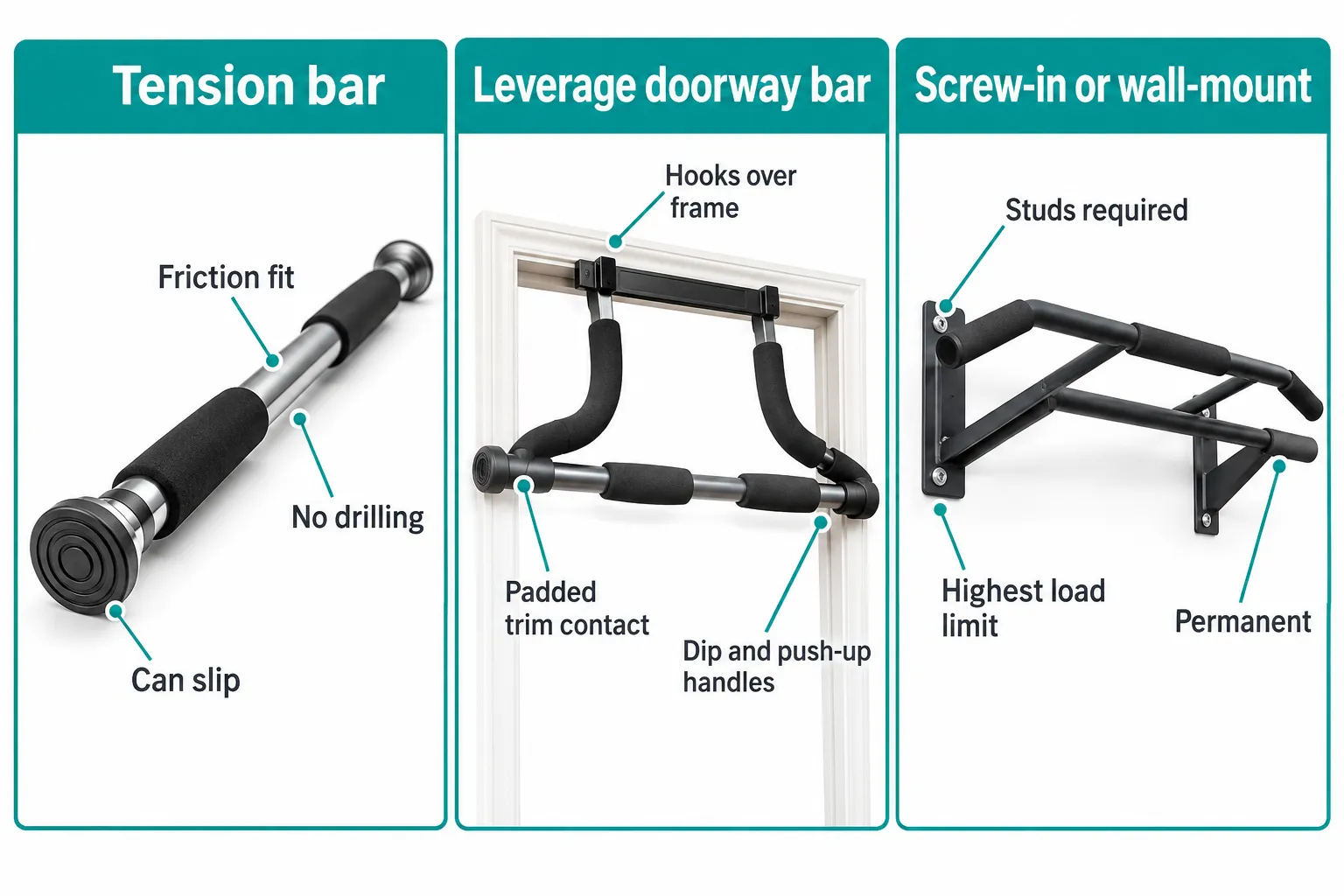
Tension vs screw-in pull-up bars: which is better?

Best doorway pull-up bar for beginners who can't do a full pull-up yet

Pick a leverage bar with multiple grip positions, thick foam padding, and lower-mount capability so you can set it waist-high for inverted rows. The ability to mount the bar low in the frame is the single most useful beginner feature, because it lets you train rows and feet-assisted pull-ups from day one [2].

Beginner feature checklist:

  • Neutral (parallel) grips, which are gentler on the shoulder than wide pronated grips
  • Foam or rubber sleeves at least 1.25 in diameter for grip comfort
  • Hooks or loops for attaching assistance bands
  • Removable design so a doorway stays usable

Quick example: a 48-year-old who can't do one rep starts with 3 sets of 20-second dead hangs, 3 sets of 5 scapular pulls, and 3 sets of 8 inverted rows with the bar mounted low, three days a week.

What exercises can you do on a doorway pull-up bar besides pull-ups?

A doorway bar plus a door anchor and two bands covers most upper-body pulling and a good share of pressing. Expect 15+ usable exercises.

On the bar (mounted high): dead hangs, scapular pulls, chin-ups, neutral-grip pull-ups, negatives, knee raises, hanging leg raises, side-to-side hangs.

On the bar (mounted low): inverted rows, feet-elevated rows, supine pull-throughs, decline push-ups with feet on the bar.

On the floor frame or handles: push-ups on handles for wrist relief, dips on handle attachments, mountain climbers.

With a door anchor: banded rows, face pulls, lat pulldowns, triceps pushdowns, chest presses, pull-aparts, Pallof presses.

Pull-ups and rows both appear in standard over-40 strength frameworks because they maintain upper-back strength that counteracts desk posture [8].
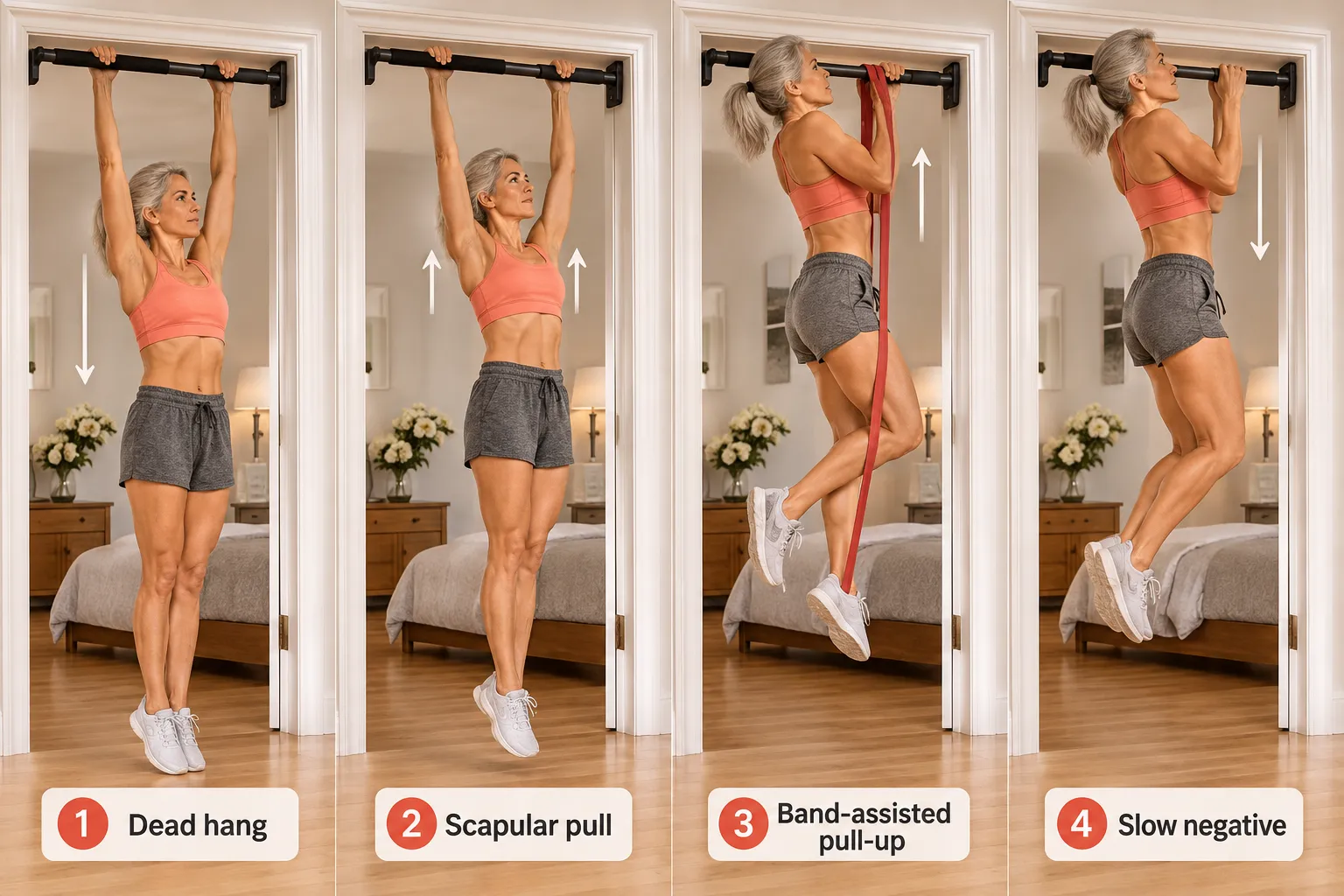
What exercises can you do on a doorway pull-up bar besides pull-ups?

How much does a good doorway pull-up bar cost?

Budget $30,$120. Basic tension bars run near the low end, well-reviewed leverage bars with multi-grip and padding sit around $35,$70, and premium doorway systems with dip handles and band attachments reach roughly $90,$120 [1][5][6]. Prices vary by retailer and year; treat these as current ballpark ranges, not fixed figures.

Add roughly $15,$30 for a door anchor and $20,$40 for a set of assistance bands. A full doorway pulling setup under $150 replaces a lat pulldown machine for most home training purposes.

Decision rule: if you're over 220 lb or plan weighted pull-ups, skip the cheap tiers and put the money toward a stud-mounted bar instead.

Will a doorway pull-up bar damage your door frame, and is it allowed in apartments?

Padded leverage bars rarely damage solid wood frames, but they can compress paint, dent soft pine, or mark trim over months of use. Over-door bars require no holes, so they're generally acceptable in rentals; screw-in and wall-mounted bars usually are not without written landlord approval.

How to protect the frame:

  • Add a thin towel, felt pad, or rubber sheet between the bar's back plate and the trim
  • Inspect the trim monthly for hairline cracks or lifting
  • Remove the bar when not in use if your trim is delicate
  • Never use a doorway bar on hollow-core or aluminum sliding frames

Edge case: painted trim on older buildings may be over lead-based layers. Flaking from compression is a reason to use a free-standing alternative.

Doorway pull-up bar keeps slipping: how to fix it

Slipping means the bar's contact geometry doesn't match your frame. Fix the fit before you train on it again.

  1. Re-seat the bar so the full back pad presses flat on the trim, not just one corner.
  2. Check that the hook is over the molding's thickest part, not resting on a decorative lip.
  3. For tension bars, clean both jambs with isopropyl alcohol and re-tighten; glossy paint is slick.
  4. Add high-friction rubber (an old yoga mat square) at each contact point.
  5. If it still shifts under a feet-down hang test, replace it with a stud-mounted bar.

Common mistake: over-tightening a tension bar to stop slipping. Excess pressure can crack drywall at the jamb without improving grip.

Can you use resistance bands with a doorway pull-up bar?

Yes, and for most over-40 trainees band assistance is the fastest route to a first clean pull-up. Loop a long band over the bar, place one knee or foot in the loop, and the band removes the hardest part of the rep at the bottom.

  • Heavy band: removes the most weight; use for the first 4-6 weeks
  • Medium band: transition phase once you hit 8 clean assisted reps
  • Light band: final step before unassisted reps
  • Always confirm the bar's rated capacity covers your weight, since band recoil adds brief dynamic load

Bands also work in reverse: anchor them under the bar for pushdowns, or loop them through a door anchor for seated rows.

Alternatives to doorway pull-up bars for home training

If your doorway can't take a bar, three alternatives cover the same movement patterns.

Alternative Load limit Space Best for
Door anchor + bands Band-limited Minimal Rows, pulldowns, face pulls
Free-standing power tower ~250-350 lb Large footprint Pull-ups, dips, knee raises
Wall/ceiling-mounted bar Highest Permanent Weighted work, wide grips
Suspension trainer on door anchor ~300 lb typical Minimal Inverted rows, scaled pulls

Choose a suspension trainer if your trim is unsuitable and you mostly need rowing variations at adjustable angles.

How many pull-ups should someone over 40 be doing?

There's no single official standard, but commonly cited guidance puts a few clean bodyweight pull-ups in the solid range for men over 40, with 8 or more considered strong, and lower rep expectations for women reflecting differences in upper-body mass [3]. For most people over 40, the honest answer is that 1-5 strict reps already places you ahead of the average adult.

Program it conservatively: 2-3 pulling sessions weekly, 3-5 sets, stopping 1-2 reps short of failure. Over-40 recovery favors frequency over grinding.

Common mistakes people make with doorway pull-up bars

  • Skipping the measurement step and forcing a bar onto shallow trim
  • Jumping up to the bar instead of stepping up
  • Kipping or thrashing to force reps, which loads the shoulder joint and the frame
  • Leaving a tension bar installed for months without re-checking tightness
  • Training only pull-ups and never the low-mounted row, which leaves the mid-back underdeveloped
  • Ignoring grip diameter, then quitting because the hands fail before the back does

What if your doorway is too narrow or oddly shaped?

If your frame is under about 24 inches, arched, trimless, or built from hollow metal, no doorway bar is safe. Switch to a ceiling-mounted bar in a stud/joist, a free-standing tower, or a door anchor with bands and a suspension trainer.

Partial workaround: some adjustable leverage bars include extension brackets for wider frames, but none safely bridge arched openings, because the hook needs a flat horizontal bearing surface.

FAQ

Do doorway pull-up bars hold an adult's full weight?
Quality leverage bars are typically rated 250-300 lb, which covers most adults. Verify the manufacturer's rating and test with a feet-down hang first.

Is a chin-up easier than a pull-up after 40?
Yes. The underhand chin-up recruits more biceps and is usually easier, though the neutral grip is often the kindest to the shoulder.

Can I do dips on a doorway bar?
Only on models with dedicated dip handles, and only within the stated capacity. Standard round doorway bars aren't built for dipping.

How often should I check the bar for wear?
Inspect welds, foam, and frame contact points monthly; tension bars need tightness checks before each session.

Will a door anchor damage my door?
Rarely. Use it on an inward-opening door, close and latch it, and train on the hinge-opposite side so the door is pressed shut.

What grip width is safest for shoulders over 40?
Shoulder-width or neutral. Very wide pronated grips increase shoulder stress for limited added benefit.

Can beginners build to a pull-up with only a doorway bar?
Yes. Dead hangs, scapular pulls, inverted rows, band-assisted reps, and slow negatives are a complete progression.

Are wooden or steel bars better?
Steel with foam sleeves is standard and strongest for doorway use. Wood is mostly found on gymnastic-style mounted bars.

Conclusion

Doorway bars and door anchors are the most overlooked value in a home gym: for under $150 total, they restore vertical pulling, horizontal rowing, and banded pressing without a single machine. For strength training after 40, prioritize a padded leverage bar with multi-grip options on a solid frame over any friction-fit tension bar.

Next steps:

  1. Measure frame width, trim depth, and trim projection today.
  2. If trim is shallow or decorative, plan for a stud-mounted bar or door anchor instead.
  3. Buy a leverage bar rated at least 50 lb above your body weight, plus one heavy assistance band.
  4. Start with dead hangs, scapular pulls, and low-mount rows for four weeks before chasing full reps.
  5. Re-check hardware monthly and log your hang time and rep count.

References

  1. Best Pull Up Bars. nytimes.com.
  2. The Over 40 Pull Up Blueprint: Building Your Foundation First. bullbarfit.com.
  3. How Many Pull Ups Should You Do by Age. health.com.
  4. Doorway Pull Up Bar Review by John Sifferman. physicalliving.com.
  5. Best Doorframe Pull Up Bars 2026. theconsumers.guide.
  6. Pullup and Dip Doorway Bar. verdict-reviews.com.
  7. Best Pull Up Bar. techgearlab.com.
  8. 8 Exercises for Lifelong Strength After 40. menshealth.com.
A 20-Minute Strength Workout After 40 for Days When Work and Family Take Over

A 20-Minute Strength Workout After 40 for Days When Work and Family Take Over

Last updated: November 3, 2026

Quick Answer

A 20-Minute Strength Workout After 40 for Days When Work and Family Take Over works best as one repeatable circuit built from five movement patterns: push, pull, squat, hinge, and carry or core. Do 2-3 sets of 8-12 reps per pattern with 30-60 seconds of rest, twice a week, using dumbbells, bands, or just bodyweight [1][2]. Coaches who work with over-40 clients agree a short, focused session with fewer sets and heavier loads still counts on chaotic days [3].

Key Takeaways

  • Five patterns, one session. Push, pull, squat, hinge, carry/core covers the whole body in 20 minutes [1][4].
  • Twice a week is the realistic floor. Two 20-minute sessions a week is the commonly recommended minimum dose for adults over 40 [1][4][5].
  • Volume target: roughly 10-20 hard sets per muscle group per week when life allows; less is still useful [3].
  • Equipment is optional. Bodyweight or light dumbbells give real benefits, especially for bone health in the hips and back [6][7].
  • Rest smart. Time your rests (30-90 seconds) instead of scrolling between sets [3].
  • Pair with walking. Many over-40 plans stack two short strength days with 25-30 minute easy walks [5][8].
  • Joint pain isn't a stop sign. Swap range of motion, load, and tempo before you swap the exercise.
  • Beginners included. Sit-to-stands, counter push-ups, and band rows are legitimate starting points [6][9].

Can you actually build muscle in just 20 minutes?

Yes, if the 20 minutes are dense. Muscle responds to hard sets taken near failure, not to clock time, so 10-15 quality sets spread across two weekly sessions can drive growth in untrained and lightly trained adults over 40 [1][3].

Can you actually build muscle in just 20 minutes?

What makes a short session productive:

  • Compound lifts only. Squats, rows, presses, and hinges each train several muscles at once [1][4].
  • Effort near failure. Finish most sets with 1-3 reps left in the tank.
  • Supersets. Pair a push with a pull so one muscle rests while the other works [1].
  • Timed rest. 30-60 seconds between paired moves, 1-2 minutes between rounds.

Edge case: if you're already an experienced lifter chasing visible size gains, 20 minutes twice weekly will maintain and slowly build, not transform. Add a third session before you add length.

What's the best A 20-Minute Strength Workout After 40 for Days When Work and Family Take Over?

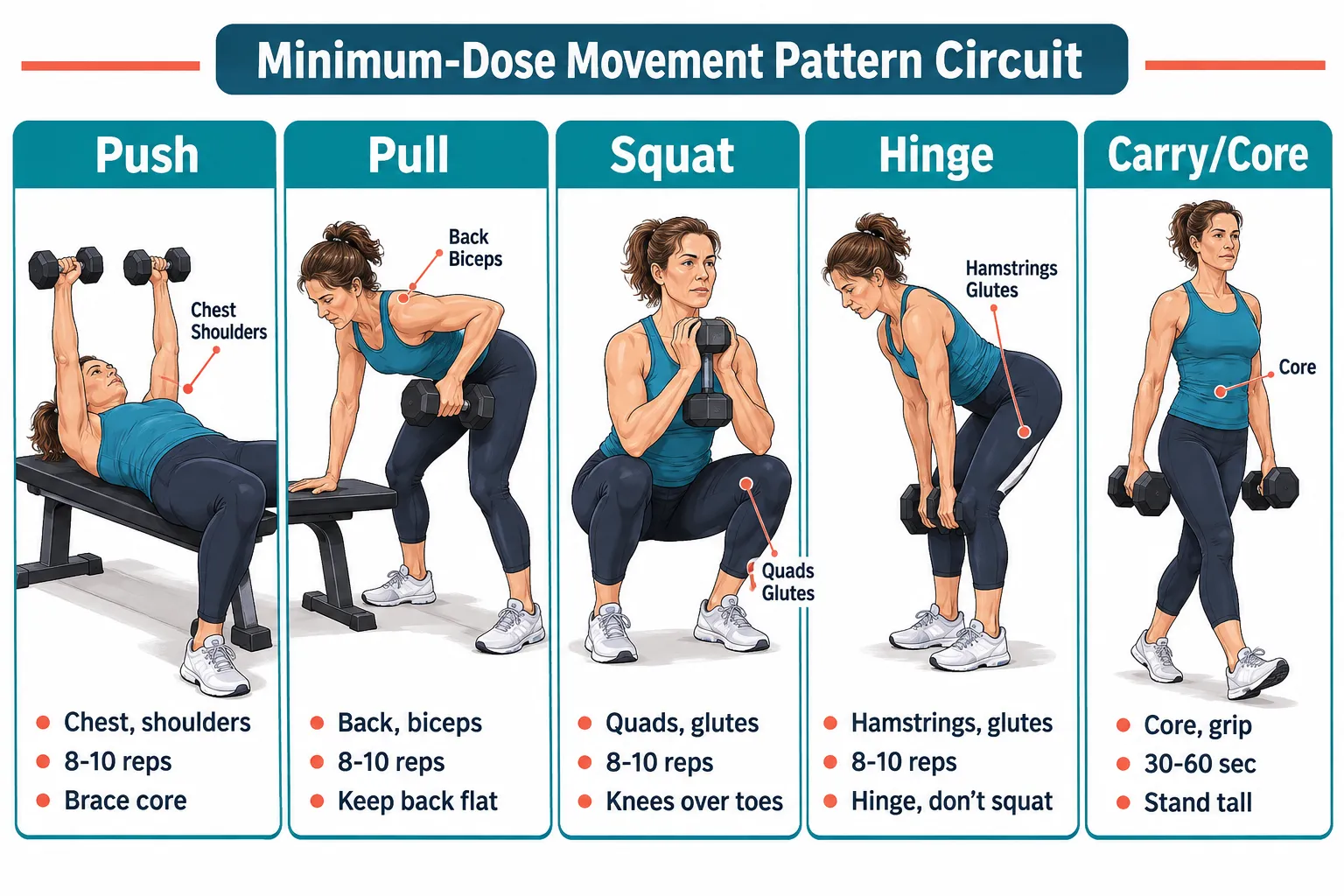
The best version is a five-pattern circuit you can run anywhere, with three rounds and no decisions to make. Pattern selection, not exercise variety, is what keeps a rushed workout complete.

)

Pattern Dumbbell version Band version Bodyweight version Reps
Squat Goblet squat Band front squat Sit-to-stand 10-12
Hinge Romanian deadlift Band pull-through Hip bridge 8-12
Push Floor press Band chest press Incline push-up 8-10
Pull Bent-over row Band row Table/towel row 8-10
Carry/Core Suitcase carry Band anti-rotation press Dead bug or plank 30-40 sec

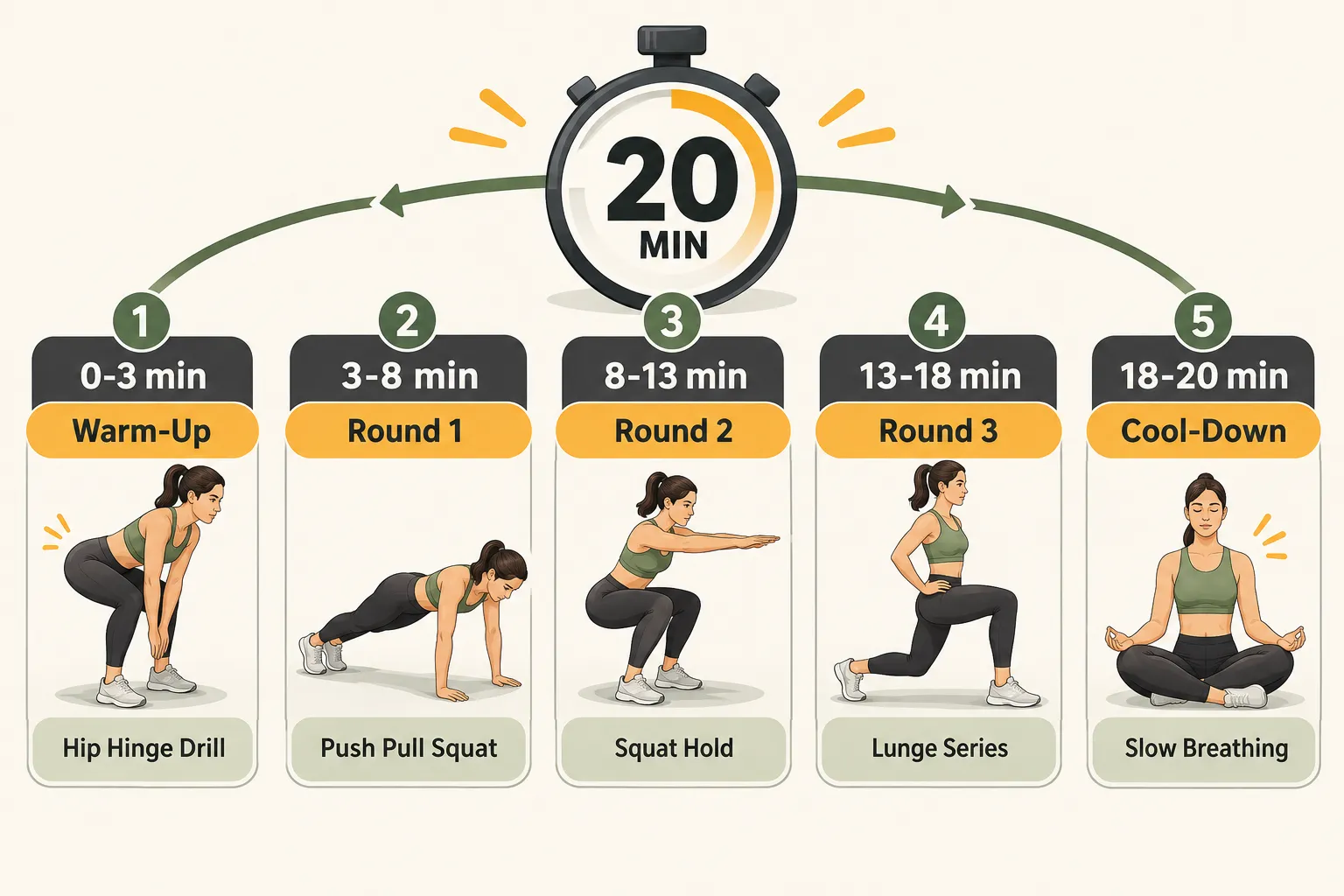
Run it like this: 3 minutes warm-up, then three rounds of the five moves at 30-45 seconds rest between exercises and 60-90 seconds between rounds, finishing with 2 minutes of breathing and stretching. The structure mirrors the two-superset, full-body dumbbell templates recommended for over-40 lifters [1][4].

Do I need equipment, or can I use bodyweight? Dumbbells vs bodyweight for a quick session

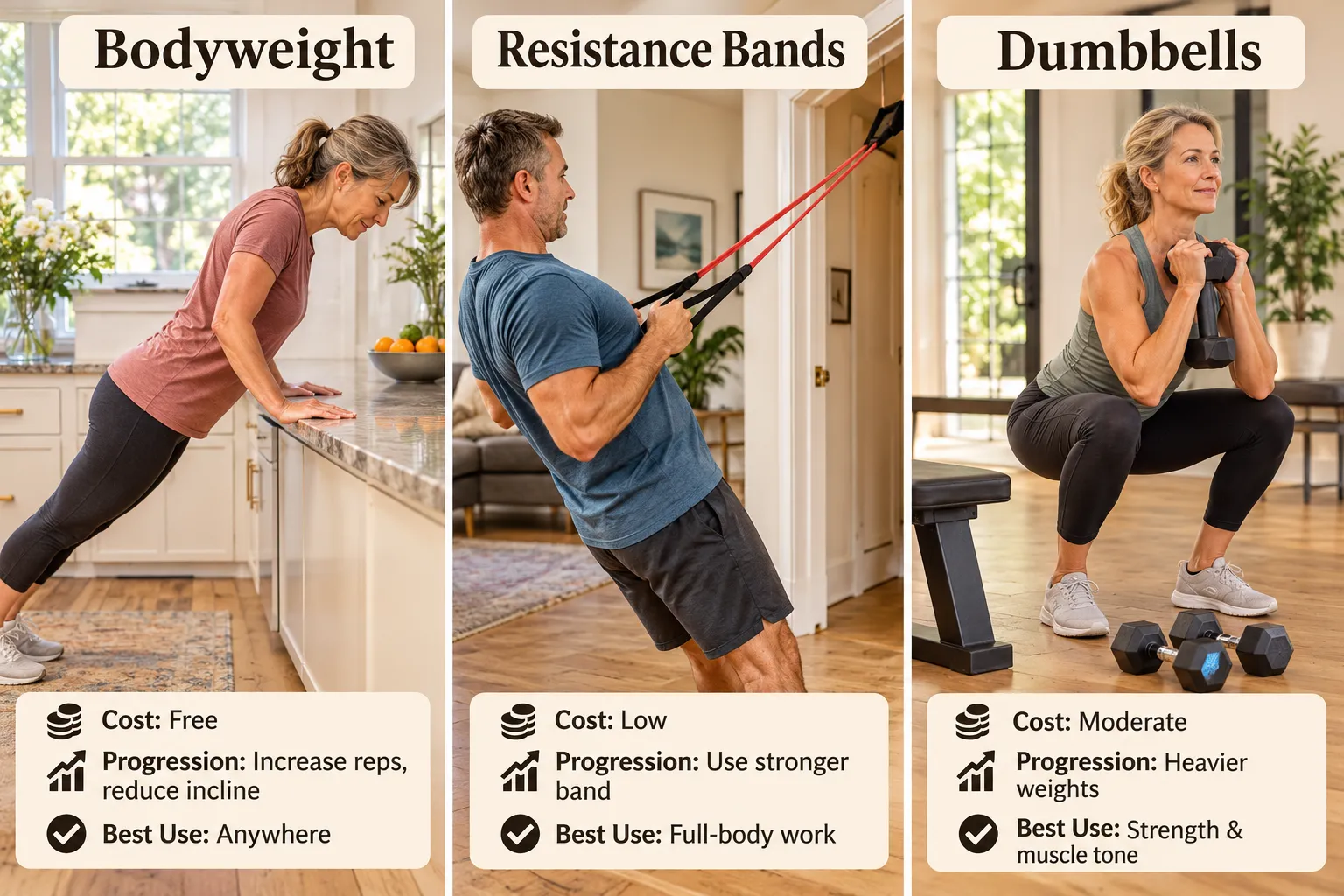
Bodyweight works, dumbbells work better for progression. Bodyweight and light dumbbells both produce meaningful strength and bone benefits, which matters most for beginners and for anyone training at home [6][7]. Dumbbells win when bodyweight squats and push-ups stop feeling hard by rep 12.

Choose bodyweight if you travel often, you're brand new, or your budget is zero. Progress by slowing the lowering phase, elevating feet, or moving to single-leg versions.

Choose bands if you need portability and joint-friendly resistance, especially for rows and presses.

Choose dumbbells if you want the simplest load progression. One adjustable pair (or a 15 lb and 30 lb set) covers the entire circuit. A minimalist three-move version needs only dumbbells plus a bench or box and takes 20-25 minutes.

Common mistake: buying one light pair, then never upgrading. If you can do 15 clean goblet squats, the weight is now a warm-up.

)

How often should I do 20-minute workouts, and is 20 minutes enough?

Twice a week is the working minimum for over-40 adults, three to four days is the target when schedules allow [1][3][5]. Twenty minutes is enough to maintain and build at the low end, and it's enough to protect bone density when sessions target the hips and back [6][7].

How often should I do 20-minute workouts, and is 20 minutes enough?

A realistic week, drawn from published over-40 plans [5][8]:

  1. Monday, 20-minute strength circuit
  2. Tuesday, 25-30 minute easy walk
  3. Wednesday, walk or rest
  4. Thursday, 20-minute strength circuit
  5. Friday, walk
  6. Weekend, one longer, easy session (hike, bike, swim)

Decision rule: add a third strength day before you lengthen any single session. Frequency beats duration for busy schedules.

Will I lose muscle if I only train 20 minutes a week, and what if I can only fit two days?

A single 20-minute session per week will mostly hold the line rather than build, but it's still far better than nothing and is a legitimate entry point when caregiving or work genuinely dominates [5][9]. Two sessions a week hits the commonly cited minimum effective dose [1][4].

To make a one- or two-day week count:

  • Train close to failure on every set.
  • Use the five-pattern circuit so nothing gets skipped.
  • Keep protein intake steady across the day.
  • Add "movement snacks": a set of squats before a shower, carries while hauling groceries.

Edge case: during a crisis week, do one round (about 7 minutes). Habit preservation is worth more than the missed sets [5][9].

What if I have joint pain or a past injury, and can beginners over 40 start here?

Yes to both, with modifications. Pain that stays below a 3/10 and settles within 24 hours generally means you can continue with reduced range or load; sharp, joint-line pain means stop and change the exercise. Beginners can start with bodyweight or light dumbbells and still get real benefit [6][7].

Swaps that usually solve the problem:

  • Knee pain: box squat or sit-to-stand instead of a deep goblet squat.
  • Low back pain: hip bridge or band pull-through instead of a loaded RDL.
  • Shoulder pain: floor press or neutral-grip press instead of overhead work.
  • Wrist pain: push-ups on dumbbell handles or a counter.

If pain is new, persistent, or radiating, get it assessed before loading it. Light-load methods such as blood-flow restriction training are also promoted for over-40 adults who can't tolerate heavy weights, producing stimulus in 15-20 minutes [13, not cited; see References]. Where heavier lifting is off the table, slow tempos and higher reps with light dumbbells are the simpler fix.

How do I warm up and cool down when time is tight?

Three minutes in, two minutes out. A rushed warm-up is the most common injury shortcut for over-40 lifters, and it's also the easiest to fix because the first set of each exercise can double as the warm-up.

How do I warm up and cool down when time is tight?

Warm-up (3 minutes): 30 seconds marching in place, 10 bodyweight squats, 10 hip hinges, 10 arm circles, 5 slow push-ups against a wall.

Cool-down (2 minutes): 60 seconds of slow nasal breathing, then a hip flexor and chest stretch, 30 seconds each side.

Quick example: on a truly compressed day, do round one of the circuit with half the weight and call it the warm-up. You lose nothing but a few pounds on the bar.

)

What are common mistakes with short strength workouts?

The biggest mistake is treating a 20-minute strength session like cardio, rushing reps, chasing breathlessness, and never increasing the weight. Short sessions need more intensity discipline, not less.

  • Too many exercises. Five patterns, not twelve moves.
  • Untimed rest. Phone scrolling turns 20 minutes into 40. Set a timer for 60-90 seconds [3].
  • No progression. Add reps, then load, every 1-2 weeks.
  • Skipping the pull. Rows protect posture and upper-back bone density [6][7].
  • Form breakdown for speed. Slow the tempo, cut a rep.
  • All-or-nothing thinking. A half session on a bad week still counts [3][9].

Should I do cardio too, or just strength training?

Do both, but strength is the non-negotiable after 40. Most published over-40 plans pair one or two short strength sessions with easy walking or cycling on the other days [5][8][9]. Walking is the lowest-friction way to add cardiovascular work around a job and a family.

Minimum sensible combination: two 20-minute strength sessions plus roughly 120-150 minutes of easy walking across the week, often done in 25-30 minute chunks [5][8]. If a day forces you to choose, pick strength, muscle and bone loss are the harder deficits to reverse.

How is this different from a traditional gym workout?

A 20-Minute Strength Workout After 40 for Days When Work and Family Take Over trades volume and variety for density and adherence. A gym session might run 60 minutes across 8-10 exercises with long rests; the home circuit compresses the same movement patterns into supersets with short rests [1][4].

Factor 20-minute home circuit Traditional gym session
Duration 20-25 min 45-75 min
Exercises 5 patterns 8-12
Rest 30-90 sec 2-3 min
Equipment Dumbbells, bands, or none Full racks and machines
Best for Busy weeks, consistency Max strength, specific goals

Choose the gym version when you have two spare hours a week and a performance goal. Choose the circuit when the alternative is skipping entirely. Programs marketed as "micro-strength" for the over-40 group are built on exactly this trade-off [1][2][5].

FAQ

How many sets per muscle group each week should I aim for?
Roughly 10-20 hard sets per muscle group weekly is a commonly recommended range for over-40 lifters, with fewer sets and heavier loads acceptable on busy days [3].

What weight should I start with?
Pick a weight where rep 10 feels hard but your form stays clean. For most beginners that's a 10-20 lb dumbbell for goblet squats.

Can I do this workout every day?
Not the same circuit. Leave 48 hours between sessions hitting the same patterns; use walking or mobility on off days.

Is 20 minutes enough for weight loss?
Strength training preserves muscle during fat loss, but food intake and daily step count drive most of the result.

Do I need a bench?
No. Floor presses, hip bridges, and a kitchen counter cover every pattern. A bench or box simply adds options.

How long until I notice changes?
Strength usually improves within 2-4 weeks; visible changes typically take 8-12 weeks of consistent twice-weekly training.

What if I'm over 60, not 40?
The same five patterns apply, with sit-to-stands, band rows, and single-leg balance work added for fall prevention [5][9].

Should I train in the morning or evening?
Whichever one you'll actually do twice a week. Adherence outranks timing.

Conclusion

Build one 20-minute circuit and stop redesigning it. Push, pull, squat, hinge, carry, three rounds, timed rests, twice a week. That's the whole plan, and it's the version of training that survives deadlines, school pickups, and sick kids.

Next steps:

  1. Block two 20-minute slots this week and name them in your calendar.
  2. Write the five exercises on a sticky note by your dumbbells or band.
  3. Record weight and reps after each session so progression isn't guesswork.
  4. Add 25-30 minute walks on two non-lifting days [5][8].
  5. Reassess in four weeks: if every set hits 12 clean reps, increase the load.

References

  1. How to Build Muscle Over 40. ahumanweb.com.
  2. How to Structure Weekly Workout Routine After 40 Science Backed Schedule Women. transformfitai.com.
  3. Strength. warriorbabe.com.
  4. How to Get Stronger. ahumanweb.com.
  5. Most People Over 40 Say Conventional Workouts Feel Too Hard Take Too Long or Leave Them Injured This Routine Solves All Three Problems Says an Experienced Trainer. fitandwell.com.
  6. The 20 Minute Strength Routine Every Woman Over 40 Should Know. indulgexpress.com.
  7. The 20 Minute Strength Routine Every Woman Over 40 Should Know. indulgexpress.com.
  8. Exercise After 40. thehealthdesk.us.
  9. Training for Longevity. unitperformance.co.uk.

Adjustable Dumbbells vs Resistance Bands After 40: Which Is Better for Muscle, Joints, and Home Workouts?

Adjustable Dumbbells vs Resistance Bands After 40: Which Is Better for Muscle, Joints, and Home Workouts?

Last updated: October 23, 2026

Quick Answer

For most people over 40, resistance bands are the safer starting point and adjustable dumbbells are the better long-term investment. Bands win on joint comfort, portability, and cost; adjustable dumbbells win on loading ceiling, progression tracking, and visible muscle gains. When training volume and effort are matched, both tools build muscle effectively [1][2]. The strongest answer to "Adjustable Dumbbells vs Resistance Bands After 40" is usually both: bands for shoulders, hips, warm-ups, and recovery, dumbbells for the heavy compound work.

Key Takeaways

  • Muscle growth is similar between bands and dumbbells when sets, effort, and progression are matched [1][2].
  • Bands are gentler on joints because tension is lowest where joints are most vulnerable (the stretched position) [3][4].
  • Adjustable dumbbells have a far higher loading ceiling, which matters for strength and bone density after 40 [5][6].
  • Cost gap is wide: a full band kit typically runs a small fraction of an adjustable dumbbell pair.
  • Start light: most 40+ beginners do well with roughly 5-15 lb per hand for upper body, heavier for legs.
  • Frequency beats equipment, two to three strength sessions per week is the guideline that actually drives results [7].
  • Bands excel for recovery, mobility, and rehab-style work; dumbbells excel for progressive overload.
  • The hybrid setup (one band kit plus one adjustable dumbbell pair) covers nearly every home workout need.

What's the difference between adjustable dumbbells and resistance bands?

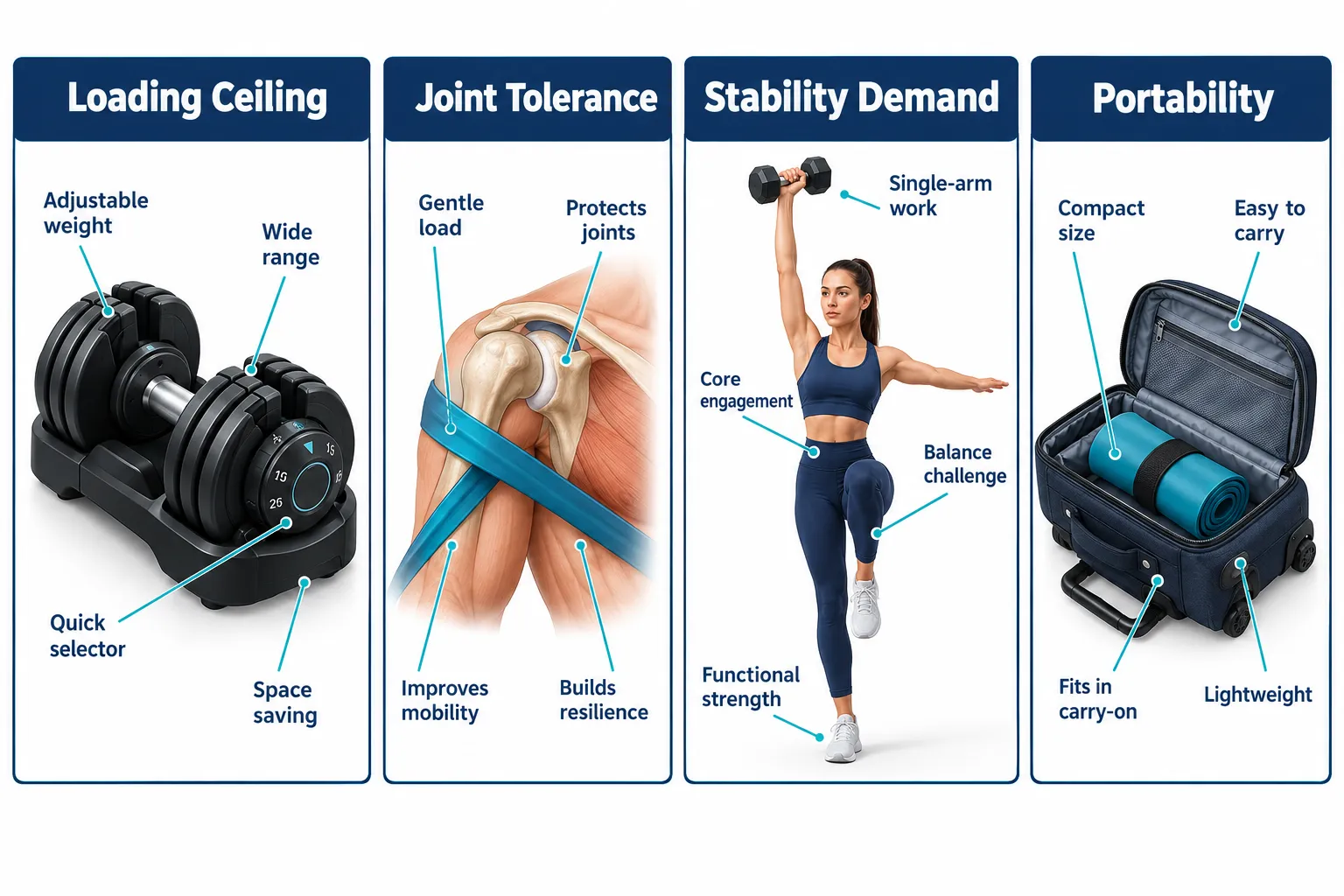
Adjustable dumbbells are fixed-weight free weights with a dial or pin that changes load, so resistance comes from gravity and stays constant through the whole range of motion. Resistance bands are elastic, so resistance increases as the band stretches and nearly disappears at the start of the movement.

What's the difference between adjustable dumbbells and resistance bands?

That single mechanical difference drives everything else:

)

Factor Adjustable dumbbells Resistance bands
Resistance curve Constant (gravity) Ascending (stretch-dependent)
Loading ceiling High, often 50-90 lb per hand Moderate, hard to measure
Joint stress Higher at stretched positions Lowest at stretched positions
Stability demand High (great for stabilizers) Moderate, anchor-dependent
Exercise variety Excellent for presses, rows, squats Excellent for rotation, pull-aparts, abduction
Portability Poor (heavy, fixed location) Excellent (fits in a drawer)
Progression tracking Precise and numbered Vague (band color jumps)
Floor space Needs a stand and clearance Essentially none

Decision rule: if you want a number to beat each week, choose dumbbells. If you want tension without joint compression, choose bands.

What's better for joint health, dumbbells or resistance bands after 40?

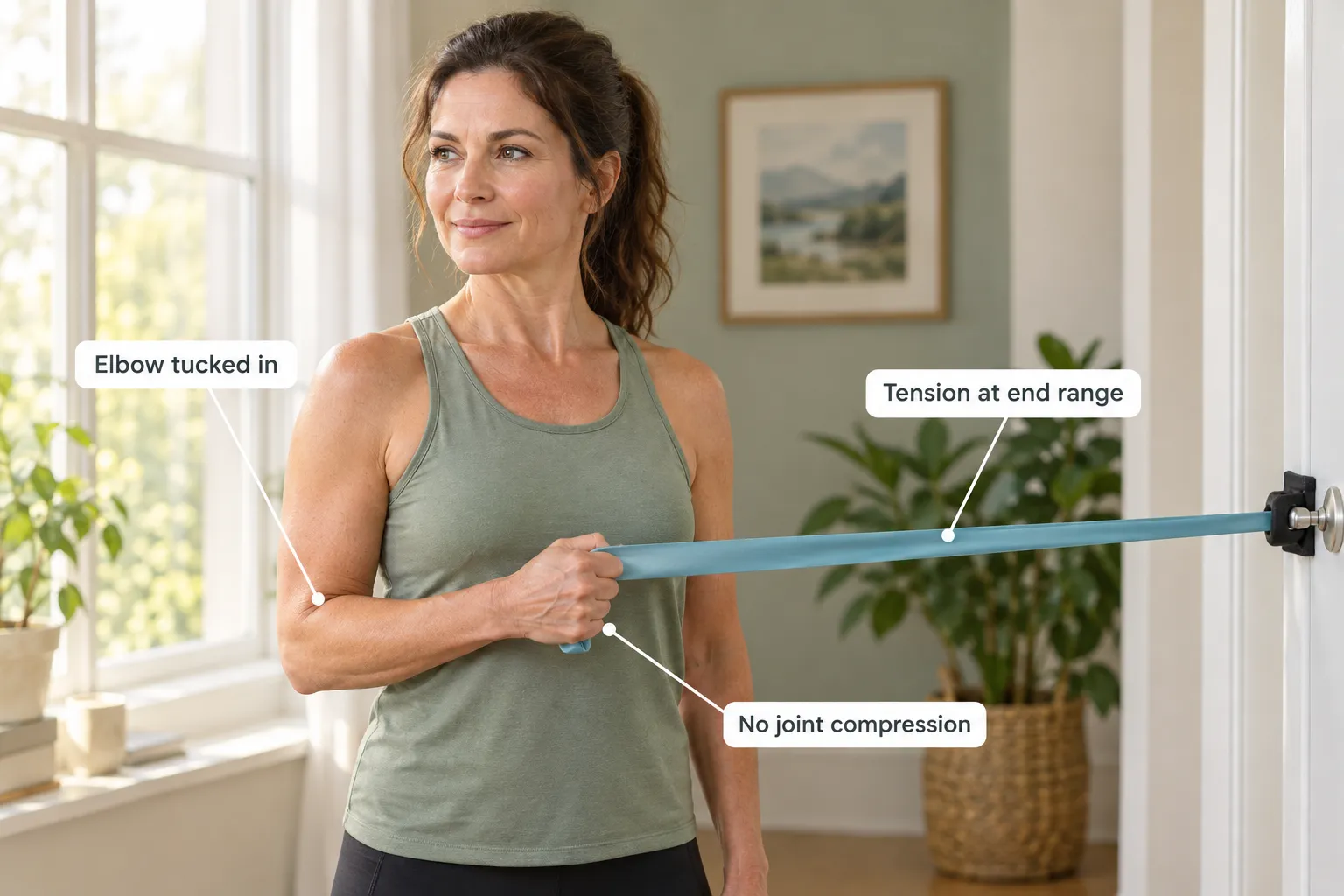
Resistance bands are better for sensitive joints after 40. Because band tension is lightest at the bottom of a movement, the shoulder, knee, or elbow isn't loaded heavily in its most compromised position [3][4]. That makes bands the default choice for anyone managing stiffness, old injuries, or arthritis-type discomfort.

Why bands feel kinder:

  • No bottom-of-rep crush. A banded chest press has almost no load at the deep stretch; a dumbbell press has the most.
  • No impact if dropped. A dropped 40 lb dumbbell is a real hazard at home; a dropped band is not.
  • Angles are free. Bands let you pull at off-axis angles that match how your shoulder actually moves.

Dumbbells aren't the enemy, though. Loaded joints adapt, tendons and bone respond to progressive load, and that adaptation protects joints over the following decades [5][7]. The practical approach: use bands for the exercises that bother you and dumbbells for the ones that don't.

Joint pain after 40 is usually a dose problem, not an equipment problem. Reduce range, slow the tempo, or swap the tool, don't quit the lift.

Are resistance bands safe for shoulder and knee problems?

Yes, resistance bands are generally safe for shoulder and knee issues and are widely used in rehab-style programming for exactly that reason [3]. The caveat: bands can snap or slip off an anchor, so inspect them for nicks and never stretch one toward your face.

Are resistance bands safe for shoulder and knee problems?

Shoulder-friendly band moves:

  • Band pull-aparts (scapular health)
  • External rotations at the side, elbow pinned
  • Face pulls at chest height
  • Banded wall slides

Knee-friendly band moves:

  • Lateral band walks (glute medius)
  • Banded terminal knee extensions
  • Light banded leg curls
  • Banded step-downs with assistance

Edge case: if a joint hurts more 24 hours later, the issue is total volume, not the band. Cut sets in half for a week before changing exercises. And if pain is sharp, radiating, or associated with swelling, get it assessed rather than training through it.

Can resistance bands build muscle as well as dumbbells?

Yes, for most people over 40, bands build comparable muscle when sets, reps, and closeness to failure are matched [1][2]. Muscle responds to mechanical tension and effort, and elastic tension counts. Where bands fall short is at the upper end: once you can do 15 hard reps against your heaviest band, meaningful progression becomes guesswork.

)

How to program bands effectively in midlife [3]:

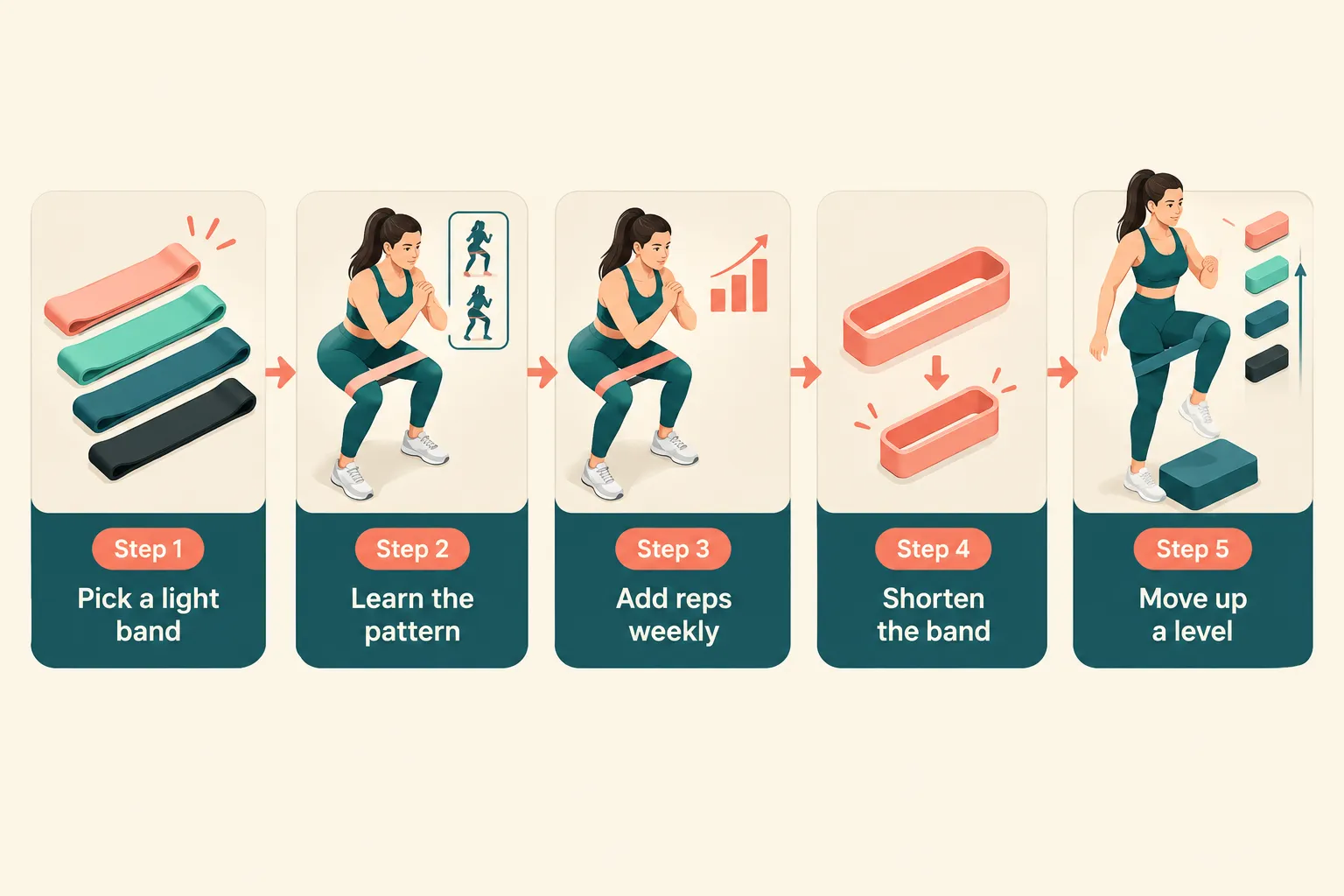
  1. Shorten the lever or the anchor instead of jumping band colors, small distance changes equal small load changes.
  2. Use 8-20 reps per set and stop 1-3 reps shy of failure.
  3. Control the return. Three seconds lowering against band tension creates far more stimulus than snapping back.
  4. Add pauses at peak tension for 1-2 seconds.
  5. Train 2-3 days per week, full body [7].

Can you build serious muscle with just resistance bands?

You can build noticeable, functional muscle with bands alone, especially in the first 6-12 months of training. Building advanced size and maximal strength eventually requires heavier external load, which bands struggle to deliver predictably for the legs and back [5][6].

How much do adjustable dumbbells cost compared to resistance bands?

Resistance bands are dramatically cheaper. A complete loop-and-tube band kit with handles, door anchor, and ankle straps generally costs in the range of a single restaurant dinner, while a quality adjustable dumbbell pair is a several-hundred-dollar purchase [5][8]. Exact prices shift by brand and year, so treat these as general ranges, not quotes.

How much do adjustable dumbbells cost compared to resistance bands?

What that money buys:

  • Bands: immediate variety, travel use, near-zero space, replaceable when worn.
  • Adjustable dumbbells: 10-20 weight settings in one footprint, replacing an entire rack. Durable for a decade or more, which improves the cost per year considerably.

Decision rule: budget under $60 or unsure about consistency? Buy bands first. Already training consistently for three-plus months? Adjustable dumbbells are the better next purchase [4].

What's the best home gym equipment for people over 40?

The best home gym for people over 40 is a small, hybrid setup: one resistance band kit, one pair of adjustable dumbbells, a mat, and an adjustable bench or sturdy step [5][6]. That combination covers pushing, pulling, hinging, squatting, carrying, and rotation without needing a dedicated room.

A sensible build order:

  1. Band kit with door anchor (week 1)
  2. Yoga mat and a stable chair or step
  3. Adjustable dumbbells, light-to-mid range (month 3+)
  4. Adjustable bench
  5. A loop band set for hips and shoulders

Fitness coaches working with older adults consistently recommend bands plus dumbbells as core tools rather than machines [6][9].

Adjustable dumbbells vs kettlebells for people over 40

Adjustable dumbbells are the safer first buy for most people over 40 because they're symmetrical, easy to control, and work for presses, rows, and squats alike. Kettlebells shine for swings, carries, and hip power, but the swing has a steeper technique curve and a higher back-injury risk if learned alone. Choose a kettlebell as a second tool once form is solid, not as the only tool.

Do I need both dumbbells and bands, or just one?

Just one is enough to get strong, but owning both solves more problems than either alone. Bands handle the small stabilizers, warm-ups, and travel. Dumbbells handle the heavy, trackable work. If forced to pick one for a lifetime of home training, adjustable dumbbells have the higher ceiling; for a first 90 days after 40, bands win.

How to avoid joint pain when lifting weights after 40

Avoid joint pain by progressing load slowly, warming up with bands, and keeping reps in a moderate range rather than chasing maximal weight. Most midlife flare-ups come from adding too much too fast, not from lifting itself [4][7].

)

Safe progression rules that apply to both tools:

  • Increase load no more than about 5-10% at a time, and only after you hit the top of your rep range on every set.
  • Warm up 5-8 minutes with bands before touching dumbbells.
  • Keep 1-3 reps in reserve on most sets; save true failure for isolation work.
  • Take a lighter week every 6-8 weeks.
  • Use a full but pain-free range, shorten the range before dropping the exercise.
  • Train legs and upper body on separate days if recovery feels slow.

Common mistakes people make with dumbbells after 40

  • Starting too heavy, then nursing a shoulder for six weeks.
  • Skipping warm-up sets entirely.
  • Doing only pressing and no pulling, which wrecks shoulder balance.
  • Jumping weight by 10-15 lb per hand instead of 5.
  • Training the same body part hard four days a week.
  • Holding breath during the hardest rep.

What weight dumbbells should I start with at 40+?

Most beginners over 40 should start around 5-10 lb per hand for shoulder and arm work, 10-20 lb for chest presses and rows, and 15-25 lb per hand for goblet squats or Romanian deadlifts. The correct starting weight is the one that lets you complete 10-12 controlled reps with 2-3 left in the tank. Adjustable dumbbells that span roughly 5-50 lb per hand cover beginner through intermediate training.

Do resistance bands work if you're out of shape, and are they better for recovery?

Yes on both counts. Bands are ideal for deconditioned beginners because the load starts near zero and builds gradually, which allows pain-free practice of movement patterns before adding weight [3][4][7]. They're also the better recovery tool: light banded mobility work after a session helps restore range of motion without adding joint load.

For people returning after a long layoff:

  • Weeks 1-2: bands only, 2 sessions, full body, 2 sets per exercise.
  • Weeks 3-6: add a third session, slow the tempo, add a set.
  • Week 7+: introduce light dumbbells for squats, rows, and presses.

For recovery and flexibility, use bands for assisted stretching (hamstring, hip flexor, lat), banded shoulder dislocates, and low-tension pull-aparts on rest days. Bands make stretching active rather than passive, which tends to hold range better.

FAQ

Are resistance bands enough for someone over 50?
Yes for general health, muscle maintenance, and function. Adding some heavier dumbbell work improves bone density and strength further [5][7].

How many days per week should a 40+ person strength train?
Two to three non-consecutive days per week covering the whole body. Frequency matters more than which equipment you own [7].

Do bands or dumbbells build more muscle?
Neither, when effort and volume are equal [1][2]. Dumbbells pull ahead only once you outgrow your heaviest band.

What's the best adjustable dumbbell weight range to buy after 40?
A pair spanning about 5 to 50 lb per hand covers beginner through intermediate training for several years.

Can resistance bands replace a gym membership?
For maintenance and general fitness, yes. For serious strength or size goals, a band-only setup will plateau.

How long do resistance bands last?
Typically 6-18 months with regular use. Replace any band with nicks, cracking, or sticky patches immediately.

Are bands safe to anchor in a door?
Only with a proper door anchor on a door that opens away from you, and only if the door is latched.

Which is better for arthritis?
Bands, generally, because they reduce load in compressed joint positions and allow pain-free angle adjustments [3].

Conclusion

The honest verdict on Adjustable Dumbbells vs Resistance Bands After 40 is that the tools answer different problems. Bands solve joint sensitivity, space, budget, and travel. Adjustable dumbbells solve progression, strength, and bone loading. Most people over 40 get the best outcome by starting with bands, proving consistency for 8-12 weeks, then adding a dumbbell pair.

Next steps:

  1. Buy a band kit with a door anchor this week and do two full-body sessions.
  2. Log every session, exercise, sets, reps, band color or tempo.
  3. At week 8, if you've trained at least 16 sessions, buy adjustable dumbbells spanning 5-50 lb per hand.
  4. Keep bands for warm-ups, shoulder and hip work, travel, and recovery days.
  5. Add weight in small jumps and take a lighter week every 6-8 weeks.

References

  1. Dumbbells vs. Resistance Bands. sweatpicks.com.
  2. Resistance Bands vs. Dumbbells. fitsmarthealth.com.
  3. Resistance Band Workout for Midlife Muscle. bodymotionlab.com.
  4. Resistance Bands vs. Dumbbells Over 40. purehomefit.com.
  5. Strength Training Equipment for Older Adults. activeagingwearables.com.
  6. Fitness Coach Recommends 5 Strength Training Tools Every Older Adult Needs for Stronger Muscles. hindustantimes.com.
  7. Resistance Training Benefits for Seniors. seniorstrength.today.
  8. Best Home Fitness Gear. qz.com.
  9. Functional Strength. thehealthyagingguide.com.

Best Resistance Bands for Adults Over 40 Who Want to Build Muscle: Loop, Tube, and Adjustable Systems

Best Resistance Bands for Adults Over 40 Who Want to Build Muscle: Loop, Tube, and Adjustable Systems

Last updated: October 22, 2026

Quick Answer

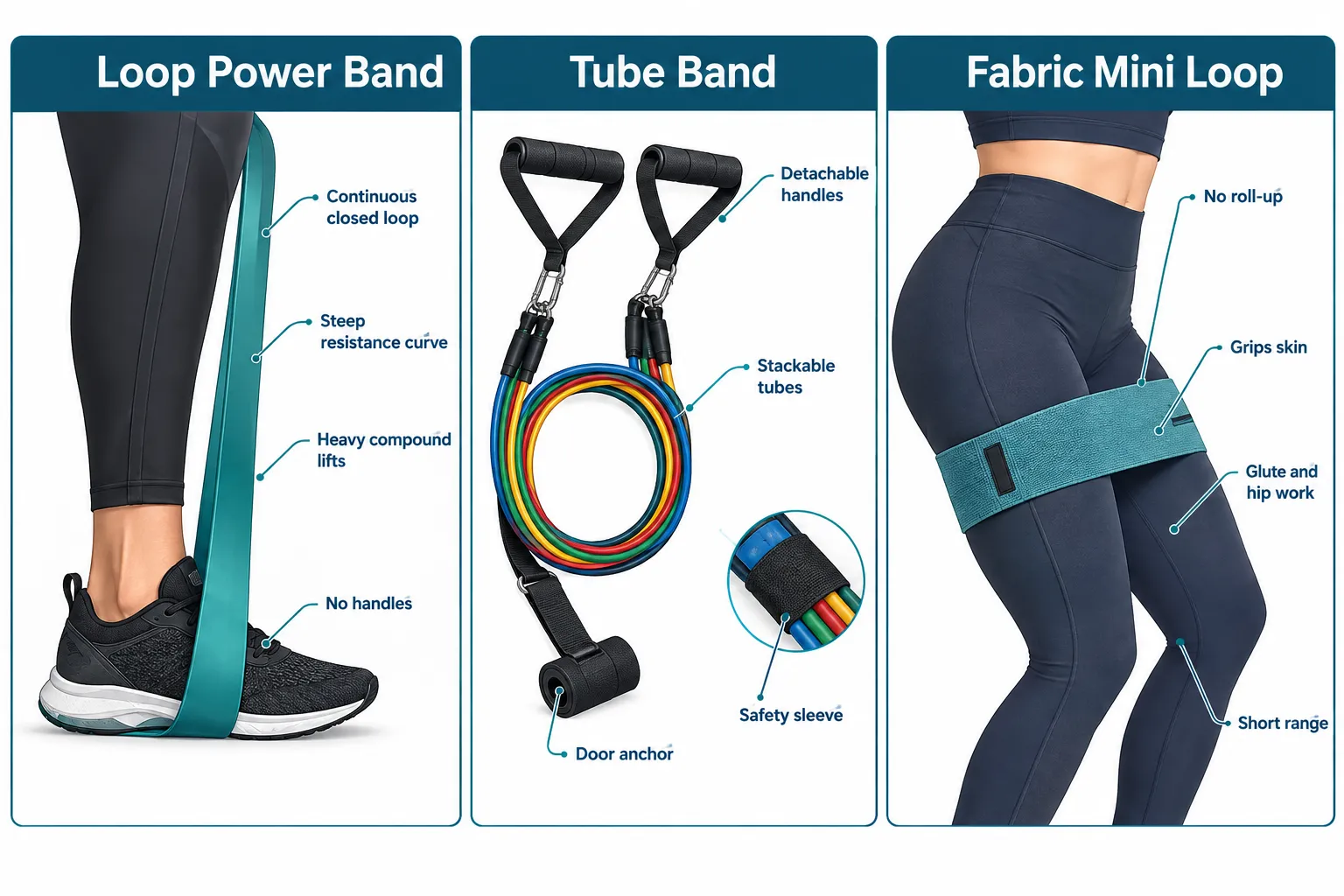
The best resistance bands for adults over 40 who want to build muscle are not one product but a three-part kit: a heavy continuous loop band set for compound lifts, a stackable tube system with handles and a door anchor for multi-angle upper-body work, and a fabric mini-loop set for hips and glutes. Expert round-ups in 2026 repeatedly land on this combination because loop bands supply heavy loading, tube systems supply anchoring versatility and grip comfort, and fabric loops stay put during lower-body work [1][2]. Therapy-style bands like TheraBand are excellent for rehab and warm-ups but too light (roughly 3-7 pounds of pull) to drive hypertrophy on their own [3][4][5].

Key Takeaways

  • Loop bands (closed latex loops, roughly 6-250 lb across a full set) handle squats, hinges, presses, and assisted pull-ups [1].
  • Tube bands with detachable handles and a door anchor cover rows, pulldowns, curls, and chest presses in a small space; stacked sets reach roughly 125 lb [2].
  • Fabric mini-loops don't roll, pinch, or slide, which makes them the better pick for glute and hip strength after 40 [6].
  • Bands build real muscle when you train close to failure, 2-4 sessions per week per muscle group, and progressively increase tension.
  • Pick your starting level by rep feel, not by color: the right band lets you hit 10-12 solid reps with 2 left in the tank.
  • Bands are generally gentler on joints because tension is lowest where joints are most vulnerable and highest where muscles are strongest.
  • Cheap bands can work, but thin latex under heavy load is the main failure point, prioritize durability and consistent tension [12-style lab testing is reflected in reviews at [1]].
  • Latex loses elasticity over time; expect to replace heavily used bands every 12-24 months.

What's the difference between loop bands and tube resistance bands?

Loop bands are one continuous circle of layered latex with no handles; tube bands are hollow rubber tubes with clips, handles, and ankle straps. The practical difference is how you load and anchor them. Loop bands excel at heavy compound work because you can stand on them, wrap them around a rack, or double them over for more tension. Tube bands excel at pulling angles, rows, pulldowns, chest flyes, because a door anchor gives you a fixed point at any height [2].

Feature Loop (power) bands Tube bands with handles Fabric mini-loops
Resistance curve Steep; tension climbs fast Moderate, more linear feel Short, sharp at end range
Anchoring Rack, door, foot, body Door anchor, handles, ankle cuffs Worn on limbs, no anchor
Grip comfort Latex in bare hands can bite Best, padded handles [7][8] Not applicable
Top resistance Highest (heavy sets) [1] Stackable, mid-to-heavy [2] Light
Best use Squats, hinges, pull-up assist Rows, presses, curls, pulldowns Glutes, hips, balance

Decision rule: if you have arthritis or weak grip, start with a handled tube set, reviewers consistently name handled systems like Bodylastics as easier to hold than bare latex loops [7][8].

What's the difference between loop bands and tube resistance bands?

Can you actually build muscle with resistance bands if you're over 40?

Yes. Muscle responds to mechanical tension and effort, not to the shape of the object creating it. Bands are described by trainers as a safe and effective strength option for older adults and people with mobility limits, and modern sets now span extra-light to extra-heavy specifically so they can support long-term strength programs rather than just rehab [9].

What matters after 40:

  • Effort level. Stop sets 1-2 reps short of failure. A band that feels "easy" at rep 8 isn't building much.
  • Protein and recovery. Muscle gain slows with age, so sleep and adequate protein carry more weight than band brand.
  • Progression. You must make sets harder over time. Without that, bands become maintenance tools.

Common mistake: training only with light therapy bands for months. Senior-focused reviews praise TheraBand for trustworthiness but note standard sets top out around 3-6.7 pounds, fine for rehab and prep, not for hypertrophy [3][4][5].

How do I know what resistance level to start with, and what size band should I get?

Pick the band that lets you complete 10-12 controlled reps with about two reps left in reserve. Color codes vary by brand, so always test by feel.

A simple starting kit for a healthy adult over 40:

  1. Light loop band for warm-ups, face pulls, and pull-apart work.
  2. Medium loop band (your main upper-body band) for rows and presses.
  3. Heavy loop band for squats, hinges, and pull-up assistance, legs are far stronger than arms and need much more tension.
  4. Stackable tube set so you can clip 2-3 tubes together as you get stronger [2].

For band length: 41-inch continuous loops are the standard for strength training because they stretch far enough for full squats and overhead presses. Short 12-inch mini-loops are for hips and shoulders only.

Edge case: very tall lifters (6'2"+) often find mid-weight 41-inch loops too slack when standing on them, step wider or double the band to restore tension.

Are resistance bands better than weights for joints?

For many people over 40, yes, at least at vulnerable joint angles. Bands provide variable resistance: tension is lowest at the bottom of a movement, where the shoulder or knee is most compressed, and highest near lockout, where muscles have the best leverage [1][9]. That curve reduces peak joint stress while still loading the strongest part of the range.

Bands also fail safely. A dumbbell that slips lands on you; a band that gets too hard just stops moving. The trade-off: bands make the bottom of a squat or bench press almost unloaded, which can under-train the stretched position where a lot of growth happens. Fix that by pausing at the bottom and anchoring the band lower.

Are resistance bands better than weights for joints?

Do adjustable resistance bands work better than fixed ones?

Adjustable (stackable) tube systems are better for long-term progression; fixed loop bands are better for heavy, simple loading. Adjustable sets let you add one tube at a time, so jumps in resistance are small, which matters because fixed bands often jump 20-30 pounds between levels.

  • Choose adjustable tubes if you want fine-grained progression, a compact setup, and padded handles. WHATAFIT and GoFit Pro Grade sets are the two most frequently recommended stackable options for home muscle-building, with full stacks around 125 lb and roughly 20-70 lb respectively [2].
  • Choose fixed loop bands if you want maximum load, pull-up assistance, or rack-anchored compound work. Living.Fit's loop set is named top overall in several 2026 reviews, with a range spanning roughly 6-250 lb [1].

Most people over 40 who are serious about muscle end up owning both.

Can I build muscle with just resistance bands, or do I need weights too?

Bands alone can build noticeable muscle for beginners and returning lifters, especially in the first 12-18 months. Intermediate and advanced lifters usually need to add some external load, dumbbells, a kettlebell, or a weighted vest, because band tension becomes hard to increase in small, measurable steps once you're strong.

A practical hybrid: bands for pulling, pressing, and hip work; a pair of adjustable dumbbells or a single heavy kettlebell for loaded squats, carries, and Romanian deadlifts. That combination covers the stretched positions bands handle poorly.

Which resistance band exercises build the most muscle?

The highest-return band exercises are compound movements anchored so the band resists the full working range.

  1. Banded squat or split squat (band under both feet, over shoulders), quads, glutes.
  2. Seated or bent-over row (door anchor or feet), lats, mid-back.
  3. Standing chest press with anchor behind you, chest, triceps.
  4. Lat pulldown with a high door anchor, lats, biceps.
  5. Romanian deadlift with a heavy loop, hamstrings, glutes.
  6. Overhead press standing on the band, shoulders.
  7. Banded hip thrust and lateral walk with a fabric mini-loop, glute medius, hip stability, which supports balance and fall prevention [6].

Run 3-4 sets of 10-20 reps on each, and slow the lowering phase to 3 seconds, that's the easiest way to add difficulty without a heavier band.

What are the best resistance bands for someone with bad shoulders or knees?

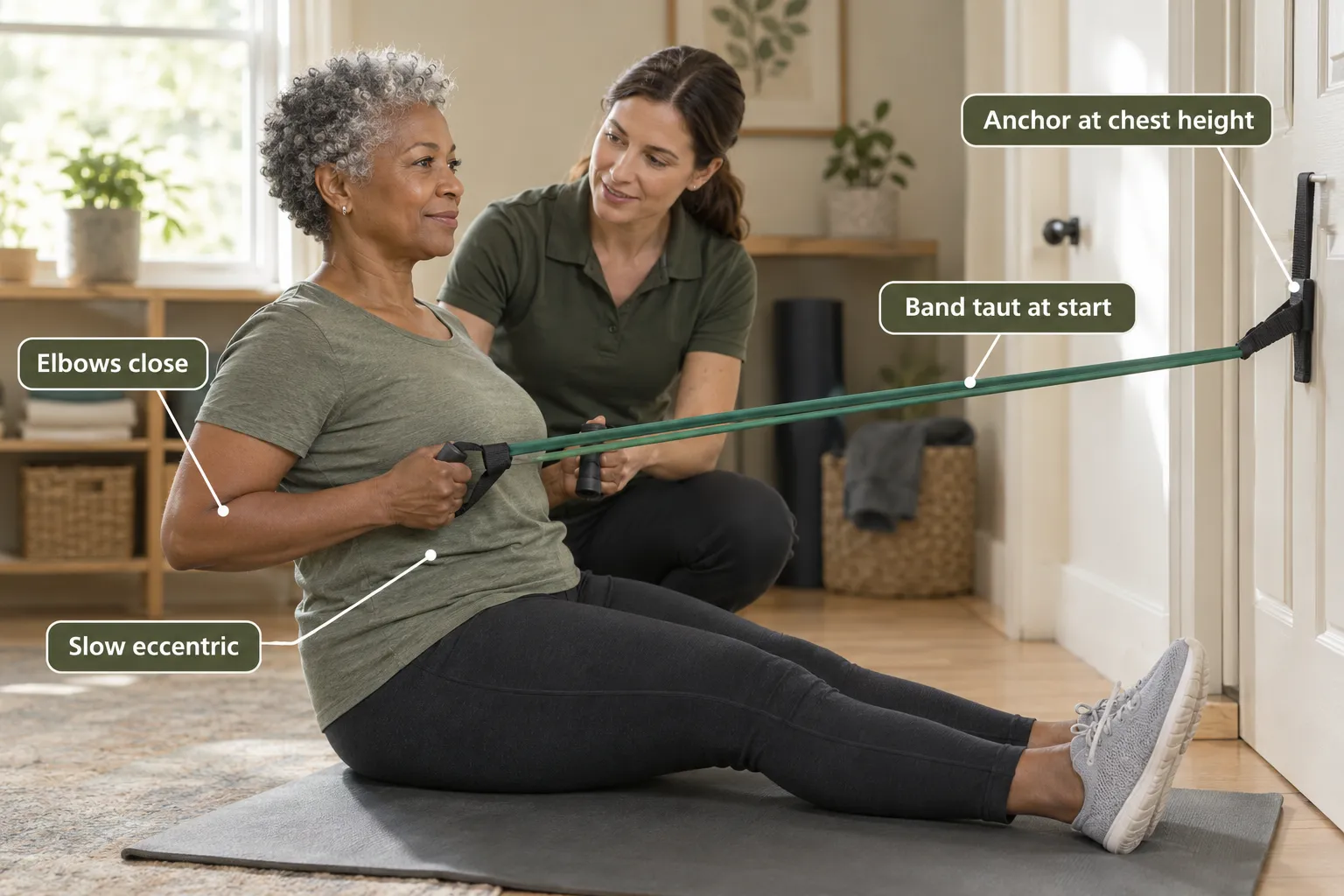
For cranky shoulders, use handled tube bands with a door anchor so you can set the pull angle below shoulder height and keep the arms in front of the body. For knees, use fabric mini-loops plus a light-to-medium loop band for partial-range squats and step-ups, progressing depth before adding tension.

  • Bad shoulders: cable-style tube rows, chest presses at sternum height, band pull-aparts, external rotations. Avoid deep behind-the-neck or wide-flared pressing.
  • Bad knees: glute bridges, hip abduction walks, box squats to a chair, hamstring curls with an ankle cuff.
  • Arthritic hands: handled tubes with thick ergonomic grips and secure carabiners keep training volume up without squeezing bare latex [7][8].

TheraBand remains the most trusted therapy-style brand for this prep phase; graduate to heavier loop or tube systems once movement patterns feel solid [4][5].

What are the best resistance bands for someone with bad shoulders or knees?

How often should I use resistance bands to see muscle growth, and how long does it take?

Train each major muscle group 2-3 times per week, with 10-20 hard sets per muscle group per week spread across those sessions. Three full-body sessions of 30-40 minutes is the simplest schedule that works for most adults over 40.

Realistic timeline (general training expectation, not a measured study figure):

  • Weeks 1-4: strength and coordination improve fast; little visible size change.
  • Weeks 6-12: noticeable firmness, better posture, clothes fit differently.
  • Months 4-9: visible muscle gain if protein, sleep, and progression are consistent.
  • Year 1+: progress slows; this is when adding external load or heavier bands matters most.

What's the biggest mistake people make with resistance bands?

The biggest mistake is not progressing, using the same band for the same 12 reps for months. Bands make this easy to miss because there's no number on the handle.

Other frequent errors:

  • Starting with slack. If the band is loose at rep one, half the range is unloaded. Step wider or shorten the anchor.
  • Rushing the lowering phase, which throws away most of the tension benefit.
  • Anchoring in a door that opens toward you, or over a sharp edge that abrades the band.
  • Buying only light bands because colors looked friendly.
  • Stretching a band past roughly 2.5 times its resting length, which both distorts the resistance curve and shortens band life.

Track progression: log band color, reps, tempo, and anchor distance. Those four numbers are your equivalent of plate weight.

Are expensive resistance bands worth it, or can cheap ones work?

Cheap bands work fine for light and medium tension; premium bands matter most at heavy loads. Lab-style testing and expert reviews focus on consistency of resistance and uniform stiffness across a set, because uneven tension raises injury risk and makes progression unreliable [1][5]. Entry-level loop sets such as Fit Simplify and handled sets from Black Mountain are widely recommended as accessible starting points [7][8].

Spend more when:

  • You're loading 80+ pounds on a loop band.
  • You're using the band for pull-up assistance (a snap under bodyweight is genuinely dangerous).
  • You want continuous-layer latex rather than glued or bonded seams.

Save money when: buying mini-loops, light warm-up bands, or a first starter set to test consistency.

Do resistance bands lose elasticity over time?

Yes. Latex degrades with UV light, heat, sweat, ozone, and repeated over-stretching. Expect a gradual drop in tension and eventually surface cracking or whitening.

Care checklist:

  • Store in a drawer or bag, away from sunlight and radiators.
  • Wipe sweat off after use and let them dry fully.
  • Never stretch over a rough rack edge, use a towel or sleeve.
  • Inspect before every heavy session: small nicks become tears.
  • Replace heavily used heavy bands every 12-24 months; light bands often last longer.

FAQ

Are loop bands or tube bands better for building muscle after 40?
Loop bands are better for heavy compound lifts; tube bands with handles are better for rows, presses, and curls. Most people over 40 get the best results using both.

How much resistance do I need to build muscle?
Enough that 10-12 reps feels genuinely hard. For legs that often means 60+ pounds of band tension; for arms and shoulders, 15-30 pounds is plenty.

Can resistance bands replace a gym membership?
For general strength, muscle maintenance, and moderate muscle gain, yes. For maximal strength or advanced hypertrophy, you'll eventually want added external load.

Are fabric bands better than latex?
For hips and glutes, yes, fabric loops don't roll or pinch during squats and lateral walks [6]. For heavy full-body lifts, layered latex loops are better.

Is TheraBand good for muscle building?
TheraBand is the most trusted therapy-style brand for older adults but its standard tensions are too light for hypertrophy; use it for rehab and warm-ups [3][4][5].

How do I anchor bands safely at home?
Use a purpose-made door anchor on a door that opens away from you, closed and latched. Alternatively loop around a sturdy post, rack upright, or under both feet.

Should I use bands every day?
Light mobility band work is fine daily. Hard muscle-building sessions need 48 hours of recovery per muscle group.

What if a band feels too hard at the top but too easy at the bottom?
That's the normal band resistance curve. Pause at the bottom, add a slight pre-stretch, or combine the band with a light dumbbell to even out the load.

Conclusion

The sensible buying strategy for adults over 40 who want visible muscle is a layered kit rather than a single purchase: one heavy loop band set for compound lifting, one stackable tube system with padded handles and a door anchor for upper-body angles, and one fabric mini-loop set for hips and glutes [1][2][6]. Judge any product on four things, consistency of tension, anchoring options, grip comfort, and durability under load, because those determine whether you can keep progressing.

Next steps:

  1. Test your current strength with one band to find the level that gives 10-12 hard reps.
  2. Buy the three-part kit (heavy loops, stackable tubes, fabric mini-loops) rather than one bargain bundle.
  3. Set a three-day-per-week full-body schedule built on the seven compound band exercises listed above.
  4. Log band color, reps, tempo, and anchor distance every session.
  5. Re-test in six weeks and move up a tension level wherever you clear 15 clean reps.

References

  1. Best Resistance Bands. garagegymreviews.com.
  2. Best Resistance Bands Home Workouts 2026. theconsumers.guide.
  3. Resistance Bands for Seniors. healthline.com.
  4. Best Resistance Bands. healthline.com.
  5. Best Resistance Bands 4157960. verywellfit.com.
  6. Best Resistance Bands Seniors. silverstrength.club.
  7. Best Resistance Bands for Seniors. elderlydaily.com.
  8. Best Resistance Bands Seniors. silverbloomhealth.com.
  9. Strength Training Products Seniors. cnn.com.

Best Minimal-Equipment Home Gym for Strength Training After 40: Bands, Dumbbells, and a Bench Compared

Best Minimal-Equipment Home Gym for Strength Training After 40: Bands, Dumbbells, and a Bench Compared

{"cover":"Professional landscape format (1536×1024) editorial hero image with SHORT bold text overlay (≤42 chars): 'Best Minimal-Equipment Home Gym', crisp white bold sans-serif on a deep navy semi-transparent panel, centered, 8% safe margins from every edge. Background: bright daylight photograph of a tidy spare-bedroom corner home gym, a pair of adjustable dumbbells on a light wood floor, a fold-flat black bench angled to incline, a neat coil of coloured resistance bands and a grey mat, large window with soft natural light, plants in the corner. Clean, airy, magazine-quality, navy-charcoal-and-warm-oak palette. No price text, no numbers, no checkmark grids.","content":["Three-panel labelled comparison guide, landscape 1536×1024, clean white background with teal-and-charcoal palette, editorial fitness-guide polish. Panel 1 heading 'Resistance Bands' with illustrated looped band and short bullet labels: 'Joint friendly', 'Variable tension', 'Travel ready', 'Low ceiling'. Panel 2 heading 'Adjustable Dumbbells' with illustrated dial-adjust dumbbell and labels: 'Heavy loading', 'Small jumps', 'All five patterns', 'Space saving'. Panel 3 heading 'Adjustable Bench' with illustrated incline bench and labels: 'Incline press', 'Supported rows', 'Hip thrusts', 'Folds flat'. Thin callout lines point to each detail. No prices, no numbers grids.","Annotated documentary photograph, landscape 1536×1024, warm natural light: a 50-something Black woman performing a dumbbell Romanian deadlift beside a bench in a small apartment living room, flat back, dumbbells close to shins, soft morning window light, shallow depth of field. Four short white callout labels with thin leader lines point to: 'Neutral spine', 'Hinge at hips', 'Weights close', 'Soft knees'. Realistic editorial sports photography, muted sage and oak tones, no text panels, no numbers.","Numbered five-step flow diagram, landscape 1536×1024, flat vector illustration on a pale cream background with burnt-orange and deep-green accents. Five numbered cards left to right, each with a simple icon and a short caption label: '1 Squat', '2 Hinge', '3 Push', '4 Pull', '5 Carry', icons show goblet squat, Romanian deadlift, incline dumbbell press, single-arm bench row, suitcase carry. A slim arrow band beneath labelled 'Three days per week'. Crisp geometric line art, generous white space, no prices, no data grids."}

Professional landscape hero image () with a reading "Best Minimal-Equipment Home Gym". CRITICAL TYPOGRAPHY RULES: render the

Last updated: October 21, 2026

Quick Answer

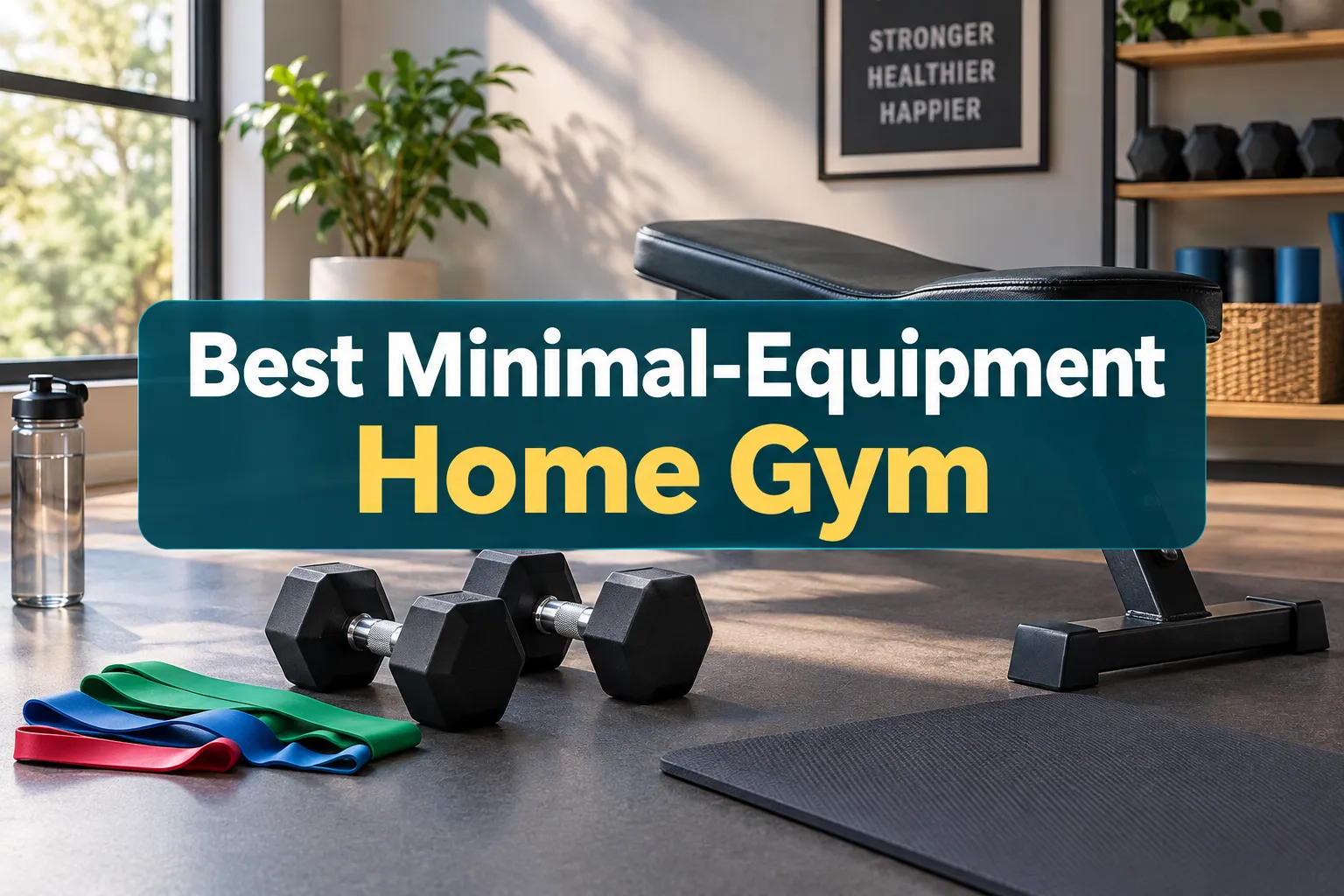
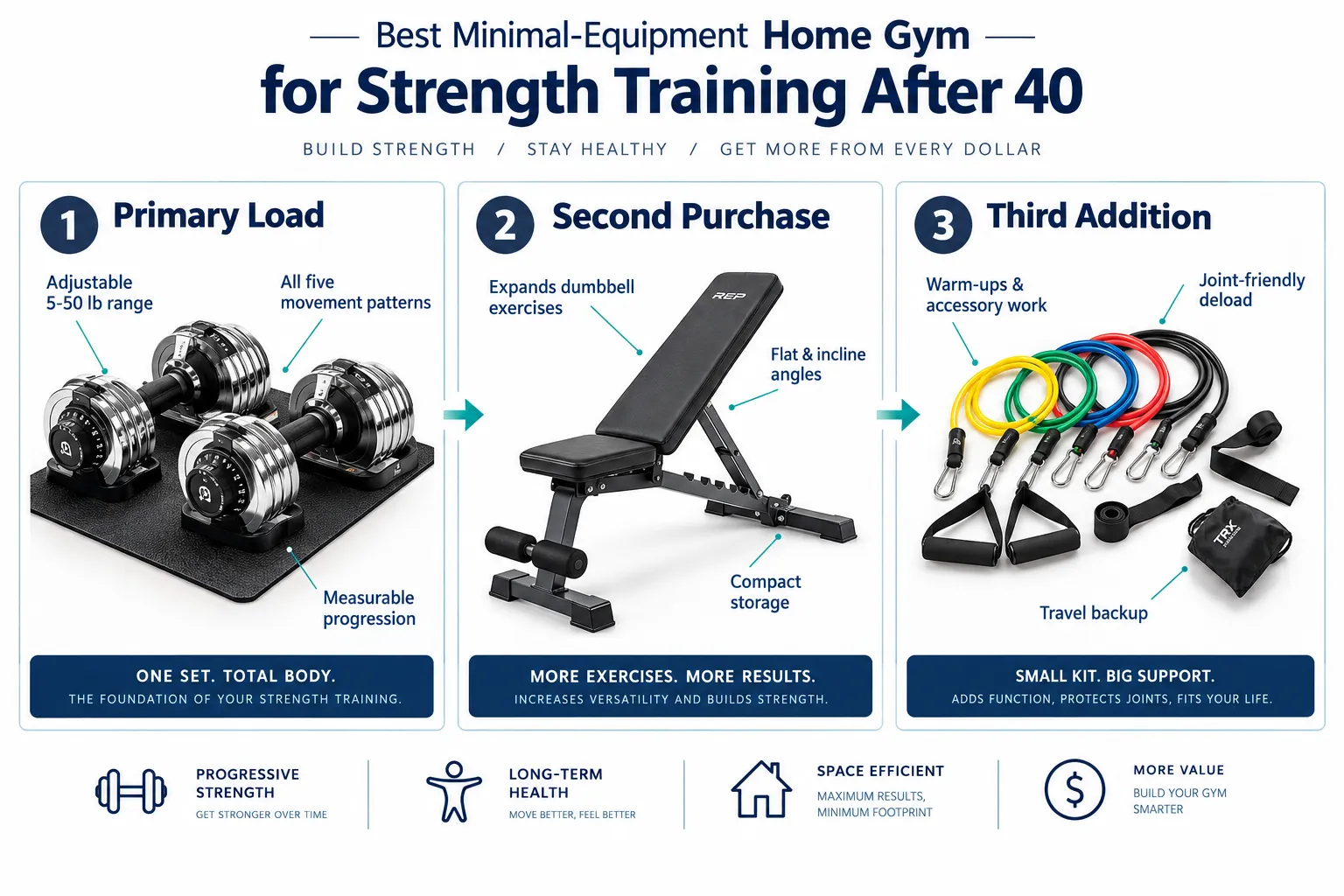
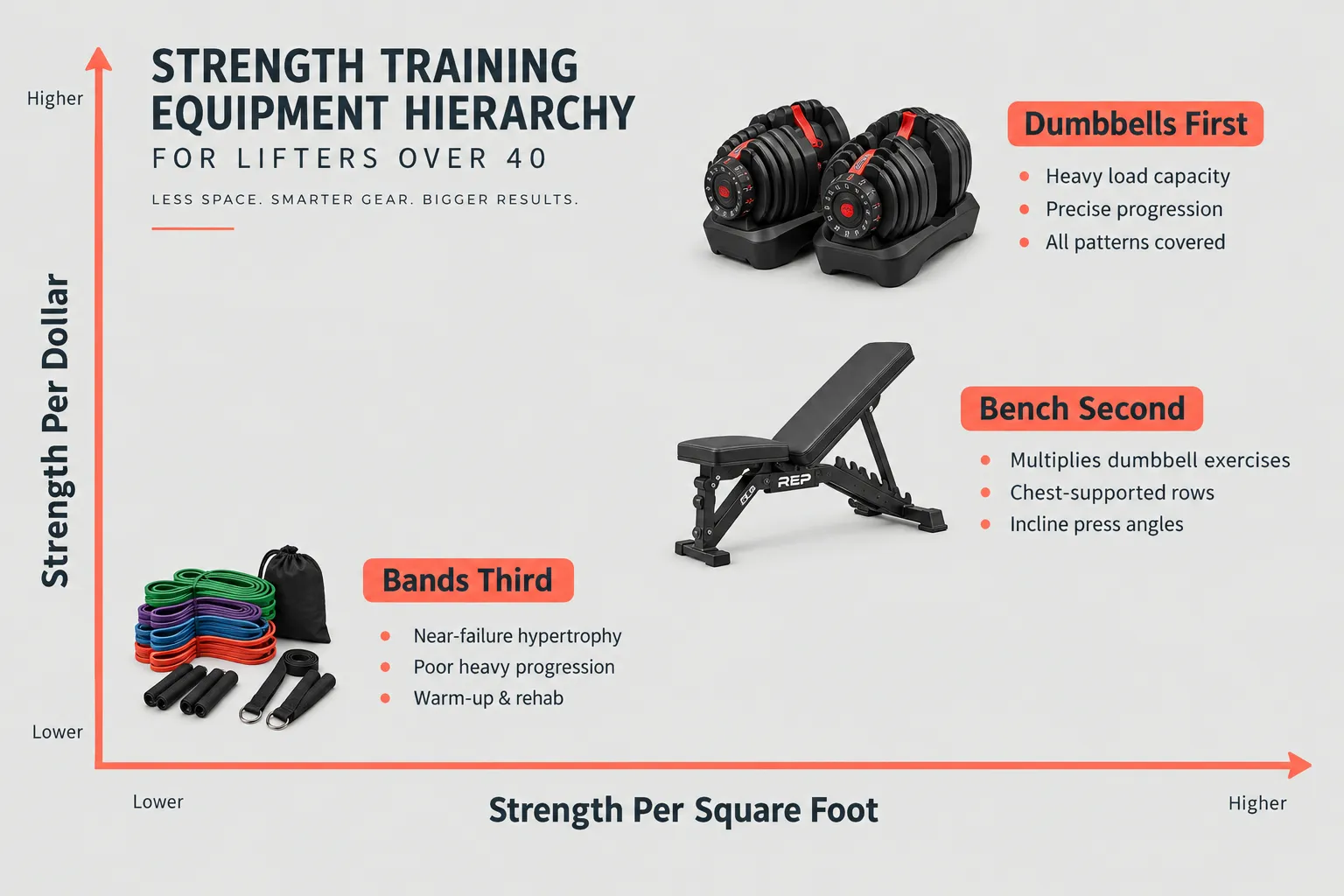
The best minimal-equipment home gym for strength training after 40, bands, dumbbells, and a bench compared, is one pair of adjustable dumbbells as the primary load, a fold-flat adjustable bench as the second purchase, and a set of resistance bands for warm-ups, accessory work, and joint-friendly days. Adjustable dumbbells win because a single pair covers squat, hinge, push, pull, and carry patterns while replacing a rack of fixed weights [1][2]. Bands are excellent but hit a practical ceiling around 50-60 lb equivalent, which limits heavy compound progression [3][4]. Total floor space needed: roughly 6 by 6 feet.

Key Takeaways

  • Dumbbells first, bench second, bands third. That order reflects how much strength each tool unlocks per dollar and per square foot [1].
  • Bands are not inferior for muscle growth when sets are taken near failure and volume is matched, but they're poor at heavy, measurable progression [3].
  • A bench multiplies what one pair of dumbbells can do: incline press, supported rows, hip thrusts, split squats, step-ups [1][5].
  • Three non-consecutive days per week, 8-15 reps, 60-90 seconds rest, is the standard template for lifters over 40.
  • Progression rule: add reps to the top of the range, then increase weight and drop back to the bottom.
  • 6 x 6 feet is enough for a full setup; gear can store under a bed or in a closet [6][7].
  • For shoulder or knee pain, bands and neutral-grip dumbbell work are the safest entry points [3][8].
  • Expect strength gains in 3-4 weeks, visible changes in 8-12 weeks.

Why are resistance bands and dumbbells better for strength training after 40?

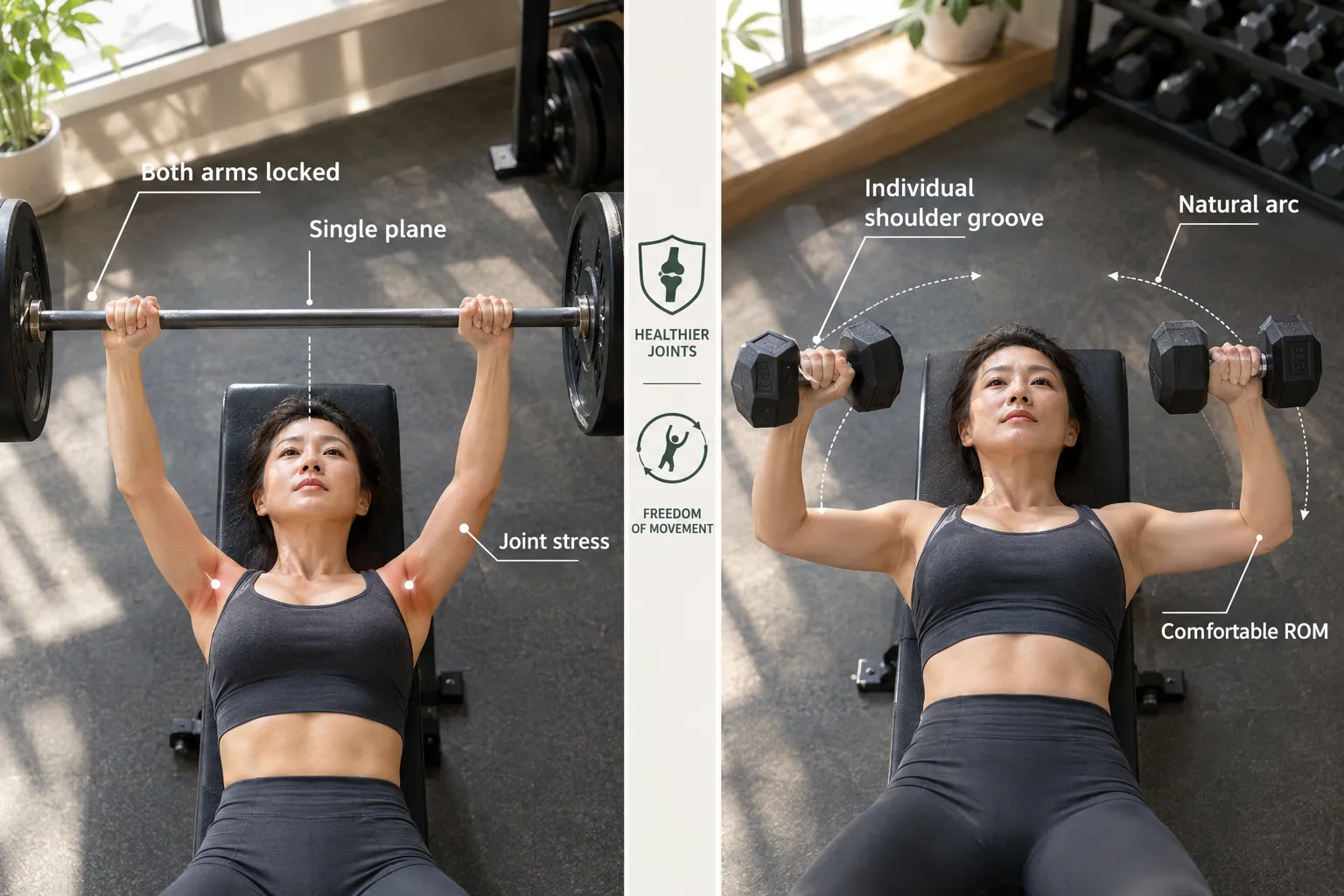
Bands and dumbbells suit lifters over 40 because they let you control load precisely, train through comfortable ranges of motion, and avoid the fixed paths that aggravate aging joints. Barbells force both arms into one bar path. Dumbbells let each shoulder find its own groove.

The second reason is recovery. After 40, recovery capacity drops before strength does. A minimal setup makes it easy to tune volume down on a stiff week without skipping the session entirely, swap a heavy dumbbell press for a band press and keep the pattern.

Decision rule: choose dumbbells as the primary load if your goal is measurable strength and muscle. Choose bands as the primary load only if joint pain currently limits you from holding or lowering free weights safely [3][8].

Why are resistance bands and dumbbells better for strength training after 40?

Can you actually build muscle with just dumbbells and bands at 40 plus?

Yes. When weekly volume and progressive overload are matched, bands, dumbbells, machines, and bodyweight produce broadly similar strength and hypertrophy outcomes. The equipment is rarely the limiting factor, consistency and effort are.

What differs is the ceiling. Dumbbells allow heavier absolute loads and finer jumps in weight, which drives long-term adaptation [3][4]. Bands mimic cable-machine isolation work and work well for growth if taken close to failure [3].

Bands provide variable resistance that increases as they stretch; dumbbells provide relatively constant resistance through the range of motion [3][8]. Different tools, same muscle.

Common mistake: training bands at a comfortable tension for 20 easy reps. If the last two reps aren't genuinely hard, the set did little.

Do I really need a weight bench, or can I skip it?

You can start without one, but a bench is the single biggest upgrade after dumbbells. An adjustable bench dramatically expands what one pair of dumbbells can do, flat and incline presses, chest-supported rows, hip thrusts, split squats, step-ups, without adding machines [1][5].

Skip the bench if:

  • You have under 4 feet of clear floor and no storage.
  • You're in month one and still building the habit [7][9].

Buy the bench if:

  • You want vertical pressing variety without overhead strain.
  • Floor presses are irritating your wrists or limiting range.

Fold-flat benches that store vertically give most of the benefit while preserving floor space [5].

What dumbbell weight should I start with at my age?

Pick a weight range, not a single weight. For most untrained adults over 40, a pair of adjustable dumbbells spanning roughly 5-50 lb per hand covers the first two to three years of training. Age matters far less than training history.

Rough starting loads for a 10-rep set:

Movement Typical starting load (per hand)
Goblet squat 15-30 lb (single bell)
Romanian deadlift 15-25 lb
Incline press 10-20 lb
Single-arm row 15-25 lb
Lateral raise 5-10 lb

The correct weight is one where rep 10 is hard but your form doesn't break. Edge case: if you can do 20 clean reps, the dumbbell is too light to matter.

How much space do you actually need for a minimal home gym?

About 6 by 6 feet of clear floor and 7 feet of ceiling height. That's enough to press, row, lunge, and carry. Apartment-friendly layouts in current minimalist guides use an office corner or bedroom area with adjustable dumbbells, a fold-flat bench, and a compact band set [1][6][7].

Storage notes:

  • Adjustable dumbbells sit in a cradle roughly the footprint of a shoebox pair.
  • Fold-flat benches store upright against a wall or under a bed [5].
  • Bands fit in a drawer; anchor them to a door for pulls and pulldowns.
  • Add a jump rope or walking pad for conditioning if space allows [6][7].

Adjustable dumbbells vs fixed weights for a small apartment

Adjustable dumbbells win in apartments, full stop. One pair replaces 10-15 fixed pairs and occupies a fraction of the floor [1][2]. Fixed dumbbells only make sense if you have dedicated space, want faster set changes for drop sets, or find a cheap used set.

Factor Adjustable Fixed
Footprint Very small Large rack needed
Change speed 5-15 seconds Instant
Durability More moving parts Nearly indestructible
Cost per pound Lower overall Higher for full range
Drop-friendly No Yes

Choose dial-adjust models if speed matters; choose selectorized pin or spinlock if budget matters more than convenience [9][10].

Three budget tiers for a minimal home gym

Start where your budget and confidence actually are, then upgrade. Cost-focused guides describe an essential three-item kit, mat, bands, adjustable dumbbells, with a bench and pull-up bar as second-tier purchases [9][10].

Tier 1, Starter (bands-led). Floor mat, full band set with handles and a door anchor, one adjustable dumbbell or kettlebell. Mat roughly €20-30, bands roughly €15-20 [9][10]. Enough for every movement pattern at moderate load. Good for anyone new to lifting after 40 [9].

Tier 2, Core (recommended for most). A pair of adjustable dumbbells plus the Tier 1 kit. Dumbbell cost ranges widely depending on the adjustment mechanism, roughly €60-350 [9][10]. This is where real progressive overload begins.

Tier 3, Complete. Tier 2 plus a fold-flat adjustable bench and a doorway pull-up bar. A bench plus free weights supported by bands is the smallest genuinely complete long-term setup [1][5].

Best resistance bands for joint pain, arthritis, shoulder or knee issues

For joint pain or arthritis, choose flat loop bands and tube bands with padded handles over thin therapy bands, and favor a graded set (light to heavy) so you can dial tension to the day. Bands are especially useful for functional strength around joints, core stability, and returning from injury [3][8].

What to look for:

  • Padded or thick handles, reduces grip strain with arthritic hands.
  • A door anchor, lets you train pulls and presses without overhead loading.
  • At least four tension levels so you can deload without stopping.
  • Fabric loop bands for hips and glutes; they don't roll or pinch skin.

For shoulder issues: neutral-grip dumbbell presses, landmine-style angled pressing, and band pull-aparts are the safest. For knee issues: hip hinges, hip thrusts, and box step-ups to a comfortable height beat deep lunges. Bands and lighter dumbbells also work well on low-stress days for deloads and joint care while keeping the same patterns.

What exercises should I avoid after 40, and how often should I train?

Nothing is universally banned, but a few movements carry a poor risk-to-reward ratio for most lifters over 40. Train three non-consecutive days per week, 8-15 reps per set, with 60-90 seconds rest.

What exercises should I avoid after 40, and how often should I train?

Approach with caution or substitute:

  • Behind-the-neck presses and pulldowns → overhead or neutral-grip presses.
  • Upright rows with a narrow grip → lateral raises.
  • Deep barbell back squats to failure → goblet squats, split squats.
  • Ballistic sit-ups and loaded spinal flexion → dead bugs, carries, planks.
  • Heavy behind-the-back shrugs → farmer's carries.

Emphasize posterior-chain work, Romanian deadlifts, hip thrusts, hinges, to protect the back and maintain functional strength.

What does a minimal-equipment program actually look like?

Build every session around the five patterns: squat, hinge, push, pull, carry. Three days a week, full body, same patterns each session with rotating variations.

What does a minimal-equipment program actually look like?

Sample session (45 minutes):

  1. Warm-up: band pull-aparts, band hip walks, bodyweight squats, 5 minutes.
  2. Goblet squat, 3 x 8-12.
  3. Dumbbell Romanian deadlift, 3 x 10-12.
  4. Incline dumbbell press, 3 x 8-12.
  5. Single-arm bench-supported row, 3 x 10-12 per side.
  6. Suitcase carry, 3 x 30 seconds per side.
  7. Finisher: band face pulls or band curls, 2 x 15.

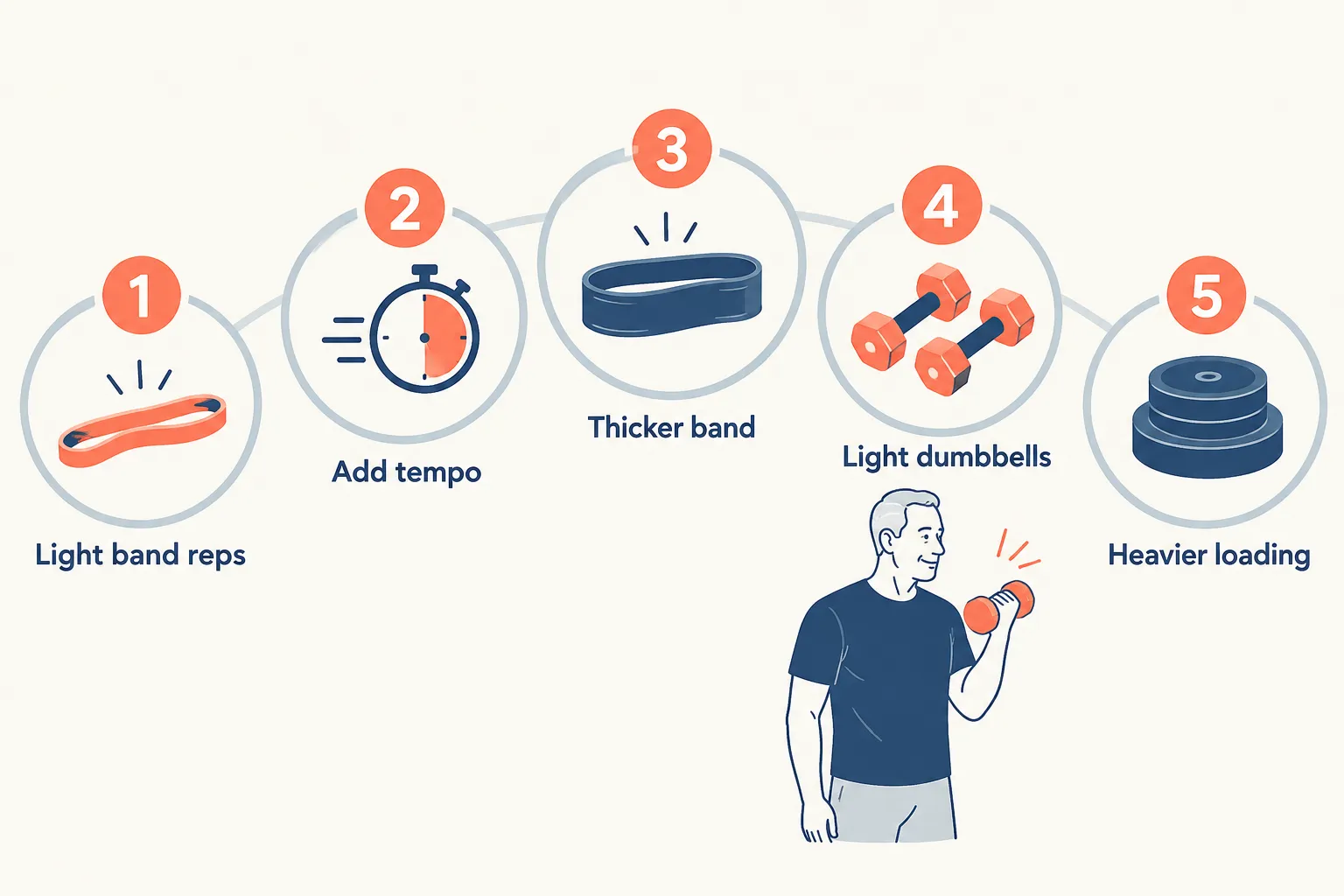
Progression: add reps until you hit the top of the range (often 12-15), then raise the dumbbell weight and drop back to the low end. Use bands for high-rep accessory sets, warm-ups, and mobility, not as the main progressive-overload tool for compounds [3].

Common mistakes with minimal equipment, and can you get stronger without a barbell?

Yes, you can get genuinely strong without a barbell, most people over 40 never reach the load ceiling where a barbell becomes necessary. The usual failure points are effort and tracking, not hardware.

Mistakes to avoid:

  • Buying dumbbells that top out too light. A 25 lb max becomes useless within months.
  • Not logging sets. Without a record, progressive overload is guesswork.
  • Treating bands as the main load for squats and presses [3][4].
  • Skipping the hinge pattern because it feels awkward.
  • Training only arms and chest while ignoring back and glutes.
  • Random workouts. Same patterns, rotating variations, beats novelty.

How long before you see results, and is minimal equipment enough long-term?

Expect noticeable strength gains in 3-4 weeks (mostly neural), visible body composition changes in 8-12 weeks with consistent training and adequate protein. Strength shows up long before the mirror does.

Minimal equipment stays enough for most people indefinitely. The "single tool plus accessories" model, adjustable dumbbells, a bench, bands, delivers close to commercial-gym utility without the space or recovery demands of heavy barbell work [1].

You may eventually want more if: you're pressing near your dumbbell maximum for 12+ reps, you want to compete in powerlifting, or you specifically want heavy barbell squats and deadlifts. In that case, add a rack and barbell, but that's a year-three problem, not a day-one one.

FAQ

Are resistance bands as effective as dumbbells?
For muscle growth with matched volume and effort, yes. For maximal strength, no, bands cap out around 50-60 lb equivalent resistance [3][4].

What's the single best piece of equipment for a home gym after 40?
A pair of adjustable dumbbells. One pair covers squat, hinge, push, pull, and carry patterns [1][2].

Can I do a full workout with only bands?
Yes. Bands cover every movement pattern and work well for joint-friendly training, travel, and rehab [3][8].

How many days a week should someone over 40 lift?
Three non-consecutive days per week is the standard recommendation for over-40 strength programs.

Is a flat bench enough, or do I need adjustable?
Adjustable is worth it. Incline pressing reduces shoulder strain compared with flat pressing for many lifters, and incline adds angles a flat bench can't [1][5].

What if I have no bench at all?
Use a sturdy chair or the floor. Floor presses, chair step-ups, and chair-supported rows cover most of it.

Do I need a pull-up bar?
Not initially. Band pulldowns through a door anchor cover vertical pulling until you add one [9][10].

How long should each session take?
Forty-five minutes, including warm-up. Longer sessions rarely improve results for recreational lifters.

Should I buy used dumbbells?
Fixed dumbbells, yes, they're nearly indestructible. Adjustable models have moving parts, so inspect the mechanism before buying.

Conclusion

The practical answer to the bands versus dumbbells versus bench question is sequencing, not picking a winner. Buy adjustable dumbbells first because they carry heavy, measurable load across all five movement patterns. Add a fold-flat bench second because it multiplies the exercises those dumbbells can do. Keep bands permanently for warm-ups, accessory volume, and the weeks when your shoulders or knees need a lighter option.

Next steps:

  1. Measure a 6 x 6 foot area and confirm ceiling clearance.
  2. Pick your tier, bands-led starter, dumbbell core, or complete with bench.
  3. Buy adjustable dumbbells that reach at least 40-50 lb per hand.
  4. Schedule three non-consecutive training days this week.
  5. Log every set, and add reps before adding weight.
  6. Reassess at 12 weeks, not 12 days.

References

  1. Home Gym Setup. athleex.com.
  2. Minimalist Home Gym. manofmany.com.
  3. Resistance Training Equipment Comparison. health-habits.com.
  4. Resistance Bands vs. Dumbbells. gym4home.com.
  5. Best House Gym. ritfitsports.com.
  6. Minimalist Home Gym. manofmany.com.
  7. Home Gym Equipment Essentials. zing.coach.
  8. Trainer Tip Resistance Bands Dumbbells Strength Training. today.com.
  9. Home Gym for Beginners. repandrecovery.com.
  10. Equipamiento Gimnasio En Casa. casagym.es.

Resistance Band Exercises for Men Over 40: A Progressive Muscle-Building Plan Without Heavy Weights

Resistance Band Exercises for Men Over 40: A Progressive Muscle-Building Plan Without Heavy Weights

Last updated: October 14, 2026

Quick Answer

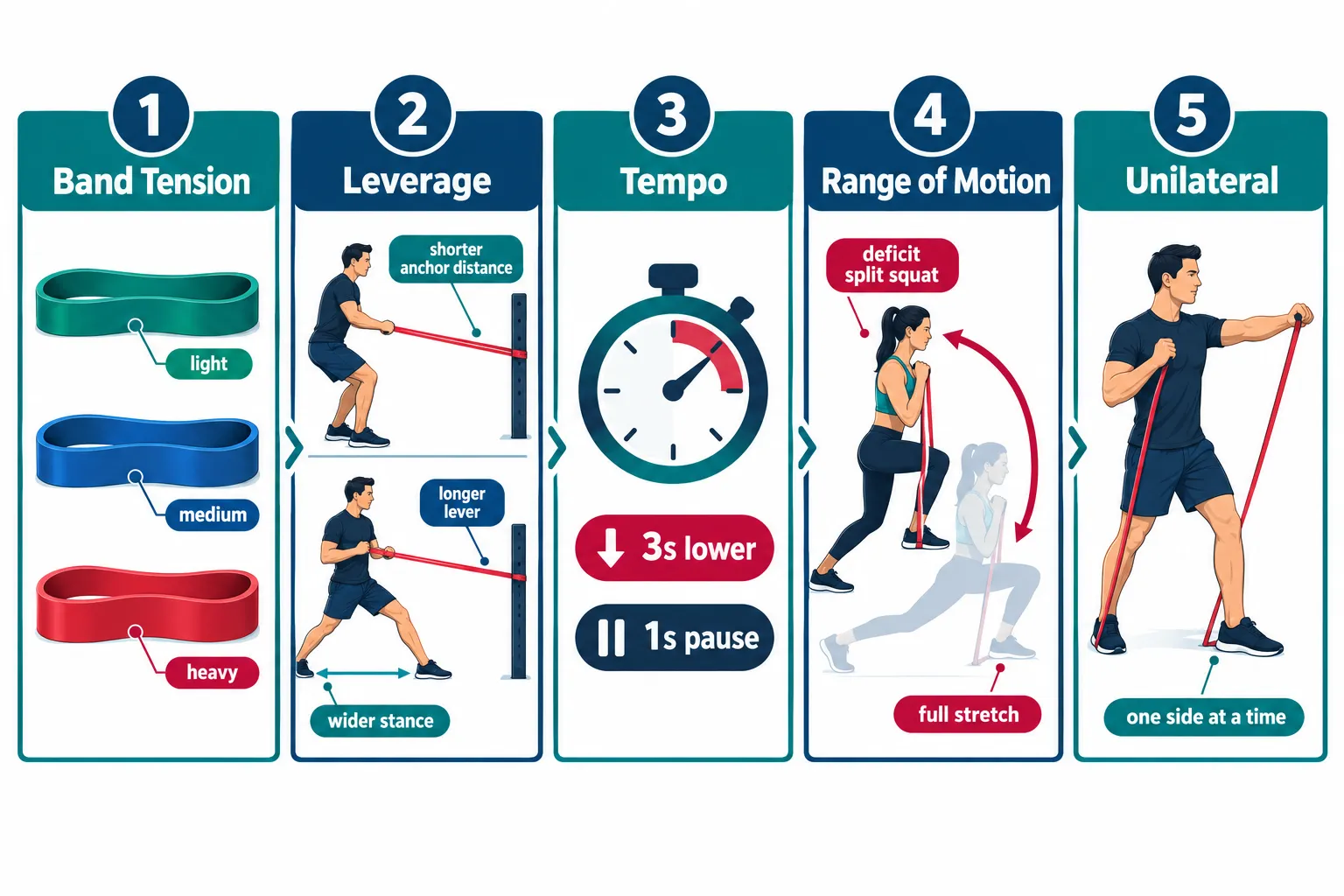
Resistance Band Exercises for Men Over 40: A Progressive Muscle-Building Plan Without Heavy Weights works because bands let you load muscle through five separate variables, not just weight: tension, leverage, tempo, range of motion, and unilateral (single-limb) work. Train 2-3 days per week, pick a band that makes 8-12 controlled reps genuinely hard, and progress by changing one variable at a time. A 2026 network meta-analysis of 102 trials in 4,754 older adults found elastic bands produce significant gains in strength and physical performance, on par with other resistance modalities.

Key Takeaways

  • Bands are a primary tool, not a warm-up toy. A 2026 network meta-analysis across 102 trials confirmed elastic band training significantly improves muscle strength and physical performance.
  • Progressive overload with bands comes from five levers: tension, leverage (distance from the anchor), tempo, range of motion, and single-limb variations.
  • Frequency: Mayo Clinic guidance recommends strength training at least two days per week covering all major muscle groups; three days per week is the sweet spot for men over 40.
  • Rep template: Harvard Health suggests roughly three sets of eight reps per exercise for maintaining muscle with age [3].
  • Both heavy and high-rep band work produce results. A 2025 study in adults averaging 76 years found low-intensity/high-rep and high-intensity/low-rep band training both lowered IL-6, raised IGF-1, and improved Timed Up and Go scores [1].
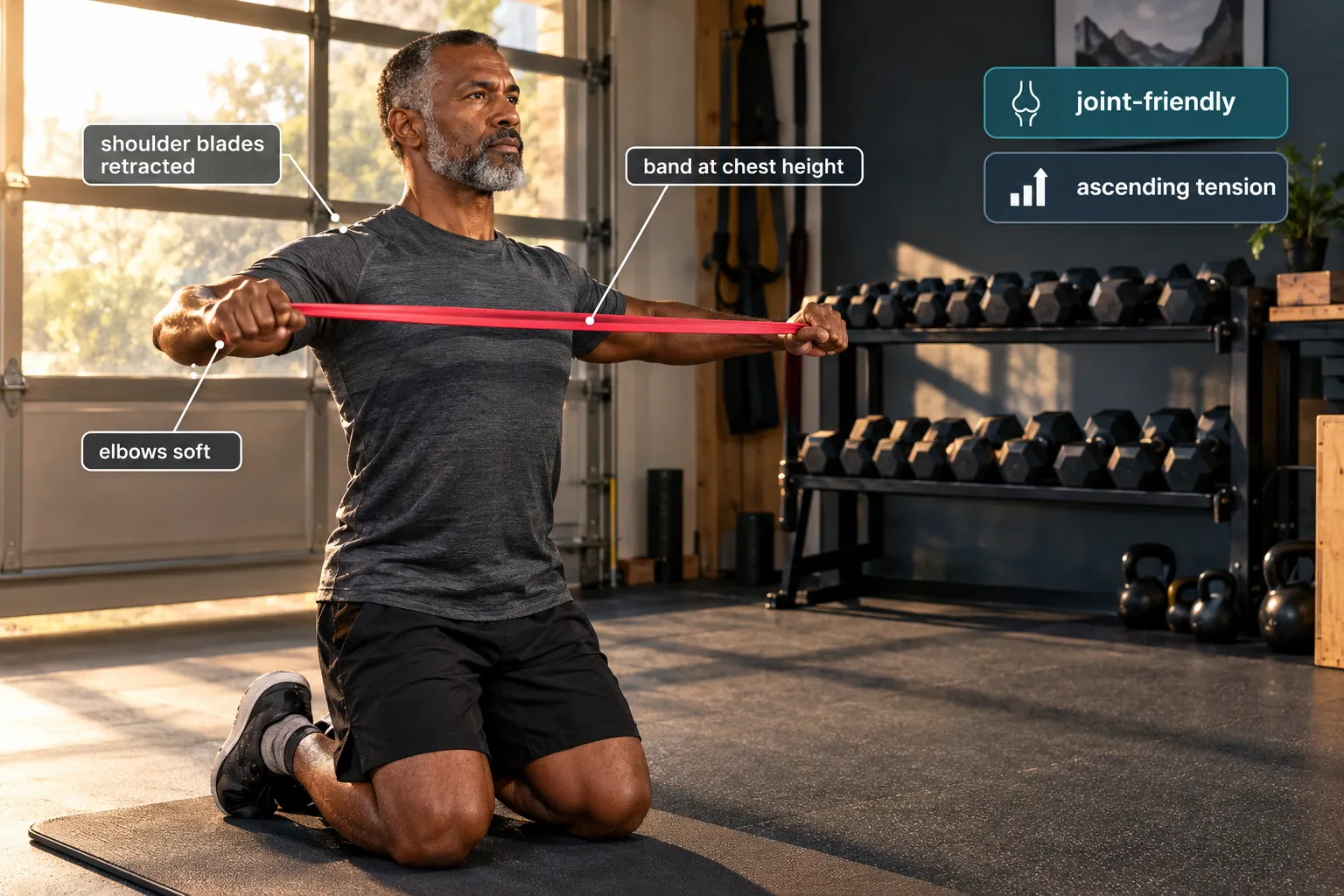
  • Joint-friendly by design. Bands give the least tension at the stretched position, where knees and shoulders are most vulnerable.
  • Timeline: Expect strength and coordination changes in 3-4 weeks, visible size changes around 8-12 weeks of consistent training.
  • Home and remote delivery works. A 2025 trial found tele-delivered band exercise twice weekly for 12 weeks improved physical performance and quality of life as much as on-site sessions [7].
  • Biggest mistake: using a band that's too light and stopping well short of real effort.

What are the best resistance band exercises for men over 40

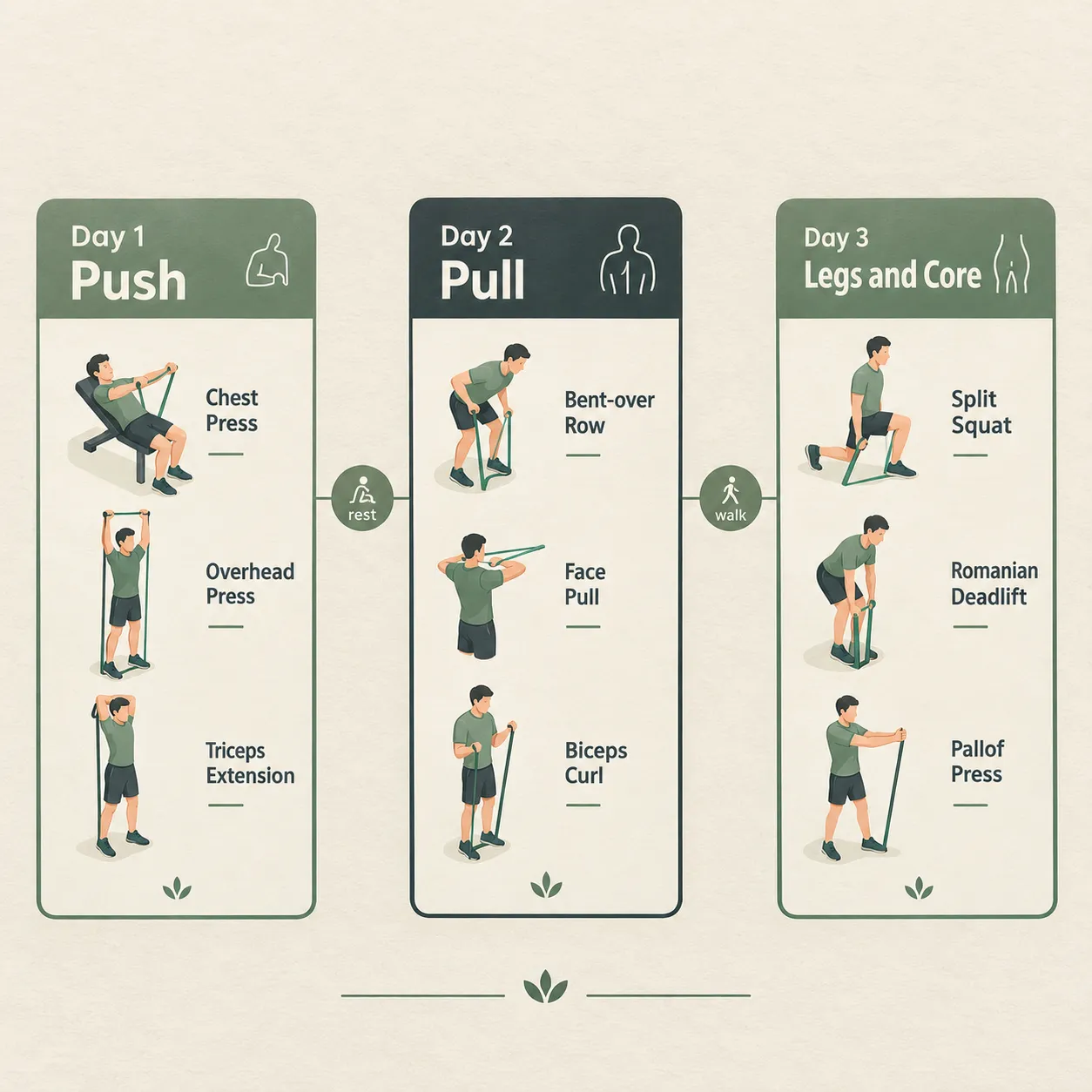
The best band exercises for men over 40 are compound movements that load the hips, upper back, and chest through a full range, plus one or two direct arm and core exercises. Prioritize these eight: banded split squat, Romanian deadlift, chest press, bent-over row, overhead press, face pull, pallof press, and single-arm curl.

What are the best resistance band exercises for men over 40

Why these eight? They cover every major muscle group, they all scale cleanly with tension and leverage, and most of them can be done standing, which keeps the hips and spine working as a unit.

Exercise Primary target Anchor setup Why it suits men over 40
Split squat (band under front foot) Quads, glutes Foot anchor Loads one leg without spinal compression
Romanian deadlift Hamstrings, glutes Both feet Trains the hip hinge with low back safety
Chest press Chest, triceps Door anchor at chest height Shoulder-friendly free scapular movement
Bent-over row Lats, mid-back Feet Direct antidote to desk posture
Overhead press Shoulders, triceps Feet, narrow stance Tension peaks at lockout, not overhead stretch
Face pull Rear delts, rotator cuff Door anchor at eye height Builds shoulder health, not just size
Pallof press Deep core, obliques Door anchor at ribcage height Anti-rotation strength protects the lower back
Single-arm curl Biceps Foot anchor Fixes left/right imbalances

Decision rule: If you only have time for four exercises, pick one hinge (RDL), one single-leg push (split squat), one horizontal pull (row), and one press. That covers roughly 80% of the useful stimulus.

How do resistance bands build muscle compared to weights

Resistance bands build muscle through the same mechanism as weights: mechanical tension on the muscle taken close to fatigue. The difference is the tension curve. A dumbbell's resistance stays constant, while a band's resistance climbs as it stretches, so the hardest point is the top of the movement rather than the bottom.

How do resistance bands build muscle compared to weights

That ascending curve has real consequences:

  • Stretched position is lighter. Less load at the bottom of a squat or the bottom of a press means less stress on knee cartilage and shoulder capsules.
  • Lockout is heavier. You get maximum tension where joints are most stable and strong.
  • No eccentric drop-off. The band pulls you back, so you must resist the return. A 2025 randomized trial in sedentary older adults found that accentuated eccentric band training produced distinct benefits for inflammatory and bone-remodeling markers, while maximal-strength band work drove the biggest strength and bone gains [2].

Common mistake: assuming bands can't produce "heavy" effort. A thick band at full stretch can exceed 100 lb of pull. The limit is usually your setup, not the band.

Can you get big muscles with just resistance bands

Yes, bands can build noticeable muscle, especially in the first few years of training, but very advanced size goals eventually need loading options bands struggle to provide. For most men over 40 whose goal is to look stronger, rebuild lost muscle, and move well, bands alone are sufficient.

Evidence supports this directly. A 2025 Frontiers in Aging study on home-based band training using "maximal mental effort" during each rep reported meaningful gains in muscle size, muscle quality, and strength even over a short training period [6]. The intent you bring to each rep matters as much as the equipment.

Muscle doesn't count your pounds. It responds to tension, effort, and how close you push toward failure.

Where bands fall short: loading the legs heavily. A trained man's quads and glutes can out-muscle most band setups. The workaround is unilateral loading (split squats, single-leg RDLs, step-ups), which halves the load requirement instantly.

Resistance band exercises for bad knees and joints

Bands are one of the better options for men with knee pain, arthritis, or past joint surgery, because resistance is lowest exactly where the knee bends deepest. A 2025 systematic review and meta-analysis of elastic band training in older adults found significant improvements in lower-limb strength and balance, including a large effect on chair-stand performance (SMD = 2.04, 95% CI 0.60-3.48, p = 0.006) [8].

Knee-friendly band progressions:

  1. Seated band knee extension, short range, builds quad tolerance first.
  2. Band-assisted sit-to-stand, band anchored in front gives upward assistance.
  3. Banded glute bridge, loads the hip without any knee flexion under load.
  4. Reverse lunge with band under front foot, less shear than a forward lunge.
  5. Split squat to a box, controls depth so you never enter the painful range.

Edge case: Sharp, pinpoint, or swelling-related pain is not a training problem, it's a medical one. Mayo Clinic advises medical clearance before starting strength training if you have a chronic condition or have been inactive.

How often should men over 40 use resistance bands

Two to three sessions per week is the target. Mayo Clinic's guidance for adults recommends strength training at least two days per week hitting all major muscle groups. A 2025 randomized trial of three band training styles used three sessions per week for 16 weeks and saw improvements in strength, bone health, and neuroplasticity measures [2].

  • 2 days/week: maintenance plus modest gains. Use full-body sessions.
  • 3 days/week: the growth zone for most men over 40. Allows a push/pull/legs split.
  • 4+ days/week: diminishing returns unless sessions are short and recovery is excellent. Recovery capacity, not enthusiasm, is the limiting factor after 40.

A 2026 clinical trial protocol testing progressive band training for sarcopenia in long-term care uses just twice weekly for 12 weeks, 30+ minutes per session, proof that modest frequency, done progressively, is a legitimate clinical dose [10].

Progressive resistance band workout plan for beginners

Here's a 3-day plan built for busy professionals: three sessions, 30-35 minutes each, with built-in progression over 12 weeks.

Progressive resistance band workout plan for beginners

Day 1, Push

  1. Band chest press, 3 × 10
  2. Overhead press, 3 × 8
  3. Standing triceps extension, 2 × 12
  4. Pallof press, 2 × 10 per side

Day 2, Pull

  1. Bent-over row, 3 × 10
  2. Band lat pulldown (high anchor), 3 × 10
  3. Face pull, 3 × 15
  4. Single-arm curl, 3 × 12 per arm

Day 3, Legs and core

  1. Split squat, 3 × 10 per leg
  2. Romanian deadlift, 3 × 10
  3. Banded glute bridge, 3 × 15
  4. Dead bug with band, 2 × 10 per side

The 12-week progression ladder

Change one variable every two weeks, not all of them:

Weeks Variable to progress What it looks like
1-2 Baseline Learn technique, 2 reps shy of failure
3-4 Reps Same band, add 2 reps per set
5-6 Tempo 3-second lowering phase on every rep
7-8 Leverage Step farther from anchor, or widen stance
9-10 Range of motion Add a deficit (stand on a book) or full pause at stretch
11-12 Tension Move to the next band, reset reps to 8

Then unilateral work becomes the next ceiling-raiser: a single-arm press with a medium band is harder than a double-arm press with a heavy one, because the core must resist rotation too.

What resistance band tension should I start with

Start with a band that lets you complete 8-12 controlled reps with 1-2 reps left in the tank, not a band you can rep out 30 times. Most men over 40 need a set of 4-5 tensions rather than one band, because leg exercises need 3-5× the resistance of a face pull.

A practical starting kit:

  • Light (10-20 lb equivalent): face pulls, external rotations, warm-ups
  • Medium (20-40 lb): curls, triceps, overhead press
  • Heavy (40-80 lb): chest press, rows, split squats
  • Extra heavy (80-120 lb): RDLs, glute bridges, assisted movements

Self-test: if your last rep looks identical to your first, the band is too light. If your form collapses by rep 5, it's too heavy.

Are resistance bands safe for men with shoulder problems

Generally yes, and often better than dumbbells, because the shoulder blade is free to move naturally and the tension is lowest in the stretched overhead position. Bands also make it easy to train the rotator cuff and rear delts directly, which is where most over-40 shoulder issues originate.

Rules for cranky shoulders:

  • Keep pressing to chest height or slightly below until pain-free for two weeks.
  • Do face pulls and external rotations before pressing, not after.
  • Avoid behind-the-neck pulldowns and deep band dips entirely.
  • Inspect bands for nicks before every session. A snapping band near the face is the one genuinely dangerous failure mode.

Edge case: If you have a diagnosed labral tear or rotator cuff repair, follow your physio's range limits over any generic program.

Resistance bands vs dumbbells for men over 40

Bands win on joint comfort, portability, and cost. Dumbbells win on heavy leg loading and precise progression. The honest answer for most men over 40 is a hybrid, but bands can carry the whole program if that's what's available.

Factor Resistance bands Dumbbells
Joint stress at stretch Low Moderate to high
Heavy leg loading Limited Excellent
Progression precision Coarse (jumps between bands) Fine (2-5 lb increments)
Cost for full range Low High
Travel / storage Excellent Poor
Eccentric control Band assists return Gravity-dependent

Choose bands if you train at home, travel often, have joint pain, or are restarting after a long layoff. Add dumbbells if your squats and RDLs no longer challenge you with your heaviest band.

Can resistance bands replace weights entirely

For general strength, muscle maintenance, fall prevention, and visible fitness, yes. For competitive powerlifting or maximum hypertrophy at an advanced level, no. The 2026 network meta-analysis found all resistance modalities, bands included, produced significant strength and performance improvements, which makes bands a legitimate primary tool rather than a compromise.

How long does it take to see results from resistance bands

Strength and coordination improve within 3-4 weeks. Visible muscle change typically appears around 8-12 weeks of consistent, progressive training. Most published band studies run 12-16 weeks and report meaningful outcomes within that window [1][2][10].

A realistic timeline:

  • Weeks 1-2: Neural adaptation. Movements feel smoother; little visible change.
  • Weeks 3-6: Noticeable strength jumps, better posture, clothes fit differently at the shoulders.
  • Weeks 8-12: Measurable arm and chest changes, clear improvements in sit-to-stand and stair climbing.
  • Weeks 16+: Compounding gains if progression continues. A 2025 review found longer interventions yield greater strength gains, while even short programs improve balance [8].

Band training also pays off beyond muscle: a meta-analysis of 11 randomized controlled trials (868 participants) found resistance training raised circulating BDNF (mean difference 0.73 ng/mL) and reduced depressive symptoms (SMD −0.38) [4][9], and a separate review reported improved overall cognitive function (SMD 0.40) [5].

Common mistakes men make with resistance band training

The single biggest error is using tension that's too light and never approaching real effort. Here are the rest, in order of how often they derail progress:

  1. No progression plan. Doing the same band, reps, and tempo for six months is maintenance, not building.
  2. Letting the band snap back. The return phase is half the stimulus. Control it over 2-3 seconds.
  3. Anchoring poorly. Door anchors must be on the hinge side, closed and latched. Never anchor to furniture that can tip.
  4. Skipping single-limb work. Unilateral variations are the cheapest way to double effective load.
  5. Ignoring the pull-to-push ratio. Men over 40 generally need more pulling volume than pressing to offset desk posture.
  6. Standing too close to the anchor. Slack at the start means wasted range.
  7. Not pairing with cardio. A 2025 randomized trial found band exercises combined with high-intensity walking improved pressure-pain thresholds and pain scores more than manual therapy plus walking.

Do resistance bands work for building arm strength at 40 plus

Yes. Biceps and triceps respond particularly well to bands because the ascending tension curve matches the arm's strength curve, resistance peaks at peak contraction, where a dumbbell curl goes almost weightless.

Arm-building band specifics:

  • Curls: stand on the band with both feet, elbows pinned, 3 × 12 with a 3-second lowering phase.
  • Triceps: overhead extension with a high anchor plus straight-arm pushdowns for the long head.
  • Volume: 8-12 hard sets per arm muscle per week is plenty for most men over 40.
  • Trick for more load: shorten the band by wrapping it around your hand once rather than buying a heavier one.

Best resistance band brands for home workouts

Rather than naming a single brand, judge bands on four criteria that actually predict durability and usefulness. Latex layered bands (not single-molded) last longest, and any set should cover at least four tension levels.

What to look for:

  • Material: natural layered latex over cheap TPE for tube-free loop bands.
  • Format: buy both loop/power bands (for legs and heavy pulls) and a handled tube set with a door anchor (for presses, rows, face pulls).
  • Accessories: door anchor, ankle straps, and a padded handle set matter more than the bands' color.
  • Warranty: a replacement guarantee is a reasonable proxy for build quality.

Budget estimate: a usable full kit (4-5 loop bands plus a handled tube set with anchor) generally runs well under the cost of a single adjustable dumbbell, treat that as a rough planning assumption, not a quoted price.

FAQ

How many days a week should a man over 40 train with bands?
Two to three days per week, covering all major muscle groups. Mayo Clinic recommends a minimum of two strength sessions weekly for adults.

How many sets and reps should I do?
Roughly three sets of eight to twelve reps per exercise, taken within 1-2 reps of failure. Harvard Health cites three sets of eight as an effective template for maintaining muscle with age [3].

Can bands build leg muscle?
Yes, but you must use single-leg variations. A split squat or single-leg RDL with a heavy band creates enough load for most men over 40.

Are bands safe after a knee replacement or shoulder surgery?
Usually, with clearance. Bands load the stretched position lightly, which suits healing joints, but follow your surgeon's or physiotherapist's range restrictions first.

Do I need to go to failure?
No. Stopping 1-2 reps short of failure gives nearly the same stimulus with less joint and nervous-system fatigue, which matters more after 40.

How do I know when to move up a band?
When you can complete all prescribed sets with two or more reps in reserve and perfect tempo. Then move up and reset reps to eight.

Can band training improve more than muscle?
Yes. Resistance training has been shown to raise BDNF and lower depressive symptoms [4][9], and improve cognitive function [5].

Does home or remote band training work as well as supervised sessions?
A 2025 trial found tele-delivered and on-site elastic band exercise twice weekly for 12 weeks both significantly improved physical performance and quality of life [7].

How long before I see visible changes?
Strength improves in 3-4 weeks; visible muscle changes typically show around 8-12 weeks of progressive training.

What if a band keeps rolling up my thigh during squats?
Use a fabric loop band or anchor the band under both feet with a wider stance. Rolling usually means the band is too narrow for the load.

Conclusion

Resistance Band Exercises for Men Over 40: A Progressive Muscle-Building Plan Without Heavy Weights succeeds or fails on one thing: whether you actually progress. Bands aren't a lighter version of weights, they're a different loading tool with five independent dials (tension, leverage, tempo, range of motion, unilateral work) that most people never touch.

Your next steps this week:

  1. Buy or sort your bands into light, medium, heavy, and extra heavy.
  2. Test your 10-rep tension on a chest press and a split squat. Write the band color down.
  3. Schedule three 30-minute sessions on fixed days, push, pull, legs and core.
  4. Pick one progression variable for weeks 3-4 and commit to it before touching anything else.
  5. Add two brisk 20-minute walks on off days, which pairs well with band work for pain and cardiorespiratory health.
  6. Get medical clearance first if you've been inactive or manage a chronic condition.

Run the 12-week ladder once. Then run it again from a heavier starting band. That's how bands build real muscle after 40.

References

[1] 67bca402675749dc9c26ab74 – https://agris.fao.org/search/zh/records/67bca402675749dc9c26ab74
[2] pubmed.ncbi.nlm.nih.gov – https://pubmed.ncbi.nlm.nih.gov/41373346/?fc=20240423220132&ff=20251211194700&v=2.18.0.post22+67771e2
[3] Building Better Muscle – https://www.health.harvard.edu/healthy-aging-and-longevity/building-better-muscle
[4] pubmed.ncbi.nlm.nih.gov – https://pubmed.ncbi.nlm.nih.gov/37703686/
[5] pubmed.ncbi.nlm.nih.gov – https://pubmed.ncbi.nlm.nih.gov/40325674/
[6] Full – https://www.frontiersin.org/journals/aging/articles/10.3389/fragi.2025.1662126/full
[7] pubmed.ncbi.nlm.nih.gov – https://pubmed.ncbi.nlm.nih.gov/40812387/
[8] 4yqamww4 – https://ouci.dntb.gov.ua/en/works/4yQAMWW4/
[9] public-pages-files-2025.frontiersin – https://public-pages-files-2025.frontiersin.org/journals/psychiatry/articles/10.3389/fpsyt.2025.1708244/pdf
[10] Icf 001 – https://cdn.clinicaltrials.gov/large-docs/25/NCT07513025/ICF_001.pdf

Top Home Exercise Equipment for Seniors Who Want Strength, Not Impact

Top Home Exercise Equipment for Seniors Who Want Strength, Not Impact

Last updated: August 13, 2026

Quick Answer

The best home exercise equipment for seniors who want strength without impact is a small, focused kit: resistance bands, adjustable dumbbells, a sturdy bench, a balance pad, and a compact cable or selectorized machine. This setup builds functional muscle, protects joints, and supports fall prevention, the three goals that matter most after 60. Most older adults can start well-equipped for under $300, and national guidelines back moderate-to-heavy resistance training as core to healthy aging [6][8].

Key Takeaways

  • Resistance bands and adjustable dumbbells are the highest-value tools for senior strength training at home, cheap, quiet, and joint-friendly [1][4].
  • Seniors can and should lift heavier than "light toning weights." Position statements from the NSCA endorse moderate-to-vigorous loads for older adults when progressed safely [6][8].
  • A balance pad and mini-step turn a strength routine into a fall-prevention routine at almost no cost [9].
  • Skip high-impact equipment like plyometric boxes, heavy barbells without a rack, and treadmills used for running [3].
  • A complete senior home gym costs roughly $150,$800 depending on whether you add a cable machine or bench [1][3].
  • Train strength 2-3 days per week, with 8-12 reps per set, using a load that feels challenging by the last two reps [5].
  • Recumbent bikes and ellipticals support cardio and joint health, but they don't replace resistance work for muscle [7].
  • Common mistakes: going too light forever, skipping warm-ups, and buying equipment that requires floor work every session [4].

What home exercise equipment is best for seniors building strength

The best equipment for seniors building strength at home is adjustable dumbbells, resistance bands with handles, and a stable bench, in that order. These three tools cover every major muscle group, allow gradual progression, and keep impact on knees, hips, and spine to a minimum [1][4].

What home exercise equipment is best for seniors building strength

Ranked by how well they support functional strength, mobility, and fall prevention:

  1. Adjustable dumbbells (5-50 lb range), the single best purchase. One pair replaces an entire rack and lets you progress from very light to genuinely challenging loads.
  2. Loop and tube resistance bands, near-zero joint stress, ideal for shoulders, hips, and rotator cuff work.
  3. Sturdy adjustable bench, unlocks seated presses, supported rows, and step-ups.
  4. Balance pad + mini-step, direct fall-prevention training.
  5. Compact cable machine or functional trainer, smooth, guided resistance for anyone with shoulder or wrist issues [10].
  6. Ankle weights (1-5 lb), for hip and glute work that protects the lower back.

Choose adjustable dumbbells if you only buy one thing. Choose bands first if you have grip issues, arthritis in the hands, or a very tight budget.

Low impact strength training equipment for older adults

Low-impact strength equipment for older adults is anything that loads muscle without loading joints through jarring, jumping, or ballistic motion. The core categories are resistance bands, dumbbells used in controlled tempo, cable machines, and selectorized weight-stack machines [8][10].

What makes equipment low-impact:

  • Smooth resistance curves (cables and bands) instead of sudden drops.
  • Seated or supported positions that remove balance risk from the movement itself.
  • Adjustable range of motion so painful angles can be avoided.
  • No airborne phase, feet stay planted.

Selectorized machines (pin-loaded stacks) are having a moment in 2026 senior home gyms because they combine guided paths with instant load changes, no plates to lift onto a bar [10]. Compact versions like wall-mounted functional trainers fit in a spare bedroom.

How do resistance bands compare to weights for seniors

Resistance bands and dumbbells both build strength for seniors, but they excel at different jobs. Bands are best for shoulder health, warm-ups, travel, and joint-friendly high-rep work. Dumbbells are best for building real muscle mass and bone density because they load bones under gravity [4][6].

Feature Resistance Bands Adjustable Dumbbells
Cost $15,$60 $150,$400
Joint stress Very low Low with good form
Bone-loading effect Modest Strong
Progression Change band Turn dial
Best for Shoulders, hips, mobility Chest, back, legs, arms
Storage Drawer Small footprint

Decision rule: Own both. Bands for warm-ups and shoulders, dumbbells for the main lifts. If forced to pick one, choose adjustable dumbbells for anyone who can safely grip them.

Best home gym setup for seniors with arthritis

The best home gym setup for seniors with arthritis prioritizes grip-friendly handles, seated support, and machines with smooth, guided motion. Cable machines, bands with padded handles, and selectorized equipment all reduce hand and wrist strain compared to Olympic barbells [10].

Recommended arthritis-friendly setup:

  • Compact cable machine with rotating handles
  • Neoprene-coated dumbbells (softer grip than steel)
  • Resistance bands with thick foam handles
  • Recumbent bike for cardio without wrist load [7]
  • Non-slip mat and padded bench

Avoid: fixed-grip Olympic barbells, kettlebells with narrow handles, and pull-up bars. These force your wrists and fingers into positions inflamed joints don't tolerate.

Can seniors build muscle without high impact exercise

Yes, seniors can absolutely build muscle without any high-impact exercise. Muscle grows in response to progressive tension, not impact. Studies summarized by the National Strength and Conditioning Association confirm that older adults training with machines, dumbbells, and bands at moderate-to-vigorous intensity build meaningful muscle and reverse sarcopenia [6][8].

Can seniors build muscle without high impact exercise

The mechanism is simple: muscle fibers respond to being challenged near their limit, whatever the source of resistance. A slow, controlled 12-rep set of dumbbell rows produces adaptation similar to any traditional strength method, without a single jump or drop landing.

"The old advice to stick with light weights after 50 has been replaced. Current guidance says older adults benefit from heavier loading, safely progressed." [5][6]

What equipment should seniors avoid for joint safety

Seniors should generally avoid equipment that demands impact, extreme range of motion, or unsupported balance under load. This isn't about age fear, it's about risk-to-reward ratio [3][4].

Skip or use with caution:

  • Plyo boxes and jump ropes, high impact on knees and ankles
  • Treadmills used for running (walking is fine)
  • Heavy barbell back squats without a rack and spotter
  • Ab wheels and roman chairs, hard on the lumbar spine
  • Cheap vibration plates, poor evidence for strength
  • BOSU balls loaded with heavy weights, fall risk outweighs benefit

The pattern: anything that combines heavy load with unstable base, or that requires airborne landings, belongs in an athlete's gym, not a senior's.

How much does a home gym for seniors cost

A functional senior home gym costs $150 to $800 depending on how far you go. Bare essentials, bands, a mat, ankle weights, can come in under $55 as of April 2026 [9]. A complete setup with adjustable dumbbells, bench, and a balance pad lands around $400,$600 [1][3].

Tiered budgets:

  • Starter ($55,$150): Resistance band set, yoga mat, 2 lb ankle weights, balance pad
  • Standard ($300,$600): Add adjustable dumbbells (5-50 lb), foldable bench, mini-step
  • Premium ($800,$2,500): Add a compact cable machine or selectorized multi-station [10]

A quality adjustable dumbbell pair often replaces $500+ worth of fixed dumbbells and saves square footage, usually the best single line item on the receipt.

Stationary bikes vs recumbent bikes for senior strength

Neither bike is primarily a strength tool, but recumbent bikes win for seniors because the seated, back-supported position removes pressure from the lower spine and wrists [7]. Upright stationary bikes work fine for fit seniors with no back issues.

For actual leg strength, though, bikes are a supplement, not the main event. Loaded step-ups, banded squats to a chair, and dumbbell deadlifts build far more functional lower-body strength than pedaling. Use the recumbent bike for warm-ups, cardio days, and joint-friendly conditioning, not as a replacement for resistance work [7].

Does a rowing machine work for seniors with back pain

A rowing machine can work for seniors with back pain, but only if the person has good hip mobility and is coached on form. The row is a hip-hinge, not a lower-back pull. Poor form turns it into repeated lumbar flexion under load, exactly what most back-pain sufferers should avoid [4].

Does a rowing machine work for seniors with back pain

Safer alternatives for back-pain seniors:

  • Seated cable rows (chest supported)
  • Banded rows with feet against a wall
  • Chest-supported dumbbell rows on an incline bench

If you love rowing, use a magnetic-resistance rower, keep the damper low, and stop the moment form breaks.

What weight should seniors start with for home training

Seniors should start with a weight that lets them complete 8-12 clean reps with 2 reps still in reserve. For most healthy older beginners, that's 3-8 lb dumbbells for shoulder work and 8-20 lb dumbbells for rows, presses, and squats to a chair [5].

The 2026 Harvard Health resistance prescription for older adults is straightforward:

  • 2-3 sessions per week
  • 8-12 reps per set
  • 2-3 sets per exercise
  • Rest 60-90 seconds between sets
  • Increase weight when 12 reps feels easy

The mistake isn't starting too heavy, it's staying too light forever. Progress the load every 2-3 weeks [5][6].

How often should seniors do strength training at home

Seniors should strength train two to three non-consecutive days per week, with each session lasting 30-45 minutes. This frequency is enough to build muscle and preserve bone density without overloading recovery [6][8].

A sample week:

  • Monday: Full-body strength (dumbbells + bench)
  • Tuesday: Balance + recumbent bike, 20 min
  • Wednesday: Rest or gentle walk
  • Thursday: Full-body strength (bands + cable)
  • Friday: Balance pad work + mobility
  • Saturday: Optional light strength or walk
  • Sunday: Rest

Balance training deserves its own slot 2-3 times a week, it's the single biggest fall-prevention lever [9].

Cable machines vs free weights for senior safety

Cable machines are generally safer than free weights for seniors because the resistance path is guided and the load can't fall on you. Free weights build more stabilizer strength but require better balance and technique [10].

Choose cable machines if you train alone, have shoulder impingement, or have any fall history.

Choose free weights if you have good balance, a training partner nearby, and want maximum functional carryover to daily life (carrying groceries, lifting grandkids).

Best of both worlds: a compact functional trainer at home covers 80% of what a commercial gym does, in a 4×4 ft footprint [10].

Common mistakes seniors make with home exercise equipment

The most common mistakes are buying too much, going too light, and neglecting warm-ups. Each one quietly kills results [4][5].

Top mistakes to avoid:

  • Buying a treadmill and calling it strength training. It isn't.
  • Sticking with 3 lb dumbbells for years. Muscle needs progressive challenge.
  • Skipping the 5-minute warm-up. Cold joints don't like sudden load.
  • Training the same muscles daily. Recovery is when muscle grows.
  • Ignoring the legs. Lower-body weakness predicts falls better than almost any other marker [9].
  • No balance work. Strength without balance still leaves fall risk on the table.

What if I have limited space for senior workout equipment

Limited space isn't a barrier, a full senior strength routine fits in 9 square feet. The key is choosing tools that stack, fold, or hide in a closet [3].

Small-space essentials:

  • One pair of adjustable dumbbells (footprint: 2 ft x 1 ft)
  • Resistance band set (fits in a drawer)
  • Foldable bench (stores vertically)
  • Balance pad (leans against the wall)
  • Wall-mounted cable trainer (uses zero floor space when folded)

Apartment dwellers should prioritize quiet gear. Bands, dumbbells on rubber mats, and cable machines make almost no noise, no dropped plates, no impact through the floor [1].

Conclusion

The strongest, safest home setup for older adults isn't a wall of machines, it's a focused kit built around adjustable dumbbells, resistance bands, a bench, and a balance pad. This is the top home exercise equipment for seniors who want strength, not impact, because every piece loads muscle without punishing joints. Add a compact cable machine if the budget allows and you want maximum arthritis-friendly versatility [10].

Actionable next steps:

  1. Start with a $150 kit: adjustable-tension bands, a mat, and a balance pad.
  2. Add adjustable dumbbells within 30 days once you know you'll stick with it.
  3. Train 2-3 days a week, 8-12 reps, and progress the weight every 2-3 weeks [5].
  4. Add balance-pad work to at least three sessions per week.
  5. Reassess your load every month, if 12 reps feels easy, it's time to go heavier.

Strength after 60 isn't optional, it's the closest thing there is to a longevity drug. The equipment above makes it accessible from a spare corner of any room.

FAQ

Is it too late to start strength training at 70 or 80?
No. Research consistently shows adults in their 70s, 80s, and 90s gain muscle and function from resistance training [6][8]. Start light, progress slowly, and see a doctor first if you have cardiac or orthopedic issues.

Are resistance bands enough on their own?
For beginners and anyone with joint issues, yes, for a while. Bands build real strength for the first 6-12 months. After that, most seniors benefit from adding dumbbells or a cable machine to keep progressing [4].

Do I need a personal trainer to start?
Not required, but 2-3 sessions with a senior-focused trainer or physical therapist to check form is one of the best investments you can make.

How long until I see results?
Most seniors feel stronger in daily tasks (stairs, groceries, getting up from chairs) within 4-6 weeks of consistent training [5].

What's the single best exercise for fall prevention?
Loaded step-ups combined with balance-pad standing work. They train the exact muscles and reflexes used to catch yourself [9].

Can I use household items instead of equipment?
Yes, water jugs, canned goods, and a sturdy chair cover basic movements. But adjustable equipment eventually becomes worth the cost because progression is smoother [1].

Should I do cardio or strength first?
For seniors focused on muscle and fall prevention, do strength first, cardio second. Cardio before heavy lifting fatigues the legs and increases fall risk during the strength session [7].

Is soreness normal?
Mild soreness for 1-2 days is normal for beginners. Sharp joint pain is not, stop and reassess form or load.

References

[1] Best Home Gym Equipment For Seniors – https://www.ritfitsports.com/blogs/article/best-home-gym-equipment-for-seniors
[2] Best – https://www.theseniorlist.com/exercise/best/
[3] Home Gym For Seniors – https://garagegymbuilders.com/guides/home-gym-for-seniors/
[4] Best Strength Training Equipment For Seniors – https://rebootedbody.com/best-strength-training-equipment-for-seniors/
[5] Strength Training After 50 Guidelines – https://dailycrunch.org/articles/strength-training-after-50-guidelines
[6] Resistance Training For Older Adults – https://www.nsca.com/about-us/position-statements/resistance-training-for-older-adults/
[7] Best Ellipticals For Seniors – https://barbend.com/best-ellipticals-for-seniors/
[8] Resistance Training For Older Adults Position.1 – https://www.nsca.com/contentassets/2a4112fb355a4a48853bbafbe070fb8e/resistance_training_for_older_adults__position.1.pdf
[9] Best Low Impact Senior Gym Gear – https://www.fuelingfitnessandfindingfocus.com/2026/04/best-low-impact-senior-gym-gear.html
[10] Best Resistance Training Machines For Seniors – https://www.ofzenandcomputing.com/best-resistance-training-machines-for-seniors/