Adjustable Dumbbells vs Resistance Bands After 40: Which Is Better for Muscle, Joints, and Home Workouts?

Adjustable Dumbbells vs Resistance Bands After 40: Which Is Better for Muscle, Joints, and Home Workouts?

Last updated: October 23, 2026

Quick Answer

For most people over 40, resistance bands are the safer starting point and adjustable dumbbells are the better long-term investment. Bands win on joint comfort, portability, and cost; adjustable dumbbells win on loading ceiling, progression tracking, and visible muscle gains. When training volume and effort are matched, both tools build muscle effectively [1][2]. The strongest answer to "Adjustable Dumbbells vs Resistance Bands After 40" is usually both: bands for shoulders, hips, warm-ups, and recovery, dumbbells for the heavy compound work.

Key Takeaways

  • Muscle growth is similar between bands and dumbbells when sets, effort, and progression are matched [1][2].
  • Bands are gentler on joints because tension is lowest where joints are most vulnerable (the stretched position) [3][4].
  • Adjustable dumbbells have a far higher loading ceiling, which matters for strength and bone density after 40 [5][6].
  • Cost gap is wide: a full band kit typically runs a small fraction of an adjustable dumbbell pair.
  • Start light: most 40+ beginners do well with roughly 5-15 lb per hand for upper body, heavier for legs.
  • Frequency beats equipment, two to three strength sessions per week is the guideline that actually drives results [7].
  • Bands excel for recovery, mobility, and rehab-style work; dumbbells excel for progressive overload.
  • The hybrid setup (one band kit plus one adjustable dumbbell pair) covers nearly every home workout need.

What's the difference between adjustable dumbbells and resistance bands?

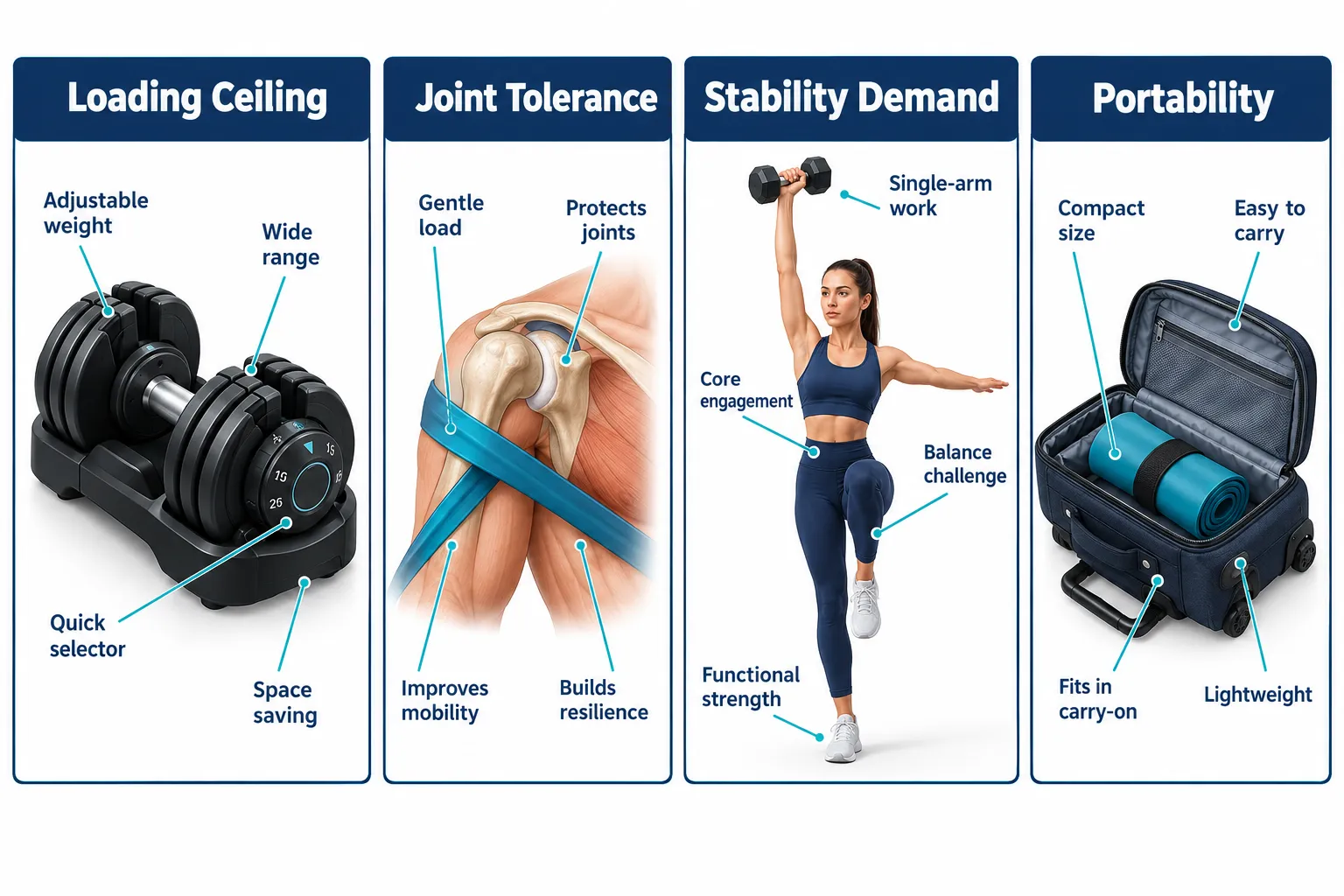
Adjustable dumbbells are fixed-weight free weights with a dial or pin that changes load, so resistance comes from gravity and stays constant through the whole range of motion. Resistance bands are elastic, so resistance increases as the band stretches and nearly disappears at the start of the movement.
What's the difference between adjustable dumbbells and resistance bands?

That single mechanical difference drives everything else:

)

Factor Adjustable dumbbells Resistance bands
Resistance curve Constant (gravity) Ascending (stretch-dependent)
Loading ceiling High, often 50-90 lb per hand Moderate, hard to measure
Joint stress Higher at stretched positions Lowest at stretched positions
Stability demand High (great for stabilizers) Moderate, anchor-dependent
Exercise variety Excellent for presses, rows, squats Excellent for rotation, pull-aparts, abduction
Portability Poor (heavy, fixed location) Excellent (fits in a drawer)
Progression tracking Precise and numbered Vague (band color jumps)
Floor space Needs a stand and clearance Essentially none

Decision rule: if you want a number to beat each week, choose dumbbells. If you want tension without joint compression, choose bands.

What's better for joint health, dumbbells or resistance bands after 40?

Resistance bands are better for sensitive joints after 40. Because band tension is lightest at the bottom of a movement, the shoulder, knee, or elbow isn't loaded heavily in its most compromised position [3][4]. That makes bands the default choice for anyone managing stiffness, old injuries, or arthritis-type discomfort.

Why bands feel kinder:

  • No bottom-of-rep crush. A banded chest press has almost no load at the deep stretch; a dumbbell press has the most.
  • No impact if dropped. A dropped 40 lb dumbbell is a real hazard at home; a dropped band is not.
  • Angles are free. Bands let you pull at off-axis angles that match how your shoulder actually moves.

Dumbbells aren't the enemy, though. Loaded joints adapt, tendons and bone respond to progressive load, and that adaptation protects joints over the following decades [5][7]. The practical approach: use bands for the exercises that bother you and dumbbells for the ones that don't.

Joint pain after 40 is usually a dose problem, not an equipment problem. Reduce range, slow the tempo, or swap the tool, don't quit the lift.

Are resistance bands safe for shoulder and knee problems?

Yes, resistance bands are generally safe for shoulder and knee issues and are widely used in rehab-style programming for exactly that reason [3]. The caveat: bands can snap or slip off an anchor, so inspect them for nicks and never stretch one toward your face.
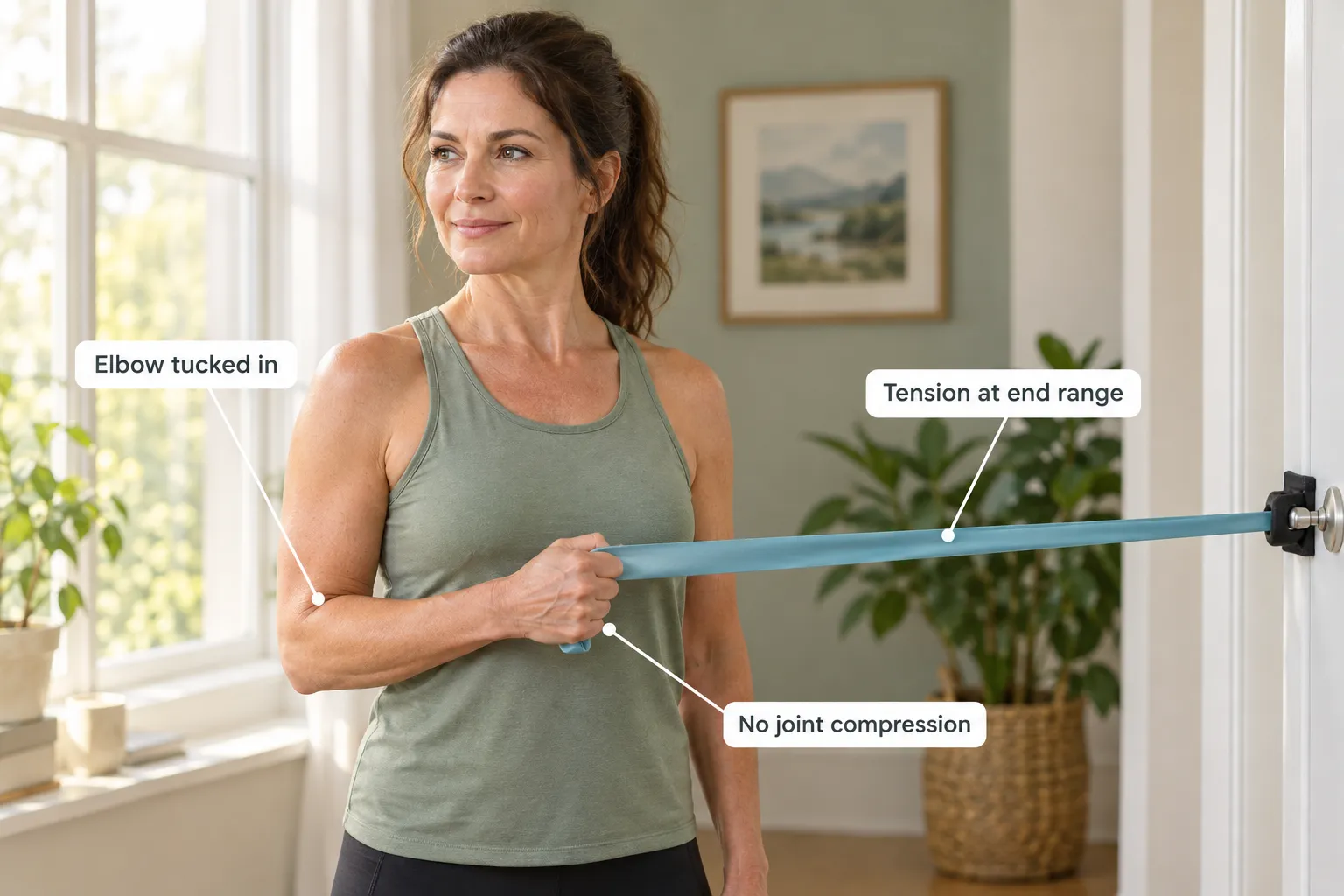
Are resistance bands safe for shoulder and knee problems?

Shoulder-friendly band moves:

  • Band pull-aparts (scapular health)
  • External rotations at the side, elbow pinned
  • Face pulls at chest height
  • Banded wall slides

Knee-friendly band moves:

  • Lateral band walks (glute medius)
  • Banded terminal knee extensions
  • Light banded leg curls
  • Banded step-downs with assistance

Edge case: if a joint hurts more 24 hours later, the issue is total volume, not the band. Cut sets in half for a week before changing exercises. And if pain is sharp, radiating, or associated with swelling, get it assessed rather than training through it.

Can resistance bands build muscle as well as dumbbells?

Yes, for most people over 40, bands build comparable muscle when sets, reps, and closeness to failure are matched [1][2]. Muscle responds to mechanical tension and effort, and elastic tension counts. Where bands fall short is at the upper end: once you can do 15 hard reps against your heaviest band, meaningful progression becomes guesswork.

)

How to program bands effectively in midlife [3]:

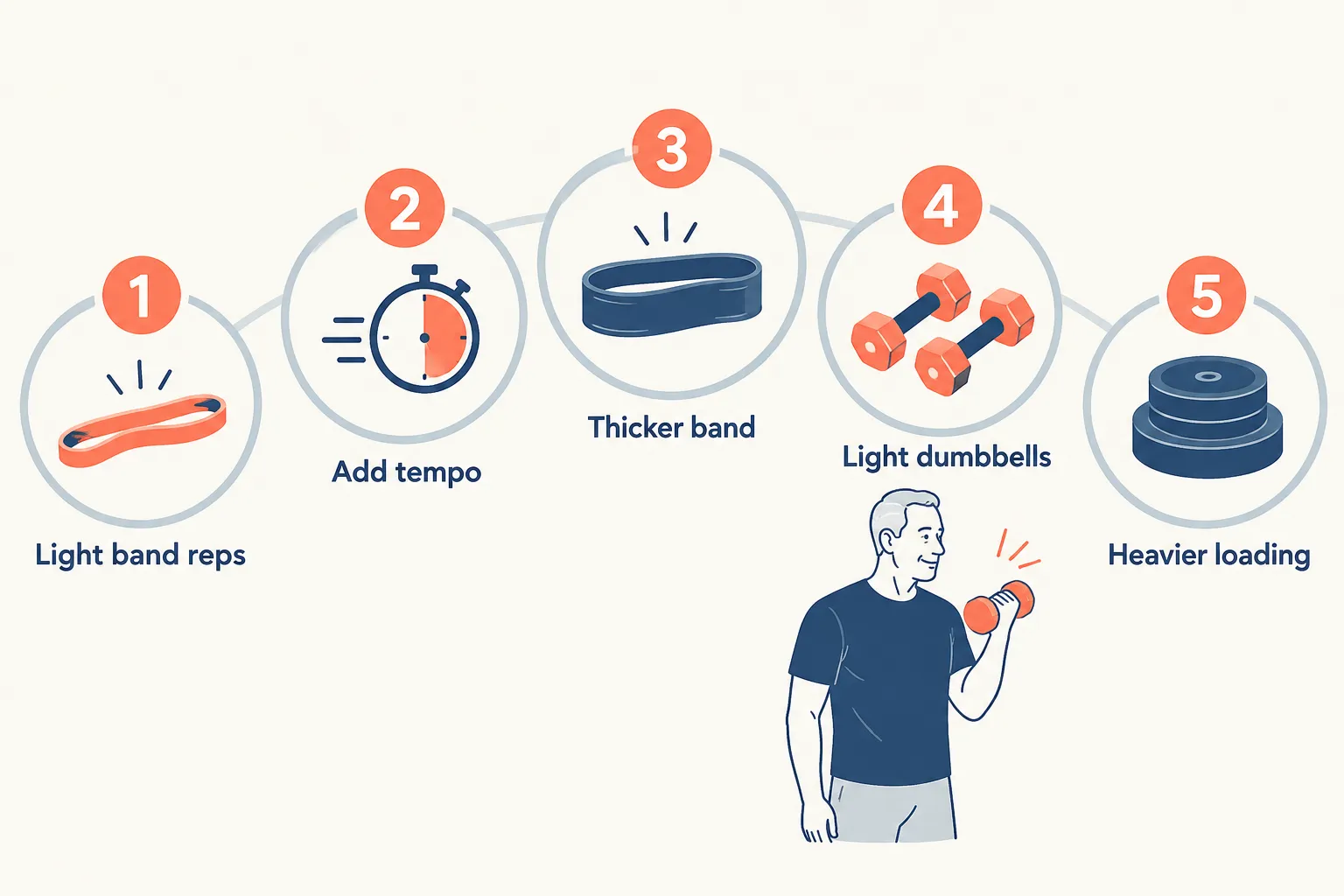
  1. Shorten the lever or the anchor instead of jumping band colors, small distance changes equal small load changes.
  2. Use 8-20 reps per set and stop 1-3 reps shy of failure.
  3. Control the return. Three seconds lowering against band tension creates far more stimulus than snapping back.
  4. Add pauses at peak tension for 1-2 seconds.
  5. Train 2-3 days per week, full body [7].

Can you build serious muscle with just resistance bands?

You can build noticeable, functional muscle with bands alone, especially in the first 6-12 months of training. Building advanced size and maximal strength eventually requires heavier external load, which bands struggle to deliver predictably for the legs and back [5][6].

How much do adjustable dumbbells cost compared to resistance bands?

Resistance bands are dramatically cheaper. A complete loop-and-tube band kit with handles, door anchor, and ankle straps generally costs in the range of a single restaurant dinner, while a quality adjustable dumbbell pair is a several-hundred-dollar purchase [5][8]. Exact prices shift by brand and year, so treat these as general ranges, not quotes.
How much do adjustable dumbbells cost compared to resistance bands?

What that money buys:

  • Bands: immediate variety, travel use, near-zero space, replaceable when worn.
  • Adjustable dumbbells: 10-20 weight settings in one footprint, replacing an entire rack. Durable for a decade or more, which improves the cost per year considerably.

Decision rule: budget under $60 or unsure about consistency? Buy bands first. Already training consistently for three-plus months? Adjustable dumbbells are the better next purchase [4].

What's the best home gym equipment for people over 40?

The best home gym for people over 40 is a small, hybrid setup: one resistance band kit, one pair of adjustable dumbbells, a mat, and an adjustable bench or sturdy step [5][6]. That combination covers pushing, pulling, hinging, squatting, carrying, and rotation without needing a dedicated room.

A sensible build order:

  1. Band kit with door anchor (week 1)
  2. Yoga mat and a stable chair or step
  3. Adjustable dumbbells, light-to-mid range (month 3+)
  4. Adjustable bench
  5. A loop band set for hips and shoulders

Fitness coaches working with older adults consistently recommend bands plus dumbbells as core tools rather than machines [6][9].

Adjustable dumbbells vs kettlebells for people over 40

Adjustable dumbbells are the safer first buy for most people over 40 because they're symmetrical, easy to control, and work for presses, rows, and squats alike. Kettlebells shine for swings, carries, and hip power, but the swing has a steeper technique curve and a higher back-injury risk if learned alone. Choose a kettlebell as a second tool once form is solid, not as the only tool.

Do I need both dumbbells and bands, or just one?

Just one is enough to get strong, but owning both solves more problems than either alone. Bands handle the small stabilizers, warm-ups, and travel. Dumbbells handle the heavy, trackable work. If forced to pick one for a lifetime of home training, adjustable dumbbells have the higher ceiling; for a first 90 days after 40, bands win.

How to avoid joint pain when lifting weights after 40

Avoid joint pain by progressing load slowly, warming up with bands, and keeping reps in a moderate range rather than chasing maximal weight. Most midlife flare-ups come from adding too much too fast, not from lifting itself [4][7].

)

Safe progression rules that apply to both tools:

  • Increase load no more than about 5-10% at a time, and only after you hit the top of your rep range on every set.
  • Warm up 5-8 minutes with bands before touching dumbbells.
  • Keep 1-3 reps in reserve on most sets; save true failure for isolation work.
  • Take a lighter week every 6-8 weeks.
  • Use a full but pain-free range, shorten the range before dropping the exercise.
  • Train legs and upper body on separate days if recovery feels slow.

Common mistakes people make with dumbbells after 40

  • Starting too heavy, then nursing a shoulder for six weeks.
  • Skipping warm-up sets entirely.
  • Doing only pressing and no pulling, which wrecks shoulder balance.
  • Jumping weight by 10-15 lb per hand instead of 5.
  • Training the same body part hard four days a week.
  • Holding breath during the hardest rep.

What weight dumbbells should I start with at 40+?

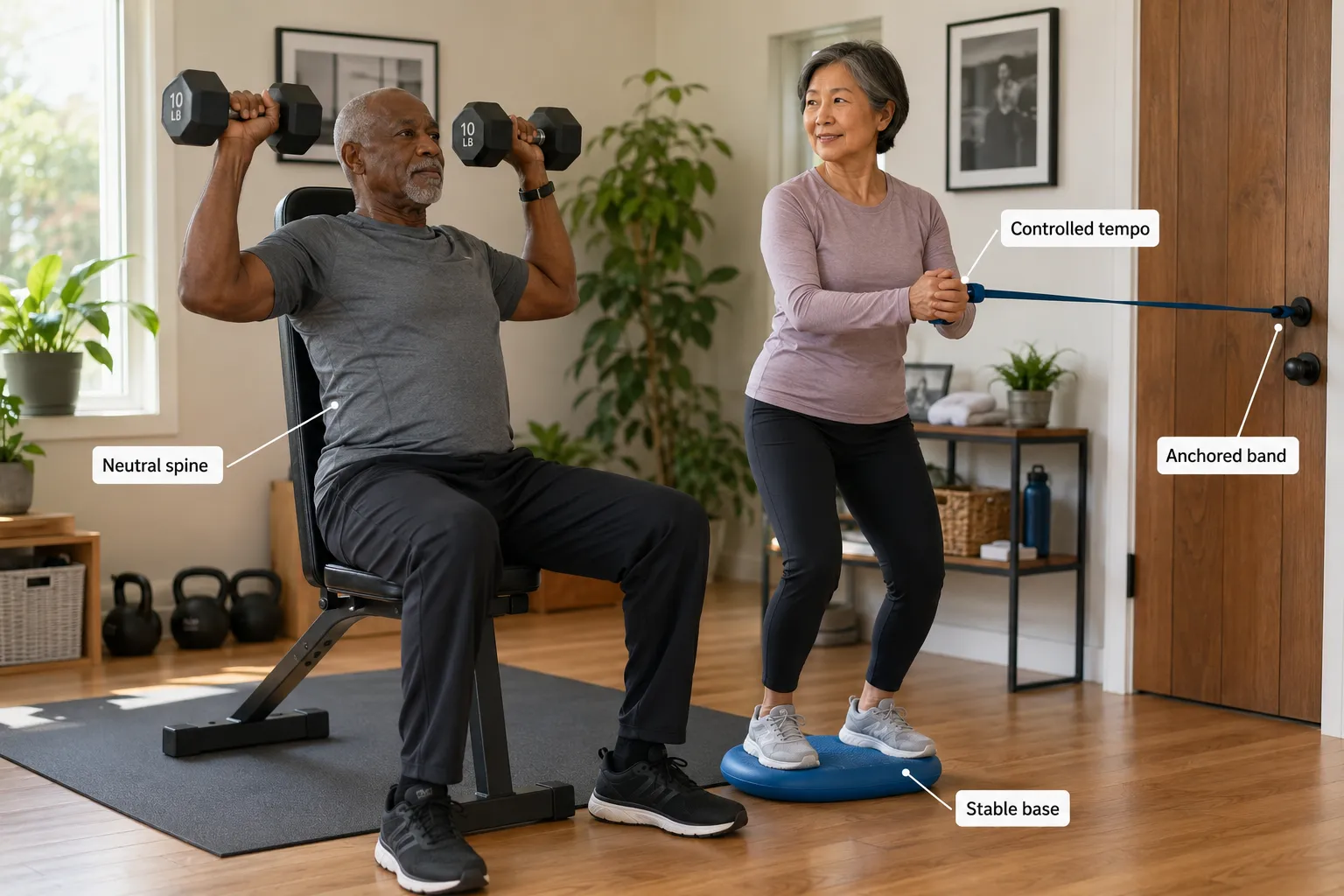
Most beginners over 40 should start around 5-10 lb per hand for shoulder and arm work, 10-20 lb for chest presses and rows, and 15-25 lb per hand for goblet squats or Romanian deadlifts. The correct starting weight is the one that lets you complete 10-12 controlled reps with 2-3 left in the tank. Adjustable dumbbells that span roughly 5-50 lb per hand cover beginner through intermediate training.

Do resistance bands work if you're out of shape, and are they better for recovery?

Yes on both counts. Bands are ideal for deconditioned beginners because the load starts near zero and builds gradually, which allows pain-free practice of movement patterns before adding weight [3][4][7]. They're also the better recovery tool: light banded mobility work after a session helps restore range of motion without adding joint load.

For people returning after a long layoff:

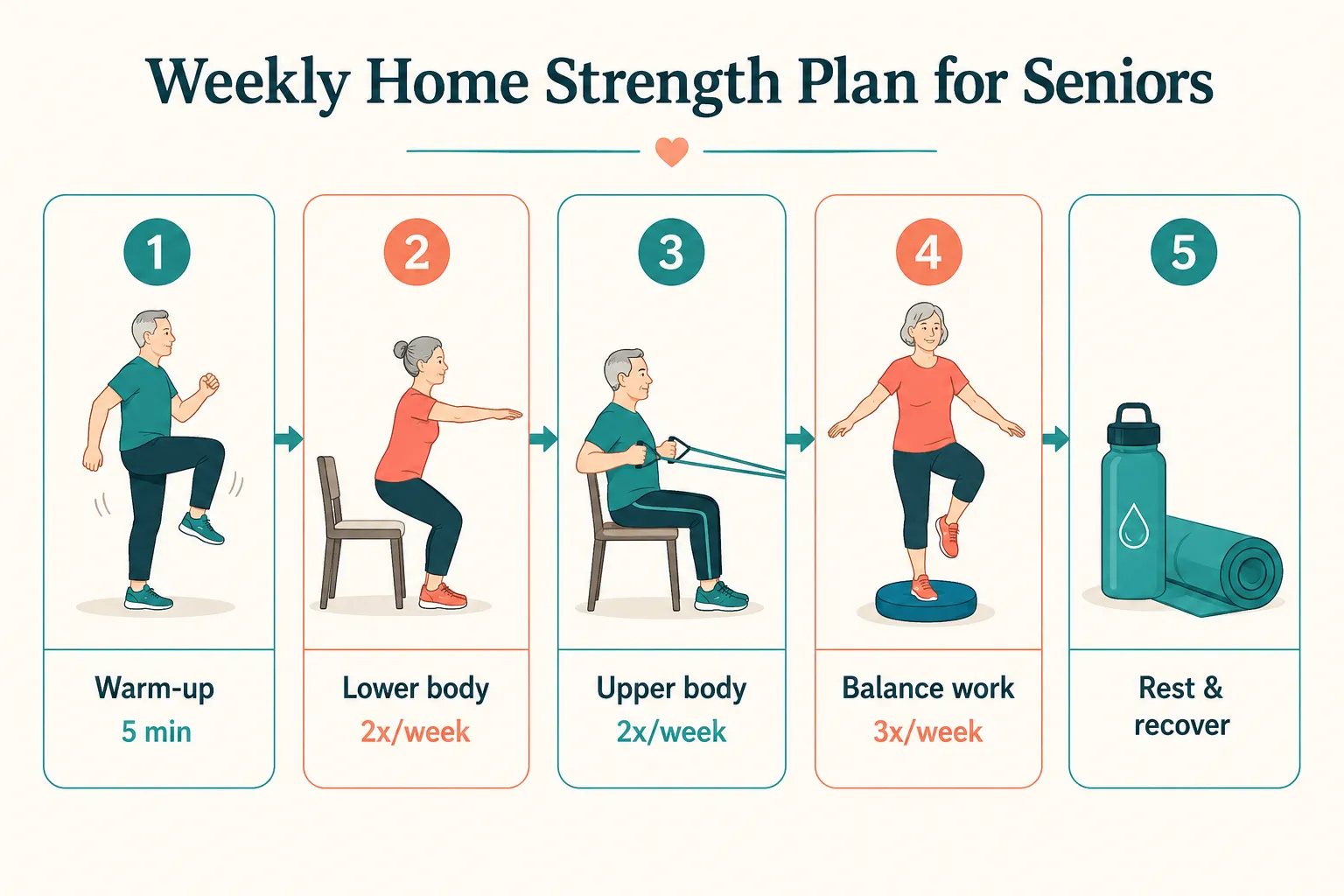
  • Weeks 1-2: bands only, 2 sessions, full body, 2 sets per exercise.
  • Weeks 3-6: add a third session, slow the tempo, add a set.
  • Week 7+: introduce light dumbbells for squats, rows, and presses.

For recovery and flexibility, use bands for assisted stretching (hamstring, hip flexor, lat), banded shoulder dislocates, and low-tension pull-aparts on rest days. Bands make stretching active rather than passive, which tends to hold range better.

FAQ

Are resistance bands enough for someone over 50?
Yes for general health, muscle maintenance, and function. Adding some heavier dumbbell work improves bone density and strength further [5][7].

How many days per week should a 40+ person strength train?
Two to three non-consecutive days per week covering the whole body. Frequency matters more than which equipment you own [7].

Do bands or dumbbells build more muscle?
Neither, when effort and volume are equal [1][2]. Dumbbells pull ahead only once you outgrow your heaviest band.

What's the best adjustable dumbbell weight range to buy after 40?
A pair spanning about 5 to 50 lb per hand covers beginner through intermediate training for several years.

Can resistance bands replace a gym membership?
For maintenance and general fitness, yes. For serious strength or size goals, a band-only setup will plateau.

How long do resistance bands last?
Typically 6-18 months with regular use. Replace any band with nicks, cracking, or sticky patches immediately.

Are bands safe to anchor in a door?
Only with a proper door anchor on a door that opens away from you, and only if the door is latched.

Which is better for arthritis?
Bands, generally, because they reduce load in compressed joint positions and allow pain-free angle adjustments [3].

Conclusion

The honest verdict on Adjustable Dumbbells vs Resistance Bands After 40 is that the tools answer different problems. Bands solve joint sensitivity, space, budget, and travel. Adjustable dumbbells solve progression, strength, and bone loading. Most people over 40 get the best outcome by starting with bands, proving consistency for 8-12 weeks, then adding a dumbbell pair.

Next steps:

  1. Buy a band kit with a door anchor this week and do two full-body sessions.
  2. Log every session, exercise, sets, reps, band color or tempo.
  3. At week 8, if you've trained at least 16 sessions, buy adjustable dumbbells spanning 5-50 lb per hand.
  4. Keep bands for warm-ups, shoulder and hip work, travel, and recovery days.
  5. Add weight in small jumps and take a lighter week every 6-8 weeks.

References

  1. Dumbbells vs. Resistance Bands. sweatpicks.com.
  2. Resistance Bands vs. Dumbbells. fitsmarthealth.com.
  3. Resistance Band Workout for Midlife Muscle. bodymotionlab.com.
  4. Resistance Bands vs. Dumbbells Over 40. purehomefit.com.
  5. Strength Training Equipment for Older Adults. activeagingwearables.com.
  6. Fitness Coach Recommends 5 Strength Training Tools Every Older Adult Needs for Stronger Muscles. hindustantimes.com.
  7. Resistance Training Benefits for Seniors. seniorstrength.today.
  8. Best Home Fitness Gear. qz.com.
  9. Functional Strength. thehealthyagingguide.com.
Best Minimal-Equipment Home Gym for Strength Training After 40: Bands, Dumbbells, and a Bench Compared

Best Minimal-Equipment Home Gym for Strength Training After 40: Bands, Dumbbells, and a Bench Compared

{"cover":"Professional landscape format (1536×1024) editorial hero image with SHORT bold text overlay (≤42 chars): 'Best Minimal-Equipment Home Gym', crisp white bold sans-serif on a deep navy semi-transparent panel, centered, 8% safe margins from every edge. Background: bright daylight photograph of a tidy spare-bedroom corner home gym, a pair of adjustable dumbbells on a light wood floor, a fold-flat black bench angled to incline, a neat coil of coloured resistance bands and a grey mat, large window with soft natural light, plants in the corner. Clean, airy, magazine-quality, navy-charcoal-and-warm-oak palette. No price text, no numbers, no checkmark grids.","content":["Three-panel labelled comparison guide, landscape 1536×1024, clean white background with teal-and-charcoal palette, editorial fitness-guide polish. Panel 1 heading 'Resistance Bands' with illustrated looped band and short bullet labels: 'Joint friendly', 'Variable tension', 'Travel ready', 'Low ceiling'. Panel 2 heading 'Adjustable Dumbbells' with illustrated dial-adjust dumbbell and labels: 'Heavy loading', 'Small jumps', 'All five patterns', 'Space saving'. Panel 3 heading 'Adjustable Bench' with illustrated incline bench and labels: 'Incline press', 'Supported rows', 'Hip thrusts', 'Folds flat'. Thin callout lines point to each detail. No prices, no numbers grids.","Annotated documentary photograph, landscape 1536×1024, warm natural light: a 50-something Black woman performing a dumbbell Romanian deadlift beside a bench in a small apartment living room, flat back, dumbbells close to shins, soft morning window light, shallow depth of field. Four short white callout labels with thin leader lines point to: 'Neutral spine', 'Hinge at hips', 'Weights close', 'Soft knees'. Realistic editorial sports photography, muted sage and oak tones, no text panels, no numbers.","Numbered five-step flow diagram, landscape 1536×1024, flat vector illustration on a pale cream background with burnt-orange and deep-green accents. Five numbered cards left to right, each with a simple icon and a short caption label: '1 Squat', '2 Hinge', '3 Push', '4 Pull', '5 Carry', icons show goblet squat, Romanian deadlift, incline dumbbell press, single-arm bench row, suitcase carry. A slim arrow band beneath labelled 'Three days per week'. Crisp geometric line art, generous white space, no prices, no data grids."}

Professional landscape hero image () with a reading "Best Minimal-Equipment Home Gym". CRITICAL TYPOGRAPHY RULES: render the

Last updated: October 21, 2026

Quick Answer

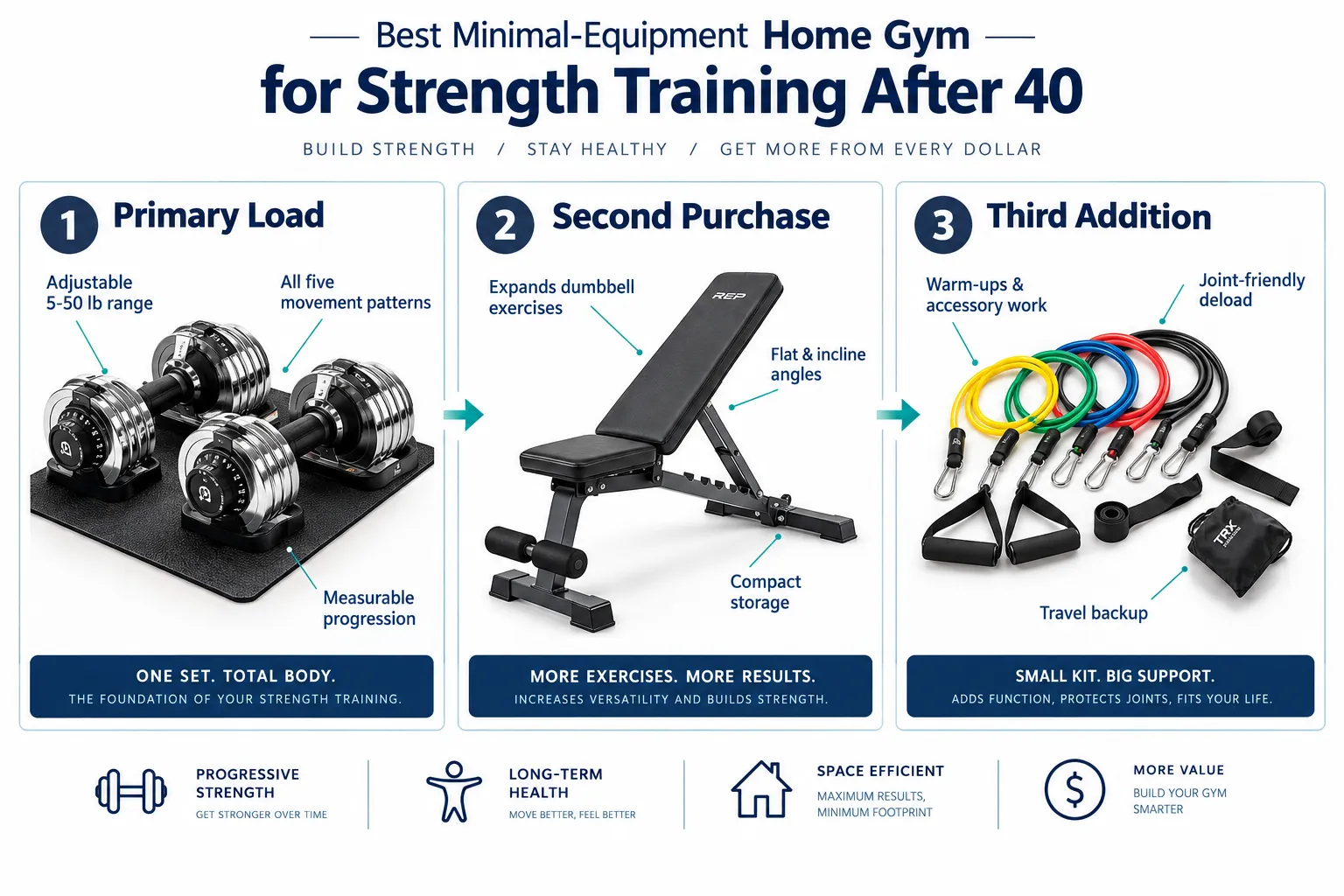
The best minimal-equipment home gym for strength training after 40, bands, dumbbells, and a bench compared, is one pair of adjustable dumbbells as the primary load, a fold-flat adjustable bench as the second purchase, and a set of resistance bands for warm-ups, accessory work, and joint-friendly days. Adjustable dumbbells win because a single pair covers squat, hinge, push, pull, and carry patterns while replacing a rack of fixed weights [1][2]. Bands are excellent but hit a practical ceiling around 50-60 lb equivalent, which limits heavy compound progression [3][4]. Total floor space needed: roughly 6 by 6 feet.

Key Takeaways

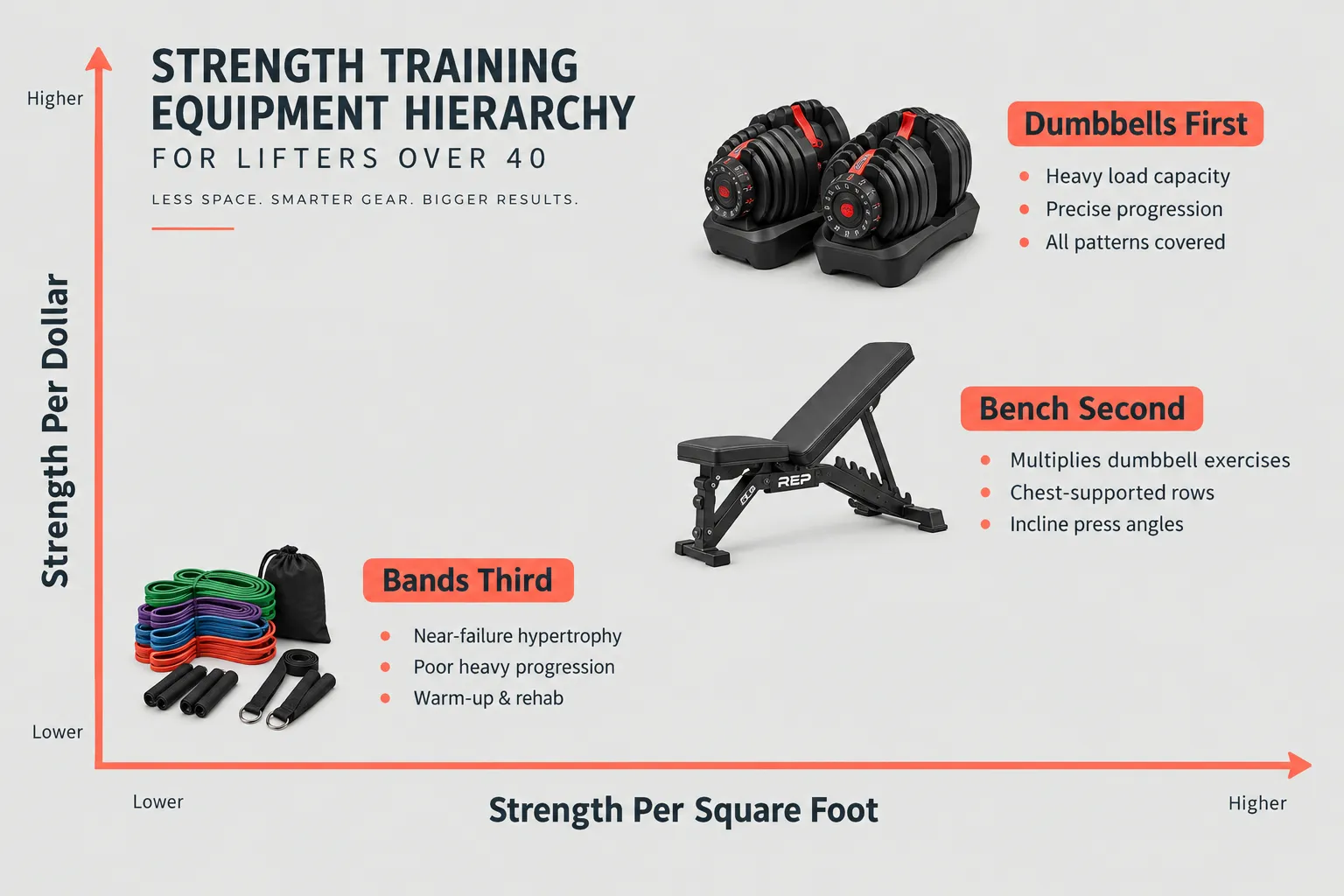
  • Dumbbells first, bench second, bands third. That order reflects how much strength each tool unlocks per dollar and per square foot [1].
  • Bands are not inferior for muscle growth when sets are taken near failure and volume is matched, but they're poor at heavy, measurable progression [3].
  • A bench multiplies what one pair of dumbbells can do: incline press, supported rows, hip thrusts, split squats, step-ups [1][5].
  • Three non-consecutive days per week, 8-15 reps, 60-90 seconds rest, is the standard template for lifters over 40.
  • Progression rule: add reps to the top of the range, then increase weight and drop back to the bottom.
  • 6 x 6 feet is enough for a full setup; gear can store under a bed or in a closet [6][7].
  • For shoulder or knee pain, bands and neutral-grip dumbbell work are the safest entry points [3][8].
  • Expect strength gains in 3-4 weeks, visible changes in 8-12 weeks.

Why are resistance bands and dumbbells better for strength training after 40?

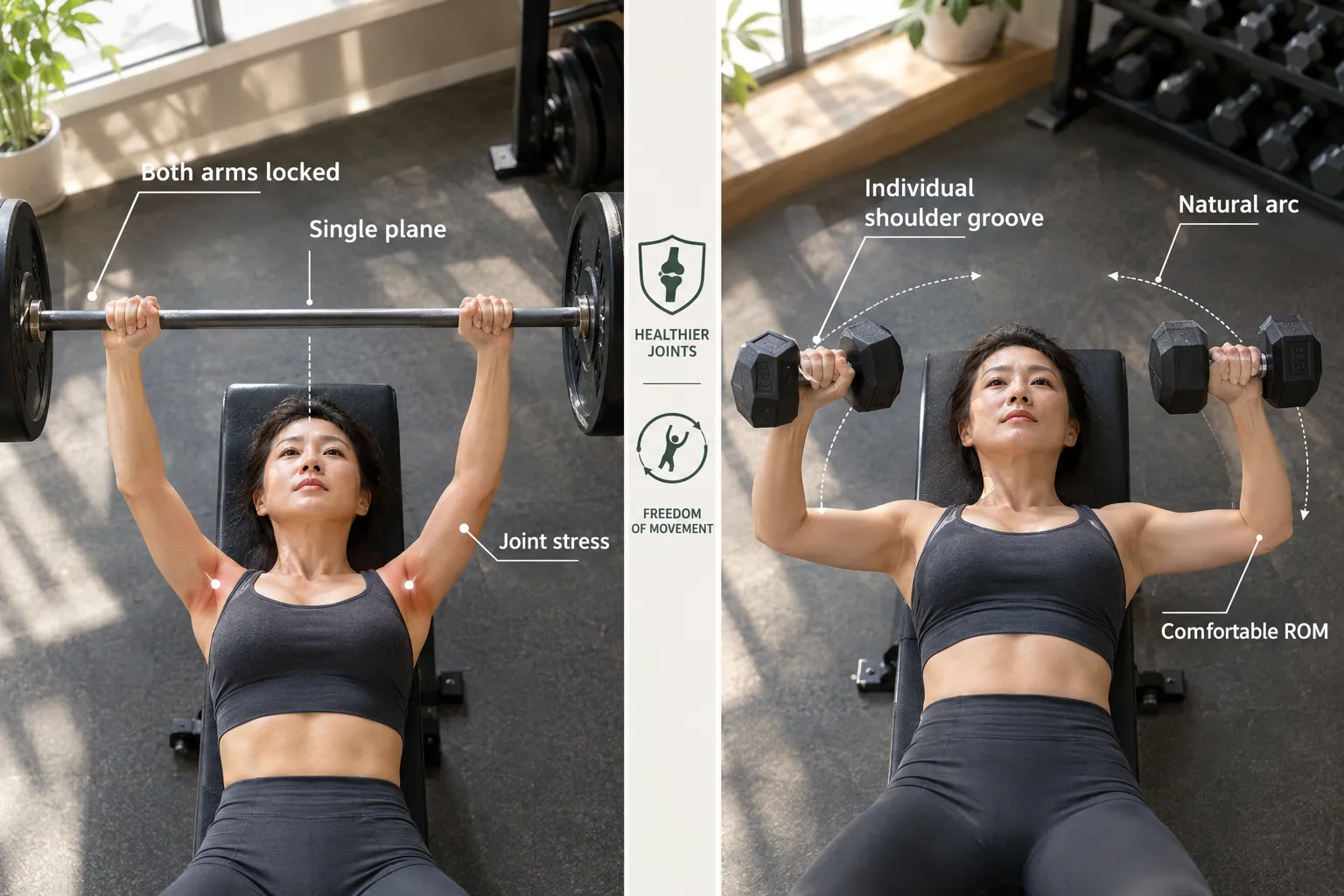
Bands and dumbbells suit lifters over 40 because they let you control load precisely, train through comfortable ranges of motion, and avoid the fixed paths that aggravate aging joints. Barbells force both arms into one bar path. Dumbbells let each shoulder find its own groove.

The second reason is recovery. After 40, recovery capacity drops before strength does. A minimal setup makes it easy to tune volume down on a stiff week without skipping the session entirely, swap a heavy dumbbell press for a band press and keep the pattern.

Decision rule: choose dumbbells as the primary load if your goal is measurable strength and muscle. Choose bands as the primary load only if joint pain currently limits you from holding or lowering free weights safely [3][8].

Why are resistance bands and dumbbells better for strength training after 40?

Can you actually build muscle with just dumbbells and bands at 40 plus?

Yes. When weekly volume and progressive overload are matched, bands, dumbbells, machines, and bodyweight produce broadly similar strength and hypertrophy outcomes. The equipment is rarely the limiting factor, consistency and effort are.

What differs is the ceiling. Dumbbells allow heavier absolute loads and finer jumps in weight, which drives long-term adaptation [3][4]. Bands mimic cable-machine isolation work and work well for growth if taken close to failure [3].

Bands provide variable resistance that increases as they stretch; dumbbells provide relatively constant resistance through the range of motion [3][8]. Different tools, same muscle.

Common mistake: training bands at a comfortable tension for 20 easy reps. If the last two reps aren't genuinely hard, the set did little.

Do I really need a weight bench, or can I skip it?

You can start without one, but a bench is the single biggest upgrade after dumbbells. An adjustable bench dramatically expands what one pair of dumbbells can do, flat and incline presses, chest-supported rows, hip thrusts, split squats, step-ups, without adding machines [1][5].

Skip the bench if:

  • You have under 4 feet of clear floor and no storage.
  • You're in month one and still building the habit [7][9].

Buy the bench if:

  • You want vertical pressing variety without overhead strain.
  • Floor presses are irritating your wrists or limiting range.

Fold-flat benches that store vertically give most of the benefit while preserving floor space [5].

What dumbbell weight should I start with at my age?

Pick a weight range, not a single weight. For most untrained adults over 40, a pair of adjustable dumbbells spanning roughly 5-50 lb per hand covers the first two to three years of training. Age matters far less than training history.

Rough starting loads for a 10-rep set:

Movement Typical starting load (per hand)
Goblet squat 15-30 lb (single bell)
Romanian deadlift 15-25 lb
Incline press 10-20 lb
Single-arm row 15-25 lb
Lateral raise 5-10 lb

The correct weight is one where rep 10 is hard but your form doesn't break. Edge case: if you can do 20 clean reps, the dumbbell is too light to matter.

How much space do you actually need for a minimal home gym?

About 6 by 6 feet of clear floor and 7 feet of ceiling height. That's enough to press, row, lunge, and carry. Apartment-friendly layouts in current minimalist guides use an office corner or bedroom area with adjustable dumbbells, a fold-flat bench, and a compact band set [1][6][7].

Storage notes:

  • Adjustable dumbbells sit in a cradle roughly the footprint of a shoebox pair.
  • Fold-flat benches store upright against a wall or under a bed [5].
  • Bands fit in a drawer; anchor them to a door for pulls and pulldowns.
  • Add a jump rope or walking pad for conditioning if space allows [6][7].

Adjustable dumbbells vs fixed weights for a small apartment

Adjustable dumbbells win in apartments, full stop. One pair replaces 10-15 fixed pairs and occupies a fraction of the floor [1][2]. Fixed dumbbells only make sense if you have dedicated space, want faster set changes for drop sets, or find a cheap used set.

Factor Adjustable Fixed
Footprint Very small Large rack needed
Change speed 5-15 seconds Instant
Durability More moving parts Nearly indestructible
Cost per pound Lower overall Higher for full range
Drop-friendly No Yes

Choose dial-adjust models if speed matters; choose selectorized pin or spinlock if budget matters more than convenience [9][10].

Three budget tiers for a minimal home gym

Start where your budget and confidence actually are, then upgrade. Cost-focused guides describe an essential three-item kit, mat, bands, adjustable dumbbells, with a bench and pull-up bar as second-tier purchases [9][10].

Tier 1, Starter (bands-led). Floor mat, full band set with handles and a door anchor, one adjustable dumbbell or kettlebell. Mat roughly €20-30, bands roughly €15-20 [9][10]. Enough for every movement pattern at moderate load. Good for anyone new to lifting after 40 [9].

Tier 2, Core (recommended for most). A pair of adjustable dumbbells plus the Tier 1 kit. Dumbbell cost ranges widely depending on the adjustment mechanism, roughly €60-350 [9][10]. This is where real progressive overload begins.

Tier 3, Complete. Tier 2 plus a fold-flat adjustable bench and a doorway pull-up bar. A bench plus free weights supported by bands is the smallest genuinely complete long-term setup [1][5].

Best resistance bands for joint pain, arthritis, shoulder or knee issues

For joint pain or arthritis, choose flat loop bands and tube bands with padded handles over thin therapy bands, and favor a graded set (light to heavy) so you can dial tension to the day. Bands are especially useful for functional strength around joints, core stability, and returning from injury [3][8].

What to look for:

  • Padded or thick handles, reduces grip strain with arthritic hands.
  • A door anchor, lets you train pulls and presses without overhead loading.
  • At least four tension levels so you can deload without stopping.
  • Fabric loop bands for hips and glutes; they don't roll or pinch skin.

For shoulder issues: neutral-grip dumbbell presses, landmine-style angled pressing, and band pull-aparts are the safest. For knee issues: hip hinges, hip thrusts, and box step-ups to a comfortable height beat deep lunges. Bands and lighter dumbbells also work well on low-stress days for deloads and joint care while keeping the same patterns.

What exercises should I avoid after 40, and how often should I train?

Nothing is universally banned, but a few movements carry a poor risk-to-reward ratio for most lifters over 40. Train three non-consecutive days per week, 8-15 reps per set, with 60-90 seconds rest.

What exercises should I avoid after 40, and how often should I train?

Approach with caution or substitute:

  • Behind-the-neck presses and pulldowns → overhead or neutral-grip presses.
  • Upright rows with a narrow grip → lateral raises.
  • Deep barbell back squats to failure → goblet squats, split squats.
  • Ballistic sit-ups and loaded spinal flexion → dead bugs, carries, planks.
  • Heavy behind-the-back shrugs → farmer's carries.

Emphasize posterior-chain work, Romanian deadlifts, hip thrusts, hinges, to protect the back and maintain functional strength.

What does a minimal-equipment program actually look like?

Build every session around the five patterns: squat, hinge, push, pull, carry. Three days a week, full body, same patterns each session with rotating variations.

What does a minimal-equipment program actually look like?

Sample session (45 minutes):

  1. Warm-up: band pull-aparts, band hip walks, bodyweight squats, 5 minutes.
  2. Goblet squat, 3 x 8-12.
  3. Dumbbell Romanian deadlift, 3 x 10-12.
  4. Incline dumbbell press, 3 x 8-12.
  5. Single-arm bench-supported row, 3 x 10-12 per side.
  6. Suitcase carry, 3 x 30 seconds per side.
  7. Finisher: band face pulls or band curls, 2 x 15.

Progression: add reps until you hit the top of the range (often 12-15), then raise the dumbbell weight and drop back to the low end. Use bands for high-rep accessory sets, warm-ups, and mobility, not as the main progressive-overload tool for compounds [3].

Common mistakes with minimal equipment, and can you get stronger without a barbell?

Yes, you can get genuinely strong without a barbell, most people over 40 never reach the load ceiling where a barbell becomes necessary. The usual failure points are effort and tracking, not hardware.

Mistakes to avoid:

  • Buying dumbbells that top out too light. A 25 lb max becomes useless within months.
  • Not logging sets. Without a record, progressive overload is guesswork.
  • Treating bands as the main load for squats and presses [3][4].
  • Skipping the hinge pattern because it feels awkward.
  • Training only arms and chest while ignoring back and glutes.
  • Random workouts. Same patterns, rotating variations, beats novelty.

How long before you see results, and is minimal equipment enough long-term?

Expect noticeable strength gains in 3-4 weeks (mostly neural), visible body composition changes in 8-12 weeks with consistent training and adequate protein. Strength shows up long before the mirror does.

Minimal equipment stays enough for most people indefinitely. The "single tool plus accessories" model, adjustable dumbbells, a bench, bands, delivers close to commercial-gym utility without the space or recovery demands of heavy barbell work [1].

You may eventually want more if: you're pressing near your dumbbell maximum for 12+ reps, you want to compete in powerlifting, or you specifically want heavy barbell squats and deadlifts. In that case, add a rack and barbell, but that's a year-three problem, not a day-one one.

FAQ

Are resistance bands as effective as dumbbells?
For muscle growth with matched volume and effort, yes. For maximal strength, no, bands cap out around 50-60 lb equivalent resistance [3][4].

What's the single best piece of equipment for a home gym after 40?
A pair of adjustable dumbbells. One pair covers squat, hinge, push, pull, and carry patterns [1][2].

Can I do a full workout with only bands?
Yes. Bands cover every movement pattern and work well for joint-friendly training, travel, and rehab [3][8].

How many days a week should someone over 40 lift?
Three non-consecutive days per week is the standard recommendation for over-40 strength programs.

Is a flat bench enough, or do I need adjustable?
Adjustable is worth it. Incline pressing reduces shoulder strain compared with flat pressing for many lifters, and incline adds angles a flat bench can't [1][5].

What if I have no bench at all?
Use a sturdy chair or the floor. Floor presses, chair step-ups, and chair-supported rows cover most of it.

Do I need a pull-up bar?
Not initially. Band pulldowns through a door anchor cover vertical pulling until you add one [9][10].

How long should each session take?
Forty-five minutes, including warm-up. Longer sessions rarely improve results for recreational lifters.

Should I buy used dumbbells?
Fixed dumbbells, yes, they're nearly indestructible. Adjustable models have moving parts, so inspect the mechanism before buying.

Conclusion

The practical answer to the bands versus dumbbells versus bench question is sequencing, not picking a winner. Buy adjustable dumbbells first because they carry heavy, measurable load across all five movement patterns. Add a fold-flat bench second because it multiplies the exercises those dumbbells can do. Keep bands permanently for warm-ups, accessory volume, and the weeks when your shoulders or knees need a lighter option.

Next steps:

  1. Measure a 6 x 6 foot area and confirm ceiling clearance.
  2. Pick your tier, bands-led starter, dumbbell core, or complete with bench.
  3. Buy adjustable dumbbells that reach at least 40-50 lb per hand.
  4. Schedule three non-consecutive training days this week.
  5. Log every set, and add reps before adding weight.
  6. Reassess at 12 weeks, not 12 days.

References

  1. Home Gym Setup. athleex.com.
  2. Minimalist Home Gym. manofmany.com.
  3. Resistance Training Equipment Comparison. health-habits.com.
  4. Resistance Bands vs. Dumbbells. gym4home.com.
  5. Best House Gym. ritfitsports.com.
  6. Minimalist Home Gym. manofmany.com.
  7. Home Gym Equipment Essentials. zing.coach.
  8. Trainer Tip Resistance Bands Dumbbells Strength Training. today.com.
  9. Home Gym for Beginners. repandrecovery.com.
  10. Equipamiento Gimnasio En Casa. casagym.es.

3-Day Full-Body Strength Routine for Busy Professionals Over 40: 30-45-Minute Workouts

Cover Image

Last updated: October 15, 2026

Quick Answer

A 3-Day Full-Body Strength Routine for Busy Professionals Over 40: 30-45-Minute Workouts works by training five movement patterns (squat, hinge, push, pull, carry) on three non-consecutive days, using supersets to fit real strength work into 30-45 minutes. Two to three sets per pattern, 6-12 reps, stopping 1-3 reps shy of failure, is enough stimulus for most adults over 40. The CDC and Mayo Clinic both recommend training all major muscle groups at least twice weekly; three days adds margin without adding fatigue [1][6]. You can run the whole program with a pair of adjustable dumbbells and one resistance band.

Key Takeaways

  • Three non-consecutive days (Monday/Wednesday/Friday is the classic layout) hits every muscle group two to three times a week.
  • 30-45 minutes is sufficient when you cut rest with supersets and skip isolation fluff.
  • Compound lifts win after 40: squats, hinges, presses, rows, and carries build the strength that protects joints and bones [3][10].
  • Minimum effective dose beats maximum effort. Two to three hard sets per pattern, not twenty junk sets.
  • Strength and cardio aren't interchangeable. Both matter, but strength is the one most people over 40 skip [4].
  • Expect strength gains in 2-4 weeks (mostly neural), visible changes in 8-12 weeks.
  • Joint pain is usually a reason to modify, not quit, change range, load, or tool, and keep training.
  • A trainer is optional, but 2-3 form sessions early on is the highest-value coaching money you can spend.
  • Progress without adding time by adding load, reps, or slowing the lowering phase, not by making workouts longer.

What is a full-body strength routine, and why is it better than split workouts?

A full-body strength routine trains all major muscle groups in a single session instead of dividing them across separate "chest day" or "leg day" workouts. For busy professionals over 40, it's usually better because each muscle group gets hit two to three times per week even if you only train three days, and missing one session doesn't leave a body part untrained for ten days.

Section Image

Body-part splits were built for people training five or six days a week. If you train three, a split means your back gets one stimulus every seven days. That's a slow way to build anything.

)

Why full-body wins on a three-day schedule:

  • Higher weekly frequency per muscle with the same total time.
  • Built-in redundancy. A missed Wednesday still leaves two full-body sessions that week.
  • Better fatigue distribution. No single joint or muscle takes a brutal beating in one session.
  • Simpler planning. One template, repeated, with small weekly adjustments.

Choose a split only if you're training four or more days a week and genuinely enjoy longer, more specialized sessions. Otherwise, full-body is the higher-return choice.

How much strength can you build in just 30 to 45 minutes?

More than most people assume. Strength adaptation depends on load, effort, and consistency, not session length. A 35-minute workout with six hard compound sets produces most of the benefit of a 75-minute workout with twenty sets, because the first few hard sets per muscle group do the heavy lifting.

Research in older adults consistently shows that structured resistance programs over roughly 12 weeks produce meaningful gains in strength and physical function, often more dramatic in function than in body composition [5][7]. Translation: you'll feel stronger and move better well before the mirror catches up.

What fits in 40 minutes:

Block Time What happens
Warm-up 5 min Joint circles, bodyweight squats, band pull-aparts
Superset A 10 min Squat pattern + upper-body pull
Superset B 10 min Hinge pattern + upper-body push
Finisher 8 min Carry or core + one accessory
Cool-down 3 min Breathing, light stretching

Common mistake: spending 12 of 40 minutes scrolling a phone between sets. Set a timer for 60-90 seconds of rest and keep it running.

Best exercises for building muscle after 40

The best exercises after 40 are loaded compound movements that cover multiple joints at once: goblet squats, Romanian deadlifts, dumbbell presses, rows, split squats, and loaded carries. They deliver the most muscle and bone stimulus per minute, and they're easier on joints than heavy single-joint work because load is shared.

Core movement library:

  • Squat pattern: goblet squat, box squat, split squat, step-up
  • Hinge pattern: dumbbell Romanian deadlift, hip thrust, band pull-through
  • Horizontal push: dumbbell floor press, push-up (elevated if needed)
  • Vertical push: half-kneeling dumbbell press, landmine press
  • Horizontal pull: one-arm dumbbell row, band row, inverted row
  • Vertical pull: band lat pulldown, assisted pull-up
  • Carry/core: suitcase carry, farmer's carry, dead bug, side plank

Harvard Health's guidance for starting resistance training emphasizes mastering the movement before loading it, and keeping the exercise list short enough to actually repeat week after week [3].

Decision rule: if an exercise requires more than 30 seconds of setup, it probably doesn't belong in a 35-minute session.

3-day workout split for busy professionals: the schedule

Train Monday, Wednesday, and Friday (or Tuesday/Thursday/Saturday) with at least one rest day between sessions. Each day is full-body but rotates emphasis so no pattern gets stale and recovery stays manageable.

)

Day 1, Squat emphasis

  1. Goblet squat, 3 × 8
  2. One-arm dumbbell row, 3 × 10 per side (superset with #1)
  3. Dumbbell floor press, 3 × 10
  4. Dumbbell RDL, 2 × 10 (superset with #3)
  5. Suitcase carry, 3 × 30 seconds per side

Day 2, Hinge emphasis

  1. Dumbbell RDL, 3 × 8
  2. Half-kneeling overhead press, 3 × 8 per side (superset with #1)
  3. Rear-foot-elevated split squat, 2 × 8 per side
  4. Band row, 3 × 12 (superset with #3)
  5. Dead bug, 3 × 8 per side

Day 3, Push/pull emphasis

  1. Push-up (or incline push-up), 3 × max-ish, leave 2 in reserve
  2. Band or assisted pull-down, 3 × 10 (superset with #1)
  3. Step-up, 2 × 10 per side
  4. Hip thrust, 2 × 12 (superset with #3)
  5. Farmer's carry, 3 × 40 seconds

Edge case: if your week collapses and you only get two sessions, run Day 1 and Day 2. Even one or two weekly sessions improve health markers; three is the sweet spot for building.

How often should I do full-body workouts per week?

Two to four times a week, with three as the target for most busy professionals over 40. Public health guidance from the CDC and Mayo Clinic recommends strength training all major muscle groups at least twice weekly; three sessions gives you more total volume while keeping a rest day between each [1][6].

Section Image

  • 2 days/week: maintenance plus modest gains. Fine during travel-heavy months.
  • 3 days/week: the practical optimum for strength, muscle, and bone.
  • 4+ days/week: diminishing returns unless sessions get shorter and more specialized.

Never stack full-body sessions back-to-back on consecutive days. Muscle protein synthesis and connective-tissue repair need roughly 48 hours, and recovery capacity tends to narrow slightly with age [7].

Can you get strong without going to the gym? Full-body routine at home

Yes. A home full-body strength routine builds real strength as long as you can keep progressively loading the movements. The limiting factor isn't the building, it's whether you own enough resistance to keep challenging yourself as you get stronger.

What equipment do I need for a home full-body strength routine?

)

  • Tier 1 (essential): one pair of adjustable dumbbells (ideally up to 50 lb each) and a long resistance band with a door anchor.
  • Tier 2 (big upgrade): a sturdy adjustable bench, a mini loop band set, a pull-up bar.
  • Tier 3 (optional): kettlebell, landmine attachment, weight vest.
  • Zero-equipment option: push-up variations, split squats, single-leg hinges, inverted rows under a table, slow tempo, and short rest. Effective for 8-16 weeks, then load becomes the bottleneck.

The CDC's Growing Stronger program was designed specifically around home-based resistance training with minimal equipment, which is reasonable proof the model works [6].

Decision rule: buy adjustable dumbbells if you plan to train at home for more than three months. Bands alone are great for travel and pulling patterns, weaker for heavy squat and hinge loading.

What's the difference between strength training and cardio for over 40?

Strength training builds muscle, bone density, and joint stability; cardio builds heart and lung capacity. Both reduce health risk, but only strength training reverses the age-related muscle loss (sarcopenia) that begins around the fourth decade [10]. Over 40, strength is usually the bigger gap.

Strength training Cardio
Main gain Muscle, bone, tendon strength Aerobic capacity, heart health
Time per week 90-135 min (3 sessions) 150 min moderate
Age-40 priority Highest, muscle loss accelerates Important, but easier to accumulate
Can combine? Yes, finish lifts, then 10 min of intervals or walk daily

Baylor College of Medicine's guidance on exercising after 40 points toward prioritizing strength work and being cautious about piling on high-intensity bootcamp-style sessions, which raise injury risk without clearly better results [4]. The cleanest combination: three strength days plus daily walking, with one optional 15-minute interval session.

Common mistakes people over 40 make with strength training

The biggest mistake is training too hard on day one and too inconsistently thereafter. The second biggest is using machines and isolation exercises only, skipping the compound lifts that actually transfer to real life.

  • Starting at 90% intensity. Begin at a weight you could do 3-4 more reps with, then build.
  • No warm-up. Five minutes of joint prep meaningfully reduces strain risk.
  • Chasing soreness as proof. Soreness measures novelty, not progress.
  • Training through sharp joint pain. Dull muscle burn is fine; sharp, localized, or lingering pain is a signal to modify.
  • Never progressing. Same dumbbells for a year equals maintenance, not growth.
  • Skipping legs. Lower-body strength is the strongest predictor of staying independent later.
  • Only lifting slowly and light. Some moderately heavy work (6-8 reps) is important for bone and tendon.

Is full-body strength training safe for people with joint problems?

For most people, yes, and often it reduces joint pain, because stronger muscles distribute load away from the joint. The key is modifying the movement, not avoiding resistance. Anyone with an active injury, recent surgery, or a diagnosed joint condition should clear the program with a physician or physical therapist first [1][3].

Section Image

Modification playbook:

  • Knee pain: swap deep squats for box squats or step-ups; reduce depth before reducing load.
  • Shoulder pain: switch overhead pressing to landmine or neutral-grip floor press.
  • Low back pain: trade barbell deadlifts for hip thrusts and band pull-throughs; brace hard on carries.
  • Wrist pain: use dumbbells with a neutral grip or push-up handles.
  • Hip pain: shorten range on split squats and widen stance on hinges.

Quick example: a 52-year-old with knee osteoarthritis who can't squat below parallel can still make excellent progress with box squats to a 16-inch box, step-ups, and heavy carries, all three load the legs without deep knee flexion.

Do I need a personal trainer for a full-body routine?

No, but two to three sessions with a qualified trainer early on is the highest-return investment for anyone new to lifting after 40. A trainer's value is in form correction and load selection during weeks 1-4, not in supervising you forever.

Hire a trainer if:

  • You've never done a hinge or squat under load.
  • You have a previous injury or surgical history.
  • You've started three times and quit three times (accountability problem).

Skip the trainer if:

  • You've trained before and just need structure.
  • You can film your sets and self-check against reputable form guides.
  • Budget is tight, put that money into adjustable dumbbells instead.

How long before you see results from strength training over 40?

Expect noticeable strength gains in 2-4 weeks, better daily function in 6-8 weeks, and visible body composition changes in 8-12 weeks of consistent training. Early gains are largely neural, your nervous system learns to recruit muscle more efficiently before the muscle itself grows much.

Realistic timeline:

  • Weeks 1-2: coordination improves, soreness peaks, weights feel lighter.
  • Weeks 3-6: clear strength jumps, better posture, easier stairs and grocery carries.
  • Weeks 7-12: measurable muscle change, improved balance, clothes fit differently.
  • Months 4-12: bone density and tendon adaptations accumulate; strength keeps climbing more slowly.

Controlled studies in older adults running roughly 12 weeks typically show substantial improvements in functional capacity, sometimes with only modest changes in body composition over that window [5]. Use strength numbers and function tests as your primary metric, not the scale.

How do you progress a full-body routine without adding more time?

Add difficulty, not duration. The four levers that make a 35-minute workout harder without making it longer: more load, more reps, slower lowering, and shorter rest.

Progression ladder (apply in order):

  1. Add reps within your target range (8 → 10 → 12) at the same weight.
  2. Add load once you hit the top of the range for all sets, then drop back to the bottom rep count.
  3. Slow the eccentric to a 3-second lowering phase on the same weight.
  4. Shorten rest from 90 to 60 seconds between superset rounds.
  5. Upgrade the variation, goblet squat to front-rack squat, incline push-up to floor push-up, two-leg to single-leg.

Rotate one lever at a time, and change something roughly every two weeks. Supersets and full-body circuits are genuinely time-efficient, but be aware they feel considerably harder than straight sets at the same load, scale weight down 5-10% the first time you tighten rest.

What should I eat before and after a 30-minute strength workout?

Before: a small carbohydrate-and-protein snack 60-90 minutes out, or nothing if you train first thing and feel fine. After: a meal with 25-40 g of protein within a couple of hours. For a 30-minute session, timing matters far less than hitting your daily protein total.

Simple options:

  • Pre (60-90 min out): banana with Greek yogurt; toast with eggs; a small protein shake.
  • Pre (15-30 min out, if hungry): half a banana or a few dates.
  • Post: chicken and rice; eggs and toast; cottage cheese and fruit; whey shake plus a piece of fruit.
  • Hydration: 300-500 ml of water before, sips during.

Daily target for adults over 40 doing resistance training: roughly 1.2-1.6 g of protein per kg of body weight, spread across 3-4 meals. Training fasted is acceptable if you tolerate it, but strength output often drops slightly on heavy sets.

FAQ

How long should each workout actually take?
Thirty to forty-five minutes including warm-up. If you're consistently going past 50 minutes, you're resting too long or doing too many exercises.

Can I do the same three workouts every week?
Yes, for 8-12 weeks. Keep the exercises and change the load and reps. Then swap two or three variations to keep adapting.

Is three days a week enough to build muscle after 40?
Yes. Three full-body sessions give each muscle group three weekly stimuli, which exceeds the minimum twice-weekly recommendation from the CDC and Mayo Clinic [1][6].

Should I lift heavy or light weights over 40?
Both. Use moderately heavy loads (6-8 reps) for your main lifts and lighter, higher-rep work (10-15) for accessories. Stop 1-3 reps before failure.

Do I need to warm up if I'm short on time?
Yes. Five minutes minimum: joint circles, bodyweight versions of the day's first two lifts, and band pull-aparts. It's the cheapest injury insurance available.

What if I can only train twice some weeks?
Run the first two days of the template. Two sessions maintain and even build; just resume three when your schedule allows.

Will resistance bands alone build real strength?
Partially. Bands work well for pulling, pressing, and rehab-style work, but they're hard to load progressively for squats and hinges. Add dumbbells once bodyweight and bands stop feeling hard.

Should I add cardio on strength days or separate days?
Separate days or after lifting. Doing hard cardio before strength work reduces the quality of your main lifts.

Is soreness necessary for progress?
No. Soreness reflects unfamiliar movement, not effectiveness. Progress is better measured by load lifted, reps completed, and how daily tasks feel.

Can I start this routine with no training background?
Yes. Begin with bodyweight or the lightest dumbbell setting, two sets instead of three, and build to the full template over three to four weeks.

Conclusion

The case for a 3-Day Full-Body Strength Routine for Busy Professionals Over 40: 30-45-Minute Workouts comes down to arithmetic: three sessions, five movement patterns, two to three hard sets each, and supersets to compress the clock. That's enough to build strength, protect bone, and keep muscle you'd otherwise lose at an accelerating rate after 40 [10].

Your next steps:

  1. Pick three non-consecutive days this week and put them in your calendar as 45-minute blocks.
  2. Buy or locate one pair of adjustable dumbbells and one long band. That's the whole kit.
  3. Run Day 1 at a deliberately easy weight. Leave 3-4 reps in reserve so you learn the patterns clean.
  4. Log every set, exercise, weight, reps. Without a log you can't progress systematically.
  5. Reassess at week 4 and week 12. Track strength numbers and function (stairs, carrying, getting off the floor), not just the scale.
  6. Clear it with your doctor first if you have joint disease, cardiac history, or a recent injury [1].

Start lighter than your ego wants, show up three times a week, and add a little each fortnight. That's the entire method.

References

[1] Art 20046670 – https://www.mayoclinic.org/healthy-lifestyle/fitness/in-depth/strength-training/art-20046670
[2] Strength Training Basics – https://rightasrain.uwmedicine.org/body/exercise/strength-training-basics
[3] Guide To Starting A Strength Training Program – https://www.health.harvard.edu/healthy-aging-and-longevity/guide-to-starting-a-strength-training-program
[4] How To Exercise After 40 – https://blogs.bcm.edu/2025/09/11/how-to-exercise-after-40/
[5] Pmc12003923 – https://pmc.ncbi.nlm.nih.gov/articles/PMC12003923/
[6] Growing Stronger – https://www.cdc.gov/physicalactivity/downloads/growing_stronger.pdf
[7] Resistance Training For Older Adults Position.1 – https://www.nsca.com/contentassets/2a4112fb355a4a48853bbafbe070fb8e/resistance_training_for_older_adults__position.1.pdf
[8] S41999 026 01614 8 – https://link.springer.com/article/10.1007/s41999-026-01614-8?error=cookies_not_supported&code=c5691147-ad7a-400c-94d5-ec4e5b4ff5cb
[9] Why The Full Body Workout Reigns Supreme 5 – https://www.gq.com/story/why-the-full-body-workout-reigns-supreme-5
[10] How Can Strength Training Build Healthier Bodies We Age – https://www.nia.nih.gov/news/how-can-strength-training-build-healthier-bodies-we-age

Best Home Strength Training Equipment for Seniors: Safe, Space-Saving Options Reviewed

Best Home Strength Training Equipment for Seniors: Safe, Space-Saving Options Reviewed

Last updated: August 15, 2026

Quick Answer

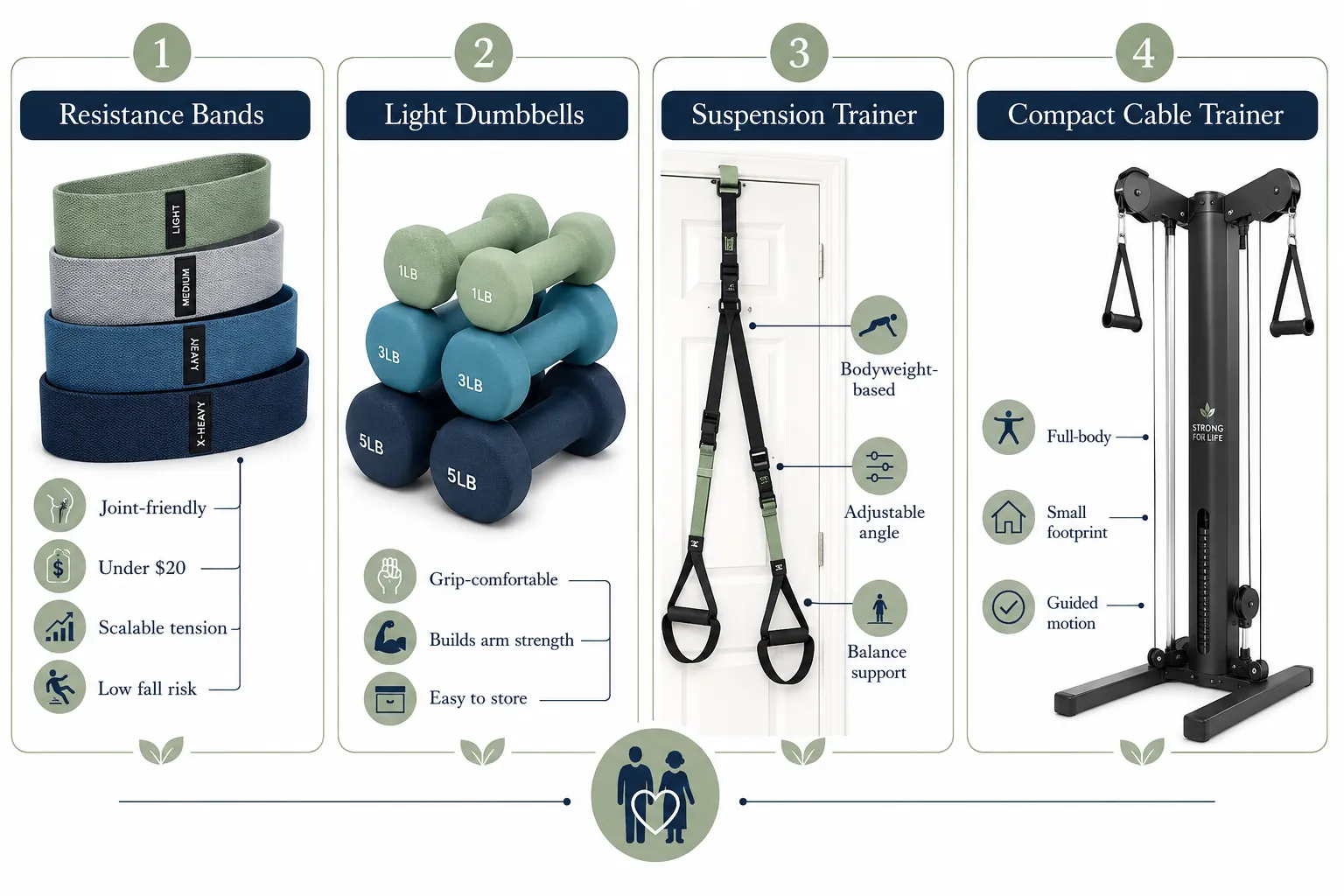
The best home strength training equipment for seniors combines safety, low joint impact, and small footprint. For most older adults, a starter kit of fabric resistance bands, light dumbbells (1-5 lb), a thick yoga mat, and a sturdy chair covers 90% of needs for under $55 [5][8]. Add adjustable dumbbells, a suspension trainer, or a compact cable system as strength improves. Resistance bands are widely called the "gold standard" for senior strength work because they're joint-friendly, scalable, and take up almost no space [10].

Key Takeaways

  • Start small: Bands + mat + light dumbbells cost $30,$55 and support strength, balance, and flexibility [5][8].
  • Bands beat dumbbells for most beginners due to gentler joint load and no drop risk [10].
  • Train 2 days a week minimum, hitting all major muscle groups [10].
  • Adjustable dumbbells (PowerBlock, Bowflex SelectTech) save the most space if you outgrow fixed weights [6].
  • Fabric bands over rubber, less snap risk and more comfort on skin [8].
  • Seated equipment (pedal exercisers, mini-ellipticals) works well for limited mobility [9][14].
  • Suspension trainers offer bodyweight resistance that scales with foot position, ideal for balance-focused strength.
  • Budget $150,$300 for a fully equipped senior home gym [8].
  • Consult a doctor before starting if you have heart, joint, or balance conditions [8].

What Strength Training Equipment Is Safe for Seniors?

The safest strength equipment for seniors shares three traits: low fall risk, controlled resistance, and forgiving joint load. Resistance bands, light dumbbells (1-5 lb), suspension trainers, and seated cable machines top the list because they let older adults build muscle without heavy loads dropping on feet or awkward barbell positions [1][10].

Safest categories for most seniors:

  • Fabric resistance bands, no snap risk, gentle on skin, scalable tension [8]
  • Light neoprene or hex dumbbells, coated grip, stable when set down [6]
  • Suspension trainers (TRX-style), resistance changes with body angle, no free weights overhead
  • Seated pedal exercisers and mini-ellipticals, zero fall risk, foldable [9][14]
  • Compact cable/functional trainers, guided motion path prevents form breakdown [3]

Avoid or delay: Olympic barbells, kettlebell swings, and plyo boxes over 12 inches unless you already train with a coach. The injury risk outweighs the benefit for most beginners over 65.

Best Compact Home Gym Equipment for Small Spaces

The best space-saving options for seniors fit in a closet or under a bed and still enable full-body strength work. Fabric bands, adjustable dumbbells, and door-anchored suspension trainers deliver the highest strength return per square foot [3][6].

Best Compact Home Gym Equipment for Small Spaces

Top compact picks for 2026:

Equipment Footprint Price Best For
Fabric resistance band set Drawer-size $15,$25 Beginners, arthritis [8]
Amazon Basics neoprene dumbbells Shelf ~$35 Fixed light weights [6]
Yes4All adjustable dumbbells Small floor space ~$79 Progressing lifters [6]
PowerBlock Elite adjustable 1 sq ft ~$299 Serious home gym, small space [6]
Bowflex SelectTech 552 1 sq ft ~$349 Convenience-focused [6]
Compact cable trainer Corner unit $400,$900 Full-body variety [3]

If you have less than 20 square feet, prioritize bands and one pair of adjustable dumbbells. That combo covers curls, presses, rows, squats, and deadlifts without ever needing a rack.

How Much Does Home Strength Training Equipment Cost?

Expect to spend $30,$50 to start and $150,$300 for a well-equipped senior home gym [8]. You do not need to spend more than that for excellent results.

Cost breakdown by tier:

  • Bare essentials ($30,$55): 3-4 fabric bands, yoga mat, light ankle weights [5][8]
  • Starter kit ($75,$150): Add fixed dumbbells (1, 3, 5 lb pairs) and a sturdy chair
  • Complete home gym ($150,$300): Add adjustable dumbbells or a suspension trainer, plus a stability ball [8]
  • Premium compact ($300,$700): PowerBlock or Bowflex adjustables, a foldable bench, and a mini cable system [6]

Decision rule: Spend on resistance tools first, cardio second. A June 2026 budget guide called dumbbells, bands, and racks the "big rocks" that deliver the most strength benefit per dollar [13].

Resistance Bands vs Dumbbells for Seniors: Which Is Better?

For most seniors, resistance bands win on safety and cost; dumbbells win on measurable progress. The right answer for you depends on grip strength, joint health, and how you like to track progress.

Choose resistance bands if you:

  • Have arthritis, weak wrists, or grip pain
  • Live in a very small space
  • Are new to strength training
  • Want the lowest injury risk [10]

Choose dumbbells if you:

  • Have healthy joints and good grip
  • Like seeing pound-by-pound progress
  • Prefer classic exercises (curls, presses, rows)
  • Already have a sturdy shelf for storage [1]

Most experts recommend using both. Bands handle rotator cuff work, lateral raises, and rehab-style moves. Dumbbells handle heavier compound lifts as strength grows [15].

Pull quote: "Resistance bands are the gold standard for senior strength training because they are joint-friendly, scalable, and space-saving." [10]

What Weight Should Seniors Lift at Home?

Most seniors should start with 1-5 lb dumbbells and light-to-medium resistance bands, then progress based on the "last 2 reps rule": the final two reps of a set should feel challenging but doable with good form [1][15].

Starter loads by exercise:

  • Biceps curls: 2-5 lb
  • Shoulder press: 1-3 lb
  • Triceps extensions: 1-3 lb
  • Bent-over rows: 3-8 lb
  • Squats (holding weight): bodyweight first, then 3-5 lb

Progress by adding 1-2 lb only after you can do 12-15 clean reps for two sets. There is no reward for lifting heavy at the cost of form, the goal is muscle preservation and function, not a personal record.

Can Seniors Build Muscle With Bodyweight Exercises?

Yes. Seniors can absolutely build muscle with bodyweight alone, especially in the first 6-12 months of training. Sit-to-stands, wall push-ups, step-ups, glute bridges, and modified planks stimulate the same muscle fibers that dumbbells do, just at a lower absolute load.

High-value bodyweight moves for seniors:

  • Sit-to-stand from a chair (functional squat)
  • Wall push-ups (chest, shoulders, triceps)
  • Step-ups on a low, stable step (legs, balance)
  • Glute bridges on the floor or mat
  • Bird-dog (core stability)

Add a $15 resistance band to any of these and you effectively double the training options. Bodyweight is the smartest starting point when equipment budget is zero.

Best Home Strength Training Equipment for Arthritis

For seniors with arthritis, the best equipment reduces gripping force, avoids impact, and allows partial ranges of motion. Fabric bands with padded handles, foam-covered light dumbbells, and seated cable machines top the list [2][8].

Best Home Strength Training Equipment for Arthritis

Arthritis-friendly gear:

  • Fabric resistance bands with soft handles, no white-knuckle gripping
  • Neoprene-coated dumbbells, softer than iron, easier on hands [6]
  • Wrist and ankle weights, attach without gripping [5]
  • Pedal exercisers, seated, uses foot straps, not hands [14]
  • Foam rollers and stability balls, supported mobility work [2]

Skip: Kettlebells (thumb strain), thick barbell grips, and pull-up bars if you have shoulder or hand arthritis.

How to Set Up a Small Home Gym for Seniors

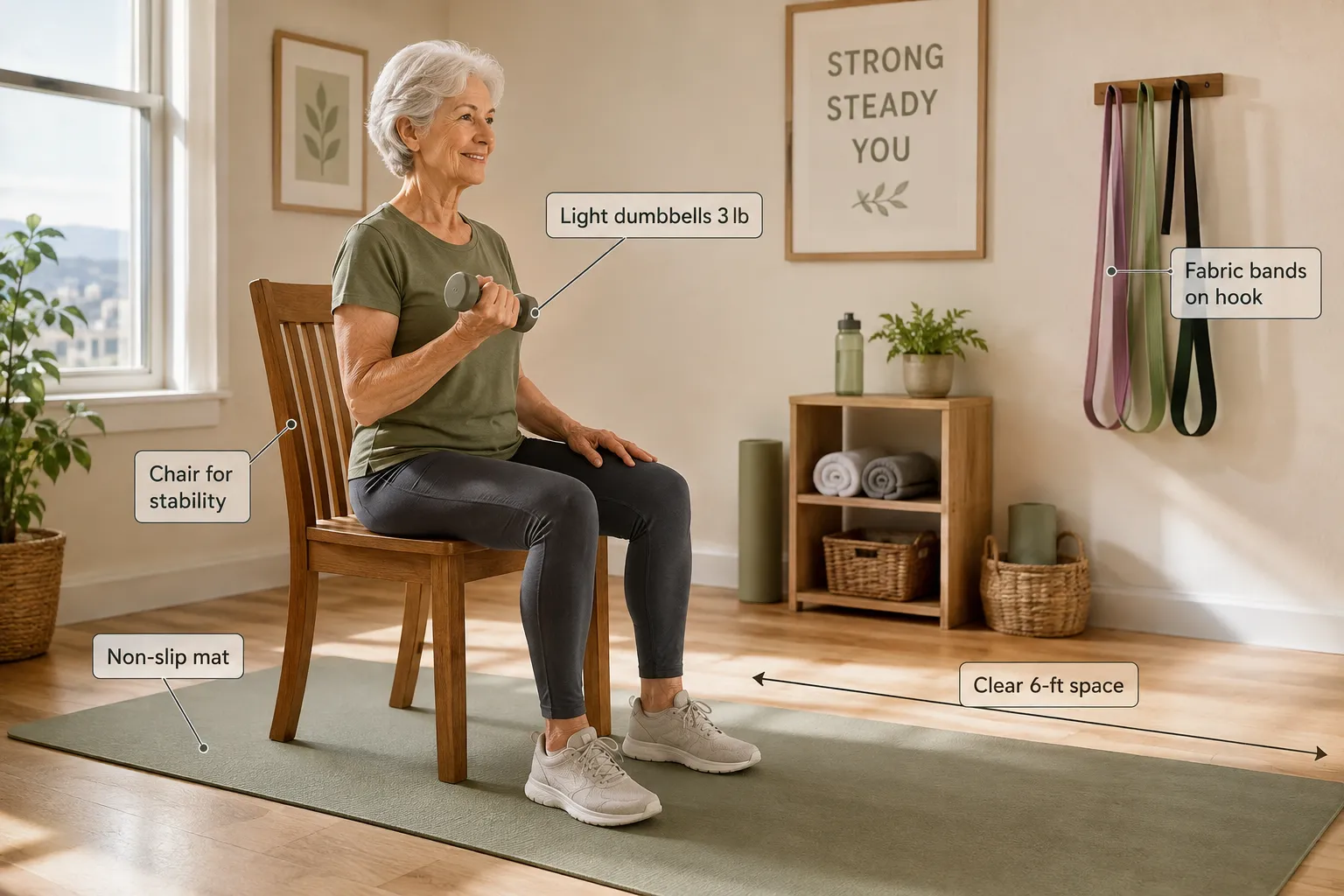
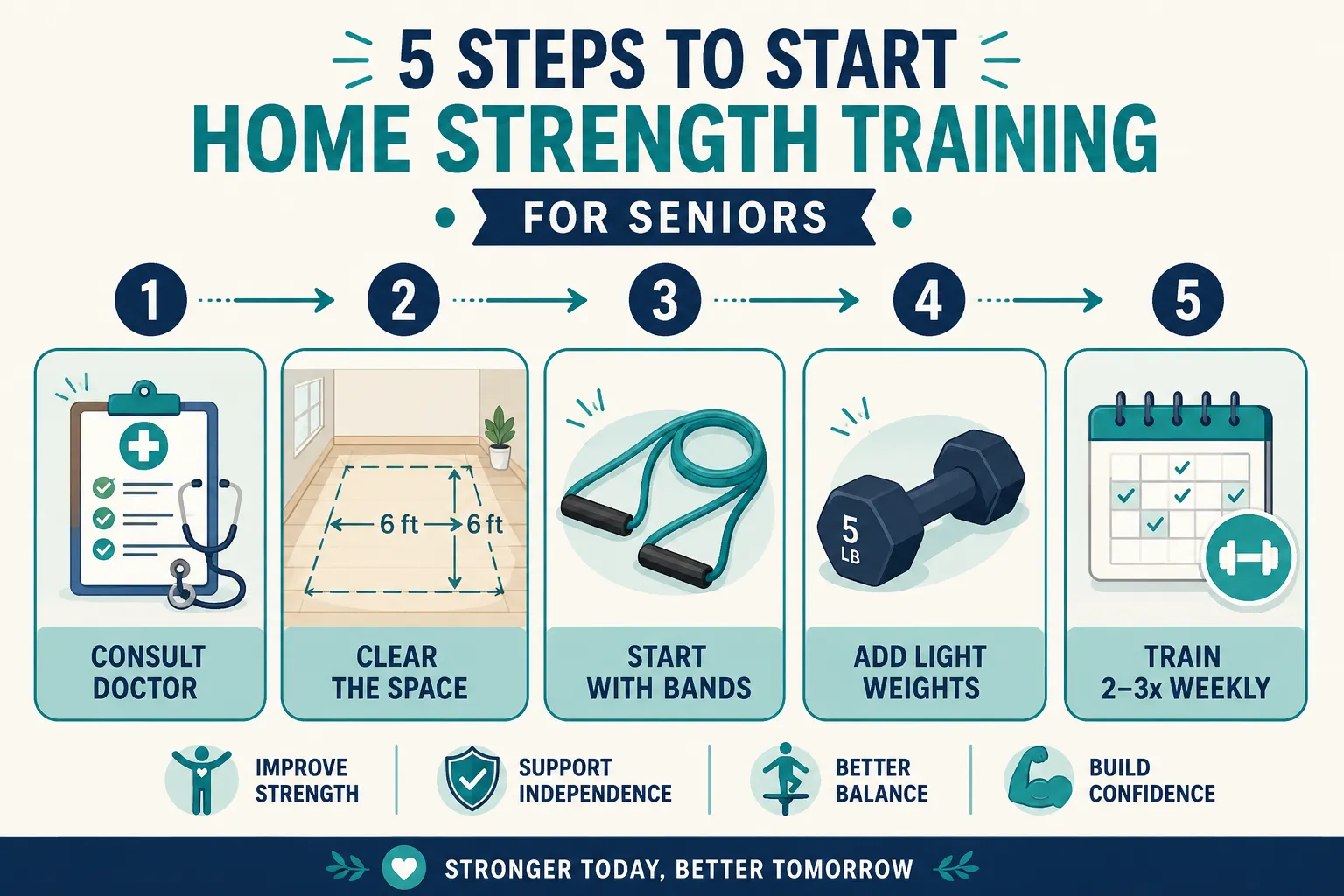
Setting up a senior home gym takes about 6 by 6 feet of floor space, good lighting, and one sturdy anchor point. Prioritize a non-slip surface and a chair for stability before adding any equipment [8].

How to Set Up a Small Home Gym for Seniors

Five-step setup checklist:

  1. Clear a 6×6 ft area with no rugs, cords, or clutter
  2. Add a non-slip mat (thick enough for floor exercises)
  3. Place a sturdy chair nearby for balance and seated exercises
  4. Install one wall hook for hanging bands and a suspension trainer
  5. Keep water and a phone within reach for hydration and safety

Lighting matters: Poor lighting causes falls. If your space is dim, add a lamp before you add equipment.

Best Home Strength Training Equipment for Seniors: Safe, Space-Saving Options Reviewed

Below are the top-rated space-saving picks for 2026, organized by budget and skill level.

Under $50, Beginner essentials:

  • Fabric resistance band set (3-4 tensions): $15,$25 [8]
  • Thick yoga mat: $20
  • Ankle weights (1-2 lb pair): $15 [5]

$50,$150, Intermediate additions:

  • Amazon Basics neoprene dumbbells (2, 3, 5 lb pairs): ~$35 [6]
  • Yes4All adjustable dumbbells: ~$79 [6]
  • CAP Barbell coated hex dumbbell set: ~$99 [6]
  • Stability ball: $25

$150,$400, Complete senior home gym:

  • PowerBlock Elite adjustable dumbbells: ~$299 (best for space saving) [6]
  • Bowflex SelectTech 552: ~$349 [6]
  • BalanceFrom foam plyo box (for step-ups): ~$100 [7]

$400+, Premium compact systems:

  • Compact cable/functional trainer: $500,$900 [3]
  • Foldable weight bench + adjustable dumbbells combo [4]

For most seniors, the best home strength training equipment for seniors: safe, space-saving options reviewed here comes down to a $150 kit, fabric bands, one pair of adjustable dumbbells, a mat, and a stability ball. That covers strength, balance, and flexibility for years.

Is Strength Training Safe for Seniors Over 70?

Yes, strength training is not just safe, it's essential, for adults over 70, provided you start light and get medical clearance if you have heart, joint, or balance issues [8][10]. Research consistently shows resistance training helps preserve independence, reduce fall risk, and maintain bone density into the 80s and beyond.

Safety rules for 70+:

  • Warm up 5 minutes before every session (marching in place works)
  • Never hold your breath during a lift, exhale on effort
  • Use a chair or wall for balance during standing exercises
  • Stop immediately if you feel chest pain, dizziness, or sharp joint pain
  • Rest 48 hours between sessions targeting the same muscles

Common Mistakes Seniors Make With Home Workouts

The most common home-workout mistakes among seniors are skipping warm-ups, choosing weights that are too heavy or too light, and training inconsistently. Each one blunts progress or invites injury.

Top mistakes to avoid:

  • Skipping warm-ups, cold muscles tear more easily
  • Ego-lifting, using 10 lb when 3 lb would be better form
  • Under-loading forever, sticking with 1 lb bands for months without progression
  • Ignoring the legs, arms get all the love, but legs prevent falls
  • Training once a week, below the 2x/week minimum for results [10]
  • No rest days, muscles grow during recovery, not during the workout
  • Poor form on squats, knees caving in, back rounding

How Often Should Seniors Do Strength Training at Home?

Seniors should strength train at least 2 days per week, targeting all major muscle groups, with 48 hours between sessions on the same body part [10]. Three sessions a week is ideal for most; four is fine if you split upper and lower body.

Sample weekly schedule:

  • Monday: Full-body strength (30 min)
  • Tuesday: Walk + balance work
  • Wednesday: Full-body strength (30 min)
  • Thursday: Rest or gentle stretching
  • Friday: Full-body strength (30 min)
  • Weekend: Active recovery (walk, garden, swim)

Each session should include 6-8 exercises, 2 sets of 10-15 reps. That's it. More is not better at this stage, consistency is.

Alternatives to Expensive Home Gym Equipment

You do not need a $2,000 rack to build strength at 65+. Effective alternatives cost under $100 combined and use household items you already own.

Household strength "equipment":

  • Full water bottles (1 liter ≈ 2.2 lb), DIY dumbbells
  • Canned goods, light hand weights for shoulder work
  • A sturdy kitchen chair, squats, step-ups, tricep dips
  • A backpack loaded with books, weighted squats and rows
  • Bath towels, DIY sliders for core work on hard floors
  • Stairs, the best free cardio and leg trainer

Pair these with a $20 band set and you have a functional home gym for under $40.

What if I Have Limited Mobility? Can I Still Strength Train at Home?

Yes. Seniors with limited mobility can build meaningful strength using seated equipment and supported exercises. Pedal exercisers, mini-ellipticals, resistance bands anchored to a chair, and light dumbbells performed while seated are all effective [9][14].

Best equipment for limited mobility:

  • RYGEO pedal exerciser (~4 lb, 5 resistance levels, arms or legs) [14]
  • Sunny or MERACH foldable mini-ellipticals (12-16 resistance levels, 300 lb capacity) [14]
  • Seated resistance band routines anchored under chair legs
  • Light dumbbells for seated curls, presses, and rows [1]

Focus on frequency over intensity. Even 10 minutes twice a day of seated resistance work preserves muscle and improves circulation.

FAQ

Q: What is the single best piece of strength equipment for a senior beginner?
A: A fabric resistance band set. It's under $25, joint-friendly, scalable, and enables 30+ exercises [8][10].

Q: Are adjustable dumbbells worth it for seniors?
A: Yes, if you plan to train for more than 6 months. PowerBlock or Bowflex adjustables replace 5-8 pairs of fixed dumbbells and save closet space [6].

Q: How long until seniors see results from home strength training?
A: Most seniors notice strength gains in 4-6 weeks and visible muscle tone in 8-12 weeks with 2-3 sessions per week.

Q: Do I need a weight bench?
A: No. A sturdy chair covers 90% of what a bench does for seniors. Add a foldable bench only if you outgrow chair-based exercises.

Q: Are smart home gyms like Tonal good for seniors?
A: They can work well for tech-comfortable seniors, but the $3,000+ price is hard to justify when a $150 kit produces similar strength results.

Q: Can I strength train if I have osteoporosis?
A: Yes, and you should, with medical clearance. Focus on controlled resistance band work and light dumbbells; avoid heavy loaded spinal flexion [8].

Q: How much space do I really need?
A: A 6×6 foot area is enough for a complete senior home gym setup.

Q: Are ankle weights safe for walking?
A: Only for exercise sets, not for daily walking. Continuous walking with ankle weights can strain hips and knees.

Conclusion

The best home strength training equipment for seniors is whatever you'll actually use twice a week. For most older adults, that starts with a $30,$55 kit of fabric bands, a mat, and light dumbbells, and grows only when you outgrow it. Adjustable dumbbells, suspension trainers, and compact cable systems are worthwhile upgrades, but they're not the entry point.

Your next steps:

  1. Clear a 6×6 ft area at home this week
  2. Order a fabric band set and one pair of light dumbbells (under $50)
  3. Schedule two 30-minute sessions on your calendar
  4. Get medical clearance if you have any chronic conditions
  5. Track your reps for 8 weeks, you'll be surprised what changes

Start light, stay consistent, and the equipment will earn its keep many times over.

References

[1] The Best Home Workout Equipment For Seniors – https://sonoffood.com/2026/04/16/the-best-home-workout-equipment-for-seniors/
[2] Best – https://www.theseniorlist.com/exercise/best/
[3] The Best Home Gym Equipment For Seniors In 2025 – https://gym-mikolo.com/blogs/home-gym/the-best-home-gym-equipment-for-seniors-in-2025
[4] Best Home Gyms – https://www.garagegymreviews.com/best-home-gyms
[5] Best Fitness Equipment Seniors – https://silverbloomhealth.com/supplements/fitness/best-fitness-equipment-seniors/
[6] 7 Best Home Gym Equipment For Seniors – https://homefitnessspace.com/7-best-home-gym-equipment-for-seniors/
[7] 14 Best Home Gyms For Older Adults In 2026 – https://babazam.com/vetted/14-best-home-gyms-for-older-adults-in-2026/
[8] Exercise Equipment For Seniors – https://vitalspage.com/articles/exercise-equipment-for-seniors
[9] Best Core Workout Equipment For Seniors – https://rebootedbody.com/best-core-workout-equipment-for-seniors/
[10] Best Home Fitness Equipment For Seniors – https://www.senioreaseguide.com/best/best-home-fitness-equipment-for-seniors

Top Home Exercise Equipment for Seniors Who Want Strength, Not Impact

Top Home Exercise Equipment for Seniors Who Want Strength, Not Impact

Last updated: August 13, 2026

Quick Answer

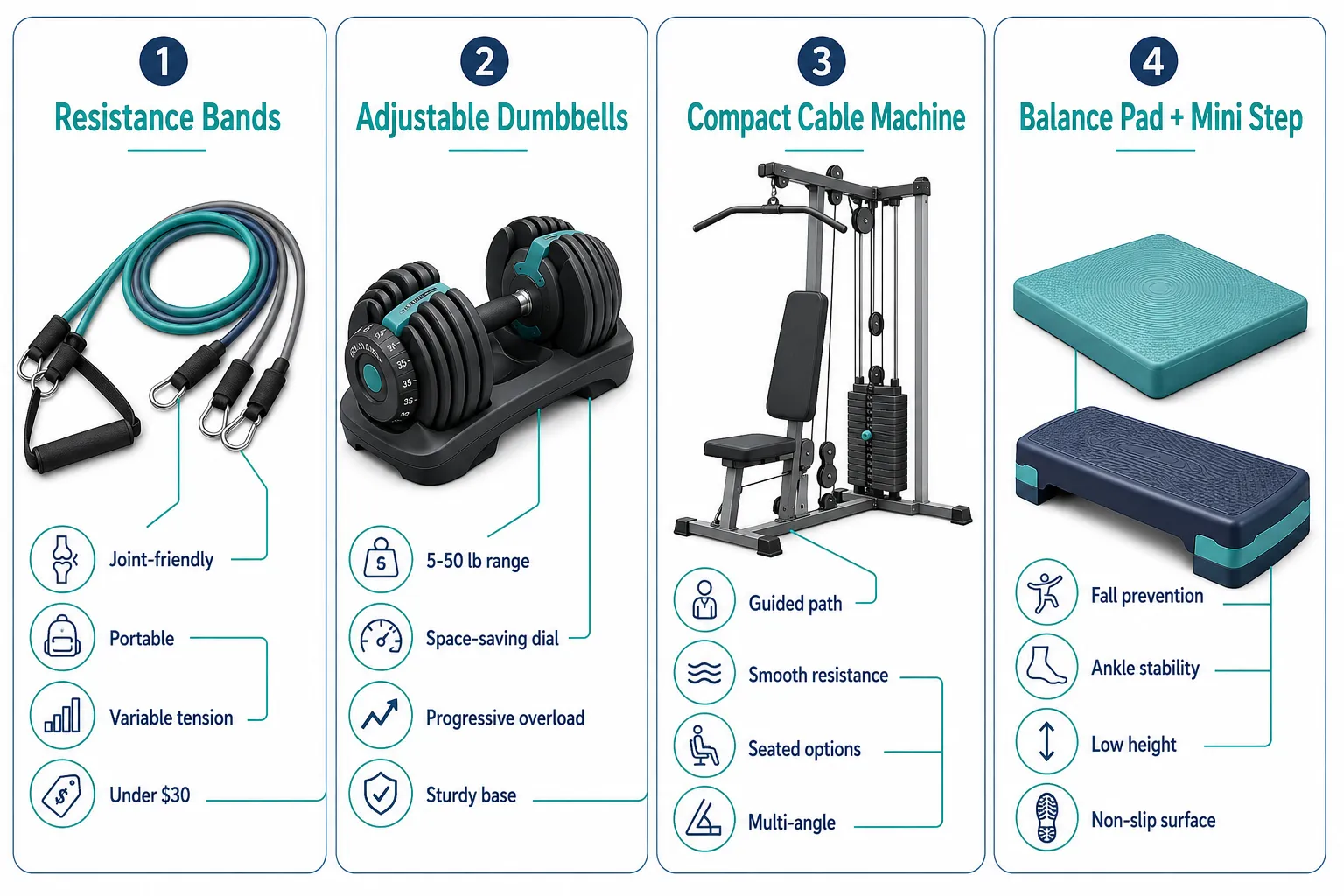
The best home exercise equipment for seniors who want strength without impact is a small, focused kit: resistance bands, adjustable dumbbells, a sturdy bench, a balance pad, and a compact cable or selectorized machine. This setup builds functional muscle, protects joints, and supports fall prevention, the three goals that matter most after 60. Most older adults can start well-equipped for under $300, and national guidelines back moderate-to-heavy resistance training as core to healthy aging [6][8].

Key Takeaways

  • Resistance bands and adjustable dumbbells are the highest-value tools for senior strength training at home, cheap, quiet, and joint-friendly [1][4].
  • Seniors can and should lift heavier than "light toning weights." Position statements from the NSCA endorse moderate-to-vigorous loads for older adults when progressed safely [6][8].
  • A balance pad and mini-step turn a strength routine into a fall-prevention routine at almost no cost [9].
  • Skip high-impact equipment like plyometric boxes, heavy barbells without a rack, and treadmills used for running [3].
  • A complete senior home gym costs roughly $150,$800 depending on whether you add a cable machine or bench [1][3].
  • Train strength 2-3 days per week, with 8-12 reps per set, using a load that feels challenging by the last two reps [5].
  • Recumbent bikes and ellipticals support cardio and joint health, but they don't replace resistance work for muscle [7].
  • Common mistakes: going too light forever, skipping warm-ups, and buying equipment that requires floor work every session [4].

What home exercise equipment is best for seniors building strength

The best equipment for seniors building strength at home is adjustable dumbbells, resistance bands with handles, and a stable bench, in that order. These three tools cover every major muscle group, allow gradual progression, and keep impact on knees, hips, and spine to a minimum [1][4].

What home exercise equipment is best for seniors building strength

Ranked by how well they support functional strength, mobility, and fall prevention:

  1. Adjustable dumbbells (5-50 lb range), the single best purchase. One pair replaces an entire rack and lets you progress from very light to genuinely challenging loads.
  2. Loop and tube resistance bands, near-zero joint stress, ideal for shoulders, hips, and rotator cuff work.
  3. Sturdy adjustable bench, unlocks seated presses, supported rows, and step-ups.
  4. Balance pad + mini-step, direct fall-prevention training.
  5. Compact cable machine or functional trainer, smooth, guided resistance for anyone with shoulder or wrist issues [10].
  6. Ankle weights (1-5 lb), for hip and glute work that protects the lower back.

Choose adjustable dumbbells if you only buy one thing. Choose bands first if you have grip issues, arthritis in the hands, or a very tight budget.

Low impact strength training equipment for older adults

Low-impact strength equipment for older adults is anything that loads muscle without loading joints through jarring, jumping, or ballistic motion. The core categories are resistance bands, dumbbells used in controlled tempo, cable machines, and selectorized weight-stack machines [8][10].

What makes equipment low-impact:

  • Smooth resistance curves (cables and bands) instead of sudden drops.
  • Seated or supported positions that remove balance risk from the movement itself.
  • Adjustable range of motion so painful angles can be avoided.
  • No airborne phase, feet stay planted.

Selectorized machines (pin-loaded stacks) are having a moment in 2026 senior home gyms because they combine guided paths with instant load changes, no plates to lift onto a bar [10]. Compact versions like wall-mounted functional trainers fit in a spare bedroom.

How do resistance bands compare to weights for seniors

Resistance bands and dumbbells both build strength for seniors, but they excel at different jobs. Bands are best for shoulder health, warm-ups, travel, and joint-friendly high-rep work. Dumbbells are best for building real muscle mass and bone density because they load bones under gravity [4][6].

Feature Resistance Bands Adjustable Dumbbells
Cost $15,$60 $150,$400
Joint stress Very low Low with good form
Bone-loading effect Modest Strong
Progression Change band Turn dial
Best for Shoulders, hips, mobility Chest, back, legs, arms
Storage Drawer Small footprint

Decision rule: Own both. Bands for warm-ups and shoulders, dumbbells for the main lifts. If forced to pick one, choose adjustable dumbbells for anyone who can safely grip them.

Best home gym setup for seniors with arthritis

The best home gym setup for seniors with arthritis prioritizes grip-friendly handles, seated support, and machines with smooth, guided motion. Cable machines, bands with padded handles, and selectorized equipment all reduce hand and wrist strain compared to Olympic barbells [10].

Recommended arthritis-friendly setup:

  • Compact cable machine with rotating handles
  • Neoprene-coated dumbbells (softer grip than steel)
  • Resistance bands with thick foam handles
  • Recumbent bike for cardio without wrist load [7]
  • Non-slip mat and padded bench

Avoid: fixed-grip Olympic barbells, kettlebells with narrow handles, and pull-up bars. These force your wrists and fingers into positions inflamed joints don't tolerate.

Can seniors build muscle without high impact exercise

Yes, seniors can absolutely build muscle without any high-impact exercise. Muscle grows in response to progressive tension, not impact. Studies summarized by the National Strength and Conditioning Association confirm that older adults training with machines, dumbbells, and bands at moderate-to-vigorous intensity build meaningful muscle and reverse sarcopenia [6][8].

Can seniors build muscle without high impact exercise

The mechanism is simple: muscle fibers respond to being challenged near their limit, whatever the source of resistance. A slow, controlled 12-rep set of dumbbell rows produces adaptation similar to any traditional strength method, without a single jump or drop landing.

"The old advice to stick with light weights after 50 has been replaced. Current guidance says older adults benefit from heavier loading, safely progressed." [5][6]

What equipment should seniors avoid for joint safety

Seniors should generally avoid equipment that demands impact, extreme range of motion, or unsupported balance under load. This isn't about age fear, it's about risk-to-reward ratio [3][4].

Skip or use with caution:

  • Plyo boxes and jump ropes, high impact on knees and ankles
  • Treadmills used for running (walking is fine)
  • Heavy barbell back squats without a rack and spotter
  • Ab wheels and roman chairs, hard on the lumbar spine
  • Cheap vibration plates, poor evidence for strength
  • BOSU balls loaded with heavy weights, fall risk outweighs benefit

The pattern: anything that combines heavy load with unstable base, or that requires airborne landings, belongs in an athlete's gym, not a senior's.

How much does a home gym for seniors cost

A functional senior home gym costs $150 to $800 depending on how far you go. Bare essentials, bands, a mat, ankle weights, can come in under $55 as of April 2026 [9]. A complete setup with adjustable dumbbells, bench, and a balance pad lands around $400,$600 [1][3].

Tiered budgets:

  • Starter ($55,$150): Resistance band set, yoga mat, 2 lb ankle weights, balance pad
  • Standard ($300,$600): Add adjustable dumbbells (5-50 lb), foldable bench, mini-step
  • Premium ($800,$2,500): Add a compact cable machine or selectorized multi-station [10]

A quality adjustable dumbbell pair often replaces $500+ worth of fixed dumbbells and saves square footage, usually the best single line item on the receipt.

Stationary bikes vs recumbent bikes for senior strength

Neither bike is primarily a strength tool, but recumbent bikes win for seniors because the seated, back-supported position removes pressure from the lower spine and wrists [7]. Upright stationary bikes work fine for fit seniors with no back issues.

For actual leg strength, though, bikes are a supplement, not the main event. Loaded step-ups, banded squats to a chair, and dumbbell deadlifts build far more functional lower-body strength than pedaling. Use the recumbent bike for warm-ups, cardio days, and joint-friendly conditioning, not as a replacement for resistance work [7].

Does a rowing machine work for seniors with back pain

A rowing machine can work for seniors with back pain, but only if the person has good hip mobility and is coached on form. The row is a hip-hinge, not a lower-back pull. Poor form turns it into repeated lumbar flexion under load, exactly what most back-pain sufferers should avoid [4].

Does a rowing machine work for seniors with back pain

Safer alternatives for back-pain seniors:

  • Seated cable rows (chest supported)
  • Banded rows with feet against a wall
  • Chest-supported dumbbell rows on an incline bench

If you love rowing, use a magnetic-resistance rower, keep the damper low, and stop the moment form breaks.

What weight should seniors start with for home training

Seniors should start with a weight that lets them complete 8-12 clean reps with 2 reps still in reserve. For most healthy older beginners, that's 3-8 lb dumbbells for shoulder work and 8-20 lb dumbbells for rows, presses, and squats to a chair [5].

The 2026 Harvard Health resistance prescription for older adults is straightforward:

  • 2-3 sessions per week
  • 8-12 reps per set
  • 2-3 sets per exercise
  • Rest 60-90 seconds between sets
  • Increase weight when 12 reps feels easy

The mistake isn't starting too heavy, it's staying too light forever. Progress the load every 2-3 weeks [5][6].

How often should seniors do strength training at home

Seniors should strength train two to three non-consecutive days per week, with each session lasting 30-45 minutes. This frequency is enough to build muscle and preserve bone density without overloading recovery [6][8].

A sample week:

  • Monday: Full-body strength (dumbbells + bench)
  • Tuesday: Balance + recumbent bike, 20 min
  • Wednesday: Rest or gentle walk
  • Thursday: Full-body strength (bands + cable)
  • Friday: Balance pad work + mobility
  • Saturday: Optional light strength or walk
  • Sunday: Rest

Balance training deserves its own slot 2-3 times a week, it's the single biggest fall-prevention lever [9].

Cable machines vs free weights for senior safety

Cable machines are generally safer than free weights for seniors because the resistance path is guided and the load can't fall on you. Free weights build more stabilizer strength but require better balance and technique [10].

Choose cable machines if you train alone, have shoulder impingement, or have any fall history.

Choose free weights if you have good balance, a training partner nearby, and want maximum functional carryover to daily life (carrying groceries, lifting grandkids).

Best of both worlds: a compact functional trainer at home covers 80% of what a commercial gym does, in a 4×4 ft footprint [10].

Common mistakes seniors make with home exercise equipment

The most common mistakes are buying too much, going too light, and neglecting warm-ups. Each one quietly kills results [4][5].

Top mistakes to avoid:

  • Buying a treadmill and calling it strength training. It isn't.
  • Sticking with 3 lb dumbbells for years. Muscle needs progressive challenge.
  • Skipping the 5-minute warm-up. Cold joints don't like sudden load.
  • Training the same muscles daily. Recovery is when muscle grows.
  • Ignoring the legs. Lower-body weakness predicts falls better than almost any other marker [9].
  • No balance work. Strength without balance still leaves fall risk on the table.

What if I have limited space for senior workout equipment

Limited space isn't a barrier, a full senior strength routine fits in 9 square feet. The key is choosing tools that stack, fold, or hide in a closet [3].

Small-space essentials:

  • One pair of adjustable dumbbells (footprint: 2 ft x 1 ft)
  • Resistance band set (fits in a drawer)
  • Foldable bench (stores vertically)
  • Balance pad (leans against the wall)
  • Wall-mounted cable trainer (uses zero floor space when folded)

Apartment dwellers should prioritize quiet gear. Bands, dumbbells on rubber mats, and cable machines make almost no noise, no dropped plates, no impact through the floor [1].

Conclusion

The strongest, safest home setup for older adults isn't a wall of machines, it's a focused kit built around adjustable dumbbells, resistance bands, a bench, and a balance pad. This is the top home exercise equipment for seniors who want strength, not impact, because every piece loads muscle without punishing joints. Add a compact cable machine if the budget allows and you want maximum arthritis-friendly versatility [10].

Actionable next steps:

  1. Start with a $150 kit: adjustable-tension bands, a mat, and a balance pad.
  2. Add adjustable dumbbells within 30 days once you know you'll stick with it.
  3. Train 2-3 days a week, 8-12 reps, and progress the weight every 2-3 weeks [5].
  4. Add balance-pad work to at least three sessions per week.
  5. Reassess your load every month, if 12 reps feels easy, it's time to go heavier.

Strength after 60 isn't optional, it's the closest thing there is to a longevity drug. The equipment above makes it accessible from a spare corner of any room.

FAQ

Is it too late to start strength training at 70 or 80?
No. Research consistently shows adults in their 70s, 80s, and 90s gain muscle and function from resistance training [6][8]. Start light, progress slowly, and see a doctor first if you have cardiac or orthopedic issues.

Are resistance bands enough on their own?
For beginners and anyone with joint issues, yes, for a while. Bands build real strength for the first 6-12 months. After that, most seniors benefit from adding dumbbells or a cable machine to keep progressing [4].

Do I need a personal trainer to start?
Not required, but 2-3 sessions with a senior-focused trainer or physical therapist to check form is one of the best investments you can make.

How long until I see results?
Most seniors feel stronger in daily tasks (stairs, groceries, getting up from chairs) within 4-6 weeks of consistent training [5].

What's the single best exercise for fall prevention?
Loaded step-ups combined with balance-pad standing work. They train the exact muscles and reflexes used to catch yourself [9].

Can I use household items instead of equipment?
Yes, water jugs, canned goods, and a sturdy chair cover basic movements. But adjustable equipment eventually becomes worth the cost because progression is smoother [1].

Should I do cardio or strength first?
For seniors focused on muscle and fall prevention, do strength first, cardio second. Cardio before heavy lifting fatigues the legs and increases fall risk during the strength session [7].

Is soreness normal?
Mild soreness for 1-2 days is normal for beginners. Sharp joint pain is not, stop and reassess form or load.

References

[1] Best Home Gym Equipment For Seniors – https://www.ritfitsports.com/blogs/article/best-home-gym-equipment-for-seniors
[2] Best – https://www.theseniorlist.com/exercise/best/
[3] Home Gym For Seniors – https://garagegymbuilders.com/guides/home-gym-for-seniors/
[4] Best Strength Training Equipment For Seniors – https://rebootedbody.com/best-strength-training-equipment-for-seniors/
[5] Strength Training After 50 Guidelines – https://dailycrunch.org/articles/strength-training-after-50-guidelines
[6] Resistance Training For Older Adults – https://www.nsca.com/about-us/position-statements/resistance-training-for-older-adults/
[7] Best Ellipticals For Seniors – https://barbend.com/best-ellipticals-for-seniors/
[8] Resistance Training For Older Adults Position.1 – https://www.nsca.com/contentassets/2a4112fb355a4a48853bbafbe070fb8e/resistance_training_for_older_adults__position.1.pdf
[9] Best Low Impact Senior Gym Gear – https://www.fuelingfitnessandfindingfocus.com/2026/04/best-low-impact-senior-gym-gear.html
[10] Best Resistance Training Machines For Seniors – https://www.ofzenandcomputing.com/best-resistance-training-machines-for-seniors/