Last updated: November 6, 2026
Quick Answer
Strength training after 40 for women works best as two to four sessions per week, built around compound movements (squat, hinge, push, pull, carry), loaded heavy enough that the last two reps feel hard. A weekly plan for perimenopause, joint health, and muscle retention should rotate movement patterns, autoregulate intensity based on sleep and symptoms, and swap in joint-friendly variations instead of skipping sessions. Muscle is still highly trainable after 40, the main change is that recovery and load tolerance fluctuate more, so the plan has to flex.
Key Takeaways
- Train strength 2-4 times weekly, with at least 48 hours between sessions hitting the same muscles [1][2].
- Lift in the 4-8 rep range for strength and bone, and 8-15 reps for muscle size and joint-friendly volume.
- It is not too late to build muscle after 40, gains are slower than at 25, but visible changes typically appear in 8-12 weeks.
- Resistance training is one of the few interventions that supports bone density, sleep, and mood at the same time [1][3].
- Joint pain usually means modify the movement, not abandon strength training.
- Use RPE (rate of perceived exertion) to autoregulate on low-energy or poor-sleep weeks instead of cancelling.
- Add unilateral work (split squats, single-arm rows) to expose side-to-side weakness and protect hips and knees.
- Progress load before progressing reps; add weight roughly every 2-3 weeks when the top set still feels controlled.
What's the best strength training routine for women over 40?
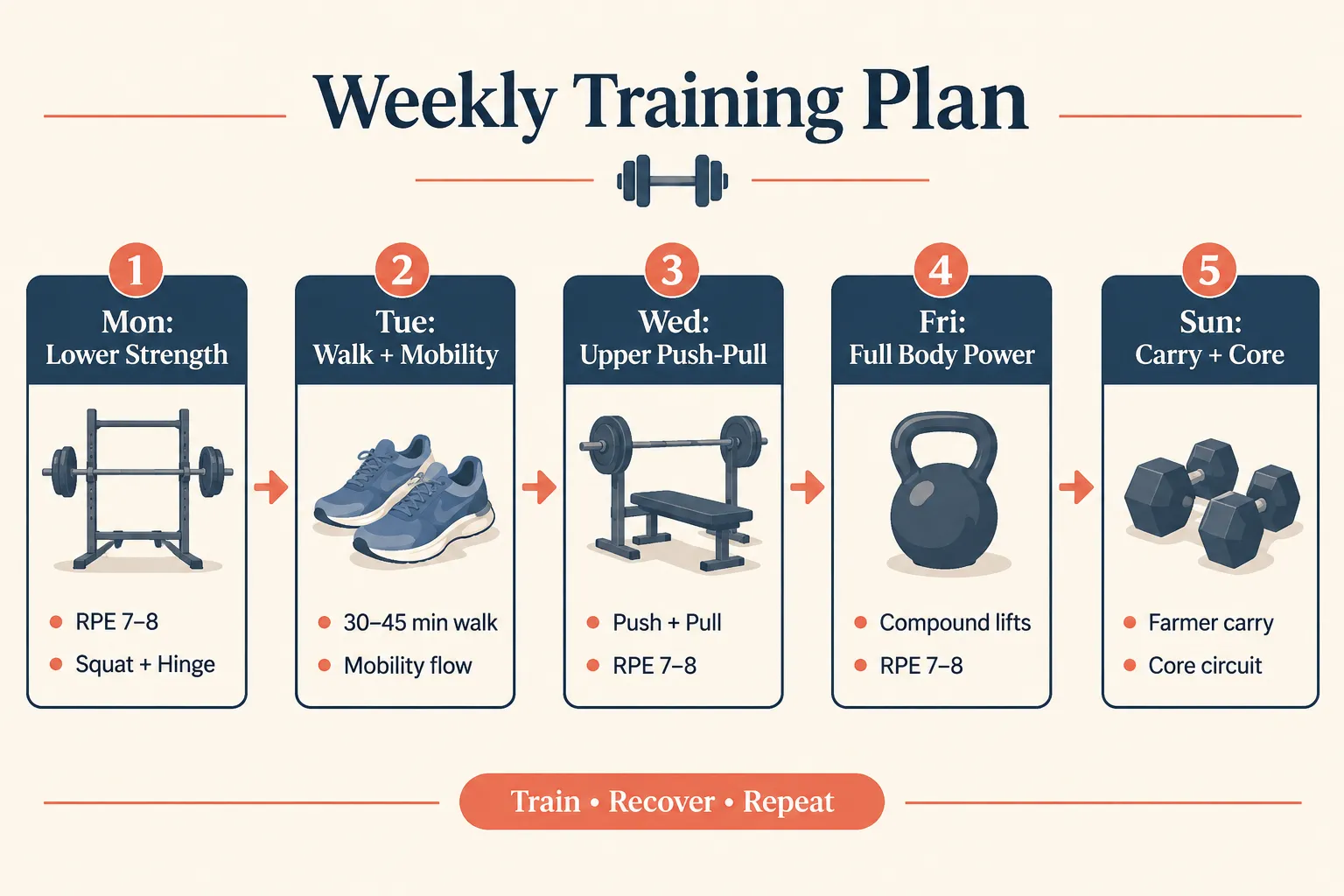
The best routine is a full-body or upper/lower split, 2-4 days a week, covering five patterns: squat, hinge, push, pull, and carry. Simplicity beats novelty here, because consistency across months is what preserves muscle and bone.
A workable three-day week:
| Day | Focus | Sample work |
|---|---|---|
| Monday | Lower strength | Goblet squat, Romanian deadlift, calf raise |
| Wednesday | Upper push/pull | Dumbbell press, chest-supported row, lat pulldown |
| Friday | Full body + power | Trap-bar deadlift, step-up, kettlebell swing, farmer carry |
Fill the gaps with walking, mobility, or a short conditioning session. Every fourth week, drop sets by about a third (a deload) to let tendons catch up.
Decision rule: choose two full-body days if you have under three hours a week; choose upper/lower four days only if sleep and recovery are reliably good.
How often should I do strength training per week?
Two sessions a week is the minimum effective dose for muscle retention; three is the practical sweet spot for most women over 40 [2][4]. Four is useful only if each session is shorter so total weekly volume stays manageable.
- 2 days: maintenance plus modest gains. Make both full-body.
- 3 days: best ratio of results to time for most women in perimenopause.
- 4+ days: split the body so no muscle group gets hammered twice in 48 hours.
Common mistake: adding a fourth day while keeping the same volume per session. That usually produces nagging shoulder or knee pain within a month, not faster progress.
Does strength training help with perimenopause symptoms, hot flashes, and mood?
Yes, resistance training is consistently linked to better sleep, steadier mood, and reduced perceived severity of some menopause symptoms, and it's recommended as a core part of perimenopause exercise programming [1][3][5]. Effects on hot flashes specifically are more variable between individuals than effects on mood and sleep.
What's reasonably well supported:
- Sleep quality and mood improve with regular resistance work [1][3].
- Body composition shifts favorably, including abdominal fat, when lifting replaces pure cardio [2][6].
- Vasomotor symptoms (hot flashes, night sweats) improve for some women, but it's not a guaranteed effect, treat it as a bonus, not the goal [1][5].
Strength training doesn't stop perimenopause. It changes how well your body tolerates it.
Edge case: if hot flashes spike during heavy sets, shift to cooler training times, longer rests, and shorter sessions rather than lower weights.
Can I build muscle after 40 as a woman, or is it too late?
You can absolutely build muscle after 40. Muscle tissue responds to progressive overload at every age; what changes is the speed of recovery and the need for adequate protein and sleep to support it [2][7].
Three things that decide whether you actually gain:
- Progressive load, the weight has to go up over months.
- Protein intake, spread across meals, not stacked at dinner.
- Recovery, poor sleep blunts adaptation more noticeably after 40 than before.
Quick example: a 47-year-old starting with a 20 lb goblet squat for 8 reps who reaches 45 lb for 8 by month four has built real strength and muscle, even if the scale hasn't moved.
How long until I see muscle gains after 40?
Strength improves in 2-4 weeks, visible muscle definition usually takes 8-12 weeks, and meaningful changes in body composition take 4-6 months of consistent training. The first month's gains are mostly neural, your nervous system learning the pattern.
A realistic timeline:
- Weeks 1-3: better coordination, less soreness, weights climb quickly.
- Weeks 4-8: clothes fit differently; energy and sleep often improve.
- Weeks 9-16: visible shape change in shoulders, glutes, and arms.
- 6 months+: bone and tendon adaptations, which are slow and silent.
Is it better to lift heavy or do more reps after 40, and how much weight should I be lifting?
Do both, in different sessions. Heavier loads (4-8 reps, around RPE 7-8) drive strength and bone loading; moderate loads (8-15 reps) build muscle with less joint stress [2][7].
How to pick a weight without testing a one-rep max:
- Choose a load where the last 2 reps are genuinely hard but form holds.
- If you could do 5+ extra reps, it's too light.
- If form breaks on rep 5 of 8, drop 10-15%.
- Add weight when you hit the top of your rep range on all sets for two sessions running.
Decision rule: if you have active joint pain or are brand new to lifting, start in the 10-15 rep range for 4-6 weeks, then introduce heavier sets.
How do I protect my joints while lifting after 40?
Protect joints by controlling tempo, keeping range of motion within a pain-free zone, and including unilateral and mobility work, not by lifting light forever. Tendons and cartilage adapt to load more slowly than muscle, so progression speed matters more than exercise choice [8][9].
Practical joint protection:
- Warm up 8-10 minutes: light cardio plus the day's patterns with an empty bar or bodyweight.
- Control the lowering phase (2-3 seconds). Fast eccentrics are where most tweaks happen.
- Add single-leg and single-arm work weekly: split squats, step-ups, single-arm rows.
- Train hips, mid-back, and rotator cuff directly, the three areas most often under-trained.
- Progress load no more than ~5-10% at a time.
What exercises should I avoid with joint pain, and can I train with arthritis?
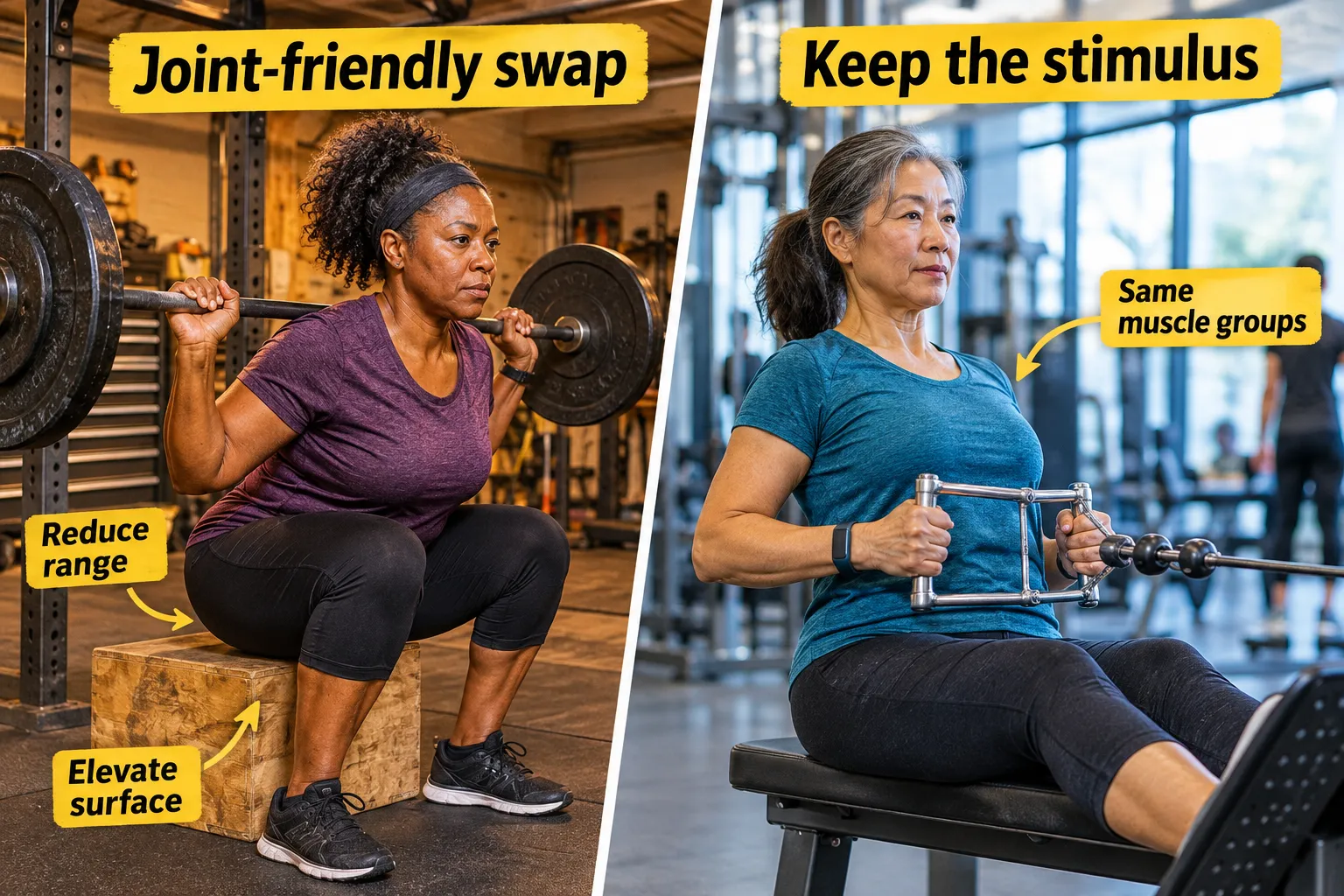
Avoid movements that produce sharp, localized, or lingering pain, and substitute rather than eliminate. Most women with osteoarthritis can and should strength train; resistance exercise is widely recommended for arthritic joints because stronger muscles reduce load on the joint itself [8][9].
Common swaps:
| Painful movement | Joint-friendly substitute |
|---|---|
| Deep barbell back squat | Box squat or goblet squat to a bench |
| Overhead barbell press | Landmine or neutral-grip dumbbell press |
| Conventional deadlift | Trap-bar deadlift or hip thrust |
| Walking lunge | Split squat with rear foot on floor |
| Upright row | Lateral raise with slight forward angle |
Use the 24-hour rule: if a joint is more painful the next day than before training, reduce range or load. Screen first if you have known osteoporosis, a hernia, pelvic floor issues, or cardiovascular disease, those need specific modifications, not generic programming [1][3].
Does strength training help prevent osteoporosis?
Yes. Progressive resistance training and impact loading are the main non-drug tools for maintaining bone mineral density, and they matter most around and after menopause when estrogen-driven bone loss accelerates [1][3].
Bone responds to force and novelty, so include:
- Heavier compound lifts (squats, deadlifts, presses) in the 4-8 rep range.
- Loaded carries and step-ups.
- Low-level impact, brisk walking, stair climbing, or small hops if joints allow.
Edge case: with diagnosed osteoporosis or a prior vertebral fracture, avoid loaded spinal flexion and rotation (sit-ups, heavy Russian twists) and get a clinician's input before heavy axial loading.
What's different about training for women versus men after 40?
The mechanics are the same; the context differs. Women face a steeper hormonal shift in their 40s and 50s, which affects recovery, bone loss rate, and symptom-driven energy swings, so autoregulation matters more [1][3][5].
Practical differences worth programming around:
- Fluctuating energy across the cycle (while still cycling) and across weeks. Plan a lighter option in advance.
- Faster bone density decline post-menopause, making heavy loading non-optional [1].
- Pelvic floor considerations with heavy bracing, breathe out on effort, and seek assessment if leakage occurs.
- Women often under-load at the start; the first correction is usually "add weight," not "add exercises."
What are common mistakes women make starting strength training later in life?
The biggest mistake is programming for calorie burn instead of strength, which produces fatigue without adaptation. The second is skipping sessions during symptom flares rather than scaling them.
Mistakes to avoid:
- Using weights so light they never challenge the last two reps.
- Changing the program every three weeks, so nothing gets progressed.
- Doing high-intensity circuits five days a week with no true rest day.
- Under-eating protein while training hard.
- Treating soreness as the measure of a good session.
- Ignoring warm-ups and cooldown mobility.
- Dropping training entirely on bad-sleep weeks instead of halving volume.
How to autoregulate on low-energy weeks
Scale the session, don't cancel it. A simple three-tier rule:
- Green (slept well, low symptoms): full session, push top sets to RPE 8.
- Amber (poor sleep or mild flare): same exercises, 2 sets instead of 3, cap at RPE 6-7.
- Red (illness, severe flare): 20 minutes, walk, mobility, light bands.
Logging which tier you used each week shows patterns within two months, and keeps the habit intact through hormonal fluctuation.
FAQ
How long should each session be?
Forty to sixty minutes, including warm-up. Shorter sessions work if you prioritize compound lifts first.
Do I need a gym?
No. Adjustable dumbbells, a bench, and resistance bands cover most of the plan, though heavy loading is easier with barbells or machines.
How much protein should I eat?
Spread protein across 3-4 meals daily to support muscle repair. Ask a clinician or dietitian for an amount suited to your weight and kidney health.
Is cardio still necessary?
Yes, for heart and metabolic health, but it shouldn't replace resistance training [2][4]. Walking plus two to three lifting days is a solid base.
Can I lift during a heavy or painful period?
Usually yes, at reduced intensity. Use the amber tier rather than skipping.
Will lifting heavy make me bulky?
No. Visible muscle gain is slow and requires sustained surplus eating; most women gain shape and density, not size.
What if I've never lifted before?
Start with 2 full-body days, machines or dumbbells, 10-15 reps, and 6 weeks of technique practice before going heavier.
Should I train through hot flashes mid-workout?
Pause, cool down, extend rest, then continue. Reduce the session rather than ending it, if you feel steady.
Conclusion
Strength training after 40 for women isn't a scaled-down version of younger training, it's the same compound lifts with smarter progression and built-in flexibility for perimenopause symptoms, joint tolerance, and inconsistent recovery. The weekly plan that works is boring on purpose: three sessions, five movement patterns, heavy enough to matter, with substitutions ready when a joint complains.
Next steps this week:
- Pick two or three fixed training days and put them in the calendar.
- Choose one exercise per pattern (squat, hinge, push, pull, carry) and log the weight.
- Set a weekly progression rule: add load when the top rep range feels controlled.
- Write your amber-day version now, before you need it.
- If you have arthritis, osteoporosis, pelvic floor symptoms, or cardiovascular disease, get screened before heavy loading [1][3].
References
- How to Exercise Effectively in Perimenopause and Menopause. news.umiamihealth.org.
- Strength Training for Menopause. everydayhealth.com.
- Menopause and Movement Empowering Clients Through Evidence Based Support. acefitness.org.
- Perimenopause Menopause Exercise. womenshealthmag.com.
- Strength Training Perimenopause. womenshealthmag.com.
- Strength Training Perimenopause. everydayhealth.com.
- Menopause Fitness Routine. equinox.com.
- Sfchron081125 Wsmc Lo. orthosurgery.ucsf.edu.
- Menopause Exercise. hfe.co.uk.
