Last updated: October 14, 2026
Quick Answer
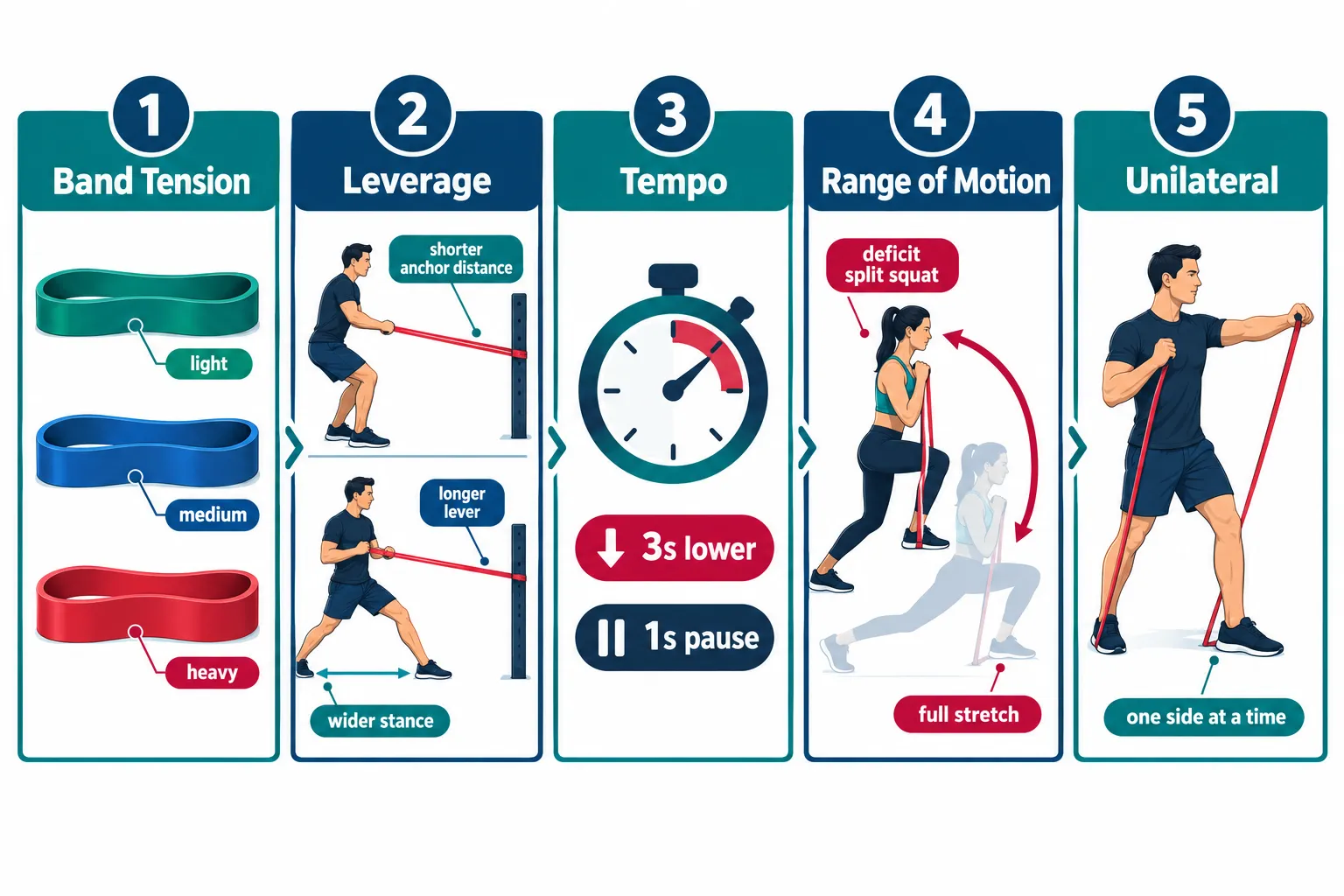
Resistance Band Exercises for Men Over 40: A Progressive Muscle-Building Plan Without Heavy Weights works because bands let you load muscle through five separate variables, not just weight: tension, leverage, tempo, range of motion, and unilateral (single-limb) work. Train 2-3 days per week, pick a band that makes 8-12 controlled reps genuinely hard, and progress by changing one variable at a time. A 2026 network meta-analysis of 102 trials in 4,754 older adults found elastic bands produce significant gains in strength and physical performance, on par with other resistance modalities.
Key Takeaways
- Bands are a primary tool, not a warm-up toy. A 2026 network meta-analysis across 102 trials confirmed elastic band training significantly improves muscle strength and physical performance.
- Progressive overload with bands comes from five levers: tension, leverage (distance from the anchor), tempo, range of motion, and single-limb variations.
- Frequency: Mayo Clinic guidance recommends strength training at least two days per week covering all major muscle groups; three days per week is the sweet spot for men over 40.
- Rep template: Harvard Health suggests roughly three sets of eight reps per exercise for maintaining muscle with age [3].
- Both heavy and high-rep band work produce results. A 2025 study in adults averaging 76 years found low-intensity/high-rep and high-intensity/low-rep band training both lowered IL-6, raised IGF-1, and improved Timed Up and Go scores [1].
- Joint-friendly by design. Bands give the least tension at the stretched position, where knees and shoulders are most vulnerable.
- Timeline: Expect strength and coordination changes in 3-4 weeks, visible size changes around 8-12 weeks of consistent training.
- Home and remote delivery works. A 2025 trial found tele-delivered band exercise twice weekly for 12 weeks improved physical performance and quality of life as much as on-site sessions [7].
- Biggest mistake: using a band that's too light and stopping well short of real effort.
What are the best resistance band exercises for men over 40
The best band exercises for men over 40 are compound movements that load the hips, upper back, and chest through a full range, plus one or two direct arm and core exercises. Prioritize these eight: banded split squat, Romanian deadlift, chest press, bent-over row, overhead press, face pull, pallof press, and single-arm curl.
Why these eight? They cover every major muscle group, they all scale cleanly with tension and leverage, and most of them can be done standing, which keeps the hips and spine working as a unit.
| Exercise | Primary target | Anchor setup | Why it suits men over 40 |
|---|---|---|---|
| Split squat (band under front foot) | Quads, glutes | Foot anchor | Loads one leg without spinal compression |
| Romanian deadlift | Hamstrings, glutes | Both feet | Trains the hip hinge with low back safety |
| Chest press | Chest, triceps | Door anchor at chest height | Shoulder-friendly free scapular movement |
| Bent-over row | Lats, mid-back | Feet | Direct antidote to desk posture |
| Overhead press | Shoulders, triceps | Feet, narrow stance | Tension peaks at lockout, not overhead stretch |
| Face pull | Rear delts, rotator cuff | Door anchor at eye height | Builds shoulder health, not just size |
| Pallof press | Deep core, obliques | Door anchor at ribcage height | Anti-rotation strength protects the lower back |
| Single-arm curl | Biceps | Foot anchor | Fixes left/right imbalances |
Decision rule: If you only have time for four exercises, pick one hinge (RDL), one single-leg push (split squat), one horizontal pull (row), and one press. That covers roughly 80% of the useful stimulus.
How do resistance bands build muscle compared to weights
Resistance bands build muscle through the same mechanism as weights: mechanical tension on the muscle taken close to fatigue. The difference is the tension curve. A dumbbell's resistance stays constant, while a band's resistance climbs as it stretches, so the hardest point is the top of the movement rather than the bottom.
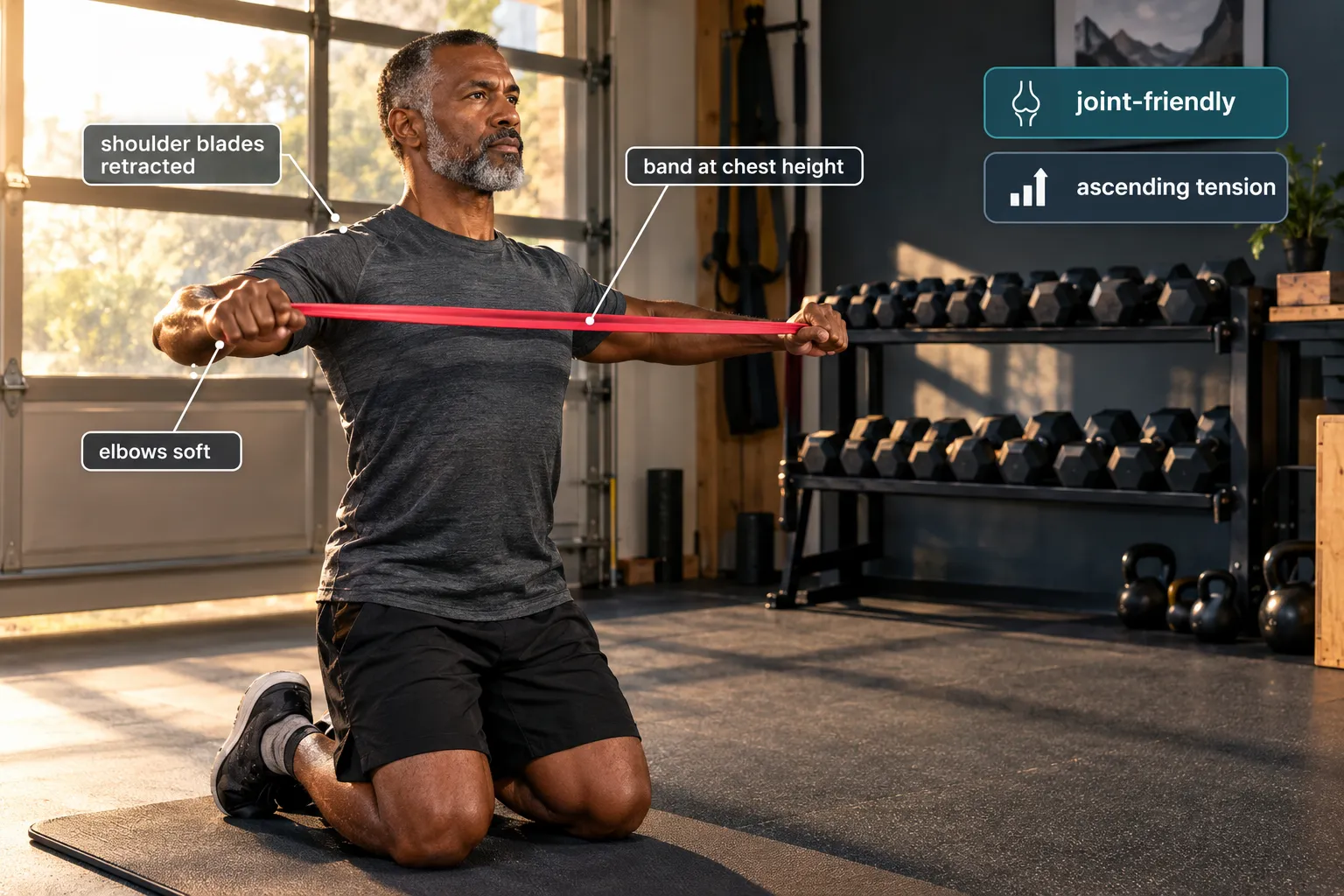
That ascending curve has real consequences:
- Stretched position is lighter. Less load at the bottom of a squat or the bottom of a press means less stress on knee cartilage and shoulder capsules.
- Lockout is heavier. You get maximum tension where joints are most stable and strong.
- No eccentric drop-off. The band pulls you back, so you must resist the return. A 2025 randomized trial in sedentary older adults found that accentuated eccentric band training produced distinct benefits for inflammatory and bone-remodeling markers, while maximal-strength band work drove the biggest strength and bone gains [2].
Common mistake: assuming bands can't produce "heavy" effort. A thick band at full stretch can exceed 100 lb of pull. The limit is usually your setup, not the band.
Can you get big muscles with just resistance bands
Yes, bands can build noticeable muscle, especially in the first few years of training, but very advanced size goals eventually need loading options bands struggle to provide. For most men over 40 whose goal is to look stronger, rebuild lost muscle, and move well, bands alone are sufficient.
Evidence supports this directly. A 2025 Frontiers in Aging study on home-based band training using "maximal mental effort" during each rep reported meaningful gains in muscle size, muscle quality, and strength even over a short training period [6]. The intent you bring to each rep matters as much as the equipment.
Muscle doesn't count your pounds. It responds to tension, effort, and how close you push toward failure.
Where bands fall short: loading the legs heavily. A trained man's quads and glutes can out-muscle most band setups. The workaround is unilateral loading (split squats, single-leg RDLs, step-ups), which halves the load requirement instantly.
Resistance band exercises for bad knees and joints
Bands are one of the better options for men with knee pain, arthritis, or past joint surgery, because resistance is lowest exactly where the knee bends deepest. A 2025 systematic review and meta-analysis of elastic band training in older adults found significant improvements in lower-limb strength and balance, including a large effect on chair-stand performance (SMD = 2.04, 95% CI 0.60-3.48, p = 0.006) [8].
Knee-friendly band progressions:
- Seated band knee extension, short range, builds quad tolerance first.
- Band-assisted sit-to-stand, band anchored in front gives upward assistance.
- Banded glute bridge, loads the hip without any knee flexion under load.
- Reverse lunge with band under front foot, less shear than a forward lunge.
- Split squat to a box, controls depth so you never enter the painful range.
Edge case: Sharp, pinpoint, or swelling-related pain is not a training problem, it's a medical one. Mayo Clinic advises medical clearance before starting strength training if you have a chronic condition or have been inactive.
How often should men over 40 use resistance bands
Two to three sessions per week is the target. Mayo Clinic's guidance for adults recommends strength training at least two days per week hitting all major muscle groups. A 2025 randomized trial of three band training styles used three sessions per week for 16 weeks and saw improvements in strength, bone health, and neuroplasticity measures [2].
- 2 days/week: maintenance plus modest gains. Use full-body sessions.
- 3 days/week: the growth zone for most men over 40. Allows a push/pull/legs split.
- 4+ days/week: diminishing returns unless sessions are short and recovery is excellent. Recovery capacity, not enthusiasm, is the limiting factor after 40.
A 2026 clinical trial protocol testing progressive band training for sarcopenia in long-term care uses just twice weekly for 12 weeks, 30+ minutes per session, proof that modest frequency, done progressively, is a legitimate clinical dose [10].
Progressive resistance band workout plan for beginners
Here's a 3-day plan built for busy professionals: three sessions, 30-35 minutes each, with built-in progression over 12 weeks.
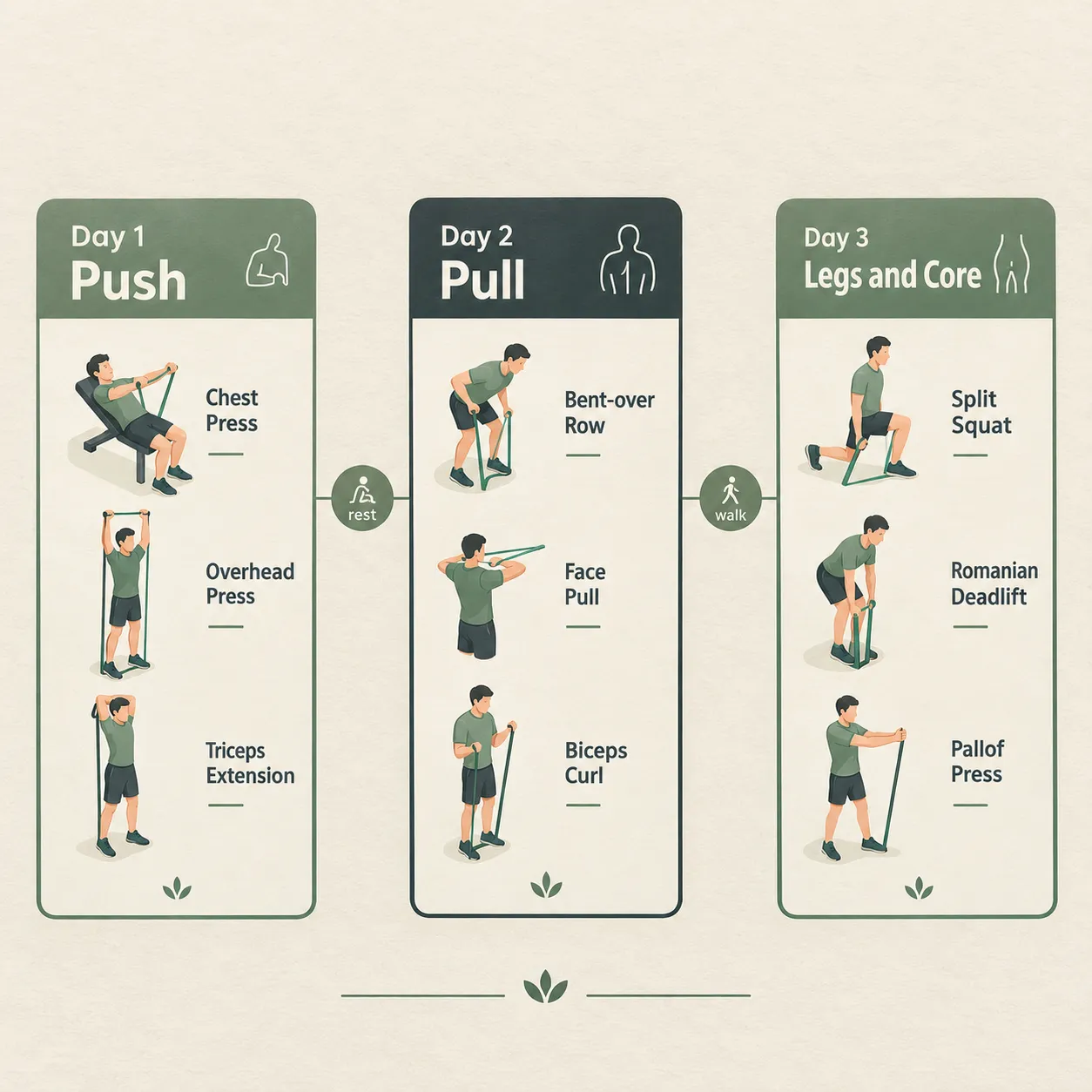
Day 1, Push
- Band chest press, 3 × 10
- Overhead press, 3 × 8
- Standing triceps extension, 2 × 12
- Pallof press, 2 × 10 per side
Day 2, Pull
- Bent-over row, 3 × 10
- Band lat pulldown (high anchor), 3 × 10
- Face pull, 3 × 15
- Single-arm curl, 3 × 12 per arm
Day 3, Legs and core
- Split squat, 3 × 10 per leg
- Romanian deadlift, 3 × 10
- Banded glute bridge, 3 × 15
- Dead bug with band, 2 × 10 per side
The 12-week progression ladder
Change one variable every two weeks, not all of them:
| Weeks | Variable to progress | What it looks like |
|---|---|---|
| 1-2 | Baseline | Learn technique, 2 reps shy of failure |
| 3-4 | Reps | Same band, add 2 reps per set |
| 5-6 | Tempo | 3-second lowering phase on every rep |
| 7-8 | Leverage | Step farther from anchor, or widen stance |
| 9-10 | Range of motion | Add a deficit (stand on a book) or full pause at stretch |
| 11-12 | Tension | Move to the next band, reset reps to 8 |
Then unilateral work becomes the next ceiling-raiser: a single-arm press with a medium band is harder than a double-arm press with a heavy one, because the core must resist rotation too.
What resistance band tension should I start with
Start with a band that lets you complete 8-12 controlled reps with 1-2 reps left in the tank, not a band you can rep out 30 times. Most men over 40 need a set of 4-5 tensions rather than one band, because leg exercises need 3-5× the resistance of a face pull.
A practical starting kit:
- Light (10-20 lb equivalent): face pulls, external rotations, warm-ups
- Medium (20-40 lb): curls, triceps, overhead press
- Heavy (40-80 lb): chest press, rows, split squats
- Extra heavy (80-120 lb): RDLs, glute bridges, assisted movements
Self-test: if your last rep looks identical to your first, the band is too light. If your form collapses by rep 5, it's too heavy.
Are resistance bands safe for men with shoulder problems
Generally yes, and often better than dumbbells, because the shoulder blade is free to move naturally and the tension is lowest in the stretched overhead position. Bands also make it easy to train the rotator cuff and rear delts directly, which is where most over-40 shoulder issues originate.
Rules for cranky shoulders:
- Keep pressing to chest height or slightly below until pain-free for two weeks.
- Do face pulls and external rotations before pressing, not after.
- Avoid behind-the-neck pulldowns and deep band dips entirely.
- Inspect bands for nicks before every session. A snapping band near the face is the one genuinely dangerous failure mode.
Edge case: If you have a diagnosed labral tear or rotator cuff repair, follow your physio's range limits over any generic program.
Resistance bands vs dumbbells for men over 40
Bands win on joint comfort, portability, and cost. Dumbbells win on heavy leg loading and precise progression. The honest answer for most men over 40 is a hybrid, but bands can carry the whole program if that's what's available.
| Factor | Resistance bands | Dumbbells |
|---|---|---|
| Joint stress at stretch | Low | Moderate to high |
| Heavy leg loading | Limited | Excellent |
| Progression precision | Coarse (jumps between bands) | Fine (2-5 lb increments) |
| Cost for full range | Low | High |
| Travel / storage | Excellent | Poor |
| Eccentric control | Band assists return | Gravity-dependent |
Choose bands if you train at home, travel often, have joint pain, or are restarting after a long layoff. Add dumbbells if your squats and RDLs no longer challenge you with your heaviest band.
Can resistance bands replace weights entirely
For general strength, muscle maintenance, fall prevention, and visible fitness, yes. For competitive powerlifting or maximum hypertrophy at an advanced level, no. The 2026 network meta-analysis found all resistance modalities, bands included, produced significant strength and performance improvements, which makes bands a legitimate primary tool rather than a compromise.
How long does it take to see results from resistance bands
Strength and coordination improve within 3-4 weeks. Visible muscle change typically appears around 8-12 weeks of consistent, progressive training. Most published band studies run 12-16 weeks and report meaningful outcomes within that window [1][2][10].
A realistic timeline:
- Weeks 1-2: Neural adaptation. Movements feel smoother; little visible change.
- Weeks 3-6: Noticeable strength jumps, better posture, clothes fit differently at the shoulders.
- Weeks 8-12: Measurable arm and chest changes, clear improvements in sit-to-stand and stair climbing.
- Weeks 16+: Compounding gains if progression continues. A 2025 review found longer interventions yield greater strength gains, while even short programs improve balance [8].
Band training also pays off beyond muscle: a meta-analysis of 11 randomized controlled trials (868 participants) found resistance training raised circulating BDNF (mean difference 0.73 ng/mL) and reduced depressive symptoms (SMD −0.38) [4][9], and a separate review reported improved overall cognitive function (SMD 0.40) [5].
Common mistakes men make with resistance band training
The single biggest error is using tension that's too light and never approaching real effort. Here are the rest, in order of how often they derail progress:
- No progression plan. Doing the same band, reps, and tempo for six months is maintenance, not building.
- Letting the band snap back. The return phase is half the stimulus. Control it over 2-3 seconds.
- Anchoring poorly. Door anchors must be on the hinge side, closed and latched. Never anchor to furniture that can tip.
- Skipping single-limb work. Unilateral variations are the cheapest way to double effective load.
- Ignoring the pull-to-push ratio. Men over 40 generally need more pulling volume than pressing to offset desk posture.
- Standing too close to the anchor. Slack at the start means wasted range.
- Not pairing with cardio. A 2025 randomized trial found band exercises combined with high-intensity walking improved pressure-pain thresholds and pain scores more than manual therapy plus walking.
Do resistance bands work for building arm strength at 40 plus
Yes. Biceps and triceps respond particularly well to bands because the ascending tension curve matches the arm's strength curve, resistance peaks at peak contraction, where a dumbbell curl goes almost weightless.
Arm-building band specifics:
- Curls: stand on the band with both feet, elbows pinned, 3 × 12 with a 3-second lowering phase.
- Triceps: overhead extension with a high anchor plus straight-arm pushdowns for the long head.
- Volume: 8-12 hard sets per arm muscle per week is plenty for most men over 40.
- Trick for more load: shorten the band by wrapping it around your hand once rather than buying a heavier one.
Best resistance band brands for home workouts
Rather than naming a single brand, judge bands on four criteria that actually predict durability and usefulness. Latex layered bands (not single-molded) last longest, and any set should cover at least four tension levels.
What to look for:
- Material: natural layered latex over cheap TPE for tube-free loop bands.
- Format: buy both loop/power bands (for legs and heavy pulls) and a handled tube set with a door anchor (for presses, rows, face pulls).
- Accessories: door anchor, ankle straps, and a padded handle set matter more than the bands' color.
- Warranty: a replacement guarantee is a reasonable proxy for build quality.
Budget estimate: a usable full kit (4-5 loop bands plus a handled tube set with anchor) generally runs well under the cost of a single adjustable dumbbell, treat that as a rough planning assumption, not a quoted price.
FAQ
How many days a week should a man over 40 train with bands?
Two to three days per week, covering all major muscle groups. Mayo Clinic recommends a minimum of two strength sessions weekly for adults.
How many sets and reps should I do?
Roughly three sets of eight to twelve reps per exercise, taken within 1-2 reps of failure. Harvard Health cites three sets of eight as an effective template for maintaining muscle with age [3].
Can bands build leg muscle?
Yes, but you must use single-leg variations. A split squat or single-leg RDL with a heavy band creates enough load for most men over 40.
Are bands safe after a knee replacement or shoulder surgery?
Usually, with clearance. Bands load the stretched position lightly, which suits healing joints, but follow your surgeon's or physiotherapist's range restrictions first.
Do I need to go to failure?
No. Stopping 1-2 reps short of failure gives nearly the same stimulus with less joint and nervous-system fatigue, which matters more after 40.
How do I know when to move up a band?
When you can complete all prescribed sets with two or more reps in reserve and perfect tempo. Then move up and reset reps to eight.
Can band training improve more than muscle?
Yes. Resistance training has been shown to raise BDNF and lower depressive symptoms [4][9], and improve cognitive function [5].
Does home or remote band training work as well as supervised sessions?
A 2025 trial found tele-delivered and on-site elastic band exercise twice weekly for 12 weeks both significantly improved physical performance and quality of life [7].
How long before I see visible changes?
Strength improves in 3-4 weeks; visible muscle changes typically show around 8-12 weeks of progressive training.
What if a band keeps rolling up my thigh during squats?
Use a fabric loop band or anchor the band under both feet with a wider stance. Rolling usually means the band is too narrow for the load.
Conclusion
Resistance Band Exercises for Men Over 40: A Progressive Muscle-Building Plan Without Heavy Weights succeeds or fails on one thing: whether you actually progress. Bands aren't a lighter version of weights, they're a different loading tool with five independent dials (tension, leverage, tempo, range of motion, unilateral work) that most people never touch.
Your next steps this week:
- Buy or sort your bands into light, medium, heavy, and extra heavy.
- Test your 10-rep tension on a chest press and a split squat. Write the band color down.
- Schedule three 30-minute sessions on fixed days, push, pull, legs and core.
- Pick one progression variable for weeks 3-4 and commit to it before touching anything else.
- Add two brisk 20-minute walks on off days, which pairs well with band work for pain and cardiorespiratory health.
- Get medical clearance first if you've been inactive or manage a chronic condition.
Run the 12-week ladder once. Then run it again from a heavier starting band. That's how bands build real muscle after 40.
References
[1] 67bca402675749dc9c26ab74 – https://agris.fao.org/search/zh/records/67bca402675749dc9c26ab74
[2] pubmed.ncbi.nlm.nih.gov – https://pubmed.ncbi.nlm.nih.gov/41373346/?fc=20240423220132&ff=20251211194700&v=2.18.0.post22+67771e2
[3] Building Better Muscle – https://www.health.harvard.edu/healthy-aging-and-longevity/building-better-muscle
[4] pubmed.ncbi.nlm.nih.gov – https://pubmed.ncbi.nlm.nih.gov/37703686/
[5] pubmed.ncbi.nlm.nih.gov – https://pubmed.ncbi.nlm.nih.gov/40325674/
[6] Full – https://www.frontiersin.org/journals/aging/articles/10.3389/fragi.2025.1662126/full
[7] pubmed.ncbi.nlm.nih.gov – https://pubmed.ncbi.nlm.nih.gov/40812387/
[8] 4yqamww4 – https://ouci.dntb.gov.ua/en/works/4yQAMWW4/
[9] public-pages-files-2025.frontiersin – https://public-pages-files-2025.frontiersin.org/journals/psychiatry/articles/10.3389/fpsyt.2025.1708244/pdf
[10] Icf 001 – https://cdn.clinicaltrials.gov/large-docs/25/NCT07513025/ICF_001.pdf