Last updated: September 8, 2026
Quick Answer
Women over 60 can build meaningful muscle and slow bone loss with just two to three short strength sessions per week at home, using body weight, resistance bands, and a few dumbbells. The research is clear: progressive resistance training, done with proper form and gradually heavier loads, improves muscle mass, bone mineral density, balance, and independence, even in women who have never lifted before [1][2][6]. The most effective home programs focus on six to eight compound movements, train each muscle group twice weekly, and prioritize slow load progression over intensity heroics.
Key Takeaways
- Two to three sessions per week of full-body resistance training is the evidence-backed minimum for muscle and bone benefits in women over 60 [1][4].
- Yes, you can build muscle after 60. Older women respond to resistance training with real gains in strength and lean mass, though slightly slower than younger women [5][8].
- Bone density improves most with moderate-to-high intensity resistance training, not light weights or walking alone [2][6].
- Six core movements cover almost everything: squat, hinge, push, pull, carry, and a balance drill.
- Home programs work. Bands, adjustable dumbbells, and a sturdy chair are enough for the first year of training.
- Falls drop by 20-30% in older adults who combine strength and balance work [10].
- Start light, progress patiently. Most women see visible strength gains in 6-12 weeks.
- Arthritis, bad knees, and back pain are usually reasons to strength train, not reasons to avoid it, when movements are chosen carefully [3].
What Are the Best Strength Training Exercises for Women Over 60?
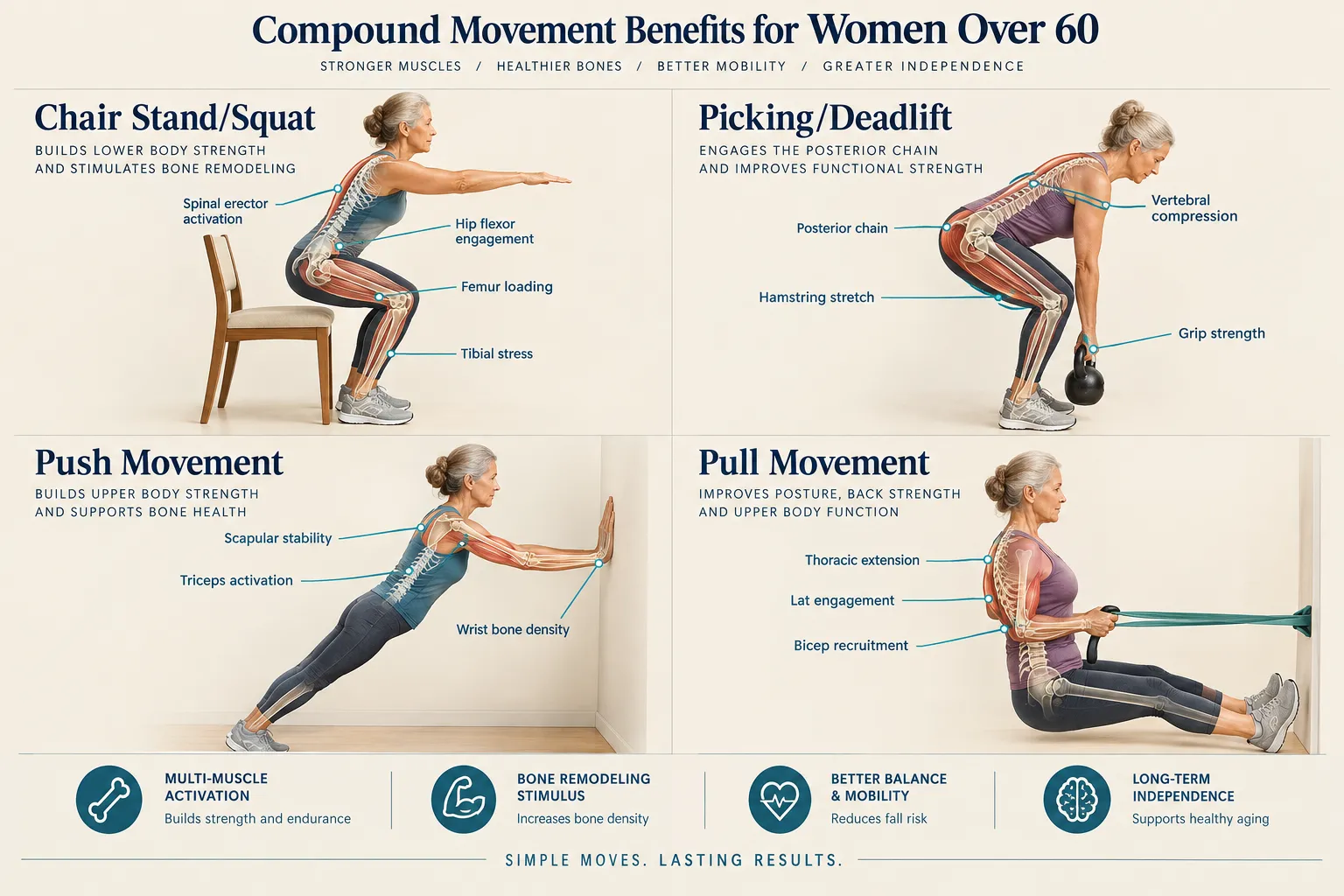
The best exercises are compound movements that mirror daily life: standing up from a chair, picking things off the floor, pushing, pulling, and carrying. These moves load multiple muscle groups and bones at once, which is exactly what drives both muscle growth and bone remodeling in older women [2][6].
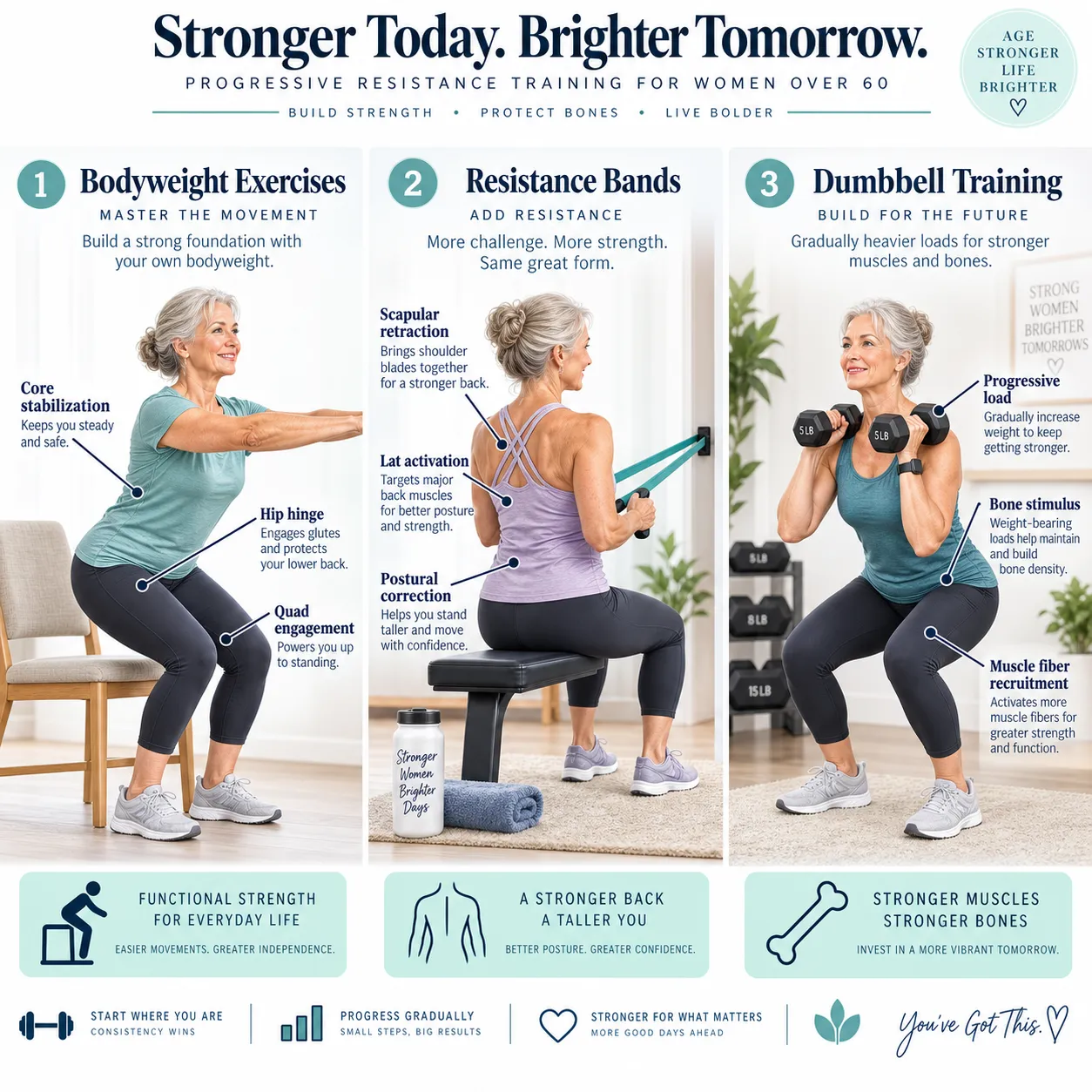
A complete home routine for women 60+ should include:
- Sit-to-stand (chair squat), trains legs, hips, and balance. The single most important exercise for preserving independence.
- Hip hinge or Romanian deadlift with light dumbbells, strengthens glutes, hamstrings, and the muscles that protect the spine.
- Wall or incline push-up, builds chest, shoulders, and arm strength without wrist strain.
- Bent-over row with dumbbells or a band, counteracts hunched posture and strengthens the upper back.
- Step-ups onto a low, stable step, improves single-leg strength and reduces fall risk.
- Farmer carry (walking with a weight in each hand), loads the spine and hips, which stimulates bone.
- Heel raises and single-leg stance, direct balance and ankle strength work.
Decision rule: If a movement causes sharp joint pain (not muscle fatigue), regress it. A wall push-up is just as valid as a floor push-up when you're starting out.
How Often Should Women Over 60 Do Strength Training Per Week?
Two to three non-consecutive days per week is the sweet spot for women over 60, matching ACSM and NSCA recommendations for older adults [1][4]. Each session should last 30-45 minutes and cover all major muscle groups.
Here's how the frequency choice usually plays out:
| Sessions/week | Best for | Expected result |
|---|---|---|
| 2 | Absolute beginners, women managing arthritis | Solid strength and bone gains, easy recovery |
| 3 | Intermediate lifters, women targeting bone density | Faster muscle growth, better balance |
| 4+ | Not recommended for most 60+ women without a coach | Diminishing returns, higher injury risk |
Muscles need 48 hours to recover at this age, so back-to-back full-body sessions aren't ideal [4]. A Monday, Wednesday, Friday schedule works well.
Can You Build Muscle After 60 as a Woman?
Yes, unequivocally. Multiple studies show postmenopausal and older women gain muscle mass, strength, and function through resistance training, even starting in their 70s and 80s [5][8]. The rate of gain is somewhat slower than in younger adults, but the relative strength improvements are often just as large.
What changes after 60:
- Anabolic resistance, muscles need a bigger stimulus (heavier loads, adequate protein) to grow.
- Recovery takes longer, usually 48-72 hours between hard sessions.
- Protein needs rise, most research supports around 1.2-1.6 g of protein per kilogram of body weight daily for older adults doing resistance training [5].
The main mistake older women make isn't that their bodies can't grow muscle. It's that they train too light for too long. Muscle grows when it's genuinely challenged.
Strength Training for Osteoporosis Prevention in Older Women
Moderate-to-high intensity resistance training is one of the few interventions that actually increases bone mineral density in postmenopausal women [2][6]. Walking, yoga, and light dumbbell work can slow bone loss, but they rarely rebuild it. Load matters.
The evidence points to a few specifics:
- Lifts loaded at roughly 70-85% of your one-rep max (a weight you could lift 6-10 times before failure) produce the strongest bone response [2][6].
- Spine and hip loading, squats, hinges, rows, and loaded carries, matter more than isolation moves.
- Impact + strength combinations show the best results in some trials, though impact work should be introduced cautiously if you already have low bone density [6].
If you have diagnosed osteoporosis, work with a physical therapist first. Certain movements (deep spinal flexion, heavy twisting) may be contraindicated. But strength training itself is not the enemy, it's usually part of the treatment plan.
Best Home Workout Equipment for Women Over 60
You don't need a home gym. A small, well-chosen kit covers everything for the first year or more.
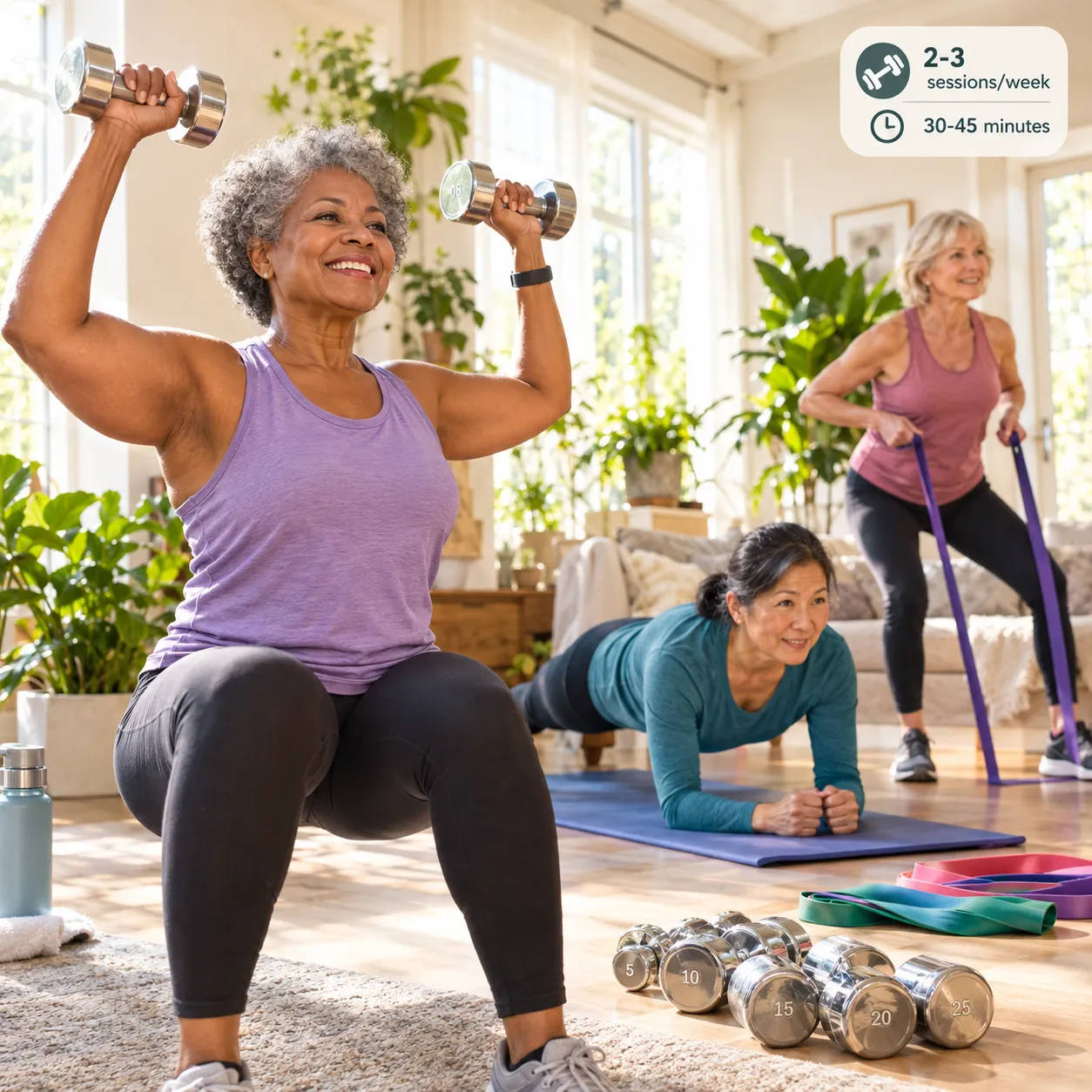
Minimum viable kit:
- Adjustable dumbbells (5-25 lb range), the single most versatile purchase.
- A set of resistance bands with handles and door anchor, great for rows, presses, and travel.
- A sturdy chair or low bench, for squats, step-ups, and incline push-ups.
- A non-slip mat, for floor work and joint comfort.
- A pair of light ankle weights (optional), useful for hip and glute work.
Nice-to-haves later: a single kettlebell (15-25 lb), a suspension trainer, and a low aerobic step.
Skip these: vibration plates, "toning" gadgets, and anything under 3 lb marketed to older women. They're too light to matter.
How Much Weight Should a 60-Year-Old Woman Lift?
Enough that the last two reps of a set feel genuinely hard, but form stays clean. In practical terms, that's typically a weight you can lift 8-12 times before you'd have to stop [1][4].
A simple starting framework:
- Weeks 1-2: Use weights you can lift 15 times easily. Focus on form.
- Weeks 3-6: Move to weights you can lift 10-12 times with effort.
- Weeks 7+: Progress toward 8-10 reps with real challenge. Add small amounts of weight when a set feels easy.
Concrete numbers for a healthy, active 60-year-old woman starting out often look like:
- Dumbbell row: 8-15 lb per hand
- Goblet squat: 10-25 lb
- Overhead press: 5-10 lb per hand
- Deadlift/hinge: 15-40 lb total
These are averages. Your right weight is whatever makes the last rep hard while looking the same as the first rep.
Strength Training vs. Cardio for Women Over 60: Which Is Better?
Neither is optional, but if you have to prioritize one after 60, choose strength training. Cardio protects your heart; strength training protects your muscle, bones, balance, and independence [1][4]. Muscle and bone loss are the harder problems to reverse.
A balanced week for most women 60+:
- 2-3 strength sessions (30-45 min each)
- 2-3 cardio sessions, brisk walking, cycling, swimming (20-40 min each)
- Daily movement, walks, gardening, stairs
Choose strength-first if: you've been sedentary, you've lost weight recently, you have low bone density, or you struggle with stairs or getting up from the floor.
Choose cardio-first if: you already lift twice a week and want to improve cardiovascular fitness or manage blood pressure.
Is Strength Training Safe for Women With Arthritis Over 60?
Yes, and it usually reduces arthritis symptoms rather than worsening them. Resistance training strengthens the muscles that support painful joints, which decreases the load on cartilage and often lowers pain scores [3].
Guidelines for arthritic joints:
- Warm up longer, 5-10 minutes of easy movement before lifting.
- Choose joint-friendly ranges of motion. Partial squats are fine if deep squats hurt.
- Avoid heavy overhead pressing with shoulder arthritis; use landmine or incline angles instead.
- Train through mild ache, not sharp pain. If pain increases the next day and lingers, reduce load.
- Consistency matters more than intensity with arthritis, showing up beats occasional hard sessions.
Water-based strength work and machine-based training are also valid options for severe cases.
Common Mistakes Women Make When Starting Strength Training Later in Life
The most common errors aren't dangerous, they just kill progress. Watch for these:
- Lifting too light for too long. Pink dumbbells feel safe but do almost nothing after week two.
- Skipping the lower body. Legs and hips drive most of the bone and balance benefits.
- Cardio-only mindset. Walking is not a substitute for resistance training after 60.
- No progression plan. Doing the same routine at the same weights for months.
- Not eating enough protein. Muscle can't grow without the raw materials [5].
- Comparing to younger women online. Your recovery, hormones, and starting point are different.
- Fearing soreness as injury. Mild muscle soreness 24-48 hours after a session is normal.
How Long Does It Take to See Muscle Gains From Strength Training Over 60?
Most women feel stronger within 2-4 weeks and see visible muscle changes in 8-12 weeks of consistent training [5][8]. Bone density changes take longer, usually 6-12 months to show on a DEXA scan [2][6].
Realistic timeline expectations:
- Weeks 1-2: Better coordination, movements feel less awkward. Little visible change.
- Weeks 3-6: Noticeably easier daily tasks (groceries, stairs). Strength gains of 15-30% on key lifts are common.
- Weeks 7-12: Visible muscle tone in arms, shoulders, and legs. Improved posture.
- Months 4-6: Body composition shifts. Clothes fit differently.
- Months 6-12: Measurable bone density improvements possible with consistent, progressive training [6].
Strength Training for Women Over 60 With Bad Knees or Back
Bad knees and backs almost always improve with the right strength training, not without it. Weak glutes, quads, and core muscles are usually the cause of chronic knee and back pain in older women, not the result.
For bad knees, focus on:
- Partial-range squats and step-ups (start with a low step)
- Hip hinges and glute bridges (build glute strength to unload the knee)
- Isometric wall sits (30-60 seconds)
- Avoid deep lunges and jumping until strength is built
For back pain, focus on:
- Hip hinges with light weight (rebuilds the posterior chain)
- Rows and reverse flies (strengthens the upper back)
- Dead bugs and bird dogs (core stability)
- Avoid heavy loaded spinal flexion and high-rep sit-ups
Getting cleared by a doctor or physical therapist first is smart, but "rest" is rarely the answer for chronic joint pain.
Do Women Over 60 Need Different Strength Training Than Younger Women?
Yes, in emphasis but not in principle. The exercises and progression rules are the same. What changes: recovery time, warm-up length, load progression speed, and the importance of balance work [1][4].
Key differences for women 60+:
- Longer warm-ups (5-10 min vs. 2-3 min for younger lifters)
- More recovery days between hard sessions
- Slower load progression, smaller weight jumps
- Mandatory balance work, younger women can skip this; older women can't
- Higher protein per kg of body weight than younger sedentary women [5]
- More attention to bone-loading exercises like carries and step-ups
Best Strength Training Program for Beginners Over 60
Here's a research-aligned starter program you can do at home three days per week:
Day A (Monday):
- Sit-to-stand or goblet squat, 3 sets of 10
- Wall or incline push-up, 3 sets of 8-12
- Dumbbell row, 3 sets of 10 per side
- Farmer carry, 3 walks of 30 seconds
- Single-leg stance, 3 x 20 seconds per leg
Day B (Wednesday):
- Hip hinge with dumbbells, 3 sets of 10
- Overhead press (seated or standing), 3 sets of 8
- Band pull-apart, 3 sets of 12
- Step-up, 3 sets of 8 per leg
- Dead bug, 3 sets of 8 per side
Day C (Friday): Repeat Day A, or alternate.
Progression rule: When you complete every set at the top of the rep range with good form, add 2-5 lb (or one band level) the following session.
Can Strength Training Improve Balance and Fall Prevention in Older Women?
Yes, strength training combined with balance work reduces falls in older adults by roughly 20-30% based on multiple systematic reviews [10]. Falls are the leading cause of injury in women over 65, so this benefit alone justifies the training.
The most fall-protective components:
- Single-leg strength (step-ups, single-leg deadlifts)
- Ankle and hip strength (heel raises, side-lying leg lifts)
- Reactive balance drills (weight shifts, tandem walking)
- Loaded carries, force stabilization under real load
Add 5-10 minutes of dedicated balance work at the end of each strength session. It compounds quickly.
FAQ
Is it too late to start strength training at 65 or 70?
No. Studies consistently show meaningful strength and functional gains in women starting resistance training in their 70s, 80s, and even 90s [5][8].
How long should each home session be?
30-45 minutes is enough, including warm-up. Longer isn't better at this age.
Do I need to eat more protein?
Most women over 60 doing resistance training benefit from roughly 1.2-1.6 g of protein per kg of body weight per day, spread across meals [5].
Should I lift if I have osteoporosis?
Yes, but get guidance first. Moderate-load resistance training is generally recommended, while heavy spinal flexion and twisting movements are usually avoided [6].
Are resistance bands enough, or do I need weights?
Bands work well for beginners and travel, but progressive overload is easier with adjustable dumbbells. A mix of both is ideal.
How do I know if I'm lifting heavy enough?
The last 2 reps of each set should feel genuinely hard while form stays clean. If you could do 5 more reps easily, go heavier.
Can I combine strength training with walking?
Yes, walking on off days is ideal. Just don't replace strength sessions with walks.
What if I've never exercised before?
Start with body weight and one set of each movement for the first week. Build up gradually. Everyone starts somewhere.
Conclusion
Strength training after 60 isn't optional maintenance, it's the single most powerful thing a woman can do to protect her muscle, bones, balance, and independence for the next 20-30 years. The research supports it, the equipment is affordable, and the time commitment is modest.
Your next steps this week:
- Pick two or three non-consecutive days on your calendar for strength sessions.
- Order or gather one set of adjustable dumbbells, one resistance band, and a sturdy chair.
- Run through the beginner Day A workout above with light weights, just to learn the movements.
- Add 20-30 g of protein to at least two meals daily.
- Reassess in 4 weeks. You'll be surprised.
Consistency beats intensity. Two focused sessions per week, done every week for a year, will transform your strength, posture, and confidence more than any single "perfect" program ever could.
References
[1] Pmc12107943 – https://pmc.ncbi.nlm.nih.gov/articles/PMC12107943/
[2] Full – https://www.frontiersin.org/journals/physiology/articles/10.3389/fphys.2023.1105303/full
[3] pubmed.ncbi.nlm.nih.gov – https://pubmed.ncbi.nlm.nih.gov/38353251/
[4] Pmc11985624 – https://pmc.ncbi.nlm.nih.gov/articles/PMC11985624/
[5] Pmc6279907 – https://pmc.ncbi.nlm.nih.gov/articles/PMC6279907/
[6] S00198 020 05441 W – https://link.springer.com/article/10.1007/s00198-020-05441-w
[7] Pmc10843212 – https://pmc.ncbi.nlm.nih.gov/articles/PMC10843212/
[8] Japplphysiol.01260 – https://journals.physiology.org/doi/full/10.1152/japplphysiol.01260.2004
[9] mdpi – https://www.mdpi.com/1424-8220/22/5/1904
[10] Pmc11972399 – https://pmc.ncbi.nlm.nih.gov/articles/PMC11972399/
