Strength Training for Women Over 60: Science-Backed Home Programs to Build Muscle and Protect Bone Density

Strength Training for Women Over 60: Science-Backed Home Programs to Build Muscle and Protect Bone Density

Last updated: September 8, 2026

Quick Answer

Women over 60 can build meaningful muscle and slow bone loss with just two to three short strength sessions per week at home, using body weight, resistance bands, and a few dumbbells. The research is clear: progressive resistance training, done with proper form and gradually heavier loads, improves muscle mass, bone mineral density, balance, and independence, even in women who have never lifted before [1][2][6]. The most effective home programs focus on six to eight compound movements, train each muscle group twice weekly, and prioritize slow load progression over intensity heroics.

Key Takeaways

  • Two to three sessions per week of full-body resistance training is the evidence-backed minimum for muscle and bone benefits in women over 60 [1][4].
  • Yes, you can build muscle after 60. Older women respond to resistance training with real gains in strength and lean mass, though slightly slower than younger women [5][8].
  • Bone density improves most with moderate-to-high intensity resistance training, not light weights or walking alone [2][6].
  • Six core movements cover almost everything: squat, hinge, push, pull, carry, and a balance drill.
  • Home programs work. Bands, adjustable dumbbells, and a sturdy chair are enough for the first year of training.
  • Falls drop by 20-30% in older adults who combine strength and balance work [10].
  • Start light, progress patiently. Most women see visible strength gains in 6-12 weeks.
  • Arthritis, bad knees, and back pain are usually reasons to strength train, not reasons to avoid it, when movements are chosen carefully [3].

What Are the Best Strength Training Exercises for Women Over 60?

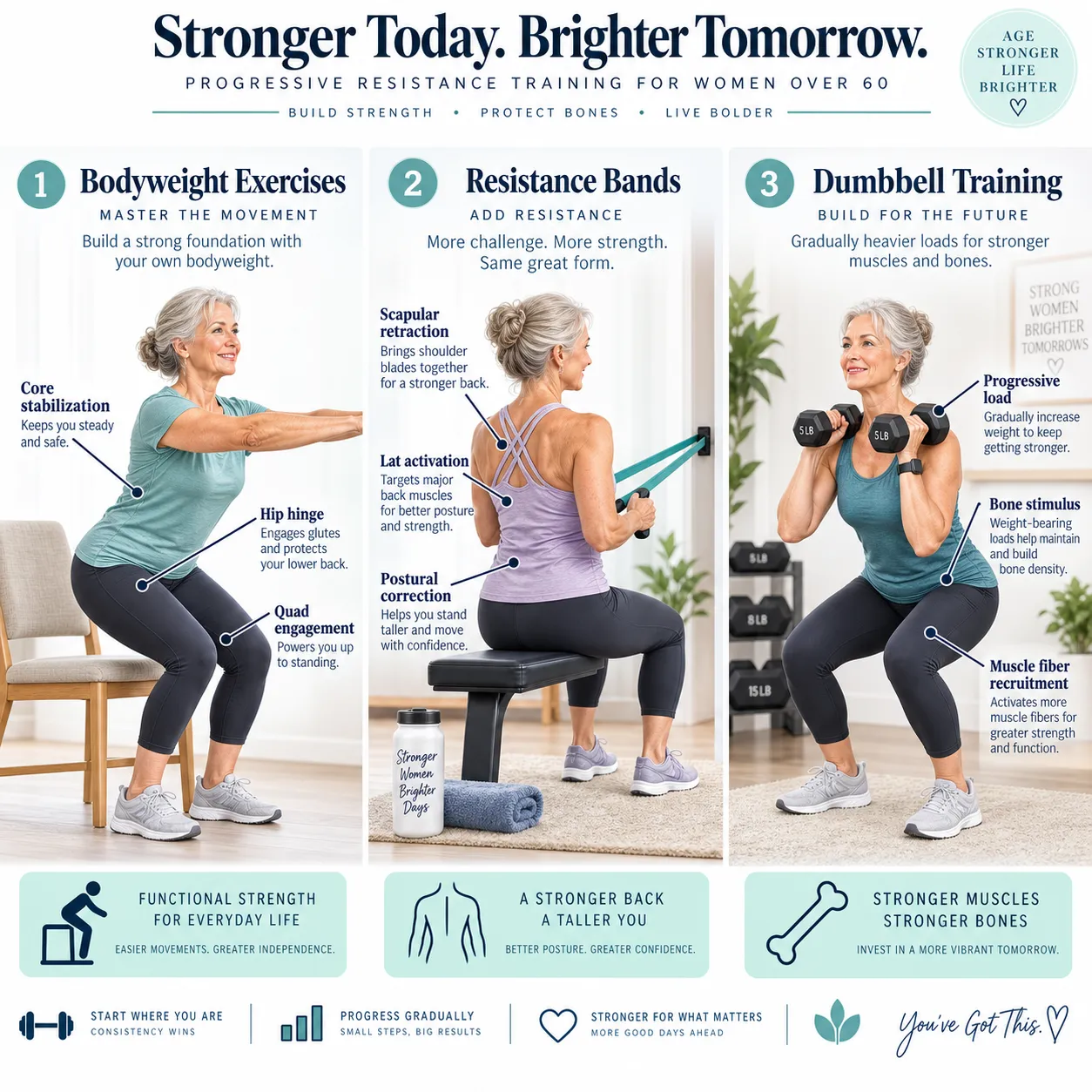
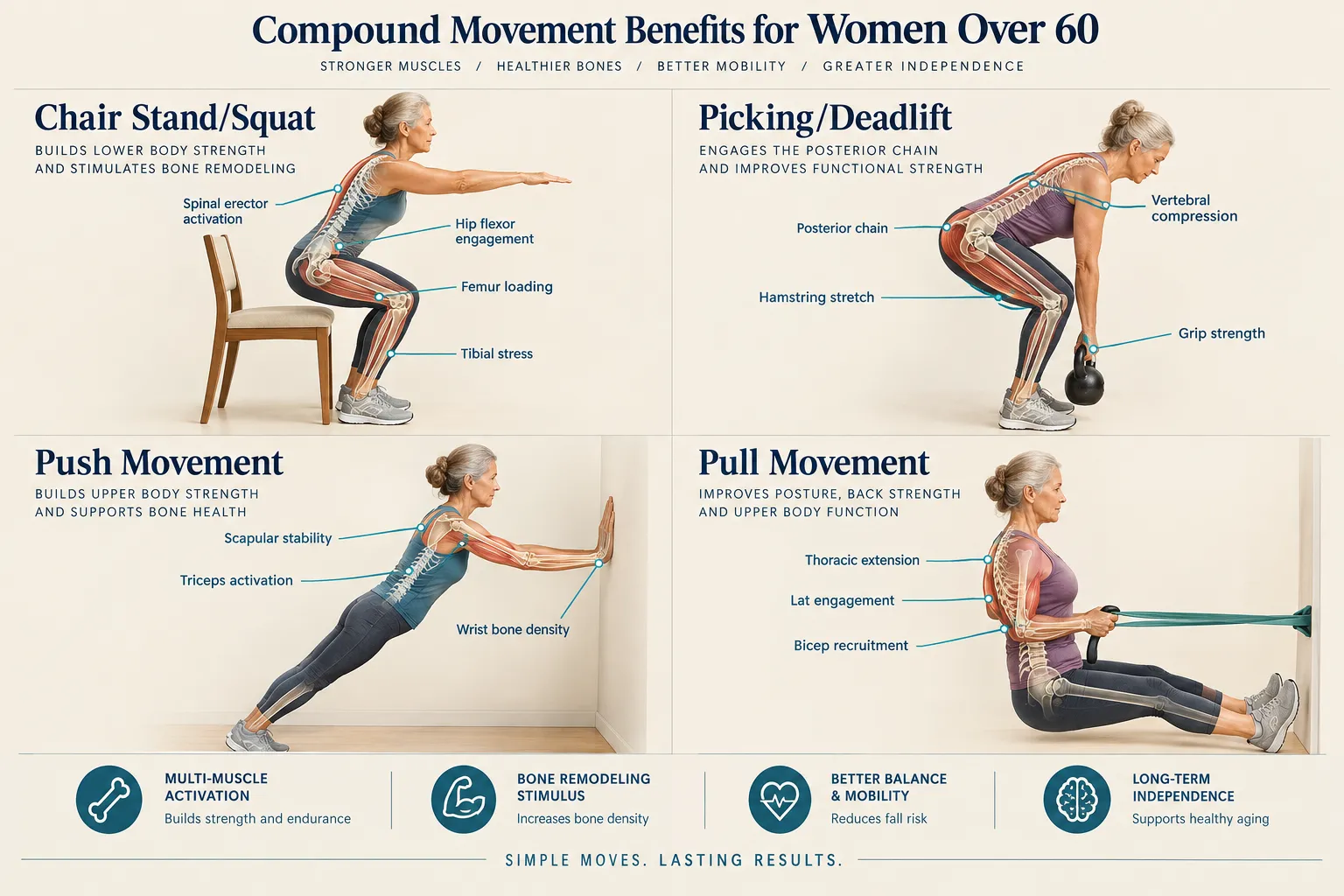
The best exercises are compound movements that mirror daily life: standing up from a chair, picking things off the floor, pushing, pulling, and carrying. These moves load multiple muscle groups and bones at once, which is exactly what drives both muscle growth and bone remodeling in older women [2][6].
What Are the Best Strength Training Exercises for Women Over 60?

A complete home routine for women 60+ should include:

  • Sit-to-stand (chair squat), trains legs, hips, and balance. The single most important exercise for preserving independence.
  • Hip hinge or Romanian deadlift with light dumbbells, strengthens glutes, hamstrings, and the muscles that protect the spine.
  • Wall or incline push-up, builds chest, shoulders, and arm strength without wrist strain.
  • Bent-over row with dumbbells or a band, counteracts hunched posture and strengthens the upper back.
  • Step-ups onto a low, stable step, improves single-leg strength and reduces fall risk.
  • Farmer carry (walking with a weight in each hand), loads the spine and hips, which stimulates bone.
  • Heel raises and single-leg stance, direct balance and ankle strength work.

Decision rule: If a movement causes sharp joint pain (not muscle fatigue), regress it. A wall push-up is just as valid as a floor push-up when you're starting out.

How Often Should Women Over 60 Do Strength Training Per Week?

Two to three non-consecutive days per week is the sweet spot for women over 60, matching ACSM and NSCA recommendations for older adults [1][4]. Each session should last 30-45 minutes and cover all major muscle groups.

Here's how the frequency choice usually plays out:

Sessions/week Best for Expected result
2 Absolute beginners, women managing arthritis Solid strength and bone gains, easy recovery
3 Intermediate lifters, women targeting bone density Faster muscle growth, better balance
4+ Not recommended for most 60+ women without a coach Diminishing returns, higher injury risk

Muscles need 48 hours to recover at this age, so back-to-back full-body sessions aren't ideal [4]. A Monday, Wednesday, Friday schedule works well.

Can You Build Muscle After 60 as a Woman?

Yes, unequivocally. Multiple studies show postmenopausal and older women gain muscle mass, strength, and function through resistance training, even starting in their 70s and 80s [5][8]. The rate of gain is somewhat slower than in younger adults, but the relative strength improvements are often just as large.

What changes after 60:

  • Anabolic resistance, muscles need a bigger stimulus (heavier loads, adequate protein) to grow.
  • Recovery takes longer, usually 48-72 hours between hard sessions.
  • Protein needs rise, most research supports around 1.2-1.6 g of protein per kilogram of body weight daily for older adults doing resistance training [5].

The main mistake older women make isn't that their bodies can't grow muscle. It's that they train too light for too long. Muscle grows when it's genuinely challenged.

Strength Training for Osteoporosis Prevention in Older Women

Moderate-to-high intensity resistance training is one of the few interventions that actually increases bone mineral density in postmenopausal women [2][6]. Walking, yoga, and light dumbbell work can slow bone loss, but they rarely rebuild it. Load matters.

The evidence points to a few specifics:

  • Lifts loaded at roughly 70-85% of your one-rep max (a weight you could lift 6-10 times before failure) produce the strongest bone response [2][6].
  • Spine and hip loading, squats, hinges, rows, and loaded carries, matter more than isolation moves.
  • Impact + strength combinations show the best results in some trials, though impact work should be introduced cautiously if you already have low bone density [6].

If you have diagnosed osteoporosis, work with a physical therapist first. Certain movements (deep spinal flexion, heavy twisting) may be contraindicated. But strength training itself is not the enemy, it's usually part of the treatment plan.

Best Home Workout Equipment for Women Over 60

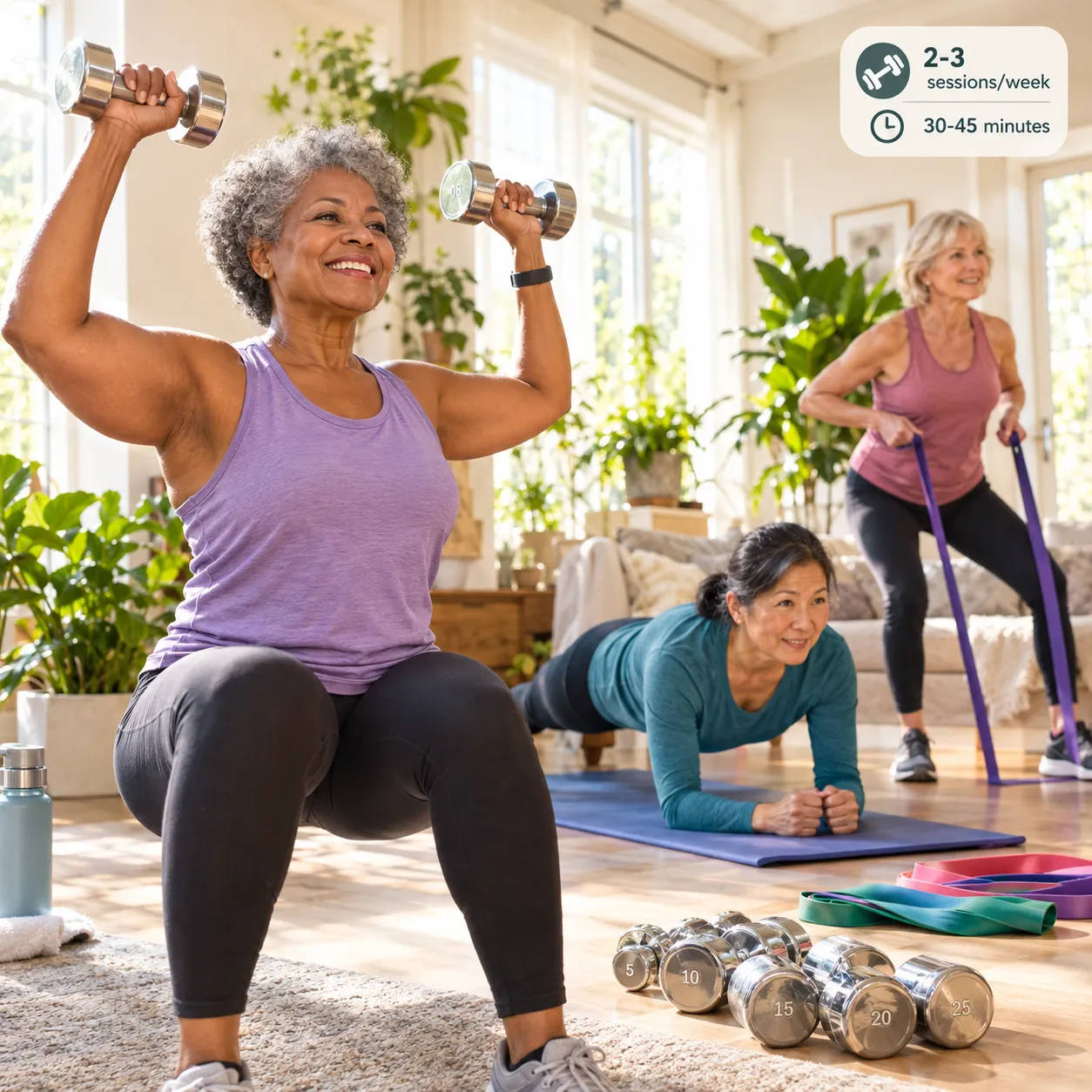
You don't need a home gym. A small, well-chosen kit covers everything for the first year or more.
Best Home Workout Equipment for Women Over 60

Minimum viable kit:

  1. Adjustable dumbbells (5-25 lb range), the single most versatile purchase.
  2. A set of resistance bands with handles and door anchor, great for rows, presses, and travel.
  3. A sturdy chair or low bench, for squats, step-ups, and incline push-ups.
  4. A non-slip mat, for floor work and joint comfort.
  5. A pair of light ankle weights (optional), useful for hip and glute work.

Nice-to-haves later: a single kettlebell (15-25 lb), a suspension trainer, and a low aerobic step.

Skip these: vibration plates, "toning" gadgets, and anything under 3 lb marketed to older women. They're too light to matter.

How Much Weight Should a 60-Year-Old Woman Lift?

Enough that the last two reps of a set feel genuinely hard, but form stays clean. In practical terms, that's typically a weight you can lift 8-12 times before you'd have to stop [1][4].

A simple starting framework:

  • Weeks 1-2: Use weights you can lift 15 times easily. Focus on form.
  • Weeks 3-6: Move to weights you can lift 10-12 times with effort.
  • Weeks 7+: Progress toward 8-10 reps with real challenge. Add small amounts of weight when a set feels easy.

Concrete numbers for a healthy, active 60-year-old woman starting out often look like:

  • Dumbbell row: 8-15 lb per hand
  • Goblet squat: 10-25 lb
  • Overhead press: 5-10 lb per hand
  • Deadlift/hinge: 15-40 lb total

These are averages. Your right weight is whatever makes the last rep hard while looking the same as the first rep.

Strength Training vs. Cardio for Women Over 60: Which Is Better?

Neither is optional, but if you have to prioritize one after 60, choose strength training. Cardio protects your heart; strength training protects your muscle, bones, balance, and independence [1][4]. Muscle and bone loss are the harder problems to reverse.

A balanced week for most women 60+:

  • 2-3 strength sessions (30-45 min each)
  • 2-3 cardio sessions, brisk walking, cycling, swimming (20-40 min each)
  • Daily movement, walks, gardening, stairs

Choose strength-first if: you've been sedentary, you've lost weight recently, you have low bone density, or you struggle with stairs or getting up from the floor.

Choose cardio-first if: you already lift twice a week and want to improve cardiovascular fitness or manage blood pressure.

Is Strength Training Safe for Women With Arthritis Over 60?

Yes, and it usually reduces arthritis symptoms rather than worsening them. Resistance training strengthens the muscles that support painful joints, which decreases the load on cartilage and often lowers pain scores [3].

Guidelines for arthritic joints:

  • Warm up longer, 5-10 minutes of easy movement before lifting.
  • Choose joint-friendly ranges of motion. Partial squats are fine if deep squats hurt.
  • Avoid heavy overhead pressing with shoulder arthritis; use landmine or incline angles instead.
  • Train through mild ache, not sharp pain. If pain increases the next day and lingers, reduce load.
  • Consistency matters more than intensity with arthritis, showing up beats occasional hard sessions.

Water-based strength work and machine-based training are also valid options for severe cases.

Common Mistakes Women Make When Starting Strength Training Later in Life

The most common errors aren't dangerous, they just kill progress. Watch for these:

  1. Lifting too light for too long. Pink dumbbells feel safe but do almost nothing after week two.
  2. Skipping the lower body. Legs and hips drive most of the bone and balance benefits.
  3. Cardio-only mindset. Walking is not a substitute for resistance training after 60.
  4. No progression plan. Doing the same routine at the same weights for months.
  5. Not eating enough protein. Muscle can't grow without the raw materials [5].
  6. Comparing to younger women online. Your recovery, hormones, and starting point are different.
  7. Fearing soreness as injury. Mild muscle soreness 24-48 hours after a session is normal.

How Long Does It Take to See Muscle Gains From Strength Training Over 60?

Most women feel stronger within 2-4 weeks and see visible muscle changes in 8-12 weeks of consistent training [5][8]. Bone density changes take longer, usually 6-12 months to show on a DEXA scan [2][6].
How Long Does It Take to See Muscle Gains From Strength Training Over 60?

Realistic timeline expectations:

  • Weeks 1-2: Better coordination, movements feel less awkward. Little visible change.
  • Weeks 3-6: Noticeably easier daily tasks (groceries, stairs). Strength gains of 15-30% on key lifts are common.
  • Weeks 7-12: Visible muscle tone in arms, shoulders, and legs. Improved posture.
  • Months 4-6: Body composition shifts. Clothes fit differently.
  • Months 6-12: Measurable bone density improvements possible with consistent, progressive training [6].

Strength Training for Women Over 60 With Bad Knees or Back

Bad knees and backs almost always improve with the right strength training, not without it. Weak glutes, quads, and core muscles are usually the cause of chronic knee and back pain in older women, not the result.

For bad knees, focus on:

  • Partial-range squats and step-ups (start with a low step)
  • Hip hinges and glute bridges (build glute strength to unload the knee)
  • Isometric wall sits (30-60 seconds)
  • Avoid deep lunges and jumping until strength is built

For back pain, focus on:

  • Hip hinges with light weight (rebuilds the posterior chain)
  • Rows and reverse flies (strengthens the upper back)
  • Dead bugs and bird dogs (core stability)
  • Avoid heavy loaded spinal flexion and high-rep sit-ups

Getting cleared by a doctor or physical therapist first is smart, but "rest" is rarely the answer for chronic joint pain.

Do Women Over 60 Need Different Strength Training Than Younger Women?

Yes, in emphasis but not in principle. The exercises and progression rules are the same. What changes: recovery time, warm-up length, load progression speed, and the importance of balance work [1][4].

Key differences for women 60+:

  • Longer warm-ups (5-10 min vs. 2-3 min for younger lifters)
  • More recovery days between hard sessions
  • Slower load progression, smaller weight jumps
  • Mandatory balance work, younger women can skip this; older women can't
  • Higher protein per kg of body weight than younger sedentary women [5]
  • More attention to bone-loading exercises like carries and step-ups

Best Strength Training Program for Beginners Over 60

Here's a research-aligned starter program you can do at home three days per week:

Day A (Monday):

  • Sit-to-stand or goblet squat, 3 sets of 10
  • Wall or incline push-up, 3 sets of 8-12
  • Dumbbell row, 3 sets of 10 per side
  • Farmer carry, 3 walks of 30 seconds
  • Single-leg stance, 3 x 20 seconds per leg

Day B (Wednesday):

  • Hip hinge with dumbbells, 3 sets of 10
  • Overhead press (seated or standing), 3 sets of 8
  • Band pull-apart, 3 sets of 12
  • Step-up, 3 sets of 8 per leg
  • Dead bug, 3 sets of 8 per side

Day C (Friday): Repeat Day A, or alternate.

Progression rule: When you complete every set at the top of the rep range with good form, add 2-5 lb (or one band level) the following session.

Can Strength Training Improve Balance and Fall Prevention in Older Women?

Yes, strength training combined with balance work reduces falls in older adults by roughly 20-30% based on multiple systematic reviews [10]. Falls are the leading cause of injury in women over 65, so this benefit alone justifies the training.

The most fall-protective components:

  • Single-leg strength (step-ups, single-leg deadlifts)
  • Ankle and hip strength (heel raises, side-lying leg lifts)
  • Reactive balance drills (weight shifts, tandem walking)
  • Loaded carries, force stabilization under real load

Add 5-10 minutes of dedicated balance work at the end of each strength session. It compounds quickly.

FAQ

Is it too late to start strength training at 65 or 70?
No. Studies consistently show meaningful strength and functional gains in women starting resistance training in their 70s, 80s, and even 90s [5][8].

How long should each home session be?
30-45 minutes is enough, including warm-up. Longer isn't better at this age.

Do I need to eat more protein?
Most women over 60 doing resistance training benefit from roughly 1.2-1.6 g of protein per kg of body weight per day, spread across meals [5].

Should I lift if I have osteoporosis?
Yes, but get guidance first. Moderate-load resistance training is generally recommended, while heavy spinal flexion and twisting movements are usually avoided [6].

Are resistance bands enough, or do I need weights?
Bands work well for beginners and travel, but progressive overload is easier with adjustable dumbbells. A mix of both is ideal.

How do I know if I'm lifting heavy enough?
The last 2 reps of each set should feel genuinely hard while form stays clean. If you could do 5 more reps easily, go heavier.

Can I combine strength training with walking?
Yes, walking on off days is ideal. Just don't replace strength sessions with walks.

What if I've never exercised before?
Start with body weight and one set of each movement for the first week. Build up gradually. Everyone starts somewhere.

Conclusion

Strength training after 60 isn't optional maintenance, it's the single most powerful thing a woman can do to protect her muscle, bones, balance, and independence for the next 20-30 years. The research supports it, the equipment is affordable, and the time commitment is modest.

Your next steps this week:

  1. Pick two or three non-consecutive days on your calendar for strength sessions.
  2. Order or gather one set of adjustable dumbbells, one resistance band, and a sturdy chair.
  3. Run through the beginner Day A workout above with light weights, just to learn the movements.
  4. Add 20-30 g of protein to at least two meals daily.
  5. Reassess in 4 weeks. You'll be surprised.

Consistency beats intensity. Two focused sessions per week, done every week for a year, will transform your strength, posture, and confidence more than any single "perfect" program ever could.

References

[1] Pmc12107943 – https://pmc.ncbi.nlm.nih.gov/articles/PMC12107943/
[2] Full – https://www.frontiersin.org/journals/physiology/articles/10.3389/fphys.2023.1105303/full
[3] pubmed.ncbi.nlm.nih.gov – https://pubmed.ncbi.nlm.nih.gov/38353251/
[4] Pmc11985624 – https://pmc.ncbi.nlm.nih.gov/articles/PMC11985624/
[5] Pmc6279907 – https://pmc.ncbi.nlm.nih.gov/articles/PMC6279907/
[6] S00198 020 05441 W – https://link.springer.com/article/10.1007/s00198-020-05441-w
[7] Pmc10843212 – https://pmc.ncbi.nlm.nih.gov/articles/PMC10843212/
[8] Japplphysiol.01260 – https://journals.physiology.org/doi/full/10.1152/japplphysiol.01260.2004
[9] mdpi – https://www.mdpi.com/1424-8220/22/5/1904
[10] Pmc11972399 – https://pmc.ncbi.nlm.nih.gov/articles/PMC11972399/
TRX vs. Resistance Bands for Seniors: Which Is Better for Joint-Friendly Home Strength Training?

TRX vs. Resistance Bands for Seniors: Which Is Better for Joint-Friendly Home Strength Training?

Last updated: August 29, 2026

Quick Answer

For most older adults, TRX suspension trainers and elastic resistance bands deliver comparable gains in strength, mobility, and balance when programs are matched for effort. A 12-week randomized trial found no significant between-group differences on functional mobility, strength, or balance outcomes.[2][8] Choose TRX if you have a secure anchor, decent standing balance, and want whole-body functional movement with fine-tuned joint loading. Choose resistance bands if you're very deconditioned, have weak grip, live in a small space, or want the cheapest, most portable option.

Key Takeaways

  • TRX and bands produce similar strength and balance gains in healthy seniors over 12 weeks.[2][8]
  • TRX excels at core activation and functional whole-body work, but requires a secure anchor and baseline balance.[11][12]
  • Bands are cheaper (typically $10,$40) versus TRX ($100,$200+), more portable, and safer for very deconditioned users.
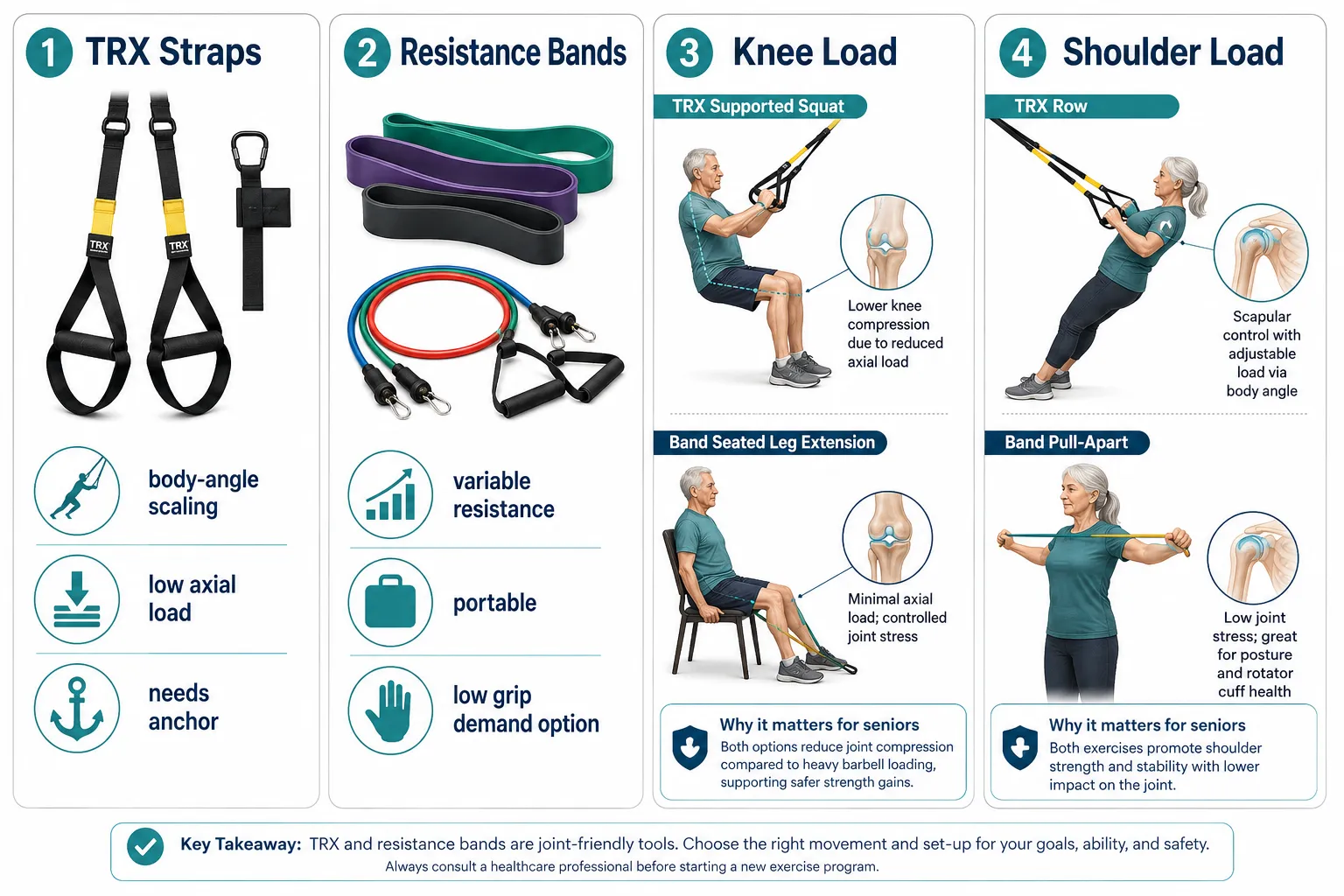
  • Both tools are joint-friendly because they let you scale load without heavy axial compression.[13]
  • TRX shines for knee-sensitive squats and shoulder-friendly rows because body angle adjusts resistance instantly.[1][13]
  • Bands are better for weak grip and seated exercise, especially loop bands you can wrap around limbs.
  • You can, and often should, combine both tools in one program for the best joint-friendly coverage.
  • No single tool prevents falls; balance-specific work must be programmed intentionally.[11]

What is TRX training and how does it work for seniors?

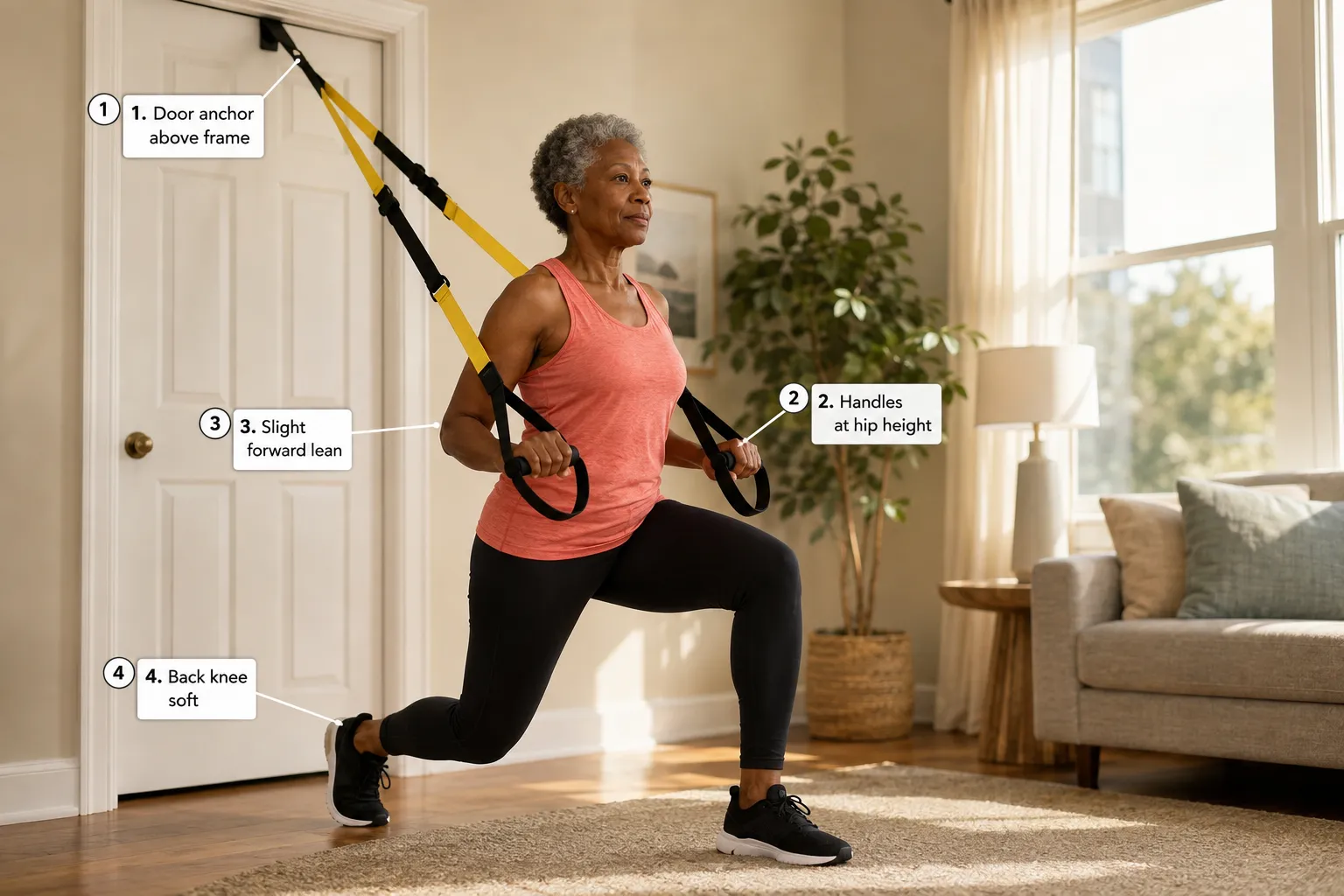
TRX is a suspension trainer: two adjustable straps with handles that anchor overhead, letting you use your body weight as resistance while you lean into or away from the anchor. For seniors, this means you can perform squats, rows, chest presses, and lunges with instant load adjustment by simply stepping closer or farther from the anchor point.[1][14]

A 2019 review in Frontiers in Physiology defines suspension training as attaching body segments to hanging straps to perform multi-joint, multi-planar exercises using body weight and instability.[12] In older adults, it can improve muscle strength, muscle mass, and functional performance.[12][15]

Why it works for older bodies:

  • Body-angle scaling means less-than-bodyweight squats and push-ups are possible when full versions hurt.[1]
  • The straps provide light hand support, which reduces fall anxiety during standing exercises.
  • Multi-planar movement patterns train the stabilizing muscles used in daily tasks like getting out of a chair.

What is TRX training and how does it work for seniors?

Decision rule: If you can stand from a chair unassisted and have a stable overhead anchor, TRX is a strong fit. If not, start with bands and progress later.

Are resistance bands safe for people with arthritis or joint pain?

Yes, resistance bands are among the safest strength tools for arthritic joints because they apply variable resistance across the range of motion with minimal axial (compressive) loading.[2][8] Unlike dumbbells, bands get progressively harder as you stretch them, meaning the weakest, most painful part of a joint's range gets the lightest load.

Why arthritic joints tolerate bands well:

  • No gravity-loaded impact on knees, hips, or spine
  • Resistance can be dialed in grip by grip on the band
  • Seated variations remove weight-bearing entirely
  • Easy to stop instantly if a movement provokes pain

Common mistake: Using a band that's too heavy and jerking through range. Slow, controlled tempo (3 seconds up, 3 seconds down) protects joints better than any single band choice.

TRX vs resistance bands: which is easier on knees and shoulders?

TRX generally wins for knees, because the straps let you offload body weight during squats and lunges, a benefit no free band can match. Bands often win for shoulders, especially for people with rotator cuff issues, because you can perform pain-free horizontal and diagonal patterns while seated with zero balance demand.

Coach-level guidance for adults over 50 highlights that TRX reduces stress on painful joints by letting you substitute suspension hamstring curls or supported squats for high-load knee-dominant exercises.[13]

Joint concern Better tool Why
Knee osteoarthritis TRX Offloads body weight in squats/lunges
Rotator cuff pain Bands Precise light loading, seated options
Hip stiffness TRX Multi-planar step-back lunges
Wrist pain Bands (loop) No hand grip needed
Lower back pain Bands Seated rows without balance load

How much do TRX straps cost compared to resistance bands?

TRX suspension trainers typically cost $100,$200+ for the official brand, with generic suspension straps starting around $30,$50. A complete resistance band set (loop bands, tube bands with handles, door anchor) usually costs $15,$40. Bands are the clear winner on price by a factor of 5-10x.

What you actually need to spend:

  • Bands starter kit: one light, one medium, one heavy loop band + a door anchor. Around $20,$30.
  • TRX starter kit: the strap system plus a door anchor (included with most kits). Around $100,$180 for reputable brands, less for generics.
  • Optional add-ons: exercise mat, sturdy chair (already owned), and grippy shoes.

For budget-constrained seniors or those testing the waters, bands are the lower-risk entry point.

Can seniors build muscle with resistance bands alone?

Yes. Seniors can build meaningful muscle and strength with resistance bands alone, provided the bands are heavy enough to reach near-failure in 8-15 reps and the program progresses over time. The 12-week CEJSSM trial showed band-based training improved functional mobility, strength, and balance to a similar extent as TRX.[2][8]

Requirements for band-only muscle building:

  1. Progressive overload, move to heavier bands or double them up as you get stronger.
  2. Multiple sets, 2-3 sets per exercise, 8-15 reps, close to muscular fatigue.
  3. Full-body coverage, press, pull, squat, hinge, and carry patterns.
  4. Consistency, 2-3 sessions weekly, minimum, for 12+ weeks.

Edge case: Very strong older adults may outgrow bands for lower-body work. At that point, adding TRX, weighted squats, or a leg press becomes useful.

Best TRX exercises for seniors with limited mobility

Start with five foundational TRX movements that scale easily by adjusting body angle: assisted squat, low row, chest press, hip hinge, and single-leg balance. Educational content for older adults shows that simply stepping closer or farther from the anchor makes each of these easier or harder.[1][14]

Best TRX exercises for seniors with limited mobility

The starter five:

  • TRX-assisted squat: Hold both handles, feet under anchor, lean back slightly and sit down. Straps take some weight off knees.
  • TRX low row: Feet forward, lean back, pull chest to handles. Adjust angle for difficulty.
  • TRX chest press: Face away from anchor, lean forward on straight arms, press back up. Easiest starting position: nearly upright.
  • TRX hip hinge: Hold handles, hinge at hips like closing a car door with your rear. Great for glutes.
  • TRX supported single-leg stance: Light fingertip contact on handles while balancing on one foot. Builds fall-prevention balance.

Common mistake: Starting too horizontal. Begin nearly upright, master the pattern, then progressively lean further.

Do I need a door anchor or pull-up bar to use TRX at home?

You need one secure overhead anchor point, most commonly a solid interior door with the included TRX door anchor, a ceiling mount, a pull-up bar, or a sturdy tree branch outdoors. Without a proper anchor, TRX is not safe to use.

Anchor options ranked by ease:

  1. TRX door anchor, included with most kits; slips over the top of a closed door. Best for renters. Door must open away from you.
  2. Ceiling or wall mount, most secure, requires drilling into a joist or stud. Best for permanent home setups.
  3. Pull-up bar in doorway, works if bar is rated for suspension use and installed correctly.
  4. Outdoor beam or tree, great for good weather; check strap wear from bark.

Never anchor to: a hollow door frame, a curtain rod, a drywall-only screw, or any furniture that isn't bolted down.

Resistance bands for seniors with weak grip strength

Weak grip is one of the strongest arguments for loop-style resistance bands over handled tube bands, because loops wrap around limbs and eliminate the need to squeeze. Weak grip also raises safety flags for TRX, since the entire system depends on holding the handles.

Grip-friendly band solutions:

  • Loop bands around wrists or ankles for rows, presses, and lateral walks
  • Bands with wrist cuffs for pulling movements
  • Handled bands with padded grips for lighter squeeze demand
  • Booty bands for seated leg exercises without any grip

A study reported in Nutrients comparing suspension training with a traditional resistance program in men averaging age 67 found the suspension group had greater hand-grip strength at the end.[3] So if grip is currently a weakness, bands are the safer start, and TRX can be phased in later as grip improves.

TRX training injuries and common mistakes seniors make

The most common TRX mistakes for seniors are anchoring incorrectly, starting too horizontal, and locking out joints under tension. Safety and feasibility studies of TRX-OldAge programs report good adherence and low adverse event rates when programs are supervised and scaled correctly.[8][12]

Top mistakes to avoid:

  • Poor anchor check. Always tug-test the strap and door before every session.
  • Too aggressive angle. Body too horizontal early on overloads shoulders and lower back.
  • Locked elbows/knees. Keep a soft bend to protect joints under load.
  • Ignoring pain. Sharp joint pain means stop, not push through.
  • Skipping warm-up. Two to three minutes of band pull-aparts and mini-squats prepares tissue.
  • No spotter or phone nearby. In case of a fall or dizziness during standing work.

Is TRX or resistance bands better for balance and fall prevention?

TRX has an edge for dynamic balance training because it demands active stabilization during standing exercises, while providing light hand support as a safety net. A 2025 study in the European Journal of Geriatrics and Gerontology found suspension training produced greater core muscle activation and improved functional performance versus traditional resistance training in adults 65-80.[11]

That said, neither tool alone prevents falls. Balance-specific exercises, single-leg stands, tandem walks, weight shifts, need to be part of any program regardless of tool choice.

Balance progression path:

  1. Seated band exercises → build baseline strength
  2. Standing band exercises with wall nearby → add postural demand
  3. TRX-supported single-leg work → introduce dynamic balance
  4. TRX exercises with lighter grip → increase stabilization demand
  5. Unsupported balance work → final progression

Can you use TRX and resistance bands together in one workout?

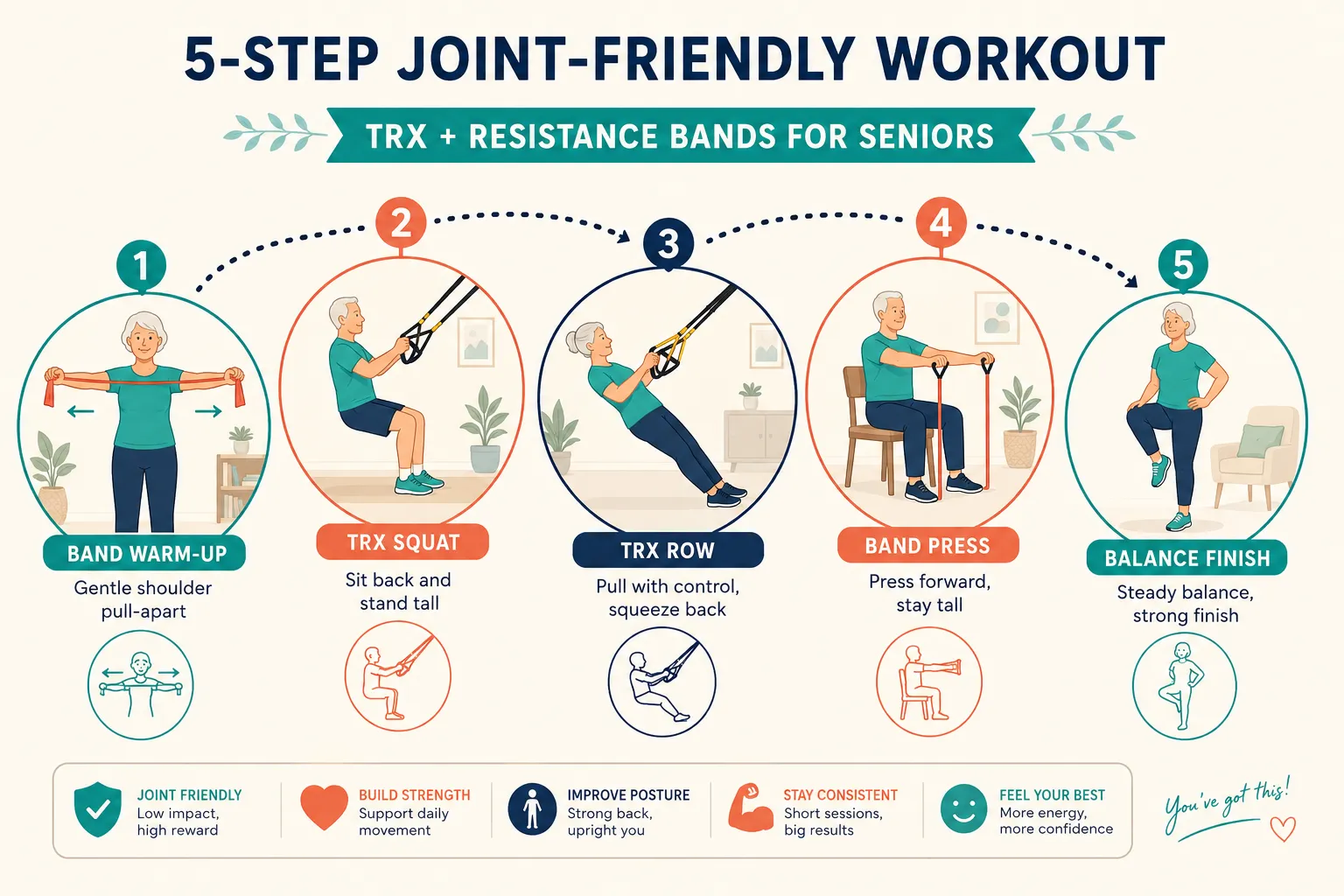
Absolutely, and combining them is often the smartest approach for joint-friendly senior training. Bands handle warm-ups, isolation work, and seated finishers; TRX handles compound standing movements.

Can you use TRX and resistance bands together in one workout?

Sample 30-minute joint-friendly session:

  1. Warm-up (5 min): Band pull-aparts, band shoulder circles, bodyweight mini-squats
  2. TRX squat, 2 x 10, lower body strength
  3. TRX low row, 2 x 10, upper back
  4. Band chest press seated, 2 x 12, chest without balance load
  5. TRX hip hinge, 2 x 10, glutes and hamstrings
  6. Band lateral walk, 2 x 10 steps each way, hip stability
  7. Cool-down (3 min): Band-assisted stretching

What weight resistance band should a senior start with?

Most seniors should start with a light band (roughly 5-15 lbs of resistance) for upper-body work and a medium band (15-25 lbs) for lower body. Color coding varies by brand, so go by feel: you should be able to complete 12-15 reps with good form and 2 reps left in reserve.

Starter kit recommendation:

  • One light loop band (upper body, rehab-style movements)
  • One medium loop band (rows, squats, hip work)
  • One heavy loop band (glute bridges, deadlifts, heavier pulls)
  • One long tube band with handles (chest press, overhead press)

Rule of thumb: If you can rip through 20 reps with no effort, size up. If you can't hit 8 clean reps, size down.

TRX alternatives for seniors who live in small spaces

Resistance bands are the top TRX alternative for small-space living because they store in a drawer and require no anchor. Other compact options include doorframe pull-up bars, sliding disc systems, and lightweight adjustable dumbbells.

Small-space strength options ranked:

  • Resistance bands, smallest footprint, most versatile
  • Suspension trainer (folded), small when stored, but needs a door for use
  • Sliders/discs, great for core and lower body, tiny storage
  • Adjustable dumbbells, compact but heavier, joint-loading
  • Kettlebell (single), one tool, many exercises, needs floor clearance

Do seniors need a trainer to use TRX safely at home?

Not strictly required, but strongly recommended for the first 2-4 sessions. A qualified trainer, ideally one certified in senior fitness or the TRX for Seniors specialty, can check anchor safety, set body angles, screen for red-flag movements, and personalize progressions.

When professional guidance is essential:

  • Existing joint replacements (hip, knee, shoulder)
  • Recent falls or dizziness episodes
  • Osteoporosis diagnosis
  • Post-surgery return to exercise
  • Balance concerns or use of a cane/walker

When self-guided is reasonable:

  • Generally healthy, no diagnosed conditions
  • Prior strength training experience
  • Comfortable following video instruction
  • Good communication with a physician who cleared exercise

Recent 2024-2026 senior-focused online programs increasingly integrate suspension trainers as joint-friendly tools, offering guided video content as a middle-ground option between fully DIY and one-on-one training.[1][4][9]

Pros and Cons Summary

TRX pros:

  • Whole-body, functional movement
  • Instant scaling by body angle
  • Strong core and balance demand
  • Light-to-moderate joint loading

TRX cons:

  • Higher cost ($100,$200+)
  • Requires secure overhead anchor
  • Demands baseline standing balance and grip strength
  • Steeper learning curve

Resistance band pros:

  • Very affordable ($15,$40)
  • Extremely portable
  • Seated options for very deconditioned users
  • Loop styles work without grip strength

Resistance band cons:

  • Bands can snap if worn, inspect regularly
  • Harder to precisely measure resistance
  • Less demand on balance and core
  • Very strong users may outgrow them

FAQ

Q: How many days a week should a senior strength train?
A: Two to three non-consecutive days per week is the standard recommendation for older adults, with 48 hours of rest between sessions targeting the same muscles.

Q: Are TRX workouts safe with a hip or knee replacement?
A: Generally yes, once cleared by your surgeon, because TRX reduces joint compression. Work with a physical therapist for the first several weeks.

Q: Can bands replace weights entirely for seniors?
A: For most seniors, yes, evidence shows bands produce comparable strength gains to traditional resistance in this age group.[2][8]

Q: How long until I notice results?
A: Most seniors feel stronger and more mobile within 4-6 weeks; measurable strength gains appear by 8-12 weeks with consistent training.

Q: Is TRX safe if I use a cane or walker?
A: Only under professional supervision. The balance demand may exceed current capacity, bands and seated exercises are safer starting points.

Q: Do bands or TRX build bone density?
A: Both can help maintain bone density through muscular tension on bones, but higher-load resistance (weights, machines) is stronger for bone building.

Q: What if I feel joint pain during an exercise?
A: Stop that exercise, reduce range of motion, or switch to a lighter version. Sharp or lingering pain warrants a call to your doctor or PT.

Q: Can I do TRX outdoors?
A: Yes, anchor to a sturdy tree branch, pergola, or playground beam rated for adult weight. Check straps for wear from bark or weather.

Conclusion

For joint-friendly home strength training in older adults, the best tool is the one you'll actually use consistently and safely. Evidence shows TRX and resistance bands produce comparable gains in strength, mobility, and balance when programs are well designed.[2][8][12] TRX offers whole-body functional movement and instant load scaling, ideal for seniors with baseline balance and a secure anchor. Bands offer unmatched affordability, portability, and accessibility, especially for very deconditioned or grip-limited users.

Your action steps:

  1. Assess honestly. Can you stand from a chair unassisted, grip firmly, and stand on one foot for 10 seconds? If yes, TRX is on the table. If no, start with bands.
  2. Start small. Buy a $20,$30 band starter kit and commit to 8 weeks, 2-3 sessions weekly, before investing in TRX.
  3. Book 2-4 sessions with a senior-certified trainer if you have any joint diagnoses, replacements, or balance concerns.
  4. Combine tools once you're comfortable with each individually, this covers the widest range of joint-friendly patterns.
  5. Track progress in a simple notebook: reps, band color, TRX angle. Progression is the engine of results.

The winner isn't TRX or bands. It's the consistent, well-scaled program you build around whichever tool fits your body, budget, and space today, with room to grow tomorrow.

References

[1] Watch – https://www.youtube.com/watch?v=5kXWcMuD_Uc
[2] 30021ad3af664701a19628237148bfcc – https://doaj.org/article/30021ad3af664701a19628237148bfcc
[3] Better Than Weights Suspension Trainers Are A Joint Friendly Way To Build Muscle In Older Adults – https://www.fitandwell.com/news/better-than-weights-suspension-trainers-are-a-joint-friendly-way-to-build-muscle-in-older-adults
[4] Watch – https://www.youtube.com/watch?v=Mzb9qjvW5z8
[8] wnus.usz.edu.pl – https://wnus.usz.edu.pl/cejssm/en/issue/120/article/1229/
[9] Watch – https://www.youtube.com/watch?v=imDxMpiIveE
[10] Suspension Trainer Exercises For The Whole Body – https://www.lifetimedaily.com/suspension-trainer-exercises-for-the-whole-body/
[11] European Journal of Geriatrics and Gerontology – suspension training vs traditional resistance training in adults 65-80
[12] Frontiers in Physiology (2019) – suspension training review in older adults
[13] Watch – https://www.youtube.com/watch?v=LA7Up35cOig
[14] Watch – https://www.youtube.com/watch?v=df_IfxLcClg
[15] Watch – https://www.youtube.com/watch?v=uyT_CsJtyCo&vl=nl-NL

Weighted vest strength and balance routines for adults 60+

Weighted vest strength and balance routines for adults 60+

Last updated: August 25, 2026

Quick Answer

Weighted vest strength and balance routines for adults 60+ are short, low-impact sessions (15-30 minutes, 2-4 times a week) that add 4-10% of body weight to everyday moves like squats, wall push-ups, and heel-to-toe walks. Used correctly, a vest can help preserve muscle, improve postural stability, and support metabolic health during aging or weight loss. It is not a guaranteed fix for hip bone density, and load, fit, and progression matter more than brand [1][5].

Key Takeaways

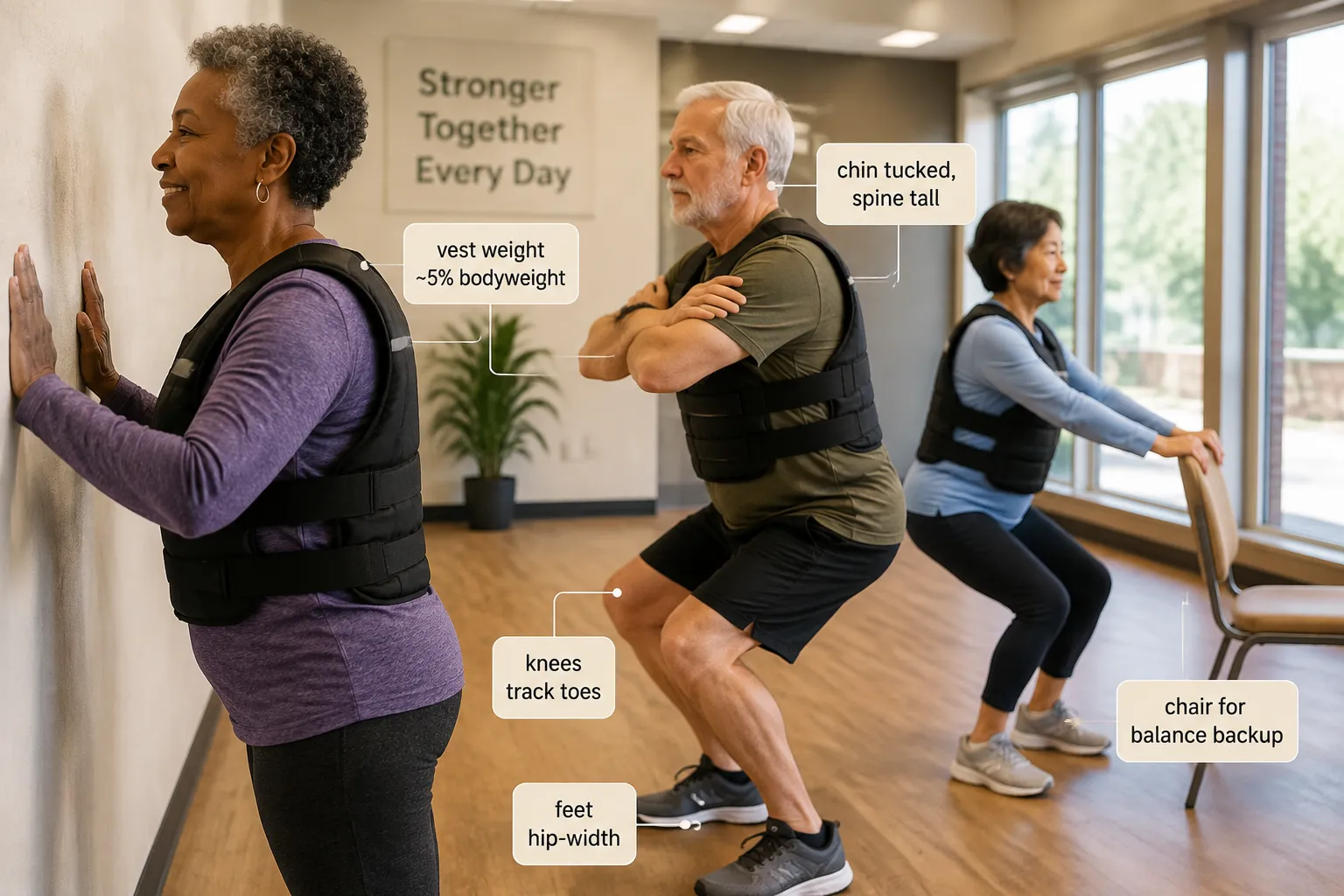
  • Start with 4-5% of body weight and progress slowly; most adults 60+ top out between 8-12% of body weight.
  • Focus on balance drills, sit-to-stands, step-ups, and posture work, not heavy cardio in a vest.
  • Train 2-4 days per week, wearing the vest 15-30 minutes per session, not all day.
  • Recent trials show vests can preserve trunk muscle density and resting energy expenditure during weight loss, but do not reliably prevent hip bone loss [2][5][8].
  • Vests are generally safer than weight belts for seniors because load is distributed across the torso.
  • Skip or modify with uncontrolled high blood pressure, recent fractures, severe osteoporosis, or acute joint flares without clinician sign-off.
  • Fit matters more than brand: snug, adjustable, breathable, and easy to put on alone.

What Are Weighted Vest Strength and Balance Routines for Adults 60+

A weighted vest routine for older adults is a structured plan that adds external load to functional movements, standing up from a chair, stepping, reaching, walking, to build strength, bone stimulus, and balance at the same time. The vest sits close to the body's center of mass, so it challenges posture and stability without loading the hands or spine the way a barbell would.

These routines matter because after age 60, adults lose roughly 1-2% of muscle mass per year and balance reflexes slow. Adding a modest external load to daily-life moves is one of the simplest ways to push back against that decline at home [1][10].

Choose a vest routine if you: want low-equipment strength training, need better balance, are trying to preserve muscle during weight loss, or want to stay independent longer.

Skip it if you: have unstable cardiovascular disease, an unhealed fracture, severe cervical spine issues, or your clinician has advised against added spinal load.

What Are the Best Weighted Vests for Seniors Over 60

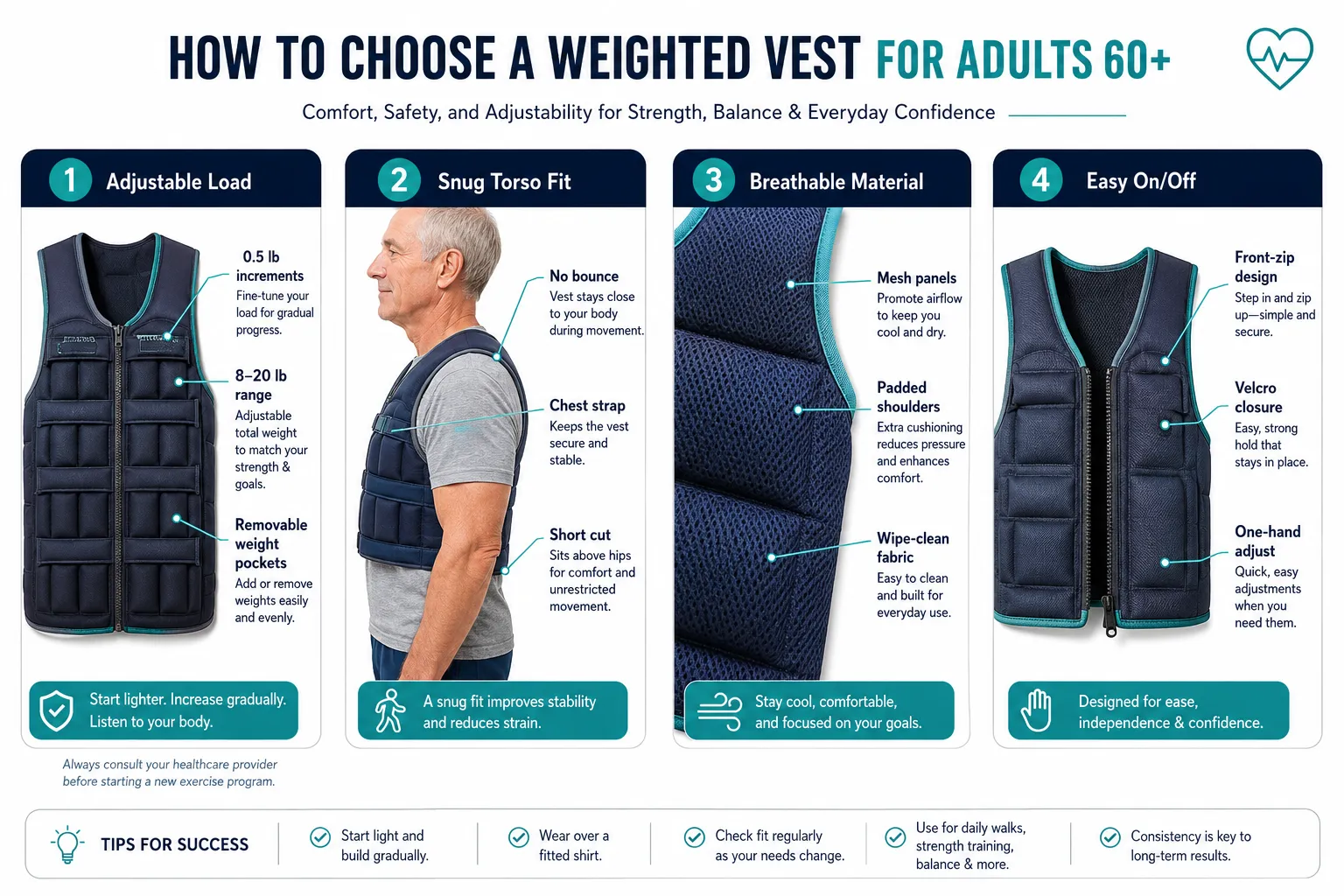
The best weighted vest for a senior is adjustable, snug, short-cut, and easy to put on alone. Look for 0.5-1 lb removable weight increments, padded shoulders, a chest or waist strap to stop bouncing, and a max load of 15-20 lb (you rarely need more).

What Are the Best Weighted Vests for Seniors Over 60

Brand-name reviews shift often, but the categories that consistently perform well for adults 60+ include:

  • Short-torso adjustable vests (examples: Hyperwear Hyper Vest FIT, Aduro Sport adjustable, Empower short vests), good for smaller frames and easier on the low back.
  • Modular pocket vests with 0.5 lb steel shot bags, best for slow progression.
  • Front-zip vests, much easier for anyone with shoulder arthritis than pullover styles.

Avoid tactical or military-style vests. They're heavy, long, and load the lumbar spine more than needed.

Rule of thumb: If you can't put the vest on by yourself in under 30 seconds, it's the wrong vest.

How Much Weight Should a 60 Year Old Wear in a Weighted Vest

Start at 4-5% of body weight and cap most routines at 8-10% of body weight. For a 150-lb adult, that means beginning around 6-8 lb and progressing toward 12-15 lb over months, not weeks. Research in older adults suggests loads that are too light produce little training effect, while loads above ~10% raise fall and joint-stress risk without much added benefit [1][10].

Progression rule: add weight only when you can complete your full routine with good form and no next-day joint pain for two consecutive sessions.

Weighted Vest Exercises for Balance and Fall Prevention

Balance work in a vest trains your body to correct itself under load, which is exactly what happens in a real stumble. A 2022 randomized trial combining whole-body vibration with weighted vest training reported meaningful gains in balance and lower-limb strength in older adults [3], and a 2025 square-stepping-plus-vest report found improved fall-risk scores in community-dwelling seniors [4].

Weighted Vest Exercises for Balance and Fall Prevention

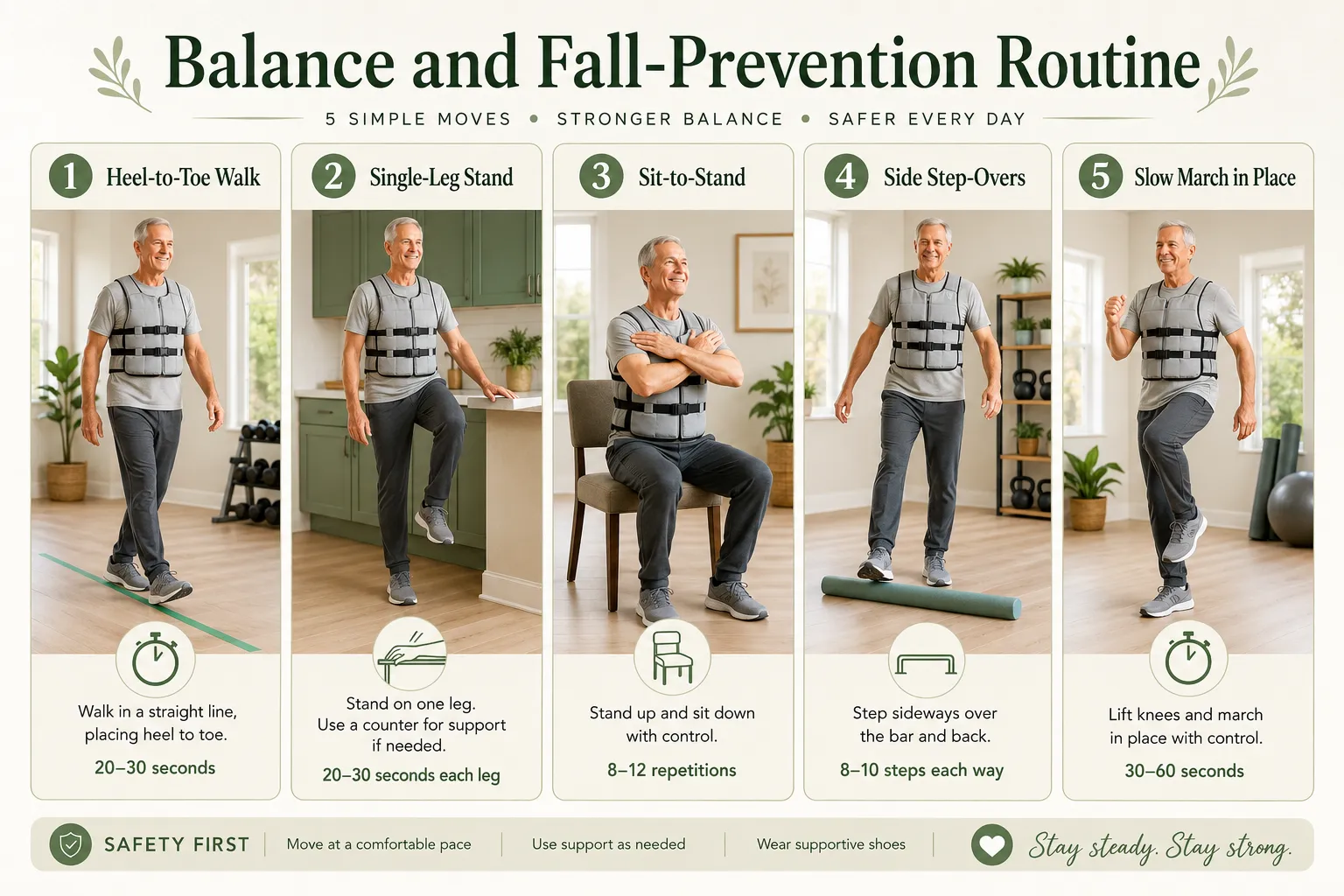
A simple 15-minute fall-prevention block, done 2-3 times a week:

  1. Heel-to-toe walk along a line, 2 lengths of 20 feet.
  2. Single-leg stand near a counter, 20 seconds per side, 3 rounds.
  3. Sit-to-stand from a sturdy chair, 2 sets of 8-12.
  4. Side step-overs across a rolled towel, 10 crossings.
  5. Slow march in place with high knees, 60 seconds.

Wear the vest for the whole block. Keep one hand near a wall or counter for the first two weeks.

Can Weighted Vests Improve Bone Density in Older Adults

Weighted vests can improve bone-loading stimulus, but current evidence shows they do not reliably prevent hip bone loss, especially during weight-loss interventions. The large 2025 INVEST in Bone Health RCT (JAMA Network Open) found that a weighted vest worn during weight loss did not preserve hip BMD compared with control [5][7]. However, follow-up analyses reported preserved trunk muscle density and resting energy expenditure, both meaningful for aging bodies [2][8][9].

What this means practically: don't rely on a vest alone for osteoporosis prevention. Pair it with impact work you tolerate (heel drops, brisk walking), resistance training, and physician-guided nutrition and medication where indicated.

Weighted Vest vs Resistance Bands for Seniors: Which Is Better

Neither is universally better, they solve different problems.

Weighted vest, best for balance, posture, sit-to-stand, walking economy, and axial loading during daily tasks. Hands stay free.

Resistance bands, best for isolated upper-body pulling, rotator cuff work, hip abduction, and travel. Lower spinal load.

Choose a vest if your goal is functional strength, balance, and staying independent. Choose bands if your goal is joint-specific rehab, shoulder health, or you have significant spinal concerns. Most well-designed programs use both.

Are Weighted Vests Safe for People with Arthritis or Joint Pain

For most adults with mild-to-moderate osteoarthritis, a light vest (4-6% body weight) is safe and often well tolerated, because the load is centered on the torso rather than the knees or hips directly. It is not appropriate during an active joint flare, with unstable joints, or after recent joint replacement without surgeon clearance.

Practical guardrails:

  • Avoid vest use during downhill walking or stairs if knees are symptomatic.
  • Skip jumping or running in a vest.
  • If pain increases the next day, drop weight by 25% or move to seated exercises.

Weighted Vests for People with Osteoporosis: Is It Safe

Vests can be safe with osteoporosis when the load is light, the routine avoids spinal flexion under load, and a clinician has cleared the person. Do not combine a vest with forward-bending, twisting, or sit-ups, these movements raise vertebral fracture risk regardless of load.

Stick to upright, hip-hinge, and balance-based work. If you have had a vertebral compression fracture, ask a physical therapist to design the routine.

How Long Should Seniors Wear a Weighted Vest During Workouts

Wear the vest for 15-30 minutes per session, not all day. Some 2025-2026 trial protocols used longer daily wear during weight-loss studies, but those were supervised and progressive [2][7]. For home use, shorter targeted sessions produce most of the strength and balance benefit with less joint fatigue.

Signs you've worn it too long: shoulder soreness, low-back ache, headache, or posture that collapses forward. Stop, remove weight, and shorten the next session.

How Often Should Seniors Do Weighted Vest Training per Week

2-4 sessions per week is the practical sweet spot. Beginners: two non-consecutive days for 2-3 weeks. Intermediate: three days. Advanced or well-conditioned adults: up to four, alternating balance-focused and strength-focused days.

Rest days matter more after 60, muscle recovery slows, and connective tissue needs the gap.

Weighted Vest Routines for Improving Posture in Older Adults

A vest can improve posture by cueing the deep trunk muscles to keep the ribcage stacked over the pelvis. A 2021 experimental study on weighted torso balance training reported gains in both anticipatory and reactive balance, both closely tied to postural control [6].

Weighted Vest Routines for Improving Posture in Older Adults

A 10-minute daily posture block:

  • Wall stand (heels, hips, upper back, head against wall), 60 seconds.
  • Chin tucks, 10 reps.
  • Scapular squeezes, 15 reps.
  • Hip hinge to countertop, 10 reps.
  • Slow walk with vest, tall spine, 3 minutes.

Do this in the morning. Posture wins compound.

What's the Difference Between Weighted Vests and Weight Belts for Seniors

A weighted vest distributes load across the shoulders and torso. A weight belt concentrates load at the hips or waist. For adults 60+, vests are usually the better default because the load stays closer to the body's center of mass and doesn't tug at the low back the way a belt can. Belts are useful for specific hip-loading protocols under supervision, but they're rarely a good first purchase for a home program.

Common Mistakes Older Adults Make with Weighted Vests

The frequent mistakes are predictable and fixable:

  • Buying too heavy. A 20-lb vest sits unused. A 10-lb adjustable vest gets worn.
  • Wearing it during long walks before strength adapts. Start with short strength sessions first.
  • Skipping the chest strap. A bouncing vest hurts shoulders and ruins form.
  • Adding weight weekly. Progress in 2-4 week blocks.
  • Doing crunches or toe-touches in the vest. Never load spinal flexion at this age.
  • Ignoring next-day soreness that lasts more than 48 hours. That's a signal to deload.

Can I Use a Weighted Vest if I Have High Blood Pressure or Heart Issues

If your blood pressure is well-controlled and your cardiologist has cleared you for moderate exercise, a light vest during standing balance and strength work is generally fine. Avoid it if you have uncontrolled hypertension, unstable angina, recent cardiac events, or symptomatic heart failure without clinician sign-off.

Safety checklist before each session:

  • Resting BP under your clinician's target.
  • No chest pressure, unusual shortness of breath, or dizziness.
  • Hydrated, not fasted longer than usual.
  • Stop immediately for symptoms and remove the vest.

A Sample Weekly Plan

Day Focus Duration Vest Load
Mon Strength (sit-to-stand, wall push-up, step-up) 20 min 5% BW
Tue Rest or walk (no vest) , ,
Wed Balance and posture block 15 min 4% BW
Thu Rest , ,
Fri Strength + short vest walk 25 min 5-6% BW
Sat Balance drills 15 min 4% BW
Sun Rest , ,

Adjust down if you're just starting. Two days a week beats zero.

FAQ

Is a 10-pound vest enough for a 70-year-old?
For most 70-year-olds under 180 lb, 8-10 lb is a productive working load once conditioned. Start lighter.

Can I wear a weighted vest for housework?
Short bouts (15-20 minutes) are fine if posture stays tall. Skip it for vacuuming, bending, or lifting.

Will a weighted vest help me lose belly fat?
It supports muscle preservation and metabolic rate during weight loss but won't spot-reduce fat [2][8].

How soon will I see balance improvements?
Most people notice steadier single-leg stands in 3-6 weeks of consistent training.

Are weighted vests safe after knee replacement?
Only with surgeon clearance, usually not before 3-6 months post-op, and starting very light.

Can I sleep or nap in a weighted vest?
No. Vests are training tools, not compression garments.

Do I need shoes with a vest indoors?
Supportive shoes are recommended for balance drills. Barefoot only on non-slip surfaces if you already train barefoot.

What if I have a pacemaker?
Ask your cardiologist first. Most modern pacemakers tolerate light vest use, but chest strap placement matters.

Conclusion

Weighted vest strength and balance routines for adults 60+ are one of the highest-leverage home tools for staying strong, upright, and independent. The evidence is clear that a modest, well-fitted vest, used 2-4 times per week for 15-30 minutes on balance, sit-to-stand, and posture work, preserves muscle quality and improves stability, even if it does not solve hip bone density on its own [1][2][5][8].

Next steps this week:

  1. Weigh yourself and calculate 4-5% of body weight.
  2. Order or borrow an adjustable vest that starts light and increments by 0.5-1 lb.
  3. Block three 20-minute sessions on your calendar.
  4. Run the balance block above on day one, the posture block on day two, and a light strength circuit on day three.
  5. Reassess in four weeks, add weight only when form and recovery both look clean.

Small load. Steady weeks. Big returns on independence.

References

[1] Full – https://www.frontiersin.org/journals/public-health/articles/10.3389/fpubh.2026.1811712/full
[2] Weighted Vests Might Help Older Adults Meet Weight Loss Goals – https://newsroom.wakehealth.edu/news-releases/2025/06/weighted-vests-might-help-older-adults-meet-weight-loss-goals
[3] S12877 022 03593 4 – https://bmcgeriatr.biomedcentral.com/articles/10.1186/s12877-022-03593-4
[4] Pmc12614173 – https://pmc.ncbi.nlm.nih.gov/articles/PMC12614173/
[5] jamanetwork – https://jamanetwork.com/journals/jamanetworkopen/fullarticle/2835505
[6] Paah – https://paahjournal.com/articles/10.5334/paah.43
[7] Were Putting Weighted Vests To The Test Heres What Our Research Shows – https://news.wfu.edu/2025/10/20/were-putting-weighted-vests-to-the-test-heres-what-our-research-shows/
[8] academic.oup – https://academic.oup.com/biomedgerontology/article/81/4/glag062/8501989?login=false
[9] academic.oup – https://academic.oup.com/innovateage/article/9/Supplement_2/igaf122.3868/8410348
[10] Full – https://www.frontiersin.org/journals/aging/articles/10.3389/fragi.2024.1335534/full

Functional longevity training for older adults at home

Functional longevity training for older adults at home

Last updated: August 23, 2026

Quick Answer

Functional longevity training for older adults at home is a mix of strength, balance, mobility, and light aerobic work built around real-life movements like standing up, reaching, carrying, and walking. Aim for 150 minutes of moderate activity, two strength sessions, and balance work three or more days per week, done in your living room with a chair, a mat, and light weights [5][10]. It's the fastest-growing shift in healthy aging, away from anti-aging pills and toward keeping people independent, mobile, and fall-free well past 80.

Key Takeaways

  • The weekly baseline for older adults is 150 minutes of moderate aerobic activity, 2 strength sessions, and balance training on 3+ days [5][10].
  • Functional training beats isolated gym work for daily independence and fall reduction in adults 65+ [1][3].
  • Fall-prevention programs need about 50 total hours over 12+ weeks to meaningfully cut fall risk, home programs can deliver this [6].
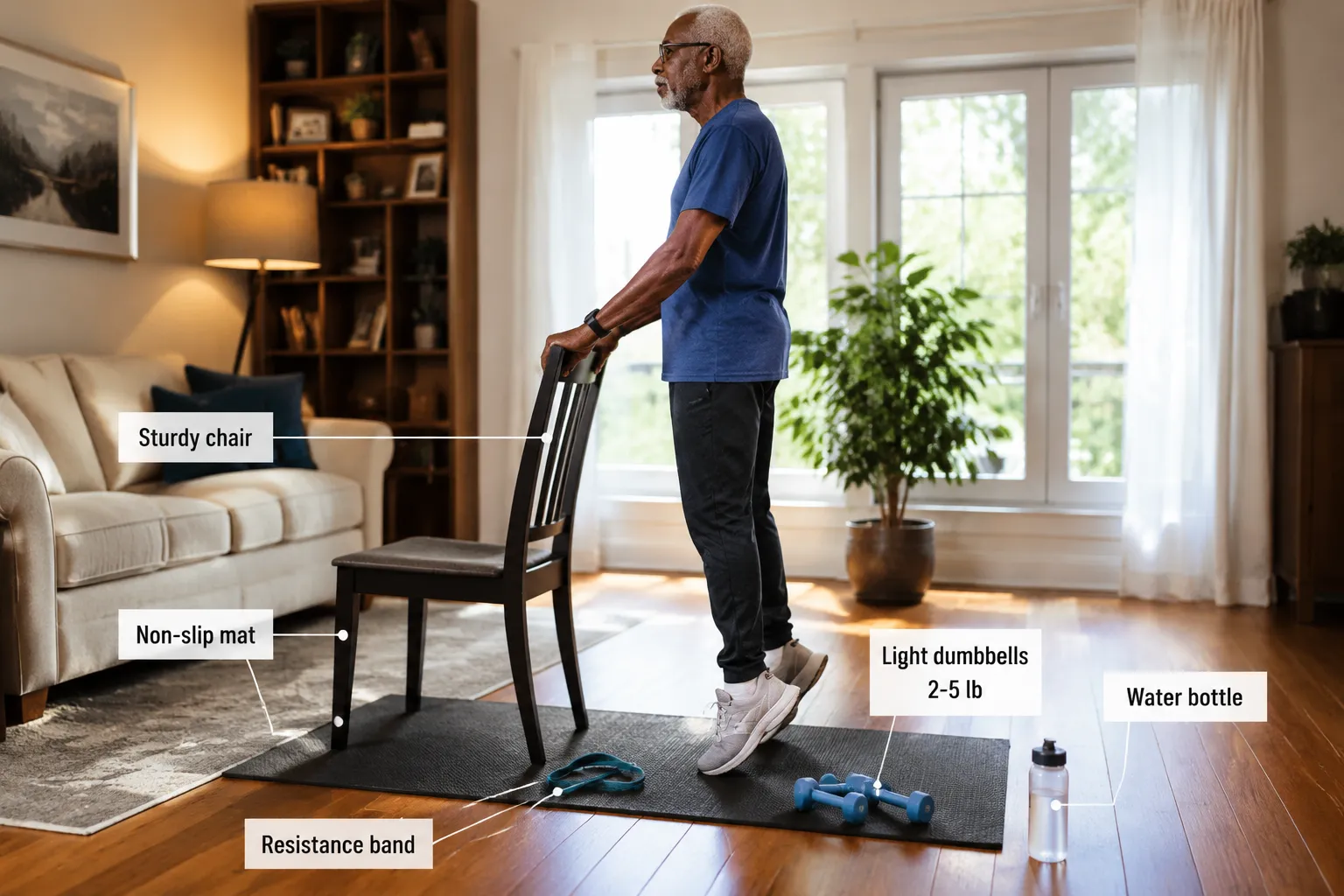
  • Minimal equipment required: a sturdy chair, non-slip mat, resistance band, and 2-5 lb dumbbells cover most exercises.
  • Results appear in 4-8 weeks, better balance and easier stair climbing come first; strength gains follow.
  • Arthritis is not a barrier; movement usually reduces joint pain when programmed correctly.
  • Lifestyle-integrated exercise (LiFE) embeds training into daily chores, boosting adherence in people who dislike "workouts" [1].
  • See a doctor first if you have heart disease, uncontrolled blood pressure, recent surgery, or frequent falls.

What Is Functional Longevity Training and How Does It Work?

Functional longevity training is exercise designed around the movements you actually need to live independently, standing up, climbing stairs, carrying groceries, catching your balance, reaching a top shelf. Instead of isolating one muscle, it trains movement patterns that build strength, stability, and coordination together.

The mechanism is simple: aging bodies lose muscle mass (sarcopenia), power, and neural coordination faster than they lose aerobic capacity. Functional training targets all three at once. Recent evidence shows that functional resistance training (FRT) produces greater gains in balance, gait, and activities of daily living than traditional isolated resistance training (TRT) in older adults [1][3].

The "longevity" part refers to a broader shift in 2026: geriatric medicine and public health now frame exercise as the single most powerful intervention for adding healthy, independent years, not just total lifespan [2][6].

What Is Functional Longevity Training and How Does It Work?

Best Functional Longevity Exercises for Seniors at Home

The best home exercises train the five movement patterns older adults use every day: squat, hinge, push, pull, and carry, plus balance and gait.

Core weekly menu:

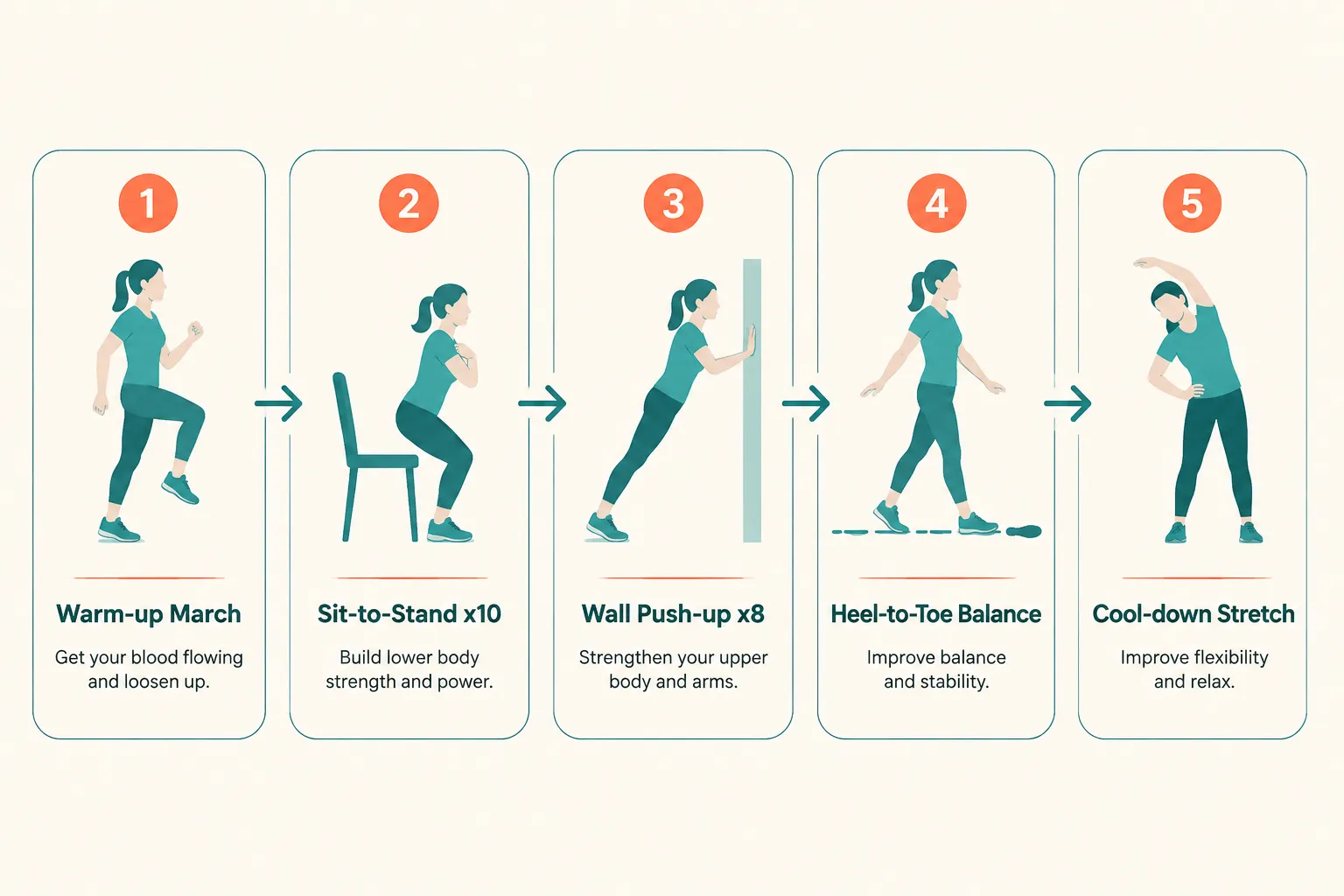
  1. Sit-to-stand from a sturdy chair, 2 sets of 8-12 reps (trains legs, hips, and getting off the toilet).
  2. Wall or counter push-ups, 2 sets of 6-10 reps (trains upper body and floor-recovery strength).
  3. Hip hinges with light weight or unloaded, 2 sets of 10 (protects the back when lifting).
  4. Farmer's carry, walk 20-30 feet holding two water bottles or dumbbells (grip, posture, gait).
  5. Heel-to-toe walk along a hallway, 2 laps (dynamic balance).
  6. Single-leg stand near a counter, 3 x 20-30 seconds each side.
  7. Step-ups onto a low step, 2 sets of 8 per leg.
  8. Marching in place or brisk walking, 10 minutes for aerobic base.

Choose harder progressions if you can already do a full set without holding on. Add a resistance band, a small weight, or close your eyes during balance work.

How Often Should Older Adults Do Functional Longevity Training?

The current 2026 baseline from WHO, the CDC, and the NHS is 150 minutes of moderate aerobic activity per week, plus 2 strength sessions, plus balance work on 3 or more days [5][10]. For fall prevention specifically, evidence points to a minimum dose of about 50 total hours over at least 12 weeks [6].

A realistic weekly structure at home:

Day Focus Time
Mon Strength + balance 30 min
Tue Brisk walk / aerobic 30 min
Wed Mobility + balance 20 min
Thu Strength + balance 30 min
Fri Brisk walk / aerobic 30 min
Sat Longer walk + carries 40 min
Sun Rest or gentle stretch ,

That's roughly 3 hours a week, hitting all three guideline pillars. Consistency matters more than intensity. Missing a session is fine; missing three weeks erases most of the gains.

Functional Longevity Training vs Regular Exercise for Seniors

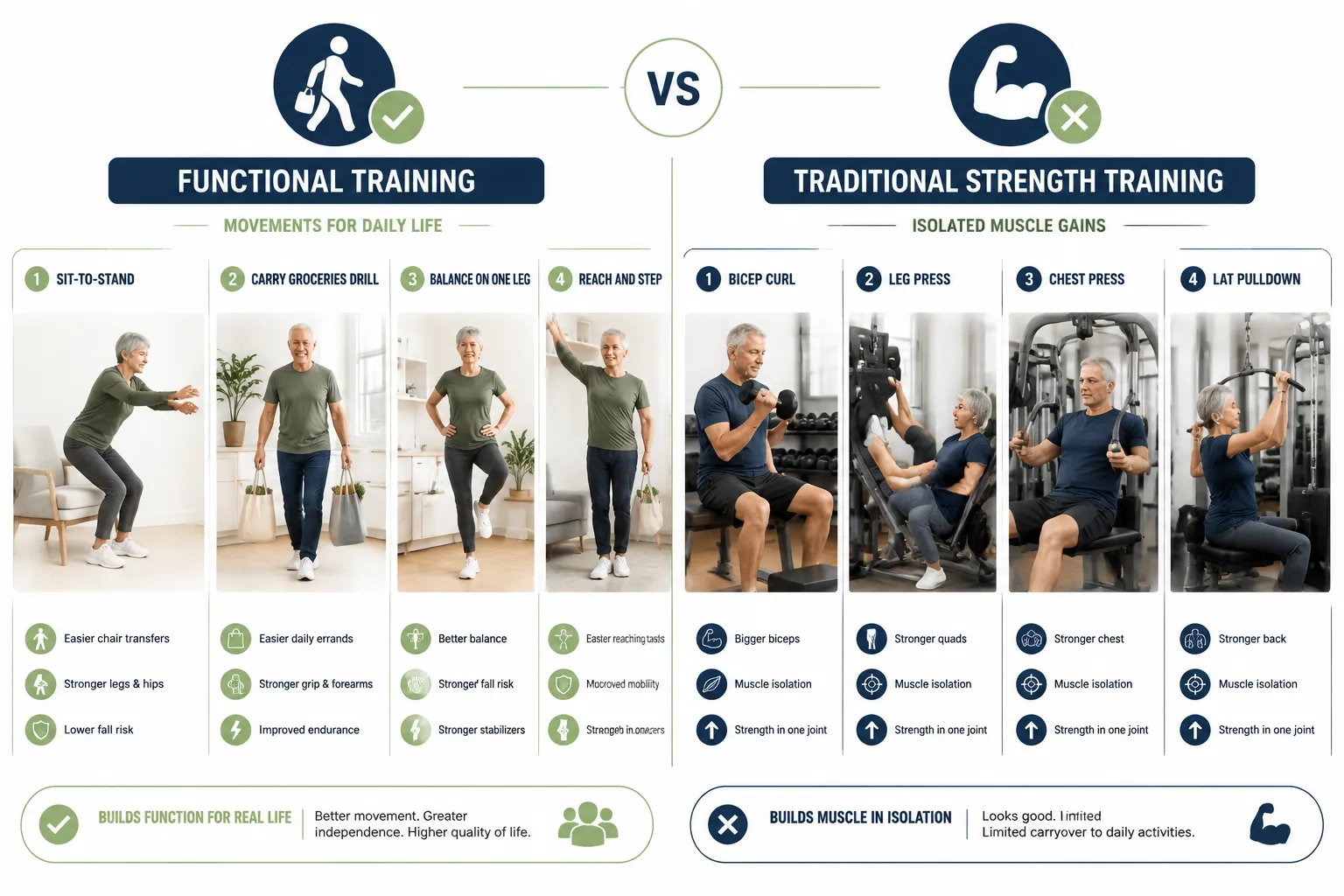
Functional training uses multi-joint, real-life patterns; regular strength training isolates individual muscles. Both help, but functional programs win on the outcomes that matter most after 65: balance, gait speed, and independence in daily tasks [1][3].

Functional Longevity Training vs Regular Exercise for Seniors

Key differences:

  • Traditional strength (bicep curl, leg press): builds muscle size and force in one joint. Good for baseline strength.
  • Functional (sit-to-stand, carry, step-up): builds strength and coordination across joints under real-world loading.
  • Combined approach wins: use compound functional lifts as the base, add isolated work if a specific muscle is weak.

A 2025 meta-analysis found FRT produced larger improvements in Timed Up-and-Go and activities of daily living than TRT in adults over 60 [1]. That said, both were better than doing nothing.

Can I Do Functional Longevity Training with Arthritis or Joint Pain?

Yes, and it usually reduces pain over time. Modern guidelines recommend movement, not rest, for most forms of arthritis. The key is starting light, avoiding sharp pain, and progressing slowly.

Adjustments that work:

  • Swap deep squats for chair-assisted sit-to-stands if knees hurt.
  • Use wall push-ups instead of floor push-ups for wrist or shoulder arthritis.
  • Warm up longer, 5-10 minutes of gentle marching or arm circles.
  • Follow the "next-day rule": if joint pain is worse the next day, reduce reps or range by 25%.

A dull ache during exercise that fades within an hour is normal. Sharp, stabbing, or lasting pain is a stop sign. See a physical therapist for a tailored program if you have severe osteoarthritis, a joint replacement, or rheumatoid disease.

Functional Longevity Training Equipment Needed at Home

You need very little. The evidence base for home programs was built largely with household items and one or two cheap tools [1][6].

Essentials (under $60 total):

  • A sturdy dining or kitchen chair (no wheels), supports balance and sit-to-stands.
  • A non-slip mat, for floor work and stability.
  • A resistance band (loop or long), replaces most upper-body machines.
  • Two light dumbbells: 2-5 lb to start, 5-10 lb as you progress. Water bottles work.
  • A stable step or bottom stair for step-ups.

Nice-to-have: a wall clock or timer, comfortable shoes with grip, and a wall or counter within arm's reach for balance work.

Functional Longevity Training Equipment Needed at Home

Skip: vibration plates, "core" gadgets, and most balance boards until you've mastered basics on the floor.

How Long Before You See Results from Functional Longevity Training?

Most older adults notice easier stair climbing and better balance within 2-4 weeks, measurable strength gains by 6-8 weeks, and meaningful fall-risk reduction after 12+ weeks of consistent training [1][6].

Typical timeline:

  • Week 1-2: Movements feel more coordinated. Less morning stiffness.
  • Week 3-4: Sit-to-stand feels lighter. Balance holds get longer.
  • Week 6-8: Grocery bags and laundry are easier. Grip is stronger.
  • Week 12+: Documented drops in fall risk, faster gait, better Timed Up-and-Go scores [1][3].
  • 6 months+: Muscle mass and bone density improve.

The 50-hour dose threshold matters. Programs shorter than 12 weeks or under 50 total hours rarely produce lasting fall-prevention effects [6].

Is Functional Longevity Training Safe for People Over 70?

Yes, for the vast majority. WHO, the CDC, and 2026 fall-prevention consensus panels all state that every older adult, including those in their 80s and 90s, should receive exercise advice, with functional balance and strength as core components [6][10]. The risk of not exercising (falls, disability, cognitive decline) is far greater than the risk of a well-designed home program.

Safety essentials for the 70+ crowd:

  • Start with supported versions of every exercise (chair or counter nearby).
  • Never hold your breath during effort, exhale on the hard part.
  • Hydrate before and after.
  • Stop for chest pain, dizziness, sudden shortness of breath, or joint locking.

Higher-risk situations that need medical clearance: recent hospitalization, uncontrolled heart disease, blood pressure over 160/100, recent fractures, or unexplained frequent falls.

Common Mistakes Older Adults Make with Functional Longevity Training

The most common mistake is doing too much too fast, then quitting after soreness. Steady, boring consistency beats heroic weekend sessions.

Other frequent errors:

  1. Skipping balance work because it feels easy, until it isn't.
  2. Only doing cardio (walking) and neglecting strength.
  3. Using weights that are too light forever, strength requires progression.
  4. Holding onto the chair with a death grip during balance drills. Fingertips only, once you're stable.
  5. Ignoring form, a fast sloppy sit-to-stand teaches your body bad patterns.
  6. Training through sharp pain instead of modifying.
  7. Stopping when you feel "good enough", detraining begins within 2 weeks of stopping.

Functional Longevity Training for People with Limited Mobility

Seated and supported versions of every functional exercise exist, and they work. Trials in frail and mobility-limited adults show meaningful strength and balance gains from chair-based programs [1][8].

A starter routine for limited mobility:

  • Seated marching, 2 minutes.
  • Seated leg extensions, 2 x 10 each leg.
  • Seated arm raises with light weights, 2 x 10.
  • Seated resistance-band rows, 2 x 10.
  • Supported sit-to-stand using armrests, 2 x 5.
  • Weight shifts while standing at a counter, 1 minute.
  • Ankle pumps and heel raises, 2 x 10.

For people with diabetic peripheral neuropathy, Parkinson's, or post-stroke deficits, general "functional training" is a good start but rarely enough, a physical therapist should build the program [7][9].

How Much Does a Functional Longevity Trainer or Program Cost?

Free to expensive, depending on delivery. Public-health-backed programs (Otago, LiFE, Tai Chi for Arthritis) are often available free through libraries, senior centers, or Medicare Advantage plans in the US.

Typical price ranges:

  • Free: NHS Live Well, CDC STEADI resources, YouTube channels (search "senior functional training").
  • Low cost: Group community classes at senior centers or YMCAs.
  • Mid range: App-based programs (see next section).
  • Higher cost: One-on-one virtual coaching or in-home personal trainers certified in senior fitness.
  • Physical therapy: Often covered by insurance with a doctor's referral, especially after a fall or surgery.

Value tip: spend the money on one or two sessions with a geriatric PT to build a personalized plan, then execute it free at home.

Functional Longevity Training Apps and Online Programs for Seniors

Remote and videoconference-supported home training is feasible, well-accepted, and effective in older adults, according to recent trials [4].

What to look for:

  • Progressive programming (not the same workout every week).
  • Balance and strength included, not just stretching.
  • Videos led by trainers with senior fitness certification (NSCA, ACE, or geriatric PT).
  • Options to modify each exercise up or down.
  • Optional live check-ins for accountability.

Categories that work: NHS-endorsed apps, YMCA 360, SilverSneakers GO, Bold, Mighty Health, and geriatric PT telehealth platforms. Free YouTube channels aimed at 60+ audiences also work if you follow a structured plan, not random videos.

What's the Difference Between Functional Training and Strength Training for Older Adults?

Strength training builds force in a specific muscle. Functional training builds usable strength across the movement patterns of daily life. Older adults usually benefit most from a program that's 80% functional, 20% targeted strength.

Quick comparison:

Feature Traditional Strength Functional Longevity
Goal Muscle size/force Independence & balance
Example Leg press machine Sit-to-stand + step-up
Equipment Machines, barbells Chair, band, body weight
Best for Building max strength Real-world tasks & falls
Fall reduction Modest Strong [1][3]

The 2026 updates to resistance-training guidelines for older adults emphasize combining both: heavier progressive loading for muscle preservation, plus functional patterns for coordination and power [2].

Do I Need to See a Doctor Before Starting Functional Longevity Training?

Most healthy older adults can start light functional training without medical clearance. WHO and CDC both endorse this. However, a doctor's visit is wise if you have any of the following [5][10]:

  • Heart disease, chest pain, or shortness of breath at rest.
  • Blood pressure consistently over 160/100.
  • Recent surgery, fracture, or hospitalization.
  • Diabetes with complications (neuropathy, retinopathy).
  • Frequent unexplained falls or dizziness.
  • A new symptom you haven't discussed yet.

Ask specifically: "Are there any movements I should avoid, and can you refer me to a physical therapist to build a starter plan?" That single question opens the door to the best possible program.

FAQ

How many days a week should a 75-year-old exercise?
Most days. Aim for 150 minutes moderate activity spread across 5 days, 2 strength sessions, and balance work 3+ days [5][10].

Can functional training reverse muscle loss after 70?
It can meaningfully slow and partially reverse sarcopenia when combined with adequate protein intake (roughly 1.0-1.2 g/kg/day) and progressive resistance [2].

Is walking enough on its own?
No. Walking is excellent aerobic exercise but doesn't build the leg strength or balance needed to prevent falls. Add strength and balance work.

What's the single most important exercise for older adults?
The sit-to-stand. It predicts independence, tracks leg strength, and translates directly to getting off the toilet, out of a chair, and up from the floor.

Can I lift heavy weights safely at 80?
Yes, with proper form and progression. 2026 resistance training guidelines specifically endorse progressive loading in adults 80+ under supervision when needed [2].

How do I know if I'm progressing?
Time your sit-to-stands (10 reps), single-leg stand duration, and how far you can walk in 6 minutes. Retest every 4 weeks.

What if I fall during training?
Learn to get up from the floor as part of your program. Practice it monthly on a soft surface with a chair nearby.

Is Tai Chi considered functional longevity training?
Yes. Tai Chi is strongly evidence-backed for balance and fall prevention in older adults [6].

Conclusion and Next Steps

The evidence in 2026 is clear: staying independent past 75 is a training outcome, not a genetic lottery. Functional longevity training at home, a chair, a band, 30 minutes, most days, delivers the biggest return on investment of any health habit available to older adults.

Your next three steps:

  1. This week: Do a baseline test. Time how long it takes to do 10 sit-to-stands from a chair. Note it.
  2. Next 7 days: Start with three 20-minute sessions: sit-to-stands, wall push-ups, heel-to-toe walking, single-leg stands, and a 10-minute walk.
  3. Month 2: Add resistance (band or light weights), extend balance holds, and book a check-in with a geriatric physical therapist to progress safely.

Consistency for 12 weeks changes the trajectory. Consistency for 12 months changes the next decade.

References

[1] Functional resistance training effects in older adults – https://pmc.ncbi.nlm.nih.gov/articles/PMC12205185/
[2] Exercise Recommendations For Older Adults 2026: A Simple Warm Guide – https://bywellcare.com/exercise-recommendations-for-older-adults-2026-a-simple-warm-guide/
[3] Frontiers in Public Health, functional training review – https://www.frontiersin.org/journals/public-health/articles/10.3389/fpubh.2025.1636439/full
[4] Videoconference-supported home exercise for older adults – https://www.tandfonline.com/doi/full/10.1080/07853890.2025.2459818
[5] NHS Physical Activity Guidelines for Older Adults – https://www.nhs.uk/live-well/exercise/physical-activity-guidelines-older-adults/
[6] The Ultimate Evidence-Based Exercise Guide to Prevent Falls in Older Adults 2026 Update – https://elsalmawyorthogeriatrics.uk/2026/03/30/the-ultimate-evidence-based-exercise-guide-to-prevent-falls-in-older-adults-2026-update/
[7] PubMed, exercise in older adults with comorbidities – https://pubmed.ncbi.nlm.nih.gov/40559671/
[8] SciELO Brazilian Journal of Gerontology – https://www.scielo.br/j/rbgg/a/ZxnyvbLjg3PPcwSdSXtJT3M/?format=pdf&lang=en
[9] PubMed, functional training with peripheral neuropathy – https://pubmed.ncbi.nlm.nih.gov/39341781/
[10] CDC Physical Activity Guidelines: Older Adults – https://www.cdc.gov/physical-activity-basics/guidelines/older-adults.html