Strength Training After 40 for Osteopenia: A Progressive Plan for Muscle, Balance, and Fracture Risk

Strength Training After 40 for Osteopenia: A Progressive Plan for Muscle, Balance, and Fracture Risk

Last updated: November 25, 2026

Quick Answer

Strength Training After 40 for Osteopenia: A Progressive Plan for Muscle, Balance, and Fracture Risk means lifting progressively heavier loads 2-3 days per week, adding brief weight-bearing impact, and training balance almost daily. Low bone density is not a reason to lift light. Supervised, high-intensity resistance and impact training has been shown to be safe and effective in people with low bone mass [1][2]. Get medical clearance first, learn technique with light loads for 4-8 weeks, then build toward heavy compound lifts.

Key Takeaways

  • Osteopenia is low bone mass, not a disease sentence. It sits between normal density and osteoporosis on a DXA scan.
  • Most fractures happen to people with osteopenia, simply because far more people fall into that range than into osteoporosis.
  • Progressive resistance training 2-3 days per week is the core clinical recommendation for bone health [3].
  • Heavier loads beat light loads for bone. Bone responds to high strain, not high repetition [1][4].
  • Balance and impact work are not optional. Preventing falls matters as much as building density.
  • Expect 8-12 months before a repeat DXA scan shows measurable change.
  • Technique and spinal safety matter more than avoiding weight. Loaded spinal flexion is the real risk, not the barbell.
  • Home training works with bands, adjustable dumbbells, and step-ups, though a gym allows heavier progression.
  • Protein, calcium, and vitamin D make the training stimulus count.

What is osteopenia, and how is it different from osteoporosis?

Osteopenia means bone mineral density is below normal but not low enough to be called osteoporosis. On a DXA scan it's a T-score between −1.0 and −2.5; osteoporosis is −2.5 or lower. The distinction is a statistical cutoff, not a biological wall.
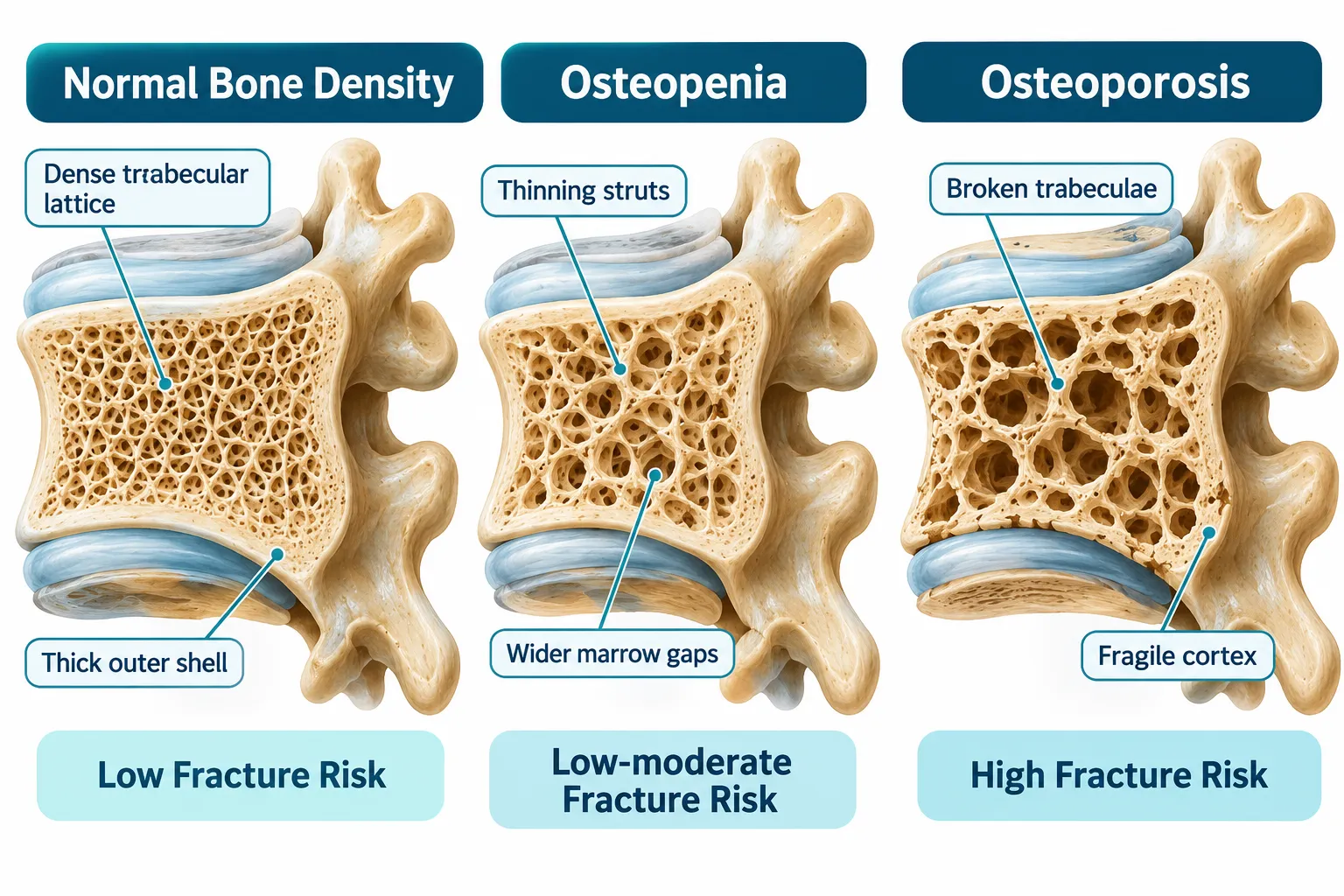
What is osteopenia, and how is it different from osteoporosis?

Normal Osteopenia Osteoporosis
T-score −1.0 or above −1.0 to −2.5 −2.5 or lower
Typical approach Maintain Train hard, maybe supplement Train with supervision, often medication
Fracture risk Baseline Mildly to moderately raised High

Here's what gets missed: because osteopenia is far more common than osteoporosis, a large share of fragility fractures occur in people in that middle range. Low risk per person, high numbers of people. That's why midlife is the window where training pays off most [5].

Can you reverse osteopenia with strength training alone?

Sometimes, partially. Resistance training can increase hip and spine bone mineral density by small percentages and reliably slows further loss, but it rarely moves a T-score from −2.0 back to normal on its own. For many people the realistic win is stopping decline and cutting fracture risk.

Choose this decision rule: if your T-score is between −1.0 and −1.5 with no other risk factors, training plus nutrition is often the whole plan. If you're at −2.3 with a family history of hip fracture, early menopause, or a previous low-trauma fracture, discuss medication with your doctor alongside training. Exercise and pharmacotherapy are complementary, not competing, and combining them is an active area of research [5].

Muscle and bone decline together, a pattern now called osteosarcopenia. Train for both, because stronger legs prevent the fall that would have broken the hip.

What are the best exercises for building bone density after 40?

Bone grows where it's loaded hard. The most effective exercises are heavy multi-joint lifts that load the hip and spine directly, plus short bursts of impact.
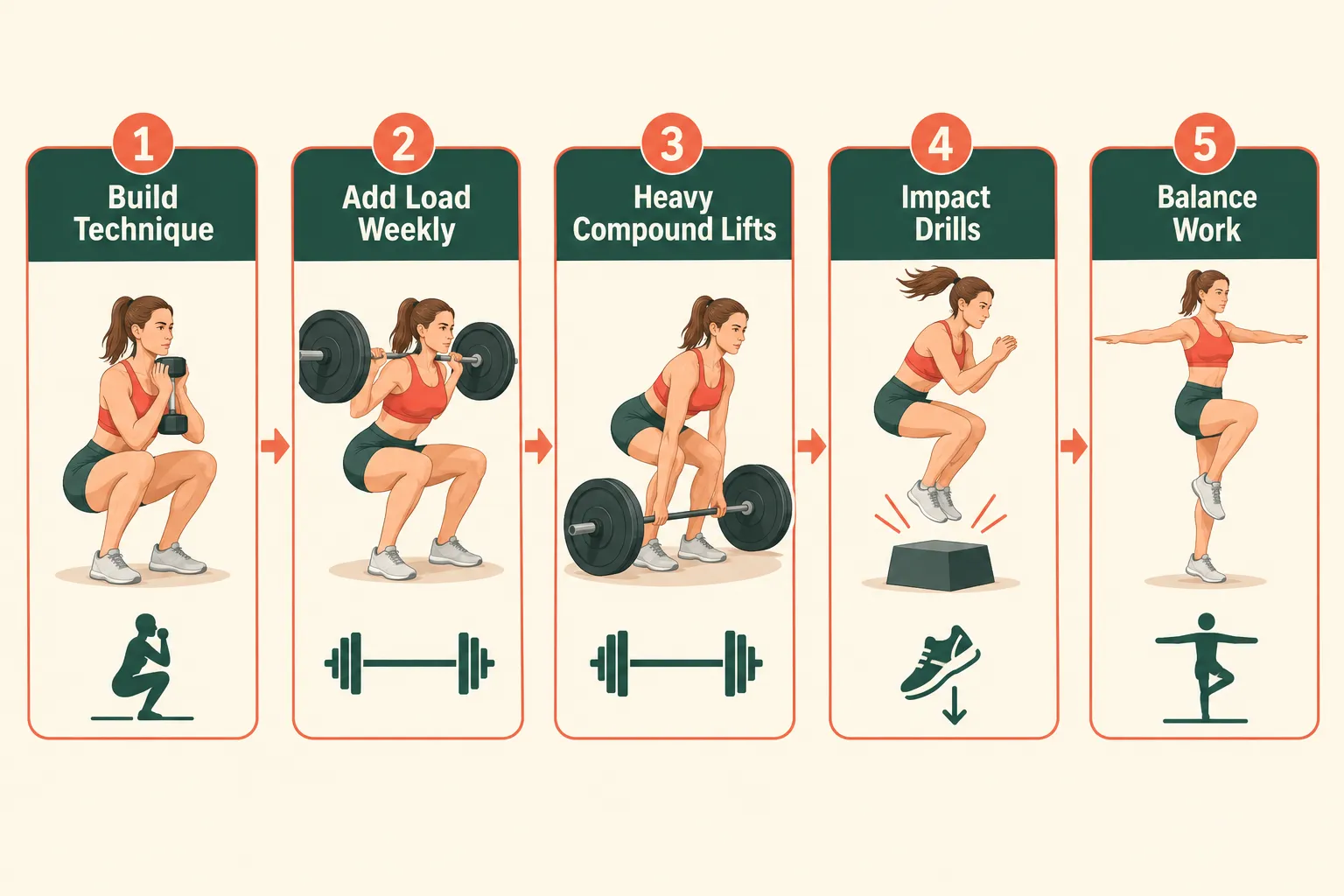
What are the best exercises for building bone density after 40?

Core lifts (site-specific loading for hip and spine):

  1. Deadlift or trap-bar deadlift
  2. Back squat, goblet squat, or leg press
  3. Overhead press
  4. Loaded step-ups and split squats
  5. Rows and lat pulldowns for upper-back strength

Impact additions (30-50 reps total, 3-4 days/week):

  • Heel drops from the toes
  • Low box step-downs
  • Light hopping or skipping, if joints tolerate it
  • Brisk walking with brief stair intervals

High-intensity resistance and impact training programs built on exactly this combination have produced bone gains without raising injury rates in trials of adults with low bone mass [1][2].

Common mistake: spending the whole session on machines that load the arms and chest. Bone in the hip and spine only responds to hip and spine loading.

How often should you do strength training if you have osteopenia?

Two to three non-consecutive days per week of progressive resistance training, with balance work on most days. That frequency matches current clinical guidance for bone health maintenance [3].

A workable week:

  • Monday: full-body lifting (45-55 min) + heel drops
  • Tuesday: brisk walk + 10 min balance drills
  • Thursday: full-body lifting + step-downs
  • Saturday: lifting or a loaded hike, plus balance
  • Daily: 2-3 minutes of single-leg stands while brushing teeth

Edge case: if you're also managing arthritis or recovering from surgery, two quality sessions beat three rushed ones. Bone responds to load magnitude, not session count.

How much weight should you be lifting with osteopenia?

Eventually, heavy enough that 5-8 reps is genuinely hard, roughly 80-85% of your one-rep max, once technique is solid. Heavier loading generally produces better bone outcomes than light, high-rep training [1][4].

The progression that keeps it safe:

  • Weeks 1-6: learn patterns with light load, 10-12 reps, 2 sets. Focus entirely on neutral spine and hip hinge.
  • Weeks 7-12: 8-10 reps, 3 sets, add a small amount of weight each week while form holds.
  • Month 4 onward: 5-8 reps, 3-5 sets on main lifts, leaving one or two reps in reserve.

Never chase a number at the cost of rounding your lower back under load. That single technique fault, not the weight itself, is what expert consensus flags as the genuine hazard [5].

Can strength training make osteopenia worse or cause fractures?

Properly coached progressive training does not make osteopenia worse, and supervised high-intensity programs in this population have reported low adverse event rates [1][2]. The danger comes from specific movements and from poor progression, not from load per se.

Risky patterns to avoid or modify:

  • Loaded or repeated spinal flexion, sit-ups, crunches, toe-touch stretches, weighted Russian twists
  • End-range spinal rotation under load
  • Sudden jumps in weight after weeks off
  • Unsupervised plyometrics if you have poor balance or a prior fracture
  • High fall-risk activities early on: slippery trail running, unstable surfaces, heavy loads without a rack or safety bars

Red flags to stop and call your doctor: new focal back pain, pain that wakes you at night, or sudden loss of height.

Do you need a gym, or can you train at home with osteopenia?

Home training works well for the first 3-6 months. Beyond that, a gym makes heavy progression far easier, because bone needs loads most home kits can't supply.
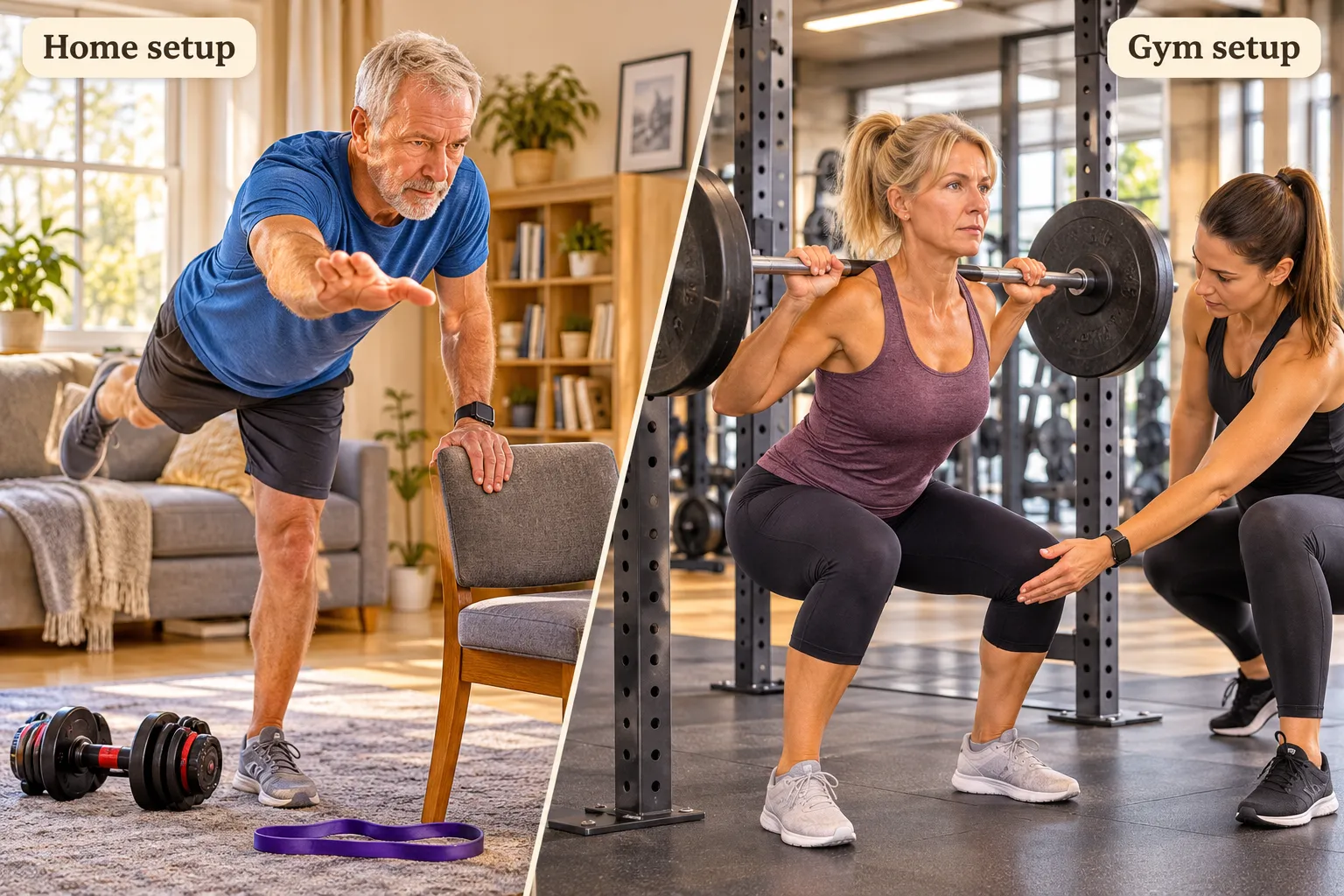
Do you need a gym, or can you train at home with osteopenia?

Minimum effective home kit: adjustable dumbbells or kettlebells (up to at least 20-25 kg), a sturdy step, resistance bands, and a chair for balance. Suspension trainers and blood-flow-restriction cuffs are useful lower-load options for people who can't tolerate heavy weight yet [6][7].

Choose a gym if: you can progress past your heaviest dumbbell, you want a squat rack and trap bar, or you'd benefit from a trainer watching your hinge pattern. Choose home if: travel, cost, or joint pain limit gym consistency. Consistent home training beats an unused membership.

Is strength training safe right after an osteopenia diagnosis, and how is it different from a normal routine?

Yes, usually within days, after your clinician confirms there's no vertebral fracture or other red flag. Start with a technique block rather than heavy loading.

How an osteopenia plan differs from a standard gym routine:

Element Typical general routine Osteopenia-specific plan
Rep range 8-15, moderate load 5-8, heavy load on main lifts
Exercise choice Aesthetic split, lots of isolation Hip- and spine-loading compounds
Spinal flexion Crunches common Avoided under load; anti-flexion core instead
Impact Incidental Deliberate heel drops and step-downs
Balance Rarely programmed Programmed 4-7 days/week
Progression Volume-driven Load-driven, tracked weekly

Can osteopenia strength training help with balance and fall prevention?

Yes, and it's arguably the fastest route to lower fracture risk. Bone density changes over months; balance and leg power improve within weeks, and most fragility fractures require a fall to happen.

Build a 10-minute balance block:

  1. Single-leg stand, 30 seconds each side (eyes open, then eyes closed near a wall)
  2. Tandem heel-to-toe walk, 10 metres
  3. Side step-overs across a low obstacle
  4. Sit-to-stand from a low chair, no hands, 10 reps
  5. Reactive step drills: step out and recover quickly in four directions

Virtual-reality and game-based balance training are emerging options that improve adherence for people who find drills tedious [4][6].

Do men and women over 40 need different osteopenia plans?

The exercise prescription is essentially the same: progressive resistance, impact, balance. What differs is screening, timing, and the hormonal context around bone loss.

  • Women: bone loss accelerates sharply in perimenopause and the first years after menopause, so that's the highest-value window to begin heavy training. Discuss hormone therapy and calcium status with a clinician.
  • Men: osteopenia is under-diagnosed and more often secondary to another cause, low testosterone, long-term steroids, alcohol, or coeliac disease. Ask for a cause workup, not just a density number [5].

How long before you see bone density improvements, and what should you eat?

Plan on 8-12 months before a repeat DXA shows change, since remodelling cycles take months and DXA can't detect small shifts reliably before then. Strength and balance improve in 4-8 weeks, which is the better short-term progress marker.

Nutrition that supports the training:

  • Protein: roughly 1.2-1.6 g per kg body weight daily, spread across meals
  • Calcium: about 1,000-1,200 mg daily, food first (dairy, tinned sardines, fortified plant milks, tofu set with calcium)
  • Vitamin D: test levels; supplement if low, per your clinician
  • Energy: don't train hard in a steep calorie deficit, which blunts both muscle and bone gains
  • Limit: heavy alcohol and smoking, both independent bone risks

Track progress with these instead of waiting on the scan: weight lifted on your main lifts, 30-second sit-to-stand count, single-leg stand time, and grip strength.

FAQ

Is walking enough for osteopenia?
No. Walking supports general health and some hip loading, but it doesn't generate the strain needed to build bone. Pair it with resistance and impact training.

Can I do yoga or Pilates with osteopenia?
Yes, with modifications. Skip deep forward folds, spinal twists under load, and rolling-down-the-spine drills. Tell the instructor about your diagnosis.

Is a trap-bar deadlift safer than a conventional deadlift?
Generally yes for beginners, because the handles sit at your sides and reduce the forward lean, making a neutral spine easier to hold.

Should I take calcium supplements?
Only if your diet falls short. Food sources are preferred; excess supplemental calcium offers no extra bone benefit and may cause other issues.

How long should the beginner technique phase last?
Four to eight weeks for most adults. Move on once you can perform hinge and squat patterns with a neutral spine at moderate load without cueing.

Does running help bone density?
Running provides useful impact for the hip, but it does little for spine or upper-body bone and won't replace resistance training.

What if I already have a vertebral fracture?
That changes the plan. Work with a physiotherapist experienced in bone health before any loaded lifting.

Can blood-flow restriction training help if I can't lift heavy?
It can build muscle at low loads and is being studied in bone health contexts [6][7]. Use it as a bridge, not a permanent substitute for heavy loading.

Conclusion

Low bone density after 40 responds to load, and treating a DXA result as a reason to train cautiously forever is the most common and costly mistake. The plan is simple to state: medical clearance, 4-8 weeks of technique work, then 2-3 weekly sessions of progressively heavier compound lifts, 30-50 daily impact reps, and a short balance block most days.

Next steps this week:

  1. Book a clinician visit to rule out vertebral fracture and secondary causes.
  2. Note your current DXA T-score and the date, so you know when a repeat scan makes sense.
  3. Record a baseline: 30-second sit-to-stand count and single-leg stand time, both sides.
  4. Schedule two lifting sessions into your calendar before next Monday.
  5. Add one protein source to each meal.

References

  1. Pmc10345999. ncbi.nlm.nih.gov.
  2. pubmed.ncbi.nlm.nih.gov.
  3. Exercise. racgp.org.au.
  4. S41598 024 57358 7. nature.com.
  5. S11914 023 00777 8. link.springer.com.
  6. Ijcp. onlinelibrary.wiley.com.
  7. S12902 026 02194 1. link.springer.com.
Strength Training for Bone Density After 40: A Safe Progressive Protocol for Hips and Spine

Strength Training for Bone Density After 40: A Safe Progressive Protocol for Hips and Spine

Last updated: October 19, 2026

Quick Answer

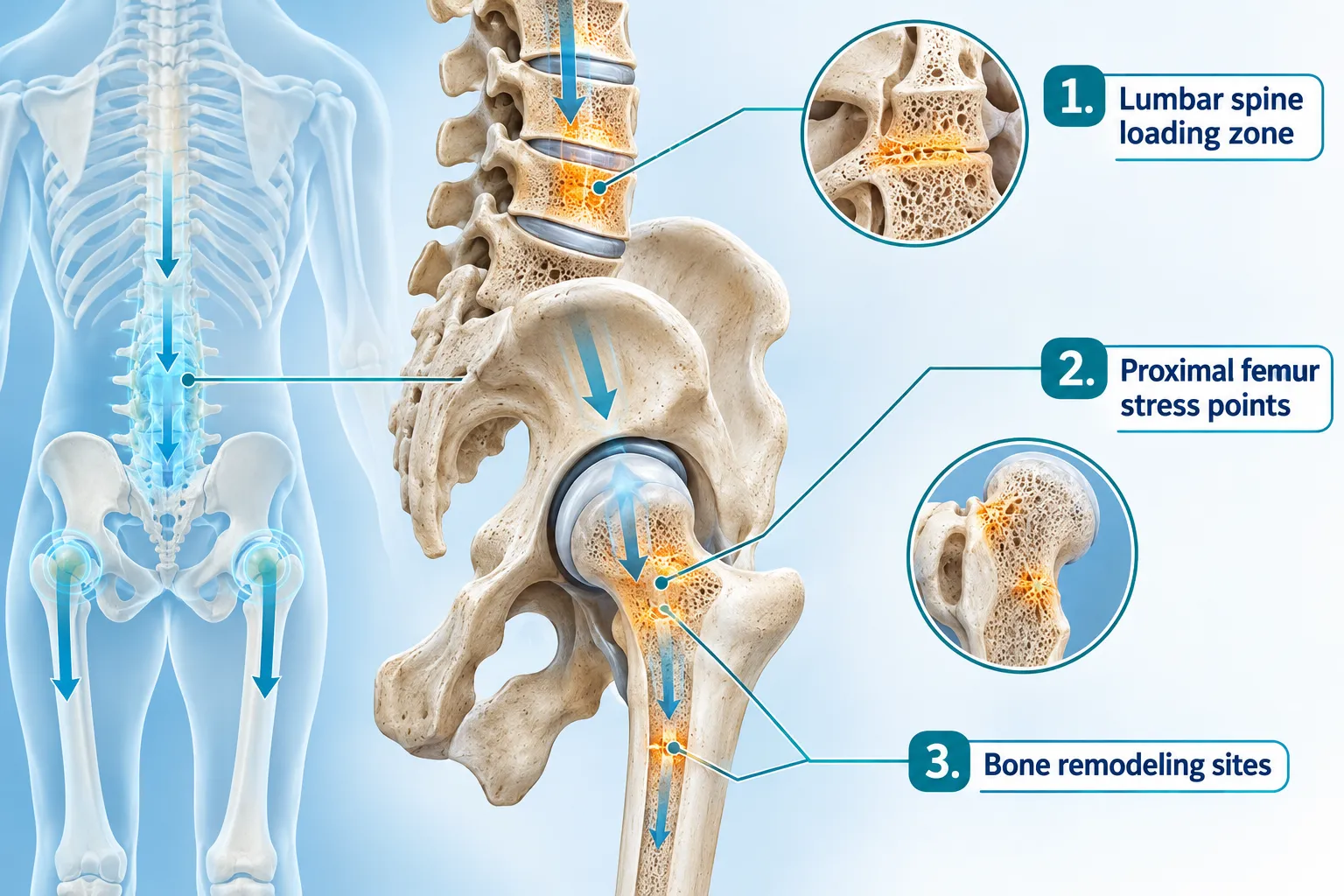
Strength Training for Bone Density After 40: A Safe Progressive Protocol for Hips and Spine works by loading the skeleton hard enough to trigger bone remodeling at the two sites that matter most for fracture risk: the lumbar spine and the proximal femur. Research in adults with low bone mass shows resistance training produces meaningful gains in bone mineral density (BMD) compared with no training, with the clearest effects at the lumbar spine and femoral neck.[5] A practical protocol uses five movement patterns, squat, hinge, press, row, carry, trained two to three times a week, with load added gradually over months and controlled impact added once technique is solid.[7] Most people should expect measurable BMD change on a DXA scan after about 9 to 12 months, not weeks.

Key Takeaways

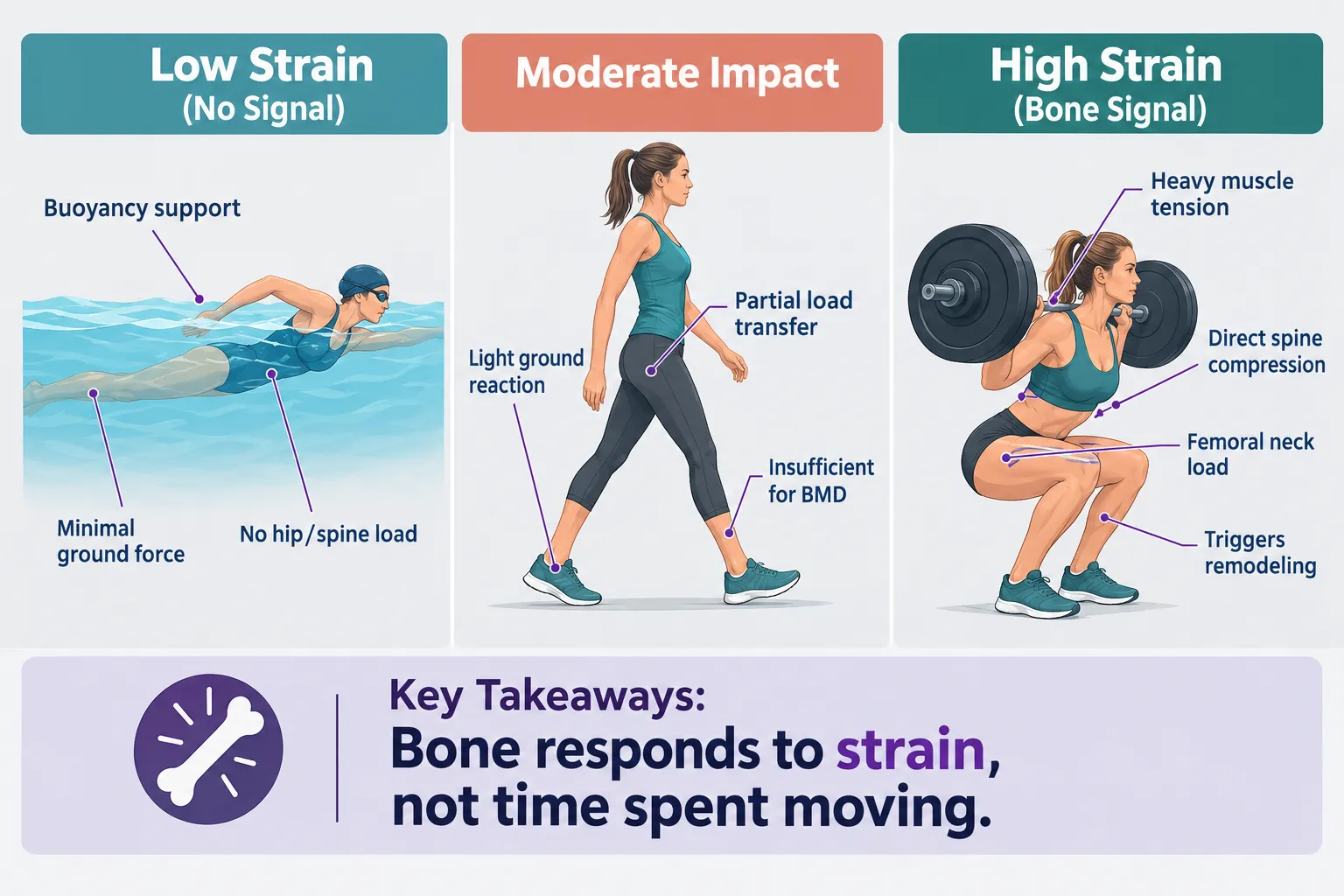
  • Bone responds to strain, not time spent moving. Walking and swimming support general health but don’t load the hip and spine enough to drive new bone.[3]
  • The spine and femoral neck respond best. Meta-analyses in both postmenopausal women and older men show significant BMD gains at the lumbar spine and femoral neck, while the total hip often shows little change.[5]
  • Postmenopausal women gain the most. A 2025 review found significant BMD effects at the femoral neck and lumbar spine in postmenopausal women, but not in premenopausal women.[5]
  • High intensity isn’t required for bone, but helps strength. High-intensity resistance training beat moderate loading for leg strength, with no significant BMD advantage at the spine or femoral neck.[8][10]
  • Supervised high-intensity resistance and impact training (HiRIT) is safe and well tolerated even in women with osteoporosis or osteopenia.[7]
  • Two to three sessions per week of progressive resistance training is the standard dose, ideally with weight-bearing impact on separate or combined days.[3][6]
  • Exercise can slow, halt, and partially reverse bone loss, but it won’t restore a young skeleton. Think “meaningful percentage points,” not transformation.
  • Food matters: adequate calcium, vitamin D, and protein let training translate into bone.[3]
  • Get a DXA scan first if you’re over 50, postmenopausal, on long-term steroids, or have a fracture history.

What is bone density and why does it matter after 40?

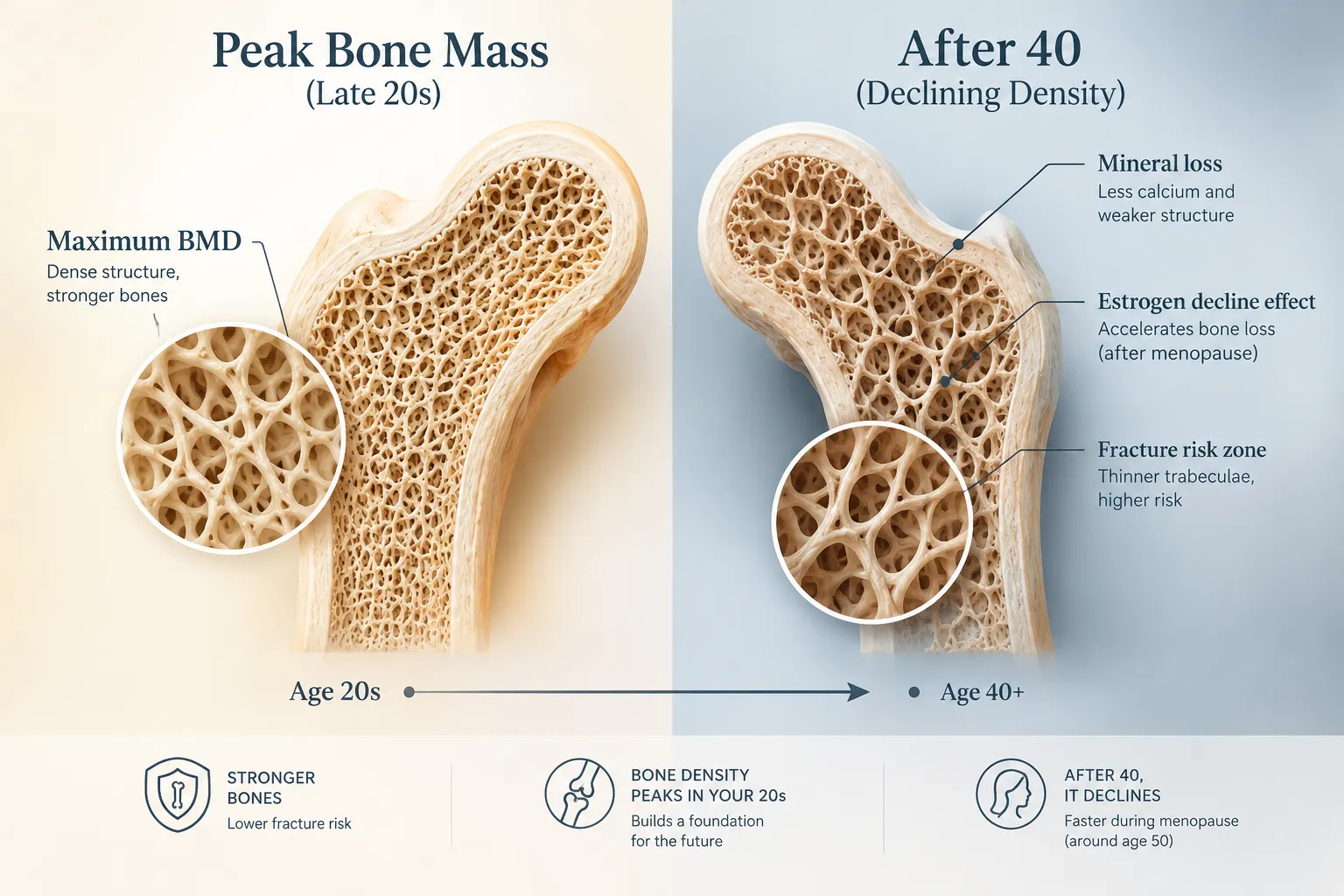
Bone density (measured as bone mineral density, or BMD) is the amount of mineral packed into a given area of bone. It matters after 40 because bone mass peaks in the late twenties and then slowly declines, with women losing bone rapidly in the years around menopause as estrogen falls.

Bone isn’t inert. It’s living tissue that constantly breaks down and rebuilds. After 40, the breakdown side starts to outpace the rebuilding side, so the internal scaffolding of the vertebrae and the hip thins out. The result is a skeleton that looks the same on the outside but fractures under forces it once shrugged off, a stumble, a hard sneeze, lifting a suitcase.

Two sites drive the clinical stakes:

  • The lumbar spine, where trabecular (spongy) bone is dense and metabolically active, so it responds relatively quickly to both loss and loading.
  • The proximal femur (femoral neck and total hip), where fractures carry the highest cost in independence and mortality.
What is bone density and why does it matter after 40?

Why 40 is the cutoff worth caring about: it’s the last window where you’re building from a reasonably strong base, before accelerated loss makes the work defensive rather than constructive.

How does strength training improve bone density in older adults?

Strength training improves bone density because muscle pulling on bone, plus ground reaction force, creates strain that signals bone-forming cells to lay down new tissue at the loaded sites. No strain, no signal.

The mechanism has three parts:

  1. Muscle tension on the bone. A heavy squat drags the glutes and quads against the femur and pelvis. That pull is the single largest mechanical load most bones ever see.
  2. Compressive and impact loading. Carrying weight, jumping, or dropping onto the heels sends force up through the skeleton, which is why loaded carries and controlled impact belong in a bone protocol.[7]
  3. Site specificity. Bone only adapts where it’s loaded. Rows and presses won’t help the femoral neck; squats and hinges won’t help the wrist.

Bone adapts to the loads you actually apply to it. Loading the hip and spine directly is the entire point of the protocol, a general fitness routine is not a bone routine.

Common mistake: assuming cardio counts. Non-weight-bearing activity like swimming or cycling is excellent for the heart and almost useless for hip and spine BMD.[3]

What the evidence shows. A comparative effectiveness analysis in adults with low bone mass reported a large standardized mean difference (SMD 1.37, 95% CI 0.38-2.36) in BMD for resistance training versus control. A meta-analysis in middle-aged and older men found significant gains at the lumbar spine and femoral neck, with no clear improvement at total hip and other cortical-dominant sites. That pattern is consistent and worth planning around.

What are the best exercises for hip and spine bone density after 40?

The best exercises are loaded compound lifts that put force directly through the hip and spine: squats, hip hinges, overhead or incline presses, rows, and loaded carries, supplemented with controlled impact. These five patterns cover the skeleton’s highest-value targets with the fewest exercises.

What are the best exercises for hip and spine bone density after 40?

PatternExample liftsPrimary bone targetStarting cue
SquatGoblet squat, box squat, back squatFemoral neck, lumbar spineSit between the hips, neutral spine
HingeTrap-bar deadlift, Romanian deadlift, hip thrustFemoral neck, total hipPush hips back, ribs stacked over pelvis
PressOverhead press, landmine press, incline pressThoracic spine, wrist, humerusBrace ribs down, don’t arch the low back
RowChest-supported row, one-arm dumbbell rowThoracic/lumbar spine, posturePull elbow past ribs, no shrug
CarrySuitcase carry, farmer’s walkAxial spine, hipTall ribcage, slow steps

Impact alternatives, scaled to tolerance:

  • Heel drops, rise onto toes, drop sharply onto heels. 10-20 reps, the gentlest entry point.
  • Step-downs and stomps, controlled, single-leg, low height.
  • Hops and small jumps, only once squats and hinges are solid and pain-free.

Choose this if… you have diagnosed osteoporosis: start with heel drops and loaded carries, skip jumping, and add compound lifts under supervision.[7]

Avoid: loaded spinal flexion (weighted sit-ups, crunches, toe-touches with weight) and end-range twisting under load. These positions raise vertebral compression risk in a thinning spine.[6]

How often should I do strength training for bone density, and what weight should I lift?

Train the hip and spine with resistance two to three times per week on non-consecutive days, using loads heavy enough that the last two reps of a set feel genuinely difficult, typically a weight you could lift 6 to 12 times before form breaks.[3][6]

A workable intensity ladder:

  • Weeks 1-4: 2-3 sets of 10-12 reps at roughly 50-60% effort. The goal is pattern quality, not load.
  • Weeks 5-12: 3 sets of 8-10 reps, adding weight whenever all sets hit the top of the rep range with clean form.
  • Month 4 onward: 3-5 sets of 5-8 reps on squats and hinges, with heavier loads under supervision if you’re training toward the HiRIT model.[7]

Does heavier mean more bone? Not necessarily. A 2025 meta-analysis found high-intensity resistance training produced substantially larger strength gains than low-to-moderate training (leg press SMD 0.95, 95% CI 0.48-1.43; leg extension SMD 0.63, 95% CI 0.09-1.17), but no significant BMD difference at the lumbar spine (SMD 0.28, 95% CI −0.02 to 0.58) or femoral neck (SMD 0.13, 95% CI −0.08 to 0.33).[8][10] Multiple intensity ranges can protect bone; higher intensity mainly buys strength, balance, and fall resistance, which also prevents fractures.

Edge case: if you’re on a joint-sparing plan after hip replacement, substitute machine-based leg press and hip thrust for deep squats and keep load high within a pain-free range.

Can you reverse bone loss after 40 with exercise, and how long does it take?

Exercise can slow, stop, and modestly reverse bone loss after 40, but it rarely restores peak young-adult density. Expect small, site-specific gains measurable on DXA after roughly 9 to 12 months of consistent training.

Can you reverse bone loss after 40 with exercise, and how long does it take?

Realistic timelines:

  • Weeks 2-8: strength, balance, and confidence improve. Bone has not changed yet.
  • Months 3-6: bone remodeling is underway but below the detection threshold of a DXA scan.
  • Months 9-12: first meaningful window for a repeat scan. Effect sizes in postmenopausal women have been reported around 0.47 at the femoral neck and 0.36 at the lumbar spine for high-intensity impact and strength training.[5]
  • Years 2+: maintenance. Stopping reverses the gains, so this is permanent programming, not a cure.

Decision rule: don’t rescan before 12 months. Scan noise (±1-2%) can swamp a real 2% gain and lead to false discouragement.

What’s the difference between osteoporosis and osteopenia, and is training safe with low bone density?

Osteopenia means BMD is below normal but not yet in the fracture-risk danger zone (T-score between −1.0 and −2.5). Osteoporosis means BMD is at or below a T-score of −2.5. Progressive resistance training is safe in both, provided it’s supervised and avoids loaded spinal flexion.

OsteopeniaOsteoporosis
T-score−1.0 to −2.5−2.5 or lower
Fracture riskElevatedHigh
Training approachFull compound lifts, progressive load, light impactCompound lifts with supervision, load progressed slowly, impact limited to heel drops/stomps initially
Hard noWeighted spinal flexionWeighted spinal flexion, twisting under load, unsupervised max lifts

A clinical review on postmenopausal bone health reports that supervised progressive high-intensity resistance and impact training (HiRIT) increases lumbar spine BMD and is safe and well tolerated in women with osteoporosis or osteopenia.[7] That’s the key reframe: for higher-risk people, cautious low-load exercise is often less protective than properly supervised heavy training.

Should I get a bone density test before starting a strength program?

Get a DXA scan before starting if you’re a postmenopausal woman, a man over 50 with risk factors, on long-term corticosteroids, or have had a fragility fracture. Otherwise, a baseline scan is useful but not a prerequisite for starting squats and rows at moderate load.

The scan changes your program in two ways: it tells you whether impact work needs restricting, and it gives you a baseline to measure against in a year.

Can women after menopause improve bone density with strength training?

Yes, and postmenopausal women show the most consistent response. A 2025 systematic review found high-intensity impact and strength training produced significant BMD gains at the femoral neck and lumbar spine in postmenopausal women, but not in premenopausal women.[5]

The likely reason: premenopausal women are closer to their skeletal ceiling, so there’s less room to gain. The practical implication is that menopause is a reason to train harder, not more gently.

What mistakes do people make when training for bone health?

The biggest mistake is training too light for too long, staying at a comfortable load that builds confidence but never generates enough strain to trigger bone formation.

Frequent errors:

  • Never progressing load. The same 10 lb dumbbells for two years do nothing for the femoral neck.
  • Skipping the hinge. Deadlift-pattern work is the most direct loading of the proximal femur available. Avoiding it out of back fear forfeits the best tool.
  • Loaded spinal flexion. Weighted crunches and rounded-back lifting in a thinning spine is the one genuinely risky choice.[6]
  • Treating walking as the program. Useful for general health, insufficient for hip and spine BMD.[3]
  • Rescanning too early, then quitting when the number hasn’t moved.
  • Ignoring balance and fall prevention. Most fractures need both weak bone and a fall.

Do I need equipment, or can I do bodyweight exercises for bone density?

Bodyweight work alone is usually insufficient once you can perform 15+ clean reps, because the load stops being challenging. Some external resistance, dumbbells, kettlebells, bands, machines, or a barbell, is needed for continued progression.

Bodyweight options that still count early on: step-ups onto a high box, split squats, push-ups, heel drops, and hip thrusts. Once those become easy, add load. A pair of adjustable dumbbells and a sturdy box covers most of the protocol at home.

What should I eat to support bone density alongside strength training?

Training provides the signal; nutrition provides the raw materials. Without adequate calcium, vitamin D, and protein, the bone-building response to resistance training is blunted.[3]

Priorities, in order:

  1. Calcium from dairy, fortified plant milks, canned fish with bones, tofu set with calcium, and leafy greens. Food sources first, supplements if you fall short.
  2. Vitamin D, which governs calcium absorption. Limited sun exposure, darker skin, and northern latitudes all raise the case for testing and supplementing.
  3. Protein spread across meals, which supports both bone matrix and the muscle doing the pulling.
  4. Limits on heavy alcohol and smoking, both of which independently accelerate bone loss.

Quick example: Greek yogurt with almonds at breakfast, sardines or tofu at lunch, and a protein-forward dinner covers calcium and protein for most adults without supplements.

FAQ

Is it too late to start strength training at 60 or 70?
No. Meta-analyses of exercise interventions in older adults consistently show BMD gains at the lumbar spine and femoral neck, and strength and balance improvements reduce fall risk immediately.[8]

How many exercises do I need per session?
Four to six. One squat, one hinge, one press, one row, and one carry covers the hip and spine efficiently in 40-50 minutes.

Can I do strength training and walking on the same day?
Yes. Walking doesn’t interfere with strength adaptation. Just do the lifting first when you’re fresh.

Does yoga or Pilates build bone density?
They improve balance, posture, and mobility, which lowers fall risk, but most poses don’t load the hip and spine enough to raise BMD. Some forward-flexion poses should be modified if you have osteoporosis.

Will strength training make existing back pain worse?
Done with neutral spine positioning and progressive loading, it usually improves it. Sharp or radiating pain means stop and get assessed.

How heavy is “heavy enough”?
A load you could lift about 6 to 12 times before form degrades, with the last two reps clearly hard. If you could do 20, it’s too light for bone.

Do vibration plates work?
Evidence is mixed and far weaker than for progressive resistance training. Treat it as a supplement, not a substitute.

Should I stop if I have a diagnosed vertebral fracture?
Stop unsupervised training and get a clinician-guided program. Training is still indicated, but exercise selection changes significantly.

Conclusion

Strength Training for Bone Density After 40: A Safe Progressive Protocol for Hips and Spine comes down to a short list of decisions: load the hip and spine directly, train two to three times a week, add weight on a schedule, avoid loaded spinal flexion, and keep going long enough to measure the result. The research pattern is consistent, the lumbar spine and femoral neck respond, the total hip is stubborn, and postmenopausal women gain the most.[5]

Start here this week:

  1. Book a DXA scan if you’re postmenopausal, over 50 with risk factors, or have a fracture history.
  2. Pick one squat, one hinge, one press, one row, and one carry. Learn them at light load for four weeks.
  3. Add weight whenever all sets hit the top of the rep range cleanly.
  4. Add heel drops or step-downs at week 5 if cleared for impact.
  5. Check calcium, vitamin D, and protein intake.
  6. Rescan at 12 months, not before.

If you have osteoporosis, osteopenia, or a fracture history, get supervision from a physiotherapist or exercise physiologist experienced with HiRIT. Supervised heavy training has a better safety record in this group than cautious under-loading.[7]

References

[1] Exercises That Improve Bone Density 11940615 – https://www.verywellhealth.com/exercises-that-improve-bone-density-11940615
[2] The Bone Building Effects Of Exercise – https://www.sydney.edu.au/charles-perkins-centre/news-and-events/news/2025/10/31/the-bone-building-effects-of-exercise-.html
[3] Exercise Your Bone Health – https://www.niams.nih.gov/health-topics/exercise-your-bone-health
[4] Art 20046670 – https://www.mayoclinic.org/healthy-lifestyle/fitness/in-depth/strength-training/art-20046670
[5] repository.londonmet.ac.uk – https://repository.londonmet.ac.uk/11869/
[6] Exercise – https://www.racgp.org.au/clinical-resources/clinical-guidelines/key-racgp-guidelines/view-all-racgp-guidelines/osteoporosis/general-bone-health-maintenance/exercise
[7] S11914 025 00912 7 – https://link.springer.com/content/pdf/10.1007/s11914-025-00912-7.pdf
[8] onlinelibrary.wiley – https://onlinelibrary.wiley.com/doi/10.1111/ggi.70607
[9] Moves For Stronger Bones 12066485 – https://www.health.com/moves-for-stronger-bones-12066485
[10] onlinelibrary.wiley – https://onlinelibrary.wiley.com/doi/pdfdirect/10.1111/ggi.70607

Weighted vest strength and balance routines for adults 60+

Weighted vest strength and balance routines for adults 60+

Last updated: August 25, 2026

Quick Answer

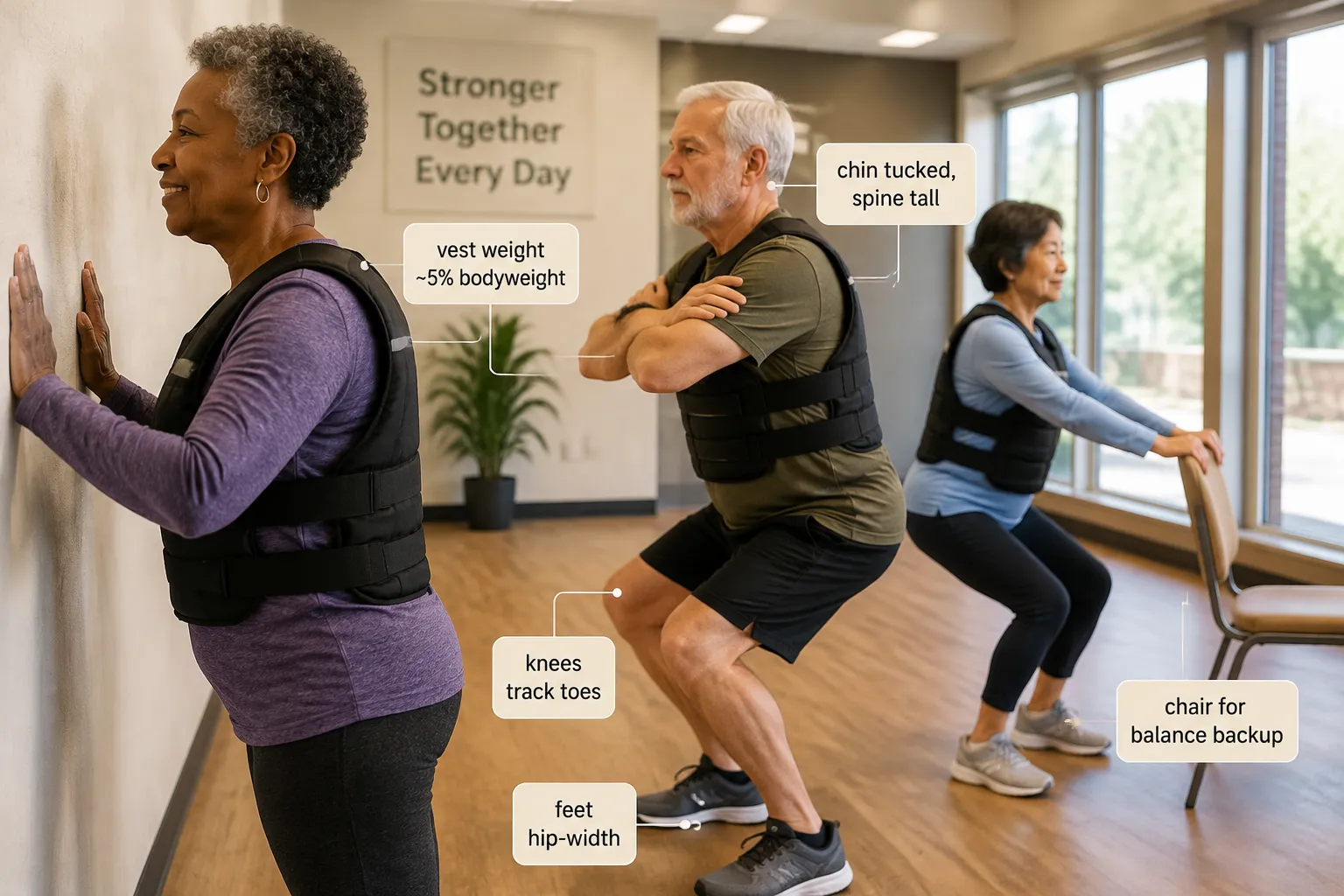
Weighted vest strength and balance routines for adults 60+ are short, low-impact sessions (15-30 minutes, 2-4 times a week) that add 4-10% of body weight to everyday moves like squats, wall push-ups, and heel-to-toe walks. Used correctly, a vest can help preserve muscle, improve postural stability, and support metabolic health during aging or weight loss. It is not a guaranteed fix for hip bone density, and load, fit, and progression matter more than brand [1][5].

Key Takeaways

  • Start with 4-5% of body weight and progress slowly; most adults 60+ top out between 8-12% of body weight.
  • Focus on balance drills, sit-to-stands, step-ups, and posture work, not heavy cardio in a vest.
  • Train 2-4 days per week, wearing the vest 15-30 minutes per session, not all day.
  • Recent trials show vests can preserve trunk muscle density and resting energy expenditure during weight loss, but do not reliably prevent hip bone loss [2][5][8].
  • Vests are generally safer than weight belts for seniors because load is distributed across the torso.
  • Skip or modify with uncontrolled high blood pressure, recent fractures, severe osteoporosis, or acute joint flares without clinician sign-off.
  • Fit matters more than brand: snug, adjustable, breathable, and easy to put on alone.

What Are Weighted Vest Strength and Balance Routines for Adults 60+

A weighted vest routine for older adults is a structured plan that adds external load to functional movements, standing up from a chair, stepping, reaching, walking, to build strength, bone stimulus, and balance at the same time. The vest sits close to the body's center of mass, so it challenges posture and stability without loading the hands or spine the way a barbell would.

These routines matter because after age 60, adults lose roughly 1-2% of muscle mass per year and balance reflexes slow. Adding a modest external load to daily-life moves is one of the simplest ways to push back against that decline at home [1][10].

Choose a vest routine if you: want low-equipment strength training, need better balance, are trying to preserve muscle during weight loss, or want to stay independent longer.

Skip it if you: have unstable cardiovascular disease, an unhealed fracture, severe cervical spine issues, or your clinician has advised against added spinal load.

What Are the Best Weighted Vests for Seniors Over 60

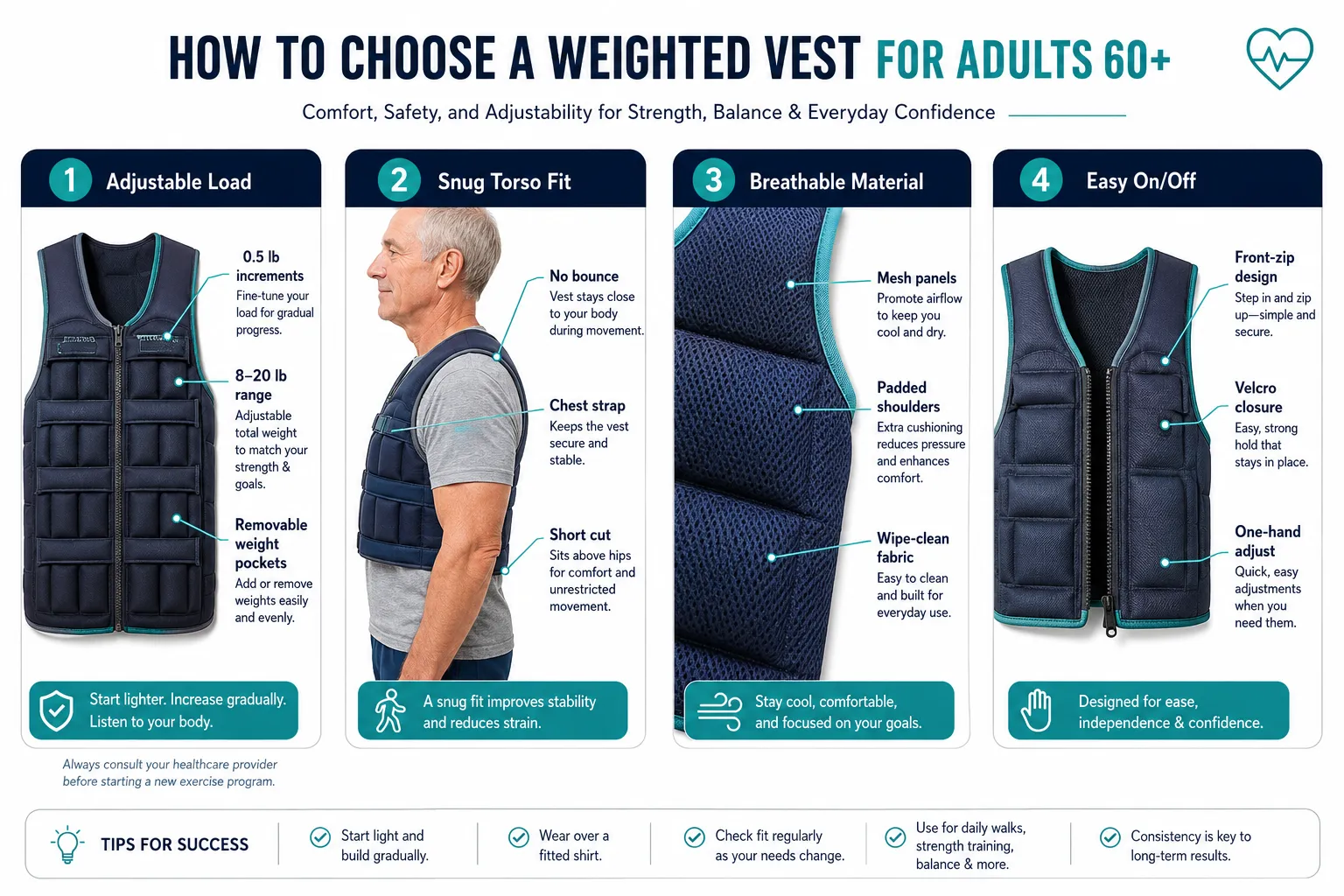
The best weighted vest for a senior is adjustable, snug, short-cut, and easy to put on alone. Look for 0.5-1 lb removable weight increments, padded shoulders, a chest or waist strap to stop bouncing, and a max load of 15-20 lb (you rarely need more).

What Are the Best Weighted Vests for Seniors Over 60

Brand-name reviews shift often, but the categories that consistently perform well for adults 60+ include:

  • Short-torso adjustable vests (examples: Hyperwear Hyper Vest FIT, Aduro Sport adjustable, Empower short vests), good for smaller frames and easier on the low back.
  • Modular pocket vests with 0.5 lb steel shot bags, best for slow progression.
  • Front-zip vests, much easier for anyone with shoulder arthritis than pullover styles.

Avoid tactical or military-style vests. They're heavy, long, and load the lumbar spine more than needed.

Rule of thumb: If you can't put the vest on by yourself in under 30 seconds, it's the wrong vest.

How Much Weight Should a 60 Year Old Wear in a Weighted Vest

Start at 4-5% of body weight and cap most routines at 8-10% of body weight. For a 150-lb adult, that means beginning around 6-8 lb and progressing toward 12-15 lb over months, not weeks. Research in older adults suggests loads that are too light produce little training effect, while loads above ~10% raise fall and joint-stress risk without much added benefit [1][10].

Progression rule: add weight only when you can complete your full routine with good form and no next-day joint pain for two consecutive sessions.

Weighted Vest Exercises for Balance and Fall Prevention

Balance work in a vest trains your body to correct itself under load, which is exactly what happens in a real stumble. A 2022 randomized trial combining whole-body vibration with weighted vest training reported meaningful gains in balance and lower-limb strength in older adults [3], and a 2025 square-stepping-plus-vest report found improved fall-risk scores in community-dwelling seniors [4].

Weighted Vest Exercises for Balance and Fall Prevention

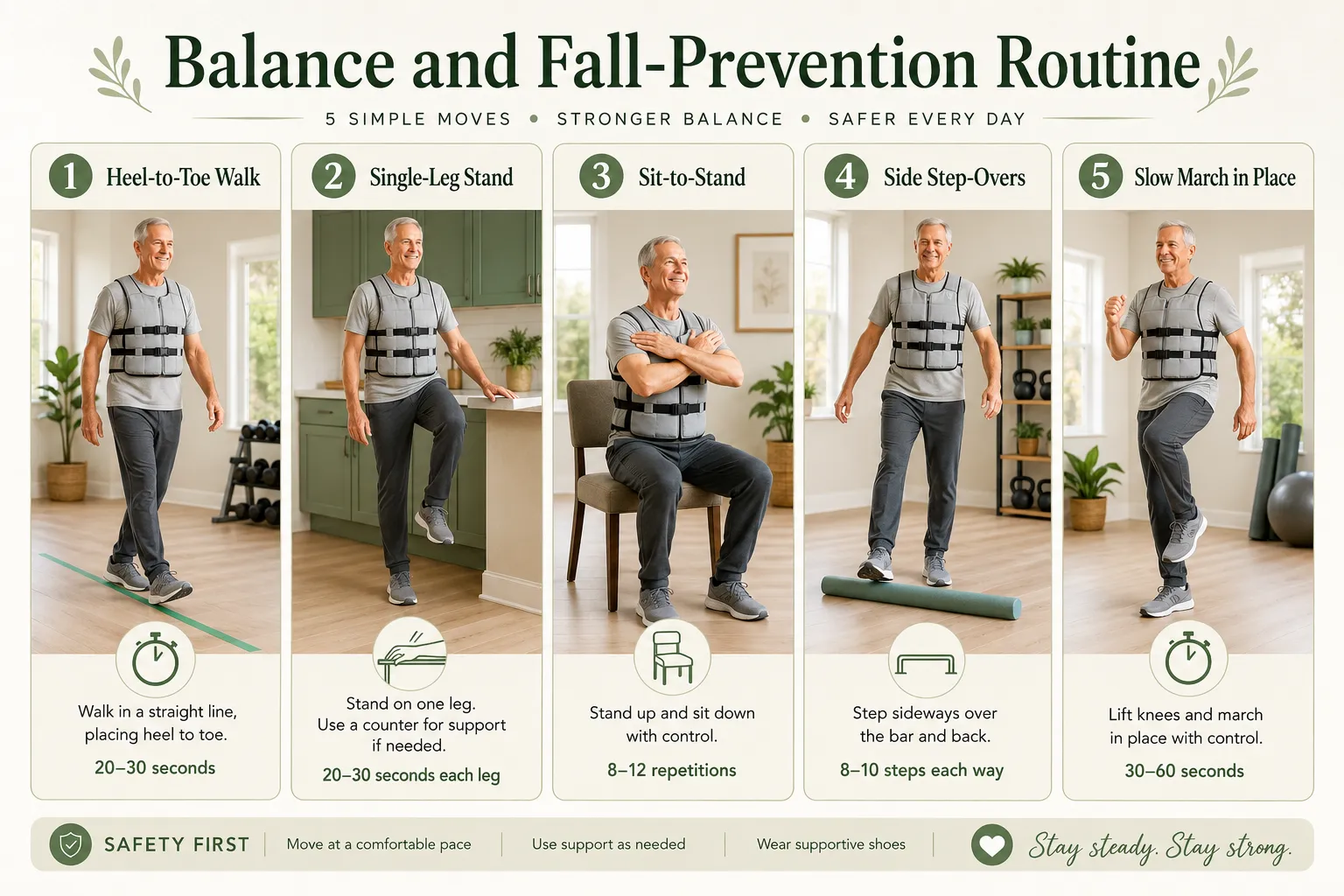
A simple 15-minute fall-prevention block, done 2-3 times a week:

  1. Heel-to-toe walk along a line, 2 lengths of 20 feet.
  2. Single-leg stand near a counter, 20 seconds per side, 3 rounds.
  3. Sit-to-stand from a sturdy chair, 2 sets of 8-12.
  4. Side step-overs across a rolled towel, 10 crossings.
  5. Slow march in place with high knees, 60 seconds.

Wear the vest for the whole block. Keep one hand near a wall or counter for the first two weeks.

Can Weighted Vests Improve Bone Density in Older Adults

Weighted vests can improve bone-loading stimulus, but current evidence shows they do not reliably prevent hip bone loss, especially during weight-loss interventions. The large 2025 INVEST in Bone Health RCT (JAMA Network Open) found that a weighted vest worn during weight loss did not preserve hip BMD compared with control [5][7]. However, follow-up analyses reported preserved trunk muscle density and resting energy expenditure, both meaningful for aging bodies [2][8][9].

What this means practically: don't rely on a vest alone for osteoporosis prevention. Pair it with impact work you tolerate (heel drops, brisk walking), resistance training, and physician-guided nutrition and medication where indicated.

Weighted Vest vs Resistance Bands for Seniors: Which Is Better

Neither is universally better, they solve different problems.

Weighted vest, best for balance, posture, sit-to-stand, walking economy, and axial loading during daily tasks. Hands stay free.

Resistance bands, best for isolated upper-body pulling, rotator cuff work, hip abduction, and travel. Lower spinal load.

Choose a vest if your goal is functional strength, balance, and staying independent. Choose bands if your goal is joint-specific rehab, shoulder health, or you have significant spinal concerns. Most well-designed programs use both.

Are Weighted Vests Safe for People with Arthritis or Joint Pain

For most adults with mild-to-moderate osteoarthritis, a light vest (4-6% body weight) is safe and often well tolerated, because the load is centered on the torso rather than the knees or hips directly. It is not appropriate during an active joint flare, with unstable joints, or after recent joint replacement without surgeon clearance.

Practical guardrails:

  • Avoid vest use during downhill walking or stairs if knees are symptomatic.
  • Skip jumping or running in a vest.
  • If pain increases the next day, drop weight by 25% or move to seated exercises.

Weighted Vests for People with Osteoporosis: Is It Safe

Vests can be safe with osteoporosis when the load is light, the routine avoids spinal flexion under load, and a clinician has cleared the person. Do not combine a vest with forward-bending, twisting, or sit-ups, these movements raise vertebral fracture risk regardless of load.

Stick to upright, hip-hinge, and balance-based work. If you have had a vertebral compression fracture, ask a physical therapist to design the routine.

How Long Should Seniors Wear a Weighted Vest During Workouts

Wear the vest for 15-30 minutes per session, not all day. Some 2025-2026 trial protocols used longer daily wear during weight-loss studies, but those were supervised and progressive [2][7]. For home use, shorter targeted sessions produce most of the strength and balance benefit with less joint fatigue.

Signs you've worn it too long: shoulder soreness, low-back ache, headache, or posture that collapses forward. Stop, remove weight, and shorten the next session.

How Often Should Seniors Do Weighted Vest Training per Week

2-4 sessions per week is the practical sweet spot. Beginners: two non-consecutive days for 2-3 weeks. Intermediate: three days. Advanced or well-conditioned adults: up to four, alternating balance-focused and strength-focused days.

Rest days matter more after 60, muscle recovery slows, and connective tissue needs the gap.

Weighted Vest Routines for Improving Posture in Older Adults

A vest can improve posture by cueing the deep trunk muscles to keep the ribcage stacked over the pelvis. A 2021 experimental study on weighted torso balance training reported gains in both anticipatory and reactive balance, both closely tied to postural control [6].

Weighted Vest Routines for Improving Posture in Older Adults

A 10-minute daily posture block:

  • Wall stand (heels, hips, upper back, head against wall), 60 seconds.
  • Chin tucks, 10 reps.
  • Scapular squeezes, 15 reps.
  • Hip hinge to countertop, 10 reps.
  • Slow walk with vest, tall spine, 3 minutes.

Do this in the morning. Posture wins compound.

What's the Difference Between Weighted Vests and Weight Belts for Seniors

A weighted vest distributes load across the shoulders and torso. A weight belt concentrates load at the hips or waist. For adults 60+, vests are usually the better default because the load stays closer to the body's center of mass and doesn't tug at the low back the way a belt can. Belts are useful for specific hip-loading protocols under supervision, but they're rarely a good first purchase for a home program.

Common Mistakes Older Adults Make with Weighted Vests

The frequent mistakes are predictable and fixable:

  • Buying too heavy. A 20-lb vest sits unused. A 10-lb adjustable vest gets worn.
  • Wearing it during long walks before strength adapts. Start with short strength sessions first.
  • Skipping the chest strap. A bouncing vest hurts shoulders and ruins form.
  • Adding weight weekly. Progress in 2-4 week blocks.
  • Doing crunches or toe-touches in the vest. Never load spinal flexion at this age.
  • Ignoring next-day soreness that lasts more than 48 hours. That's a signal to deload.

Can I Use a Weighted Vest if I Have High Blood Pressure or Heart Issues

If your blood pressure is well-controlled and your cardiologist has cleared you for moderate exercise, a light vest during standing balance and strength work is generally fine. Avoid it if you have uncontrolled hypertension, unstable angina, recent cardiac events, or symptomatic heart failure without clinician sign-off.

Safety checklist before each session:

  • Resting BP under your clinician's target.
  • No chest pressure, unusual shortness of breath, or dizziness.
  • Hydrated, not fasted longer than usual.
  • Stop immediately for symptoms and remove the vest.

A Sample Weekly Plan

Day Focus Duration Vest Load
Mon Strength (sit-to-stand, wall push-up, step-up) 20 min 5% BW
Tue Rest or walk (no vest) , ,
Wed Balance and posture block 15 min 4% BW
Thu Rest , ,
Fri Strength + short vest walk 25 min 5-6% BW
Sat Balance drills 15 min 4% BW
Sun Rest , ,

Adjust down if you're just starting. Two days a week beats zero.

FAQ

Is a 10-pound vest enough for a 70-year-old?
For most 70-year-olds under 180 lb, 8-10 lb is a productive working load once conditioned. Start lighter.

Can I wear a weighted vest for housework?
Short bouts (15-20 minutes) are fine if posture stays tall. Skip it for vacuuming, bending, or lifting.

Will a weighted vest help me lose belly fat?
It supports muscle preservation and metabolic rate during weight loss but won't spot-reduce fat [2][8].

How soon will I see balance improvements?
Most people notice steadier single-leg stands in 3-6 weeks of consistent training.

Are weighted vests safe after knee replacement?
Only with surgeon clearance, usually not before 3-6 months post-op, and starting very light.

Can I sleep or nap in a weighted vest?
No. Vests are training tools, not compression garments.

Do I need shoes with a vest indoors?
Supportive shoes are recommended for balance drills. Barefoot only on non-slip surfaces if you already train barefoot.

What if I have a pacemaker?
Ask your cardiologist first. Most modern pacemakers tolerate light vest use, but chest strap placement matters.

Conclusion

Weighted vest strength and balance routines for adults 60+ are one of the highest-leverage home tools for staying strong, upright, and independent. The evidence is clear that a modest, well-fitted vest, used 2-4 times per week for 15-30 minutes on balance, sit-to-stand, and posture work, preserves muscle quality and improves stability, even if it does not solve hip bone density on its own [1][2][5][8].

Next steps this week:

  1. Weigh yourself and calculate 4-5% of body weight.
  2. Order or borrow an adjustable vest that starts light and increments by 0.5-1 lb.
  3. Block three 20-minute sessions on your calendar.
  4. Run the balance block above on day one, the posture block on day two, and a light strength circuit on day three.
  5. Reassess in four weeks, add weight only when form and recovery both look clean.

Small load. Steady weeks. Big returns on independence.

References

[1] Full – https://www.frontiersin.org/journals/public-health/articles/10.3389/fpubh.2026.1811712/full
[2] Weighted Vests Might Help Older Adults Meet Weight Loss Goals – https://newsroom.wakehealth.edu/news-releases/2025/06/weighted-vests-might-help-older-adults-meet-weight-loss-goals
[3] S12877 022 03593 4 – https://bmcgeriatr.biomedcentral.com/articles/10.1186/s12877-022-03593-4
[4] Pmc12614173 – https://pmc.ncbi.nlm.nih.gov/articles/PMC12614173/
[5] jamanetwork – https://jamanetwork.com/journals/jamanetworkopen/fullarticle/2835505
[6] Paah – https://paahjournal.com/articles/10.5334/paah.43
[7] Were Putting Weighted Vests To The Test Heres What Our Research Shows – https://news.wfu.edu/2025/10/20/were-putting-weighted-vests-to-the-test-heres-what-our-research-shows/
[8] academic.oup – https://academic.oup.com/biomedgerontology/article/81/4/glag062/8501989?login=false
[9] academic.oup – https://academic.oup.com/innovateage/article/9/Supplement_2/igaf122.3868/8410348
[10] Full – https://www.frontiersin.org/journals/aging/articles/10.3389/fragi.2024.1335534/full