Last updated: November 24, 2026
Quick Answer
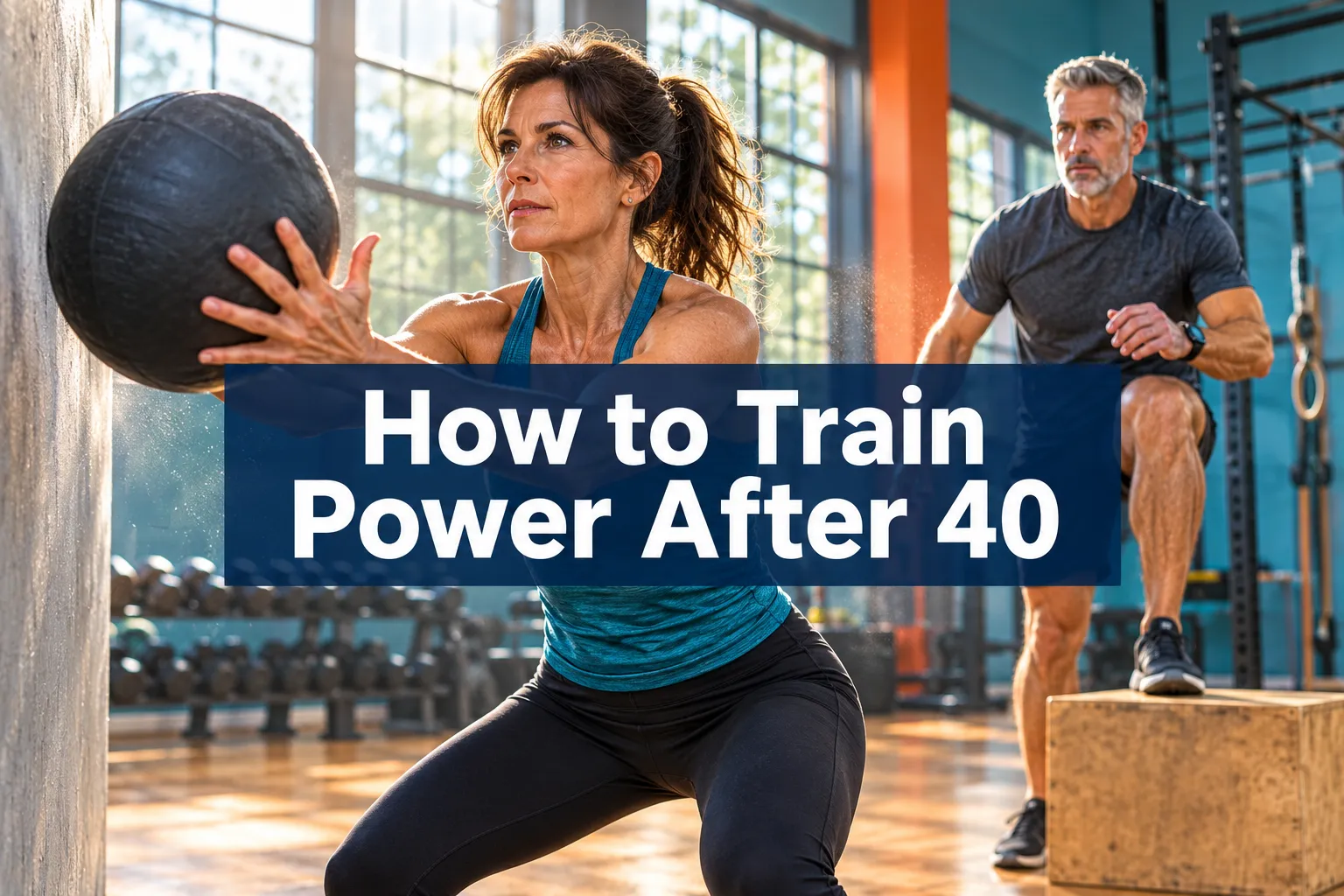
Power, force produced quickly, fades faster than raw strength after midlife, and it's the quality that keeps you fast, balanced, and hard to knock over. Learning how to train power after 40 with safe explosive strength exercises for speed, balance, and athleticism means using light-to-moderate loads (roughly 40-60% of your one-rep max) moved with maximal intended speed, 2-3 sessions per week, on multi-joint moves like squats, step-ups, rows, and medicine-ball throws [1][2]. Jumping isn't required. Intent is.
Key Takeaways
- Power training uses moderate loads moved fast, not maximal loads moved slowly [1].
- ACSM-aligned guidance suggests 2-3 sessions weekly, 1-3 sets of 6-10 reps on major multi-joint movements with maximal concentric speed [1][2].
- In a 2025 randomized trial, older adults who added explosive intent to weight-bearing resistance work gained significantly more rate of force development than those doing identical exercises slowly, with no serious adverse events reported [3][4].
- High-speed resistance training improved rate of torque development and reduced fear of falling, with gains retained at 12 months [5].
- Explosive training beat traditional strength training for early rate of force development and gait speed in one randomized trial [6].
- Plyometrics are optional. Rapid sit-to-stands, step-ups, and medicine-ball passes build power with far less joint load [2].
- Elastic bands, vibration platforms, and bodyweight work can all train explosive qualities [7].
- Expect 4-8 weeks for noticeable speed and stair-climbing changes; measurable neuromuscular gains appear within 12-16 weeks in trials [5][8].
Is power training safe after 40, or bad for your joints?
Power training is generally safe after 40 when it's screened, scaled, and progressed, and the evidence base skews older than you. Randomized trials in adults in their 60s, 70s, and beyond consistently report low rates of serious adverse events when explosive work is introduced with pre-exercise screening, individualized loads, and controlled landings [3][6][9].
The joint-wrecking reputation comes from one specific thing: high-impact jumping done with poor landing mechanics and no base of strength. That's avoidable.
Three safety rules that matter most:
- Build a strength base first. A 2025 review concluded heavy strength training is safe for healthy older adults when supervised and properly progressed, and that this base makes the later addition of higher-velocity movement safer.
- Fast up, controlled down. The concentric (lifting) phase is explosive. The lowering phase stays deliberate.
- Impact is the last variable you add. Load and speed come first; ground impact comes much later, if at all.
Explosive intent produces most of the neuromuscular benefit. Explosive impact produces most of the risk.
Choose caution if: you have known cardiovascular disease, osteoporosis, or active joint pathology. Those populations should begin with low-impact fast movements, rapid sit-to-stands, step-ups, medicine-ball passes, before any true plyometrics, and should clear training with a clinician first [2].
What's the difference between power training and regular strength training?
Strength is how much force you can produce. Power is how much force you can produce per unit of time. Strength training uses heavy loads moved slowly; power training uses lighter loads moved as fast as possible.
| Variable | Strength training | Power training |
|---|---|---|
| Typical load | ~70-85% 1RM | ~40-60% 1RM |
| Bar/body speed | Slow, grinding | Maximal intended speed |
| Reps per set | 4-8 | 6-10 [1][2] |
| Rest | 2-4 min | 1.5-3 min (full recovery for speed) |
| Main adaptation | Force capacity, muscle mass | Rate of force development |
| Real-world payoff | Carrying, lifting | Catching a trip, sprinting, changing direction |
Why this matters after 40: fast-twitch motor units and tendon stiffness decline earlier than overall muscle size, so the ability to generate force quickly drops faster than the ability to generate force at all. ACSM materials note power training often produces larger functional gains than slow strength work in older adults [1][2].
Common mistake: loading a "power" squat at 80% and calling it explosive. At that load the bar can't move fast enough to train velocity. Drop the load, raise the intent.
What are the best explosive exercises for people over 40 that won't cause injury?
The safest high-return explosive exercises are lower-body, multi-joint movements with moderate loads and fast concentric phases: squats, sit-to-stands, step-ups, and leg presses, plus upper-body throws and fast rows [1].
Tier 1, start here (no impact)
- Fast sit-to-stand from a chair or box (explode up, sit down slowly)
- Low box step-up, driving the trail knee up quickly
- Medicine-ball chest pass into a wall (6-8 lb)
- Banded speed row or fast cable row
- Fast-tempo goblet squat at 40-50% effort load
Tier 2, add after 4-6 weeks
- Medicine-ball slam and rotational throw
- Trap-bar or dumbbell jump-shrug (no feet leaving floor)
- Low pogo hops on grass or a mat, 10-15 seconds
- Lateral band shuffle with a quick push-off
Tier 3, only with a solid base and healthy joints
- Low box jumps (step down, never jump down)
- Broad jump for distance, 3-5 reps
- Single-leg hop-and-stick for landing control
Quick example session (35 min): 8-min warm-up → fast sit-to-stands 3×8 → med-ball chest pass 3×6 → low step-up 3×6/side → banded speed row 3×8 → single-leg balance holds 2×30s/side.
How often should you do power training when you're over 40?
Two to three sessions per week, with at least 48 hours between them, matches both ACSM-aligned guidance and the trial protocols that produced results [1][2]. Each session needs only 1-3 sets of 6-10 reps per movement.
Power work is nervous-system work. Stop a set the moment bar or body speed visibly drops, that's the signal you've stopped training power and started training fatigue.
A workable weekly split:
- Monday: power (lower body emphasis) + light core
- Wednesday: heavier strength (slow, controlled)
- Friday: power (mixed upper/lower) + balance drills
- Weekend: walking, cycling, or sport
Edge case: if you're also playing a sport with sprinting or jumping, count that as a power session and cut to one gym power day.
Can you build athletic power and speed in your 50s or later?
Yes, and the research is clearest in people considerably older. A 16-week high-speed resistance training trial in independent older adults improved physical function alongside roughly a 7.5% increase in general cognitive performance [8]. A 12-month follow-up in Scientific Reports found the gains in rate of torque development and reductions in fear of falling were clinically meaningful and sustained a full year later [5].
A 12-week power program in mobility-limited older adults (gait speed under 0.9 m/s) even improved bone microarchitecture and estimated bone strength, with notable gains at the radius in women [9].
So the ceiling at 55 is lower than at 25, but the rate of improvement from an untrained start is often larger. Beginners frequently add noticeable sprint-stride quickness and stair speed within two months.
Are plyometrics safe for older adults, or too risky?
Plyometrics are safe for a subset of adults over 40, those with no significant joint or bone issues, a few months of consistent strength training, and good landing control. For everyone else, they're unnecessary, because low-impact fast movements deliver most of the benefit.
Progress in this order:
- Fast concentric lifts (no flight phase)
- Jump-shrugs and fast step-ups (feet stay down)
- Low-amplitude pogo hops on a forgiving surface
- Low box jumps, stepping down
- Single-leg hops, only if 3-4 are clean
Landing checklist: quiet feet, knees tracking over toes, hips sitting back, chest up, no inward knee collapse. If a landing is loud, the dose is too high.
Skip plyometrics entirely if: you have osteoporosis, a knee or hip replacement, active tendinopathy, or unmanaged cardiovascular disease [2].
How does power training help with balance and fall prevention?
Catching a stumble is a power problem, not a strength problem, you have a fraction of a second to put a foot down and produce force. That's rate of force development, and explosive training targets it directly.
In a randomized trial on institutionalized older adults, explosive plantar-flexor training produced larger improvements in early RFD and gait speed than traditional strength training, even though both raised maximal strength [6]. A 2025 trial found adults who added explosive intent to weight-bearing resistance work gained significantly more RFD than a matched slow-tempo group [3][4]. And the 12-month HSRT follow-up showed reduced fear of falling that persisted [5], which matters, because fear of falling restricts movement and accelerates decline.
Pair power work with 5 minutes of balance drills: single-leg stands, tandem walks, and a controlled reactive step in each direction.
What equipment do you need, and can you do power training without a gym?
You can train power with nothing but a sturdy chair and floor space. Equipment widens the options but isn't the gatekeeper.
Zero-equipment power work: fast sit-to-stands, fast step-ups on a stair, quick lateral shuffles, low pogo hops, fast push-ups from a counter, and fast-tempo split squats.
Three cheap upgrades (most value first):
- Resistance bands, a 2025 comparative trial found maximal elastic-band resistance training improved bone health, isokinetic strength, and biomarkers in sedentary older adults alongside high-velocity and eccentric modes [7].
- Medicine ball (6-10 lb), the simplest way to train upper-body and rotational power with zero landing impact.
- A pair of moderate dumbbells or a kettlebell for loaded fast squats and jump-shrugs.
For people with sarcopenia or frailty, a 2025 Scientific Reports study found 12 weeks of whole-body vibration training enhanced explosive force and contraction efficiency comparably to conventional resistance training, a useful option when plyometrics are off the table.
Is power training good for women over 40, and what if you have joint pain or arthritis?
Power training is equally valuable for women over 40, arguably more so, given the overlap with bone health. The 12-week power training trial in mobility-limited adults found improvements in bone microarchitecture and estimated strength, with women showing particularly notable gains at the radius [9]. Elastic-band and high-velocity modes also improved bone markers in sedentary adults of both sexes [7].
If you have joint pain or arthritis:
- Train through pain-free ranges only; partial-depth fast squats still build power.
- Favor closed-chain, low-impact moves: sled pushes, step-ups, fast leg press.
- Use seated or supported variations on flare-up days.
- Keep soreness-free 48 hours between sessions, and clear the plan with a clinician or physical therapist [2].
Decision rule: if a movement hurts during the set, change the range or the implement before you change the exercise entirely.
What should you do to warm up before explosive strength exercises at 40 plus?
Spend 8-12 minutes raising tissue temperature, mobilizing hips and ankles, then priming the nervous system with a few submaximal fast reps. Tendons in midlife need more warm-up time than muscle does, and skipping it is the most common cause of Achilles and patellar complaints.
The 10-minute protocol:
- 3 min easy bike, brisk walk, or rowing
- 2 min ankle rocks, hip airplanes, thoracic rotations
- 2 min glute bridges and banded lateral walks
- 2 min pogo-style calf bounces (tiny, quiet) and arm swings
- 1-2 min ramp-up sets: 3-4 reps of the day's first power move at 50%, then 75% speed-effort
Common mistakes people make with power exercises over 40
The biggest mistake is treating power training like strength training with extra enthusiasm, heavy loads, high reps, and short rest, which produces fatigue instead of speed.
- Going too heavy. Above ~60% 1RM, velocity collapses.
- Chasing reps. Eight fast reps beat fifteen slow ones; stop when speed drops.
- Skipping the strength base. Build a few months of controlled resistance work first.
- Jumping down from boxes. Step down. Landing from height is the single riskiest common habit.
- Training power when exhausted. Schedule it first in the session, on fresh legs.
- No lower-body priority. Guidance emphasizes lower-extremity, multi-joint power first for fall risk and balance.
- Zero progression. Add load, height, or complexity every 3-4 weeks, one variable at a time.
FAQ
How long before I see results from power training after 40?
Most people notice easier stair climbing and quicker first steps in 4-8 weeks. Measurable neuromuscular gains in trials show up across 12-16 week programs and can persist 12 months [5][8].
Is power training safe if I've never lifted weights?
Start with 6-8 weeks of basic resistance training to build a base, then add explosive intent to the movements you've already learned.
What load should I use for explosive exercises?
Roughly 40-60% of your one-rep max is where power output peaks; reserve 70-85% for separate strength sessions [1].
Do I have to jump to train power?
No. Fast sit-to-stands, step-ups, and medicine-ball throws build rate of force development without any flight phase [2].
How many reps per set?
About 6-10 reps, 1-3 sets per exercise, stopping when movement speed noticeably slows [1][2].
Can power training improve brain function?
One 16-week high-speed resistance training trial reported about a 7.5% improvement in general cognitive performance alongside functional gains [8].
Should I do power and strength in the same workout?
You can, put power first, while fresh. Many people over 40 prefer separate days for better recovery.
Is power training different for women over 40?
The programming is the same. Bone benefits may be especially relevant, with one trial showing notable upper-limb bone gains in women [9].
What if I have osteoporosis?
Avoid impact and ballistic moves. Use fast but non-ballistic resistance work, bands, or vibration platforms with clinician approval [2].
Can older adults with slow gait speed do power training?
Yes. A 12-week program in adults with gait speed under 0.9 m/s improved bone strength outcomes safely [9].
Conclusion
Power is the most trainable, most neglected athletic quality after 40, and it responds to intent more than intensity. The trial evidence is consistent: moderate loads moved fast improve rate of force development, gait speed, chair-rise performance, bone strength, and confidence in dynamic movement, with low adverse-event rates when the progression is sensible [3][5][6][9].
Your next four weeks:
- Pick two non-consecutive days for power work.
- Choose three Tier 1 moves (fast sit-to-stand, low step-up, medicine-ball chest pass).
- Do 3 sets of 8, resting 2 minutes, stopping any set when speed drops.
- Warm up 10 minutes every time, without exception.
- At week 4, add one Tier 2 move and retest a 5-rep timed sit-to-stand to see your progress.
Screen first if you have cardiovascular, bone, or joint conditions. Then move fast, land soft, and stop before fatigue steals the speed you came for.
References
- 00135124 202509000 00008. journals.lww.com.
- Power for Older Adults. acsm.org.
- pubmed.ncbi.nlm.nih.gov.
- A92424b8f87ab86b5fe45d6767ee3b795a79f4a9. semanticscholar.org.
- S41598 025 09095 8. link.springer.com.
- Pmc11678039. pmc.ncbi.nlm.nih.gov.
- Record Detail. search.pedro.org.au.
- S11332 025 01419 5. link.springer.com.
- S11657 024 01487 Z. link.springer.com.
