Last updated: August 25, 2026
Quick Answer
Weighted vest strength and balance routines for adults 60+ are short, low-impact sessions (15-30 minutes, 2-4 times a week) that add 4-10% of body weight to everyday moves like squats, wall push-ups, and heel-to-toe walks. Used correctly, a vest can help preserve muscle, improve postural stability, and support metabolic health during aging or weight loss. It is not a guaranteed fix for hip bone density, and load, fit, and progression matter more than brand [1][5].
Key Takeaways
- Start with 4-5% of body weight and progress slowly; most adults 60+ top out between 8-12% of body weight.
- Focus on balance drills, sit-to-stands, step-ups, and posture work, not heavy cardio in a vest.
- Train 2-4 days per week, wearing the vest 15-30 minutes per session, not all day.
- Recent trials show vests can preserve trunk muscle density and resting energy expenditure during weight loss, but do not reliably prevent hip bone loss [2][5][8].
- Vests are generally safer than weight belts for seniors because load is distributed across the torso.
- Skip or modify with uncontrolled high blood pressure, recent fractures, severe osteoporosis, or acute joint flares without clinician sign-off.
- Fit matters more than brand: snug, adjustable, breathable, and easy to put on alone.
What Are Weighted Vest Strength and Balance Routines for Adults 60+
A weighted vest routine for older adults is a structured plan that adds external load to functional movements, standing up from a chair, stepping, reaching, walking, to build strength, bone stimulus, and balance at the same time. The vest sits close to the body's center of mass, so it challenges posture and stability without loading the hands or spine the way a barbell would.
These routines matter because after age 60, adults lose roughly 1-2% of muscle mass per year and balance reflexes slow. Adding a modest external load to daily-life moves is one of the simplest ways to push back against that decline at home [1][10].
Choose a vest routine if you: want low-equipment strength training, need better balance, are trying to preserve muscle during weight loss, or want to stay independent longer.
Skip it if you: have unstable cardiovascular disease, an unhealed fracture, severe cervical spine issues, or your clinician has advised against added spinal load.
What Are the Best Weighted Vests for Seniors Over 60
The best weighted vest for a senior is adjustable, snug, short-cut, and easy to put on alone. Look for 0.5-1 lb removable weight increments, padded shoulders, a chest or waist strap to stop bouncing, and a max load of 15-20 lb (you rarely need more).
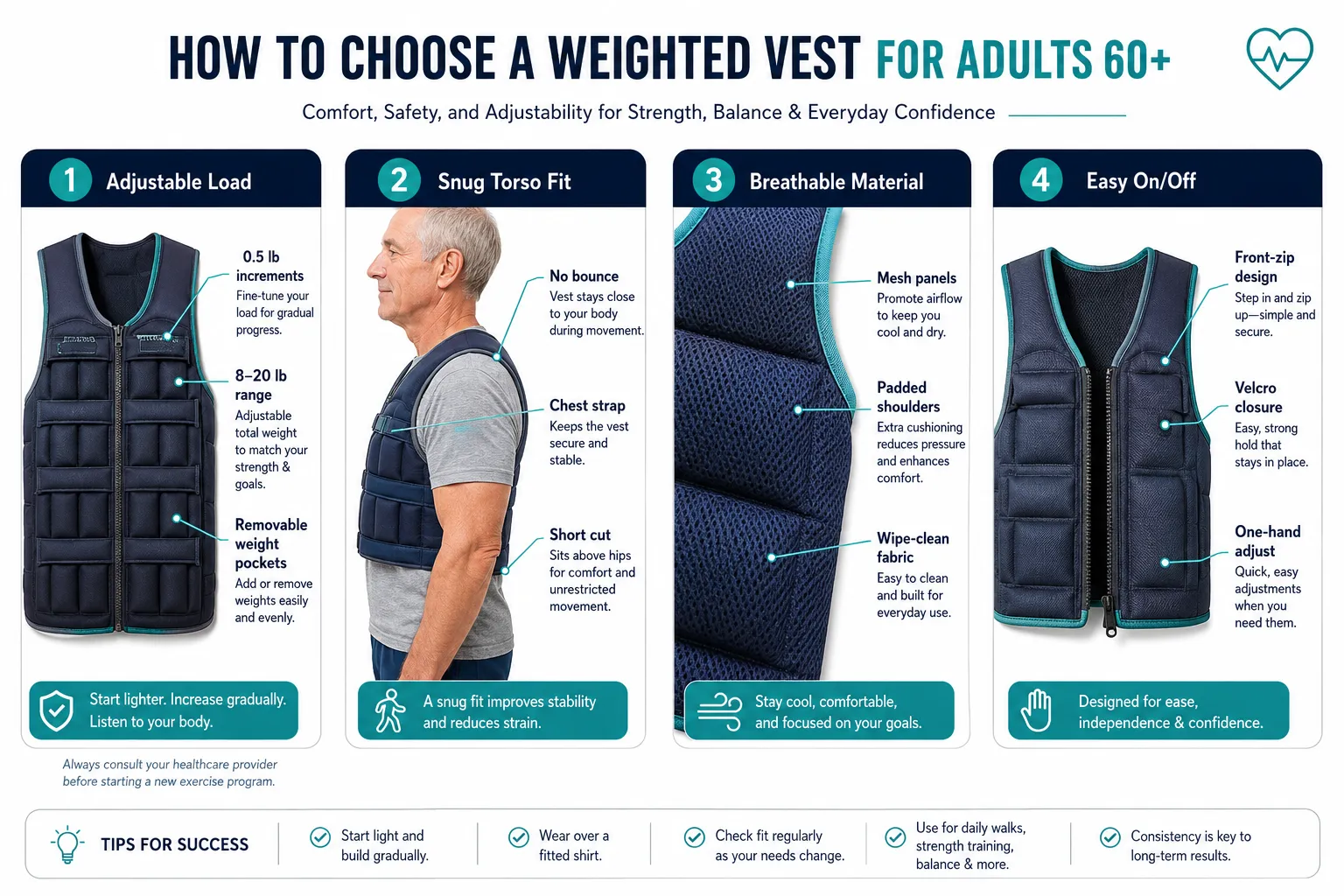
Brand-name reviews shift often, but the categories that consistently perform well for adults 60+ include:
- Short-torso adjustable vests (examples: Hyperwear Hyper Vest FIT, Aduro Sport adjustable, Empower short vests), good for smaller frames and easier on the low back.
- Modular pocket vests with 0.5 lb steel shot bags, best for slow progression.
- Front-zip vests, much easier for anyone with shoulder arthritis than pullover styles.
Avoid tactical or military-style vests. They're heavy, long, and load the lumbar spine more than needed.
Rule of thumb: If you can't put the vest on by yourself in under 30 seconds, it's the wrong vest.
How Much Weight Should a 60 Year Old Wear in a Weighted Vest
Start at 4-5% of body weight and cap most routines at 8-10% of body weight. For a 150-lb adult, that means beginning around 6-8 lb and progressing toward 12-15 lb over months, not weeks. Research in older adults suggests loads that are too light produce little training effect, while loads above ~10% raise fall and joint-stress risk without much added benefit [1][10].
Progression rule: add weight only when you can complete your full routine with good form and no next-day joint pain for two consecutive sessions.
Weighted Vest Exercises for Balance and Fall Prevention
Balance work in a vest trains your body to correct itself under load, which is exactly what happens in a real stumble. A 2022 randomized trial combining whole-body vibration with weighted vest training reported meaningful gains in balance and lower-limb strength in older adults [3], and a 2025 square-stepping-plus-vest report found improved fall-risk scores in community-dwelling seniors [4].
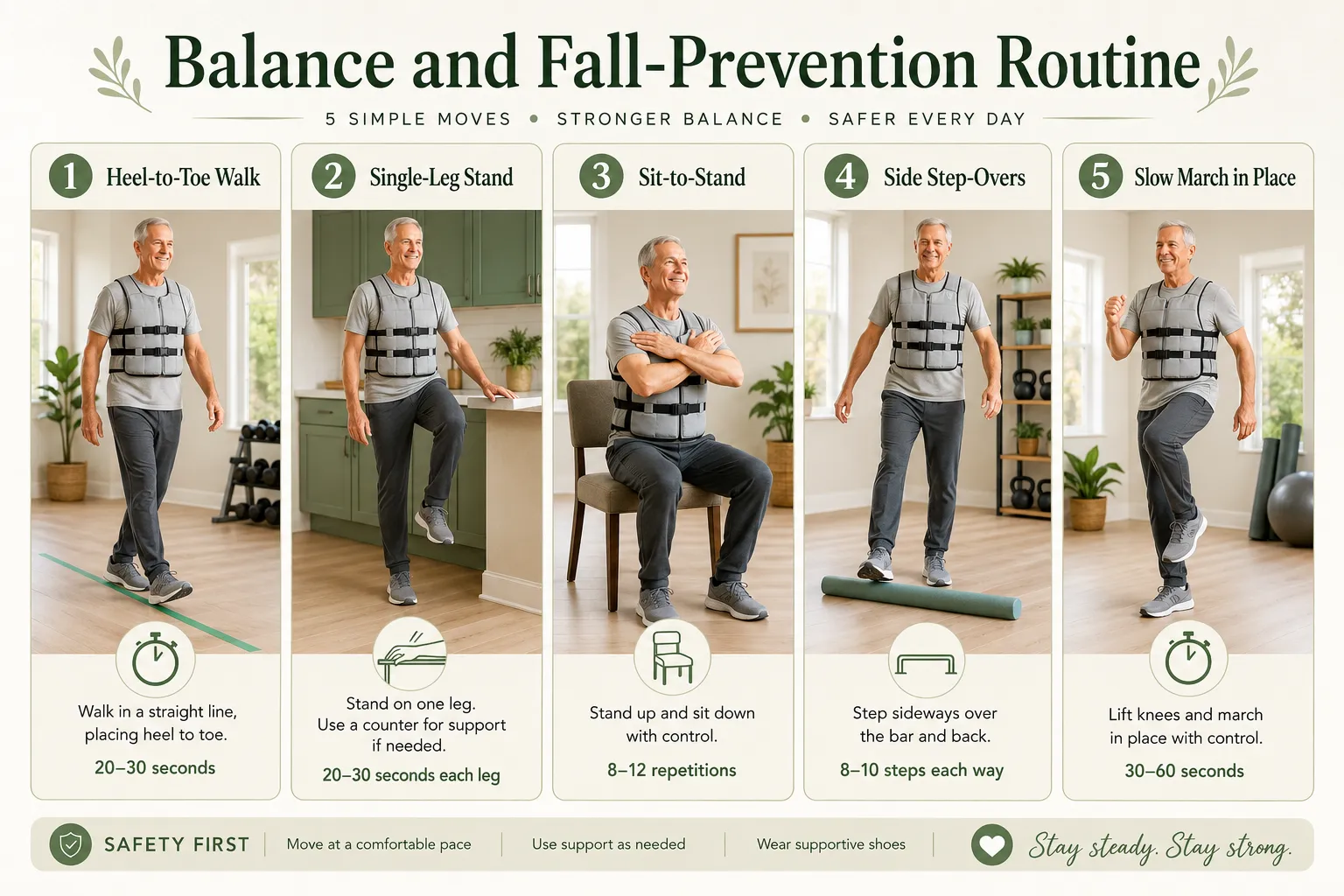
A simple 15-minute fall-prevention block, done 2-3 times a week:
- Heel-to-toe walk along a line, 2 lengths of 20 feet.
- Single-leg stand near a counter, 20 seconds per side, 3 rounds.
- Sit-to-stand from a sturdy chair, 2 sets of 8-12.
- Side step-overs across a rolled towel, 10 crossings.
- Slow march in place with high knees, 60 seconds.
Wear the vest for the whole block. Keep one hand near a wall or counter for the first two weeks.
Can Weighted Vests Improve Bone Density in Older Adults
Weighted vests can improve bone-loading stimulus, but current evidence shows they do not reliably prevent hip bone loss, especially during weight-loss interventions. The large 2025 INVEST in Bone Health RCT (JAMA Network Open) found that a weighted vest worn during weight loss did not preserve hip BMD compared with control [5][7]. However, follow-up analyses reported preserved trunk muscle density and resting energy expenditure, both meaningful for aging bodies [2][8][9].
What this means practically: don't rely on a vest alone for osteoporosis prevention. Pair it with impact work you tolerate (heel drops, brisk walking), resistance training, and physician-guided nutrition and medication where indicated.
Weighted Vest vs Resistance Bands for Seniors: Which Is Better
Neither is universally better, they solve different problems.
Resistance bands, best for isolated upper-body pulling, rotator cuff work, hip abduction, and travel. Lower spinal load.
Choose a vest if your goal is functional strength, balance, and staying independent. Choose bands if your goal is joint-specific rehab, shoulder health, or you have significant spinal concerns. Most well-designed programs use both.
Are Weighted Vests Safe for People with Arthritis or Joint Pain
For most adults with mild-to-moderate osteoarthritis, a light vest (4-6% body weight) is safe and often well tolerated, because the load is centered on the torso rather than the knees or hips directly. It is not appropriate during an active joint flare, with unstable joints, or after recent joint replacement without surgeon clearance.
Practical guardrails:
- Avoid vest use during downhill walking or stairs if knees are symptomatic.
- Skip jumping or running in a vest.
- If pain increases the next day, drop weight by 25% or move to seated exercises.
Weighted Vests for People with Osteoporosis: Is It Safe
Vests can be safe with osteoporosis when the load is light, the routine avoids spinal flexion under load, and a clinician has cleared the person. Do not combine a vest with forward-bending, twisting, or sit-ups, these movements raise vertebral fracture risk regardless of load.
Stick to upright, hip-hinge, and balance-based work. If you have had a vertebral compression fracture, ask a physical therapist to design the routine.
How Long Should Seniors Wear a Weighted Vest During Workouts
Wear the vest for 15-30 minutes per session, not all day. Some 2025-2026 trial protocols used longer daily wear during weight-loss studies, but those were supervised and progressive [2][7]. For home use, shorter targeted sessions produce most of the strength and balance benefit with less joint fatigue.
Signs you've worn it too long: shoulder soreness, low-back ache, headache, or posture that collapses forward. Stop, remove weight, and shorten the next session.
How Often Should Seniors Do Weighted Vest Training per Week
2-4 sessions per week is the practical sweet spot. Beginners: two non-consecutive days for 2-3 weeks. Intermediate: three days. Advanced or well-conditioned adults: up to four, alternating balance-focused and strength-focused days.
Rest days matter more after 60, muscle recovery slows, and connective tissue needs the gap.
Weighted Vest Routines for Improving Posture in Older Adults
A vest can improve posture by cueing the deep trunk muscles to keep the ribcage stacked over the pelvis. A 2021 experimental study on weighted torso balance training reported gains in both anticipatory and reactive balance, both closely tied to postural control [6].
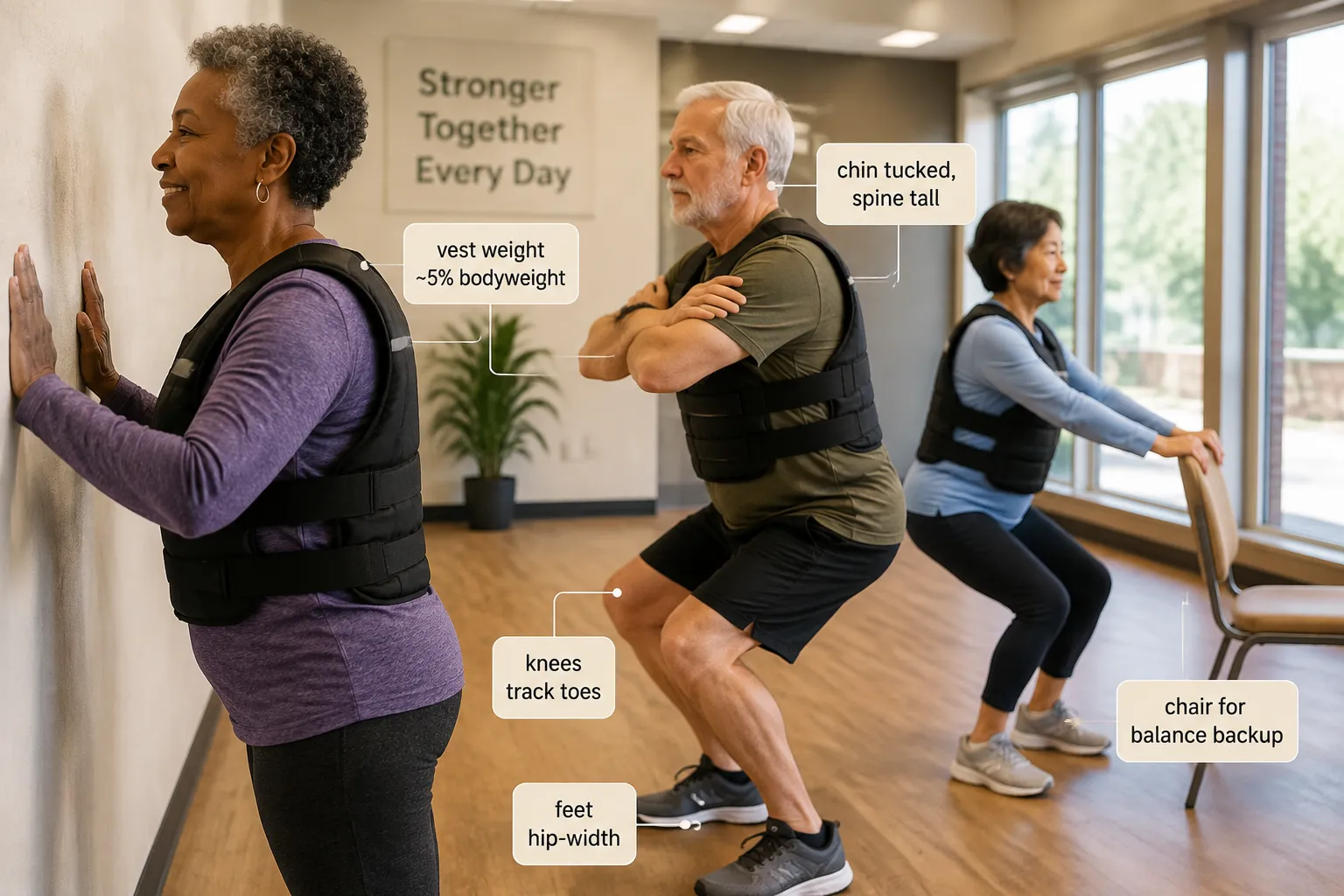
A 10-minute daily posture block:
- Wall stand (heels, hips, upper back, head against wall), 60 seconds.
- Chin tucks, 10 reps.
- Scapular squeezes, 15 reps.
- Hip hinge to countertop, 10 reps.
- Slow walk with vest, tall spine, 3 minutes.
Do this in the morning. Posture wins compound.
What's the Difference Between Weighted Vests and Weight Belts for Seniors
A weighted vest distributes load across the shoulders and torso. A weight belt concentrates load at the hips or waist. For adults 60+, vests are usually the better default because the load stays closer to the body's center of mass and doesn't tug at the low back the way a belt can. Belts are useful for specific hip-loading protocols under supervision, but they're rarely a good first purchase for a home program.
Common Mistakes Older Adults Make with Weighted Vests
The frequent mistakes are predictable and fixable:
- Buying too heavy. A 20-lb vest sits unused. A 10-lb adjustable vest gets worn.
- Wearing it during long walks before strength adapts. Start with short strength sessions first.
- Skipping the chest strap. A bouncing vest hurts shoulders and ruins form.
- Adding weight weekly. Progress in 2-4 week blocks.
- Doing crunches or toe-touches in the vest. Never load spinal flexion at this age.
- Ignoring next-day soreness that lasts more than 48 hours. That's a signal to deload.
Can I Use a Weighted Vest if I Have High Blood Pressure or Heart Issues
If your blood pressure is well-controlled and your cardiologist has cleared you for moderate exercise, a light vest during standing balance and strength work is generally fine. Avoid it if you have uncontrolled hypertension, unstable angina, recent cardiac events, or symptomatic heart failure without clinician sign-off.
Safety checklist before each session:
- Resting BP under your clinician's target.
- No chest pressure, unusual shortness of breath, or dizziness.
- Hydrated, not fasted longer than usual.
- Stop immediately for symptoms and remove the vest.
A Sample Weekly Plan
| Day | Focus | Duration | Vest Load |
|---|---|---|---|
| Mon | Strength (sit-to-stand, wall push-up, step-up) | 20 min | 5% BW |
| Tue | Rest or walk (no vest) | , | , |
| Wed | Balance and posture block | 15 min | 4% BW |
| Thu | Rest | , | , |
| Fri | Strength + short vest walk | 25 min | 5-6% BW |
| Sat | Balance drills | 15 min | 4% BW |
| Sun | Rest | , | , |
Adjust down if you're just starting. Two days a week beats zero.
FAQ
Is a 10-pound vest enough for a 70-year-old?
For most 70-year-olds under 180 lb, 8-10 lb is a productive working load once conditioned. Start lighter.
Can I wear a weighted vest for housework?
Short bouts (15-20 minutes) are fine if posture stays tall. Skip it for vacuuming, bending, or lifting.
Will a weighted vest help me lose belly fat?
It supports muscle preservation and metabolic rate during weight loss but won't spot-reduce fat [2][8].
How soon will I see balance improvements?
Most people notice steadier single-leg stands in 3-6 weeks of consistent training.
Are weighted vests safe after knee replacement?
Only with surgeon clearance, usually not before 3-6 months post-op, and starting very light.
Can I sleep or nap in a weighted vest?
No. Vests are training tools, not compression garments.
Do I need shoes with a vest indoors?
Supportive shoes are recommended for balance drills. Barefoot only on non-slip surfaces if you already train barefoot.
What if I have a pacemaker?
Ask your cardiologist first. Most modern pacemakers tolerate light vest use, but chest strap placement matters.
Conclusion
Weighted vest strength and balance routines for adults 60+ are one of the highest-leverage home tools for staying strong, upright, and independent. The evidence is clear that a modest, well-fitted vest, used 2-4 times per week for 15-30 minutes on balance, sit-to-stand, and posture work, preserves muscle quality and improves stability, even if it does not solve hip bone density on its own [1][2][5][8].
Next steps this week:
- Weigh yourself and calculate 4-5% of body weight.
- Order or borrow an adjustable vest that starts light and increments by 0.5-1 lb.
- Block three 20-minute sessions on your calendar.
- Run the balance block above on day one, the posture block on day two, and a light strength circuit on day three.
- Reassess in four weeks, add weight only when form and recovery both look clean.
Small load. Steady weeks. Big returns on independence.
References
[1] Full – https://www.frontiersin.org/journals/public-health/articles/10.3389/fpubh.2026.1811712/full
[2] Weighted Vests Might Help Older Adults Meet Weight Loss Goals – https://newsroom.wakehealth.edu/news-releases/2025/06/weighted-vests-might-help-older-adults-meet-weight-loss-goals
[3] S12877 022 03593 4 – https://bmcgeriatr.biomedcentral.com/articles/10.1186/s12877-022-03593-4
[4] Pmc12614173 – https://pmc.ncbi.nlm.nih.gov/articles/PMC12614173/
[5] jamanetwork – https://jamanetwork.com/journals/jamanetworkopen/fullarticle/2835505
[6] Paah – https://paahjournal.com/articles/10.5334/paah.43
[7] Were Putting Weighted Vests To The Test Heres What Our Research Shows – https://news.wfu.edu/2025/10/20/were-putting-weighted-vests-to-the-test-heres-what-our-research-shows/
[8] academic.oup – https://academic.oup.com/biomedgerontology/article/81/4/glag062/8501989?login=false
[9] academic.oup – https://academic.oup.com/innovateage/article/9/Supplement_2/igaf122.3868/8410348
[10] Full – https://www.frontiersin.org/journals/aging/articles/10.3389/fragi.2024.1335534/full