Last updated: July 28, 2026
Quick Answer
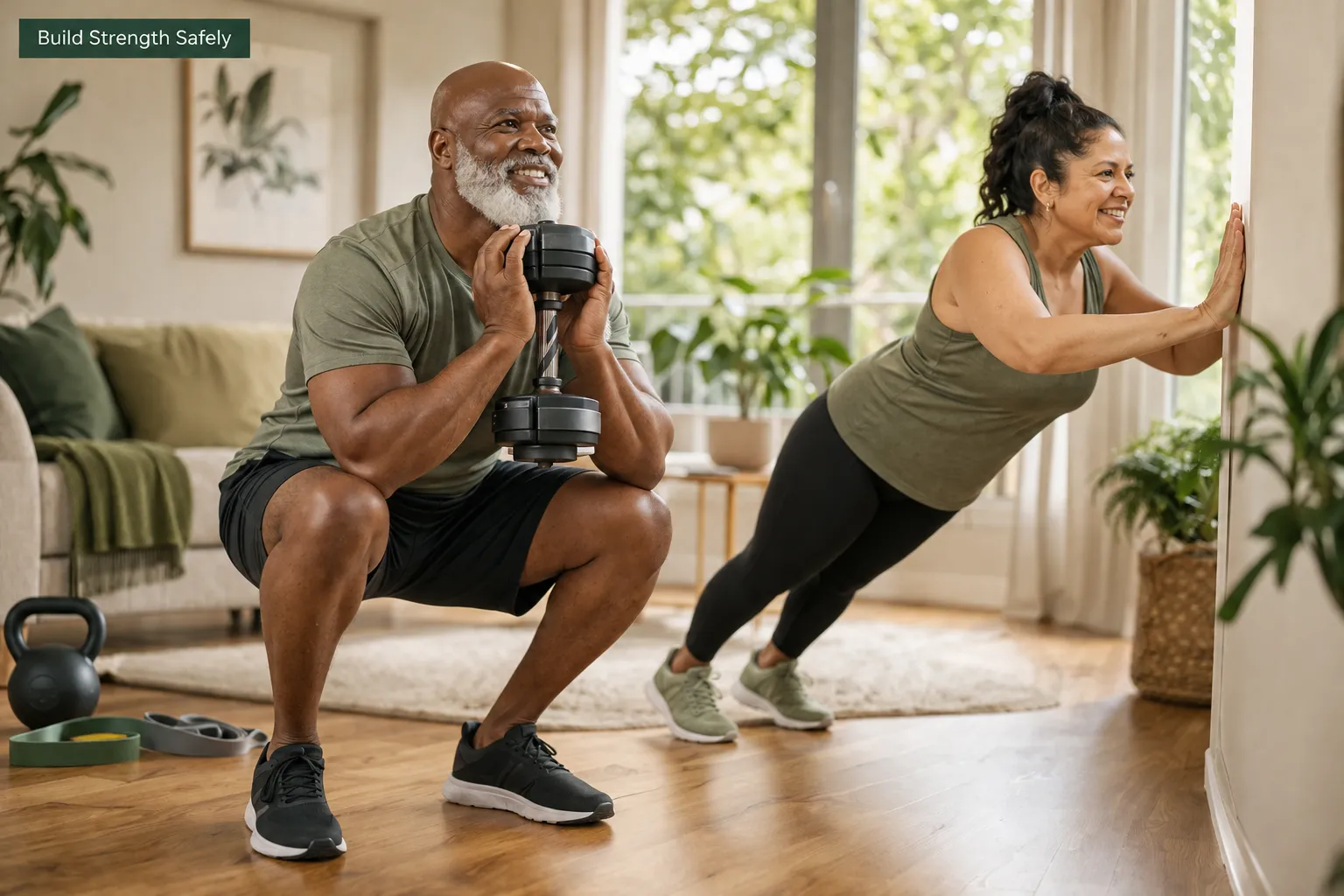
Progressive strength training for seniors means gradually increasing resistance, reps, or difficulty over weeks so your muscles and bones keep adapting. Adults over 50 can build meaningful muscle and improve bone density at home using bodyweight moves, resistance bands, and a few dumbbells, no gym needed. Aim for 2-3 sessions per week, hitting all major muscle groups, and add small load increases every 1-2 weeks [3][7].
)
Key Takeaways
- Muscle growth is possible at any age. Studies show adults in their 60s, 70s, 80s, and even 90s can gain strength and lean mass with consistent resistance training [1][5].
- Progression is the key ingredient. Doing the same 3-pound dumbbell curls forever won't build bone or muscle, the load must increase over time [3].
- 2-3 sessions per week covering all major muscle groups is the ACSM 2026 target for older adults [3].
- Heavy loads may build more strength than light ones for seniors who train safely with good form [3].
- Bones respond to load. Weight-bearing and resistance exercise stimulate bone remodeling and can slow or reverse density loss [6].
- Home training works. A pair of adjustable dumbbells, a resistance band, and a sturdy chair cover most needs.
- Arthritis is not a stop sign. Modified strength training often reduces joint pain over time [9].
- Expect visible strength gains in 6-12 weeks and measurable bone density changes over 6-12 months [1][8].
What is progressive strength training and how does it work for older adults?
Progressive strength training is a method where you steadily increase the demand on your muscles, through heavier weight, more reps, more sets, or harder variations, so your body keeps adapting. For older adults, this means starting at a comfortable baseline and adding a small challenge every 1-2 weeks.
The mechanism is simple: muscle and bone are living tissues that respond to stress. When you lift something slightly harder than last week, tiny signals tell your body to build more muscle fibers and lay down more bone [5][8].
How progression looks in practice:
- Week 1: 10 chair squats with bodyweight
- Week 3: 12 chair squats holding a gallon of water
- Week 5: 10 squats holding a 10-lb dumbbell
- Week 8: 10 squats holding two 10-lb dumbbells
Small, steady jumps beat huge leaps. This is the difference between exercise that maintains and exercise that builds.
Why is muscle and bone density important after age 50?
After 50, adults lose roughly 1-2% of muscle mass and 1% of bone density per year without intervention, a process called sarcopenia and osteopenia [4][5]. That loss compounds. By age 80, an untrained person may have lost 30-40% of their peak strength.
Why it matters:
- Falls and fractures. Weak muscles and thin bones drive most senior injuries. A hip fracture at 75 carries a serious mortality risk within one year [6].
- Independence. Getting off the toilet, climbing stairs, and carrying groceries all require leg and grip strength.
- Metabolic health. More muscle means better blood sugar control and a higher resting metabolism [5].
- Balance and posture. Strong back, hip, and core muscles keep you upright.
Direct answer: Muscle and bone density protect your ability to live independently, recover from illness, and avoid life-changing fractures. After 50, defending them is a health priority on par with blood pressure or cholesterol.
Can you build muscle after 50 without going to a gym?
Yes. Multiple studies confirm that adults over 50, and even over 80, build measurable muscle at home using bodyweight, bands, and light-to-moderate dumbbells [1][5]. Gyms offer variety, but they aren't required for the fundamentals.
What home training gives you:
- No commute, no membership, no waiting for equipment
- Privacy to learn form at your own pace
- Consistency, which matters more than fancy machines
What you sacrifice: heavy barbell options and coached feedback. For most seniors, the trade is worth it, especially in the first 1-2 years, where progress comes fast on modest equipment.
Best home exercises for seniors to increase bone density
Bone responds best to weight-bearing and resistance exercise that loads the hip, spine, and wrist [6][8]. The following moves cover those areas and can be scaled from beginner to advanced.
| Movement | Bones loaded | Beginner version | Progression |
|---|---|---|---|
| Squat | Hip, spine | Chair sit-to-stand | Goblet squat with dumbbell |
| Hip hinge / deadlift | Hip, spine | Hinge to countertop | Kettlebell or dumbbell deadlift |
| Push-up | Wrist, spine | Wall push-up | Incline then floor push-up |
| Row | Spine, shoulder | Band seated row | Dumbbell bent-over row |
| Overhead press | Spine, wrist | Light dumbbell press | Heavier standing press |
| Step-up | Hip, spine | 4-inch step | 8-inch step with weight |
| Farmer's carry | Spine, wrist, grip | Two grocery bags | Heavy dumbbells, 60+ seconds |
Rule of thumb: Choose a weight that feels challenging by rep 8-10. Easy sets don't stimulate bone.
How often should seniors do strength training per week?
The 2026 ACSM guidance recommends 2-3 strength sessions per week for older adults, targeting all major muscle groups, with at least 48 hours between sessions for the same muscles [3]. The BBC's 2026 review of the research reached the same conclusion [7].
A workable weekly plan:
- Monday: Full-body strength (30-40 min)
- Wednesday: Full-body strength (30-40 min)
- Friday: Full-body strength or a lighter mobility + balance day
- Other days: Walking, gardening, or light cardio
Two sessions per week still delivers most of the benefit if three feels like too much. One session per week maintains but doesn't build.
)
Progressive strength training for seniors with arthritis or joint pain
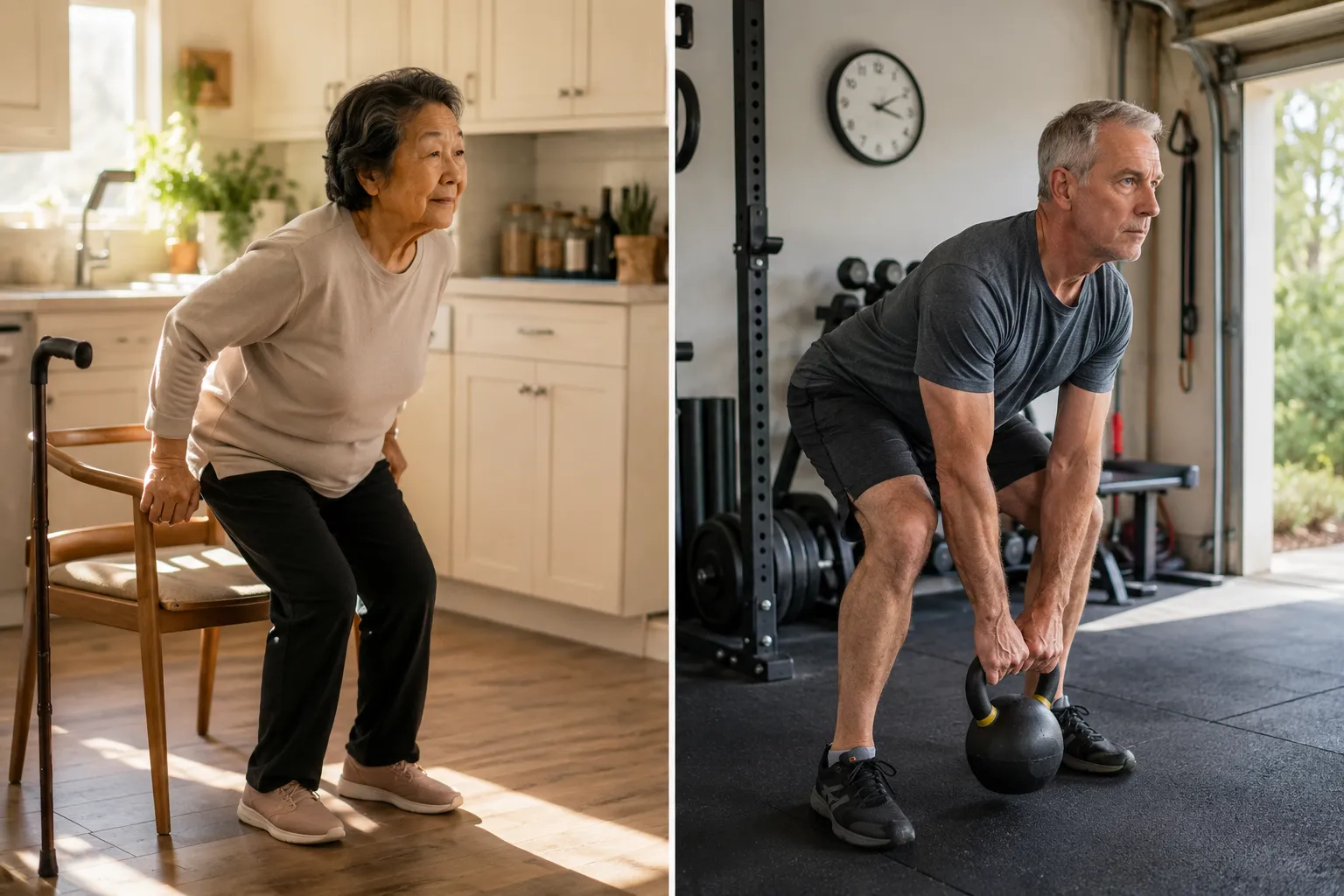
Arthritis is not a reason to skip strength training, it's a reason to do it. Stronger muscles around a joint reduce load on the cartilage and often lower pain scores over time [9]. The rules just change slightly.
Adjustments that work:
- Warm up longer. 5-10 minutes of easy movement before lifting.
- Reduce range of motion. Half-squats before full squats.
- Slower tempo. 3 seconds down, 1 second up, less jarring on joints.
- Skip painful angles. If overhead pressing hurts the shoulder, try incline pressing instead.
- Track pain, not just weight. Pain during the set that fades within 24 hours is usually fine. Pain that lingers 48+ hours means back off.
Decision rule: If a joint hurts sharply during a movement, stop and modify. If it aches mildly and settles quickly, continue with lighter load.
What equipment do I need for senior strength training at home?
You can start with almost nothing. A full home setup for progressive strength training under $200 typically includes:
- A sturdy chair (for squats, rows, step-ups)
- A set of resistance bands with different tensions, $20-40
- Adjustable dumbbells or a few pairs (5, 10, 15, 20 lb), $80-200
- A yoga or exercise mat, $20
- Optional: a light kettlebell (10-20 lb) for hip hinges, $30-50
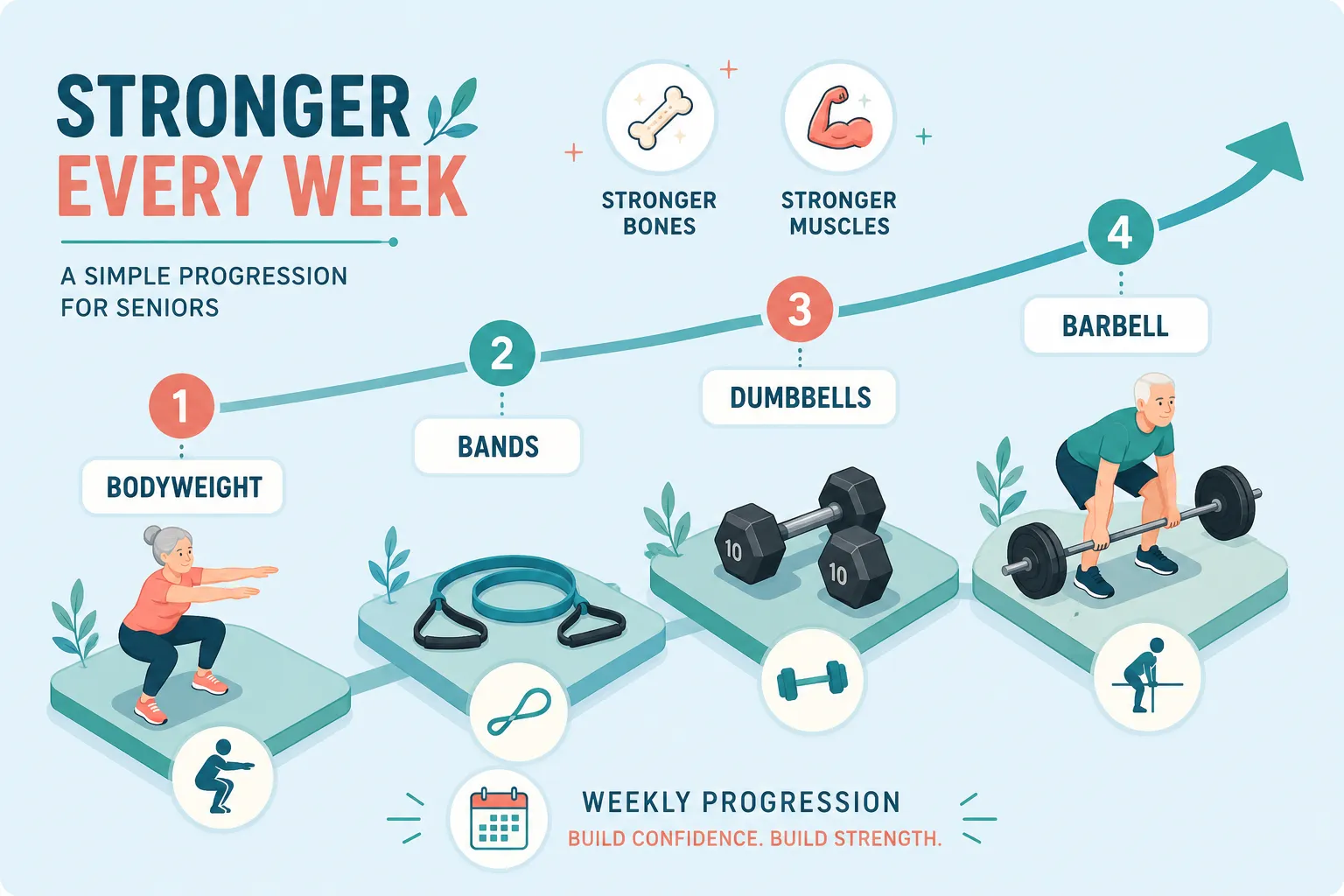
Progression path: Bodyweight → resistance bands → light dumbbells → heavier dumbbells or kettlebell. Adjustable dumbbells are the single best purchase because they grow with you for years.
Skip: vibration plates, ab rollers, ThighMasters, and anything advertised on late-night TV.
How long does it take to see results from strength training over 50?
Results come in stages, and each stage has a rough timeline based on published research [1][5][8]:
- Weeks 1-4: Nervous system adaptations. You feel stronger and more coordinated, but muscles haven't grown much yet.
- Weeks 6-12: Visible muscle gains begin. Clothes fit differently. Everyday tasks feel easier.
- Months 3-6: Meaningful strength gains, often 30-50% on key lifts for beginners.
- Months 6-12: Bone density changes become measurable on DEXA scans in many people [6][8].
- Year 1+: Body composition, balance, and functional independence shift dramatically.
The trap: quitting at week 3 because the mirror hasn't changed. Trust the timeline.
Is progressive strength training safe for seniors with osteoporosis?
Yes, with modifications. The 2024 NOGG osteoporosis guideline explicitly endorses progressive resistance training as part of fracture prevention, provided form is good and spinal flexion under load is avoided [6].
Safe for osteoporosis:
- Squats, hip hinges with neutral spine
- Rows, presses, carries
- Slow, controlled tempo
- Weight-bearing walking
Avoid or modify:
- Loaded spinal flexion (weighted crunches, toe-touches)
- High-impact jumping unless cleared by a doctor
- Twisting under heavy load
Direct answer: Progressive strength training is one of the most recommended interventions for osteoporosis when performed with neutral spine and gradual load progression. Get clearance from your doctor if you've had a recent fracture or a DEXA T-score below -3.0.
Common mistakes seniors make when starting strength training
The five most frequent errors, each of which limits results or increases injury risk:
- Staying too light forever. 2-pound dumbbells don't stimulate bone or build muscle after the first month.
- Skipping legs. Upper-body-only routines miss the biggest muscle groups and the bones most likely to fracture.
- No warm-up. Cold muscles and stiff joints don't tolerate load well.
- Ego lifting. Jumping weight too fast is how injuries happen. Add 2.5-5 lb at a time, not 20.
- Inconsistent schedule. Training hard for two weeks then skipping a month resets progress.
Bonus mistake: Not tracking anything. A simple notebook with date, exercise, weight, and reps beats memory every time.
Progressive strength training vs regular exercise for seniors
Regular exercise (walking, gardening, yoga) is valuable but doesn't build muscle or bone the way resistance training does. The mechanisms are different [3][5][8].
| Factor | Walking / cardio | Progressive strength training |
|---|---|---|
| Heart health | Excellent | Moderate |
| Muscle building | Low | High |
| Bone density | Modest | High |
| Fall prevention | Moderate | High |
| Metabolic health | Good | Very good |
| Time required | 30+ min | 30-40 min, 2-3x/week |
The verdict: Do both. Walking daily plus strength training 2-3x per week covers the biggest health drivers for adults over 50.
Can seniors build muscle without weights at home?
Yes, especially in the first 6-12 months. Bodyweight and band-only routines build significant muscle in previously untrained older adults [1][7]. The catch: progression eventually requires more resistance.
Bodyweight progression examples:
- Squats: chair-assisted → bodyweight → single-leg to a chair → pistol squats
- Push-ups: wall → countertop → incline → floor → decline
- Rows: band rows → inverted rows under a sturdy table
- Hinges: hip hinge to wall → single-leg deadlift
Once bodyweight variations become too easy for 15+ reps, adding external load (dumbbells, bands, a loaded backpack) is the fastest way to keep progressing.
How to progress safely in strength training as a senior
Progression is the whole game. The safest method for older adults is called double progression: hit the top of your rep range, then add weight next session.
The double-progression rule:
- Pick a rep range, e.g., 8-12 reps.
- Start with a weight you can lift for 8 reps with good form.
- Each session, try to add 1 rep.
- When you hit 12 reps for all sets, increase the weight next session and drop back to 8 reps.
- Repeat.
Weekly progression checklist:
- Did I hit all planned sets and reps? ✓
- Was form solid throughout? ✓
- Did I recover well between sessions? ✓
- No lingering joint pain? ✓
If all four are yes, add load. If any is no, hold steady for another week.
Best beginner strength training program for 60 year olds at home
A simple, effective full-body program for 3 days per week:
Workout A (Mon/Fri):
- Chair squats or goblet squats, 3 sets of 8-12
- Wall or incline push-ups, 3 sets of 8-12
- Band or dumbbell rows, 3 sets of 8-12
- Farmer's carry, 3 rounds of 30 seconds
Workout B (Wed):
- Dumbbell deadlifts (hip hinge), 3 sets of 8-10
- Overhead press (light dumbbells), 3 sets of 8-12
- Step-ups onto a low step, 3 sets of 8 per leg
- Dead bug or bird dog, 3 sets of 8 per side
Warm up with 5 minutes of easy walking and arm circles. Cool down with 5 minutes of gentle stretching. Log every session. Add load using double progression.
)
FAQ
Is it too late to start strength training at 70 or 80?
No. Research documents meaningful muscle and strength gains in adults into their 90s [1][5]. Starting later means slower progress, but the direction is still up.
Should seniors lift heavy weights?
When form is solid, moderately heavy loads (challenging by rep 8-10) build more strength than very light ones [3]. Start light, progress gradually, and consider heavier work once you have 3-6 months of consistent training.
How much protein do seniors need to build muscle?
Most research supports 1.0-1.2 grams per kilogram of bodyweight daily for active older adults, spread across meals [4]. That's higher than the standard RDA. Talk to your doctor if you have kidney concerns.
Can strength training reverse osteoporosis?
It can slow, stop, and sometimes modestly reverse bone density loss, especially when combined with adequate calcium, vitamin D, and medical treatment where prescribed [6][8].
Is soreness normal?
Mild soreness for 1-2 days after a new exercise is normal. Sharp pain during a set, or soreness lasting 4+ days, means you did too much.
Do I need a trainer to start?
Not required, but 2-3 sessions with a qualified trainer or physical therapist to check form is a smart investment for anyone new to lifting.
What if I have high blood pressure?
Most people with controlled blood pressure can strength train safely. Avoid holding your breath during lifts, exhale on the effort. Get clearance if your BP is uncontrolled.
Can I combine strength training with walking?
Yes, and you should. Walking on non-lifting days works well.
Conclusion
Progressive strength training for seniors is the closest thing to a fountain of youth that research has produced. Two or three short sessions per week, bodyweight to bands to dumbbells, will rebuild muscle, defend bone, sharpen balance, and protect independence for decades.
Your next steps:
- This week: pick a chair, do 3 sets of 8 sit-to-stands, then 3 sets of 8 wall push-ups. That's your baseline.
- Order a resistance band and a pair of adjustable dumbbells if you don't have them.
- Schedule three 30-minute sessions on your calendar for next week, treat them like doctor's appointments.
- Log every session. Track weight and reps.
- Add a rep or a pound whenever the previous session felt manageable.
Consistency beats intensity. Show up twice a week for a year, and you'll be stronger at 65 than you were at 55.
References
[1] Build Muscle After 60 – https://healthymag.org/2026/07/08/build-muscle-after-60/
[3] Resistance Training Guidelines Update 2026 – https://acsm.org/resistance-training-guidelines-update-2026/
[4] As A Doctor I Recommend These 4 Things To Reduce Age Related Muscle Loss – https://www.sandiegouniontribune.com/2026/07/28/as-a-doctor-i-recommend-these-4-things-to-reduce-age-related-muscle-loss/
[5] Healthspan Recognizing The Rewards Of Resistance Training – https://www.humangood.org/about/news-room/healthspan-recognizing-the-rewards-of-resistance-training
[6] NOGG Guideline 2024 – https://www.nogg.org.uk/sites/nogg/download/NOGG-Guideline-2024.pdf
[7] How To Start Strength Training To Stay Healthier As You Age – https://www.bbc.com/future/article/20260612-how-to-start-strength-training-to-stay-healthier-as-you-age
[8] PMC10345999 – https://pmc.ncbi.nlm.nih.gov/articles/PMC10345999/
[9] Senior Workouts – https://www.healthline.com/health/everyday-fitness/senior-workouts
[10] Strength Training Older Adults – https://www.tuftsmedicarepreferred.org/healthy-living/strength-training-older-adults