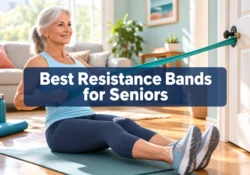
Best Resistance Bands for Seniors: Safe Setups, Progressions, and Buyer’s Guide for Home Strength

Best Resistance Bands for Seniors: Safe Setups, Progressions, and Buyer’s Guide for Home Strength

Last updated: September 6, 2026

Quick Answer

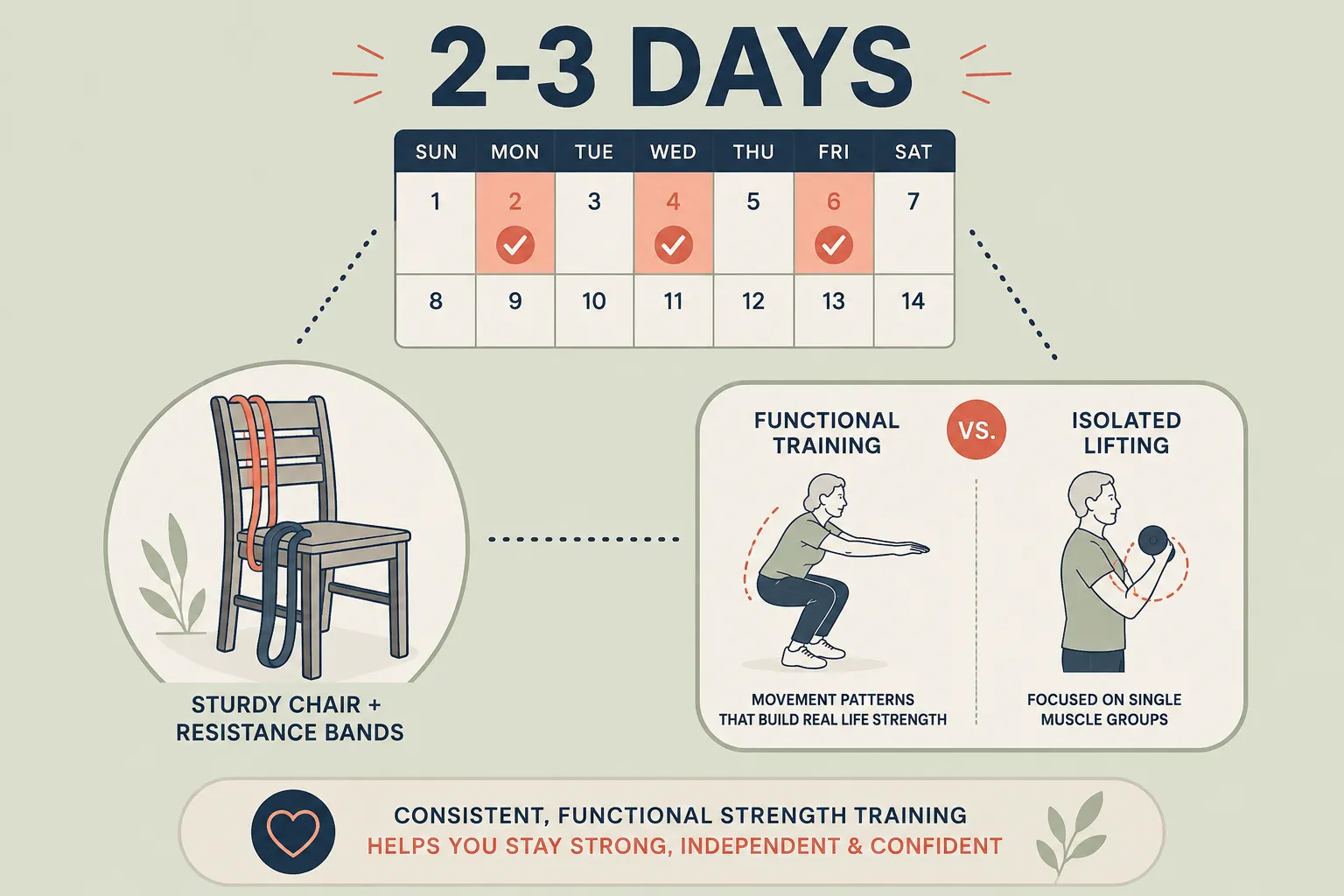
The best resistance bands for seniors are light-to-medium loop bands and tube bands with soft foam handles (typically 5-20 lb of resistance), used 2-3 times per week for 8-12 reps across 1-3 sets. Look for latex-free options if allergies are a concern, secure door anchors, and clearly color-coded tension levels. Bogi Fitness, TheraBand, Bodylastics, and Fit Simplify consistently rank well in 2026 buyer's guides for older adults [1][3][7].

Key Takeaways

  • Start light. Choose a tension you can lift for 15 reps with 3-5 "reps in reserve", if you can't hit 10 clean reps, drop a level.
  • Tube bands with handles are best for pressing and rowing; loop bands are best for hips, glutes, and knees.
  • Latex-free bands (TPE or fabric) suit seniors with latex allergies or sensitive skin.
  • Bands improve strength, balance, gait speed, and fall-related outcomes in older adults when used consistently [1][7].
  • Anchor safely: use a door anchor with the door closing toward you, never a doorknob.
  • Expect to spend $15,$60 for a quality senior-friendly set in 2026 [3][6].
  • Progress slowly, add reps first, then tension, over 4-6 week cycles.
  • Bands are safer than free weights for many seniors because there's no dropped-weight risk.

What Are Resistance Bands and How Do They Work for Seniors?

Resistance bands are elastic tools, loops, tubes, or flat therapy strips, that create tension when stretched, forcing muscles to work through a full range of motion. For seniors, they replace or complement dumbbells by delivering progressive resistance without heavy loads on joints [4].

The tension increases as the band stretches, which means the hardest point of the movement usually matches where the muscle is strongest. That's joint-friendly, especially for arthritic knees, shoulders, and hips.

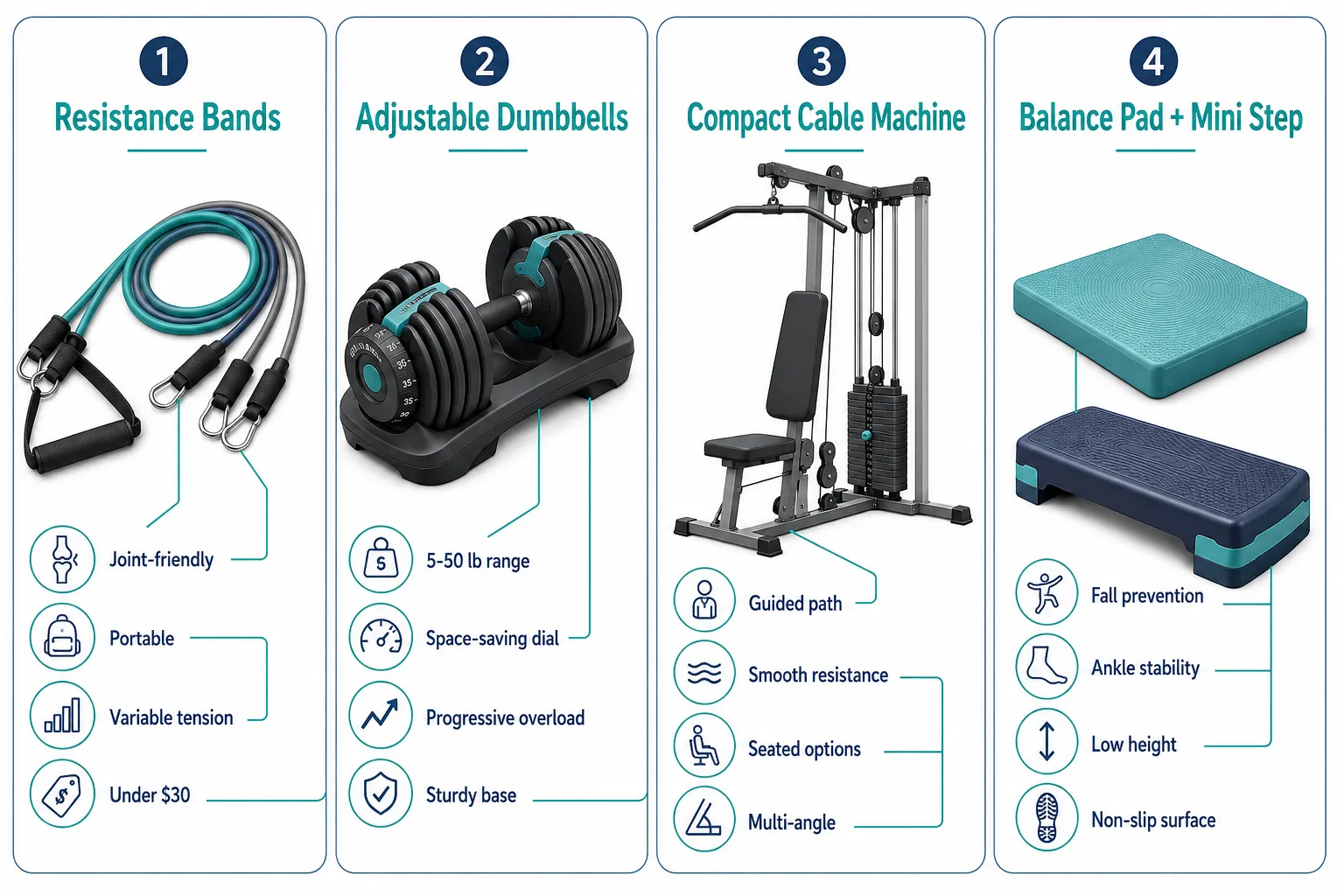
Three main types you'll see:

  • Loop bands, closed circles, great for lower-body and glute work
  • Tube bands with handles, best for upper-body pushing, pulling, and pressing
  • Therapy flat bands, thin sheets (like TheraBand) used in physical therapy and rehab
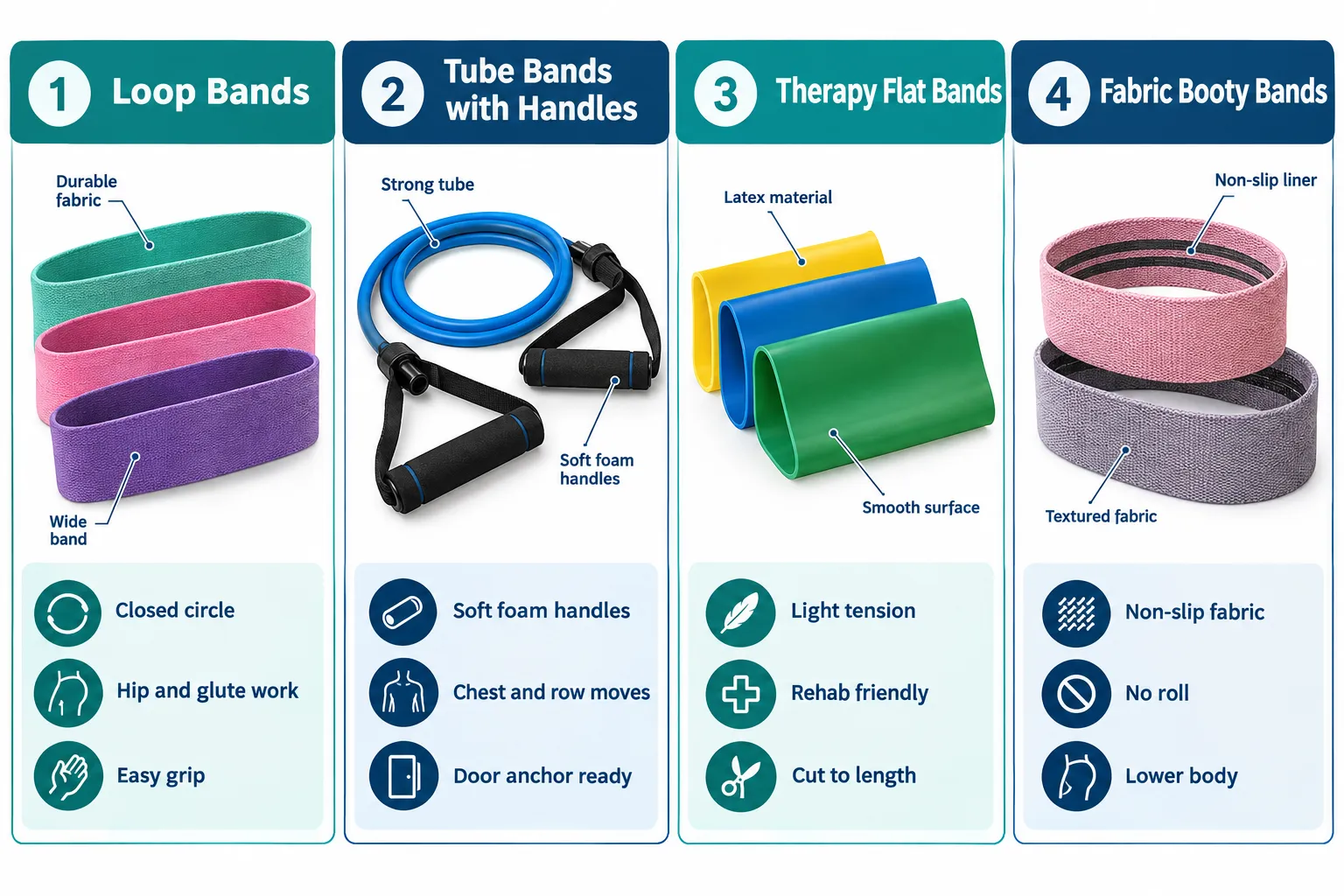
What Are Resistance Bands and How Do They Work for Seniors?

Are Resistance Bands Safe for Older Adults with Arthritis?

Yes, resistance bands are generally one of the safest strength-training tools for arthritic seniors because they load muscles without joint impact and let you control tension moment-by-moment. Physical therapists routinely prescribe them for hip, knee, and shoulder osteoarthritis.

Three reasons they work well with arthritis:

  1. No dropped-weight risk. A band can't fall on your foot.
  2. Variable tension. You can shorten your grip or step closer to the anchor to reduce load on a flare-up day.
  3. Smooth resistance curve. No sudden loading spikes on inflamed joints.

Decision rule: If a movement causes sharp joint pain (not muscle fatigue), stop and reduce tension by 30-50%. Dull muscle burn is fine, sharp joint pain is not.

Common mistake: Using too much tension too fast because bands "feel light." The eccentric (returning) phase is where seniors most often overstretch a joint.

Best Resistance Bands for Seniors with Limited Mobility

For seniors with limited mobility, soft-handle tube bands with light tension (5-15 lb) and fabric loop bands are the top picks. They allow seated exercise, require minimal grip strength, and don't demand standing balance.

Top picks for limited-mobility users in 2026:

  • TheraBand CLX / Loop bands, clinical standard, color-coded, latex and latex-free versions [3]
  • Bogi Fitness Tube Set, foam handles reduce grip strain, comes with door anchor [7]
  • Fit Simplify Loop Bands, inexpensive fabric loops, easy to slip on while seated [1][6]
  • Bodylastics Snap-Guard Tubes, internal safety cord prevents snap-back injuries [3][7]

Look for chair-friendly length (48 inches or more for tube bands) and soft neoprene handles rather than hard plastic.

How to Use Resistance Bands Safely for Seniors: Step by Step

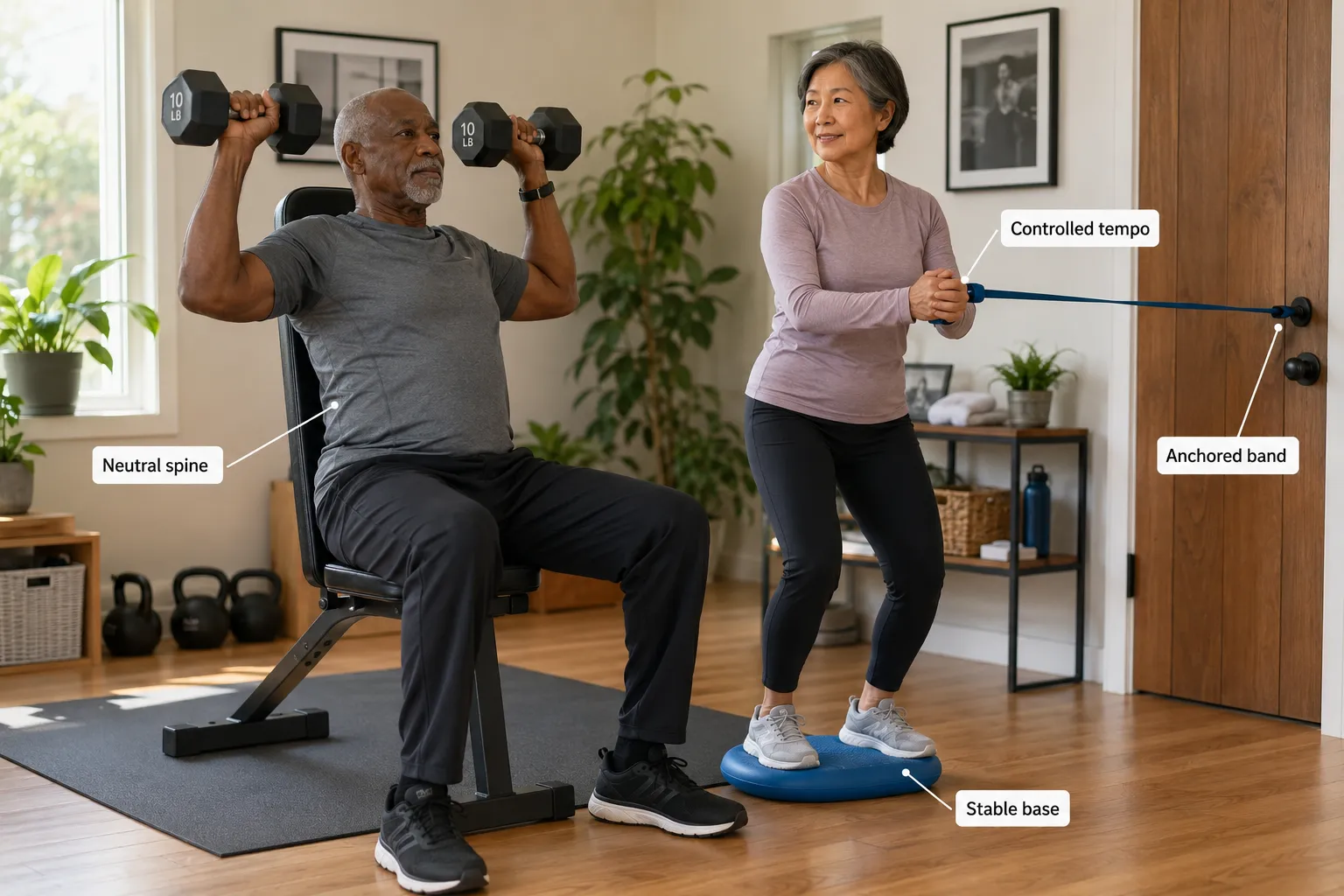
Safe use comes down to five habits: inspect, anchor, align, tempo, and reserve.
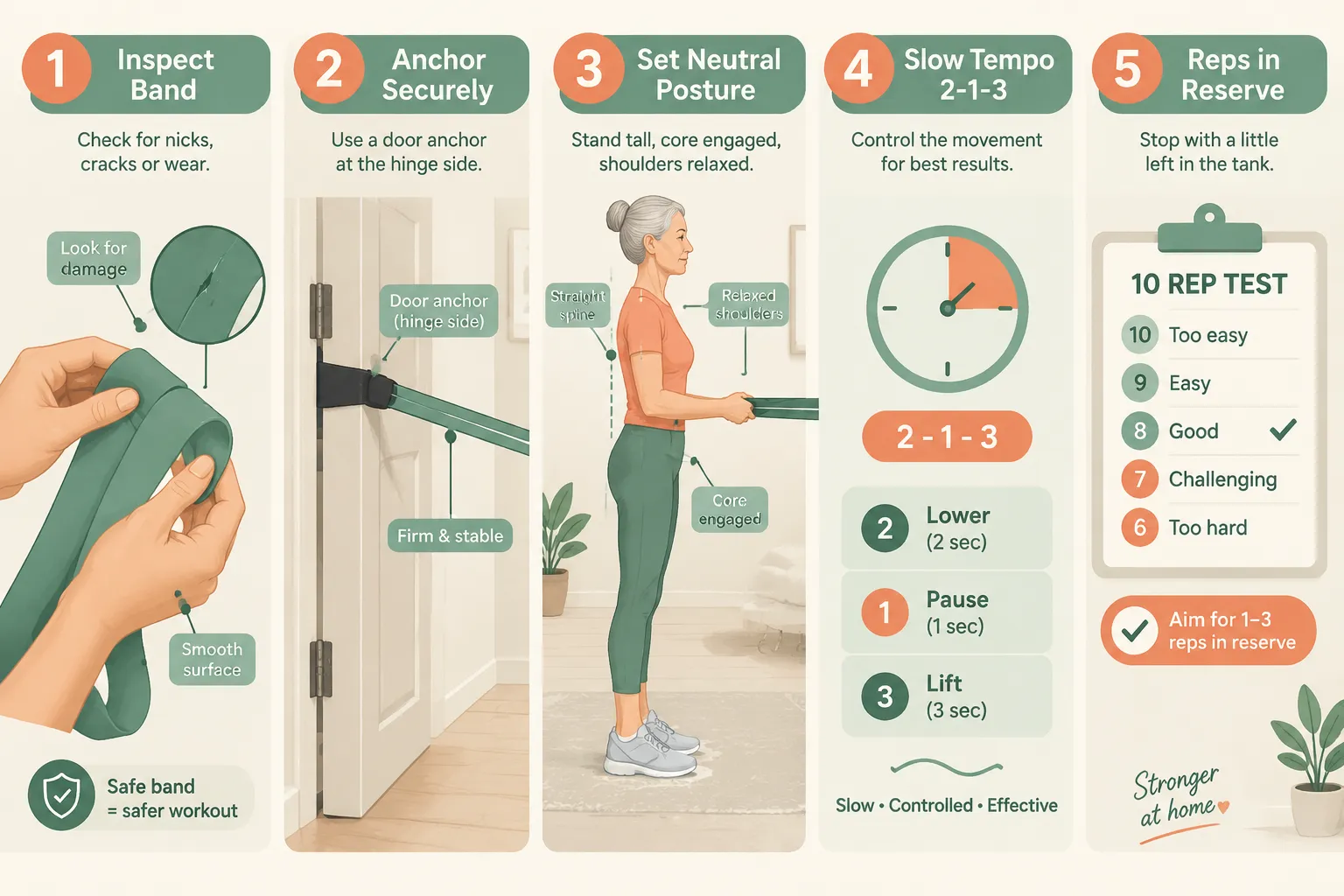
How to Use Resistance Bands Safely for Seniors: Step by Step

Step-by-step safe setup:

  1. Inspect the band for nicks, tears, or dry patches every session. Replace latex bands every 6-12 months with regular use [4].
  2. Anchor securely. Use a proper door anchor placed on the hinge side, with the door closing toward you. Never tie to a doorknob or furniture leg.
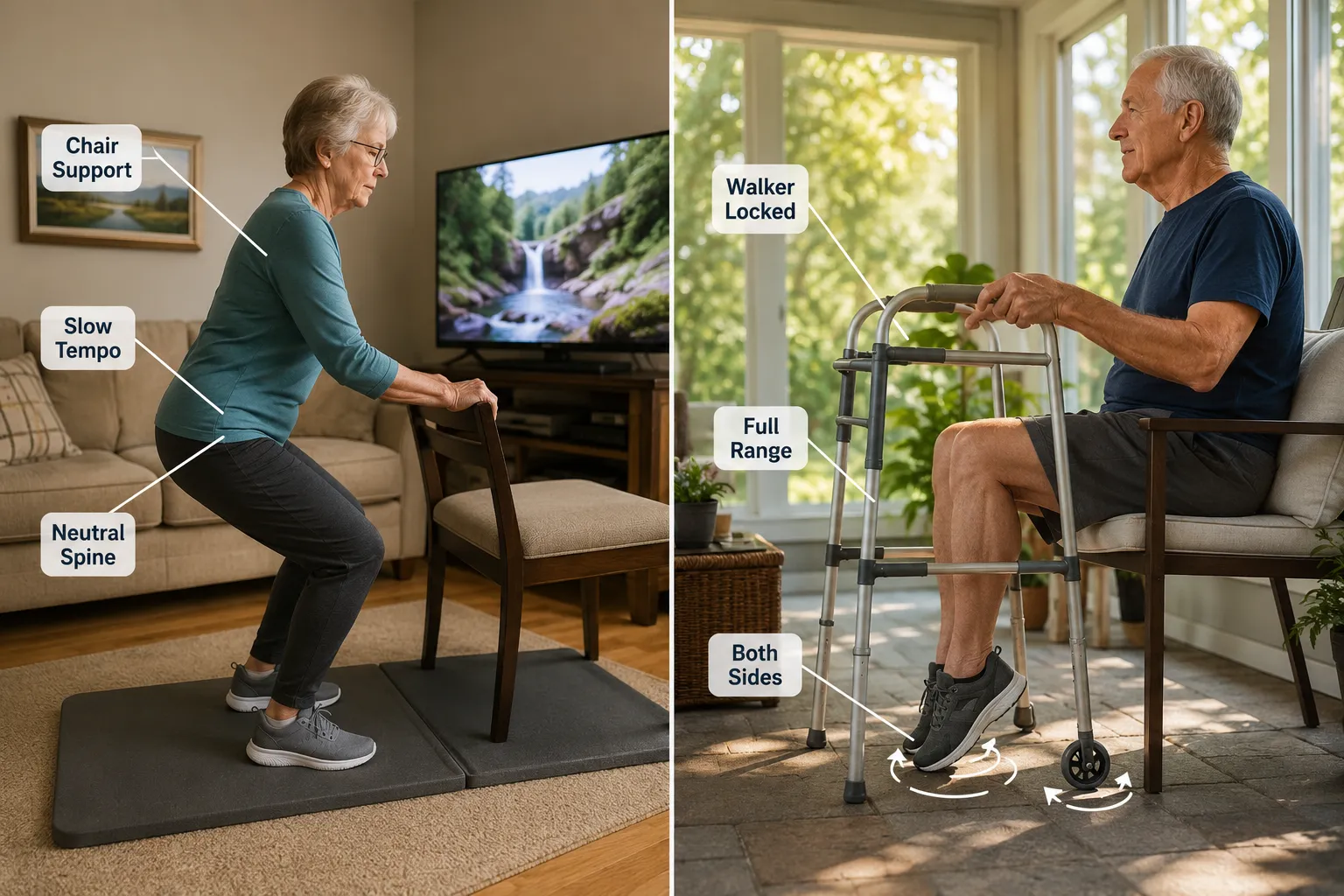
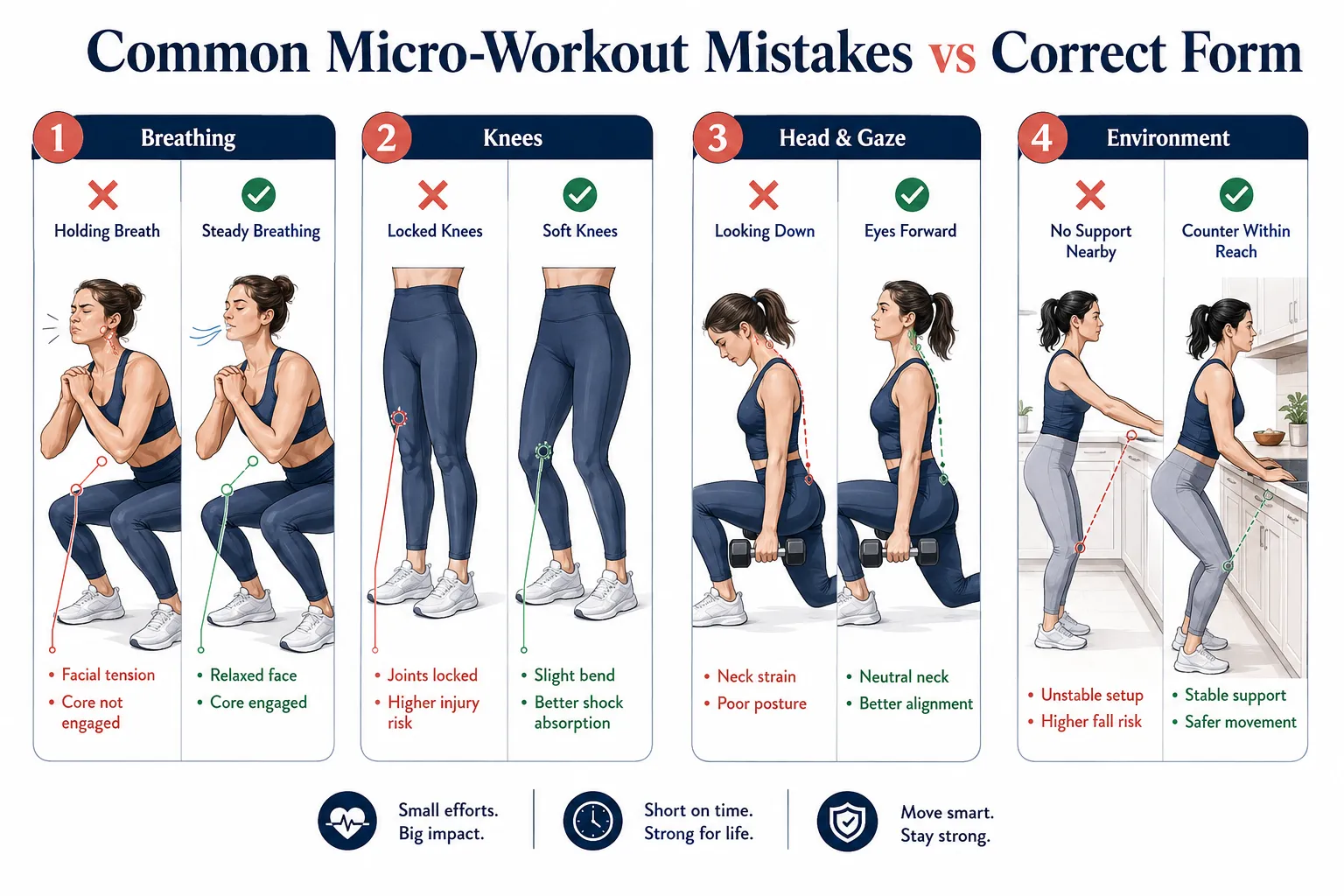
  3. Set neutral posture. Feet hip-width, knees soft, spine tall, ribs down. Sit if standing balance is a concern.
  4. Control the tempo. Aim for a 2-second lift, 1-second pause, 3-second return. The slow return is where strength (and safety) is built.
  5. Leave reps in reserve. Stop each set 2-3 reps before failure. Grinding out final reps is where form breaks down.

Eye safety note: Always keep your face out of the band's snap-back path. Wear glasses when anchoring overhead.

Resistance Bands vs Weights for Seniors: Which Is Better?

For most seniors, resistance bands are the safer starting point, while dumbbells become useful once baseline strength and confidence are built. Neither is universally better, they serve different goals.

Factor Resistance Bands Dumbbells
Joint impact Very low Moderate
Dropped-weight risk None Real
Portability Excellent Poor
Cost for full range $15,$60 $150,$400
Precise load tracking Harder Easy
Best for Rehab, mobility, travel Progressive overload past ~20 lb

Choose bands if: You have arthritis, limited space, live alone, are recovering from surgery, or are new to strength training.

Choose weights if: You've been training 6+ months, want to build maximal strength, and have stable balance.

Most seniors do best with both, bands for daily maintenance and dumbbells 1-2x per week for progressive loading.

How Much Do Quality Resistance Bands for Seniors Cost?

Expect to pay $15,$60 for a complete senior-friendly set in 2026. Individual bands run $5,$15. Premium kits with door anchors, ankle straps, and carry bags top out around $80 [3][6].

What you're paying for at each tier:

  • Under $20: Basic fabric loops or single tubes. Fine for light rehab; may lack anchors.
  • $20,$40: Complete stackable tube sets with handles, door anchor, ankle straps, the sweet spot for most seniors [1][7].
  • $40,$80: Premium brands (Bodylastics, TheraBand) with safety cords, latex-free options, and higher durability.

Avoid ultra-cheap sets under $10, the handles often detach, and the tension is inconsistent between bands.

Resistance Band Exercises for Seniors to Build Strength

A well-rounded senior program covers six movement patterns: squat, hinge, push, pull, carry, and rotation. Bands can train all six.

Core senior exercise list (2-3 sets, 8-12 reps each):

  • Seated row (tube band, anchored low), upper back, posture
  • Chest press (tube band, anchored behind you), chest, shoulders
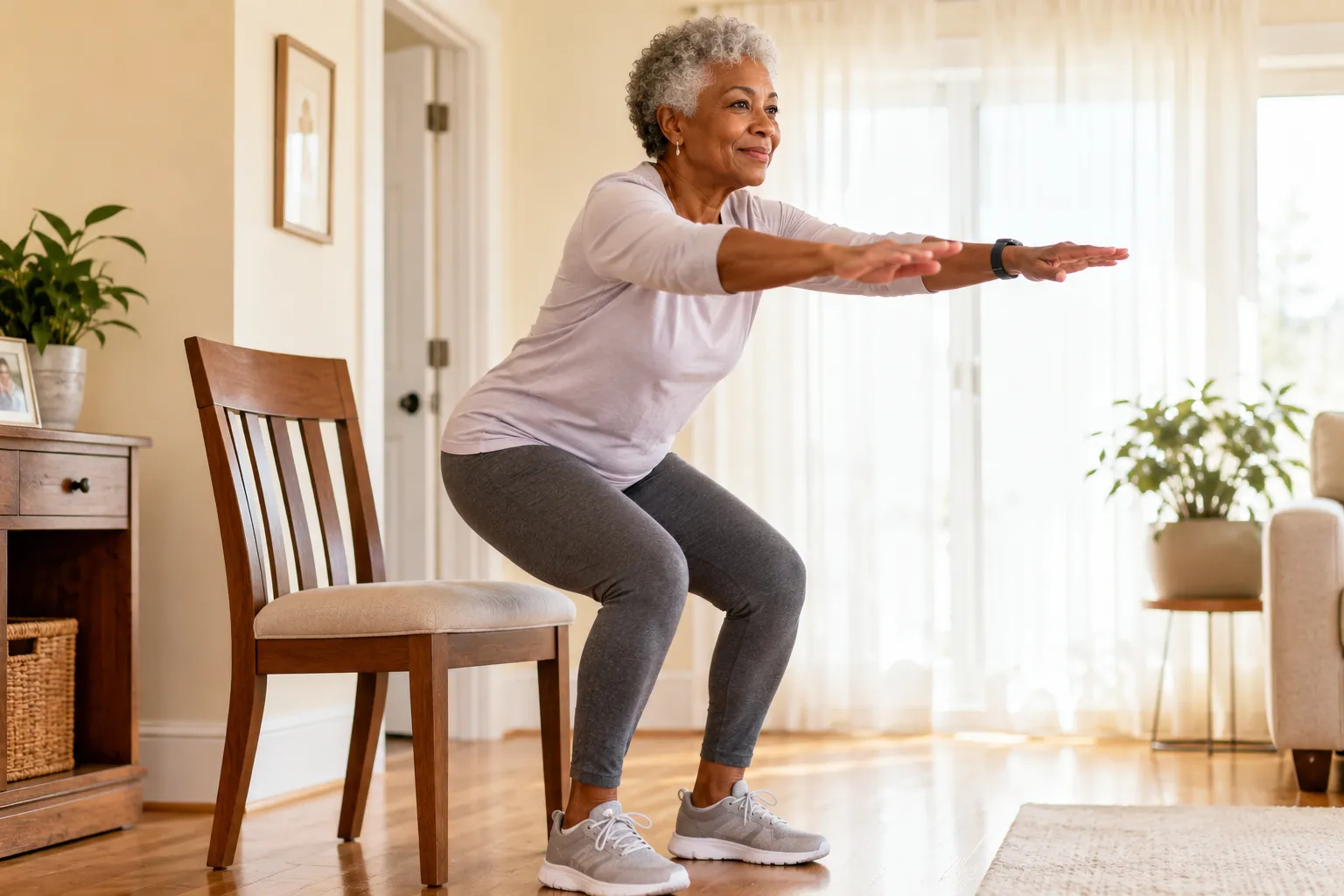
  • Banded sit-to-stand (loop above knees), glutes, quads, functional lower body
  • Standing hip abduction (loop at ankles), hip stability, fall prevention
  • Overhead pull-apart (light band between hands), shoulder health, posture
  • Banded good morning (loop under feet, over shoulders), hamstrings, hips
  • Farmer's carry substitute, hold band handles at sides, walk in place for 30 seconds
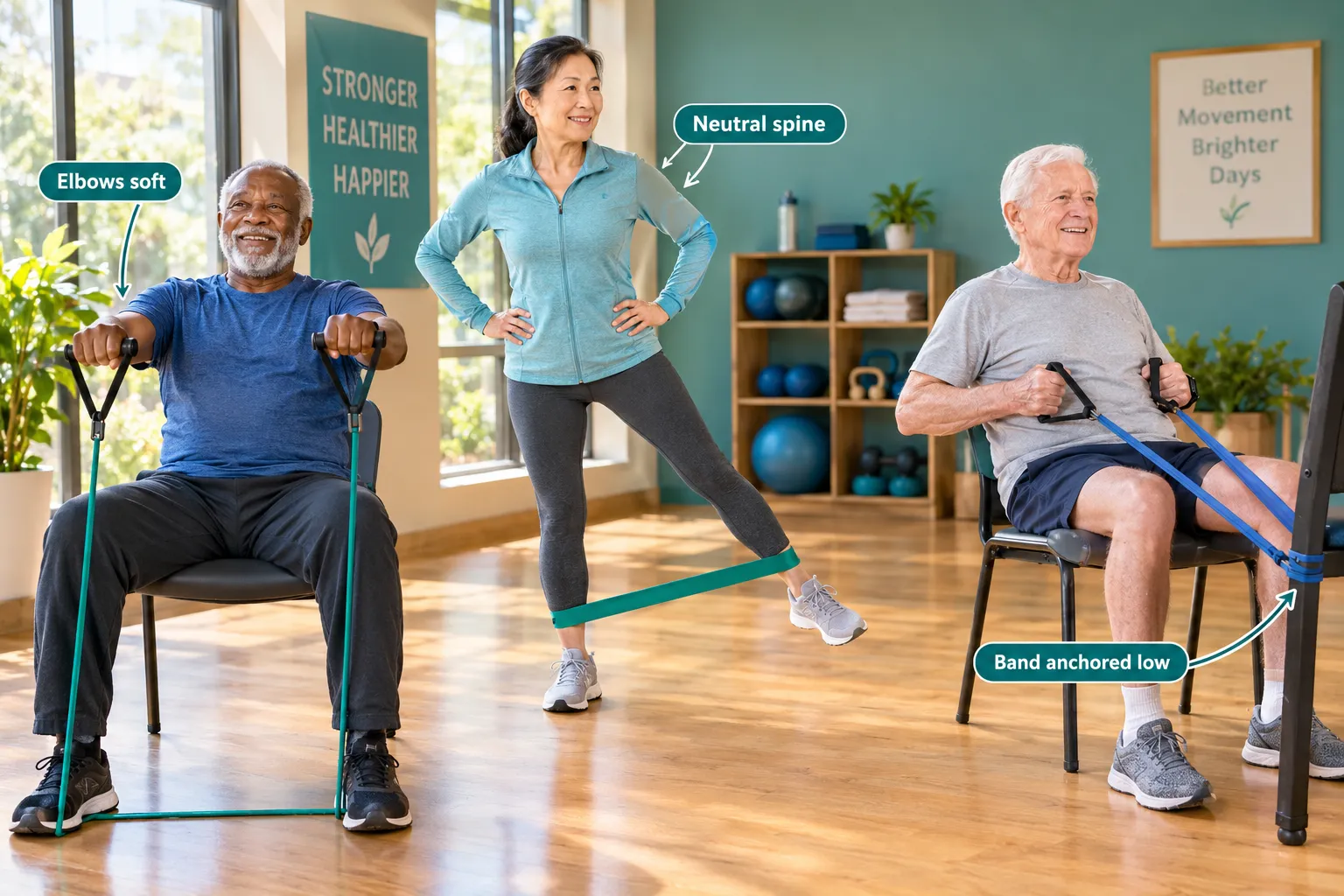
Resistance Band Exercises for Seniors to Build Strength

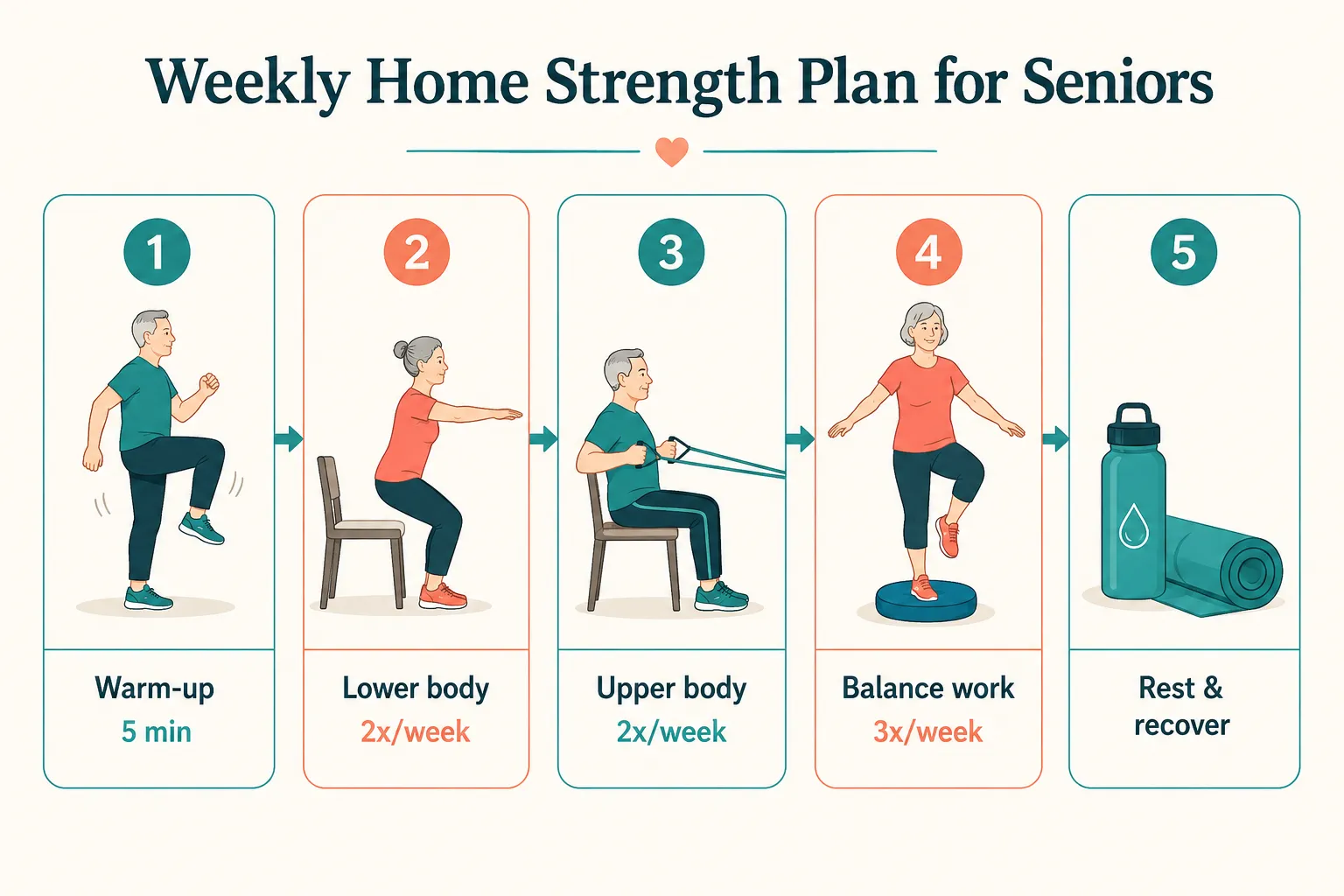
Weekly template: 2-3 sessions, 30-40 minutes each, with at least one rest day between. Add balance work (single-leg stands) between sets.

Can Seniors Use Resistance Bands After Surgery or Injury?

Yes, but only with medical clearance and typically starting with the lightest tension available (often yellow or peach in most color systems). Bands are so common in post-surgical rehab, knee replacements, rotator cuff repair, hip surgery, that many hospitals send patients home with them [4].

Guidelines for post-op band use:

  • Get written clearance from your surgeon or PT before starting
  • Begin with isometric holds (no movement, just tension) for 1-2 weeks
  • Progress to full range of motion only when pain-free
  • Follow your PT's specific protocol, don't self-prescribe

Red-flag conditions where you should not train with bands without clinical supervision: uncontrolled hypertension, recent cardiac event, active hernia, severe osteoporosis with recent fracture, retinal detachment risk, or acute joint inflammation.

Light Resistance Bands for Beginners vs Medium Resistance

Beginners should almost always start with light bands (typically 5-10 lb equivalent) for the first 2-4 weeks, then graduate to medium (10-20 lb) once form is dialed in and 12 reps feel easy.

Color-code reference (varies by brand, but common):

  • Yellow / peach: Extra light (2-5 lb)
  • Red / pink: Light (5-10 lb)
  • Green: Medium (10-15 lb)
  • Blue: Heavy (15-20 lb)
  • Black / purple: Extra heavy (20-30+ lb)

The 10-rep test: Do a set of the exercise with a given band. If you can't hit 10 clean reps, the band is too heavy. If you could do more than 20, it's too light.

Resistance Band Set Brands Recommended for Older Adults

The most consistently recommended brands for seniors across 2026 buyer's guides:

  • TheraBand, clinical gold standard, used in PT clinics worldwide [3]
  • Bodylastics, internal safety cord, stackable tension, senior-friendly handles [3][7]
  • Fit Simplify, affordable fabric loops, widely reviewed and durable [1][6]
  • Bogi Fitness, foam-handled tube sets popular with older users [7]
  • TRX, premium option for those wanting suspension-plus-band flexibility [3]
  • Rogue Monster Bands, heavy-duty, best once you've progressed past starter tension [3]

Buyer's checklist:

  1. Color-coded tension levels
  2. Door anchor included
  3. Latex-free option available
  4. Foam or fabric handles (not hard plastic)
  5. Snap-guard or safety cord for tube bands
  6. Written warranty (6 months minimum)

How to Progress Resistance Band Workouts for Seniors Over Time

Progress bands using the "reps first, tension second" rule across 4-6 week cycles. Add one rep per set each week until you hit the top of your range, then jump to the next band color and drop back to the bottom of the range.

A simple 12-week progression:

Weeks Sets × Reps Tension Focus
1-2 1 × 8 Light Form, range of motion
3-4 2 × 10 Light Volume
5-6 2 × 12 Light, Medium Tension bump
7-8 3 × 10 Medium Volume + tension
9-10 3 × 12 Medium Capacity
11-12 3 × 8 Medium, Heavy New tension baseline

Progression rule of thumb: If you can do 12 clean reps with 3 reps in reserve, it's time to bump tension.

Resistance Bands for Seniors with Weak Grip Strength

For seniors with weak grip, fabric loop bands, wrist-cuff attachments, and thick foam-handled tubes eliminate the grip bottleneck. Grip weakness shouldn't limit strength training for the rest of the body.

Grip-friendly solutions:

  • Fabric loop bands, slip over wrists or ankles, no gripping required
  • Ankle/wrist cuff attachments, Velcro straps that clip to tube-band carabiners
  • Thick foam handles, reduce hand fatigue vs. thin rubber grips
  • Figure-8 bands, natural handle shape that cradles the palm

Simple grip training also helps: squeeze a soft ball for 10-15 seconds, 3 sets, daily.

Do Resistance Bands Really Work for Building Muscle in Seniors?

Yes, resistance bands can produce measurable gains in strength, muscle size, functional capacity, and gait speed in older adults when used with sufficient tension and consistency [1][7]. Multiple 2026 buyer's guides reference clinical literature showing band-only training improves lower-limb strength, balance, and reduces frailty markers in seniors.

The catch: you have to push the tension. Doing 30 reps with a band that offers no challenge doesn't build muscle. Aim for that 8-12 rep range with 2-3 reps in reserve.

Realistic expectations at 3-6 months of consistent training:

  • Sit-to-stand: 25-50% more repetitions in 30 seconds
  • Grip strength: 5-15% improvement
  • Gait speed: measurable improvement in a 6-minute walk test
  • Fall confidence: meaningful subjective improvement

Common Mistakes Seniors Make with Resistance Band Training

The five most common band mistakes among older adults:

  1. Anchoring to a doorknob. It can slip off. Always use a proper door anchor.
  2. Skipping the eccentric. Snapping the band back on the return phase wastes 50% of the training effect and stresses joints.
  3. Starting too heavy. Ego-lifting with bands still causes shoulder and elbow strain.
  4. Ignoring band wear. A frayed band can snap mid-rep. Inspect before every session.
  5. Doing the same routine forever. Progression stops without new tension or new exercises.

Bonus mistake: Training in socks on slick floors. Wear grippy shoes or train barefoot on a mat.

FAQ

How often should seniors use resistance bands?
Two to three sessions per week, with at least one rest day between sessions. Sessions of 20-40 minutes are plenty [7].

Can I do resistance band exercises seated?
Yes, nearly every upper-body movement (rows, presses, curls, pull-aparts) can be done seated. Many hip and knee movements can too.

What's the difference between latex and TPE bands?
Latex bands are more durable and elastic; TPE (thermoplastic elastomer) bands are latex-free, better for allergies, but wear out faster.

How long do resistance bands last?
With regular use, 6-12 months for latex bands and 4-8 months for TPE. Inspect for cracks weekly [4].

Do I need a door anchor?
For tube bands with handles, yes, it unlocks 80% of the exercise library. Loop bands often don't need one.

Are resistance bands enough on their own for seniors?
For most older adults starting out, yes. Advanced trainees may add dumbbells for heavier lower-body work.

What tension should a 70-year-old woman start with?
Typically light (5-10 lb / red or pink) for upper body and light-to-medium (10-15 lb / green) for lower body, but adjust to the 10-rep test.

Can resistance bands help with osteoporosis?
They can support bone-loading through muscle pull, but heavier loading (weights, weight-bearing exercise) is more effective for bone density. Talk to a doctor about a combined plan.

Are fabric bands better than rubber for seniors?
For lower-body loop work, fabric bands don't roll or pinch skin, many seniors prefer them. For upper-body, rubber tubes with handles remain the standard.

What should I do if a band snaps during exercise?
Stop immediately, check for injury (especially eyes and face), and discard the band. Never repair with tape.

Conclusion

The best resistance bands for seniors combine light-to-medium tension, soft handles, secure anchoring, and clear progression rules. Start with a reputable set from brands like TheraBand, Bodylastics, Fit Simplify, or Bogi Fitness, budget $20,$40 for a complete kit, and commit to 2-3 sessions per week using the 10-rep test to guide your tension choices [1][3][7].

Your next steps:

  1. Order a color-coded set with a door anchor and latex-free option if needed
  2. Schedule three 30-minute sessions this week
  3. Start with 1 set of 8 reps per exercise, light tension
  4. Track your reps weekly and progress in 4-week cycles
  5. Add a balance move between every set

Consistency beats intensity every time. A senior who trains twice a week for a year will out-perform one who trains hard for three weeks and quits.

References

[1] Best Resistance Bands – https://www.nytimes.com/wirecutter/reviews/best-resistance-bands/
[2] Best Resistance Bands – https://www.womanandhome.com/health-wellbeing/best-resistance-bands/
[3] Best Resistance Bands – https://www.garagegymreviews.com/best-resistance-bands
[4] Resistance Bands Review – https://fitnessvolt.com/resistance-bands-review/
[5] Best Resistance Bands – https://homegymverdict.com/best/best-resistance-bands/
[6] Best Resistance Bands – https://www.womenshealthmag.com/fitness/g25418209/best-resistance-bands/
[7] Best Resistance Bands 2026 Tested Ranked – https://bodymotionlab.com/blog/best-resistance-bands-2026-tested-ranked
[8] Best Resistance Bands Workout Sets Home Training 2026 – https://www.theconsumers.guide/reviews/best-resistance-bands-workout-sets-home-training-2026
[9] Best Resistance Bands Exercise B2024776 – https://www.independent.co.uk/extras/indybest/outdoor-activity/sports-equipment-accessories/best-resistance-bands-exercise-b2024776.html
[10] Best Resistance Bands A1034688665 – https://www.consumerreports.org/health/resistance-bands/best-resistance-bands-a1034688665/
Using Wearables and Mobile Fitness Apps to Personalize Senior Strength and Mobility Training

Using Wearables and Mobile Fitness Apps to Personalize Senior Strength and Mobility Training

{"cover":"Professional landscape format (1536×1024) editorial hero image with bold text overlay 'Using Wearables and Mobile Fitness Apps' in crisp white sans-serif on a semi-transparent teal overlay panel, centered with 10% safe margins from every edge, no character touches the edge. Background: bright natural-daylight photograph of an active silver-haired woman in her late 60s doing a controlled resistance band squat in a sunlit living room, an Apple Watch-style smartwatch clearly visible on her wrist, a tablet propped on a chair showing a colorful workout progress ring, warm hardwood floors, soft window light, magazine-cover polish, teal-and-coral accent palette. No pricing, no numbers rendered as text.","content":["Four-panel labelled comparison guide (1536×1024) titled 'Wearable Options for Seniors': Panel 1 'Basic Fitness Tracker' with a slim wristband illustration and labels 'Steps', 'Heart rate', 'Sleep', 'Long battery'; Panel 2 'Smartwatch' with a square-face watch illustration and labels 'ECG', 'Fall detection', 'Apps', 'GPS'; Panel 3 'Medical Alert Wearable' with a pendant illustration and labels 'SOS button', 'Auto-fall alert', '24/7 monitoring'; Panel 4 'Smart Ring' with a ring illustration and labels 'HRV', 'Recovery', 'Discreet wear'. Clean white background, thin teal callout lines, navy typography, editorial medical-guide polish, 5% safe margins.","Annotated documentary photograph (1536×1024) of a diverse 70-year-old Black man performing a seated resistance band row in a bright home living room, smartwatch on left wrist, smartphone on side table showing a workout app with a heart rate zone graph, four small floating callout labels with thin lines pointing to elements: 'Zone 2 heart rate', 'Rep counter', 'Form reminder', 'Rest timer'. Natural window light, shallow depth of field, warm neutral palette, editorial fitness magazine quality, labels short and inside a 5% safe margin.","Numbered five-step process flow illustration (1536×1024) titled 'Personalize Your Training Loop': Step 1 'Baseline Assessment' with a clipboard icon; Step 2 'Set Goals in App' with a target icon; Step 3 'Wearable Tracks Session' with a smartwatch icon; Step 4 'App Adjusts Intensity' with a dial icon; Step 5 'Weekly Progress Review' with a chart icon. Curved arrow connecting each step, soft coral-and-teal gradient background, flat vector style, short label per step, clean sans-serif typography, editorial infographic polish, 5% safe margins."}

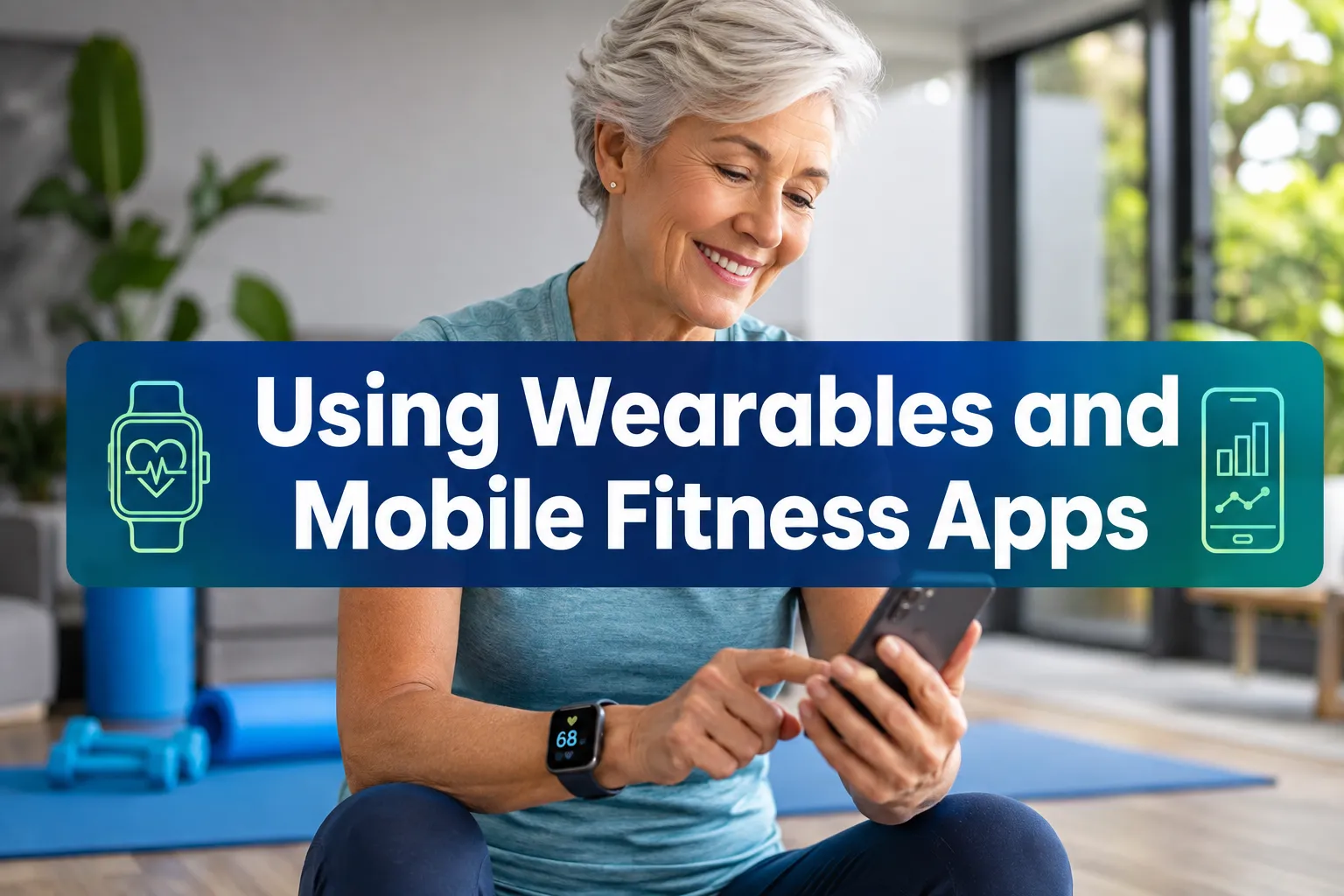
Professional landscape hero image () with a reading "Using Wearables and Mobile Fitness Apps". CRITICAL TYPOGRAPHY RULES:

Last updated: September 5, 2026

Quick Answer

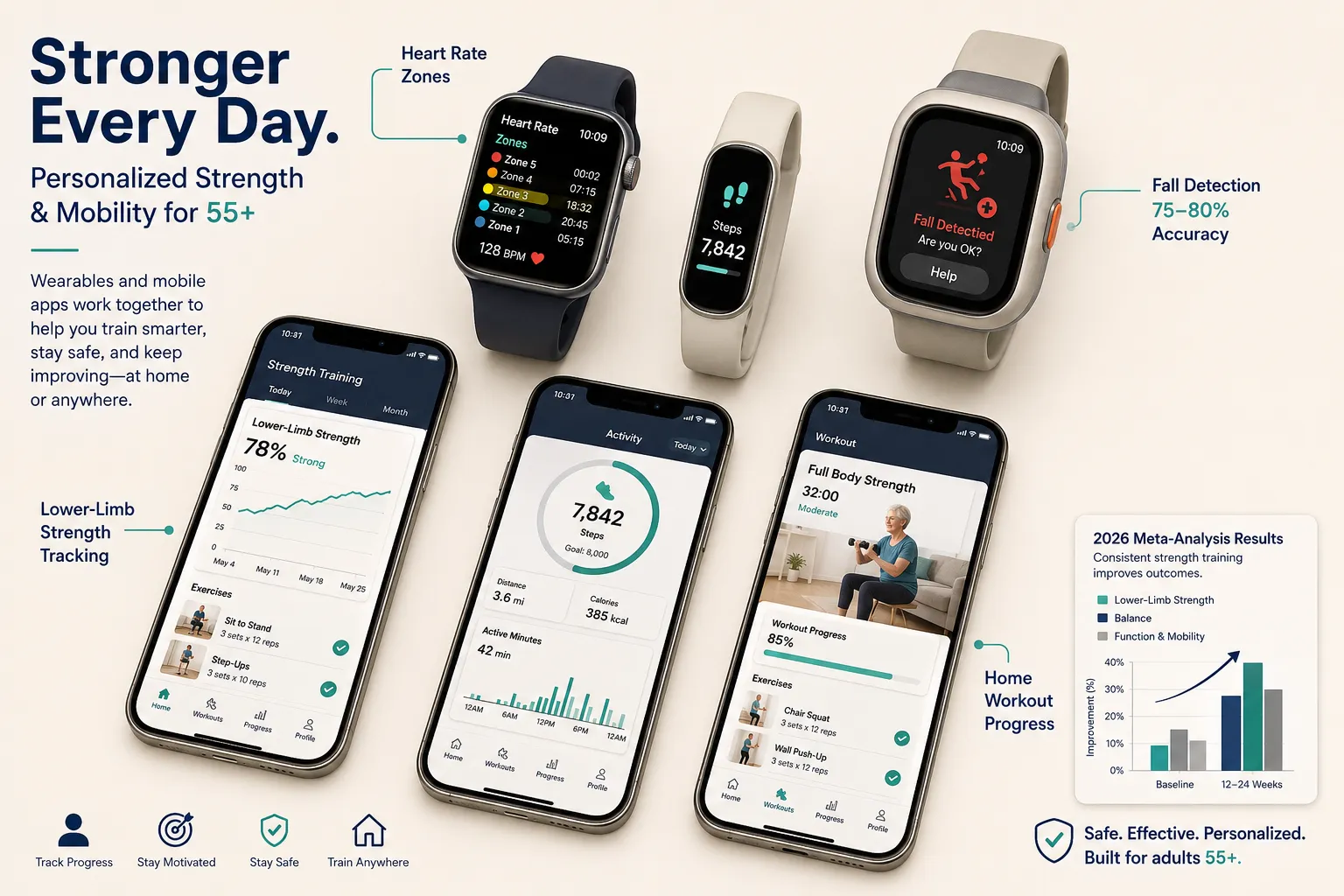
Adults 55+ can use wearables (smartwatches, fitness trackers, medical-alert devices) alongside mobile fitness apps to set safe intensity, track strength and mobility gains, and progress workouts at home. A 2026 meta-analysis in older adults found that wearable-guided exercise produced meaningful improvements in lower-limb strength and balance, and a 2026 clinical trial showed smart strength devices substantially increased knee-extensor strength in frail seniors [1][3]. The best setup pairs one comfortable wearable that tracks heart rate and movement with one app that delivers structured strength, balance, and mobility routines.

Key Takeaways

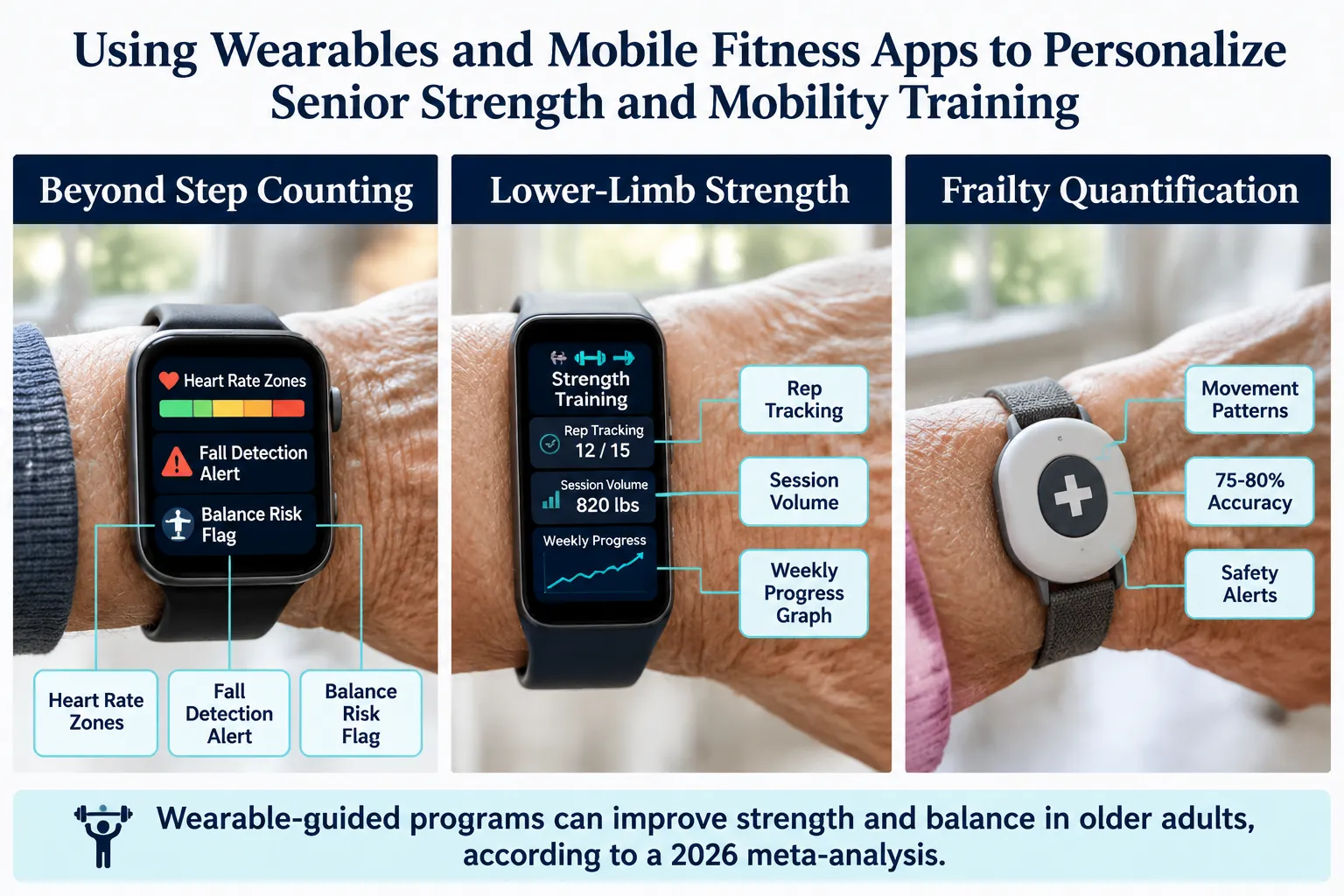
  • Wearables now do more than count steps, they measure heart rate zones, detect falls, quantify frailty, and flag balance risk with 75-80% accuracy [8].
  • A 2026 meta-analysis confirmed wearable-guided programs significantly improve lower-limb strength and balance in older adults [1].
  • Smart strength devices paired with apps notably raised knee-extensor strength in frail seniors in a 2026 trial [3].
  • Free apps can work well; you rarely need to pay more than $10,$15 a month for a quality senior-focused program.
  • Zone 2 heart rate (roughly 60-70% of max) is a safe, effective target for most strength and mobility sessions.
  • Most seniors with pacemakers can use wearables safely, but should keep the device 6+ inches from the pacemaker and confirm with a cardiologist.
  • Wearables help arthritis sufferers pace effort, but silicone bands and larger touchscreens matter more than raw specs.
  • Apps do not fully replace a trainer or physical therapist for complex conditions, but they extend and reinforce professional guidance.

What wearables are best for tracking senior fitness and mobility?

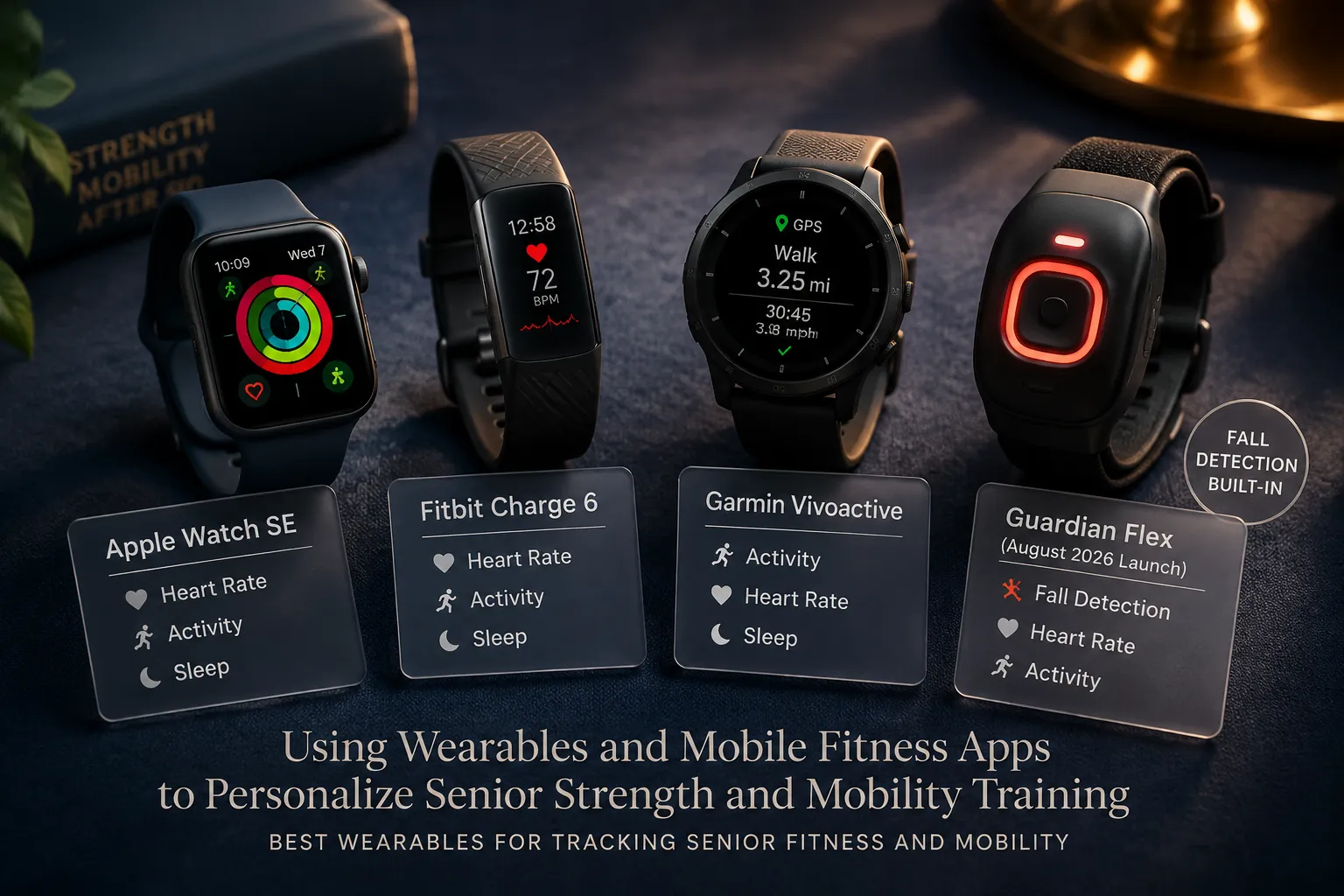
The best wearables for seniors are ones that balance accuracy, ease of use, and comfort. For most adults 55+, an Apple Watch SE, Fitbit Charge 6, Garmin Vivoactive, or a medical-alert hybrid like the Guardian Flex (launched August 2026) covers the essentials: heart rate, activity, sleep, and fall detection [2].

What wearables are best for tracking senior fitness and mobility?

)

Pick based on the primary goal:

  • Strength and mobility training focus: Apple Watch SE or Fitbit Charge 6. Both track heart rate zones during resistance work and integrate cleanly with dozens of apps.
  • Fall safety plus activity: Apple Watch (built-in fall detection), Guardian Flex, or a medical-alert pendant with activity tracking [2][5].
  • Simple daily wear, long battery: Fitbit Inspire 3 or Garmin Vivosmart, 7-10 day battery, minimal buttons.
  • Discreet all-day tracking: Oura Ring or Ultrahuman Ring, good for seniors who dislike wristbands.

Wearable sensors can now quantify frailty and fall risk with 75-80% accuracy, and classify slip/trip events with over 98% accuracy, which is why they're moving into structured senior training programs [8].

Decision rule: If falls are a real concern, choose a device with automatic fall detection. If strength progression is the goal, choose one with reliable continuous heart rate and third-party app support.

How do fitness apps personalize workouts for older adults?

Modern senior fitness apps personalize by pulling wearable data (heart rate, movement patterns, recovery) and combining it with user inputs (age, conditions, goals, session feedback) to adjust the next workout automatically. This is the shift from tracking to adaptive coaching.

Typical personalization inputs:

  1. Baseline questionnaire, mobility limits, joint pain, medications, prior injuries.
  2. Wearable-derived data, resting heart rate, HRV, activity level, sleep.
  3. In-workout feedback, perceived effort ratings, completed reps, skipped exercises.
  4. Progression rules, the app raises resistance, reps, or complexity when heart rate response drops or perceived effort falls.

Apps like SilverSneakers GO, Bold, Mighty Health, and Nymbl use this loop to serve strength, balance, and mobility routines tuned to the individual. Evidence-based resistance band protocols can also be embedded into apps and paired with a wearable for real-time monitoring [4][7].

Can smartwatches help seniors with strength training?

Yes. Smartwatches help seniors train strength safely by tracking heart rate response between sets, timing rest, counting reps in some apps, and logging session volume over weeks. The 2026 meta-analysis found wearable-guided exercise produced significant improvements in lower-limb strength in older adults [1].

)

What a smartwatch actually adds to strength work:

  • Rest timing: Vibration alerts prevent rushing between sets, 60-90 seconds is ideal for most senior programs.
  • Heart rate ceiling: Warns you if effort spikes too high.
  • Session logging: Weekly and monthly views show consistency, which predicts strength gains better than any single workout.
  • Form cues (in some apps): Sensor-based apps can flag when tempo is off or a rep is incomplete.

Common mistake: Relying on the watch's "calories burned" number for strength work. It's inaccurate for resistance training. Focus on heart rate zones and completed sessions instead.

What's the difference between fitness trackers and smartwatches for seniors?

A fitness tracker is a slim wristband focused on activity, heart rate, and sleep, usually with a small display and 5-10 day battery. A smartwatch is a fuller computer on the wrist, apps, ECG, fall detection, notifications, GPS, and typically 1-2 day battery.

Feature Fitness Tracker Smartwatch
Battery life 5-10 days 1-2 days
Screen size Small Large, touchscreen
Fall detection Rare Common (Apple, Samsung)
ECG / blood oxygen Some Most
Third-party apps Limited Extensive
Price range Lower Higher
Ease for arthritis Very easy Larger touch targets help

Choose a tracker if: the senior wants simplicity, long battery, and just the basics.
Choose a smartwatch if: fall detection, ECG, or app-guided workouts matter.

How much do senior fitness apps cost, and what are the best free options?

Most quality senior fitness apps cost between $0 and $15 per month. Many excellent programs are free, especially those bundled with Medicare Advantage plans or wearable ecosystems.

How much do senior fitness apps cost, and what are the best free options?

Best free options for seniors:

  • SilverSneakers GO, free with many Medicare Advantage plans; strength, cardio, and balance routines built for older adults.
  • Nymbl, free in many U.S. states through public health partnerships; focused on fall prevention and balance.
  • Apple Fitness (limited free tier) and Fitbit basic app, free workouts, guided breathing, and activity tracking.
  • YouTube channels (Bob & Brad, HASfit Senior), free structured strength and mobility routines.
  • MyGuardian companion app, free with a Guardian medical alert device, includes activity and check-in features [10].

Paid but worth it: Bold ($10-15/mo), Mighty Health (~$25/mo with coaching), Apple Fitness+ ($9.99/mo).

Decision rule: Start free for 30 days. Only pay if you need live coaching, condition-specific programs (Parkinson's, post-stroke), or richer progression tracking.

Why isn't my fitness app tracking my movements accurately?

Fitness apps typically miscount senior workouts for four reasons: the wearable is worn too loose, the workout mode isn't selected, the movement is too slow for the sensor's algorithm, or strength work doesn't produce the wrist motion the app expects.

Fixes that work:

  1. Tighten the band, one finger-width of slack, not two. Loose wrists produce ghost data.
  2. Select the right mode, "Strength Training," "Yoga," or "Other" before starting. Auto-detection misses slow, controlled movements.
  3. Log resistance work manually, most wearables underreport seated or band-based strength. Use the app's rep logger.
  4. Update firmware, algorithm improvements happen quarterly.
  5. Wear on the non-dominant wrist, usually more accurate for daily steps.

Edge case: Seniors who use walkers or canes often get undercounted steps because one arm doesn't swing. A hip-clip tracker or ankle band solves this.

Can seniors use Apple Watch or Fitbit for physical therapy?

Yes, as a support tool, not a replacement. Physical therapists increasingly ask patients to wear an Apple Watch or Fitbit between sessions to verify home-exercise adherence, track heart rate response to prescribed movements, and flag setbacks like reduced daily steps after a joint procedure.

Practical uses in PT:

  • Adherence tracking: The therapist can see which days the prescribed workout was completed.
  • Range-of-motion checks: Some apps use the watch's motion sensors to estimate shoulder or hip range.
  • Recovery monitoring: Post-op patients track daily steps to hit a rising goal (e.g., 2,000 → 5,000 over six weeks).
  • Heart rate response: Cardiac rehab uses zone-based training with continuous monitoring.

Discuss with the PT which specific metrics to share and how often. Most modern PT clinics accept a screenshot from the Health or Fitbit app as a progress log.

What heart rate zones should seniors aim for during strength training?

Most seniors should train in Zone 2 (roughly 60-70% of estimated max heart rate) for strength and mobility work, with brief spikes into Zone 3 during hardest sets. This range builds strength safely without over-stressing the cardiovascular system.

A rough guide using the 220-minus-age formula:

  • Age 60: Max ~160 bpm → Zone 2 = 96-112 bpm
  • Age 70: Max ~150 bpm → Zone 2 = 90-105 bpm
  • Age 80: Max ~140 bpm → Zone 2 = 84-98 bpm

Pull quote: "The goal during senior strength training isn't a pounding heart, it's controlled effort you could hold a short conversation through."

Adjust down 10-20 bpm for anyone on beta-blockers, and always use perceived exertion (a 5-6 out of 10) as a backup to the number. Confirm target zones with a physician if there's any cardiac history.

Are fitness wearables safe for seniors with pacemakers?

Most fitness wearables are safe for seniors with pacemakers, but the device should be kept at least 6 inches away from the pacemaker itself, and any wearable with strong magnets (like the Apple Watch charging puck or some fitness rings) should not be placed directly on the chest.

Are fitness wearables safe for seniors with pacemakers?

Practical safety rules:

  • Wear the watch on the wrist opposite the pacemaker implant when possible.
  • Avoid placing the phone or watch in a breast pocket over the pacemaker.
  • ECG features on smartwatches are generally not accurate in pacemaker patients, ignore those readings.
  • Confirm with the cardiologist or device manufacturer if switching to a new wearable.

Heart rate readings from optical wrist sensors are unaffected by pacemakers and remain useful for training zones.

How often should seniors do strength training according to apps?

Nearly every evidence-based senior app recommends strength training 2-3 times per week on non-consecutive days, plus daily mobility or balance work. This matches CDC and WHO guidelines and aligns with the 2026 meta-analysis showing meaningful strength and balance gains from wearable-guided programs [1].

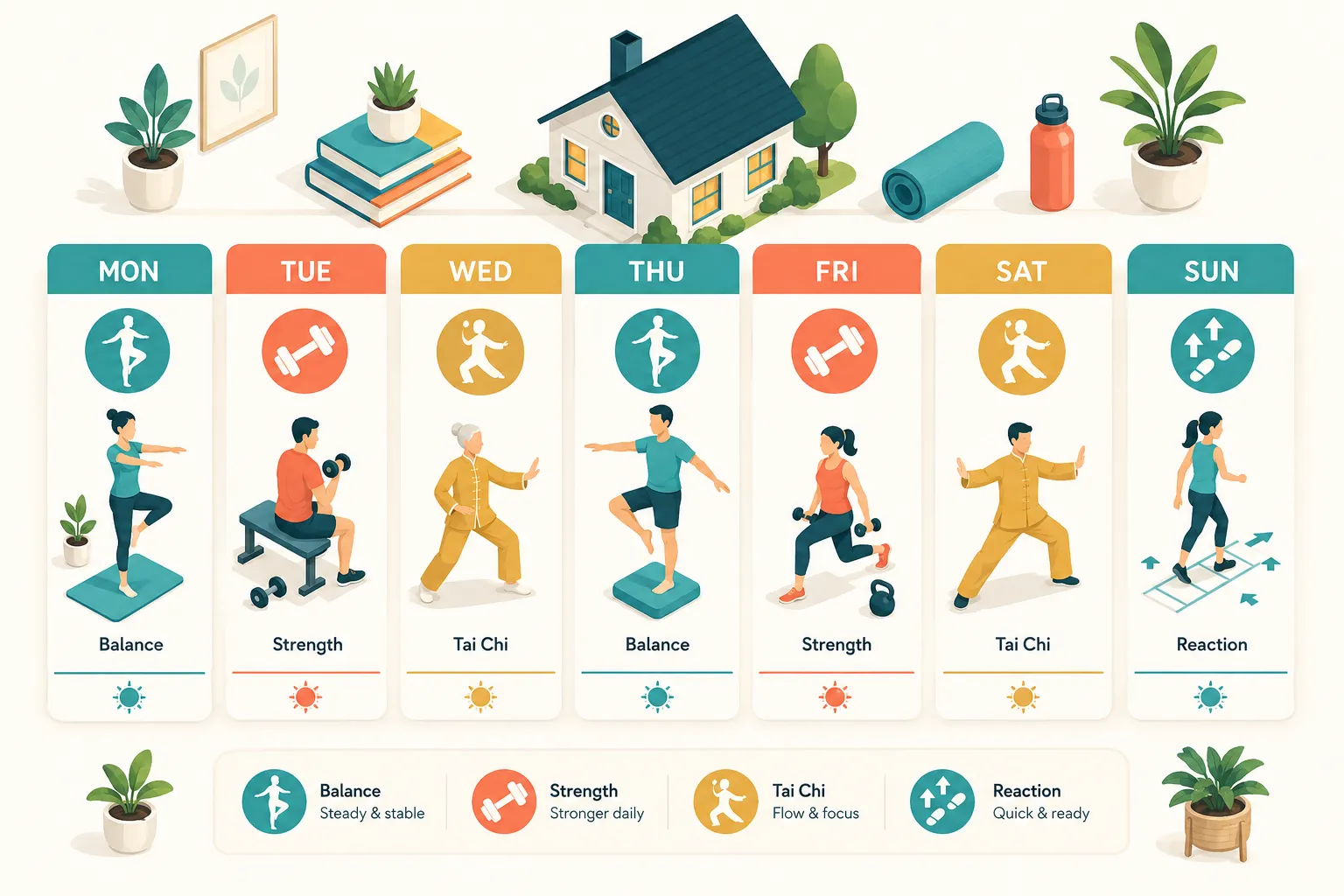
A typical weekly template apps use:

  • Monday: Full-body strength (30-40 min)
  • Tuesday: Mobility + balance (15-20 min)
  • Wednesday: Walk + light bands (30 min)
  • Thursday: Full-body strength (30-40 min)
  • Friday: Mobility + balance (15-20 min)
  • Saturday: Longer walk or gentle yoga
  • Sunday: Rest or stretch

Apps automatically shorten sessions if wearable data shows poor sleep or elevated resting heart rate, a small but genuinely useful piece of adaptive coaching.

Can fitness apps replace a personal trainer for seniors?

Fitness apps can replace a general personal trainer for healthy, motivated seniors, but they cannot replace a physical therapist, exercise physiologist, or trainer with geriatric certification for anyone recovering from surgery, managing Parkinson's, post-stroke, severe osteoporosis, or advanced frailty.

Where apps do well:

  • Consistent programming and progression
  • Reminders and streak tracking
  • Video demonstrations of every exercise
  • Objective feedback via wearable data

Where humans still win:

  • Hands-on form correction
  • Complex condition management
  • Motivation during setbacks
  • Real-time safety judgment

Best hybrid model: See a certified trainer or PT for 3-4 sessions to build a base, then let the app + wearable maintain and progress the program at home.

What features should a senior fitness app have?

A good senior fitness app should have large text, clear video demonstrations, low-impact and seated modification options, wearable integration, progress tracking, and a safety-focused progression system.

)

Non-negotiable features:

  • Large, high-contrast interface, no tiny gray text on white.
  • Seated and standing options for every exercise.
  • Video demonstrations with clear, older-adult demonstrators.
  • Balance and fall-prevention modules, not just cardio and strength.
  • Wearable sync with Apple Health, Google Fit, Fitbit, or Garmin.
  • Rest-day logic, the app should sometimes tell you to rest.
  • Emergency contact or fall alert integration, especially valuable given the 2026 push toward integrated safety-plus-training ecosystems [9].
  • Offline mode for spotty Wi-Fi.

Nice-to-haves: coach messaging, condition-specific tracks (arthritis, osteoporosis, diabetes), and family/caregiver dashboards.

Do wearables work for seniors with arthritis or joint pain?

Yes, wearables work well for seniors with arthritis, and they can actually help manage it, but band material, weight, and interface design matter more than headline specs. Look for soft silicone or fabric bands, lightweight cases under 40 grams, and larger touch targets.

Ways wearables help arthritis sufferers:

  • Pacing: Heart rate and step trends flag flare-up days so you can dial back.
  • Movement reminders: Gentle nudges every hour reduce stiffness.
  • Sleep tracking: Poor sleep predicts arthritis pain days, data helps plan gentler workouts.
  • Range-of-motion progress: Some PT apps use the sensor to estimate joint mobility gains.

Avoid: Heavy metal bands, small crown dials that require fine finger control, and any device requiring a two-hand clasp. Magnetic loop bands are the easiest to fasten with arthritic hands.

Sample two-week starter plan

A simple way to combine wearables and apps if you're starting from scratch:

Week 1, Baseline

  1. Wear the device all day, every day. Note resting heart rate.
  2. Do a 5-minute movement test the app recommends (sit-to-stand, timed walk).
  3. Complete two 20-minute app workouts. Rate effort 1-10.

Week 2, Personalize

  1. Increase to three strength sessions, keep Zone 2 heart rate.
  2. Add one daily 10-minute mobility routine.
  3. Review weekly summary, steps, active minutes, resting HR trend.
  4. Adjust workout difficulty if resting heart rate is stable or falling.

FAQ

Do I need Wi-Fi at home to use a fitness wearable?
Not always. Most wearables sync to your phone over Bluetooth. Wi-Fi helps with faster app updates and cloud backup, but is not required for daily tracking.

Can two people share one app account?
Usually no, most apps tie personalization to one profile. Family plans (Apple Fitness+, Fitbit Premium) support multiple users under one subscription.

What if I forget to charge my wearable?
Choose a device with 5+ day battery, or set a weekly charging routine, for example, while showering on Sunday morning.

Are there wearables designed specifically for seniors?
Yes. Medical Guardian's Guardian Flex (August 2026) and other alert-based wearables target older adults with fall detection and simplified interfaces [2].

Should I trust the calorie count on my watch?
Only loosely. Trust heart rate, step count, and active minutes far more than calorie estimates.

Can wearables detect a fall automatically?
Yes. Apple Watch, several Samsung and Garmin models, and dedicated medical alert wearables detect hard falls and can call for help [5][9].

Is it worth upgrading to a newer smartwatch every year?
No. Most seniors get 3-4 useful years from a mid-range wearable. Upgrade when the battery weakens or a needed feature appears.

How do caregivers stay in the loop?
Many apps and medical alert systems offer caregiver dashboards showing daily activity, workout completion, and fall alerts, a growing standard in 2026 aging-in-place ecosystems [6][9].

Conclusion

Using wearables and mobile fitness apps to personalize senior strength and mobility training is no longer a novelty, it's the most practical way for adults 55+ to train safely and progressively at home. The 2026 evidence is clear: wearable-guided programs measurably improve strength and balance, and app-based coaching increasingly adapts in real time to how the body is responding [1][3].

Next steps:

  1. Pick one wearable that matches your priority, strength progression, fall safety, or all-day comfort.
  2. Try 1-2 free apps for 30 days before paying.
  3. Aim for 2-3 strength sessions and daily mobility work in Zone 2 heart rate.
  4. Share your app data with your doctor or PT at your next visit.
  5. Reassess every 8-12 weeks, bump resistance, add complexity, or shift focus based on the numbers.

The technology only works if it's worn and used. Start simple, stay consistent, and let the data do the personalization for you.

References

[1] pubmed.ncbi.nlm.nih.gov – https://pubmed.ncbi.nlm.nih.gov/41822921/
[2] Medical Guardian Launches Guardian Flex – https://finance.yahoo.com/healthcare/articles/medical-guardian-launches-guardian-flex-130000137.html
[3] pubmed.ncbi.nlm.nih.gov – https://pubmed.ncbi.nlm.nih.gov/41511633/
[4] Best Resistance Bands For Seniors – https://elderlydaily.com/reviews/best-resistance-bands-for-seniors
[5] Wearable Falls Detection Review 2026 – https://caregivers.website/wearable-falls-detection-review-2026
[6] pubmed.ncbi.nlm.nih.gov – https://pubmed.ncbi.nlm.nih.gov/41960380/
[7] Best Resistance Bands For Seniors – https://www.myexerciseplan.com/strength-weights/best-resistance-bands-for-seniors/
[8] Pmc12831105 – https://pmc.ncbi.nlm.nih.gov/articles/PMC12831105/
[9] CES 2026 Highlights Future Of AgeTech Fall Prevention AI Monitoring – https://beingpatient.com/ces-2026-highlights-future-of-agetech-fall-prevention-ai-monitoring/
[10] MyGuardian App Details – https://play.google.com/store/apps/details?id=com.hc.myguardian&hl=en_US

Mobility Flow Sequences for Joint Health: Gentle Continuous Movement Routines for Older Adults

Mobility Flow Sequences for Joint Health: Gentle Continuous Movement Routines for Older Adults

Last updated: September 3, 2026

Quick Answer

Mobility flow sequences are short, continuous routines that guide older adults through the natural range of every major joint, neck, shoulders, spine, hips, knees, and ankles, without holding static stretches. Done for 5 to 15 minutes most days, they reduce stiffness, improve gait, and keep joints nourished by moving synovial fluid. They're widely considered safe for most seniors, including many with arthritis, when performed slowly with support from a chair or wall [1][4].

Key Takeaways

  • Mobility flows are continuous, not held. You move through joint ranges rather than pausing in a stretch [4].
  • 5 to 15 minutes daily is the sweet spot most trainers and clinicians recommend for older adults [4][9].
  • Joint-by-joint structure works best: start at the neck and work down, or reverse [10].
  • Chair or wall support makes flows safer and accessible for people with balance issues or limited mobility [4][6].
  • Low-impact and joint-friendly, mobility flows align with official physical activity guidelines for adults 65+ [8].
  • Results appear in 2-6 weeks for reduced stiffness; strength and balance gains take longer [2][7].
  • Not a replacement for physical therapy after injury or surgery, but a strong complement to it [5].
  • People with severe osteoporosis, acute joint flare-ups, or recent surgery should get medical clearance first [8].

What Are Mobility Flow Sequences and How Do They Work?

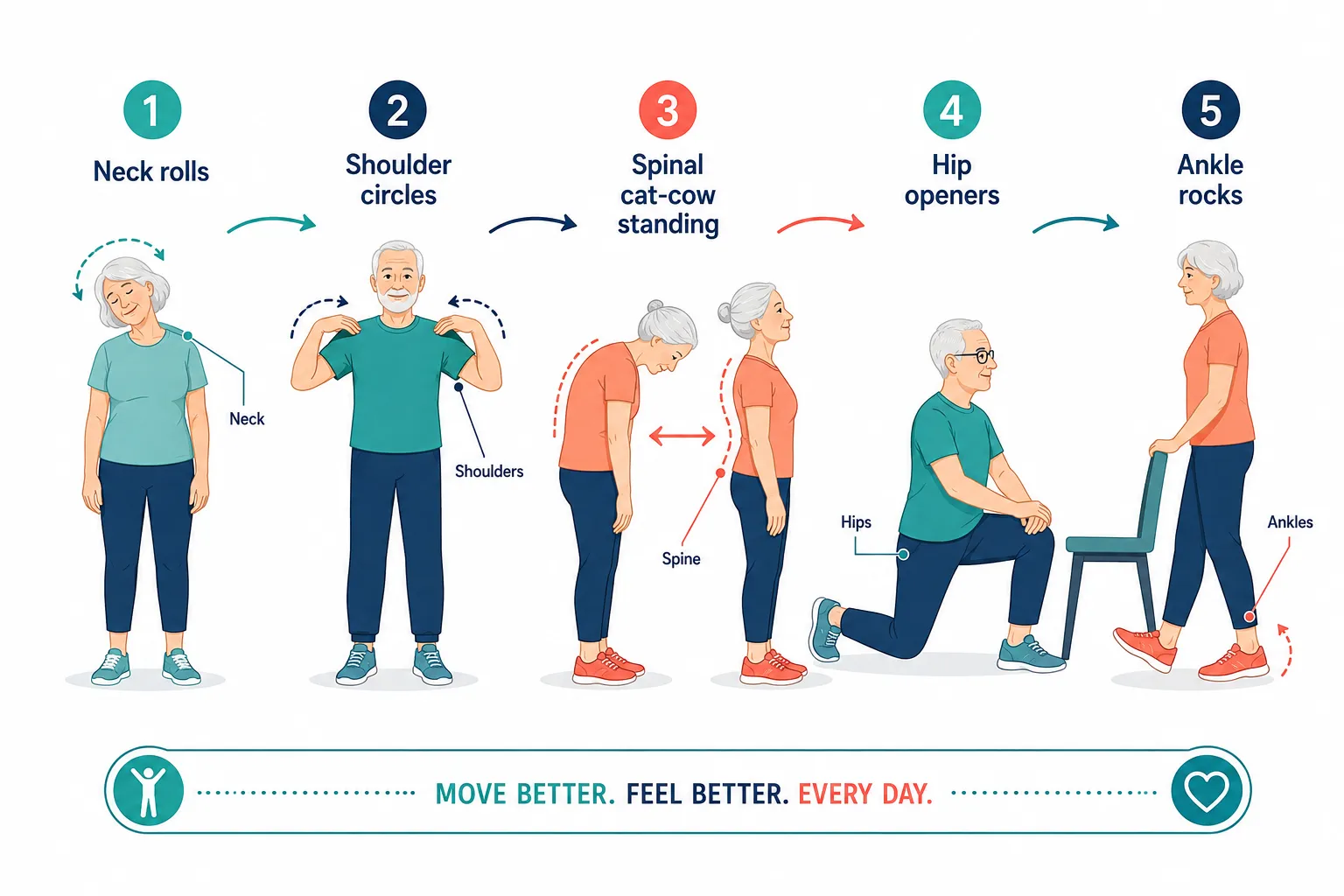
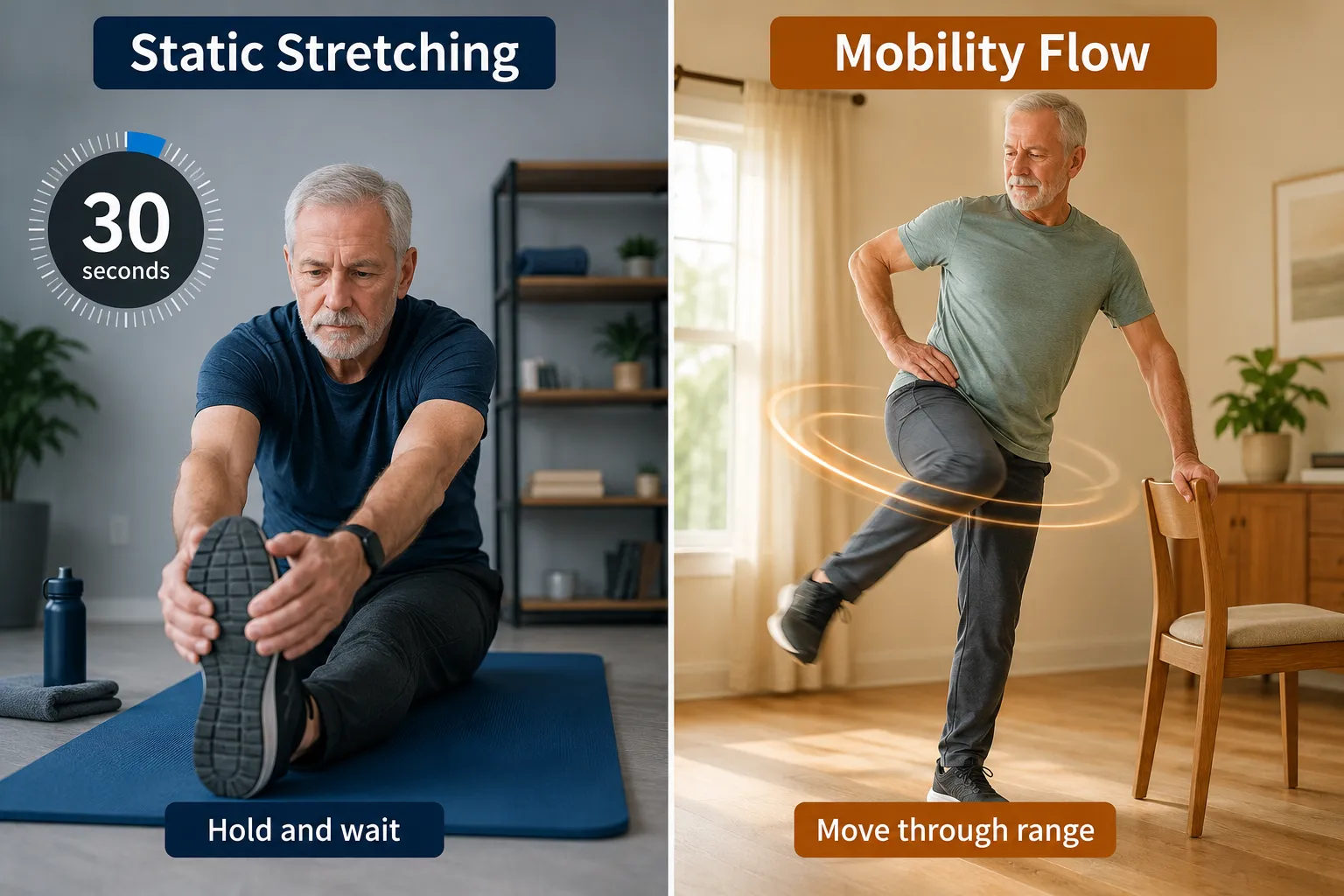
Mobility flow sequences are structured routines that move each joint through its available range in a smooth, continuous pattern. Unlike static stretching, where you hold a position, flows keep you moving, arm circles blend into shoulder rolls, which lead into a gentle spinal twist, and so on.

They work through two main mechanisms. First, movement stimulates the production and circulation of synovial fluid, the natural lubricant inside joints, which helps cartilage stay healthy and reduces the gritty feeling of stiffness [4]. Second, repeated controlled motion signals the nervous system to release protective muscle guarding, so joints feel looser and gait becomes more fluid [5].

A typical flow follows a joint-by-joint template:

  1. Neck rotations and tilts
  2. Shoulder rolls and arm circles
  3. Thoracic spine rotations
  4. Hip circles and gentle swings
  5. Knee bends and mini squats
  6. Ankle circles and heel-toe rocks

What Are Mobility Flow Sequences and How Do They Work?

The whole sequence usually takes 8 to 12 minutes and requires no equipment beyond a sturdy chair.

Best Mobility Flow Exercises for Seniors With Arthritis

The best flows for arthritic joints are low-load, pain-free, and rhythmic. Movement helps arthritic joints, sitting still makes them worse. NICE-aligned arthritis guidance and rehab clinicians consistently recommend regular flexibility and mobility practice as a core part of managing joint disease [5].

Try these six evidence-supported movements, done for 8-12 slow repetitions each:

  • Seated marching: warms up hips and knees
  • Shoulder rolls (forward and back): eases neck and upper back tension
  • Seated spinal twist: mobilizes the thoracic spine without loading discs
  • Ankle alphabet: draw letters with your toes to work the ankle in every direction
  • Wall-supported hip circles: opens the hip capsule safely
  • Cat-cow, standing or seated: alternates spinal flexion and extension [6]

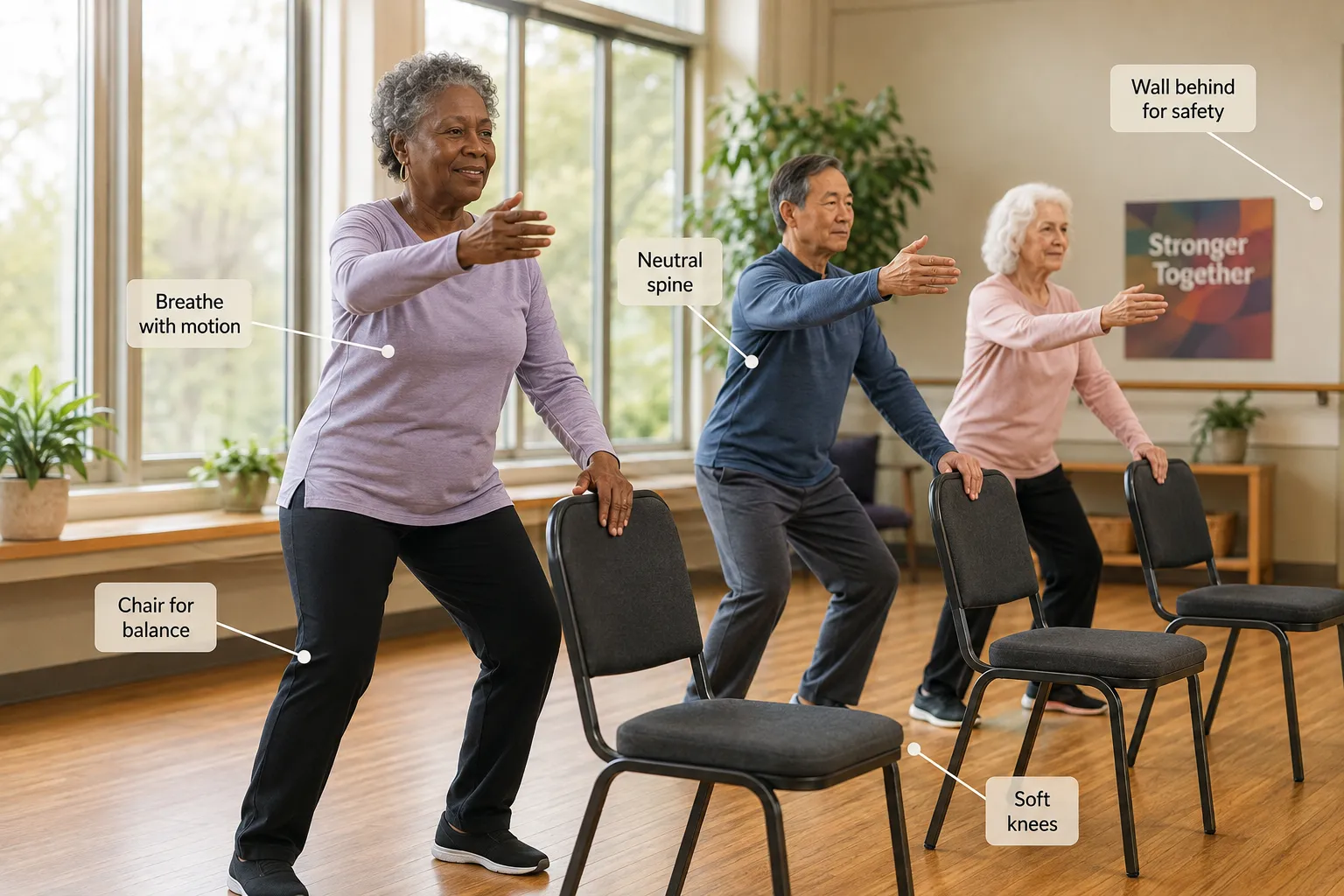
Choose seated versions if: knees or hips flare with weight-bearing, or balance is limited. Choose standing versions with wall support if: you want to add gait and balance benefits.

Skip any movement that produces sharp pain. A mild "working" sensation is fine; sharp or radiating pain is not.

How Often Should Older Adults Do Mobility Flow Routines?

Most days of the week, ideally daily. Short, frequent sessions beat long, occasional ones. The U.S. Physical Activity Guidelines recommend that adults 65+ include flexibility and balance work in their weekly routine, alongside 150 minutes of moderate aerobic activity and 2 sessions of strength work [8].

A practical schedule:

Frequency Duration Best For
Daily 5-10 min Morning stiffness, arthritis
5x per week 10-15 min General maintenance
3x per week 15-20 min Combined with strength days

Many trainers now frame these as "movement snacks", small doses of motion sprinkled through the day, especially useful for sedentary seniors who won't commit to a full workout [9].

Difference Between Mobility Flows and Stretching for Joint Health

Mobility flows move joints through ranges; stretching holds a position at end-range. Both have value, but for aging joints, continuous motion is usually more useful than long holds [4].

Quick comparison

Static stretching: hold a position 20-60 seconds. Targets muscle length. Can feel intense.

Mobility flow: move continuously through range. Targets joint capsule, synovial fluid, and neuromuscular control. Feels smooth.

Verdict: Flows are better for daily joint maintenance. Stretching still helps for specific tight muscles.

The trainer's line "joints need to move to feel good, not just be stretched" captures the shift many rehab professionals are making in 2026 [4].

Difference Between Mobility Flows and Stretching for Joint Health

Can Mobility Flow Sequences Help With Joint Pain Relief?

Yes, for many people, particularly those with stiffness-driven pain from osteoarthritis, general inactivity, or postural strain. Gentle continuous movement increases blood flow, warms tissues, and reduces the perception of pain by dialing down protective muscle guarding [5][7].

Expect modest, gradual relief rather than instant fixes. A 2024 review of low-impact activity in arthritis populations found that regular flexibility and mobility work reduced self-reported joint pain and improved function over 8-12 weeks [1].

Flows are less effective for:

  • Acute inflammatory flare-ups (rest first, then reintroduce gently)
  • Pain from a specific structural injury (see a clinician)
  • Nerve-related pain like sciatica (needs targeted care)

Mobility Flow Routines for People With Limited Mobility

Seated and supported flows keep almost everyone in motion, regardless of ability. If standing is hard, a sturdy chair becomes the whole studio.

A seated 10-minute flow:

  1. Neck: slow yes-nods, then side-to-side, 6 each
  2. Shoulders: rolls forward 8, backward 8
  3. Arms: reach overhead alternately, 8 per side
  4. Spine: gentle seated twists, 6 per side
  5. Hips: seated marching, 20 total
  6. Knees: straighten and bend one leg at a time, 8 per side
  7. Ankles: circles in each direction, 8 each

For people using walkers or wheelchairs, upper-body and seated hip work still delivers meaningful stiffness relief [6]. The key is daily consistency at a low dose.

What Equipment Do I Need for Gentle Mobility Flows?

Almost nothing. That's part of why these routines have gained traction, no gym, no membership, no barriers.

Recommended (not required):

  • A sturdy, armless chair
  • A wall for balance support
  • A non-slip mat if you'll do any floor work
  • Comfortable, non-restrictive clothing
  • A resistance band (light) for gentle shoulder and hip work later

Skip weighted equipment for pure mobility work, the goal is range and lubrication, not load [10].

Are Mobility Flow Sequences Safe for People With Osteoporosis?

Generally yes, with two important modifications: avoid loaded spinal flexion (rounding forward under weight) and avoid deep spinal twists. Both can raise vertebral fracture risk in people with reduced bone density [8].

Safer swaps:

  • Replace forward-fold movements with hip hinges and supported bends
  • Replace deep seated twists with gentle thoracic rotations in a neutral spine
  • Add weight-bearing standing flows (with wall support), these actually help bone density

Anyone with a diagnosed osteoporosis or a recent DEXA scan showing low T-scores should have a physical therapist review their routine once before starting.

How Long Does It Take to See Results From Mobility Flow Routines?

Most people notice less morning stiffness within 2-3 weeks of daily practice. Improvements in balance, gait quality, and functional range of motion typically show up between weeks 4 and 8 [2][7].

A rough timeline:

  • Week 1-2: Movement feels easier, less "creaky" in the morning
  • Week 3-4: Noticeable improvement in reaching, turning, bending
  • Week 6-8: Better balance, more confident walking, easier stairs
  • Week 12+: Sustained changes in posture and fall confidence

Progress plateaus without consistency. Miss two weeks and much of the fluidity fades, this is a keep-doing-it practice, not a one-time fix.

Mobility Flow Sequences vs Physical Therapy for Older Adults

Mobility flows are general maintenance; physical therapy is targeted rehabilitation. They serve different purposes and often work best together.

Choose mobility flows if:

  • You have general age-related stiffness
  • You want daily prevention and joint care
  • You have no acute injury or recent surgery

Choose physical therapy if:

  • You're recovering from surgery, injury, or a fall
  • You have pain that limits daily activities
  • You need a personalized assessment [5]

Many PTs now prescribe mobility flows as homework between sessions, and hand patients a flow to continue after discharge [10].

Mobility Flow Sequences vs Physical Therapy for Older Adults

Common Mistakes People Make Doing Mobility Flows

The routine is simple, but a few habits blunt the benefits:

  1. Rushing through the reps. Speed reduces the joint-lubrication effect. Slow down.
  2. Pushing into pain. Mobility work should feel like relief, not effort. Back off if it hurts.
  3. Holding the breath. Breathe naturally through each movement.
  4. Skipping the lower body because it's harder to see improvement there.
  5. Doing it once a week and expecting change. Consistency beats intensity.
  6. Ignoring balance support when needed, falling during a mobility routine defeats the point.
  7. Copying advanced yoga flows meant for younger, mobile bodies. Use routines designed for older adults [4].

Mobility Flow Routines for Stiff Hips and Lower Back

Hips and the lumbar spine cause most complaints in older adults. A focused 6-minute flow:

  • Standing hip circles (hands on chair back): 6 each direction
  • Standing knee raises: 8 per side
  • Wall-supported leg swings (forward/back, gentle): 8 per side
  • Standing cat-cow: 8 rounds
  • Standing side bends: 6 per side
  • Pelvic tilts against wall: 10 slow reps

This sequence targets the hip capsule, glute activation, and thoracolumbar mobility, the three biggest contributors to comfortable walking after 60 [6][7].

Can You Do Mobility Flows Every Day?

Yes. Unlike strength training, mobility work has no required recovery day. Joints benefit from daily motion. In fact, the biggest single factor separating people with fluid, comfortable joints from those with chronic stiffness is frequency of gentle movement, not intensity [4][9].

The main caveat: if a specific joint is inflamed or recovering from a flare, rest that joint for 24-48 hours while continuing to move the rest of your body.

Who Should Not Do Mobility Flow Sequences?

Most older adults can safely start today. Talk to a doctor or physical therapist first if any of the following apply:

  • Recent surgery (especially joint replacement) within the last 6-12 weeks
  • Acute injury or fracture that hasn't fully healed
  • Severe osteoporosis with a history of vertebral fractures
  • Uncontrolled cardiovascular conditions where even light activity is restricted
  • Acute inflammatory arthritis flare with hot, swollen joints
  • Balance disorders that make even supported standing unsafe [8]

Clearance doesn't mean "no." It usually means a modified version prescribed by a clinician.

FAQ

How many minutes of mobility flow do older adults need daily?
Five to fifteen minutes most days delivers meaningful stiffness relief and gait improvement for most seniors [4].

Can mobility flows replace walking?
No. Flows complement aerobic activity like walking, but don't replace it. Guidelines recommend both [8].

Is it okay to feel some cracking or popping in the joints?
Painless cracking is normal and harmless. Painful clicking or grinding warrants a clinician's opinion.

Should I do mobility flows in the morning or evening?
Morning helps combat overnight stiffness. Evening helps unwind tight tissues. Both work, pick what you'll do consistently.

Can mobility flows improve balance?
Yes, especially standing flows with weight shifts. Trainers increasingly build balance cues into flows to reduce fall risk [4].

Do I need to warm up before a mobility flow?
The flow itself is the warm-up. Start with the smallest, gentlest movements and let intensity build naturally.

Are online follow-along videos safe for beginners?
Yes, if they're designed for older adults and use chair or wall support. Avoid generic yoga classes unless taught by an instructor experienced with aging bodies.

Can mobility flows help with knee osteoarthritis?
Yes. Gentle, pain-free movement is a first-line recommendation for knee OA and helps preserve function [1][5].

Will mobility flows help with posture?
Yes, particularly the thoracic spine and shoulder segments. Expect gradual postural improvement over 6-12 weeks [7].

Can I combine mobility flows with strength training?
Absolutely, flows make excellent warm-ups and cool-downs for strength sessions.

Conclusion

Mobility flow sequences give older adults a simple, low-risk way to keep joints comfortable and gait fluid: move every joint through its available range, every day, in a continuous rhythm. They're safe for most people with arthritis, adaptable for limited mobility, and consistent with official physical activity guidance for adults 65+.

Start this week:

  1. Pick a 10-minute follow-along flow designed for older adults [4][6]
  2. Put a sturdy chair in a clear space
  3. Commit to 6 sessions in the next 7 days
  4. Note morning stiffness on day 1 and day 14, the difference is your proof

If pain limits daily life, add a physical therapy consult on top of your daily flow. Movement is medicine for aging joints, and the dose is a few minutes, most days, for the rest of your life.

References

[1] Mobility Exercises For Seniors – https://www.healthline.com/health/senior-health/mobility-exercises-for-seniors
[2] Improving Mobility In Old Age – https://www.healthline.com/health/improving-mobility-in-old-age
[3] Mobility Exercises Seniors – https://neverleavetheplayground.com/mobility-exercises-seniors/
[4] Your Joints Need To Move To Feel Good, A Certified Trainer Shares The Gentle Mobility Routine He Uses With Seniors – https://www.fitandwell.com/exercise/flexibility/your-joints-need-to-move-to-feel-good-a-certified-trainer-shares-the-gentle-mobility-routine-he-uses-with-seniors-to-soothe-joint-stiffness-after-60
[5] Joint Mobility Exercises – https://www.healthline.com/health/fitness-exercise/joint-mobility-exercises
[6] A Mobility Expert Recommends These Six Stretches For Older Adults With Especially Stiff Joints – https://www.fitandwell.com/exercise/flexibility/a-mobility-expert-recommends-these-six-stretches-for-older-adults-with-especially-stiff-joints
[7] Exercises For Mobility Range Of Motion After 50 – https://www.health.com/exercises-for-mobility-range-of-motion-after-50-11904156
[8] Physical Activity Guidelines 2nd Edition – https://odphp.health.gov/sites/default/files/2019-09/Physical_Activity_Guidelines_2nd_edition.pdf
[9] Home Exercise Routine – https://thehealthyagingguide.com/tag/home-exercise-routine/
[10] The Top 5 Mobility Exercises For Aging Joints – https://vitalityptgr.com/the-top-5-mobility-exercises-for-aging-joints/

Best Exercise Apps for Seniors: Home Strength, Mobility, and Balance Training on Your Phone

Best Exercise Apps for Seniors: Home Strength, Mobility, and Balance Training on Your Phone

Last updated: September 1, 2026

Quick Answer

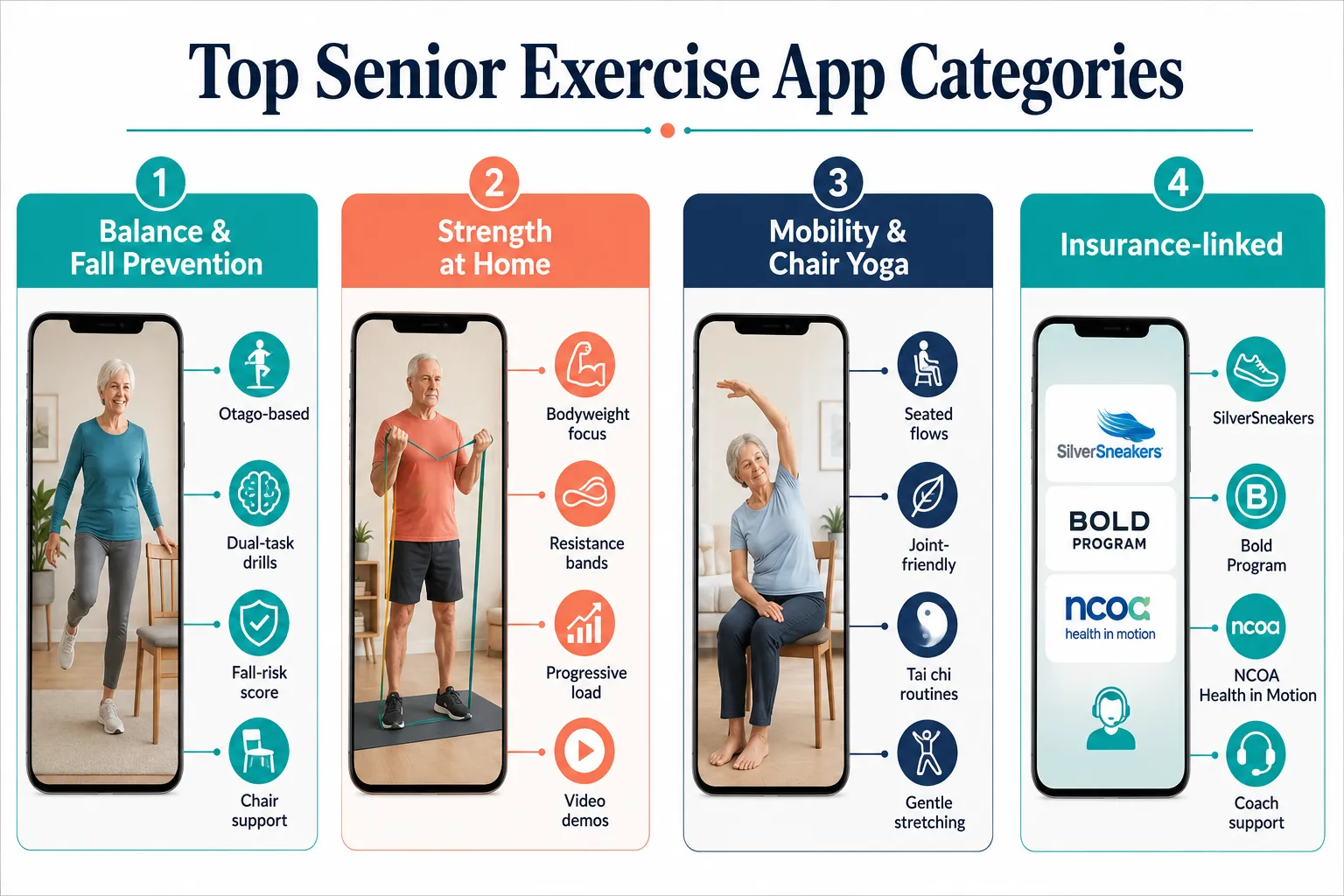
The best exercise apps for seniors in 2026 combine evidence-based balance training, gentle strength work, and mobility routines that run on a standard smartphone. Top picks include SilverSneakers GO, Bold, StandingTall, Stay Steady, Apple Fitness+, GentleFit, and Golden Moves, with free options like Eldergym for follow-along videos. Choose an app that uses proven protocols (Otago, A Matter of Balance), offers video demonstrations, and adapts intensity to your fitness level.[1][2][6][8]

Key Takeaways

  • Senior-specific apps outperform mainstream fitness apps for adults 65+ because they emphasize safety cues, chair options, and progressive balance work.[1][2]
  • Clinically-backed programs matter: apps built on the Otago Exercise Programme or A Matter of Balance have documented fall-reduction results.[6][8][22]
  • A 2026 mHealth review found app-based fall prevention produced an 11% relative reduction in falls over 12 months, with no serious adverse events.[22]
  • Balance and strength together work best, apps focusing on only one dimension leave key fall-prevention benefits on the table.[19][22]
  • Free options exist (Eldergym, SilverSneakers GO with Medicare Advantage), but paid apps typically offer more coaching and progression.[1][2]
  • Look for video demonstrations, large text, adjustable pace, and offline mode before signing up.
  • Wearable integration (Apple Watch, Fitbit) improves adherence by tracking steps, heart rate, and workout completion.

What Are the Best Exercise Apps for Seniors in 2026?

The best exercise apps for seniors combine guided video sessions, balance-focused programming, and a simple interface designed for older users. Consumer roundups updated in August 2026 consistently rank SilverSneakers GO, Bold, StretchPartner, Apple Fitness+, Pvolve, GentleFit, and Golden Moves as leaders for home strength, mobility, and balance training.[1][2][4][5]

What Are the Best Exercise Apps for Seniors in 2026?

)

Here's how the standouts break down:

App Best For Cost (2026) Key Feature
SilverSneakers GO Medicare Advantage members Free with benefit Live and on-demand classes
Bold Fall prevention Free tier + premium Personalized balance program
StandingTall Clinical balance training Free (research-backed) 20% fall injury reduction data[8]
Stay Steady Home balance assessment Free/low-cost Otago-based + TUG test[6]
Apple Fitness+ All-around low-impact $9.99/mo Deep Apple Watch integration
GentleFit Adults 50+ new to exercise Freemium Simple navigation, low-impact[4]
Golden Moves Adults 65+ at home Freemium No-equipment routines[5]
Eldergym Free follow-along Free YouTube-style video library

Choose SilverSneakers if you have Medicare Advantage, it's essentially free. Choose Bold or StandingTall if falls or balance are your main concern. Choose Apple Fitness+ if you already wear an Apple Watch.

How Do Exercise Apps Help With Balance and Fall Prevention?

Exercise apps reduce fall risk by delivering structured balance and strength routines proven in clinical trials, often based on the Otago Exercise Programme or A Matter of Balance. A 2026 systematic review of mHealth fall-prevention apps reported an 11% relative reduction in the proportion of older adults experiencing a fall over 12 months, with a number-needed-to-treat of 15.[22]

Specific results from the research literature:

  • StandingTall: clinically proven to reduce injuries from falls by 20%.[8]
  • Safe Step app trial: only 11% of participants in the app group experienced a fall during the intervention.[21]
  • Bold Fall Prevention Program: 46% reduction in annualized falls per year and a 182% increase in weekly activity minutes.[18]
  • Community telehealth reviews: a risk ratio of 0.63 for falls (a 37% relative reduction).[23]

How they work in practice: most apps combine single-leg stands, tandem walking, sit-to-stand repetitions, and dual-task exercises (moving while doing a mental task). Nymbl Training specifically uses dual-task drills that pair balance moves with brain challenges.[9]

A well-designed app can replicate the core mechanics of a supervised balance class, delivered in your living room, at the times that work for you.

Common mistake: treating an app as a substitute for a physical therapist after a recent fall or surgery. Always get medical clearance first.

Can Seniors Build Muscle With Home Workout Apps?

Yes, seniors can build meaningful strength using home workout apps, especially those featuring progressive bodyweight movements, resistance bands, and light dumbbells. Apps like Pvolve, Apple Fitness+, SilverSneakers GO, and Strong Foundations (UC San Diego's 12-week online program) emphasize posture, functional strength, and balance in the same session.[1][19]

What to look for in a strength-focused app:

  1. Progressive overload, sessions that gradually increase reps, sets, or resistance.
  2. Compound movements, sit-to-stand, wall push-ups, band rows, and step-ups translate directly to daily life.
  3. Two to three sessions per week, the strength dosage most guidelines recommend for older adults.
  4. Rest and recovery guidance built into the schedule.

The Strong Foundations program at UC San Diego, delivered once weekly over 12 weeks online, demonstrated improved balance, posture, and strength with real-time semi-individualized coaching.[19] Similar structure appears in Bold's premium tier and Apple Fitness+'s strength collections for older adults.

Best Free Exercise Apps for Older Adults

The best free exercise apps for seniors include SilverSneakers GO (free with most Medicare Advantage plans), Eldergym (free follow-along videos), StandingTall (free clinical program), and free tiers of Bold, Nymbl Training, and GentleFit.[1][2][8]

Free options worth downloading first:

  • SilverSneakers GO, full class library if eligible.
  • Bold (free tier), a personalized plan and starter balance sessions.
  • StandingTall, full research-grade balance program at no cost.[8]
  • Eldergym Senior Fitness, free follow-along videos with a coach.[2]
  • Nymbl Training, dual-task balance training, often offered free through state health departments.

Decision rule: start with a free app for the first 30 days. If you use it three times a week and want more variety, upgrade to a paid option.

Exercise Apps for Seniors With Arthritis or Joint Pain

For seniors with arthritis or joint pain, the safest apps focus on low-impact, chair-based, or water-alternative movements with clear modifications. StretchPartner (chair-first mobility), Chair Yoga Tai Chi Fitness, GentleFit, Golden Moves, and SilverSneakers GO all specialize in joint-friendly routines.[1][3][4][5]

)

Tai chi and qigong apps have grown especially fast, a 2026 landscape analysis found 16 tai chi/qigong apps for seniors, several of which surpassed 1,300 ratings within months of launch.[3] Tai chi's slow, weight-shifting patterns are ideal for stiff knees, hips, or shoulders.

Features that matter for arthritis:

  • Warm-up routines that are 5+ minutes long.
  • Seated modifications for every standing exercise.
  • Range-of-motion drills instead of high reps.
  • The ability to slow the video down.

Skip apps that default to HIIT, plyometrics, or floor-based routines with no chair alternative.

How Much Do Senior Fitness Apps Cost?

Senior fitness apps typically cost between $0 and $15 per month, though specialized AI-guided or tai chi apps can run $19.99 to $99.99 per year.[3] Many quality options are free through insurance benefits or nonprofit partnerships.

How Much Do Senior Fitness Apps Cost?

Typical 2026 pricing:

  • Free tier apps: SilverSneakers GO (with Medicare Advantage), StandingTall, Eldergym, Bold free tier.
  • Budget ($4,$9/mo): GentleFit, Golden Moves, Stay Steady premium.
  • Mid-range ($9.99,$14.99/mo): Apple Fitness+, Pvolve, Bold premium.
  • Annual specialty apps: Tai Chi Beginners & Seniors and similar AI-guided tools, $19.99,$99.99/year.[3][13]

Insurance angle: if you have Medicare Advantage, ask your plan about SilverSneakers, Renew Active, or Silver&Fit, these often include app access. The NCOA's Health in Motion program (2026) delivers Otago and A Matter of Balance digitally through health coaches, sometimes at no cost for eligible adults.[26]

Which Exercise Apps Work Offline for Seniors?

Offline access matters for seniors with unreliable Wi-Fi or limited data plans. Apps that allow video downloads for offline playback include Apple Fitness+ (with subscription), SilverSneakers GO (select classes), and Pvolve. Free follow-along programs like Eldergym rely on YouTube, which offers offline downloads with a YouTube Premium subscription.

How to check before subscribing: search the app description for "download" or "offline" and ask customer support directly. Many balance-focused apps like StandingTall and Stay Steady work with cached content once initially loaded.[6][8]

Quick tip: download a full week of workouts on Wi-Fi at home, then use them anywhere without a signal.

Are There Exercise Apps Specifically Designed for Seniors vs General Fitness Apps?

Yes, a distinct category of senior-specific exercise apps now dominates the market. A 2026 landscape analysis identified 79 senior-focused fitness apps, 44 of which were new that year, spanning chair exercise (23 apps), tai chi/qigong (16), all-round workouts (15), and dedicated balance/fall-prevention apps.[3]

Senior-specific apps differ from general fitness apps in four key ways:

  1. Interface design, larger fonts, higher contrast, simpler navigation.
  2. Exercise selection, no jumping, minimal floor work, chair alternatives for every move.
  3. Pacing, slower demonstrations with clear safety cues.
  4. Content framing, instructors are often older, and the tone assumes zero fitness background.

When general apps still work: if you're an active 65-year-old comfortable with Peloton, Nike Training Club, or Fitbod, those work fine, just skip the plyometric and HIIT programs.

How Do I Know If an Exercise App Is Safe for My Age and Fitness Level?

An exercise app is likely safe if it uses evidence-based protocols, offers video demonstrations, includes safety warnings, and encourages you to consult a healthcare provider before starting.

)

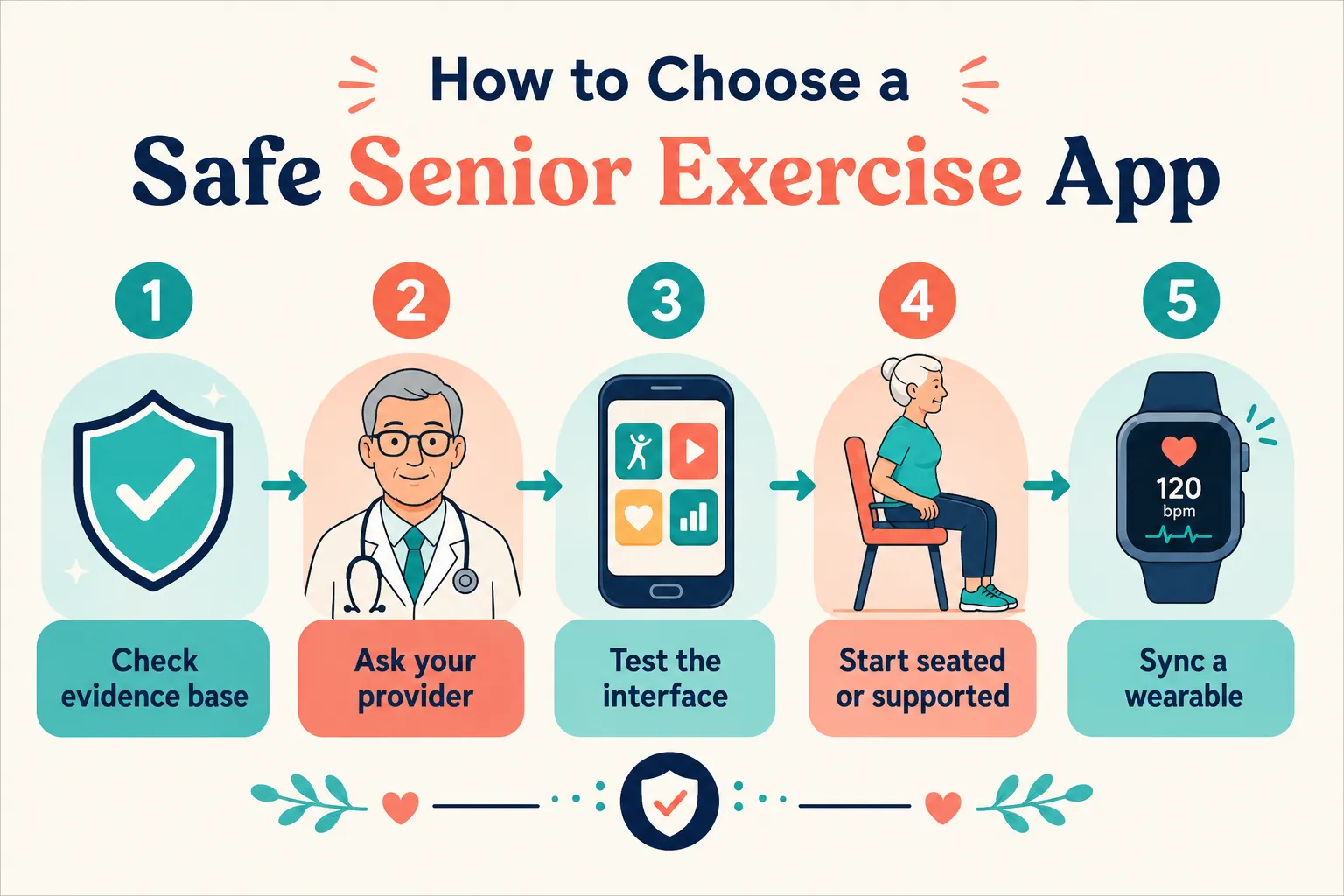
Use this five-step safety check:

  1. Check the evidence base. Does the app reference Otago, A Matter of Balance, or peer-reviewed research?[6][8][26]
  2. Ask your provider. Especially if you've had a fall, surgery, or new medical condition in the last year.
  3. Test the interface. Can you read every button without straining?
  4. Start seated or supported. Use a sturdy chair for the first two weeks, even for standing exercises.
  5. Sync a wearable. Heart rate and step data help you stay in a safe range.

Red flags: no demonstration videos, no safety disclaimers, aggressive marketing promising fast results, or exercises with no seated modification.

Best Apps for Senior Mobility and Flexibility Training

The best apps for senior mobility include StretchPartner (chair-first), Chair Yoga Tai Chi Fitness, Apple Fitness+ Mindful Cooldown, GentleFit, and dedicated tai chi apps that have surged in 2026.[1][3][4]

Mobility apps focus on:

  • Joint range of motion (shoulders, hips, ankles, spine).
  • Fascial stretching with slow, sustained holds.
  • Tai chi and qigong flows for weight shifting and coordination.
  • Breathing and posture cues that pair with movement.

Pro tip: stack a 10-minute mobility session before your strength or balance workout. It cuts injury risk and improves how well you can perform the harder moves.

Can Seniors Use Regular Fitness Apps or Do They Need Senior-Specific Ones?

Active, healthy seniors can absolutely use regular fitness apps, as long as they filter for low-impact programs and skip high-intensity content. Seniors with limited mobility, recent injuries, or fall risk should choose senior-specific apps instead.

Can Seniors Use Regular Fitness Apps or Do They Need Senior-Specific Ones?

A quick decision rule:

  • Regular apps work if you're already exercising 3+ times a week, have no balance issues, and can safely get up and down from the floor.
  • Senior-specific apps are better if you're new to exercise, have arthritis, use a cane or walker, or worry about falling.

Reviews of mainstream apps have found that many fail to meet the needs of frail older adults, lacking personalization and safety adaptations for disability or cognitive limits.[29]

Exercise Apps That Don't Require Equipment at Home

Several strong apps deliver full workouts using only your body weight and a sturdy chair. Top no-equipment picks include Golden Moves, GentleFit, Eldergym, StandingTall, Stay Steady, and most SilverSneakers GO classes.[4][5][6][8]

Movements you can do with zero equipment:

  • Sit-to-stand (functional leg strength)
  • Wall push-ups (upper body)
  • Standing marches (balance + cardio)
  • Heel-to-toe walking (dynamic balance)
  • Single-leg stands (near a counter for support)
  • Chair squats and rows (band optional)

Add a light resistance band (about $10) later if you want to progress upper-body strength.

What Features Should I Look for in a Senior Exercise App?

Prioritize video demonstrations, adjustable pacing, seated alternatives, evidence-based programs, and wearable integration. These features separate genuinely useful senior apps from repackaged general fitness content.

The must-have feature checklist:

  • Clear video demonstrations from multiple angles
  • Large, high-contrast text and buttons
  • Ability to slow down or pause the workout
  • Chair or supported version of every standing exercise
  • Progress tracking with simple visualizations
  • Reminders and motivational coaching
  • Integration with Apple Watch, Fitbit, or Google Fit
  • Fall-risk assessment (bonus)
  • Offline mode (bonus)
  • Family/caregiver sharing (bonus)

Research emphasizes that motivational coaching and human support significantly improve adherence, participants in a 12-week digital fall-prevention program specifically valued having a coach layered on top of app content.[17][30]

Do Exercise Apps for Seniors Have Video Demonstrations or Just Text Instructions?

Nearly all quality senior exercise apps use video demonstrations, often the entire session is a follow-along video with an instructor. Text-only apps are outdated and generally unsafe for older users.

What to expect from video-first apps:

  • Full follow-along sessions (10-45 minutes).
  • Instructor demonstrating both standing and seated versions.
  • Verbal safety cues throughout.
  • Progress markers on-screen.

Apps with the clearest video quality in 2026: Apple Fitness+, SilverSneakers GO, Pvolve, Bold, and StretchPartner.[1][2] Free options like Eldergym provide solid YouTube-style videos without slick production but with excellent teaching.

Wearable Integration: Why It Matters

Wearables amplify what an app can do by tracking heart rate, steps, sleep, and workout completion. A meta-analysis of six studies with 818 older adults found that digital health app users recorded an average of 799 more steps per day than controls.[20] Another review found activity trackers combined with apps added about 912 steps per day compared with other active interventions.[27]

Best integrations in 2026:

  • Apple Watch + Apple Fitness+, deepest integration, on-screen heart rate during workouts.
  • Fitbit + SilverSneakers GO, solid tracking of daily activity.
  • Google Fit + GentleFit / Golden Moves, basic but reliable step and workout logging.

Frequently Asked Questions

Are exercise apps safe for someone in their 80s?
Yes, if the app is senior-specific and you've been cleared by a healthcare provider. Start with seated or supported exercises and progress slowly.

Can I use an exercise app after hip or knee replacement?
Only with your surgeon or physical therapist's approval. Some apps like Bold and Stay Steady offer post-surgery-friendly modifications, but a licensed professional should guide the first phase of recovery.

How often should seniors use an exercise app?
Aim for balance and mobility work 3-5 days per week and strength training 2-3 days per week, based on general geriatric exercise guidelines.

Do these apps replace a physical therapist?
No. Apps supplement care but don't replace a licensed clinician, especially after a fall or injury. Use them alongside professional guidance.

Which app is best for someone who has fallen before?
Bold, StandingTall, Stay Steady, and Nymbl Training are specifically designed for fall prevention and have documented results in this population.[8][18][22]

Can these apps help with arthritis pain?
Yes, gentle mobility and tai chi apps often reduce stiffness. Chair-based programs are especially helpful for painful joints.[3]

Do I need Wi-Fi to use exercise apps?
Not always. Apple Fitness+, SilverSneakers GO, and Pvolve allow offline downloads. Download workouts at home and use them anywhere.

What's the difference between SilverSneakers and Silver&Fit?
Both are Medicare Advantage fitness benefits with app access. Coverage depends on your specific plan, call your insurer to check.

Are AI-powered senior fitness apps worth it?
Some are. Tools like FallProofAI use gait analysis and computer vision to generate personalized fall-risk scores.[7] They work best as a supplement to a proven exercise program, not a replacement.

Can family members monitor my workouts?
Some apps like Bold and NCOA's Health in Motion allow caregiver dashboards. Ask before subscribing if this feature matters to you.[26]

Conclusion: Next Steps for Choosing Your App

The best exercise apps for seniors in 2026 make evidence-based strength, mobility, and balance training accessible from any smartphone. The market has matured, 79 senior-focused apps now exist, many built on clinical protocols like Otago and A Matter of Balance, with documented fall-reduction results between 11% and 46%.[3][18][22]

Your action plan for this week:

  1. Pick one free app based on your top goal, Bold or StandingTall for falls, SilverSneakers for all-around fitness, StretchPartner for mobility.
  2. Get medical clearance if you've had a fall, surgery, or new diagnosis in the last year.
  3. Commit to 3 sessions in the first week, 15 minutes each, seated or supported.
  4. Track it with your phone or a wearable so you can see progress.
  5. Reassess at 30 days. If you're using it, upgrade or explore a second app for variety. If not, try a different one.

Consistency beats intensity. A 15-minute daily balance session done for a year does more for independence than any single perfect workout. Download one app today and take the first session before the week ends.

References

[1] Best Exercise Apps For Seniors – https://stretchpartner.com/blog/best-exercise-apps-for-seniors
[2] Exercise – https://www.seniorliving.org/cell-phone/apps/exercise/
[3] Seniors Fitness – https://www.appaloma.com/research/seniors-fitness
[4] GentleFit Senior Exercise – https://apps.apple.com/us/app/gentlefit-senior-exercise/id6760631535
[5] Golden Moves – https://apps.apple.com/us/app/golden-moves/id6777085453
[6] Stay Steady – https://play.google.com/store/apps/details?id=com.wode.staysteady&hl=en
[7] FallProofAI – https://apps.apple.com/us/app/fallproofai/id6748337594
[8] StandingTall – https://play.google.com/store/apps/details?id=au.org.standingtall.prd&hl=en_US
[9] Game of Falls – https://play.google.com/store/apps/details?id=com.sjinnovation.gameoffalls.live&hl=gsw
[10] Workout for Seniors – SeniorFit – https://apps.apple.com/us/app/workout-for-seniors-seniorfit/id6443794000

Fall Prevention Micro-Workouts: 5-Minute Routines You Can Do While Cooking or Watching TV

Fall Prevention Micro-Workouts: 5-Minute Routines You Can Do While Cooking or Watching TV

Last updated: August 30, 2026

Quick Answer

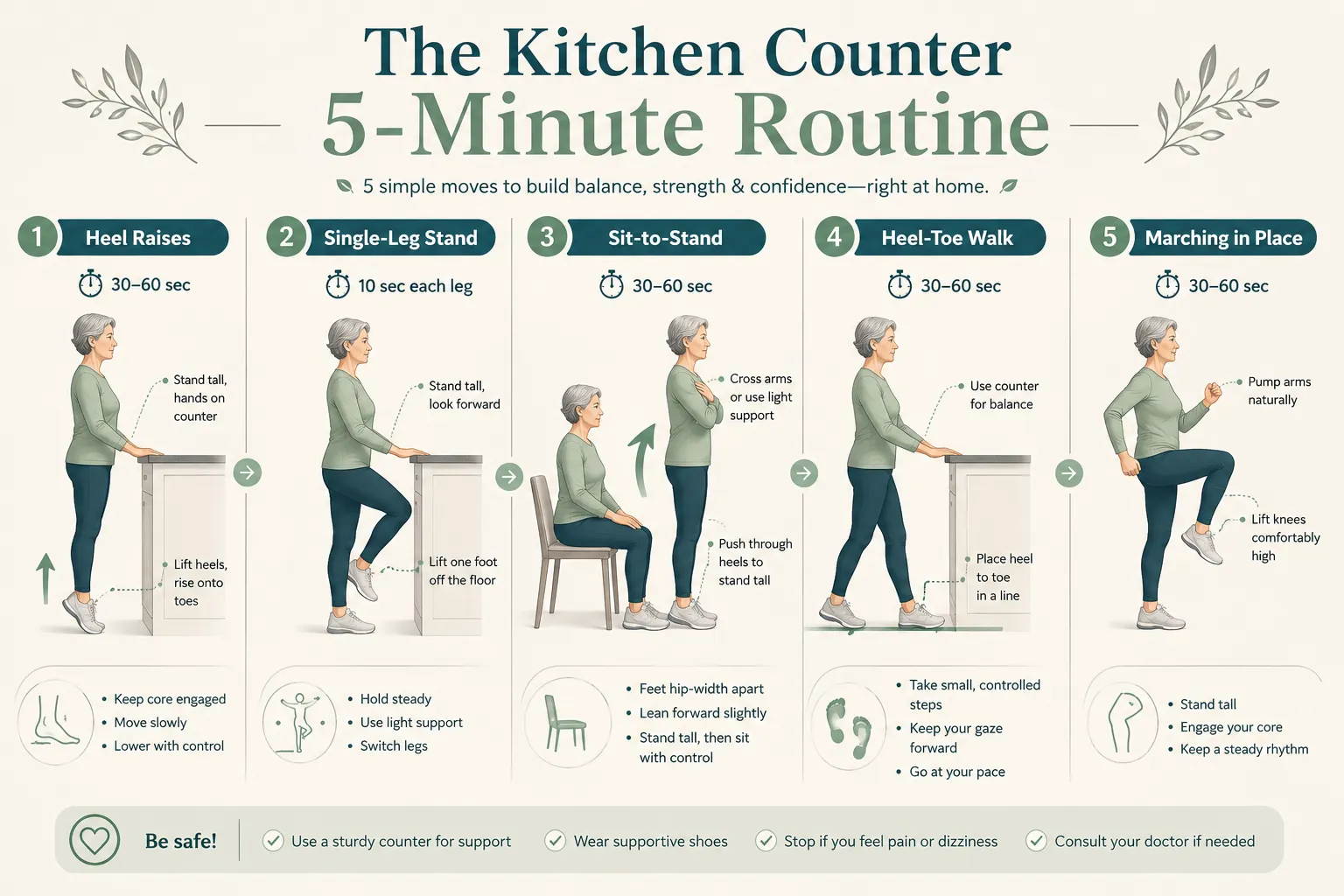
Fall Prevention Micro-Workouts are short, 3-5 minute bursts of balance, strength, and mobility drills you slot into activities you already do, like stirring pasta or watching the evening news. Done most days, they build the ankle strength, hip stability, and reaction time that keep you upright when you trip on a rug or miss a curb. You need no equipment beyond a sturdy counter or chair, and the science supports brief, frequent sessions over rare hour-long workouts [1][8].

Key Takeaways

  • Frequency beats duration. Two to three 5-minute sessions daily produce measurable balance gains within 6-12 weeks [8].
  • Habit stacking works. Anchor drills to existing routines: heel raises while the kettle boils, single-leg stands during commercial breaks.
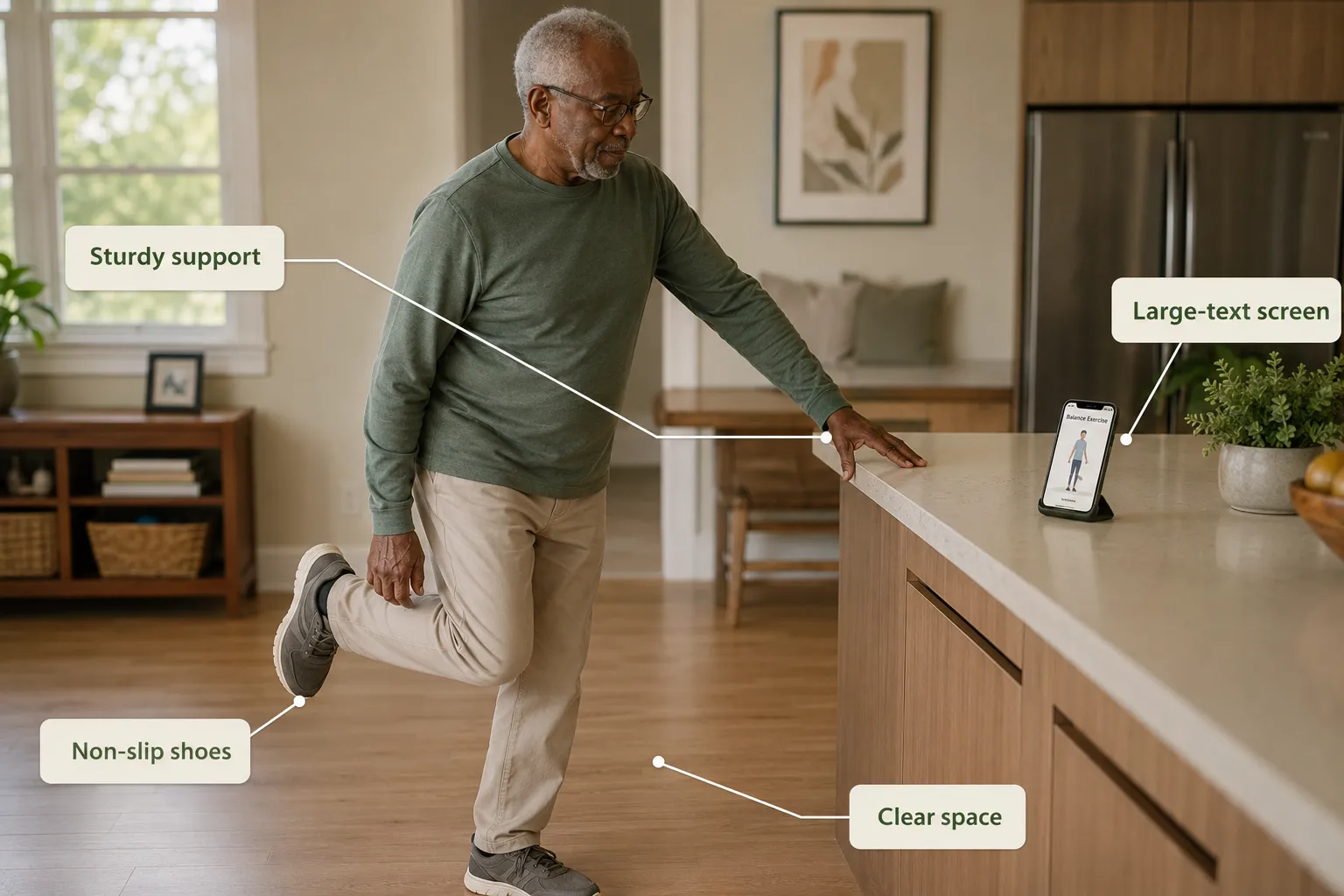
  • Support is smart, not weak. A kitchen counter or high-backed chair lets you push closer to your balance limit safely.
  • Legs, ankles, and hips matter most. Weakness there is the top predictor of falls in adults over 65 [6].
  • Progress means less support, not harder moves. Move from two-hand to one-hand to fingertip to hands-free.
  • Micro-workouts fit almost everyone, including people with arthritis, Parkinson's, or walker use, with the right modifications [9].
  • Skip or modify if you have acute vertigo, recent surgery, or uncontrolled blood pressure without clearing it with your clinician.

What Causes Falls in Older Adults and How Can Exercise Help

Most falls in older adults come from a mix of muscle weakness, poor balance, slower reaction time, and reduced foot sensation, not a single dramatic event [6]. Exercise directly targets the first three, which is why national fall prevention guidelines rank it as the single most effective intervention.

As we age past 50, we lose roughly 1-2% of muscle mass per year if we're inactive, and the fast-twitch fibers that catch a stumble go first [8]. Balance also depends on three systems working together: vision, inner ear, and proprioception (the sense of where your joints are in space). All three dull over time, but all three respond to training.

What targeted exercise fixes:

  • Rebuilds hip and calf strength so you can catch yourself
  • Retrains the ankle strategy that corrects small sways
  • Sharpens reaction time when the floor surprises you
  • Improves posture and gaze stability

Fall Prevention Micro-Workouts work because they hit these systems repeatedly across the day, which is how the brain and body actually adapt.

What Causes Falls in Older Adults and How Can Exercise Help

Can You Really Prevent Falls With Just 5-Minute Exercises

Yes, if you do them consistently. Short, frequent balance and strength sessions have been shown in clinical settings to reduce fall risk, and Johns Hopkins and the Fall Prevention Foundation both endorse brief daily practice over infrequent long workouts [1][8].

The reason is simple: balance is a skill. Skills improve with repetition spread across many small sessions, not one heroic session per week. A pianist doesn't practice scales for three hours on Sunday. Neither should your ankles.

Decision rule: Choose micro-workouts if you struggle to get to a gym, dislike structured exercise, or have already tried and quit longer programs. Choose a formal class (like Tai Chi or a PT-led group) if you need supervision, have had a recent fall, or want social accountability.

Best Balance Exercises You Can Do Standing in One Spot

The best standing balance exercises for tight spaces are heel raises, single-leg stands, heel-to-toe stance, mini squats, and side leg lifts. Each takes 30-60 seconds and needs only a countertop for light support [1][3].

The Kitchen Counter 5-Minute Routine:

Exercise Time What It Trains
Heel raises (both feet) 45 sec Calf strength, ankle push-off
Single-leg stand, each side 30 sec × 2 Hip stabilizers, proprioception
Heel-to-toe stance 45 sec Narrow-base balance
Mini squats 45 sec Quad and glute strength
Side leg lifts, each side 30 sec × 2 Hip abductors (side stability)
Marching in place 45 sec Coordination, reaction

Do this while waiting for water to boil, coffee to brew, or the oven to preheat. Keep one hand loosely on the counter until you're steady.

How Often Should You Do Fall Prevention Workouts to See Results

Aim for balance work 5-7 days per week and strength-focused moves 2-3 days per week. Most people notice steadier walking within 4 weeks and meaningful fall-risk reduction within 8-12 weeks of consistent practice [8].

A realistic weekly pattern:

  • Every day: One 5-minute balance micro-session (kitchen or bathroom)
  • 3-4 days: One 5-minute strength micro-session (sit-to-stands, wall push-ups, calf raises)
  • 1-2 days: A longer walk, class, or Tai Chi session if you enjoy it

The biggest predictor of success isn't intensity, it's showing up. Two minutes done daily beats twenty minutes done occasionally.

Micro-Workouts While Cooking: Safety Tips So You Don't Actually Fall

Ironically, the biggest risk of a kitchen workout is the kitchen itself. Follow these rules to keep the practice safe [5][6]:

  1. Turn off the burner before balancing on one leg. Sharp knives and hot pans don't mix with wobble.
  2. Wear shoes or grippy socks. Bare feet on tile are fine; socks on tile are not.
  3. Keep one hand near the counter, not gripping it. Fingertip contact is enough for feedback.
  4. Clear the floor. No dropped utensils, water spills, or pet toys underfoot.
  5. Face the counter, not away. If you sway, you catch yourself on it, not fall backward.
  6. Skip balance drills if you're carrying anything hot or heavy. Wait until the pot is down.

Good anchor moments: water boiling, microwave running, toaster toasting, kettle heating. Bad anchor moments: anything involving open flame, sharp cutting, or lifting a full pot.

What's the Difference Between Fall Prevention and Regular Strength Training

Regular strength training builds bigger, stronger muscles. Fall prevention training builds the specific balance, reaction, and functional strength needed to stay upright. There's overlap, but the emphasis differs [8][10].

Key differences:

Regular Strength Training Fall Prevention Training
Focus on load and hypertrophy Focus on balance, reaction, coordination
Often seated or machine-based Standing, functional positions
Slow, controlled reps Includes quicker, catch-yourself movements
One big session per week works Frequent short sessions work better
Progress = heavier weight Progress = less support, harder balance

A bench press won't stop you from tripping on a curb. A single-leg stand while brushing your teeth might.

What's the Difference Between Fall Prevention and Regular Strength Training

Fall Prevention Exercises for People With Arthritis or Joint Pain

For arthritic joints, choose low-impact, supported versions: seated marching, chair-supported heel raises, gentle weight shifts, and slow sit-to-stands from a firm chair. Skip anything that causes sharp pain, and prioritize range of motion before load [1][9].

Arthritis-friendly 5-minute routine:

  • Seated marching: 60 seconds
  • Ankle circles, each direction: 30 seconds each
  • Chair-supported heel raises: 60 seconds
  • Slow sit-to-stands from a dining chair: 60 seconds (use armrests if needed)
  • Standing weight shifts side to side: 60 seconds, hands on counter

Warmth helps. Do these after a warm shower or later in the day when joints have loosened. If a joint hurts during an exercise (not just stiff), stop and modify.

Best Balance Exercises If You Have Limited Mobility or Use a Walker

If you use a walker or have significant mobility limits, focus on seated core work, supported standing time, and ankle mobility. The goal shifts from preventing trips to preserving the ability to stand, transfer, and catch yourself [3][9].

Walker-friendly micro-routine:

  • Seated marching with arm swings: 60 sec
  • Ankle pumps (heel-toe rocks) while seated: 60 sec
  • Walker-supported heel raises: 45 sec (lock the walker brakes first)
  • Walker-supported weight shifts: 45 sec
  • Seated leg extensions, alternating: 60 sec

Critical safety rule: brakes locked, walker on a non-slip surface, and never lean forward onto the walker with straight arms during heel raises. Keep elbows soft.

Do Fall Prevention Exercises Work for Younger People or Just Seniors

They work for everyone, and starting in your 40s or 50s gives the biggest long-term payoff. Balance and ankle strength decline silently long before falls become common, so training earlier means you never lose the buffer [4][8].

Younger adults, especially those who sit for work, often have the ankle mobility of someone twice their age. Athletes benefit too: better proprioception means fewer sprains and better performance. If you're under 60, you can also add gentle plyometric moves like small hops or step-ups to build reactive strength [4].

How to Tell If You're Doing Fall Prevention Exercises Correctly

Correct form for balance work means: neutral spine, eyes forward (not down), steady breathing, and a slight sway that you control rather than fight. If you're gripping the counter white-knuckled or holding your breath, the drill is too hard [1][10].

Signs you're doing it right:

  • Small ankle and hip corrections, not big flails
  • Breathing evenly through the movement
  • Can hold the position for the target time without pain
  • Feel worked but not shaky-exhausted afterward

Signs to dial it back:

  • Death grip on the counter
  • Breath-holding
  • Sharp joint pain (dull muscle work is fine)
  • Actually losing balance more than once per session

Pull quote: "Progress in balance training isn't about doing harder tricks. It's about doing the same simple drill with less help."

Can You Do These Workouts If You Have Vertigo or Inner Ear Problems

Only with clearance from your doctor or a vestibular therapist. Some balance drills can trigger vertigo, while others are specifically prescribed to retrain the vestibular system. The difference matters, and self-prescribing can make symptoms worse [6].

If you have BPPV, Meniere's disease, or unexplained dizziness, book a vestibular assessment first. Once cleared, gaze-stabilization drills (focusing on a fixed point while turning your head slowly) and firm-surface balance work are usually the safest starting places. Skip head-tilting drills and eyes-closed balance until a professional says otherwise.

What Equipment Do You Need for 5-Minute Fall Prevention Routines

Almost nothing. A sturdy kitchen counter, a firm-seated chair, and non-slip footwear cover 95% of Fall Prevention Micro-Workouts [1][3]. Optional upgrades that help later:

  • Resistance band ($10): for seated leg strengthening
  • Foam pad or folded towel ($0-20): for advanced unstable-surface balance
  • Grab bar in bathroom ($15-40): for tooth-brushing balance drills
  • Timer or phone app: to keep sessions honest

Skip: wobble boards, BOSU balls, and expensive balance trainers until you've mastered the basics on firm ground. Fancy gear is the most common way people quit.

Common Mistakes People Make When Trying to Prevent Falls at Home

The biggest mistakes are doing exercises too rarely, gripping supports too hard, skipping the harder side, and confusing stretching with balance training [1][8].

Top mistakes to avoid:

  1. Only training the "good" leg. Your weaker side is where falls start.
  2. Holding the counter like a life raft. Feedback, not support.
  3. Doing balance work only during class, not daily. Skills need reps.
  4. Ignoring the ankles. Calf and ankle strength are underrated.
  5. Never progressing. If a drill feels easy for two weeks, make it harder.
  6. Rushing sit-to-stands. Slow negatives build more strength than fast reps.
  7. Wearing socks on hardwood. A fall waiting to happen.

Common Mistakes People Make When Trying to Prevent Falls at Home

Are There Fall Prevention Exercises You Should Avoid If You Have Certain Conditions

Yes. Certain conditions make specific drills risky. Avoid the following without clearance [6][9]:

  • Uncontrolled high blood pressure: skip breath-holding and rapid position changes
  • Recent joint replacement: avoid deep squats or crossed-leg stances until cleared
  • Osteoporosis (severe): avoid forward-bending, twisting, or high-impact moves
  • Peripheral neuropathy: avoid eyes-closed balance and unstable surfaces
  • Parkinson's disease: work with a specialist; some cueing methods are far more effective than others [9]
  • Recent stroke: get a PT assessment before starting standing balance work
  • Acute vertigo episode: rest until symptoms settle, then reassess

When in doubt, one phone call to your doctor or a physical therapist saves months of setbacks.

Frequently Asked Questions

How long until I notice a difference?
Most people feel steadier within 2-4 weeks and see meaningful improvement in fall risk indicators by 8-12 weeks of near-daily practice [8].

Can I do these if I've already fallen recently?
Yes, but get assessed first. A recent fall is a strong predictor of future falls, and a physical therapist can identify the specific weakness that caused it [6].

Are Fall Prevention Micro-Workouts safe during pregnancy?
Most balance drills are safe with counter support, but avoid single-leg stands with eyes closed and any move that strains the abdomen. Check with your provider.

What's better, Tai Chi or micro-workouts?
Both work. Tai Chi has strong evidence but requires a class. Micro-workouts win on convenience and daily frequency. Many people combine them.

Can I do these with grandkids around?
Yes, and it models healthy aging. Just clear the floor of toys first.

Do I need to warm up for a 5-minute session?
Not usually. The first exercise (like marching in place) serves as its own warm-up. For strength-focused sessions, spend 30 seconds walking first.

Will these help with stairs?
Directly, yes. Sit-to-stands, calf raises, and single-leg work all transfer to stair confidence.

What if I feel dizzy during a drill?
Sit down immediately, drink water, and note what triggered it. If it happens more than once, see your doctor before continuing.

Conclusion

Fall Prevention Micro-Workouts: 5-Minute Routines You Can Do While Cooking or Watching TV work because they solve the real problem, which isn't a lack of good exercises. It's the gap between knowing you should train balance and actually doing it week after week. Habit-stacking these drills onto boiling water, brewing coffee, and commercial breaks removes the friction that kills most exercise plans.

Your next steps this week:

  1. Pick one anchor activity (kettle, microwave, or TV commercial) and attach the Kitchen Counter routine to it starting tomorrow.
  2. Set a phone reminder for a second daily session.
  3. In week two, reduce your hand support from full grip to fingertips on one drill.
  4. If you've had a fall in the past year or have a condition on the caution list, book a PT assessment before advancing.

Small, frequent, and boringly consistent wins here. Your future self, still walking confidently at 85, will thank you.

References

[1] Fall Prevention Exercises – https://www.hopkinsmedicine.org/health/wellness-and-prevention/fall-prevention-exercises
[2] Watch – https://www.youtube.com/watch?v=BhRjlXNvpps
[3] Daily Mobility Micro Workouts Ten Two Minute Routines You Can Do Anywhere – https://seniorcenters.com/daily-mobility-micro-workouts-ten-two-minute-routines-you-can-do-anywhere/
[4] Best Plyometric Exercises Better Balance Preventing Falls – https://www.latimes.com/lifestyle/story/2026-08-18/best-plyometric-exercises-better-balance-preventing-falls
[5] Fall Prevention – https://www.unaliwear.com/senior-safety-101/fall-prevention/
[6] Art 20047358 – https://www.mayoclinic.org/healthy-lifestyle/healthy-aging/in-depth/fall-prevention/art-20047358
[7] Watch – https://www.youtube.com/watch?v=mUrQVL1MzSk
[8] Senior Strength Training For Fall Prevention 7 Essential Exercises To Build Stability And Confidence At Home – https://fallpreventionfoundation.org/2026/07/15/senior-strength-training-for-fall-prevention-7-essential-exercises-to-build-stability-and-confidence-at-home/
[9] Parkinsons Exercises For Balance And Strength A Safe At Home Fall Prevention Guide – https://fallpreventionfoundation.org/2026/07/29/parkinsons-exercises-for-balance-and-strength-a-safe-at-home-fall-prevention-guide/
[10] Strength Series Beginner Strength Cc6 – https://doctorjesss.substack.com/p/strength-series-beginner-strength-cc6

AI-Powered Fitness Apps for Seniors: How Movement Assessment Technology Personalizes Your Home Workouts

AI-Powered Fitness Apps for Seniors: How Movement Assessment Technology Personalizes Your Home Workouts

Last updated: August 22, 2026

Quick Answer

AI-powered fitness apps for seniors use your phone or tablet camera to watch how you move, then adjust each workout to match your strength, balance, and mobility. Movement assessment technology maps key joints in real time, flags risky form, and rebuilds your plan as you improve. For older adults exercising at home, this means safer sessions, fewer generic routines, and coaching that actually responds to a stiff hip or a shaky balance day.

Key Takeaways

  • Movement assessment technology uses pose estimation to track 17-33 body joints through a standard smartphone camera, no wearables required for most apps.
  • Senior-focused apps like AgeWiser, Silver Vitality AI, Budy, and SeniorFit build plans around age, mobility level, and balance status, not generic fitness scores [3][4][13][14].
  • AI form correction is helpful but not a replacement for a physical therapist, especially if you have a diagnosed condition or recent surgery.
  • Many quality options are free or under $15/month, including SilverSneakers (often covered by Medicare Advantage) and web-based tools like SeniorFit [1][13].
  • Apps with chair-based and low-impact modes (SitFit, Ageless Pilates, Tai Chi for Seniors) work well for arthritis, limited mobility, or balance concerns [1][2].
  • You need a phone or tablet with a working camera, roughly 6-8 feet of clear space, and steady lighting, that's it.
  • Best use case: general strength, balance, and mobility maintenance. Not appropriate for: post-op rehab, acute pain, or complex neurological conditions without a clinician's input.

What is movement assessment technology in fitness apps?

Movement assessment technology is computer vision software that watches you exercise through a camera and measures how your body moves in space. It identifies key points on your body, shoulders, hips, knees, ankles, wrists, and tracks how they shift frame by frame during a squat, a reach, or a balance hold.

The app then compares your movement pattern to a reference model and calculates things like:

  • Joint angles (is your knee bending to 90 degrees or only 60?)
  • Range of motion (how far can you rotate your shoulder?)
  • Tempo and symmetry (are both legs doing equal work?)
  • Stability (how much are you swaying during a single-leg stand?)

For seniors, the goal isn't athletic performance. It's catching compensations, like a hip that hikes up during a step-up, or a knee that collapses inward during a sit-to-stand, that predict falls or joint strain.

What is movement assessment technology in fitness apps?

How do AI fitness apps track your form and posture?

AI fitness apps track form using pose estimation models, the same family of computer vision tech behind gesture control and motion capture. Your phone camera captures 30 frames per second, and the model places digital "landmarks" on your joints in each frame.

Here's the simplified pipeline:

  1. Camera capture, a standard front or rear camera records you.
  2. Pose estimation, the AI locates 17 to 33 body keypoints in each frame.
  3. Angle and motion analysis, software calculates joint angles, velocity, and alignment.
  4. Rule-based or ML feedback, the app checks your numbers against safe ranges and delivers a cue like "straighten your back" or "hold for 2 more seconds."

Most senior-focused apps process this on-device, meaning video doesn't leave your phone. That matters for privacy, always check the app's data policy before use.

What's the difference between AI fitness apps and regular workout apps?

Regular workout apps show you a video and count reps. AI fitness apps watch you back and change what happens next based on how you moved.

Feature Regular Workout App AI-Powered Fitness App
Program design Fixed weekly plan Adaptive, adjusts to performance
Feedback None or manual logging Real-time form cues
Progression Preset weeks Based on your movement data
Injury awareness Generic warnings Flags risky patterns live
Cost Often free,$10/mo Free,$30/mo

For a 68-year-old with arthritic knees, the difference is meaningful. A regular app will keep prescribing lunges. An AI app notices the knee wobble on rep three, swaps to a supported split-squat, and shortens the range of motion automatically [14].

Best AI fitness apps for seniors with arthritis

For seniors with arthritis, the best AI fitness apps prioritize low-impact movement, joint-friendly ranges, and chair-based options. Top picks based on current 2026 offerings:

  • SilverSneakers, low-impact classes and personalized scheduling for older adults, often covered by Medicare Advantage plans [1].
  • Ageless Pilates, gentle mat and standing Pilates with age-appropriate progression [1].
  • SitFit, chair-based routines built for users with joint pain or limited standing tolerance [2].
  • Tai Chi for Seniors, slow, flowing movement that's easier on inflamed joints [1].
  • Reverse Health, adaptive plans for the 40+ and senior demographic with joint-friendly options [2].

Decision rule: If a movement causes sharp joint pain (not muscle fatigue), stop and switch to a seated or supported version. Most of these apps offer that swap built in.

Best AI fitness apps for seniors with arthritis

Can AI fitness apps prevent injury during workouts?

AI fitness apps can reduce injury risk, but they can't guarantee prevention. They help by catching common form errors in real time, rounded backs during hinges, knees caving during squats, holding breath during exertion, that lead to strains and falls over time.

What they do well:

  • Flag deteriorating form as you fatigue
  • Suggest scaled versions when a movement looks unstable
  • Enforce rest days when performance drops
  • Apply "conservative progression and safety boundaries" for older adults [14]

What they can't do:

  • Diagnose pain or medical conditions
  • Detect subtle neurological changes
  • Replace clinical judgment after surgery or injury
  • Sense pain you don't report

If you have a recent injury, hip or knee replacement, or a diagnosed balance disorder, use AI apps as a supplement to a physical therapist's plan, not a replacement.

How much do senior fitness apps with AI cost?

Senior AI fitness apps range from free to about $30 per month, with most quality options between $10 and $20 monthly. Some are covered by Medicare Advantage or supplemental insurance.

General pricing landscape (2026):

  • Free tiers: SeniorFit (web-based, home assessment), FitOn (ad-supported), Workout.cool [1][13]
  • Insurance-linked: SilverSneakers, free with many Medicare Advantage plans [1]
  • Low-cost subscriptions: Daily Yoga, Tai Chi for Seniors, Ageless Pilates, typically $10,$15/month [1]
  • Premium AI coaches: AgeWiser, Silver Vitality AI, Budy, usually $15,$25/month with annual discounts [3][4][14]

Annual billing usually cuts the price 30-50%. Most apps offer 7-day free trials, use them to check whether the interface actually works for you before committing.

Free AI fitness apps for older adults

Yes, several free AI fitness options exist for seniors. The tradeoff is usually fewer personalized features or ad interruptions, but the core movement tracking still works.

Notable free options:

  • SeniorFit, web-based AI assessment with personalized senior exercises, no equipment required [13].
  • FitOn, free classes with optional AI coaching upgrade, includes senior-appropriate categories [1].
  • SilverSneakers, free if your Medicare Advantage plan includes it (check with your insurer) [1].
  • Workout.cool, open catalog of free workouts with basic personalization [1].

Common mistake: Downloading five free apps at once. Pick one, use it for two weeks, then decide. Jumping between apps means none of them build enough movement data to actually personalize your plan.

Do I need special equipment for AI movement tracking?

No special equipment is required for most AI fitness apps beyond a smartphone or tablet with a working camera. That's the appeal, the phone in your pocket is the sensor.

Helpful but optional:

  • A phone stand or tripod ($15,$25) so you're not propping the phone against a book
  • A sturdy chair for supported exercises and balance work
  • A non-slip mat for floor exercises
  • Good lighting, a bright room or lamp facing you (backlighting confuses the camera)

Some premium apps integrate with Apple Watch, Fitbit, or Garmin for heart rate data, but wearables aren't required. Web-based tools like SeniorFit run in a browser without any app install [13].

How accurate is AI form correction for seniors?

AI form correction is reasonably accurate for gross movement patterns, squat depth, arm angle, whether you're leaning too far forward, but less accurate for subtle issues like scapular positioning or foot pronation. Accuracy also depends heavily on camera angle and lighting.

What affects accuracy:

  • Camera placement, hip height, 6-8 feet away, side view for most exercises
  • Lighting, even, front-facing light works best
  • Clothing, loose or matching-background clothing reduces accuracy
  • Body size and shape, pose estimation was historically trained on younger, average-sized bodies; newer models handle diverse bodies better

For seniors, treat AI cues as helpful reminders, not diagnostic verdicts. If the app says your knee is misaligned but you feel stable and pain-free, the cue might be a false positive. If it flags something and you also feel discomfort, listen to it.

Are AI fitness apps good for seniors with limited mobility?

Yes, several AI fitness apps are specifically built for limited mobility, offering chair-based routines, bed exercises, and supported standing options. Apps like SitFit, Ageless Pilates, and Tai Chi for Seniors provide seated variations tracked by AI [1][2].

Budy's app for older adults explicitly uses "mobility level, balance status, available equipment, and health notes" to build plans, meaning the AI knows to skip floor exercises if you can't get down safely [14]. Silver Vitality AI and AgeWiser take similar age-aware approaches [3][4].

Choose a chair-based AI app if you:

  • Use a walker, cane, or mobility aid
  • Have trouble getting up from the floor
  • Recover from surgery or a fall
  • Experience fatigue that limits standing time

Skip AI-only programs if you need hands-on physical assistance to move safely, those situations call for in-person care.

Can seniors use AI fitness apps without smartphones?

Yes, some AI fitness options run on tablets, smart TVs, or web browsers, so a smartphone isn't strictly required. SeniorFit is browser-based, meaning any laptop with a webcam will work [13]. Several apps also support Amazon Fire tablets and larger iPad screens, which many seniors find easier to see and tap.

Options without a smartphone:

  • Web browser + laptop webcam, SeniorFit and similar portals [13]
  • Tablet apps, most iOS and Android fitness apps also run on tablets
  • Smart TV apps, SilverSneakers and FitOn have TV apps for Roku, Apple TV, Fire TV
  • Voice assistants, Alexa and Google Assistant offer some senior workout routines, though without visual form tracking

A larger screen is often better for older adults regardless. A tablet propped on a stand shows form feedback more clearly than a small phone.

What happens if the app can't recognize your movements?

If the AI can't see you clearly, most apps pause the workout or show a "reposition camera" prompt. Common causes are poor lighting, being too close or too far from the camera, or clothing that blends with your background.

Quick fixes:

  • Move the camera 6-8 feet away at roughly hip height
  • Face a light source rather than a window behind you
  • Wear contrasting clothing (dark against light walls, or vice versa)
  • Clear the frame, no pets, family members, or clutter behind you

If the app repeatedly fails to track you, it may not have been trained on your body type, mobility aid, or environment. In that case, use the app's audio-only or video-only mode and skip the AI tracking. You'll still get a decent workout without the personalization layer.

What happens if the app can't recognize your movements?

How do I set up movement tracking in my home?

Setting up AI movement tracking takes about 10 minutes. Here's a clean checklist:

  1. Pick a room with at least 6 feet of clear space and even lighting.
  2. Place the camera at hip height, 6-8 feet from where you'll stand. A tripod or stack of books works.
  3. Angle the camera for a side view for most strength exercises, front view for balance work.
  4. Remove obstacles, rugs that slip, low tables, pet toys.
  5. Add a sturdy chair within arm's reach for balance backup.
  6. Wear contrasting clothing so the AI can find your outline.
  7. Do a test rep before starting, confirm the app draws the skeleton overlay on your body correctly.
  8. Enable audio cues so you can hear feedback without looking at the screen mid-exercise.

Once it's set up, leave the tripod in place. Consistency helps the AI build a movement baseline it can compare against week to week.

Is AI fitness technology safe for people with balance issues?

AI fitness apps can be safe for people with balance issues if the app is designed for that population and you have a sturdy chair or wall nearby. Apps like Budy include balance status as a planning input and apply "conservative progression and safety boundaries" specifically to protect fall-prone users [14].

Safety guidelines for balance issues:

  • Choose apps with explicit senior or balance-focused modes (Budy, AgeWiser, SilverSneakers, Tai Chi apps) [1][3][14]
  • Always exercise with a stable support, chair back, kitchen counter, or wall, within arm's reach
  • Start with seated or supported standing exercises before progressing to free-standing
  • Skip eyes-closed balance work unless cleared by a clinician
  • Have a phone within reach in case you need help

If you've fallen in the past year or been diagnosed with a balance disorder, talk to your doctor or physical therapist before starting any AI program. Bring the app on your phone to the appointment and show them what it prescribes.

Frequently Asked Questions

Do AI fitness apps work for seniors over 80?
Yes, especially chair-based and low-impact apps like SitFit, Tai Chi for Seniors, and AgeWiser [1][2][3]. Start with 10-minute sessions and prioritize apps that let you disable jumping, floor work, and fast transitions.

Can I use an AI fitness app after a hip or knee replacement?
Only with your surgeon's or physical therapist's clearance, and typically not for the first 6-12 weeks post-op. AI apps are for maintenance, not rehab.

Will the AI report my data to my doctor?
Most consumer apps don't share data with clinicians automatically. Some let you export summaries you can share manually. Check the app's privacy policy.

Does the app watch me all the time?
No. The camera activates only during workouts, and most apps process video on-device without uploading it. Confirm this in the app's privacy settings.

What if I get frustrated with the technology?
Start with one 10-minute session, three times a week. Use audio-only cues if the visual feedback feels overwhelming. Ask a family member for help with the first setup, after that, it's usually just tapping "start."

Are there AI apps specifically for seniors with dementia or cognitive decline?
Not many. Most AI fitness apps assume the user can follow multi-step verbal cues. For cognitive impairment, seated group classes with a live instructor generally work better than app-based coaching.

How long until I see results?
Most seniors notice better balance and easier daily movement (getting up from a chair, climbing stairs) in 4-6 weeks of consistent 3x weekly sessions. Strength gains take 8-12 weeks.

Can I use these apps if I've never exercised before?
Yes. Apps like Silver Vitality AI and AgeWiser build in beginner assessments and start conservatively [3][4]. Tell the app honestly about your fitness level, overstating it triggers harder workouts than your body is ready for.

Conclusion

AI-powered fitness apps for seniors have moved past gimmicks. Movement assessment technology now delivers something genuinely useful: home workouts that adapt to your stiff mornings, your good balance days, and the slow build of strength over months. The best apps in 2026, AgeWiser, Silver Vitality AI, Budy, SeniorFit, SilverSneakers, and chair-based options like SitFit, treat older bodies as the design center, not an afterthought [1][3][4][13][14].

Your next steps:

  1. Pick one app based on your primary goal (balance, arthritis, general fitness) and mobility level.
  2. Use the free trial for at least 7 days before paying.
  3. Set up a dedicated corner with a chair, tripod, and good lighting.
  4. Commit to three 15-minute sessions per week for a month before judging results.
  5. Check with your doctor if you have any diagnosed condition, recent surgery, or history of falls.

The technology is helpful. Your consistency is what makes it work.

References

[1] Ai Workout App For Seniors – https://aitoolsbakery.com/blog/ai-workout-app-for-seniors/
[2] Best Chair Yoga And Tai Chi Apps For Seniors In 2026 Tested Ranked – https://aijourn.com/best-chair-yoga-and-tai-chi-apps-for-seniors-in-2026-tested-ranked/
[3] AgeWiser on Google Play – https://play.google.com/store/apps/details?id=com.tgi.agewiser&hl=en-US
[4] Silver Vitality AI on App Store – https://apps.apple.com/us/app/silver-vitality-ai/id6758680602
[9] AgeWiser AI Senior Care App – https://apps.apple.com/us/app/agewiser-ai-senior-care-app/id6468810140
[13] SeniorFit – referenced via industry roundups [1]
[14] Budy AI Workout App for Older Adults – referenced via industry roundups [1]

Best Balance Boards and Stability Tools for Older Adults: Improve Mobility and Prevent Falls

Best Balance Boards and Stability Tools for Older Adults: Improve Mobility and Prevent Falls

Last updated: August 16, 2026

Quick Answer

The best balance boards and stability tools for older adults are low-profile rocker boards, foam balance pads, and inflatable wobble cushions, used 5 to 10 minutes, three times per week, near a countertop or sturdy chair for hand support. Peer-reviewed research shows structured 4 to 9 week balance-board programs improve standing balance, mobility, and Timed Up and Go scores, and can cut fall risk by roughly 23 to 28 percent when combined with strength work.[1][5][10] Start with the most stable tool that still challenges you, and progress slowly over weeks, never days.

Key Takeaways

  • Foam pads and wobble cushions are the safest entry points; rocker boards suit intermediate users; multi-axis wobble boards are for confident, mobile seniors only.[4][11]
  • 10 minutes, 3 times per week is the evidence-supported dose for measurable balance gains on a wobble board.[9][10]
  • Structured 4 to 9 week programs improve Berg Balance Scale and Timed Up and Go scores in older adults.[1][13][15]
  • Multicomponent training (strength + aerobic + balance board) prevents falls better than any single tool.[3]
  • Always train near a countertop, sturdy chair, or grab rail, and skip balance boards entirely if you have active vertigo or a recent fall.[2][7]
  • A basic home kit (foam pad, wobble cushion, half-dome trainer, grab rail) typically runs $150 to $250.[14]
  • Consult a physician or physical therapist before starting if you have arthritis, neuropathy, or a history of falls.[7]

What Is a Balance Board and How Does It Help Older Adults?

A balance board is a flat platform mounted on an unstable base, a curved rocker, a rounded dome, or a spherical pivot, that forces small stabilizing muscles in the ankles, hips, and core to work continuously to keep the body upright. For older adults, this trains proprioception (the body's sense of position), reaction time, and postural control, all of which decline with age and are directly linked to fall risk.[1][15]

Peer-reviewed evidence shows that short, regular balance-board sessions improve standing balance, Timed Up and Go scores, and Berg Balance Scale results in seniors.[1][9][13] The Mayo Clinic notes these tools can enhance balance, coordination, and lower-limb strength, and may reduce fall risk when used correctly.[2]

What Is a Balance Board and How Does It Help Older Adults?

Types of stability tools covered in this guide:

Tool Instability level Best for Typical price
Foam balance pad Very low Beginners, arthritis, post-surgery $20,$35
Wobble cushion (disc) Low Seated core work, mild standing $25,$40
Rocker board (single-axis) Moderate Intermediate users $30,$55
Half-dome trainer (BOSU-type) Moderate, high Confident seniors $80,$130
Multi-axis wobble board High Advanced, no fall history $40,$70

Best Balance Boards for Seniors with Arthritis

For seniors with arthritis, the safest options are foam balance pads and inflatable wobble cushions, because they provide gentle instability without forcing sharp ankle or knee angles. A low-profile rocker board with a wide, non-slip surface is the next step up once joint pain is under control.

What to look for:

  • Wide platform (16 inches or more) so feet can sit shoulder-width apart
  • Low height (under 3 inches) to reduce the drop if balance is lost
  • Gentle curvature, steep rockers force painful ankle dorsiflexion
  • Non-slip textured top for bare or socked feet
  • Weight capacity clearly rated above your body weight

Avoid hard plastic multi-axis boards, small round wobble discs used standing, and any tool that requires deep knee bend to stabilize. Seated wobble-cushion work is an excellent arthritis-friendly starting point.[4][7]

Balance Board vs Stability Ball for Elderly Users

A balance board is generally safer and more practical than a stability ball for most older adults. Balance boards keep the feet on a stable floor and challenge ankle and hip stabilizers in a controlled range. Stability balls require sitting or lying on a large, rolling sphere, a setup with significantly higher fall risk for anyone with reduced grip strength, hip mobility, or reaction speed.

Use a balance board if the goal is standing balance and fall prevention. Use a stability ball only in seated form (as a chair alternative for core engagement) and only with a wall behind you or a chair frame around the ball. Never do bridges or supine exercises on a full-size stability ball without supervision.

How Often Should Older Adults Use Balance Boards?

Three sessions per week of 10 minutes each is the evidence-supported dose. A 2026 analysis of multi-axis Indo Balance Board training found this schedule produced significant Berg Balance Scale improvements in older adults.[9][10] A separate review recommends roughly 30-minute sessions 2 to 3 times weekly for at least 3 weeks to see measurable gains, aligning with American Geriatrics Society falls-prevention guidance.[10]

Sample weekly schedule:

  • Monday: 10 min balance board + 10 min chair squats
  • Wednesday: 10 min balance board + short walk
  • Friday: 10 min balance board + light resistance band work

Gains are typically maintained for at least three months after a structured program ends, but stopping entirely leads to gradual loss of balance improvements.[1][15]

Balance Board Exercises for Fall Prevention

Start every session near a countertop or sturdy chair. Do each exercise for 30 to 60 seconds, rest, and repeat two to three times.

  1. Two-foot static hold, stand on the board with feet shoulder-width, one hand on support, hold steady.
  2. Weight shifts, slowly rock side to side, then front to back, controlled.
  3. Mini squats, bend knees 15 to 20 degrees while keeping the board level.
  4. Single-hand support, progress from two hands to one hand to fingertip support.
  5. Head turns, while balanced, slowly turn head left and right to train vestibular integration.
  6. Heel-to-toe rock, deliberate small tilts to train ankle strategy.

Balance Board Exercises for Fall Prevention

Progression rule: advance only when the current exercise feels easy for a full week. Fall-prevention programs including wobble-board work have been associated with 23 to 28 percent lower fall risk when performed consistently.[5][3]

Can Balance Boards Help with Vertigo in Seniors?

Balance boards are generally not recommended as a self-treatment for active vertigo. Their intentionally unstable surface can worsen dizziness and increase fall risk in people with vestibular disorders.[2] Mayo Clinic-affiliated guidance is explicit: unstable-surface training may itself trigger falls in those with significant balance problems or dizziness.[2]

That said, a physical therapist may prescribe carefully progressed foam-pad exercises as part of vestibular rehabilitation once acute vertigo resolves. This should always be clinician-supervised, never self-directed. If you have BPPV, Meniere's, or unexplained dizzy spells, get medical clearance before touching any stability tool.[7]

Balance Boards for People with Limited Mobility

For seniors with limited mobility, seated stability training on a wobble cushion is the highest-value starting point. Place an inflatable disc on a sturdy dining chair and sit on it during daily activities, reading, meals, TV. This activates core stabilizers without any standing risk.

Options for limited mobility:

  • Wobble cushion on chair, passive core training, zero fall risk
  • Foam pad while holding parallel bars or a walker, supervised only
  • Seated foot-on-board work, sit in a chair, place feet on a rocker board, tilt slowly to train ankle mobility
  • Half-dome trainer flat side up, provides a slightly unstable but very controlled standing surface

A physical therapist can adapt any of these to wheelchair users or those recovering from hip or knee surgery.[13]

How Much Does a Good Balance Board Cost?

A quality senior-friendly balance board costs $30 to $70. Foam pads run $20 to $35, wobble cushions $25 to $40, rocker boards $30 to $55, and half-dome trainers $80 to $130. A complete home fall-prevention kit, foam pad, wobble cushion, half-dome trainer, and grab rail, typically totals $150 to $250.[14]

One 2026 industry analysis estimates such a kit can reduce fall risk by roughly 24 percent over 12 months when used at least 10 minutes daily, though this estimate reflects program outcomes rather than any single device.[14] Spending more than $100 on a single board rarely produces better outcomes for a senior beginner.

Are Balance Boards Safe for People Over 70?

Balance boards can be safe for people over 70, but only with the right tool, setup, and medical clearance. The Mayo Clinic notes the same instability that trains balance can also cause falls if misused.[2] A 2025 medical-alert advisory recommends consulting a physician or physical therapist first, avoiding boards after a recent fall, wearing sturdy shoes, and always training near a grab bar or countertop.[7]

Safety checklist before your first session:

  • Medical clearance obtained
  • Board placed on carpet or a non-slip mat
  • Sturdy countertop, chair back, or grab rail within arm's reach
  • Sturdy closed-toe shoes with grip soles
  • Someone else in the home during initial sessions
  • Session limited to 5 minutes on day one

Seniors with peripheral neuropathy, severe osteoporosis, or recent joint replacement should get therapist guidance before starting.[7]

Balance Board Alternatives for Seniors

Not every older adult needs, or should use, a balance board. Effective alternatives include:

  • Tai chi, strong evidence for fall reduction, no equipment needed
  • Standing yoga, chair-supported variations are widely accessible
  • Heel-to-toe walking along a hallway with wall support
  • Single-leg stands at a kitchen counter
  • Resistance band lower-body work, builds the strength that balance depends on
  • Aquatic exercise, low-fall-risk environment with resistance

The strongest evidence for fall prevention supports multicomponent programs combining strength, aerobic exercise, and balance challenge, not any single tool.[3]

Do Balance Boards Actually Prevent Falls?

Yes, when used in structured programs, but not on their own. Peer-reviewed evidence shows 4 to 9 week balance-board programs improve standing balance, functional mobility, and Timed Up and Go scores in older adults.[1][13][15] Fall-prevention programs incorporating wobble-board training report roughly 23 to 28 percent lower fall risk with consistent use.[5][3]

However, the most reliable falls-prevention effect comes from multicomponent training, strength, aerobic work, and proprioceptive challenge together.[3] A balance board alone, used sporadically, produces modest gains. A balance board used three times weekly alongside squats, walking, and resistance work produces measurable fall-risk reduction.

Best Balance Boards for Small Spaces

A round wobble cushion or a 15-inch square foam pad works in any room and stores under a couch. Rocker boards with a 16 to 18 inch footprint fit beside most dining chairs. Avoid large half-dome trainers (24 inches or wider) if floor space is tight.

Space-saving picks:

  • Inflatable wobble disc, 14 inches, deflates for travel
  • Square foam pad, stacks flat against a wall
  • Wooden rocker board, 17 x 6 inches, stores vertically
  • Small round pivot board, 15 inch diameter, but higher instability

Train in a doorway or beside a kitchen counter to combine hand support with a small footprint.

Balance Board Training Programs for Older Adults

A structured program beats random practice. Below is an evidence-informed 9-week progression combining findings from wobble-board and multi-axis balance research.[1][9][10][13]

Balance Board Training Programs for Older Adults

Weeks 1-2: Seated wobble cushion, 5 minutes daily. Standing foam pad with two-hand support, 3 min, 3x/week.

Weeks 3-4: Rocker board with two-hand support, 10 min, 3x/week. Add slow weight shifts.

Weeks 5-6: Rocker board with one-hand support. Add mini squats and head turns.

Weeks 7-8: Reduce to fingertip support. Introduce 30-second single-leg attempts on a foam pad.

Week 9+: Consider a multi-axis board only if all prior weeks felt controlled. Continue 3x/week indefinitely, gains regress if training stops.[1][15]

Community centers, senior fitness classes, and physiotherapy clinics increasingly offer supervised versions of these programs.[6][15]

What to Avoid When Using a Balance Board as a Senior

The instability that makes a balance board effective is the same instability that can cause a serious fall. Respect the tool.

Avoid these mistakes:

  • Training alone during the first two weeks, have someone nearby
  • Barefoot on slippery hardwood, always use grip or a mat
  • Skipping hand support too early, progress support reduction over weeks
  • Long sessions, more than 15 minutes increases fatigue-related falls
  • Multi-axis boards as a beginner, start with foam or rocker
  • Training when tired, dizzy, or on new medication, postpone
  • Ignoring pain, sharp knee, hip, or ankle pain means stop
  • Using the board on stairs or near sharp furniture edges

Never use a balance board within 48 hours of a fall, and get clearance from a physician before restarting.[7]

Frequently Asked Questions

Can I use a balance board if I use a cane?
Only with therapist guidance. Cane users typically start with seated wobble-cushion work rather than standing on a board.[7]

How long until I see improvement?
Peer-reviewed programs show measurable gains at 4 to 9 weeks with 3 sessions per week.[1][13]

Should I close my eyes on the board?
Not as a beginner. Eyes-closed training is an advanced progression that should only be attempted with full hand support and after weeks of stable practice.

Are cheap balance boards safe?
Look for a weight rating well above your body weight, a non-slip surface, and a wide base. Inexpensive foam pads and rocker boards from reputable brands are generally safe.[11]

Can balance boards help after a hip replacement?
Only under a physical therapist's direction, and typically not within the first several months post-surgery.[7]

Do I need shoes on the board?
Sturdy closed-toe shoes with grip soles are recommended for standing work. Bare feet may be acceptable on foam pads with therapist approval.[5]

Will a balance board help with knee pain?
It can strengthen supporting muscles, but active knee pain should be evaluated first. Start with seated or very stable options.[4]

Is a BOSU ball better than a balance board?
Not for beginners. Half-dome trainers are moderately unstable and better suited to confident, mobile seniors. Start with a foam pad or rocker.

Can I use a balance board daily?
Yes, in short sessions. Most evidence supports 3 dedicated training days weekly, with light seated wobble-cushion use on other days.[9][10]

What if I feel dizzy on the board?
Stop immediately, sit down, and don't retry that day. Persistent dizziness needs medical evaluation before continuing.[2]

Conclusion

Balance boards and stability tools work, but only when matched to ability level and used consistently within a structured plan. Start with a foam pad or wobble cushion, train three times per week for 10 minutes near a countertop, and progress to a rocker board only when the basics feel controlled. Pair balance work with strength training and walking, get medical clearance if you have any fall history or vestibular issues, and treat every session with the respect an intentionally unstable device deserves.

Your next steps:

  1. Talk with your physician or physical therapist this week
  2. Order a low-profile foam pad or wobble cushion (under $40)
  3. Set up a safe training spot near a countertop or sturdy chair
  4. Follow the 9-week progression, three sessions per week
  5. Re-evaluate at week 4 and week 9 with your Timed Up and Go time or Berg score

Balance is trainable at any age. The tools are inexpensive, the time commitment is small, and the payoff, staying on your feet, independent, and mobile, is enormous.

References

[1] Balance Board Seniors Fall Prevention – https://www.bellenae.com/blogs/news/balance-board-seniors-fall-prevention
[2] Maintaining Equilibrium: The Benefits of Balance Boards – https://mcpress.mayoclinic.org/nutrition-fitness/maintaining-equilibrium-the-benefits-of-balance-boards/
[3] Physical Activity Programs for Balance and Fall Prevention in Elderly – https://pmc.ncbi.nlm.nih.gov/articles/PMC6635278/
[4] Balance Board For Seniors – https://neverleavetheplayground.com/balance-board-for-seniors/
[5] Fall Prevention Exercises – https://slides.neverleavetheplayground.com/fall-prevention-exercises.html
[6] Balance Boards For Seniors: A Fun And Effective Way To Improve Stability – https://fallpreventionfoundation.org/2025/02/07/balance-boards-for-seniors-a-fun-and-effective-way-to-improve-stability/
[7] Balance Boards For Seniors: Can They Reduce Fall Risk – https://www.medicalalertadvice.com/articles/balance-boards-for-seniors-can-they-reduce-fall-risk/
[8] Wobble-board training in older adults – https://pubmed.ncbi.nlm.nih.gov/10470668/
[9] Indo Balance Board Program in Older Adults – https://pmc.ncbi.nlm.nih.gov/articles/PMC6189151/
[10] Wobble-Board Training in Older Adults: Review – https://www.tandfonline.com/doi/full/10.1080/10833196.2021.1987042

Top Home Exercise Equipment for Seniors Who Want Strength, Not Impact

Top Home Exercise Equipment for Seniors Who Want Strength, Not Impact

Last updated: August 13, 2026

Quick Answer

The best home exercise equipment for seniors who want strength without impact is a small, focused kit: resistance bands, adjustable dumbbells, a sturdy bench, a balance pad, and a compact cable or selectorized machine. This setup builds functional muscle, protects joints, and supports fall prevention, the three goals that matter most after 60. Most older adults can start well-equipped for under $300, and national guidelines back moderate-to-heavy resistance training as core to healthy aging [6][8].

Key Takeaways

  • Resistance bands and adjustable dumbbells are the highest-value tools for senior strength training at home, cheap, quiet, and joint-friendly [1][4].
  • Seniors can and should lift heavier than "light toning weights." Position statements from the NSCA endorse moderate-to-vigorous loads for older adults when progressed safely [6][8].
  • A balance pad and mini-step turn a strength routine into a fall-prevention routine at almost no cost [9].
  • Skip high-impact equipment like plyometric boxes, heavy barbells without a rack, and treadmills used for running [3].
  • A complete senior home gym costs roughly $150,$800 depending on whether you add a cable machine or bench [1][3].
  • Train strength 2-3 days per week, with 8-12 reps per set, using a load that feels challenging by the last two reps [5].
  • Recumbent bikes and ellipticals support cardio and joint health, but they don't replace resistance work for muscle [7].
  • Common mistakes: going too light forever, skipping warm-ups, and buying equipment that requires floor work every session [4].

What home exercise equipment is best for seniors building strength

The best equipment for seniors building strength at home is adjustable dumbbells, resistance bands with handles, and a stable bench, in that order. These three tools cover every major muscle group, allow gradual progression, and keep impact on knees, hips, and spine to a minimum [1][4].

What home exercise equipment is best for seniors building strength

Ranked by how well they support functional strength, mobility, and fall prevention:

  1. Adjustable dumbbells (5-50 lb range), the single best purchase. One pair replaces an entire rack and lets you progress from very light to genuinely challenging loads.
  2. Loop and tube resistance bands, near-zero joint stress, ideal for shoulders, hips, and rotator cuff work.
  3. Sturdy adjustable bench, unlocks seated presses, supported rows, and step-ups.
  4. Balance pad + mini-step, direct fall-prevention training.
  5. Compact cable machine or functional trainer, smooth, guided resistance for anyone with shoulder or wrist issues [10].
  6. Ankle weights (1-5 lb), for hip and glute work that protects the lower back.

Choose adjustable dumbbells if you only buy one thing. Choose bands first if you have grip issues, arthritis in the hands, or a very tight budget.

Low impact strength training equipment for older adults

Low-impact strength equipment for older adults is anything that loads muscle without loading joints through jarring, jumping, or ballistic motion. The core categories are resistance bands, dumbbells used in controlled tempo, cable machines, and selectorized weight-stack machines [8][10].

What makes equipment low-impact:

  • Smooth resistance curves (cables and bands) instead of sudden drops.
  • Seated or supported positions that remove balance risk from the movement itself.
  • Adjustable range of motion so painful angles can be avoided.
  • No airborne phase, feet stay planted.

Selectorized machines (pin-loaded stacks) are having a moment in 2026 senior home gyms because they combine guided paths with instant load changes, no plates to lift onto a bar [10]. Compact versions like wall-mounted functional trainers fit in a spare bedroom.

How do resistance bands compare to weights for seniors

Resistance bands and dumbbells both build strength for seniors, but they excel at different jobs. Bands are best for shoulder health, warm-ups, travel, and joint-friendly high-rep work. Dumbbells are best for building real muscle mass and bone density because they load bones under gravity [4][6].

Feature Resistance Bands Adjustable Dumbbells
Cost $15,$60 $150,$400
Joint stress Very low Low with good form
Bone-loading effect Modest Strong
Progression Change band Turn dial
Best for Shoulders, hips, mobility Chest, back, legs, arms
Storage Drawer Small footprint

Decision rule: Own both. Bands for warm-ups and shoulders, dumbbells for the main lifts. If forced to pick one, choose adjustable dumbbells for anyone who can safely grip them.

Best home gym setup for seniors with arthritis

The best home gym setup for seniors with arthritis prioritizes grip-friendly handles, seated support, and machines with smooth, guided motion. Cable machines, bands with padded handles, and selectorized equipment all reduce hand and wrist strain compared to Olympic barbells [10].

Recommended arthritis-friendly setup:

  • Compact cable machine with rotating handles
  • Neoprene-coated dumbbells (softer grip than steel)
  • Resistance bands with thick foam handles
  • Recumbent bike for cardio without wrist load [7]
  • Non-slip mat and padded bench

Avoid: fixed-grip Olympic barbells, kettlebells with narrow handles, and pull-up bars. These force your wrists and fingers into positions inflamed joints don't tolerate.

Can seniors build muscle without high impact exercise

Yes, seniors can absolutely build muscle without any high-impact exercise. Muscle grows in response to progressive tension, not impact. Studies summarized by the National Strength and Conditioning Association confirm that older adults training with machines, dumbbells, and bands at moderate-to-vigorous intensity build meaningful muscle and reverse sarcopenia [6][8].

Can seniors build muscle without high impact exercise

The mechanism is simple: muscle fibers respond to being challenged near their limit, whatever the source of resistance. A slow, controlled 12-rep set of dumbbell rows produces adaptation similar to any traditional strength method, without a single jump or drop landing.

"The old advice to stick with light weights after 50 has been replaced. Current guidance says older adults benefit from heavier loading, safely progressed." [5][6]

What equipment should seniors avoid for joint safety

Seniors should generally avoid equipment that demands impact, extreme range of motion, or unsupported balance under load. This isn't about age fear, it's about risk-to-reward ratio [3][4].

Skip or use with caution:

  • Plyo boxes and jump ropes, high impact on knees and ankles
  • Treadmills used for running (walking is fine)
  • Heavy barbell back squats without a rack and spotter
  • Ab wheels and roman chairs, hard on the lumbar spine
  • Cheap vibration plates, poor evidence for strength
  • BOSU balls loaded with heavy weights, fall risk outweighs benefit

The pattern: anything that combines heavy load with unstable base, or that requires airborne landings, belongs in an athlete's gym, not a senior's.

How much does a home gym for seniors cost

A functional senior home gym costs $150 to $800 depending on how far you go. Bare essentials, bands, a mat, ankle weights, can come in under $55 as of April 2026 [9]. A complete setup with adjustable dumbbells, bench, and a balance pad lands around $400,$600 [1][3].

Tiered budgets:

  • Starter ($55,$150): Resistance band set, yoga mat, 2 lb ankle weights, balance pad
  • Standard ($300,$600): Add adjustable dumbbells (5-50 lb), foldable bench, mini-step
  • Premium ($800,$2,500): Add a compact cable machine or selectorized multi-station [10]

A quality adjustable dumbbell pair often replaces $500+ worth of fixed dumbbells and saves square footage, usually the best single line item on the receipt.

Stationary bikes vs recumbent bikes for senior strength

Neither bike is primarily a strength tool, but recumbent bikes win for seniors because the seated, back-supported position removes pressure from the lower spine and wrists [7]. Upright stationary bikes work fine for fit seniors with no back issues.

For actual leg strength, though, bikes are a supplement, not the main event. Loaded step-ups, banded squats to a chair, and dumbbell deadlifts build far more functional lower-body strength than pedaling. Use the recumbent bike for warm-ups, cardio days, and joint-friendly conditioning, not as a replacement for resistance work [7].

Does a rowing machine work for seniors with back pain

A rowing machine can work for seniors with back pain, but only if the person has good hip mobility and is coached on form. The row is a hip-hinge, not a lower-back pull. Poor form turns it into repeated lumbar flexion under load, exactly what most back-pain sufferers should avoid [4].

Does a rowing machine work for seniors with back pain

Safer alternatives for back-pain seniors:

  • Seated cable rows (chest supported)
  • Banded rows with feet against a wall
  • Chest-supported dumbbell rows on an incline bench

If you love rowing, use a magnetic-resistance rower, keep the damper low, and stop the moment form breaks.

What weight should seniors start with for home training

Seniors should start with a weight that lets them complete 8-12 clean reps with 2 reps still in reserve. For most healthy older beginners, that's 3-8 lb dumbbells for shoulder work and 8-20 lb dumbbells for rows, presses, and squats to a chair [5].

The 2026 Harvard Health resistance prescription for older adults is straightforward:

  • 2-3 sessions per week
  • 8-12 reps per set
  • 2-3 sets per exercise
  • Rest 60-90 seconds between sets
  • Increase weight when 12 reps feels easy

The mistake isn't starting too heavy, it's staying too light forever. Progress the load every 2-3 weeks [5][6].

How often should seniors do strength training at home

Seniors should strength train two to three non-consecutive days per week, with each session lasting 30-45 minutes. This frequency is enough to build muscle and preserve bone density without overloading recovery [6][8].

A sample week:

  • Monday: Full-body strength (dumbbells + bench)
  • Tuesday: Balance + recumbent bike, 20 min
  • Wednesday: Rest or gentle walk
  • Thursday: Full-body strength (bands + cable)
  • Friday: Balance pad work + mobility
  • Saturday: Optional light strength or walk
  • Sunday: Rest

Balance training deserves its own slot 2-3 times a week, it's the single biggest fall-prevention lever [9].

Cable machines vs free weights for senior safety

Cable machines are generally safer than free weights for seniors because the resistance path is guided and the load can't fall on you. Free weights build more stabilizer strength but require better balance and technique [10].

Choose cable machines if you train alone, have shoulder impingement, or have any fall history.

Choose free weights if you have good balance, a training partner nearby, and want maximum functional carryover to daily life (carrying groceries, lifting grandkids).

Best of both worlds: a compact functional trainer at home covers 80% of what a commercial gym does, in a 4×4 ft footprint [10].

Common mistakes seniors make with home exercise equipment

The most common mistakes are buying too much, going too light, and neglecting warm-ups. Each one quietly kills results [4][5].

Top mistakes to avoid:

  • Buying a treadmill and calling it strength training. It isn't.
  • Sticking with 3 lb dumbbells for years. Muscle needs progressive challenge.
  • Skipping the 5-minute warm-up. Cold joints don't like sudden load.
  • Training the same muscles daily. Recovery is when muscle grows.
  • Ignoring the legs. Lower-body weakness predicts falls better than almost any other marker [9].
  • No balance work. Strength without balance still leaves fall risk on the table.

What if I have limited space for senior workout equipment

Limited space isn't a barrier, a full senior strength routine fits in 9 square feet. The key is choosing tools that stack, fold, or hide in a closet [3].

Small-space essentials:

  • One pair of adjustable dumbbells (footprint: 2 ft x 1 ft)
  • Resistance band set (fits in a drawer)
  • Foldable bench (stores vertically)
  • Balance pad (leans against the wall)
  • Wall-mounted cable trainer (uses zero floor space when folded)

Apartment dwellers should prioritize quiet gear. Bands, dumbbells on rubber mats, and cable machines make almost no noise, no dropped plates, no impact through the floor [1].

Conclusion

The strongest, safest home setup for older adults isn't a wall of machines, it's a focused kit built around adjustable dumbbells, resistance bands, a bench, and a balance pad. This is the top home exercise equipment for seniors who want strength, not impact, because every piece loads muscle without punishing joints. Add a compact cable machine if the budget allows and you want maximum arthritis-friendly versatility [10].

Actionable next steps:

  1. Start with a $150 kit: adjustable-tension bands, a mat, and a balance pad.
  2. Add adjustable dumbbells within 30 days once you know you'll stick with it.
  3. Train 2-3 days a week, 8-12 reps, and progress the weight every 2-3 weeks [5].
  4. Add balance-pad work to at least three sessions per week.
  5. Reassess your load every month, if 12 reps feels easy, it's time to go heavier.

Strength after 60 isn't optional, it's the closest thing there is to a longevity drug. The equipment above makes it accessible from a spare corner of any room.

FAQ

Is it too late to start strength training at 70 or 80?
No. Research consistently shows adults in their 70s, 80s, and 90s gain muscle and function from resistance training [6][8]. Start light, progress slowly, and see a doctor first if you have cardiac or orthopedic issues.

Are resistance bands enough on their own?
For beginners and anyone with joint issues, yes, for a while. Bands build real strength for the first 6-12 months. After that, most seniors benefit from adding dumbbells or a cable machine to keep progressing [4].

Do I need a personal trainer to start?
Not required, but 2-3 sessions with a senior-focused trainer or physical therapist to check form is one of the best investments you can make.

How long until I see results?
Most seniors feel stronger in daily tasks (stairs, groceries, getting up from chairs) within 4-6 weeks of consistent training [5].

What's the single best exercise for fall prevention?
Loaded step-ups combined with balance-pad standing work. They train the exact muscles and reflexes used to catch yourself [9].

Can I use household items instead of equipment?
Yes, water jugs, canned goods, and a sturdy chair cover basic movements. But adjustable equipment eventually becomes worth the cost because progression is smoother [1].

Should I do cardio or strength first?
For seniors focused on muscle and fall prevention, do strength first, cardio second. Cardio before heavy lifting fatigues the legs and increases fall risk during the strength session [7].

Is soreness normal?
Mild soreness for 1-2 days is normal for beginners. Sharp joint pain is not, stop and reassess form or load.

References

[1] Best Home Gym Equipment For Seniors – https://www.ritfitsports.com/blogs/article/best-home-gym-equipment-for-seniors
[2] Best – https://www.theseniorlist.com/exercise/best/
[3] Home Gym For Seniors – https://garagegymbuilders.com/guides/home-gym-for-seniors/
[4] Best Strength Training Equipment For Seniors – https://rebootedbody.com/best-strength-training-equipment-for-seniors/
[5] Strength Training After 50 Guidelines – https://dailycrunch.org/articles/strength-training-after-50-guidelines
[6] Resistance Training For Older Adults – https://www.nsca.com/about-us/position-statements/resistance-training-for-older-adults/
[7] Best Ellipticals For Seniors – https://barbend.com/best-ellipticals-for-seniors/
[8] Resistance Training For Older Adults Position.1 – https://www.nsca.com/contentassets/2a4112fb355a4a48853bbafbe070fb8e/resistance_training_for_older_adults__position.1.pdf
[9] Best Low Impact Senior Gym Gear – https://www.fuelingfitnessandfindingfocus.com/2026/04/best-low-impact-senior-gym-gear.html
[10] Best Resistance Training Machines For Seniors – https://www.ofzenandcomputing.com/best-resistance-training-machines-for-seniors/

Functional strength training for older adults at home

Functional strength training for older adults at home

{"cover":"Professional landscape format (1536×1024) editorial hero image with bold text overlay 'Functional Strength at Home' in crisp white sans-serif on a warm-toned semi-transparent panel, centered with 8% safe margins. Background: bright natural-light photograph of an active 70-year-old woman in athletic wear performing a sit-to-stand exercise from a sturdy wooden chair in a sunlit living room, resistance band nearby on hardwood floor, houseplants and large window with soft morning light, warm color grade, magazine cover polish, shallow depth of field, inspiring and dignified mood.","content":["Bright editorial photograph in landscape format (1536×1024) of a diverse group of three older adults (Asian man in his 70s, Black woman in her 60s, white man in his 80s) doing bodyweight squats and wall push-ups in a sunlit home living room, wearing casual athletic clothing, resistance bands and light dumbbells on a yoga mat nearby, natural window light streaming in, warm neutral palette, high editorial quality, candid and encouraging atmosphere, shallow depth of field","Split-screen editorial landscape image (1536×1024): left half shows an older woman in her late 60s carrying grocery bags up porch steps with confident posture in bright outdoor daylight; right half shows the same style of woman performing a farmer's carry with two small dumbbells in a bright home kitchen, symbolizing how functional training translates to daily life; warm natural lighting, magazine editorial polish, no text overlays, clean composition","Flat vector infographic in landscape format (1536×1024) showing a weekly functional training schedule for seniors: seven day-of-week icons across the top, with small illustrated exercise icons (chair squat, wall push-up, heel raise, band row, single-leg stand) mapped to three training days, rest and walking icons on other days; soft sage green, cream, and terracotta palette, short labels max 3 words each, generous 8% safe margins, clean modern design, save-worthy Pinterest infographic quality"}

Professional landscape hero image () with a reading "Functional Strength Training for Older". CRITICAL TYPOGRAPHY RULES:

Last updated: August 11, 2026

Strength-focused programs for seniors have climbed into the top worldwide fitness trends this year, and most of that momentum is happening in living rooms, not gyms. The reason is simple: home-based routines using resistance bands, light dumbbells, and bodyweight moves deliver the same fall-prevention and independence benefits as commercial gym programs, without the commute, cost, or intimidation factor.

Quick Answer

Quick Answer

Functional strength training for older adults at home means practicing movements that mirror real daily tasks, standing up from a chair, climbing stairs, carrying groceries, reaching overhead, using bodyweight, resistance bands, or light dumbbells. Most adults over 60 should aim for 2 to 3 sessions per week, 20 to 40 minutes each, targeting the legs, hips, core, and upper body. Done consistently, it reduces fall risk, protects independence, and produces visible strength gains within 6 to 12 weeks.

Key Takeaways

  • Functional training beats traditional lifting for seniors because it trains movement patterns used in daily life, not isolated muscles.
  • 2 to 3 non-consecutive days per week is the sweet spot for most older adults.
  • A sturdy chair, a wall, and a set of resistance bands are enough to start, no gym required.
  • Fall risk drops significantly when programs include balance work alongside strength (backed by decades of research from the CDC and WHO guidelines).
  • Arthritis is not a reason to avoid strength training, in most cases, it's a reason to start.
  • Expect noticeable strength gains in 6 to 8 weeks and functional improvements (easier stairs, better balance) within 4 weeks.
  • Progression matters more than intensity, small weekly increases work better than pushing hard once.
  • A physical therapist is ideal for anyone recovering from injury or surgery; a trainer is optional for healthy beginners.

)

What Is Functional Strength Training and Why Does It Matter for Seniors

Functional strength training is exercise designed around real-world movements, squatting, pushing, pulling, hinging, carrying, and rotating, rather than isolated muscle work like bicep curls. For older adults, it matters because it directly protects the abilities that keep people independent: getting off the toilet, climbing into a car, catching yourself when you trip, lifting a grandchild.

After age 30, adults lose roughly 3-8% of muscle mass per decade, and that rate accelerates after 60. This loss (called sarcopenia) is the single biggest predictor of losing independence in later life. Functional training slows and often reverses it while also training the nervous system to coordinate movement, the piece that pure weight machines miss.

The goal isn't to look strong. It's to still be able to do what you love at 85.

Functional Strength Training vs Regular Weight Lifting for Older Adults

The short answer: Functional training is usually the better default for adults over 60, but traditional lifting still has a place, especially for building raw strength in specific muscles.

Here's how they compare:

Feature Functional Strength Training Traditional Weight Lifting
Movement pattern Multi-joint, real-life motions Often single-joint, isolated
Equipment needed Minimal (bands, bodyweight, light weights) Machines, barbells, gym access
Balance component Built-in Usually absent
Injury risk (untrained) Lower Higher
Best for Daily independence, fall prevention Peak strength, bodybuilding goals
Home-friendly Excellent Limited

Choose functional training if your goal is staying independent, preventing falls, or moving better in daily life. Add traditional lifting if you already have a strength base and want to target specific weak areas (like grip or shoulder strength).

Best Functional Strength Exercises You Can Do at Home Without Equipment

The most effective home routine covers five movement patterns. Start with these bodyweight versions:

1. Sit-to-stand (chair squat), Sit on a sturdy chair, feet flat, arms crossed. Stand up without using hands. Sit back down with control. Trains the same muscles used to get off the toilet or out of a car. Start with 2 sets of 8-10.

2. Wall push-up, Stand arm's length from a wall, hands at shoulder height. Bend elbows to bring your chest toward the wall, then push back. Builds pushing strength for getting up from the floor. 2 sets of 8-12.

3. Heel raises, Stand behind a chair, hold the back for balance. Rise onto the balls of your feet, then lower slowly. Strengthens calves and ankles for stairs and walking. 2 sets of 12-15.

4. Standing hip hinge, Stand tall, hands on hips. Push hips back like closing a car door with your rear, keeping your back flat. Return upright. Trains the pattern for picking things up safely. 2 sets of 10.

5. Single-leg stand, Hold a counter, lift one foot slightly. Balance for 10-30 seconds. Switch sides. The single best fall-prevention drill. 3 times per leg.

Do the whole circuit 2-3 times per week. Add 1-2 reps per week as it gets easier.

How Often Should Older Adults Do Functional Strength Training

Two to three sessions per week, on non-consecutive days. That's the standing recommendation from the World Health Organization and the American College of Sports Medicine for adults 65 and older.

A practical week looks like this:

  • Monday: 30-minute strength session
  • Tuesday: Walking or light activity
  • Wednesday: Rest or gentle stretching
  • Thursday: 30-minute strength session
  • Friday: Walking
  • Saturday: Optional third strength session or balance work
  • Sunday: Rest

Muscles need 48 hours to recover and rebuild, which is why back-to-back strength days aren't ideal for beginners. If you're feeling more energetic, add walking or gentle mobility on off days, not more lifting.

Can Functional Strength Training Help Prevent Falls in Seniors

Can Functional Strength Training Help Prevent Falls in Seniors

Yes, this is one of the most consistently supported findings in geriatric research. Programs that combine strength (especially lower body) with balance work reduce fall rates by roughly 20-30% in community-dwelling older adults, according to systematic reviews cited in WHO and CDC guidelines.

Falls happen when three things fail at once: leg strength, balance reactions, and ankle stability. Functional training hits all three. The exercises that matter most:

  • Sit-to-stands (leg strength)
  • Single-leg stands (static balance)
  • Heel-toe walking (dynamic balance)
  • Step-ups on a low step (reactive strength)
  • Heel and toe raises (ankle stability)

Include at least one balance-focused move every session. Progress by narrowing your base of support (feet together → tandem stance → single leg), then by closing your eyes briefly while holding a counter.

)

What Equipment Do You Need to Start Functional Strength Training at Home

You need almost nothing to start. A sturdy chair, a wall, and enough floor space to lie down cover 80% of a beginner program.

When you're ready to add resistance, buy in this order:

  1. A set of resistance bands (loop bands and long tube bands with handles), $15-30. Most versatile purchase you can make.
  2. Light dumbbells, start with a pair each of 2, 5, and 8 lbs. Adjustable dumbbells save space.
  3. A yoga mat for floor work, $20.
  4. A stable step (an actual exercise step or the bottom stair) for step-ups.
  5. A door anchor for bands, under $10, unlocks rowing and pulling movements.

Skip the vibration plates, ab rollers, and complicated machines. They're marketing, not fitness.

Is Functional Strength Training Safe for People With Arthritis or Joint Pain

Yes, and for most people with osteoarthritis, it's actively recommended. The Arthritis Foundation and every major rheumatology guideline lists resistance training as a first-line treatment for joint pain, because stronger muscles offload stressed joints.

The rules for training with arthritis:

  • Move through pain-free ranges only. If a squat hurts at the bottom, don't go as low.
  • Warm up longer, 5-10 minutes of walking or gentle mobility before strength work.
  • Expect stiffness, not sharp pain. A little discomfort during exercise is fine. Sharp, stabbing, or joint-line pain is a stop signal.
  • Slow tempo helps. Take 3 seconds to lower and 2 seconds to rise. This reduces joint stress.
  • Bad days happen. On flared-up days, do less volume or switch to gentle range-of-motion work.

If you have rheumatoid arthritis, a joint replacement, or severe joint damage, get clearance from your doctor or physical therapist before starting.

How Long Does It Take to See Results From Functional Strength Training

Most older adults notice functional improvements within 2-4 weeks and measurable strength gains within 6-8 weeks. The pattern typically looks like this:

  • Weeks 1-2: Better coordination, exercises feel less awkward. Not much visible change.
  • Weeks 3-4: Stairs feel easier. Getting up from chairs is smoother. Balance improves.
  • Weeks 6-8: You can do more reps or heavier resistance. Posture often improves.
  • Weeks 12+: Real muscle changes. Clothes may fit differently. Daily tasks feel notably easier.
  • 6 months+: Bone density improvements (especially with weight-bearing moves), significant fall-risk reduction.

The catch: results reverse quickly if you stop. Two weeks off is enough to lose noticeable strength after 60. Consistency beats intensity, three modest sessions per week for a year outperforms two hard weeks followed by quitting.

Functional Strength Training for Seniors With Limited Mobility

Limited mobility doesn't disqualify anyone from strength training, it just changes the starting point. Seated and supported exercises can build meaningful strength for people who can't stand for long, use a walker, or are recovering from surgery.

A seated functional routine:

  • Seated marches, lift knees alternately, 30 seconds
  • Seated leg extensions, straighten one knee, hold 2 seconds, lower
  • Seated overhead press with light dumbbells or soup cans
  • Seated rows with a resistance band anchored to a doorknob
  • Ankle circles and heel-toe pumps for circulation and ankle strength
  • Seated torso rotations, arms crossed, rotate side to side

If standing is possible with support, add supported sit-to-stands (using arms), counter-supported heel raises, and gentle marches while holding a counter. Progress by reducing how much you rely on the support, not by rushing to standing exercises.

Common Mistakes Older Adults Make When Doing Strength Training at Home

Common Mistakes Older Adults Make When Doing Strength Training at Home

The biggest errors are almost always about approach, not exercise choice:

  1. Going too easy for too long. If 12 reps feels effortless, it's not building strength. The last 2-3 reps should feel challenging.
  2. Skipping warm-ups. 5 minutes of walking or marching in place prevents most tweaks and pulls.
  3. Holding the breath. Exhale on effort (the hard part), inhale on the easier part. Breath-holding spikes blood pressure.
  4. Ignoring the lower body. Legs and hips drive independence. Don't spend all your time on arms.
  5. No progression plan. Doing the same routine at the same difficulty for months stops producing results.
  6. Skipping balance work. Strength without balance still leaves fall risk on the table.
  7. Comparing to old fitness levels. The goal is progress from where you are today, not returning to age 40.

Should You Get a Trainer or Do Functional Strength Training on Your Own

A qualified trainer or physical therapist is worth the investment for the first 4-8 sessions if you're new, recovering from injury, or managing chronic conditions. After that, most healthy older adults can train independently using video guidance and a written program.

Get professional help if:

  • You've had a recent surgery, fall, or hospitalization
  • You have Parkinson's, MS, severe arthritis, or heart conditions
  • You've never done resistance training and want form checked
  • Your balance is already impaired

You can start solo if:

  • You're generally healthy and cleared by your doctor
  • You can follow along with reputable video programs (many senior-specific programs exist on YouTube from licensed physical therapists)
  • You start conservatively and progress slowly

The National Institute on Aging's free "Go4Life" workout materials are a solid starting point built specifically for older adults.

Functional Strength Training vs Yoga for Older Adults: Which Is Better

They solve different problems, and the best answer is often both. Strength training builds muscle and bone. Yoga builds flexibility, balance, and body awareness.

Functional Strength Training Yoga
Best at Building muscle, preserving bone, fall prevention Flexibility, balance, stress relief
Cardiovascular Moderate Low (except vigorous styles)
Muscle gains High Modest
Joint mobility Moderate High
Accessibility High High (chair yoga available)

Choose strength training first if you're losing muscle, worried about falls, or need to protect bone density. Add yoga for mobility, balance, and mental well-being. Two strength sessions plus one yoga session per week is an excellent combination for most adults over 60.

How to Modify Functional Strength Exercises if You Have Balance Issues

Every standing exercise can be modified by adding support, changing the base of support, or moving to a seated version. The rule: never train balance in a position where a real fall could happen.

Balance-friendly modifications:

  • For squats: Hold the back of a chair with both hands, then one hand, then fingertips as balance improves
  • For lunges: Do split squats holding a counter, or replace with step-ups
  • For single-leg stands: Start touching a wall with your hand, then a counter, then no support with a chair nearby
  • For overhead work: Sit in a chair with back support
  • For anything on the floor: Have a chair or sturdy furniture nearby to help you get up

Train balance in a safe corner (walls on two sides, a chair in front) so a stumble means grabbing furniture, not falling.

)

What's the Difference Between Functional Training and Physical Therapy for Seniors

Physical therapy treats specific medical problems; functional training builds general fitness. A physical therapist diagnoses movement issues, uses exercises as medicine to fix them, and is covered by insurance when prescribed. Functional training is a maintenance and improvement program you do on your own or with a trainer.

See a physical therapist for:

  • Recent injury, surgery, or fall
  • Persistent pain that limits daily activities
  • Neurological conditions (stroke recovery, Parkinson's)
  • Significant balance decline
  • After a hospitalization

Do functional training for:

  • Maintaining and building strength over years
  • Preventing decline before it starts
  • General fitness, weight management, energy
  • After you've been discharged from PT and want to keep gains

Many older adults benefit from a "PT graduation" model: work with a physical therapist to fix specific issues, then transition to an ongoing functional training program to maintain the gains.

FAQ

Is 70 too old to start strength training?
No. Research consistently shows adults in their 80s and 90s gain strength from resistance training. The benefits often show up faster in previously sedentary older adults because the starting point is lower.

How heavy should the weights be?
Light enough that you can do 10-15 reps with good form, heavy enough that the last 2-3 reps feel challenging. For most beginners, that's 2-8 lb dumbbells or light-resistance bands.

Do I need to warm up before functional training?
Yes. Five minutes of walking, marching in place, or gentle arm circles prepares muscles and joints and reduces injury risk.

Can I do this if I have osteoporosis?
Usually yes, and it's often recommended, but avoid heavy forward-bending or spinal-loading moves without medical clearance. A physical therapist can build a bone-safe program.

What if I miss a week?
Don't try to make it up. Resume at your previous level or slightly lighter. Missing occasional weeks is normal and won't undo progress.

Should I train on an empty stomach?
No need. A light snack (banana, toast, yogurt) 30-60 minutes before helps energy. Drink water during the session.

Is soreness after workouts normal?
Mild soreness for 1-2 days is normal, especially when starting or adding difficulty. Sharp pain, joint pain, or soreness lasting over 3 days means you did too much.

Can I combine this with walking?
Yes. Walking and strength training complement each other perfectly. Alternate days is the simplest schedule.

How long should each session be?
20-40 minutes is ideal. Beginners can start with 15-20 minutes and build up.

Do I need to stretch after?
Gentle stretching for 5 minutes after strength work is beneficial but not critical. Focus on the muscles you just trained.

Conclusion: Your Next Steps

Functional strength training at home is the highest-return investment older adults can make in their independence. It's cheap, backed by decades of research, and works for nearly every fitness level and health status.

Start this week:

  1. Pick 3 days on your calendar (e.g., Monday, Wednesday, Friday).
  2. Choose 5 exercises from the bodyweight list above. Do 2 sets of each.
  3. Time yourself, aim for 20 minutes total, including warm-up.
  4. Track it. A simple notebook works. Note reps done and how it felt.
  5. After 2 weeks, add one rep to each exercise, or add a third set.
  6. After 4 weeks, buy resistance bands and start adding them.
  7. After 8 weeks, reassess: are stairs easier? Getting up from chairs smoother? That's the real measure.

If you have any concern about health conditions, medications, or recent surgeries, get medical clearance first, but don't use that as an excuse to delay. Ask your doctor at your next visit and start with seated exercises in the meantime.

The strongest predictor of independence at 85 isn't genetics or luck. It's the habits you build now.

Fall Prevention Exercises After 60: Evidence-Based Home Workouts for Balance and Stability

Fall Prevention Exercises After 60: Evidence-Based Home Workouts for Balance and Stability

Last updated: August 6, 2026

Quick Answer

Fall prevention exercises after 60 work best when they combine balance training, lower-body strength, and reactive stepping practiced at least 3 hours weekly. Evidence shows structured programs like Otago and Tai Ji Quan cut fall rates by 23-58%, while multimodal home routines reduce falls by roughly 34% [5][7]. Start with chair stands, progressive single-leg holds, and heel-to-toe walking three days a week, adding Tai Chi or resistance work as stability improves.

Key Takeaways

  • Multimodal training beats single exercises. Combining balance, strength, and functional movement reduces fall rates by 34% [7].
  • Tai Ji Quan is the single most effective modality, with 31-58% fall reductions in community-dwelling seniors [5].
  • Volume matters. At least 3 hours per week, sustained for 32+ weeks, produces the strongest results [1][7].
  • The Otago Program (balance + strength, 3x weekly) cuts falls by 23-40% [5].
  • Home-based programs work. Structured home routines reduce fall rates by 24% with high-certainty evidence [7][8].
  • Progression is essential. Move from feet-apart holds to feet-together, single-leg, and eyes-closed variations over weeks [2].
  • Reactive balance training (perturbation practice) improves recovery when balance is unexpectedly lost [5].
  • Most people feel steadier in 4-8 weeks with consistent practice; measurable strength gains take 8-12 weeks.

Key Takeaways

What Causes Falls in Older Adults Over 60?

Falls in adults over 60 usually result from a combination of muscle weakness, impaired balance, slowed reaction time, medication side effects, and environmental hazards, rarely a single cause. Vision changes, low blood pressure on standing, inner-ear problems, and reduced foot sensation also contribute.

The biggest modifiable risk factors are lower-body weakness (especially quads and hip abductors), poor postural control, and slow reactive stepping. That's why exercise-based prevention works: it targets exactly what age chips away at.

Common contributors:

  • Weak legs and hips (can't recover from a stumble)
  • Slower reflexes when balance is disrupted
  • Poor vision or bifocals on stairs
  • Medications causing dizziness or drowsiness
  • Home hazards: loose rugs, poor lighting, no grab bars
  • Fear of falling (which paradoxically increases fall risk)

Decision rule: If you've had a near-fall in the last 6 months, treat exercise as a medical intervention, not a hobby.

What Causes Falls in Older Adults Over 60?

Best Balance Exercises for Seniors at Home

The most effective home balance exercises for seniors are progressive stance work, chair stands, heel-to-toe walking, and single-leg holds, all doable with just a sturdy chair and wall access. These form the backbone of the evidence-based Otago and CDC-endorsed protocols.

Core home routine (start here):

  1. Chair stands, Sit to stand 10 times without using hands, twice daily. Progress to holding light weights [2].
  2. Progressive stance holds, Feet apart → feet together → tandem (heel-to-toe) → single-leg. Hold each 10-30 seconds, 5 reps twice daily [2].
  3. Heel-to-toe walking, 20 steps forward along a hallway, hand near wall for safety.
  4. Heel raises and toe raises, 10-15 reps, twice daily, holding chair for support.
  5. Sideways walking, 10 steps each direction, focusing on hip control.
  6. Eyes-closed standing (advanced), Only once feet-together stance is easy for 30 seconds.

"The safest way to progress is to reduce your base of support before you reduce your support. Feet-together with a hand on the counter is safer than single-leg in open space."

Common mistake: Skipping the easier stances because they feel too simple. The nervous system needs that foundation before advancing.

How Often Should I Do Fall Prevention Exercises?

Aim for at least 3 hours per week spread across most days, with dedicated balance work at least 3 days weekly. Meta-analysis of 38 studies shows programs done more than 5 times per week for over 32 weeks produce significantly greater fall reductions than shorter or less frequent routines [1].

Sample weekly schedule:

Day Focus Time
Mon Balance + strength 30 min
Tue Walking + heel raises 30 min
Wed Tai Chi or balance 30 min
Thu Strength (chair stands, bands) 25 min
Fri Balance + reactive stepping 30 min
Sat Walking or Tai Chi 30 min
Sun Gentle mobility / rest 15 min

The WHO recommends adults 65+ get at least 150 minutes of moderate activity weekly plus specific balance and strength work, this schedule hits both targets [6].

Can Fall Prevention Exercises Really Reduce Injury Risk?

Yes, the evidence is strong and consistent. Multimodal exercise programs reduce fall rates by 34% and cut the number of people who fall by 22%, based on moderate-certainty evidence from Cochrane-level reviews [7][10]. Home-based programs specifically reduce falls by 24% with high-certainty evidence [7][8].

What that means in plain numbers: If 100 sedentary adults over 60 would have 60 falls next year, a good exercise program brings that closer to 40 falls. For serious injuries like hip fractures, the reduction is even more meaningful because reactive stepping training helps you break falls better.

What doesn't work as well:

  • Walking alone (helpful, but not enough)
  • Generic gym classes without balance focus
  • Short programs under 12 weeks
  • Doing exercises 1x per week

Tai Chi vs Strength Training for Fall Prevention

Tai Ji Quan (Tai Chi) has the strongest single-modality evidence, with 31-58% fall reductions, while strength training alone shows smaller effects unless combined with balance work [5]. The best approach for most adults over 60 is to do both.

Head-to-head:

  • Tai Chi wins for: balance confidence, postural control, low-impact accessibility, group motivation.
  • Strength training wins for: climbing stairs, getting off the floor, carrying groceries, recovering from a trip.
  • Combined (multimodal) wins for: overall fall risk reduction, 34% rate reduction [7].

Choose Tai Chi if you have arthritis, are new to exercise, or dislike gym-style workouts. Choose strength-first if you've lost noticeable leg power (struggle to stand from a low couch). Do both if you can, this is what the Otago Program essentially does.

What Equipment Do I Need for Senior Balance Workouts?

Almost nothing. A sturdy chair, a wall, and non-slip footwear cover 90% of evidence-based fall prevention exercises after 60: evidence-based home workouts for balance and stability rely on bodyweight and progression, not gear.

Minimum kit:

  • A sturdy dining or kitchen chair (no wheels, no arms)
  • Clear wall space or countertop for hand support
  • Non-slip shoes or bare feet on a non-slip surface
  • Enough floor space to take 5 steps in a straight line

Optional upgrades:

  • Resistance bands (light, medium), under $15
  • 2-5 lb dumbbells for progression
  • Foam pad or folded towel for advanced balance surfaces
  • Timer or phone app

Skip these: Wobble boards and BOSU balls without supervision. They're too unstable for home practice without a trainer.

Are Fall Prevention Exercises Safe if I Have Arthritis?

Yes, and they're specifically recommended. Low-impact balance training, Tai Chi, and controlled strength work are safe and beneficial for most people with osteoarthritis. The American Geriatrics Society lists these as essential fall prevention components even for those with joint disease [8].

Arthritis-friendly modifications:

  • Warm up with 5 minutes of gentle marching in place
  • Use a chair for hand support during balance work
  • Reduce range of motion on painful joints, half a chair stand still counts
  • Skip deep squats; use partial range instead
  • Aquatic classes are excellent complements

Red flags, stop and call your doctor: sharp joint pain (not muscle soreness), swelling that lasts >48 hours, or any new numbness.

How Long Does It Take to See Improvement in Balance?

Most adults notice better steadiness within 4-8 weeks of consistent practice, with measurable strength and functional gains at 8-12 weeks. Full fall-risk reduction benefits typically show at 6+ months of continued training [1].

Realistic timeline:

  • Weeks 1-2: Exercises feel awkward; slight muscle soreness is normal.
  • Weeks 3-4: Balance holds get easier; can extend times.
  • Weeks 5-8: Noticeable confidence on stairs, curbs, uneven ground.
  • Weeks 9-12: Chair stands feel easy; can progress to weighted versions.
  • 6+ months: Meaningful reduction in fall risk backed by research [1][5].

If you plateau after 6 weeks, progress the difficulty, narrow your stance, close your eyes, or add head turns.

What's the Difference Between Balance and Stability Exercises?

Balance is your ability to stay upright when still or moving slowly (standing on one foot). Stability is your ability to control movement through a range, like squatting or reaching without wobbling. Both matter, and good fall prevention exercises after 60: evidence-based home workouts for balance and stability train them together.

  • Balance exercise example: Single-leg stance for 30 seconds.
  • Stability exercise example: Chair stand with a slow 3-second descent.
  • Combined example: Step-up onto a low platform with a pause at the top.

Simple test: If you can hold single-leg stance for 30 seconds but wobble climbing stairs, you need more stability work. If you're strong but shaky on one foot, you need more balance work.

Can I Do These Exercises If I've Already Fallen Before?

Yes, and you should. Having fallen once doubles your risk of falling again, which makes structured exercise more important, not less. Start with a supervised program if possible (physical therapist evaluation, EnhanceFitness, or Otago through a local aging services agency) [4].

Post-fall starting protocol:

  1. Get medical clearance, especially if head or hip was involved.
  2. Ask about a physical therapy referral, Medicare typically covers it.
  3. Start seated exercises: seated marching, ankle pumps, chair-supported leg lifts.
  4. Progress to standing holds with both hands on a counter.
  5. Add reactive stepping practice (safely, with a spotter) once stable.

Fear of falling itself is a risk factor. Gentle, successful exercise breaks the fear-immobility-weakness cycle.

Which Exercises Work Best for People With Vertigo?

For vertigo (especially BPPV or vestibular disorders), start with vestibular-specific rehabilitation rather than generic balance work, see a physical therapist trained in vestibular rehab first. Once cleared, gaze stabilization and gradual balance progression are safe and effective.

Vertigo-safe starting exercises:

  • Seated gaze stabilization (focus on a spot while turning head slowly)
  • Standing with feet apart, eyes open, hand on counter
  • Slow marching in place
  • Walking with head still (add head turns only when stable)

Avoid initially: Eyes-closed exercises, quick head movements, and any position that reproduces symptoms. Progress only when a session doesn't trigger vertigo.

How Do I Know if I'm Doing Balance Exercises Correctly?

You're doing it right when the exercise feels challenging but controlled, you can maintain the position with some effort, occasional micro-corrections, but without lurching or grabbing support constantly. If it's easy, progress. If you're catching yourself repeatedly, regress.

Self-check list:

  • ✅ Breathing normally (not holding breath)
  • ✅ Standing tall, not hunched or leaning
  • ✅ Eyes forward, not staring at feet
  • ✅ Support hand hovering, not gripping
  • ✅ Can hold position for target time with small sways only

Video yourself once a month. You'll see posture issues you can't feel. Better yet, one session with a physical therapist can calibrate your form for months of solo practice.

Are There Exercises I Should Avoid After 60?

Yes, a few movements carry more risk than benefit for most adults over 60, especially those with osteoporosis, joint replacements, or a fall history.

Generally avoid or modify:

  • Deep forward bends and toe touches (risk with osteoporosis)
  • Full sit-ups and crunches (spine flexion under load)
  • Behind-the-neck presses or pull-downs (shoulder impingement)
  • Running on uneven surfaces without adequate strength base
  • Plyometric jumps unless cleared and progressed carefully
  • Yoga inversions (headstands, shoulder stands)

Better swaps: planks instead of sit-ups, wall angels instead of behind-the-neck presses, brisk walking instead of jogging.

What if I Don't Have Space for a Full Workout Routine?

You need less space than you think, roughly a 3×3 foot area next to a sturdy chair or counter is enough for a complete fall prevention routine. Balance and strength work don't require running room.

Tiny-space routine (5×5 ft, 15 minutes):

  1. Chair stands, 10 reps
  2. Heel raises holding counter, 15 reps
  3. Single-leg stance each side, 20 sec
  4. Tandem stance hold, 20 sec each foot forward
  5. Marching in place, 30 seconds
  6. Sideways steps (2 each way), 5 rounds
  7. Wall push-ups, 10 reps

Do this 3-5 times a week and you're hitting the minimum evidence-based threshold [7].

What if I Don't Have Space for a Full Workout Routine?

Frequently Asked Questions

Is walking enough to prevent falls?
No. Walking helps cardiovascular health and mild leg strength, but it doesn't train the balance and reactive stepping that prevent falls. Add dedicated balance work at least 3 days a week [7].

Should I use a walker while doing these exercises?
If you already use one, yes, for safety during standing exercises. Do seated exercises without it. A physical therapist can assess whether you might progress away from the walker.

Can I do fall prevention exercises in bed?
Yes for warm-up moves (ankle pumps, leg lifts, bridges), but standing balance work must be done upright with support nearby.

Do these exercises work if I'm over 80?
Yes. Research on the Otago Program and Tai Ji Quan includes adults into their 90s, with meaningful fall reductions across ages [5]. Progression may be slower, but benefits are real.

Is it too late to start after 70?
No. Improvements in balance and strength happen at any age with consistent training. Starting later just means starting at an easier level.

How do I know if I need a physical therapist?
See one if you've fallen in the past year, feel unsteady daily, use a mobility aid, or have vertigo. Medicare typically covers evaluation with a physician referral.

Are group classes better than home workouts?
Both work. Programs like EnhanceFitness and Tai Ji Quan classes show 20-30% fall reductions [4]. Home routines like Otago show 23-40% reductions [5]. Choose based on preference and access.

Can I do these exercises after a hip replacement?
Yes, once your surgeon clears you (usually 6-12 weeks post-op). Follow hip precautions and start with a physical therapist.

Conclusion

Falls after 60 aren't inevitable, they're largely a training problem, and training is fixable. The research is clear: multimodal home workouts combining balance, strength, and reactive stepping cut fall rates by roughly a third when done consistently for 3+ hours weekly [7]. Tai Ji Quan and the Otago Program have the strongest track records, but even a simple home routine of chair stands, progressive stances, and heel-to-toe walking moves the needle.

Your next steps:

  1. This week: Start the 15-minute tiny-space routine 3 days.
  2. Weeks 2-4: Add a 4th and 5th day; progress stance difficulty.
  3. Week 4: Consider a physical therapy evaluation if you've fallen before.
  4. Month 2: Try a free EnhanceFitness or Tai Chi class through your local aging services agency.
  5. Month 3 and beyond: Reassess balance; progress to weighted chair stands and eyes-closed holds.

Consistency beats intensity. Fifteen good minutes five days a week will do more for your independence than a heroic workout once a month.

References

[1] Effects of Different Exercise Programs on Fall Risk in Older Adults – https://pmc.ncbi.nlm.nih.gov/articles/PMC8657315/
[2] Fall Prevention Exercises – Johns Hopkins Medicine – https://www.hopkinsmedicine.org/health/wellness-and-prevention/fall-prevention-exercises
[4] Evidence-Based Falls Prevention Programs – NCOA – https://www.ncoa.org/article/evidence-based-falls-prevention-programs/
[5] Systematic Review of Exercise Interventions for Fall Prevention – https://pmc.ncbi.nlm.nih.gov/articles/PMC12842942/
[6] WHO Physical Activity Guidelines and Fall Prevention – https://pmc.ncbi.nlm.nih.gov/articles/PMC10435089/
[7] Exercise for preventing falls in older people living in the community (Cochrane Review) – https://pubmed.ncbi.nlm.nih.gov/30703272/
[8] Falls in Older Adults: Approach and Prevention – AAFP – https://www.aafp.org/pubs/afp/issues/2020/0101/p42.html
[10] Fall prevention interventions in community-dwelling older adults – https://pubmed.ncbi.nlm.nih.gov/33239019/?tool=bestpractice.com