Mobility Flow Sequences for Joint Health: Gentle Continuous Movement Routines for Older Adults

Mobility Flow Sequences for Joint Health: Gentle Continuous Movement Routines for Older Adults

Last updated: September 3, 2026

Quick Answer

Mobility flow sequences are short, continuous routines that guide older adults through the natural range of every major joint, neck, shoulders, spine, hips, knees, and ankles, without holding static stretches. Done for 5 to 15 minutes most days, they reduce stiffness, improve gait, and keep joints nourished by moving synovial fluid. They're widely considered safe for most seniors, including many with arthritis, when performed slowly with support from a chair or wall [1][4].

Key Takeaways

  • Mobility flows are continuous, not held. You move through joint ranges rather than pausing in a stretch [4].
  • 5 to 15 minutes daily is the sweet spot most trainers and clinicians recommend for older adults [4][9].
  • Joint-by-joint structure works best: start at the neck and work down, or reverse [10].
  • Chair or wall support makes flows safer and accessible for people with balance issues or limited mobility [4][6].
  • Low-impact and joint-friendly, mobility flows align with official physical activity guidelines for adults 65+ [8].
  • Results appear in 2-6 weeks for reduced stiffness; strength and balance gains take longer [2][7].
  • Not a replacement for physical therapy after injury or surgery, but a strong complement to it [5].
  • People with severe osteoporosis, acute joint flare-ups, or recent surgery should get medical clearance first [8].

What Are Mobility Flow Sequences and How Do They Work?

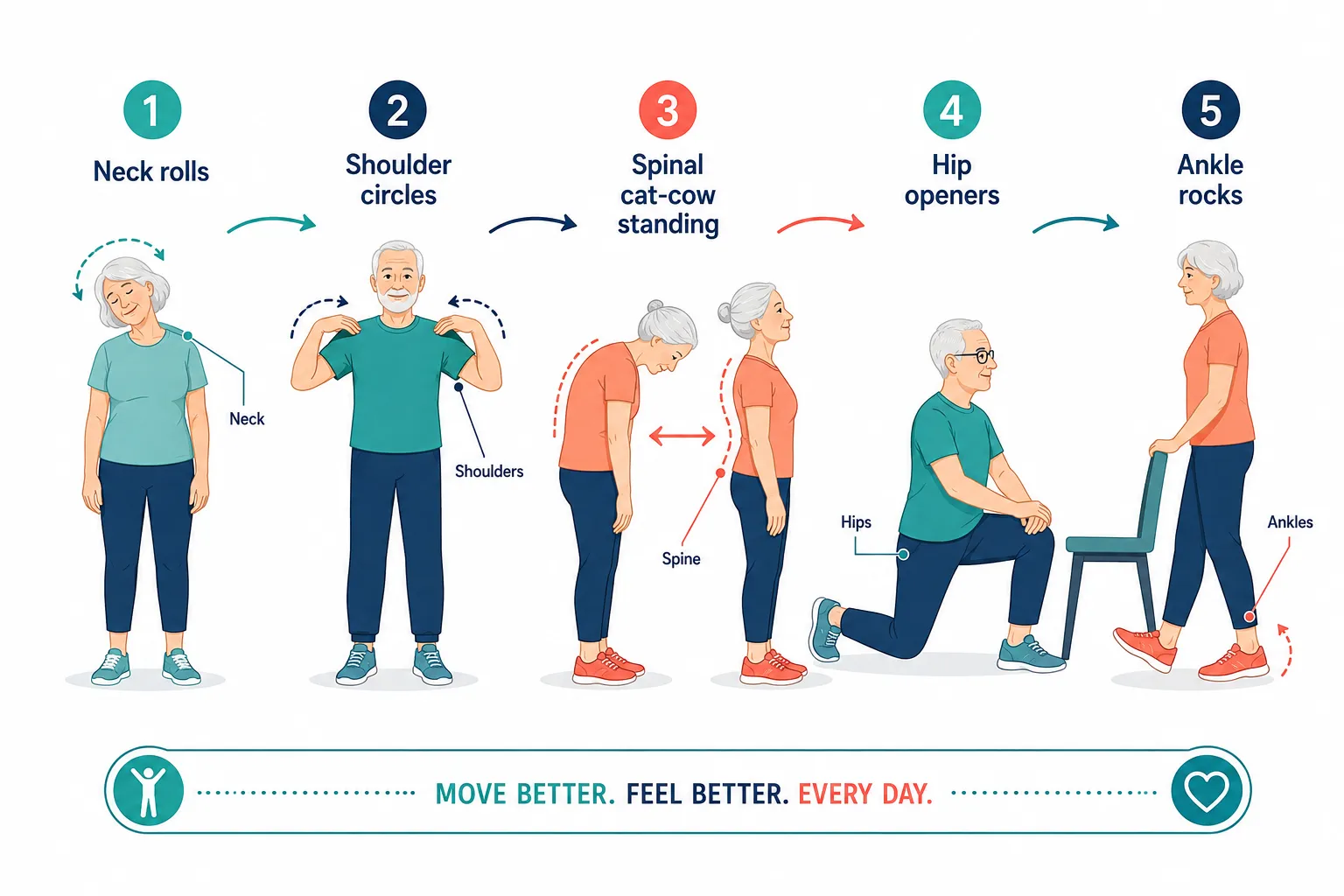
Mobility flow sequences are structured routines that move each joint through its available range in a smooth, continuous pattern. Unlike static stretching, where you hold a position, flows keep you moving, arm circles blend into shoulder rolls, which lead into a gentle spinal twist, and so on.

They work through two main mechanisms. First, movement stimulates the production and circulation of synovial fluid, the natural lubricant inside joints, which helps cartilage stay healthy and reduces the gritty feeling of stiffness [4]. Second, repeated controlled motion signals the nervous system to release protective muscle guarding, so joints feel looser and gait becomes more fluid [5].

A typical flow follows a joint-by-joint template:

  1. Neck rotations and tilts
  2. Shoulder rolls and arm circles
  3. Thoracic spine rotations
  4. Hip circles and gentle swings
  5. Knee bends and mini squats
  6. Ankle circles and heel-toe rocks

What Are Mobility Flow Sequences and How Do They Work?

The whole sequence usually takes 8 to 12 minutes and requires no equipment beyond a sturdy chair.

Best Mobility Flow Exercises for Seniors With Arthritis

The best flows for arthritic joints are low-load, pain-free, and rhythmic. Movement helps arthritic joints, sitting still makes them worse. NICE-aligned arthritis guidance and rehab clinicians consistently recommend regular flexibility and mobility practice as a core part of managing joint disease [5].

Try these six evidence-supported movements, done for 8-12 slow repetitions each:

  • Seated marching: warms up hips and knees
  • Shoulder rolls (forward and back): eases neck and upper back tension
  • Seated spinal twist: mobilizes the thoracic spine without loading discs
  • Ankle alphabet: draw letters with your toes to work the ankle in every direction
  • Wall-supported hip circles: opens the hip capsule safely
  • Cat-cow, standing or seated: alternates spinal flexion and extension [6]

Choose seated versions if: knees or hips flare with weight-bearing, or balance is limited. Choose standing versions with wall support if: you want to add gait and balance benefits.

Skip any movement that produces sharp pain. A mild "working" sensation is fine; sharp or radiating pain is not.

How Often Should Older Adults Do Mobility Flow Routines?

Most days of the week, ideally daily. Short, frequent sessions beat long, occasional ones. The U.S. Physical Activity Guidelines recommend that adults 65+ include flexibility and balance work in their weekly routine, alongside 150 minutes of moderate aerobic activity and 2 sessions of strength work [8].

A practical schedule:

Frequency Duration Best For
Daily 5-10 min Morning stiffness, arthritis
5x per week 10-15 min General maintenance
3x per week 15-20 min Combined with strength days

Many trainers now frame these as "movement snacks", small doses of motion sprinkled through the day, especially useful for sedentary seniors who won't commit to a full workout [9].

Difference Between Mobility Flows and Stretching for Joint Health

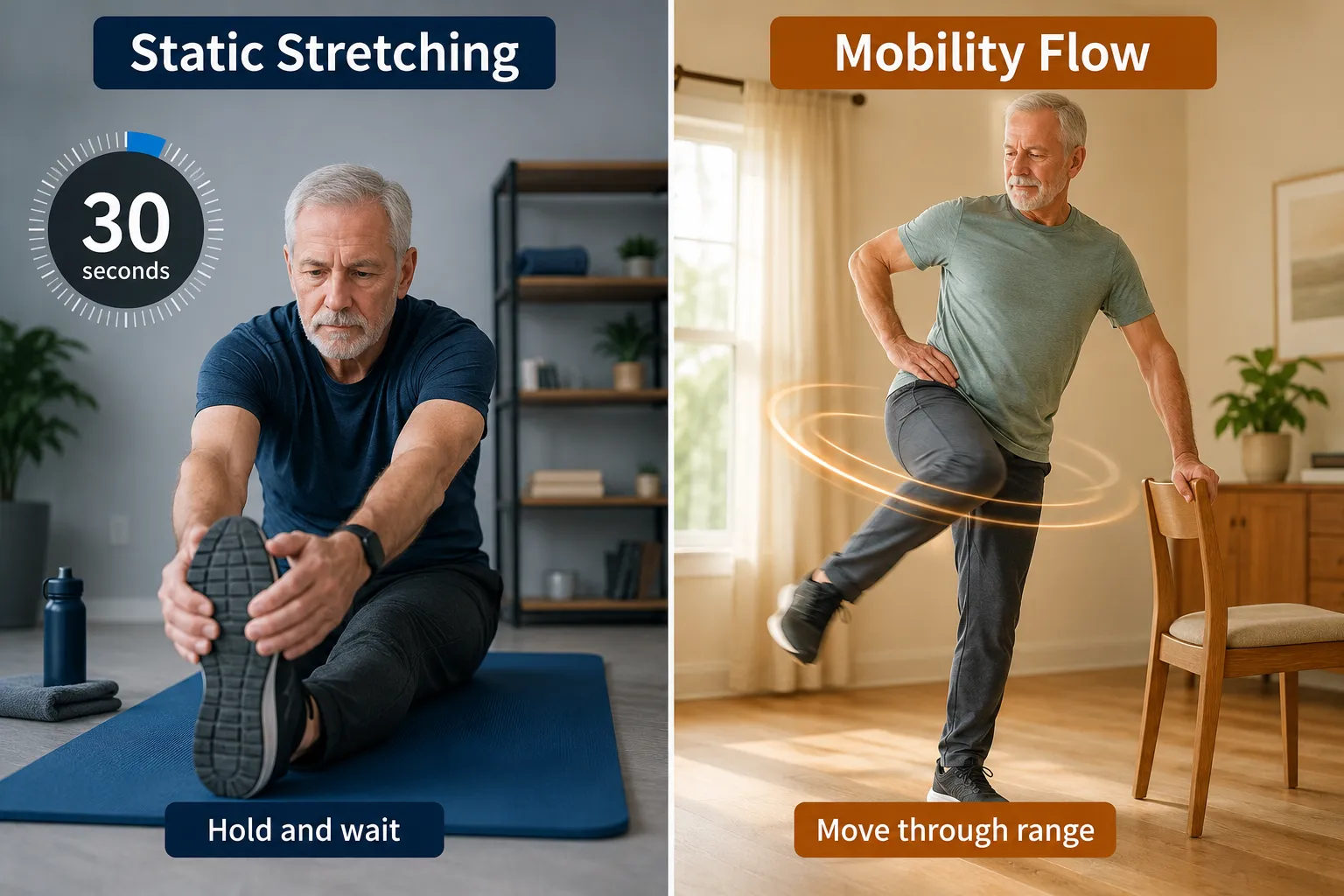
Mobility flows move joints through ranges; stretching holds a position at end-range. Both have value, but for aging joints, continuous motion is usually more useful than long holds [4].

Quick comparison

Static stretching: hold a position 20-60 seconds. Targets muscle length. Can feel intense.

Mobility flow: move continuously through range. Targets joint capsule, synovial fluid, and neuromuscular control. Feels smooth.

Verdict: Flows are better for daily joint maintenance. Stretching still helps for specific tight muscles.

The trainer's line "joints need to move to feel good, not just be stretched" captures the shift many rehab professionals are making in 2026 [4].
Difference Between Mobility Flows and Stretching for Joint Health

Can Mobility Flow Sequences Help With Joint Pain Relief?

Yes, for many people, particularly those with stiffness-driven pain from osteoarthritis, general inactivity, or postural strain. Gentle continuous movement increases blood flow, warms tissues, and reduces the perception of pain by dialing down protective muscle guarding [5][7].

Expect modest, gradual relief rather than instant fixes. A 2024 review of low-impact activity in arthritis populations found that regular flexibility and mobility work reduced self-reported joint pain and improved function over 8-12 weeks [1].

Flows are less effective for:

  • Acute inflammatory flare-ups (rest first, then reintroduce gently)
  • Pain from a specific structural injury (see a clinician)
  • Nerve-related pain like sciatica (needs targeted care)

Mobility Flow Routines for People With Limited Mobility

Seated and supported flows keep almost everyone in motion, regardless of ability. If standing is hard, a sturdy chair becomes the whole studio.

A seated 10-minute flow:

  1. Neck: slow yes-nods, then side-to-side, 6 each
  2. Shoulders: rolls forward 8, backward 8
  3. Arms: reach overhead alternately, 8 per side
  4. Spine: gentle seated twists, 6 per side
  5. Hips: seated marching, 20 total
  6. Knees: straighten and bend one leg at a time, 8 per side
  7. Ankles: circles in each direction, 8 each

For people using walkers or wheelchairs, upper-body and seated hip work still delivers meaningful stiffness relief [6]. The key is daily consistency at a low dose.

What Equipment Do I Need for Gentle Mobility Flows?

Almost nothing. That's part of why these routines have gained traction, no gym, no membership, no barriers.

Recommended (not required):

  • A sturdy, armless chair
  • A wall for balance support
  • A non-slip mat if you'll do any floor work
  • Comfortable, non-restrictive clothing
  • A resistance band (light) for gentle shoulder and hip work later

Skip weighted equipment for pure mobility work, the goal is range and lubrication, not load [10].

Are Mobility Flow Sequences Safe for People With Osteoporosis?

Generally yes, with two important modifications: avoid loaded spinal flexion (rounding forward under weight) and avoid deep spinal twists. Both can raise vertebral fracture risk in people with reduced bone density [8].

Safer swaps:

  • Replace forward-fold movements with hip hinges and supported bends
  • Replace deep seated twists with gentle thoracic rotations in a neutral spine
  • Add weight-bearing standing flows (with wall support), these actually help bone density

Anyone with a diagnosed osteoporosis or a recent DEXA scan showing low T-scores should have a physical therapist review their routine once before starting.

How Long Does It Take to See Results From Mobility Flow Routines?

Most people notice less morning stiffness within 2-3 weeks of daily practice. Improvements in balance, gait quality, and functional range of motion typically show up between weeks 4 and 8 [2][7].

A rough timeline:

  • Week 1-2: Movement feels easier, less "creaky" in the morning
  • Week 3-4: Noticeable improvement in reaching, turning, bending
  • Week 6-8: Better balance, more confident walking, easier stairs
  • Week 12+: Sustained changes in posture and fall confidence

Progress plateaus without consistency. Miss two weeks and much of the fluidity fades, this is a keep-doing-it practice, not a one-time fix.

Mobility Flow Sequences vs Physical Therapy for Older Adults

Mobility flows are general maintenance; physical therapy is targeted rehabilitation. They serve different purposes and often work best together.

Choose mobility flows if:

  • You have general age-related stiffness
  • You want daily prevention and joint care
  • You have no acute injury or recent surgery

Choose physical therapy if:

  • You're recovering from surgery, injury, or a fall
  • You have pain that limits daily activities
  • You need a personalized assessment [5]

Many PTs now prescribe mobility flows as homework between sessions, and hand patients a flow to continue after discharge [10].
Mobility Flow Sequences vs Physical Therapy for Older Adults

Common Mistakes People Make Doing Mobility Flows

The routine is simple, but a few habits blunt the benefits:

  1. Rushing through the reps. Speed reduces the joint-lubrication effect. Slow down.
  2. Pushing into pain. Mobility work should feel like relief, not effort. Back off if it hurts.
  3. Holding the breath. Breathe naturally through each movement.
  4. Skipping the lower body because it's harder to see improvement there.
  5. Doing it once a week and expecting change. Consistency beats intensity.
  6. Ignoring balance support when needed, falling during a mobility routine defeats the point.
  7. Copying advanced yoga flows meant for younger, mobile bodies. Use routines designed for older adults [4].

Mobility Flow Routines for Stiff Hips and Lower Back

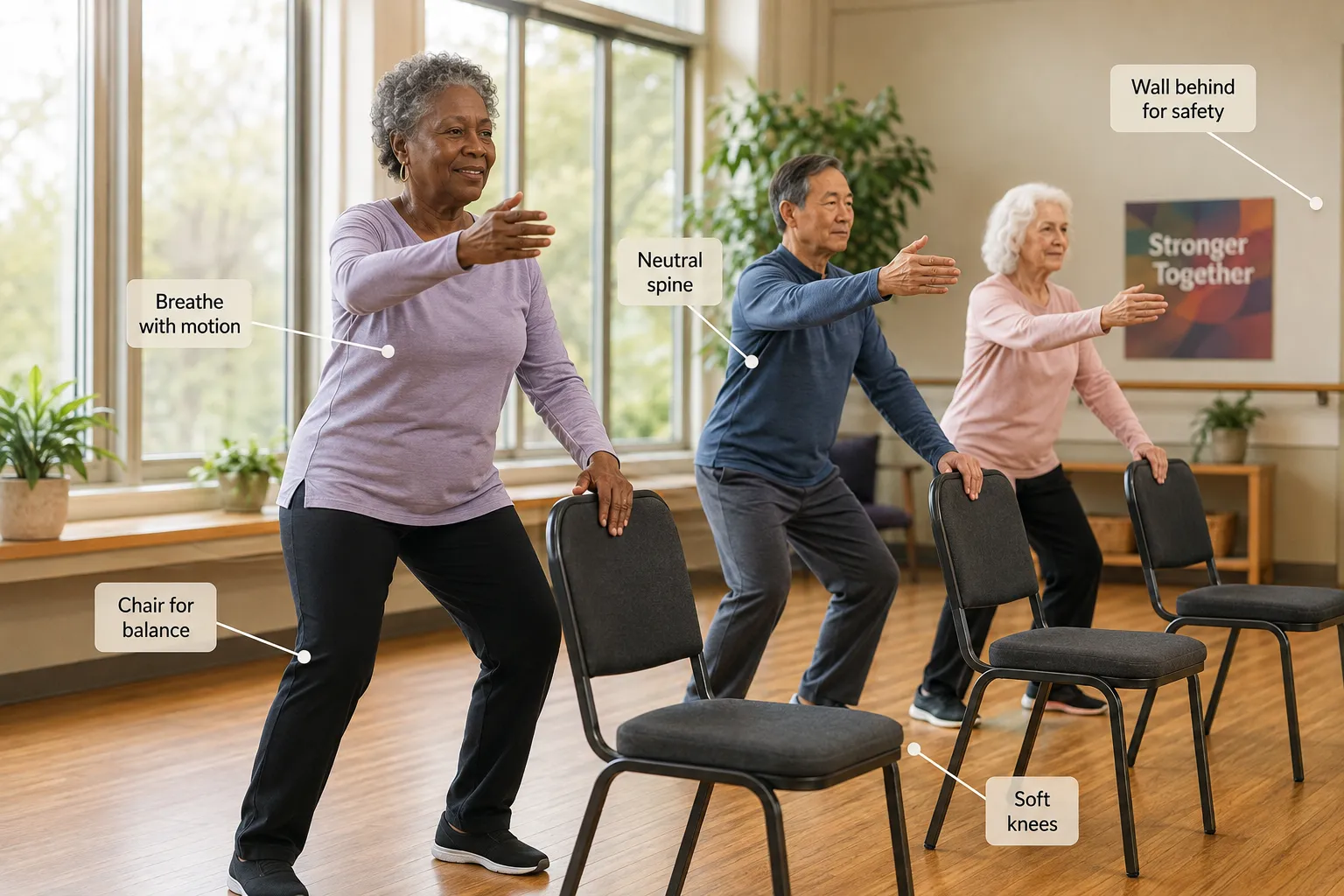
Hips and the lumbar spine cause most complaints in older adults. A focused 6-minute flow:

  • Standing hip circles (hands on chair back): 6 each direction
  • Standing knee raises: 8 per side
  • Wall-supported leg swings (forward/back, gentle): 8 per side
  • Standing cat-cow: 8 rounds
  • Standing side bends: 6 per side
  • Pelvic tilts against wall: 10 slow reps

This sequence targets the hip capsule, glute activation, and thoracolumbar mobility, the three biggest contributors to comfortable walking after 60 [6][7].

Can You Do Mobility Flows Every Day?

Yes. Unlike strength training, mobility work has no required recovery day. Joints benefit from daily motion. In fact, the biggest single factor separating people with fluid, comfortable joints from those with chronic stiffness is frequency of gentle movement, not intensity [4][9].

The main caveat: if a specific joint is inflamed or recovering from a flare, rest that joint for 24-48 hours while continuing to move the rest of your body.

Who Should Not Do Mobility Flow Sequences?

Most older adults can safely start today. Talk to a doctor or physical therapist first if any of the following apply:

  • Recent surgery (especially joint replacement) within the last 6-12 weeks
  • Acute injury or fracture that hasn't fully healed
  • Severe osteoporosis with a history of vertebral fractures
  • Uncontrolled cardiovascular conditions where even light activity is restricted
  • Acute inflammatory arthritis flare with hot, swollen joints
  • Balance disorders that make even supported standing unsafe [8]

Clearance doesn't mean "no." It usually means a modified version prescribed by a clinician.

FAQ

How many minutes of mobility flow do older adults need daily?
Five to fifteen minutes most days delivers meaningful stiffness relief and gait improvement for most seniors [4].

Can mobility flows replace walking?
No. Flows complement aerobic activity like walking, but don't replace it. Guidelines recommend both [8].

Is it okay to feel some cracking or popping in the joints?
Painless cracking is normal and harmless. Painful clicking or grinding warrants a clinician's opinion.

Should I do mobility flows in the morning or evening?
Morning helps combat overnight stiffness. Evening helps unwind tight tissues. Both work, pick what you'll do consistently.

Can mobility flows improve balance?
Yes, especially standing flows with weight shifts. Trainers increasingly build balance cues into flows to reduce fall risk [4].

Do I need to warm up before a mobility flow?
The flow itself is the warm-up. Start with the smallest, gentlest movements and let intensity build naturally.

Are online follow-along videos safe for beginners?
Yes, if they're designed for older adults and use chair or wall support. Avoid generic yoga classes unless taught by an instructor experienced with aging bodies.

Can mobility flows help with knee osteoarthritis?
Yes. Gentle, pain-free movement is a first-line recommendation for knee OA and helps preserve function [1][5].

Will mobility flows help with posture?
Yes, particularly the thoracic spine and shoulder segments. Expect gradual postural improvement over 6-12 weeks [7].

Can I combine mobility flows with strength training?
Absolutely, flows make excellent warm-ups and cool-downs for strength sessions.

Conclusion

Mobility flow sequences give older adults a simple, low-risk way to keep joints comfortable and gait fluid: move every joint through its available range, every day, in a continuous rhythm. They're safe for most people with arthritis, adaptable for limited mobility, and consistent with official physical activity guidance for adults 65+.

Start this week:

  1. Pick a 10-minute follow-along flow designed for older adults [4][6]
  2. Put a sturdy chair in a clear space
  3. Commit to 6 sessions in the next 7 days
  4. Note morning stiffness on day 1 and day 14, the difference is your proof

If pain limits daily life, add a physical therapy consult on top of your daily flow. Movement is medicine for aging joints, and the dose is a few minutes, most days, for the rest of your life.

References

[1] Mobility Exercises For Seniors – https://www.healthline.com/health/senior-health/mobility-exercises-for-seniors
[2] Improving Mobility In Old Age – https://www.healthline.com/health/improving-mobility-in-old-age
[3] Mobility Exercises Seniors – https://neverleavetheplayground.com/mobility-exercises-seniors/
[4] Your Joints Need To Move To Feel Good, A Certified Trainer Shares The Gentle Mobility Routine He Uses With Seniors – https://www.fitandwell.com/exercise/flexibility/your-joints-need-to-move-to-feel-good-a-certified-trainer-shares-the-gentle-mobility-routine-he-uses-with-seniors-to-soothe-joint-stiffness-after-60
[5] Joint Mobility Exercises – https://www.healthline.com/health/fitness-exercise/joint-mobility-exercises
[6] A Mobility Expert Recommends These Six Stretches For Older Adults With Especially Stiff Joints – https://www.fitandwell.com/exercise/flexibility/a-mobility-expert-recommends-these-six-stretches-for-older-adults-with-especially-stiff-joints
[7] Exercises For Mobility Range Of Motion After 50 – https://www.health.com/exercises-for-mobility-range-of-motion-after-50-11904156
[8] Physical Activity Guidelines 2nd Edition – https://odphp.health.gov/sites/default/files/2019-09/Physical_Activity_Guidelines_2nd_edition.pdf
[9] Home Exercise Routine – https://thehealthyagingguide.com/tag/home-exercise-routine/
[10] The Top 5 Mobility Exercises For Aging Joints – https://vitalityptgr.com/the-top-5-mobility-exercises-for-aging-joints/
Best Balance Boards and Stability Tools for Older Adults: Improve Mobility and Prevent Falls

Best Balance Boards and Stability Tools for Older Adults: Improve Mobility and Prevent Falls

Last updated: August 16, 2026

Quick Answer

The best balance boards and stability tools for older adults are low-profile rocker boards, foam balance pads, and inflatable wobble cushions, used 5 to 10 minutes, three times per week, near a countertop or sturdy chair for hand support. Peer-reviewed research shows structured 4 to 9 week balance-board programs improve standing balance, mobility, and Timed Up and Go scores, and can cut fall risk by roughly 23 to 28 percent when combined with strength work.[1][5][10] Start with the most stable tool that still challenges you, and progress slowly over weeks, never days.

Key Takeaways

  • Foam pads and wobble cushions are the safest entry points; rocker boards suit intermediate users; multi-axis wobble boards are for confident, mobile seniors only.[4][11]
  • 10 minutes, 3 times per week is the evidence-supported dose for measurable balance gains on a wobble board.[9][10]
  • Structured 4 to 9 week programs improve Berg Balance Scale and Timed Up and Go scores in older adults.[1][13][15]
  • Multicomponent training (strength + aerobic + balance board) prevents falls better than any single tool.[3]
  • Always train near a countertop, sturdy chair, or grab rail, and skip balance boards entirely if you have active vertigo or a recent fall.[2][7]
  • A basic home kit (foam pad, wobble cushion, half-dome trainer, grab rail) typically runs $150 to $250.[14]
  • Consult a physician or physical therapist before starting if you have arthritis, neuropathy, or a history of falls.[7]

What Is a Balance Board and How Does It Help Older Adults?

A balance board is a flat platform mounted on an unstable base, a curved rocker, a rounded dome, or a spherical pivot, that forces small stabilizing muscles in the ankles, hips, and core to work continuously to keep the body upright. For older adults, this trains proprioception (the body's sense of position), reaction time, and postural control, all of which decline with age and are directly linked to fall risk.[1][15]

Peer-reviewed evidence shows that short, regular balance-board sessions improve standing balance, Timed Up and Go scores, and Berg Balance Scale results in seniors.[1][9][13] The Mayo Clinic notes these tools can enhance balance, coordination, and lower-limb strength, and may reduce fall risk when used correctly.[2]

What Is a Balance Board and How Does It Help Older Adults?

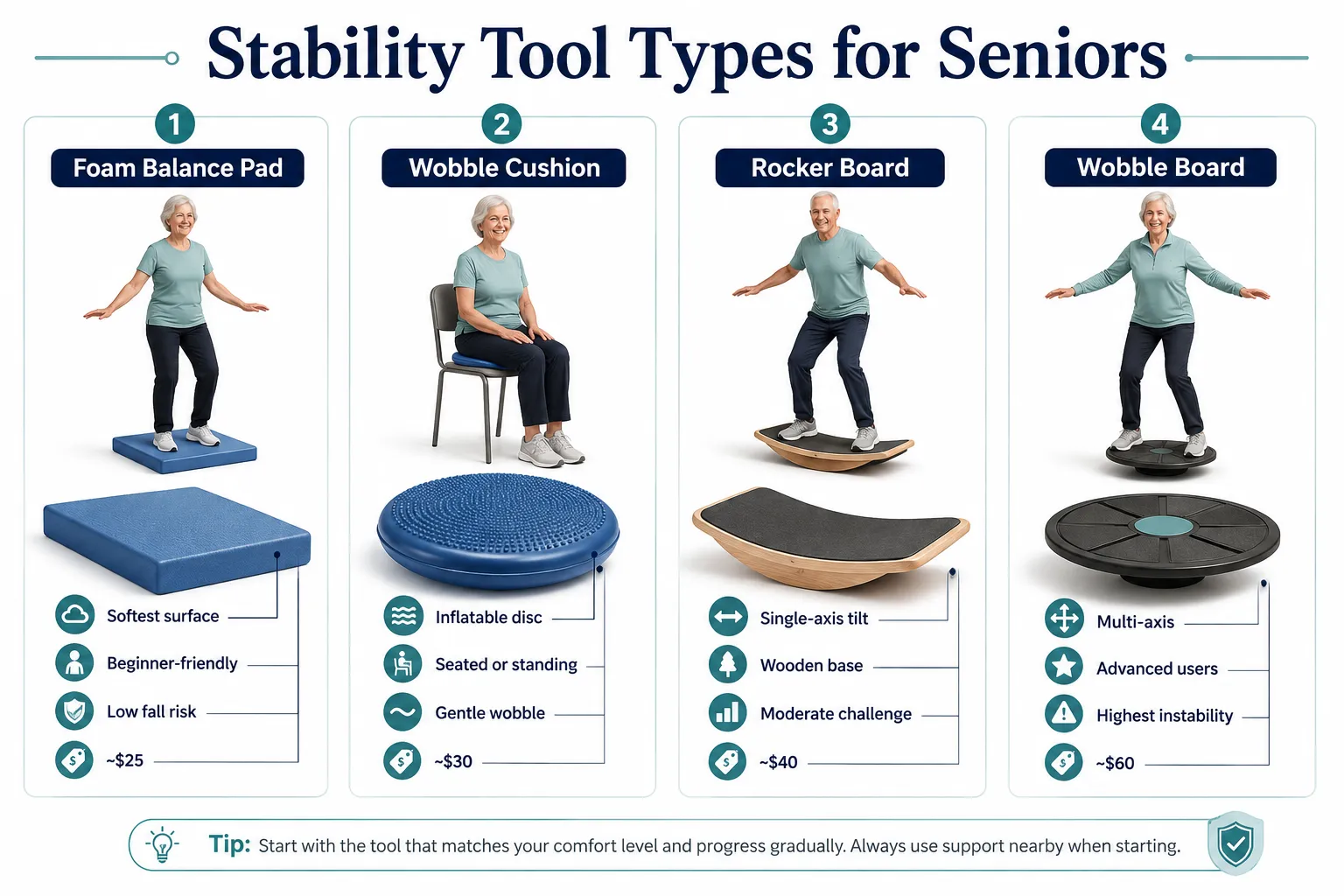
Types of stability tools covered in this guide:

Tool Instability level Best for Typical price
Foam balance pad Very low Beginners, arthritis, post-surgery $20,$35
Wobble cushion (disc) Low Seated core work, mild standing $25,$40
Rocker board (single-axis) Moderate Intermediate users $30,$55
Half-dome trainer (BOSU-type) Moderate, high Confident seniors $80,$130
Multi-axis wobble board High Advanced, no fall history $40,$70

Best Balance Boards for Seniors with Arthritis

For seniors with arthritis, the safest options are foam balance pads and inflatable wobble cushions, because they provide gentle instability without forcing sharp ankle or knee angles. A low-profile rocker board with a wide, non-slip surface is the next step up once joint pain is under control.

What to look for:

  • Wide platform (16 inches or more) so feet can sit shoulder-width apart
  • Low height (under 3 inches) to reduce the drop if balance is lost
  • Gentle curvature, steep rockers force painful ankle dorsiflexion
  • Non-slip textured top for bare or socked feet
  • Weight capacity clearly rated above your body weight

Avoid hard plastic multi-axis boards, small round wobble discs used standing, and any tool that requires deep knee bend to stabilize. Seated wobble-cushion work is an excellent arthritis-friendly starting point.[4][7]

Balance Board vs Stability Ball for Elderly Users

A balance board is generally safer and more practical than a stability ball for most older adults. Balance boards keep the feet on a stable floor and challenge ankle and hip stabilizers in a controlled range. Stability balls require sitting or lying on a large, rolling sphere, a setup with significantly higher fall risk for anyone with reduced grip strength, hip mobility, or reaction speed.

Use a balance board if the goal is standing balance and fall prevention. Use a stability ball only in seated form (as a chair alternative for core engagement) and only with a wall behind you or a chair frame around the ball. Never do bridges or supine exercises on a full-size stability ball without supervision.

How Often Should Older Adults Use Balance Boards?

Three sessions per week of 10 minutes each is the evidence-supported dose. A 2026 analysis of multi-axis Indo Balance Board training found this schedule produced significant Berg Balance Scale improvements in older adults.[9][10] A separate review recommends roughly 30-minute sessions 2 to 3 times weekly for at least 3 weeks to see measurable gains, aligning with American Geriatrics Society falls-prevention guidance.[10]

Sample weekly schedule:

  • Monday: 10 min balance board + 10 min chair squats
  • Wednesday: 10 min balance board + short walk
  • Friday: 10 min balance board + light resistance band work

Gains are typically maintained for at least three months after a structured program ends, but stopping entirely leads to gradual loss of balance improvements.[1][15]

Balance Board Exercises for Fall Prevention

Start every session near a countertop or sturdy chair. Do each exercise for 30 to 60 seconds, rest, and repeat two to three times.

  1. Two-foot static hold, stand on the board with feet shoulder-width, one hand on support, hold steady.
  2. Weight shifts, slowly rock side to side, then front to back, controlled.
  3. Mini squats, bend knees 15 to 20 degrees while keeping the board level.
  4. Single-hand support, progress from two hands to one hand to fingertip support.
  5. Head turns, while balanced, slowly turn head left and right to train vestibular integration.
  6. Heel-to-toe rock, deliberate small tilts to train ankle strategy.

Balance Board Exercises for Fall Prevention

Progression rule: advance only when the current exercise feels easy for a full week. Fall-prevention programs including wobble-board work have been associated with 23 to 28 percent lower fall risk when performed consistently.[5][3]

Can Balance Boards Help with Vertigo in Seniors?

Balance boards are generally not recommended as a self-treatment for active vertigo. Their intentionally unstable surface can worsen dizziness and increase fall risk in people with vestibular disorders.[2] Mayo Clinic-affiliated guidance is explicit: unstable-surface training may itself trigger falls in those with significant balance problems or dizziness.[2]

That said, a physical therapist may prescribe carefully progressed foam-pad exercises as part of vestibular rehabilitation once acute vertigo resolves. This should always be clinician-supervised, never self-directed. If you have BPPV, Meniere's, or unexplained dizzy spells, get medical clearance before touching any stability tool.[7]

Balance Boards for People with Limited Mobility

For seniors with limited mobility, seated stability training on a wobble cushion is the highest-value starting point. Place an inflatable disc on a sturdy dining chair and sit on it during daily activities, reading, meals, TV. This activates core stabilizers without any standing risk.

Options for limited mobility:

  • Wobble cushion on chair, passive core training, zero fall risk
  • Foam pad while holding parallel bars or a walker, supervised only
  • Seated foot-on-board work, sit in a chair, place feet on a rocker board, tilt slowly to train ankle mobility
  • Half-dome trainer flat side up, provides a slightly unstable but very controlled standing surface

A physical therapist can adapt any of these to wheelchair users or those recovering from hip or knee surgery.[13]

How Much Does a Good Balance Board Cost?

A quality senior-friendly balance board costs $30 to $70. Foam pads run $20 to $35, wobble cushions $25 to $40, rocker boards $30 to $55, and half-dome trainers $80 to $130. A complete home fall-prevention kit, foam pad, wobble cushion, half-dome trainer, and grab rail, typically totals $150 to $250.[14]

One 2026 industry analysis estimates such a kit can reduce fall risk by roughly 24 percent over 12 months when used at least 10 minutes daily, though this estimate reflects program outcomes rather than any single device.[14] Spending more than $100 on a single board rarely produces better outcomes for a senior beginner.

Are Balance Boards Safe for People Over 70?

Balance boards can be safe for people over 70, but only with the right tool, setup, and medical clearance. The Mayo Clinic notes the same instability that trains balance can also cause falls if misused.[2] A 2025 medical-alert advisory recommends consulting a physician or physical therapist first, avoiding boards after a recent fall, wearing sturdy shoes, and always training near a grab bar or countertop.[7]

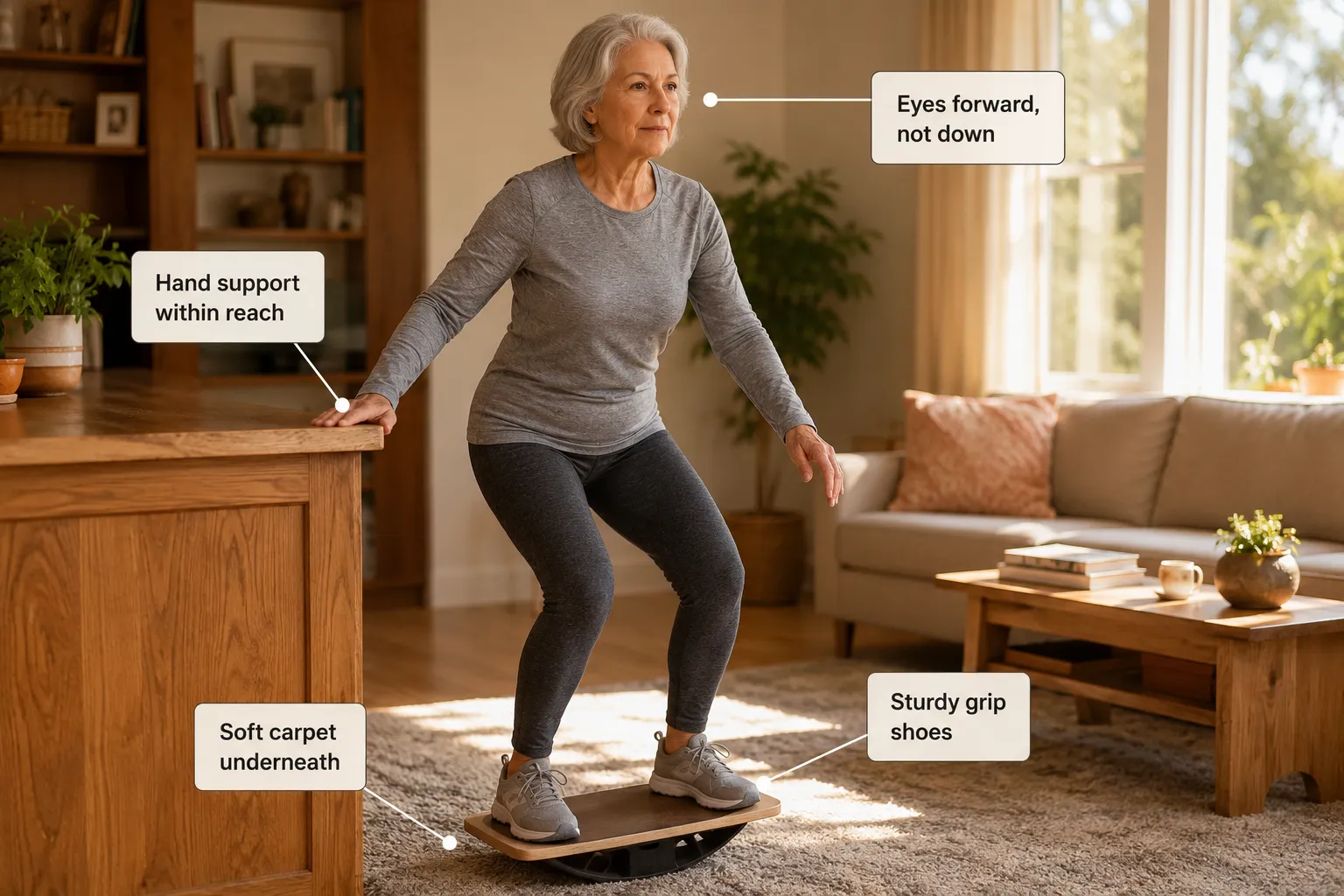
Safety checklist before your first session:

  • Medical clearance obtained
  • Board placed on carpet or a non-slip mat
  • Sturdy countertop, chair back, or grab rail within arm's reach
  • Sturdy closed-toe shoes with grip soles
  • Someone else in the home during initial sessions
  • Session limited to 5 minutes on day one

Seniors with peripheral neuropathy, severe osteoporosis, or recent joint replacement should get therapist guidance before starting.[7]

Balance Board Alternatives for Seniors

Not every older adult needs, or should use, a balance board. Effective alternatives include:

  • Tai chi, strong evidence for fall reduction, no equipment needed
  • Standing yoga, chair-supported variations are widely accessible
  • Heel-to-toe walking along a hallway with wall support
  • Single-leg stands at a kitchen counter
  • Resistance band lower-body work, builds the strength that balance depends on
  • Aquatic exercise, low-fall-risk environment with resistance

The strongest evidence for fall prevention supports multicomponent programs combining strength, aerobic exercise, and balance challenge, not any single tool.[3]

Do Balance Boards Actually Prevent Falls?

Yes, when used in structured programs, but not on their own. Peer-reviewed evidence shows 4 to 9 week balance-board programs improve standing balance, functional mobility, and Timed Up and Go scores in older adults.[1][13][15] Fall-prevention programs incorporating wobble-board training report roughly 23 to 28 percent lower fall risk with consistent use.[5][3]

However, the most reliable falls-prevention effect comes from multicomponent training, strength, aerobic work, and proprioceptive challenge together.[3] A balance board alone, used sporadically, produces modest gains. A balance board used three times weekly alongside squats, walking, and resistance work produces measurable fall-risk reduction.

Best Balance Boards for Small Spaces

A round wobble cushion or a 15-inch square foam pad works in any room and stores under a couch. Rocker boards with a 16 to 18 inch footprint fit beside most dining chairs. Avoid large half-dome trainers (24 inches or wider) if floor space is tight.

Space-saving picks:

  • Inflatable wobble disc, 14 inches, deflates for travel
  • Square foam pad, stacks flat against a wall
  • Wooden rocker board, 17 x 6 inches, stores vertically
  • Small round pivot board, 15 inch diameter, but higher instability

Train in a doorway or beside a kitchen counter to combine hand support with a small footprint.

Balance Board Training Programs for Older Adults

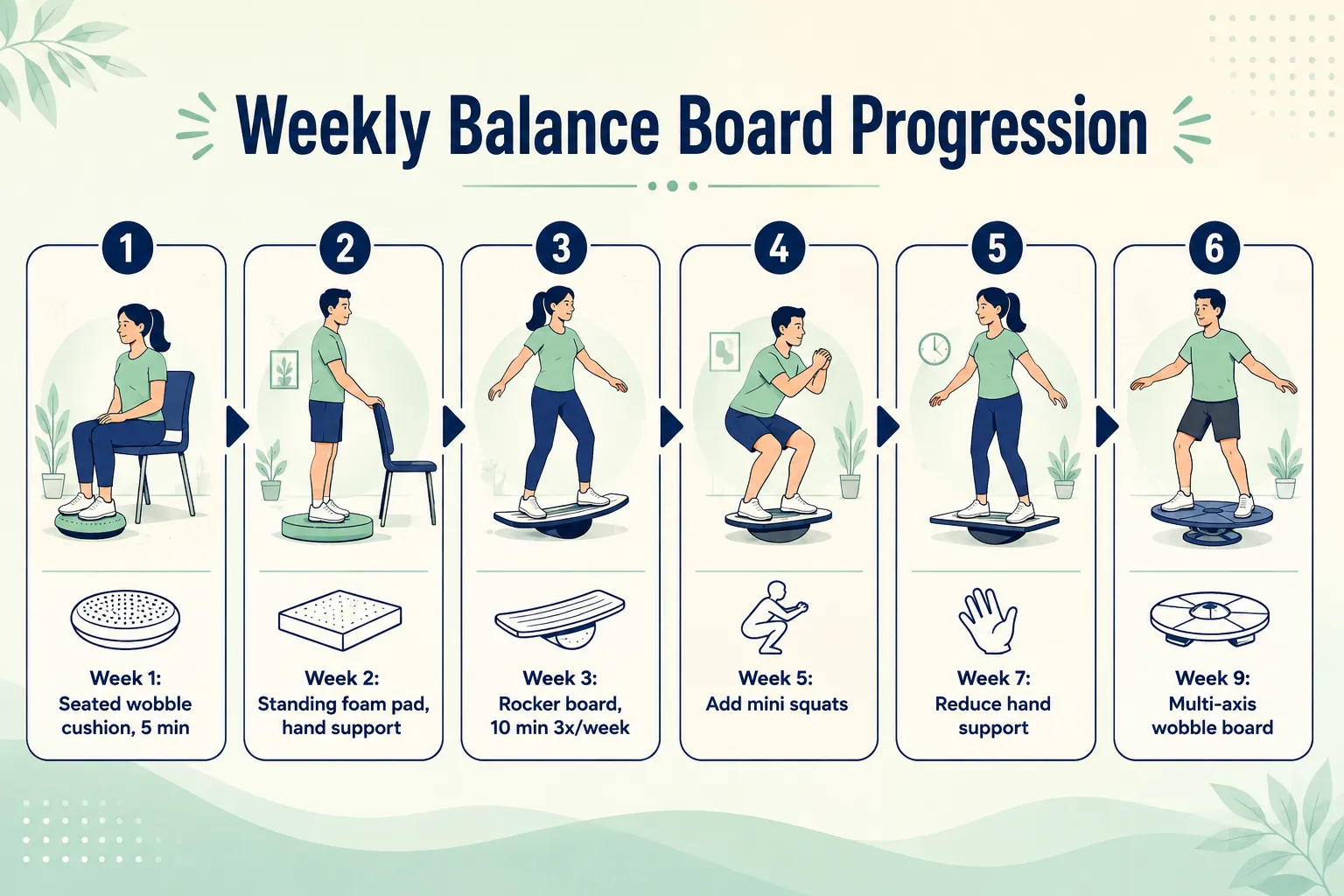
A structured program beats random practice. Below is an evidence-informed 9-week progression combining findings from wobble-board and multi-axis balance research.[1][9][10][13]

Balance Board Training Programs for Older Adults

Weeks 1-2: Seated wobble cushion, 5 minutes daily. Standing foam pad with two-hand support, 3 min, 3x/week.

Weeks 3-4: Rocker board with two-hand support, 10 min, 3x/week. Add slow weight shifts.

Weeks 5-6: Rocker board with one-hand support. Add mini squats and head turns.

Weeks 7-8: Reduce to fingertip support. Introduce 30-second single-leg attempts on a foam pad.

Week 9+: Consider a multi-axis board only if all prior weeks felt controlled. Continue 3x/week indefinitely, gains regress if training stops.[1][15]

Community centers, senior fitness classes, and physiotherapy clinics increasingly offer supervised versions of these programs.[6][15]

What to Avoid When Using a Balance Board as a Senior

The instability that makes a balance board effective is the same instability that can cause a serious fall. Respect the tool.

Avoid these mistakes:

  • Training alone during the first two weeks, have someone nearby
  • Barefoot on slippery hardwood, always use grip or a mat
  • Skipping hand support too early, progress support reduction over weeks
  • Long sessions, more than 15 minutes increases fatigue-related falls
  • Multi-axis boards as a beginner, start with foam or rocker
  • Training when tired, dizzy, or on new medication, postpone
  • Ignoring pain, sharp knee, hip, or ankle pain means stop
  • Using the board on stairs or near sharp furniture edges

Never use a balance board within 48 hours of a fall, and get clearance from a physician before restarting.[7]

Frequently Asked Questions

Can I use a balance board if I use a cane?
Only with therapist guidance. Cane users typically start with seated wobble-cushion work rather than standing on a board.[7]

How long until I see improvement?
Peer-reviewed programs show measurable gains at 4 to 9 weeks with 3 sessions per week.[1][13]

Should I close my eyes on the board?
Not as a beginner. Eyes-closed training is an advanced progression that should only be attempted with full hand support and after weeks of stable practice.

Are cheap balance boards safe?
Look for a weight rating well above your body weight, a non-slip surface, and a wide base. Inexpensive foam pads and rocker boards from reputable brands are generally safe.[11]

Can balance boards help after a hip replacement?
Only under a physical therapist's direction, and typically not within the first several months post-surgery.[7]

Do I need shoes on the board?
Sturdy closed-toe shoes with grip soles are recommended for standing work. Bare feet may be acceptable on foam pads with therapist approval.[5]

Will a balance board help with knee pain?
It can strengthen supporting muscles, but active knee pain should be evaluated first. Start with seated or very stable options.[4]

Is a BOSU ball better than a balance board?
Not for beginners. Half-dome trainers are moderately unstable and better suited to confident, mobile seniors. Start with a foam pad or rocker.

Can I use a balance board daily?
Yes, in short sessions. Most evidence supports 3 dedicated training days weekly, with light seated wobble-cushion use on other days.[9][10]

What if I feel dizzy on the board?
Stop immediately, sit down, and don't retry that day. Persistent dizziness needs medical evaluation before continuing.[2]

Conclusion

Balance boards and stability tools work, but only when matched to ability level and used consistently within a structured plan. Start with a foam pad or wobble cushion, train three times per week for 10 minutes near a countertop, and progress to a rocker board only when the basics feel controlled. Pair balance work with strength training and walking, get medical clearance if you have any fall history or vestibular issues, and treat every session with the respect an intentionally unstable device deserves.

Your next steps:

  1. Talk with your physician or physical therapist this week
  2. Order a low-profile foam pad or wobble cushion (under $40)
  3. Set up a safe training spot near a countertop or sturdy chair
  4. Follow the 9-week progression, three sessions per week
  5. Re-evaluate at week 4 and week 9 with your Timed Up and Go time or Berg score

Balance is trainable at any age. The tools are inexpensive, the time commitment is small, and the payoff, staying on your feet, independent, and mobile, is enormous.

References

[1] Balance Board Seniors Fall Prevention – https://www.bellenae.com/blogs/news/balance-board-seniors-fall-prevention
[2] Maintaining Equilibrium: The Benefits of Balance Boards – https://mcpress.mayoclinic.org/nutrition-fitness/maintaining-equilibrium-the-benefits-of-balance-boards/
[3] Physical Activity Programs for Balance and Fall Prevention in Elderly – https://pmc.ncbi.nlm.nih.gov/articles/PMC6635278/
[4] Balance Board For Seniors – https://neverleavetheplayground.com/balance-board-for-seniors/
[5] Fall Prevention Exercises – https://slides.neverleavetheplayground.com/fall-prevention-exercises.html
[6] Balance Boards For Seniors: A Fun And Effective Way To Improve Stability – https://fallpreventionfoundation.org/2025/02/07/balance-boards-for-seniors-a-fun-and-effective-way-to-improve-stability/
[7] Balance Boards For Seniors: Can They Reduce Fall Risk – https://www.medicalalertadvice.com/articles/balance-boards-for-seniors-can-they-reduce-fall-risk/
[8] Wobble-board training in older adults – https://pubmed.ncbi.nlm.nih.gov/10470668/
[9] Indo Balance Board Program in Older Adults – https://pmc.ncbi.nlm.nih.gov/articles/PMC6189151/
[10] Wobble-Board Training in Older Adults: Review – https://www.tandfonline.com/doi/full/10.1080/10833196.2021.1987042