Last updated: September 3, 2026
Quick Answer
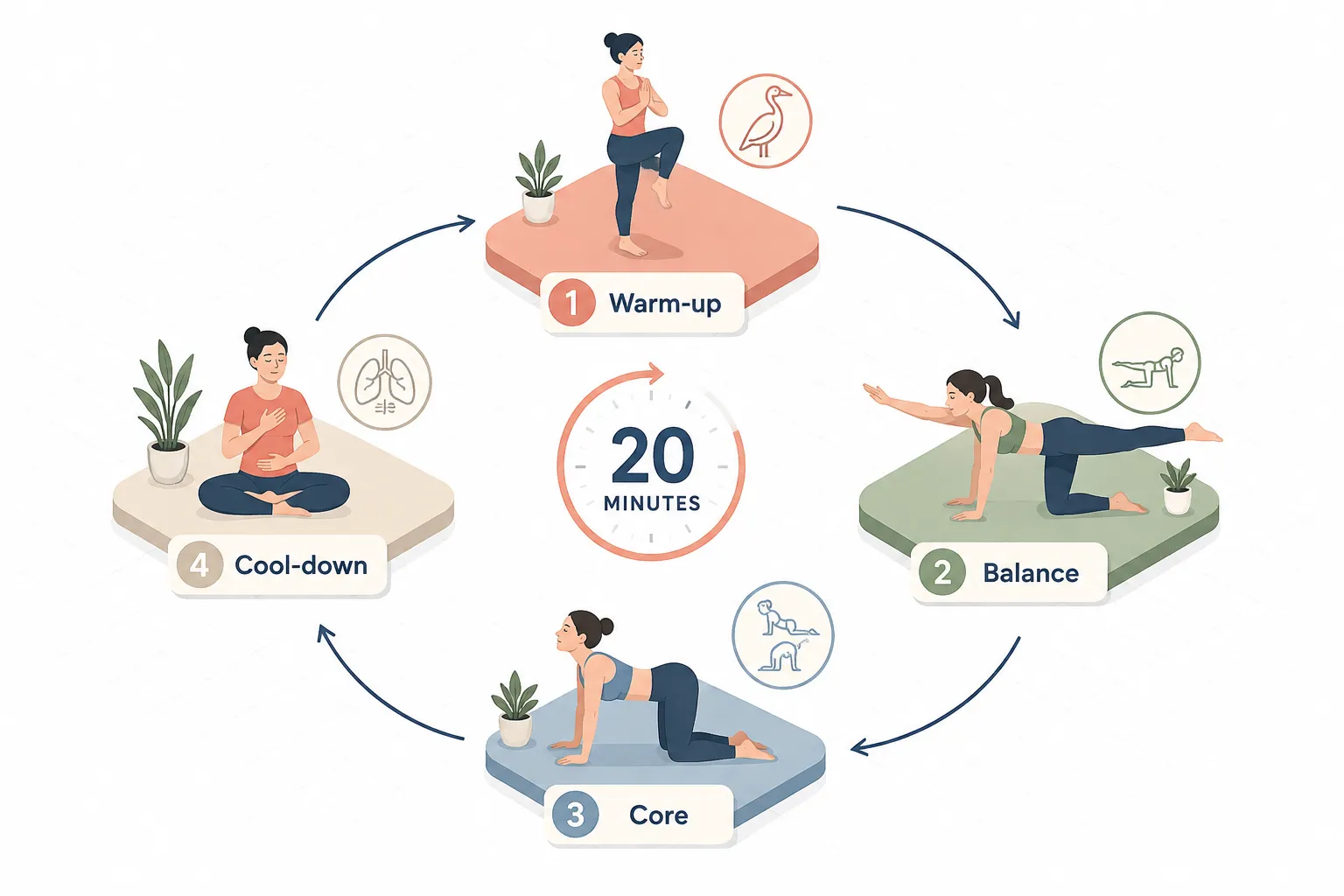
Mobility flow sequences are short, continuous routines that guide older adults through the natural range of every major joint, neck, shoulders, spine, hips, knees, and ankles, without holding static stretches. Done for 5 to 15 minutes most days, they reduce stiffness, improve gait, and keep joints nourished by moving synovial fluid. They're widely considered safe for most seniors, including many with arthritis, when performed slowly with support from a chair or wall [1][4].
Key Takeaways
- Mobility flows are continuous, not held. You move through joint ranges rather than pausing in a stretch [4].
- 5 to 15 minutes daily is the sweet spot most trainers and clinicians recommend for older adults [4][9].
- Joint-by-joint structure works best: start at the neck and work down, or reverse [10].
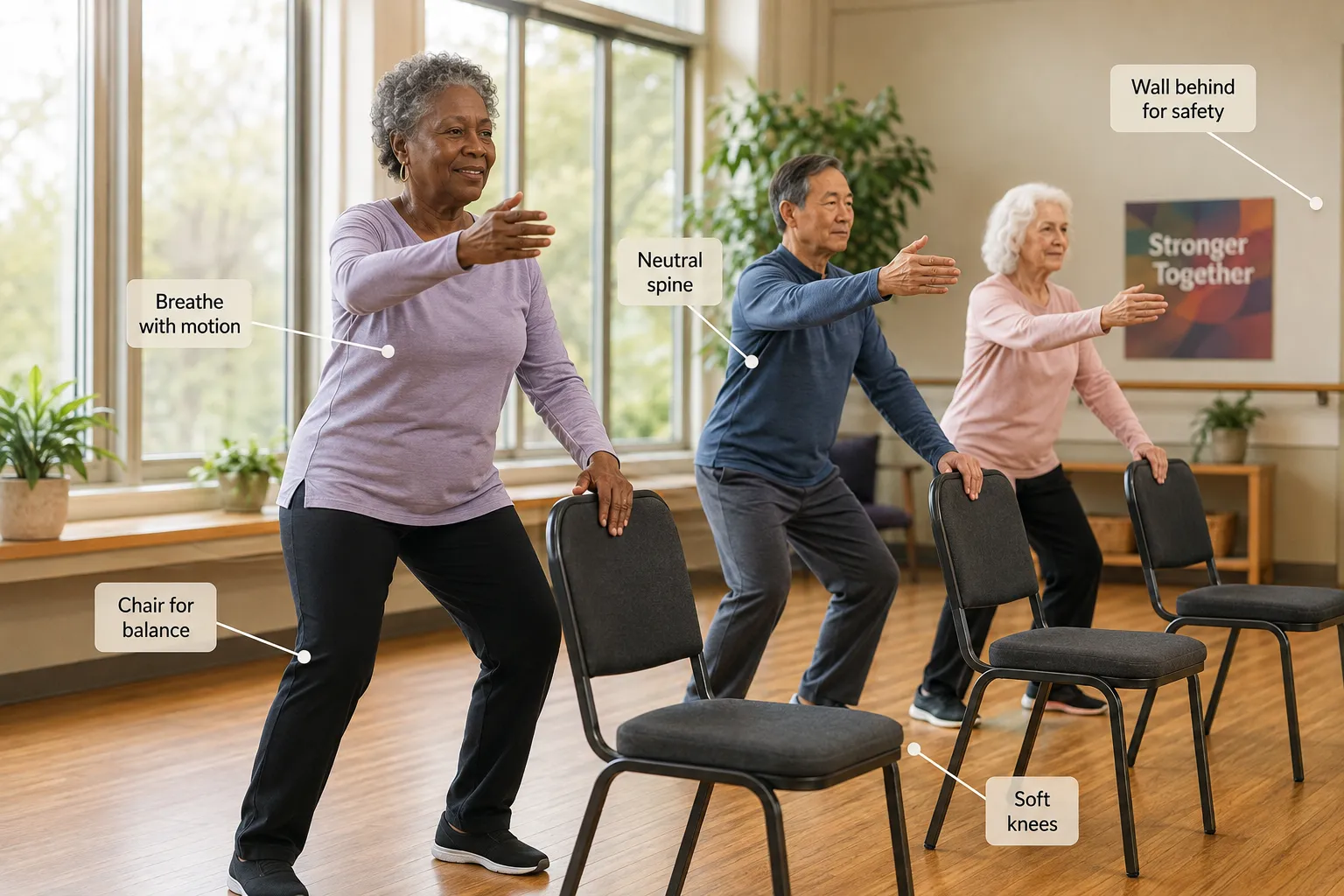
- Chair or wall support makes flows safer and accessible for people with balance issues or limited mobility [4][6].
- Low-impact and joint-friendly, mobility flows align with official physical activity guidelines for adults 65+ [8].
- Results appear in 2-6 weeks for reduced stiffness; strength and balance gains take longer [2][7].
- Not a replacement for physical therapy after injury or surgery, but a strong complement to it [5].
- People with severe osteoporosis, acute joint flare-ups, or recent surgery should get medical clearance first [8].
What Are Mobility Flow Sequences and How Do They Work?
Mobility flow sequences are structured routines that move each joint through its available range in a smooth, continuous pattern. Unlike static stretching, where you hold a position, flows keep you moving, arm circles blend into shoulder rolls, which lead into a gentle spinal twist, and so on.
They work through two main mechanisms. First, movement stimulates the production and circulation of synovial fluid, the natural lubricant inside joints, which helps cartilage stay healthy and reduces the gritty feeling of stiffness [4]. Second, repeated controlled motion signals the nervous system to release protective muscle guarding, so joints feel looser and gait becomes more fluid [5].
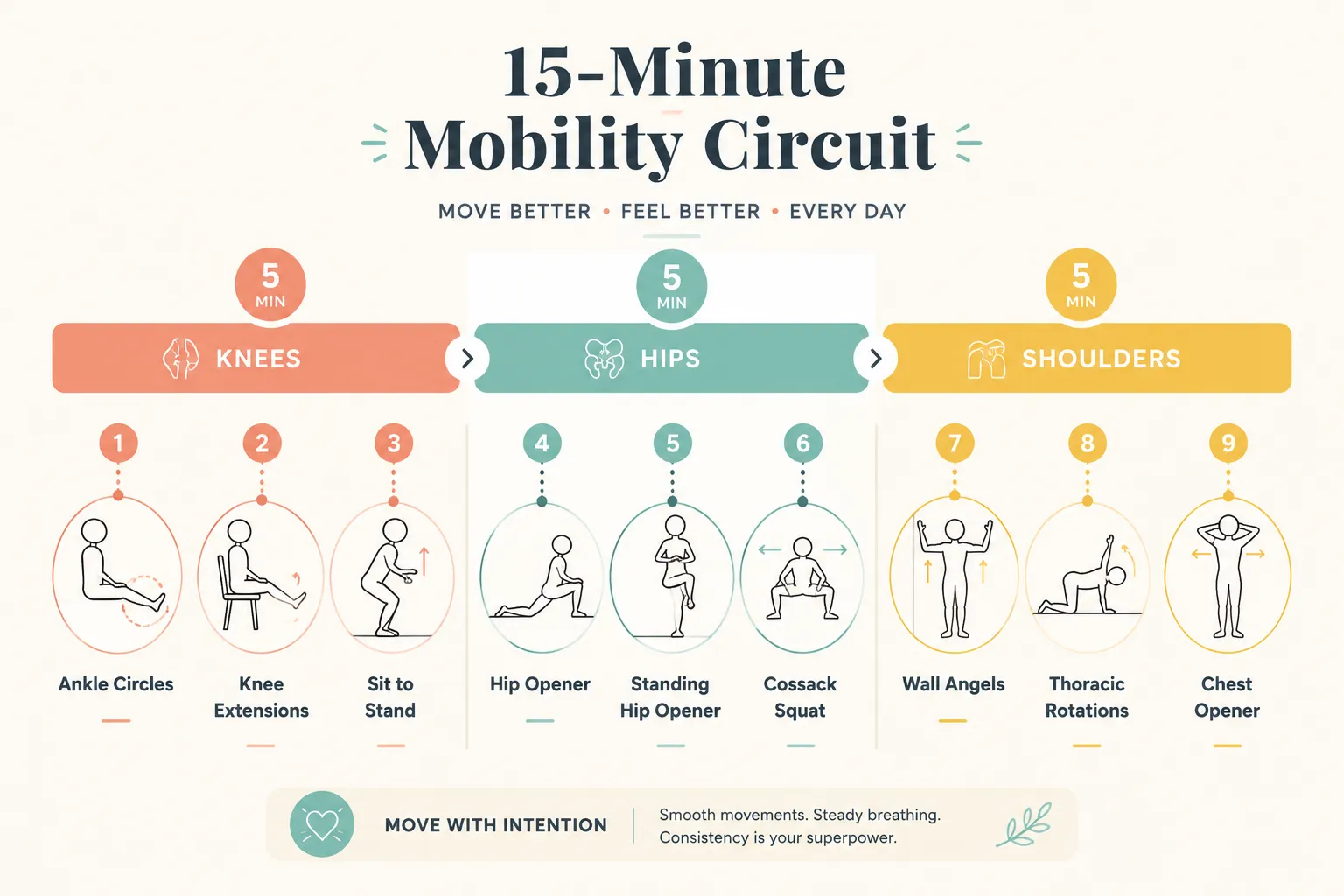
A typical flow follows a joint-by-joint template:
- Neck rotations and tilts
- Shoulder rolls and arm circles
- Thoracic spine rotations
- Hip circles and gentle swings
- Knee bends and mini squats
- Ankle circles and heel-toe rocks
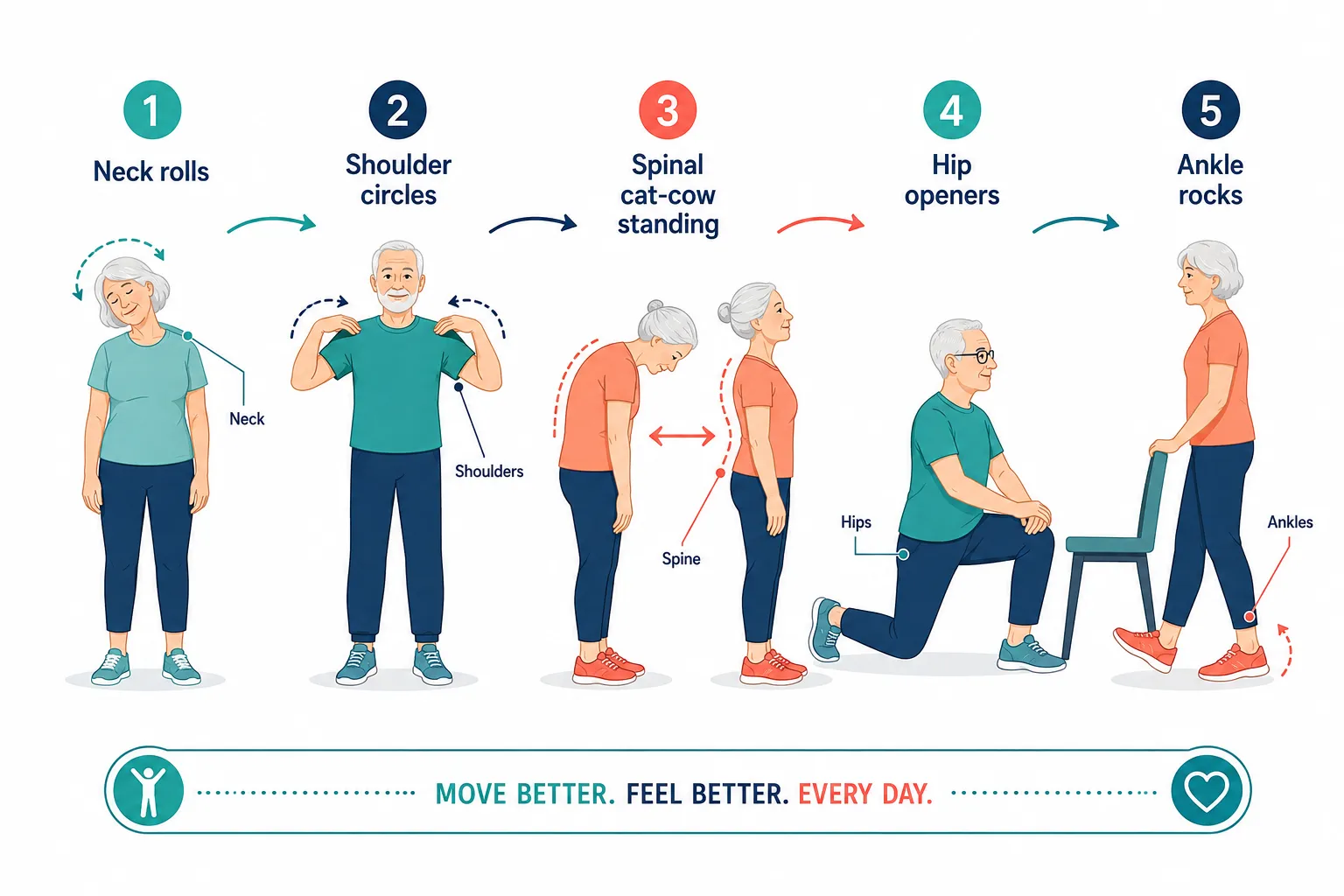
The whole sequence usually takes 8 to 12 minutes and requires no equipment beyond a sturdy chair.
Best Mobility Flow Exercises for Seniors With Arthritis
The best flows for arthritic joints are low-load, pain-free, and rhythmic. Movement helps arthritic joints, sitting still makes them worse. NICE-aligned arthritis guidance and rehab clinicians consistently recommend regular flexibility and mobility practice as a core part of managing joint disease [5].
Try these six evidence-supported movements, done for 8-12 slow repetitions each:
- Seated marching: warms up hips and knees
- Shoulder rolls (forward and back): eases neck and upper back tension
- Seated spinal twist: mobilizes the thoracic spine without loading discs
- Ankle alphabet: draw letters with your toes to work the ankle in every direction
- Wall-supported hip circles: opens the hip capsule safely
- Cat-cow, standing or seated: alternates spinal flexion and extension [6]
Choose seated versions if: knees or hips flare with weight-bearing, or balance is limited. Choose standing versions with wall support if: you want to add gait and balance benefits.
Skip any movement that produces sharp pain. A mild "working" sensation is fine; sharp or radiating pain is not.
How Often Should Older Adults Do Mobility Flow Routines?
Most days of the week, ideally daily. Short, frequent sessions beat long, occasional ones. The U.S. Physical Activity Guidelines recommend that adults 65+ include flexibility and balance work in their weekly routine, alongside 150 minutes of moderate aerobic activity and 2 sessions of strength work [8].
A practical schedule:
| Frequency | Duration | Best For |
|---|---|---|
| Daily | 5-10 min | Morning stiffness, arthritis |
| 5x per week | 10-15 min | General maintenance |
| 3x per week | 15-20 min | Combined with strength days |
Many trainers now frame these as "movement snacks", small doses of motion sprinkled through the day, especially useful for sedentary seniors who won't commit to a full workout [9].
Difference Between Mobility Flows and Stretching for Joint Health
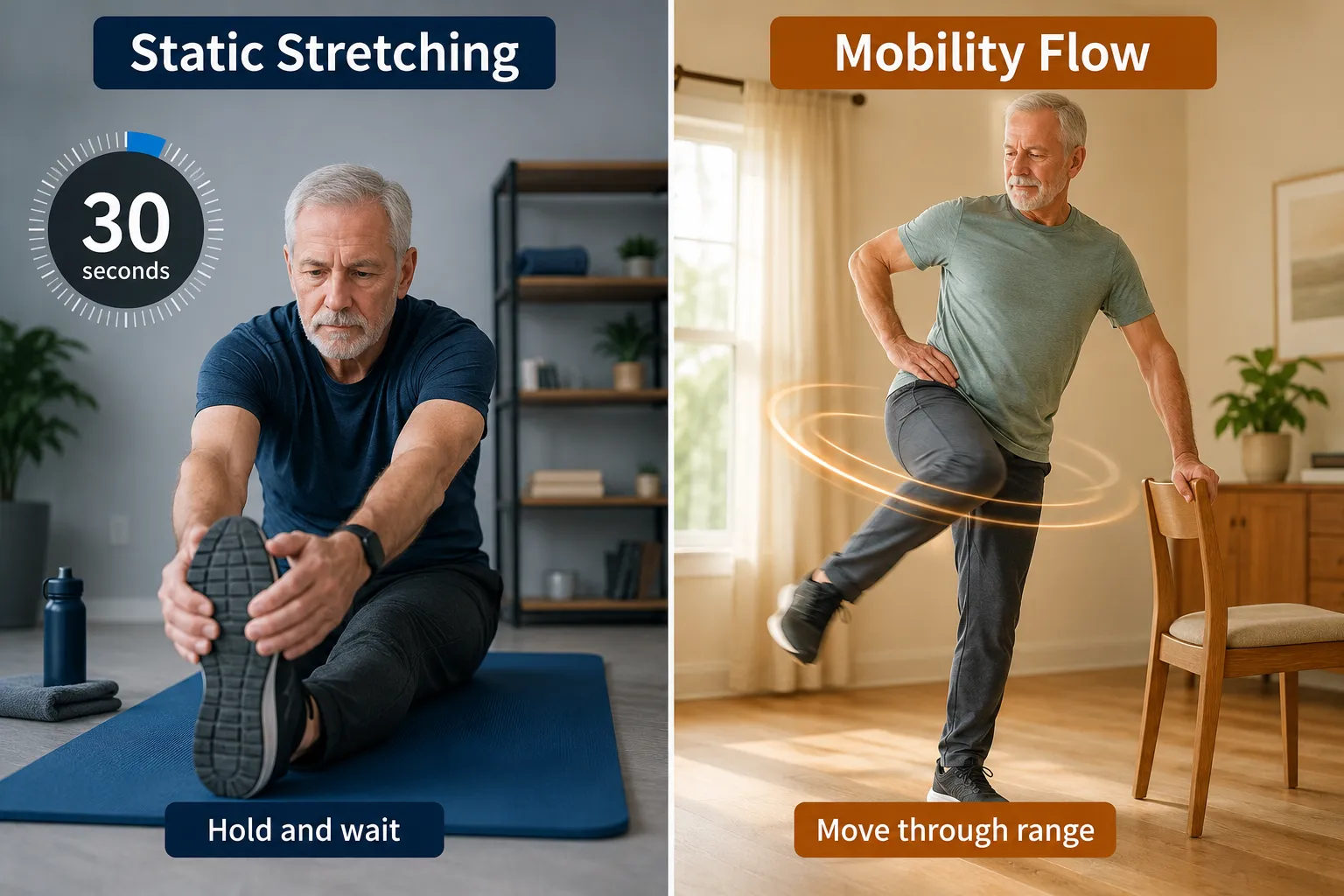
Mobility flows move joints through ranges; stretching holds a position at end-range. Both have value, but for aging joints, continuous motion is usually more useful than long holds [4].
Static stretching: hold a position 20-60 seconds. Targets muscle length. Can feel intense.
Mobility flow: move continuously through range. Targets joint capsule, synovial fluid, and neuromuscular control. Feels smooth.
Verdict: Flows are better for daily joint maintenance. Stretching still helps for specific tight muscles.
The trainer's line "joints need to move to feel good, not just be stretched" captures the shift many rehab professionals are making in 2026 [4].
Can Mobility Flow Sequences Help With Joint Pain Relief?
Yes, for many people, particularly those with stiffness-driven pain from osteoarthritis, general inactivity, or postural strain. Gentle continuous movement increases blood flow, warms tissues, and reduces the perception of pain by dialing down protective muscle guarding [5][7].
Expect modest, gradual relief rather than instant fixes. A 2024 review of low-impact activity in arthritis populations found that regular flexibility and mobility work reduced self-reported joint pain and improved function over 8-12 weeks [1].
Flows are less effective for:
- Acute inflammatory flare-ups (rest first, then reintroduce gently)
- Pain from a specific structural injury (see a clinician)
- Nerve-related pain like sciatica (needs targeted care)
Mobility Flow Routines for People With Limited Mobility
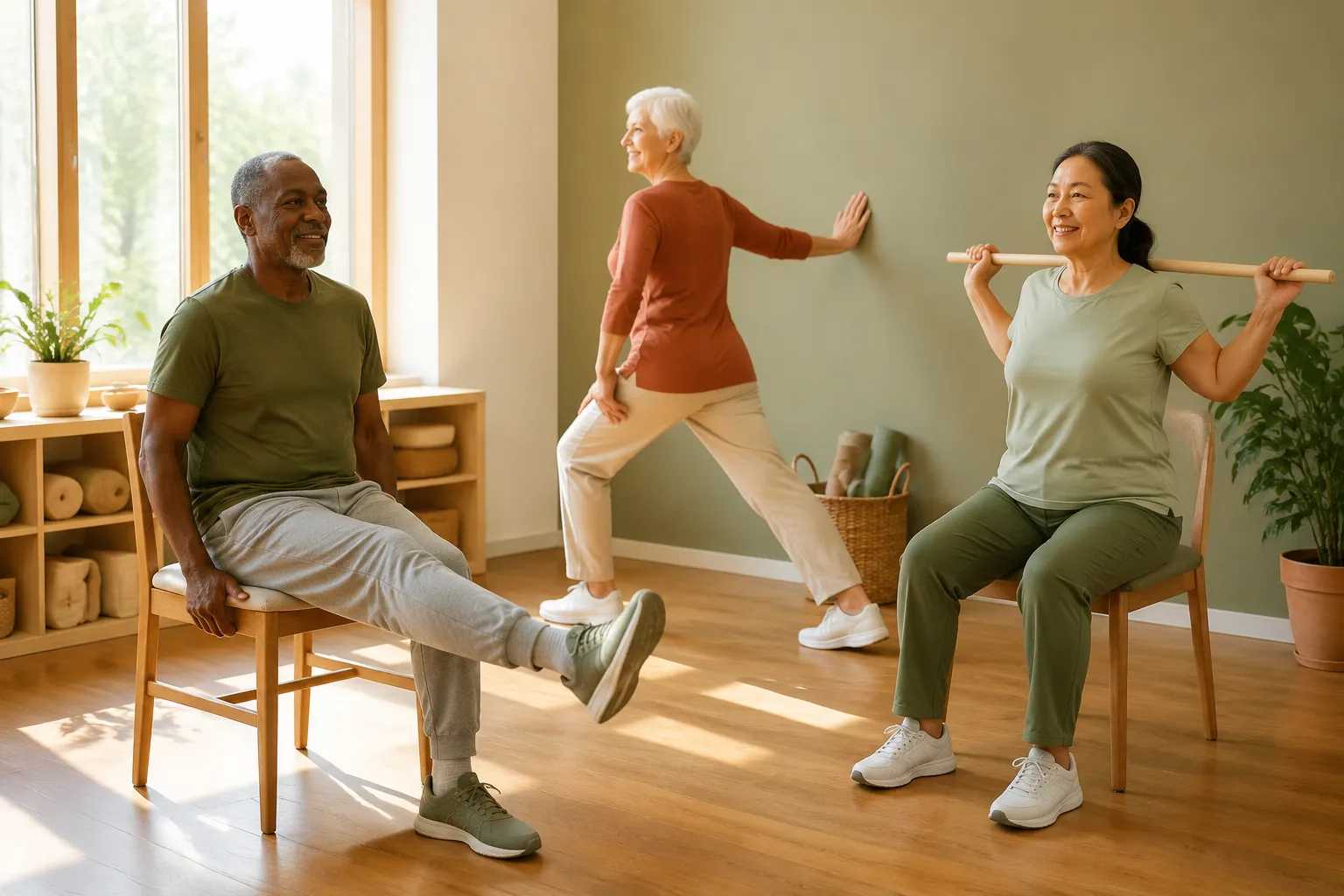
Seated and supported flows keep almost everyone in motion, regardless of ability. If standing is hard, a sturdy chair becomes the whole studio.
A seated 10-minute flow:
- Neck: slow yes-nods, then side-to-side, 6 each
- Shoulders: rolls forward 8, backward 8
- Arms: reach overhead alternately, 8 per side
- Spine: gentle seated twists, 6 per side
- Hips: seated marching, 20 total
- Knees: straighten and bend one leg at a time, 8 per side
- Ankles: circles in each direction, 8 each
For people using walkers or wheelchairs, upper-body and seated hip work still delivers meaningful stiffness relief [6]. The key is daily consistency at a low dose.
What Equipment Do I Need for Gentle Mobility Flows?
Almost nothing. That's part of why these routines have gained traction, no gym, no membership, no barriers.
Recommended (not required):
- A sturdy, armless chair
- A wall for balance support
- A non-slip mat if you'll do any floor work
- Comfortable, non-restrictive clothing
- A resistance band (light) for gentle shoulder and hip work later
Skip weighted equipment for pure mobility work, the goal is range and lubrication, not load [10].
Are Mobility Flow Sequences Safe for People With Osteoporosis?
Generally yes, with two important modifications: avoid loaded spinal flexion (rounding forward under weight) and avoid deep spinal twists. Both can raise vertebral fracture risk in people with reduced bone density [8].
Safer swaps:
- Replace forward-fold movements with hip hinges and supported bends
- Replace deep seated twists with gentle thoracic rotations in a neutral spine
- Add weight-bearing standing flows (with wall support), these actually help bone density
Anyone with a diagnosed osteoporosis or a recent DEXA scan showing low T-scores should have a physical therapist review their routine once before starting.
How Long Does It Take to See Results From Mobility Flow Routines?
Most people notice less morning stiffness within 2-3 weeks of daily practice. Improvements in balance, gait quality, and functional range of motion typically show up between weeks 4 and 8 [2][7].
A rough timeline:
- Week 1-2: Movement feels easier, less "creaky" in the morning
- Week 3-4: Noticeable improvement in reaching, turning, bending
- Week 6-8: Better balance, more confident walking, easier stairs
- Week 12+: Sustained changes in posture and fall confidence
Progress plateaus without consistency. Miss two weeks and much of the fluidity fades, this is a keep-doing-it practice, not a one-time fix.
Mobility Flow Sequences vs Physical Therapy for Older Adults
Mobility flows are general maintenance; physical therapy is targeted rehabilitation. They serve different purposes and often work best together.
Choose mobility flows if:
- You have general age-related stiffness
- You want daily prevention and joint care
- You have no acute injury or recent surgery
Choose physical therapy if:
- You're recovering from surgery, injury, or a fall
- You have pain that limits daily activities
- You need a personalized assessment [5]
Many PTs now prescribe mobility flows as homework between sessions, and hand patients a flow to continue after discharge [10].
Common Mistakes People Make Doing Mobility Flows
The routine is simple, but a few habits blunt the benefits:
- Rushing through the reps. Speed reduces the joint-lubrication effect. Slow down.
- Pushing into pain. Mobility work should feel like relief, not effort. Back off if it hurts.
- Holding the breath. Breathe naturally through each movement.
- Skipping the lower body because it's harder to see improvement there.
- Doing it once a week and expecting change. Consistency beats intensity.
- Ignoring balance support when needed, falling during a mobility routine defeats the point.
- Copying advanced yoga flows meant for younger, mobile bodies. Use routines designed for older adults [4].
Mobility Flow Routines for Stiff Hips and Lower Back
Hips and the lumbar spine cause most complaints in older adults. A focused 6-minute flow:
- Standing hip circles (hands on chair back): 6 each direction
- Standing knee raises: 8 per side
- Wall-supported leg swings (forward/back, gentle): 8 per side
- Standing cat-cow: 8 rounds
- Standing side bends: 6 per side
- Pelvic tilts against wall: 10 slow reps
This sequence targets the hip capsule, glute activation, and thoracolumbar mobility, the three biggest contributors to comfortable walking after 60 [6][7].
Can You Do Mobility Flows Every Day?
Yes. Unlike strength training, mobility work has no required recovery day. Joints benefit from daily motion. In fact, the biggest single factor separating people with fluid, comfortable joints from those with chronic stiffness is frequency of gentle movement, not intensity [4][9].
The main caveat: if a specific joint is inflamed or recovering from a flare, rest that joint for 24-48 hours while continuing to move the rest of your body.
Who Should Not Do Mobility Flow Sequences?
Most older adults can safely start today. Talk to a doctor or physical therapist first if any of the following apply:
- Recent surgery (especially joint replacement) within the last 6-12 weeks
- Acute injury or fracture that hasn't fully healed
- Severe osteoporosis with a history of vertebral fractures
- Uncontrolled cardiovascular conditions where even light activity is restricted
- Acute inflammatory arthritis flare with hot, swollen joints
- Balance disorders that make even supported standing unsafe [8]
Clearance doesn't mean "no." It usually means a modified version prescribed by a clinician.
FAQ
How many minutes of mobility flow do older adults need daily?
Five to fifteen minutes most days delivers meaningful stiffness relief and gait improvement for most seniors [4].
Can mobility flows replace walking?
No. Flows complement aerobic activity like walking, but don't replace it. Guidelines recommend both [8].
Is it okay to feel some cracking or popping in the joints?
Painless cracking is normal and harmless. Painful clicking or grinding warrants a clinician's opinion.
Should I do mobility flows in the morning or evening?
Morning helps combat overnight stiffness. Evening helps unwind tight tissues. Both work, pick what you'll do consistently.
Can mobility flows improve balance?
Yes, especially standing flows with weight shifts. Trainers increasingly build balance cues into flows to reduce fall risk [4].
Do I need to warm up before a mobility flow?
The flow itself is the warm-up. Start with the smallest, gentlest movements and let intensity build naturally.
Are online follow-along videos safe for beginners?
Yes, if they're designed for older adults and use chair or wall support. Avoid generic yoga classes unless taught by an instructor experienced with aging bodies.
Can mobility flows help with knee osteoarthritis?
Yes. Gentle, pain-free movement is a first-line recommendation for knee OA and helps preserve function [1][5].
Will mobility flows help with posture?
Yes, particularly the thoracic spine and shoulder segments. Expect gradual postural improvement over 6-12 weeks [7].
Can I combine mobility flows with strength training?
Absolutely, flows make excellent warm-ups and cool-downs for strength sessions.
Conclusion
Mobility flow sequences give older adults a simple, low-risk way to keep joints comfortable and gait fluid: move every joint through its available range, every day, in a continuous rhythm. They're safe for most people with arthritis, adaptable for limited mobility, and consistent with official physical activity guidance for adults 65+.
Start this week:
- Pick a 10-minute follow-along flow designed for older adults [4][6]
- Put a sturdy chair in a clear space
- Commit to 6 sessions in the next 7 days
- Note morning stiffness on day 1 and day 14, the difference is your proof
If pain limits daily life, add a physical therapy consult on top of your daily flow. Movement is medicine for aging joints, and the dose is a few minutes, most days, for the rest of your life.
References
[1] Mobility Exercises For Seniors – https://www.healthline.com/health/senior-health/mobility-exercises-for-seniors
[2] Improving Mobility In Old Age – https://www.healthline.com/health/improving-mobility-in-old-age
[3] Mobility Exercises Seniors – https://neverleavetheplayground.com/mobility-exercises-seniors/
[4] Your Joints Need To Move To Feel Good, A Certified Trainer Shares The Gentle Mobility Routine He Uses With Seniors – https://www.fitandwell.com/exercise/flexibility/your-joints-need-to-move-to-feel-good-a-certified-trainer-shares-the-gentle-mobility-routine-he-uses-with-seniors-to-soothe-joint-stiffness-after-60
[5] Joint Mobility Exercises – https://www.healthline.com/health/fitness-exercise/joint-mobility-exercises
[6] A Mobility Expert Recommends These Six Stretches For Older Adults With Especially Stiff Joints – https://www.fitandwell.com/exercise/flexibility/a-mobility-expert-recommends-these-six-stretches-for-older-adults-with-especially-stiff-joints
[7] Exercises For Mobility Range Of Motion After 50 – https://www.health.com/exercises-for-mobility-range-of-motion-after-50-11904156
[8] Physical Activity Guidelines 2nd Edition – https://odphp.health.gov/sites/default/files/2019-09/Physical_Activity_Guidelines_2nd_edition.pdf
[9] Home Exercise Routine – https://thehealthyagingguide.com/tag/home-exercise-routine/
[10] The Top 5 Mobility Exercises For Aging Joints – https://vitalityptgr.com/the-top-5-mobility-exercises-for-aging-joints/