Daily mobility routines for injury prevention and long-term independence

Daily mobility routines for injury prevention and long-term independence

Last updated: August 9, 2026

Quick Answer

A daily mobility routine is 5-15 minutes of controlled joint movement through full range, hips, spine, shoulders, ankles, done most days to prevent injury and preserve independence. In 2026, updated guidance emphasizes short, structured sessions over long stretching marathons, because consistency beats duration for reducing pain, improving balance, and keeping you strong into later decades [1][3].

Key Takeaways

  • 10 minutes a day of targeted mobility work outperforms one long weekly session for injury prevention [1].
  • Mobility ≠ flexibility. Mobility is active control through a range; flexibility is passive length.
  • Falls are the leading cause of injury-related loss of independence in adults over 65, and mobility plus reaction training measurably reduces that risk [2][7].
  • Desk workers need hip flexor, thoracic spine, and neck priority. Athletes need sport-specific ranges plus recovery mobility.
  • Do dynamic mobility before workouts, longer holds after or on rest days.
  • No equipment required for a starter routine, a mat and a doorway are enough.
  • Results appear in 2-4 weeks with daily practice: less stiffness, better sleep posture, easier stairs.
  • Seniors benefit most from routines that combine mobility with balance and reaction drills [2][6].
Key Takeaways

What is a daily mobility routine and why does it matter?

A daily mobility routine is a short sequence of controlled joint movements, usually 5 to 15 minutes, that takes each major joint through its full active range. It matters because joints that don't move regularly lose range, and lost range is the quiet start of most non-traumatic injuries and age-related decline in independence [1][3].

Think of it as brushing your teeth for your joints. Skip it and problems build silently: tight hips lead to back pain, stiff ankles lead to knee pain, locked-up shoulders lead to neck issues. The 2026 guidance from clinical physios and strength coaches has shifted toward short daily sessions rather than infrequent long ones, because tissue adaptation responds to frequency [1][3].

Who this is for: Desk workers, parents, weekend athletes, anyone over 40, and seniors who want to keep climbing stairs and getting off the floor without help.

Who this isn't for (as a standalone fix): People with acute injuries, post-surgical patients, or anyone with unexplained pain, see a clinician first.

What's the difference between mobility and flexibility?

Flexibility is passive; mobility is active. Flexibility is how far a joint can be moved by an outside force (like a stretch). Mobility is how far you can move that joint under your own control, with strength and stability throughout the range.

A quick example: touching your toes with your hands is flexibility. Lifting one leg to hip height and holding it there is mobility. You need both, but mobility is what actually protects you when you slip on ice or catch a falling grocery bag.

Trait Flexibility Mobility
Control Passive Active
Requires strength No Yes
Protects against injury Partially Directly
Best training method Long static holds Dynamic controlled reps
Time to see gains 4-6 weeks 2-4 weeks

Best mobility exercises to prevent injuries

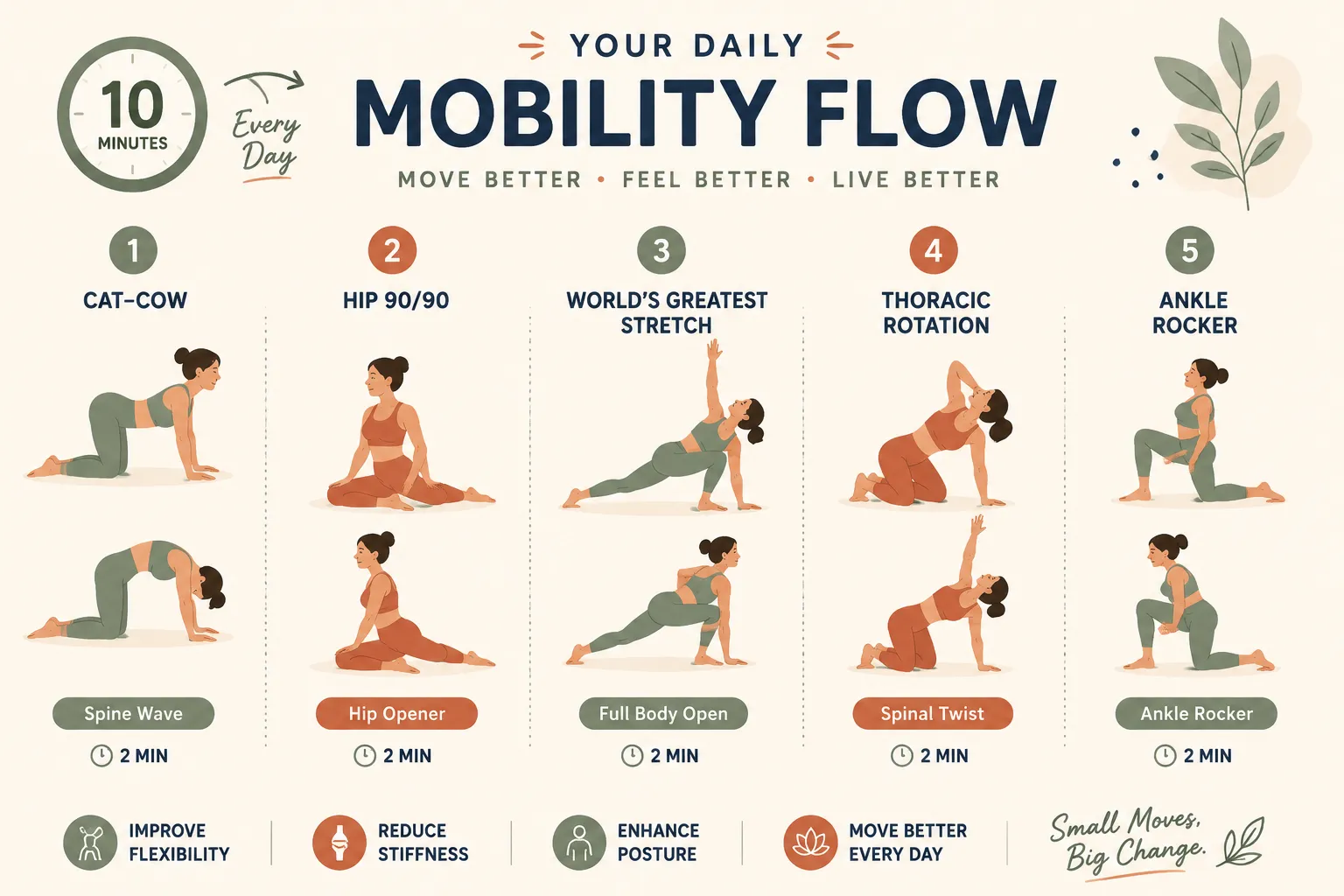
The best mobility exercises hit the joints that stiffen fastest under modern life: hips, thoracic spine, shoulders, and ankles. Do the following seven movements daily, the full sequence takes about 10 minutes [3][4].

  1. Cat-cow (spine), 8 slow reps. Wakes up the whole back.
  2. World's greatest stretch, 5 per side. Hits hips, hamstrings, thoracic spine at once.
  3. 90/90 hip switches, 8 per side. Restores internal and external hip rotation.
  4. Thoracic rotations (bench or floor), 6 per side. Frees mid-back for shoulders and neck.
  5. Deep squat hold with reach, 30-60 seconds. The most underrated longevity drill.
  6. Wall shoulder slides (scapular Y-T-W), 8 reps. Rebuilds overhead range.
  7. Ankle rockers, 10 per side. Key for balance, running, stair-climbing.

Decision rule: If you only have 5 minutes, do the deep squat hold, 90/90 hips, and thoracic rotations. Those three cover 70% of the value.

How long should a daily mobility routine take?

10 minutes is the sweet spot for most people. That's enough to hit every major joint without becoming a chore you skip. Beginners can start at 5 minutes; experienced trainees or people recovering from injury may benefit from 15-20 [1][3].

  • 5 minutes: Bare minimum, hips, spine, one problem area.
  • 10 minutes: Full-body maintenance. This is the target.
  • 15-20 minutes: Rehab, athlete recovery, or catching up after a sedentary week.

More is not automatically better. Past 20 minutes, adherence drops sharply and returns diminish. Consistency at 10 minutes daily beats 45 minutes twice a week every time [1].

Mobility routine for desk workers vs athletes

Desk workers need to reverse chair posture; athletes need to restore ranges their sport shortens. The exercises overlap, but priorities differ.

Mobility routine for desk workers vs athletes

Desk worker priority (10 min):

  • Hip flexor stretch (couch stretch), 60 sec/side
  • Thoracic extension over foam roller, 90 sec
  • Chin tucks and doorway chest opener, 60 sec
  • Glute bridges, 10 reps
  • Ankle rockers, 10/side

Athlete priority (10-15 min):

  • Sport-specific dynamic warm-up (leg swings, arm circles)
  • Deep squat hold with reach, 90 sec
  • 90/90 hip transitions, 8/side
  • Cossack squats, 6/side
  • Shoulder CARs (controlled articular rotations), 5/side
  • Foam roll problem areas post-training

Common mistake: Desk workers copying athlete routines skip the postural resets they actually need. Athletes copying desk routines miss the loaded range work that protects them at competition intensity.

Can mobility work help you stay independent as you age?

Yes, and it's one of the highest-return habits after age 50. Loss of hip mobility, ankle range, and single-leg balance is the sequence that leads to falls, and falls are the leading cause of injury-related loss of independence in older adults [2][6][7].

A 2026 CNN health report highlighted that reaction-time and mobility training together measurably reduce fall risk in adults over 65 [2]. IU Health's fall prevention program similarly combines strength, balance, and mobility drills as the core intervention [7].

What preserves independence:

  • Getting off the floor without using hands (hip and ankle mobility)
  • Reaching overhead (shoulder and thoracic mobility)
  • Turning to look behind while walking (cervical and thoracic rotation)
  • Stepping over obstacles (hip flexion and single-leg balance)

Practice these movement patterns, not just isolated stretches. The goal isn't a party trick, it's still tying your own shoes at 85.

Mobility routine for lower back pain and knee issues

For lower back pain, mobilize the hips and thoracic spine, not the low back itself. For knee issues, mobilize the hips and ankles. Most chronic pain in these areas comes from the joints above and below being stiff, forcing the painful joint to compensate [4].

Lower back routine (daily, 8 min):

  • Cat-cow, 10 reps
  • 90/90 hip switches, 8/side
  • Thoracic rotations, 8/side
  • Glute bridges, 12 reps
  • Dead bug, 8/side
  • Avoid: aggressive spinal twists during flare-ups.

Knee routine (daily, 8 min):

  • Ankle rockers against wall, 10/side
  • Hip 90/90-8/side
  • Bodyweight step-downs, 8/side
  • Terminal knee extensions with band, 12 reps
  • Couch stretch, 60 sec/side

Edge case: Sharp, sudden, or swelling-related pain is not a mobility problem, see a clinician.

Should I do mobility work before or after workouts?

Do dynamic mobility before workouts and longer holds after. Dynamic movement primes joints and nervous system; static holds after training help restore length without blunting force output.

  • Pre-workout (3-5 min): Leg swings, arm circles, world's greatest stretch, CARs. Movement-based, no long holds.
  • Post-workout (5-10 min): Deep squat hold, couch stretch, chest opener, pigeon. Longer static positions where you can breathe and settle.
  • Off-day mobility (10-15 min): The full daily routine, done slowly.

Common mistake: Doing 5-minute static stretches before lifting or sprinting. Research since the early 2010s has repeatedly shown this can reduce power output and offers no injury-prevention benefit compared to dynamic prep [4].

Common mistakes people make with mobility training

The biggest mistakes are treating mobility like passive stretching, chasing extreme ranges, and doing it inconsistently. Fix these three and progress accelerates fast.

  • Bouncing through positions instead of controlling them. Slow beats fast.
  • Only stretching what's tight. Tight muscles are often protecting a weak joint, strengthen the surrounding area too.
  • Skipping the deep squat. It's uncomfortable at first, but it's the single most predictive movement of long-term hip and knee health [3].
  • Doing it once a week. Frequency drives adaptation. Ten minutes daily > 70 minutes weekly.
  • Ignoring breath. Holding your breath in a stretch signals your nervous system to guard. Long exhales unlock range.
  • Chasing pain. Discomfort is fine; sharp pain is a stop sign.

"Mobility is not about being bendy. It's about owning every degree of range you have with strength and control.", a principle echoed across 2026 clinical guidance [1][3].

Mobility routine for seniors to prevent falls

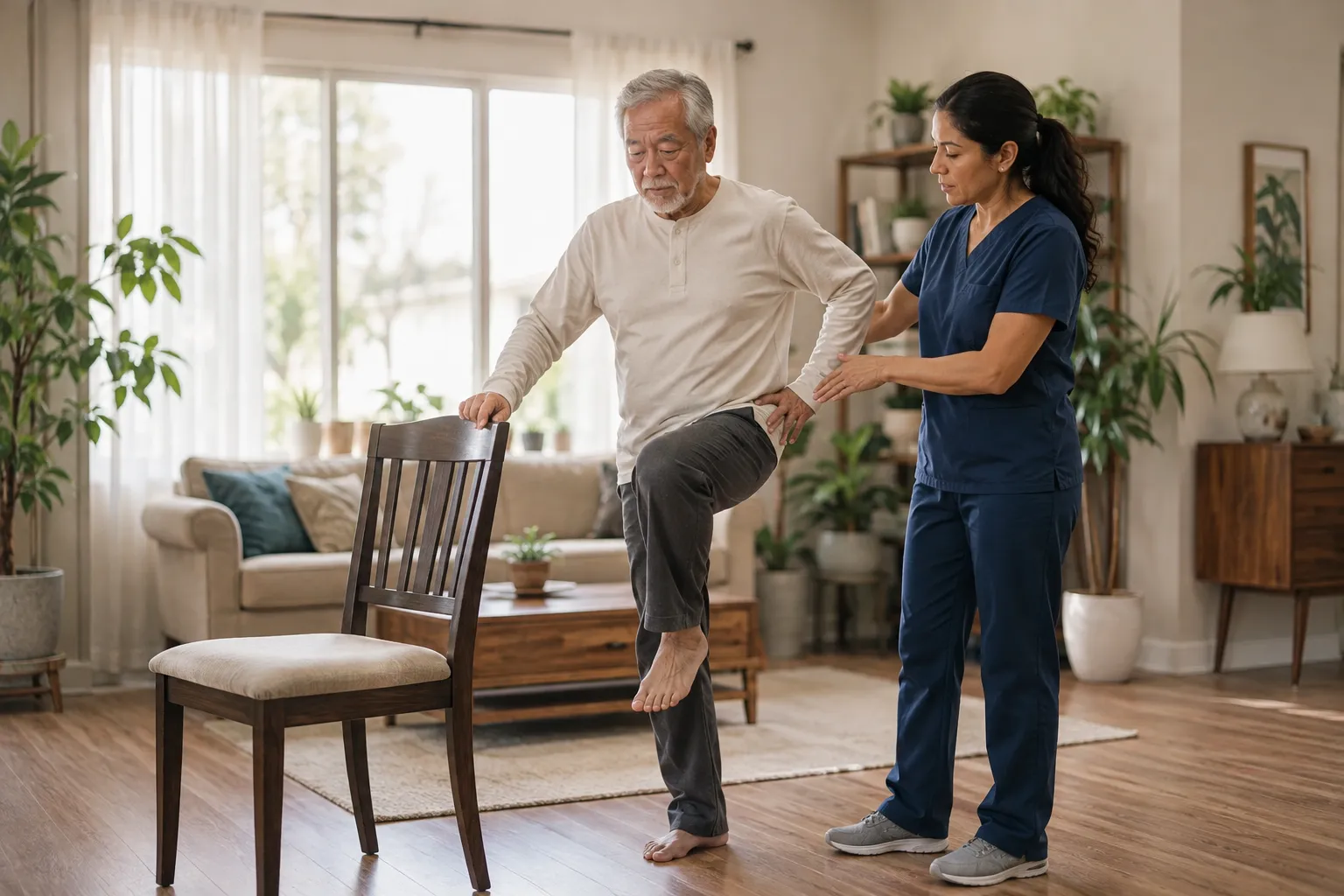
Seniors should combine mobility with balance and reaction drills, that combination is what actually reduces falls. Isolated stretching helps stiffness but doesn't prevent the loss-of-balance moment [2][5][6][7].
Mobility routine for seniors to prevent falls

Daily 10-minute senior routine:

  1. Seated marches, 20 reps. Warm-up hips safely.
  2. Ankle circles and pumps, 10 each direction, per side.
  3. Sit-to-stands from a sturdy chair, 8-12 reps.
  4. Heel-to-toe walking, 20 steps along a wall for support.
  5. Single-leg stand, 20 seconds per side, near a counter.
  6. Standing thoracic rotation, 6 per side.
  7. Wall shoulder slides, 8 reps.

Add weekly: Reaction drills like catching a tossed ball or stepping to unexpected cues. A 2026 CNN wellness report highlighted these as a top-tier fall prevention tool [2].

Safety rule: Always have a chair, wall, or counter within reach for balance work. Never train balance alone if you've fallen in the past year, start with a physical therapist [7][9].

How often do you need to do mobility work to see results?

Daily practice shows results in 2 to 4 weeks. Three times a week works but takes twice as long. Once a week maintains almost nothing.

  • Week 1: Less morning stiffness, easier bending to tie shoes.
  • Weeks 2-3: Improved sleep, better posture at your desk, deeper squat.
  • Week 4+: Noticeable strength in end-ranges, fewer minor tweaks and strains.
  • Month 3+: Structural changes, tissue and nervous-system adaptations that hold up under stress.

Miss a day? Fine. Miss a week? Restart at 70% intensity. The routine is a lifelong practice, not a program you complete.

Is a daily mobility routine necessary or just optional?

For long-term health and independence, it's necessary, not optional. If you sit for more than 4 hours a day, exercise hard, are over 40, or have any recurring pain, a daily mobility habit is one of the highest-leverage things you can do for future you [1][3][4].

You can skip it if: You're a manual laborer who moves through full ranges all day, you're under 25 with no pain, and you sleep well. Even then, a 5-minute check-in is smart insurance.

You absolutely need it if: You're desk-based, you strength train, you're a runner or cyclist, you're over 50, or you've had any injury in the last 3 years.

What equipment do I need for a basic mobility routine at home?

None. A mat and a doorway are enough to start. Equipment can add options but is never the barrier.

Starter (free): A yoga mat or carpet, a wall, a doorway, a sturdy chair.

Level up ($30-80):

  • Foam roller, for thoracic spine and calves
  • Resistance band (loop), for hip and shoulder activation
  • Lacrosse ball or massage ball, for targeted release

Advanced ($100+): Kettlebell for loaded mobility work (goblet squats, halos), a pull-up bar for hanging (excellent for shoulders and spine decompression).

Common mistake: Buying gadgets before building the habit. Do 30 days with zero equipment first.

Mobility exercises for people with limited range of motion

Start seated or supported, and work in the range you have, not the range you wish you had. Progress comes from consistent movement in small ranges, not from forcing depth [5][9].

Chair-based starter routine (8 min):

  • Seated cat-cow, 8 reps
  • Seated marches, 15 reps
  • Seated leg extensions, 10/side
  • Seated thoracic rotation, 6/side
  • Arm circles, 8 each direction
  • Ankle circles, 10 each direction
  • Neck half-circles, 4 each direction

Progression path: Chair → chair + standing (holding chair) → standing unsupported → floor-based work. Move to the next level only when the current one feels easy and safe.

Edge case: Post-surgical, neurological conditions, or severe arthritis, always work with a physical therapist to individualize the plan [9].

Sample 10-Minute Daily Mobility Routine

Here's a done-for-you template you can start today. No equipment. Repeat once through.

Time Exercise Reps/Duration
0:00 Cat-cow 8 slow reps
1:00 World's greatest stretch 5/side
3:00 90/90 hip switches 8/side
5:00 Deep squat hold + reach 45 sec
6:00 Thoracic rotations 6/side
7:30 Wall shoulder slides 8 reps
8:30 Ankle rockers 10/side
9:30 Standing forward fold + roll up 2 reps

FAQ

Is mobility training the same as yoga?
No. Yoga includes mobility but also emphasizes flexibility, breathwork, and philosophy. Mobility training is more targeted at joint control and injury prevention.

Can I do mobility work every day, even on rest days?
Yes. Daily low-intensity mobility is designed to be done every day, including rest days from lifting or running.

Will mobility work help my posture?
Yes, especially thoracic spine and hip flexor mobility, combined with strengthening the back and glutes.

How long until I can do a full deep squat?
Most people restore a comfortable bodyweight deep squat within 4-8 weeks of daily hip and ankle mobility work.

Is it normal to feel sore after mobility work?
Mild next-day tightness in worked areas is normal. Sharp pain is not, reduce range and re-evaluate.

Can mobility work replace strength training?
No. They complement each other. Mobility gives you range; strength gives you control of that range.

Are online mobility apps worth it?
They can help with consistency and progression, but a free 10-minute routine done daily beats an app used sporadically.

What time of day is best for mobility?
Whenever you'll actually do it. Morning wakes up the body; evening decompresses it. Both work.

Should kids do mobility routines?
Kids naturally maintain mobility through play. Structured routines aren't necessary unless they're competitive athletes.

Can mobility work help with sciatica?
Sometimes, hip and thoracic mobility often relieves referred symptoms. But sciatica warrants clinical evaluation first.

Conclusion

Daily mobility routines for injury prevention and long-term independence come down to one habit: 10 minutes, most days, moving every major joint through the range you own. It's the least glamorous fitness advice available, and also the most effective for how you'll feel at 50, 70, and 90.

Your next steps:

  1. This week: Do the 10-minute template above once a day. No equipment. No excuses.
  2. Week 2: Add one balance or reaction drill if you're over 50.
  3. Week 4: Reassess, deeper squat? Less back stiffness? Easier stairs? Keep going.
  4. Month 3: Make it as automatic as brushing your teeth.

Mobility is the quiet infrastructure of an active life. Build it daily, and you keep the freedom to move, work, play, and live on your own terms for decades longer.

References

[1] New Year New Mobility 5 Daily Habits To Keep You Moving In 2026 – https://thewoodfordphysio.com/new-year-new-mobility-5-daily-habits-to-keep-you-moving-in-2026/
[2] Train Faster Reaction Prevent Falls Wellness – https://www.cnn.com/2026/07/31/health/train-faster-reaction-prevent-falls-wellness
[3] Mobility And Stability For Long Term Health – https://www.legion.org/information-center/news/magazine/2026/august/mobility-and-stability-for-long-term-health
[4] Injury Prevention Tips 2026 – https://www.braceability.com/blogs/articles/injury-prevention-tips-2026
[5] Mobility Exercises For Seniors – https://www.healthline.com/health/senior-health/mobility-exercises-for-seniors
[6] Fall Risk Reduction – https://spectrumcs.org/senior-services/fall-risk-reduction
[7] Nr Iu Healths Fall Prevention Program For Seniors Returns – https://iuhealth.org/for-media/press-releases/nr-iu-healths-fall-prevention-program-for-seniors-returns
[8] Watch – https://www.youtube.com/watch?v=G1IgyQ8TuNE
[9] Healthy Aging Tips For Spring Senior Mobility Exercises That Support Independence – https://centershealthcare.com/media/healthy-aging-tips-for-spring-senior-mobility-exercises-that-support-independence/
[10] Watch – https://www.youtube.com/watch?v=zTJfBAFgHwQ


Balance, Flow, and Core Strength: A 20-Minute Mobility Flow for Active Agers

Balance, Flow, and Core Strength: A 20-Minute Mobility Flow for Active Agers

Last updated: August 2, 2026

Quick Answer

A 20-minute mobility flow for active agers links balance drills, core activation, and gentle joint mobility into one continuous routine, no equipment required. Done three to four times a week, it can measurably improve single-leg balance, trunk stability, and hip mobility within four to six weeks. The key is flowing between positions (standing, kneeling, floor) so the body practices transitions, which is where most falls actually happen.

Quick Answer

Key Takeaways

  • Mobility flow blends yoga's transitions, Pilates' core control, and physical therapy's balance work into one sequence.
  • 20 minutes, 3-4x per week is the sweet spot for older adults, enough to build capacity without over-fatiguing joints.
  • Balance improvements typically appear in 2-4 weeks; strength and mobility gains in 6-8 weeks.
  • No equipment needed, though a sturdy chair, wall, and yoga mat make the routine safer and more comfortable.
  • Falls happen during transitions (sitting to standing, turning, reaching), so training transitions matters more than static poses.
  • Safe with most conditions including arthritis, mild back pain, and osteoporosis when modified, but check with a doctor first if you have recent surgery or acute injury.
  • Morning practice tends to reduce stiffness and set posture for the day; evening practice helps unwind tight hips and shoulders.
  • Common mistakes: rushing transitions, holding the breath, and skipping the warm-up.

What is mobility flow and why does it matter for older adults

Mobility flow is a continuous sequence of movements that takes joints through their full range while engaging stabilizing muscles, typically the core, hips, and shoulders. Unlike static stretching, it keeps you moving from one position to the next, which trains the nervous system to control the body during transitions.

For older adults, that matters because aging doesn't just reduce flexibility, it reduces motor control. The brain gets slower at coordinating multi-joint movement, which is why picking up a dropped item or stepping off a curb can feel unsteady. Mobility flow rebuilds that coordination.

Who it's for: Adults 50+ who can stand and move independently, including those with mild arthritis, high blood pressure, or a history of minor joint pain.

Who should modify or skip it: Anyone recovering from recent surgery, with severe balance disorders, uncontrolled blood pressure, or acute injury, see a physical therapist first.

How does a 20-minute mobility routine improve balance and core strength

A 20-minute flow improves balance and core strength by combining three things in one session: proprioceptive challenge (standing on one leg, changing planes), deep core activation (breath-linked bracing during transitions), and hip and ankle mobility (the joints most responsible for reactive balance).

Here's what happens physiologically:

  • Weeks 1-2: Nervous system adapts. You feel steadier and more coordinated even before muscles change.
  • Weeks 3-4: Deep stabilizers (transverse abdominis, glute medius, ankle stabilizers) strengthen. Single-leg balance improves noticeably.
  • Weeks 5-8: Range of motion increases at hips, thoracic spine, and shoulders. Everyday movements, turning, bending, reaching, feel easier.

The 20-minute length matters. Long enough to hit all major joints and get a training effect, short enough that form doesn't degrade from fatigue.

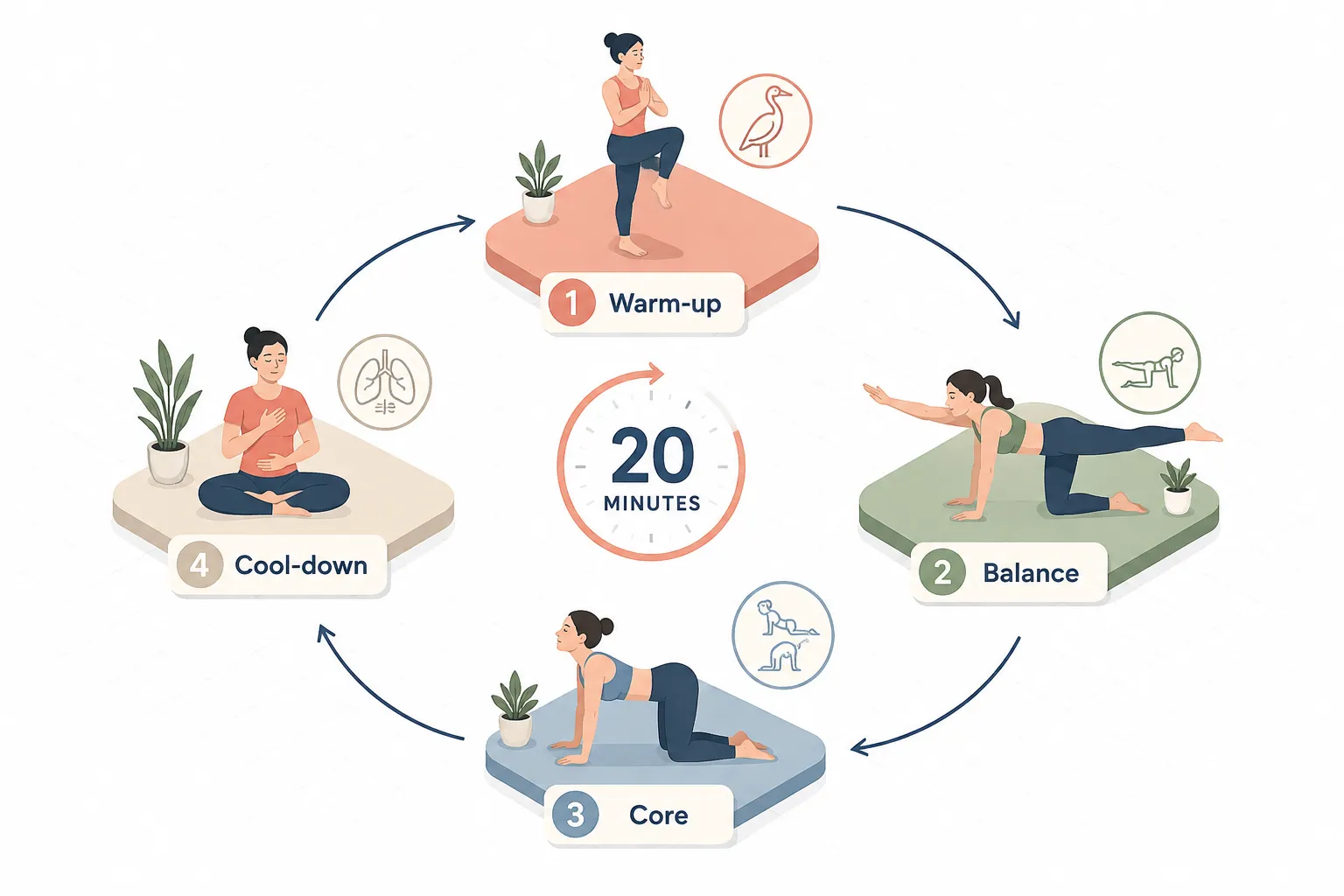
The 20-minute mobility flow: Balance, flow, and core strength for active agers

This is the full routine. Move slowly, breathe steadily, and rest whenever you need. A sturdy chair or wall should be within arm's reach for balance segments.

Block 1: Warm-up and joint prep (4 minutes)

  1. Seated cat-cow, 8 reps. Sit tall in a chair, hands on knees, arch and round the spine with breath.
  2. Neck half-circles, 4 each side. Chin to chest, roll ear toward shoulder, return.
  3. Shoulder rolls + arm circles, 30 seconds each direction.
  4. Ankle circles and pumps, 10 each foot.
  5. Seated marches with reach, 30 seconds. Lift knee, opposite arm reaches overhead.

Block 2: Standing mobility and balance (6 minutes)

  1. Standing hip circles, 5 each direction, each leg. Hand on chair for support.
  2. Heel-to-toe rocks, 15 reps. Rise onto toes, rock back onto heels.
  3. Single-leg stand, 20-30 seconds each leg. Progress: eyes closed or head turns.
  4. Standing knee lift with arm reach, 8 each side. Lift knee, opposite arm overhead, hold 2 seconds.
  5. Sit-to-stand from chair, 8 reps, slow tempo.
  6. Standing hip hinge, 8 reps. Hands on hips, hinge forward with a flat back.

Block 3: Floor flow, core and spinal mobility (7 minutes)

  1. Cat-cow on hands and knees, 8 breaths.
  2. Bird-dog, 6 each side. Opposite arm and leg extend, pause, return.
  3. Thread the needle, 5 each side. Rotates the thoracic spine.
  4. Dead-bug, 6 each side. Lying on back, opposite arm and leg lower slowly.
  5. Glute bridge, 10 reps. Lift hips, squeeze glutes, lower.
  6. Supine spinal twist, 30 seconds each side.

Block 4: Cool-down flow (3 minutes)

  1. Child's pose, 5 breaths.
  2. Seated forward fold, 5 breaths.
  3. Standing side bends, 3 each side.
  4. Box breathing, 4 counts in, 4 hold, 4 out, 4 hold. Repeat 4 times.

Block 4: Cool-down flow (3 minutes)

Best mobility exercises for people over 50 or 60

The most valuable mobility exercises for people over 50 target the joints that stiffen first: hips, thoracic spine (mid-back), ankles, and shoulders. These are also the joints most linked to fall prevention and posture.

Top 7 exercises to prioritize:

Exercise Primary benefit Reps
Sit-to-stand Leg strength, transfer power 8-12
Single-leg stand Static balance, ankle stability 20-30 sec each
Bird-dog Core control, spinal stability 6 each side
Glute bridge Posterior chain, low-back health 10-15
Thoracic rotation Mid-back mobility, posture 5 each side
Hip 90/90 transitions Deep hip mobility 5 each side
Heel-to-toe walk Dynamic balance 10 steps

Choose sit-to-stand over squats if your knees complain. It trains the same muscles with less joint stress.

Can you do mobility flow if you have arthritis or joint pain

Yes, in fact, mobility flow is often recommended for mild-to-moderate arthritis because gentle, repeated movement lubricates joints and reduces stiffness. The Arthritis Foundation consistently endorses low-impact, range-of-motion routines for exactly this reason.

Rules for arthritic joints:

  • Move within a pain-free range. A little stiffness is fine; sharp pain is a stop signal.
  • Warm up longer, 5-6 minutes instead of 4, especially in the morning.
  • Reduce reps, not intensity. Do 4 reps of a movement with good form rather than 10 rushed ones.
  • Skip deep flexion if knees or hips are painful, use partial range.
  • Ice after if a joint feels aggravated; heat before if it feels stiff.

Common mistake: Stopping movement entirely when a joint hurts. Immobility usually makes arthritis worse. Gentle daily motion is the treatment.

Mobility flow vs yoga vs Pilates for active aging

Mobility flow, yoga, and Pilates overlap but emphasize different things. For active agers, mobility flow tends to be the most direct match for functional daily movement.

Quick comparison:

  • Yoga, Emphasizes flexibility, breath, and held postures. Great for calm and range of motion, but some styles (Ashtanga, hot yoga) are too intense for older joints.
  • Pilates, Emphasizes deep core control and precise, slow movement. Excellent for posture and back health; less focus on standing balance.
  • Mobility flow, Emphasizes joint range plus balance plus transitions. Most closely mirrors real-life movement patterns like getting off the floor or navigating stairs.

Choose mobility flow if you want practical, fall-prevention, focused training. Choose yoga if you want mental calm and long holds. Choose Pilates if you have back issues and need deep core work. Many active agers do all three across the week.

How often should you do mobility work to see results in balance

Three to four sessions per week of 20 minutes each is the research-backed sweet spot for balance improvement in older adults. Daily short sessions (10 minutes) also work, the total weekly volume matters more than session length.

Realistic schedule:

  • Minimum effective dose: 2 sessions/week, maintains what you have.
  • Balance improvement: 3-4 sessions/week, measurable gains in 4-6 weeks.
  • Optimal: 4-5 sessions/week with one full-body strength session added.

Signs it's working: You stop reaching for railings, you can put on socks standing up, you turn without shuffling, and you get off the floor without using hands.

What equipment do you need for a 20-minute mobility session

Almost nothing. The routine is bodyweight-only, but a few items make it safer and more comfortable.

Essential:

  • Sturdy chair or wall, for balance support during standing work.
  • Yoga mat or rug, cushions knees and spine during floor segments.

Nice-to-have:

  • Yoga block, reduces distance to the floor if hips are tight.
  • Light resistance band, adds progression once basics feel easy.
  • Wooden dowel or broomstick, helps with shoulder mobility drills.

Skip: Anything that promises "instant balance" through vibration plates or gadgets. Balance is a skill built through practice, not equipment.

What equipment do you need for a 20-minute mobility session

Is mobility flow safe if you have back problems or injuries

Mobility flow is generally safe and often therapeutic for chronic low back stiffness, but specific conditions require modification. Anyone with disc herniation, spinal stenosis, or recent back surgery should have a physical therapist review the routine first.

Modifications for back issues:

  • Skip deep forward folds, hinge from the hips with a flat back instead.
  • Avoid loaded spinal twists, use gentle, unweighted rotations.
  • Prioritize glute bridges and bird-dogs, these directly support spinal stability.
  • Use a chair for floor transitions, getting up and down is often more provocative than the exercises themselves.

Red flags to stop: Radiating pain down the leg, numbness, sudden weakness, or pain that gets worse over the session (not better).

Common mistakes people make during mobility training

Most people undermine their mobility work with a handful of small errors. Fixing these usually doubles the results within a few weeks.

  1. Rushing transitions, the whole point is controlled movement between positions. Slow down by 30%.
  2. Holding the breath, breath drives core engagement. Exhale on effort, inhale on release.
  3. Skipping the warm-up, cold joints don't move well, especially in the morning.
  4. Doing it once a week, mobility is like brushing teeth. Frequency beats intensity.
  5. Pushing into pain, mobility work should feel like effort, not sharp discomfort.
  6. Ignoring the feet, bare feet on the floor during balance work builds better proprioception than cushioned shoes.
  7. Comparing to old range, meet your body where it is today, not where it was at 35.

How long before you notice better balance from mobility exercises

Most people feel steadier within 2-3 weeks of consistent practice. Measurable improvements in single-leg stand time and functional tests typically appear by 4-6 weeks. Larger gains in strength and joint range take 8-12 weeks.

Timeline expectations:

  • Week 1: Body feels looser after each session; sleep may improve.
  • Week 2-3: Steadier when turning, reaching, or standing from a chair.
  • Week 4-6: Single-leg balance holds double or triple in length.
  • Week 8+: Everyday tasks feel dramatically easier, stairs, gardening, getting in and out of the car.

The nervous system adapts fast; muscle and connective tissue take longer. Patience is part of the practice.

Mobility flow for people with limited mobility or balance issues

The routine can be fully seated or chair-supported for those with significant balance limitations, walking aids, or post-surgery restrictions. The principle is the same: move every joint through its available range with breath and control.

Seated version, 15 minutes:

  • Seated cat-cow, neck rolls, shoulder circles (3 min)
  • Seated marches, knee extensions, ankle pumps (4 min)
  • Seated torso twists, side bends, forward hinges (4 min)
  • Seated arm reaches, shoulder mobility with a dowel (2 min)
  • Box breathing and gentle stretch hold (2 min)

Standing with chair support: Do the full routine but keep one hand lightly on a chair back throughout the standing block. Progress by using two fingers, then one, then hovering.

Can mobility training help prevent falls in older adults

Yes, this is one of the most well-supported findings in geriatric research. Structured exercise programs that combine balance, strength, and mobility work reduce fall rates in community-dwelling older adults, according to Cochrane reviews of dozens of trials.

Why it works:

  • Faster reaction time to trips and slips.
  • Stronger ankle and hip stabilizers to catch loss of balance.
  • Better spatial awareness from practicing multi-plane movement.
  • Confidence, fear of falling itself increases fall risk. Practice reduces the fear.

Falls almost never happen from standing still. They happen during transitions, turning, stepping down, reaching. Mobility flow trains exactly those moments.

What's the difference between mobility and flexibility training

Flexibility is passive, how far a joint can be moved when something else moves it (like a stretch). Mobility is active, how far you can move a joint using your own muscles with control. Mobility requires flexibility plus strength through the range.

Simple example: You can passively bring your knee to your chest lying down (flexibility). But can you lift your knee that high while standing (mobility)? For older adults, mobility is the more useful quality because daily life requires active, controlled movement, not held stretches.

Best time of day to do a mobility flow routine

Morning is ideal for reducing stiffness and improving posture through the day; evening is better for relaxation, hip release, and sleep quality. Both work, consistency beats timing.

Morning benefits:

  • Reduces overnight joint stiffness
  • Improves posture and energy for the day
  • Easier to make habitual

Evening benefits:

  • Releases accumulated tension from sitting
  • Improves sleep onset
  • Body is warmer, so range is greater

Avoid: Heavy mobility work immediately after a large meal or right before bed if you use energizing sequences.

Pull quote: "The best mobility routine is the one you'll actually do, same time, same place, most days of the week."

FAQ

Do I need to be flexible to start a mobility flow?
No. Mobility flow builds flexibility gradually. Start where your body is today.

Can I do this if I've never exercised?
Yes. Start with the seated version for one week, then add the standing block. Progress at your own pace.

Is it safe with osteoporosis?
Generally yes, but avoid deep forward folds and loaded spinal flexion. Focus on posture-supporting moves like glute bridges, bird-dogs, and standing balance work. Confirm with your doctor.

How is this different from tai chi?
Tai chi is excellent for balance and is a proven fall-prevention practice. Mobility flow adds more targeted core and joint range work, and takes less time to learn.

Will 20 minutes really make a difference?
Yes, if done 3-4 times a week consistently. Frequency and consistency matter more than session length.

Can I do this if I use a cane or walker?
Yes, use the seated and chair-supported versions. Skip single-leg balance work or do it while holding the walker.

Should I feel sore afterward?
Mild muscle awareness is normal. Sharp pain, joint swelling, or lasting soreness beyond 48 hours means back off intensity.

What if I miss a few days?
No problem. Restart at a lighter intensity for one session, then resume normally. Consistency over months matters, not perfection week to week.

Conclusion

A 20-minute mobility flow won't turn back the clock, but it will change how the next 20 years feel. The gains, steadier balance, easier transitions, less morning stiffness, more confidence on stairs and uneven ground, compound quietly with each session.

Start this week:

  1. Pick a time (morning or evening) and commit to three sessions.
  2. Set up a chair, mat, and clear floor space.
  3. Do the full 20-minute flow, or start with the seated version.
  4. Track how you feel, not just what you did.
  5. After four weeks, retest single-leg balance and sit-to-stand count.

The body responds to movement at every age. Give it 20 minutes, three times a week, and it will return the favor for decades.

Joint-Friendly Mobility Routine for Knees, Hips, and Shoulders: 15 Minutes to Move Better, Not Harder

Joint-Friendly Mobility Routine for Knees, Hips, and Shoulders: 15 Minutes to Move Better, Not Harder

Last updated: July 23, 2026

Quick Answer

Quick Answer

A joint-friendly mobility routine for knees, hips, and shoulders takes about 15 minutes and uses slow, controlled circles, gentle range-of-motion drills, and chair or wall support to protect painful joints while restoring how you walk, reach, and stand up. Done three to five times a week, it improves comfort in daily movement without adding stress to cartilage or tendons [5][9]. The goal is smoother motion, not harder effort.

Key Takeaways

  • 15 minutes, most days is enough to notice change in 2-4 weeks [9][10].
  • Chair and wall support make this routine safe for arthritis, weak knees, or balance issues [8].
  • Controlled circles and rotations at the ankle, hip, and shoulder are the backbone of joint health [5].
  • Move through pain-free ranges only. Sharp pain is a stop signal; mild stiffness fading during warm-up is fine [7].
  • Mobility is different from stretching. You're actively moving joints through their full range, not holding a static stretch [4].
  • Athletes and older adults both benefit, mobility feeds performance and independence [2][9].
  • Warm-up first. Even 60 seconds of marching in place changes how joints respond [7].
  • No equipment required beyond a sturdy chair, a wall, and a mat.

)

What Is Joint Mobility and Why Does It Matter for Knees, Hips, and Shoulders?

Joint mobility is your ability to actively move a joint through its full range of motion with control. It combines flexibility, strength at end ranges, and neuromuscular coordination [5]. For knees, hips, and shoulders, the three joints most responsible for walking, sitting, reaching, and dressing, mobility loss shows up as stiffness getting out of a car, difficulty reaching a top shelf, or hesitation on stairs [8].

These joints matter because they do the most work in daily life. Hips drive gait and posture. Knees absorb load every step. Shoulders handle nearly every upper-body task. When any of them lose motion, the others compensate, and pain often follows [7].

Decision rule: If you can't touch your shoulder blade with the opposite hand, squat to chair height without pain, or step up a full flight of stairs without stiffness, mobility work should be a weekly habit.

How Is a Mobility Routine Different from Stretching or Yoga?

Mobility trains active, controlled movement through a joint's range. Static stretching holds a lengthened position; yoga blends postures, breath, and flexibility. Mobility work sits in between and often replaces both for joint-specific goals [4].

  • Static stretching: hold a hamstring stretch for 30 seconds. Passive.
  • Yoga: flows and holds emphasizing flexibility and mind-body connection.
  • Mobility: slow, deliberate circles, rotations, and controlled articular movements that strengthen the range you already have and expand it safely [5].

The practical difference: mobility drills warm the joint capsule, lubricate cartilage with synovial fluid, and teach your nervous system to own each degree of motion [7]. That's why a 15-minute mobility session often reduces stiffness faster than the same time spent stretching.

Can I Do Joint Mobility Exercises If I Have Arthritis or Joint Pain?

Yes, and gentle mobility is often one of the recommended approaches for arthritic joints because controlled movement helps circulate synovial fluid and reduces stiffness [7][9]. The key is staying inside pain-free ranges and using support (chair, wall, countertop) to unload the joint.

Guidelines for painful joints:

  • Start with smaller circles and shorter ranges. Expand only if comfortable.
  • Use a chair for balance during hip and knee work.
  • Skip anything that produces sharp, pinching, or radiating pain.
  • Warm up with 1-2 minutes of easy marching or arm swings first [7].
  • Talk to your doctor or physical therapist if you have a recent injury, joint replacement, or diagnosed condition before starting.

Most people with mild osteoarthritis tolerate this style of low-impact routine well [9].

What's the Best Time of Day to Do a 15-Minute Mobility Routine?

Morning is usually best because joints are stiffest after sleep, and mobility work sets a smoother tone for the day. Evening also works well for winding down and reducing accumulated tension from sitting. The best time is whichever time you'll actually do it consistently [10].

  • Morning: clears overnight stiffness, improves posture before you sit at a desk.
  • Pre-workout: primes joints for stronger, safer training [2][10].
  • Evening: unwinds hips and shoulders after prolonged sitting.

Avoid doing it right before bed if it energizes you, and skip it in the first 5 minutes after waking, take a quick walk to the kitchen first so tissues aren't cold.

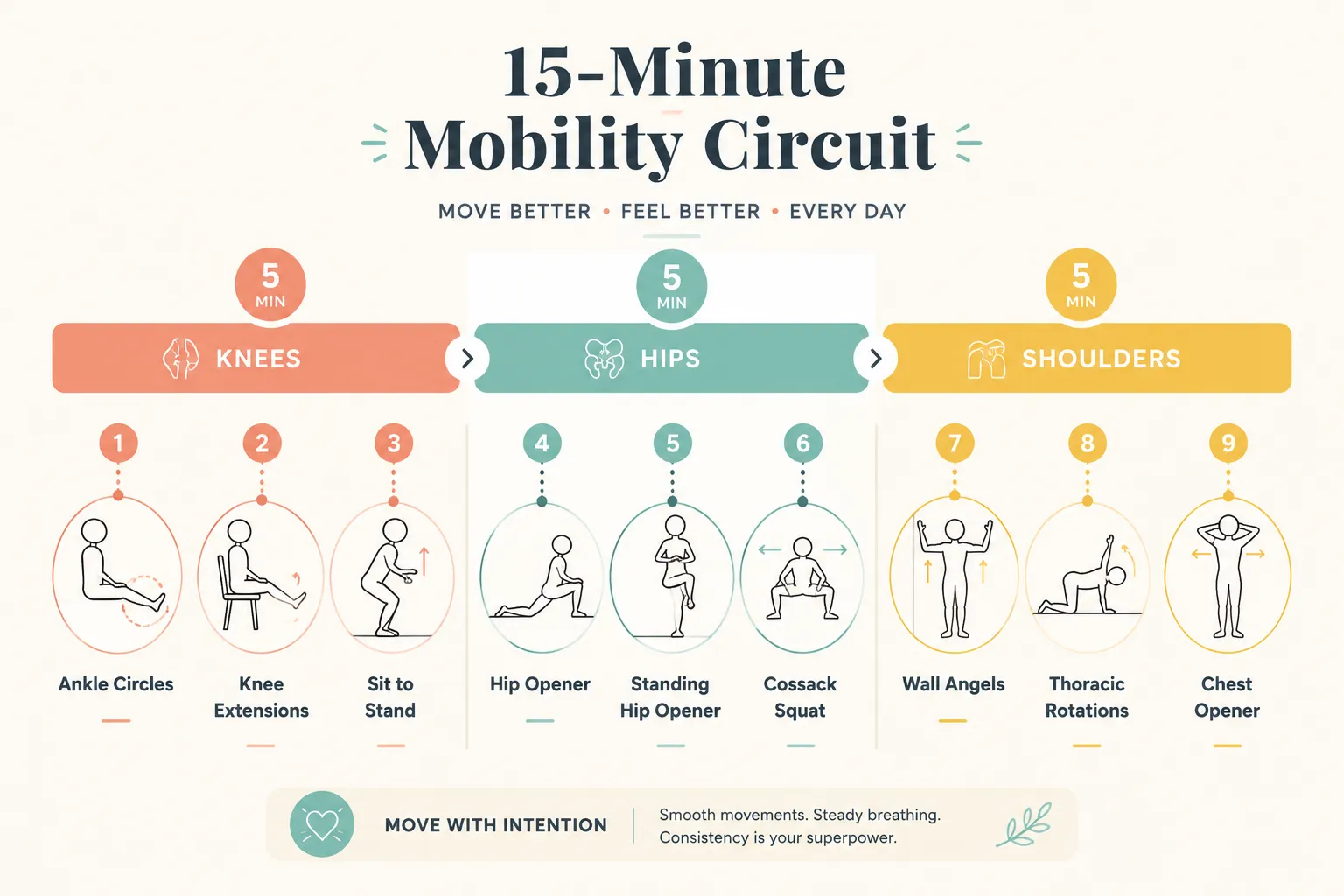
The 15-Minute Joint-Friendly Mobility Routine for Knees, Hips, and Shoulders

Here's the full sequence. Move slowly. Breathe. Use a chair or wall whenever you want more control.

)

Minutes 0-2: Warm-Up

  • Seated or standing marches, 60 seconds. Lift knees to a comfortable height.
  • Arm swings, 30 seconds forward, 30 seconds side to side.

Minutes 2-6: Knees and Ankles

  • Seated knee extensions, sit tall in a chair, straighten one knee, hold 2 seconds, lower. 10 reps each side.
  • Ankle circles, 10 in each direction, per foot. Ankles feed knee health.
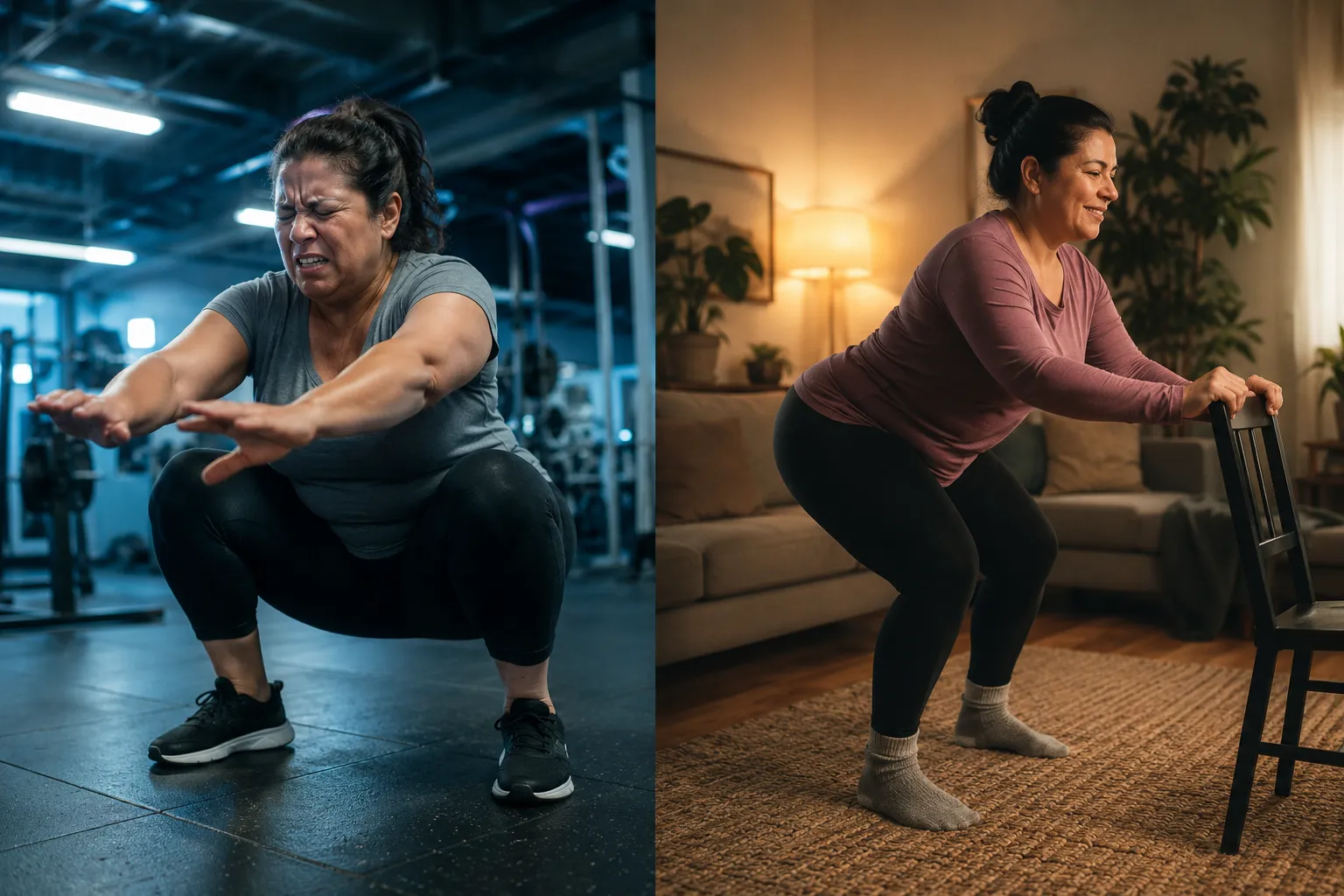
  • Supported mini-squats, hold the chair back, sit down and stand up slowly. 8-10 reps.
  • Standing hamstring sweeps, heel out, gentle toe pull, no bouncing. 8 per side.

Minutes 6-10: Hips

  • Standing hip circles, hold a chair or wall, lift one knee to hip height, circle it out, back, down. 6 per direction per leg [5].
  • Supported figure-4 opener, cross one ankle over the opposite knee while seated, gently press the top knee down. Hold 20 seconds each side.
  • Standing hip hinges, hands on chair back, push hips back, feel hamstrings. 10 reps.
  • Side leg lifts, hold chair, lift leg out to the side. 8 per side.

Minutes 10-13: Shoulders

  • Shoulder circles, 8 forward, 8 backward. Big, slow, deliberate [5].
  • Wall angels, stand with back to wall, arms in "goalpost" position, slide arms up and down. 8 reps.
  • Cross-body reach, bring one arm across chest, hold 15 seconds. Repeat.
  • Doorway chest opener, forearm on door frame, step through gently. 20 seconds each side.

Minutes 13-15: Full-Body Integration

  • Seated thoracic rotations, hands crossed over chest, rotate side to side. 8 per side.
  • Standing reach and roll, reach up, roll shoulders down, take three slow breaths.

That's the routine. Same order every day builds the habit and lets you track how each joint feels [2][3].

How Often Should I Do Joint Mobility Work to See Results?

How Often Should I Do Joint Mobility Work to See Results?

Aim for 3-5 sessions per week, with at least one full day of practice on weekends. Most people notice easier movement within 2-3 weeks and meaningful range-of-motion gains by week 6 [9][10].

  • Minimum effective dose: 3 sessions per week, 15 minutes each.
  • Optimal: daily, especially if you sit for long hours.
  • Recovery days: shorter 5-minute versions still count [4].

Consistency beats intensity here. Ten easy sessions in two weeks will move you further than two hard sessions [10].

Is Joint Mobility Good for Runners and Athletes or Just Older People?

Mobility is essential for both. Runners rely on hip extension and ankle dorsiflexion for efficient stride. Lifters need shoulder and hip mobility to hit safe positions under load. Older adults need it for daily independence [2][9]. The exercises overlap significantly; the intensity and progression differ.

  • Athletes: add mobility before workouts and on rest days to prevent overuse injuries [10].
  • Recreational exercisers: use it to fix nagging tightness and improve form.
  • Older adults (50+): prioritize floor-supported and chair-based versions for safety [8].

The same 15-minute template scales up or down.

What Equipment Do I Need for a Joint-Friendly Mobility Routine?

Almost none. A sturdy chair, a clear wall, and a yoga mat cover 95% of what this routine requires [3][8].

Optional additions:

  • A light dowel or broomstick for shoulder pass-throughs.
  • A yoga block or firm cushion for hip openers.
  • A soft resistance band for gentle activation.

Skip anything that requires balancing on unstable surfaces early on. Stability first, then challenge.

Can Mobility Exercises Help with Knee Pain or Shoulder Stiffness?

Yes. Gentle, consistent mobility work is one of the most-recommended non-medication strategies for chronic knee and shoulder discomfort tied to stiffness, inactivity, or mild arthritis [7][9]. It improves circulation to the joint, strengthens surrounding stabilizers, and gradually restores range.

  • For knee pain: focus on ankle circles, hip mobility, and quad-strengthening seated knee extensions. Weak hips and stiff ankles overload the knee [7].
  • For shoulder stiffness: wall angels, shoulder circles, and thoracic rotations work best. The thoracic spine drives shoulder motion, so mobilizing it upstream unlocks the shoulder itself [5].

If pain is sharp, sudden, or accompanied by swelling, stop and see a professional before continuing.

What Mistakes Do People Make When Starting a Mobility Routine?

The biggest mistake is treating mobility like a workout, going hard, forcing range, or chasing a "burn." That defeats the purpose. Other common errors include:

  • Skipping the warm-up. Cold joints don't respond well [7].
  • Holding breath. Breathe steadily through every rep.
  • Rushing. Slow control is the whole point.
  • Ignoring pain signals. Discomfort at end range is fine; sharp pain is not [4].
  • Doing it once, then quitting. Mobility compounds over weeks, not days [9].
  • Only working the sore joint. Mobility upstream and downstream matters just as much [5].

)

Is Mobility Work Better Than Foam Rolling for Joint Health?

They do different jobs. Foam rolling addresses muscle and fascia tension. Mobility work trains joint range and control. For joint health specifically, active mobility usually delivers more benefit because it strengthens the muscles supporting the joint at every angle [5][7].

Combine them: foam roll for 3-5 minutes before your mobility session if a muscle feels particularly tight. Then move into the 15-minute routine.

How Long Does It Take to Notice Improvements in Mobility?

How Long Does It Take to Notice Improvements in Mobility?

Most people report feeling better, less morning stiffness, easier stairs, freer shoulders, within 10 to 14 days of consistent practice [9][10]. Measurable range-of-motion gains (deeper squat, higher reach) typically show up between weeks 4 and 8.

  • Week 1: less stiffness, better mood after sessions.
  • Weeks 2-3: easier daily movements.
  • Weeks 4-6: visible range improvement.
  • Weeks 8-12: stronger, more confident movement overall.

Track one benchmark, like how far you can reach behind your back, every two weeks to stay motivated.

What Should I Do If Certain Movements Hurt During Mobility Work?

Stop the specific movement, not the whole session. Reduce the range, add support, or skip that drill entirely and come back to it in a week. Pain is data, not failure [7].

Pain troubleshooting:

  • Sharp or pinching pain: skip and consult a professional.
  • Deep ache during a stretch: ease off by 30% and rebreathe.
  • Pain after the session: you likely pushed too far; reduce reps next time.
  • Ongoing pain in one joint: book a physical therapy visit for a proper assessment.

Never push through pain hoping it will loosen up. It rarely does.

Can I Combine Mobility Work with My Regular Workout Routine?

Absolutely. Mobility pairs well with any strength, cardio, or sport training and often improves your performance in them [2][10].

  • Before workouts: use the routine as a dynamic warm-up.
  • After workouts: shorten it to 5-7 minutes focused on the joints you just worked.
  • On rest days: do the full 15-minute version.

The routine adds no fatigue and reduces stiffness that limits lifts, runs, or long walks.

Are There Mobility Exercises I Should Avoid with Bad Knees?

Yes. Skip deep loaded squats, aggressive lunges, twisting on a planted foot, and any drill that puts your knee past your toes under load if it triggers pain [7]. Also avoid:

  • Deep, unsupported pistol-style squats.
  • High-impact jumping or plyometric variations.
  • Excessive kneeling on hard floors.
  • Fast, uncontrolled leg swings.

Choose instead: seated knee extensions, supported mini-squats to a chair, standing hip circles with balance support, and ankle mobility work, all included in the routine above.

Pros and Cons of a 15-Minute Joint-Friendly Mobility Routine

Pros

  • Fits into any schedule.
  • Requires almost no equipment.
  • Safe for most ages and fitness levels.
  • Improves daily comfort quickly.
  • Complements every other form of exercise.

Cons

  • Requires consistency to work.
  • Not a substitute for strength training or cardio.
  • Not enough for serious injuries, see a professional.
  • Progress is gradual, not dramatic.

FAQ

How many days a week should I do this routine?
Three to five days is the sweet spot. Daily is fine if intensity stays low [9].

Can I do this if I've had a knee or hip replacement?
Only with clearance from your surgeon or physical therapist. They may modify specific drills.

Do I need to warm up separately before the routine?
The first two minutes are the warm-up. If you feel especially stiff, add another minute of marching.

Will 15 minutes really make a difference?
Yes. Multiple sources note that short, consistent sessions produce measurable mobility gains within weeks [9][10].

Can I do this routine seated the whole time?
Most drills have a seated version. This makes it accessible for balance concerns or fatigue [8].

What if I only have 5 minutes?
Do the warm-up, one hip drill, one shoulder drill, and one knee drill. Better than nothing [4].

Is this safe during pregnancy?
Generally yes with modifications, but confirm with your OB or midwife first.

Can kids or teens do it?
Yes, though most young people already have adequate mobility. It's more valuable for adults over 30.

Do I need shoes?
Barefoot or socks is fine indoors. Ankle mobility often improves without shoes.

What if a movement feels awkward at first?
That's normal. Your nervous system is learning. Give it two weeks before deciding it doesn't work.

Conclusion

A 15-minute joint-friendly mobility routine for knees, hips, and shoulders isn't glamorous, but it delivers something most training doesn't: freer daily movement without extra strain. The formula is simple, controlled circles, supported drills, pain-free ranges, and consistency across most days of the week.

Your next steps:

  1. Block 15 minutes on your calendar for tomorrow morning.
  2. Set up a sturdy chair near a wall.
  3. Run through the routine above once, slowly.
  4. Track how one movement (reaching overhead, standing from a chair) feels at week 1, week 4, and week 8.
  5. Adjust anything that hurts; keep everything that helps.

Move better, not harder. Your knees, hips, and shoulders will do the rest of the work, you just have to give them the daily invitation.

References

[1] Watch – https://www.youtube.com/watch?v=UYSdIntPy1E
[2] 15 Minute Bodyweight Mobility Circuit – https://runlovers.it/en/2026/15-minute-bodyweight-mobility-circuit/
[3] 15 Minute Full Body Routine – https://simplmobility.com/blog/15-minute-full-body-routine
[4] 5 Minute Mobility – https://www.nerdfitness.com/blog/5-minute-mobility/
[5] Joint Mobility Exercises – https://www.healthline.com/health/fitness-exercise/joint-mobility-exercises
[6] Watch – https://www.youtube.com/watch?v=zGIe_keQM_8
[7] Add These Mobility Exercises Into Your Workout Routine For Healthy Joints – https://www.alphaortho.net/blog/add-these-mobility-exercises-into-your-workout-routine-for-healthy-joints
[8] Exercises For Mobility Range Of Motion After 50 – https://www.health.com/exercises-for-mobility-range-of-motion-after-50-11904156
[9] Improve Mobility After 40: Easy 15 Minute Exercises To Reduce Joint Pain, Boost Strength – https://www.muscleandfitness.com/anti-aging/wellness/improve-mobility-after-40-easy-15-minute-exercises-to-reduce-joint-pain-boost-strength/
[10] Mobility Training 15 Minutes A Day That Will Truly Transform Your Workouts – https://www.inspiredbysports.com/en/mobility-training-15-minutes-a-day-that-will-truly-transform-your-workouts/