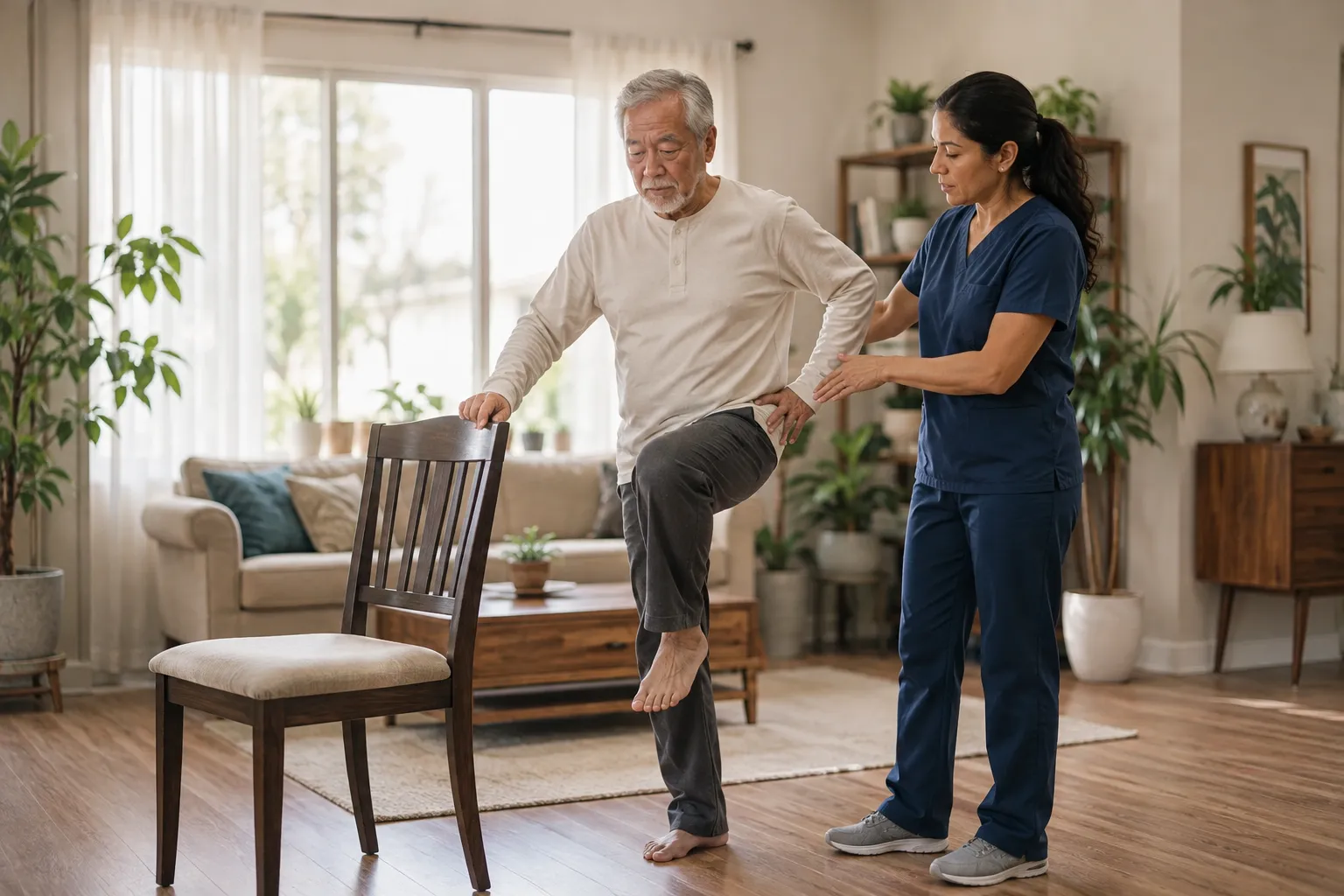
Daily mobility and flexibility micro-routines for longevity

Daily mobility and flexibility micro-routines for longevity

Last updated: August 27, 2026

Quick Answer

Daily mobility and flexibility micro-routines for longevity are short, structured movement blocks, typically 4 to 10 minutes, done once or several times a day to preserve joint range, muscle length, and functional strength as you age. A 2026 systematic review found these "exercise snacks" measurably improve fitness and mobility in adults, and a June 2026 clinical report showed a 4-minute daily routine can slow age-related muscle decline without a gym [1][2]. The best routine is the one you'll actually do every day.

Key Takeaways

  • Short beats long. Two to four bouts of 1-5 minutes across the day match or beat one 30-minute session for mobility and metabolic health [6][10].
  • Daily is the point. Mobility responds to frequency, not intensity, treat it like brushing your teeth [7].
  • Start now, whatever your age. Benefits are documented in adults 65+ and in midlife desk workers [2][5].
  • Break up sitting. One minute of movement every 30-60 minutes protects joints and blood sugar [6].
  • Mobility ≠ stretching. Mobility trains active control through range; stretching only lengthens tissue.
  • Five to seven movements cover most of the body: hips, spine, shoulders, ankles, and neck.
  • Track streaks, not sweat. Consistency for 8-12 weeks is when most people report reduced stiffness [3].

What Are Mobility Micro-Routines and How Do They Work?

Mobility micro-routines are brief, deliberate bouts of movement, usually under 10 minutes, that take joints through their full active range while lightly loading surrounding muscles. They work by re-teaching the nervous system to access ranges you already own but rarely use, and by nudging synovial fluid, fascia, and circulation without the fatigue cost of a full workout.
What Are Mobility Micro-Routines and How Do They Work?

The mechanism is repetition, not duration. A 2024 review of "exercise snacks" concluded that intermittent bouts under 10 minutes trigger many of the same cardiovascular and neuromuscular adaptations as longer sessions, provided they're done consistently [10]. A 2026 systematic review confirmed measurable gains in functional mobility, leg power, and cardiorespiratory fitness from these micro-doses [1].

"Stretching is a form of hygiene, like brushing your teeth. It's what you do every day that keeps the system working.", Harvard Health guidance on stretching for healthy aging [7]

Best Daily Flexibility Exercises for Aging Well

The most useful daily flexibility exercises for aging well hit the joints that stiffen first: hips, thoracic spine, shoulders, and ankles. Harvard Health recommends a rotation of gentle stretches held for 30-60 seconds, done daily rather than intensely [7].

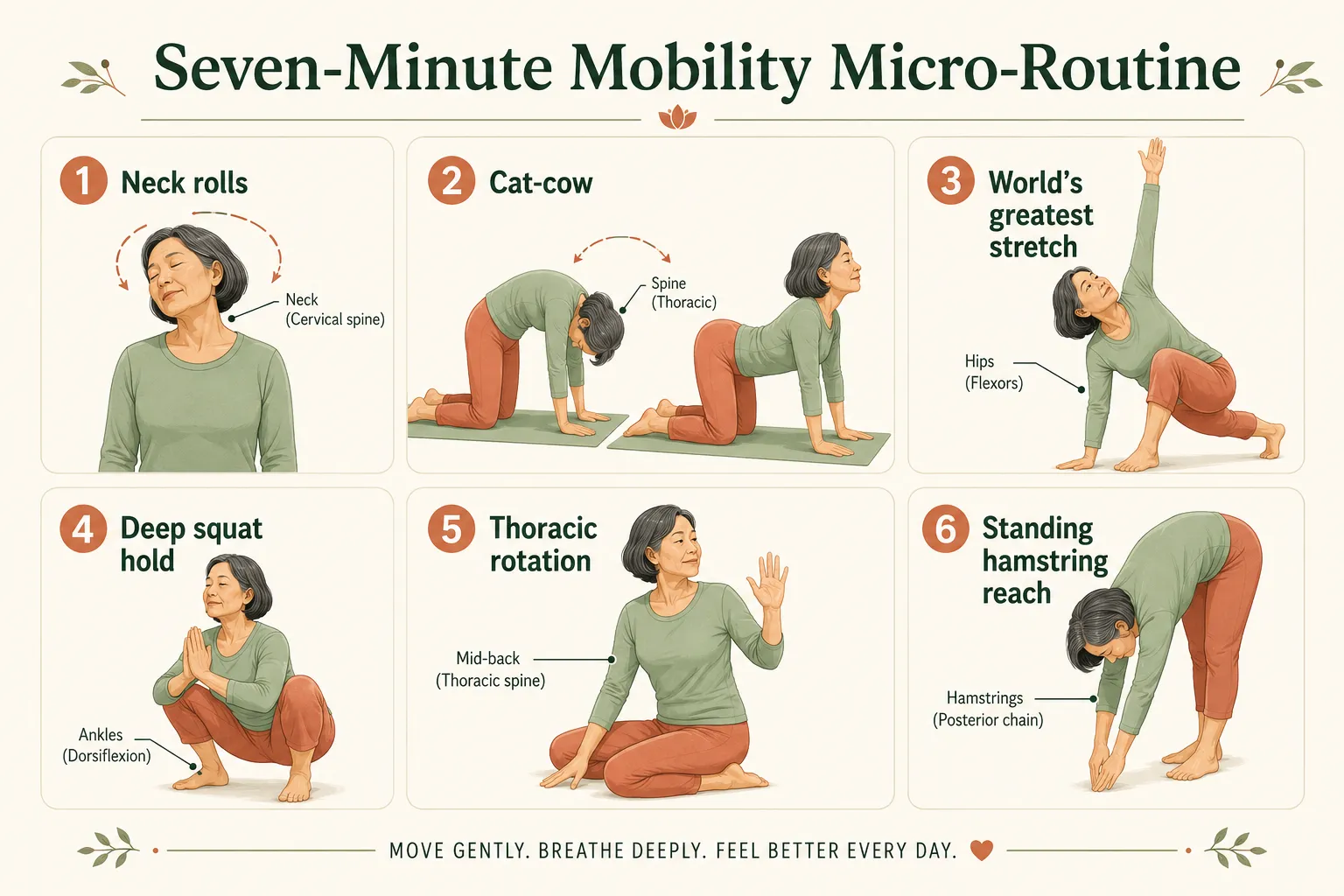
A durable daily set includes:

  1. Cat-cow, spinal segmentation, 60 seconds
  2. World's greatest stretch, hips, hamstrings, thoracic spine, 4 reps per side
  3. Deep squat hold, hips, ankles, knees, 30-60 seconds
  4. Doorway chest opener, shoulders and pecs, 30 seconds each arm
  5. Standing hamstring reach with toe pull, posterior chain, 45 seconds per side
  6. Neck half-circles, cervical range, 6 slow reps
  7. Standing calf stretch off a step, ankles, 30 seconds per side

)

Frontiers published a 2026 trial showing 9-minute leg-focused circuits and Tai Chi meaningfully improved balance and lower-body function in older adults, evidence that even a single daily block moves the needle [5].

How Long Should a Mobility Routine Take Each Day?

Five to ten minutes a day is enough for most people. You do not need 45 minutes. The July 2026 "4-minute mobility miracle" protocol for adults 65+ documented measurable strength and range-of-motion gains from a single daily 4-minute sequence [2].

Practical time targets:

  • Bare minimum: 4 minutes, once a day
  • Sweet spot: 7-10 minutes, once a day, or 2 × 3 minutes
  • Advanced: 3 × 5 minutes spread across the day (morning, midday, evening)

The upper limit isn't time, it's willingness to show up tomorrow. A 28-day remote home-based exercise snacking pilot in 2026 found adherence dropped sharply once daily sessions exceeded 12 minutes [3].

Difference Between Mobility Work and Stretching

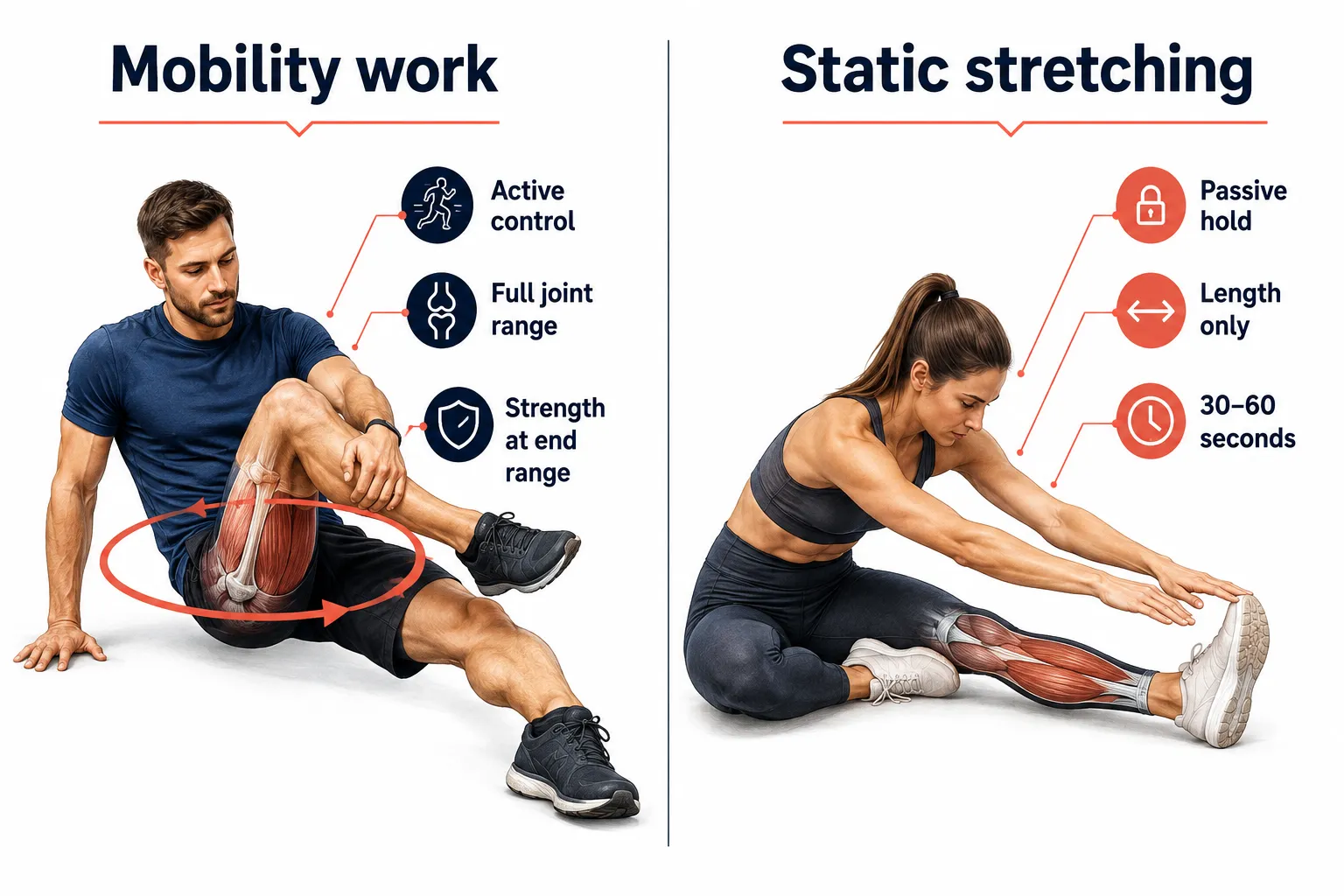
Mobility work is active, you own the range under muscular control. Stretching is passive, you lengthen a tissue and hold. Both matter, but they train different things.

Feature Mobility Work Static Stretching
Control Active, you move the joint Passive, gravity or a partner holds you
Trains Strength through range Tissue length only
Duration 5-20 seconds per rep, multiple reps 30-60 seconds per hold
Best for Everyday function, injury prevention Post-exercise, cool-down, tight tissues
Example Controlled hip circles (CARs) Seated hamstring stretch

)

Decision rule: If you can only pick one, choose mobility. Range you can't control isn't range you can use.

Can Micro-Routines Prevent Joint Pain and Stiffness?

Yes, for most non-pathological stiffness, daily micro-routines are one of the most effective interventions available. Joint pain from disuse, prolonged sitting, and normal age-related tissue changes responds well to frequent gentle loading through range [1][7].
Can Micro-Routines Prevent Joint Pain and Stiffness?

What the evidence shows:

  • Daily movement reduces morning stiffness within 2-4 weeks in most adults [7]
  • Breaking up sitting with ≤1-minute bouts every 1-4 hours improves joint symptoms and blood glucose [6]
  • Structured mobility work is included in guidance for midlife and beyond because tissues respond to load at any age [9]

Common edge case: If pain is sharp, radiates, or wakes you at night, that's not stiffness, that's a signal to see a clinician before layering on a routine.

Mobility Routines for Desk Workers and Sedentary People

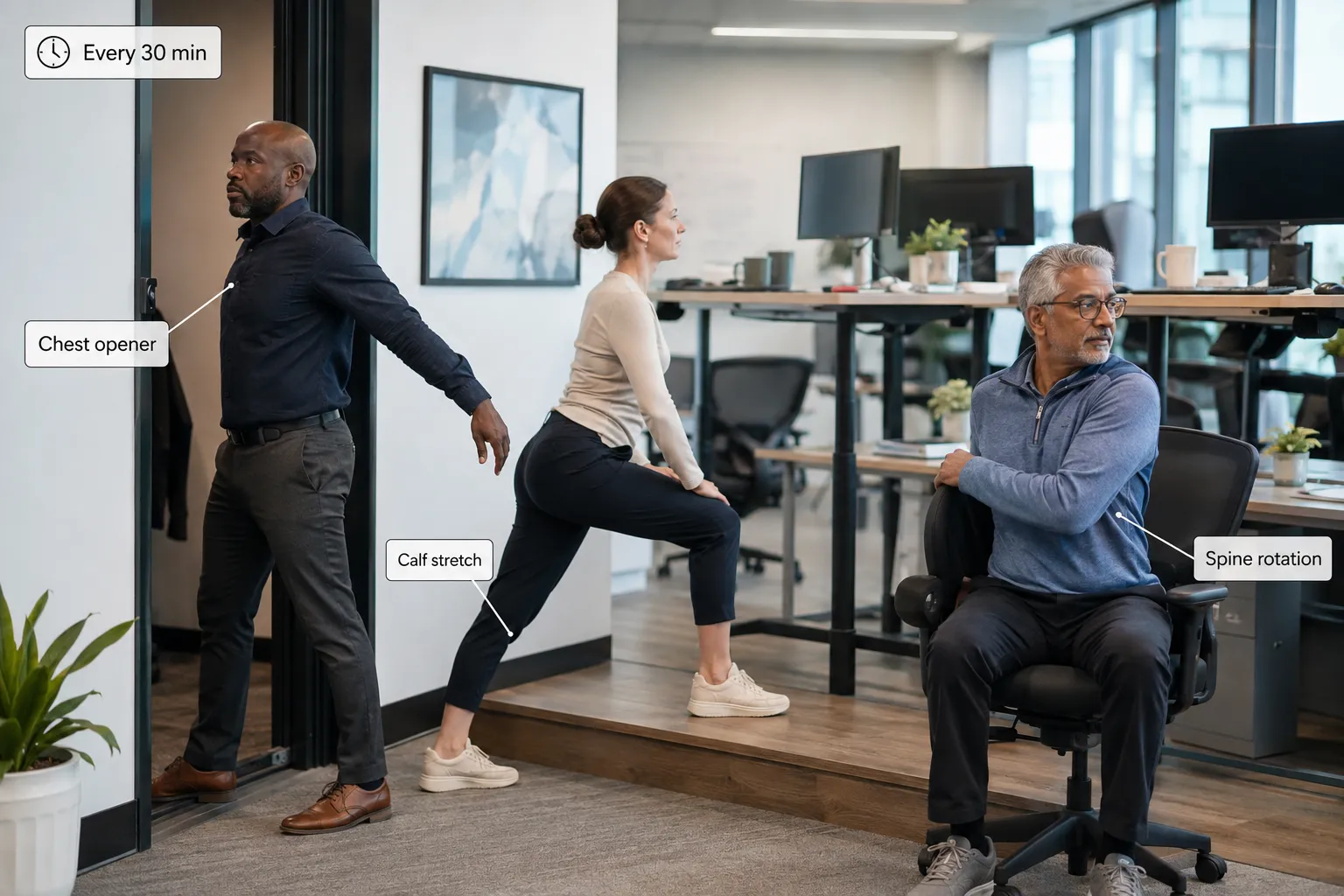
Desk workers need routines built around the specific damage of sitting: locked hips, rounded thoracic spine, tight chest, and cranky necks. The fix is frequency, not a longer evening workout.

A workable desk-worker protocol:

  • Every 30-60 minutes: Stand, do 60 seconds of movement (hip openers, thoracic rotations, or a walk to the water cooler) [6]
  • Mid-morning: 3-minute chest opener + hip flexor sequence
  • Lunch: 5-minute walk plus a 90-second deep squat hold
  • End of day: 7-minute full-body reset before dinner

)

The 2024-2026 evidence on breaking up sitting is unusually consistent: even one minute of movement per hour meaningfully reduces cardiometabolic risk markers linked to sedentary time [6].

What Age Should You Start Doing Mobility Work?

The correct answer is now, at any age. Mobility research consistently shows benefits from adolescence through the 80s. Starting in your 30s or 40s builds a buffer against the natural 3-8% per-decade loss of range that begins in midlife [9].

Age-specific priorities:

  • 20s, 30s: Ankle, hip, and thoracic mobility to protect against future injury
  • 40s, 50s: Add shoulder and spine work; counter desk-related stiffness [9]
  • 60s+: Prioritize balance, deep squat, and single-leg control, this is where the 4-minute daily protocols shine [2]
  • 75+: Chair-based mobility and Tai Chi, style patterns show strong evidence for fall prevention [5]

Common Mistakes People Make with Flexibility Routines

The five mistakes that derail daily mobility work:

  1. Going too long. A 25-minute routine you skip 5 days a week beats a 5-minute one you never do. Wrong.
  2. Bouncing or forcing range. Slow, controlled movement outperforms ballistic stretching for adults.
  3. Ignoring the ankles and thoracic spine. These two joints unlock most whole-body improvements.
  4. Only stretching, never strengthening the new range. Length without control creates injury risk.
  5. Doing it "when I have time." Anchor it to an existing habit (coffee, teeth brushing, first email) or it won't happen.

A 2025 qualitative study of older adults found the biggest barrier to exercise snacks wasn't ability, it was forgetting [4].

Mobility Exercises for People with Arthritis or Injuries

For people with arthritis or a recent injury, mobility micro-routines are usually beneficial, but the rules change. Slow, pain-free, low-load range work is generally recommended, while forced end-range positions and long static holds on inflamed joints are not.
Mobility Exercises for People with Arthritis or Injuries

Modified approach:

  • Reduce range, not frequency. Move the joint through pain-free range only, multiple times per day.
  • Warm before moving. A hot shower or 3 minutes of walking preps stiff joints.
  • Prioritize isometrics at mid-range for arthritic knees and shoulders, they build strength without irritating the joint.
  • Avoid deep loaded end-range (deep squats, extreme shoulder stretches) during flare-ups.
  • Work with a clinician for post-surgical or acute injury cases, a physiotherapist can prescribe a version of these routines tailored to you [8].

How Often Do You Need to Do Mobility Work to See Results?

Daily, or at least 5 days per week, for 4-8 weeks before expecting durable change. Range-of-motion gains show up in 2-4 weeks; strength-through-range and reduced stiffness typically consolidate by week 8 [1][3].

Timeline expectations:

  • Week 1-2: Feeling looser day-to-day; less morning stiffness
  • Week 3-4: Measurable range-of-motion changes (touch further, squat deeper)
  • Week 6-8: Reduced joint pain and better balance
  • Week 12+: New range feels "yours", you use it without thinking

Decision rule: Choose 6 days a week of 5 minutes over 3 days a week of 15 minutes. Frequency wins.

Best Apps or Programs for Daily Mobility Routines

The best mobility apps combine short daily sessions (under 15 minutes), progressions, and reminders. As of 2026, the field includes GOWOD, Pliability (formerly ROMWOD), Movement Vault, and the mobility programs inside Peloton, Apple Fitness+, and Nike Training Club. Free options include the YouTube libraries of Kelly Starrett, Squat University, and GMB Fitness.

What to look for:

  • Session length ≤ 15 minutes as default
  • Daily reminder functionality
  • A screening assessment so the plan targets your tight spots
  • Progressions, not just a rotating playlist

Skip apps that: demand 45+ minute sessions, gate every feature behind a paywall, or don't let you filter by body part or time available.

Mobility Routines vs Yoga for Flexibility

Yoga and dedicated mobility work overlap but aren't the same. Yoga blends flexibility, breath, balance, and mindfulness in longer sessions. Mobility micro-routines are shorter, more targeted, and emphasize active control through joint range.

Mobility micro-routines Yoga
Typical length 4-10 minutes 30-75 minutes
Primary goal Joint range + control Flexibility + breath + balance
Equipment None Mat (usually)
Learning curve Low Medium
Best for Daily maintenance, desk workers Whole-practice wellbeing

Choose mobility micro-routines if you want a low-friction daily habit. Choose yoga if you want a longer practice that also trains breath, focus, and balance. Doing both, micro-mobility daily, yoga 1-2 times a week, is a strong combination.

Can You Do Mobility Work Every Single Day?

Yes. Daily mobility is not only safe for most people, it's the goal. Unlike high-intensity strength training, gentle mobility work doesn't produce the tissue damage that requires recovery days [7]. Harvard's guidance explicitly frames stretching as daily hygiene [7].

Exceptions:

  • Acute injury: wait for clinician clearance
  • Post-surgical: follow rehab protocol
  • During a flare of an inflammatory condition: reduce range, don't skip entirely

Mobility Exercises That Take Less Than 5 Minutes

Here's a proven under-5-minute routine you can do anywhere, no equipment:

The 4-Minute Daily Reset

  1. Neck half-circles, 30 seconds (chin to chest, ear to shoulder, both sides)
  2. Cat-cow, 45 seconds (slow spinal waves)
  3. World's greatest stretch, 60 seconds (30 seconds per side)
  4. Deep squat hold with thoracic rotation, 45 seconds
  5. Standing forward fold with knee bend, 30 seconds
  6. Doorway chest opener, 30 seconds

Total: 4 minutes. This mirrors the structure of the July 2026 protocol shown to improve strength and range in adults over 65 [2].

FAQ

Is 5 minutes of mobility a day really enough?
Yes, 4 to 10 minutes daily is enough to preserve and often improve joint range, especially when done consistently over 8+ weeks [1][2].

Should I do mobility work before or after exercise?
Both work. Dynamic mobility (controlled movement) before exercise; static holds are better after or on rest days.

Can mobility work fix my bad posture?
It helps significantly if your posture problems come from tightness and disuse. Combine mobility with strengthening the weak muscles (usually mid-back and glutes).

What's the single most important mobility exercise?
For most adults, the deep squat hold, it addresses hips, ankles, knees, and low back simultaneously.

Will mobility work help me sleep better?
Many people report better sleep from a 5-minute evening mobility session, likely from parasympathetic activation, though direct clinical evidence is still emerging.

Do I need equipment?
No. Every routine in this guide requires only a floor and possibly a doorway or step.

Can kids and teenagers do mobility work?
Yes, and it's a good habit to build early, especially given increased screen time.

Is soreness normal after mobility work?
Mild novel-tissue soreness is fine. Sharp or joint-line pain is not, back off the range.

How do I know if I'm improving?
Track one benchmark movement (deep squat, sit-and-reach, or shoulder overhead reach) monthly.

Can I combine mobility with walking?
Absolutely, a daily walk plus 5 minutes of targeted mobility is one of the highest-return longevity habits available.

Conclusion

The gap between people who stay mobile into their 80s and those who don't isn't genetics, it's the boring, daily choice to move joints through their full range. Daily mobility and flexibility micro-routines for longevity are the highest-leverage habit in aging well: 4 to 10 minutes a day, done consistently, buys back decades of function.

Next steps:

  1. Tonight: Pick 4 movements from this article. Write them down.
  2. Tomorrow morning: Do them once, before coffee. Anchor them to an existing habit.
  3. This week: Hit 5 days out of 7. Track it on a calendar.
  4. Week 4: Reassess one benchmark (deep squat depth, overhead reach).
  5. Week 8: Add a second daily block or extend to 10 minutes.

Start today, at whatever age you are, from wherever your body is right now. Frequency compounds.

References

[1] Systematic review of exercise snacks and functional mobility – https://pmc.ncbi.nlm.nih.gov/articles/PMC12732512/
[2] The 4-Minute Mobility Miracle: Reverse Muscle Decline Without the Gym – https://clinicalnews.org/2026/07/05/the-4-minute-mobility-miracle-reverse-muscle-decline-without-the-gym-ep-1300-jun-2026/
[3] Remote home-based exercise snacking 28-day pilot – https://pubmed.ncbi.nlm.nih.gov/41950555/
[4] Perceptions and barriers: older adults' views on exercise snacks – https://coconote.app/notes/6cd386bc-e58a-4c65-ad4f-7a8021dd9ec5
[5] Frontiers 2026: 9-minute leg circuits and Tai Chi for older adults – https://www.frontiersin.org/journals/public-health/articles/10.3389/fpubh.2026.1810516/full
[6] Exercise Snacks: Small Bouts, Big Benefits – https://blogs.bmj.com/bjsm/2025/10/24/exercise-snacks-small-bouts-big-benefits/
[7] A Plan for Easy Stretching – Harvard Health – https://www.health.harvard.edu/healthy-aging-and-longevity/a-plan-for-easy-stretching
[8] Frontiers in Medicine 2026: structured routines for older adults – https://public-pages-files-2025.frontiersin.org/journals/medicine/articles/10.3389/fmed.2026.1755508/pdf
[9] Cornerstone movements and mobility for midlife and beyond – https://pmc.ncbi.nlm.nih.gov/articles/PMC11624330/
[10] Exercise Snacks and Other Forms of Intermittent Physical Activity – https://www.fisiologiadelejercicio.com/wp-content/uploads/2024/01/Exercise-Snacks-and-Other-Forms-of-Intermittent-Physical-Activity.pdf

Daily mobility routines for injury prevention and long-term independence

Daily mobility routines for injury prevention and long-term independence

Last updated: August 9, 2026

Quick Answer

A daily mobility routine is 5-15 minutes of controlled joint movement through full range, hips, spine, shoulders, ankles, done most days to prevent injury and preserve independence. In 2026, updated guidance emphasizes short, structured sessions over long stretching marathons, because consistency beats duration for reducing pain, improving balance, and keeping you strong into later decades [1][3].

Key Takeaways

  • 10 minutes a day of targeted mobility work outperforms one long weekly session for injury prevention [1].
  • Mobility ≠ flexibility. Mobility is active control through a range; flexibility is passive length.
  • Falls are the leading cause of injury-related loss of independence in adults over 65, and mobility plus reaction training measurably reduces that risk [2][7].
  • Desk workers need hip flexor, thoracic spine, and neck priority. Athletes need sport-specific ranges plus recovery mobility.
  • Do dynamic mobility before workouts, longer holds after or on rest days.
  • No equipment required for a starter routine, a mat and a doorway are enough.
  • Results appear in 2-4 weeks with daily practice: less stiffness, better sleep posture, easier stairs.
  • Seniors benefit most from routines that combine mobility with balance and reaction drills [2][6].

Key Takeaways

What is a daily mobility routine and why does it matter?

A daily mobility routine is a short sequence of controlled joint movements, usually 5 to 15 minutes, that takes each major joint through its full active range. It matters because joints that don't move regularly lose range, and lost range is the quiet start of most non-traumatic injuries and age-related decline in independence [1][3].

Think of it as brushing your teeth for your joints. Skip it and problems build silently: tight hips lead to back pain, stiff ankles lead to knee pain, locked-up shoulders lead to neck issues. The 2026 guidance from clinical physios and strength coaches has shifted toward short daily sessions rather than infrequent long ones, because tissue adaptation responds to frequency [1][3].

Who this is for: Desk workers, parents, weekend athletes, anyone over 40, and seniors who want to keep climbing stairs and getting off the floor without help.

Who this isn't for (as a standalone fix): People with acute injuries, post-surgical patients, or anyone with unexplained pain, see a clinician first.

What's the difference between mobility and flexibility?

Flexibility is passive; mobility is active. Flexibility is how far a joint can be moved by an outside force (like a stretch). Mobility is how far you can move that joint under your own control, with strength and stability throughout the range.

A quick example: touching your toes with your hands is flexibility. Lifting one leg to hip height and holding it there is mobility. You need both, but mobility is what actually protects you when you slip on ice or catch a falling grocery bag.

Trait Flexibility Mobility
Control Passive Active
Requires strength No Yes
Protects against injury Partially Directly
Best training method Long static holds Dynamic controlled reps
Time to see gains 4-6 weeks 2-4 weeks

Best mobility exercises to prevent injuries

The best mobility exercises hit the joints that stiffen fastest under modern life: hips, thoracic spine, shoulders, and ankles. Do the following seven movements daily, the full sequence takes about 10 minutes [3][4].

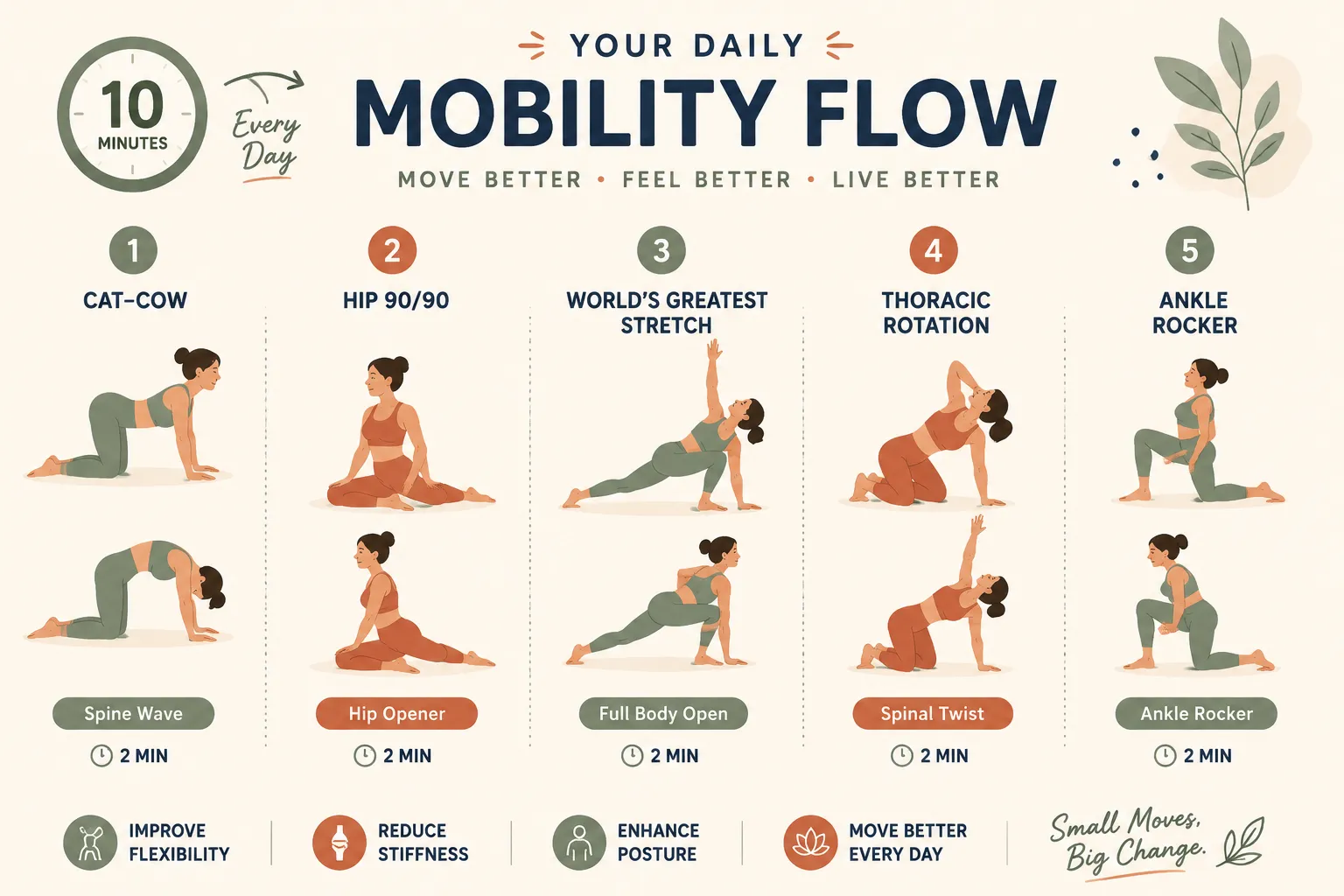
  1. Cat-cow (spine), 8 slow reps. Wakes up the whole back.
  2. World's greatest stretch, 5 per side. Hits hips, hamstrings, thoracic spine at once.
  3. 90/90 hip switches, 8 per side. Restores internal and external hip rotation.
  4. Thoracic rotations (bench or floor), 6 per side. Frees mid-back for shoulders and neck.
  5. Deep squat hold with reach, 30-60 seconds. The most underrated longevity drill.
  6. Wall shoulder slides (scapular Y-T-W), 8 reps. Rebuilds overhead range.
  7. Ankle rockers, 10 per side. Key for balance, running, stair-climbing.

Decision rule: If you only have 5 minutes, do the deep squat hold, 90/90 hips, and thoracic rotations. Those three cover 70% of the value.

How long should a daily mobility routine take?

10 minutes is the sweet spot for most people. That's enough to hit every major joint without becoming a chore you skip. Beginners can start at 5 minutes; experienced trainees or people recovering from injury may benefit from 15-20 [1][3].

  • 5 minutes: Bare minimum, hips, spine, one problem area.
  • 10 minutes: Full-body maintenance. This is the target.
  • 15-20 minutes: Rehab, athlete recovery, or catching up after a sedentary week.

More is not automatically better. Past 20 minutes, adherence drops sharply and returns diminish. Consistency at 10 minutes daily beats 45 minutes twice a week every time [1].

Mobility routine for desk workers vs athletes

Desk workers need to reverse chair posture; athletes need to restore ranges their sport shortens. The exercises overlap, but priorities differ.

Mobility routine for desk workers vs athletes

Desk worker priority (10 min):

  • Hip flexor stretch (couch stretch), 60 sec/side
  • Thoracic extension over foam roller, 90 sec
  • Chin tucks and doorway chest opener, 60 sec
  • Glute bridges, 10 reps
  • Ankle rockers, 10/side

Athlete priority (10-15 min):

  • Sport-specific dynamic warm-up (leg swings, arm circles)
  • Deep squat hold with reach, 90 sec
  • 90/90 hip transitions, 8/side
  • Cossack squats, 6/side
  • Shoulder CARs (controlled articular rotations), 5/side
  • Foam roll problem areas post-training

Common mistake: Desk workers copying athlete routines skip the postural resets they actually need. Athletes copying desk routines miss the loaded range work that protects them at competition intensity.

Can mobility work help you stay independent as you age?

Yes, and it's one of the highest-return habits after age 50. Loss of hip mobility, ankle range, and single-leg balance is the sequence that leads to falls, and falls are the leading cause of injury-related loss of independence in older adults [2][6][7].

A 2026 CNN health report highlighted that reaction-time and mobility training together measurably reduce fall risk in adults over 65 [2]. IU Health's fall prevention program similarly combines strength, balance, and mobility drills as the core intervention [7].

What preserves independence:

  • Getting off the floor without using hands (hip and ankle mobility)
  • Reaching overhead (shoulder and thoracic mobility)
  • Turning to look behind while walking (cervical and thoracic rotation)
  • Stepping over obstacles (hip flexion and single-leg balance)

Practice these movement patterns, not just isolated stretches. The goal isn't a party trick, it's still tying your own shoes at 85.

Mobility routine for lower back pain and knee issues

For lower back pain, mobilize the hips and thoracic spine, not the low back itself. For knee issues, mobilize the hips and ankles. Most chronic pain in these areas comes from the joints above and below being stiff, forcing the painful joint to compensate [4].

Lower back routine (daily, 8 min):

  • Cat-cow, 10 reps
  • 90/90 hip switches, 8/side
  • Thoracic rotations, 8/side
  • Glute bridges, 12 reps
  • Dead bug, 8/side
  • Avoid: aggressive spinal twists during flare-ups.

Knee routine (daily, 8 min):

  • Ankle rockers against wall, 10/side
  • Hip 90/90-8/side
  • Bodyweight step-downs, 8/side
  • Terminal knee extensions with band, 12 reps
  • Couch stretch, 60 sec/side

Edge case: Sharp, sudden, or swelling-related pain is not a mobility problem, see a clinician.

Should I do mobility work before or after workouts?

Do dynamic mobility before workouts and longer holds after. Dynamic movement primes joints and nervous system; static holds after training help restore length without blunting force output.

  • Pre-workout (3-5 min): Leg swings, arm circles, world's greatest stretch, CARs. Movement-based, no long holds.
  • Post-workout (5-10 min): Deep squat hold, couch stretch, chest opener, pigeon. Longer static positions where you can breathe and settle.
  • Off-day mobility (10-15 min): The full daily routine, done slowly.

Common mistake: Doing 5-minute static stretches before lifting or sprinting. Research since the early 2010s has repeatedly shown this can reduce power output and offers no injury-prevention benefit compared to dynamic prep [4].

Common mistakes people make with mobility training

The biggest mistakes are treating mobility like passive stretching, chasing extreme ranges, and doing it inconsistently. Fix these three and progress accelerates fast.

  • Bouncing through positions instead of controlling them. Slow beats fast.
  • Only stretching what's tight. Tight muscles are often protecting a weak joint, strengthen the surrounding area too.
  • Skipping the deep squat. It's uncomfortable at first, but it's the single most predictive movement of long-term hip and knee health [3].
  • Doing it once a week. Frequency drives adaptation. Ten minutes daily > 70 minutes weekly.
  • Ignoring breath. Holding your breath in a stretch signals your nervous system to guard. Long exhales unlock range.
  • Chasing pain. Discomfort is fine; sharp pain is a stop sign.

"Mobility is not about being bendy. It's about owning every degree of range you have with strength and control.", a principle echoed across 2026 clinical guidance [1][3].

Mobility routine for seniors to prevent falls

Seniors should combine mobility with balance and reaction drills, that combination is what actually reduces falls. Isolated stretching helps stiffness but doesn't prevent the loss-of-balance moment [2][5][6][7].

Mobility routine for seniors to prevent falls

Daily 10-minute senior routine:

  1. Seated marches, 20 reps. Warm-up hips safely.
  2. Ankle circles and pumps, 10 each direction, per side.
  3. Sit-to-stands from a sturdy chair, 8-12 reps.
  4. Heel-to-toe walking, 20 steps along a wall for support.
  5. Single-leg stand, 20 seconds per side, near a counter.
  6. Standing thoracic rotation, 6 per side.
  7. Wall shoulder slides, 8 reps.

Add weekly: Reaction drills like catching a tossed ball or stepping to unexpected cues. A 2026 CNN wellness report highlighted these as a top-tier fall prevention tool [2].

Safety rule: Always have a chair, wall, or counter within reach for balance work. Never train balance alone if you've fallen in the past year, start with a physical therapist [7][9].

How often do you need to do mobility work to see results?

Daily practice shows results in 2 to 4 weeks. Three times a week works but takes twice as long. Once a week maintains almost nothing.

  • Week 1: Less morning stiffness, easier bending to tie shoes.
  • Weeks 2-3: Improved sleep, better posture at your desk, deeper squat.
  • Week 4+: Noticeable strength in end-ranges, fewer minor tweaks and strains.
  • Month 3+: Structural changes, tissue and nervous-system adaptations that hold up under stress.

Miss a day? Fine. Miss a week? Restart at 70% intensity. The routine is a lifelong practice, not a program you complete.

Is a daily mobility routine necessary or just optional?

For long-term health and independence, it's necessary, not optional. If you sit for more than 4 hours a day, exercise hard, are over 40, or have any recurring pain, a daily mobility habit is one of the highest-leverage things you can do for future you [1][3][4].

You can skip it if: You're a manual laborer who moves through full ranges all day, you're under 25 with no pain, and you sleep well. Even then, a 5-minute check-in is smart insurance.

You absolutely need it if: You're desk-based, you strength train, you're a runner or cyclist, you're over 50, or you've had any injury in the last 3 years.

What equipment do I need for a basic mobility routine at home?

None. A mat and a doorway are enough to start. Equipment can add options but is never the barrier.

Starter (free): A yoga mat or carpet, a wall, a doorway, a sturdy chair.

Level up ($30-80):

  • Foam roller, for thoracic spine and calves
  • Resistance band (loop), for hip and shoulder activation
  • Lacrosse ball or massage ball, for targeted release

Advanced ($100+): Kettlebell for loaded mobility work (goblet squats, halos), a pull-up bar for hanging (excellent for shoulders and spine decompression).

Common mistake: Buying gadgets before building the habit. Do 30 days with zero equipment first.

Mobility exercises for people with limited range of motion

Start seated or supported, and work in the range you have, not the range you wish you had. Progress comes from consistent movement in small ranges, not from forcing depth [5][9].

Chair-based starter routine (8 min):

  • Seated cat-cow, 8 reps
  • Seated marches, 15 reps
  • Seated leg extensions, 10/side
  • Seated thoracic rotation, 6/side
  • Arm circles, 8 each direction
  • Ankle circles, 10 each direction
  • Neck half-circles, 4 each direction

Progression path: Chair → chair + standing (holding chair) → standing unsupported → floor-based work. Move to the next level only when the current one feels easy and safe.

Edge case: Post-surgical, neurological conditions, or severe arthritis, always work with a physical therapist to individualize the plan [9].

Sample 10-Minute Daily Mobility Routine

Here's a done-for-you template you can start today. No equipment. Repeat once through.

Time Exercise Reps/Duration
0:00 Cat-cow 8 slow reps
1:00 World's greatest stretch 5/side
3:00 90/90 hip switches 8/side
5:00 Deep squat hold + reach 45 sec
6:00 Thoracic rotations 6/side
7:30 Wall shoulder slides 8 reps
8:30 Ankle rockers 10/side
9:30 Standing forward fold + roll up 2 reps

FAQ

Is mobility training the same as yoga?
No. Yoga includes mobility but also emphasizes flexibility, breathwork, and philosophy. Mobility training is more targeted at joint control and injury prevention.

Can I do mobility work every day, even on rest days?
Yes. Daily low-intensity mobility is designed to be done every day, including rest days from lifting or running.

Will mobility work help my posture?
Yes, especially thoracic spine and hip flexor mobility, combined with strengthening the back and glutes.

How long until I can do a full deep squat?
Most people restore a comfortable bodyweight deep squat within 4-8 weeks of daily hip and ankle mobility work.

Is it normal to feel sore after mobility work?
Mild next-day tightness in worked areas is normal. Sharp pain is not, reduce range and re-evaluate.

Can mobility work replace strength training?
No. They complement each other. Mobility gives you range; strength gives you control of that range.

Are online mobility apps worth it?
They can help with consistency and progression, but a free 10-minute routine done daily beats an app used sporadically.

What time of day is best for mobility?
Whenever you'll actually do it. Morning wakes up the body; evening decompresses it. Both work.

Should kids do mobility routines?
Kids naturally maintain mobility through play. Structured routines aren't necessary unless they're competitive athletes.

Can mobility work help with sciatica?
Sometimes, hip and thoracic mobility often relieves referred symptoms. But sciatica warrants clinical evaluation first.

Conclusion

Daily mobility routines for injury prevention and long-term independence come down to one habit: 10 minutes, most days, moving every major joint through the range you own. It's the least glamorous fitness advice available, and also the most effective for how you'll feel at 50, 70, and 90.

Your next steps:

  1. This week: Do the 10-minute template above once a day. No equipment. No excuses.
  2. Week 2: Add one balance or reaction drill if you're over 50.
  3. Week 4: Reassess, deeper squat? Less back stiffness? Easier stairs? Keep going.
  4. Month 3: Make it as automatic as brushing your teeth.

Mobility is the quiet infrastructure of an active life. Build it daily, and you keep the freedom to move, work, play, and live on your own terms for decades longer.

References

[1] New Year New Mobility 5 Daily Habits To Keep You Moving In 2026 – https://thewoodfordphysio.com/new-year-new-mobility-5-daily-habits-to-keep-you-moving-in-2026/
[2] Train Faster Reaction Prevent Falls Wellness – https://www.cnn.com/2026/07/31/health/train-faster-reaction-prevent-falls-wellness
[3] Mobility And Stability For Long Term Health – https://www.legion.org/information-center/news/magazine/2026/august/mobility-and-stability-for-long-term-health
[4] Injury Prevention Tips 2026 – https://www.braceability.com/blogs/articles/injury-prevention-tips-2026
[5] Mobility Exercises For Seniors – https://www.healthline.com/health/senior-health/mobility-exercises-for-seniors
[6] Fall Risk Reduction – https://spectrumcs.org/senior-services/fall-risk-reduction
[7] Nr Iu Healths Fall Prevention Program For Seniors Returns – https://iuhealth.org/for-media/press-releases/nr-iu-healths-fall-prevention-program-for-seniors-returns
[8] Watch – https://www.youtube.com/watch?v=G1IgyQ8TuNE
[9] Healthy Aging Tips For Spring Senior Mobility Exercises That Support Independence – https://centershealthcare.com/media/healthy-aging-tips-for-spring-senior-mobility-exercises-that-support-independence/
[10] Watch – https://www.youtube.com/watch?v=zTJfBAFgHwQ