
Last updated: August 27, 2026
Quick Answer
Daily mobility and flexibility micro-routines for longevity are short, structured movement blocks, typically 4 to 10 minutes, done once or several times a day to preserve joint range, muscle length, and functional strength as you age. A 2026 systematic review found these "exercise snacks" measurably improve fitness and mobility in adults, and a June 2026 clinical report showed a 4-minute daily routine can slow age-related muscle decline without a gym [1][2]. The best routine is the one you'll actually do every day.
Key Takeaways
- Short beats long. Two to four bouts of 1-5 minutes across the day match or beat one 30-minute session for mobility and metabolic health [6][10].
- Daily is the point. Mobility responds to frequency, not intensity, treat it like brushing your teeth [7].
- Start now, whatever your age. Benefits are documented in adults 65+ and in midlife desk workers [2][5].
- Break up sitting. One minute of movement every 30-60 minutes protects joints and blood sugar [6].
- Mobility ≠ stretching. Mobility trains active control through range; stretching only lengthens tissue.
- Five to seven movements cover most of the body: hips, spine, shoulders, ankles, and neck.
- Track streaks, not sweat. Consistency for 8-12 weeks is when most people report reduced stiffness [3].
What Are Mobility Micro-Routines and How Do They Work?
Mobility micro-routines are brief, deliberate bouts of movement, usually under 10 minutes, that take joints through their full active range while lightly loading surrounding muscles. They work by re-teaching the nervous system to access ranges you already own but rarely use, and by nudging synovial fluid, fascia, and circulation without the fatigue cost of a full workout.
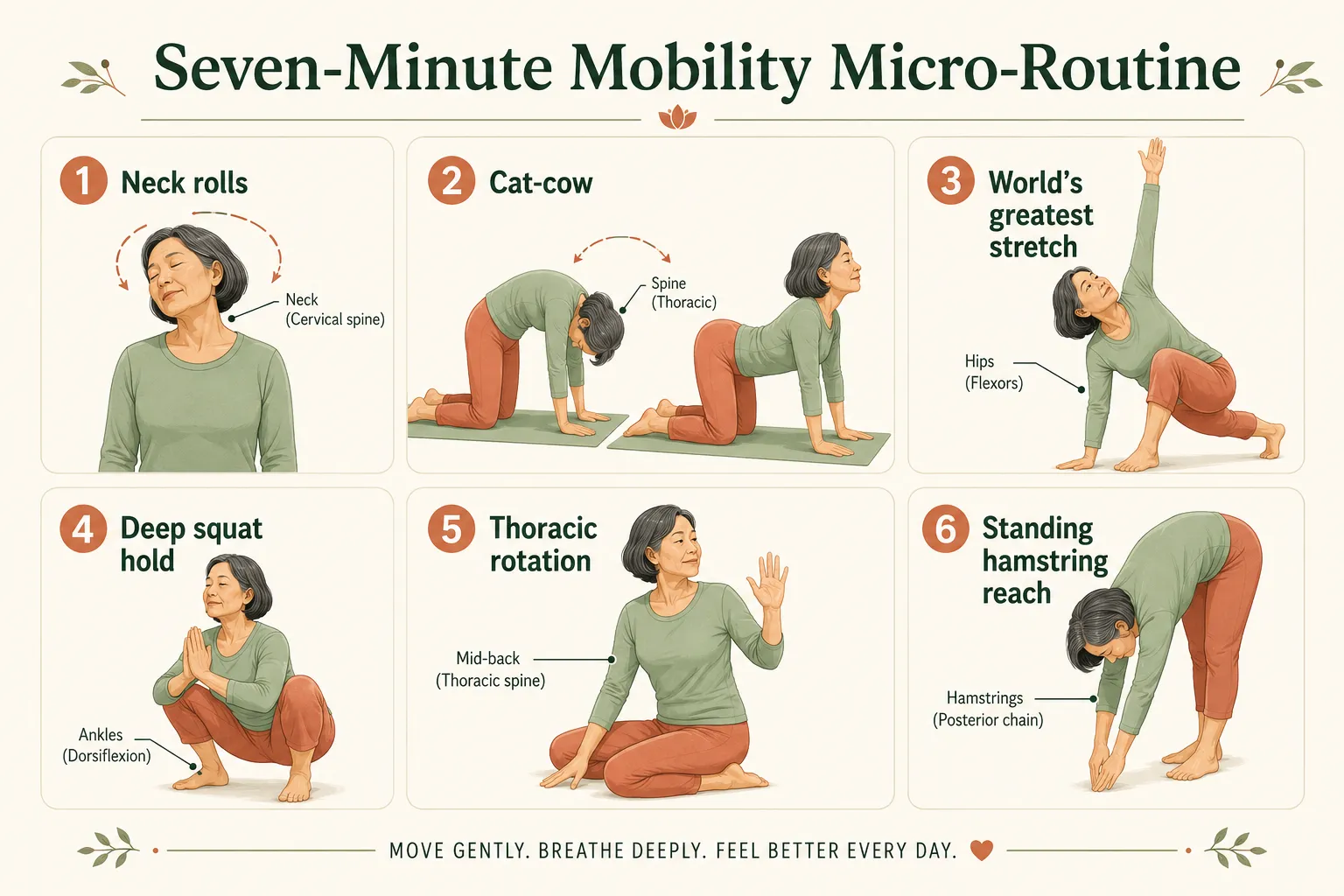
The mechanism is repetition, not duration. A 2024 review of "exercise snacks" concluded that intermittent bouts under 10 minutes trigger many of the same cardiovascular and neuromuscular adaptations as longer sessions, provided they're done consistently [10]. A 2026 systematic review confirmed measurable gains in functional mobility, leg power, and cardiorespiratory fitness from these micro-doses [1].
"Stretching is a form of hygiene, like brushing your teeth. It's what you do every day that keeps the system working.", Harvard Health guidance on stretching for healthy aging [7]
Best Daily Flexibility Exercises for Aging Well
The most useful daily flexibility exercises for aging well hit the joints that stiffen first: hips, thoracic spine, shoulders, and ankles. Harvard Health recommends a rotation of gentle stretches held for 30-60 seconds, done daily rather than intensely [7].
A durable daily set includes:
- Cat-cow, spinal segmentation, 60 seconds
- World's greatest stretch, hips, hamstrings, thoracic spine, 4 reps per side
- Deep squat hold, hips, ankles, knees, 30-60 seconds
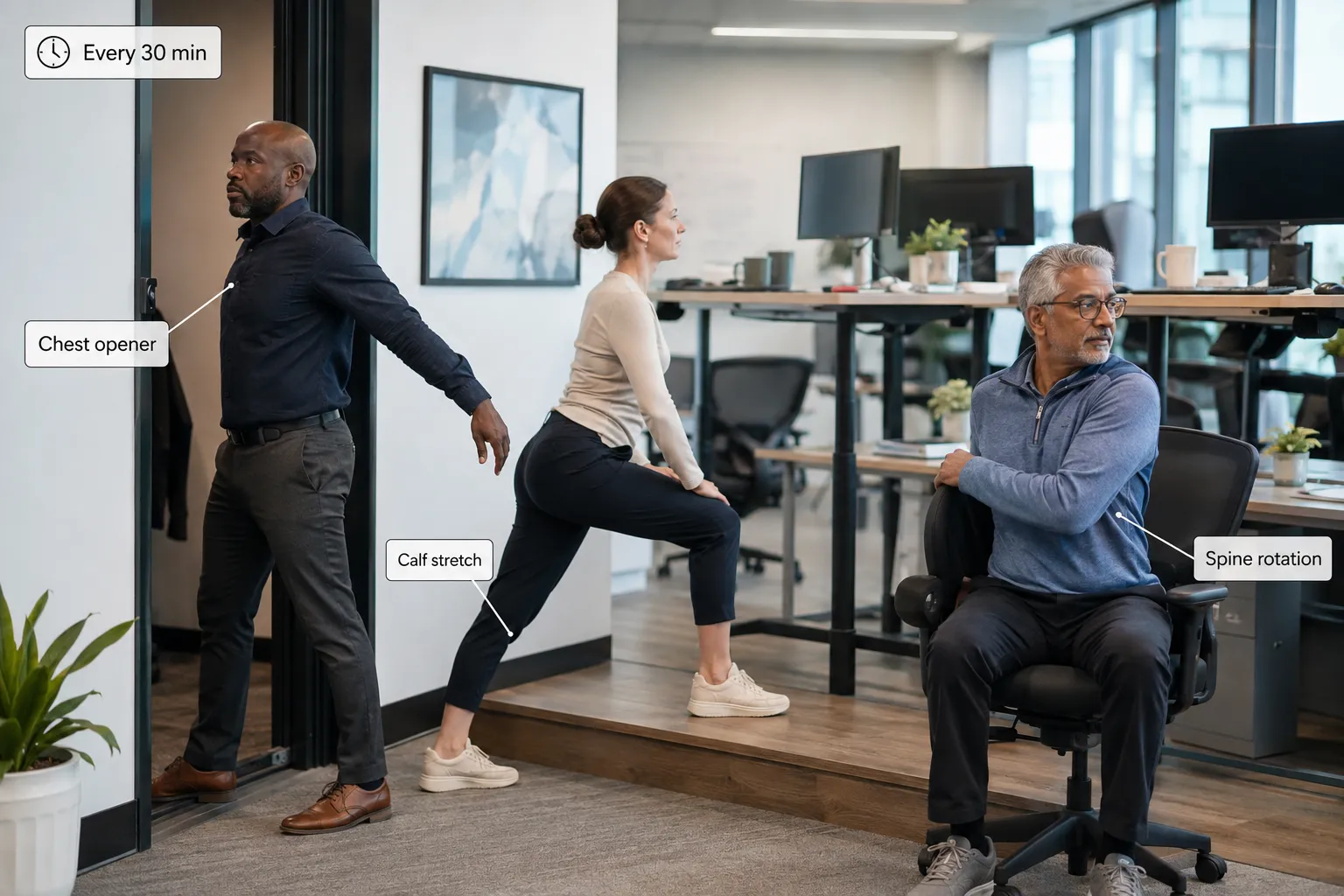
- Doorway chest opener, shoulders and pecs, 30 seconds each arm
- Standing hamstring reach with toe pull, posterior chain, 45 seconds per side
- Neck half-circles, cervical range, 6 slow reps
- Standing calf stretch off a step, ankles, 30 seconds per side
)
Frontiers published a 2026 trial showing 9-minute leg-focused circuits and Tai Chi meaningfully improved balance and lower-body function in older adults, evidence that even a single daily block moves the needle [5].
How Long Should a Mobility Routine Take Each Day?
Five to ten minutes a day is enough for most people. You do not need 45 minutes. The July 2026 "4-minute mobility miracle" protocol for adults 65+ documented measurable strength and range-of-motion gains from a single daily 4-minute sequence [2].
Practical time targets:
- Bare minimum: 4 minutes, once a day
- Sweet spot: 7-10 minutes, once a day, or 2 × 3 minutes
- Advanced: 3 × 5 minutes spread across the day (morning, midday, evening)
The upper limit isn't time, it's willingness to show up tomorrow. A 28-day remote home-based exercise snacking pilot in 2026 found adherence dropped sharply once daily sessions exceeded 12 minutes [3].
Difference Between Mobility Work and Stretching
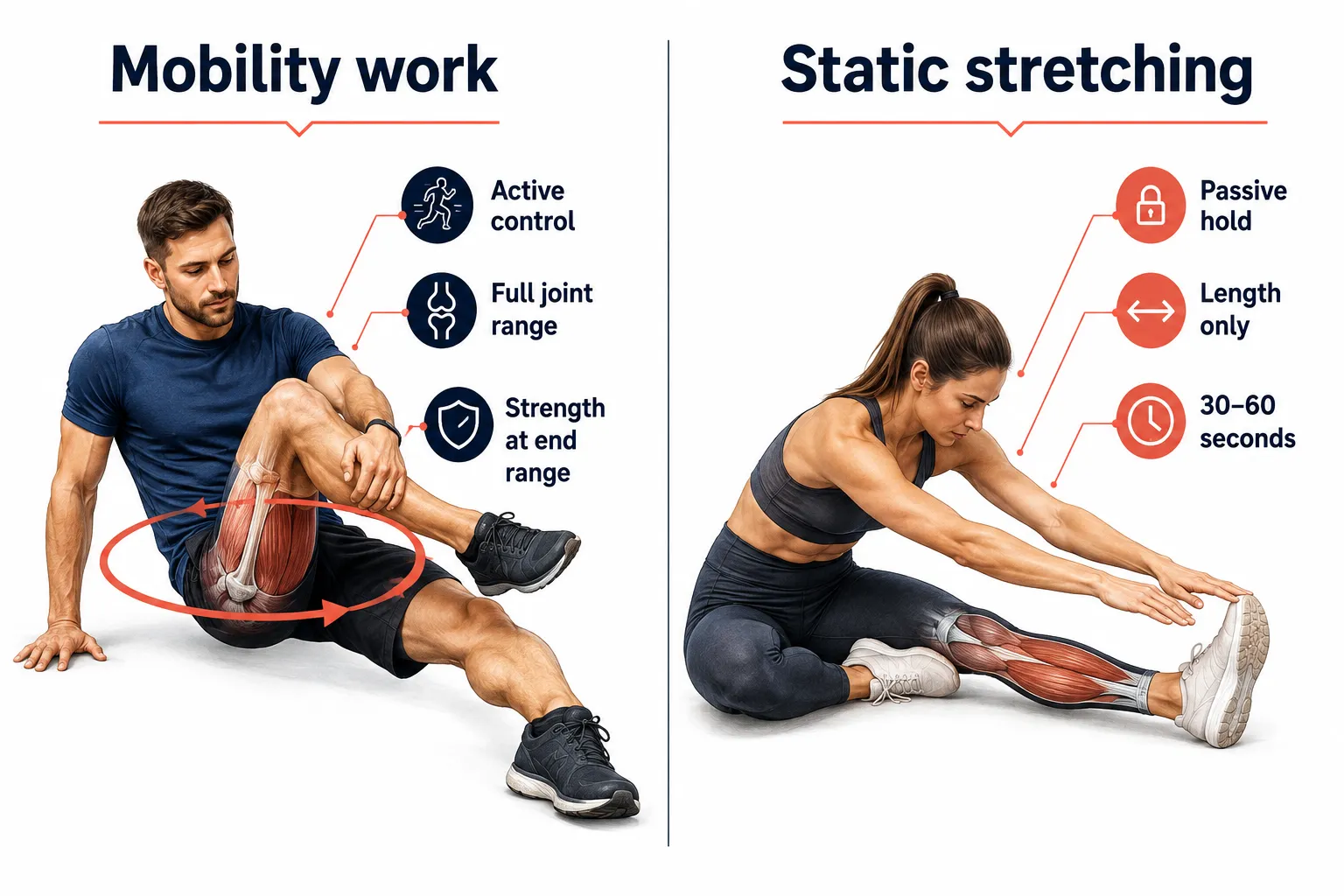
Mobility work is active, you own the range under muscular control. Stretching is passive, you lengthen a tissue and hold. Both matter, but they train different things.
| Feature | Mobility Work | Static Stretching |
|---|---|---|
| Control | Active, you move the joint | Passive, gravity or a partner holds you |
| Trains | Strength through range | Tissue length only |
| Duration | 5-20 seconds per rep, multiple reps | 30-60 seconds per hold |
| Best for | Everyday function, injury prevention | Post-exercise, cool-down, tight tissues |
| Example | Controlled hip circles (CARs) | Seated hamstring stretch |
)
Decision rule: If you can only pick one, choose mobility. Range you can't control isn't range you can use.
Can Micro-Routines Prevent Joint Pain and Stiffness?
Yes, for most non-pathological stiffness, daily micro-routines are one of the most effective interventions available. Joint pain from disuse, prolonged sitting, and normal age-related tissue changes responds well to frequent gentle loading through range [1][7].
What the evidence shows:
- Daily movement reduces morning stiffness within 2-4 weeks in most adults [7]
- Breaking up sitting with ≤1-minute bouts every 1-4 hours improves joint symptoms and blood glucose [6]
- Structured mobility work is included in guidance for midlife and beyond because tissues respond to load at any age [9]
Common edge case: If pain is sharp, radiates, or wakes you at night, that's not stiffness, that's a signal to see a clinician before layering on a routine.
Mobility Routines for Desk Workers and Sedentary People
Desk workers need routines built around the specific damage of sitting: locked hips, rounded thoracic spine, tight chest, and cranky necks. The fix is frequency, not a longer evening workout.
A workable desk-worker protocol:
- Every 30-60 minutes: Stand, do 60 seconds of movement (hip openers, thoracic rotations, or a walk to the water cooler) [6]
- Mid-morning: 3-minute chest opener + hip flexor sequence
- Lunch: 5-minute walk plus a 90-second deep squat hold
- End of day: 7-minute full-body reset before dinner
)
The 2024-2026 evidence on breaking up sitting is unusually consistent: even one minute of movement per hour meaningfully reduces cardiometabolic risk markers linked to sedentary time [6].
What Age Should You Start Doing Mobility Work?
The correct answer is now, at any age. Mobility research consistently shows benefits from adolescence through the 80s. Starting in your 30s or 40s builds a buffer against the natural 3-8% per-decade loss of range that begins in midlife [9].
Age-specific priorities:
- 20s, 30s: Ankle, hip, and thoracic mobility to protect against future injury
- 40s, 50s: Add shoulder and spine work; counter desk-related stiffness [9]
- 60s+: Prioritize balance, deep squat, and single-leg control, this is where the 4-minute daily protocols shine [2]
- 75+: Chair-based mobility and Tai Chi, style patterns show strong evidence for fall prevention [5]
Common Mistakes People Make with Flexibility Routines
The five mistakes that derail daily mobility work:
- Going too long. A 25-minute routine you skip 5 days a week beats a 5-minute one you never do. Wrong.
- Bouncing or forcing range. Slow, controlled movement outperforms ballistic stretching for adults.
- Ignoring the ankles and thoracic spine. These two joints unlock most whole-body improvements.
- Only stretching, never strengthening the new range. Length without control creates injury risk.
- Doing it "when I have time." Anchor it to an existing habit (coffee, teeth brushing, first email) or it won't happen.
A 2025 qualitative study of older adults found the biggest barrier to exercise snacks wasn't ability, it was forgetting [4].
Mobility Exercises for People with Arthritis or Injuries
For people with arthritis or a recent injury, mobility micro-routines are usually beneficial, but the rules change. Slow, pain-free, low-load range work is generally recommended, while forced end-range positions and long static holds on inflamed joints are not.
Modified approach:
- Reduce range, not frequency. Move the joint through pain-free range only, multiple times per day.
- Warm before moving. A hot shower or 3 minutes of walking preps stiff joints.
- Prioritize isometrics at mid-range for arthritic knees and shoulders, they build strength without irritating the joint.
- Avoid deep loaded end-range (deep squats, extreme shoulder stretches) during flare-ups.
- Work with a clinician for post-surgical or acute injury cases, a physiotherapist can prescribe a version of these routines tailored to you [8].
How Often Do You Need to Do Mobility Work to See Results?
Daily, or at least 5 days per week, for 4-8 weeks before expecting durable change. Range-of-motion gains show up in 2-4 weeks; strength-through-range and reduced stiffness typically consolidate by week 8 [1][3].
Timeline expectations:
- Week 1-2: Feeling looser day-to-day; less morning stiffness
- Week 3-4: Measurable range-of-motion changes (touch further, squat deeper)
- Week 6-8: Reduced joint pain and better balance
- Week 12+: New range feels "yours", you use it without thinking
Decision rule: Choose 6 days a week of 5 minutes over 3 days a week of 15 minutes. Frequency wins.
Best Apps or Programs for Daily Mobility Routines
The best mobility apps combine short daily sessions (under 15 minutes), progressions, and reminders. As of 2026, the field includes GOWOD, Pliability (formerly ROMWOD), Movement Vault, and the mobility programs inside Peloton, Apple Fitness+, and Nike Training Club. Free options include the YouTube libraries of Kelly Starrett, Squat University, and GMB Fitness.
What to look for:
- Session length ≤ 15 minutes as default
- Daily reminder functionality
- A screening assessment so the plan targets your tight spots
- Progressions, not just a rotating playlist
Skip apps that: demand 45+ minute sessions, gate every feature behind a paywall, or don't let you filter by body part or time available.
Mobility Routines vs Yoga for Flexibility
Yoga and dedicated mobility work overlap but aren't the same. Yoga blends flexibility, breath, balance, and mindfulness in longer sessions. Mobility micro-routines are shorter, more targeted, and emphasize active control through joint range.
| Mobility micro-routines | Yoga | |
|---|---|---|
| Typical length | 4-10 minutes | 30-75 minutes |
| Primary goal | Joint range + control | Flexibility + breath + balance |
| Equipment | None | Mat (usually) |
| Learning curve | Low | Medium |
| Best for | Daily maintenance, desk workers | Whole-practice wellbeing |
Choose mobility micro-routines if you want a low-friction daily habit. Choose yoga if you want a longer practice that also trains breath, focus, and balance. Doing both, micro-mobility daily, yoga 1-2 times a week, is a strong combination.
Can You Do Mobility Work Every Single Day?
Yes. Daily mobility is not only safe for most people, it's the goal. Unlike high-intensity strength training, gentle mobility work doesn't produce the tissue damage that requires recovery days [7]. Harvard's guidance explicitly frames stretching as daily hygiene [7].
Exceptions:
- Acute injury: wait for clinician clearance
- Post-surgical: follow rehab protocol
- During a flare of an inflammatory condition: reduce range, don't skip entirely
Mobility Exercises That Take Less Than 5 Minutes
Here's a proven under-5-minute routine you can do anywhere, no equipment:
The 4-Minute Daily Reset
- Neck half-circles, 30 seconds (chin to chest, ear to shoulder, both sides)
- Cat-cow, 45 seconds (slow spinal waves)
- World's greatest stretch, 60 seconds (30 seconds per side)
- Deep squat hold with thoracic rotation, 45 seconds
- Standing forward fold with knee bend, 30 seconds
- Doorway chest opener, 30 seconds
Total: 4 minutes. This mirrors the structure of the July 2026 protocol shown to improve strength and range in adults over 65 [2].
FAQ
Is 5 minutes of mobility a day really enough?
Yes, 4 to 10 minutes daily is enough to preserve and often improve joint range, especially when done consistently over 8+ weeks [1][2].
Should I do mobility work before or after exercise?
Both work. Dynamic mobility (controlled movement) before exercise; static holds are better after or on rest days.
Can mobility work fix my bad posture?
It helps significantly if your posture problems come from tightness and disuse. Combine mobility with strengthening the weak muscles (usually mid-back and glutes).
What's the single most important mobility exercise?
For most adults, the deep squat hold, it addresses hips, ankles, knees, and low back simultaneously.
Will mobility work help me sleep better?
Many people report better sleep from a 5-minute evening mobility session, likely from parasympathetic activation, though direct clinical evidence is still emerging.
Do I need equipment?
No. Every routine in this guide requires only a floor and possibly a doorway or step.
Can kids and teenagers do mobility work?
Yes, and it's a good habit to build early, especially given increased screen time.
Is soreness normal after mobility work?
Mild novel-tissue soreness is fine. Sharp or joint-line pain is not, back off the range.
How do I know if I'm improving?
Track one benchmark movement (deep squat, sit-and-reach, or shoulder overhead reach) monthly.
Can I combine mobility with walking?
Absolutely, a daily walk plus 5 minutes of targeted mobility is one of the highest-return longevity habits available.
Conclusion
The gap between people who stay mobile into their 80s and those who don't isn't genetics, it's the boring, daily choice to move joints through their full range. Daily mobility and flexibility micro-routines for longevity are the highest-leverage habit in aging well: 4 to 10 minutes a day, done consistently, buys back decades of function.
Next steps:
- Tonight: Pick 4 movements from this article. Write them down.
- Tomorrow morning: Do them once, before coffee. Anchor them to an existing habit.
- This week: Hit 5 days out of 7. Track it on a calendar.
- Week 4: Reassess one benchmark (deep squat depth, overhead reach).
- Week 8: Add a second daily block or extend to 10 minutes.
Start today, at whatever age you are, from wherever your body is right now. Frequency compounds.
References
[1] Systematic review of exercise snacks and functional mobility – https://pmc.ncbi.nlm.nih.gov/articles/PMC12732512/
[2] The 4-Minute Mobility Miracle: Reverse Muscle Decline Without the Gym – https://clinicalnews.org/2026/07/05/the-4-minute-mobility-miracle-reverse-muscle-decline-without-the-gym-ep-1300-jun-2026/
[3] Remote home-based exercise snacking 28-day pilot – https://pubmed.ncbi.nlm.nih.gov/41950555/
[4] Perceptions and barriers: older adults' views on exercise snacks – https://coconote.app/notes/6cd386bc-e58a-4c65-ad4f-7a8021dd9ec5
[5] Frontiers 2026: 9-minute leg circuits and Tai Chi for older adults – https://www.frontiersin.org/journals/public-health/articles/10.3389/fpubh.2026.1810516/full
[6] Exercise Snacks: Small Bouts, Big Benefits – https://blogs.bmj.com/bjsm/2025/10/24/exercise-snacks-small-bouts-big-benefits/
[7] A Plan for Easy Stretching – Harvard Health – https://www.health.harvard.edu/healthy-aging-and-longevity/a-plan-for-easy-stretching
[8] Frontiers in Medicine 2026: structured routines for older adults – https://public-pages-files-2025.frontiersin.org/journals/medicine/articles/10.3389/fmed.2026.1755508/pdf
[9] Cornerstone movements and mobility for midlife and beyond – https://pmc.ncbi.nlm.nih.gov/articles/PMC11624330/
[10] Exercise Snacks and Other Forms of Intermittent Physical Activity – https://www.fisiologiadelejercicio.com/wp-content/uploads/2024/01/Exercise-Snacks-and-Other-Forms-of-Intermittent-Physical-Activity.pdf