Last updated: November 13, 2026
Quick Answer
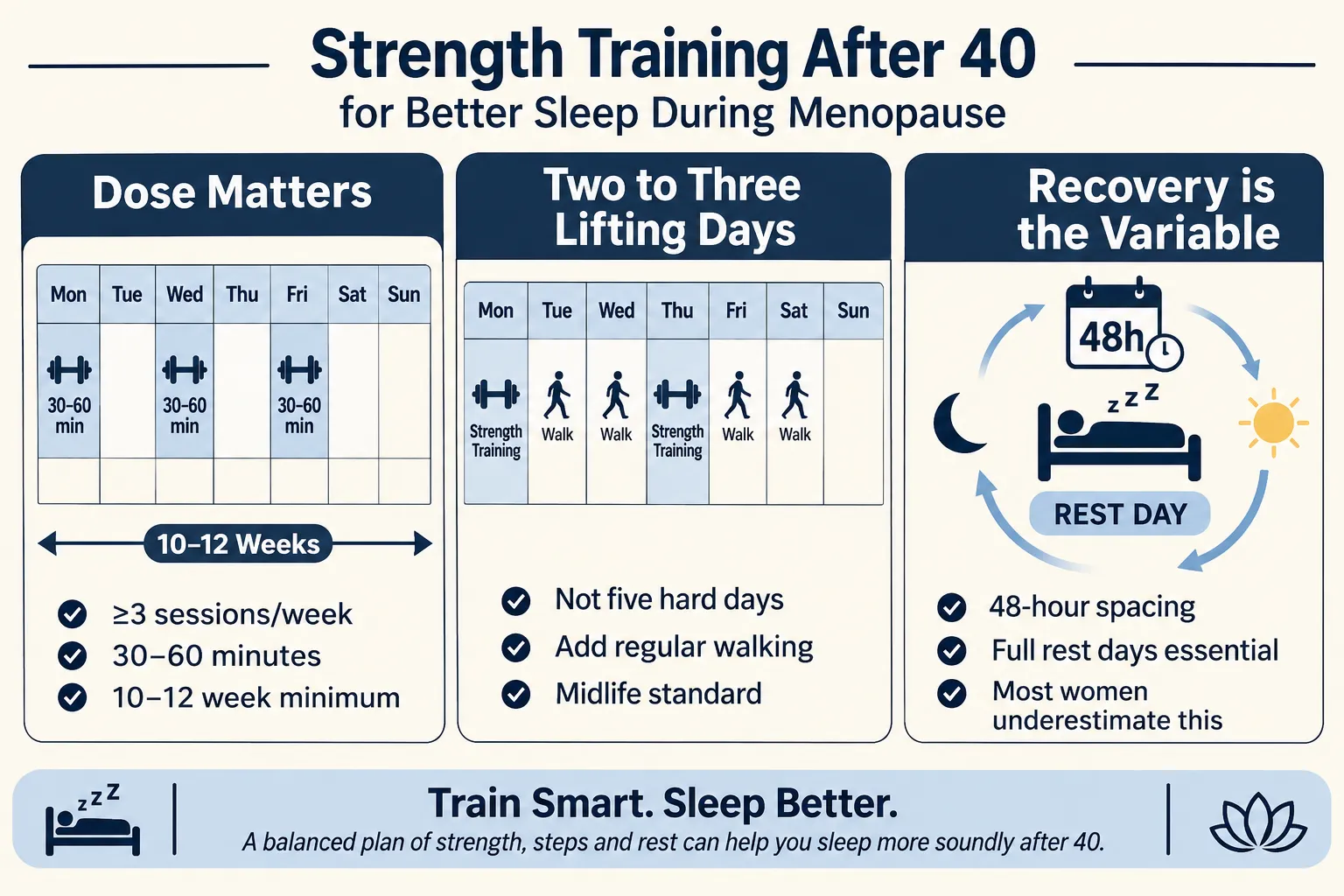
Strength training after 40 for menopause-related sleep disruption works best as a recovery-focused weekly plan: two to three progressive resistance sessions per week, 30 to 60 minutes each, spaced with at least one full day between sessions, held for 10 to 12 weeks before judging results. Research on exercise in perimenopausal women shows meaningful reductions in insomnia severity at roughly that dose [1][2]. The lifting itself matters less than the recovery scaffolding around it: session spacing, intensity caps, and a consistent wind-down.
Key Takeaways
- Dose matters. Sleep benefits in trials cluster around ≥3 sessions/week, 30-60 minutes, for 10-12 weeks [1][2].
- Two to three lifting days plus regular walking or aerobic work is the midlife standard, not five hard days [3].
- Recovery is the variable most women get wrong, not exercise selection.
- Combined resistance + aerobic training improves fatigue, mood, and sleep quality more consistently than either alone [4][5].
- Lifting does not reliably worsen night-time hot flashes; heat and timing are the usual culprits, not load.
- Expect 4-6 weeks for early changes, 10-12 weeks for a clear verdict.
- Low energy is not a reason to skip, it's a reason to shorten the session and cut the load.
- Overtraining signals include waking at 3 a.m., rising resting heart rate, flat mood, and stalled lifts.
- Strength training is safe with osteoporosis when loading is progressive and spinal flexion under load is avoided.
- Not every program helps sleep, multicomponent programs without targeted design show mixed results [6].
Does strength training actually help with menopause sleep problems?
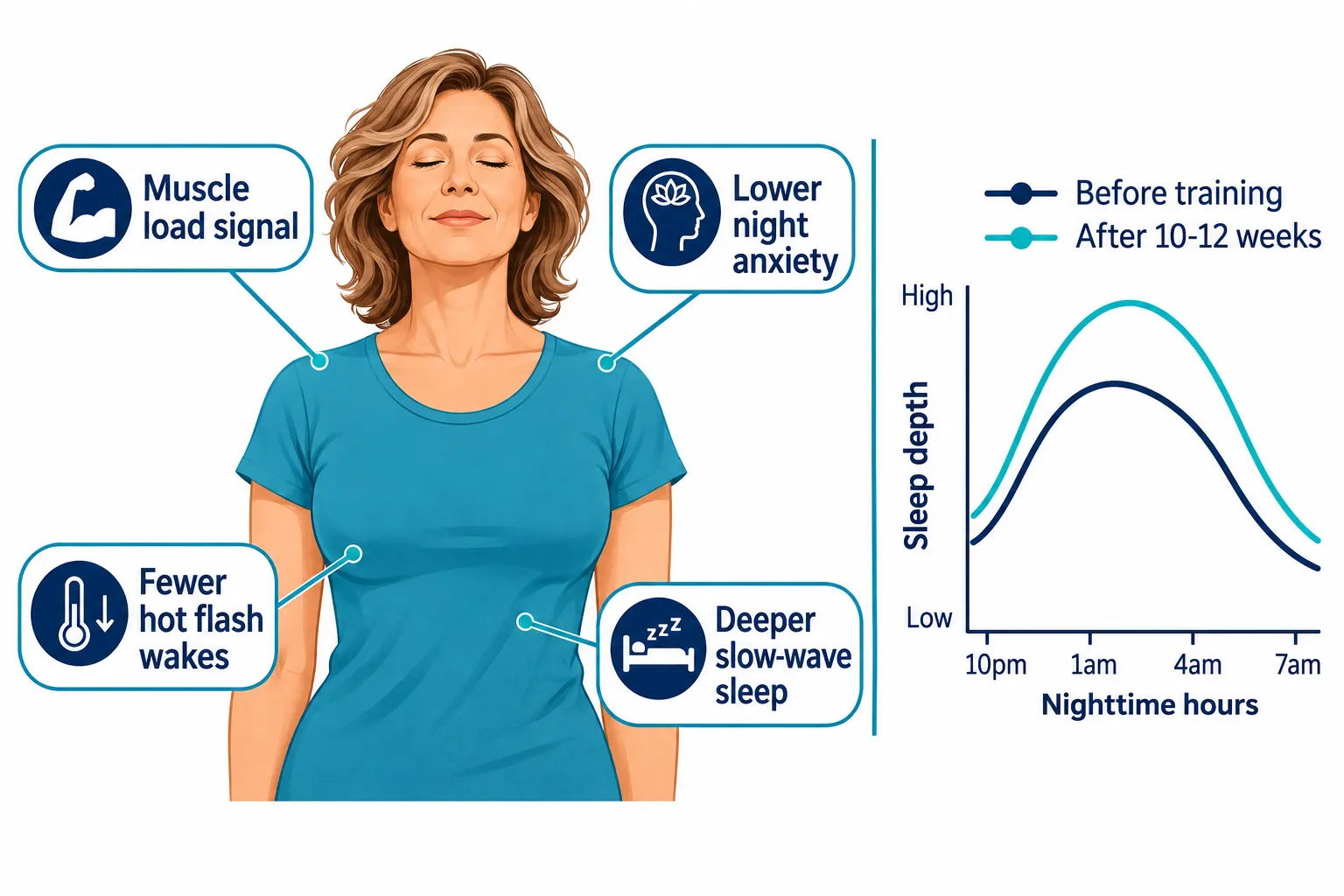
Yes, for many women, with a caveat: the effect is indirect. Resistance training reduces insomnia severity in perimenopausal women largely by improving the things that wake you up, including anxiety, low mood, fatigue, and vasomotor symptoms [1][2]. The muscle-loading stimulus also increases the body's drive for deep, restorative sleep in the first half of the night.
)
What the evidence supports:
- Exercise programs that include strength work significantly lower insomnia severity scores in perimenopausal women [1].
- Combined aerobic and resistance protocols improve menopausal symptom burden, fatigue, and self-reported sleep quality [4][5].
- High-intensity resistance training, in some protocols paired with creatine, shows promising effects on sleep and symptoms [7].
- Not all multicomponent programs produce sleep gains, which is why program design beats "just move more" [6][8].
Resistance training doesn't sedate you. It makes the body's recovery demand loud enough that sleep stops feeling optional.
Decision rule: if your sleep problem is mainly night sweats and racing thoughts, strength work plus symptom management is a reasonable first line. If you snore heavily or stop breathing at night, get screened for sleep apnea before blaming hormones.
How much recovery do I need between workouts after 40?
Plan for 48 hours between sessions that train the same muscle groups, and at least one completely training-free day per week. Recovery capacity declines modestly with age and declines further when sleep is already fragmented, so the recovery window is doing real work, not padding the calendar.
Practical recovery rules:
- Never stack two hard lifting days back to back in the first 8 weeks.
- Keep most sets 2-3 reps short of failure. Grinding reps spike the stress response and tend to cost sleep that night.
- Use walking as the in-between day, not another conditioning session.
- Deload every 4th to 6th week by cutting volume roughly in half while keeping the movements.
Edge case: if you're already sleeping under 6 hours most nights, treat your first 3 weeks as a "greasing the groove" block, light loads, full ranges, no soreness chasing. Hard training on a 5-hour sleep debt reliably makes sleep worse before it makes it better.
Strength training vs cardio for better sleep during menopause
Neither wins outright, and the research favors doing both. Resistance training protects muscle and bone and drives the deep-sleep pressure; aerobic work is better at reducing anxiety and daytime fatigue. Trials combining aerobic plus resistance training show the most consistent improvements in menopausal symptoms and sleep quality [4][5].
| Factor | Strength training | Aerobic / cardio |
|---|---|---|
| Deep-sleep pressure | Strong | Moderate |
| Anxiety and mood | Moderate | Strong |
| Bone and muscle retention | Strong | Weak |
| Hot flash management | Mixed | Mixed |
| Risk of sleep disruption if done late | Lower | Higher at high intensity |
Choose strength-dominant if you're losing muscle, have low bone density, or feel physically weak. Choose aerobic-dominant if anxiety and rumination are your main night-time problem. Most women over 40 do best with 2-3 lifts and 2-3 walks or easy cardio sessions weekly [3].
Will lifting weights make my hot flashes worse at night?
Usually no. Resistance training raises core temperature less and for less time than hard endurance work, and lifting has not been shown to reliably increase night-time vasomotor symptoms. What does trigger flashes is residual heat, a hot room, late caffeine, and alcohol.
Heat-management checklist:
- Finish lifting at least 3 hours before bed when possible.
- Cool down deliberately: cool shower, bedroom at 16-18°C (60-65°F).
- Train in breathable layers and keep rest periods long enough to stop sweating between sets.
- Skip the post-workout sauna or hot bath on nights you already flash.
If flashes spike after every session regardless of timing and cooling, reduce circuit-style density (fewer supersets, longer rests) before reducing total load.
What time of day should I exercise if I have insomnia from menopause?
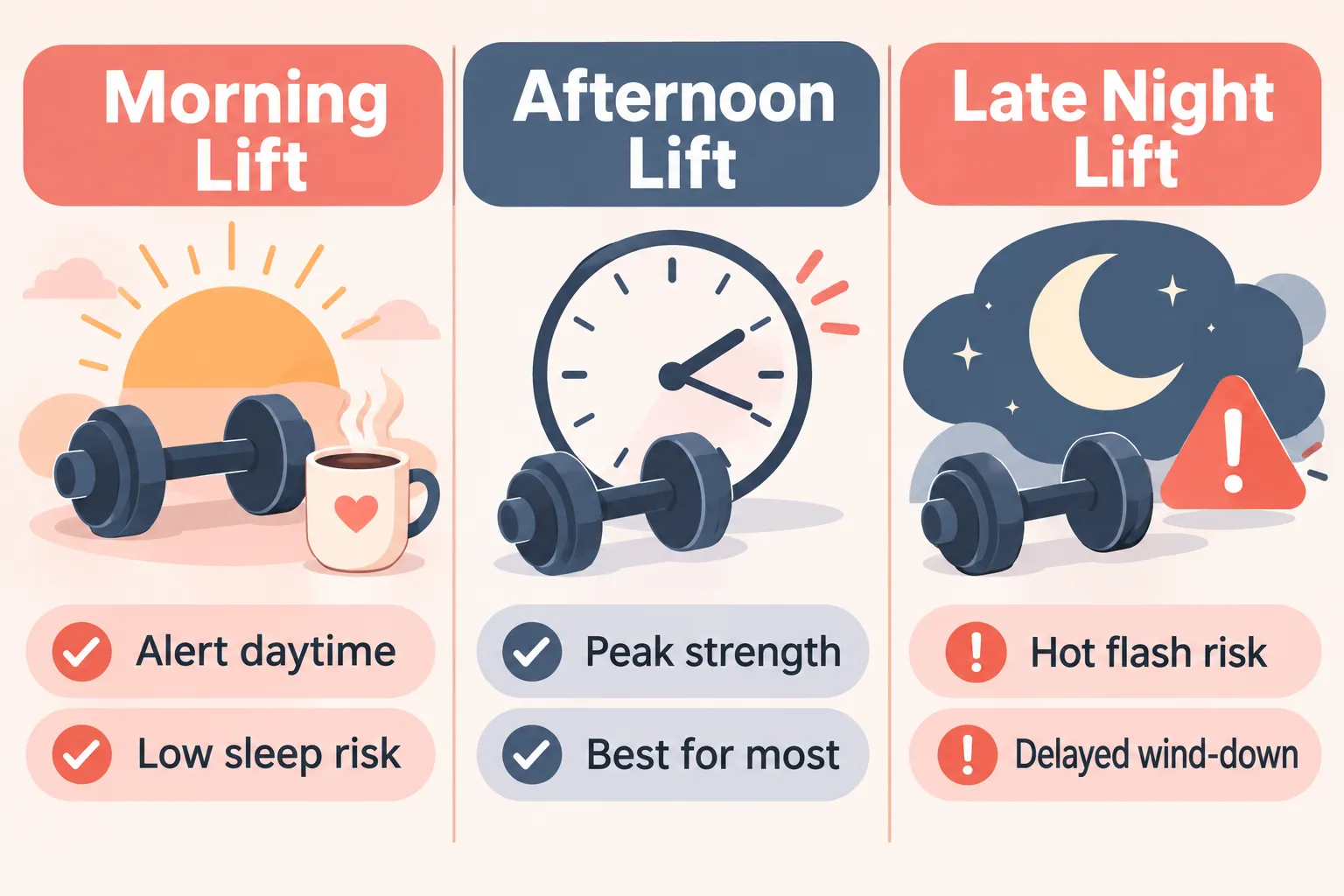
Late afternoon to early evening is the sweet spot for most women, with a hard cutoff about 3 hours before bedtime for intense sessions. Strength is highest in the afternoon, and finishing then lets core temperature fall into the evening, which supports sleep onset.
)
- Morning lifters: fine, and often better for consistency and daytime alertness. Pair with bright outdoor light within an hour of waking.
- Afternoon lifters: best performance, lowest sleep interference. Default choice.
- Night lifters (after 8 p.m.): workable only if you keep intensity moderate, cool down fully, and dim lights after.
Common mistake: training at 9 p.m. because it's "the only time," then blaming menopause for a 1 a.m. wake-up. If late is the only option, swap the heavy barbell session for machines, tempo work, and mobility.
How many days a week should I strength train to sleep better, and can I train with menopause fatigue?
Three sessions a week is the evidence-aligned target; two is enough to see benefit if each session is full-body and progressive [1][3]. Yes, you can train through menopause fatigue, the fix is reducing session size, not skipping it.
Low-energy day protocol:
- Keep the warm-up (5 minutes, full body).
- Do the first two exercises only.
- Cut load by 20-30% and stop every set well short of failure.
- Finish with 10 minutes of walking or slow breathing.
Most women report feeling better at the end of a scaled session than at the start. If you feel worse 30 minutes after finishing, on three or more consecutive sessions, that's a signal to deload for a full week.
A recovery-focused weekly plan for strength training after 40
Here is a concrete weekly template built around recovery spacing rather than maximum volume. It fits the 3-sessions-per-week, 30-60-minute dose associated with sleep benefit [1][2].
)
| Day | Focus | Time | Intensity cap |
|---|---|---|---|
| Monday | Lower body strength (squat pattern, hinge, split squat, calf) | 40-50 min | 2-3 reps in reserve |
| Tuesday | Walk 30 min + 10 min mobility | 40 min | Conversational |
| Wednesday | Upper body strength (press, row, pull-down, carry) | 40-50 min | 2-3 reps in reserve |
| Thursday | Yoga or Qigong reset | 20-30 min | Easy |
| Friday | Full-body light (deadlift variation, push-up, row, core brace) | 30-40 min | 4 reps in reserve |
| Saturday | Easy walk or hike | 30-60 min | Conversational |
| Sunday | Full rest + sleep-hygiene night | , | , |
Progression: add one rep per set each week until you hit the top of the range, then add the smallest available load and drop back to the bottom rep. Reassess at week 6 and week 12.
Mind, body sessions aren't filler. Yoga, Qigong, and walking complement resistance work for sleep and give the nervous system a lower-stress day between lifts [6][9].
What are common mistakes women make starting strength training over 40?
The biggest mistake is treating training like punishment, high frequency, high intensity, no deload, which fragments sleep instead of fixing it. The second is quitting at week 4, before the 10-12 week window where sleep changes show up [1].
- Doing five hard sessions a week and calling the resulting insomnia "hormones."
- Chasing soreness as proof of a good workout.
- Using only machines and never loading the hips, which limits bone benefit.
- Under-eating on training days, which worsens night waking.
- Skipping the warm-up, then injuring a shoulder and losing three months.
- Changing the program every two weeks, so nothing progresses.
Is strength training safe for women over 40 with osteoporosis?
Yes, and it's one of the few interventions that loads bone directly, but exercise selection changes. Avoid loaded spinal flexion (weighted sit-ups, toe-touch machines) and high-impact twisting; prioritize controlled axial loading and hip-dominant work.
Safer loading choices: goblet squats, trap-bar or hip-hinge deadlifts from blocks, split squats, seated and standing presses, rows, and loaded carries. Progress load slowly and get clearance from a clinician who knows your DEXA results, especially after a prior vertebral fracture.
What else helps menopause sleep besides exercise, and do I need supplements or hormones?
Exercise is one lever among several. Sleep hygiene, cognitive behavioral therapy for insomnia, bedroom cooling, alcohol reduction, and clinical treatment of vasomotor symptoms all work alongside training, and strength work does not replace any of them.
On supplements and hormones: no supplement is required for strength training to improve sleep. Creatine monohydrate has been studied alongside high-intensity resistance training in midlife women with promising symptom and sleep findings [7], but the evidence is early. Menopausal hormone therapy is a medical decision made with a clinician based on symptoms, age, and risk profile, not a training variable. Treat supplements as optional additions after the training and sleep basics are in place.
Complementary, low-cost options with supportive evidence in menopausal populations include yoga, Qigong, walking programs, and reflexology [6][9].
How long does it take to see sleep improvements, and what happens if I overtrain?
Expect the first changes (easier sleep onset, fewer night wakes) around weeks 4 to 6, with clearer improvement by weeks 10 to 12, the window used in most trials reporting insomnia benefit [1][2]. Overtraining reverses those gains quickly.
Signs training stress is too high:
- Waking at 2-4 a.m. wired, on nights after hard sessions
- Resting heart rate up 5+ beats for several mornings
- Strength stalling or dropping three weeks running
- Irritability, low motivation, persistent heavy legs
- Appetite swings and nagging minor injuries
Response: take 5-7 days of walking only, then restart at 60% of prior volume. Overtraining during the menopause transition compounds an already-fragile recovery state, so err early and err light.
Is a gym membership or home workout better for menopause strength training?
Whichever one you'll actually do three times a week. A gym wins on load progression and bone-loading options; home wins on consistency, cost, and the ability to train in a cool, private space on a bad-sleep day.
- Choose a gym if you want heavier hinges and squats, need bone-specific loading, or value coaching.
- Choose home if your main barrier is time, travel, or self-consciousness. Adjustable dumbbells (up to ~20 kg per hand), a bench, and bands cover years of progress.
- Hybrid is common and effective: one gym session for heavy lower-body work, two home sessions for upper body and full-body light days.
FAQ
How many sessions per week do I actually need for sleep benefits?
Three sessions per week of 30-60 minutes is the dose most associated with reduced insomnia severity; two full-body sessions still help [1][2].
Can strength training replace sleep medication?
No. It's a complementary strategy. Any change to prescribed sleep medication should be made with your prescriber.
Should I lift on a night I barely slept?
Train, but halve the volume and drop the load 20-30%. Skip heavy singles and anything requiring sharp balance.
Does soreness mean the session will hurt my sleep?
Mild soreness is fine. Severe soreness often coincides with restless nights, which is a sign the session was too large.
How long before I see bone or muscle changes?
Strength gains show within 4-8 weeks; measurable bone change takes 12 months or more of consistent progressive loading.
Is HIIT a good substitute?
Not for bone and muscle retention, and high-intensity work late in the day is more likely to disturb sleep than moderate resistance training.
Do I need protein shakes?
No, shakes are a convenience. Adequate total daily protein from food covers the same need.
What if my sleep gets worse in week 2?
Common with a new training stimulus. Hold the volume flat rather than progressing, and reassess at week 4.
Conclusion
Strength training after 40 for menopause-related sleep disruption is not a question of working harder, it's a question of applying the right dose and then protecting the recovery around it. Two to three progressive resistance sessions weekly, 30 to 60 minutes each, spaced with full days between them, run consistently for 10 to 12 weeks, matches what the research on perimenopausal women actually supports [1][2][3].
Next steps this week:
- Pick three non-consecutive training days and put them in the calendar.
- Run the Monday/Wednesday/Friday template above at 4 reps in reserve for two weeks.
- Track three numbers nightly: bedtime, wake-ups, and morning energy (1-5).
- Set a hard 3-hour buffer between training and bed.
- Review at week 6, deload, and reassess at week 12 before changing the plan.
References
- pubmed.ncbi.nlm.nih.gov.
- Pmc12750805. pmc.ncbi.nlm.nih.gov.
- Training Through Transition Menopause. nfpt.com.
- Pmc12385796. pmc.ncbi.nlm.nih.gov.
- pubmed.ncbi.nlm.nih.gov.
- Pmc12008710. pmc.ncbi.nlm.nih.gov.
- S00421 026 06481 6. link.springer.com.
- Record Detail. search.pedro.org.au.
- 12905 2023 Article 2515. pmc.ncbi.nlm.nih.gov.
