Using Wearables and Mobile Fitness Apps to Personalize Senior Strength and Mobility Training

Using Wearables and Mobile Fitness Apps to Personalize Senior Strength and Mobility Training

{"cover":"Professional landscape format (1536×1024) editorial hero image with bold text overlay 'Using Wearables and Mobile Fitness Apps' in crisp white sans-serif on a semi-transparent teal overlay panel, centered with 10% safe margins from every edge, no character touches the edge. Background: bright natural-daylight photograph of an active silver-haired woman in her late 60s doing a controlled resistance band squat in a sunlit living room, an Apple Watch-style smartwatch clearly visible on her wrist, a tablet propped on a chair showing a colorful workout progress ring, warm hardwood floors, soft window light, magazine-cover polish, teal-and-coral accent palette. No pricing, no numbers rendered as text.","content":["Four-panel labelled comparison guide (1536×1024) titled 'Wearable Options for Seniors': Panel 1 'Basic Fitness Tracker' with a slim wristband illustration and labels 'Steps', 'Heart rate', 'Sleep', 'Long battery'; Panel 2 'Smartwatch' with a square-face watch illustration and labels 'ECG', 'Fall detection', 'Apps', 'GPS'; Panel 3 'Medical Alert Wearable' with a pendant illustration and labels 'SOS button', 'Auto-fall alert', '24/7 monitoring'; Panel 4 'Smart Ring' with a ring illustration and labels 'HRV', 'Recovery', 'Discreet wear'. Clean white background, thin teal callout lines, navy typography, editorial medical-guide polish, 5% safe margins.","Annotated documentary photograph (1536×1024) of a diverse 70-year-old Black man performing a seated resistance band row in a bright home living room, smartwatch on left wrist, smartphone on side table showing a workout app with a heart rate zone graph, four small floating callout labels with thin lines pointing to elements: 'Zone 2 heart rate', 'Rep counter', 'Form reminder', 'Rest timer'. Natural window light, shallow depth of field, warm neutral palette, editorial fitness magazine quality, labels short and inside a 5% safe margin.","Numbered five-step process flow illustration (1536×1024) titled 'Personalize Your Training Loop': Step 1 'Baseline Assessment' with a clipboard icon; Step 2 'Set Goals in App' with a target icon; Step 3 'Wearable Tracks Session' with a smartwatch icon; Step 4 'App Adjusts Intensity' with a dial icon; Step 5 'Weekly Progress Review' with a chart icon. Curved arrow connecting each step, soft coral-and-teal gradient background, flat vector style, short label per step, clean sans-serif typography, editorial infographic polish, 5% safe margins."}
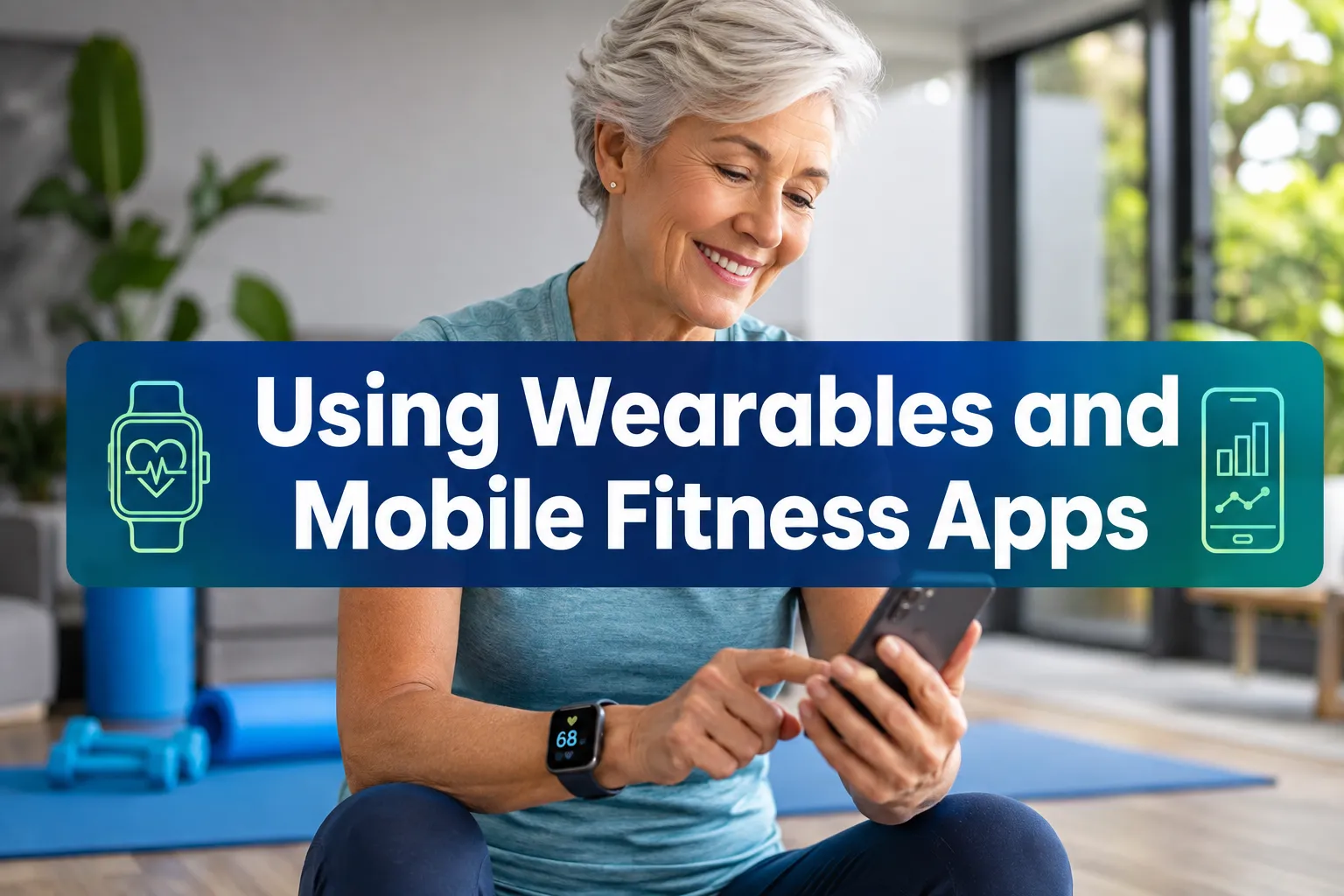
Professional landscape hero image () with a reading "Using Wearables and Mobile Fitness Apps". CRITICAL TYPOGRAPHY RULES:

Last updated: September 5, 2026

Quick Answer

Adults 55+ can use wearables (smartwatches, fitness trackers, medical-alert devices) alongside mobile fitness apps to set safe intensity, track strength and mobility gains, and progress workouts at home. A 2026 meta-analysis in older adults found that wearable-guided exercise produced meaningful improvements in lower-limb strength and balance, and a 2026 clinical trial showed smart strength devices substantially increased knee-extensor strength in frail seniors [1][3]. The best setup pairs one comfortable wearable that tracks heart rate and movement with one app that delivers structured strength, balance, and mobility routines.

Key Takeaways

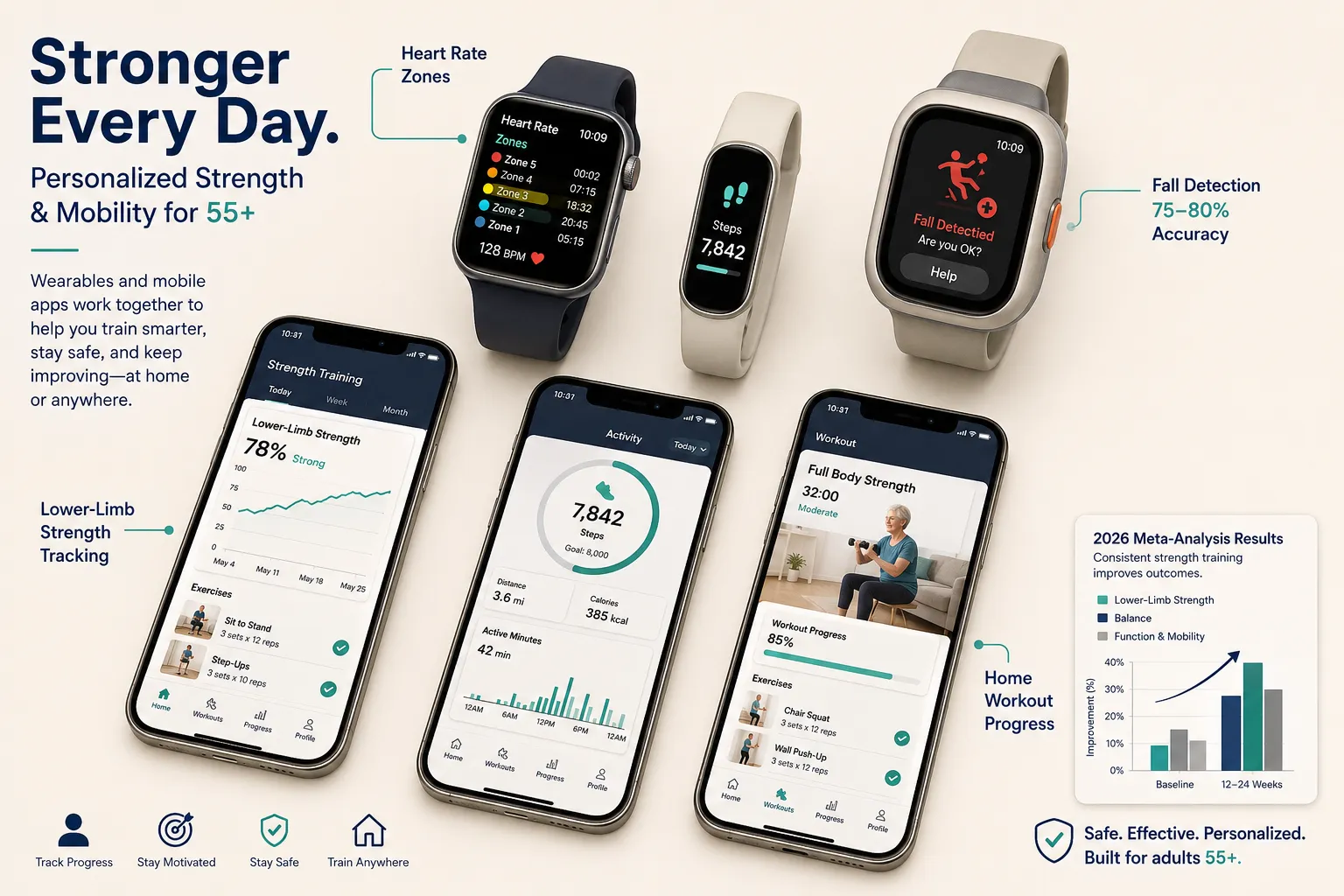
  • Wearables now do more than count steps, they measure heart rate zones, detect falls, quantify frailty, and flag balance risk with 75-80% accuracy [8].
  • A 2026 meta-analysis confirmed wearable-guided programs significantly improve lower-limb strength and balance in older adults [1].
  • Smart strength devices paired with apps notably raised knee-extensor strength in frail seniors in a 2026 trial [3].
  • Free apps can work well; you rarely need to pay more than $10,$15 a month for a quality senior-focused program.
  • Zone 2 heart rate (roughly 60-70% of max) is a safe, effective target for most strength and mobility sessions.
  • Most seniors with pacemakers can use wearables safely, but should keep the device 6+ inches from the pacemaker and confirm with a cardiologist.
  • Wearables help arthritis sufferers pace effort, but silicone bands and larger touchscreens matter more than raw specs.
  • Apps do not fully replace a trainer or physical therapist for complex conditions, but they extend and reinforce professional guidance.

What wearables are best for tracking senior fitness and mobility?

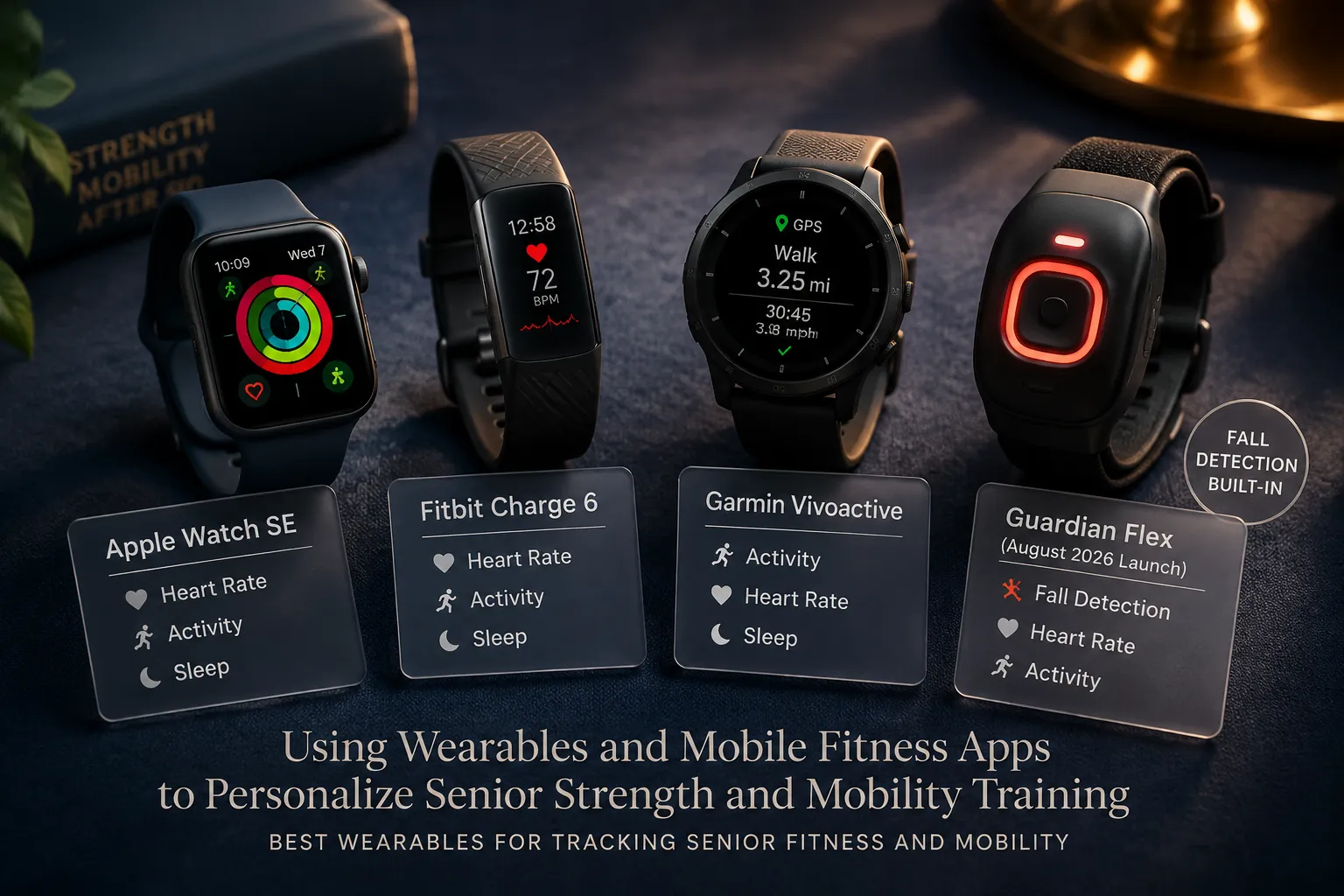
The best wearables for seniors are ones that balance accuracy, ease of use, and comfort. For most adults 55+, an Apple Watch SE, Fitbit Charge 6, Garmin Vivoactive, or a medical-alert hybrid like the Guardian Flex (launched August 2026) covers the essentials: heart rate, activity, sleep, and fall detection [2].
What wearables are best for tracking senior fitness and mobility?

)

Pick based on the primary goal:

  • Strength and mobility training focus: Apple Watch SE or Fitbit Charge 6. Both track heart rate zones during resistance work and integrate cleanly with dozens of apps.
  • Fall safety plus activity: Apple Watch (built-in fall detection), Guardian Flex, or a medical-alert pendant with activity tracking [2][5].
  • Simple daily wear, long battery: Fitbit Inspire 3 or Garmin Vivosmart, 7-10 day battery, minimal buttons.
  • Discreet all-day tracking: Oura Ring or Ultrahuman Ring, good for seniors who dislike wristbands.

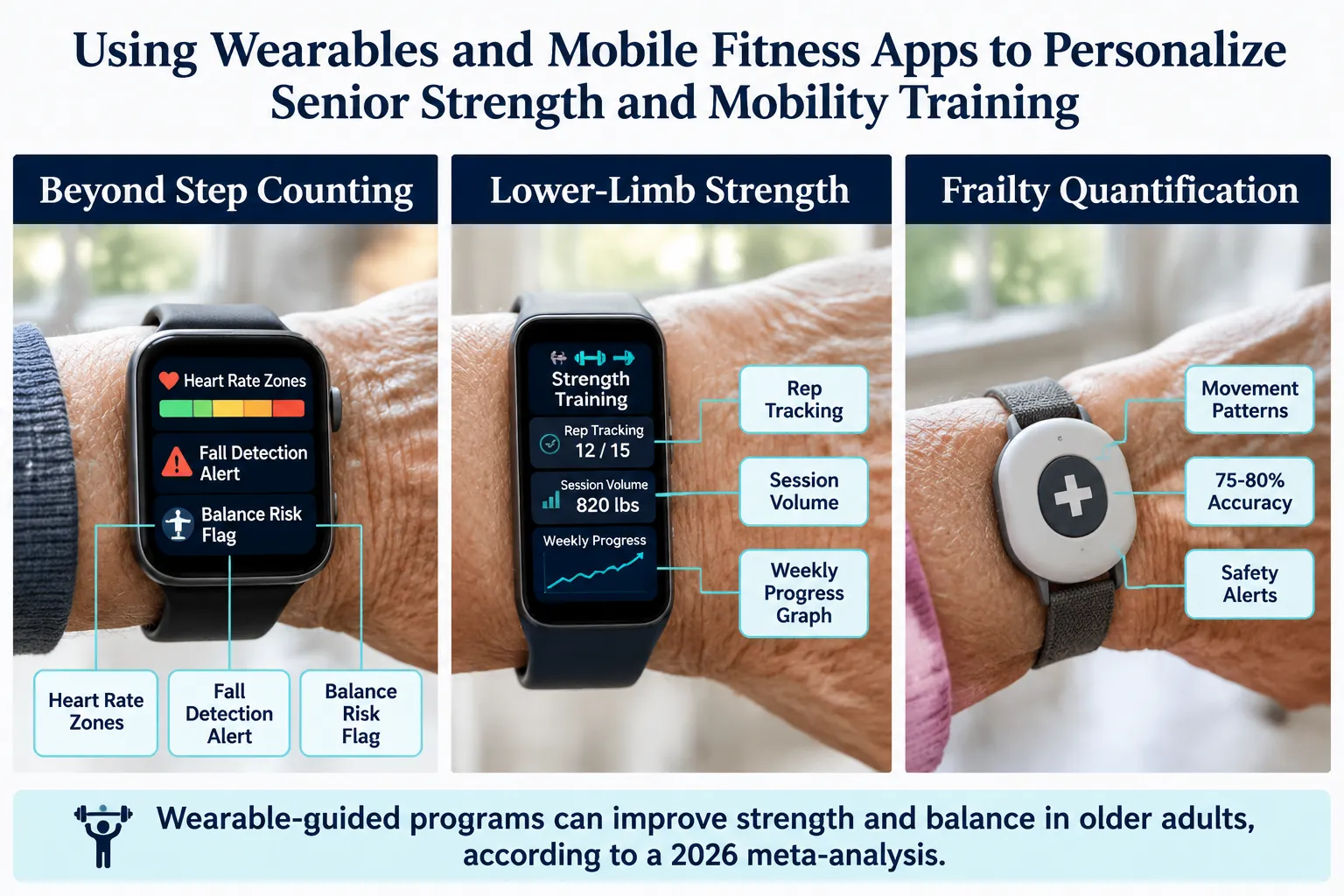
Wearable sensors can now quantify frailty and fall risk with 75-80% accuracy, and classify slip/trip events with over 98% accuracy, which is why they're moving into structured senior training programs [8].

Decision rule: If falls are a real concern, choose a device with automatic fall detection. If strength progression is the goal, choose one with reliable continuous heart rate and third-party app support.

How do fitness apps personalize workouts for older adults?

Modern senior fitness apps personalize by pulling wearable data (heart rate, movement patterns, recovery) and combining it with user inputs (age, conditions, goals, session feedback) to adjust the next workout automatically. This is the shift from tracking to adaptive coaching.

Typical personalization inputs:

  1. Baseline questionnaire, mobility limits, joint pain, medications, prior injuries.
  2. Wearable-derived data, resting heart rate, HRV, activity level, sleep.
  3. In-workout feedback, perceived effort ratings, completed reps, skipped exercises.
  4. Progression rules, the app raises resistance, reps, or complexity when heart rate response drops or perceived effort falls.

Apps like SilverSneakers GO, Bold, Mighty Health, and Nymbl use this loop to serve strength, balance, and mobility routines tuned to the individual. Evidence-based resistance band protocols can also be embedded into apps and paired with a wearable for real-time monitoring [4][7].

Can smartwatches help seniors with strength training?

Yes. Smartwatches help seniors train strength safely by tracking heart rate response between sets, timing rest, counting reps in some apps, and logging session volume over weeks. The 2026 meta-analysis found wearable-guided exercise produced significant improvements in lower-limb strength in older adults [1].

)

What a smartwatch actually adds to strength work:

  • Rest timing: Vibration alerts prevent rushing between sets, 60-90 seconds is ideal for most senior programs.
  • Heart rate ceiling: Warns you if effort spikes too high.
  • Session logging: Weekly and monthly views show consistency, which predicts strength gains better than any single workout.
  • Form cues (in some apps): Sensor-based apps can flag when tempo is off or a rep is incomplete.

Common mistake: Relying on the watch's "calories burned" number for strength work. It's inaccurate for resistance training. Focus on heart rate zones and completed sessions instead.

What's the difference between fitness trackers and smartwatches for seniors?

A fitness tracker is a slim wristband focused on activity, heart rate, and sleep, usually with a small display and 5-10 day battery. A smartwatch is a fuller computer on the wrist, apps, ECG, fall detection, notifications, GPS, and typically 1-2 day battery.

Feature Fitness Tracker Smartwatch
Battery life 5-10 days 1-2 days
Screen size Small Large, touchscreen
Fall detection Rare Common (Apple, Samsung)
ECG / blood oxygen Some Most
Third-party apps Limited Extensive
Price range Lower Higher
Ease for arthritis Very easy Larger touch targets help

Choose a tracker if: the senior wants simplicity, long battery, and just the basics.
Choose a smartwatch if: fall detection, ECG, or app-guided workouts matter.

How much do senior fitness apps cost, and what are the best free options?

Most quality senior fitness apps cost between $0 and $15 per month. Many excellent programs are free, especially those bundled with Medicare Advantage plans or wearable ecosystems.
How much do senior fitness apps cost, and what are the best free options?

Best free options for seniors:

  • SilverSneakers GO, free with many Medicare Advantage plans; strength, cardio, and balance routines built for older adults.
  • Nymbl, free in many U.S. states through public health partnerships; focused on fall prevention and balance.
  • Apple Fitness (limited free tier) and Fitbit basic app, free workouts, guided breathing, and activity tracking.
  • YouTube channels (Bob & Brad, HASfit Senior), free structured strength and mobility routines.
  • MyGuardian companion app, free with a Guardian medical alert device, includes activity and check-in features [10].

Paid but worth it: Bold ($10-15/mo), Mighty Health (~$25/mo with coaching), Apple Fitness+ ($9.99/mo).

Decision rule: Start free for 30 days. Only pay if you need live coaching, condition-specific programs (Parkinson's, post-stroke), or richer progression tracking.

Why isn't my fitness app tracking my movements accurately?

Fitness apps typically miscount senior workouts for four reasons: the wearable is worn too loose, the workout mode isn't selected, the movement is too slow for the sensor's algorithm, or strength work doesn't produce the wrist motion the app expects.

Fixes that work:

  1. Tighten the band, one finger-width of slack, not two. Loose wrists produce ghost data.
  2. Select the right mode, "Strength Training," "Yoga," or "Other" before starting. Auto-detection misses slow, controlled movements.
  3. Log resistance work manually, most wearables underreport seated or band-based strength. Use the app's rep logger.
  4. Update firmware, algorithm improvements happen quarterly.
  5. Wear on the non-dominant wrist, usually more accurate for daily steps.

Edge case: Seniors who use walkers or canes often get undercounted steps because one arm doesn't swing. A hip-clip tracker or ankle band solves this.

Can seniors use Apple Watch or Fitbit for physical therapy?

Yes, as a support tool, not a replacement. Physical therapists increasingly ask patients to wear an Apple Watch or Fitbit between sessions to verify home-exercise adherence, track heart rate response to prescribed movements, and flag setbacks like reduced daily steps after a joint procedure.

Practical uses in PT:

  • Adherence tracking: The therapist can see which days the prescribed workout was completed.
  • Range-of-motion checks: Some apps use the watch's motion sensors to estimate shoulder or hip range.
  • Recovery monitoring: Post-op patients track daily steps to hit a rising goal (e.g., 2,000 → 5,000 over six weeks).
  • Heart rate response: Cardiac rehab uses zone-based training with continuous monitoring.

Discuss with the PT which specific metrics to share and how often. Most modern PT clinics accept a screenshot from the Health or Fitbit app as a progress log.

What heart rate zones should seniors aim for during strength training?

Most seniors should train in Zone 2 (roughly 60-70% of estimated max heart rate) for strength and mobility work, with brief spikes into Zone 3 during hardest sets. This range builds strength safely without over-stressing the cardiovascular system.

A rough guide using the 220-minus-age formula:

  • Age 60: Max ~160 bpm → Zone 2 = 96-112 bpm
  • Age 70: Max ~150 bpm → Zone 2 = 90-105 bpm
  • Age 80: Max ~140 bpm → Zone 2 = 84-98 bpm

Pull quote: "The goal during senior strength training isn't a pounding heart, it's controlled effort you could hold a short conversation through."

Adjust down 10-20 bpm for anyone on beta-blockers, and always use perceived exertion (a 5-6 out of 10) as a backup to the number. Confirm target zones with a physician if there's any cardiac history.

Are fitness wearables safe for seniors with pacemakers?

Most fitness wearables are safe for seniors with pacemakers, but the device should be kept at least 6 inches away from the pacemaker itself, and any wearable with strong magnets (like the Apple Watch charging puck or some fitness rings) should not be placed directly on the chest.
Are fitness wearables safe for seniors with pacemakers?

Practical safety rules:

  • Wear the watch on the wrist opposite the pacemaker implant when possible.
  • Avoid placing the phone or watch in a breast pocket over the pacemaker.
  • ECG features on smartwatches are generally not accurate in pacemaker patients, ignore those readings.
  • Confirm with the cardiologist or device manufacturer if switching to a new wearable.

Heart rate readings from optical wrist sensors are unaffected by pacemakers and remain useful for training zones.

How often should seniors do strength training according to apps?

Nearly every evidence-based senior app recommends strength training 2-3 times per week on non-consecutive days, plus daily mobility or balance work. This matches CDC and WHO guidelines and aligns with the 2026 meta-analysis showing meaningful strength and balance gains from wearable-guided programs [1].

A typical weekly template apps use:

  • Monday: Full-body strength (30-40 min)
  • Tuesday: Mobility + balance (15-20 min)
  • Wednesday: Walk + light bands (30 min)
  • Thursday: Full-body strength (30-40 min)
  • Friday: Mobility + balance (15-20 min)
  • Saturday: Longer walk or gentle yoga
  • Sunday: Rest or stretch

Apps automatically shorten sessions if wearable data shows poor sleep or elevated resting heart rate, a small but genuinely useful piece of adaptive coaching.

Can fitness apps replace a personal trainer for seniors?

Fitness apps can replace a general personal trainer for healthy, motivated seniors, but they cannot replace a physical therapist, exercise physiologist, or trainer with geriatric certification for anyone recovering from surgery, managing Parkinson's, post-stroke, severe osteoporosis, or advanced frailty.

Where apps do well:

  • Consistent programming and progression
  • Reminders and streak tracking
  • Video demonstrations of every exercise
  • Objective feedback via wearable data

Where humans still win:

  • Hands-on form correction
  • Complex condition management
  • Motivation during setbacks
  • Real-time safety judgment

Best hybrid model: See a certified trainer or PT for 3-4 sessions to build a base, then let the app + wearable maintain and progress the program at home.

What features should a senior fitness app have?

A good senior fitness app should have large text, clear video demonstrations, low-impact and seated modification options, wearable integration, progress tracking, and a safety-focused progression system.

)

Non-negotiable features:

  • Large, high-contrast interface, no tiny gray text on white.
  • Seated and standing options for every exercise.
  • Video demonstrations with clear, older-adult demonstrators.
  • Balance and fall-prevention modules, not just cardio and strength.
  • Wearable sync with Apple Health, Google Fit, Fitbit, or Garmin.
  • Rest-day logic, the app should sometimes tell you to rest.
  • Emergency contact or fall alert integration, especially valuable given the 2026 push toward integrated safety-plus-training ecosystems [9].
  • Offline mode for spotty Wi-Fi.

Nice-to-haves: coach messaging, condition-specific tracks (arthritis, osteoporosis, diabetes), and family/caregiver dashboards.

Do wearables work for seniors with arthritis or joint pain?

Yes, wearables work well for seniors with arthritis, and they can actually help manage it, but band material, weight, and interface design matter more than headline specs. Look for soft silicone or fabric bands, lightweight cases under 40 grams, and larger touch targets.

Ways wearables help arthritis sufferers:

  • Pacing: Heart rate and step trends flag flare-up days so you can dial back.
  • Movement reminders: Gentle nudges every hour reduce stiffness.
  • Sleep tracking: Poor sleep predicts arthritis pain days, data helps plan gentler workouts.
  • Range-of-motion progress: Some PT apps use the sensor to estimate joint mobility gains.

Avoid: Heavy metal bands, small crown dials that require fine finger control, and any device requiring a two-hand clasp. Magnetic loop bands are the easiest to fasten with arthritic hands.

Sample two-week starter plan

A simple way to combine wearables and apps if you're starting from scratch:

Week 1, Baseline

  1. Wear the device all day, every day. Note resting heart rate.
  2. Do a 5-minute movement test the app recommends (sit-to-stand, timed walk).
  3. Complete two 20-minute app workouts. Rate effort 1-10.

Week 2, Personalize

  1. Increase to three strength sessions, keep Zone 2 heart rate.
  2. Add one daily 10-minute mobility routine.
  3. Review weekly summary, steps, active minutes, resting HR trend.
  4. Adjust workout difficulty if resting heart rate is stable or falling.

FAQ

Do I need Wi-Fi at home to use a fitness wearable?
Not always. Most wearables sync to your phone over Bluetooth. Wi-Fi helps with faster app updates and cloud backup, but is not required for daily tracking.

Can two people share one app account?
Usually no, most apps tie personalization to one profile. Family plans (Apple Fitness+, Fitbit Premium) support multiple users under one subscription.

What if I forget to charge my wearable?
Choose a device with 5+ day battery, or set a weekly charging routine, for example, while showering on Sunday morning.

Are there wearables designed specifically for seniors?
Yes. Medical Guardian's Guardian Flex (August 2026) and other alert-based wearables target older adults with fall detection and simplified interfaces [2].

Should I trust the calorie count on my watch?
Only loosely. Trust heart rate, step count, and active minutes far more than calorie estimates.

Can wearables detect a fall automatically?
Yes. Apple Watch, several Samsung and Garmin models, and dedicated medical alert wearables detect hard falls and can call for help [5][9].

Is it worth upgrading to a newer smartwatch every year?
No. Most seniors get 3-4 useful years from a mid-range wearable. Upgrade when the battery weakens or a needed feature appears.

How do caregivers stay in the loop?
Many apps and medical alert systems offer caregiver dashboards showing daily activity, workout completion, and fall alerts, a growing standard in 2026 aging-in-place ecosystems [6][9].

Conclusion

Using wearables and mobile fitness apps to personalize senior strength and mobility training is no longer a novelty, it's the most practical way for adults 55+ to train safely and progressively at home. The 2026 evidence is clear: wearable-guided programs measurably improve strength and balance, and app-based coaching increasingly adapts in real time to how the body is responding [1][3].

Next steps:

  1. Pick one wearable that matches your priority, strength progression, fall safety, or all-day comfort.
  2. Try 1-2 free apps for 30 days before paying.
  3. Aim for 2-3 strength sessions and daily mobility work in Zone 2 heart rate.
  4. Share your app data with your doctor or PT at your next visit.
  5. Reassess every 8-12 weeks, bump resistance, add complexity, or shift focus based on the numbers.

The technology only works if it's worn and used. Start simple, stay consistent, and let the data do the personalization for you.

References

[1] pubmed.ncbi.nlm.nih.gov – https://pubmed.ncbi.nlm.nih.gov/41822921/
[2] Medical Guardian Launches Guardian Flex – https://finance.yahoo.com/healthcare/articles/medical-guardian-launches-guardian-flex-130000137.html
[3] pubmed.ncbi.nlm.nih.gov – https://pubmed.ncbi.nlm.nih.gov/41511633/
[4] Best Resistance Bands For Seniors – https://elderlydaily.com/reviews/best-resistance-bands-for-seniors
[5] Wearable Falls Detection Review 2026 – https://caregivers.website/wearable-falls-detection-review-2026
[6] pubmed.ncbi.nlm.nih.gov – https://pubmed.ncbi.nlm.nih.gov/41960380/
[7] Best Resistance Bands For Seniors – https://www.myexerciseplan.com/strength-weights/best-resistance-bands-for-seniors/
[8] Pmc12831105 – https://pmc.ncbi.nlm.nih.gov/articles/PMC12831105/
[9] CES 2026 Highlights Future Of AgeTech Fall Prevention AI Monitoring – https://beingpatient.com/ces-2026-highlights-future-of-agetech-fall-prevention-ai-monitoring/
[10] MyGuardian App Details – https://play.google.com/store/apps/details?id=com.hc.myguardian&hl=en_US
Best Balance Boards and Stability Tools for Older Adults: Improve Mobility and Prevent Falls

Best Balance Boards and Stability Tools for Older Adults: Improve Mobility and Prevent Falls

Last updated: August 16, 2026

Quick Answer

The best balance boards and stability tools for older adults are low-profile rocker boards, foam balance pads, and inflatable wobble cushions, used 5 to 10 minutes, three times per week, near a countertop or sturdy chair for hand support. Peer-reviewed research shows structured 4 to 9 week balance-board programs improve standing balance, mobility, and Timed Up and Go scores, and can cut fall risk by roughly 23 to 28 percent when combined with strength work.[1][5][10] Start with the most stable tool that still challenges you, and progress slowly over weeks, never days.

Key Takeaways

  • Foam pads and wobble cushions are the safest entry points; rocker boards suit intermediate users; multi-axis wobble boards are for confident, mobile seniors only.[4][11]
  • 10 minutes, 3 times per week is the evidence-supported dose for measurable balance gains on a wobble board.[9][10]
  • Structured 4 to 9 week programs improve Berg Balance Scale and Timed Up and Go scores in older adults.[1][13][15]
  • Multicomponent training (strength + aerobic + balance board) prevents falls better than any single tool.[3]
  • Always train near a countertop, sturdy chair, or grab rail, and skip balance boards entirely if you have active vertigo or a recent fall.[2][7]
  • A basic home kit (foam pad, wobble cushion, half-dome trainer, grab rail) typically runs $150 to $250.[14]
  • Consult a physician or physical therapist before starting if you have arthritis, neuropathy, or a history of falls.[7]

What Is a Balance Board and How Does It Help Older Adults?

A balance board is a flat platform mounted on an unstable base, a curved rocker, a rounded dome, or a spherical pivot, that forces small stabilizing muscles in the ankles, hips, and core to work continuously to keep the body upright. For older adults, this trains proprioception (the body's sense of position), reaction time, and postural control, all of which decline with age and are directly linked to fall risk.[1][15]

Peer-reviewed evidence shows that short, regular balance-board sessions improve standing balance, Timed Up and Go scores, and Berg Balance Scale results in seniors.[1][9][13] The Mayo Clinic notes these tools can enhance balance, coordination, and lower-limb strength, and may reduce fall risk when used correctly.[2]

What Is a Balance Board and How Does It Help Older Adults?

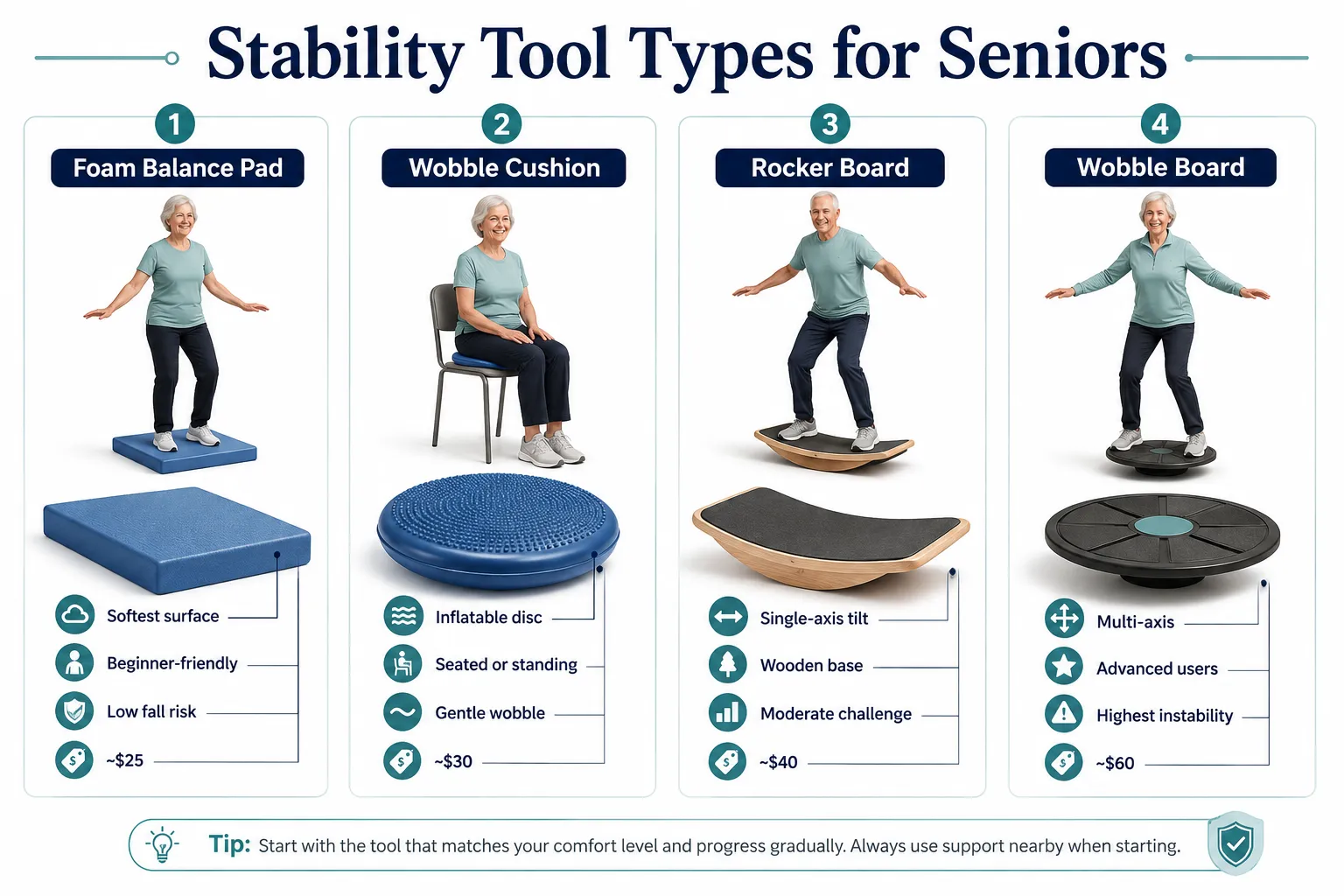
Types of stability tools covered in this guide:

Tool Instability level Best for Typical price
Foam balance pad Very low Beginners, arthritis, post-surgery $20,$35
Wobble cushion (disc) Low Seated core work, mild standing $25,$40
Rocker board (single-axis) Moderate Intermediate users $30,$55
Half-dome trainer (BOSU-type) Moderate, high Confident seniors $80,$130
Multi-axis wobble board High Advanced, no fall history $40,$70

Best Balance Boards for Seniors with Arthritis

For seniors with arthritis, the safest options are foam balance pads and inflatable wobble cushions, because they provide gentle instability without forcing sharp ankle or knee angles. A low-profile rocker board with a wide, non-slip surface is the next step up once joint pain is under control.

What to look for:

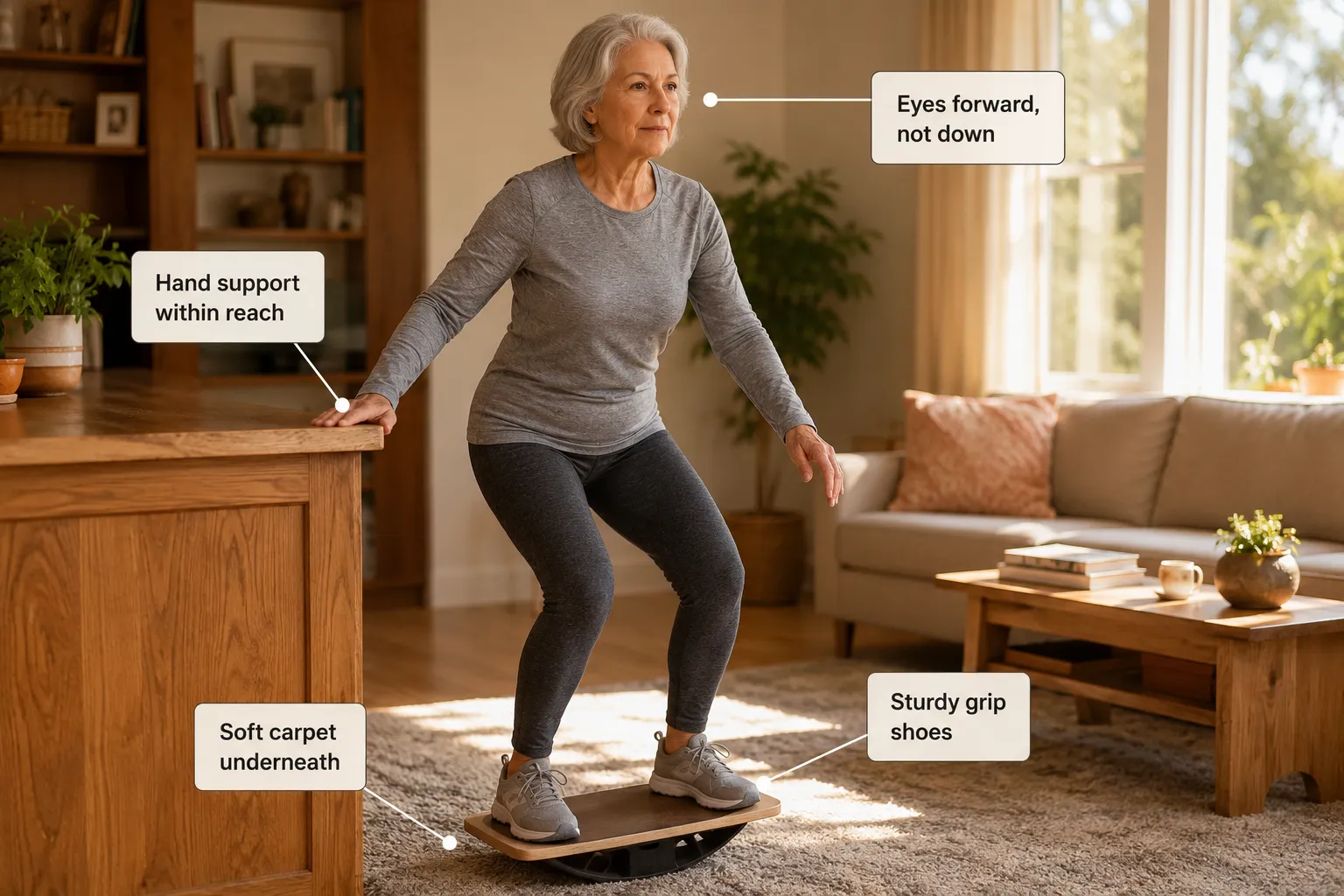
  • Wide platform (16 inches or more) so feet can sit shoulder-width apart
  • Low height (under 3 inches) to reduce the drop if balance is lost
  • Gentle curvature, steep rockers force painful ankle dorsiflexion
  • Non-slip textured top for bare or socked feet
  • Weight capacity clearly rated above your body weight

Avoid hard plastic multi-axis boards, small round wobble discs used standing, and any tool that requires deep knee bend to stabilize. Seated wobble-cushion work is an excellent arthritis-friendly starting point.[4][7]

Balance Board vs Stability Ball for Elderly Users

A balance board is generally safer and more practical than a stability ball for most older adults. Balance boards keep the feet on a stable floor and challenge ankle and hip stabilizers in a controlled range. Stability balls require sitting or lying on a large, rolling sphere, a setup with significantly higher fall risk for anyone with reduced grip strength, hip mobility, or reaction speed.

Use a balance board if the goal is standing balance and fall prevention. Use a stability ball only in seated form (as a chair alternative for core engagement) and only with a wall behind you or a chair frame around the ball. Never do bridges or supine exercises on a full-size stability ball without supervision.

How Often Should Older Adults Use Balance Boards?

Three sessions per week of 10 minutes each is the evidence-supported dose. A 2026 analysis of multi-axis Indo Balance Board training found this schedule produced significant Berg Balance Scale improvements in older adults.[9][10] A separate review recommends roughly 30-minute sessions 2 to 3 times weekly for at least 3 weeks to see measurable gains, aligning with American Geriatrics Society falls-prevention guidance.[10]

Sample weekly schedule:

  • Monday: 10 min balance board + 10 min chair squats
  • Wednesday: 10 min balance board + short walk
  • Friday: 10 min balance board + light resistance band work

Gains are typically maintained for at least three months after a structured program ends, but stopping entirely leads to gradual loss of balance improvements.[1][15]

Balance Board Exercises for Fall Prevention

Start every session near a countertop or sturdy chair. Do each exercise for 30 to 60 seconds, rest, and repeat two to three times.

  1. Two-foot static hold, stand on the board with feet shoulder-width, one hand on support, hold steady.
  2. Weight shifts, slowly rock side to side, then front to back, controlled.
  3. Mini squats, bend knees 15 to 20 degrees while keeping the board level.
  4. Single-hand support, progress from two hands to one hand to fingertip support.
  5. Head turns, while balanced, slowly turn head left and right to train vestibular integration.
  6. Heel-to-toe rock, deliberate small tilts to train ankle strategy.

Balance Board Exercises for Fall Prevention

Progression rule: advance only when the current exercise feels easy for a full week. Fall-prevention programs including wobble-board work have been associated with 23 to 28 percent lower fall risk when performed consistently.[5][3]

Can Balance Boards Help with Vertigo in Seniors?

Balance boards are generally not recommended as a self-treatment for active vertigo. Their intentionally unstable surface can worsen dizziness and increase fall risk in people with vestibular disorders.[2] Mayo Clinic-affiliated guidance is explicit: unstable-surface training may itself trigger falls in those with significant balance problems or dizziness.[2]

That said, a physical therapist may prescribe carefully progressed foam-pad exercises as part of vestibular rehabilitation once acute vertigo resolves. This should always be clinician-supervised, never self-directed. If you have BPPV, Meniere's, or unexplained dizzy spells, get medical clearance before touching any stability tool.[7]

Balance Boards for People with Limited Mobility

For seniors with limited mobility, seated stability training on a wobble cushion is the highest-value starting point. Place an inflatable disc on a sturdy dining chair and sit on it during daily activities, reading, meals, TV. This activates core stabilizers without any standing risk.

Options for limited mobility:

  • Wobble cushion on chair, passive core training, zero fall risk
  • Foam pad while holding parallel bars or a walker, supervised only
  • Seated foot-on-board work, sit in a chair, place feet on a rocker board, tilt slowly to train ankle mobility
  • Half-dome trainer flat side up, provides a slightly unstable but very controlled standing surface

A physical therapist can adapt any of these to wheelchair users or those recovering from hip or knee surgery.[13]

How Much Does a Good Balance Board Cost?

A quality senior-friendly balance board costs $30 to $70. Foam pads run $20 to $35, wobble cushions $25 to $40, rocker boards $30 to $55, and half-dome trainers $80 to $130. A complete home fall-prevention kit, foam pad, wobble cushion, half-dome trainer, and grab rail, typically totals $150 to $250.[14]

One 2026 industry analysis estimates such a kit can reduce fall risk by roughly 24 percent over 12 months when used at least 10 minutes daily, though this estimate reflects program outcomes rather than any single device.[14] Spending more than $100 on a single board rarely produces better outcomes for a senior beginner.

Are Balance Boards Safe for People Over 70?

Balance boards can be safe for people over 70, but only with the right tool, setup, and medical clearance. The Mayo Clinic notes the same instability that trains balance can also cause falls if misused.[2] A 2025 medical-alert advisory recommends consulting a physician or physical therapist first, avoiding boards after a recent fall, wearing sturdy shoes, and always training near a grab bar or countertop.[7]

Safety checklist before your first session:

  • Medical clearance obtained
  • Board placed on carpet or a non-slip mat
  • Sturdy countertop, chair back, or grab rail within arm's reach
  • Sturdy closed-toe shoes with grip soles
  • Someone else in the home during initial sessions
  • Session limited to 5 minutes on day one

Seniors with peripheral neuropathy, severe osteoporosis, or recent joint replacement should get therapist guidance before starting.[7]

Balance Board Alternatives for Seniors

Not every older adult needs, or should use, a balance board. Effective alternatives include:

  • Tai chi, strong evidence for fall reduction, no equipment needed
  • Standing yoga, chair-supported variations are widely accessible
  • Heel-to-toe walking along a hallway with wall support
  • Single-leg stands at a kitchen counter
  • Resistance band lower-body work, builds the strength that balance depends on
  • Aquatic exercise, low-fall-risk environment with resistance

The strongest evidence for fall prevention supports multicomponent programs combining strength, aerobic exercise, and balance challenge, not any single tool.[3]

Do Balance Boards Actually Prevent Falls?

Yes, when used in structured programs, but not on their own. Peer-reviewed evidence shows 4 to 9 week balance-board programs improve standing balance, functional mobility, and Timed Up and Go scores in older adults.[1][13][15] Fall-prevention programs incorporating wobble-board training report roughly 23 to 28 percent lower fall risk with consistent use.[5][3]

However, the most reliable falls-prevention effect comes from multicomponent training, strength, aerobic work, and proprioceptive challenge together.[3] A balance board alone, used sporadically, produces modest gains. A balance board used three times weekly alongside squats, walking, and resistance work produces measurable fall-risk reduction.

Best Balance Boards for Small Spaces

A round wobble cushion or a 15-inch square foam pad works in any room and stores under a couch. Rocker boards with a 16 to 18 inch footprint fit beside most dining chairs. Avoid large half-dome trainers (24 inches or wider) if floor space is tight.

Space-saving picks:

  • Inflatable wobble disc, 14 inches, deflates for travel
  • Square foam pad, stacks flat against a wall
  • Wooden rocker board, 17 x 6 inches, stores vertically
  • Small round pivot board, 15 inch diameter, but higher instability

Train in a doorway or beside a kitchen counter to combine hand support with a small footprint.

Balance Board Training Programs for Older Adults

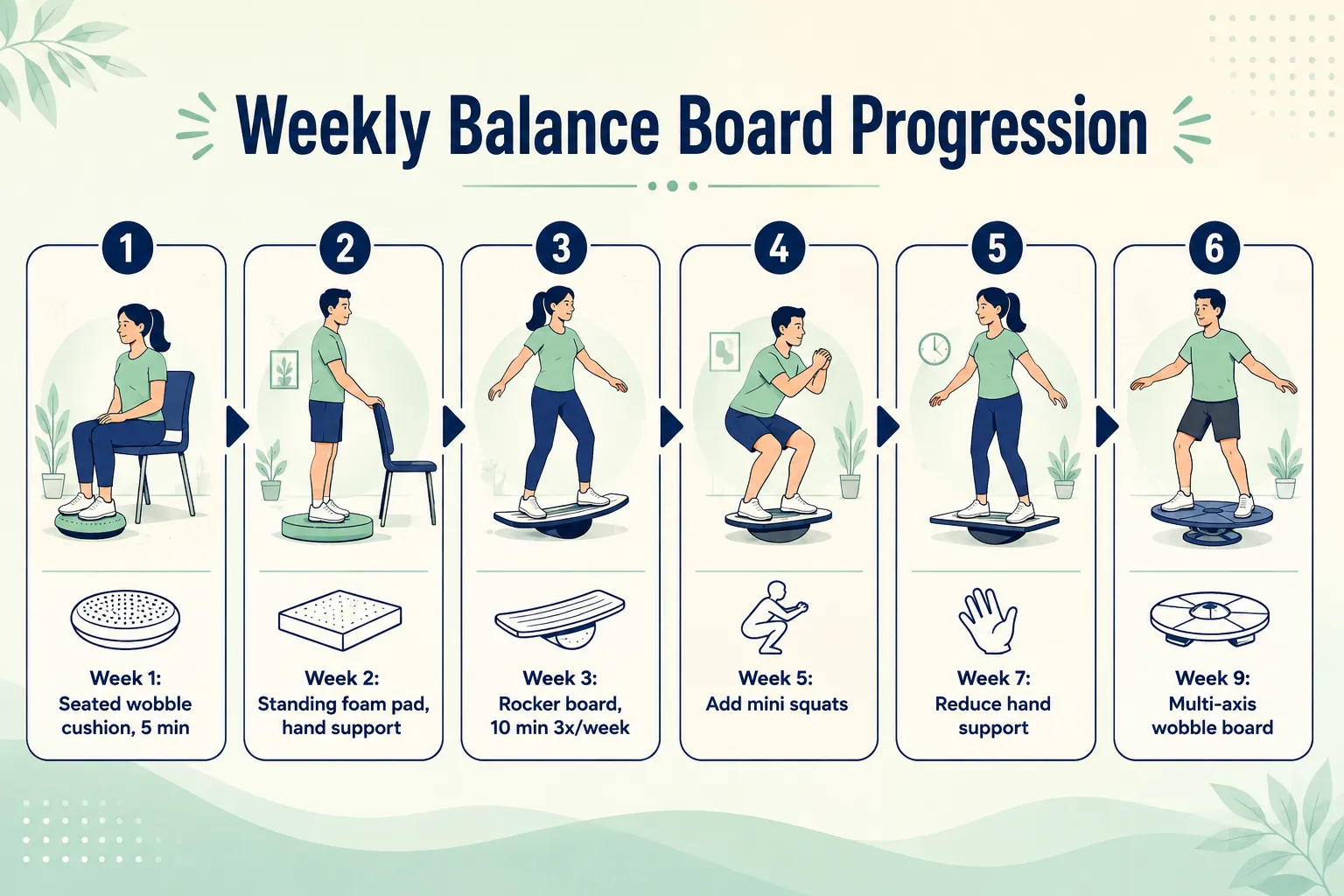
A structured program beats random practice. Below is an evidence-informed 9-week progression combining findings from wobble-board and multi-axis balance research.[1][9][10][13]

Balance Board Training Programs for Older Adults

Weeks 1-2: Seated wobble cushion, 5 minutes daily. Standing foam pad with two-hand support, 3 min, 3x/week.

Weeks 3-4: Rocker board with two-hand support, 10 min, 3x/week. Add slow weight shifts.

Weeks 5-6: Rocker board with one-hand support. Add mini squats and head turns.

Weeks 7-8: Reduce to fingertip support. Introduce 30-second single-leg attempts on a foam pad.

Week 9+: Consider a multi-axis board only if all prior weeks felt controlled. Continue 3x/week indefinitely, gains regress if training stops.[1][15]

Community centers, senior fitness classes, and physiotherapy clinics increasingly offer supervised versions of these programs.[6][15]

What to Avoid When Using a Balance Board as a Senior

The instability that makes a balance board effective is the same instability that can cause a serious fall. Respect the tool.

Avoid these mistakes:

  • Training alone during the first two weeks, have someone nearby
  • Barefoot on slippery hardwood, always use grip or a mat
  • Skipping hand support too early, progress support reduction over weeks
  • Long sessions, more than 15 minutes increases fatigue-related falls
  • Multi-axis boards as a beginner, start with foam or rocker
  • Training when tired, dizzy, or on new medication, postpone
  • Ignoring pain, sharp knee, hip, or ankle pain means stop
  • Using the board on stairs or near sharp furniture edges

Never use a balance board within 48 hours of a fall, and get clearance from a physician before restarting.[7]

Frequently Asked Questions

Can I use a balance board if I use a cane?
Only with therapist guidance. Cane users typically start with seated wobble-cushion work rather than standing on a board.[7]

How long until I see improvement?
Peer-reviewed programs show measurable gains at 4 to 9 weeks with 3 sessions per week.[1][13]

Should I close my eyes on the board?
Not as a beginner. Eyes-closed training is an advanced progression that should only be attempted with full hand support and after weeks of stable practice.

Are cheap balance boards safe?
Look for a weight rating well above your body weight, a non-slip surface, and a wide base. Inexpensive foam pads and rocker boards from reputable brands are generally safe.[11]

Can balance boards help after a hip replacement?
Only under a physical therapist's direction, and typically not within the first several months post-surgery.[7]

Do I need shoes on the board?
Sturdy closed-toe shoes with grip soles are recommended for standing work. Bare feet may be acceptable on foam pads with therapist approval.[5]

Will a balance board help with knee pain?
It can strengthen supporting muscles, but active knee pain should be evaluated first. Start with seated or very stable options.[4]

Is a BOSU ball better than a balance board?
Not for beginners. Half-dome trainers are moderately unstable and better suited to confident, mobile seniors. Start with a foam pad or rocker.

Can I use a balance board daily?
Yes, in short sessions. Most evidence supports 3 dedicated training days weekly, with light seated wobble-cushion use on other days.[9][10]

What if I feel dizzy on the board?
Stop immediately, sit down, and don't retry that day. Persistent dizziness needs medical evaluation before continuing.[2]

Conclusion

Balance boards and stability tools work, but only when matched to ability level and used consistently within a structured plan. Start with a foam pad or wobble cushion, train three times per week for 10 minutes near a countertop, and progress to a rocker board only when the basics feel controlled. Pair balance work with strength training and walking, get medical clearance if you have any fall history or vestibular issues, and treat every session with the respect an intentionally unstable device deserves.

Your next steps:

  1. Talk with your physician or physical therapist this week
  2. Order a low-profile foam pad or wobble cushion (under $40)
  3. Set up a safe training spot near a countertop or sturdy chair
  4. Follow the 9-week progression, three sessions per week
  5. Re-evaluate at week 4 and week 9 with your Timed Up and Go time or Berg score

Balance is trainable at any age. The tools are inexpensive, the time commitment is small, and the payoff, staying on your feet, independent, and mobile, is enormous.

References

[1] Balance Board Seniors Fall Prevention – https://www.bellenae.com/blogs/news/balance-board-seniors-fall-prevention
[2] Maintaining Equilibrium: The Benefits of Balance Boards – https://mcpress.mayoclinic.org/nutrition-fitness/maintaining-equilibrium-the-benefits-of-balance-boards/
[3] Physical Activity Programs for Balance and Fall Prevention in Elderly – https://pmc.ncbi.nlm.nih.gov/articles/PMC6635278/
[4] Balance Board For Seniors – https://neverleavetheplayground.com/balance-board-for-seniors/
[5] Fall Prevention Exercises – https://slides.neverleavetheplayground.com/fall-prevention-exercises.html
[6] Balance Boards For Seniors: A Fun And Effective Way To Improve Stability – https://fallpreventionfoundation.org/2025/02/07/balance-boards-for-seniors-a-fun-and-effective-way-to-improve-stability/
[7] Balance Boards For Seniors: Can They Reduce Fall Risk – https://www.medicalalertadvice.com/articles/balance-boards-for-seniors-can-they-reduce-fall-risk/
[8] Wobble-board training in older adults – https://pubmed.ncbi.nlm.nih.gov/10470668/
[9] Indo Balance Board Program in Older Adults – https://pmc.ncbi.nlm.nih.gov/articles/PMC6189151/
[10] Wobble-Board Training in Older Adults: Review – https://www.tandfonline.com/doi/full/10.1080/10833196.2021.1987042

Core Strength and Balance Flow Sessions at Home to Boost Mobility and Prevent Falls

Core Strength and Balance Flow Sessions at Home to Boost Mobility and Prevent Falls

Last updated: August 1, 2026

Quick Answer

Quick Answer

Core strength and balance flow sessions at home to boost mobility and prevent falls combine gentle abdominal and hip work with slow, connected movement patterns borrowed from yoga, tai chi, and Pilates. Done 2-4 times a week for 20-30 minutes, this style of training has been shown in multiple clinical reviews (including the Cochrane 2019 falls-prevention meta-analysis) to cut fall risk in older adults by roughly 20-30%. No gym required, just a sturdy chair, a mat, and a wall.

Key Takeaways

  • Frequency matters more than intensity. Three sessions a week for 12 weeks is the sweet spot most research points to.
  • Flow beats isolated reps. Linking movements (like a cat-cow into a bird-dog into a side plank) trains the nervous system to react, which is what actually prevents falls.
  • A chair is the single most important tool. It doubles as support, a prop, and a resistance anchor.
  • Core weakness shows up as poor posture, back pain, and difficulty rising from a chair, not just a soft belly.
  • Static balance (holding still) and dynamic balance (moving through space) are different skills. You need both.
  • Younger adults benefit too. Balance flow work restores mobility lost to desk jobs and reduces injury risk in sport.
  • Most people notice improvements in 2-4 weeks; measurable fall-risk reduction typically appears by week 8-12.
  • You do not need a trainer to start, but a one-time video assessment can catch bad form early.

What is core strength and balance training, and why does it prevent falls?

Core strength and balance training is a category of exercise that strengthens the muscles wrapping your trunk, hips, and pelvis, while simultaneously challenging your body's ability to sense and correct its position in space. It prevents falls because most falls happen when the body loses balance mid-movement (stepping off a curb, turning quickly, reaching for something) and the core is too slow or too weak to catch the shift.

Three systems keep you upright: your inner ear (vestibular), your eyes (visual), and your body's position sensors (proprioceptive). Balance flow sessions train all three at once. When you slowly transition from a standing pose to a lunge with your eyes tracking your hand, you're forcing those systems to talk to each other, the exact skill that fails during a real-world stumble.

The core isn't just abs. It's the diaphragm on top, pelvic floor on the bottom, and deep abdominal and back muscles wrapping around like a corset. Weakness anywhere in this cylinder makes balance harder.

How often should I do balance and core exercises to see results?

Aim for 2-4 sessions per week, 20-30 minutes each, for at least 12 weeks. Research on older adults consistently shows this is the minimum "dose" needed to reduce fall risk meaningfully. Fewer than two sessions a week produces mood benefits but limited physical change.

A realistic weekly template:

Day Session Length
Monday Core + slow balance flow 25 min
Wednesday Tai-chi-inspired dynamic flow 20 min
Friday Pilates-based core + wall balance 30 min
Optional Sun Gentle mobility walk-through 15 min

Choose more frequency (4x) if: you're recovering from a fall, have osteoporosis, or are over 70.
Choose less (2x) if: you're active in other sports and using this as maintenance.

Best core strength exercises for seniors at home

The best exercises are low-impact, chair-optional, and build from stable to unstable positions. Start with these five:

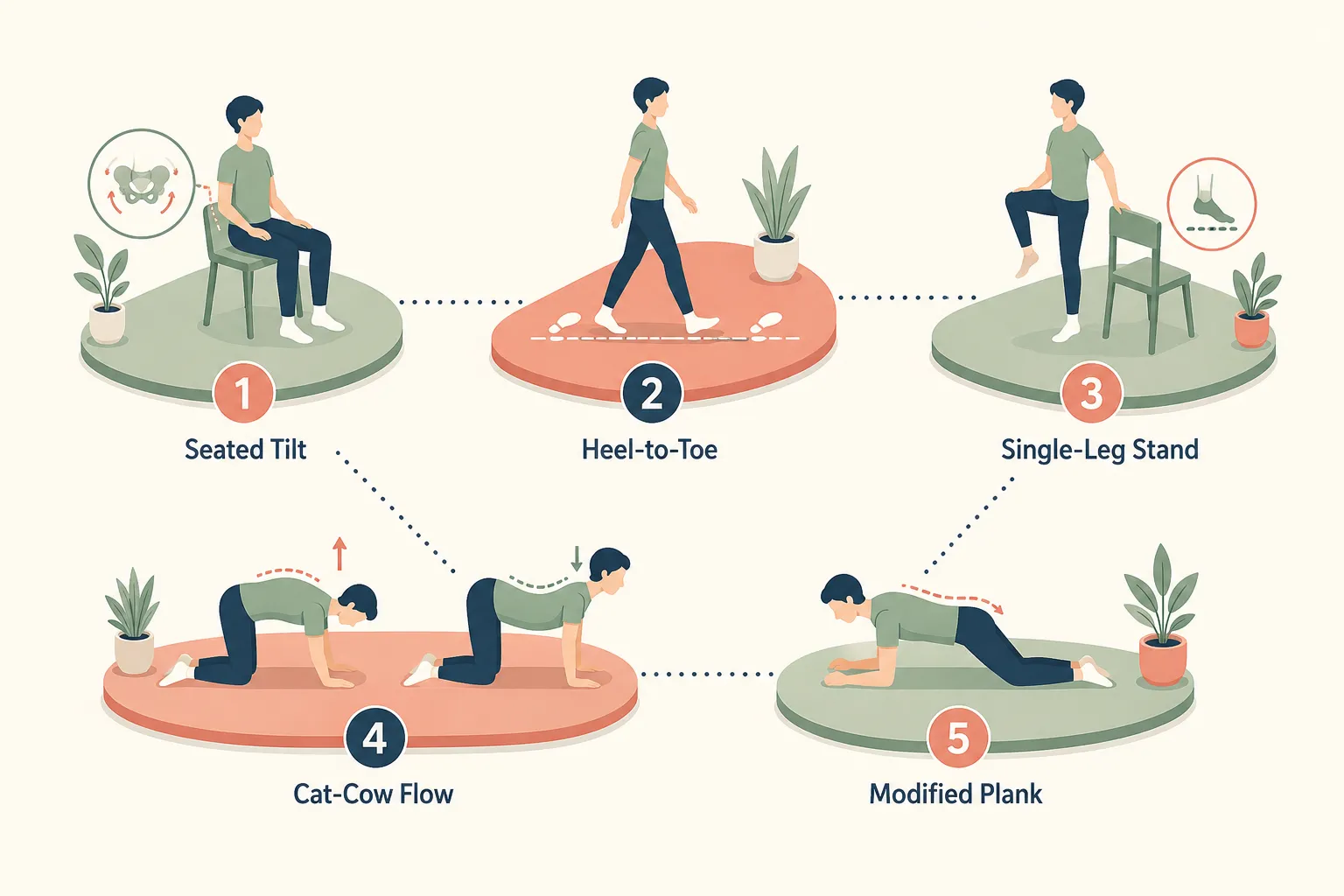
  1. Seated pelvic tilts, Sit tall, rock the pelvis forward and back 10 times. Wakes up the deep abdominal wall.
  2. Modified dead bug, Lie on your back, knees bent at 90°, lower one heel to tap the floor, alternate. 8 per side.
  3. Bird-dog (from hands and knees), Extend opposite arm and leg, hold 3 seconds. 6 per side.
  4. Standing marches with chair support, Lift knee to hip height, pause, lower. 10 per side.
  5. Wall sit with breath focus, Slide down a wall to a shallow squat, hold 20-30 seconds while breathing slowly.

)

The trick with older adults: quality over quantity. Six slow, focused reps beat twenty sloppy ones every time.

Can balance training really prevent falls, or does it just help with stability?

Yes, it genuinely prevents falls, not just stability in the moment. The Cochrane systematic review of exercise for fall prevention (Sherrington et al., 2019) analyzed over 100 trials and found that balance and functional training reduced the rate of falls by about 24% in community-dwelling older adults. Tai chi specifically showed roughly a 20% reduction.

The mechanism isn't just stronger legs. Balance flow work:

  • Sharpens reaction time in the ankles and hips (the "ankle strategy" and "hip strategy" your brain uses to catch a stumble).
  • Improves proprioception, your unconscious sense of where your limbs are.
  • Reduces fear of falling, which itself is a major fall predictor. Fearful walkers shuffle, and shuffling causes falls.

Common mistake: People assume walking is enough. It isn't. Walking is linear and predictable; falls happen in unpredictable moments. You need training that mimics the chaos.

What equipment do I need for home balance and core workouts?

What equipment do I need for home balance and core workouts?

Very little. The five essentials:

  • A sturdy, non-rolling chair (dining chair, not office chair)
  • A yoga mat with grip
  • A clear wall space at least 4 feet wide
  • Comfortable, snug clothing (loose pants can trip you)
  • Bare feet or thin, flexible shoes, cushioned running shoes actually reduce balance feedback

Optional upgrades once you're 4-6 weeks in:

  • Balance pad or folded towel ($15-30) for unstable surface training
  • Resistance loop bands ($10) for hip strength
  • Light dumbbells (2-5 lb) for added core load

Skip: BOSU balls, wobble boards, and vibrating plates until you have a solid base. They're not beginner tools despite the marketing.

How long should a core and balance session be?

Twenty to thirty minutes is the sweet spot for most home practitioners. Shorter than 15 minutes and you can't cover warm-up, main work, and cool-down properly. Longer than 40 minutes and fatigue leads to sloppy form, which is when injuries happen.

A well-built session:

  • 5 minutes warm-up: joint circles, gentle spinal rolls, breath work
  • 10-15 minutes main flow: core activation → static balance → dynamic balance flow
  • 5 minutes cool-down: stretching, floor work, breathing

If you only have 10 minutes, keep the warm-up and cut the main flow in half. Never skip the warm-up before balance work.

Is balance training safe if I already have balance problems?

Yes, but start seated and near support. People with existing balance issues benefit the most from this training, they just need to scale entry appropriately.

Safe-start rules:

  1. First 2 weeks: do everything seated or with two hands on a chair back.
  2. Weeks 3-4: progress to one hand on chair.
  3. Weeks 5+: fingertips only, then hover, then hands free.

Talk to a doctor first if you have: recent surgery, uncontrolled vertigo, severe osteoporosis, Parkinson's-related instability, or you've fallen more than twice in the past year. A physical therapist can screen you and clear you for home practice.

Edge case: If you have inner ear disorders (BPPV, Meniere's), certain head-turning movements can trigger dizziness. Modify by keeping the gaze forward and moving slowly.

Static balance exercises vs. dynamic balance flow, what's the difference?

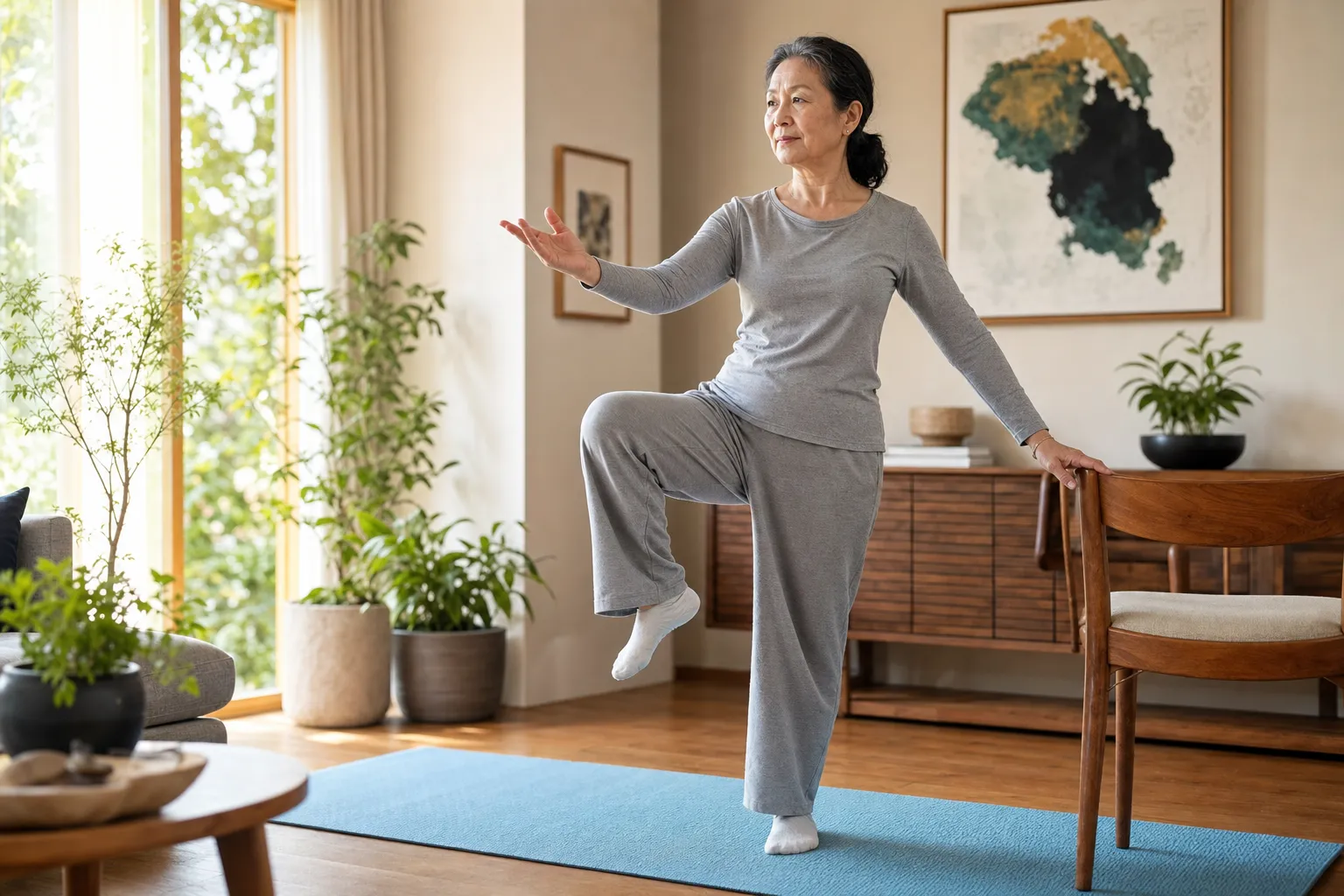
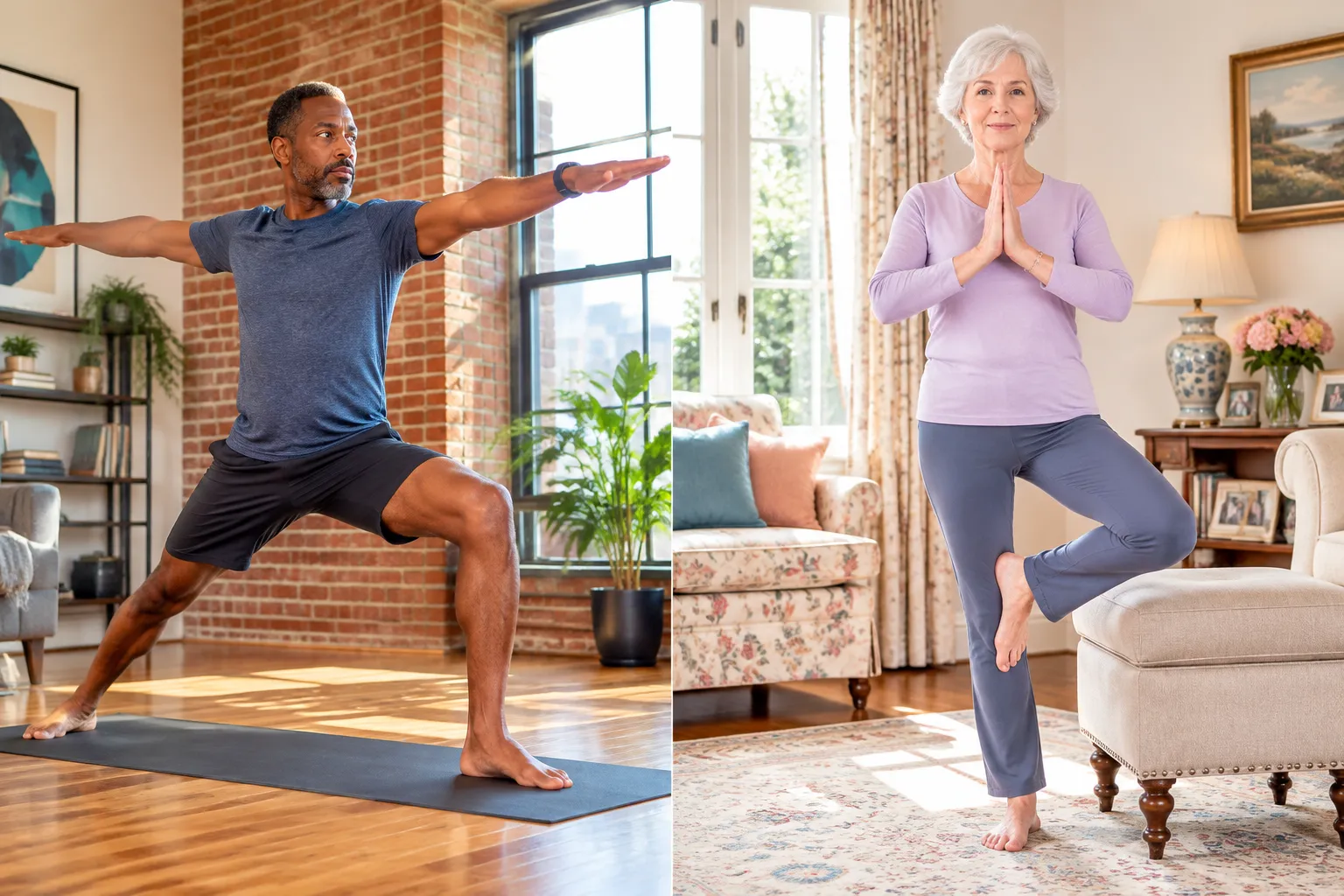
Static balance is holding still, standing on one foot, tree pose, a plank. Dynamic balance is maintaining control while moving, walking heel-to-toe, transitioning between yoga poses, tai chi weight shifts. You need both, but dynamic balance flow is what most closely mimics real-life fall situations.

Static Balance Dynamic Balance Flow
What it trains Postural muscles, endurance Reaction, coordination
Example Tree pose, single-leg stand Tai chi form, sun salutation
Best for Beginners, foundation Real-world fall prevention
Time to master 2-3 weeks 6-12 weeks

Rule of thumb: Spend the first month mostly static. Layer in dynamic flow once you can hold single-leg stands for 20 seconds without wobbling.

Online balance classes vs. in-person: what's the cost difference?

Online core and balance classes typically run $10-30 per month for unlimited access (SilverSneakers On-Demand, Yoga with Adriene's free library, GetActive, Bold, Nymbl). In-person classes at a studio or Y average $15-25 per class or $80-150 per month for unlimited. Physical therapy sessions run $75-200 each but often include insurance coverage.

)

Choose online if: you're self-motivated, have basic fitness experience, and want flexibility.
Choose in-person if: you need accountability, have specific medical concerns, or benefit from social exercise.
Choose PT (at least short-term) if: you've fallen recently or have a diagnosed condition. Get cleared first, then transition to home practice.

Can younger people benefit from balance flow, or is it just for older adults?

Can younger people benefit from balance flow, or is it just for older adults?

Balance flow benefits every age, it's marketed to seniors because they're the group with the highest fall risk, but adults in their 20s, 50s often have surprisingly poor balance from sedentary jobs. If you can't stand on one foot with eyes closed for 10 seconds, you're behind the curve.

For younger adults, balance flow specifically helps:

  • Runners and cyclists, improves single-leg stability, reduces knee and ankle injuries
  • Desk workers, reverses hip and thoracic stiffness
  • Parents, restores the core control lost during pregnancy or from years of one-sided carrying
  • Recreational athletes, sharpens agility and reaction time

The training just scales up: faster flows, less support, more single-leg work, added load.

How do I know if my core is weak and needs work?

Try these four quick self-tests. Struggling with two or more means your core needs attention:

  1. Sit-to-stand test: Rise from a chair without using your hands. Can you do it 5 times in under 15 seconds?
  2. Single-leg stand: Balance on one foot with eyes open. Under 20 seconds is a red flag if you're under 65.
  3. Plank hold: Forearm plank with a straight line from head to heels. Under 30 seconds signals weakness.
  4. Bend-and-reach: Bend to touch your toes and stand back up. Does your low back hurt or do you feel unstable?

Other signs: chronic low back pain, poor posture when tired, difficulty carrying groceries up stairs, needing hands to push off your thighs when standing.

What mistakes do people make starting balance training at home?

The five most common errors:

  1. Skipping the warm-up. Cold joints plus balance work equals sprained ankles. Always do 3-5 minutes of joint circles first.
  2. Progressing too fast. People see quick early gains and jump to advanced moves. The nervous system needs 4-6 weeks to consolidate before adding challenge.
  3. Holding the breath. Balance requires oxygen to the brain. Breath-holding is a top cause of dizziness during practice.
  4. Practicing on carpet. Deep pile carpet actually makes balance too unstable for beginners. Firm floor with a mat is better.
  5. Only training in one direction. Everyone does forward lunges and forgets side and rotational movement, but most real falls involve twisting or lateral shifts.

Do I need a trainer, or can I do core and balance flow on my own?

Most healthy adults can do this on their own using video classes and structured programs. But one or two sessions with a qualified trainer or physical therapist at the start will catch form errors that would otherwise become injuries or plateaus.

Consider a professional if:

  • You've fallen in the past year
  • You have osteoporosis, arthritis, or a joint replacement
  • You're recovering from surgery or a stroke
  • You feel dizzy or unstable doing basic moves
  • You've been sedentary for over a year

Otherwise, well-structured video programs from certified instructors (look for CPT, PT, or E-RYT credentials) work well. YouTube channels focused on senior fitness, Pilates, and gentle yoga are legitimate starting points.

How quickly will I notice improvements in mobility and balance?

Week 1-2: You'll feel more aware of your body. Balance itself may not improve yet, but posture usually does.
Week 3-4: Single-leg stands get noticeably steadier. Getting out of chairs feels easier.
Week 6-8: Mobility improvements become obvious, reaching, turning, and stair-climbing feel smoother.
Week 8-12: Measurable fall-risk reduction appears in objective tests (Berg Balance Scale, Timed Up and Go).
Week 12+: Gains consolidate. Stopping now means losing progress within 4-6 weeks.

The key: consistency beats intensity. Three 20-minute sessions a week for 12 weeks outperforms one 90-minute weekend session.

FAQ

Q: Can I do balance flow if I use a cane or walker?
A: Yes. Start entirely seated, then progress to standing with two hands on a sturdy surface. Many chair yoga and seated tai chi programs are designed exactly for this.

Q: Will core work flatten my belly?
A: It may improve posture and reduce the visual "pooch" from weak deep abdominals, but visible fat loss requires nutrition changes. Core training is for function first, aesthetics second.

Q: Is yoga or tai chi better for fall prevention?
A: Tai chi has more direct fall-prevention research behind it. Yoga builds more strength and flexibility. A blended flow session gets the best of both.

Q: Can I do this if I have knee pain?
A: Yes, with modifications. Avoid deep squats and kneeling positions; substitute chair-based versions. Knee pain often improves as hip and core strength develop.

Q: What time of day is best?
A: Morning for most people, joints warm up during the session and you gain balance benefits throughout the day. Avoid right before bed if practice energizes you.

Q: Do I need to warm up if the flow is already gentle?
A: Yes. Even gentle balance work challenges the nervous system, and cold muscles react slowly. Five minutes of joint circles is non-negotiable.

Q: Can I combine this with strength training?
A: Absolutely. Do balance flow on strength-training rest days, or as a 10-minute warm-up before lifting.

Q: Will I feel sore?
A: Mild soreness in the deep abdominals, hips, and small stabilizer muscles is normal for the first 2 weeks. Sharp pain is not.

Conclusion: Your Next Steps

Start this week. Not with a 90-minute masterclass, but with one 20-minute session. Set a chair on your mat, watch a beginner-level balance flow video, and commit to three sessions this week.

Concrete action plan:

  1. Today: Do the four self-assessment tests. Write down your numbers.
  2. This week: Complete three 20-minute sessions. Any beginner tai chi, chair yoga, or Pilates fundamentals video works.
  3. Week 2-4: Add one new balance challenge per week (eyes closed briefly, one hand off the chair, a longer hold).
  4. Week 6: Retest yourself. Compare to week 1.
  5. Week 12: Reassess. Adjust your program based on what improved most.

Core strength and balance flow sessions at home to boost mobility and prevent falls aren't a quick fix, they're a lifelong maintenance practice, like brushing your teeth. Twenty minutes, three times a week, for the rest of your life is the actual prescription. The payoff, staying independent, mobile, and unafraid of falling, is worth every session.

Healthspan vs. Lifespan: Strength and Mobility Training After 50 to Stay Independent Longer

Healthspan vs. Lifespan: Strength and Mobility Training After 50 to Stay Independent Longer

Last updated: July 26, 2026

Editorial landscape split-screen conceptual illustration contrasting 'healthspan' and 'lifespan': left side shows a vibrant

Quick Answer

Lifespan is how long you live. Healthspan is how long you live well, without disability or dependence. After 50, the fastest way to widen the gap in your favor is progressive strength training two to three days per week, paired with daily mobility work. Recent 2026 guidance calls resistance training "mandatory" for healthspan, with a sweet spot of roughly 90-120 minutes per week [2][7].

Key Takeaways

  • Lifespan measures years lived. Healthspan measures years lived independently, and the two can differ by a decade or more.
  • Strength training is the single biggest lever for preserving independence after 50, according to 2026 fitness and longevity research [2][7].
  • Aim for 90-120 minutes of strength work per week, split across 2-3 sessions, plus 150 minutes of moderate cardio [7][10].
  • Sarcopenia (age-related muscle loss) begins in your 30s and accelerates after 60, resistance training is the proven counter [8].
  • Mobility work daily, even 10 minutes, protects joints and prevents the stiffness that leads to falls.
  • Falls are the leading cause of injury death in adults over 65, and balance-focused training cuts fall risk meaningfully [4].
  • It's not too late at 60, 70, or 80, muscle responds to training at every age studied [5].
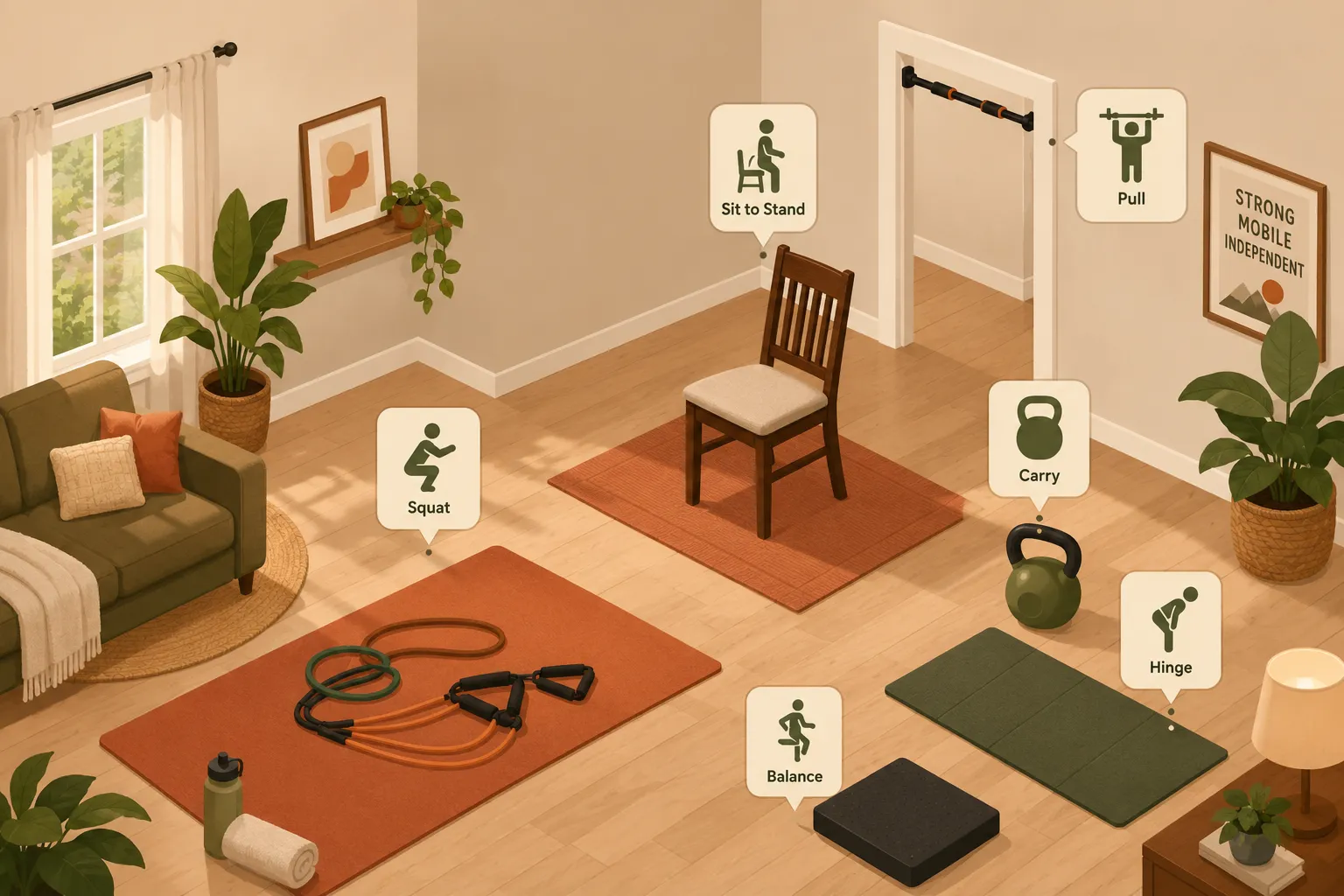
  • Functional, daily-life movements (squat, hinge, carry, push, pull, rotate) matter more than machines.

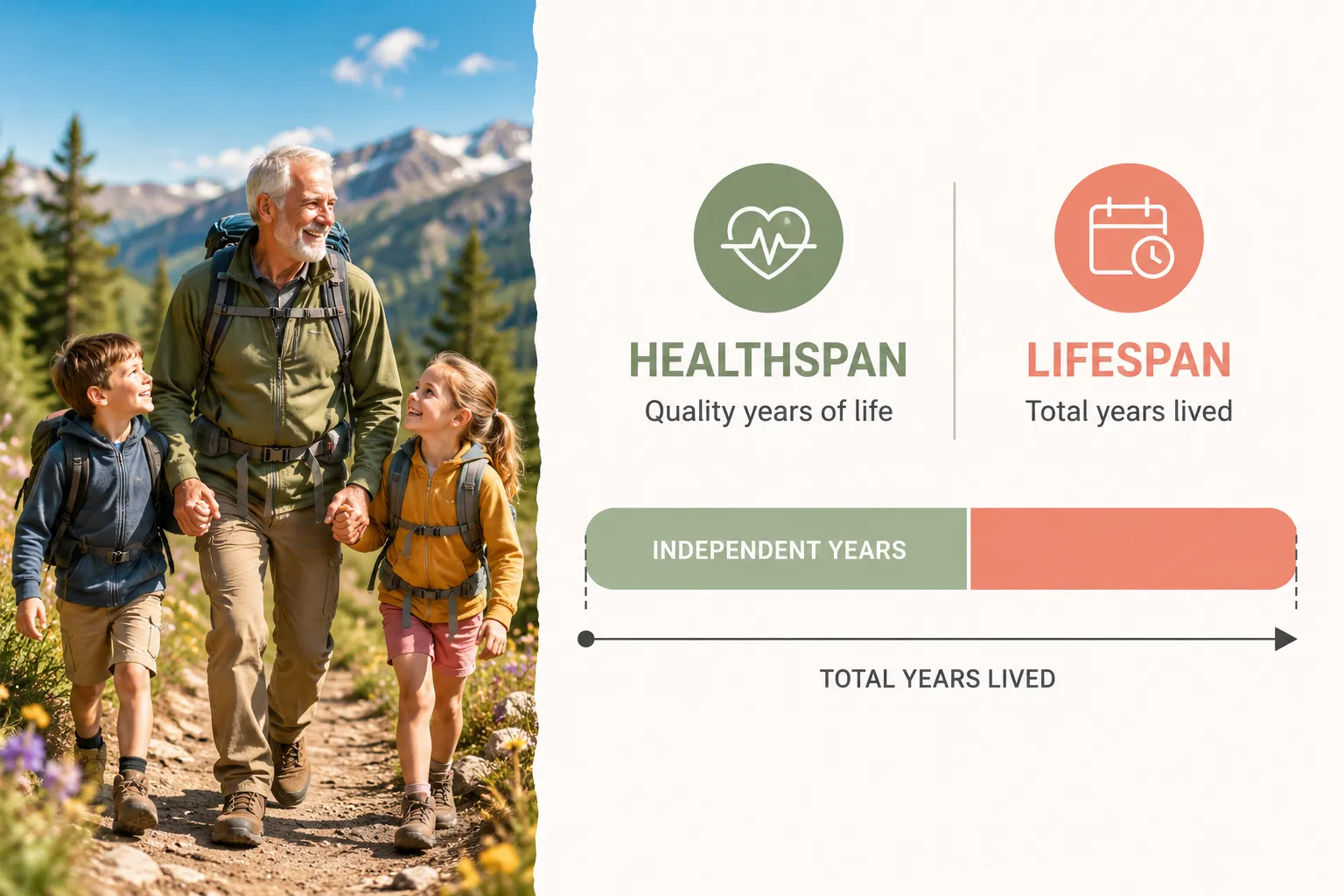
What's the difference between healthspan and lifespan?

Lifespan is the total number of years you live. Healthspan is the number of those years spent in good health, mobile, cognitively sharp, and independent. In the U.S., the average person lives roughly 10 years longer than they stay healthy, meaning the last decade often involves disability, chronic disease, or loss of independence [1].

The goal of training after 50 isn't to add years to the end of life. It's to compress the frail years down to as few as possible. Strength and mobility work is the most reliable tool for doing that [2].

Quick example: Two 55-year-olds both live to 85. One spends the last 12 years using a walker, dependent on family. The other hikes with grandkids until 82 and lives alone comfortably until the end. Same lifespan. Very different healthspan.

Why is strength training important after 50?

Because muscle is the organ of independence. After 50, adults lose roughly 1-2% of muscle mass per year and up to 3% of strength annually if they don't train, a condition called sarcopenia [8]. Weak muscles mean weaker bones, worse balance, slower metabolism, and a higher risk of falls, fractures, and hospitalization.

Resistance training reverses much of this. It's the only intervention that consistently rebuilds muscle, improves bone density, and preserves the fast-twitch fibers you need to catch yourself when you trip [5][8]. In 2026 healthspan guidance, strength training moved from "recommended" to "mandatory", treated the same way clinicians treat blood pressure control [2][7].

What strength training protects:

  • Muscle mass and power (power fades faster than strength and matters more for falls)
  • Bone density, reducing fracture risk
  • Insulin sensitivity and metabolic health
  • Cognitive function, through myokines released during exercise
  • Confidence, knowing your body can handle stairs, groceries, and grandkids

How much strength and mobility training do you need to stay independent?

The current sweet spot from 2026 longevity research is 90-120 minutes of strength training per week, spread across 2-3 sessions, plus 150 minutes of moderate cardio and daily mobility work of 10-15 minutes [7][10]. International guidelines for older adults align: at least two strength sessions per week that hit all major muscle groups, plus balance work [10].

A realistic weekly template:

Day Focus Time
Monday Full-body strength 40 min
Tuesday Walk + mobility 30 + 10 min
Wednesday Rest or easy walk 20 min
Thursday Full-body strength 40 min
Friday Walk + balance work 30 + 10 min
Saturday Optional third strength or hike 30-60 min
Sunday Mobility and stretch 15 min

You don't need a gym. A single kettlebell, a set of resistance bands, a sturdy chair, and floor space are enough to run this program for years.

How much strength and mobility training do you need to stay independent?

Can you improve healthspan at 60, or is it too late?

It's not too late. Studies of adults starting resistance training in their 60s, 70s, and even 90s show meaningful gains in muscle mass, strength, walking speed, and stair-climbing ability within 8-12 weeks [4][5]. The relative gains are often larger in older beginners than in younger trained people, because there's more room to improve.

The honest caveat: progress is slower, recovery takes longer, and injury risk is higher if you skip the ramp-up. Start light, add load gradually, and prioritize form over weight for the first two to three months.

Decision rule: If you can stand up from a chair without using your hands, you have enough baseline strength to start a beginner program at home. If you can't, start with sit-to-stands from a higher surface and build from there.

What exercises prevent falls in older adults?

Falls are prevented by a mix of lower-body strength, single-leg balance, and reactive power, the ability to move fast when you stumble. The exercises with the strongest evidence for fall prevention include:

  1. Sit-to-stand from a chair, trains the hip and thigh muscles you use every day
  2. Step-ups onto a low box or bottom stair, builds single-leg strength
  3. Farmer's carries (walking with weights in each hand), trains grip, core, and gait stability
  4. Single-leg balance holds, 30 seconds per leg, progress to eyes closed
  5. Heel-to-toe walking in a straight line
  6. Tai chi or slow controlled squats, proven to reduce fall rates in randomized trials [4]
  7. Loaded hip hinges (deadlifts with light weight), trains the posterior chain that catches you when you trip

Aim to include at least one balance-focused movement in every session.

Healthspan training vs. regular gym workouts for seniors

Healthspan training is built around functional movement patterns you use in daily life: squatting to a chair, hinging to pick something up, carrying groceries, pushing a door open, pulling yourself out of a pool. Regular gym workouts often isolate muscles on machines, bicep curls, leg extensions, seated chest press, which build size but transfer poorly to real life [7].

Choose healthspan-style training if you want to: stay independent, prevent falls, keep hiking or gardening, play with grandchildren, and reduce injury risk.

Choose bodybuilding-style training if you want to: maximize muscle size, look a certain way, or compete.

The two overlap, but the emphasis matters. A 70-year-old who can deadlift a suitcase, carry it up stairs, and get down to the floor and back up has more functional capacity than one with big arms and a sore back.

How often should you do strength and mobility work after 50?

Strength: 2-3 sessions per week, with at least 48 hours between sessions targeting the same muscles. Mobility: daily, in short 10-minute doses [7][10]. More isn't better once you cross about 150 minutes of strength work per week, recovery becomes the bottleneck [7].

A simple minimum-effective-dose plan:

  • Two 30-minute strength sessions per week (full body)
  • Ten minutes of mobility on non-lifting days
  • One longer walk or hike on the weekend
  • Five to ten minutes of balance work sprinkled through the week

That's under three hours total. It's enough to meaningfully shift your healthspan trajectory.

What happens if you don't train for strength and mobility as you age?

You lose muscle, bone, and balance on a predictable timeline. By 80, an untrained adult has typically lost 30-40% of the muscle mass they had at 30, and grip strength drops in parallel with overall mortality risk [8][9]. The functional consequences:

  • Difficulty rising from a chair or toilet without assistance
  • Higher fall risk, one in four adults over 65 falls each year [4]
  • Loss of driving independence as reaction time and neck mobility decline
  • Hospitalizations after minor injuries that a stronger body would shrug off
  • Cognitive decline accelerates in parallel with physical decline

None of this is inevitable. It's the default trajectory without training. Resistance work bends the curve.

"Muscle is the currency of aging. Spend it wisely, and you buy back years of independence.", a summary of the current healthspan consensus [2][7]

Is healthspan training safe if you have arthritis or joint pain?

Yes, and it's often the best thing you can do for joint pain. Strength training reduces arthritis symptoms by building the muscle that supports and stabilizes the joint [5]. The key is smart programming: pain-free range of motion, gradual loading, and choosing exercises that don't aggravate the specific joint.

Arthritis-friendly swaps:

  • Painful squats → box squats to a higher surface, or wall sits
  • Painful overhead press → landmine press at an angle
  • Painful running → cycling, swimming, or fast walking
  • Painful floor work → standing or elevated variations

When to consult a professional first: recent joint replacement, active flare, unexplained pain, uncontrolled blood pressure, or any cardiac symptoms. A physical therapist or a certified trainer with older-adult experience can adapt any program.

Best mobility exercises for people over 50 at home

Mobility work restores the range of motion that stiffens with age and desk work. These seven movements cover the biggest problem areas and take under 10 minutes:

  1. Cat-cow, 8 slow reps, spine flexion and extension
  2. World's greatest stretch, 3 per side, hips and thoracic spine
  3. 90/90 hip switches, 8 per side, hip rotation
  4. Doorway pec stretch, 30 seconds per side, chest and shoulders
  5. Wall slides, 10 reps, shoulder and upper-back mobility
  6. Ankle circles and calf stretches, 30 seconds per side (ankle mobility drives balance)
  7. Deep squat hold, build up to 60 seconds, holding a support if needed

Do these daily. Consistency beats intensity for mobility.

Best mobility exercises for people over 50 at home

How long does it take to notice improvements in strength and balance?

Most beginners notice better balance and easier stairs within 2-4 weeks. Measurable strength gains show up around 6-8 weeks. Visible muscle changes and meaningful bone-density shifts take 3-6 months of consistent training [5][8].

Realistic milestones for a 55-year-old starting from scratch:

  • Week 2: Getting off the floor feels easier
  • Week 4: Stairs no longer require the handrail
  • Week 8: Groceries feel lighter, posture improves
  • Month 3: Can perform 10 full squats without a chair, hold single-leg balance 30 seconds
  • Month 6: Deadlifting your bodyweight becomes realistic; sleep and energy noticeably better

The gains compound. The person who trains at 55 arrives at 75 with a completely different body than the one who didn't.

Who should not do strength training after 50?

Very few people. The contraindications are narrow: uncontrolled high blood pressure, unstable cardiovascular disease, recent surgery without medical clearance, active infection, or acute injury [5]. Even in most of these cases, modified training is possible and beneficial once cleared.

Talk to your doctor before starting if you have:

  • Recent heart attack, stroke, or heart surgery
  • Uncontrolled diabetes or blood pressure
  • Advanced osteoporosis with recent fractures
  • Balance disorders causing frequent falls
  • Chronic pain that isn't diagnosed

For nearly everyone else, the risk of not training is higher than the risk of training carefully.

Common mistakes people make with senior fitness programs

The mistakes are predictable, and avoiding them is most of the battle:

  • Going too light forever. Muscles adapt to challenge. If your weights never get heavier, neither do you.
  • Skipping the lower body. The legs and glutes drive independence. Upper-body-only routines miss the point.
  • Cardio-only fitness. Walking is great but doesn't build or preserve muscle on its own [8].
  • No progression plan. Doing the same three exercises for a year produces one year of the same body.
  • Ignoring balance work. Falls happen because balance isn't trained, not because legs are weak.
  • Copying young-athlete programs. Recovery needs are different after 50. Two hard sessions plus mobility beats five mediocre sessions.
  • Fearing soreness. Mild muscle soreness is normal and safe. Sharp joint pain is not.

Does healthspan training really help you stay independent longer?

Yes. Multiple long-term studies show that adults with higher muscle strength, grip strength, and functional capacity live more years independent of assistance and have lower rates of nursing-home admission [4][9]. The 2026 fitness research consensus treats functional movement capacity, sit-to-stand, gait speed, grip strength, as a vital sign of healthspan, on par with blood pressure [7].

The mechanism is straightforward: stronger muscles mean fewer falls, faster recovery from illness, better metabolic health, and more reserve capacity when something goes wrong. It's not a guarantee, but it shifts the odds significantly.

FAQ

Is it safe to lift heavy weights after 60?
Yes, with proper form and gradual progression. "Heavy" is relative to your current strength, challenging weight for you, not for a 25-year-old. Studies show adults in their 80s and 90s safely doing progressive resistance training [5].

Do I need a personal trainer to start?
Not required, but 3-6 sessions with a qualified trainer can prevent months of form mistakes. Look for someone certified in older-adult fitness (NSCA, ACSM, or similar credentials).

Can I combine strength and cardio in one session?
Yes. Strength first, then cardio, for the best strength outcomes. Or alternate days if you have time.

How much protein do I need?
Most healthspan researchers recommend 1.2-1.6 grams per kilogram of bodyweight daily for adults over 50 doing resistance training, spread across meals [8].

What if I have osteoporosis?
Strength training is one of the best interventions for osteoporosis, but exercise selection matters. Avoid heavy spinal flexion and get guidance from a physical therapist or trainer familiar with the condition.

Is walking enough?
Walking is essential but not sufficient. It maintains cardiovascular health but doesn't build the muscle mass and power needed to prevent falls and preserve independence [8].

How do I know if I'm progressing?
Track sets, reps, and weight in a notebook or app. Also test yourself monthly: how many sit-to-stands in 30 seconds, how long you can balance on one leg, how fast you can walk 400 meters.

Should I train through joint pain?
No sharp pain, ever. Mild stiffness that eases as you warm up is normal. Pain that gets worse during or after a set means change the movement.

Conclusion: Your next steps

Healthspan is trainable. The compounding effect of 30 minutes, three times per week, over years, is the difference between an independent 80-year-old and a dependent one. Start this week, not next month.

Do this in the next seven days:

  1. Book a check-in with your doctor if you haven't exercised in years or have a chronic condition.
  2. Pick two 30-minute windows on your calendar this week and label them "strength."
  3. Buy or borrow one kettlebell (15-25 lb for most beginners) and a set of resistance bands. Total cost under $60.
  4. Learn five foundational movements: goblet squat, hip hinge, farmer's carry, chair sit-to-stand, and doorway row. YouTube tutorials from certified trainers are fine.
  5. Do a 10-minute mobility routine daily, starting tomorrow morning.
  6. Track something measurable: how many sit-to-stands in 30 seconds. Retest monthly.

The goal isn't to become an athlete. It's to stay the person who carries their own groceries, plays on the floor with grandchildren, and travels without help, for as many years as possible. Strength and mobility training after 50 is the most reliable path we have.

References

[1] Healthspan Recognizing The Rewards Of Resistance Training – https://www.humangood.org/about/news-room/healthspan-recognizing-the-rewards-of-resistance-training
[2] Is Strength Training The Key To Your Health Span – https://www.bch.org/latest-news/2026/february/is-strength-training-the-key-to-your-health-span/
[4] PMC12182867 – https://pmc.ncbi.nlm.nih.gov/articles/PMC12182867/
[5] Resistance Training and the Older Adult – https://bpb-us-e2.wpmucdn.com/websites.umass.edu/dist/a/2523/files/2009/07/resistancetrainingandtheOlderAdult.pdf
[7] Fitness Research 2026 Makes Movement A Healthspan Test – https://www.pagalishor.in/articles/fitness-research-2026-makes-movement-a-healthspan-test
[8] Combating Sarcopenia With Exercise And Protein – https://www.gethealthspan.com/research/article/combating-sarcopenia-with-exercise-and-protein
[9] Physical function and healthspan – https://www.sciencedirect.com/science/article/pii/S1279770723007881
[10] Resistance Training By The Numbers – https://www.health.harvard.edu/healthy-aging-and-longevity/resistance-training-by-the-numbers