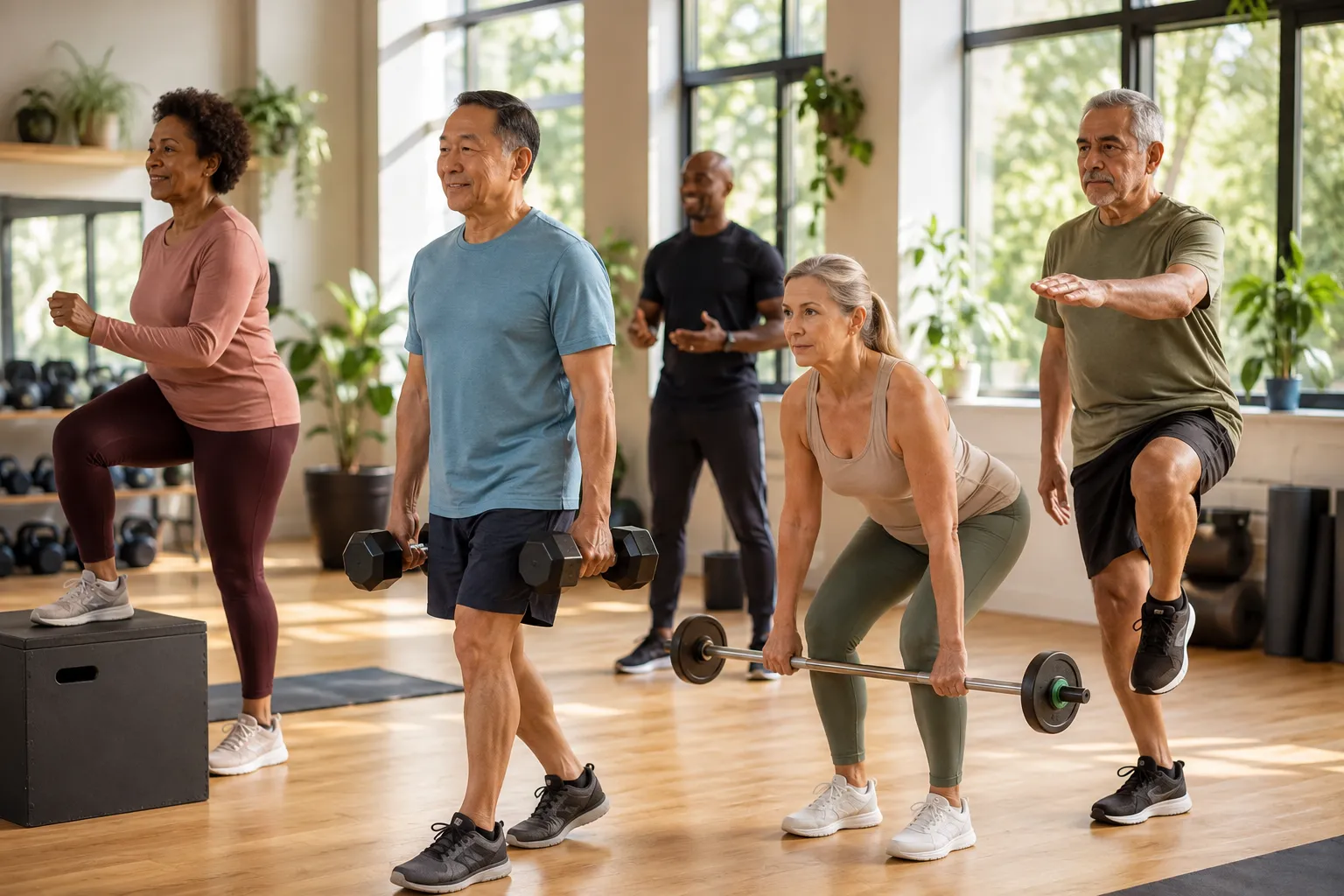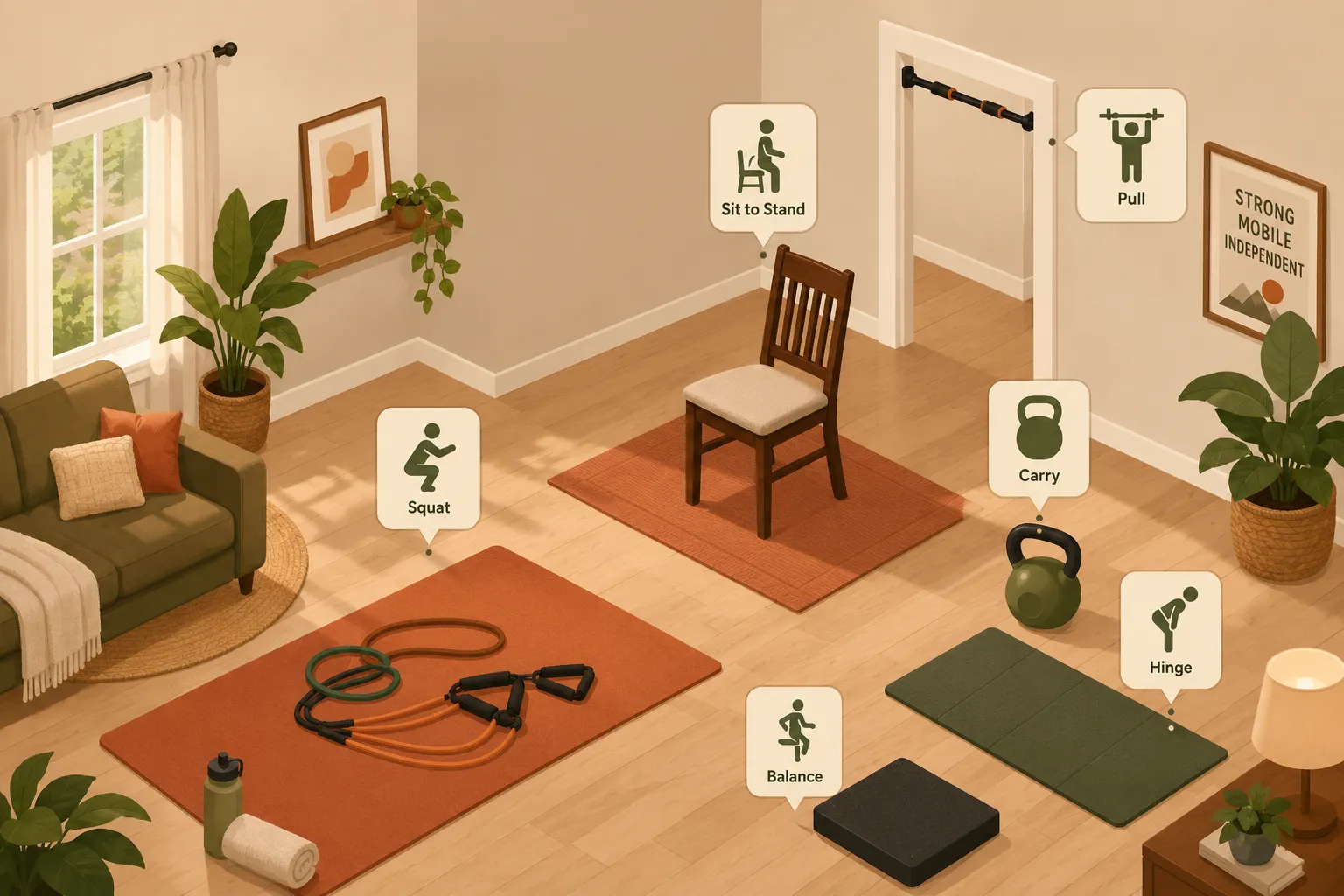
Strength Training After 40 for Muscle Preservation: How to Slow Age-Related Muscle Loss

Strength Training After 40 for Muscle Preservation: How to Slow Age-Related Muscle Loss

Last updated: October 16, 2026

Quick Answer

Adults start losing roughly 3-8% of muscle mass per decade after age 30, and the rate speeds up after 60 [9]. Strength training after 40 for muscle preservation works by giving muscle a reason to stay: progressive resistance two or more days per week, enough dietary protein, and real recovery between sessions. Current guidance for older adults recommends muscle-strengthening activities on at least 2 days per week covering all major muscle groups [8][3]. Preservation programming is simpler and lower-volume than a bodybuilding plan, which matters because most people over 40 quit from overdoing it, not from going too easy.

Key Takeaways

  • Muscle loss after 40 is driven by fewer and smaller fast-twitch fibers, motor unit loss, and reduced response to protein, not just “getting older.”
  • Two to three sessions per week is the evidence-backed floor for maintaining lean mass and strength [8][3].
  • Strength gains come faster and larger than mass gains. Meta-analyses in older adults consistently show big improvements in strength and function with more modest changes in muscle size.
  • Protein matters more with age because older muscle responds less to the same dose. Spreading intake across meals helps.
  • Yes, you can still build muscle after 40, 50, and 60. Resistance training improves strength even in adults in their 80s and 90s [2].
  • Cardio doesn’t preserve muscle the way resistance training does; the best plan combines both plus balance work.
  • Joint pain is rarely a reason to stop lifting, it’s usually a reason to change range of motion, load, or exercise selection.
  • Expect strength changes in 4-8 weeks, visible body composition changes in 3-6 months.
  • Home-based, low-equipment training works. Bands, bodyweight, and a few dumbbells produce real results when progressed.

What is sarcopenia and why does muscle loss happen after 40?

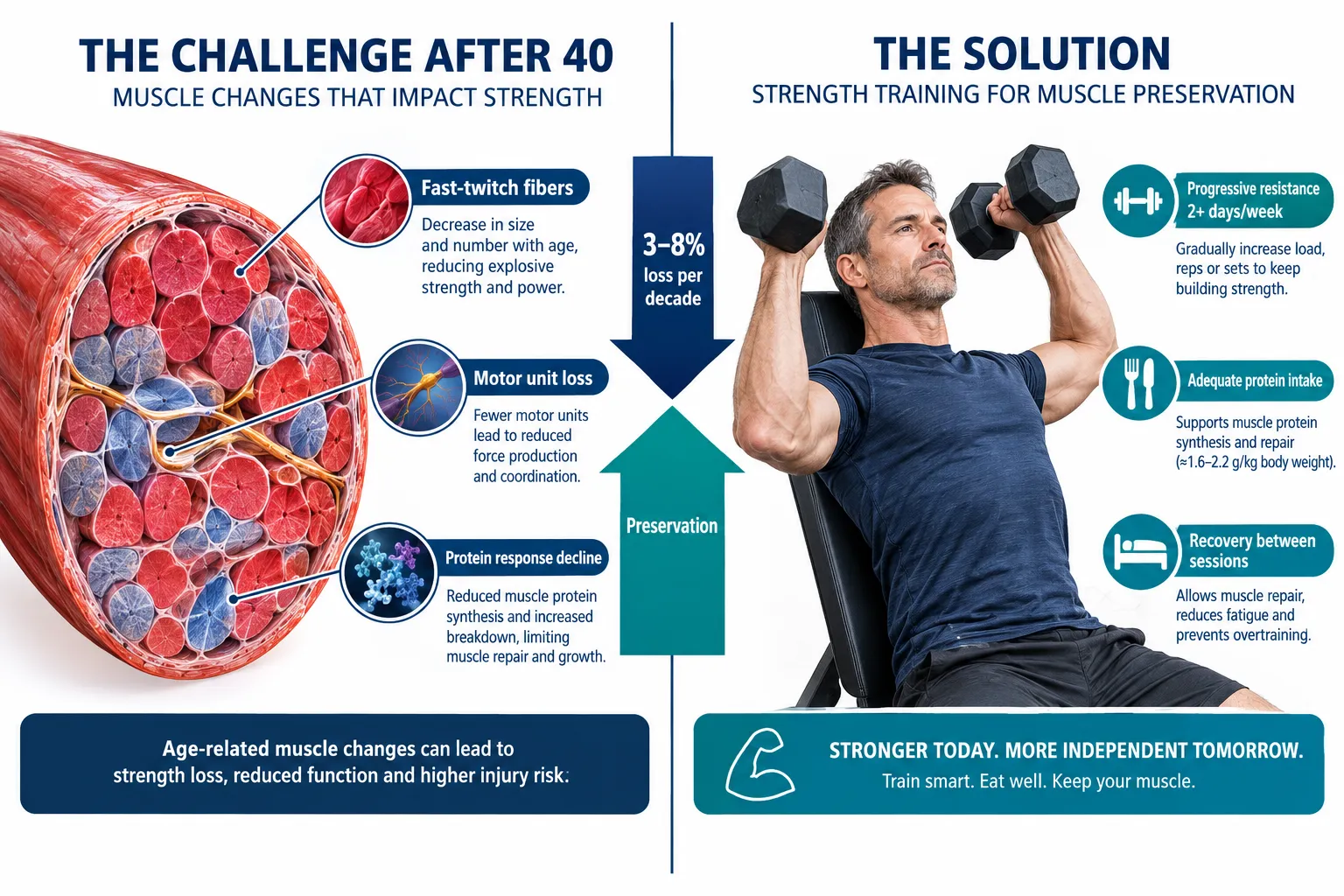
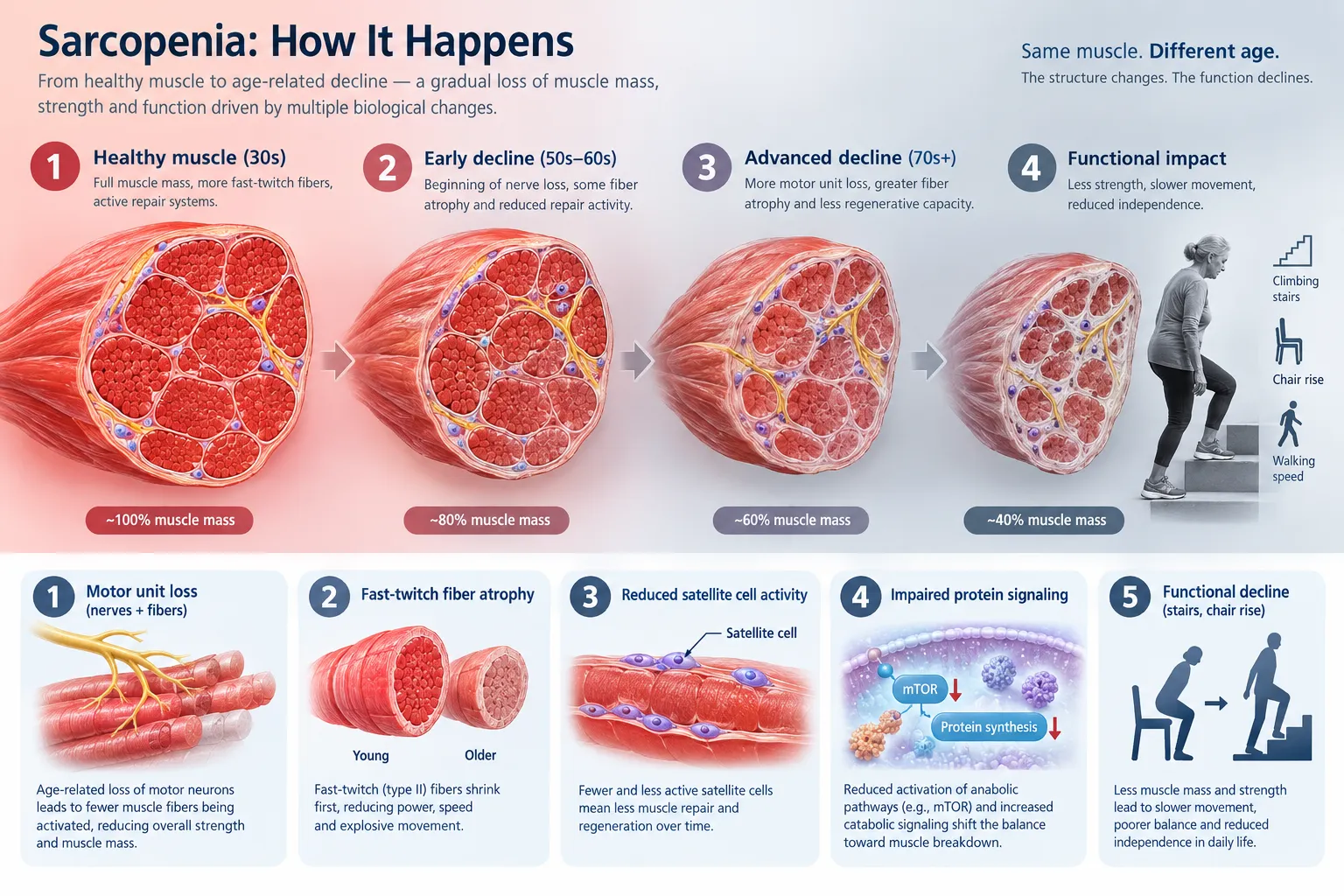
Sarcopenia is the progressive, age-related loss of muscle mass, strength, and function. It begins quietly in the 30s and 40s, and becomes clinically noticeable when strength drops enough to affect walking, stair climbing, or getting out of a chair.
What is sarcopenia and why does muscle loss happen after 40?


Several things happen at once:

  • Motor unit loss. Nerves that supply muscle fibers die off, and some fibers are orphaned. Fewer motor units means less force, especially fast force.
  • Type II (fast-twitch) fiber shrinkage. These high-power fibers atrophy first. That’s why explosive power declines faster than endurance.
  • Anabolic resistance. Older muscle needs a larger protein dose to trigger the same muscle-building response as younger muscle.
  • Less daily movement. Reduced activity accelerates everything above, and it’s the piece most under your control.
  • Hormonal shifts. Declining testosterone in men and the estrogen drop around menopause in women both reduce the signal to maintain lean tissue.

Sarcopenia isn’t a single event. It’s the slow result of a muscle that stops being asked to do hard things.

Common mistake: assuming a stable bodyweight means stable muscle. Many people over 40 keep the same number on the scale while quietly trading muscle for fat, sometimes called sarcopenic obesity.

How much muscle do you lose per year after age 40?

Adults lose roughly 3-8% of muscle mass per decade after age 30, and that rate accelerates after 60 [9]. Converted to an annual figure, that’s about 0.3-0.8% per year in midlife, climbing to around 1% or more per year later in life.

Strength declines faster than size. Muscle power, meaning force produced quickly, declines fastest of all, which is why older adults often struggle to catch a stumble before they struggle to lift a suitcase.

DecadeTypical mass loss (untrained)What usually shows up first
40s~0.3-0.5% per yearReduced power, slower recovery
50s~0.5-0.8% per yearNoticeable strength drop, grip weakening
60s+~1%+ per yearStair climbing, chair rise, balance

These are population averages, not a personal forecast. Someone who lifts consistently through their 40s and 50s can hold or even increase lean mass over that same window.

Does strength training after 40 actually prevent muscle loss?

Yes. Progressive resistance training is the most reliably effective intervention for slowing age-related muscle loss, and the evidence is strongest for strength and physical function rather than raw size [2][6]. Even nursing-home residents in their 80s and 90s have improved strength substantially with supervised resistance training [2].

Here’s the honest nuance: meta-analyses in older adults typically show large improvements in strength (often 20-50% over several months of training) but more modest gains in muscle cross-sectional area. For preservation purposes that’s fine, the functional outcomes that keep people independent track more closely with strength and power than with centimeters of thigh circumference.

Decision rule: if your goal is to stay strong, mobile and independent, prioritize getting stronger on 5-6 basic movement patterns. If your goal is visible size, you’ll need higher volume, more calories, and more patience.

How often should you do strength training after 40?

Train all major muscle groups on at least 2 days per week, which is the standing recommendation in physical activity guidelines for older adults [8][3]. Three sessions per week is the practical sweet spot for most people over 40 who want preservation plus modest gains.

A workable frequency ladder:

  1. 2 days/week, full body, the maintenance minimum. Enough to hold lean mass and build meaningful strength.
  2. 3 days/week, full body or upper/lower split, better progression, still manageable recovery.
  3. 4 days/week, only if you sleep well, eat enough protein, and have no nagging joints. More isn’t automatically better after 40.

Edge case: if you’ve had two or more consecutive weeks of poor sleep or high stress, drop to two sessions and keep the loads. Cutting frequency protects recovery better than cutting intensity does.

Best strength training program for men over 40 and women over 40

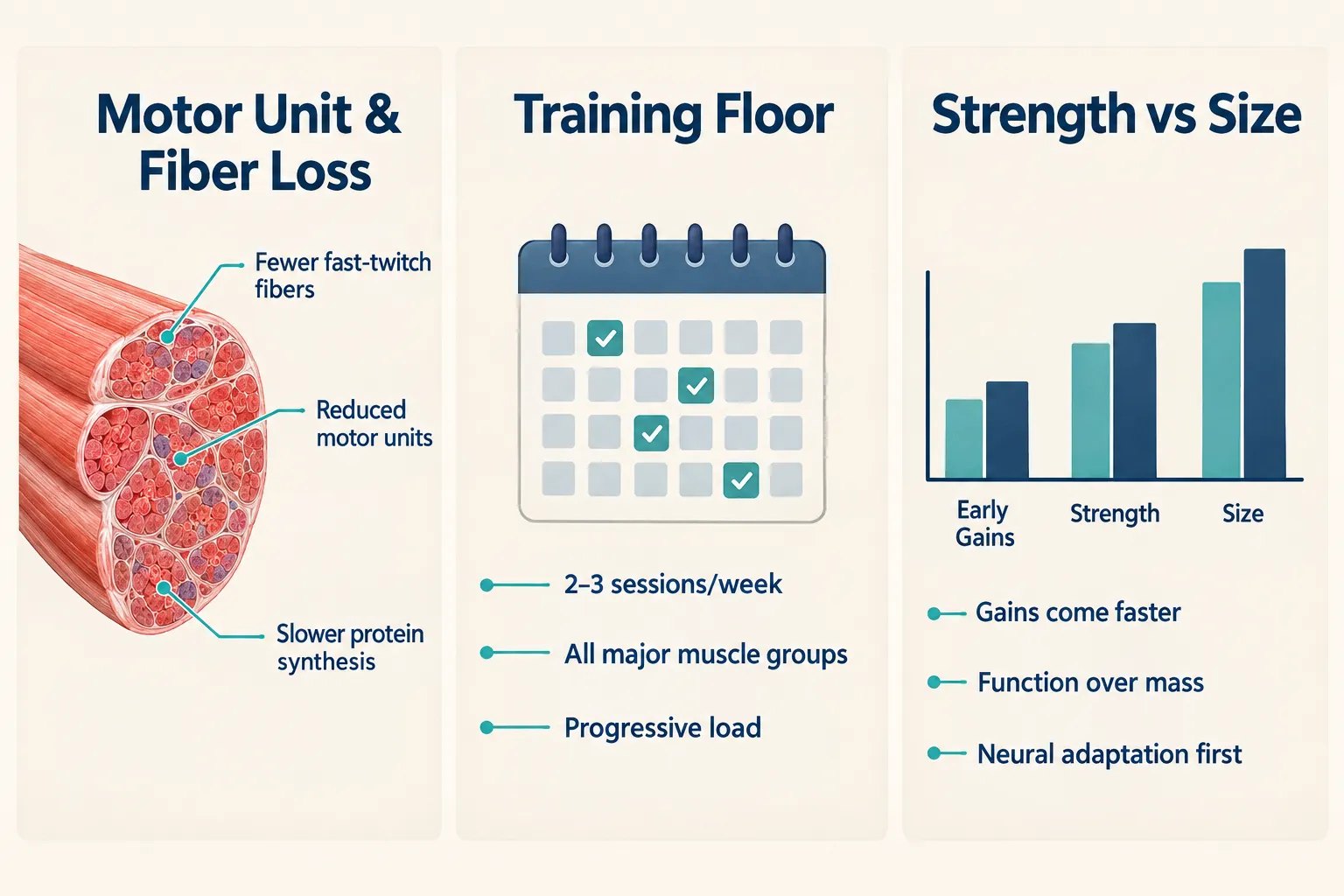
The core program is the same for both: 5-7 compound movement patterns, 2-3 sets each, 6-12 reps, trained 2-3 times per week with progressive load [10]. The differences are in emphasis, not in exercise selection.
Best strength training program for men over 40 and women over 40


Shared template (per session):

  1. Squat pattern (goblet squat, leg press, box squat), 2-3 × 8-12
  2. Hinge pattern (Romanian deadlift, hip thrust, trap-bar deadlift), 2-3 × 6-10
  3. Upper push (incline dumbbell press, push-up, machine press), 2-3 × 8-12
  4. Upper pull (seated row, lat pulldown, inverted row), 2-3 × 8-12
  5. Carry or core (farmer’s carry, dead bug, suitcase carry), 2 sets
  6. Single-leg or balance work (split squat, step-up, single-leg stand), 2 sets

Emphasis for men over 40: men typically lose relative power faster and under-train the posterior chain and single-leg work. Add one hinge-dominant lift and one unilateral lower-body exercise per week, and resist the urge to only train chest and arms.

Emphasis for women over 40: bone density and grip strength deserve extra attention, especially through perimenopause and after. Prioritize loaded hinges, carries, and heavier compound lifts in the 5-8 rep range at least once a week. Training below 10 reps is not “bulking”, it’s the most efficient route to strength and bone loading.

Intensity guidance: work at roughly 60-80% of your one-rep max, or an effort where you stop 1-3 reps short of failure. Heavier loading is increasingly recommended for older adults who are medically cleared, because it drives bone and neural adaptations that light weights don’t [6][7].

Strength training after 40 vs cardio: which is better for muscle preservation?

For preserving muscle, resistance training wins; for heart health, aerobic exercise wins. Neither replaces the other, and the current standard for healthy aging is a multicomponent program: strength plus aerobic plus balance work [8][3].

 Resistance trainingAerobic training
Preserves lean massStrong effectMinimal effect
Builds strength/powerStrong effectLittle
Cardiorespiratory fitnessModestStrong effect
Bone densityStrong effectLow for cycling/swimming
Balance and fall riskGood (with specific work)Limited

Decision rule: if you only have 150 minutes a week to train, spend 60-90 of them on resistance training and the rest on brisk walking, cycling, or intervals. If you’re in a calorie deficit, protect muscle by keeping resistance sessions and cutting cardio volume first.

How much protein do you need after 40 to build and keep muscle?

Most adults over 40 do better at 1.2-1.6 g of protein per kg of bodyweight per day, which is above the standard RDA of 0.8 g/kg. The reason is anabolic resistance: older muscle needs a bigger per-meal dose to switch on protein synthesis.

Practical approach:

  • Aim for 25-40 g of protein per meal, across 3-4 meals, rather than one large protein hit at dinner.
  • Include a protein source after training within a few hours, timing matters less than daily total, but it’s an easy habit anchor.
  • Prioritize leucine-rich sources: dairy, eggs, fish, poultry, lean meat, soy, or a whey/pea blend.
  • Don’t forget energy. Chronic under-eating blunts the training response no matter how much protein you eat.

Edge case: anyone with chronic kidney disease should set protein targets with their physician, not from a general article.

Can you still gain muscle after 40, and is it too late to start at 50 or 60?

Yes, and no, it isn’t too late. Untrained adults in their 50s, 60s, and 70s routinely gain muscle and strength when they start progressive resistance training, and improvements have been documented even in adults in their 80s and 90s [2][9].

What changes with age is the rate, not the possibility. Expect gains to come somewhat slower than they would have at 25, and expect recovery to need more respect. The flip side: because the starting point is lower, the functional payoff from the first six months is often larger than it would be for a younger lifter.

Quick example: a 58-year-old who can barely complete five bodyweight squats may be doing 3 sets of 10 goblet squats with a 25 lb kettlebell within 10 weeks. The mass change is small; the change in stair climbing, balance, and confidence is not.

Strength training after 40 with joint pain or arthritis

Joint pain usually calls for modifying training, not stopping it. Resistance training strengthens the muscles that support arthritic joints and often reduces pain over time, and clinical exercise prescriptions are routinely tailored to comorbidities and baseline fitness [6][1].
Strength training after 40 with joint pain or arthritis


Modifications that work:

  • Shorten the range of motion to the pain-free zone, then expand it as symptoms settle (box squats instead of deep squats).
  • Switch to machines or supported positions, chest-supported rows, leg press, seated presses reduce spinal and shoulder loading.
  • Use bands or cables where the resistance curve is kinder to joints than free weights.
  • Change grip and angle: neutral-grip dumbbells, trap bar instead of straight bar, landmine press instead of overhead press.
  • Apply the 24-hour rule. Soreness that fades within a day is fine. Joint pain that’s worse the next morning means the load or range was too much.

Anyone with inflammatory arthritis, recent joint replacement, uncontrolled hypertension, or cardiac disease should get a clinician’s sign-off and, ideally, a few supervised sessions first.

Do you need different equipment or home training options after 40?

No special equipment is required. Home-based programs using resistance bands, bodyweight, and adjustable dumbbells produce meaningful strength gains in older adults when the resistance is progressed over time [5][6].

A minimal effective home kit:

  • A pair of adjustable dumbbells or 3 fixed pairs (light, medium, heavy)
  • Two resistance bands (medium and heavy loop bands)
  • A sturdy chair or bench for support and seated work
  • Optional: one kettlebell for carries, swings, and goblet squats

What matters isn’t the gear, it’s progression: add reps, then load, then sets. The CDC’s long-standing Growing Stronger program is built around exactly this kind of simple, home-based progression [5].

How long does it take to see results from strength training after 40?

Strength improvements typically appear within 4-8 weeks, while visible changes in muscle shape and body composition usually take 3-6 months of consistent training. The first gains are neural: your nervous system recruits existing muscle more effectively before the muscle itself grows.

A realistic timeline:

TimeframeWhat you’ll notice
Weeks 1-3Better coordination, less soreness per session
Weeks 4-8Clear strength gains, easier stairs and carries
Months 3-6Visible changes in shape, improved posture and balance
Months 6-12+Measurable lean mass preservation or gain, better bone loading

Common mistake: judging progress by the mirror in week three and quitting. Track reps and loads in a notebook or app, those move before anything visual does.

Common mistakes with strength training over 40

The biggest error is treating a preservation program like a mass-gain program: too much volume, too often, with too little recovery. Here’s the shortlist worth avoiding:

  1. Training to failure every set. It raises fatigue and joint stress without proportional benefit.
  2. Skipping progression. Doing the same 10 lb dumbbells for two years is maintenance of a habit, not of muscle.
  3. Only using machines. Add carries, single-leg work, and free-weight patterns for balance and real-world transfer.
  4. Avoiding all heavy loading out of fear. Medically cleared adults benefit from heavier work in the 5-8 rep range [7].
  5. Ignoring protein and calories while training hard, especially during intentional weight loss.
  6. Treating soreness as the goal. Soreness measures novelty, not effectiveness.
  7. No deload weeks. Every 6-10 weeks, cut volume by about half for a week. Joints and connective tissue need it more after 40.
  8. Dropping sleep. Under 6 hours a night reliably blunts strength and recovery.

FAQ

Is 40 too late to start lifting weights?
No. People who begin resistance training in their 40s, 50s, and even 80s gain strength and function [2]. Starting later means slower progress, not no progress.

How many sets per week do I need to maintain muscle?
Roughly 4-8 hard sets per muscle group per week is enough to maintain for most people over 40. Building typically needs 10 or more.

Should I lift heavy or light weights after 40?
Both have a place, but heavier loads (about 70-80% of max, 5-8 reps) drive the neural and bone adaptations that light weights don’t. Use light, higher-rep work for joints that don’t tolerate load.

Do I need a trainer?
Not required, but 3-6 sessions with a qualified trainer is the fastest way to fix technique and set the right starting loads, especially with prior injuries.

Can resistance training help with bone density too?
Yes. Loaded compound lifts and impact-bearing work stress bone directly, which is why they’re recommended alongside strength work for older adults [3][1].

What about creatine after 40?
Creatine monohydrate is one of the better-studied supplements for strength and lean mass in older adults. Discuss it with a physician if you have kidney concerns.

How long should a session be?
30-45 minutes is plenty for a full-body session of 5-6 exercises. Longer sessions usually add fatigue, not results.

Is walking enough to prevent muscle loss?
No. Walking supports heart health and mobility, but it doesn’t provide the progressive overload needed to preserve lean mass.

Can I train through muscle soreness?
Mild soreness is fine. Train a different muscle group or reduce load if soreness limits full range of motion.

Conclusion

Age-related muscle loss is predictable, measurable, and largely modifiable. The formula for strength training after 40 for muscle preservation isn’t complicated: lift against progressively heavier resistance two to three times a week, eat 1.2-1.6 g of protein per kg daily, sleep enough to recover, and keep doing it for years rather than weeks.

Your next steps this week:

  1. Schedule two 35-minute sessions on your calendar as non-negotiable appointments.
  2. Pick the six-exercise template above and record your starting weights and reps.
  3. Add protein to breakfast, most people over 40 are short there, not at dinner.
  4. Get medical clearance now if you have arthritis, cardiac history, or uncontrolled blood pressure.
  5. Re-test one marker in 8 weeks: chair rises in 30 seconds, or your goblet squat load for 10 reps.

Consistency over intensity wins this one. The muscle you keep in your 40s and 50s is the independence you spend in your 70s and 80s.

References

[1] Strength Training – https://hgic.clemson.edu/factsheet/strength-training/
[2] Resistance Training By The Numbers – https://www.health.harvard.edu/healthy-aging-and-longevity/resistance-training-by-the-numbers
[3] Physical Activity Guidelines For Older Adults – https://www.healthdirect.gov.au/physical-activity-guidelines-for-older-adults
[4] pubmed.ncbi.nlm.nih.gov – https://pubmed.ncbi.nlm.nih.gov/41668861/
[5] Growing Stronger – https://www.cdc.gov/physicalactivity/downloads/growing_stronger.pdf
[6] Full – https://www.frontiersin.org/journals/rehabilitation-sciences/articles/10.3389/fresc.2025.1538336/full
[7] Jcsm – https://onlinelibrary.wiley.com/doi/full/10.1002/jcsm.13804
[8] Older Adults – https://www.cdc.gov/physical-activity-basics/guidelines/older-adults.html
[9] Pmc3117172 – https://pmc.ncbi.nlm.nih.gov/articles/PMC3117172/
[10] Tables – https://link.springer.com/article/10.1007/s12603-021-1665-8/tables/1

Healthspan vs. Lifespan: Strength and Mobility Training After 50 to Stay Independent Longer

Healthspan vs. Lifespan: Strength and Mobility Training After 50 to Stay Independent Longer

Last updated: July 26, 2026

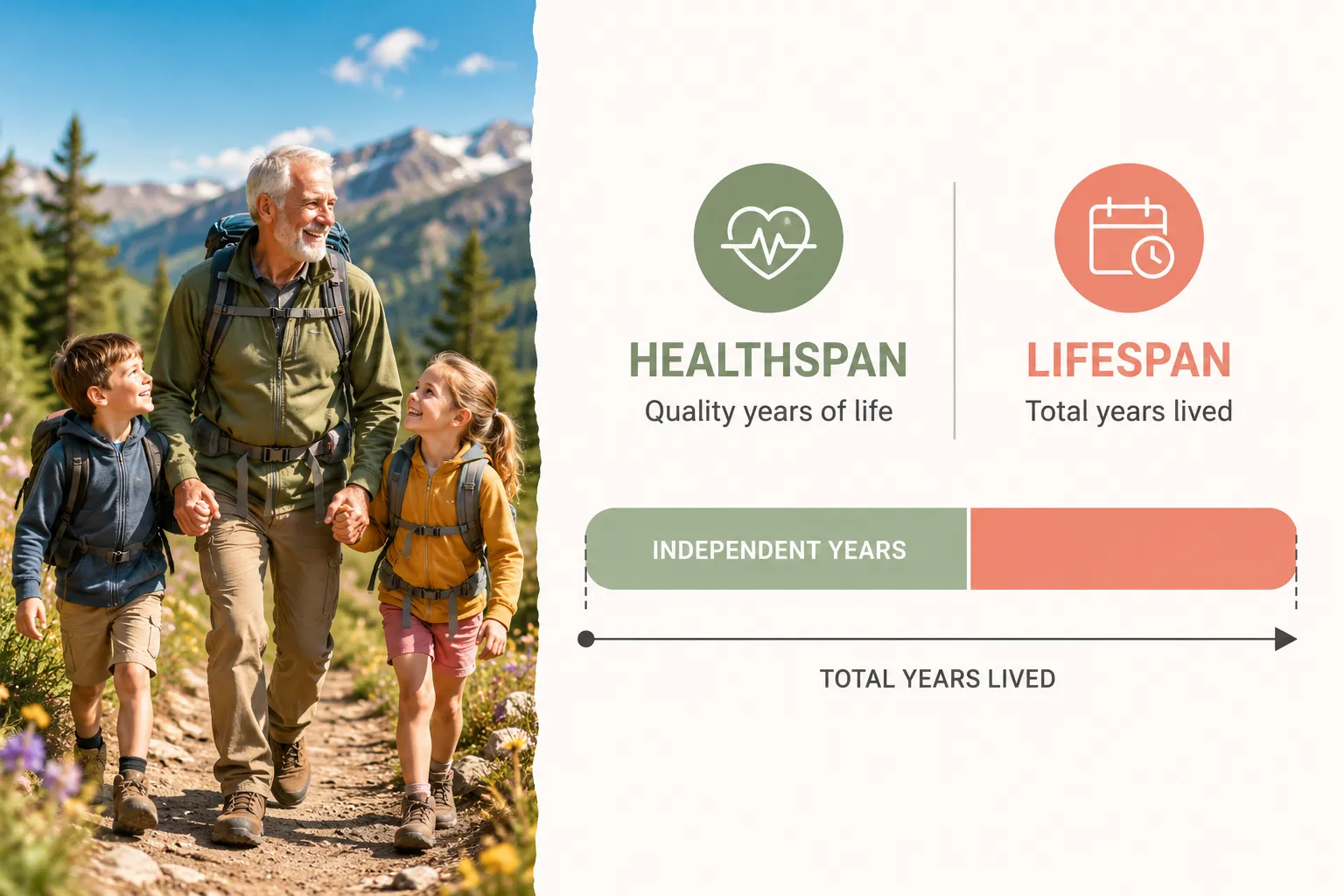
Editorial landscape split-screen conceptual illustration contrasting 'healthspan' and 'lifespan': left side shows a vibrant

Quick Answer

Lifespan is how long you live. Healthspan is how long you live well, without disability or dependence. After 50, the fastest way to widen the gap in your favor is progressive strength training two to three days per week, paired with daily mobility work. Recent 2026 guidance calls resistance training "mandatory" for healthspan, with a sweet spot of roughly 90-120 minutes per week [2][7].

Key Takeaways

  • Lifespan measures years lived. Healthspan measures years lived independently, and the two can differ by a decade or more.
  • Strength training is the single biggest lever for preserving independence after 50, according to 2026 fitness and longevity research [2][7].
  • Aim for 90-120 minutes of strength work per week, split across 2-3 sessions, plus 150 minutes of moderate cardio [7][10].
  • Sarcopenia (age-related muscle loss) begins in your 30s and accelerates after 60, resistance training is the proven counter [8].
  • Mobility work daily, even 10 minutes, protects joints and prevents the stiffness that leads to falls.
  • Falls are the leading cause of injury death in adults over 65, and balance-focused training cuts fall risk meaningfully [4].
  • It's not too late at 60, 70, or 80, muscle responds to training at every age studied [5].
  • Functional, daily-life movements (squat, hinge, carry, push, pull, rotate) matter more than machines.

What's the difference between healthspan and lifespan?

Lifespan is the total number of years you live. Healthspan is the number of those years spent in good health, mobile, cognitively sharp, and independent. In the U.S., the average person lives roughly 10 years longer than they stay healthy, meaning the last decade often involves disability, chronic disease, or loss of independence [1].

The goal of training after 50 isn't to add years to the end of life. It's to compress the frail years down to as few as possible. Strength and mobility work is the most reliable tool for doing that [2].

Quick example: Two 55-year-olds both live to 85. One spends the last 12 years using a walker, dependent on family. The other hikes with grandkids until 82 and lives alone comfortably until the end. Same lifespan. Very different healthspan.

Why is strength training important after 50?

Because muscle is the organ of independence. After 50, adults lose roughly 1-2% of muscle mass per year and up to 3% of strength annually if they don't train, a condition called sarcopenia [8]. Weak muscles mean weaker bones, worse balance, slower metabolism, and a higher risk of falls, fractures, and hospitalization.

Resistance training reverses much of this. It's the only intervention that consistently rebuilds muscle, improves bone density, and preserves the fast-twitch fibers you need to catch yourself when you trip [5][8]. In 2026 healthspan guidance, strength training moved from "recommended" to "mandatory", treated the same way clinicians treat blood pressure control [2][7].

What strength training protects:

  • Muscle mass and power (power fades faster than strength and matters more for falls)
  • Bone density, reducing fracture risk
  • Insulin sensitivity and metabolic health
  • Cognitive function, through myokines released during exercise
  • Confidence, knowing your body can handle stairs, groceries, and grandkids

How much strength and mobility training do you need to stay independent?

The current sweet spot from 2026 longevity research is 90-120 minutes of strength training per week, spread across 2-3 sessions, plus 150 minutes of moderate cardio and daily mobility work of 10-15 minutes [7][10]. International guidelines for older adults align: at least two strength sessions per week that hit all major muscle groups, plus balance work [10].

A realistic weekly template:

Day Focus Time
Monday Full-body strength 40 min
Tuesday Walk + mobility 30 + 10 min
Wednesday Rest or easy walk 20 min
Thursday Full-body strength 40 min
Friday Walk + balance work 30 + 10 min
Saturday Optional third strength or hike 30-60 min
Sunday Mobility and stretch 15 min

You don't need a gym. A single kettlebell, a set of resistance bands, a sturdy chair, and floor space are enough to run this program for years.

How much strength and mobility training do you need to stay independent?

Can you improve healthspan at 60, or is it too late?

It's not too late. Studies of adults starting resistance training in their 60s, 70s, and even 90s show meaningful gains in muscle mass, strength, walking speed, and stair-climbing ability within 8-12 weeks [4][5]. The relative gains are often larger in older beginners than in younger trained people, because there's more room to improve.

The honest caveat: progress is slower, recovery takes longer, and injury risk is higher if you skip the ramp-up. Start light, add load gradually, and prioritize form over weight for the first two to three months.

Decision rule: If you can stand up from a chair without using your hands, you have enough baseline strength to start a beginner program at home. If you can't, start with sit-to-stands from a higher surface and build from there.

What exercises prevent falls in older adults?

Falls are prevented by a mix of lower-body strength, single-leg balance, and reactive power, the ability to move fast when you stumble. The exercises with the strongest evidence for fall prevention include:

  1. Sit-to-stand from a chair, trains the hip and thigh muscles you use every day
  2. Step-ups onto a low box or bottom stair, builds single-leg strength
  3. Farmer's carries (walking with weights in each hand), trains grip, core, and gait stability
  4. Single-leg balance holds, 30 seconds per leg, progress to eyes closed
  5. Heel-to-toe walking in a straight line
  6. Tai chi or slow controlled squats, proven to reduce fall rates in randomized trials [4]
  7. Loaded hip hinges (deadlifts with light weight), trains the posterior chain that catches you when you trip

Aim to include at least one balance-focused movement in every session.

Healthspan training vs. regular gym workouts for seniors

Healthspan training is built around functional movement patterns you use in daily life: squatting to a chair, hinging to pick something up, carrying groceries, pushing a door open, pulling yourself out of a pool. Regular gym workouts often isolate muscles on machines, bicep curls, leg extensions, seated chest press, which build size but transfer poorly to real life [7].

Choose healthspan-style training if you want to: stay independent, prevent falls, keep hiking or gardening, play with grandchildren, and reduce injury risk.

Choose bodybuilding-style training if you want to: maximize muscle size, look a certain way, or compete.

The two overlap, but the emphasis matters. A 70-year-old who can deadlift a suitcase, carry it up stairs, and get down to the floor and back up has more functional capacity than one with big arms and a sore back.

How often should you do strength and mobility work after 50?

Strength: 2-3 sessions per week, with at least 48 hours between sessions targeting the same muscles. Mobility: daily, in short 10-minute doses [7][10]. More isn't better once you cross about 150 minutes of strength work per week, recovery becomes the bottleneck [7].

A simple minimum-effective-dose plan:

  • Two 30-minute strength sessions per week (full body)
  • Ten minutes of mobility on non-lifting days
  • One longer walk or hike on the weekend
  • Five to ten minutes of balance work sprinkled through the week

That's under three hours total. It's enough to meaningfully shift your healthspan trajectory.

What happens if you don't train for strength and mobility as you age?

You lose muscle, bone, and balance on a predictable timeline. By 80, an untrained adult has typically lost 30-40% of the muscle mass they had at 30, and grip strength drops in parallel with overall mortality risk [8][9]. The functional consequences:

  • Difficulty rising from a chair or toilet without assistance
  • Higher fall risk, one in four adults over 65 falls each year [4]
  • Loss of driving independence as reaction time and neck mobility decline
  • Hospitalizations after minor injuries that a stronger body would shrug off
  • Cognitive decline accelerates in parallel with physical decline

None of this is inevitable. It's the default trajectory without training. Resistance work bends the curve.

"Muscle is the currency of aging. Spend it wisely, and you buy back years of independence.", a summary of the current healthspan consensus [2][7]

Is healthspan training safe if you have arthritis or joint pain?

Yes, and it's often the best thing you can do for joint pain. Strength training reduces arthritis symptoms by building the muscle that supports and stabilizes the joint [5]. The key is smart programming: pain-free range of motion, gradual loading, and choosing exercises that don't aggravate the specific joint.

Arthritis-friendly swaps:

  • Painful squats → box squats to a higher surface, or wall sits
  • Painful overhead press → landmine press at an angle
  • Painful running → cycling, swimming, or fast walking
  • Painful floor work → standing or elevated variations

When to consult a professional first: recent joint replacement, active flare, unexplained pain, uncontrolled blood pressure, or any cardiac symptoms. A physical therapist or a certified trainer with older-adult experience can adapt any program.

Best mobility exercises for people over 50 at home

Mobility work restores the range of motion that stiffens with age and desk work. These seven movements cover the biggest problem areas and take under 10 minutes:

  1. Cat-cow, 8 slow reps, spine flexion and extension
  2. World's greatest stretch, 3 per side, hips and thoracic spine
  3. 90/90 hip switches, 8 per side, hip rotation
  4. Doorway pec stretch, 30 seconds per side, chest and shoulders
  5. Wall slides, 10 reps, shoulder and upper-back mobility
  6. Ankle circles and calf stretches, 30 seconds per side (ankle mobility drives balance)
  7. Deep squat hold, build up to 60 seconds, holding a support if needed

Do these daily. Consistency beats intensity for mobility.

Best mobility exercises for people over 50 at home

How long does it take to notice improvements in strength and balance?

Most beginners notice better balance and easier stairs within 2-4 weeks. Measurable strength gains show up around 6-8 weeks. Visible muscle changes and meaningful bone-density shifts take 3-6 months of consistent training [5][8].

Realistic milestones for a 55-year-old starting from scratch:

  • Week 2: Getting off the floor feels easier
  • Week 4: Stairs no longer require the handrail
  • Week 8: Groceries feel lighter, posture improves
  • Month 3: Can perform 10 full squats without a chair, hold single-leg balance 30 seconds
  • Month 6: Deadlifting your bodyweight becomes realistic; sleep and energy noticeably better

The gains compound. The person who trains at 55 arrives at 75 with a completely different body than the one who didn't.

Who should not do strength training after 50?

Very few people. The contraindications are narrow: uncontrolled high blood pressure, unstable cardiovascular disease, recent surgery without medical clearance, active infection, or acute injury [5]. Even in most of these cases, modified training is possible and beneficial once cleared.

Talk to your doctor before starting if you have:

  • Recent heart attack, stroke, or heart surgery
  • Uncontrolled diabetes or blood pressure
  • Advanced osteoporosis with recent fractures
  • Balance disorders causing frequent falls
  • Chronic pain that isn't diagnosed

For nearly everyone else, the risk of not training is higher than the risk of training carefully.

Common mistakes people make with senior fitness programs

The mistakes are predictable, and avoiding them is most of the battle:

  • Going too light forever. Muscles adapt to challenge. If your weights never get heavier, neither do you.
  • Skipping the lower body. The legs and glutes drive independence. Upper-body-only routines miss the point.
  • Cardio-only fitness. Walking is great but doesn't build or preserve muscle on its own [8].
  • No progression plan. Doing the same three exercises for a year produces one year of the same body.
  • Ignoring balance work. Falls happen because balance isn't trained, not because legs are weak.
  • Copying young-athlete programs. Recovery needs are different after 50. Two hard sessions plus mobility beats five mediocre sessions.
  • Fearing soreness. Mild muscle soreness is normal and safe. Sharp joint pain is not.

Does healthspan training really help you stay independent longer?

Yes. Multiple long-term studies show that adults with higher muscle strength, grip strength, and functional capacity live more years independent of assistance and have lower rates of nursing-home admission [4][9]. The 2026 fitness research consensus treats functional movement capacity, sit-to-stand, gait speed, grip strength, as a vital sign of healthspan, on par with blood pressure [7].

The mechanism is straightforward: stronger muscles mean fewer falls, faster recovery from illness, better metabolic health, and more reserve capacity when something goes wrong. It's not a guarantee, but it shifts the odds significantly.

FAQ

Is it safe to lift heavy weights after 60?
Yes, with proper form and gradual progression. "Heavy" is relative to your current strength, challenging weight for you, not for a 25-year-old. Studies show adults in their 80s and 90s safely doing progressive resistance training [5].

Do I need a personal trainer to start?
Not required, but 3-6 sessions with a qualified trainer can prevent months of form mistakes. Look for someone certified in older-adult fitness (NSCA, ACSM, or similar credentials).

Can I combine strength and cardio in one session?
Yes. Strength first, then cardio, for the best strength outcomes. Or alternate days if you have time.

How much protein do I need?
Most healthspan researchers recommend 1.2-1.6 grams per kilogram of bodyweight daily for adults over 50 doing resistance training, spread across meals [8].

What if I have osteoporosis?
Strength training is one of the best interventions for osteoporosis, but exercise selection matters. Avoid heavy spinal flexion and get guidance from a physical therapist or trainer familiar with the condition.

Is walking enough?
Walking is essential but not sufficient. It maintains cardiovascular health but doesn't build the muscle mass and power needed to prevent falls and preserve independence [8].

How do I know if I'm progressing?
Track sets, reps, and weight in a notebook or app. Also test yourself monthly: how many sit-to-stands in 30 seconds, how long you can balance on one leg, how fast you can walk 400 meters.

Should I train through joint pain?
No sharp pain, ever. Mild stiffness that eases as you warm up is normal. Pain that gets worse during or after a set means change the movement.

Conclusion: Your next steps

Healthspan is trainable. The compounding effect of 30 minutes, three times per week, over years, is the difference between an independent 80-year-old and a dependent one. Start this week, not next month.

Do this in the next seven days:

  1. Book a check-in with your doctor if you haven't exercised in years or have a chronic condition.
  2. Pick two 30-minute windows on your calendar this week and label them "strength."
  3. Buy or borrow one kettlebell (15-25 lb for most beginners) and a set of resistance bands. Total cost under $60.
  4. Learn five foundational movements: goblet squat, hip hinge, farmer's carry, chair sit-to-stand, and doorway row. YouTube tutorials from certified trainers are fine.
  5. Do a 10-minute mobility routine daily, starting tomorrow morning.
  6. Track something measurable: how many sit-to-stands in 30 seconds. Retest monthly.

The goal isn't to become an athlete. It's to stay the person who carries their own groceries, plays on the floor with grandchildren, and travels without help, for as many years as possible. Strength and mobility training after 50 is the most reliable path we have.

References

[1] Healthspan Recognizing The Rewards Of Resistance Training – https://www.humangood.org/about/news-room/healthspan-recognizing-the-rewards-of-resistance-training
[2] Is Strength Training The Key To Your Health Span – https://www.bch.org/latest-news/2026/february/is-strength-training-the-key-to-your-health-span/
[4] PMC12182867 – https://pmc.ncbi.nlm.nih.gov/articles/PMC12182867/
[5] Resistance Training and the Older Adult – https://bpb-us-e2.wpmucdn.com/websites.umass.edu/dist/a/2523/files/2009/07/resistancetrainingandtheOlderAdult.pdf
[7] Fitness Research 2026 Makes Movement A Healthspan Test – https://www.pagalishor.in/articles/fitness-research-2026-makes-movement-a-healthspan-test
[8] Combating Sarcopenia With Exercise And Protein – https://www.gethealthspan.com/research/article/combating-sarcopenia-with-exercise-and-protein
[9] Physical function and healthspan – https://www.sciencedirect.com/science/article/pii/S1279770723007881
[10] Resistance Training By The Numbers – https://www.health.harvard.edu/healthy-aging-and-longevity/resistance-training-by-the-numbers