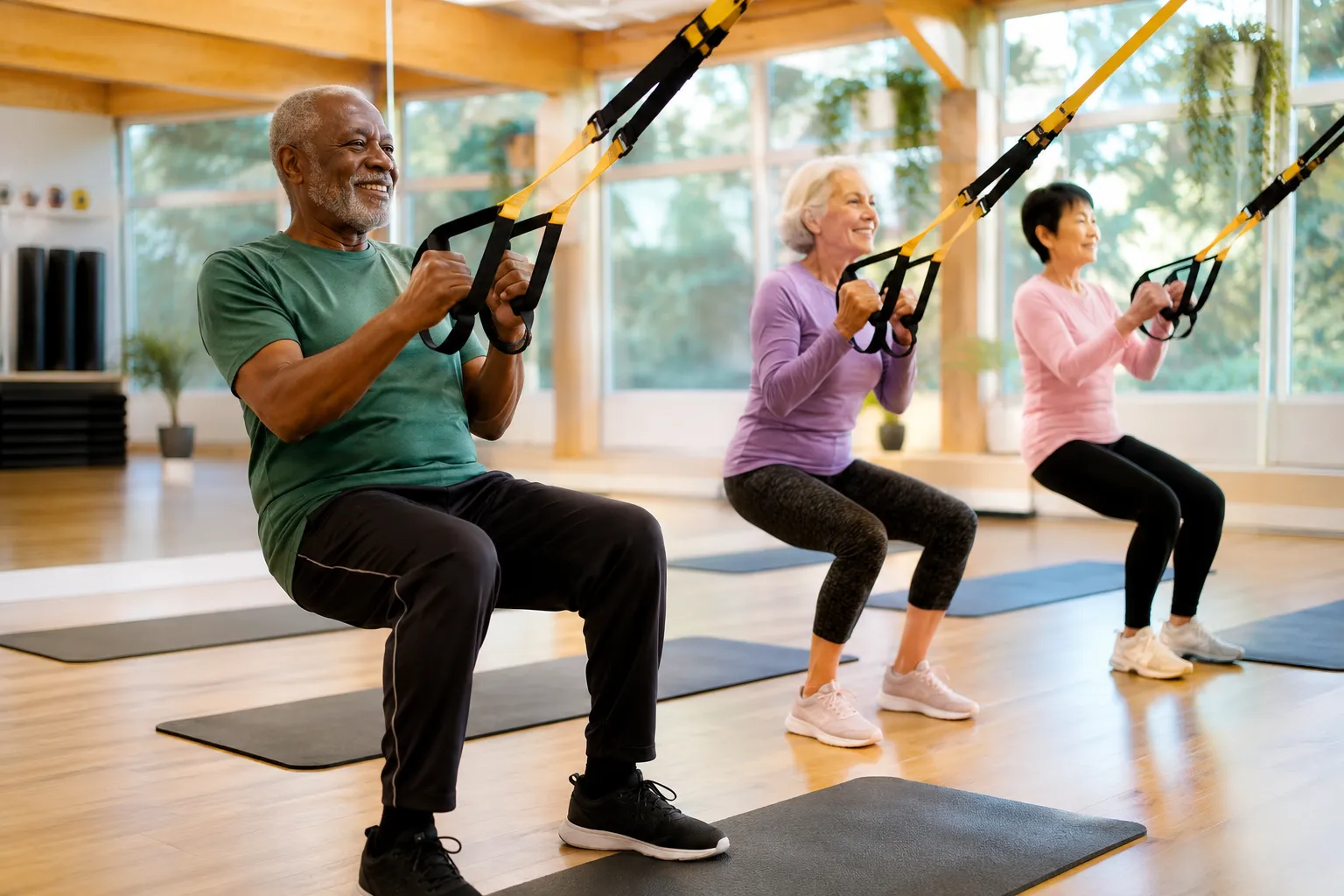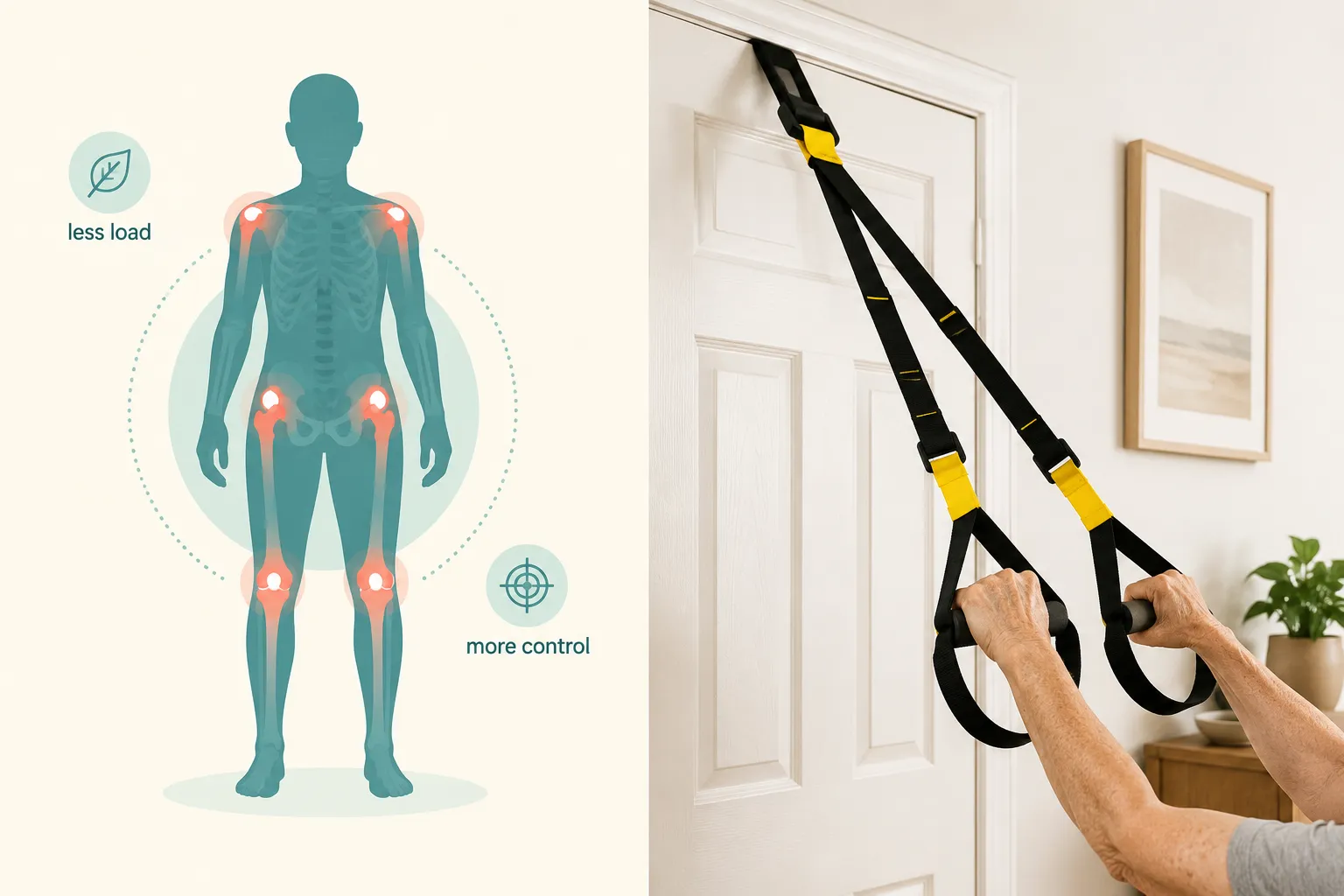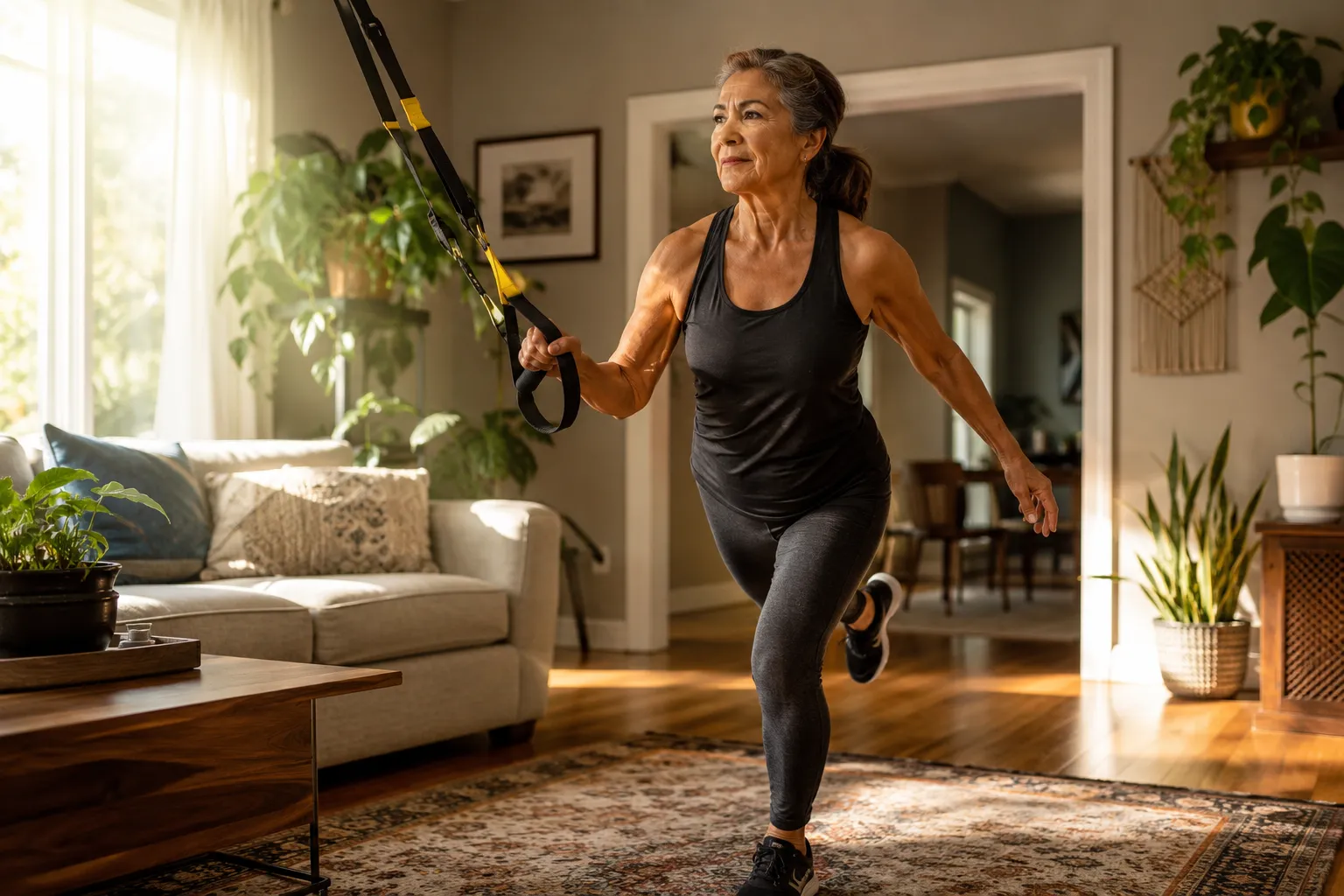
Top Home Exercise Equipment for Seniors Who Want Strength, Not Impact

Top Home Exercise Equipment for Seniors Who Want Strength, Not Impact

Last updated: August 13, 2026

Quick Answer

The best home exercise equipment for seniors who want strength without impact is a small, focused kit: resistance bands, adjustable dumbbells, a sturdy bench, a balance pad, and a compact cable or selectorized machine. This setup builds functional muscle, protects joints, and supports fall prevention, the three goals that matter most after 60. Most older adults can start well-equipped for under $300, and national guidelines back moderate-to-heavy resistance training as core to healthy aging [6][8].

Key Takeaways

  • Resistance bands and adjustable dumbbells are the highest-value tools for senior strength training at home, cheap, quiet, and joint-friendly [1][4].
  • Seniors can and should lift heavier than "light toning weights." Position statements from the NSCA endorse moderate-to-vigorous loads for older adults when progressed safely [6][8].
  • A balance pad and mini-step turn a strength routine into a fall-prevention routine at almost no cost [9].
  • Skip high-impact equipment like plyometric boxes, heavy barbells without a rack, and treadmills used for running [3].
  • A complete senior home gym costs roughly $150,$800 depending on whether you add a cable machine or bench [1][3].
  • Train strength 2-3 days per week, with 8-12 reps per set, using a load that feels challenging by the last two reps [5].
  • Recumbent bikes and ellipticals support cardio and joint health, but they don't replace resistance work for muscle [7].
  • Common mistakes: going too light forever, skipping warm-ups, and buying equipment that requires floor work every session [4].

What home exercise equipment is best for seniors building strength

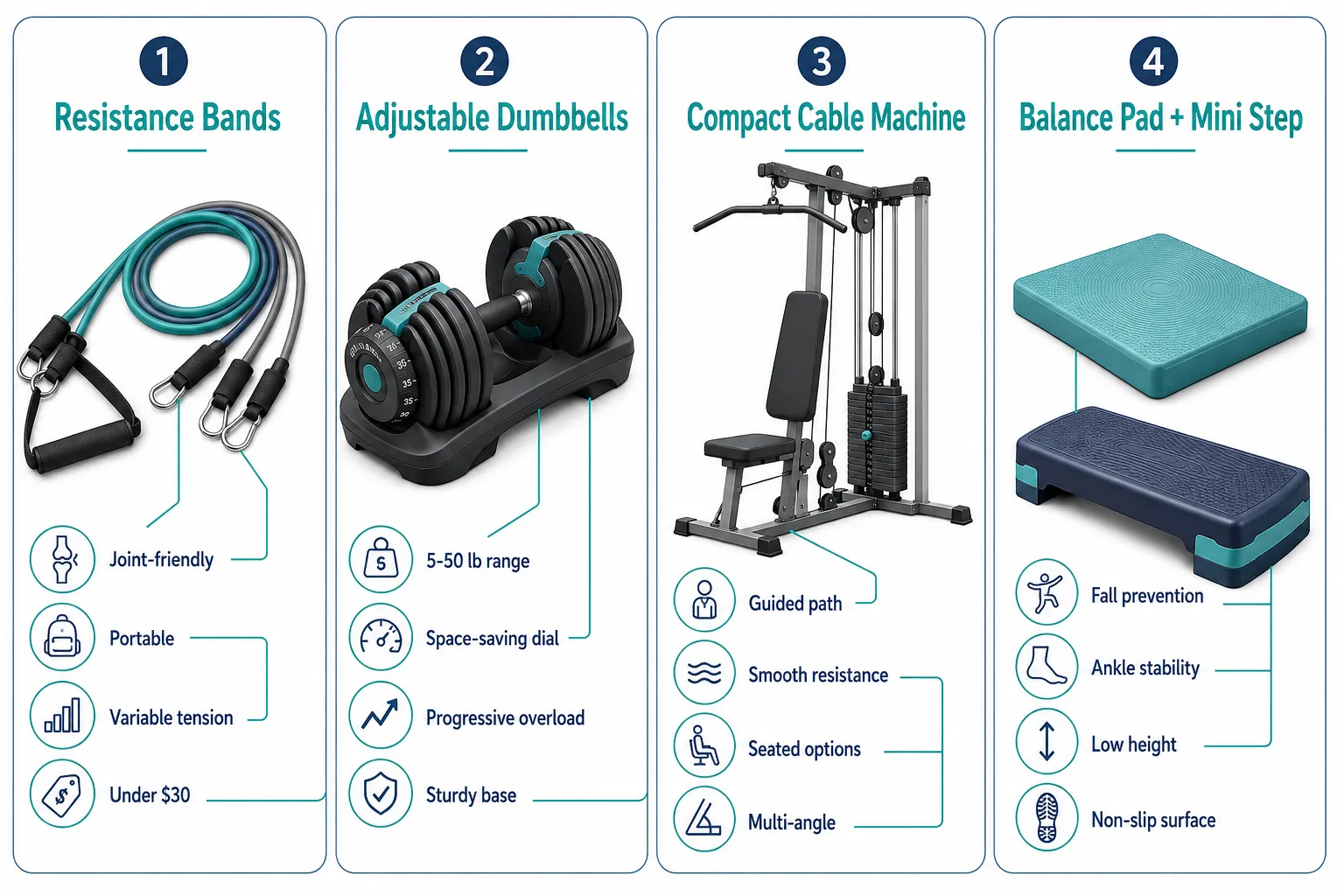
The best equipment for seniors building strength at home is adjustable dumbbells, resistance bands with handles, and a stable bench, in that order. These three tools cover every major muscle group, allow gradual progression, and keep impact on knees, hips, and spine to a minimum [1][4].
What home exercise equipment is best for seniors building strength

Ranked by how well they support functional strength, mobility, and fall prevention:

  1. Adjustable dumbbells (5-50 lb range), the single best purchase. One pair replaces an entire rack and lets you progress from very light to genuinely challenging loads.
  2. Loop and tube resistance bands, near-zero joint stress, ideal for shoulders, hips, and rotator cuff work.
  3. Sturdy adjustable bench, unlocks seated presses, supported rows, and step-ups.
  4. Balance pad + mini-step, direct fall-prevention training.
  5. Compact cable machine or functional trainer, smooth, guided resistance for anyone with shoulder or wrist issues [10].
  6. Ankle weights (1-5 lb), for hip and glute work that protects the lower back.

Choose adjustable dumbbells if you only buy one thing. Choose bands first if you have grip issues, arthritis in the hands, or a very tight budget.

Low impact strength training equipment for older adults

Low-impact strength equipment for older adults is anything that loads muscle without loading joints through jarring, jumping, or ballistic motion. The core categories are resistance bands, dumbbells used in controlled tempo, cable machines, and selectorized weight-stack machines [8][10].

What makes equipment low-impact:

  • Smooth resistance curves (cables and bands) instead of sudden drops.
  • Seated or supported positions that remove balance risk from the movement itself.
  • Adjustable range of motion so painful angles can be avoided.
  • No airborne phase, feet stay planted.

Selectorized machines (pin-loaded stacks) are having a moment in 2026 senior home gyms because they combine guided paths with instant load changes, no plates to lift onto a bar [10]. Compact versions like wall-mounted functional trainers fit in a spare bedroom.

How do resistance bands compare to weights for seniors

Resistance bands and dumbbells both build strength for seniors, but they excel at different jobs. Bands are best for shoulder health, warm-ups, travel, and joint-friendly high-rep work. Dumbbells are best for building real muscle mass and bone density because they load bones under gravity [4][6].

Feature Resistance Bands Adjustable Dumbbells
Cost $15,$60 $150,$400
Joint stress Very low Low with good form
Bone-loading effect Modest Strong
Progression Change band Turn dial
Best for Shoulders, hips, mobility Chest, back, legs, arms
Storage Drawer Small footprint

Decision rule: Own both. Bands for warm-ups and shoulders, dumbbells for the main lifts. If forced to pick one, choose adjustable dumbbells for anyone who can safely grip them.

Best home gym setup for seniors with arthritis

The best home gym setup for seniors with arthritis prioritizes grip-friendly handles, seated support, and machines with smooth, guided motion. Cable machines, bands with padded handles, and selectorized equipment all reduce hand and wrist strain compared to Olympic barbells [10].

Recommended arthritis-friendly setup:

  • Compact cable machine with rotating handles
  • Neoprene-coated dumbbells (softer grip than steel)
  • Resistance bands with thick foam handles
  • Recumbent bike for cardio without wrist load [7]
  • Non-slip mat and padded bench

Avoid: fixed-grip Olympic barbells, kettlebells with narrow handles, and pull-up bars. These force your wrists and fingers into positions inflamed joints don't tolerate.

Can seniors build muscle without high impact exercise

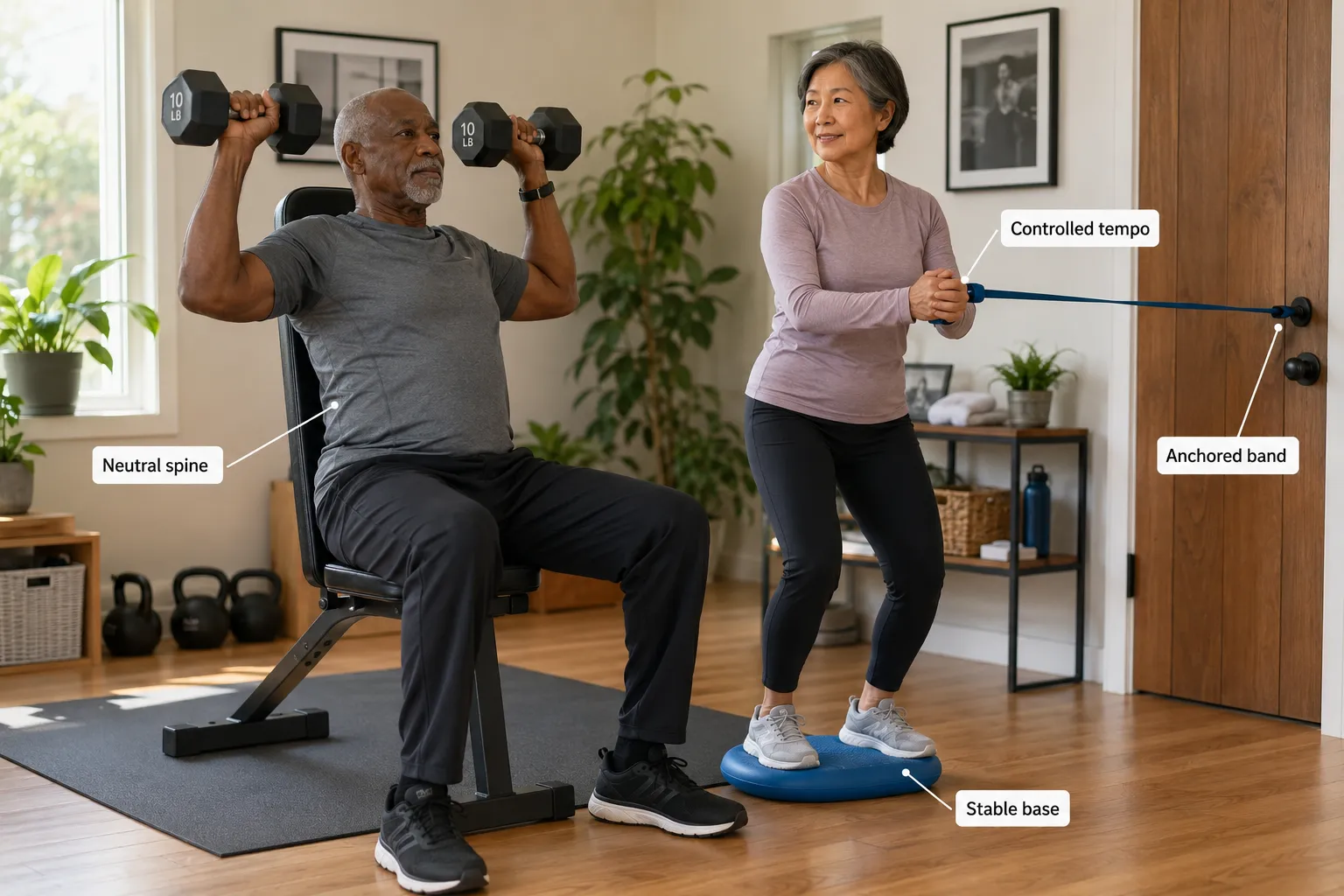
Yes, seniors can absolutely build muscle without any high-impact exercise. Muscle grows in response to progressive tension, not impact. Studies summarized by the National Strength and Conditioning Association confirm that older adults training with machines, dumbbells, and bands at moderate-to-vigorous intensity build meaningful muscle and reverse sarcopenia [6][8].
Can seniors build muscle without high impact exercise

The mechanism is simple: muscle fibers respond to being challenged near their limit, whatever the source of resistance. A slow, controlled 12-rep set of dumbbell rows produces adaptation similar to any traditional strength method, without a single jump or drop landing.

"The old advice to stick with light weights after 50 has been replaced. Current guidance says older adults benefit from heavier loading, safely progressed." [5][6]

What equipment should seniors avoid for joint safety

Seniors should generally avoid equipment that demands impact, extreme range of motion, or unsupported balance under load. This isn't about age fear, it's about risk-to-reward ratio [3][4].

Skip or use with caution:

  • Plyo boxes and jump ropes, high impact on knees and ankles
  • Treadmills used for running (walking is fine)
  • Heavy barbell back squats without a rack and spotter
  • Ab wheels and roman chairs, hard on the lumbar spine
  • Cheap vibration plates, poor evidence for strength
  • BOSU balls loaded with heavy weights, fall risk outweighs benefit

The pattern: anything that combines heavy load with unstable base, or that requires airborne landings, belongs in an athlete's gym, not a senior's.

How much does a home gym for seniors cost

A functional senior home gym costs $150 to $800 depending on how far you go. Bare essentials, bands, a mat, ankle weights, can come in under $55 as of April 2026 [9]. A complete setup with adjustable dumbbells, bench, and a balance pad lands around $400,$600 [1][3].

Tiered budgets:

  • Starter ($55,$150): Resistance band set, yoga mat, 2 lb ankle weights, balance pad
  • Standard ($300,$600): Add adjustable dumbbells (5-50 lb), foldable bench, mini-step
  • Premium ($800,$2,500): Add a compact cable machine or selectorized multi-station [10]

A quality adjustable dumbbell pair often replaces $500+ worth of fixed dumbbells and saves square footage, usually the best single line item on the receipt.

Stationary bikes vs recumbent bikes for senior strength

Neither bike is primarily a strength tool, but recumbent bikes win for seniors because the seated, back-supported position removes pressure from the lower spine and wrists [7]. Upright stationary bikes work fine for fit seniors with no back issues.

For actual leg strength, though, bikes are a supplement, not the main event. Loaded step-ups, banded squats to a chair, and dumbbell deadlifts build far more functional lower-body strength than pedaling. Use the recumbent bike for warm-ups, cardio days, and joint-friendly conditioning, not as a replacement for resistance work [7].

Does a rowing machine work for seniors with back pain

A rowing machine can work for seniors with back pain, but only if the person has good hip mobility and is coached on form. The row is a hip-hinge, not a lower-back pull. Poor form turns it into repeated lumbar flexion under load, exactly what most back-pain sufferers should avoid [4].
Does a rowing machine work for seniors with back pain

Safer alternatives for back-pain seniors:

  • Seated cable rows (chest supported)
  • Banded rows with feet against a wall
  • Chest-supported dumbbell rows on an incline bench

If you love rowing, use a magnetic-resistance rower, keep the damper low, and stop the moment form breaks.

What weight should seniors start with for home training

Seniors should start with a weight that lets them complete 8-12 clean reps with 2 reps still in reserve. For most healthy older beginners, that's 3-8 lb dumbbells for shoulder work and 8-20 lb dumbbells for rows, presses, and squats to a chair [5].

The 2026 Harvard Health resistance prescription for older adults is straightforward:

  • 2-3 sessions per week
  • 8-12 reps per set
  • 2-3 sets per exercise
  • Rest 60-90 seconds between sets
  • Increase weight when 12 reps feels easy

The mistake isn't starting too heavy, it's staying too light forever. Progress the load every 2-3 weeks [5][6].

How often should seniors do strength training at home

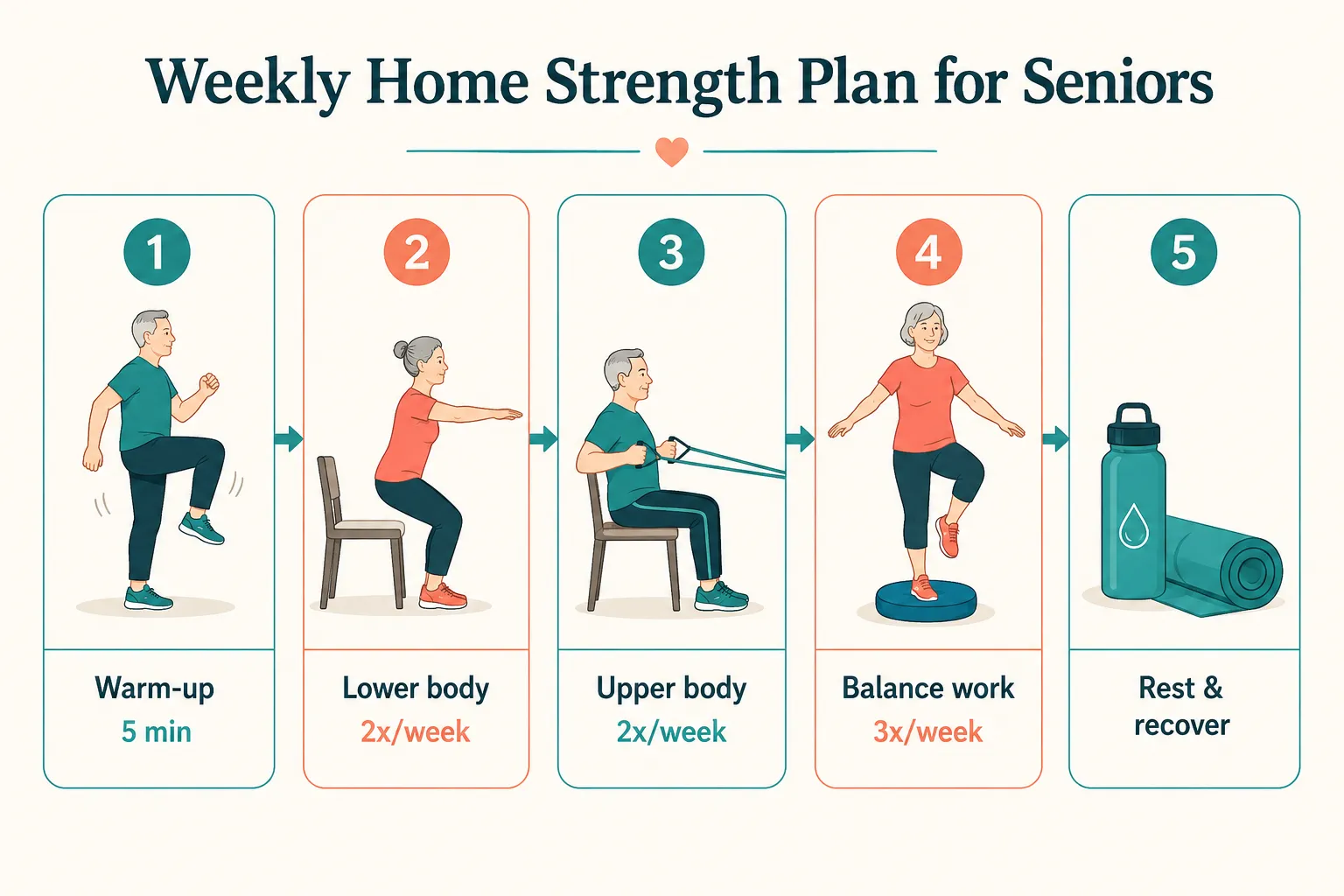
Seniors should strength train two to three non-consecutive days per week, with each session lasting 30-45 minutes. This frequency is enough to build muscle and preserve bone density without overloading recovery [6][8].

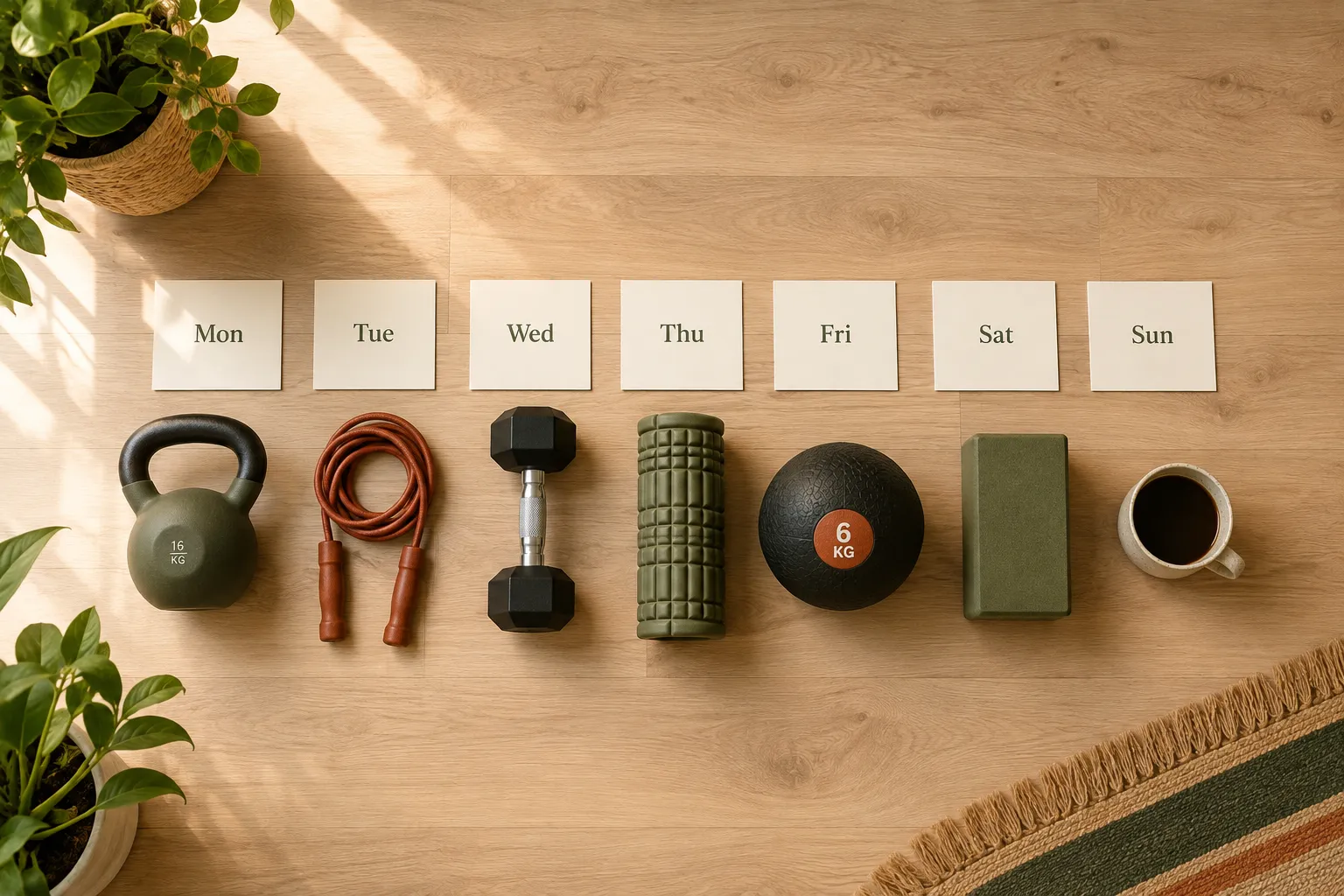
A sample week:

  • Monday: Full-body strength (dumbbells + bench)
  • Tuesday: Balance + recumbent bike, 20 min
  • Wednesday: Rest or gentle walk
  • Thursday: Full-body strength (bands + cable)
  • Friday: Balance pad work + mobility
  • Saturday: Optional light strength or walk
  • Sunday: Rest

Balance training deserves its own slot 2-3 times a week, it's the single biggest fall-prevention lever [9].

Cable machines vs free weights for senior safety

Cable machines are generally safer than free weights for seniors because the resistance path is guided and the load can't fall on you. Free weights build more stabilizer strength but require better balance and technique [10].

Choose cable machines if you train alone, have shoulder impingement, or have any fall history.

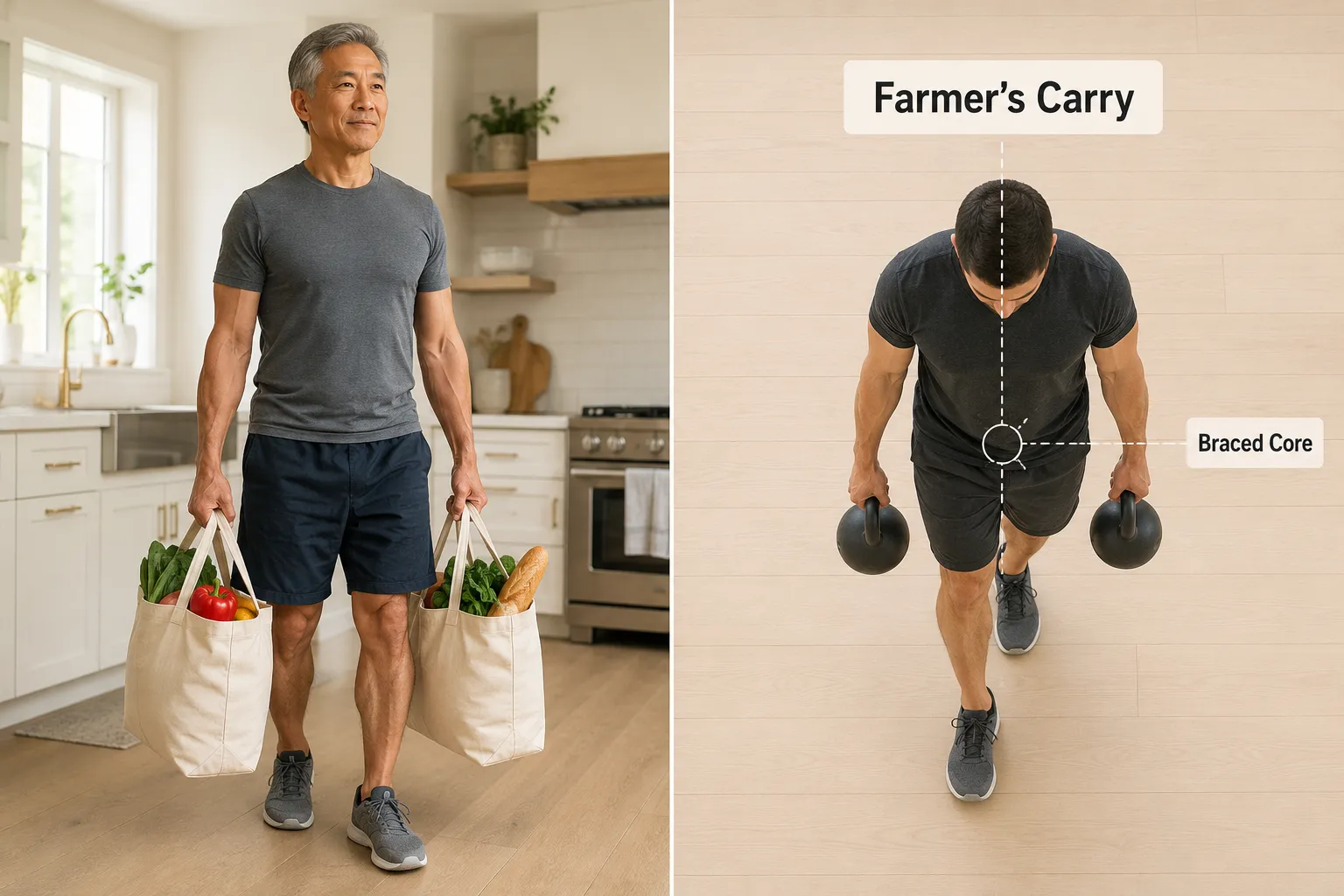
Choose free weights if you have good balance, a training partner nearby, and want maximum functional carryover to daily life (carrying groceries, lifting grandkids).

Best of both worlds: a compact functional trainer at home covers 80% of what a commercial gym does, in a 4×4 ft footprint [10].

Common mistakes seniors make with home exercise equipment

The most common mistakes are buying too much, going too light, and neglecting warm-ups. Each one quietly kills results [4][5].

Top mistakes to avoid:

  • Buying a treadmill and calling it strength training. It isn't.
  • Sticking with 3 lb dumbbells for years. Muscle needs progressive challenge.
  • Skipping the 5-minute warm-up. Cold joints don't like sudden load.
  • Training the same muscles daily. Recovery is when muscle grows.
  • Ignoring the legs. Lower-body weakness predicts falls better than almost any other marker [9].
  • No balance work. Strength without balance still leaves fall risk on the table.

What if I have limited space for senior workout equipment

Limited space isn't a barrier, a full senior strength routine fits in 9 square feet. The key is choosing tools that stack, fold, or hide in a closet [3].

Small-space essentials:

  • One pair of adjustable dumbbells (footprint: 2 ft x 1 ft)
  • Resistance band set (fits in a drawer)
  • Foldable bench (stores vertically)
  • Balance pad (leans against the wall)
  • Wall-mounted cable trainer (uses zero floor space when folded)

Apartment dwellers should prioritize quiet gear. Bands, dumbbells on rubber mats, and cable machines make almost no noise, no dropped plates, no impact through the floor [1].

Conclusion

The strongest, safest home setup for older adults isn't a wall of machines, it's a focused kit built around adjustable dumbbells, resistance bands, a bench, and a balance pad. This is the top home exercise equipment for seniors who want strength, not impact, because every piece loads muscle without punishing joints. Add a compact cable machine if the budget allows and you want maximum arthritis-friendly versatility [10].

Actionable next steps:

  1. Start with a $150 kit: adjustable-tension bands, a mat, and a balance pad.
  2. Add adjustable dumbbells within 30 days once you know you'll stick with it.
  3. Train 2-3 days a week, 8-12 reps, and progress the weight every 2-3 weeks [5].
  4. Add balance-pad work to at least three sessions per week.
  5. Reassess your load every month, if 12 reps feels easy, it's time to go heavier.

Strength after 60 isn't optional, it's the closest thing there is to a longevity drug. The equipment above makes it accessible from a spare corner of any room.

FAQ

Is it too late to start strength training at 70 or 80?
No. Research consistently shows adults in their 70s, 80s, and 90s gain muscle and function from resistance training [6][8]. Start light, progress slowly, and see a doctor first if you have cardiac or orthopedic issues.

Are resistance bands enough on their own?
For beginners and anyone with joint issues, yes, for a while. Bands build real strength for the first 6-12 months. After that, most seniors benefit from adding dumbbells or a cable machine to keep progressing [4].

Do I need a personal trainer to start?
Not required, but 2-3 sessions with a senior-focused trainer or physical therapist to check form is one of the best investments you can make.

How long until I see results?
Most seniors feel stronger in daily tasks (stairs, groceries, getting up from chairs) within 4-6 weeks of consistent training [5].

What's the single best exercise for fall prevention?
Loaded step-ups combined with balance-pad standing work. They train the exact muscles and reflexes used to catch yourself [9].

Can I use household items instead of equipment?
Yes, water jugs, canned goods, and a sturdy chair cover basic movements. But adjustable equipment eventually becomes worth the cost because progression is smoother [1].

Should I do cardio or strength first?
For seniors focused on muscle and fall prevention, do strength first, cardio second. Cardio before heavy lifting fatigues the legs and increases fall risk during the strength session [7].

Is soreness normal?
Mild soreness for 1-2 days is normal for beginners. Sharp joint pain is not, stop and reassess form or load.

References

[1] Best Home Gym Equipment For Seniors – https://www.ritfitsports.com/blogs/article/best-home-gym-equipment-for-seniors
[2] Best – https://www.theseniorlist.com/exercise/best/
[3] Home Gym For Seniors – https://garagegymbuilders.com/guides/home-gym-for-seniors/
[4] Best Strength Training Equipment For Seniors – https://rebootedbody.com/best-strength-training-equipment-for-seniors/
[5] Strength Training After 50 Guidelines – https://dailycrunch.org/articles/strength-training-after-50-guidelines
[6] Resistance Training For Older Adults – https://www.nsca.com/about-us/position-statements/resistance-training-for-older-adults/
[7] Best Ellipticals For Seniors – https://barbend.com/best-ellipticals-for-seniors/
[8] Resistance Training For Older Adults Position.1 – https://www.nsca.com/contentassets/2a4112fb355a4a48853bbafbe070fb8e/resistance_training_for_older_adults__position.1.pdf
[9] Best Low Impact Senior Gym Gear – https://www.fuelingfitnessandfindingfocus.com/2026/04/best-low-impact-senior-gym-gear.html
[10] Best Resistance Training Machines For Seniors – https://www.ofzenandcomputing.com/best-resistance-training-machines-for-seniors/
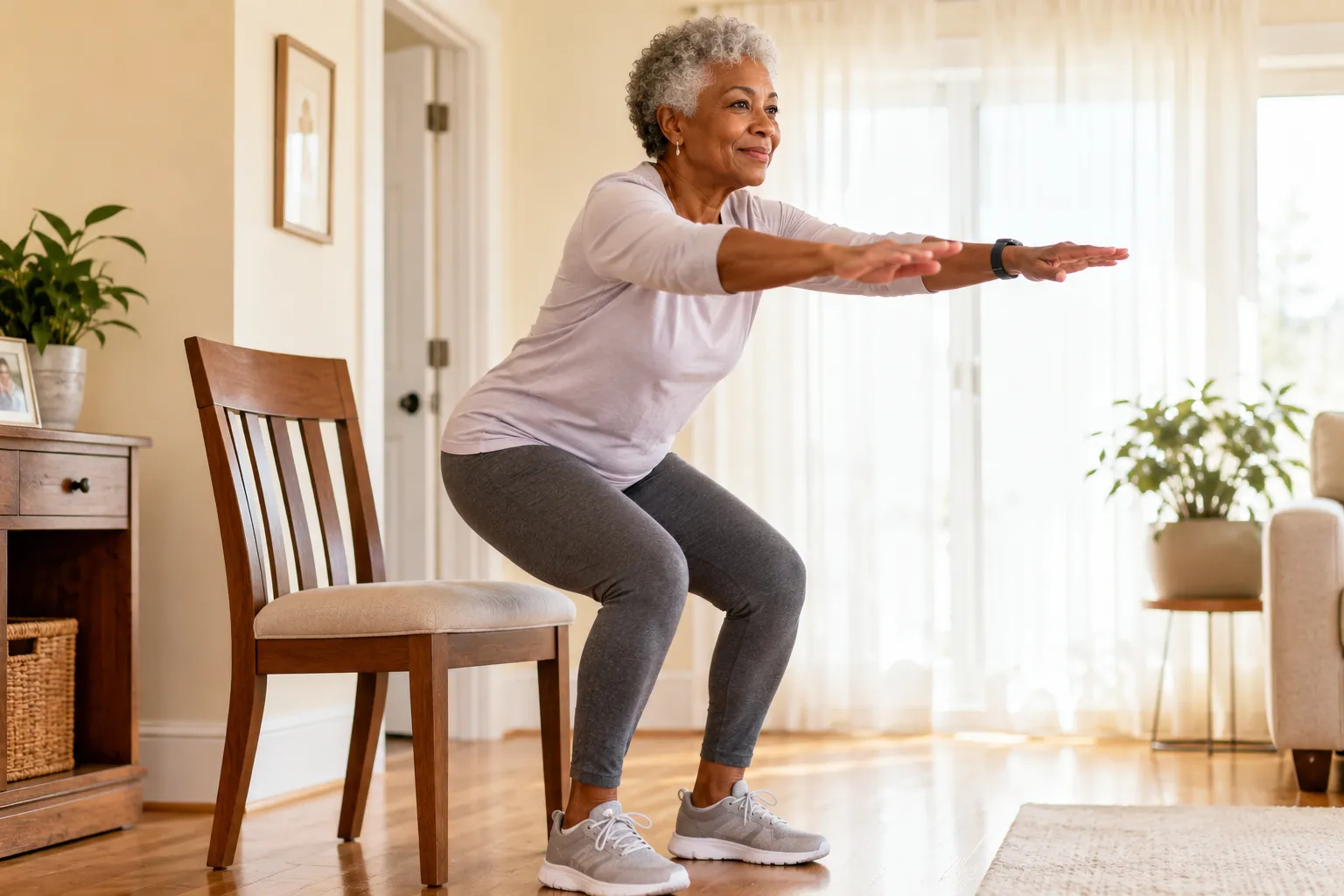
Functional strength training for older adults at home

Functional strength training for older adults at home

{"cover":"Professional landscape format (1536×1024) editorial hero image with bold text overlay 'Functional Strength at Home' in crisp white sans-serif on a warm-toned semi-transparent panel, centered with 8% safe margins. Background: bright natural-light photograph of an active 70-year-old woman in athletic wear performing a sit-to-stand exercise from a sturdy wooden chair in a sunlit living room, resistance band nearby on hardwood floor, houseplants and large window with soft morning light, warm color grade, magazine cover polish, shallow depth of field, inspiring and dignified mood.","content":["Bright editorial photograph in landscape format (1536×1024) of a diverse group of three older adults (Asian man in his 70s, Black woman in her 60s, white man in his 80s) doing bodyweight squats and wall push-ups in a sunlit home living room, wearing casual athletic clothing, resistance bands and light dumbbells on a yoga mat nearby, natural window light streaming in, warm neutral palette, high editorial quality, candid and encouraging atmosphere, shallow depth of field","Split-screen editorial landscape image (1536×1024): left half shows an older woman in her late 60s carrying grocery bags up porch steps with confident posture in bright outdoor daylight; right half shows the same style of woman performing a farmer's carry with two small dumbbells in a bright home kitchen, symbolizing how functional training translates to daily life; warm natural lighting, magazine editorial polish, no text overlays, clean composition","Flat vector infographic in landscape format (1536×1024) showing a weekly functional training schedule for seniors: seven day-of-week icons across the top, with small illustrated exercise icons (chair squat, wall push-up, heel raise, band row, single-leg stand) mapped to three training days, rest and walking icons on other days; soft sage green, cream, and terracotta palette, short labels max 3 words each, generous 8% safe margins, clean modern design, save-worthy Pinterest infographic quality"}

Professional landscape hero image () with a reading "Functional Strength Training for Older". CRITICAL TYPOGRAPHY RULES:

Last updated: August 11, 2026

Strength-focused programs for seniors have climbed into the top worldwide fitness trends this year, and most of that momentum is happening in living rooms, not gyms. The reason is simple: home-based routines using resistance bands, light dumbbells, and bodyweight moves deliver the same fall-prevention and independence benefits as commercial gym programs, without the commute, cost, or intimidation factor.

Quick Answer

Quick Answer

Functional strength training for older adults at home means practicing movements that mirror real daily tasks, standing up from a chair, climbing stairs, carrying groceries, reaching overhead, using bodyweight, resistance bands, or light dumbbells. Most adults over 60 should aim for 2 to 3 sessions per week, 20 to 40 minutes each, targeting the legs, hips, core, and upper body. Done consistently, it reduces fall risk, protects independence, and produces visible strength gains within 6 to 12 weeks.

Key Takeaways

  • Functional training beats traditional lifting for seniors because it trains movement patterns used in daily life, not isolated muscles.
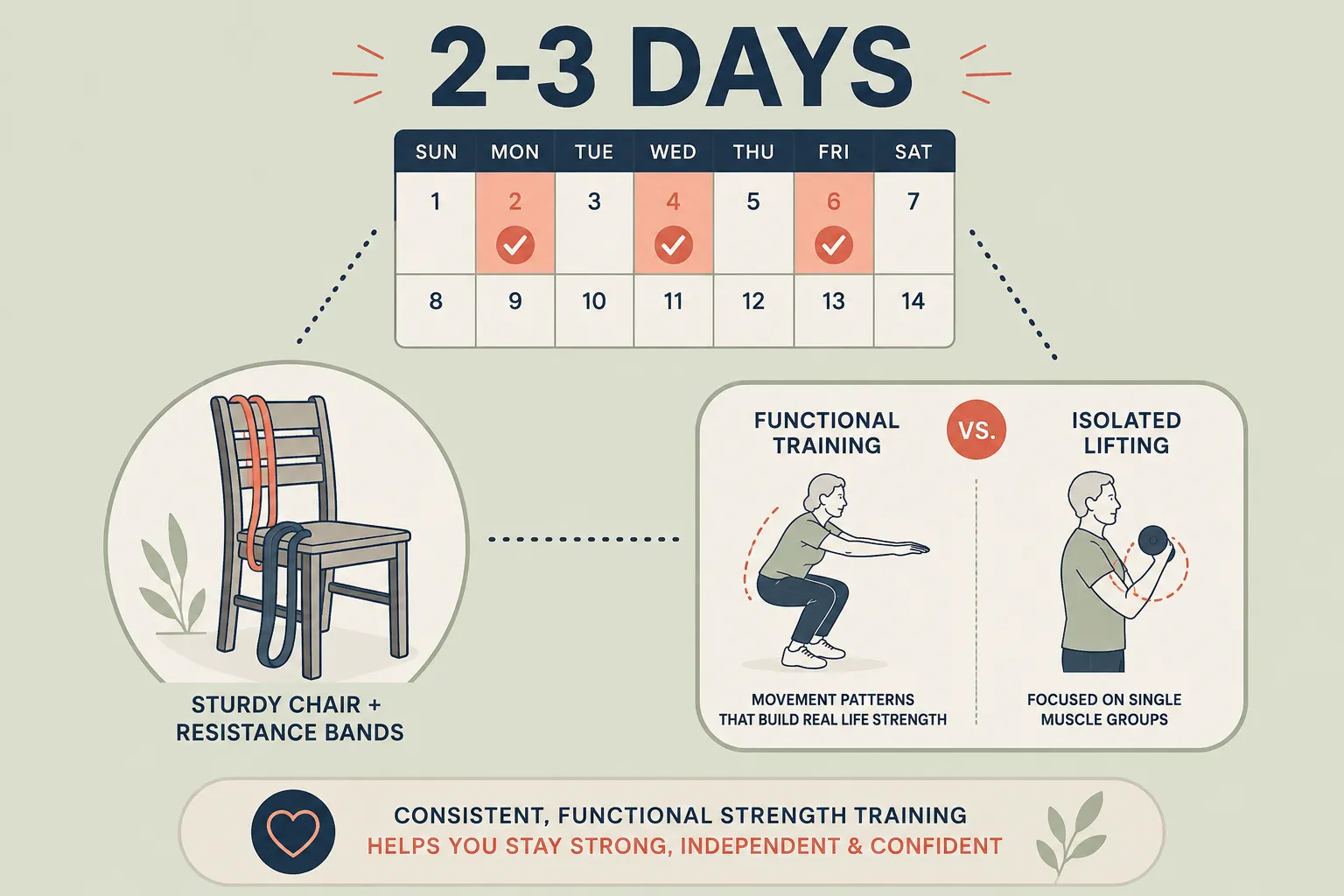
  • 2 to 3 non-consecutive days per week is the sweet spot for most older adults.
  • A sturdy chair, a wall, and a set of resistance bands are enough to start, no gym required.
  • Fall risk drops significantly when programs include balance work alongside strength (backed by decades of research from the CDC and WHO guidelines).
  • Arthritis is not a reason to avoid strength training, in most cases, it's a reason to start.
  • Expect noticeable strength gains in 6 to 8 weeks and functional improvements (easier stairs, better balance) within 4 weeks.
  • Progression matters more than intensity, small weekly increases work better than pushing hard once.
  • A physical therapist is ideal for anyone recovering from injury or surgery; a trainer is optional for healthy beginners.

)

What Is Functional Strength Training and Why Does It Matter for Seniors

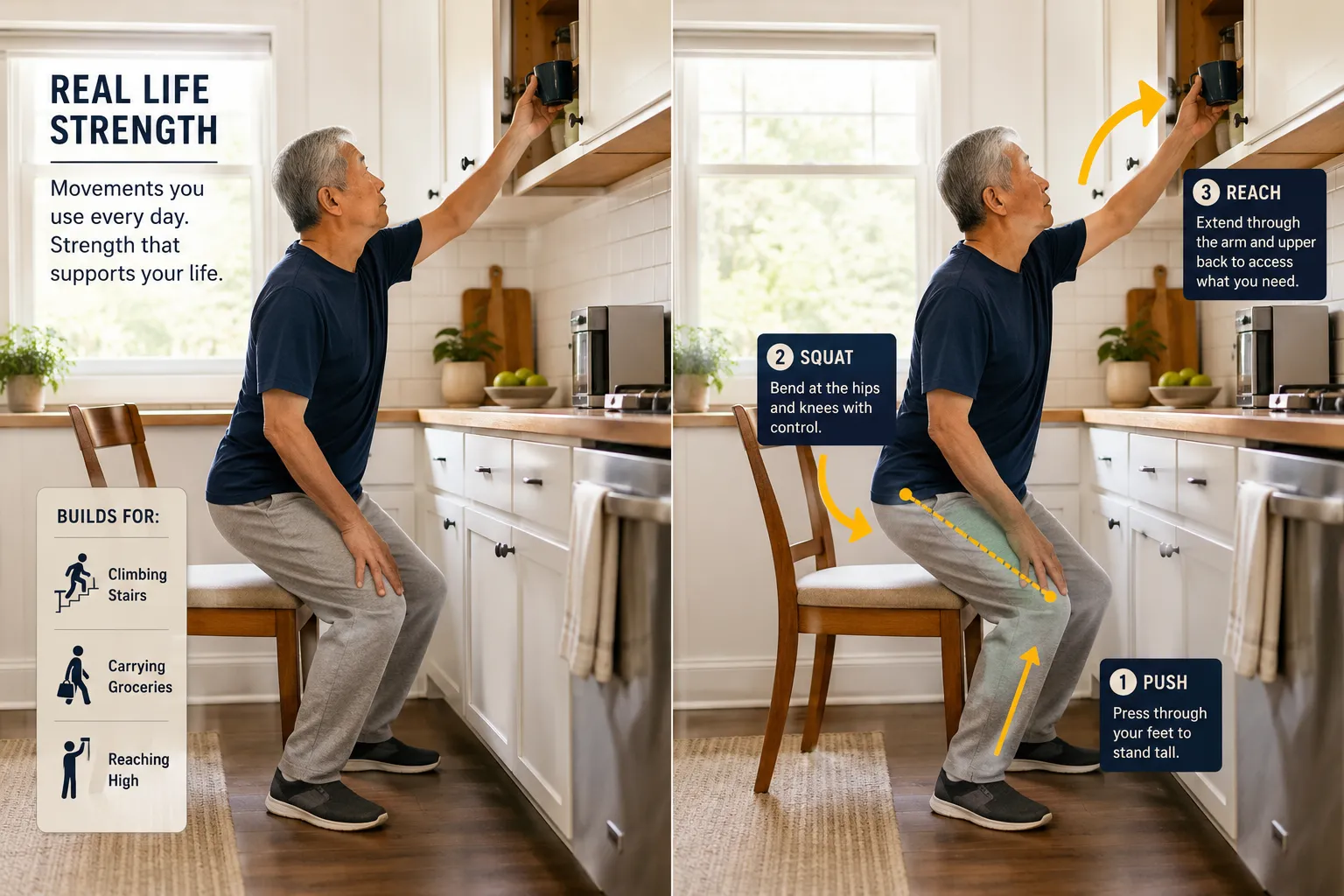
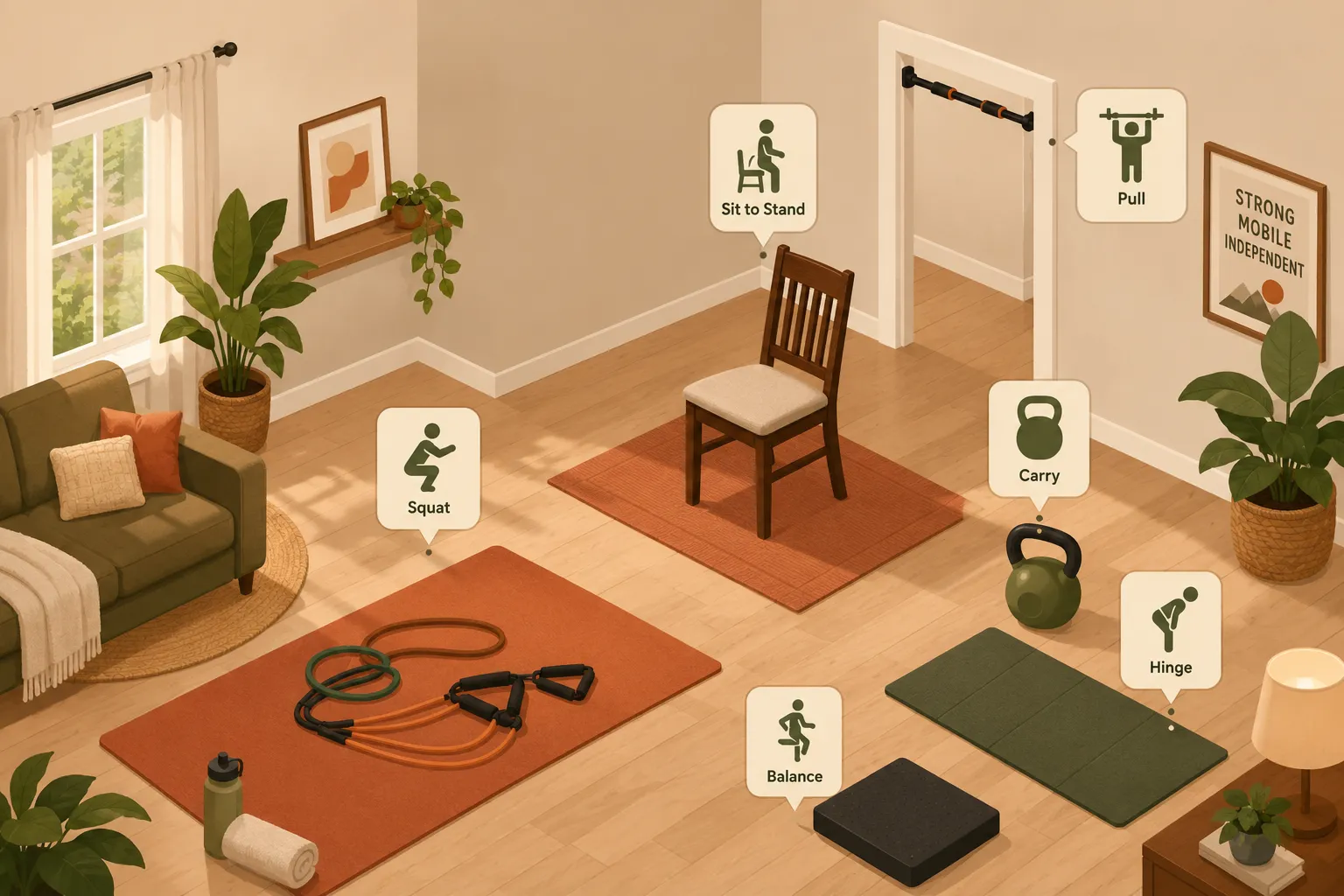
Functional strength training is exercise designed around real-world movements, squatting, pushing, pulling, hinging, carrying, and rotating, rather than isolated muscle work like bicep curls. For older adults, it matters because it directly protects the abilities that keep people independent: getting off the toilet, climbing into a car, catching yourself when you trip, lifting a grandchild.

After age 30, adults lose roughly 3-8% of muscle mass per decade, and that rate accelerates after 60. This loss (called sarcopenia) is the single biggest predictor of losing independence in later life. Functional training slows and often reverses it while also training the nervous system to coordinate movement, the piece that pure weight machines miss.

The goal isn't to look strong. It's to still be able to do what you love at 85.

Functional Strength Training vs Regular Weight Lifting for Older Adults

The short answer: Functional training is usually the better default for adults over 60, but traditional lifting still has a place, especially for building raw strength in specific muscles.

Here's how they compare:

Feature Functional Strength Training Traditional Weight Lifting
Movement pattern Multi-joint, real-life motions Often single-joint, isolated
Equipment needed Minimal (bands, bodyweight, light weights) Machines, barbells, gym access
Balance component Built-in Usually absent
Injury risk (untrained) Lower Higher
Best for Daily independence, fall prevention Peak strength, bodybuilding goals
Home-friendly Excellent Limited

Choose functional training if your goal is staying independent, preventing falls, or moving better in daily life. Add traditional lifting if you already have a strength base and want to target specific weak areas (like grip or shoulder strength).

Best Functional Strength Exercises You Can Do at Home Without Equipment

The most effective home routine covers five movement patterns. Start with these bodyweight versions:

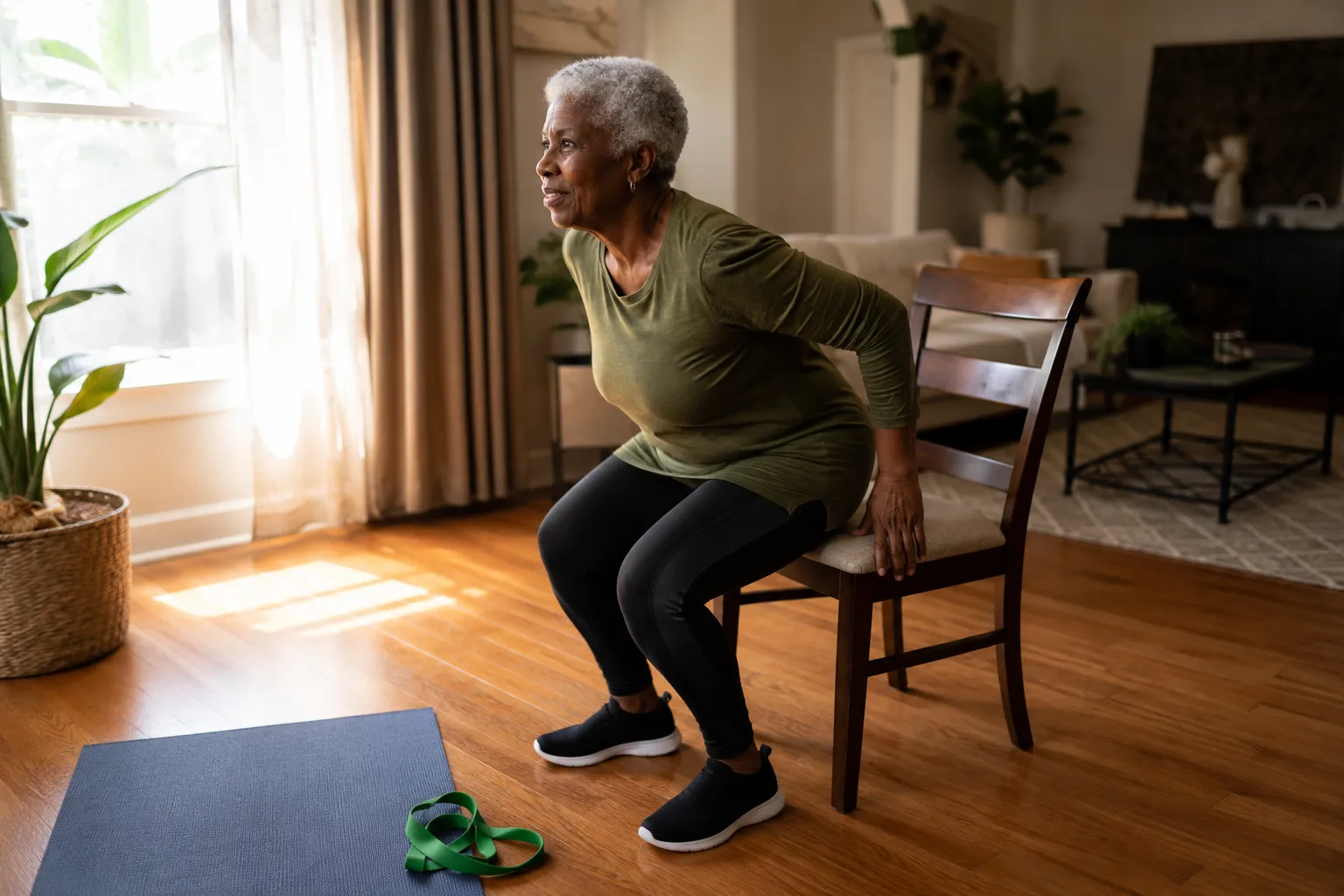
1. Sit-to-stand (chair squat), Sit on a sturdy chair, feet flat, arms crossed. Stand up without using hands. Sit back down with control. Trains the same muscles used to get off the toilet or out of a car. Start with 2 sets of 8-10.

2. Wall push-up, Stand arm's length from a wall, hands at shoulder height. Bend elbows to bring your chest toward the wall, then push back. Builds pushing strength for getting up from the floor. 2 sets of 8-12.

3. Heel raises, Stand behind a chair, hold the back for balance. Rise onto the balls of your feet, then lower slowly. Strengthens calves and ankles for stairs and walking. 2 sets of 12-15.

4. Standing hip hinge, Stand tall, hands on hips. Push hips back like closing a car door with your rear, keeping your back flat. Return upright. Trains the pattern for picking things up safely. 2 sets of 10.

5. Single-leg stand, Hold a counter, lift one foot slightly. Balance for 10-30 seconds. Switch sides. The single best fall-prevention drill. 3 times per leg.

Do the whole circuit 2-3 times per week. Add 1-2 reps per week as it gets easier.

How Often Should Older Adults Do Functional Strength Training

Two to three sessions per week, on non-consecutive days. That's the standing recommendation from the World Health Organization and the American College of Sports Medicine for adults 65 and older.

A practical week looks like this:

  • Monday: 30-minute strength session
  • Tuesday: Walking or light activity
  • Wednesday: Rest or gentle stretching
  • Thursday: 30-minute strength session
  • Friday: Walking
  • Saturday: Optional third strength session or balance work
  • Sunday: Rest

Muscles need 48 hours to recover and rebuild, which is why back-to-back strength days aren't ideal for beginners. If you're feeling more energetic, add walking or gentle mobility on off days, not more lifting.

Can Functional Strength Training Help Prevent Falls in Seniors

Can Functional Strength Training Help Prevent Falls in Seniors

Yes, this is one of the most consistently supported findings in geriatric research. Programs that combine strength (especially lower body) with balance work reduce fall rates by roughly 20-30% in community-dwelling older adults, according to systematic reviews cited in WHO and CDC guidelines.

Falls happen when three things fail at once: leg strength, balance reactions, and ankle stability. Functional training hits all three. The exercises that matter most:

  • Sit-to-stands (leg strength)
  • Single-leg stands (static balance)
  • Heel-toe walking (dynamic balance)
  • Step-ups on a low step (reactive strength)
  • Heel and toe raises (ankle stability)

Include at least one balance-focused move every session. Progress by narrowing your base of support (feet together → tandem stance → single leg), then by closing your eyes briefly while holding a counter.

)

What Equipment Do You Need to Start Functional Strength Training at Home

You need almost nothing to start. A sturdy chair, a wall, and enough floor space to lie down cover 80% of a beginner program.

When you're ready to add resistance, buy in this order:

  1. A set of resistance bands (loop bands and long tube bands with handles), $15-30. Most versatile purchase you can make.
  2. Light dumbbells, start with a pair each of 2, 5, and 8 lbs. Adjustable dumbbells save space.
  3. A yoga mat for floor work, $20.
  4. A stable step (an actual exercise step or the bottom stair) for step-ups.
  5. A door anchor for bands, under $10, unlocks rowing and pulling movements.

Skip the vibration plates, ab rollers, and complicated machines. They're marketing, not fitness.

Is Functional Strength Training Safe for People With Arthritis or Joint Pain

Yes, and for most people with osteoarthritis, it's actively recommended. The Arthritis Foundation and every major rheumatology guideline lists resistance training as a first-line treatment for joint pain, because stronger muscles offload stressed joints.

The rules for training with arthritis:

  • Move through pain-free ranges only. If a squat hurts at the bottom, don't go as low.
  • Warm up longer, 5-10 minutes of walking or gentle mobility before strength work.
  • Expect stiffness, not sharp pain. A little discomfort during exercise is fine. Sharp, stabbing, or joint-line pain is a stop signal.
  • Slow tempo helps. Take 3 seconds to lower and 2 seconds to rise. This reduces joint stress.
  • Bad days happen. On flared-up days, do less volume or switch to gentle range-of-motion work.

If you have rheumatoid arthritis, a joint replacement, or severe joint damage, get clearance from your doctor or physical therapist before starting.

How Long Does It Take to See Results From Functional Strength Training

Most older adults notice functional improvements within 2-4 weeks and measurable strength gains within 6-8 weeks. The pattern typically looks like this:

  • Weeks 1-2: Better coordination, exercises feel less awkward. Not much visible change.
  • Weeks 3-4: Stairs feel easier. Getting up from chairs is smoother. Balance improves.
  • Weeks 6-8: You can do more reps or heavier resistance. Posture often improves.
  • Weeks 12+: Real muscle changes. Clothes may fit differently. Daily tasks feel notably easier.
  • 6 months+: Bone density improvements (especially with weight-bearing moves), significant fall-risk reduction.

The catch: results reverse quickly if you stop. Two weeks off is enough to lose noticeable strength after 60. Consistency beats intensity, three modest sessions per week for a year outperforms two hard weeks followed by quitting.

Functional Strength Training for Seniors With Limited Mobility

Limited mobility doesn't disqualify anyone from strength training, it just changes the starting point. Seated and supported exercises can build meaningful strength for people who can't stand for long, use a walker, or are recovering from surgery.

A seated functional routine:

  • Seated marches, lift knees alternately, 30 seconds
  • Seated leg extensions, straighten one knee, hold 2 seconds, lower
  • Seated overhead press with light dumbbells or soup cans
  • Seated rows with a resistance band anchored to a doorknob
  • Ankle circles and heel-toe pumps for circulation and ankle strength
  • Seated torso rotations, arms crossed, rotate side to side

If standing is possible with support, add supported sit-to-stands (using arms), counter-supported heel raises, and gentle marches while holding a counter. Progress by reducing how much you rely on the support, not by rushing to standing exercises.

Common Mistakes Older Adults Make When Doing Strength Training at Home

Common Mistakes Older Adults Make When Doing Strength Training at Home

The biggest errors are almost always about approach, not exercise choice:

  1. Going too easy for too long. If 12 reps feels effortless, it's not building strength. The last 2-3 reps should feel challenging.
  2. Skipping warm-ups. 5 minutes of walking or marching in place prevents most tweaks and pulls.
  3. Holding the breath. Exhale on effort (the hard part), inhale on the easier part. Breath-holding spikes blood pressure.
  4. Ignoring the lower body. Legs and hips drive independence. Don't spend all your time on arms.
  5. No progression plan. Doing the same routine at the same difficulty for months stops producing results.
  6. Skipping balance work. Strength without balance still leaves fall risk on the table.
  7. Comparing to old fitness levels. The goal is progress from where you are today, not returning to age 40.

Should You Get a Trainer or Do Functional Strength Training on Your Own

A qualified trainer or physical therapist is worth the investment for the first 4-8 sessions if you're new, recovering from injury, or managing chronic conditions. After that, most healthy older adults can train independently using video guidance and a written program.

Get professional help if:

  • You've had a recent surgery, fall, or hospitalization
  • You have Parkinson's, MS, severe arthritis, or heart conditions
  • You've never done resistance training and want form checked
  • Your balance is already impaired

You can start solo if:

  • You're generally healthy and cleared by your doctor
  • You can follow along with reputable video programs (many senior-specific programs exist on YouTube from licensed physical therapists)
  • You start conservatively and progress slowly

The National Institute on Aging's free "Go4Life" workout materials are a solid starting point built specifically for older adults.

Functional Strength Training vs Yoga for Older Adults: Which Is Better

They solve different problems, and the best answer is often both. Strength training builds muscle and bone. Yoga builds flexibility, balance, and body awareness.

Functional Strength Training Yoga
Best at Building muscle, preserving bone, fall prevention Flexibility, balance, stress relief
Cardiovascular Moderate Low (except vigorous styles)
Muscle gains High Modest
Joint mobility Moderate High
Accessibility High High (chair yoga available)

Choose strength training first if you're losing muscle, worried about falls, or need to protect bone density. Add yoga for mobility, balance, and mental well-being. Two strength sessions plus one yoga session per week is an excellent combination for most adults over 60.

How to Modify Functional Strength Exercises if You Have Balance Issues

Every standing exercise can be modified by adding support, changing the base of support, or moving to a seated version. The rule: never train balance in a position where a real fall could happen.

Balance-friendly modifications:

  • For squats: Hold the back of a chair with both hands, then one hand, then fingertips as balance improves
  • For lunges: Do split squats holding a counter, or replace with step-ups
  • For single-leg stands: Start touching a wall with your hand, then a counter, then no support with a chair nearby
  • For overhead work: Sit in a chair with back support
  • For anything on the floor: Have a chair or sturdy furniture nearby to help you get up

Train balance in a safe corner (walls on two sides, a chair in front) so a stumble means grabbing furniture, not falling.

)

What's the Difference Between Functional Training and Physical Therapy for Seniors

Physical therapy treats specific medical problems; functional training builds general fitness. A physical therapist diagnoses movement issues, uses exercises as medicine to fix them, and is covered by insurance when prescribed. Functional training is a maintenance and improvement program you do on your own or with a trainer.

See a physical therapist for:

  • Recent injury, surgery, or fall
  • Persistent pain that limits daily activities
  • Neurological conditions (stroke recovery, Parkinson's)
  • Significant balance decline
  • After a hospitalization

Do functional training for:

  • Maintaining and building strength over years
  • Preventing decline before it starts
  • General fitness, weight management, energy
  • After you've been discharged from PT and want to keep gains

Many older adults benefit from a "PT graduation" model: work with a physical therapist to fix specific issues, then transition to an ongoing functional training program to maintain the gains.

FAQ

Is 70 too old to start strength training?
No. Research consistently shows adults in their 80s and 90s gain strength from resistance training. The benefits often show up faster in previously sedentary older adults because the starting point is lower.

How heavy should the weights be?
Light enough that you can do 10-15 reps with good form, heavy enough that the last 2-3 reps feel challenging. For most beginners, that's 2-8 lb dumbbells or light-resistance bands.

Do I need to warm up before functional training?
Yes. Five minutes of walking, marching in place, or gentle arm circles prepares muscles and joints and reduces injury risk.

Can I do this if I have osteoporosis?
Usually yes, and it's often recommended, but avoid heavy forward-bending or spinal-loading moves without medical clearance. A physical therapist can build a bone-safe program.

What if I miss a week?
Don't try to make it up. Resume at your previous level or slightly lighter. Missing occasional weeks is normal and won't undo progress.

Should I train on an empty stomach?
No need. A light snack (banana, toast, yogurt) 30-60 minutes before helps energy. Drink water during the session.

Is soreness after workouts normal?
Mild soreness for 1-2 days is normal, especially when starting or adding difficulty. Sharp pain, joint pain, or soreness lasting over 3 days means you did too much.

Can I combine this with walking?
Yes. Walking and strength training complement each other perfectly. Alternate days is the simplest schedule.

How long should each session be?
20-40 minutes is ideal. Beginners can start with 15-20 minutes and build up.

Do I need to stretch after?
Gentle stretching for 5 minutes after strength work is beneficial but not critical. Focus on the muscles you just trained.

Conclusion: Your Next Steps

Functional strength training at home is the highest-return investment older adults can make in their independence. It's cheap, backed by decades of research, and works for nearly every fitness level and health status.

Start this week:

  1. Pick 3 days on your calendar (e.g., Monday, Wednesday, Friday).
  2. Choose 5 exercises from the bodyweight list above. Do 2 sets of each.
  3. Time yourself, aim for 20 minutes total, including warm-up.
  4. Track it. A simple notebook works. Note reps done and how it felt.
  5. After 2 weeks, add one rep to each exercise, or add a third set.
  6. After 4 weeks, buy resistance bands and start adding them.
  7. After 8 weeks, reassess: are stairs easier? Getting up from chairs smoother? That's the real measure.

If you have any concern about health conditions, medications, or recent surgeries, get medical clearance first, but don't use that as an excuse to delay. Ask your doctor at your next visit and start with seated exercises in the meantime.

The strongest predictor of independence at 85 isn't genetics or luck. It's the habits you build now.

Hybrid home workouts combining strength, mobility, and recovery

Hybrid home workouts combining strength, mobility, and recovery

Last updated: August 8, 2026

Quick Answer

Hybrid home workouts combining strength, mobility, and recovery blend compound lifting, joint prep, and active recovery into one weekly plan, usually 3-5 focused sessions of 30-60 minutes. The goal is building muscle and staying pain-free without the burnout of daily high-intensity training. Most people need only a pair of adjustable dumbbells, a resistance band, and a mat to run a full program at home.[2][10]

Quick Answer

Key Takeaways

  • A standard hybrid week runs 3-5 strength days plus 1-2 mobility or active recovery sessions.[2][10]
  • Sessions of 30-45 minutes are enough when programmed well, longer isn't better.[8]
  • Mobility comes first as prep, foam rolling and stretching come after the strength block.[6]
  • Minimal gear works: adjustable dumbbells, a band, and a mat cover 90% of hybrid programming.[4][5]
  • Hybrid training beats CrossFit for joint health and sustainability, but CrossFit wins on community and pure intensity.[1]
  • You can train daily only if you rotate intensity, hard/easy/mobility, not hard every day.[10]
  • Beginners should start with 3 sessions a week for 4 weeks before adding volume.[4]

What's the Difference Between Hybrid Workouts and Regular Strength Training?

Regular strength training focuses on one goal, usually getting stronger or bigger, through lifting alone. Hybrid workouts fold in cardio conditioning, mobility drills, and recovery work inside the same weekly plan, so you build strength without losing endurance or joint range of motion.[1][10]

Traditional strength training looks like: bench, squat, deadlift, rows, 3-5 sets of 5-8 reps, rest days between. Nothing else.

Hybrid training looks like: those same lifts on 2-3 days, plus a conditioning day (kettlebell flows, sprints, tempo cardio), a dedicated mobility session, and one true recovery day. The point is a body that's strong, springy, and durable, not one that can only do one thing well.[10]

Choose hybrid if you want to lift heavy and hike, run, or play sports without feeling stiff. Choose pure strength if your only goal is maximum barbell numbers.

How Do You Combine Strength and Mobility Work in One Workout?

Put mobility at the start as targeted prep for the lifts you're about to do, then do strength, then finish with 5-10 minutes of static stretching or breathing. This sandwich structure warms tissue, loads it, then downshifts the nervous system.[6]

A clean 45-minute session looks like this:

  1. 5-8 min mobility prep, thoracic rotations, 90/90 hip switches, ankle rocks, band pull-aparts. Target the joints you're about to load.
  2. 25-30 min strength block, one main compound lift (squat, hinge, press, or pull) for 3-4 sets of 6-10 reps, then 2 accessory movements as a superset.
  3. 5-10 min finisher or conditioning, sled push, kettlebell swings, or bike sprints if you want conditioning; skip if it's a heavy day.
  4. 5 min cooldown, box breathing, hamstring stretch, hip flexor stretch, child's pose.

Common mistake: doing a 20-minute yoga flow before heavy squats. Long static stretching before lifting can temporarily reduce force output. Save the deep stretching for after.[6]

Best Hybrid Home Workout Routine for Beginners

Start with three full-body sessions a week on non-consecutive days (Mon/Wed/Fri), 35-45 minutes each. Each session includes mobility prep, two compound lifts, one carry or core drill, and a short cooldown.[4]

Beginner Week 1-4 template:

Day Focus Structure
Monday Lower + core Goblet squat, Romanian deadlift, suitcase carry
Wednesday Upper + mobility Push-up, one-arm row, band pull-apart, thoracic flow
Friday Full body Kettlebell swing, split squat, plank, farmer carry
Tue/Thu/Sat Optional 20-min walk or gentle mobility flow
Sunday Rest Full off

Use 3 sets of 8-10 reps for lifts, rest 60-90 seconds between sets. Add 2.5-5 lb every 1-2 weeks when the last set feels controlled. After four weeks, add a fourth training day.[4][10]

How Long Should a Hybrid Workout Be?

Most hybrid sessions should run 30-60 minutes, 30-45 for conditioning-heavy days, 45-60 for pure strength days. Anything under 25 minutes rarely leaves room for both mobility and quality lifting; anything over 75 tends to cut into recovery.[8]

A 2026 hybrid guide specifically recommends the 30-minute session as the sustainable sweet spot for busy adults: 5 minutes prep, 20 minutes work, 5 minutes cooldown.[8]

Decision rule: if you only have 30 minutes, drop the finisher and keep strength + mobility. Cutting the strength block to squeeze in cardio is the wrong trade.

Do I Need Equipment for Hybrid Home Workouts?

No, but a small kit dramatically expands what you can program. The minimum viable setup is a resistance band, one kettlebell or a pair of adjustable dumbbells, and a mat. That covers squats, hinges, presses, rows, carries, and every mobility drill.[4][5]

Tiered equipment list:

  • Bare minimum ($0): bodyweight, a backpack loaded with books, a sturdy chair.
  • Starter ($100-250): one 35-53 lb kettlebell, a mid-weight resistance band, a foam roller, a yoga mat.
  • Complete home gym ($400-900): adjustable dumbbells (up to 50 lb per hand), a doorway pull-up bar, a set of mini bands, a foam roller, a lacrosse ball.
  • Serious hybrid setup ($1,500+): power rack, barbell, plates, adjustable bench.

For most people, the starter tier runs a full hybrid program for years.[5]

Do I Need Equipment for Hybrid Home Workouts?

Hybrid Workout vs CrossFit: Which Is Better?

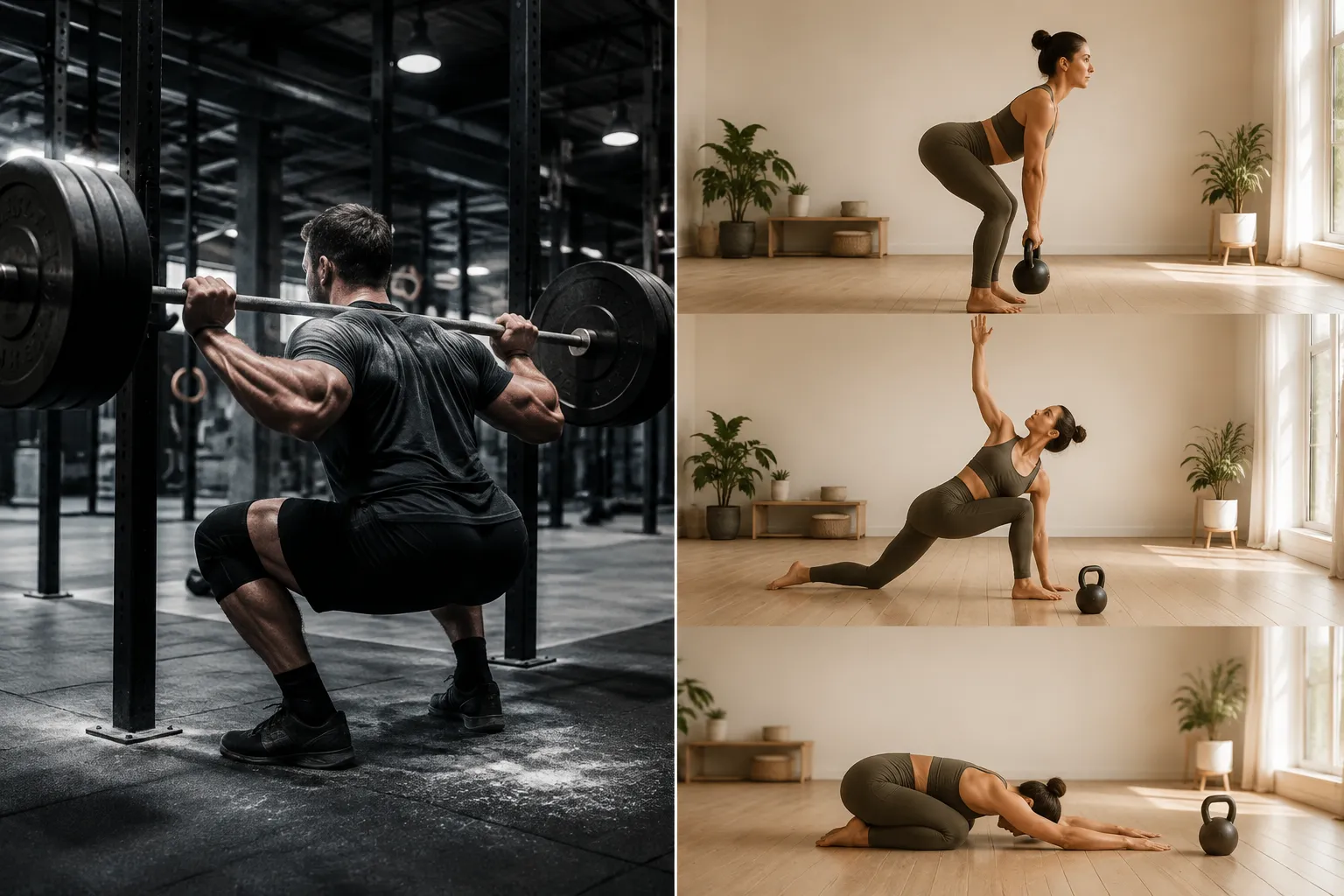
Hybrid training and CrossFit share DNA, both mix strength and conditioning, but they diverge on intensity, structure, and injury risk. Hybrid is better for long-term joint health, sport carryover, and sustainable progress. CrossFit is better for community, competitive drive, and maximum conditioning.[1]

Factor Hybrid Training CrossFit
Intensity Moderate, high, controlled Very high, often maximal
Session length 30-60 min 45-75 min
Injury risk Lower Higher (Olympic lifts under fatigue)
Progression Linear, individualized WOD-based, varied
Community Solo or small group Strong gym culture
Cost Low (home) $150-250/mo box fee

Choose CrossFit if you thrive on competition and coached intensity. Choose hybrid if you want to train forever without wrecking your shoulders and knees.[1][10]

Common Mistakes People Make with Hybrid Workouts

The biggest mistake is treating every session like it should crush you. Hybrid training only works when hard days are actually hard and easy days are actually easy.[10]

Top mistakes to avoid:

  • Turning mobility days into more cardio. Recovery days should feel restorative, not draining.
  • Skipping the warm-up because "it's just a home workout." Cold tissue plus loaded squats equals injuries.
  • Adding conditioning to every strength day. Two hard finishers a week is plenty.
  • Chasing variety over progression. Random workouts feel productive but don't build strength. Repeat the same lifts for 4-6 weeks and add load.
  • Ignoring sleep and food. Hybrid volume without 7+ hours of sleep and adequate protein produces fatigue, not results.[6][10]

"The point of hybrid isn't doing more, it's doing the right things in the right order so nothing breaks."

How Often Should You Do Hybrid Workouts Per Week?

Three to five sessions per week is the sweet spot for most adults, with at least one full rest day and one active recovery day. Beginners should stay at three; intermediate lifters do four; advanced athletes may run five with careful intensity rotation.[2][10]

Weekly frequency by level:

  • Beginner: 3 sessions, 2 walking days, 2 rest days.
  • Intermediate: 4 sessions (2 strength, 1 conditioning+mobility, 1 full-body power), 1 active recovery, 2 rest.
  • Advanced: 5 sessions rotating heavy/light/conditioning/power/skill, 1 mobility, 1 rest.[2]

Best Recovery Exercises to Add to Strength Training

Recovery isn't just lying on the couch. Active recovery, light movement that boosts blood flow without adding fatigue, accelerates soreness relief and joint health. Add 10-20 minutes on non-lifting days.[6]

Top recovery exercises:

  1. Foam rolling, quads, glutes, thoracic spine, lats. 60 seconds per area.
  2. 90/90 hip switches, 2 sets of 8 per side. Restores hip rotation lost from sitting.
  3. Cat-cow and thoracic openers, spinal decompression, 8-10 reps.
  4. Deep breathing (box or 4-7-8), 5 minutes to downshift the nervous system.
  5. Zone 2 walking, 20-40 minutes at conversational pace. Aids circulation without eating into recovery.
  6. Banded distractions, hip and shoulder capsule mobility, 30 seconds per position.

Do these on rest days and the last 5 minutes of every strength session.[6]

Can You Do Hybrid Workouts Every Day?

Yes, but only if you rotate intensity, you can't do heavy strength and hard conditioning seven days a week. Daily training works when you alternate hard, easy, and mobility-only days.[10]

Sustainable 7-day rotation:

  • Mon: Hard strength (lower)
  • Tue: Easy conditioning + mobility
  • Wed: Hard strength (upper)
  • Thu: Active recovery (walk + foam roll)
  • Fri: Full-body power + core
  • Sat: Optional play (hike, sport, easy bike)
  • Sun: Rest or gentle yoga

Edge case: if you're over 40, sleeping poorly, or dealing with high work stress, drop to 4 total sessions. Recovery capacity is finite.[6][10]

Hybrid Workouts for People with Limited Space

A 6-by-6-foot area is enough for a full hybrid program. You don't need a garage gym, you need one clear patch of floor, vertical space to press overhead, and a single anchor point (a door, a heavy couch leg) for band work.[5]

Space-efficient exercises that need almost no room:

  • Goblet squats, split squats, reverse lunges
  • Romanian deadlifts, single-leg deadlifts
  • Push-ups, dumbbell floor presses, pike push-ups
  • One-arm rows, banded rows, band pull-aparts
  • Kettlebell swings (need ~6 ft of clearance in front)
  • Plank variations, dead bugs, bird dogs
  • Every mobility drill

Skip: barbell overhead work, box jumps, sled pushes. Everything else fits.

How to Structure a Week of Hybrid Training

The standard 2026 hybrid template alternates strength days with conditioning/mobility days and includes at least one active recovery day.[2]

Proven weekly structure (intermediate):

Day Session Duration
Mon Lower-body strength (squat + hinge focus) 50 min
Tue Conditioning + mobility (20-min HIIT or tempo cardio + 10-min flow) 35 min
Wed Upper-body strength (push + pull focus) 50 min
Thu Active recovery / LISS walk 30 min
Fri Full-body power + core (kettlebell, med ball, carries) 45 min
Sat Optional play or mobility 20-40 min
Sun Rest or gentle movement ,

This template is the backbone of most 2026 hybrid programs and works for busy adults who want strength without losing conditioning.[2][10]

How to Structure a Week of Hybrid Training

Mobility Work Before or After Strength Training?

Both, but with different purposes. Do dynamic, targeted mobility before lifting to prep the specific joints you'll load. Do static stretching and foam rolling after to help nervous system downshift and reduce next-day tightness.[6]

Before lifting (5-8 min):

  • Leg swings, hip circles, thoracic rotations
  • Band pull-aparts, scap push-ups
  • 2 warm-up sets of the first lift at 40% and 60% load

After lifting (5-10 min):

  • Foam roll worked muscles
  • Static holds: hip flexors, hamstrings, chest doorway stretch (30-60 sec each)
  • Deep nasal breathing

Common mistake: long yoga before lifting. Static holds over 60 seconds pre-workout can temporarily reduce power output. Save deep stretching for post-session or off-days.[6]

Hybrid Workout Apps or Programs Worth Buying

The best hybrid programs in 2026 offer structured progression, video demos, and adjustable equipment options. Look for ones that program strength, conditioning, and mobility, not just workout libraries.[10]

Categories worth paying for:

  • Structured hybrid apps, Jefit, Ladder, Future, Fitbod. Give you weekly programming with mobility built in.[10]
  • Coach-led hybrid programs, Inov8 hybrid plans, individual coaches on Trainerize. Higher cost, more personalized.[4]
  • Mobility-specific apps, GOWOD, Pliability, Bodymotionlab routines pair well with any strength app.[6]

Decision rule: if you have to invent your own workouts, you'll stop in 6 weeks. Pay for programming.

FAQ

How long until I see results from hybrid training?
Strength gains show in 3-4 weeks; visible body changes in 8-12 weeks with consistent training and adequate protein.

Can hybrid training replace running for cardio?
Mostly, yes. Kettlebell flows, circuits, and Zone 2 walking cover general cardio. If you're training for a race, keep dedicated running.

Is hybrid training good for weight loss?
Yes. The combination of strength (preserves muscle) and conditioning (burns calories) with adequate protein is one of the most effective fat-loss approaches.

Do I need supplements?
No. Prioritize protein (0.7-1 g per pound of bodyweight), sleep, and creatine (5 g daily) if you want one add-on.

Should I train fasted?
Fine for short mobility or Zone 2 sessions. Eat something with protein and carbs 60-90 minutes before heavy lifting.

What if I miss a workout?
Skip it and continue with the next scheduled session. Don't double up, that spikes fatigue.

Can older adults do hybrid training?
Absolutely. Adults 50+ benefit most from the combination of strength (bone density) and mobility (fall prevention). Start with 3 sessions a week.

How much protein do I need?
Aim for 0.7-1 g per pound of bodyweight daily, split across 3-4 meals.

Conclusion

Hybrid home workouts combining strength, mobility, and recovery are the most sustainable way to build a body that lifts heavy, moves well, and doesn't fall apart at 45. The formula is boring on purpose: 3-5 focused sessions a week, mobility as prep, strength as the main course, recovery baked in.

Your next steps:

  1. Pick 3 days this week and commit to 40-minute sessions.
  2. Buy the starter kit, one kettlebell, a band, a mat, a foam roller.
  3. Run the beginner template above for 4 weeks. Don't change it.
  4. Track lifts in a notebook or app. Add 2.5-5 lb when the last set feels controlled.
  5. After 4 weeks, add a fourth day and one dedicated mobility session.

Consistency beats intensity. A 40-minute session done 3 times a week for a year will outperform a 90-minute killer session done twice before you quit.

References

[1] Hybrid Workouts Blending Strength And Mobility For Balanced Results – https://remix-fitness.com/blog/hybrid-workouts-blending-strength-and-mobility-for-balanced-results
[2] How To Build A Sustainable Hybrid Workout Routine Strength Cardio Mobility Recovery For Lasting Results – https://exerciseplease.com/how-to-build-a-sustainable-hybrid-workout-routine-strength-cardio-mobility-recovery-for-lasting-results/
[4] Hybrid Training For Beginners – https://www.inov8.com/us/blog/post/hybrid-training-for-beginners
[5] Hybrid Workouts How To Mix Strength Cardio And Mobility – https://fitnessworld.ca/blog/hybrid-workouts-how-to-mix-strength-cardio-and-mobility/
[6] Recovery Mobility Routine 2026 Strength Progress – https://bodymotionlab.com/blog/recovery-mobility-routine-2026-strength-progress
[8] Hybrid Training Strength Cardio 30 Minutes – https://runlovers.it/en/2026/hybrid-training-strength-cardio-30-minutes/
[10] Hybrid Training The Complete Guide To Combining Strength Cardio Mobility In 2026 – https://www.jefit.com/blog/hybrid-training-the-complete-guide-to-combining-strength-cardio-mobility-in-2026

Healthspan vs. Lifespan: Strength and Mobility Training After 50 to Stay Independent Longer

Healthspan vs. Lifespan: Strength and Mobility Training After 50 to Stay Independent Longer

Last updated: July 26, 2026

Editorial landscape split-screen conceptual illustration contrasting 'healthspan' and 'lifespan': left side shows a vibrant

Quick Answer

Lifespan is how long you live. Healthspan is how long you live well, without disability or dependence. After 50, the fastest way to widen the gap in your favor is progressive strength training two to three days per week, paired with daily mobility work. Recent 2026 guidance calls resistance training "mandatory" for healthspan, with a sweet spot of roughly 90-120 minutes per week [2][7].

Key Takeaways

  • Lifespan measures years lived. Healthspan measures years lived independently, and the two can differ by a decade or more.
  • Strength training is the single biggest lever for preserving independence after 50, according to 2026 fitness and longevity research [2][7].
  • Aim for 90-120 minutes of strength work per week, split across 2-3 sessions, plus 150 minutes of moderate cardio [7][10].
  • Sarcopenia (age-related muscle loss) begins in your 30s and accelerates after 60, resistance training is the proven counter [8].
  • Mobility work daily, even 10 minutes, protects joints and prevents the stiffness that leads to falls.
  • Falls are the leading cause of injury death in adults over 65, and balance-focused training cuts fall risk meaningfully [4].
  • It's not too late at 60, 70, or 80, muscle responds to training at every age studied [5].
  • Functional, daily-life movements (squat, hinge, carry, push, pull, rotate) matter more than machines.

What's the difference between healthspan and lifespan?

Lifespan is the total number of years you live. Healthspan is the number of those years spent in good health, mobile, cognitively sharp, and independent. In the U.S., the average person lives roughly 10 years longer than they stay healthy, meaning the last decade often involves disability, chronic disease, or loss of independence [1].

The goal of training after 50 isn't to add years to the end of life. It's to compress the frail years down to as few as possible. Strength and mobility work is the most reliable tool for doing that [2].

Quick example: Two 55-year-olds both live to 85. One spends the last 12 years using a walker, dependent on family. The other hikes with grandkids until 82 and lives alone comfortably until the end. Same lifespan. Very different healthspan.

Why is strength training important after 50?

Because muscle is the organ of independence. After 50, adults lose roughly 1-2% of muscle mass per year and up to 3% of strength annually if they don't train, a condition called sarcopenia [8]. Weak muscles mean weaker bones, worse balance, slower metabolism, and a higher risk of falls, fractures, and hospitalization.

Resistance training reverses much of this. It's the only intervention that consistently rebuilds muscle, improves bone density, and preserves the fast-twitch fibers you need to catch yourself when you trip [5][8]. In 2026 healthspan guidance, strength training moved from "recommended" to "mandatory", treated the same way clinicians treat blood pressure control [2][7].

What strength training protects:

  • Muscle mass and power (power fades faster than strength and matters more for falls)
  • Bone density, reducing fracture risk
  • Insulin sensitivity and metabolic health
  • Cognitive function, through myokines released during exercise
  • Confidence, knowing your body can handle stairs, groceries, and grandkids

How much strength and mobility training do you need to stay independent?

The current sweet spot from 2026 longevity research is 90-120 minutes of strength training per week, spread across 2-3 sessions, plus 150 minutes of moderate cardio and daily mobility work of 10-15 minutes [7][10]. International guidelines for older adults align: at least two strength sessions per week that hit all major muscle groups, plus balance work [10].

A realistic weekly template:

Day Focus Time
Monday Full-body strength 40 min
Tuesday Walk + mobility 30 + 10 min
Wednesday Rest or easy walk 20 min
Thursday Full-body strength 40 min
Friday Walk + balance work 30 + 10 min
Saturday Optional third strength or hike 30-60 min
Sunday Mobility and stretch 15 min

You don't need a gym. A single kettlebell, a set of resistance bands, a sturdy chair, and floor space are enough to run this program for years.

How much strength and mobility training do you need to stay independent?

Can you improve healthspan at 60, or is it too late?

It's not too late. Studies of adults starting resistance training in their 60s, 70s, and even 90s show meaningful gains in muscle mass, strength, walking speed, and stair-climbing ability within 8-12 weeks [4][5]. The relative gains are often larger in older beginners than in younger trained people, because there's more room to improve.

The honest caveat: progress is slower, recovery takes longer, and injury risk is higher if you skip the ramp-up. Start light, add load gradually, and prioritize form over weight for the first two to three months.

Decision rule: If you can stand up from a chair without using your hands, you have enough baseline strength to start a beginner program at home. If you can't, start with sit-to-stands from a higher surface and build from there.

What exercises prevent falls in older adults?

Falls are prevented by a mix of lower-body strength, single-leg balance, and reactive power, the ability to move fast when you stumble. The exercises with the strongest evidence for fall prevention include:

  1. Sit-to-stand from a chair, trains the hip and thigh muscles you use every day
  2. Step-ups onto a low box or bottom stair, builds single-leg strength
  3. Farmer's carries (walking with weights in each hand), trains grip, core, and gait stability
  4. Single-leg balance holds, 30 seconds per leg, progress to eyes closed
  5. Heel-to-toe walking in a straight line
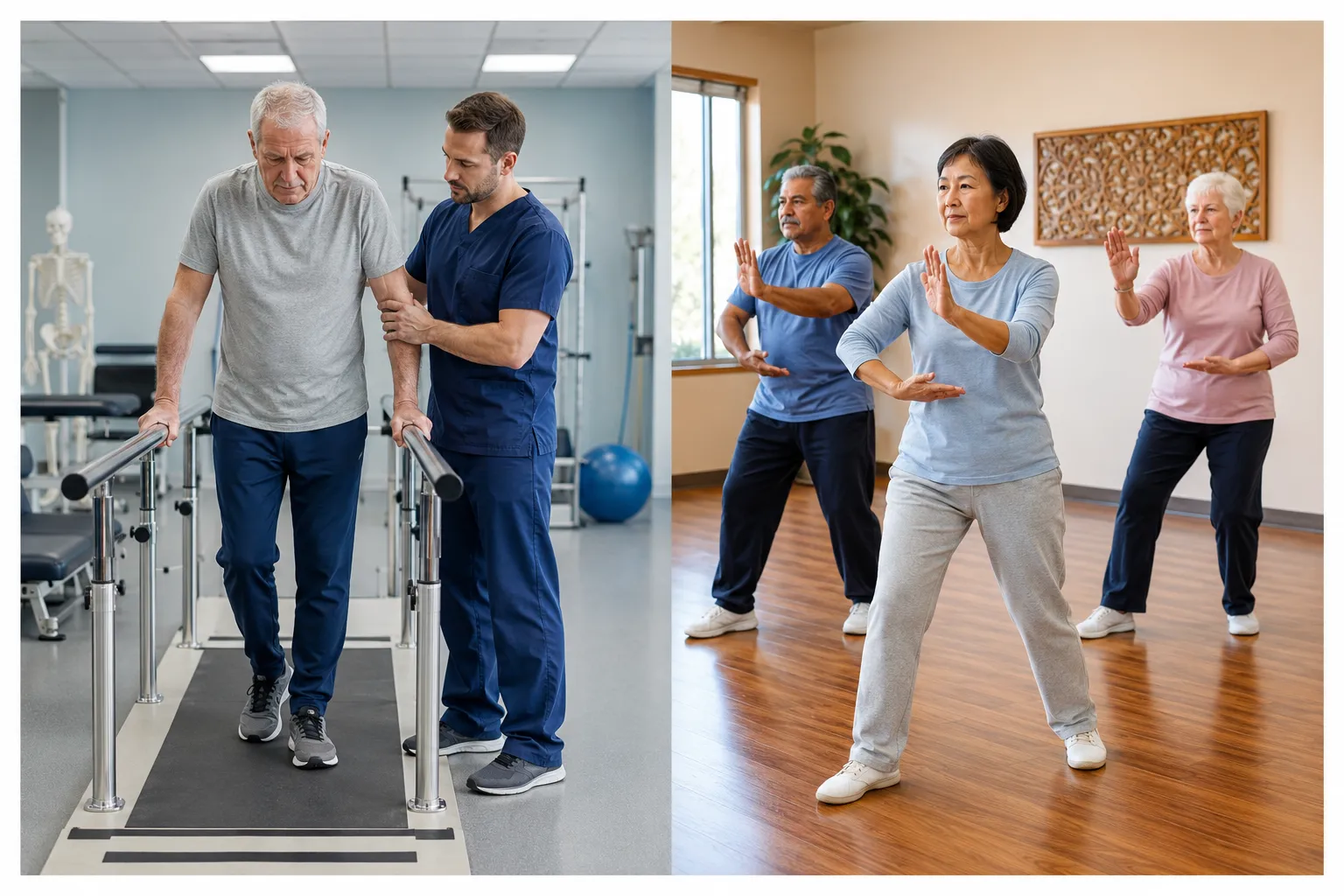
  6. Tai chi or slow controlled squats, proven to reduce fall rates in randomized trials [4]
  7. Loaded hip hinges (deadlifts with light weight), trains the posterior chain that catches you when you trip

Aim to include at least one balance-focused movement in every session.

Healthspan training vs. regular gym workouts for seniors

Healthspan training is built around functional movement patterns you use in daily life: squatting to a chair, hinging to pick something up, carrying groceries, pushing a door open, pulling yourself out of a pool. Regular gym workouts often isolate muscles on machines, bicep curls, leg extensions, seated chest press, which build size but transfer poorly to real life [7].

Choose healthspan-style training if you want to: stay independent, prevent falls, keep hiking or gardening, play with grandchildren, and reduce injury risk.

Choose bodybuilding-style training if you want to: maximize muscle size, look a certain way, or compete.

The two overlap, but the emphasis matters. A 70-year-old who can deadlift a suitcase, carry it up stairs, and get down to the floor and back up has more functional capacity than one with big arms and a sore back.

How often should you do strength and mobility work after 50?

Strength: 2-3 sessions per week, with at least 48 hours between sessions targeting the same muscles. Mobility: daily, in short 10-minute doses [7][10]. More isn't better once you cross about 150 minutes of strength work per week, recovery becomes the bottleneck [7].

A simple minimum-effective-dose plan:

  • Two 30-minute strength sessions per week (full body)
  • Ten minutes of mobility on non-lifting days
  • One longer walk or hike on the weekend
  • Five to ten minutes of balance work sprinkled through the week

That's under three hours total. It's enough to meaningfully shift your healthspan trajectory.

What happens if you don't train for strength and mobility as you age?

You lose muscle, bone, and balance on a predictable timeline. By 80, an untrained adult has typically lost 30-40% of the muscle mass they had at 30, and grip strength drops in parallel with overall mortality risk [8][9]. The functional consequences:

  • Difficulty rising from a chair or toilet without assistance
  • Higher fall risk, one in four adults over 65 falls each year [4]
  • Loss of driving independence as reaction time and neck mobility decline
  • Hospitalizations after minor injuries that a stronger body would shrug off
  • Cognitive decline accelerates in parallel with physical decline

None of this is inevitable. It's the default trajectory without training. Resistance work bends the curve.

"Muscle is the currency of aging. Spend it wisely, and you buy back years of independence.", a summary of the current healthspan consensus [2][7]

Is healthspan training safe if you have arthritis or joint pain?

Yes, and it's often the best thing you can do for joint pain. Strength training reduces arthritis symptoms by building the muscle that supports and stabilizes the joint [5]. The key is smart programming: pain-free range of motion, gradual loading, and choosing exercises that don't aggravate the specific joint.

Arthritis-friendly swaps:

  • Painful squats → box squats to a higher surface, or wall sits
  • Painful overhead press → landmine press at an angle
  • Painful running → cycling, swimming, or fast walking
  • Painful floor work → standing or elevated variations

When to consult a professional first: recent joint replacement, active flare, unexplained pain, uncontrolled blood pressure, or any cardiac symptoms. A physical therapist or a certified trainer with older-adult experience can adapt any program.

Best mobility exercises for people over 50 at home

Mobility work restores the range of motion that stiffens with age and desk work. These seven movements cover the biggest problem areas and take under 10 minutes:

  1. Cat-cow, 8 slow reps, spine flexion and extension
  2. World's greatest stretch, 3 per side, hips and thoracic spine
  3. 90/90 hip switches, 8 per side, hip rotation
  4. Doorway pec stretch, 30 seconds per side, chest and shoulders
  5. Wall slides, 10 reps, shoulder and upper-back mobility
  6. Ankle circles and calf stretches, 30 seconds per side (ankle mobility drives balance)
  7. Deep squat hold, build up to 60 seconds, holding a support if needed

Do these daily. Consistency beats intensity for mobility.

Best mobility exercises for people over 50 at home

How long does it take to notice improvements in strength and balance?

Most beginners notice better balance and easier stairs within 2-4 weeks. Measurable strength gains show up around 6-8 weeks. Visible muscle changes and meaningful bone-density shifts take 3-6 months of consistent training [5][8].

Realistic milestones for a 55-year-old starting from scratch:

  • Week 2: Getting off the floor feels easier
  • Week 4: Stairs no longer require the handrail
  • Week 8: Groceries feel lighter, posture improves
  • Month 3: Can perform 10 full squats without a chair, hold single-leg balance 30 seconds
  • Month 6: Deadlifting your bodyweight becomes realistic; sleep and energy noticeably better

The gains compound. The person who trains at 55 arrives at 75 with a completely different body than the one who didn't.

Who should not do strength training after 50?

Very few people. The contraindications are narrow: uncontrolled high blood pressure, unstable cardiovascular disease, recent surgery without medical clearance, active infection, or acute injury [5]. Even in most of these cases, modified training is possible and beneficial once cleared.

Talk to your doctor before starting if you have:

  • Recent heart attack, stroke, or heart surgery
  • Uncontrolled diabetes or blood pressure
  • Advanced osteoporosis with recent fractures
  • Balance disorders causing frequent falls
  • Chronic pain that isn't diagnosed

For nearly everyone else, the risk of not training is higher than the risk of training carefully.

Common mistakes people make with senior fitness programs

The mistakes are predictable, and avoiding them is most of the battle:

  • Going too light forever. Muscles adapt to challenge. If your weights never get heavier, neither do you.
  • Skipping the lower body. The legs and glutes drive independence. Upper-body-only routines miss the point.
  • Cardio-only fitness. Walking is great but doesn't build or preserve muscle on its own [8].
  • No progression plan. Doing the same three exercises for a year produces one year of the same body.
  • Ignoring balance work. Falls happen because balance isn't trained, not because legs are weak.
  • Copying young-athlete programs. Recovery needs are different after 50. Two hard sessions plus mobility beats five mediocre sessions.
  • Fearing soreness. Mild muscle soreness is normal and safe. Sharp joint pain is not.

Does healthspan training really help you stay independent longer?

Yes. Multiple long-term studies show that adults with higher muscle strength, grip strength, and functional capacity live more years independent of assistance and have lower rates of nursing-home admission [4][9]. The 2026 fitness research consensus treats functional movement capacity, sit-to-stand, gait speed, grip strength, as a vital sign of healthspan, on par with blood pressure [7].

The mechanism is straightforward: stronger muscles mean fewer falls, faster recovery from illness, better metabolic health, and more reserve capacity when something goes wrong. It's not a guarantee, but it shifts the odds significantly.

FAQ

Is it safe to lift heavy weights after 60?
Yes, with proper form and gradual progression. "Heavy" is relative to your current strength, challenging weight for you, not for a 25-year-old. Studies show adults in their 80s and 90s safely doing progressive resistance training [5].

Do I need a personal trainer to start?
Not required, but 3-6 sessions with a qualified trainer can prevent months of form mistakes. Look for someone certified in older-adult fitness (NSCA, ACSM, or similar credentials).

Can I combine strength and cardio in one session?
Yes. Strength first, then cardio, for the best strength outcomes. Or alternate days if you have time.

How much protein do I need?
Most healthspan researchers recommend 1.2-1.6 grams per kilogram of bodyweight daily for adults over 50 doing resistance training, spread across meals [8].

What if I have osteoporosis?
Strength training is one of the best interventions for osteoporosis, but exercise selection matters. Avoid heavy spinal flexion and get guidance from a physical therapist or trainer familiar with the condition.

Is walking enough?
Walking is essential but not sufficient. It maintains cardiovascular health but doesn't build the muscle mass and power needed to prevent falls and preserve independence [8].

How do I know if I'm progressing?
Track sets, reps, and weight in a notebook or app. Also test yourself monthly: how many sit-to-stands in 30 seconds, how long you can balance on one leg, how fast you can walk 400 meters.

Should I train through joint pain?
No sharp pain, ever. Mild stiffness that eases as you warm up is normal. Pain that gets worse during or after a set means change the movement.

Conclusion: Your next steps

Healthspan is trainable. The compounding effect of 30 minutes, three times per week, over years, is the difference between an independent 80-year-old and a dependent one. Start this week, not next month.

Do this in the next seven days:

  1. Book a check-in with your doctor if you haven't exercised in years or have a chronic condition.
  2. Pick two 30-minute windows on your calendar this week and label them "strength."
  3. Buy or borrow one kettlebell (15-25 lb for most beginners) and a set of resistance bands. Total cost under $60.
  4. Learn five foundational movements: goblet squat, hip hinge, farmer's carry, chair sit-to-stand, and doorway row. YouTube tutorials from certified trainers are fine.
  5. Do a 10-minute mobility routine daily, starting tomorrow morning.
  6. Track something measurable: how many sit-to-stands in 30 seconds. Retest monthly.

The goal isn't to become an athlete. It's to stay the person who carries their own groceries, plays on the floor with grandchildren, and travels without help, for as many years as possible. Strength and mobility training after 50 is the most reliable path we have.

References

[1] Healthspan Recognizing The Rewards Of Resistance Training – https://www.humangood.org/about/news-room/healthspan-recognizing-the-rewards-of-resistance-training
[2] Is Strength Training The Key To Your Health Span – https://www.bch.org/latest-news/2026/february/is-strength-training-the-key-to-your-health-span/
[4] PMC12182867 – https://pmc.ncbi.nlm.nih.gov/articles/PMC12182867/
[5] Resistance Training and the Older Adult – https://bpb-us-e2.wpmucdn.com/websites.umass.edu/dist/a/2523/files/2009/07/resistancetrainingandtheOlderAdult.pdf
[7] Fitness Research 2026 Makes Movement A Healthspan Test – https://www.pagalishor.in/articles/fitness-research-2026-makes-movement-a-healthspan-test
[8] Combating Sarcopenia With Exercise And Protein – https://www.gethealthspan.com/research/article/combating-sarcopenia-with-exercise-and-protein
[9] Physical function and healthspan – https://www.sciencedirect.com/science/article/pii/S1279770723007881
[10] Resistance Training By The Numbers – https://www.health.harvard.edu/healthy-aging-and-longevity/resistance-training-by-the-numbers

Active Aging Workout Plans: How Multi-Component Programs Cut Fall Risk for Older Adults

Active Aging Workout Plans: How Multi-Component Programs Cut Fall Risk for Older Adults

Last updated: July 25, 2026

Quick Answer

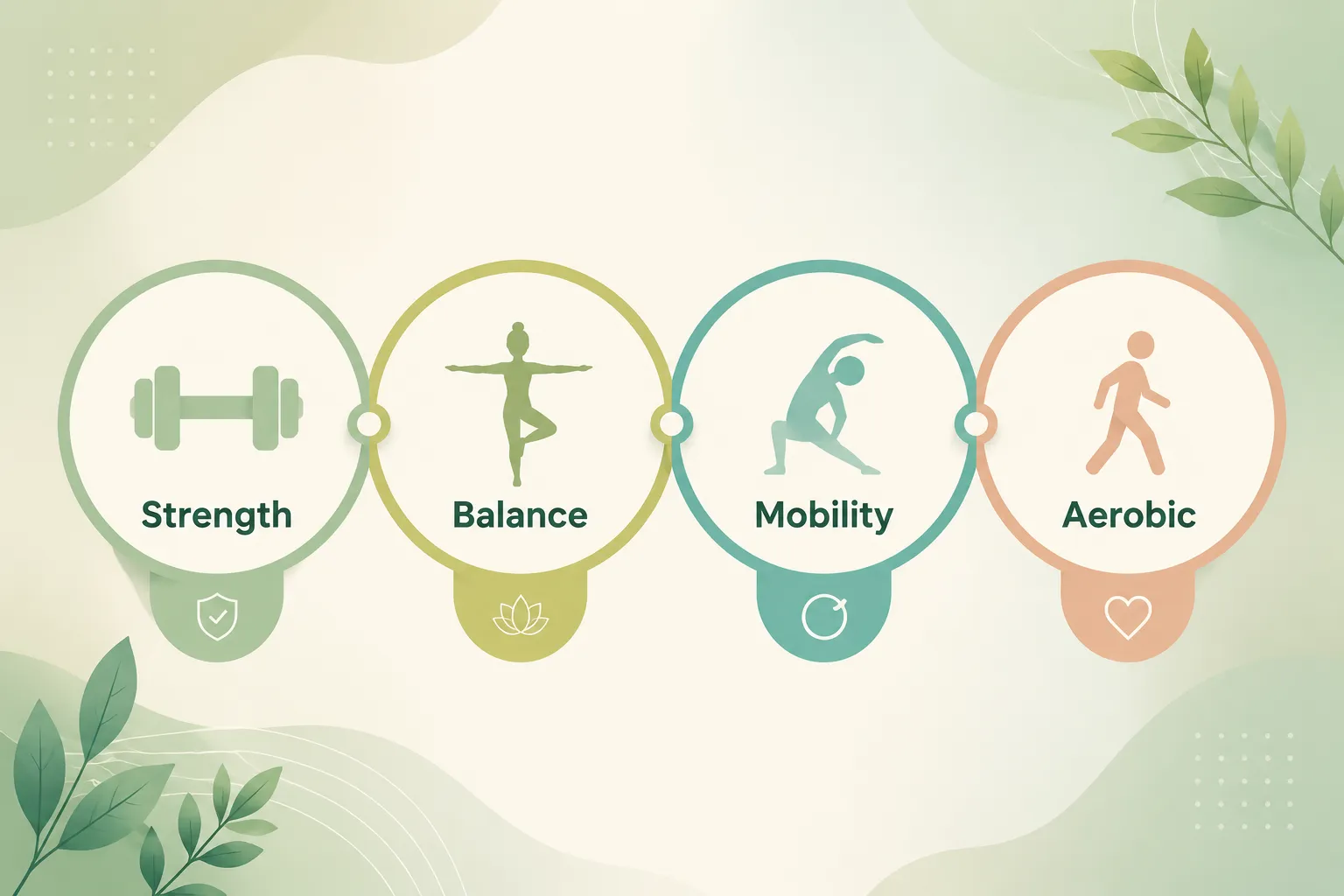
Active aging workout plans that combine strength, balance, mobility, and aerobic training can reduce falls in older adults by roughly 23-34% compared with no exercise or single-focus routines, according to recent Cochrane and 2025 meta-analyses [1][7]. The most effective programs run 2-3 sessions per week for at least 12 weeks, target the legs and trunk, and include progressive balance challenges. Home-based versions work when they follow the same structure as supervised programs.

Key Takeaways

  • Multi-component programs beat single-focus workouts for fall prevention, especially when balance training is dosed at 3+ hours per week [1][5].
  • Falls drop by about 23% in community-dwelling adults 65+ who follow structured exercise programs with balance and strength components [7].
  • Three sessions per week, 45-60 minutes each, is the sweet spot for most older adults training at home.
  • Improvements in balance and gait appear in 8-12 weeks; fall-rate reductions typically show at 6+ months [4].
  • Frailty is not a disqualifier. Chair-based and seated-progression versions of active aging programs are safe for pre-frail and frail adults with clearance [6].
  • Cost ranges from free (NIH Go4Life, CDC STEADI) to $15,$40/month for guided apps or community classes.
  • The biggest mistakes are skipping the balance component, using weights that are too light, and stopping after 4-6 weeks before adaptations kick in.

Key Takeaways

What is active aging and why does it matter for older adults?

Active aging is a framework, endorsed by the WHO, that treats physical activity as the central lever for maintaining independence, cognition, and function after 60. It matters because falls are the leading cause of injury-related death in adults 65+, and roughly one in four older adults falls each year in the United States.

Multi-component active aging workout plans directly attack the modifiable risk factors: weak legs, poor balance, stiff hips and ankles, and slow reaction time. Unlike a walking-only routine, they train the neuromuscular systems that actually stop a stumble from becoming a fall [1].

Who benefits most: community-dwelling adults 60+, people recovering from a recent fall, adults with early sarcopenia, and anyone whose doctor has mentioned "deconditioning."

How do multi-component workout programs reduce fall risk?

Multi-component programs cut fall risk because they train the exact systems that fail during a near-fall: lower-body force production, single-leg stability, ankle mobility, and reactive stepping. A 2025 systematic review comparing multi-component vs. single-component training found multi-component programs consistently outperformed strength-only or balance-only interventions on fall rate and fall-related injuries [5].

The mechanism is layered:

  1. Strength work rebuilds the quadriceps, glutes, and calves that generate the force needed to catch yourself.
  2. Balance training sharpens the vestibular and proprioceptive reflexes that fire in the 200-400 milliseconds you have to recover from a trip.
  3. Mobility work restores ankle dorsiflexion and hip extension, so your foot actually clears the carpet edge.
  4. Aerobic conditioning keeps you from fatiguing on stairs or long walks, when most falls happen.

Cochrane-level evidence puts the fall reduction from well-designed exercise programs at around 23% for fall rate and 15% for the number of people who fall [7]. Programs that include 3+ hours per week of balance-focused work show the largest effect [1].

"Exercise is the single most effective single intervention for reducing falls in community-dwelling older adults.", summary finding, Cochrane review of exercise for fall prevention [7]

What exercises are included in active aging programs?

Effective active aging workout plans include four exercise categories, done in most sessions. Here's what each looks like in practice:

Strength (lower body priority)

  • Sit-to-stands from a chair (progress to one-legged)
  • Step-ups onto a low platform
  • Wall or counter push-ups
  • Hip hinges with a light dumbbell or kettlebell
  • Calf raises, then single-leg calf raises

Balance (progressive challenge)

  • Feet-together stand → semi-tandem → tandem → single-leg
  • Weight shifts and controlled reaches
  • Heel-to-toe walking along a line
  • Standing on a folded towel or foam pad (once safe)
  • Reactive stepping drills (step in response to a cue)

Mobility and flexibility

  • Ankle circles and calf stretches
  • Hip flexor stretch (kneeling or supported)
  • Thoracic rotations in a chair
  • Cat-cow or seated cat-cow

Aerobic

  • Brisk walking, 20-30 minutes
  • Stationary cycling
  • Water walking or aquatic classes

A typical 45-minute session covers all four, with roughly 20 minutes of strength, 15 minutes of balance, 5 minutes of mobility, and either a separate aerobic day or 10 minutes bolted onto the session.

How often should seniors do active aging workouts per week?

Most evidence supports 2-3 sessions per week of combined strength and balance work, plus 150 minutes per week of moderate aerobic activity, this matches WHO and ACSM guidance and is the dose used in the trials showing the biggest fall-risk reductions [4][7].

Sample weekly template for adults 60+ training at home

Day Focus Duration
Monday Strength + balance 45 min
Tuesday Brisk walk 30 min
Wednesday Balance + mobility 30 min
Thursday Brisk walk or cycling 30 min
Friday Strength + balance 45 min
Saturday Longer walk or aquatic class 40 min
Sunday Rest or gentle mobility 15 min

Decision rule: If you're brand new, start with 2 combined sessions plus 2 walks, then add the third session in week 3-4. If you've been sedentary for over a year, cut every session in half for the first two weeks.

Sample weekly template for adults 60+ training at home

Can I start active aging exercises if I'm already frail or injured?

Yes, in most cases, but the entry point changes. Frail and pre-frail adults still benefit from multi-component training. A 2024 review found that even in frail older adults, supervised or well-designed home programs improved physical function and reduced falls when programs started with seated and supported exercises before progressing to standing work [6].

If you're frail or recovering from injury, do this:

  1. Get medical clearance, especially after a recent hospitalization.
  2. Start with chair-based versions of every exercise.
  3. Work with a physical therapist for the first 4-6 weeks if possible, this is often covered by Medicare after a fall.
  4. Prioritize sit-to-stands and supported balance holds over aerobic volume.
  5. Progress by adding time under tension before adding weight.

Do not start unsupervised if you have: unstable cardiovascular disease, uncontrolled arrhythmia, severe osteoporosis with recent vertebral fracture, or acute joint injury.

Active aging workout plans vs regular gym routines for seniors

Active aging plans are structurally different from a standard gym routine. A regular gym program built around machines and steady-state cardio can improve strength but often skips the two ingredients that most directly prevent falls: dynamic balance and reactive stepping.

Feature Active Aging Plan Standard Gym Routine
Balance training Built in, progressive Usually absent
Strength focus Functional (sit-to-stand, step-up) Isolated machines
Fall-risk impact Direct, evidence-backed [1][7] Indirect
Skill work (reactive stepping) Included Rarely
Session structure Multi-component Body-part split

Choose an active aging plan if your goal is independence, fall prevention, or recovering function. A standard gym routine may be fine if you're already highly active and just want to preserve muscle, but bolt on 15 minutes of balance work twice a week.

Best active aging programs for people with arthritis or balance issues

For arthritis, the Arthritis Foundation's Walk With Ease and aquatic-based programs are strong entry points because water reduces joint load while still training balance and strength. Tai chi has some of the best evidence for adults with balance impairments, a 2024 analysis found tai chi reduced falls by roughly 20% in this group [9].

Program picks by condition:

  • Knee or hip osteoarthritis: GLA:D program, aquatic multi-component classes, recumbent cycling paired with home strength work.
  • Balance impairment or history of falls: Otago Exercise Programme (physiotherapist-designed, 17 exercises), tai chi (Yang or Sun style), CDC STEADI-aligned classes.
  • Low back pain: McKenzie-informed mobility plus glute-focused strength; skip loaded flexion.
  • Osteoporosis: LIFTMOR-style progressive resistance (with supervision), balance training, no forward-bending loaded work.

How long does it take to see fall risk improvement from these workouts?

Measurable improvements in balance and leg strength appear within 8-12 weeks of consistent training [4]. Actual reductions in fall rates, meaning fewer falls per year, usually show up in trials at 6 months and beyond [7].

Here's the rough timeline:

  • Weeks 1-4: Neuromuscular adaptation. Exercises feel easier, coordination improves.
  • Weeks 4-12: Measurable gains in sit-to-stand speed, gait speed, and single-leg balance time.
  • Months 3-6: Meaningful strength gains, better stair climbing, reduced fear of falling.
  • 6+ months: Statistically lower fall rate compared to non-exercisers.

The takeaway: stick with it for at least six months before judging whether the program "works."

What's the difference between active aging and physical therapy?

Physical therapy is clinical, short-term, and prescribed to treat a specific impairment. Active aging is a long-term lifestyle framework designed to maintain function and prevent decline. Both can use similar exercises, but the goals and delivery differ.

What's the difference between active aging and physical therapy?

Physical therapy:

  • Prescribed after injury, surgery, or a fall
  • 1-on-1, usually covered by insurance for a limited number of visits
  • Diagnostic and corrective
  • Typically 6-12 weeks

Active aging:

  • Ongoing (years to decades)
  • Group class, app, or self-guided
  • Preventive and performance-focused
  • Life-long

Many older adults do PT first after a fall, then transition into an active aging program to keep the gains.

Active aging workout plan cost and where to find programs

Costs range from free to about $40 per month. You do not need an expensive gym membership to get the benefit.

Free or low-cost options:

  • NIH Go4Life, free videos and printable plans
  • CDC STEADI toolkit, free provider-facing fall-prevention resources with patient handouts
  • Otago Exercise Programme, free protocol available online
  • YMCA Enhanced Fitness, sliding-scale pricing
  • SilverSneakers, free with many Medicare Advantage plans

Paid options ($15,$40/month):

  • Bold, Mighty Health, and similar senior-focused fitness apps
  • Community center active aging classes
  • Small-group personal training (higher cost, but strong supervision)

Equipment you actually need at home:

  • Sturdy chair
  • Resistance band (medium)
  • Two dumbbells (start with 3-8 lb; you'll outgrow them fast)
  • Non-slip mat
  • Wall or counter for balance support

Common mistakes older adults make when starting active aging exercises

The five biggest mistakes that either cause injury or waste effort:

  1. Skipping the balance component because it feels less like "real exercise." Balance is where the fall-risk reduction actually comes from.
  2. Using weights that are too light. If sit-to-stands with a 3-lb dumbbell feel easy after two weeks, add weight. Strength gains require progressive overload.
  3. Quitting at week 4-6 before the strength adaptations show up.
  4. Doing only walking. Walking maintains cardiovascular fitness but does not by itself lower fall risk meaningfully [1].
  5. Progressing balance work too slowly, staying on two feet forever. You need to challenge stability to improve it (safely, near a counter).

Is active aging safe for people with heart conditions or diabetes?

Yes, with medical clearance. Multi-component exercise is broadly recommended for stable cardiovascular disease and type 2 diabetes because it improves blood pressure, glycemic control, and functional capacity. The 2025 evidence continues to support supervised or well-structured programs for these groups [4][8].

Precautions:

  • Heart disease: Get a clearance conversation with your cardiologist. Skip Valsalva-style straining. Use rate of perceived exertion (RPE) rather than heart rate if you're on beta-blockers.
  • Type 2 diabetes: Check glucose before and after; carry a fast carb; watch feet for blisters.
  • Uncontrolled hypertension (>160/100): Delay starting until managed.
  • On anticoagulants: Emphasize balance safety; a fall carries higher bleeding risk.

Who should do active aging workouts and who shouldn't?

Should do:

  • Adults 60+ who want to maintain independence
  • Anyone with a fall in the past year
  • Adults with early sarcopenia or noticeable strength loss
  • People recently discharged from PT who want to keep their gains
  • Caregivers and spouses (do it together, adherence doubles)

Should not start unsupervised:

  • Anyone with unstable angina or a recent cardiac event (last 3 months)
  • Adults with uncontrolled arrhythmia
  • Acute joint injury or recent fracture without clearance
  • Severe cognitive impairment without a supervising caregiver
  • Uncontrolled severe hypertension

These groups should either delay or start with a physical therapist or clinical exercise physiologist.

How do I know if an active aging program is actually effective?

An effective program checks these boxes. Use it as a screening checklist before you commit.

  • Includes all four components, strength, balance, mobility, aerobic
  • Progressive, exercises get harder over weeks (harder balance positions, more weight, more reps)
  • Balance work is dosed at 3+ hours weekly at some point in the program [1]
  • Session length is 30-60 minutes, 2-3 times a week minimum
  • Designed or reviewed by a PT, exercise physiologist, or certified specialist (NSCA-CSPS, ACE Senior Fitness, ACSM)
  • Has an assessment, sit-to-stand test, timed up-and-go, or single-leg balance, so you can measure change
  • Runs at least 12 weeks in the initial block

Programs missing three or more of these are unlikely to move fall risk meaningfully.

FAQ

Is 30 minutes a day enough for active aging?
Yes, if it's structured. Thirty minutes of combined strength and balance work, 3 days a week, plus daily walking, hits the effective dose used in most fall-prevention trials.

Can I do active aging workouts every day?
Yes for balance, mobility, and walking. No for heavy strength work, leave 48 hours between hard lower-body sessions.

Does walking count as fall prevention?
Walking alone does not meaningfully lower fall risk in high-risk older adults [1]. It must be paired with balance and strength work.

What's the single best exercise for fall prevention?
The sit-to-stand. It trains the exact leg strength and pattern used to catch yourself when you stumble.

Are group classes better than solo home workouts?
Adherence is usually higher in groups, and effect sizes are similar when programs are structured the same way. Choose whichever you'll actually do.

Do I need a doctor's clearance to start?
If you have any cardiovascular disease, uncontrolled diabetes, recent surgery, osteoporosis, or a fall in the last 6 months, yes. Otherwise, start conservatively.

Will active aging exercises help with fear of falling?
Yes. Tai chi and multi-component programs both reduce fear of falling in trials, which independently improves quality of life [9].

Can these programs reverse sarcopenia?
They can significantly slow it and often reverse early stages when combined with adequate protein (1.0-1.2 g/kg/day for older adults).

Conclusion

The evidence is settled: multi-component active aging workout plans are the most effective non-pharmaceutical intervention for cutting fall risk in adults 60+. The formula is not complicated, strength, balance, mobility, and aerobic training, 2-3 times a week, for at least 12 weeks, but each component has to actually be there. Programs that skip the balance work or stop before three months rarely move the needle.

Your next steps:

  1. This week: Do a baseline sit-to-stand test (count how many you can do in 30 seconds) and time how long you can stand on one leg.
  2. Pick a program: Start with Otago, SilverSneakers, or a free NIH Go4Life plan if you're new. Choose a paid app or class if you need structure.
  3. Commit to 12 weeks: Put the sessions on your calendar. Track them.
  4. Retest at week 12: Compare sit-to-stand and balance times. If numbers improved, keep going. If not, get a professional assessment.
  5. Progress deliberately: Add weight, harder balance positions, or longer walks every 2-3 weeks.

The goal is not to become an athlete. It's to still be climbing your own stairs, carrying your own groceries, and standing on one leg to pull on a sock at age 85. Multi-component training is how you get there.

References

[1] Effect of exercise for fall prevention in community-dwelling older adults – https://pmc.ncbi.nlm.nih.gov/articles/PMC12336026/
[2] Multicomponent exercise program on functional fitness in older adults – https://www.ijrrjournal.com/IJRR_Vol.12_Issue.12_December2025/IJRR-Abstract51.html
[3] Multicomponent training and fall risk in older adults – https://pubmed.ncbi.nlm.nih.gov/42176369/
[4] Exercise interventions and physical function in older adults – https://pmc.ncbi.nlm.nih.gov/articles/PMC12196961/
[5] A systematic review of multicomponent vs single-component training programs for fall prevention in older adults – https://www.bohrium.com/paper-details/a-systematic-review-of-multicomponent-vs-single-component-training-programs-for-fall-prevention-in-the-elderly-a-systematic-review/1152951217664557065-9083
[6] Multicomponent exercise in frail and pre-frail older adults – https://pmc.ncbi.nlm.nih.gov/articles/PMC10971002/
[7] Cochrane review: exercise for preventing falls in community-dwelling older people – https://pubmed.ncbi.nlm.nih.gov/39167923/
[8] Physical activity interventions in older adults with chronic conditions – https://pubmed.ncbi.nlm.nih.gov/39616365/
[9] Dual-task interventions and fall prevention in seniors – https://medicalxpress.com/news/2024-06-task-interventions-seniors-falls.html
[10] Balance and strength training outcomes in older adults – https://pubmed.ncbi.nlm.nih.gov/42237301/

Suspension Training for Seniors: Joint-Friendly Strength and Flexibility at Home

Suspension Training for Seniors: Joint-Friendly Strength and Flexibility at Home

Last updated: July 23, 2026

Quick Answer

Quick Answer

Suspension training uses two adjustable straps anchored overhead so you can leverage your own body weight for strength, balance, and mobility work. For adults 55+, it's one of the most joint-friendly ways to build total-body strength at home because you control the load simply by shifting your feet. A 6-week study of older adults showed significant gains in functional reach (57.2 cm to 68.6 cm) and balance scores, with 100% attendance and no dropouts [1][2]. Start with 2 sessions per week, keep the straps at chest height for beginner angles, and progress gradually.

Key Takeaways

  • Suspension training (like TRX) lets seniors adjust exercise difficulty instantly by changing foot position, no plates or dumbbells required [5].
  • Research shows measurable balance and functional reach improvements in just 6 weeks of twice-weekly training [1][2].
  • It's generally safe for arthritic joints because the straps reduce impact and let you offload weight anytime [3].
  • A quality home suspension trainer costs $30,$200, and setup takes about 5 minutes on a door or beam.
  • 91% of older participants in a German TRX study wanted to keep training after 12 weeks; 36% reported less musculoskeletal pain [4].
  • Ideal frequency: 2-3 sessions per week, 20-30 minutes each, with at least one rest day between sessions.
  • Balance and core work transfer directly to fall prevention and everyday tasks like standing from a chair [3][6].
  • You do NOT need a personal trainer to start, but one video consult or a class can prevent common form mistakes.

What is suspension training and how does it work

Suspension training is a bodyweight exercise method using two nylon straps with handles anchored to a fixed overhead point. You lean into or away from the anchor, and gravity plus your body angle create the resistance. The steeper your angle, the harder the exercise. Step your feet forward or back to make any move easier or harder in seconds.

The system was originally developed by a Navy SEAL who needed a portable way to train anywhere. Today, brands like TRX, WOSS, and Lifeline sell home-friendly kits. Because both hands (or feet) are supported by the straps, your core muscles fire on nearly every rep to stabilize you [3]. That's why it delivers strength, balance, and mobility benefits at once.

Quick example: A standing row with straps at chest height. Grip the handles, walk your feet forward until your body leans back at 45 degrees, then pull your chest to your hands. Feet farther forward equals harder. That single adjustment replaces switching to a heavier dumbbell.

Is suspension training safe for seniors with arthritis

Yes, suspension training is generally safe and often preferred for seniors with arthritis because you control the load and can offload instantly by standing more upright. Unlike free weights, there's no fixed resistance you're locked into. If a knee or shoulder flares up mid-set, you simply reduce your lean angle or step out of the strap.

)

Research supports this: In a 12-week TRX study with adults 60+, 36% of participants reported reduced musculoskeletal pain during the program [4]. The controlled range of motion and self-selected intensity make it easier on inflamed joints than machines or barbells.

Choose suspension training over free weights if: you have knee osteoarthritis, rotator cuff issues, grip weakness, or a history of dropped weights. Skip or modify if: you have severe balance impairment without a wall/chair nearby, uncontrolled blood pressure, or recent joint replacement (wait for surgeon clearance).

Common mistake: Going too deep too soon. Arthritic knees don't need full range on day one. Work in a pain-free 30-60 degree squat and expand as tolerated.

Can you do suspension training at home without equipment

You cannot do true suspension training without straps, but you can replicate many of the same movement patterns using a sturdy table, a towel over a closed door, or a chair for support. These substitutes work for a few weeks while you decide whether to buy a system.

Home substitutes that work:

  • Sturdy dining table for inverted rows (grip the edge, walk feet under).
  • Two firm chair backs placed hip-width apart for supported squats and dips.
  • Thick bath towel looped over a solid door hinge side (test carefully) for beginner rows.
  • Kitchen counter for angled push-ups and single-leg balance drills.

That said, a real suspension trainer is more versatile and safer than jury-rigged setups, and entry-level units cost less than one month of a gym membership.

Suspension training vs resistance bands for older adults

Both are joint-friendly, but they solve different problems. Suspension straps train stability, balance, and total-body coordination because your core stabilizes on every rep. Resistance bands train isolated strength with steady tension and are easier to travel with.

Factor Suspension Trainer Resistance Bands
Best for Balance, core, full-body Isolated muscles, rehab
Learning curve Moderate Low
Space needed Overhead anchor None
Cost $30,$200 $15,$50
Balance training Excellent Limited
Grip demand High Low, moderate

Choose suspension straps if balance and fall prevention are your top goals. Choose bands if you have weak grip strength or want ultra-portable equipment. Many seniors use both, bands for arms and glutes, straps for compound moves and balance.

How often should seniors do suspension training per week

Two to three sessions per week is the sweet spot for most adults 55+, with at least 48 hours between sessions to allow recovery. The 6-week research protocol that produced significant balance and functional reach gains used twice-weekly sessions [1][2].

Sample weekly schedule:

  • Monday: 25 min suspension session (full body, moderate)
  • Wednesday: Walking or gentle mobility
  • Friday: 25 min suspension session (focus on balance and core)
  • Other days: Rest, walking, or light stretching

Beginners should start with once per week for the first two weeks, then add a second session. Soreness in the first sessions is normal; sharp joint pain is not.

Best suspension training exercises for balance and fall prevention

Best suspension training exercises for balance and fall prevention

The most effective fall-prevention moves combine single-leg stance, hip strength, and core stability. Suspension straps let you practice these safely by giving you handles to grab if you lose balance. This is a major advantage over doing single-leg drills unassisted [6].

Top 5 balance and fall-prevention exercises:

  1. Assisted single-leg stand: Hold both handles lightly, lift one foot, hold 20-30 seconds. Progress by using one hand, then fingertips.
  2. Suspended split squat: Rear foot in the strap, front foot forward, gentle knee bend. Trains hip stability and unilateral strength.
  3. Squat to stand: Hold handles at chest height, sit back into a squat, drive up. Builds the exact pattern of standing from a chair.
  4. Standing hip abduction: Hold handles, lift one leg out to the side. Strengthens the glute medius, the main hip stabilizer.
  5. Chest-height row: Trains the postural muscles that keep you upright and prevent forward-leaning falls.

Quick example progression: Start every session with 60 seconds of assisted single-leg stands per side. In four weeks, most seniors can hold 30 seconds hands-free.

Suspension training for seniors with bad knees or shoulders

For bad knees, the straps let you assist yourself out of squats and lunges, drastically reducing knee load. For sensitive shoulders, keep the arms below shoulder height and avoid overhead pulling until strength returns.

)

Knee-friendly modifications:

  • Shorten squat depth to a comfortable range (often 45-60 degrees).
  • Use the straps to unload 20-30% of your weight on the way down.
  • Skip jumping or plyometric variations entirely.

Shoulder-friendly modifications:

  • Keep hands below chin level for the first month.
  • Use a neutral grip (palms facing each other) instead of overhand.
  • Avoid "Y" and "T" raises until a physical therapist clears full overhead motion.

Edge case: After a total knee replacement, most surgeons approve gentle suspension work at 8-12 weeks post-op, but always get individual clearance first.

How much does a suspension trainer cost

A quality home suspension trainer costs $30 to $200. The official TRX Home2 kit runs around $150,$200. Reliable budget brands like WOSS Attack, Lifeline Jungle Gym, and Bodyweight Warrior sell solid units for $30,$60.

What you actually need:

  • The strap system with handles and foot cradles
  • A door anchor (usually included)
  • Optional: a beam anchor or ceiling hook for permanent setup ($10,$20)

Skip the extras. You don't need branded mats, apps, or premium subscriptions to start. YouTube has hundreds of free senior-focused suspension routines.

Total realistic startup cost: $40,$180 including anchor, one time. That's cheaper than 1-3 months of most gyms.

Can suspension training improve flexibility in seniors

Yes. Suspension straps double as a mobility tool because the handles give you something to hold onto during deep stretches, which allows a greater range of motion than unassisted stretching. Seniors often reach positions on the straps they cannot access on the floor.

Effective mobility uses:

  • Assisted hip flexor stretch: Rear foot in strap, front knee forward, sink hips down.
  • Chest opener: Grip handles behind you, step forward, feel the stretch across the chest and biceps.
  • Assisted squat hold: Hold handles, sit deep, let the straps support your weight. Improves ankle and hip mobility.
  • Hamstring stretch: Foot in strap, gently raise leg while lying on the floor.

Combined with strength work, this addresses the flexibility deficits that limit daily tasks like reaching, dressing, and getting off the floor [3].

What mistakes do older adults make with suspension training

The most common mistakes are going too hard too soon, ignoring strap length, and skipping the warm-up. Each is fixable with a bit of attention.

Top mistakes and fixes:

  1. Straps too long or uneven. Both handles should sit at exactly the same height. Check every session.
  2. Feet placed too aggressively. Beginners often start at 45 degrees when 20 degrees is plenty. Start upright, progress weekly.
  3. Holding breath during pulls. Exhale on effort, inhale on return.
  4. Sagging hips in planks and rows. Squeeze the glutes to keep a straight line from ear to ankle.
  5. Skipping the warm-up. Five minutes of marching, arm circles, and gentle squats prevents most tweaks.
  6. Death-gripping the handles. A relaxed grip reduces forearm fatigue and blood pressure spikes.

Suspension training for seniors with limited mobility

Suspension training is one of the few strength methods that works well for adults with limited mobility because you can perform every exercise seated or standing at partial range. The straps provide external support that reduces the balance demand.

Seated adaptations:

  • Seated rows from a sturdy chair
  • Seated chest press (facing away from anchor)
  • Seated overhead reach for shoulder mobility

Standing with support:

  • Chair placed within arm's reach for extra security
  • Wall two feet behind you as a safety backstop
  • Caregiver or spouse spotting the first few sessions

Start with 5-10 minute sessions, twice weekly, and add two minutes per week. The 6-week study population included older adults with typical age-related limitations, and all 11 participants completed the program with no dropouts [2].

Do you need a trainer to start suspension training

Do you need a trainer to start suspension training

You don't strictly need a personal trainer, but a single 30-minute consultation with a certified trainer (ideally one with a NASM Senior Fitness Specialist or ACE credential) can save you months of trial and error. Many offer virtual sessions for $40,$80.

Alternatives to a personal trainer:

  • Reputable YouTube channels focused on senior fitness
  • Local senior center TRX classes (often free with membership)
  • One-time posture check with a physical therapist
  • The instruction manual and app that come with most kits

Choose a trainer if: you have a recent injury, chronic condition, or feel nervous about form. Self-teach if: you're generally healthy, comfortable following videos, and willing to start conservatively.

Suspension training vs traditional weight lifting for seniors

Both build strength, but they work differently. Traditional lifting uses fixed external loads (dumbbells, machines) and is excellent for measurable strength gains. Suspension training uses body weight at variable angles and builds strength alongside balance, coordination, and core stability [6].

)

Traditional lifting advantages: Precise progression in small increments, better for pure muscle mass building, easier to isolate specific muscles.

Suspension training advantages: Lower joint impact, portable, no dropped-weight risk, built-in balance training, one piece of equipment covers 100+ exercises [5].

Best approach for most seniors: Combine both. Use suspension straps 2 days per week for full-body and balance, and dumbbells 1 day per week for targeted work like biceps curls and calf raises.

How long does it take to see results from suspension training

Balance and coordination improvements typically show up in 2-3 weeks. Strength gains follow at 4-6 weeks. Visible body composition changes take 8-12 weeks with consistent training and reasonable nutrition.

The published 6-week study showed statistically significant balance and functional reach improvements after just 12 sessions (twice weekly for 6 weeks) [1][2]. Participants also reported subjective gains in confidence and daily function.

Realistic month-by-month expectations:

  • Weeks 1-2: Learning positions, mild soreness, feeling steadier
  • Weeks 3-4: Notable balance improvement, easier to stand from chairs
  • Weeks 5-8: Clear strength gains, better posture, deeper squats
  • Weeks 9-12: Meaningful changes in stamina, muscle tone, and confidence

A simple 20-minute starter routine

Do this twice per week with at least one rest day between sessions. Adjust strap angle so each exercise feels moderately challenging by the last two reps.

  1. Warm-up (3 min): March in place, arm circles, 5 slow squats
  2. Assisted squats: 2 sets of 10 reps
  3. Chest-height rows: 2 sets of 8-10 reps
  4. Chest press (facing away): 2 sets of 8-10 reps
  5. Single-leg stance (assisted): 2 sets of 20 seconds per leg
  6. Standing hip abduction: 2 sets of 8 per side
  7. Assisted hip flexor stretch: 30 seconds per side
  8. Chest opener stretch: 30 seconds

Rest 45-60 seconds between sets. Total time: about 20-25 minutes.

FAQ

Is TRX safe for a 70-year-old?
Yes, for most healthy 70-year-olds. Research on adults 60+ shows high adherence and reduced pain with proper progression [4]. Get a doctor's clearance if you have heart disease, uncontrolled blood pressure, or recent surgery.

Can I use a door anchor safely?
Yes, if the door is solid (not hollow), opens away from you, and is fully closed and latched. Test with light body weight first.

What if I can't grip the handles well?
Wrap a small towel around each handle for a thicker grip, or use padded workout gloves. Grip strength itself will improve with training.

Will suspension training help me stand up from a chair more easily?
Yes. The squat-to-stand pattern trained on the straps directly transfers to chair rises, and most seniors notice improvement within 3-4 weeks.

How high should I anchor the straps?
Between 7 and 9 feet for most home use. The handles should hang to about mid-calf when the straps are fully extended.

Can I do suspension training every day?
Two to three days per week is optimal. Daily strength work doesn't allow recovery, and recovery is when strength gains happen.

Is it okay if I feel shaky during exercises?
Mild shaking is normal, it means your stabilizer muscles are working. Violent shaking or losing balance means the angle is too aggressive; step back and reduce difficulty.

What should I do if I have osteoporosis?
Suspension training is generally safe, but avoid forward-flexion moves and any position that rounds the spine under load. Consult a physical therapist for a personal plan.

Conclusion

Suspension training gives adults 55+ a low-impact, adaptable, and affordable way to build strength, balance, and mobility from a single anchor point at home. The published research is small but promising: measurable balance gains in 6 weeks, high adherence, and reported reductions in joint pain [1][2][4]. The equipment costs less than a month of gym membership and stores in a drawer.

Your next steps this week:

  1. Get medical clearance if you have any chronic condition or are new to exercise.
  2. Buy a basic suspension trainer ($30,$60 is enough to start).
  3. Set up a safe anchor point at 7-9 feet high.
  4. Do the 20-minute starter routine above, twice this week.
  5. Track balance in one simple way: time how long you can stand on one foot. Retest in 4 weeks.

Start conservatively, progress weekly, and let the strap angle do the work. Consistency over intensity is what changes function at 60, 70, and 80.

References

[1] Efficacy of a 6-Week Suspension Training Exercise Program on Fitness Components in Older Adults – https://pmc.ncbi.nlm.nih.gov/articles/PMC9362890/
[2] Efficacy Of A 6 Week Suspension Training Exercise Program On Fitness Components – https://www.physiohub.io/research/older-adults/efficacy-of-a-6-week-suspension-training-exercise-program-on-fitness-components
[3] Benefits Of Strength Training For Seniors – https://insurefitness.com/benefits-of-strength-training-for-seniors/
[4] Suspension Training For Older Adults – https://blog.nasm.org/suspension-training-for-older-adults
[5] Suspension Training For Seniors – https://wellness.nifs.org/blog/suspension-training-for-seniors
[6] TRX Suspension Training: A New Functional Training Approach for Older Adults – https://fis.dshs-koeln.de/de/publications/trx-suspension-training-a-new-functional-training-approach-for-ol/
[7] Effects of Suspension Training on Older Adults – https://pmc.ncbi.nlm.nih.gov/articles/PMC6966604/
[8] Suspension Training Research – https://www.mdpi.com/1648-9144/60/1/47

Functional Fitness for Everyday Independence: How to Train Stair Climbing, Carrying, and Getting Off the Floor

Functional Fitness for Everyday Independence: How to Train Stair Climbing, Carrying, and Getting Off the Floor

Last updated: July 23, 2026

Adults who can't climb a flight of stairs without a handrail or rise from a chair without pushing off with their arms are flagged in research as being at higher risk of losing independent living [4]. The good news: every one of those tasks is trainable at any age. This guide maps the three activities of daily living (ADLs) that decide whether someone keeps their home life autonomous, stair climbing, carrying, and getting off the floor, to specific exercises you can start this week.

Editorial landscape photograph of a fit 60-year-old Black woman ascending a set of concrete park stairs two steps at a time,

Quick Answer

Functional fitness for everyday independence trains the exact movements you use at home, climbing stairs, carrying groceries, and getting up from the floor, instead of isolated gym machines. The most effective program combines single-leg strength (step-ups, split squats), loaded carries (farmer's walks), and floor-transfer drills (Turkish get-ups, sit-to-stands) done 2-3 times per week. Research on 80-year-olds identifies stair climbing without a handrail and rising from a chair without arm support as core markers of independent living [4].

Key Takeaways

  • Independence is measurable. Stair climbing without a rail and rising from a chair without arms are used in studies as objective markers of whether older adults can live alone [4].
  • Train the task, not just the muscle. Stair-specific training rivals machine-based training for older adults [12].
  • Three pillars matter most: legs that push (stairs), a braced core that carries (groceries), and hips that transfer (floor).
  • Frequency beats intensity. Two to three focused sessions per week produces meaningful gains within 8-12 weeks.
  • Falls are preventable. Regular floor-transfer practice reduces fear of falling and improves recovery if a fall happens [10].
  • Minimal equipment required. A sturdy step, two dumbbells or grocery bags, and floor space cover 90% of the program.

What Is Functional Fitness and Why Does It Matter for Daily Life

Functional fitness is training that mirrors real-world tasks, pushing, pulling, squatting, hinging, carrying, and getting up and down, so the strength you build transfers directly to daily life. It matters because the ability to perform tasks like stair climbing and rising from a chair without support is used by researchers to classify whether an older adult can live independently [4].

The difference is practical. A leg press machine strengthens your quads while you sit down. A step-up strengthens your quads and trains your balance, hip control, and coordination in the exact pattern you use on the staircase at home. When function fails, independence follows. When function is trained, independence is preserved.

Best Exercises to Improve Stair Climbing Ability

The best exercises for stair climbing are step-ups, split squats, and eccentric step-downs, because they train single-leg strength and knee control under load, the exact demands of ascending and descending stairs. Stair climbing is one of the top five tasks that becomes hardest with age, which is why some trials use stair-climbing exercise itself as a training protocol for older adults [12].

Core stair-climbing exercises:

  1. Step-ups (start with a 6-inch step, progress to 12-16 inches). 2 sets of 8 per leg. Drive through the heel, don't push off the bottom foot.
  2. Split squats (bodyweight, then holding light dumbbells). 2 sets of 8 per leg. Builds the strength needed to push up one step at a time.
  3. Eccentric step-downs (lower slowly for 3 seconds). 2 sets of 6 per leg. This trains descending stairs, the direction where most falls happen.
  4. Calf raises on a stair edge. 2 sets of 15. Ankle strength matters for stair push-off and balance.

Decision rule: If you currently need a handrail on both sides, start with 4-inch steps and hold a wall lightly. Progress step height before adding weight.

Common mistake: Rushing up. Slow, controlled reps build more usable strength than fast ones and reduce knee stress.

How to Train for Carrying Heavy Groceries and Objects Safely

To carry heavy objects safely, train loaded carries, walking while holding weight in one or both hands, because they build grip, core bracing, and posture endurance simultaneously. Groceries, laundry baskets, and a grandchild all share the same demand: hold a load while your legs keep moving.

How to Train for Carrying Heavy Groceries and Objects Safely

Core carrying exercises:

  • Farmer's carry. Hold a dumbbell (or a jug of water) in each hand, walk 20-40 steps with tall posture. 2-3 rounds.
  • Suitcase carry. Same idea, but load only one side. This trains the obliques to keep you from tipping, the exact skill of carrying a single grocery bag.
  • Bear hug carry. Hug a heavy object (sandbag, laundry basket, weighted pillow) against your chest and walk. Mimics carrying a large box.
  • Deadlift to carry. Practice picking the load up from the floor with a hip hinge, then walking. Most injuries happen at the pick-up, not the carry.

Safe lifting checklist:

  • Feet close to the object
  • Hips back, chest up
  • Grip firmly, brace the core (like bracing for a light punch)
  • Stand up with the legs, not the low back
  • Look forward, not down, while walking

Exercises to Get Up Off the Floor Easier as You Age

The most effective exercises to get off the floor are the sit-to-stand, kneeling-to-standing drill, and modified Turkish get-up, because they rehearse the exact transitions of a floor transfer. Practicing the movement itself, slowly and often, is what trainers report works best for older clients [8][10].

A simple floor-transfer progression:

  1. Chair sit-to-stand. 2 sets of 10, no hands. Builds the base strength for standing up.
  2. Half-kneeling to standing. From one knee down, one foot forward, stand up without using hands. 5 per leg.
  3. Side sit to kneel. Sit sideways on the floor, roll to hands and knees, stand up. Practice both sides, most people are one-sided.
  4. Turkish get-up (unweighted). A slow, 6-step transition from lying on your back to standing. Even without a weight, it teaches every position of a controlled floor exit [2][3].

Frequency: Practice getting to the floor and back up 2-3 times per session, 3 sessions per week. Repetition is what makes the movement automatic [10].

Common mistake: Avoiding the floor entirely. The less you use it, the harder it gets. Sit on the floor for 5 minutes a day while watching TV to normalize the transition.

Functional Fitness vs Regular Gym Workouts: What's the Difference

Functional fitness trains multi-joint movements that mirror daily tasks; regular gym workouts often isolate single muscles on machines. Both build strength, but only functional training directly transfers to stairs, carrying, and floor transfers because it rehearses balance, coordination, and posture at the same time.

Machine workout: Leg extension → trains quads while seated, no balance demand.

Functional workout: Step-up with dumbbells → trains quads, glutes, balance, grip, and posture in one movement, same pattern as climbing stairs with groceries.

Choose functional training if your goal is daily-life capability, fall prevention, or aging in place. Choose traditional gym work if your goal is bodybuilding, isolated rehab, or you have a specific injury that requires machine-controlled loading. Most people benefit from a blend, with functional movements as the base.

How Often Should I Do Functional Fitness Training

Two to three sessions per week, 30-45 minutes each, is the sweet spot for most adults. This frequency allows enough recovery between sessions while providing the repeated exposure needed for neurological adaptation, the skill part of strength.

Sample weekly split:

Day Focus Time
Monday Legs and stairs (step-ups, split squats) 30 min
Wednesday Carries and core (farmer's walks, planks) 30 min
Friday Floor transfers and full-body (get-ups, sit-to-stands) 30 min
Daily 5-minute walk + 1 minute of floor sitting 6 min

Edge case: If you're brand new to exercise or recovering from an illness, start with two 20-minute sessions per week. Consistency for 6 weeks beats an ambitious plan you abandon in 10 days.

Can Functional Fitness Prevent Falls and Injuries at Home

Yes, functional fitness reduces fall risk by strengthening the muscles and reflexes that catch you before you fall and by teaching you how to get back up if you do. Programs that combine leg strength, balance, and floor-transfer practice consistently outperform strength-only programs for fall reduction in older adults [6][7].

The three-part fall-protection system:

  1. Prevention. Strong legs, good balance, and ankle mobility keep you upright.
  2. Reaction. Fast reflexes and grip strength let you catch yourself on a rail or counter.
  3. Recovery. Practiced floor transfers mean a fall is an inconvenience, not a hospital visit [10].

Most fall-related injuries happen at home during ordinary tasks, stepping off a curb, carrying laundry, reaching for something high. The training that prevents them is the training that mimics them.

Functional Fitness for Seniors and Older Adults

For seniors, functional fitness should prioritize sit-to-stands, assisted step-ups, and floor-transfer practice, because these directly correspond to the tasks used by researchers to assess independent-living capacity [4]. Even adults in their 80s and 90s show measurable strength gains within 8-12 weeks of consistent training.

Functional Fitness for Seniors and Older Adults

Senior-specific adjustments:

  • Begin with body weight only for 2-3 weeks before adding load
  • Use a sturdy chair or wall for balance assistance during single-leg work
  • Warm up longer, 5 to 10 minutes of easy walking or marching in place
  • Practice descending as often as ascending, going down is where balance fails
  • Include soft floor work on a rug or mat to reduce fear during transfers

Trainers working with older clients report that the biggest breakthrough often isn't strength but rehearsal: doing the movement enough times that it stops feeling risky [8].

Common Mistakes People Make When Training Functional Movements

The most common mistakes are skipping the descending/eccentric portion of exercises, avoiding the floor entirely, and using too much weight too soon. Each mistake reduces the transfer of training to real-world independence.

Top mistakes to avoid:

  1. Only training "up." Step-ups without step-downs skip the harder half of stair use.
  2. Machine-only workouts. They build muscle but not balance or coordination.
  3. Never practicing floor transfers. The skill disappears with disuse.
  4. Chasing weight instead of quality. A perfect body-weight split squat beats a wobbly loaded one.
  5. All bilateral, no single-leg. Real life happens one leg at a time (stairs, curbs, stepping over pets).
  6. Skipping grip work. Carrying groceries fails at the hands first.

What Equipment Do I Need for Functional Fitness at Home

You need very little: a sturdy step or bottom stair, two dumbbells or filled water jugs, a chair, and a soft floor space. That covers roughly 90% of the training that matters for daily independence.

Minimum home setup:

  • Sturdy chair (for sit-to-stands and balance support)
  • Step or bottom stair (for step-ups and step-downs)
  • Two hand weights (5-20 lb dumbbells, or two filled 1-gallon jugs at ~8 lb each)
  • Yoga mat or carpet (for floor transfers)
  • Wall space (for balance work and wall push-ups)

Nice to add later: a resistance band, a heavier kettlebell, and a taller step (12-16 inches).

How Long Does It Take to See Results from Functional Fitness

Most people notice improvements in 2-4 weeks (easier stairs, less fatigue with groceries) and measurable strength gains in 8-12 weeks. Neurological adaptations, balance, coordination, confidence, happen first; muscle changes follow.

Realistic timeline:

  • Week 1-2: Movements feel awkward; soreness after sessions is normal
  • Week 3-4: Daily tasks feel noticeably easier
  • Week 6-8: Strength gains visible in reps and load handled
  • Week 12+: Improvements in balance tests, walking speed, and floor-transfer ease [5][6]

The people who see the best results aren't the ones who train hardest, they're the ones who train the most consistently.

Is Functional Fitness Good for People with Mobility Issues

Yes, and it's often more effective than traditional exercise for people with mobility issues, because it can be scaled to any starting level and directly targets the tasks that mobility limits. Seated sit-to-stands, wall-supported step-ups, and floor-transfer drills all have easier versions.

Modifications for limited mobility:

  • Sit-to-stand with a higher chair or armrest push-off
  • Step-ups onto a 2-inch platform, holding a rail
  • Floor transfers practiced from a bed or sofa first, then a low chair, then the floor
  • Chair-supported single-leg balance for 10 seconds

If you have a specific condition (recent surgery, severe arthritis, neurological issues), start with a physical therapist for the first 4-6 weeks, then transition to home practice.

Functional Fitness Training for People Who Sit All Day

For desk workers, functional fitness should prioritize hip mobility, glute activation, and posture endurance, because prolonged sitting weakens the exact muscles that stairs and carrying demand. Ten minutes of daily movement plus two structured sessions per week is enough to reverse most sitting-related decline.

Daily desk-worker routine (10 minutes):

  • 20 sit-to-stands from your office chair
  • 10 step-ups on a low box or stair, each leg
  • 30-second wall sit
  • 30 seconds of standing hip circles per side
  • 10 slow squats with arms overhead

Twice-weekly session (30 minutes): Add loaded carries, split squats, and one floor transfer drill. This combination directly counteracts the postural patterns of desk work while building the strength daily life demands.

FAQ

How is functional fitness different from CrossFit?
Functional fitness borrows movement patterns from CrossFit but usually removes the high-intensity, competitive elements. The focus is real-life capability, not workout performance.

Can I do functional fitness every day?
Light movements (walking, mobility, sit-to-stands) can be daily. Loaded strength work should have a rest day between sessions.

Do I need a personal trainer?
Not required, but 2-4 sessions with a qualified trainer at the start can fix form issues before they become habits.

Is walking enough for functional fitness?
Walking is excellent cardio and helpful for legs but doesn't build enough strength for stairs, carrying, or floor transfers on its own. Combine walking with 2 strength sessions weekly.

What if I fall while training?
Train on a soft floor, near a wall or sturdy chair, with a phone nearby. Practicing controlled floor transfers actually reduces fall injury risk over time [10].

Can functional fitness help with knee pain?
Often yes, strengthening the muscles around the knee (quads, glutes, calves) reduces load on the joint. Start light and stop any exercise that causes sharp pain.

How old is too old to start?
There isn't an upper age limit. Adults in their 80s and 90s show meaningful gains when they start training consistently [4].

Should I stretch before or after?
A light dynamic warm-up (marching, arm circles) works best before. Static stretching is better after the session.

Conclusion

Independence at home rests on three trainable skills: climbing stairs, carrying loads, and getting off the floor. Every one of them responds to focused practice at any age. Pick one movement from each category, do them 2-3 times a week for the next 8 weeks, and measure your progress by how daily life feels, not how sore you are.

Your next steps:

  1. This week: Do 10 sit-to-stands, 10 step-ups per leg, and one floor transfer, three times.
  2. Week 2: Add a farmer's carry (20 steps with something moderately heavy).
  3. Week 4: Retest, can you get off the floor without using your hands? Climb stairs without a rail?
  4. Week 8: Add load, add reps, and start practicing the harder version of each movement.

Independence isn't given up all at once. It's traded away one skipped stair, one avoided floor sit, one grocery trip made in three trips instead of two. Reverse those trades, and the autonomy comes back.

References

[2] Exercises Getting Off Floor Easier After 65 – https://www.eatthis.com/exercises-getting-off-floor-easier-after-65/
[3] Getting Up From The Floor For Seniors – https://ferra.club/blog/getting-up-from-the-floor-for-seniors
[4] Paperinformation – https://www.scirp.org/journal/paperinformation?paperid=21937
[5] researchdirects – https://researchdirects.com/index.php/therapy/article/download/187/151
[6] Pmc11155611 – https://pmc.ncbi.nlm.nih.gov/articles/PMC11155611/
[7] Pmc6352105 – https://pmc.ncbi.nlm.nih.gov/articles/PMC6352105/
[8] What Helped My Senior Clients Get Off The Floor – https://www.reddit.com/r/SeniorFitness/comments/1lk2jm3/what_helped_my_senior_clients_get_off_the_floor/
[10] The Best Exercises To Help Older People Get Off The Floor – https://rangeofmotion.net.au/the-best-exercises-to-help-older-people-get-off-the-floor/