
Last updated: July 23, 2026
Adults who can't climb a flight of stairs without a handrail or rise from a chair without pushing off with their arms are flagged in research as being at higher risk of losing independent living [4]. The good news: every one of those tasks is trainable at any age. This guide maps the three activities of daily living (ADLs) that decide whether someone keeps their home life autonomous, stair climbing, carrying, and getting off the floor, to specific exercises you can start this week.
Quick Answer
Functional fitness for everyday independence trains the exact movements you use at home, climbing stairs, carrying groceries, and getting up from the floor, instead of isolated gym machines. The most effective program combines single-leg strength (step-ups, split squats), loaded carries (farmer's walks), and floor-transfer drills (Turkish get-ups, sit-to-stands) done 2-3 times per week. Research on 80-year-olds identifies stair climbing without a handrail and rising from a chair without arm support as core markers of independent living [4].
Key Takeaways
- Independence is measurable. Stair climbing without a rail and rising from a chair without arms are used in studies as objective markers of whether older adults can live alone [4].
- Train the task, not just the muscle. Stair-specific training rivals machine-based training for older adults [12].
- Three pillars matter most: legs that push (stairs), a braced core that carries (groceries), and hips that transfer (floor).
- Frequency beats intensity. Two to three focused sessions per week produces meaningful gains within 8-12 weeks.
- Falls are preventable. Regular floor-transfer practice reduces fear of falling and improves recovery if a fall happens [10].
- Minimal equipment required. A sturdy step, two dumbbells or grocery bags, and floor space cover 90% of the program.
What Is Functional Fitness and Why Does It Matter for Daily Life
Functional fitness is training that mirrors real-world tasks, pushing, pulling, squatting, hinging, carrying, and getting up and down, so the strength you build transfers directly to daily life. It matters because the ability to perform tasks like stair climbing and rising from a chair without support is used by researchers to classify whether an older adult can live independently [4].
The difference is practical. A leg press machine strengthens your quads while you sit down. A step-up strengthens your quads and trains your balance, hip control, and coordination in the exact pattern you use on the staircase at home. When function fails, independence follows. When function is trained, independence is preserved.
Best Exercises to Improve Stair Climbing Ability
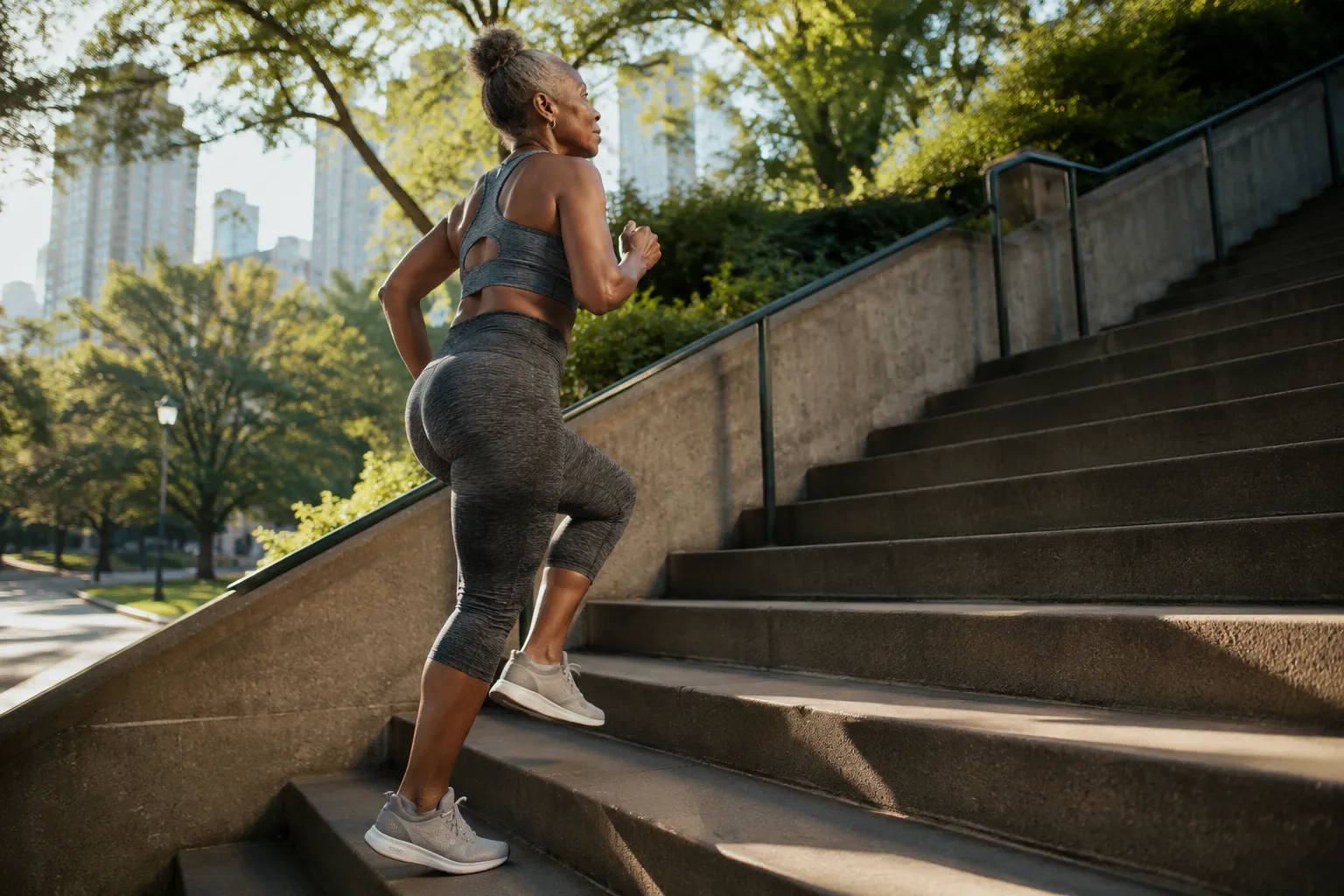
The best exercises for stair climbing are step-ups, split squats, and eccentric step-downs, because they train single-leg strength and knee control under load, the exact demands of ascending and descending stairs. Stair climbing is one of the top five tasks that becomes hardest with age, which is why some trials use stair-climbing exercise itself as a training protocol for older adults [12].
Core stair-climbing exercises:
- Step-ups (start with a 6-inch step, progress to 12-16 inches). 2 sets of 8 per leg. Drive through the heel, don't push off the bottom foot.
- Split squats (bodyweight, then holding light dumbbells). 2 sets of 8 per leg. Builds the strength needed to push up one step at a time.
- Eccentric step-downs (lower slowly for 3 seconds). 2 sets of 6 per leg. This trains descending stairs, the direction where most falls happen.
- Calf raises on a stair edge. 2 sets of 15. Ankle strength matters for stair push-off and balance.
Decision rule: If you currently need a handrail on both sides, start with 4-inch steps and hold a wall lightly. Progress step height before adding weight.
Common mistake: Rushing up. Slow, controlled reps build more usable strength than fast ones and reduce knee stress.
How to Train for Carrying Heavy Groceries and Objects Safely
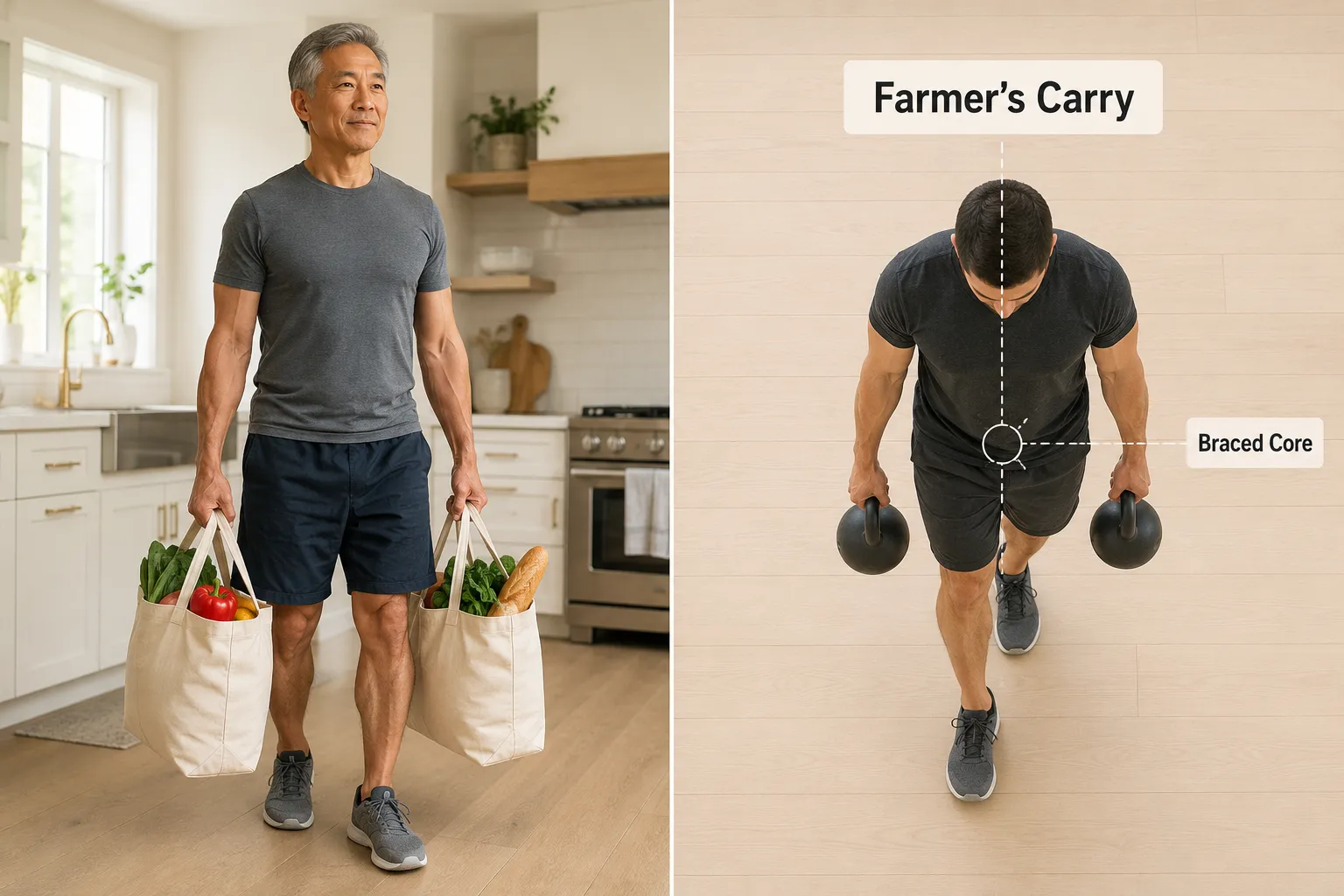
To carry heavy objects safely, train loaded carries, walking while holding weight in one or both hands, because they build grip, core bracing, and posture endurance simultaneously. Groceries, laundry baskets, and a grandchild all share the same demand: hold a load while your legs keep moving.
Core carrying exercises:
- Farmer's carry. Hold a dumbbell (or a jug of water) in each hand, walk 20-40 steps with tall posture. 2-3 rounds.
- Suitcase carry. Same idea, but load only one side. This trains the obliques to keep you from tipping, the exact skill of carrying a single grocery bag.
- Bear hug carry. Hug a heavy object (sandbag, laundry basket, weighted pillow) against your chest and walk. Mimics carrying a large box.
- Deadlift to carry. Practice picking the load up from the floor with a hip hinge, then walking. Most injuries happen at the pick-up, not the carry.
Safe lifting checklist:
- Feet close to the object
- Hips back, chest up
- Grip firmly, brace the core (like bracing for a light punch)
- Stand up with the legs, not the low back
- Look forward, not down, while walking
Exercises to Get Up Off the Floor Easier as You Age
The most effective exercises to get off the floor are the sit-to-stand, kneeling-to-standing drill, and modified Turkish get-up, because they rehearse the exact transitions of a floor transfer. Practicing the movement itself, slowly and often, is what trainers report works best for older clients [8][10].
A simple floor-transfer progression:
- Chair sit-to-stand. 2 sets of 10, no hands. Builds the base strength for standing up.
- Half-kneeling to standing. From one knee down, one foot forward, stand up without using hands. 5 per leg.
- Side sit to kneel. Sit sideways on the floor, roll to hands and knees, stand up. Practice both sides, most people are one-sided.
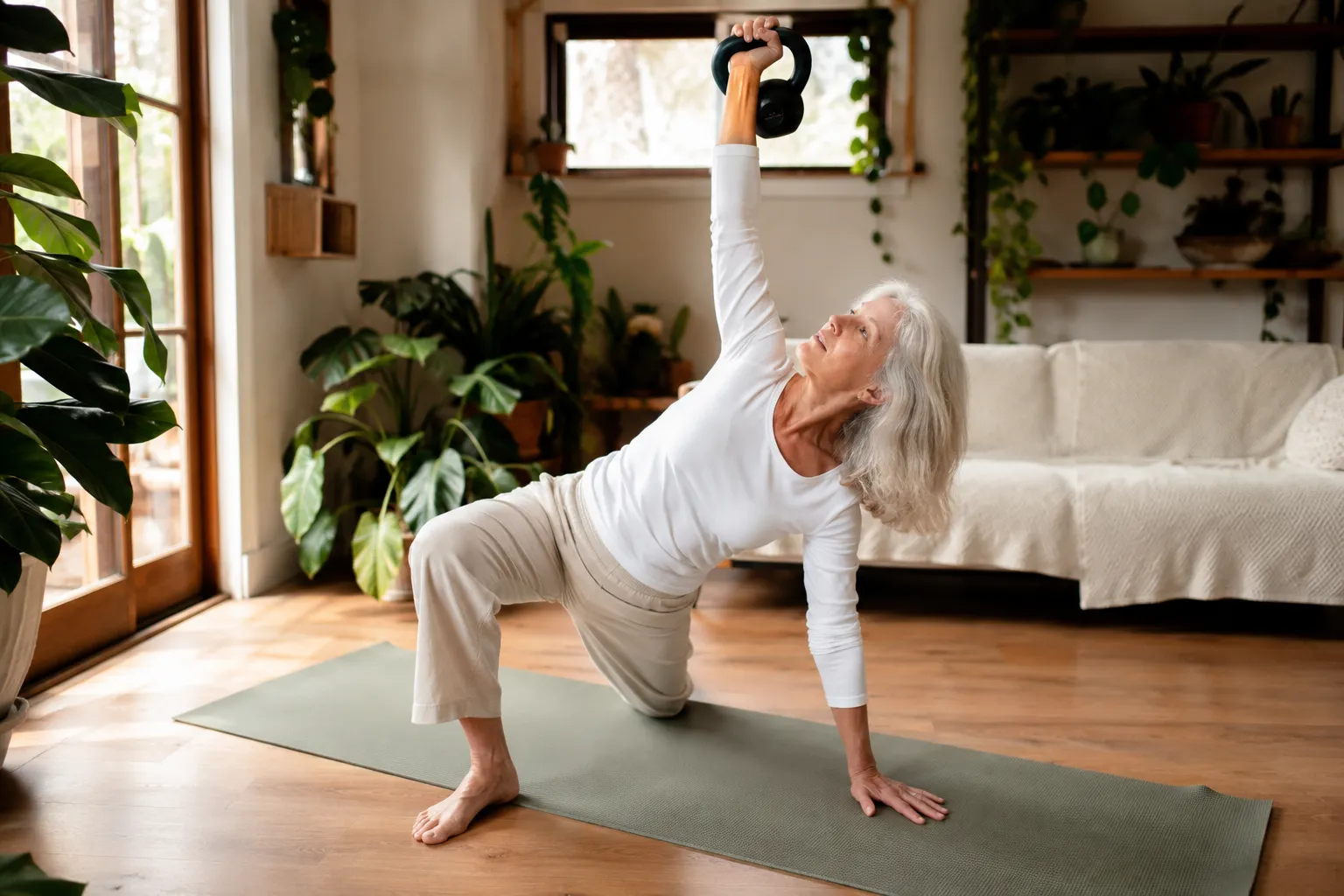
- Turkish get-up (unweighted). A slow, 6-step transition from lying on your back to standing. Even without a weight, it teaches every position of a controlled floor exit [2][3].
Frequency: Practice getting to the floor and back up 2-3 times per session, 3 sessions per week. Repetition is what makes the movement automatic [10].
Common mistake: Avoiding the floor entirely. The less you use it, the harder it gets. Sit on the floor for 5 minutes a day while watching TV to normalize the transition.
Functional Fitness vs Regular Gym Workouts: What's the Difference
Functional fitness trains multi-joint movements that mirror daily tasks; regular gym workouts often isolate single muscles on machines. Both build strength, but only functional training directly transfers to stairs, carrying, and floor transfers because it rehearses balance, coordination, and posture at the same time.
Functional workout: Step-up with dumbbells → trains quads, glutes, balance, grip, and posture in one movement, same pattern as climbing stairs with groceries.
Choose functional training if your goal is daily-life capability, fall prevention, or aging in place. Choose traditional gym work if your goal is bodybuilding, isolated rehab, or you have a specific injury that requires machine-controlled loading. Most people benefit from a blend, with functional movements as the base.
How Often Should I Do Functional Fitness Training
Two to three sessions per week, 30-45 minutes each, is the sweet spot for most adults. This frequency allows enough recovery between sessions while providing the repeated exposure needed for neurological adaptation, the skill part of strength.
Sample weekly split:
| Day | Focus | Time |
|---|---|---|
| Monday | Legs and stairs (step-ups, split squats) | 30 min |
| Wednesday | Carries and core (farmer's walks, planks) | 30 min |
| Friday | Floor transfers and full-body (get-ups, sit-to-stands) | 30 min |
| Daily | 5-minute walk + 1 minute of floor sitting | 6 min |
Edge case: If you're brand new to exercise or recovering from an illness, start with two 20-minute sessions per week. Consistency for 6 weeks beats an ambitious plan you abandon in 10 days.
Can Functional Fitness Prevent Falls and Injuries at Home
Yes, functional fitness reduces fall risk by strengthening the muscles and reflexes that catch you before you fall and by teaching you how to get back up if you do. Programs that combine leg strength, balance, and floor-transfer practice consistently outperform strength-only programs for fall reduction in older adults [6][7].
The three-part fall-protection system:
- Prevention. Strong legs, good balance, and ankle mobility keep you upright.
- Reaction. Fast reflexes and grip strength let you catch yourself on a rail or counter.
- Recovery. Practiced floor transfers mean a fall is an inconvenience, not a hospital visit [10].
Most fall-related injuries happen at home during ordinary tasks, stepping off a curb, carrying laundry, reaching for something high. The training that prevents them is the training that mimics them.
Functional Fitness for Seniors and Older Adults
For seniors, functional fitness should prioritize sit-to-stands, assisted step-ups, and floor-transfer practice, because these directly correspond to the tasks used by researchers to assess independent-living capacity [4]. Even adults in their 80s and 90s show measurable strength gains within 8-12 weeks of consistent training.
Senior-specific adjustments:
- Begin with body weight only for 2-3 weeks before adding load
- Use a sturdy chair or wall for balance assistance during single-leg work
- Warm up longer, 5 to 10 minutes of easy walking or marching in place
- Practice descending as often as ascending, going down is where balance fails
- Include soft floor work on a rug or mat to reduce fear during transfers
Trainers working with older clients report that the biggest breakthrough often isn't strength but rehearsal: doing the movement enough times that it stops feeling risky [8].
Common Mistakes People Make When Training Functional Movements
The most common mistakes are skipping the descending/eccentric portion of exercises, avoiding the floor entirely, and using too much weight too soon. Each mistake reduces the transfer of training to real-world independence.
Top mistakes to avoid:
- Only training "up." Step-ups without step-downs skip the harder half of stair use.
- Machine-only workouts. They build muscle but not balance or coordination.
- Never practicing floor transfers. The skill disappears with disuse.
- Chasing weight instead of quality. A perfect body-weight split squat beats a wobbly loaded one.
- All bilateral, no single-leg. Real life happens one leg at a time (stairs, curbs, stepping over pets).
- Skipping grip work. Carrying groceries fails at the hands first.
What Equipment Do I Need for Functional Fitness at Home
You need very little: a sturdy step or bottom stair, two dumbbells or filled water jugs, a chair, and a soft floor space. That covers roughly 90% of the training that matters for daily independence.
Minimum home setup:
- Sturdy chair (for sit-to-stands and balance support)
- Step or bottom stair (for step-ups and step-downs)
- Two hand weights (5-20 lb dumbbells, or two filled 1-gallon jugs at ~8 lb each)
- Yoga mat or carpet (for floor transfers)
- Wall space (for balance work and wall push-ups)
Nice to add later: a resistance band, a heavier kettlebell, and a taller step (12-16 inches).
How Long Does It Take to See Results from Functional Fitness
Most people notice improvements in 2-4 weeks (easier stairs, less fatigue with groceries) and measurable strength gains in 8-12 weeks. Neurological adaptations, balance, coordination, confidence, happen first; muscle changes follow.
Realistic timeline:
- Week 1-2: Movements feel awkward; soreness after sessions is normal
- Week 3-4: Daily tasks feel noticeably easier
- Week 6-8: Strength gains visible in reps and load handled
- Week 12+: Improvements in balance tests, walking speed, and floor-transfer ease [5][6]
The people who see the best results aren't the ones who train hardest, they're the ones who train the most consistently.
Is Functional Fitness Good for People with Mobility Issues
Yes, and it's often more effective than traditional exercise for people with mobility issues, because it can be scaled to any starting level and directly targets the tasks that mobility limits. Seated sit-to-stands, wall-supported step-ups, and floor-transfer drills all have easier versions.
Modifications for limited mobility:
- Sit-to-stand with a higher chair or armrest push-off
- Step-ups onto a 2-inch platform, holding a rail
- Floor transfers practiced from a bed or sofa first, then a low chair, then the floor
- Chair-supported single-leg balance for 10 seconds
If you have a specific condition (recent surgery, severe arthritis, neurological issues), start with a physical therapist for the first 4-6 weeks, then transition to home practice.
Functional Fitness Training for People Who Sit All Day
For desk workers, functional fitness should prioritize hip mobility, glute activation, and posture endurance, because prolonged sitting weakens the exact muscles that stairs and carrying demand. Ten minutes of daily movement plus two structured sessions per week is enough to reverse most sitting-related decline.
Daily desk-worker routine (10 minutes):
- 20 sit-to-stands from your office chair
- 10 step-ups on a low box or stair, each leg
- 30-second wall sit
- 30 seconds of standing hip circles per side
- 10 slow squats with arms overhead
Twice-weekly session (30 minutes): Add loaded carries, split squats, and one floor transfer drill. This combination directly counteracts the postural patterns of desk work while building the strength daily life demands.
FAQ
How is functional fitness different from CrossFit?
Functional fitness borrows movement patterns from CrossFit but usually removes the high-intensity, competitive elements. The focus is real-life capability, not workout performance.
Can I do functional fitness every day?
Light movements (walking, mobility, sit-to-stands) can be daily. Loaded strength work should have a rest day between sessions.
Do I need a personal trainer?
Not required, but 2-4 sessions with a qualified trainer at the start can fix form issues before they become habits.
Is walking enough for functional fitness?
Walking is excellent cardio and helpful for legs but doesn't build enough strength for stairs, carrying, or floor transfers on its own. Combine walking with 2 strength sessions weekly.
What if I fall while training?
Train on a soft floor, near a wall or sturdy chair, with a phone nearby. Practicing controlled floor transfers actually reduces fall injury risk over time [10].
Can functional fitness help with knee pain?
Often yes, strengthening the muscles around the knee (quads, glutes, calves) reduces load on the joint. Start light and stop any exercise that causes sharp pain.
How old is too old to start?
There isn't an upper age limit. Adults in their 80s and 90s show meaningful gains when they start training consistently [4].
Should I stretch before or after?
A light dynamic warm-up (marching, arm circles) works best before. Static stretching is better after the session.
Conclusion
Independence at home rests on three trainable skills: climbing stairs, carrying loads, and getting off the floor. Every one of them responds to focused practice at any age. Pick one movement from each category, do them 2-3 times a week for the next 8 weeks, and measure your progress by how daily life feels, not how sore you are.
Your next steps:
- This week: Do 10 sit-to-stands, 10 step-ups per leg, and one floor transfer, three times.
- Week 2: Add a farmer's carry (20 steps with something moderately heavy).
- Week 4: Retest, can you get off the floor without using your hands? Climb stairs without a rail?
- Week 8: Add load, add reps, and start practicing the harder version of each movement.
Independence isn't given up all at once. It's traded away one skipped stair, one avoided floor sit, one grocery trip made in three trips instead of two. Reverse those trades, and the autonomy comes back.
References
[2] Exercises Getting Off Floor Easier After 65 – https://www.eatthis.com/exercises-getting-off-floor-easier-after-65/
[3] Getting Up From The Floor For Seniors – https://ferra.club/blog/getting-up-from-the-floor-for-seniors
[4] Paperinformation – https://www.scirp.org/journal/paperinformation?paperid=21937
[5] researchdirects – https://researchdirects.com/index.php/therapy/article/download/187/151
[6] Pmc11155611 – https://pmc.ncbi.nlm.nih.gov/articles/PMC11155611/
[7] Pmc6352105 – https://pmc.ncbi.nlm.nih.gov/articles/PMC6352105/
[8] What Helped My Senior Clients Get Off The Floor – https://www.reddit.com/r/SeniorFitness/comments/1lk2jm3/what_helped_my_senior_clients_get_off_the_floor/
[10] The Best Exercises To Help Older People Get Off The Floor – https://rangeofmotion.net.au/the-best-exercises-to-help-older-people-get-off-the-floor/