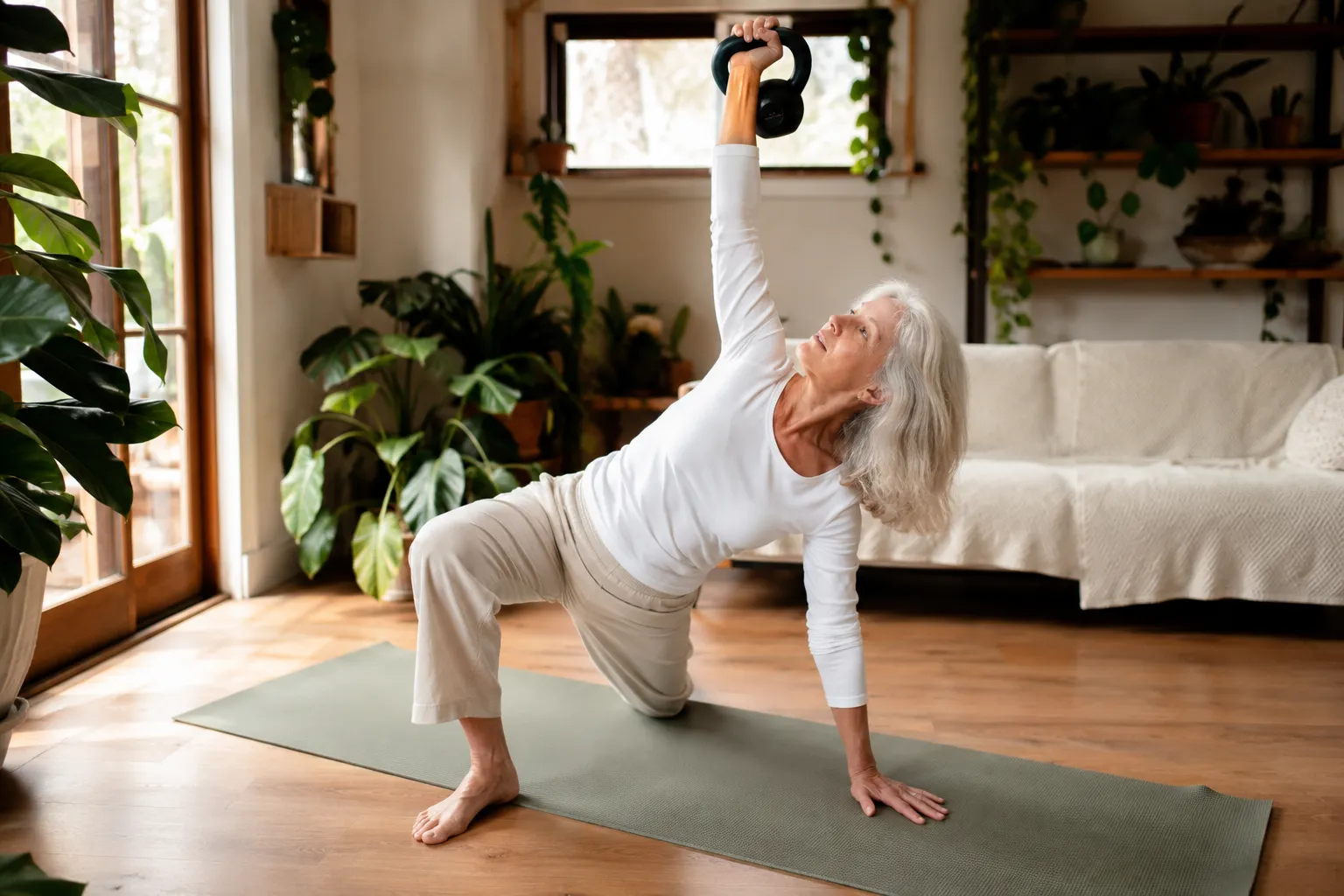
Fall Prevention Micro-Workouts: 5-Minute Routines You Can Do While Cooking or Watching TV

Fall Prevention Micro-Workouts: 5-Minute Routines You Can Do While Cooking or Watching TV

Last updated: August 30, 2026

Quick Answer

Fall Prevention Micro-Workouts are short, 3-5 minute bursts of balance, strength, and mobility drills you slot into activities you already do, like stirring pasta or watching the evening news. Done most days, they build the ankle strength, hip stability, and reaction time that keep you upright when you trip on a rug or miss a curb. You need no equipment beyond a sturdy counter or chair, and the science supports brief, frequent sessions over rare hour-long workouts [1][8].

Key Takeaways

  • Frequency beats duration. Two to three 5-minute sessions daily produce measurable balance gains within 6-12 weeks [8].
  • Habit stacking works. Anchor drills to existing routines: heel raises while the kettle boils, single-leg stands during commercial breaks.
  • Support is smart, not weak. A kitchen counter or high-backed chair lets you push closer to your balance limit safely.
  • Legs, ankles, and hips matter most. Weakness there is the top predictor of falls in adults over 65 [6].
  • Progress means less support, not harder moves. Move from two-hand to one-hand to fingertip to hands-free.
  • Micro-workouts fit almost everyone, including people with arthritis, Parkinson's, or walker use, with the right modifications [9].
  • Skip or modify if you have acute vertigo, recent surgery, or uncontrolled blood pressure without clearing it with your clinician.

What Causes Falls in Older Adults and How Can Exercise Help

Most falls in older adults come from a mix of muscle weakness, poor balance, slower reaction time, and reduced foot sensation, not a single dramatic event [6]. Exercise directly targets the first three, which is why national fall prevention guidelines rank it as the single most effective intervention.

As we age past 50, we lose roughly 1-2% of muscle mass per year if we're inactive, and the fast-twitch fibers that catch a stumble go first [8]. Balance also depends on three systems working together: vision, inner ear, and proprioception (the sense of where your joints are in space). All three dull over time, but all three respond to training.

What targeted exercise fixes:

  • Rebuilds hip and calf strength so you can catch yourself
  • Retrains the ankle strategy that corrects small sways
  • Sharpens reaction time when the floor surprises you
  • Improves posture and gaze stability

Fall Prevention Micro-Workouts work because they hit these systems repeatedly across the day, which is how the brain and body actually adapt.
What Causes Falls in Older Adults and How Can Exercise Help

Can You Really Prevent Falls With Just 5-Minute Exercises

Yes, if you do them consistently. Short, frequent balance and strength sessions have been shown in clinical settings to reduce fall risk, and Johns Hopkins and the Fall Prevention Foundation both endorse brief daily practice over infrequent long workouts [1][8].

The reason is simple: balance is a skill. Skills improve with repetition spread across many small sessions, not one heroic session per week. A pianist doesn't practice scales for three hours on Sunday. Neither should your ankles.

Decision rule: Choose micro-workouts if you struggle to get to a gym, dislike structured exercise, or have already tried and quit longer programs. Choose a formal class (like Tai Chi or a PT-led group) if you need supervision, have had a recent fall, or want social accountability.

Best Balance Exercises You Can Do Standing in One Spot

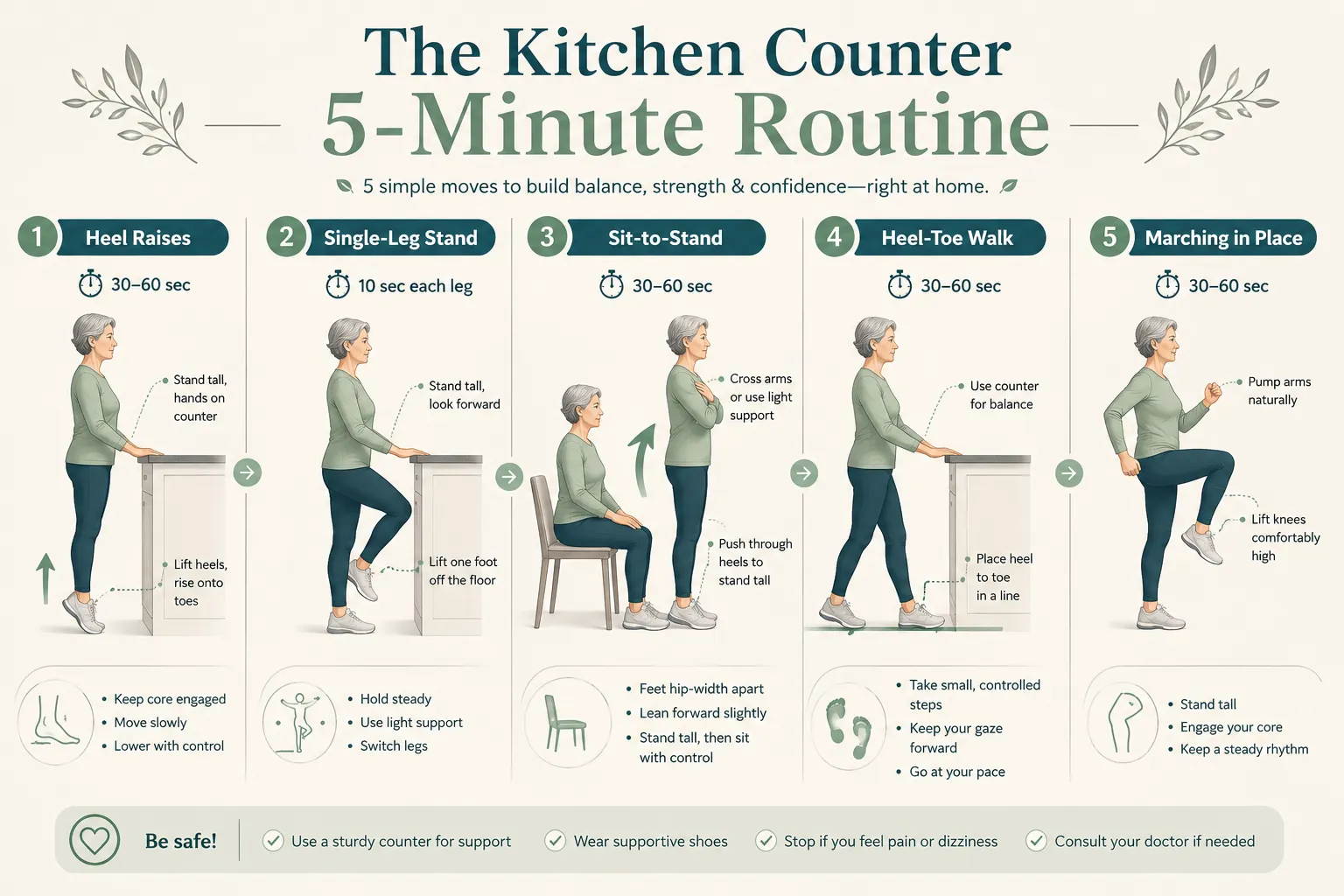
The best standing balance exercises for tight spaces are heel raises, single-leg stands, heel-to-toe stance, mini squats, and side leg lifts. Each takes 30-60 seconds and needs only a countertop for light support [1][3].

The Kitchen Counter 5-Minute Routine:

Exercise Time What It Trains
Heel raises (both feet) 45 sec Calf strength, ankle push-off
Single-leg stand, each side 30 sec × 2 Hip stabilizers, proprioception
Heel-to-toe stance 45 sec Narrow-base balance
Mini squats 45 sec Quad and glute strength
Side leg lifts, each side 30 sec × 2 Hip abductors (side stability)
Marching in place 45 sec Coordination, reaction

Do this while waiting for water to boil, coffee to brew, or the oven to preheat. Keep one hand loosely on the counter until you're steady.

How Often Should You Do Fall Prevention Workouts to See Results

Aim for balance work 5-7 days per week and strength-focused moves 2-3 days per week. Most people notice steadier walking within 4 weeks and meaningful fall-risk reduction within 8-12 weeks of consistent practice [8].

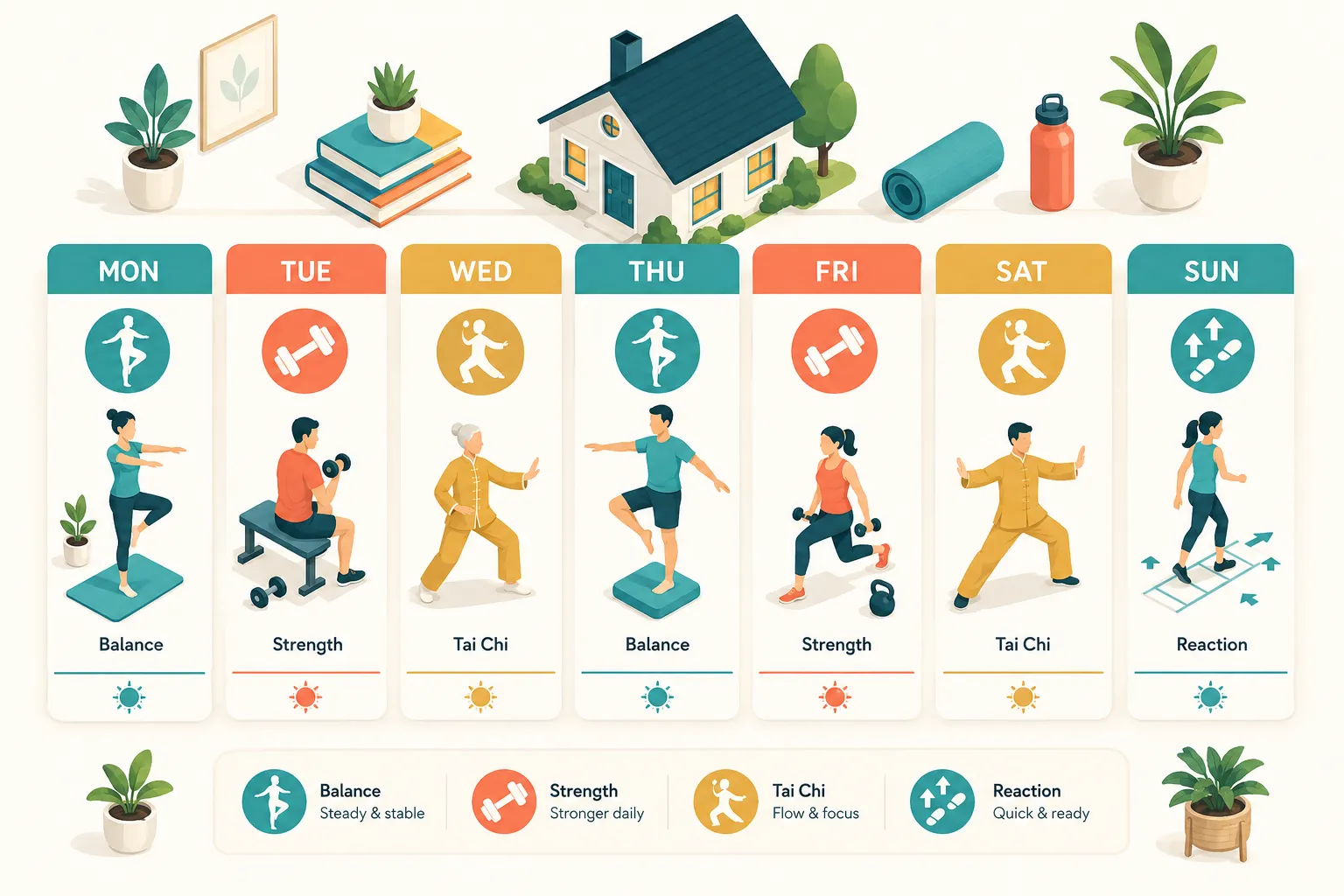
A realistic weekly pattern:

  • Every day: One 5-minute balance micro-session (kitchen or bathroom)
  • 3-4 days: One 5-minute strength micro-session (sit-to-stands, wall push-ups, calf raises)
  • 1-2 days: A longer walk, class, or Tai Chi session if you enjoy it

The biggest predictor of success isn't intensity, it's showing up. Two minutes done daily beats twenty minutes done occasionally.

Micro-Workouts While Cooking: Safety Tips So You Don't Actually Fall

Ironically, the biggest risk of a kitchen workout is the kitchen itself. Follow these rules to keep the practice safe [5][6]:

  1. Turn off the burner before balancing on one leg. Sharp knives and hot pans don't mix with wobble.
  2. Wear shoes or grippy socks. Bare feet on tile are fine; socks on tile are not.
  3. Keep one hand near the counter, not gripping it. Fingertip contact is enough for feedback.
  4. Clear the floor. No dropped utensils, water spills, or pet toys underfoot.
  5. Face the counter, not away. If you sway, you catch yourself on it, not fall backward.
  6. Skip balance drills if you're carrying anything hot or heavy. Wait until the pot is down.

Good anchor moments: water boiling, microwave running, toaster toasting, kettle heating. Bad anchor moments: anything involving open flame, sharp cutting, or lifting a full pot.

What's the Difference Between Fall Prevention and Regular Strength Training

Regular strength training builds bigger, stronger muscles. Fall prevention training builds the specific balance, reaction, and functional strength needed to stay upright. There's overlap, but the emphasis differs [8][10].

Key differences:

Regular Strength Training Fall Prevention Training
Focus on load and hypertrophy Focus on balance, reaction, coordination
Often seated or machine-based Standing, functional positions
Slow, controlled reps Includes quicker, catch-yourself movements
One big session per week works Frequent short sessions work better
Progress = heavier weight Progress = less support, harder balance

A bench press won't stop you from tripping on a curb. A single-leg stand while brushing your teeth might.
What's the Difference Between Fall Prevention and Regular Strength Training

Fall Prevention Exercises for People With Arthritis or Joint Pain

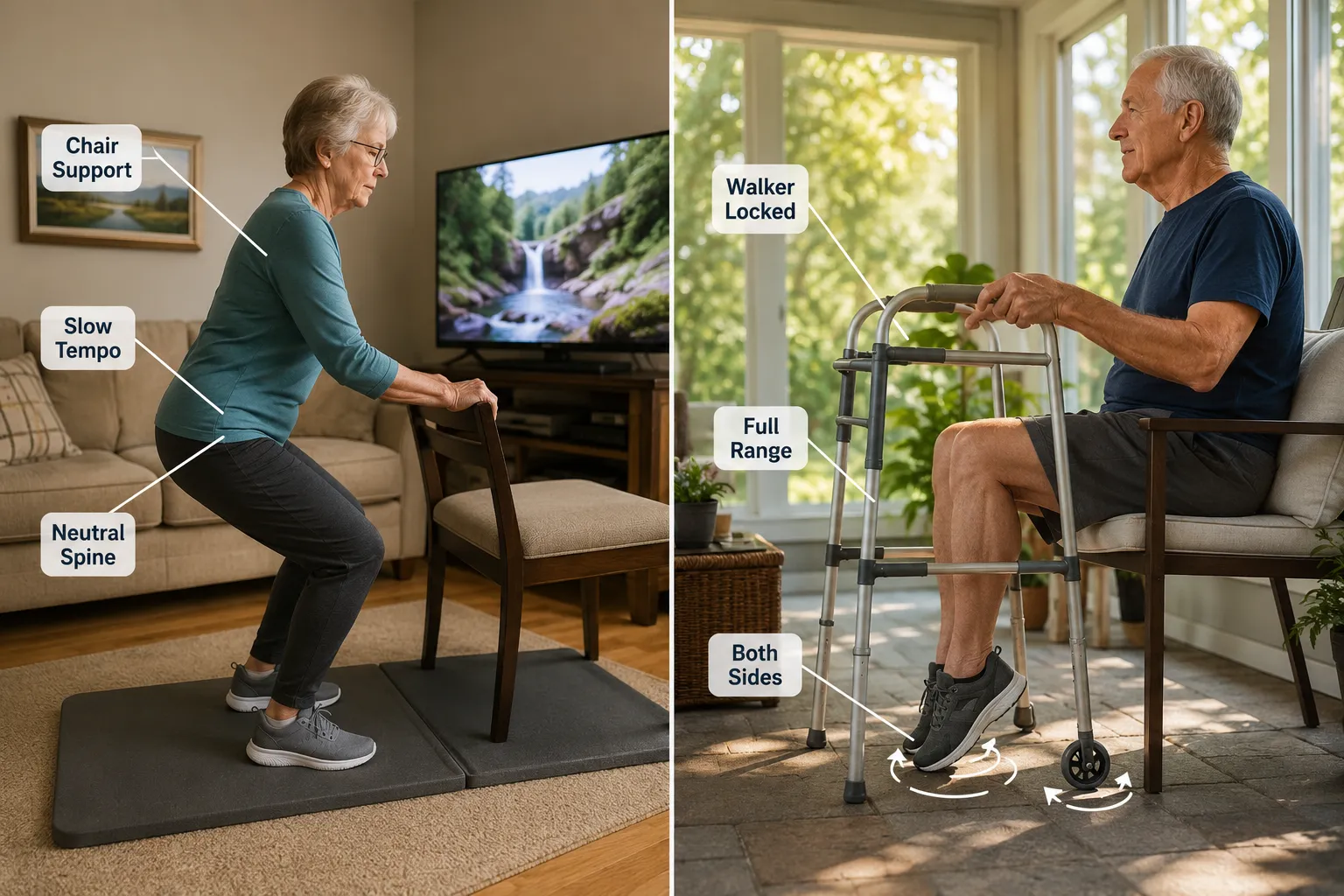
For arthritic joints, choose low-impact, supported versions: seated marching, chair-supported heel raises, gentle weight shifts, and slow sit-to-stands from a firm chair. Skip anything that causes sharp pain, and prioritize range of motion before load [1][9].

Arthritis-friendly 5-minute routine:

  • Seated marching: 60 seconds
  • Ankle circles, each direction: 30 seconds each
  • Chair-supported heel raises: 60 seconds
  • Slow sit-to-stands from a dining chair: 60 seconds (use armrests if needed)
  • Standing weight shifts side to side: 60 seconds, hands on counter

Warmth helps. Do these after a warm shower or later in the day when joints have loosened. If a joint hurts during an exercise (not just stiff), stop and modify.

Best Balance Exercises If You Have Limited Mobility or Use a Walker

If you use a walker or have significant mobility limits, focus on seated core work, supported standing time, and ankle mobility. The goal shifts from preventing trips to preserving the ability to stand, transfer, and catch yourself [3][9].

Walker-friendly micro-routine:

  • Seated marching with arm swings: 60 sec
  • Ankle pumps (heel-toe rocks) while seated: 60 sec
  • Walker-supported heel raises: 45 sec (lock the walker brakes first)
  • Walker-supported weight shifts: 45 sec
  • Seated leg extensions, alternating: 60 sec

Critical safety rule: brakes locked, walker on a non-slip surface, and never lean forward onto the walker with straight arms during heel raises. Keep elbows soft.

Do Fall Prevention Exercises Work for Younger People or Just Seniors

They work for everyone, and starting in your 40s or 50s gives the biggest long-term payoff. Balance and ankle strength decline silently long before falls become common, so training earlier means you never lose the buffer [4][8].

Younger adults, especially those who sit for work, often have the ankle mobility of someone twice their age. Athletes benefit too: better proprioception means fewer sprains and better performance. If you're under 60, you can also add gentle plyometric moves like small hops or step-ups to build reactive strength [4].

How to Tell If You're Doing Fall Prevention Exercises Correctly

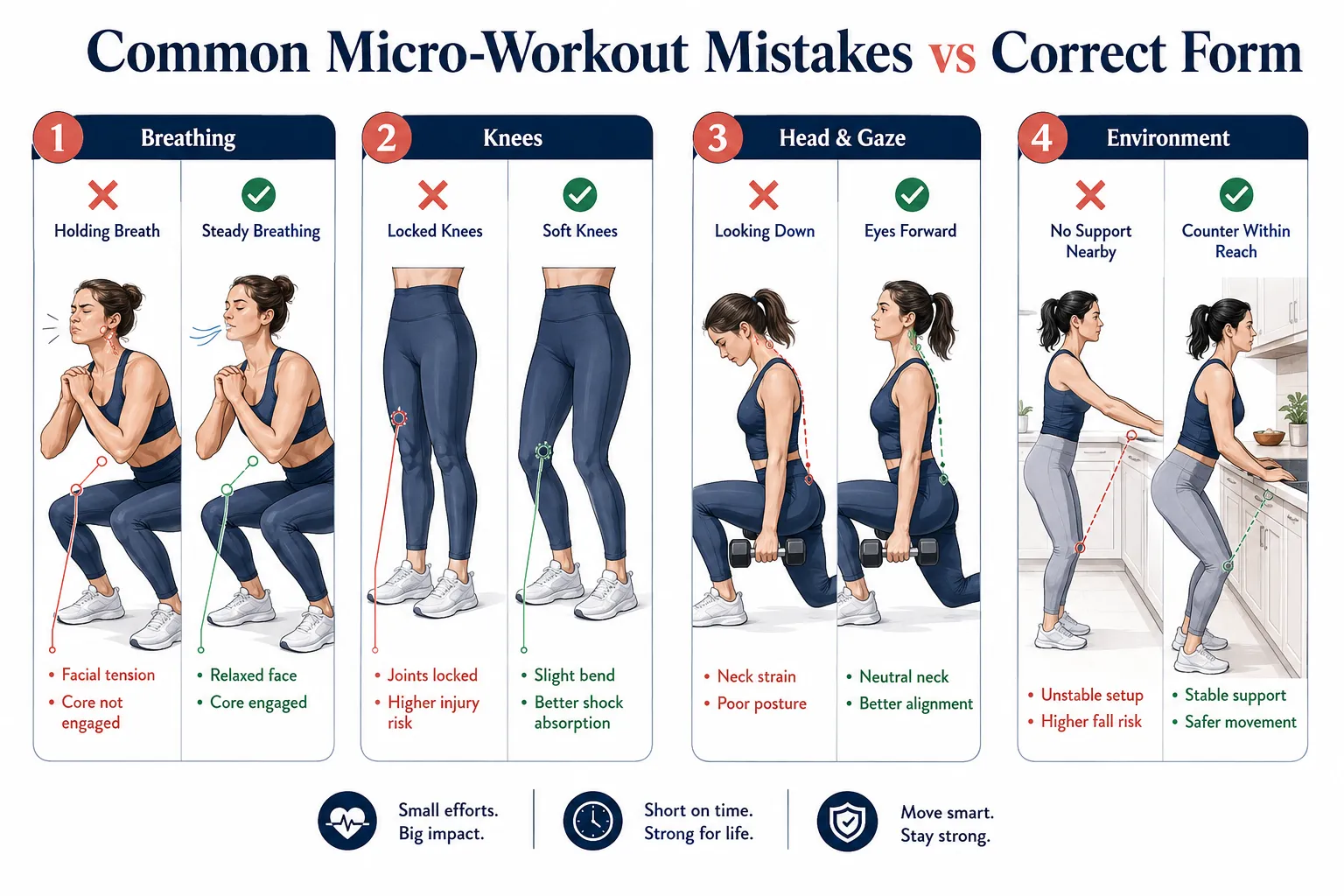
Correct form for balance work means: neutral spine, eyes forward (not down), steady breathing, and a slight sway that you control rather than fight. If you're gripping the counter white-knuckled or holding your breath, the drill is too hard [1][10].

Signs you're doing it right:

  • Small ankle and hip corrections, not big flails
  • Breathing evenly through the movement
  • Can hold the position for the target time without pain
  • Feel worked but not shaky-exhausted afterward

Signs to dial it back:

  • Death grip on the counter
  • Breath-holding
  • Sharp joint pain (dull muscle work is fine)
  • Actually losing balance more than once per session

Pull quote: "Progress in balance training isn't about doing harder tricks. It's about doing the same simple drill with less help."

Can You Do These Workouts If You Have Vertigo or Inner Ear Problems

Only with clearance from your doctor or a vestibular therapist. Some balance drills can trigger vertigo, while others are specifically prescribed to retrain the vestibular system. The difference matters, and self-prescribing can make symptoms worse [6].

If you have BPPV, Meniere's disease, or unexplained dizziness, book a vestibular assessment first. Once cleared, gaze-stabilization drills (focusing on a fixed point while turning your head slowly) and firm-surface balance work are usually the safest starting places. Skip head-tilting drills and eyes-closed balance until a professional says otherwise.

What Equipment Do You Need for 5-Minute Fall Prevention Routines

Almost nothing. A sturdy kitchen counter, a firm-seated chair, and non-slip footwear cover 95% of Fall Prevention Micro-Workouts [1][3]. Optional upgrades that help later:

  • Resistance band ($10): for seated leg strengthening
  • Foam pad or folded towel ($0-20): for advanced unstable-surface balance
  • Grab bar in bathroom ($15-40): for tooth-brushing balance drills
  • Timer or phone app: to keep sessions honest

Skip: wobble boards, BOSU balls, and expensive balance trainers until you've mastered the basics on firm ground. Fancy gear is the most common way people quit.

Common Mistakes People Make When Trying to Prevent Falls at Home

The biggest mistakes are doing exercises too rarely, gripping supports too hard, skipping the harder side, and confusing stretching with balance training [1][8].

Top mistakes to avoid:

  1. Only training the "good" leg. Your weaker side is where falls start.
  2. Holding the counter like a life raft. Feedback, not support.
  3. Doing balance work only during class, not daily. Skills need reps.
  4. Ignoring the ankles. Calf and ankle strength are underrated.
  5. Never progressing. If a drill feels easy for two weeks, make it harder.
  6. Rushing sit-to-stands. Slow negatives build more strength than fast reps.
  7. Wearing socks on hardwood. A fall waiting to happen.
Common Mistakes People Make When Trying to Prevent Falls at Home

Are There Fall Prevention Exercises You Should Avoid If You Have Certain Conditions

Yes. Certain conditions make specific drills risky. Avoid the following without clearance [6][9]:

  • Uncontrolled high blood pressure: skip breath-holding and rapid position changes
  • Recent joint replacement: avoid deep squats or crossed-leg stances until cleared
  • Osteoporosis (severe): avoid forward-bending, twisting, or high-impact moves
  • Peripheral neuropathy: avoid eyes-closed balance and unstable surfaces
  • Parkinson's disease: work with a specialist; some cueing methods are far more effective than others [9]
  • Recent stroke: get a PT assessment before starting standing balance work
  • Acute vertigo episode: rest until symptoms settle, then reassess

When in doubt, one phone call to your doctor or a physical therapist saves months of setbacks.

Frequently Asked Questions

How long until I notice a difference?
Most people feel steadier within 2-4 weeks and see meaningful improvement in fall risk indicators by 8-12 weeks of near-daily practice [8].

Can I do these if I've already fallen recently?
Yes, but get assessed first. A recent fall is a strong predictor of future falls, and a physical therapist can identify the specific weakness that caused it [6].

Are Fall Prevention Micro-Workouts safe during pregnancy?
Most balance drills are safe with counter support, but avoid single-leg stands with eyes closed and any move that strains the abdomen. Check with your provider.

What's better, Tai Chi or micro-workouts?
Both work. Tai Chi has strong evidence but requires a class. Micro-workouts win on convenience and daily frequency. Many people combine them.

Can I do these with grandkids around?
Yes, and it models healthy aging. Just clear the floor of toys first.

Do I need to warm up for a 5-minute session?
Not usually. The first exercise (like marching in place) serves as its own warm-up. For strength-focused sessions, spend 30 seconds walking first.

Will these help with stairs?
Directly, yes. Sit-to-stands, calf raises, and single-leg work all transfer to stair confidence.

What if I feel dizzy during a drill?
Sit down immediately, drink water, and note what triggered it. If it happens more than once, see your doctor before continuing.

Conclusion

Fall Prevention Micro-Workouts: 5-Minute Routines You Can Do While Cooking or Watching TV work because they solve the real problem, which isn't a lack of good exercises. It's the gap between knowing you should train balance and actually doing it week after week. Habit-stacking these drills onto boiling water, brewing coffee, and commercial breaks removes the friction that kills most exercise plans.

Your next steps this week:

  1. Pick one anchor activity (kettle, microwave, or TV commercial) and attach the Kitchen Counter routine to it starting tomorrow.
  2. Set a phone reminder for a second daily session.
  3. In week two, reduce your hand support from full grip to fingertips on one drill.
  4. If you've had a fall in the past year or have a condition on the caution list, book a PT assessment before advancing.

Small, frequent, and boringly consistent wins here. Your future self, still walking confidently at 85, will thank you.

References

[1] Fall Prevention Exercises – https://www.hopkinsmedicine.org/health/wellness-and-prevention/fall-prevention-exercises
[2] Watch – https://www.youtube.com/watch?v=BhRjlXNvpps
[3] Daily Mobility Micro Workouts Ten Two Minute Routines You Can Do Anywhere – https://seniorcenters.com/daily-mobility-micro-workouts-ten-two-minute-routines-you-can-do-anywhere/
[4] Best Plyometric Exercises Better Balance Preventing Falls – https://www.latimes.com/lifestyle/story/2026-08-18/best-plyometric-exercises-better-balance-preventing-falls
[5] Fall Prevention – https://www.unaliwear.com/senior-safety-101/fall-prevention/
[6] Art 20047358 – https://www.mayoclinic.org/healthy-lifestyle/healthy-aging/in-depth/fall-prevention/art-20047358
[7] Watch – https://www.youtube.com/watch?v=mUrQVL1MzSk
[8] Senior Strength Training For Fall Prevention 7 Essential Exercises To Build Stability And Confidence At Home – https://fallpreventionfoundation.org/2026/07/15/senior-strength-training-for-fall-prevention-7-essential-exercises-to-build-stability-and-confidence-at-home/
[9] Parkinsons Exercises For Balance And Strength A Safe At Home Fall Prevention Guide – https://fallpreventionfoundation.org/2026/07/29/parkinsons-exercises-for-balance-and-strength-a-safe-at-home-fall-prevention-guide/
[10] Strength Series Beginner Strength Cc6 – https://doctorjesss.substack.com/p/strength-series-beginner-strength-cc6
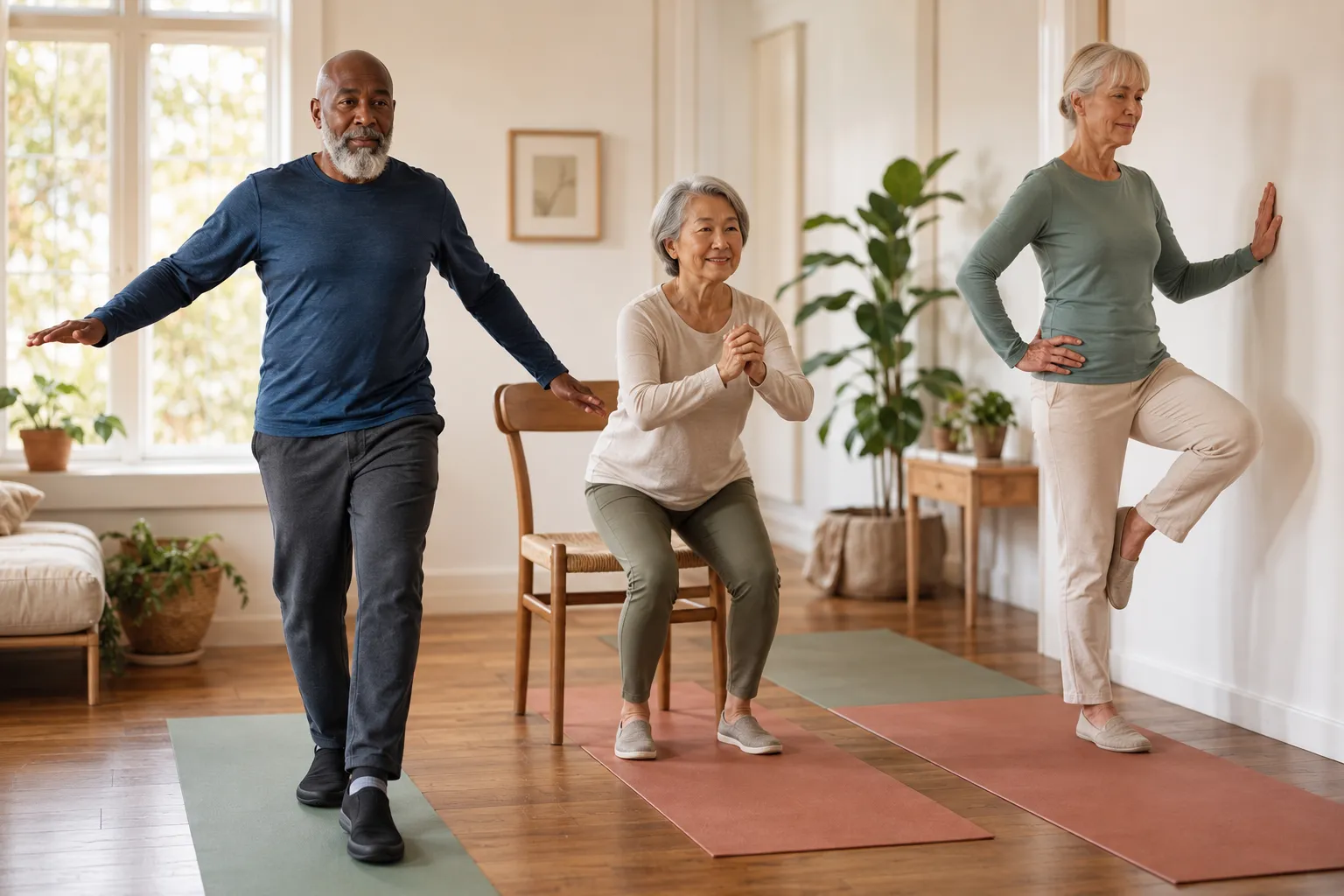
Fall Prevention Exercises After 60: Evidence-Based Home Workouts for Balance and Stability

Fall Prevention Exercises After 60: Evidence-Based Home Workouts for Balance and Stability

Last updated: August 6, 2026

Quick Answer

Fall prevention exercises after 60 work best when they combine balance training, lower-body strength, and reactive stepping practiced at least 3 hours weekly. Evidence shows structured programs like Otago and Tai Ji Quan cut fall rates by 23-58%, while multimodal home routines reduce falls by roughly 34% [5][7]. Start with chair stands, progressive single-leg holds, and heel-to-toe walking three days a week, adding Tai Chi or resistance work as stability improves.

Key Takeaways

  • Multimodal training beats single exercises. Combining balance, strength, and functional movement reduces fall rates by 34% [7].
  • Tai Ji Quan is the single most effective modality, with 31-58% fall reductions in community-dwelling seniors [5].
  • Volume matters. At least 3 hours per week, sustained for 32+ weeks, produces the strongest results [1][7].
  • The Otago Program (balance + strength, 3x weekly) cuts falls by 23-40% [5].
  • Home-based programs work. Structured home routines reduce fall rates by 24% with high-certainty evidence [7][8].
  • Progression is essential. Move from feet-apart holds to feet-together, single-leg, and eyes-closed variations over weeks [2].
  • Reactive balance training (perturbation practice) improves recovery when balance is unexpectedly lost [5].
  • Most people feel steadier in 4-8 weeks with consistent practice; measurable strength gains take 8-12 weeks.

Key Takeaways

What Causes Falls in Older Adults Over 60?

Falls in adults over 60 usually result from a combination of muscle weakness, impaired balance, slowed reaction time, medication side effects, and environmental hazards, rarely a single cause. Vision changes, low blood pressure on standing, inner-ear problems, and reduced foot sensation also contribute.

The biggest modifiable risk factors are lower-body weakness (especially quads and hip abductors), poor postural control, and slow reactive stepping. That's why exercise-based prevention works: it targets exactly what age chips away at.

Common contributors:

  • Weak legs and hips (can't recover from a stumble)
  • Slower reflexes when balance is disrupted
  • Poor vision or bifocals on stairs
  • Medications causing dizziness or drowsiness
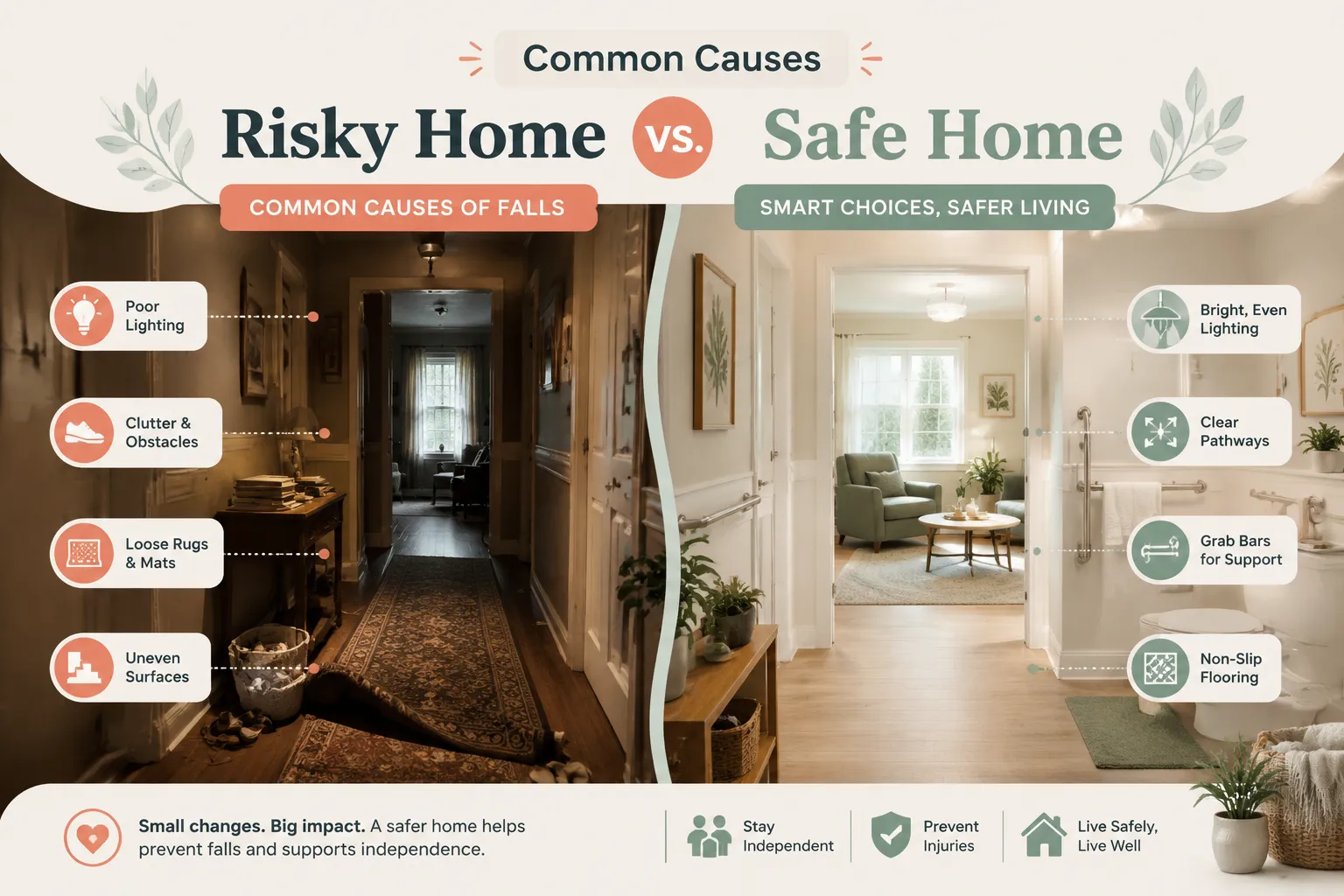
  • Home hazards: loose rugs, poor lighting, no grab bars
  • Fear of falling (which paradoxically increases fall risk)

Decision rule: If you've had a near-fall in the last 6 months, treat exercise as a medical intervention, not a hobby.

What Causes Falls in Older Adults Over 60?

Best Balance Exercises for Seniors at Home

The most effective home balance exercises for seniors are progressive stance work, chair stands, heel-to-toe walking, and single-leg holds, all doable with just a sturdy chair and wall access. These form the backbone of the evidence-based Otago and CDC-endorsed protocols.

Core home routine (start here):

  1. Chair stands, Sit to stand 10 times without using hands, twice daily. Progress to holding light weights [2].
  2. Progressive stance holds, Feet apart → feet together → tandem (heel-to-toe) → single-leg. Hold each 10-30 seconds, 5 reps twice daily [2].
  3. Heel-to-toe walking, 20 steps forward along a hallway, hand near wall for safety.
  4. Heel raises and toe raises, 10-15 reps, twice daily, holding chair for support.
  5. Sideways walking, 10 steps each direction, focusing on hip control.
  6. Eyes-closed standing (advanced), Only once feet-together stance is easy for 30 seconds.

"The safest way to progress is to reduce your base of support before you reduce your support. Feet-together with a hand on the counter is safer than single-leg in open space."

Common mistake: Skipping the easier stances because they feel too simple. The nervous system needs that foundation before advancing.

How Often Should I Do Fall Prevention Exercises?

Aim for at least 3 hours per week spread across most days, with dedicated balance work at least 3 days weekly. Meta-analysis of 38 studies shows programs done more than 5 times per week for over 32 weeks produce significantly greater fall reductions than shorter or less frequent routines [1].

Sample weekly schedule:

Day Focus Time
Mon Balance + strength 30 min
Tue Walking + heel raises 30 min
Wed Tai Chi or balance 30 min
Thu Strength (chair stands, bands) 25 min
Fri Balance + reactive stepping 30 min
Sat Walking or Tai Chi 30 min
Sun Gentle mobility / rest 15 min

The WHO recommends adults 65+ get at least 150 minutes of moderate activity weekly plus specific balance and strength work, this schedule hits both targets [6].

Can Fall Prevention Exercises Really Reduce Injury Risk?

Yes, the evidence is strong and consistent. Multimodal exercise programs reduce fall rates by 34% and cut the number of people who fall by 22%, based on moderate-certainty evidence from Cochrane-level reviews [7][10]. Home-based programs specifically reduce falls by 24% with high-certainty evidence [7][8].

What that means in plain numbers: If 100 sedentary adults over 60 would have 60 falls next year, a good exercise program brings that closer to 40 falls. For serious injuries like hip fractures, the reduction is even more meaningful because reactive stepping training helps you break falls better.

What doesn't work as well:

  • Walking alone (helpful, but not enough)
  • Generic gym classes without balance focus
  • Short programs under 12 weeks
  • Doing exercises 1x per week

Tai Chi vs Strength Training for Fall Prevention

Tai Ji Quan (Tai Chi) has the strongest single-modality evidence, with 31-58% fall reductions, while strength training alone shows smaller effects unless combined with balance work [5]. The best approach for most adults over 60 is to do both.

Head-to-head:

  • Tai Chi wins for: balance confidence, postural control, low-impact accessibility, group motivation.
  • Strength training wins for: climbing stairs, getting off the floor, carrying groceries, recovering from a trip.
  • Combined (multimodal) wins for: overall fall risk reduction, 34% rate reduction [7].

Choose Tai Chi if you have arthritis, are new to exercise, or dislike gym-style workouts. Choose strength-first if you've lost noticeable leg power (struggle to stand from a low couch). Do both if you can, this is what the Otago Program essentially does.

What Equipment Do I Need for Senior Balance Workouts?

Almost nothing. A sturdy chair, a wall, and non-slip footwear cover 90% of evidence-based fall prevention exercises after 60: evidence-based home workouts for balance and stability rely on bodyweight and progression, not gear.

Minimum kit:

  • A sturdy dining or kitchen chair (no wheels, no arms)
  • Clear wall space or countertop for hand support
  • Non-slip shoes or bare feet on a non-slip surface
  • Enough floor space to take 5 steps in a straight line

Optional upgrades:

  • Resistance bands (light, medium), under $15
  • 2-5 lb dumbbells for progression
  • Foam pad or folded towel for advanced balance surfaces
  • Timer or phone app

Skip these: Wobble boards and BOSU balls without supervision. They're too unstable for home practice without a trainer.

Are Fall Prevention Exercises Safe if I Have Arthritis?

Yes, and they're specifically recommended. Low-impact balance training, Tai Chi, and controlled strength work are safe and beneficial for most people with osteoarthritis. The American Geriatrics Society lists these as essential fall prevention components even for those with joint disease [8].

Arthritis-friendly modifications:

  • Warm up with 5 minutes of gentle marching in place
  • Use a chair for hand support during balance work
  • Reduce range of motion on painful joints, half a chair stand still counts
  • Skip deep squats; use partial range instead
  • Aquatic classes are excellent complements

Red flags, stop and call your doctor: sharp joint pain (not muscle soreness), swelling that lasts >48 hours, or any new numbness.

How Long Does It Take to See Improvement in Balance?

Most adults notice better steadiness within 4-8 weeks of consistent practice, with measurable strength and functional gains at 8-12 weeks. Full fall-risk reduction benefits typically show at 6+ months of continued training [1].

Realistic timeline:

  • Weeks 1-2: Exercises feel awkward; slight muscle soreness is normal.
  • Weeks 3-4: Balance holds get easier; can extend times.
  • Weeks 5-8: Noticeable confidence on stairs, curbs, uneven ground.
  • Weeks 9-12: Chair stands feel easy; can progress to weighted versions.
  • 6+ months: Meaningful reduction in fall risk backed by research [1][5].

If you plateau after 6 weeks, progress the difficulty, narrow your stance, close your eyes, or add head turns.

What's the Difference Between Balance and Stability Exercises?

Balance is your ability to stay upright when still or moving slowly (standing on one foot). Stability is your ability to control movement through a range, like squatting or reaching without wobbling. Both matter, and good fall prevention exercises after 60: evidence-based home workouts for balance and stability train them together.

  • Balance exercise example: Single-leg stance for 30 seconds.
  • Stability exercise example: Chair stand with a slow 3-second descent.
  • Combined example: Step-up onto a low platform with a pause at the top.

Simple test: If you can hold single-leg stance for 30 seconds but wobble climbing stairs, you need more stability work. If you're strong but shaky on one foot, you need more balance work.

Can I Do These Exercises If I've Already Fallen Before?

Yes, and you should. Having fallen once doubles your risk of falling again, which makes structured exercise more important, not less. Start with a supervised program if possible (physical therapist evaluation, EnhanceFitness, or Otago through a local aging services agency) [4].

Post-fall starting protocol:

  1. Get medical clearance, especially if head or hip was involved.
  2. Ask about a physical therapy referral, Medicare typically covers it.
  3. Start seated exercises: seated marching, ankle pumps, chair-supported leg lifts.
  4. Progress to standing holds with both hands on a counter.
  5. Add reactive stepping practice (safely, with a spotter) once stable.

Fear of falling itself is a risk factor. Gentle, successful exercise breaks the fear-immobility-weakness cycle.

Which Exercises Work Best for People With Vertigo?

For vertigo (especially BPPV or vestibular disorders), start with vestibular-specific rehabilitation rather than generic balance work, see a physical therapist trained in vestibular rehab first. Once cleared, gaze stabilization and gradual balance progression are safe and effective.

Vertigo-safe starting exercises:

  • Seated gaze stabilization (focus on a spot while turning head slowly)
  • Standing with feet apart, eyes open, hand on counter
  • Slow marching in place
  • Walking with head still (add head turns only when stable)

Avoid initially: Eyes-closed exercises, quick head movements, and any position that reproduces symptoms. Progress only when a session doesn't trigger vertigo.

How Do I Know if I'm Doing Balance Exercises Correctly?

You're doing it right when the exercise feels challenging but controlled, you can maintain the position with some effort, occasional micro-corrections, but without lurching or grabbing support constantly. If it's easy, progress. If you're catching yourself repeatedly, regress.

Self-check list:

  • ✅ Breathing normally (not holding breath)
  • ✅ Standing tall, not hunched or leaning
  • ✅ Eyes forward, not staring at feet
  • ✅ Support hand hovering, not gripping
  • ✅ Can hold position for target time with small sways only

Video yourself once a month. You'll see posture issues you can't feel. Better yet, one session with a physical therapist can calibrate your form for months of solo practice.

Are There Exercises I Should Avoid After 60?

Yes, a few movements carry more risk than benefit for most adults over 60, especially those with osteoporosis, joint replacements, or a fall history.

Generally avoid or modify:

  • Deep forward bends and toe touches (risk with osteoporosis)
  • Full sit-ups and crunches (spine flexion under load)
  • Behind-the-neck presses or pull-downs (shoulder impingement)
  • Running on uneven surfaces without adequate strength base
  • Plyometric jumps unless cleared and progressed carefully
  • Yoga inversions (headstands, shoulder stands)

Better swaps: planks instead of sit-ups, wall angels instead of behind-the-neck presses, brisk walking instead of jogging.

What if I Don't Have Space for a Full Workout Routine?

You need less space than you think, roughly a 3×3 foot area next to a sturdy chair or counter is enough for a complete fall prevention routine. Balance and strength work don't require running room.

Tiny-space routine (5×5 ft, 15 minutes):

  1. Chair stands, 10 reps
  2. Heel raises holding counter, 15 reps
  3. Single-leg stance each side, 20 sec
  4. Tandem stance hold, 20 sec each foot forward
  5. Marching in place, 30 seconds
  6. Sideways steps (2 each way), 5 rounds
  7. Wall push-ups, 10 reps

Do this 3-5 times a week and you're hitting the minimum evidence-based threshold [7].

What if I Don't Have Space for a Full Workout Routine?

Frequently Asked Questions

Is walking enough to prevent falls?
No. Walking helps cardiovascular health and mild leg strength, but it doesn't train the balance and reactive stepping that prevent falls. Add dedicated balance work at least 3 days a week [7].

Should I use a walker while doing these exercises?
If you already use one, yes, for safety during standing exercises. Do seated exercises without it. A physical therapist can assess whether you might progress away from the walker.

Can I do fall prevention exercises in bed?
Yes for warm-up moves (ankle pumps, leg lifts, bridges), but standing balance work must be done upright with support nearby.

Do these exercises work if I'm over 80?
Yes. Research on the Otago Program and Tai Ji Quan includes adults into their 90s, with meaningful fall reductions across ages [5]. Progression may be slower, but benefits are real.

Is it too late to start after 70?
No. Improvements in balance and strength happen at any age with consistent training. Starting later just means starting at an easier level.

How do I know if I need a physical therapist?
See one if you've fallen in the past year, feel unsteady daily, use a mobility aid, or have vertigo. Medicare typically covers evaluation with a physician referral.

Are group classes better than home workouts?
Both work. Programs like EnhanceFitness and Tai Ji Quan classes show 20-30% fall reductions [4]. Home routines like Otago show 23-40% reductions [5]. Choose based on preference and access.

Can I do these exercises after a hip replacement?
Yes, once your surgeon clears you (usually 6-12 weeks post-op). Follow hip precautions and start with a physical therapist.

Conclusion

Falls after 60 aren't inevitable, they're largely a training problem, and training is fixable. The research is clear: multimodal home workouts combining balance, strength, and reactive stepping cut fall rates by roughly a third when done consistently for 3+ hours weekly [7]. Tai Ji Quan and the Otago Program have the strongest track records, but even a simple home routine of chair stands, progressive stances, and heel-to-toe walking moves the needle.

Your next steps:

  1. This week: Start the 15-minute tiny-space routine 3 days.
  2. Weeks 2-4: Add a 4th and 5th day; progress stance difficulty.
  3. Week 4: Consider a physical therapy evaluation if you've fallen before.
  4. Month 2: Try a free EnhanceFitness or Tai Chi class through your local aging services agency.
  5. Month 3 and beyond: Reassess balance; progress to weighted chair stands and eyes-closed holds.

Consistency beats intensity. Fifteen good minutes five days a week will do more for your independence than a heroic workout once a month.

References

[1] Effects of Different Exercise Programs on Fall Risk in Older Adults – https://pmc.ncbi.nlm.nih.gov/articles/PMC8657315/
[2] Fall Prevention Exercises – Johns Hopkins Medicine – https://www.hopkinsmedicine.org/health/wellness-and-prevention/fall-prevention-exercises
[4] Evidence-Based Falls Prevention Programs – NCOA – https://www.ncoa.org/article/evidence-based-falls-prevention-programs/
[5] Systematic Review of Exercise Interventions for Fall Prevention – https://pmc.ncbi.nlm.nih.gov/articles/PMC12842942/
[6] WHO Physical Activity Guidelines and Fall Prevention – https://pmc.ncbi.nlm.nih.gov/articles/PMC10435089/
[7] Exercise for preventing falls in older people living in the community (Cochrane Review) – https://pubmed.ncbi.nlm.nih.gov/30703272/
[8] Falls in Older Adults: Approach and Prevention – AAFP – https://www.aafp.org/pubs/afp/issues/2020/0101/p42.html
[10] Fall prevention interventions in community-dwelling older adults – https://pubmed.ncbi.nlm.nih.gov/33239019/?tool=bestpractice.com

Functional Fitness for Everyday Independence: How to Train Stair Climbing, Carrying, and Getting Off the Floor

Functional Fitness for Everyday Independence: How to Train Stair Climbing, Carrying, and Getting Off the Floor

Last updated: July 23, 2026

Adults who can't climb a flight of stairs without a handrail or rise from a chair without pushing off with their arms are flagged in research as being at higher risk of losing independent living [4]. The good news: every one of those tasks is trainable at any age. This guide maps the three activities of daily living (ADLs) that decide whether someone keeps their home life autonomous, stair climbing, carrying, and getting off the floor, to specific exercises you can start this week.

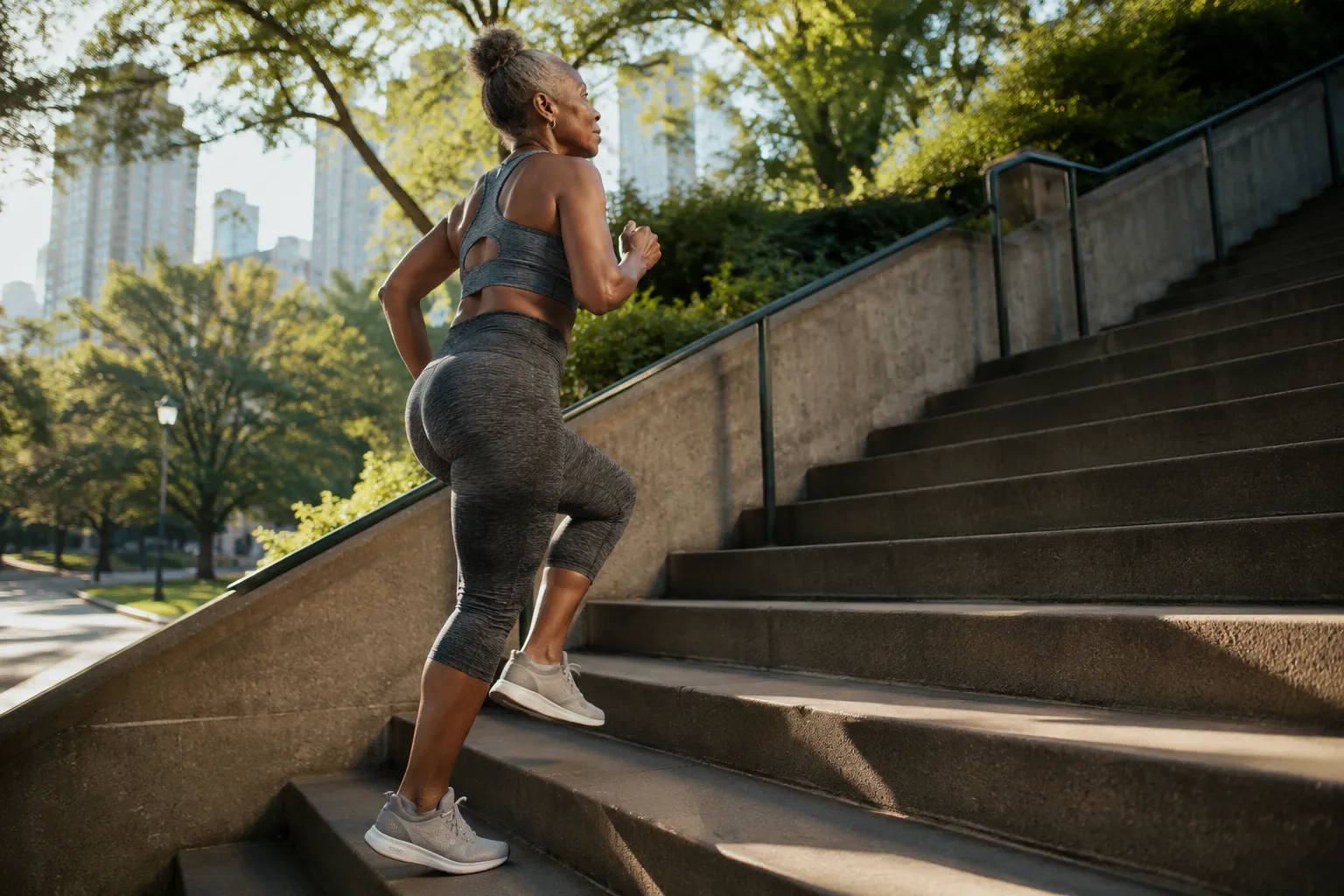
Editorial landscape photograph of a fit 60-year-old Black woman ascending a set of concrete park stairs two steps at a time,

Quick Answer

Functional fitness for everyday independence trains the exact movements you use at home, climbing stairs, carrying groceries, and getting up from the floor, instead of isolated gym machines. The most effective program combines single-leg strength (step-ups, split squats), loaded carries (farmer's walks), and floor-transfer drills (Turkish get-ups, sit-to-stands) done 2-3 times per week. Research on 80-year-olds identifies stair climbing without a handrail and rising from a chair without arm support as core markers of independent living [4].

Key Takeaways

  • Independence is measurable. Stair climbing without a rail and rising from a chair without arms are used in studies as objective markers of whether older adults can live alone [4].
  • Train the task, not just the muscle. Stair-specific training rivals machine-based training for older adults [12].
  • Three pillars matter most: legs that push (stairs), a braced core that carries (groceries), and hips that transfer (floor).
  • Frequency beats intensity. Two to three focused sessions per week produces meaningful gains within 8-12 weeks.
  • Falls are preventable. Regular floor-transfer practice reduces fear of falling and improves recovery if a fall happens [10].
  • Minimal equipment required. A sturdy step, two dumbbells or grocery bags, and floor space cover 90% of the program.

What Is Functional Fitness and Why Does It Matter for Daily Life

Functional fitness is training that mirrors real-world tasks, pushing, pulling, squatting, hinging, carrying, and getting up and down, so the strength you build transfers directly to daily life. It matters because the ability to perform tasks like stair climbing and rising from a chair without support is used by researchers to classify whether an older adult can live independently [4].

The difference is practical. A leg press machine strengthens your quads while you sit down. A step-up strengthens your quads and trains your balance, hip control, and coordination in the exact pattern you use on the staircase at home. When function fails, independence follows. When function is trained, independence is preserved.

Best Exercises to Improve Stair Climbing Ability

The best exercises for stair climbing are step-ups, split squats, and eccentric step-downs, because they train single-leg strength and knee control under load, the exact demands of ascending and descending stairs. Stair climbing is one of the top five tasks that becomes hardest with age, which is why some trials use stair-climbing exercise itself as a training protocol for older adults [12].

Core stair-climbing exercises:

  1. Step-ups (start with a 6-inch step, progress to 12-16 inches). 2 sets of 8 per leg. Drive through the heel, don't push off the bottom foot.
  2. Split squats (bodyweight, then holding light dumbbells). 2 sets of 8 per leg. Builds the strength needed to push up one step at a time.
  3. Eccentric step-downs (lower slowly for 3 seconds). 2 sets of 6 per leg. This trains descending stairs, the direction where most falls happen.
  4. Calf raises on a stair edge. 2 sets of 15. Ankle strength matters for stair push-off and balance.

Decision rule: If you currently need a handrail on both sides, start with 4-inch steps and hold a wall lightly. Progress step height before adding weight.

Common mistake: Rushing up. Slow, controlled reps build more usable strength than fast ones and reduce knee stress.

How to Train for Carrying Heavy Groceries and Objects Safely

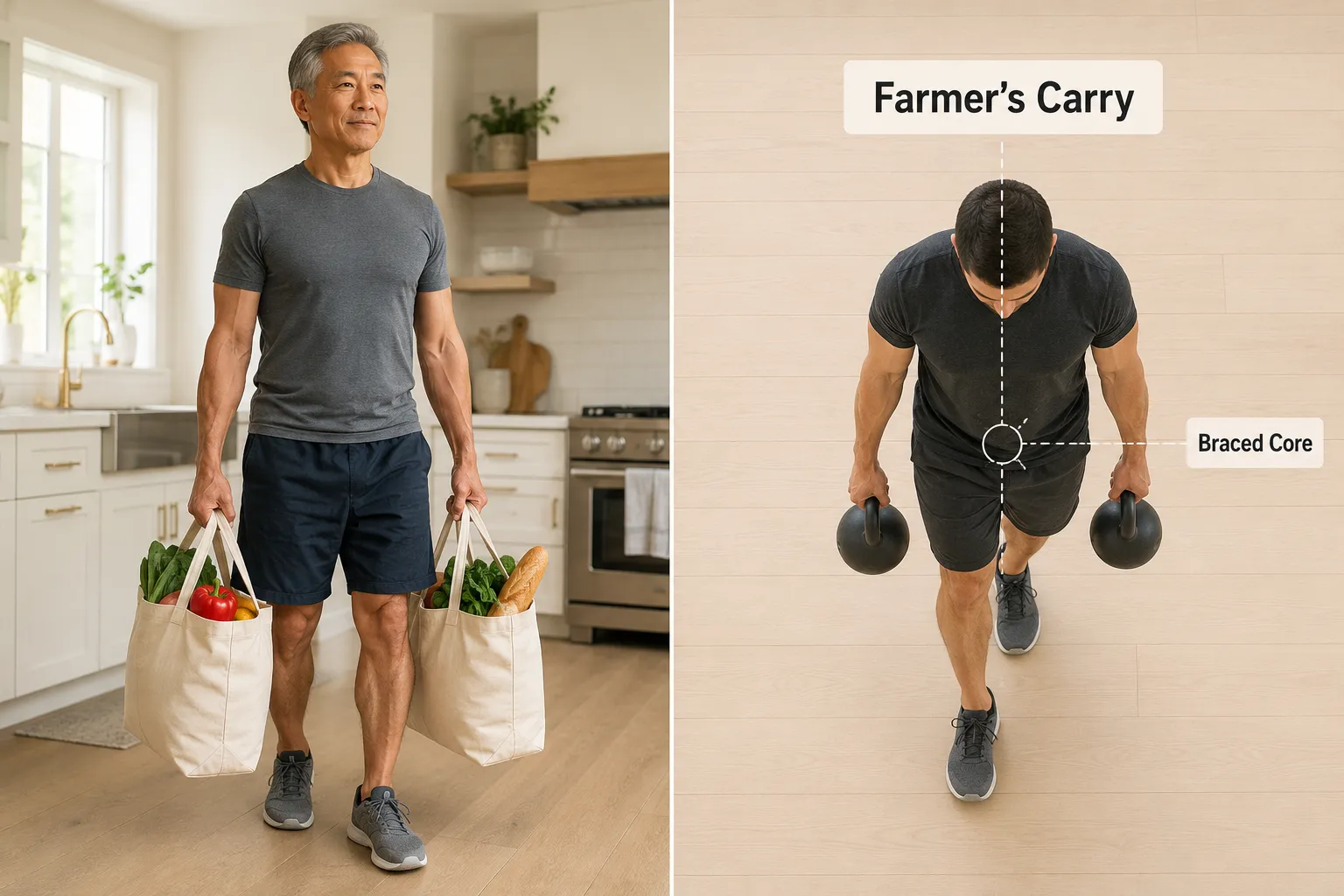
To carry heavy objects safely, train loaded carries, walking while holding weight in one or both hands, because they build grip, core bracing, and posture endurance simultaneously. Groceries, laundry baskets, and a grandchild all share the same demand: hold a load while your legs keep moving.

How to Train for Carrying Heavy Groceries and Objects Safely

Core carrying exercises:

  • Farmer's carry. Hold a dumbbell (or a jug of water) in each hand, walk 20-40 steps with tall posture. 2-3 rounds.
  • Suitcase carry. Same idea, but load only one side. This trains the obliques to keep you from tipping, the exact skill of carrying a single grocery bag.
  • Bear hug carry. Hug a heavy object (sandbag, laundry basket, weighted pillow) against your chest and walk. Mimics carrying a large box.
  • Deadlift to carry. Practice picking the load up from the floor with a hip hinge, then walking. Most injuries happen at the pick-up, not the carry.

Safe lifting checklist:

  • Feet close to the object
  • Hips back, chest up
  • Grip firmly, brace the core (like bracing for a light punch)
  • Stand up with the legs, not the low back
  • Look forward, not down, while walking

Exercises to Get Up Off the Floor Easier as You Age

The most effective exercises to get off the floor are the sit-to-stand, kneeling-to-standing drill, and modified Turkish get-up, because they rehearse the exact transitions of a floor transfer. Practicing the movement itself, slowly and often, is what trainers report works best for older clients [8][10].

A simple floor-transfer progression:

  1. Chair sit-to-stand. 2 sets of 10, no hands. Builds the base strength for standing up.
  2. Half-kneeling to standing. From one knee down, one foot forward, stand up without using hands. 5 per leg.
  3. Side sit to kneel. Sit sideways on the floor, roll to hands and knees, stand up. Practice both sides, most people are one-sided.
  4. Turkish get-up (unweighted). A slow, 6-step transition from lying on your back to standing. Even without a weight, it teaches every position of a controlled floor exit [2][3].

Frequency: Practice getting to the floor and back up 2-3 times per session, 3 sessions per week. Repetition is what makes the movement automatic [10].

Common mistake: Avoiding the floor entirely. The less you use it, the harder it gets. Sit on the floor for 5 minutes a day while watching TV to normalize the transition.

Functional Fitness vs Regular Gym Workouts: What's the Difference

Functional fitness trains multi-joint movements that mirror daily tasks; regular gym workouts often isolate single muscles on machines. Both build strength, but only functional training directly transfers to stairs, carrying, and floor transfers because it rehearses balance, coordination, and posture at the same time.

Machine workout: Leg extension → trains quads while seated, no balance demand.

Functional workout: Step-up with dumbbells → trains quads, glutes, balance, grip, and posture in one movement, same pattern as climbing stairs with groceries.

Choose functional training if your goal is daily-life capability, fall prevention, or aging in place. Choose traditional gym work if your goal is bodybuilding, isolated rehab, or you have a specific injury that requires machine-controlled loading. Most people benefit from a blend, with functional movements as the base.

How Often Should I Do Functional Fitness Training

Two to three sessions per week, 30-45 minutes each, is the sweet spot for most adults. This frequency allows enough recovery between sessions while providing the repeated exposure needed for neurological adaptation, the skill part of strength.

Sample weekly split:

Day Focus Time
Monday Legs and stairs (step-ups, split squats) 30 min
Wednesday Carries and core (farmer's walks, planks) 30 min
Friday Floor transfers and full-body (get-ups, sit-to-stands) 30 min
Daily 5-minute walk + 1 minute of floor sitting 6 min

Edge case: If you're brand new to exercise or recovering from an illness, start with two 20-minute sessions per week. Consistency for 6 weeks beats an ambitious plan you abandon in 10 days.

Can Functional Fitness Prevent Falls and Injuries at Home

Yes, functional fitness reduces fall risk by strengthening the muscles and reflexes that catch you before you fall and by teaching you how to get back up if you do. Programs that combine leg strength, balance, and floor-transfer practice consistently outperform strength-only programs for fall reduction in older adults [6][7].

The three-part fall-protection system:

  1. Prevention. Strong legs, good balance, and ankle mobility keep you upright.
  2. Reaction. Fast reflexes and grip strength let you catch yourself on a rail or counter.
  3. Recovery. Practiced floor transfers mean a fall is an inconvenience, not a hospital visit [10].

Most fall-related injuries happen at home during ordinary tasks, stepping off a curb, carrying laundry, reaching for something high. The training that prevents them is the training that mimics them.

Functional Fitness for Seniors and Older Adults

For seniors, functional fitness should prioritize sit-to-stands, assisted step-ups, and floor-transfer practice, because these directly correspond to the tasks used by researchers to assess independent-living capacity [4]. Even adults in their 80s and 90s show measurable strength gains within 8-12 weeks of consistent training.

Functional Fitness for Seniors and Older Adults

Senior-specific adjustments:

  • Begin with body weight only for 2-3 weeks before adding load
  • Use a sturdy chair or wall for balance assistance during single-leg work
  • Warm up longer, 5 to 10 minutes of easy walking or marching in place
  • Practice descending as often as ascending, going down is where balance fails
  • Include soft floor work on a rug or mat to reduce fear during transfers

Trainers working with older clients report that the biggest breakthrough often isn't strength but rehearsal: doing the movement enough times that it stops feeling risky [8].

Common Mistakes People Make When Training Functional Movements

The most common mistakes are skipping the descending/eccentric portion of exercises, avoiding the floor entirely, and using too much weight too soon. Each mistake reduces the transfer of training to real-world independence.

Top mistakes to avoid:

  1. Only training "up." Step-ups without step-downs skip the harder half of stair use.
  2. Machine-only workouts. They build muscle but not balance or coordination.
  3. Never practicing floor transfers. The skill disappears with disuse.
  4. Chasing weight instead of quality. A perfect body-weight split squat beats a wobbly loaded one.
  5. All bilateral, no single-leg. Real life happens one leg at a time (stairs, curbs, stepping over pets).
  6. Skipping grip work. Carrying groceries fails at the hands first.

What Equipment Do I Need for Functional Fitness at Home

You need very little: a sturdy step or bottom stair, two dumbbells or filled water jugs, a chair, and a soft floor space. That covers roughly 90% of the training that matters for daily independence.

Minimum home setup:

  • Sturdy chair (for sit-to-stands and balance support)
  • Step or bottom stair (for step-ups and step-downs)
  • Two hand weights (5-20 lb dumbbells, or two filled 1-gallon jugs at ~8 lb each)
  • Yoga mat or carpet (for floor transfers)
  • Wall space (for balance work and wall push-ups)

Nice to add later: a resistance band, a heavier kettlebell, and a taller step (12-16 inches).

How Long Does It Take to See Results from Functional Fitness

Most people notice improvements in 2-4 weeks (easier stairs, less fatigue with groceries) and measurable strength gains in 8-12 weeks. Neurological adaptations, balance, coordination, confidence, happen first; muscle changes follow.

Realistic timeline:

  • Week 1-2: Movements feel awkward; soreness after sessions is normal
  • Week 3-4: Daily tasks feel noticeably easier
  • Week 6-8: Strength gains visible in reps and load handled
  • Week 12+: Improvements in balance tests, walking speed, and floor-transfer ease [5][6]

The people who see the best results aren't the ones who train hardest, they're the ones who train the most consistently.

Is Functional Fitness Good for People with Mobility Issues

Yes, and it's often more effective than traditional exercise for people with mobility issues, because it can be scaled to any starting level and directly targets the tasks that mobility limits. Seated sit-to-stands, wall-supported step-ups, and floor-transfer drills all have easier versions.

Modifications for limited mobility:

  • Sit-to-stand with a higher chair or armrest push-off
  • Step-ups onto a 2-inch platform, holding a rail
  • Floor transfers practiced from a bed or sofa first, then a low chair, then the floor
  • Chair-supported single-leg balance for 10 seconds

If you have a specific condition (recent surgery, severe arthritis, neurological issues), start with a physical therapist for the first 4-6 weeks, then transition to home practice.

Functional Fitness Training for People Who Sit All Day

For desk workers, functional fitness should prioritize hip mobility, glute activation, and posture endurance, because prolonged sitting weakens the exact muscles that stairs and carrying demand. Ten minutes of daily movement plus two structured sessions per week is enough to reverse most sitting-related decline.

Daily desk-worker routine (10 minutes):

  • 20 sit-to-stands from your office chair
  • 10 step-ups on a low box or stair, each leg
  • 30-second wall sit
  • 30 seconds of standing hip circles per side
  • 10 slow squats with arms overhead

Twice-weekly session (30 minutes): Add loaded carries, split squats, and one floor transfer drill. This combination directly counteracts the postural patterns of desk work while building the strength daily life demands.

FAQ

How is functional fitness different from CrossFit?
Functional fitness borrows movement patterns from CrossFit but usually removes the high-intensity, competitive elements. The focus is real-life capability, not workout performance.

Can I do functional fitness every day?
Light movements (walking, mobility, sit-to-stands) can be daily. Loaded strength work should have a rest day between sessions.

Do I need a personal trainer?
Not required, but 2-4 sessions with a qualified trainer at the start can fix form issues before they become habits.

Is walking enough for functional fitness?
Walking is excellent cardio and helpful for legs but doesn't build enough strength for stairs, carrying, or floor transfers on its own. Combine walking with 2 strength sessions weekly.

What if I fall while training?
Train on a soft floor, near a wall or sturdy chair, with a phone nearby. Practicing controlled floor transfers actually reduces fall injury risk over time [10].

Can functional fitness help with knee pain?
Often yes, strengthening the muscles around the knee (quads, glutes, calves) reduces load on the joint. Start light and stop any exercise that causes sharp pain.

How old is too old to start?
There isn't an upper age limit. Adults in their 80s and 90s show meaningful gains when they start training consistently [4].

Should I stretch before or after?
A light dynamic warm-up (marching, arm circles) works best before. Static stretching is better after the session.

Conclusion

Independence at home rests on three trainable skills: climbing stairs, carrying loads, and getting off the floor. Every one of them responds to focused practice at any age. Pick one movement from each category, do them 2-3 times a week for the next 8 weeks, and measure your progress by how daily life feels, not how sore you are.

Your next steps:

  1. This week: Do 10 sit-to-stands, 10 step-ups per leg, and one floor transfer, three times.
  2. Week 2: Add a farmer's carry (20 steps with something moderately heavy).
  3. Week 4: Retest, can you get off the floor without using your hands? Climb stairs without a rail?
  4. Week 8: Add load, add reps, and start practicing the harder version of each movement.

Independence isn't given up all at once. It's traded away one skipped stair, one avoided floor sit, one grocery trip made in three trips instead of two. Reverse those trades, and the autonomy comes back.

References

[2] Exercises Getting Off Floor Easier After 65 – https://www.eatthis.com/exercises-getting-off-floor-easier-after-65/
[3] Getting Up From The Floor For Seniors – https://ferra.club/blog/getting-up-from-the-floor-for-seniors
[4] Paperinformation – https://www.scirp.org/journal/paperinformation?paperid=21937
[5] researchdirects – https://researchdirects.com/index.php/therapy/article/download/187/151
[6] Pmc11155611 – https://pmc.ncbi.nlm.nih.gov/articles/PMC11155611/
[7] Pmc6352105 – https://pmc.ncbi.nlm.nih.gov/articles/PMC6352105/
[8] What Helped My Senior Clients Get Off The Floor – https://www.reddit.com/r/SeniorFitness/comments/1lk2jm3/what_helped_my_senior_clients_get_off_the_floor/
[10] The Best Exercises To Help Older People Get Off The Floor – https://rangeofmotion.net.au/the-best-exercises-to-help-older-people-get-off-the-floor/