
Last updated: August 6, 2026
Quick Answer
Fall prevention exercises after 60 work best when they combine balance training, lower-body strength, and reactive stepping practiced at least 3 hours weekly. Evidence shows structured programs like Otago and Tai Ji Quan cut fall rates by 23-58%, while multimodal home routines reduce falls by roughly 34% [5][7]. Start with chair stands, progressive single-leg holds, and heel-to-toe walking three days a week, adding Tai Chi or resistance work as stability improves.
Key Takeaways
- Multimodal training beats single exercises. Combining balance, strength, and functional movement reduces fall rates by 34% [7].
- Tai Ji Quan is the single most effective modality, with 31-58% fall reductions in community-dwelling seniors [5].
- Volume matters. At least 3 hours per week, sustained for 32+ weeks, produces the strongest results [1][7].
- The Otago Program (balance + strength, 3x weekly) cuts falls by 23-40% [5].
- Home-based programs work. Structured home routines reduce fall rates by 24% with high-certainty evidence [7][8].
- Progression is essential. Move from feet-apart holds to feet-together, single-leg, and eyes-closed variations over weeks [2].
- Reactive balance training (perturbation practice) improves recovery when balance is unexpectedly lost [5].
- Most people feel steadier in 4-8 weeks with consistent practice; measurable strength gains take 8-12 weeks.
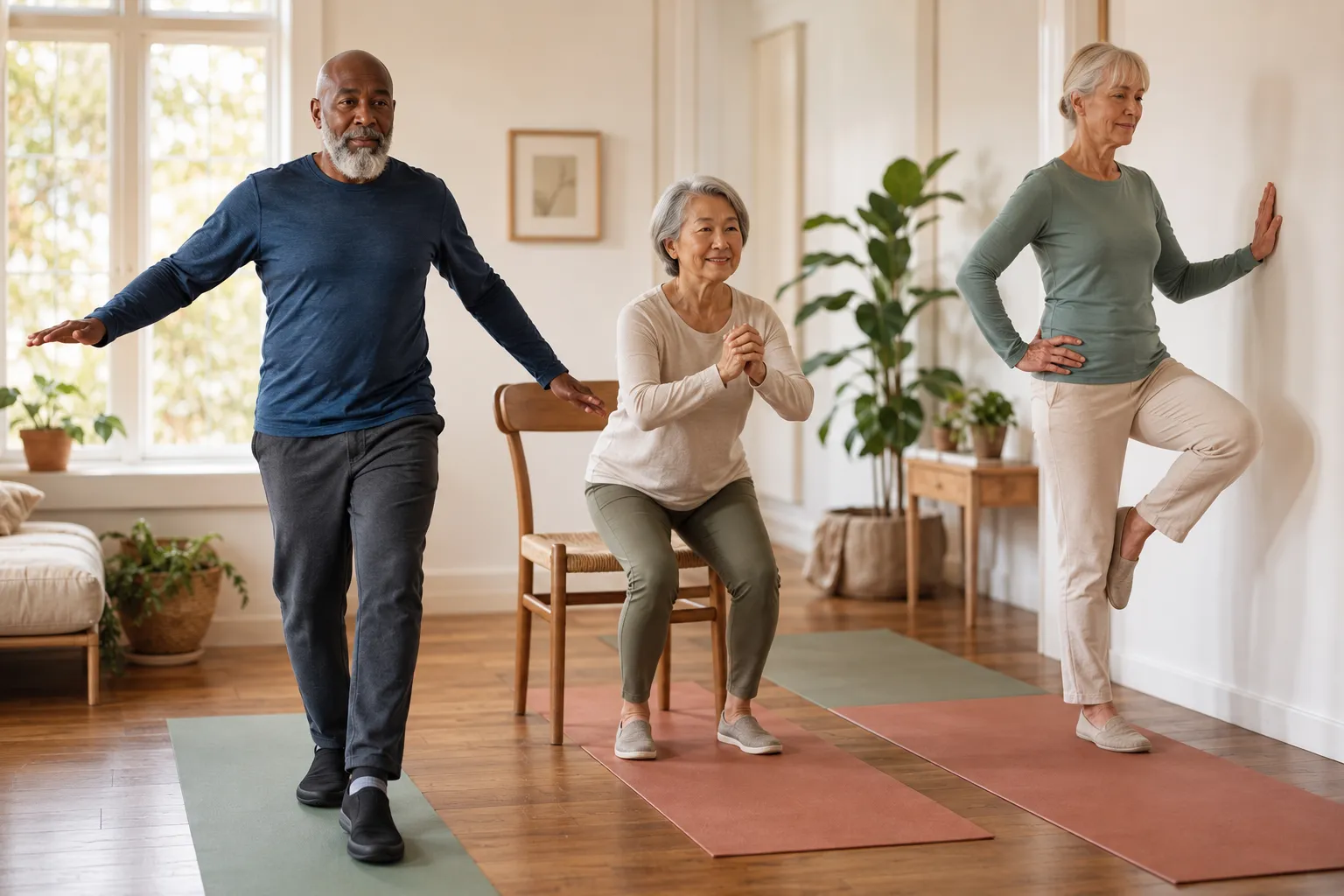
What Causes Falls in Older Adults Over 60?
Falls in adults over 60 usually result from a combination of muscle weakness, impaired balance, slowed reaction time, medication side effects, and environmental hazards, rarely a single cause. Vision changes, low blood pressure on standing, inner-ear problems, and reduced foot sensation also contribute.
The biggest modifiable risk factors are lower-body weakness (especially quads and hip abductors), poor postural control, and slow reactive stepping. That's why exercise-based prevention works: it targets exactly what age chips away at.
Common contributors:
- Weak legs and hips (can't recover from a stumble)
- Slower reflexes when balance is disrupted
- Poor vision or bifocals on stairs
- Medications causing dizziness or drowsiness
- Home hazards: loose rugs, poor lighting, no grab bars
- Fear of falling (which paradoxically increases fall risk)
Decision rule: If you've had a near-fall in the last 6 months, treat exercise as a medical intervention, not a hobby.
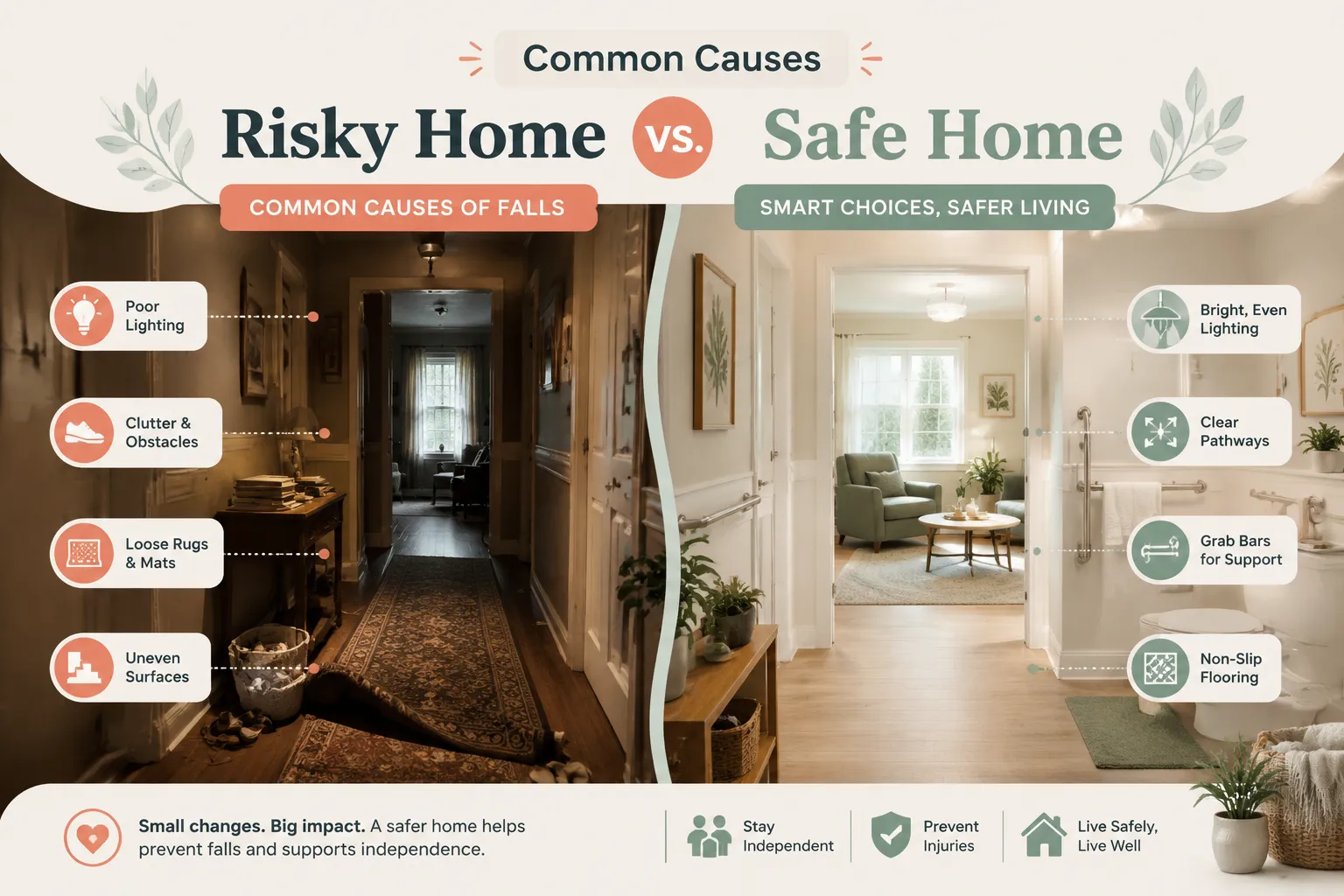
Best Balance Exercises for Seniors at Home
The most effective home balance exercises for seniors are progressive stance work, chair stands, heel-to-toe walking, and single-leg holds, all doable with just a sturdy chair and wall access. These form the backbone of the evidence-based Otago and CDC-endorsed protocols.
Core home routine (start here):
- Chair stands, Sit to stand 10 times without using hands, twice daily. Progress to holding light weights [2].
- Progressive stance holds, Feet apart → feet together → tandem (heel-to-toe) → single-leg. Hold each 10-30 seconds, 5 reps twice daily [2].
- Heel-to-toe walking, 20 steps forward along a hallway, hand near wall for safety.
- Heel raises and toe raises, 10-15 reps, twice daily, holding chair for support.
- Sideways walking, 10 steps each direction, focusing on hip control.
- Eyes-closed standing (advanced), Only once feet-together stance is easy for 30 seconds.
"The safest way to progress is to reduce your base of support before you reduce your support. Feet-together with a hand on the counter is safer than single-leg in open space."
Common mistake: Skipping the easier stances because they feel too simple. The nervous system needs that foundation before advancing.
How Often Should I Do Fall Prevention Exercises?
Aim for at least 3 hours per week spread across most days, with dedicated balance work at least 3 days weekly. Meta-analysis of 38 studies shows programs done more than 5 times per week for over 32 weeks produce significantly greater fall reductions than shorter or less frequent routines [1].
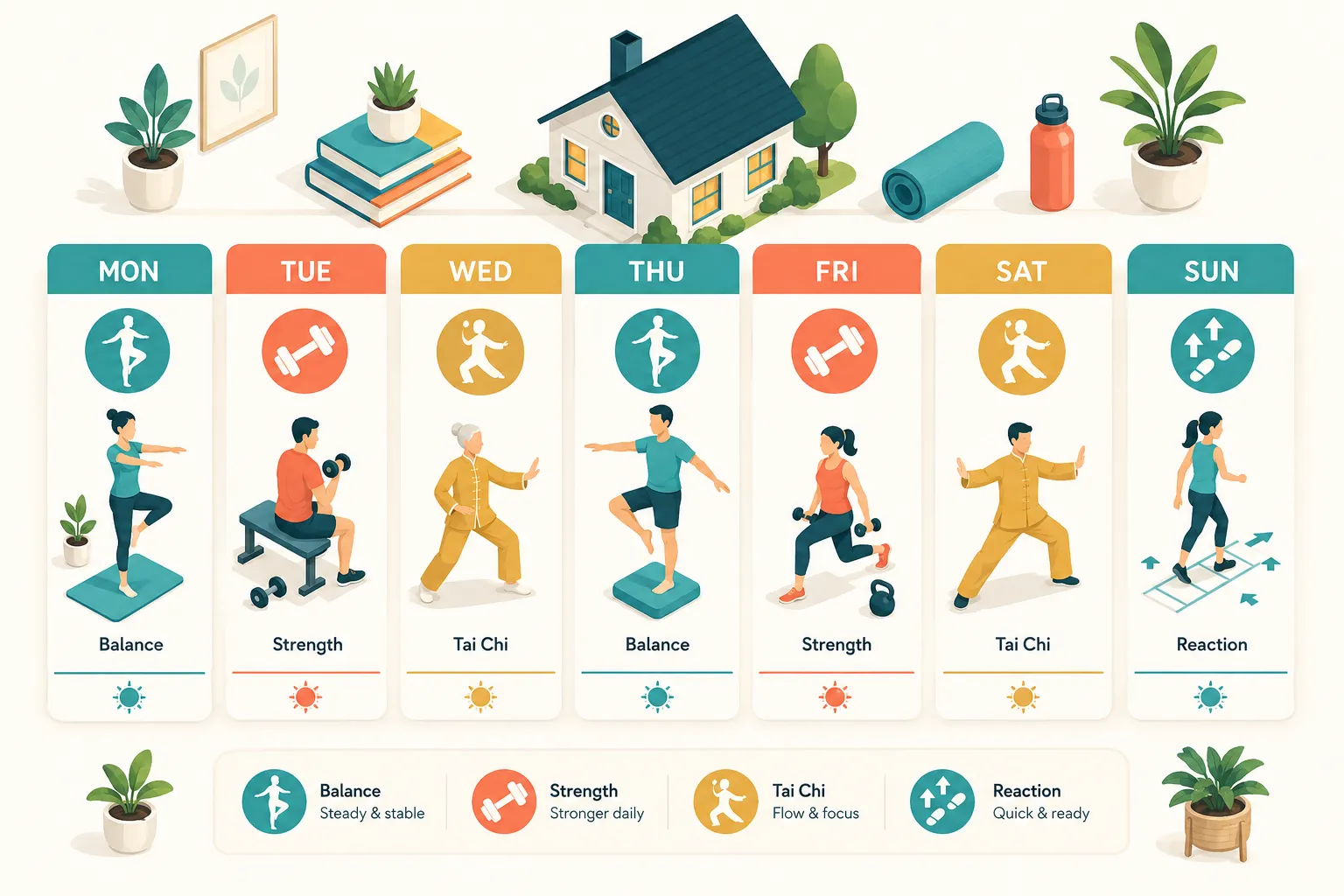
Sample weekly schedule:
| Day | Focus | Time |
|---|---|---|
| Mon | Balance + strength | 30 min |
| Tue | Walking + heel raises | 30 min |
| Wed | Tai Chi or balance | 30 min |
| Thu | Strength (chair stands, bands) | 25 min |
| Fri | Balance + reactive stepping | 30 min |
| Sat | Walking or Tai Chi | 30 min |
| Sun | Gentle mobility / rest | 15 min |
The WHO recommends adults 65+ get at least 150 minutes of moderate activity weekly plus specific balance and strength work, this schedule hits both targets [6].
Can Fall Prevention Exercises Really Reduce Injury Risk?
Yes, the evidence is strong and consistent. Multimodal exercise programs reduce fall rates by 34% and cut the number of people who fall by 22%, based on moderate-certainty evidence from Cochrane-level reviews [7][10]. Home-based programs specifically reduce falls by 24% with high-certainty evidence [7][8].
What that means in plain numbers: If 100 sedentary adults over 60 would have 60 falls next year, a good exercise program brings that closer to 40 falls. For serious injuries like hip fractures, the reduction is even more meaningful because reactive stepping training helps you break falls better.
What doesn't work as well:
- Walking alone (helpful, but not enough)
- Generic gym classes without balance focus
- Short programs under 12 weeks
- Doing exercises 1x per week
Tai Chi vs Strength Training for Fall Prevention
Tai Ji Quan (Tai Chi) has the strongest single-modality evidence, with 31-58% fall reductions, while strength training alone shows smaller effects unless combined with balance work [5]. The best approach for most adults over 60 is to do both.
Head-to-head:
- Tai Chi wins for: balance confidence, postural control, low-impact accessibility, group motivation.
- Strength training wins for: climbing stairs, getting off the floor, carrying groceries, recovering from a trip.
- Combined (multimodal) wins for: overall fall risk reduction, 34% rate reduction [7].
Choose Tai Chi if you have arthritis, are new to exercise, or dislike gym-style workouts. Choose strength-first if you've lost noticeable leg power (struggle to stand from a low couch). Do both if you can, this is what the Otago Program essentially does.
What Equipment Do I Need for Senior Balance Workouts?
Almost nothing. A sturdy chair, a wall, and non-slip footwear cover 90% of evidence-based fall prevention exercises after 60: evidence-based home workouts for balance and stability rely on bodyweight and progression, not gear.
Minimum kit:
- A sturdy dining or kitchen chair (no wheels, no arms)
- Clear wall space or countertop for hand support
- Non-slip shoes or bare feet on a non-slip surface
- Enough floor space to take 5 steps in a straight line
Optional upgrades:
- Resistance bands (light, medium), under $15
- 2-5 lb dumbbells for progression
- Foam pad or folded towel for advanced balance surfaces
- Timer or phone app
Skip these: Wobble boards and BOSU balls without supervision. They're too unstable for home practice without a trainer.
Are Fall Prevention Exercises Safe if I Have Arthritis?
Yes, and they're specifically recommended. Low-impact balance training, Tai Chi, and controlled strength work are safe and beneficial for most people with osteoarthritis. The American Geriatrics Society lists these as essential fall prevention components even for those with joint disease [8].
Arthritis-friendly modifications:
- Warm up with 5 minutes of gentle marching in place
- Use a chair for hand support during balance work
- Reduce range of motion on painful joints, half a chair stand still counts
- Skip deep squats; use partial range instead
- Aquatic classes are excellent complements
Red flags, stop and call your doctor: sharp joint pain (not muscle soreness), swelling that lasts >48 hours, or any new numbness.
How Long Does It Take to See Improvement in Balance?
Most adults notice better steadiness within 4-8 weeks of consistent practice, with measurable strength and functional gains at 8-12 weeks. Full fall-risk reduction benefits typically show at 6+ months of continued training [1].
Realistic timeline:
- Weeks 1-2: Exercises feel awkward; slight muscle soreness is normal.
- Weeks 3-4: Balance holds get easier; can extend times.
- Weeks 5-8: Noticeable confidence on stairs, curbs, uneven ground.
- Weeks 9-12: Chair stands feel easy; can progress to weighted versions.
- 6+ months: Meaningful reduction in fall risk backed by research [1][5].
If you plateau after 6 weeks, progress the difficulty, narrow your stance, close your eyes, or add head turns.
What's the Difference Between Balance and Stability Exercises?
Balance is your ability to stay upright when still or moving slowly (standing on one foot). Stability is your ability to control movement through a range, like squatting or reaching without wobbling. Both matter, and good fall prevention exercises after 60: evidence-based home workouts for balance and stability train them together.
- Balance exercise example: Single-leg stance for 30 seconds.
- Stability exercise example: Chair stand with a slow 3-second descent.
- Combined example: Step-up onto a low platform with a pause at the top.
Simple test: If you can hold single-leg stance for 30 seconds but wobble climbing stairs, you need more stability work. If you're strong but shaky on one foot, you need more balance work.
Can I Do These Exercises If I've Already Fallen Before?
Yes, and you should. Having fallen once doubles your risk of falling again, which makes structured exercise more important, not less. Start with a supervised program if possible (physical therapist evaluation, EnhanceFitness, or Otago through a local aging services agency) [4].
Post-fall starting protocol:
- Get medical clearance, especially if head or hip was involved.
- Ask about a physical therapy referral, Medicare typically covers it.
- Start seated exercises: seated marching, ankle pumps, chair-supported leg lifts.
- Progress to standing holds with both hands on a counter.
- Add reactive stepping practice (safely, with a spotter) once stable.
Fear of falling itself is a risk factor. Gentle, successful exercise breaks the fear-immobility-weakness cycle.
Which Exercises Work Best for People With Vertigo?
For vertigo (especially BPPV or vestibular disorders), start with vestibular-specific rehabilitation rather than generic balance work, see a physical therapist trained in vestibular rehab first. Once cleared, gaze stabilization and gradual balance progression are safe and effective.
Vertigo-safe starting exercises:
- Seated gaze stabilization (focus on a spot while turning head slowly)
- Standing with feet apart, eyes open, hand on counter
- Slow marching in place
- Walking with head still (add head turns only when stable)
Avoid initially: Eyes-closed exercises, quick head movements, and any position that reproduces symptoms. Progress only when a session doesn't trigger vertigo.
How Do I Know if I'm Doing Balance Exercises Correctly?
You're doing it right when the exercise feels challenging but controlled, you can maintain the position with some effort, occasional micro-corrections, but without lurching or grabbing support constantly. If it's easy, progress. If you're catching yourself repeatedly, regress.
Self-check list:
- ✅ Breathing normally (not holding breath)
- ✅ Standing tall, not hunched or leaning
- ✅ Eyes forward, not staring at feet
- ✅ Support hand hovering, not gripping
- ✅ Can hold position for target time with small sways only
Video yourself once a month. You'll see posture issues you can't feel. Better yet, one session with a physical therapist can calibrate your form for months of solo practice.
Are There Exercises I Should Avoid After 60?
Yes, a few movements carry more risk than benefit for most adults over 60, especially those with osteoporosis, joint replacements, or a fall history.
Generally avoid or modify:
- Deep forward bends and toe touches (risk with osteoporosis)
- Full sit-ups and crunches (spine flexion under load)
- Behind-the-neck presses or pull-downs (shoulder impingement)
- Running on uneven surfaces without adequate strength base
- Plyometric jumps unless cleared and progressed carefully
- Yoga inversions (headstands, shoulder stands)
Better swaps: planks instead of sit-ups, wall angels instead of behind-the-neck presses, brisk walking instead of jogging.
What if I Don't Have Space for a Full Workout Routine?
You need less space than you think, roughly a 3×3 foot area next to a sturdy chair or counter is enough for a complete fall prevention routine. Balance and strength work don't require running room.
Tiny-space routine (5×5 ft, 15 minutes):
- Chair stands, 10 reps
- Heel raises holding counter, 15 reps
- Single-leg stance each side, 20 sec
- Tandem stance hold, 20 sec each foot forward
- Marching in place, 30 seconds
- Sideways steps (2 each way), 5 rounds
- Wall push-ups, 10 reps
Do this 3-5 times a week and you're hitting the minimum evidence-based threshold [7].
Frequently Asked Questions
Is walking enough to prevent falls?
No. Walking helps cardiovascular health and mild leg strength, but it doesn't train the balance and reactive stepping that prevent falls. Add dedicated balance work at least 3 days a week [7].
Should I use a walker while doing these exercises?
If you already use one, yes, for safety during standing exercises. Do seated exercises without it. A physical therapist can assess whether you might progress away from the walker.
Can I do fall prevention exercises in bed?
Yes for warm-up moves (ankle pumps, leg lifts, bridges), but standing balance work must be done upright with support nearby.
Do these exercises work if I'm over 80?
Yes. Research on the Otago Program and Tai Ji Quan includes adults into their 90s, with meaningful fall reductions across ages [5]. Progression may be slower, but benefits are real.
Is it too late to start after 70?
No. Improvements in balance and strength happen at any age with consistent training. Starting later just means starting at an easier level.
How do I know if I need a physical therapist?
See one if you've fallen in the past year, feel unsteady daily, use a mobility aid, or have vertigo. Medicare typically covers evaluation with a physician referral.
Are group classes better than home workouts?
Both work. Programs like EnhanceFitness and Tai Ji Quan classes show 20-30% fall reductions [4]. Home routines like Otago show 23-40% reductions [5]. Choose based on preference and access.
Can I do these exercises after a hip replacement?
Yes, once your surgeon clears you (usually 6-12 weeks post-op). Follow hip precautions and start with a physical therapist.
Conclusion
Falls after 60 aren't inevitable, they're largely a training problem, and training is fixable. The research is clear: multimodal home workouts combining balance, strength, and reactive stepping cut fall rates by roughly a third when done consistently for 3+ hours weekly [7]. Tai Ji Quan and the Otago Program have the strongest track records, but even a simple home routine of chair stands, progressive stances, and heel-to-toe walking moves the needle.
Your next steps:
- This week: Start the 15-minute tiny-space routine 3 days.
- Weeks 2-4: Add a 4th and 5th day; progress stance difficulty.
- Week 4: Consider a physical therapy evaluation if you've fallen before.
- Month 2: Try a free EnhanceFitness or Tai Chi class through your local aging services agency.
- Month 3 and beyond: Reassess balance; progress to weighted chair stands and eyes-closed holds.
Consistency beats intensity. Fifteen good minutes five days a week will do more for your independence than a heroic workout once a month.
References
[1] Effects of Different Exercise Programs on Fall Risk in Older Adults – https://pmc.ncbi.nlm.nih.gov/articles/PMC8657315/
[2] Fall Prevention Exercises – Johns Hopkins Medicine – https://www.hopkinsmedicine.org/health/wellness-and-prevention/fall-prevention-exercises
[4] Evidence-Based Falls Prevention Programs – NCOA – https://www.ncoa.org/article/evidence-based-falls-prevention-programs/
[5] Systematic Review of Exercise Interventions for Fall Prevention – https://pmc.ncbi.nlm.nih.gov/articles/PMC12842942/
[6] WHO Physical Activity Guidelines and Fall Prevention – https://pmc.ncbi.nlm.nih.gov/articles/PMC10435089/
[7] Exercise for preventing falls in older people living in the community (Cochrane Review) – https://pubmed.ncbi.nlm.nih.gov/30703272/
[8] Falls in Older Adults: Approach and Prevention – AAFP – https://www.aafp.org/pubs/afp/issues/2020/0101/p42.html
[10] Fall prevention interventions in community-dwelling older adults – https://pubmed.ncbi.nlm.nih.gov/33239019/?tool=bestpractice.com