Functional strength training for older adults at home

Functional strength training for older adults at home

{"cover":"Professional landscape format (1536×1024) editorial hero image with bold text overlay 'Functional Strength at Home' in crisp white sans-serif on a warm-toned semi-transparent panel, centered with 8% safe margins. Background: bright natural-light photograph of an active 70-year-old woman in athletic wear performing a sit-to-stand exercise from a sturdy wooden chair in a sunlit living room, resistance band nearby on hardwood floor, houseplants and large window with soft morning light, warm color grade, magazine cover polish, shallow depth of field, inspiring and dignified mood.","content":["Bright editorial photograph in landscape format (1536×1024) of a diverse group of three older adults (Asian man in his 70s, Black woman in her 60s, white man in his 80s) doing bodyweight squats and wall push-ups in a sunlit home living room, wearing casual athletic clothing, resistance bands and light dumbbells on a yoga mat nearby, natural window light streaming in, warm neutral palette, high editorial quality, candid and encouraging atmosphere, shallow depth of field","Split-screen editorial landscape image (1536×1024): left half shows an older woman in her late 60s carrying grocery bags up porch steps with confident posture in bright outdoor daylight; right half shows the same style of woman performing a farmer's carry with two small dumbbells in a bright home kitchen, symbolizing how functional training translates to daily life; warm natural lighting, magazine editorial polish, no text overlays, clean composition","Flat vector infographic in landscape format (1536×1024) showing a weekly functional training schedule for seniors: seven day-of-week icons across the top, with small illustrated exercise icons (chair squat, wall push-up, heel raise, band row, single-leg stand) mapped to three training days, rest and walking icons on other days; soft sage green, cream, and terracotta palette, short labels max 3 words each, generous 8% safe margins, clean modern design, save-worthy Pinterest infographic quality"}
Professional landscape hero image () with a reading "Functional Strength Training for Older". CRITICAL TYPOGRAPHY RULES:

Last updated: August 11, 2026

Strength-focused programs for seniors have climbed into the top worldwide fitness trends this year, and most of that momentum is happening in living rooms, not gyms. The reason is simple: home-based routines using resistance bands, light dumbbells, and bodyweight moves deliver the same fall-prevention and independence benefits as commercial gym programs, without the commute, cost, or intimidation factor.

Quick Answer
Quick Answer

Functional strength training for older adults at home means practicing movements that mirror real daily tasks, standing up from a chair, climbing stairs, carrying groceries, reaching overhead, using bodyweight, resistance bands, or light dumbbells. Most adults over 60 should aim for 2 to 3 sessions per week, 20 to 40 minutes each, targeting the legs, hips, core, and upper body. Done consistently, it reduces fall risk, protects independence, and produces visible strength gains within 6 to 12 weeks.

Key Takeaways

  • Functional training beats traditional lifting for seniors because it trains movement patterns used in daily life, not isolated muscles.
  • 2 to 3 non-consecutive days per week is the sweet spot for most older adults.
  • A sturdy chair, a wall, and a set of resistance bands are enough to start, no gym required.
  • Fall risk drops significantly when programs include balance work alongside strength (backed by decades of research from the CDC and WHO guidelines).
  • Arthritis is not a reason to avoid strength training, in most cases, it's a reason to start.
  • Expect noticeable strength gains in 6 to 8 weeks and functional improvements (easier stairs, better balance) within 4 weeks.
  • Progression matters more than intensity, small weekly increases work better than pushing hard once.
  • A physical therapist is ideal for anyone recovering from injury or surgery; a trainer is optional for healthy beginners.

)

What Is Functional Strength Training and Why Does It Matter for Seniors

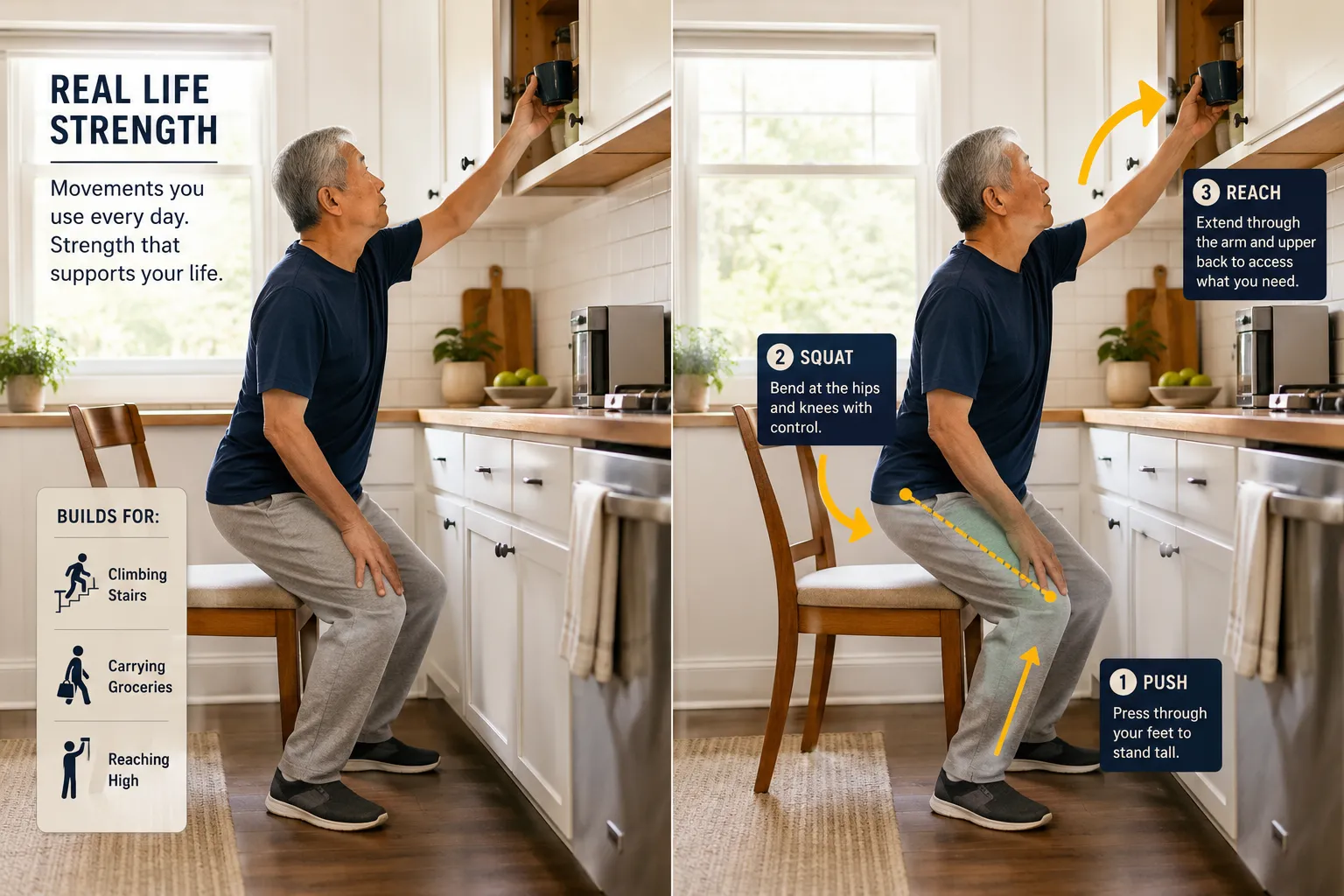
Functional strength training is exercise designed around real-world movements, squatting, pushing, pulling, hinging, carrying, and rotating, rather than isolated muscle work like bicep curls. For older adults, it matters because it directly protects the abilities that keep people independent: getting off the toilet, climbing into a car, catching yourself when you trip, lifting a grandchild.

After age 30, adults lose roughly 3-8% of muscle mass per decade, and that rate accelerates after 60. This loss (called sarcopenia) is the single biggest predictor of losing independence in later life. Functional training slows and often reverses it while also training the nervous system to coordinate movement, the piece that pure weight machines miss.

The goal isn't to look strong. It's to still be able to do what you love at 85.

Functional Strength Training vs Regular Weight Lifting for Older Adults

The short answer: Functional training is usually the better default for adults over 60, but traditional lifting still has a place, especially for building raw strength in specific muscles.

Here's how they compare:

Feature Functional Strength Training Traditional Weight Lifting
Movement pattern Multi-joint, real-life motions Often single-joint, isolated
Equipment needed Minimal (bands, bodyweight, light weights) Machines, barbells, gym access
Balance component Built-in Usually absent
Injury risk (untrained) Lower Higher
Best for Daily independence, fall prevention Peak strength, bodybuilding goals
Home-friendly Excellent Limited

Choose functional training if your goal is staying independent, preventing falls, or moving better in daily life. Add traditional lifting if you already have a strength base and want to target specific weak areas (like grip or shoulder strength).

Best Functional Strength Exercises You Can Do at Home Without Equipment

The most effective home routine covers five movement patterns. Start with these bodyweight versions:

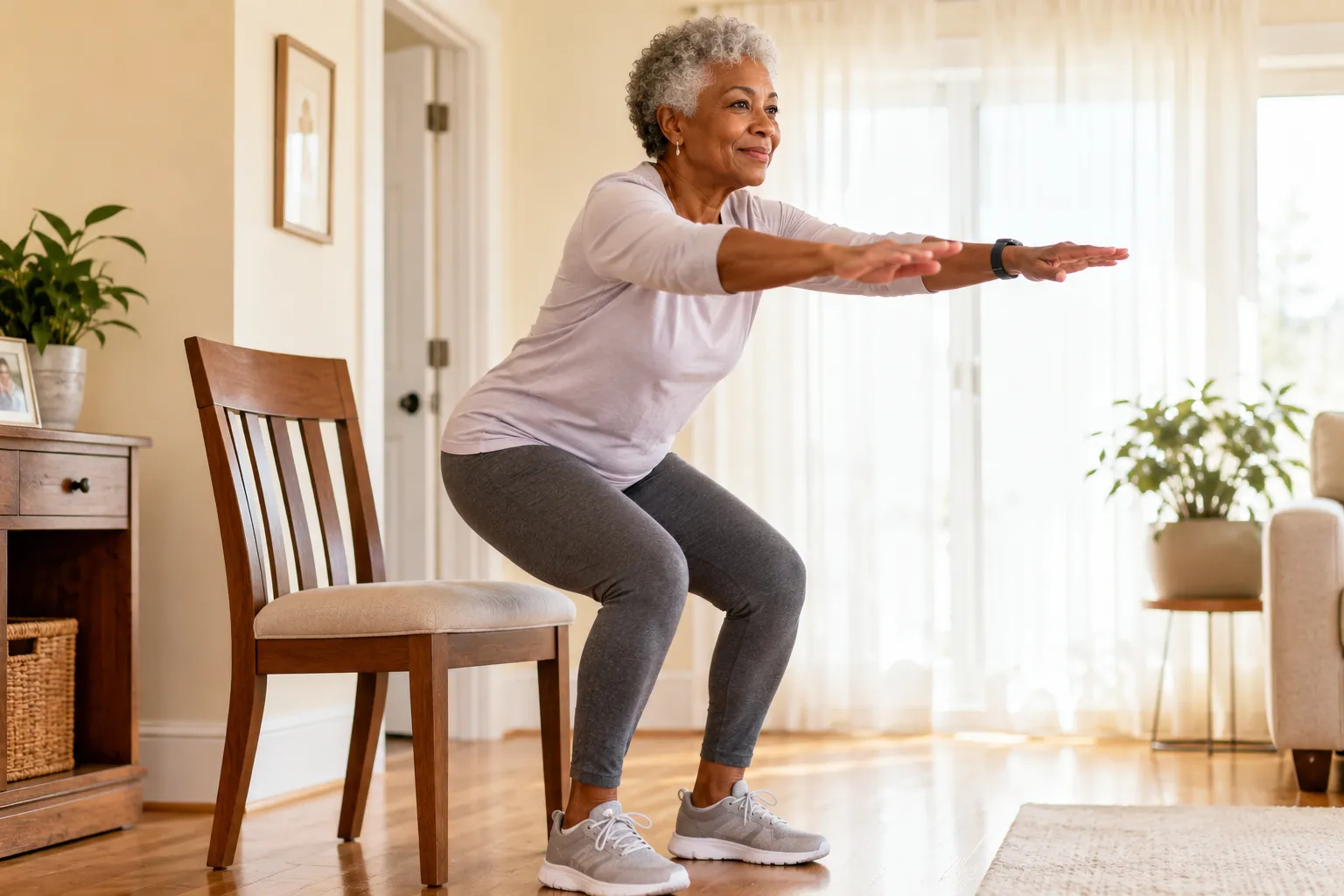
1. Sit-to-stand (chair squat), Sit on a sturdy chair, feet flat, arms crossed. Stand up without using hands. Sit back down with control. Trains the same muscles used to get off the toilet or out of a car. Start with 2 sets of 8-10.

2. Wall push-up, Stand arm's length from a wall, hands at shoulder height. Bend elbows to bring your chest toward the wall, then push back. Builds pushing strength for getting up from the floor. 2 sets of 8-12.

3. Heel raises, Stand behind a chair, hold the back for balance. Rise onto the balls of your feet, then lower slowly. Strengthens calves and ankles for stairs and walking. 2 sets of 12-15.

4. Standing hip hinge, Stand tall, hands on hips. Push hips back like closing a car door with your rear, keeping your back flat. Return upright. Trains the pattern for picking things up safely. 2 sets of 10.

5. Single-leg stand, Hold a counter, lift one foot slightly. Balance for 10-30 seconds. Switch sides. The single best fall-prevention drill. 3 times per leg.

Do the whole circuit 2-3 times per week. Add 1-2 reps per week as it gets easier.

How Often Should Older Adults Do Functional Strength Training

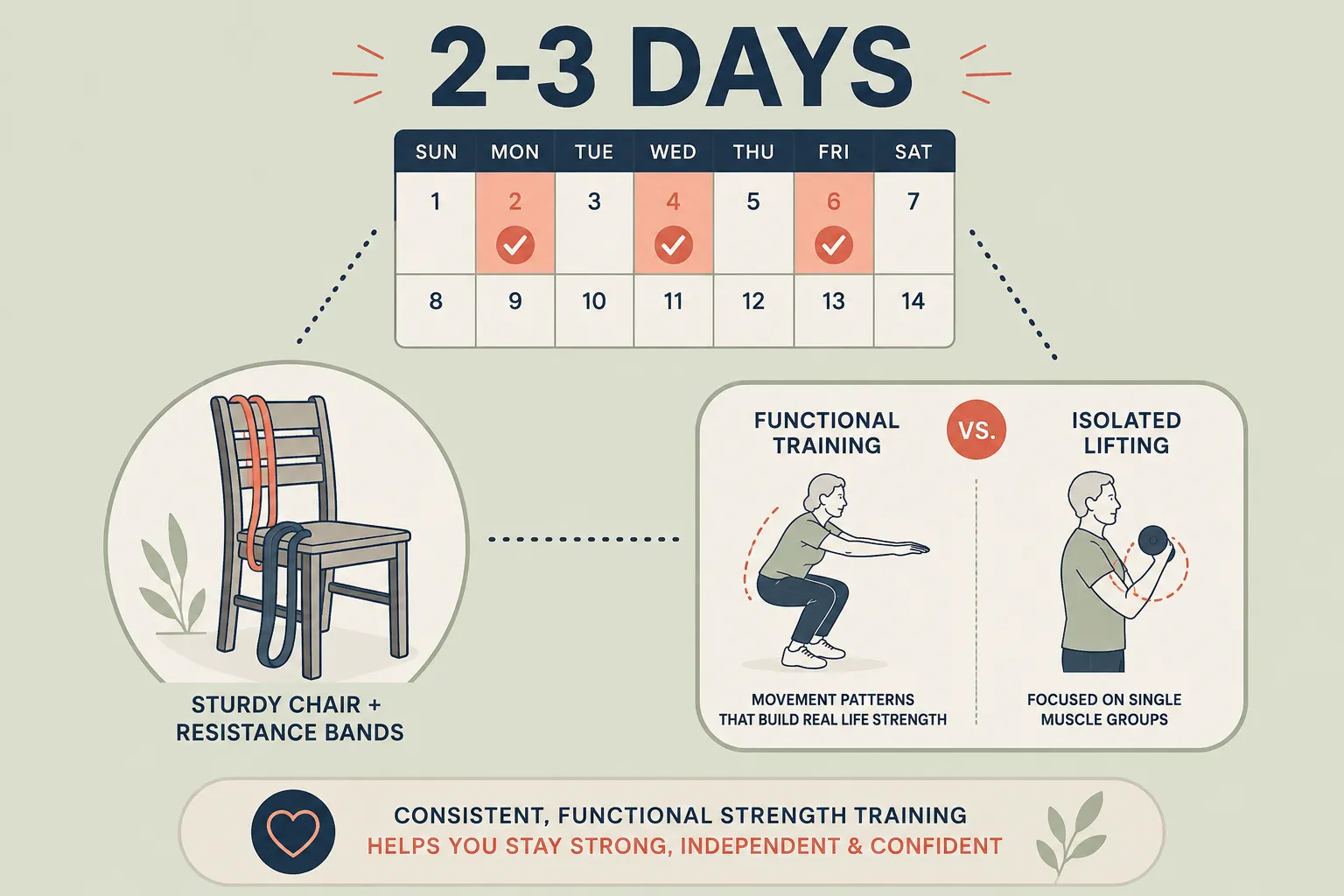
Two to three sessions per week, on non-consecutive days. That's the standing recommendation from the World Health Organization and the American College of Sports Medicine for adults 65 and older.

A practical week looks like this:

  • Monday: 30-minute strength session
  • Tuesday: Walking or light activity
  • Wednesday: Rest or gentle stretching
  • Thursday: 30-minute strength session
  • Friday: Walking
  • Saturday: Optional third strength session or balance work
  • Sunday: Rest

Muscles need 48 hours to recover and rebuild, which is why back-to-back strength days aren't ideal for beginners. If you're feeling more energetic, add walking or gentle mobility on off days, not more lifting.

Can Functional Strength Training Help Prevent Falls in Seniors
Can Functional Strength Training Help Prevent Falls in Seniors

Yes, this is one of the most consistently supported findings in geriatric research. Programs that combine strength (especially lower body) with balance work reduce fall rates by roughly 20-30% in community-dwelling older adults, according to systematic reviews cited in WHO and CDC guidelines.

Falls happen when three things fail at once: leg strength, balance reactions, and ankle stability. Functional training hits all three. The exercises that matter most:

  • Sit-to-stands (leg strength)
  • Single-leg stands (static balance)
  • Heel-toe walking (dynamic balance)
  • Step-ups on a low step (reactive strength)
  • Heel and toe raises (ankle stability)

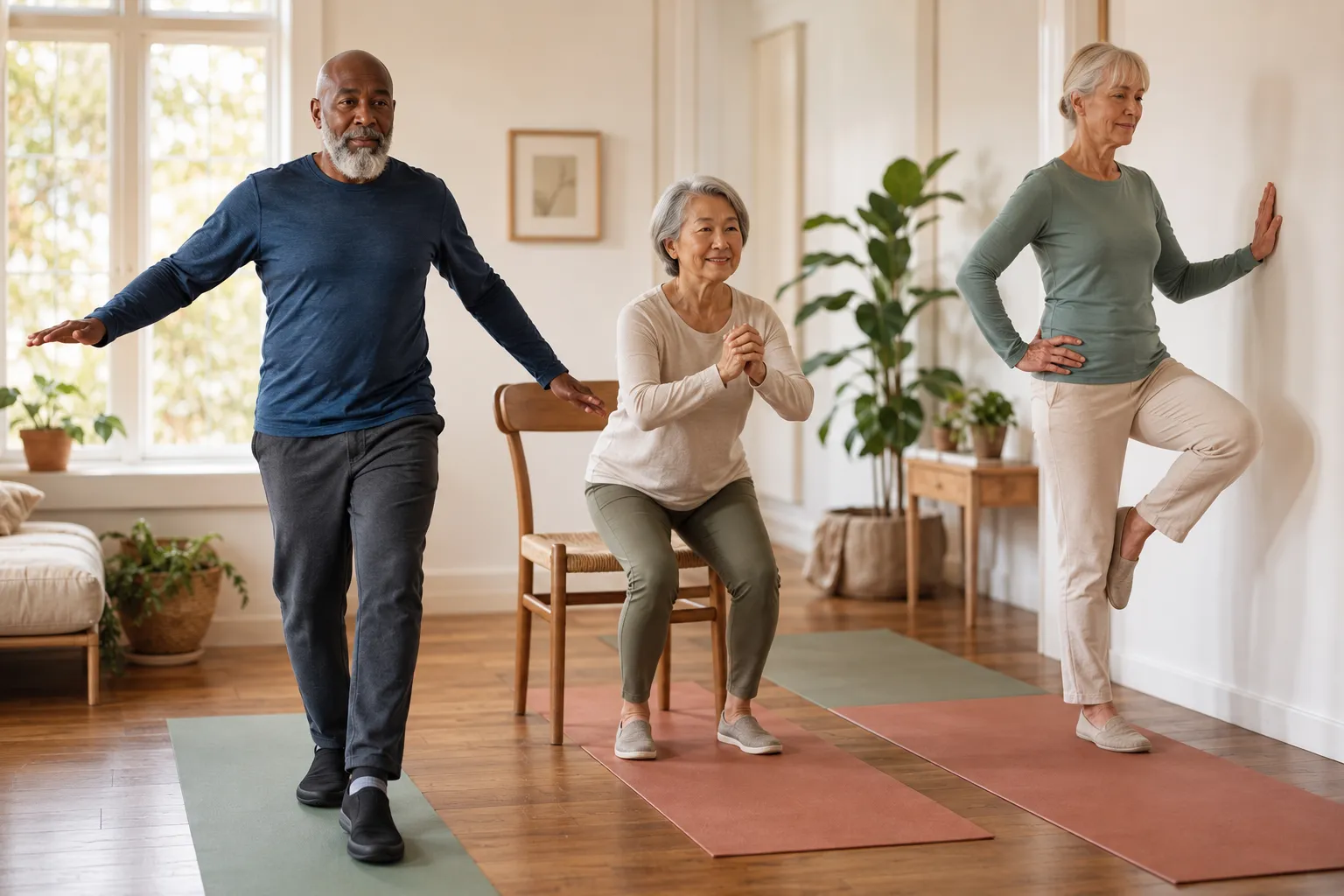
Include at least one balance-focused move every session. Progress by narrowing your base of support (feet together → tandem stance → single leg), then by closing your eyes briefly while holding a counter.

)

What Equipment Do You Need to Start Functional Strength Training at Home

You need almost nothing to start. A sturdy chair, a wall, and enough floor space to lie down cover 80% of a beginner program.

When you're ready to add resistance, buy in this order:

  1. A set of resistance bands (loop bands and long tube bands with handles), $15-30. Most versatile purchase you can make.
  2. Light dumbbells, start with a pair each of 2, 5, and 8 lbs. Adjustable dumbbells save space.
  3. A yoga mat for floor work, $20.
  4. A stable step (an actual exercise step or the bottom stair) for step-ups.
  5. A door anchor for bands, under $10, unlocks rowing and pulling movements.

Skip the vibration plates, ab rollers, and complicated machines. They're marketing, not fitness.

Is Functional Strength Training Safe for People With Arthritis or Joint Pain

Yes, and for most people with osteoarthritis, it's actively recommended. The Arthritis Foundation and every major rheumatology guideline lists resistance training as a first-line treatment for joint pain, because stronger muscles offload stressed joints.

The rules for training with arthritis:

  • Move through pain-free ranges only. If a squat hurts at the bottom, don't go as low.
  • Warm up longer, 5-10 minutes of walking or gentle mobility before strength work.
  • Expect stiffness, not sharp pain. A little discomfort during exercise is fine. Sharp, stabbing, or joint-line pain is a stop signal.
  • Slow tempo helps. Take 3 seconds to lower and 2 seconds to rise. This reduces joint stress.
  • Bad days happen. On flared-up days, do less volume or switch to gentle range-of-motion work.

If you have rheumatoid arthritis, a joint replacement, or severe joint damage, get clearance from your doctor or physical therapist before starting.

How Long Does It Take to See Results From Functional Strength Training

Most older adults notice functional improvements within 2-4 weeks and measurable strength gains within 6-8 weeks. The pattern typically looks like this:

  • Weeks 1-2: Better coordination, exercises feel less awkward. Not much visible change.
  • Weeks 3-4: Stairs feel easier. Getting up from chairs is smoother. Balance improves.
  • Weeks 6-8: You can do more reps or heavier resistance. Posture often improves.
  • Weeks 12+: Real muscle changes. Clothes may fit differently. Daily tasks feel notably easier.
  • 6 months+: Bone density improvements (especially with weight-bearing moves), significant fall-risk reduction.

The catch: results reverse quickly if you stop. Two weeks off is enough to lose noticeable strength after 60. Consistency beats intensity, three modest sessions per week for a year outperforms two hard weeks followed by quitting.

Functional Strength Training for Seniors With Limited Mobility

Limited mobility doesn't disqualify anyone from strength training, it just changes the starting point. Seated and supported exercises can build meaningful strength for people who can't stand for long, use a walker, or are recovering from surgery.

A seated functional routine:

  • Seated marches, lift knees alternately, 30 seconds
  • Seated leg extensions, straighten one knee, hold 2 seconds, lower
  • Seated overhead press with light dumbbells or soup cans
  • Seated rows with a resistance band anchored to a doorknob
  • Ankle circles and heel-toe pumps for circulation and ankle strength
  • Seated torso rotations, arms crossed, rotate side to side

If standing is possible with support, add supported sit-to-stands (using arms), counter-supported heel raises, and gentle marches while holding a counter. Progress by reducing how much you rely on the support, not by rushing to standing exercises.

Common Mistakes Older Adults Make When Doing Strength Training at Home
Common Mistakes Older Adults Make When Doing Strength Training at Home

The biggest errors are almost always about approach, not exercise choice:

  1. Going too easy for too long. If 12 reps feels effortless, it's not building strength. The last 2-3 reps should feel challenging.
  2. Skipping warm-ups. 5 minutes of walking or marching in place prevents most tweaks and pulls.
  3. Holding the breath. Exhale on effort (the hard part), inhale on the easier part. Breath-holding spikes blood pressure.
  4. Ignoring the lower body. Legs and hips drive independence. Don't spend all your time on arms.
  5. No progression plan. Doing the same routine at the same difficulty for months stops producing results.
  6. Skipping balance work. Strength without balance still leaves fall risk on the table.
  7. Comparing to old fitness levels. The goal is progress from where you are today, not returning to age 40.

Should You Get a Trainer or Do Functional Strength Training on Your Own

A qualified trainer or physical therapist is worth the investment for the first 4-8 sessions if you're new, recovering from injury, or managing chronic conditions. After that, most healthy older adults can train independently using video guidance and a written program.

Get professional help if:

  • You've had a recent surgery, fall, or hospitalization
  • You have Parkinson's, MS, severe arthritis, or heart conditions
  • You've never done resistance training and want form checked
  • Your balance is already impaired

You can start solo if:

  • You're generally healthy and cleared by your doctor
  • You can follow along with reputable video programs (many senior-specific programs exist on YouTube from licensed physical therapists)
  • You start conservatively and progress slowly

The National Institute on Aging's free "Go4Life" workout materials are a solid starting point built specifically for older adults.

Functional Strength Training vs Yoga for Older Adults: Which Is Better

They solve different problems, and the best answer is often both. Strength training builds muscle and bone. Yoga builds flexibility, balance, and body awareness.

Functional Strength Training Yoga
Best at Building muscle, preserving bone, fall prevention Flexibility, balance, stress relief
Cardiovascular Moderate Low (except vigorous styles)
Muscle gains High Modest
Joint mobility Moderate High
Accessibility High High (chair yoga available)

Choose strength training first if you're losing muscle, worried about falls, or need to protect bone density. Add yoga for mobility, balance, and mental well-being. Two strength sessions plus one yoga session per week is an excellent combination for most adults over 60.

How to Modify Functional Strength Exercises if You Have Balance Issues

Every standing exercise can be modified by adding support, changing the base of support, or moving to a seated version. The rule: never train balance in a position where a real fall could happen.

Balance-friendly modifications:

  • For squats: Hold the back of a chair with both hands, then one hand, then fingertips as balance improves
  • For lunges: Do split squats holding a counter, or replace with step-ups
  • For single-leg stands: Start touching a wall with your hand, then a counter, then no support with a chair nearby
  • For overhead work: Sit in a chair with back support
  • For anything on the floor: Have a chair or sturdy furniture nearby to help you get up

Train balance in a safe corner (walls on two sides, a chair in front) so a stumble means grabbing furniture, not falling.

)

What's the Difference Between Functional Training and Physical Therapy for Seniors

Physical therapy treats specific medical problems; functional training builds general fitness. A physical therapist diagnoses movement issues, uses exercises as medicine to fix them, and is covered by insurance when prescribed. Functional training is a maintenance and improvement program you do on your own or with a trainer.

See a physical therapist for:

  • Recent injury, surgery, or fall
  • Persistent pain that limits daily activities
  • Neurological conditions (stroke recovery, Parkinson's)
  • Significant balance decline
  • After a hospitalization

Do functional training for:

  • Maintaining and building strength over years
  • Preventing decline before it starts
  • General fitness, weight management, energy
  • After you've been discharged from PT and want to keep gains

Many older adults benefit from a "PT graduation" model: work with a physical therapist to fix specific issues, then transition to an ongoing functional training program to maintain the gains.

FAQ

Is 70 too old to start strength training?
No. Research consistently shows adults in their 80s and 90s gain strength from resistance training. The benefits often show up faster in previously sedentary older adults because the starting point is lower.

How heavy should the weights be?
Light enough that you can do 10-15 reps with good form, heavy enough that the last 2-3 reps feel challenging. For most beginners, that's 2-8 lb dumbbells or light-resistance bands.

Do I need to warm up before functional training?
Yes. Five minutes of walking, marching in place, or gentle arm circles prepares muscles and joints and reduces injury risk.

Can I do this if I have osteoporosis?
Usually yes, and it's often recommended, but avoid heavy forward-bending or spinal-loading moves without medical clearance. A physical therapist can build a bone-safe program.

What if I miss a week?
Don't try to make it up. Resume at your previous level or slightly lighter. Missing occasional weeks is normal and won't undo progress.

Should I train on an empty stomach?
No need. A light snack (banana, toast, yogurt) 30-60 minutes before helps energy. Drink water during the session.

Is soreness after workouts normal?
Mild soreness for 1-2 days is normal, especially when starting or adding difficulty. Sharp pain, joint pain, or soreness lasting over 3 days means you did too much.

Can I combine this with walking?
Yes. Walking and strength training complement each other perfectly. Alternate days is the simplest schedule.

How long should each session be?
20-40 minutes is ideal. Beginners can start with 15-20 minutes and build up.

Do I need to stretch after?
Gentle stretching for 5 minutes after strength work is beneficial but not critical. Focus on the muscles you just trained.

Conclusion: Your Next Steps

Functional strength training at home is the highest-return investment older adults can make in their independence. It's cheap, backed by decades of research, and works for nearly every fitness level and health status.

Start this week:

  1. Pick 3 days on your calendar (e.g., Monday, Wednesday, Friday).
  2. Choose 5 exercises from the bodyweight list above. Do 2 sets of each.
  3. Time yourself, aim for 20 minutes total, including warm-up.
  4. Track it. A simple notebook works. Note reps done and how it felt.
  5. After 2 weeks, add one rep to each exercise, or add a third set.
  6. After 4 weeks, buy resistance bands and start adding them.
  7. After 8 weeks, reassess: are stairs easier? Getting up from chairs smoother? That's the real measure.

If you have any concern about health conditions, medications, or recent surgeries, get medical clearance first, but don't use that as an excuse to delay. Ask your doctor at your next visit and start with seated exercises in the meantime.

The strongest predictor of independence at 85 isn't genetics or luck. It's the habits you build now.

Fall Prevention Exercises After 60: Evidence-Based Home Workouts for Balance and Stability

Fall Prevention Exercises After 60: Evidence-Based Home Workouts for Balance and Stability

Last updated: August 6, 2026

Quick Answer

Fall prevention exercises after 60 work best when they combine balance training, lower-body strength, and reactive stepping practiced at least 3 hours weekly. Evidence shows structured programs like Otago and Tai Ji Quan cut fall rates by 23-58%, while multimodal home routines reduce falls by roughly 34% [5][7]. Start with chair stands, progressive single-leg holds, and heel-to-toe walking three days a week, adding Tai Chi or resistance work as stability improves.

Key Takeaways

  • Multimodal training beats single exercises. Combining balance, strength, and functional movement reduces fall rates by 34% [7].
  • Tai Ji Quan is the single most effective modality, with 31-58% fall reductions in community-dwelling seniors [5].
  • Volume matters. At least 3 hours per week, sustained for 32+ weeks, produces the strongest results [1][7].
  • The Otago Program (balance + strength, 3x weekly) cuts falls by 23-40% [5].
  • Home-based programs work. Structured home routines reduce fall rates by 24% with high-certainty evidence [7][8].
  • Progression is essential. Move from feet-apart holds to feet-together, single-leg, and eyes-closed variations over weeks [2].
  • Reactive balance training (perturbation practice) improves recovery when balance is unexpectedly lost [5].
  • Most people feel steadier in 4-8 weeks with consistent practice; measurable strength gains take 8-12 weeks.

Key Takeaways

What Causes Falls in Older Adults Over 60?

Falls in adults over 60 usually result from a combination of muscle weakness, impaired balance, slowed reaction time, medication side effects, and environmental hazards, rarely a single cause. Vision changes, low blood pressure on standing, inner-ear problems, and reduced foot sensation also contribute.

The biggest modifiable risk factors are lower-body weakness (especially quads and hip abductors), poor postural control, and slow reactive stepping. That's why exercise-based prevention works: it targets exactly what age chips away at.

Common contributors:

  • Weak legs and hips (can't recover from a stumble)
  • Slower reflexes when balance is disrupted
  • Poor vision or bifocals on stairs
  • Medications causing dizziness or drowsiness
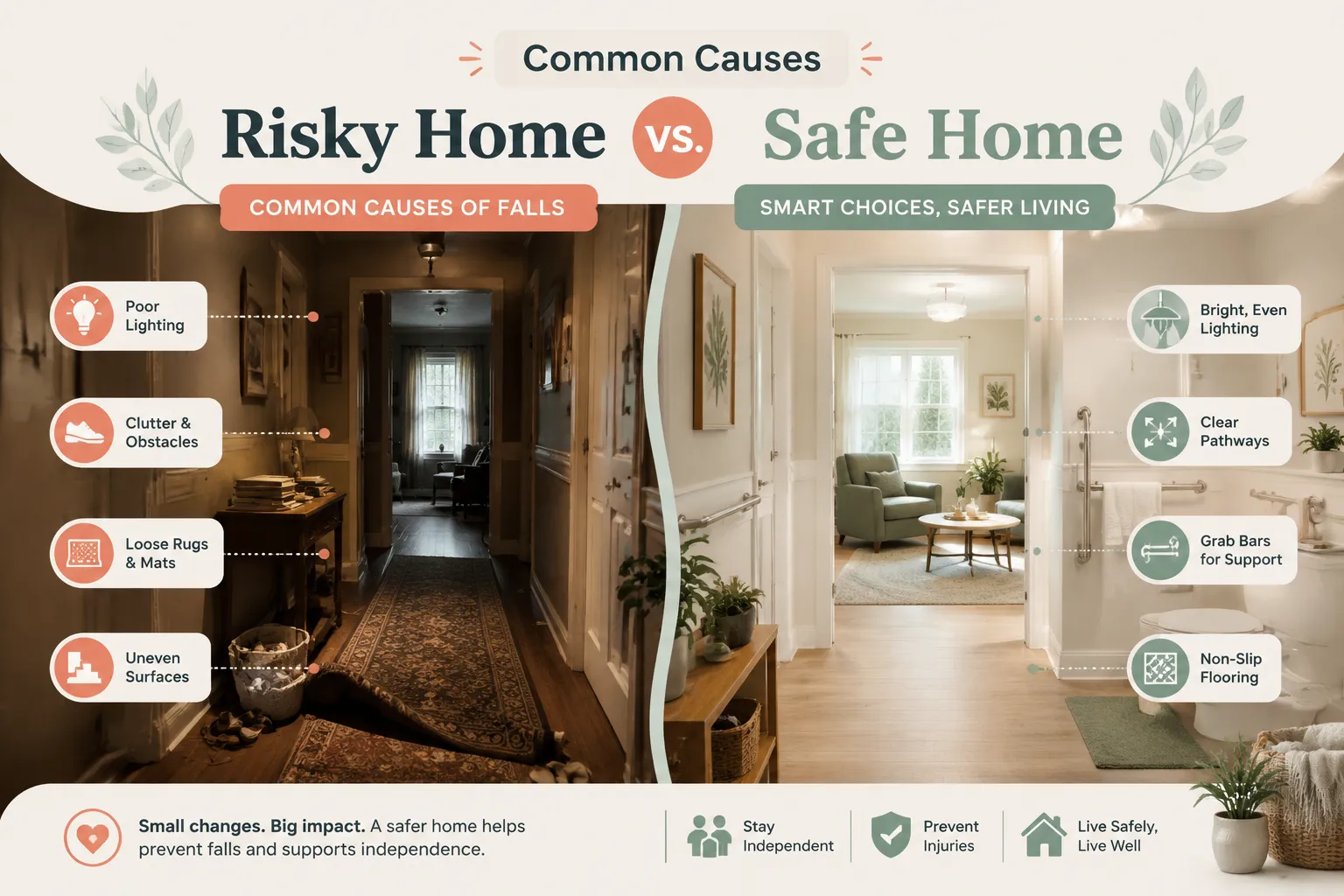
  • Home hazards: loose rugs, poor lighting, no grab bars
  • Fear of falling (which paradoxically increases fall risk)

Decision rule: If you've had a near-fall in the last 6 months, treat exercise as a medical intervention, not a hobby.

What Causes Falls in Older Adults Over 60?

Best Balance Exercises for Seniors at Home

The most effective home balance exercises for seniors are progressive stance work, chair stands, heel-to-toe walking, and single-leg holds, all doable with just a sturdy chair and wall access. These form the backbone of the evidence-based Otago and CDC-endorsed protocols.

Core home routine (start here):

  1. Chair stands, Sit to stand 10 times without using hands, twice daily. Progress to holding light weights [2].
  2. Progressive stance holds, Feet apart → feet together → tandem (heel-to-toe) → single-leg. Hold each 10-30 seconds, 5 reps twice daily [2].
  3. Heel-to-toe walking, 20 steps forward along a hallway, hand near wall for safety.
  4. Heel raises and toe raises, 10-15 reps, twice daily, holding chair for support.
  5. Sideways walking, 10 steps each direction, focusing on hip control.
  6. Eyes-closed standing (advanced), Only once feet-together stance is easy for 30 seconds.

"The safest way to progress is to reduce your base of support before you reduce your support. Feet-together with a hand on the counter is safer than single-leg in open space."

Common mistake: Skipping the easier stances because they feel too simple. The nervous system needs that foundation before advancing.

How Often Should I Do Fall Prevention Exercises?

Aim for at least 3 hours per week spread across most days, with dedicated balance work at least 3 days weekly. Meta-analysis of 38 studies shows programs done more than 5 times per week for over 32 weeks produce significantly greater fall reductions than shorter or less frequent routines [1].

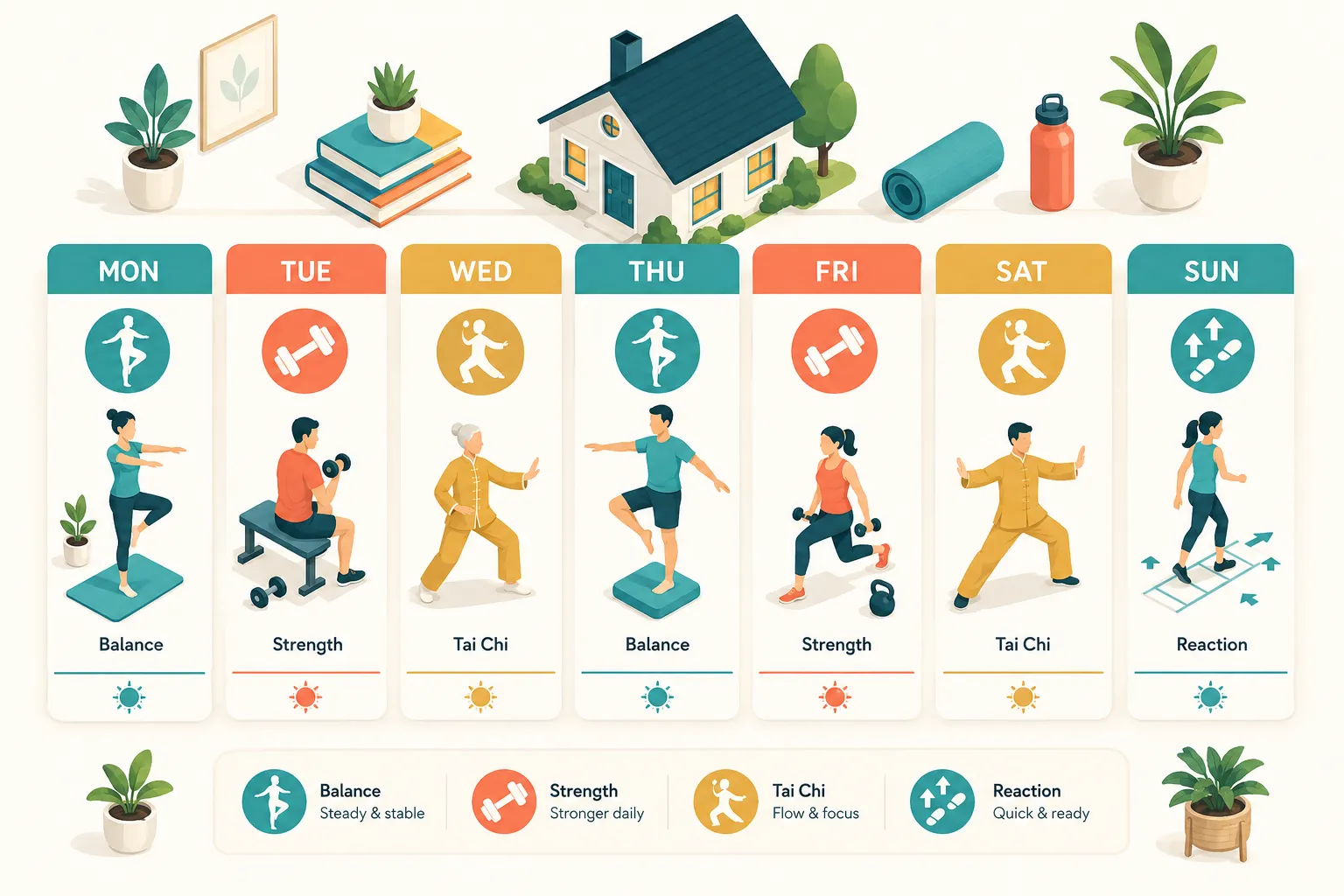
Sample weekly schedule:

Day Focus Time
Mon Balance + strength 30 min
Tue Walking + heel raises 30 min
Wed Tai Chi or balance 30 min
Thu Strength (chair stands, bands) 25 min
Fri Balance + reactive stepping 30 min
Sat Walking or Tai Chi 30 min
Sun Gentle mobility / rest 15 min

The WHO recommends adults 65+ get at least 150 minutes of moderate activity weekly plus specific balance and strength work, this schedule hits both targets [6].

Can Fall Prevention Exercises Really Reduce Injury Risk?

Yes, the evidence is strong and consistent. Multimodal exercise programs reduce fall rates by 34% and cut the number of people who fall by 22%, based on moderate-certainty evidence from Cochrane-level reviews [7][10]. Home-based programs specifically reduce falls by 24% with high-certainty evidence [7][8].

What that means in plain numbers: If 100 sedentary adults over 60 would have 60 falls next year, a good exercise program brings that closer to 40 falls. For serious injuries like hip fractures, the reduction is even more meaningful because reactive stepping training helps you break falls better.

What doesn't work as well:

  • Walking alone (helpful, but not enough)
  • Generic gym classes without balance focus
  • Short programs under 12 weeks
  • Doing exercises 1x per week

Tai Chi vs Strength Training for Fall Prevention

Tai Ji Quan (Tai Chi) has the strongest single-modality evidence, with 31-58% fall reductions, while strength training alone shows smaller effects unless combined with balance work [5]. The best approach for most adults over 60 is to do both.

Head-to-head:

  • Tai Chi wins for: balance confidence, postural control, low-impact accessibility, group motivation.
  • Strength training wins for: climbing stairs, getting off the floor, carrying groceries, recovering from a trip.
  • Combined (multimodal) wins for: overall fall risk reduction, 34% rate reduction [7].

Choose Tai Chi if you have arthritis, are new to exercise, or dislike gym-style workouts. Choose strength-first if you've lost noticeable leg power (struggle to stand from a low couch). Do both if you can, this is what the Otago Program essentially does.

What Equipment Do I Need for Senior Balance Workouts?

Almost nothing. A sturdy chair, a wall, and non-slip footwear cover 90% of evidence-based fall prevention exercises after 60: evidence-based home workouts for balance and stability rely on bodyweight and progression, not gear.

Minimum kit:

  • A sturdy dining or kitchen chair (no wheels, no arms)
  • Clear wall space or countertop for hand support
  • Non-slip shoes or bare feet on a non-slip surface
  • Enough floor space to take 5 steps in a straight line

Optional upgrades:

  • Resistance bands (light, medium), under $15
  • 2-5 lb dumbbells for progression
  • Foam pad or folded towel for advanced balance surfaces
  • Timer or phone app

Skip these: Wobble boards and BOSU balls without supervision. They're too unstable for home practice without a trainer.

Are Fall Prevention Exercises Safe if I Have Arthritis?

Yes, and they're specifically recommended. Low-impact balance training, Tai Chi, and controlled strength work are safe and beneficial for most people with osteoarthritis. The American Geriatrics Society lists these as essential fall prevention components even for those with joint disease [8].

Arthritis-friendly modifications:

  • Warm up with 5 minutes of gentle marching in place
  • Use a chair for hand support during balance work
  • Reduce range of motion on painful joints, half a chair stand still counts
  • Skip deep squats; use partial range instead
  • Aquatic classes are excellent complements

Red flags, stop and call your doctor: sharp joint pain (not muscle soreness), swelling that lasts >48 hours, or any new numbness.

How Long Does It Take to See Improvement in Balance?

Most adults notice better steadiness within 4-8 weeks of consistent practice, with measurable strength and functional gains at 8-12 weeks. Full fall-risk reduction benefits typically show at 6+ months of continued training [1].

Realistic timeline:

  • Weeks 1-2: Exercises feel awkward; slight muscle soreness is normal.
  • Weeks 3-4: Balance holds get easier; can extend times.
  • Weeks 5-8: Noticeable confidence on stairs, curbs, uneven ground.
  • Weeks 9-12: Chair stands feel easy; can progress to weighted versions.
  • 6+ months: Meaningful reduction in fall risk backed by research [1][5].

If you plateau after 6 weeks, progress the difficulty, narrow your stance, close your eyes, or add head turns.

What's the Difference Between Balance and Stability Exercises?

Balance is your ability to stay upright when still or moving slowly (standing on one foot). Stability is your ability to control movement through a range, like squatting or reaching without wobbling. Both matter, and good fall prevention exercises after 60: evidence-based home workouts for balance and stability train them together.

  • Balance exercise example: Single-leg stance for 30 seconds.
  • Stability exercise example: Chair stand with a slow 3-second descent.
  • Combined example: Step-up onto a low platform with a pause at the top.

Simple test: If you can hold single-leg stance for 30 seconds but wobble climbing stairs, you need more stability work. If you're strong but shaky on one foot, you need more balance work.

Can I Do These Exercises If I've Already Fallen Before?

Yes, and you should. Having fallen once doubles your risk of falling again, which makes structured exercise more important, not less. Start with a supervised program if possible (physical therapist evaluation, EnhanceFitness, or Otago through a local aging services agency) [4].

Post-fall starting protocol:

  1. Get medical clearance, especially if head or hip was involved.
  2. Ask about a physical therapy referral, Medicare typically covers it.
  3. Start seated exercises: seated marching, ankle pumps, chair-supported leg lifts.
  4. Progress to standing holds with both hands on a counter.
  5. Add reactive stepping practice (safely, with a spotter) once stable.

Fear of falling itself is a risk factor. Gentle, successful exercise breaks the fear-immobility-weakness cycle.

Which Exercises Work Best for People With Vertigo?

For vertigo (especially BPPV or vestibular disorders), start with vestibular-specific rehabilitation rather than generic balance work, see a physical therapist trained in vestibular rehab first. Once cleared, gaze stabilization and gradual balance progression are safe and effective.

Vertigo-safe starting exercises:

  • Seated gaze stabilization (focus on a spot while turning head slowly)
  • Standing with feet apart, eyes open, hand on counter
  • Slow marching in place
  • Walking with head still (add head turns only when stable)

Avoid initially: Eyes-closed exercises, quick head movements, and any position that reproduces symptoms. Progress only when a session doesn't trigger vertigo.

How Do I Know if I'm Doing Balance Exercises Correctly?

You're doing it right when the exercise feels challenging but controlled, you can maintain the position with some effort, occasional micro-corrections, but without lurching or grabbing support constantly. If it's easy, progress. If you're catching yourself repeatedly, regress.

Self-check list:

  • ✅ Breathing normally (not holding breath)
  • ✅ Standing tall, not hunched or leaning
  • ✅ Eyes forward, not staring at feet
  • ✅ Support hand hovering, not gripping
  • ✅ Can hold position for target time with small sways only

Video yourself once a month. You'll see posture issues you can't feel. Better yet, one session with a physical therapist can calibrate your form for months of solo practice.

Are There Exercises I Should Avoid After 60?

Yes, a few movements carry more risk than benefit for most adults over 60, especially those with osteoporosis, joint replacements, or a fall history.

Generally avoid or modify:

  • Deep forward bends and toe touches (risk with osteoporosis)
  • Full sit-ups and crunches (spine flexion under load)
  • Behind-the-neck presses or pull-downs (shoulder impingement)
  • Running on uneven surfaces without adequate strength base
  • Plyometric jumps unless cleared and progressed carefully
  • Yoga inversions (headstands, shoulder stands)

Better swaps: planks instead of sit-ups, wall angels instead of behind-the-neck presses, brisk walking instead of jogging.

What if I Don't Have Space for a Full Workout Routine?

You need less space than you think, roughly a 3×3 foot area next to a sturdy chair or counter is enough for a complete fall prevention routine. Balance and strength work don't require running room.

Tiny-space routine (5×5 ft, 15 minutes):

  1. Chair stands, 10 reps
  2. Heel raises holding counter, 15 reps
  3. Single-leg stance each side, 20 sec
  4. Tandem stance hold, 20 sec each foot forward
  5. Marching in place, 30 seconds
  6. Sideways steps (2 each way), 5 rounds
  7. Wall push-ups, 10 reps

Do this 3-5 times a week and you're hitting the minimum evidence-based threshold [7].

What if I Don't Have Space for a Full Workout Routine?

Frequently Asked Questions

Is walking enough to prevent falls?
No. Walking helps cardiovascular health and mild leg strength, but it doesn't train the balance and reactive stepping that prevent falls. Add dedicated balance work at least 3 days a week [7].

Should I use a walker while doing these exercises?
If you already use one, yes, for safety during standing exercises. Do seated exercises without it. A physical therapist can assess whether you might progress away from the walker.

Can I do fall prevention exercises in bed?
Yes for warm-up moves (ankle pumps, leg lifts, bridges), but standing balance work must be done upright with support nearby.

Do these exercises work if I'm over 80?
Yes. Research on the Otago Program and Tai Ji Quan includes adults into their 90s, with meaningful fall reductions across ages [5]. Progression may be slower, but benefits are real.

Is it too late to start after 70?
No. Improvements in balance and strength happen at any age with consistent training. Starting later just means starting at an easier level.

How do I know if I need a physical therapist?
See one if you've fallen in the past year, feel unsteady daily, use a mobility aid, or have vertigo. Medicare typically covers evaluation with a physician referral.

Are group classes better than home workouts?
Both work. Programs like EnhanceFitness and Tai Ji Quan classes show 20-30% fall reductions [4]. Home routines like Otago show 23-40% reductions [5]. Choose based on preference and access.

Can I do these exercises after a hip replacement?
Yes, once your surgeon clears you (usually 6-12 weeks post-op). Follow hip precautions and start with a physical therapist.

Conclusion

Falls after 60 aren't inevitable, they're largely a training problem, and training is fixable. The research is clear: multimodal home workouts combining balance, strength, and reactive stepping cut fall rates by roughly a third when done consistently for 3+ hours weekly [7]. Tai Ji Quan and the Otago Program have the strongest track records, but even a simple home routine of chair stands, progressive stances, and heel-to-toe walking moves the needle.

Your next steps:

  1. This week: Start the 15-minute tiny-space routine 3 days.
  2. Weeks 2-4: Add a 4th and 5th day; progress stance difficulty.
  3. Week 4: Consider a physical therapy evaluation if you've fallen before.
  4. Month 2: Try a free EnhanceFitness or Tai Chi class through your local aging services agency.
  5. Month 3 and beyond: Reassess balance; progress to weighted chair stands and eyes-closed holds.

Consistency beats intensity. Fifteen good minutes five days a week will do more for your independence than a heroic workout once a month.

References

[1] Effects of Different Exercise Programs on Fall Risk in Older Adults – https://pmc.ncbi.nlm.nih.gov/articles/PMC8657315/
[2] Fall Prevention Exercises – Johns Hopkins Medicine – https://www.hopkinsmedicine.org/health/wellness-and-prevention/fall-prevention-exercises
[4] Evidence-Based Falls Prevention Programs – NCOA – https://www.ncoa.org/article/evidence-based-falls-prevention-programs/
[5] Systematic Review of Exercise Interventions for Fall Prevention – https://pmc.ncbi.nlm.nih.gov/articles/PMC12842942/
[6] WHO Physical Activity Guidelines and Fall Prevention – https://pmc.ncbi.nlm.nih.gov/articles/PMC10435089/
[7] Exercise for preventing falls in older people living in the community (Cochrane Review) – https://pubmed.ncbi.nlm.nih.gov/30703272/
[8] Falls in Older Adults: Approach and Prevention – AAFP – https://www.aafp.org/pubs/afp/issues/2020/0101/p42.html
[10] Fall prevention interventions in community-dwelling older adults – https://pubmed.ncbi.nlm.nih.gov/33239019/?tool=bestpractice.com

Suspension Training for Seniors: Joint-Friendly Strength and Flexibility at Home

Suspension Training for Seniors: Joint-Friendly Strength and Flexibility at Home

Last updated: July 23, 2026

Quick Answer

Quick Answer

Suspension training uses two adjustable straps anchored overhead so you can leverage your own body weight for strength, balance, and mobility work. For adults 55+, it's one of the most joint-friendly ways to build total-body strength at home because you control the load simply by shifting your feet. A 6-week study of older adults showed significant gains in functional reach (57.2 cm to 68.6 cm) and balance scores, with 100% attendance and no dropouts [1][2]. Start with 2 sessions per week, keep the straps at chest height for beginner angles, and progress gradually.

Key Takeaways

  • Suspension training (like TRX) lets seniors adjust exercise difficulty instantly by changing foot position, no plates or dumbbells required [5].
  • Research shows measurable balance and functional reach improvements in just 6 weeks of twice-weekly training [1][2].
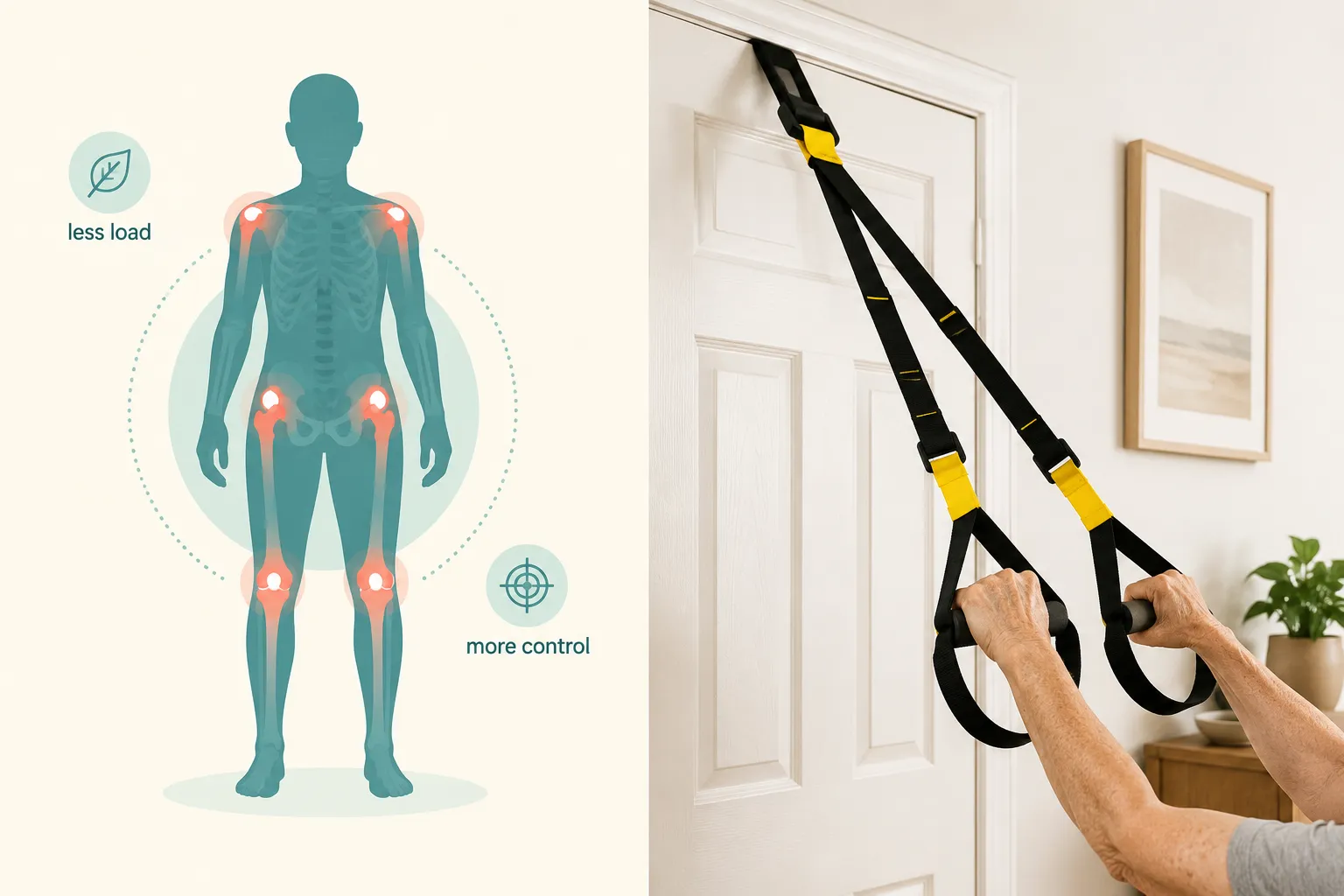
  • It's generally safe for arthritic joints because the straps reduce impact and let you offload weight anytime [3].
  • A quality home suspension trainer costs $30,$200, and setup takes about 5 minutes on a door or beam.
  • 91% of older participants in a German TRX study wanted to keep training after 12 weeks; 36% reported less musculoskeletal pain [4].
  • Ideal frequency: 2-3 sessions per week, 20-30 minutes each, with at least one rest day between sessions.
  • Balance and core work transfer directly to fall prevention and everyday tasks like standing from a chair [3][6].
  • You do NOT need a personal trainer to start, but one video consult or a class can prevent common form mistakes.

What is suspension training and how does it work

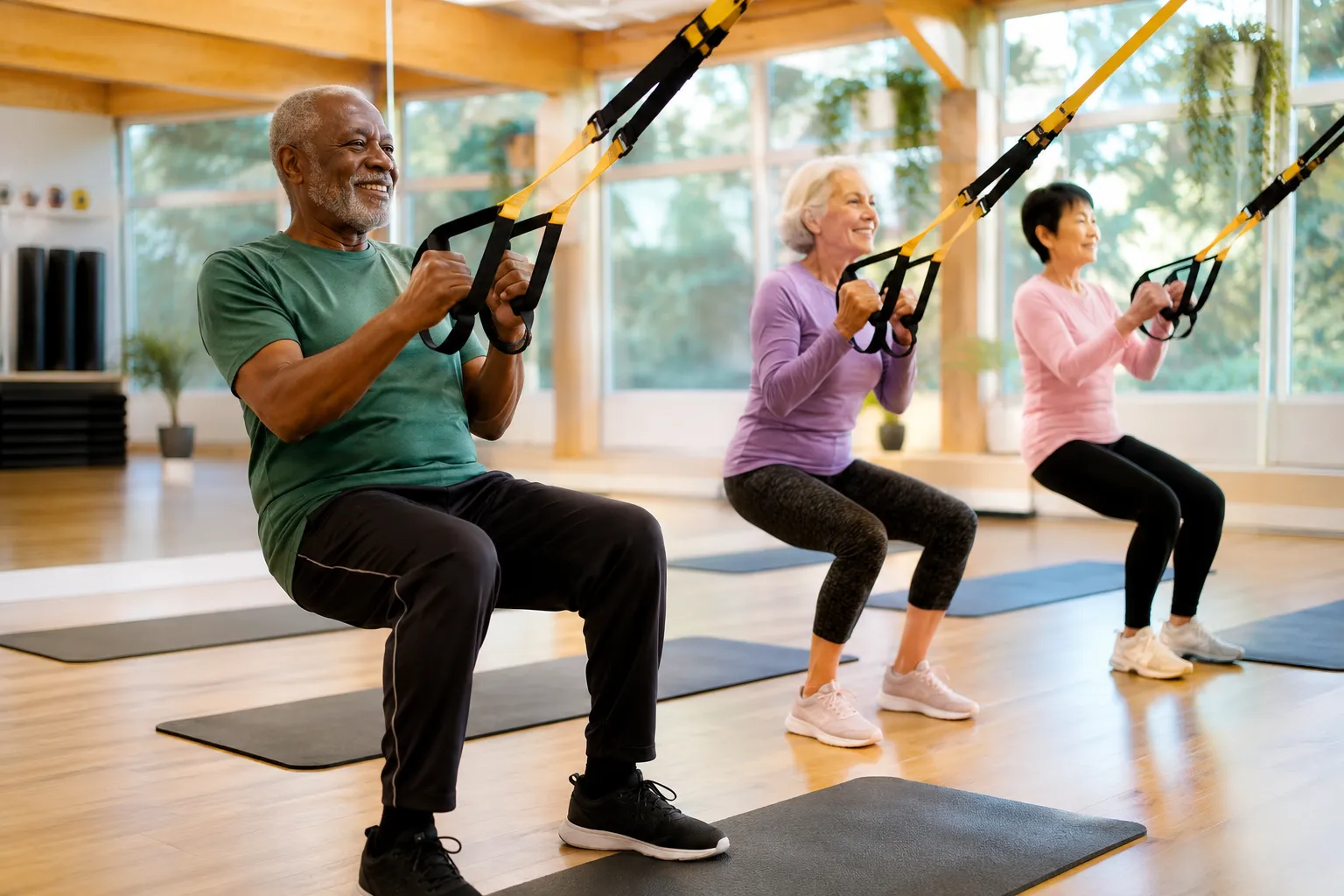
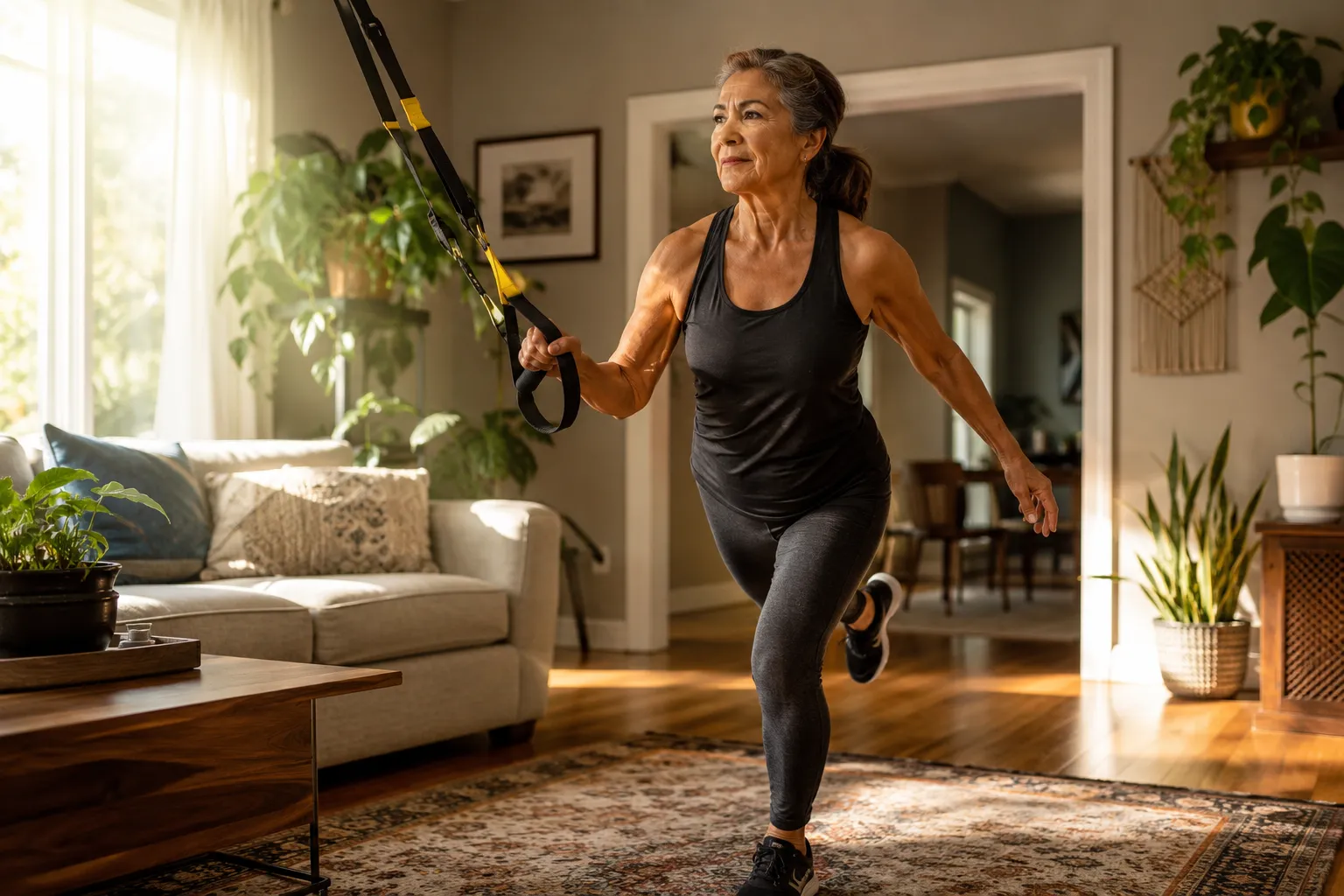
Suspension training is a bodyweight exercise method using two nylon straps with handles anchored to a fixed overhead point. You lean into or away from the anchor, and gravity plus your body angle create the resistance. The steeper your angle, the harder the exercise. Step your feet forward or back to make any move easier or harder in seconds.

The system was originally developed by a Navy SEAL who needed a portable way to train anywhere. Today, brands like TRX, WOSS, and Lifeline sell home-friendly kits. Because both hands (or feet) are supported by the straps, your core muscles fire on nearly every rep to stabilize you [3]. That's why it delivers strength, balance, and mobility benefits at once.

Quick example: A standing row with straps at chest height. Grip the handles, walk your feet forward until your body leans back at 45 degrees, then pull your chest to your hands. Feet farther forward equals harder. That single adjustment replaces switching to a heavier dumbbell.

Is suspension training safe for seniors with arthritis

Yes, suspension training is generally safe and often preferred for seniors with arthritis because you control the load and can offload instantly by standing more upright. Unlike free weights, there's no fixed resistance you're locked into. If a knee or shoulder flares up mid-set, you simply reduce your lean angle or step out of the strap.

)

Research supports this: In a 12-week TRX study with adults 60+, 36% of participants reported reduced musculoskeletal pain during the program [4]. The controlled range of motion and self-selected intensity make it easier on inflamed joints than machines or barbells.

Choose suspension training over free weights if: you have knee osteoarthritis, rotator cuff issues, grip weakness, or a history of dropped weights. Skip or modify if: you have severe balance impairment without a wall/chair nearby, uncontrolled blood pressure, or recent joint replacement (wait for surgeon clearance).

Common mistake: Going too deep too soon. Arthritic knees don't need full range on day one. Work in a pain-free 30-60 degree squat and expand as tolerated.

Can you do suspension training at home without equipment

You cannot do true suspension training without straps, but you can replicate many of the same movement patterns using a sturdy table, a towel over a closed door, or a chair for support. These substitutes work for a few weeks while you decide whether to buy a system.

Home substitutes that work:

  • Sturdy dining table for inverted rows (grip the edge, walk feet under).
  • Two firm chair backs placed hip-width apart for supported squats and dips.
  • Thick bath towel looped over a solid door hinge side (test carefully) for beginner rows.
  • Kitchen counter for angled push-ups and single-leg balance drills.

That said, a real suspension trainer is more versatile and safer than jury-rigged setups, and entry-level units cost less than one month of a gym membership.

Suspension training vs resistance bands for older adults

Both are joint-friendly, but they solve different problems. Suspension straps train stability, balance, and total-body coordination because your core stabilizes on every rep. Resistance bands train isolated strength with steady tension and are easier to travel with.

Factor Suspension Trainer Resistance Bands
Best for Balance, core, full-body Isolated muscles, rehab
Learning curve Moderate Low
Space needed Overhead anchor None
Cost $30,$200 $15,$50
Balance training Excellent Limited
Grip demand High Low, moderate

Choose suspension straps if balance and fall prevention are your top goals. Choose bands if you have weak grip strength or want ultra-portable equipment. Many seniors use both, bands for arms and glutes, straps for compound moves and balance.

How often should seniors do suspension training per week

Two to three sessions per week is the sweet spot for most adults 55+, with at least 48 hours between sessions to allow recovery. The 6-week research protocol that produced significant balance and functional reach gains used twice-weekly sessions [1][2].

Sample weekly schedule:

  • Monday: 25 min suspension session (full body, moderate)
  • Wednesday: Walking or gentle mobility
  • Friday: 25 min suspension session (focus on balance and core)
  • Other days: Rest, walking, or light stretching

Beginners should start with once per week for the first two weeks, then add a second session. Soreness in the first sessions is normal; sharp joint pain is not.

Best suspension training exercises for balance and fall prevention

Best suspension training exercises for balance and fall prevention

The most effective fall-prevention moves combine single-leg stance, hip strength, and core stability. Suspension straps let you practice these safely by giving you handles to grab if you lose balance. This is a major advantage over doing single-leg drills unassisted [6].

Top 5 balance and fall-prevention exercises:

  1. Assisted single-leg stand: Hold both handles lightly, lift one foot, hold 20-30 seconds. Progress by using one hand, then fingertips.
  2. Suspended split squat: Rear foot in the strap, front foot forward, gentle knee bend. Trains hip stability and unilateral strength.
  3. Squat to stand: Hold handles at chest height, sit back into a squat, drive up. Builds the exact pattern of standing from a chair.
  4. Standing hip abduction: Hold handles, lift one leg out to the side. Strengthens the glute medius, the main hip stabilizer.
  5. Chest-height row: Trains the postural muscles that keep you upright and prevent forward-leaning falls.

Quick example progression: Start every session with 60 seconds of assisted single-leg stands per side. In four weeks, most seniors can hold 30 seconds hands-free.

Suspension training for seniors with bad knees or shoulders

For bad knees, the straps let you assist yourself out of squats and lunges, drastically reducing knee load. For sensitive shoulders, keep the arms below shoulder height and avoid overhead pulling until strength returns.

)

Knee-friendly modifications:

  • Shorten squat depth to a comfortable range (often 45-60 degrees).
  • Use the straps to unload 20-30% of your weight on the way down.
  • Skip jumping or plyometric variations entirely.

Shoulder-friendly modifications:

  • Keep hands below chin level for the first month.
  • Use a neutral grip (palms facing each other) instead of overhand.
  • Avoid "Y" and "T" raises until a physical therapist clears full overhead motion.

Edge case: After a total knee replacement, most surgeons approve gentle suspension work at 8-12 weeks post-op, but always get individual clearance first.

How much does a suspension trainer cost

A quality home suspension trainer costs $30 to $200. The official TRX Home2 kit runs around $150,$200. Reliable budget brands like WOSS Attack, Lifeline Jungle Gym, and Bodyweight Warrior sell solid units for $30,$60.

What you actually need:

  • The strap system with handles and foot cradles
  • A door anchor (usually included)
  • Optional: a beam anchor or ceiling hook for permanent setup ($10,$20)

Skip the extras. You don't need branded mats, apps, or premium subscriptions to start. YouTube has hundreds of free senior-focused suspension routines.

Total realistic startup cost: $40,$180 including anchor, one time. That's cheaper than 1-3 months of most gyms.

Can suspension training improve flexibility in seniors

Yes. Suspension straps double as a mobility tool because the handles give you something to hold onto during deep stretches, which allows a greater range of motion than unassisted stretching. Seniors often reach positions on the straps they cannot access on the floor.

Effective mobility uses:

  • Assisted hip flexor stretch: Rear foot in strap, front knee forward, sink hips down.
  • Chest opener: Grip handles behind you, step forward, feel the stretch across the chest and biceps.
  • Assisted squat hold: Hold handles, sit deep, let the straps support your weight. Improves ankle and hip mobility.
  • Hamstring stretch: Foot in strap, gently raise leg while lying on the floor.

Combined with strength work, this addresses the flexibility deficits that limit daily tasks like reaching, dressing, and getting off the floor [3].

What mistakes do older adults make with suspension training

The most common mistakes are going too hard too soon, ignoring strap length, and skipping the warm-up. Each is fixable with a bit of attention.

Top mistakes and fixes:

  1. Straps too long or uneven. Both handles should sit at exactly the same height. Check every session.
  2. Feet placed too aggressively. Beginners often start at 45 degrees when 20 degrees is plenty. Start upright, progress weekly.
  3. Holding breath during pulls. Exhale on effort, inhale on return.
  4. Sagging hips in planks and rows. Squeeze the glutes to keep a straight line from ear to ankle.
  5. Skipping the warm-up. Five minutes of marching, arm circles, and gentle squats prevents most tweaks.
  6. Death-gripping the handles. A relaxed grip reduces forearm fatigue and blood pressure spikes.

Suspension training for seniors with limited mobility

Suspension training is one of the few strength methods that works well for adults with limited mobility because you can perform every exercise seated or standing at partial range. The straps provide external support that reduces the balance demand.

Seated adaptations:

  • Seated rows from a sturdy chair
  • Seated chest press (facing away from anchor)
  • Seated overhead reach for shoulder mobility

Standing with support:

  • Chair placed within arm's reach for extra security
  • Wall two feet behind you as a safety backstop
  • Caregiver or spouse spotting the first few sessions

Start with 5-10 minute sessions, twice weekly, and add two minutes per week. The 6-week study population included older adults with typical age-related limitations, and all 11 participants completed the program with no dropouts [2].

Do you need a trainer to start suspension training

Do you need a trainer to start suspension training

You don't strictly need a personal trainer, but a single 30-minute consultation with a certified trainer (ideally one with a NASM Senior Fitness Specialist or ACE credential) can save you months of trial and error. Many offer virtual sessions for $40,$80.

Alternatives to a personal trainer:

  • Reputable YouTube channels focused on senior fitness
  • Local senior center TRX classes (often free with membership)
  • One-time posture check with a physical therapist
  • The instruction manual and app that come with most kits

Choose a trainer if: you have a recent injury, chronic condition, or feel nervous about form. Self-teach if: you're generally healthy, comfortable following videos, and willing to start conservatively.

Suspension training vs traditional weight lifting for seniors

Both build strength, but they work differently. Traditional lifting uses fixed external loads (dumbbells, machines) and is excellent for measurable strength gains. Suspension training uses body weight at variable angles and builds strength alongside balance, coordination, and core stability [6].

)

Traditional lifting advantages: Precise progression in small increments, better for pure muscle mass building, easier to isolate specific muscles.

Suspension training advantages: Lower joint impact, portable, no dropped-weight risk, built-in balance training, one piece of equipment covers 100+ exercises [5].

Best approach for most seniors: Combine both. Use suspension straps 2 days per week for full-body and balance, and dumbbells 1 day per week for targeted work like biceps curls and calf raises.

How long does it take to see results from suspension training

Balance and coordination improvements typically show up in 2-3 weeks. Strength gains follow at 4-6 weeks. Visible body composition changes take 8-12 weeks with consistent training and reasonable nutrition.

The published 6-week study showed statistically significant balance and functional reach improvements after just 12 sessions (twice weekly for 6 weeks) [1][2]. Participants also reported subjective gains in confidence and daily function.

Realistic month-by-month expectations:

  • Weeks 1-2: Learning positions, mild soreness, feeling steadier
  • Weeks 3-4: Notable balance improvement, easier to stand from chairs
  • Weeks 5-8: Clear strength gains, better posture, deeper squats
  • Weeks 9-12: Meaningful changes in stamina, muscle tone, and confidence

A simple 20-minute starter routine

Do this twice per week with at least one rest day between sessions. Adjust strap angle so each exercise feels moderately challenging by the last two reps.

  1. Warm-up (3 min): March in place, arm circles, 5 slow squats
  2. Assisted squats: 2 sets of 10 reps
  3. Chest-height rows: 2 sets of 8-10 reps
  4. Chest press (facing away): 2 sets of 8-10 reps
  5. Single-leg stance (assisted): 2 sets of 20 seconds per leg
  6. Standing hip abduction: 2 sets of 8 per side
  7. Assisted hip flexor stretch: 30 seconds per side
  8. Chest opener stretch: 30 seconds

Rest 45-60 seconds between sets. Total time: about 20-25 minutes.

FAQ

Is TRX safe for a 70-year-old?
Yes, for most healthy 70-year-olds. Research on adults 60+ shows high adherence and reduced pain with proper progression [4]. Get a doctor's clearance if you have heart disease, uncontrolled blood pressure, or recent surgery.

Can I use a door anchor safely?
Yes, if the door is solid (not hollow), opens away from you, and is fully closed and latched. Test with light body weight first.

What if I can't grip the handles well?
Wrap a small towel around each handle for a thicker grip, or use padded workout gloves. Grip strength itself will improve with training.

Will suspension training help me stand up from a chair more easily?
Yes. The squat-to-stand pattern trained on the straps directly transfers to chair rises, and most seniors notice improvement within 3-4 weeks.

How high should I anchor the straps?
Between 7 and 9 feet for most home use. The handles should hang to about mid-calf when the straps are fully extended.

Can I do suspension training every day?
Two to three days per week is optimal. Daily strength work doesn't allow recovery, and recovery is when strength gains happen.

Is it okay if I feel shaky during exercises?
Mild shaking is normal, it means your stabilizer muscles are working. Violent shaking or losing balance means the angle is too aggressive; step back and reduce difficulty.

What should I do if I have osteoporosis?
Suspension training is generally safe, but avoid forward-flexion moves and any position that rounds the spine under load. Consult a physical therapist for a personal plan.

Conclusion

Suspension training gives adults 55+ a low-impact, adaptable, and affordable way to build strength, balance, and mobility from a single anchor point at home. The published research is small but promising: measurable balance gains in 6 weeks, high adherence, and reported reductions in joint pain [1][2][4]. The equipment costs less than a month of gym membership and stores in a drawer.

Your next steps this week:

  1. Get medical clearance if you have any chronic condition or are new to exercise.
  2. Buy a basic suspension trainer ($30,$60 is enough to start).
  3. Set up a safe anchor point at 7-9 feet high.
  4. Do the 20-minute starter routine above, twice this week.
  5. Track balance in one simple way: time how long you can stand on one foot. Retest in 4 weeks.

Start conservatively, progress weekly, and let the strap angle do the work. Consistency over intensity is what changes function at 60, 70, and 80.

References

[1] Efficacy of a 6-Week Suspension Training Exercise Program on Fitness Components in Older Adults – https://pmc.ncbi.nlm.nih.gov/articles/PMC9362890/
[2] Efficacy Of A 6 Week Suspension Training Exercise Program On Fitness Components – https://www.physiohub.io/research/older-adults/efficacy-of-a-6-week-suspension-training-exercise-program-on-fitness-components
[3] Benefits Of Strength Training For Seniors – https://insurefitness.com/benefits-of-strength-training-for-seniors/
[4] Suspension Training For Older Adults – https://blog.nasm.org/suspension-training-for-older-adults
[5] Suspension Training For Seniors – https://wellness.nifs.org/blog/suspension-training-for-seniors
[6] TRX Suspension Training: A New Functional Training Approach for Older Adults – https://fis.dshs-koeln.de/de/publications/trx-suspension-training-a-new-functional-training-approach-for-ol/
[7] Effects of Suspension Training on Older Adults – https://pmc.ncbi.nlm.nih.gov/articles/PMC6966604/
[8] Suspension Training Research – https://www.mdpi.com/1648-9144/60/1/47