{"cover":"Professional landscape format (1536×1024) editorial hero image with bold text overlay 'Functional Strength at Home' in crisp white sans-serif on a warm-toned semi-transparent panel, centered with 8% safe margins. Background: bright natural-light photograph of an active 70-year-old woman in athletic wear performing a sit-to-stand exercise from a sturdy wooden chair in a sunlit living room, resistance band nearby on hardwood floor, houseplants and large window with soft morning light, warm color grade, magazine cover polish, shallow depth of field, inspiring and dignified mood.","content":["Bright editorial photograph in landscape format (1536×1024) of a diverse group of three older adults (Asian man in his 70s, Black woman in her 60s, white man in his 80s) doing bodyweight squats and wall push-ups in a sunlit home living room, wearing casual athletic clothing, resistance bands and light dumbbells on a yoga mat nearby, natural window light streaming in, warm neutral palette, high editorial quality, candid and encouraging atmosphere, shallow depth of field","Split-screen editorial landscape image (1536×1024): left half shows an older woman in her late 60s carrying grocery bags up porch steps with confident posture in bright outdoor daylight; right half shows the same style of woman performing a farmer's carry with two small dumbbells in a bright home kitchen, symbolizing how functional training translates to daily life; warm natural lighting, magazine editorial polish, no text overlays, clean composition","Flat vector infographic in landscape format (1536×1024) showing a weekly functional training schedule for seniors: seven day-of-week icons across the top, with small illustrated exercise icons (chair squat, wall push-up, heel raise, band row, single-leg stand) mapped to three training days, rest and walking icons on other days; soft sage green, cream, and terracotta palette, short labels max 3 words each, generous 8% safe margins, clean modern design, save-worthy Pinterest infographic quality"}
Last updated: August 11, 2026
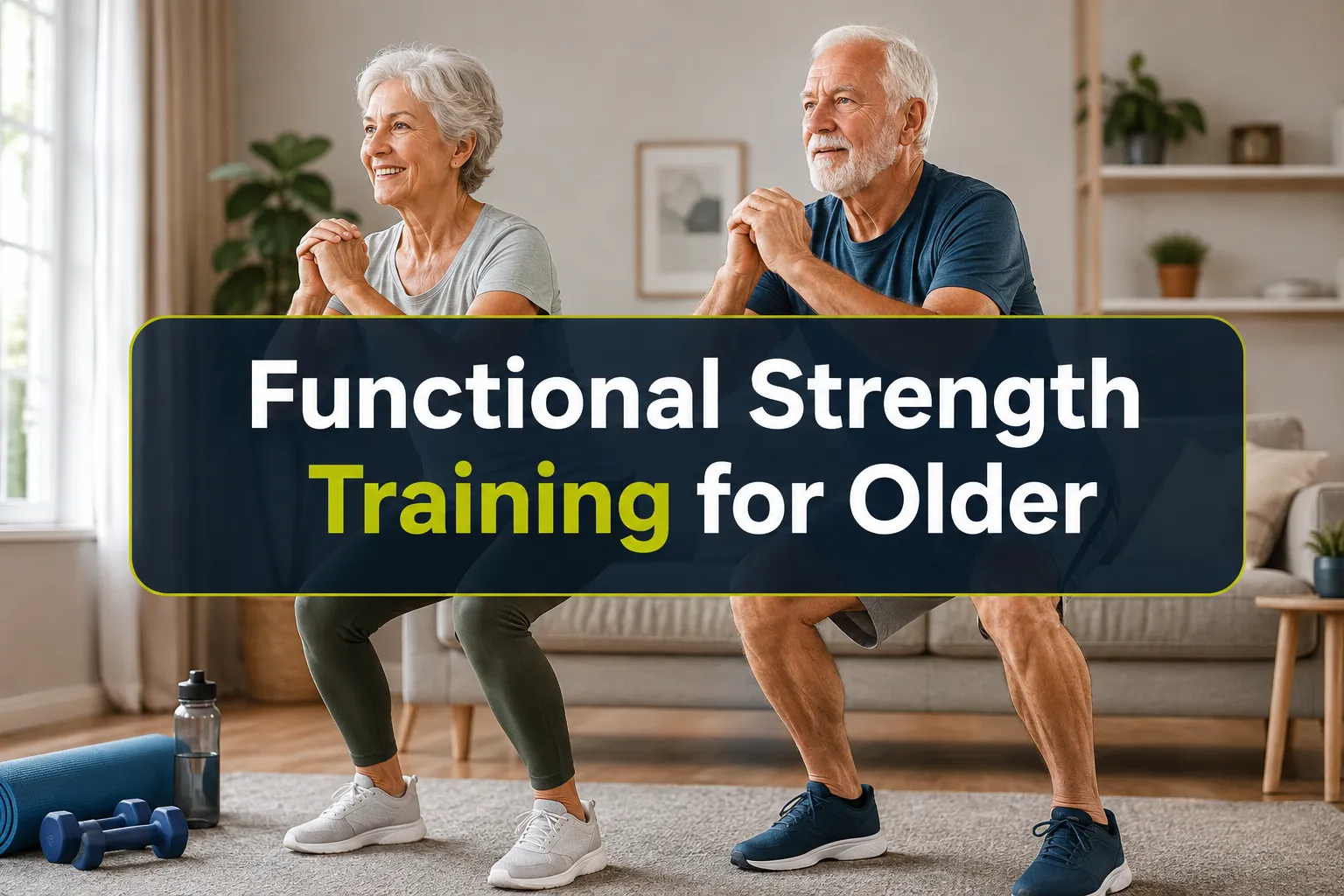
Strength-focused programs for seniors have climbed into the top worldwide fitness trends this year, and most of that momentum is happening in living rooms, not gyms. The reason is simple: home-based routines using resistance bands, light dumbbells, and bodyweight moves deliver the same fall-prevention and independence benefits as commercial gym programs, without the commute, cost, or intimidation factor.
Quick Answer
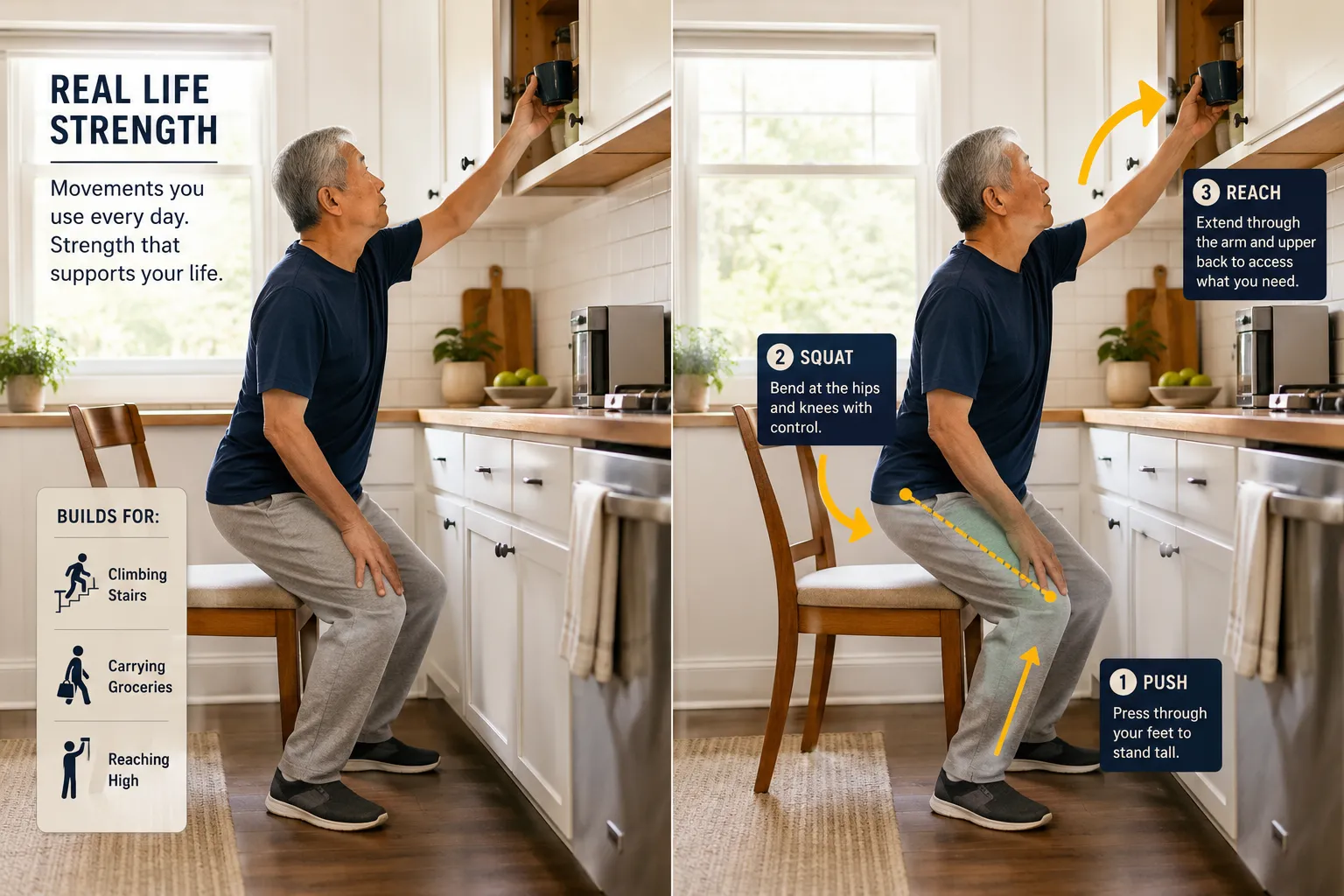
Functional strength training for older adults at home means practicing movements that mirror real daily tasks, standing up from a chair, climbing stairs, carrying groceries, reaching overhead, using bodyweight, resistance bands, or light dumbbells. Most adults over 60 should aim for 2 to 3 sessions per week, 20 to 40 minutes each, targeting the legs, hips, core, and upper body. Done consistently, it reduces fall risk, protects independence, and produces visible strength gains within 6 to 12 weeks.
Key Takeaways
- Functional training beats traditional lifting for seniors because it trains movement patterns used in daily life, not isolated muscles.
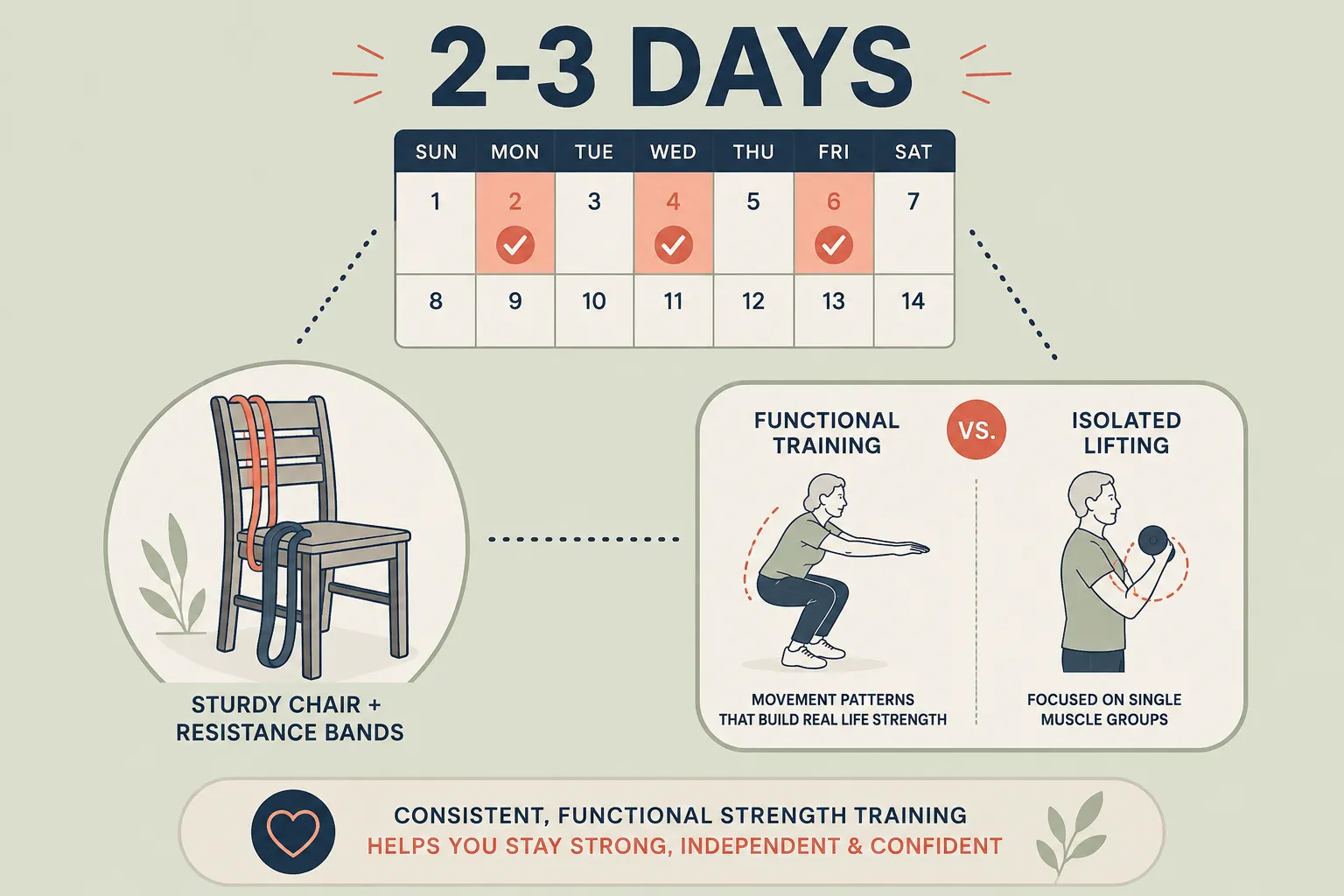
- 2 to 3 non-consecutive days per week is the sweet spot for most older adults.
- A sturdy chair, a wall, and a set of resistance bands are enough to start, no gym required.
- Fall risk drops significantly when programs include balance work alongside strength (backed by decades of research from the CDC and WHO guidelines).
- Arthritis is not a reason to avoid strength training, in most cases, it's a reason to start.
- Expect noticeable strength gains in 6 to 8 weeks and functional improvements (easier stairs, better balance) within 4 weeks.
- Progression matters more than intensity, small weekly increases work better than pushing hard once.
- A physical therapist is ideal for anyone recovering from injury or surgery; a trainer is optional for healthy beginners.
)
What Is Functional Strength Training and Why Does It Matter for Seniors
Functional strength training is exercise designed around real-world movements, squatting, pushing, pulling, hinging, carrying, and rotating, rather than isolated muscle work like bicep curls. For older adults, it matters because it directly protects the abilities that keep people independent: getting off the toilet, climbing into a car, catching yourself when you trip, lifting a grandchild.
After age 30, adults lose roughly 3-8% of muscle mass per decade, and that rate accelerates after 60. This loss (called sarcopenia) is the single biggest predictor of losing independence in later life. Functional training slows and often reverses it while also training the nervous system to coordinate movement, the piece that pure weight machines miss.
The goal isn't to look strong. It's to still be able to do what you love at 85.
Functional Strength Training vs Regular Weight Lifting for Older Adults
The short answer: Functional training is usually the better default for adults over 60, but traditional lifting still has a place, especially for building raw strength in specific muscles.
Here's how they compare:
| Feature | Functional Strength Training | Traditional Weight Lifting |
|---|---|---|
| Movement pattern | Multi-joint, real-life motions | Often single-joint, isolated |
| Equipment needed | Minimal (bands, bodyweight, light weights) | Machines, barbells, gym access |
| Balance component | Built-in | Usually absent |
| Injury risk (untrained) | Lower | Higher |
| Best for | Daily independence, fall prevention | Peak strength, bodybuilding goals |
| Home-friendly | Excellent | Limited |
Choose functional training if your goal is staying independent, preventing falls, or moving better in daily life. Add traditional lifting if you already have a strength base and want to target specific weak areas (like grip or shoulder strength).
Best Functional Strength Exercises You Can Do at Home Without Equipment
The most effective home routine covers five movement patterns. Start with these bodyweight versions:
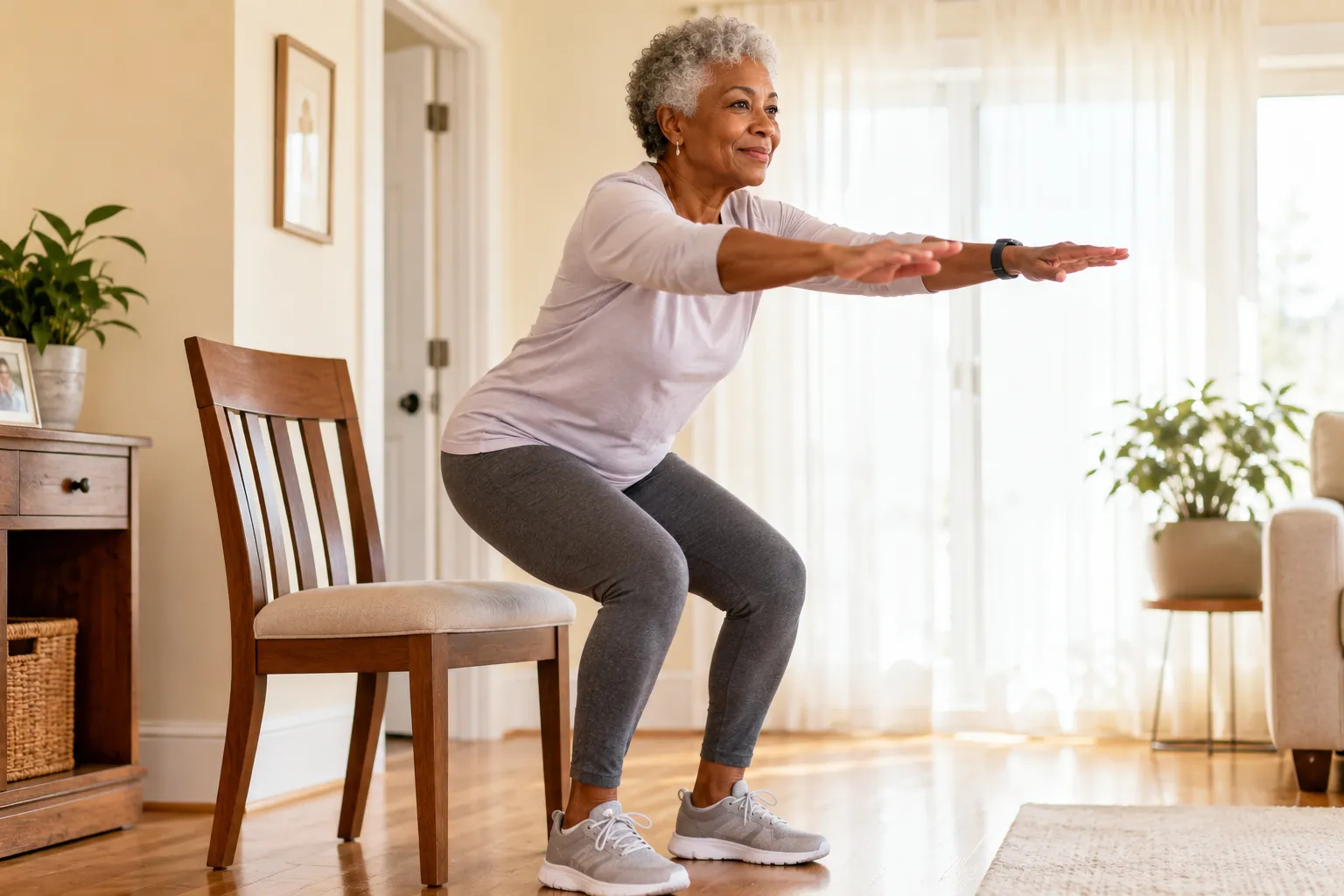
1. Sit-to-stand (chair squat), Sit on a sturdy chair, feet flat, arms crossed. Stand up without using hands. Sit back down with control. Trains the same muscles used to get off the toilet or out of a car. Start with 2 sets of 8-10.
2. Wall push-up, Stand arm's length from a wall, hands at shoulder height. Bend elbows to bring your chest toward the wall, then push back. Builds pushing strength for getting up from the floor. 2 sets of 8-12.
3. Heel raises, Stand behind a chair, hold the back for balance. Rise onto the balls of your feet, then lower slowly. Strengthens calves and ankles for stairs and walking. 2 sets of 12-15.
4. Standing hip hinge, Stand tall, hands on hips. Push hips back like closing a car door with your rear, keeping your back flat. Return upright. Trains the pattern for picking things up safely. 2 sets of 10.
5. Single-leg stand, Hold a counter, lift one foot slightly. Balance for 10-30 seconds. Switch sides. The single best fall-prevention drill. 3 times per leg.
Do the whole circuit 2-3 times per week. Add 1-2 reps per week as it gets easier.
How Often Should Older Adults Do Functional Strength Training
Two to three sessions per week, on non-consecutive days. That's the standing recommendation from the World Health Organization and the American College of Sports Medicine for adults 65 and older.
A practical week looks like this:
- Monday: 30-minute strength session
- Tuesday: Walking or light activity
- Wednesday: Rest or gentle stretching
- Thursday: 30-minute strength session
- Friday: Walking
- Saturday: Optional third strength session or balance work
- Sunday: Rest
Muscles need 48 hours to recover and rebuild, which is why back-to-back strength days aren't ideal for beginners. If you're feeling more energetic, add walking or gentle mobility on off days, not more lifting.
Can Functional Strength Training Help Prevent Falls in Seniors
Yes, this is one of the most consistently supported findings in geriatric research. Programs that combine strength (especially lower body) with balance work reduce fall rates by roughly 20-30% in community-dwelling older adults, according to systematic reviews cited in WHO and CDC guidelines.
Falls happen when three things fail at once: leg strength, balance reactions, and ankle stability. Functional training hits all three. The exercises that matter most:
- Sit-to-stands (leg strength)
- Single-leg stands (static balance)
- Heel-toe walking (dynamic balance)
- Step-ups on a low step (reactive strength)
- Heel and toe raises (ankle stability)
Include at least one balance-focused move every session. Progress by narrowing your base of support (feet together → tandem stance → single leg), then by closing your eyes briefly while holding a counter.
)
What Equipment Do You Need to Start Functional Strength Training at Home
You need almost nothing to start. A sturdy chair, a wall, and enough floor space to lie down cover 80% of a beginner program.
When you're ready to add resistance, buy in this order:
- A set of resistance bands (loop bands and long tube bands with handles), $15-30. Most versatile purchase you can make.
- Light dumbbells, start with a pair each of 2, 5, and 8 lbs. Adjustable dumbbells save space.
- A yoga mat for floor work, $20.
- A stable step (an actual exercise step or the bottom stair) for step-ups.
- A door anchor for bands, under $10, unlocks rowing and pulling movements.
Skip the vibration plates, ab rollers, and complicated machines. They're marketing, not fitness.
Is Functional Strength Training Safe for People With Arthritis or Joint Pain
Yes, and for most people with osteoarthritis, it's actively recommended. The Arthritis Foundation and every major rheumatology guideline lists resistance training as a first-line treatment for joint pain, because stronger muscles offload stressed joints.
The rules for training with arthritis:
- Move through pain-free ranges only. If a squat hurts at the bottom, don't go as low.
- Warm up longer, 5-10 minutes of walking or gentle mobility before strength work.
- Expect stiffness, not sharp pain. A little discomfort during exercise is fine. Sharp, stabbing, or joint-line pain is a stop signal.
- Slow tempo helps. Take 3 seconds to lower and 2 seconds to rise. This reduces joint stress.
- Bad days happen. On flared-up days, do less volume or switch to gentle range-of-motion work.
If you have rheumatoid arthritis, a joint replacement, or severe joint damage, get clearance from your doctor or physical therapist before starting.
How Long Does It Take to See Results From Functional Strength Training
Most older adults notice functional improvements within 2-4 weeks and measurable strength gains within 6-8 weeks. The pattern typically looks like this:
- Weeks 1-2: Better coordination, exercises feel less awkward. Not much visible change.
- Weeks 3-4: Stairs feel easier. Getting up from chairs is smoother. Balance improves.
- Weeks 6-8: You can do more reps or heavier resistance. Posture often improves.
- Weeks 12+: Real muscle changes. Clothes may fit differently. Daily tasks feel notably easier.
- 6 months+: Bone density improvements (especially with weight-bearing moves), significant fall-risk reduction.
The catch: results reverse quickly if you stop. Two weeks off is enough to lose noticeable strength after 60. Consistency beats intensity, three modest sessions per week for a year outperforms two hard weeks followed by quitting.
Functional Strength Training for Seniors With Limited Mobility
Limited mobility doesn't disqualify anyone from strength training, it just changes the starting point. Seated and supported exercises can build meaningful strength for people who can't stand for long, use a walker, or are recovering from surgery.
A seated functional routine:
- Seated marches, lift knees alternately, 30 seconds
- Seated leg extensions, straighten one knee, hold 2 seconds, lower
- Seated overhead press with light dumbbells or soup cans
- Seated rows with a resistance band anchored to a doorknob
- Ankle circles and heel-toe pumps for circulation and ankle strength
- Seated torso rotations, arms crossed, rotate side to side
If standing is possible with support, add supported sit-to-stands (using arms), counter-supported heel raises, and gentle marches while holding a counter. Progress by reducing how much you rely on the support, not by rushing to standing exercises.
Common Mistakes Older Adults Make When Doing Strength Training at Home
The biggest errors are almost always about approach, not exercise choice:
- Going too easy for too long. If 12 reps feels effortless, it's not building strength. The last 2-3 reps should feel challenging.
- Skipping warm-ups. 5 minutes of walking or marching in place prevents most tweaks and pulls.
- Holding the breath. Exhale on effort (the hard part), inhale on the easier part. Breath-holding spikes blood pressure.
- Ignoring the lower body. Legs and hips drive independence. Don't spend all your time on arms.
- No progression plan. Doing the same routine at the same difficulty for months stops producing results.
- Skipping balance work. Strength without balance still leaves fall risk on the table.
- Comparing to old fitness levels. The goal is progress from where you are today, not returning to age 40.
Should You Get a Trainer or Do Functional Strength Training on Your Own
A qualified trainer or physical therapist is worth the investment for the first 4-8 sessions if you're new, recovering from injury, or managing chronic conditions. After that, most healthy older adults can train independently using video guidance and a written program.
Get professional help if:
- You've had a recent surgery, fall, or hospitalization
- You have Parkinson's, MS, severe arthritis, or heart conditions
- You've never done resistance training and want form checked
- Your balance is already impaired
You can start solo if:
- You're generally healthy and cleared by your doctor
- You can follow along with reputable video programs (many senior-specific programs exist on YouTube from licensed physical therapists)
- You start conservatively and progress slowly
The National Institute on Aging's free "Go4Life" workout materials are a solid starting point built specifically for older adults.
Functional Strength Training vs Yoga for Older Adults: Which Is Better
They solve different problems, and the best answer is often both. Strength training builds muscle and bone. Yoga builds flexibility, balance, and body awareness.
| Functional Strength Training | Yoga | |
|---|---|---|
| Best at | Building muscle, preserving bone, fall prevention | Flexibility, balance, stress relief |
| Cardiovascular | Moderate | Low (except vigorous styles) |
| Muscle gains | High | Modest |
| Joint mobility | Moderate | High |
| Accessibility | High | High (chair yoga available) |
Choose strength training first if you're losing muscle, worried about falls, or need to protect bone density. Add yoga for mobility, balance, and mental well-being. Two strength sessions plus one yoga session per week is an excellent combination for most adults over 60.
How to Modify Functional Strength Exercises if You Have Balance Issues
Every standing exercise can be modified by adding support, changing the base of support, or moving to a seated version. The rule: never train balance in a position where a real fall could happen.
Balance-friendly modifications:
- For squats: Hold the back of a chair with both hands, then one hand, then fingertips as balance improves
- For lunges: Do split squats holding a counter, or replace with step-ups
- For single-leg stands: Start touching a wall with your hand, then a counter, then no support with a chair nearby
- For overhead work: Sit in a chair with back support
- For anything on the floor: Have a chair or sturdy furniture nearby to help you get up
Train balance in a safe corner (walls on two sides, a chair in front) so a stumble means grabbing furniture, not falling.
)
What's the Difference Between Functional Training and Physical Therapy for Seniors
Physical therapy treats specific medical problems; functional training builds general fitness. A physical therapist diagnoses movement issues, uses exercises as medicine to fix them, and is covered by insurance when prescribed. Functional training is a maintenance and improvement program you do on your own or with a trainer.
See a physical therapist for:
- Recent injury, surgery, or fall
- Persistent pain that limits daily activities
- Neurological conditions (stroke recovery, Parkinson's)
- Significant balance decline
- After a hospitalization
Do functional training for:
- Maintaining and building strength over years
- Preventing decline before it starts
- General fitness, weight management, energy
- After you've been discharged from PT and want to keep gains
Many older adults benefit from a "PT graduation" model: work with a physical therapist to fix specific issues, then transition to an ongoing functional training program to maintain the gains.
FAQ
Is 70 too old to start strength training?
No. Research consistently shows adults in their 80s and 90s gain strength from resistance training. The benefits often show up faster in previously sedentary older adults because the starting point is lower.
How heavy should the weights be?
Light enough that you can do 10-15 reps with good form, heavy enough that the last 2-3 reps feel challenging. For most beginners, that's 2-8 lb dumbbells or light-resistance bands.
Do I need to warm up before functional training?
Yes. Five minutes of walking, marching in place, or gentle arm circles prepares muscles and joints and reduces injury risk.
Can I do this if I have osteoporosis?
Usually yes, and it's often recommended, but avoid heavy forward-bending or spinal-loading moves without medical clearance. A physical therapist can build a bone-safe program.
What if I miss a week?
Don't try to make it up. Resume at your previous level or slightly lighter. Missing occasional weeks is normal and won't undo progress.
Should I train on an empty stomach?
No need. A light snack (banana, toast, yogurt) 30-60 minutes before helps energy. Drink water during the session.
Is soreness after workouts normal?
Mild soreness for 1-2 days is normal, especially when starting or adding difficulty. Sharp pain, joint pain, or soreness lasting over 3 days means you did too much.
Can I combine this with walking?
Yes. Walking and strength training complement each other perfectly. Alternate days is the simplest schedule.
How long should each session be?
20-40 minutes is ideal. Beginners can start with 15-20 minutes and build up.
Do I need to stretch after?
Gentle stretching for 5 minutes after strength work is beneficial but not critical. Focus on the muscles you just trained.
Conclusion: Your Next Steps
Functional strength training at home is the highest-return investment older adults can make in their independence. It's cheap, backed by decades of research, and works for nearly every fitness level and health status.
Start this week:
- Pick 3 days on your calendar (e.g., Monday, Wednesday, Friday).
- Choose 5 exercises from the bodyweight list above. Do 2 sets of each.
- Time yourself, aim for 20 minutes total, including warm-up.
- Track it. A simple notebook works. Note reps done and how it felt.
- After 2 weeks, add one rep to each exercise, or add a third set.
- After 4 weeks, buy resistance bands and start adding them.
- After 8 weeks, reassess: are stairs easier? Getting up from chairs smoother? That's the real measure.
If you have any concern about health conditions, medications, or recent surgeries, get medical clearance first, but don't use that as an excuse to delay. Ask your doctor at your next visit and start with seated exercises in the meantime.
The strongest predictor of independence at 85 isn't genetics or luck. It's the habits you build now.