
Last updated: August 30, 2026
Quick Answer
Fall Prevention Micro-Workouts are short, 3-5 minute bursts of balance, strength, and mobility drills you slot into activities you already do, like stirring pasta or watching the evening news. Done most days, they build the ankle strength, hip stability, and reaction time that keep you upright when you trip on a rug or miss a curb. You need no equipment beyond a sturdy counter or chair, and the science supports brief, frequent sessions over rare hour-long workouts [1][8].
Key Takeaways
- Frequency beats duration. Two to three 5-minute sessions daily produce measurable balance gains within 6-12 weeks [8].
- Habit stacking works. Anchor drills to existing routines: heel raises while the kettle boils, single-leg stands during commercial breaks.
- Support is smart, not weak. A kitchen counter or high-backed chair lets you push closer to your balance limit safely.
- Legs, ankles, and hips matter most. Weakness there is the top predictor of falls in adults over 65 [6].
- Progress means less support, not harder moves. Move from two-hand to one-hand to fingertip to hands-free.
- Micro-workouts fit almost everyone, including people with arthritis, Parkinson's, or walker use, with the right modifications [9].
- Skip or modify if you have acute vertigo, recent surgery, or uncontrolled blood pressure without clearing it with your clinician.
What Causes Falls in Older Adults and How Can Exercise Help
Most falls in older adults come from a mix of muscle weakness, poor balance, slower reaction time, and reduced foot sensation, not a single dramatic event [6]. Exercise directly targets the first three, which is why national fall prevention guidelines rank it as the single most effective intervention.
As we age past 50, we lose roughly 1-2% of muscle mass per year if we're inactive, and the fast-twitch fibers that catch a stumble go first [8]. Balance also depends on three systems working together: vision, inner ear, and proprioception (the sense of where your joints are in space). All three dull over time, but all three respond to training.
What targeted exercise fixes:
- Rebuilds hip and calf strength so you can catch yourself
- Retrains the ankle strategy that corrects small sways
- Sharpens reaction time when the floor surprises you
- Improves posture and gaze stability
Fall Prevention Micro-Workouts work because they hit these systems repeatedly across the day, which is how the brain and body actually adapt.
Can You Really Prevent Falls With Just 5-Minute Exercises
Yes, if you do them consistently. Short, frequent balance and strength sessions have been shown in clinical settings to reduce fall risk, and Johns Hopkins and the Fall Prevention Foundation both endorse brief daily practice over infrequent long workouts [1][8].
The reason is simple: balance is a skill. Skills improve with repetition spread across many small sessions, not one heroic session per week. A pianist doesn't practice scales for three hours on Sunday. Neither should your ankles.
Decision rule: Choose micro-workouts if you struggle to get to a gym, dislike structured exercise, or have already tried and quit longer programs. Choose a formal class (like Tai Chi or a PT-led group) if you need supervision, have had a recent fall, or want social accountability.
Best Balance Exercises You Can Do Standing in One Spot
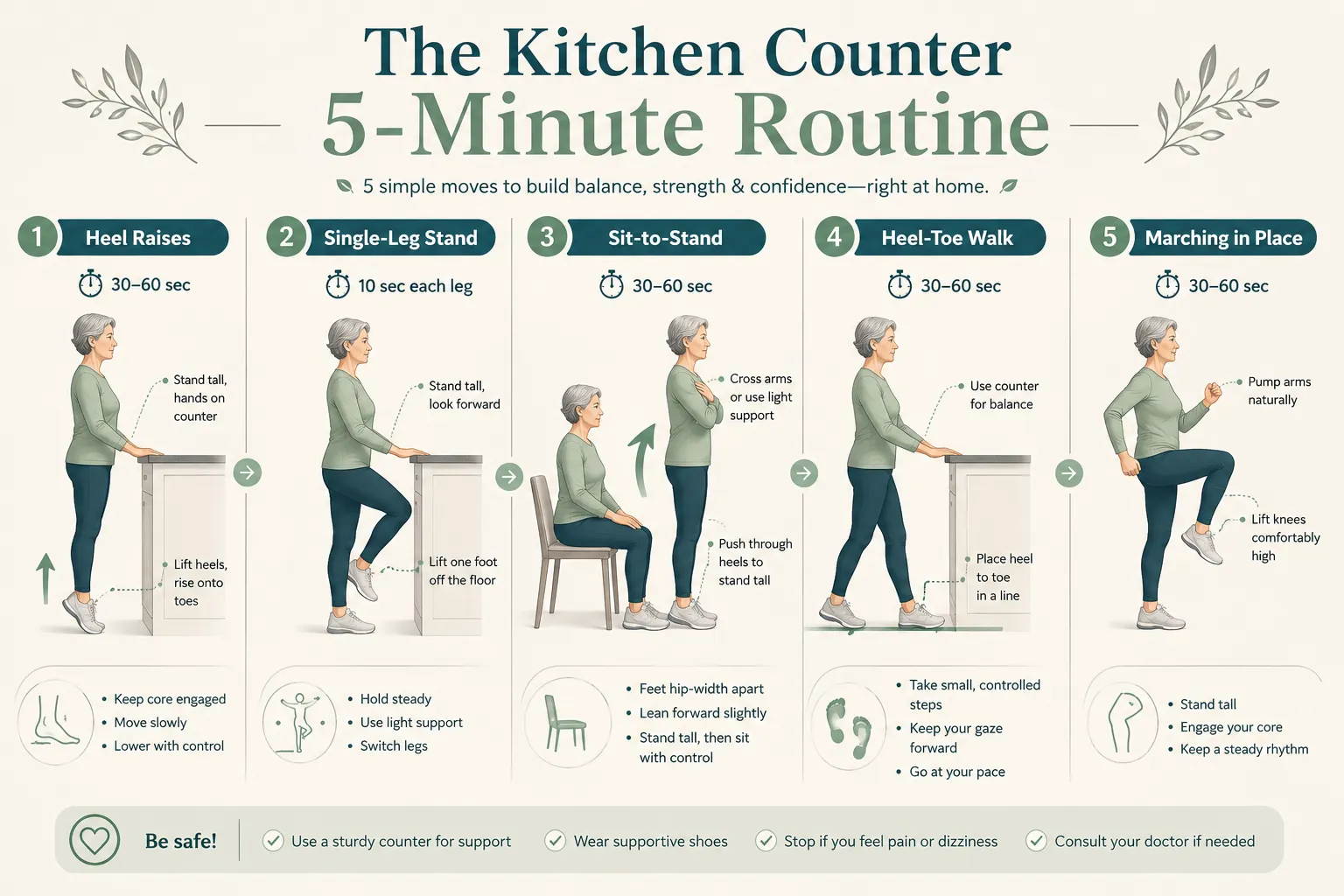
The best standing balance exercises for tight spaces are heel raises, single-leg stands, heel-to-toe stance, mini squats, and side leg lifts. Each takes 30-60 seconds and needs only a countertop for light support [1][3].
The Kitchen Counter 5-Minute Routine:
| Exercise | Time | What It Trains |
|---|---|---|
| Heel raises (both feet) | 45 sec | Calf strength, ankle push-off |
| Single-leg stand, each side | 30 sec × 2 | Hip stabilizers, proprioception |
| Heel-to-toe stance | 45 sec | Narrow-base balance |
| Mini squats | 45 sec | Quad and glute strength |
| Side leg lifts, each side | 30 sec × 2 | Hip abductors (side stability) |
| Marching in place | 45 sec | Coordination, reaction |
Do this while waiting for water to boil, coffee to brew, or the oven to preheat. Keep one hand loosely on the counter until you're steady.
How Often Should You Do Fall Prevention Workouts to See Results
Aim for balance work 5-7 days per week and strength-focused moves 2-3 days per week. Most people notice steadier walking within 4 weeks and meaningful fall-risk reduction within 8-12 weeks of consistent practice [8].
A realistic weekly pattern:
- Every day: One 5-minute balance micro-session (kitchen or bathroom)
- 3-4 days: One 5-minute strength micro-session (sit-to-stands, wall push-ups, calf raises)
- 1-2 days: A longer walk, class, or Tai Chi session if you enjoy it
The biggest predictor of success isn't intensity, it's showing up. Two minutes done daily beats twenty minutes done occasionally.
Micro-Workouts While Cooking: Safety Tips So You Don't Actually Fall
Ironically, the biggest risk of a kitchen workout is the kitchen itself. Follow these rules to keep the practice safe [5][6]:
- Turn off the burner before balancing on one leg. Sharp knives and hot pans don't mix with wobble.
- Wear shoes or grippy socks. Bare feet on tile are fine; socks on tile are not.
- Keep one hand near the counter, not gripping it. Fingertip contact is enough for feedback.
- Clear the floor. No dropped utensils, water spills, or pet toys underfoot.
- Face the counter, not away. If you sway, you catch yourself on it, not fall backward.
- Skip balance drills if you're carrying anything hot or heavy. Wait until the pot is down.
Good anchor moments: water boiling, microwave running, toaster toasting, kettle heating. Bad anchor moments: anything involving open flame, sharp cutting, or lifting a full pot.
What's the Difference Between Fall Prevention and Regular Strength Training
Regular strength training builds bigger, stronger muscles. Fall prevention training builds the specific balance, reaction, and functional strength needed to stay upright. There's overlap, but the emphasis differs [8][10].
Key differences:
| Regular Strength Training | Fall Prevention Training |
|---|---|
| Focus on load and hypertrophy | Focus on balance, reaction, coordination |
| Often seated or machine-based | Standing, functional positions |
| Slow, controlled reps | Includes quicker, catch-yourself movements |
| One big session per week works | Frequent short sessions work better |
| Progress = heavier weight | Progress = less support, harder balance |
A bench press won't stop you from tripping on a curb. A single-leg stand while brushing your teeth might.
Fall Prevention Exercises for People With Arthritis or Joint Pain
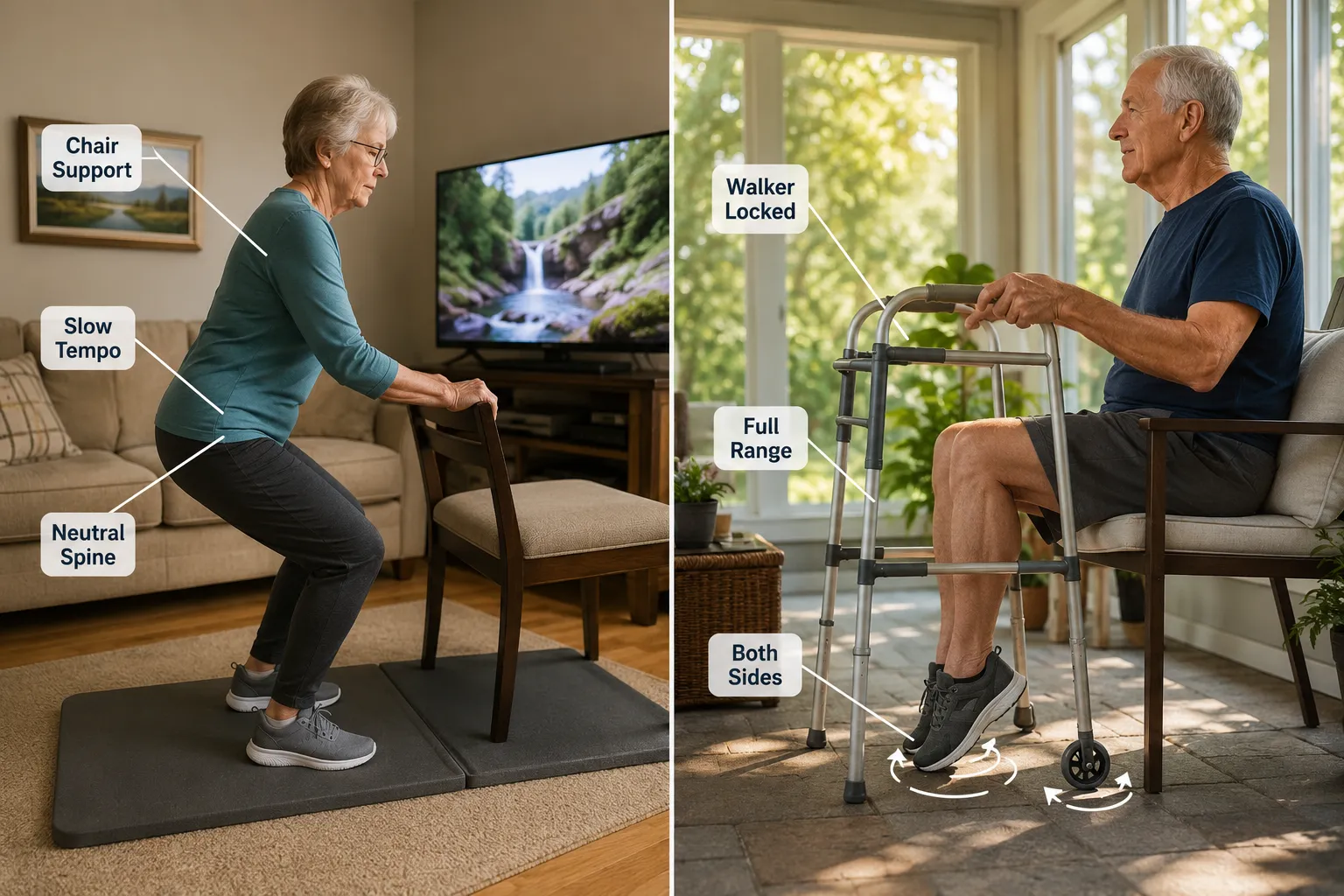
For arthritic joints, choose low-impact, supported versions: seated marching, chair-supported heel raises, gentle weight shifts, and slow sit-to-stands from a firm chair. Skip anything that causes sharp pain, and prioritize range of motion before load [1][9].
Arthritis-friendly 5-minute routine:
- Seated marching: 60 seconds
- Ankle circles, each direction: 30 seconds each
- Chair-supported heel raises: 60 seconds
- Slow sit-to-stands from a dining chair: 60 seconds (use armrests if needed)
- Standing weight shifts side to side: 60 seconds, hands on counter
Warmth helps. Do these after a warm shower or later in the day when joints have loosened. If a joint hurts during an exercise (not just stiff), stop and modify.
Best Balance Exercises If You Have Limited Mobility or Use a Walker
If you use a walker or have significant mobility limits, focus on seated core work, supported standing time, and ankle mobility. The goal shifts from preventing trips to preserving the ability to stand, transfer, and catch yourself [3][9].
Walker-friendly micro-routine:
- Seated marching with arm swings: 60 sec
- Ankle pumps (heel-toe rocks) while seated: 60 sec
- Walker-supported heel raises: 45 sec (lock the walker brakes first)
- Walker-supported weight shifts: 45 sec
- Seated leg extensions, alternating: 60 sec
Critical safety rule: brakes locked, walker on a non-slip surface, and never lean forward onto the walker with straight arms during heel raises. Keep elbows soft.
Do Fall Prevention Exercises Work for Younger People or Just Seniors
They work for everyone, and starting in your 40s or 50s gives the biggest long-term payoff. Balance and ankle strength decline silently long before falls become common, so training earlier means you never lose the buffer [4][8].
Younger adults, especially those who sit for work, often have the ankle mobility of someone twice their age. Athletes benefit too: better proprioception means fewer sprains and better performance. If you're under 60, you can also add gentle plyometric moves like small hops or step-ups to build reactive strength [4].
How to Tell If You're Doing Fall Prevention Exercises Correctly
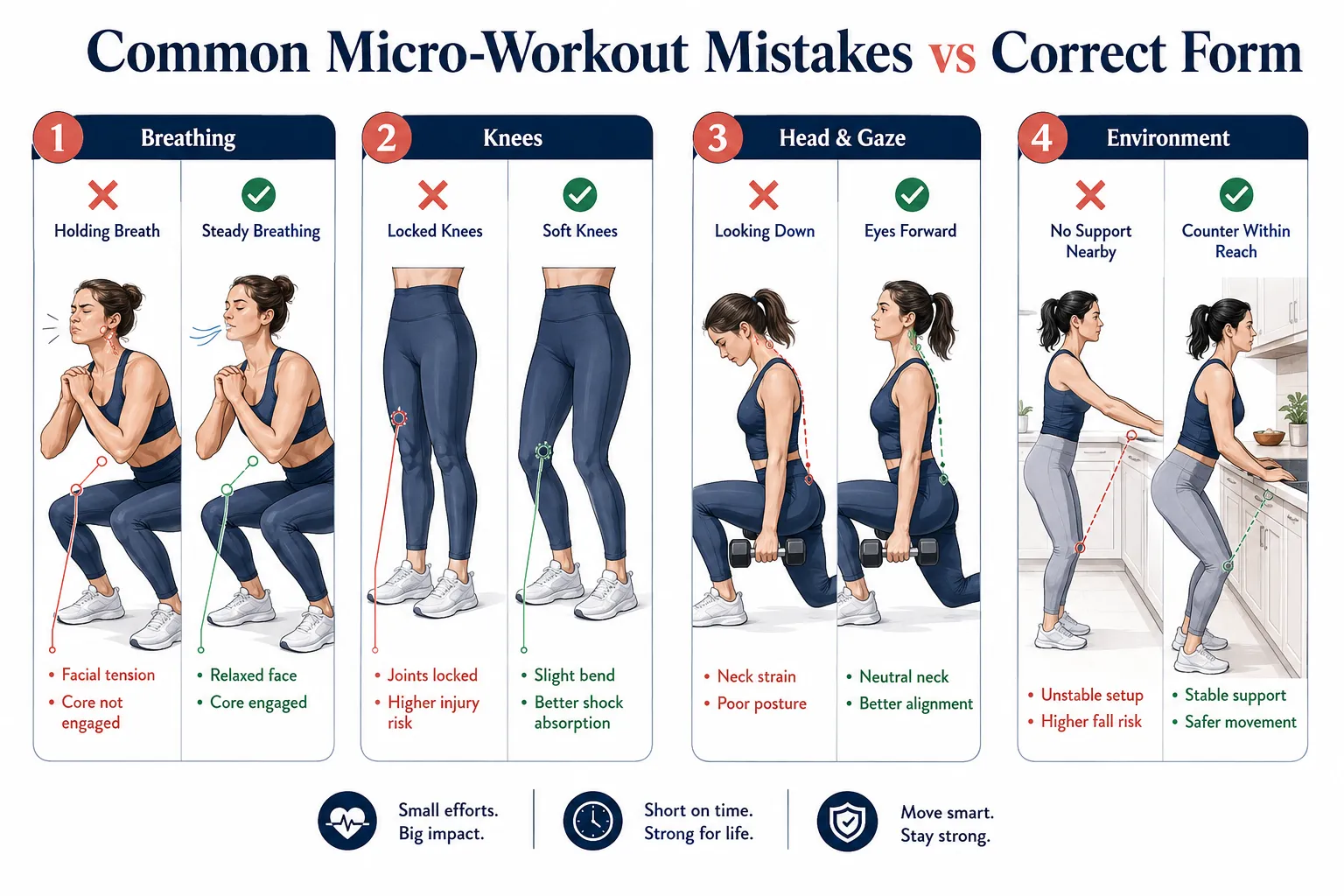
Correct form for balance work means: neutral spine, eyes forward (not down), steady breathing, and a slight sway that you control rather than fight. If you're gripping the counter white-knuckled or holding your breath, the drill is too hard [1][10].
Signs you're doing it right:
- Small ankle and hip corrections, not big flails
- Breathing evenly through the movement
- Can hold the position for the target time without pain
- Feel worked but not shaky-exhausted afterward
Signs to dial it back:
- Death grip on the counter
- Breath-holding
- Sharp joint pain (dull muscle work is fine)
- Actually losing balance more than once per session
Pull quote: "Progress in balance training isn't about doing harder tricks. It's about doing the same simple drill with less help."
Can You Do These Workouts If You Have Vertigo or Inner Ear Problems
Only with clearance from your doctor or a vestibular therapist. Some balance drills can trigger vertigo, while others are specifically prescribed to retrain the vestibular system. The difference matters, and self-prescribing can make symptoms worse [6].
If you have BPPV, Meniere's disease, or unexplained dizziness, book a vestibular assessment first. Once cleared, gaze-stabilization drills (focusing on a fixed point while turning your head slowly) and firm-surface balance work are usually the safest starting places. Skip head-tilting drills and eyes-closed balance until a professional says otherwise.
What Equipment Do You Need for 5-Minute Fall Prevention Routines
Almost nothing. A sturdy kitchen counter, a firm-seated chair, and non-slip footwear cover 95% of Fall Prevention Micro-Workouts [1][3]. Optional upgrades that help later:
- Resistance band ($10): for seated leg strengthening
- Foam pad or folded towel ($0-20): for advanced unstable-surface balance
- Grab bar in bathroom ($15-40): for tooth-brushing balance drills
- Timer or phone app: to keep sessions honest
Skip: wobble boards, BOSU balls, and expensive balance trainers until you've mastered the basics on firm ground. Fancy gear is the most common way people quit.
Common Mistakes People Make When Trying to Prevent Falls at Home
The biggest mistakes are doing exercises too rarely, gripping supports too hard, skipping the harder side, and confusing stretching with balance training [1][8].
Top mistakes to avoid:
- Only training the "good" leg. Your weaker side is where falls start.
- Holding the counter like a life raft. Feedback, not support.
- Doing balance work only during class, not daily. Skills need reps.
- Ignoring the ankles. Calf and ankle strength are underrated.
- Never progressing. If a drill feels easy for two weeks, make it harder.
- Rushing sit-to-stands. Slow negatives build more strength than fast reps.
- Wearing socks on hardwood. A fall waiting to happen.
Are There Fall Prevention Exercises You Should Avoid If You Have Certain Conditions
Yes. Certain conditions make specific drills risky. Avoid the following without clearance [6][9]:
- Uncontrolled high blood pressure: skip breath-holding and rapid position changes
- Recent joint replacement: avoid deep squats or crossed-leg stances until cleared
- Osteoporosis (severe): avoid forward-bending, twisting, or high-impact moves
- Peripheral neuropathy: avoid eyes-closed balance and unstable surfaces
- Parkinson's disease: work with a specialist; some cueing methods are far more effective than others [9]
- Recent stroke: get a PT assessment before starting standing balance work
- Acute vertigo episode: rest until symptoms settle, then reassess
When in doubt, one phone call to your doctor or a physical therapist saves months of setbacks.
Frequently Asked Questions
How long until I notice a difference?
Most people feel steadier within 2-4 weeks and see meaningful improvement in fall risk indicators by 8-12 weeks of near-daily practice [8].
Can I do these if I've already fallen recently?
Yes, but get assessed first. A recent fall is a strong predictor of future falls, and a physical therapist can identify the specific weakness that caused it [6].
Are Fall Prevention Micro-Workouts safe during pregnancy?
Most balance drills are safe with counter support, but avoid single-leg stands with eyes closed and any move that strains the abdomen. Check with your provider.
What's better, Tai Chi or micro-workouts?
Both work. Tai Chi has strong evidence but requires a class. Micro-workouts win on convenience and daily frequency. Many people combine them.
Can I do these with grandkids around?
Yes, and it models healthy aging. Just clear the floor of toys first.
Do I need to warm up for a 5-minute session?
Not usually. The first exercise (like marching in place) serves as its own warm-up. For strength-focused sessions, spend 30 seconds walking first.
Will these help with stairs?
Directly, yes. Sit-to-stands, calf raises, and single-leg work all transfer to stair confidence.
What if I feel dizzy during a drill?
Sit down immediately, drink water, and note what triggered it. If it happens more than once, see your doctor before continuing.
Conclusion
Fall Prevention Micro-Workouts: 5-Minute Routines You Can Do While Cooking or Watching TV work because they solve the real problem, which isn't a lack of good exercises. It's the gap between knowing you should train balance and actually doing it week after week. Habit-stacking these drills onto boiling water, brewing coffee, and commercial breaks removes the friction that kills most exercise plans.
Your next steps this week:
- Pick one anchor activity (kettle, microwave, or TV commercial) and attach the Kitchen Counter routine to it starting tomorrow.
- Set a phone reminder for a second daily session.
- In week two, reduce your hand support from full grip to fingertips on one drill.
- If you've had a fall in the past year or have a condition on the caution list, book a PT assessment before advancing.
Small, frequent, and boringly consistent wins here. Your future self, still walking confidently at 85, will thank you.
References
[1] Fall Prevention Exercises – https://www.hopkinsmedicine.org/health/wellness-and-prevention/fall-prevention-exercises
[2] Watch – https://www.youtube.com/watch?v=BhRjlXNvpps
[3] Daily Mobility Micro Workouts Ten Two Minute Routines You Can Do Anywhere – https://seniorcenters.com/daily-mobility-micro-workouts-ten-two-minute-routines-you-can-do-anywhere/
[4] Best Plyometric Exercises Better Balance Preventing Falls – https://www.latimes.com/lifestyle/story/2026-08-18/best-plyometric-exercises-better-balance-preventing-falls
[5] Fall Prevention – https://www.unaliwear.com/senior-safety-101/fall-prevention/
[6] Art 20047358 – https://www.mayoclinic.org/healthy-lifestyle/healthy-aging/in-depth/fall-prevention/art-20047358
[7] Watch – https://www.youtube.com/watch?v=mUrQVL1MzSk
[8] Senior Strength Training For Fall Prevention 7 Essential Exercises To Build Stability And Confidence At Home – https://fallpreventionfoundation.org/2026/07/15/senior-strength-training-for-fall-prevention-7-essential-exercises-to-build-stability-and-confidence-at-home/
[9] Parkinsons Exercises For Balance And Strength A Safe At Home Fall Prevention Guide – https://fallpreventionfoundation.org/2026/07/29/parkinsons-exercises-for-balance-and-strength-a-safe-at-home-fall-prevention-guide/
[10] Strength Series Beginner Strength Cc6 – https://doctorjesss.substack.com/p/strength-series-beginner-strength-cc6