
{"cover":"Professional landscape format (1536×1024) editorial hero image with SHORT bold text overlay (≤42 chars): 'Strength Training After 40 for Muscle', set in bold white sans-serif on a semi-transparent deep-navy overlay panel, centered with 8% safe margins from every edge so no character touches any border. Background: bright, naturally lit community gym photographed in late-morning daylight through tall windows, a fit woman in her late forties gripping a loaded barbell mid-deadlift set-up in the foreground, a man around 55 performing a dumbbell goblet squat slightly out of focus behind her, chalk dust catching the light, rubber flooring, teal and warm-grey palette, crisp magazine-cover polish, shallow depth of field. No price tables, no dollar amounts, no checkmark grids.","content":["Landscape format (1536×1024) annotated medical-guide style illustration explaining sarcopenia: left side shows a cross-section diagram of a healthy adult thigh muscle at age 35 with densely packed red muscle fibers, right side shows the same cross-section at age 65 with fewer, thinner fibers and increased pale fat infiltration. Thin callout lines point to short labels: 'Type II fibers shrink', 'Motor unit loss', 'Fat infiltration', 'Reduced protein synthesis', 'Lower nerve signal'. Clean white background, teal-and-crimson anatomical palette, small axis-free silhouette figures at the bottom showing posture change. Editorial clinical textbook polish, labels 1-6 words, sharp and non-overlapping, inside a 5% safe margin.","Landscape format (1536×1024) four-panel labelled comparison guide titled across the top in small bold type: a weekly strength training plan for adults over 40. Panel 1 'Lower Body Push' with small illustrated figures doing goblet squat and leg press plus bullet labels 'Squat pattern', '2-3 sets', 'Slow lowering'. Panel 2 'Upper Push' with incline dumbbell press and push-up labels 'Chest and shoulders', 'Neutral grip'. Panel 3 'Hinge and Pull' with a Romanian deadlift and seated row, labels 'Hips back', 'Back and hamstrings'. Panel 4 'Carry and Balance' with a farmer's carry and single-leg stand, labels 'Grip strength', 'Fall prevention'. Flat vector illustration, navy-teal-amber palette, thin dividing lines, bright white background, Pinterest-save polish, every label 1-6 words inside a 5% safe margin.","Landscape format (1536×1024) bright documentary photograph of a joint-friendly home strength session: a Black man in his early sixties with grey beard performing a seated resistance-band chest press on a sturdy dining chair in a sunlit living room, a woman in her forties beside him holding a kettlebell in a hip-hinge position on a yoga mat, adjustable dumbbells and a looped band on the wooden floor. Four small clean callout labels with thin leader lines: 'Supported seating', 'Pain-free range', 'Band resistance', 'Neutral spine'. Warm natural morning light, soft shadows, oak-and-sage palette, high-end wellness magazine composition, labels short and inside a 5% safe margin."}

Last updated: October 16, 2026
Quick Answer
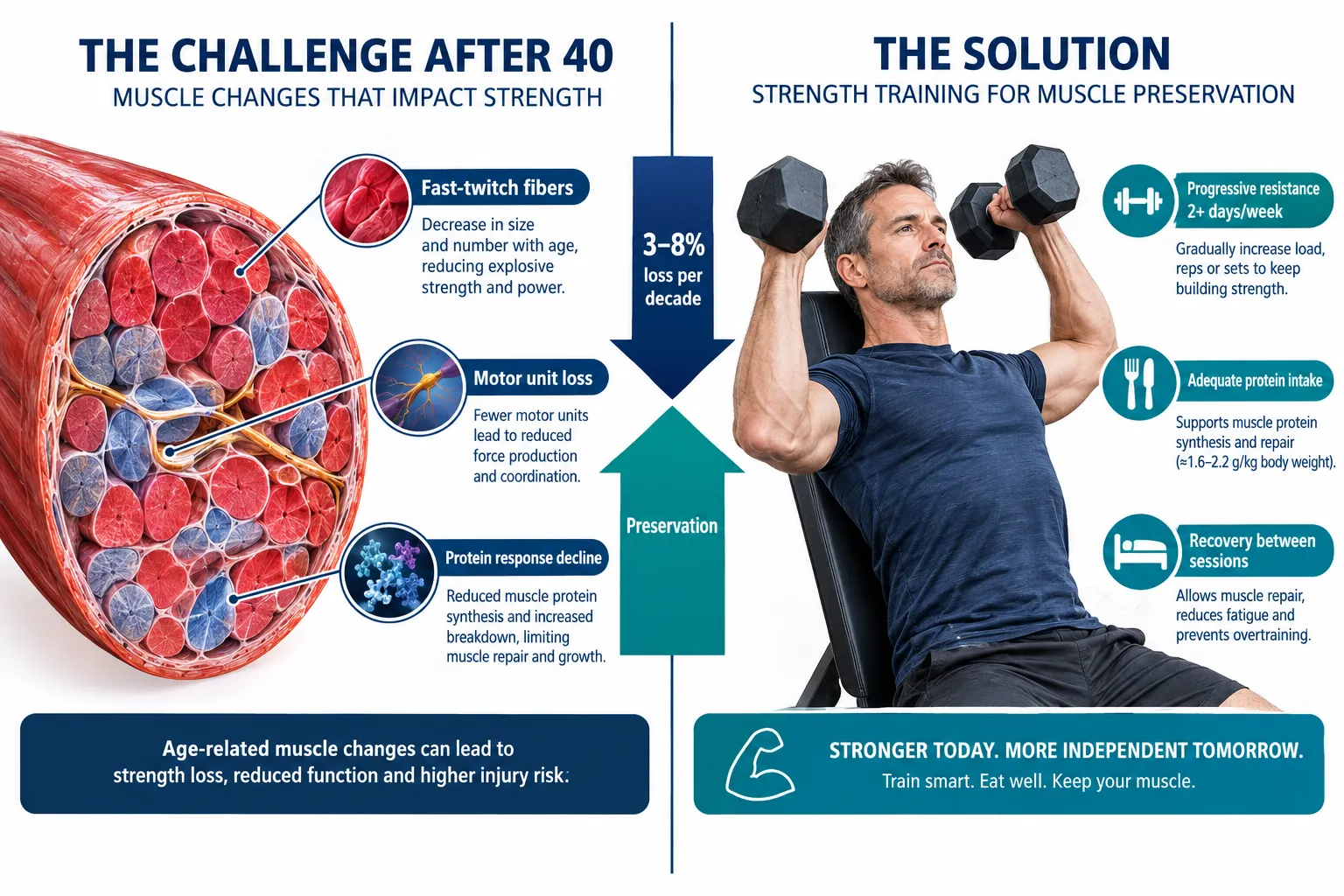
Adults start losing roughly 3-8% of muscle mass per decade after age 30, and the rate speeds up after 60 [9]. Strength training after 40 for muscle preservation works by giving muscle a reason to stay: progressive resistance two or more days per week, enough dietary protein, and real recovery between sessions. Current guidance for older adults recommends muscle-strengthening activities on at least 2 days per week covering all major muscle groups [8][3]. Preservation programming is simpler and lower-volume than a bodybuilding plan, which matters because most people over 40 quit from overdoing it, not from going too easy.
Key Takeaways
- Muscle loss after 40 is driven by fewer and smaller fast-twitch fibers, motor unit loss, and reduced response to protein, not just "getting older."
- Two to three sessions per week is the evidence-backed floor for maintaining lean mass and strength [8][3].
- Strength gains come faster and larger than mass gains. Meta-analyses in older adults consistently show big improvements in strength and function with more modest changes in muscle size.
- Protein matters more with age because older muscle responds less to the same dose. Spreading intake across meals helps.
- Yes, you can still build muscle after 40, 50, and 60. Resistance training improves strength even in adults in their 80s and 90s [2].
- Cardio doesn't preserve muscle the way resistance training does; the best plan combines both plus balance work.
- Joint pain is rarely a reason to stop lifting, it's usually a reason to change range of motion, load, or exercise selection.
- Expect strength changes in 4-8 weeks, visible body composition changes in 3-6 months.
- Home-based, low-equipment training works. Bands, bodyweight, and a few dumbbells produce real results when progressed.
What is sarcopenia and why does muscle loss happen after 40?
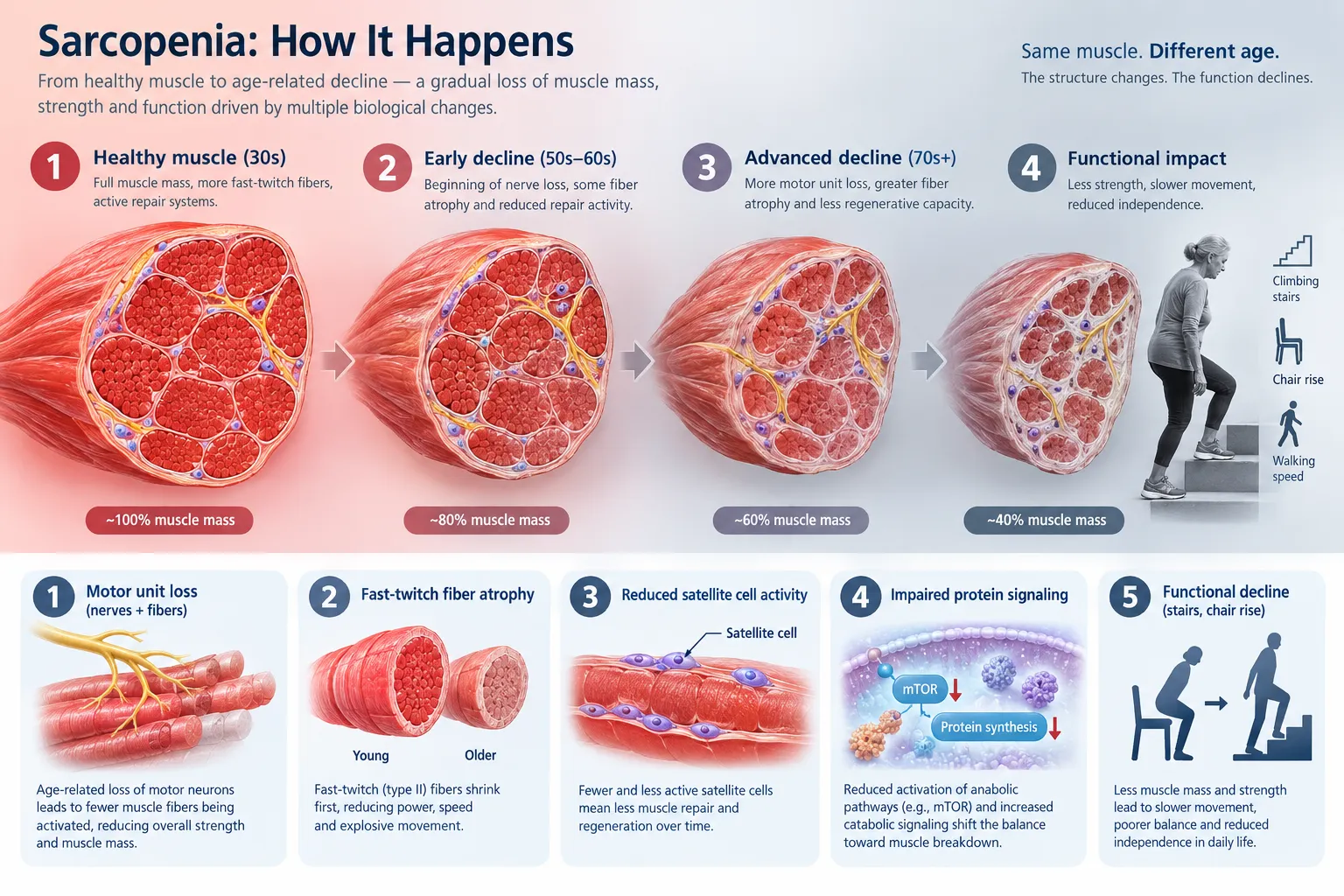
Sarcopenia is the progressive, age-related loss of muscle mass, strength, and function. It begins quietly in the 30s and 40s, and becomes clinically noticeable when strength drops enough to affect walking, stair climbing, or getting out of a chair.
)
Several things happen at once:
- Motor unit loss. Nerves that supply muscle fibers die off, and some fibers are orphaned. Fewer motor units means less force, especially fast force.
- Type II (fast-twitch) fiber shrinkage. These high-power fibers atrophy first. That's why explosive power declines faster than endurance.
- Anabolic resistance. Older muscle needs a larger protein dose to trigger the same muscle-building response as younger muscle.
- Less daily movement. Reduced activity accelerates everything above, and it's the piece most under your control.
- Hormonal shifts. Declining testosterone in men and the estrogen drop around menopause in women both reduce the signal to maintain lean tissue.
Sarcopenia isn't a single event. It's the slow result of a muscle that stops being asked to do hard things.
Common mistake: assuming a stable bodyweight means stable muscle. Many people over 40 keep the same number on the scale while quietly trading muscle for fat, sometimes called sarcopenic obesity.
How much muscle do you lose per year after age 40?
Adults lose roughly 3-8% of muscle mass per decade after age 30, and that rate accelerates after 60 [9]. Converted to an annual figure, that's about 0.3-0.8% per year in midlife, climbing to around 1% or more per year later in life.
Strength declines faster than size. Muscle power, meaning force produced quickly, declines fastest of all, which is why older adults often struggle to catch a stumble before they struggle to lift a suitcase.
| Decade | Typical mass loss (untrained) | What usually shows up first |
|---|---|---|
| 40s | ~0.3-0.5% per year | Reduced power, slower recovery |
| 50s | ~0.5-0.8% per year | Noticeable strength drop, grip weakening |
| 60s+ | ~1%+ per year | Stair climbing, chair rise, balance |
These are population averages, not a personal forecast. Someone who lifts consistently through their 40s and 50s can hold or even increase lean mass over that same window.
Does strength training after 40 actually prevent muscle loss?
Yes. Progressive resistance training is the most reliably effective intervention for slowing age-related muscle loss, and the evidence is strongest for strength and physical function rather than raw size [2][6]. Even nursing-home residents in their 80s and 90s have improved strength substantially with supervised resistance training [2].
Here's the honest nuance: meta-analyses in older adults typically show large improvements in strength (often 20-50% over several months of training) but more modest gains in muscle cross-sectional area. For preservation purposes that's fine, the functional outcomes that keep people independent track more closely with strength and power than with centimeters of thigh circumference.
Decision rule: if your goal is to stay strong, mobile and independent, prioritize getting stronger on 5-6 basic movement patterns. If your goal is visible size, you'll need higher volume, more calories, and more patience.
How often should you do strength training after 40?
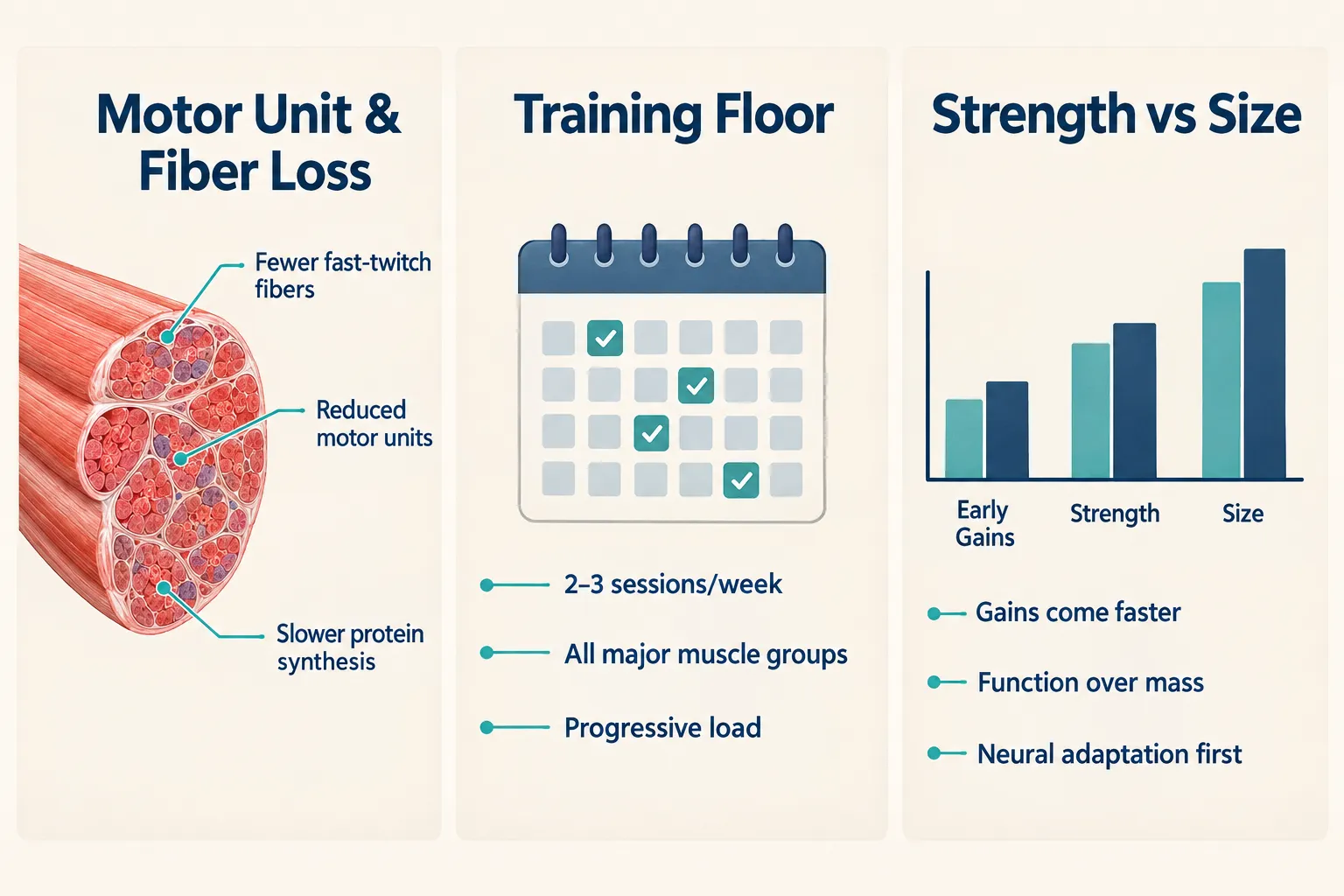
Train all major muscle groups on at least 2 days per week, which is the standing recommendation in physical activity guidelines for older adults [8][3]. Three sessions per week is the practical sweet spot for most people over 40 who want preservation plus modest gains.
A workable frequency ladder:
- 2 days/week, full body, the maintenance minimum. Enough to hold lean mass and build meaningful strength.
- 3 days/week, full body or upper/lower split, better progression, still manageable recovery.
- 4 days/week, only if you sleep well, eat enough protein, and have no nagging joints. More isn't automatically better after 40.
Edge case: if you've had two or more consecutive weeks of poor sleep or high stress, drop to two sessions and keep the loads. Cutting frequency protects recovery better than cutting intensity does.
Best strength training program for men over 40 and women over 40
The core program is the same for both: 5-7 compound movement patterns, 2-3 sets each, 6-12 reps, trained 2-3 times per week with progressive load [10]. The differences are in emphasis, not in exercise selection.
)
Shared template (per session):
- Squat pattern (goblet squat, leg press, box squat), 2-3 × 8-12
- Hinge pattern (Romanian deadlift, hip thrust, trap-bar deadlift), 2-3 × 6-10
- Upper push (incline dumbbell press, push-up, machine press), 2-3 × 8-12
- Upper pull (seated row, lat pulldown, inverted row), 2-3 × 8-12
- Carry or core (farmer's carry, dead bug, suitcase carry), 2 sets
- Single-leg or balance work (split squat, step-up, single-leg stand), 2 sets
Emphasis for men over 40: men typically lose relative power faster and under-train the posterior chain and single-leg work. Add one hinge-dominant lift and one unilateral lower-body exercise per week, and resist the urge to only train chest and arms.
Emphasis for women over 40: bone density and grip strength deserve extra attention, especially through perimenopause and after. Prioritize loaded hinges, carries, and heavier compound lifts in the 5-8 rep range at least once a week. Training below 10 reps is not "bulking", it's the most efficient route to strength and bone loading.
Intensity guidance: work at roughly 60-80% of your one-rep max, or an effort where you stop 1-3 reps short of failure. Heavier loading is increasingly recommended for older adults who are medically cleared, because it drives bone and neural adaptations that light weights don't [6][7].
Strength training after 40 vs cardio: which is better for muscle preservation?
For preserving muscle, resistance training wins; for heart health, aerobic exercise wins. Neither replaces the other, and the current standard for healthy aging is a multicomponent program: strength plus aerobic plus balance work [8][3].
| Resistance training | Aerobic training | |
|---|---|---|
| Preserves lean mass | Strong effect | Minimal effect |
| Builds strength/power | Strong effect | Little |
| Cardiorespiratory fitness | Modest | Strong effect |
| Bone density | Strong effect | Low for cycling/swimming |
| Balance and fall risk | Good (with specific work) | Limited |
Decision rule: if you only have 150 minutes a week to train, spend 60-90 of them on resistance training and the rest on brisk walking, cycling, or intervals. If you're in a calorie deficit, protect muscle by keeping resistance sessions and cutting cardio volume first.
How much protein do you need after 40 to build and keep muscle?
Most adults over 40 do better at 1.2-1.6 g of protein per kg of bodyweight per day, which is above the standard RDA of 0.8 g/kg. The reason is anabolic resistance: older muscle needs a bigger per-meal dose to switch on protein synthesis.
Practical approach:
- Aim for 25-40 g of protein per meal, across 3-4 meals, rather than one large protein hit at dinner.
- Include a protein source after training within a few hours, timing matters less than daily total, but it's an easy habit anchor.
- Prioritize leucine-rich sources: dairy, eggs, fish, poultry, lean meat, soy, or a whey/pea blend.
- Don't forget energy. Chronic under-eating blunts the training response no matter how much protein you eat.
Edge case: anyone with chronic kidney disease should set protein targets with their physician, not from a general article.
Can you still gain muscle after 40, and is it too late to start at 50 or 60?
Yes, and no, it isn't too late. Untrained adults in their 50s, 60s, and 70s routinely gain muscle and strength when they start progressive resistance training, and improvements have been documented even in adults in their 80s and 90s [2][9].
What changes with age is the rate, not the possibility. Expect gains to come somewhat slower than they would have at 25, and expect recovery to need more respect. The flip side: because the starting point is lower, the functional payoff from the first six months is often larger than it would be for a younger lifter.
Quick example: a 58-year-old who can barely complete five bodyweight squats may be doing 3 sets of 10 goblet squats with a 25 lb kettlebell within 10 weeks. The mass change is small; the change in stair climbing, balance, and confidence is not.
Strength training after 40 with joint pain or arthritis
Joint pain usually calls for modifying training, not stopping it. Resistance training strengthens the muscles that support arthritic joints and often reduces pain over time, and clinical exercise prescriptions are routinely tailored to comorbidities and baseline fitness [6][1].
)
Modifications that work:
- Shorten the range of motion to the pain-free zone, then expand it as symptoms settle (box squats instead of deep squats).
- Switch to machines or supported positions, chest-supported rows, leg press, seated presses reduce spinal and shoulder loading.
- Use bands or cables where the resistance curve is kinder to joints than free weights.
- Change grip and angle: neutral-grip dumbbells, trap bar instead of straight bar, landmine press instead of overhead press.
- Apply the 24-hour rule. Soreness that fades within a day is fine. Joint pain that's worse the next morning means the load or range was too much.
Anyone with inflammatory arthritis, recent joint replacement, uncontrolled hypertension, or cardiac disease should get a clinician's sign-off and, ideally, a few supervised sessions first.
Do you need different equipment or home training options after 40?
No special equipment is required. Home-based programs using resistance bands, bodyweight, and adjustable dumbbells produce meaningful strength gains in older adults when the resistance is progressed over time [5][6].
A minimal effective home kit:
- A pair of adjustable dumbbells or 3 fixed pairs (light, medium, heavy)
- Two resistance bands (medium and heavy loop bands)
- A sturdy chair or bench for support and seated work
- Optional: one kettlebell for carries, swings, and goblet squats
What matters isn't the gear, it's progression: add reps, then load, then sets. The CDC's long-standing Growing Stronger program is built around exactly this kind of simple, home-based progression [5].
How long does it take to see results from strength training after 40?
Strength improvements typically appear within 4-8 weeks, while visible changes in muscle shape and body composition usually take 3-6 months of consistent training. The first gains are neural: your nervous system recruits existing muscle more effectively before the muscle itself grows.
A realistic timeline:
| Timeframe | What you'll notice |
|---|---|
| Weeks 1-3 | Better coordination, less soreness per session |
| Weeks 4-8 | Clear strength gains, easier stairs and carries |
| Months 3-6 | Visible changes in shape, improved posture and balance |
| Months 6-12+ | Measurable lean mass preservation or gain, better bone loading |
Common mistake: judging progress by the mirror in week three and quitting. Track reps and loads in a notebook or app, those move before anything visual does.
Common mistakes with strength training over 40
The biggest error is treating a preservation program like a mass-gain program: too much volume, too often, with too little recovery. Here's the shortlist worth avoiding:
- Training to failure every set. It raises fatigue and joint stress without proportional benefit.
- Skipping progression. Doing the same 10 lb dumbbells for two years is maintenance of a habit, not of muscle.
- Only using machines. Add carries, single-leg work, and free-weight patterns for balance and real-world transfer.
- Avoiding all heavy loading out of fear. Medically cleared adults benefit from heavier work in the 5-8 rep range [7].
- Ignoring protein and calories while training hard, especially during intentional weight loss.
- Treating soreness as the goal. Soreness measures novelty, not effectiveness.
- No deload weeks. Every 6-10 weeks, cut volume by about half for a week. Joints and connective tissue need it more after 40.
- Dropping sleep. Under 6 hours a night reliably blunts strength and recovery.
FAQ
Is 40 too late to start lifting weights?
No. People who begin resistance training in their 40s, 50s, and even 80s gain strength and function [2]. Starting later means slower progress, not no progress.
How many sets per week do I need to maintain muscle?
Roughly 4-8 hard sets per muscle group per week is enough to maintain for most people over 40. Building typically needs 10 or more.
Should I lift heavy or light weights after 40?
Both have a place, but heavier loads (about 70-80% of max, 5-8 reps) drive the neural and bone adaptations that light weights don't. Use light, higher-rep work for joints that don't tolerate load.
Do I need a trainer?
Not required, but 3-6 sessions with a qualified trainer is the fastest way to fix technique and set the right starting loads, especially with prior injuries.
Can resistance training help with bone density too?
Yes. Loaded compound lifts and impact-bearing work stress bone directly, which is why they're recommended alongside strength work for older adults [3][1].
What about creatine after 40?
Creatine monohydrate is one of the better-studied supplements for strength and lean mass in older adults. Discuss it with a physician if you have kidney concerns.
How long should a session be?
30-45 minutes is plenty for a full-body session of 5-6 exercises. Longer sessions usually add fatigue, not results.
Is walking enough to prevent muscle loss?
No. Walking supports heart health and mobility, but it doesn't provide the progressive overload needed to preserve lean mass.
Can I train through muscle soreness?
Mild soreness is fine. Train a different muscle group or reduce load if soreness limits full range of motion.
Conclusion
Age-related muscle loss is predictable, measurable, and largely modifiable. The formula for strength training after 40 for muscle preservation isn't complicated: lift against progressively heavier resistance two to three times a week, eat 1.2-1.6 g of protein per kg daily, sleep enough to recover, and keep doing it for years rather than weeks.
Your next steps this week:
- Schedule two 35-minute sessions on your calendar as non-negotiable appointments.
- Pick the six-exercise template above and record your starting weights and reps.
- Add protein to breakfast, most people over 40 are short there, not at dinner.
- Get medical clearance now if you have arthritis, cardiac history, or uncontrolled blood pressure.
- Re-test one marker in 8 weeks: chair rises in 30 seconds, or your goblet squat load for 10 reps.
Consistency over intensity wins this one. The muscle you keep in your 40s and 50s is the independence you spend in your 70s and 80s.
References
[1] Strength Training – https://hgic.clemson.edu/factsheet/strength-training/
[2] Resistance Training By The Numbers – https://www.health.harvard.edu/healthy-aging-and-longevity/resistance-training-by-the-numbers
[3] Physical Activity Guidelines For Older Adults – https://www.healthdirect.gov.au/physical-activity-guidelines-for-older-adults
[4] pubmed.ncbi.nlm.nih.gov – https://pubmed.ncbi.nlm.nih.gov/41668861/
[5] Growing Stronger – https://www.cdc.gov/physicalactivity/downloads/growing_stronger.pdf
[6] Full – https://www.frontiersin.org/journals/rehabilitation-sciences/articles/10.3389/fresc.2025.1538336/full
[7] Jcsm – https://onlinelibrary.wiley.com/doi/full/10.1002/jcsm.13804
[8] Older Adults – https://www.cdc.gov/physical-activity-basics/guidelines/older-adults.html
[9] Pmc3117172 – https://pmc.ncbi.nlm.nih.gov/articles/PMC3117172/
[10] Tables – https://link.springer.com/article/10.1007/s12603-021-1665-8/tables/1
