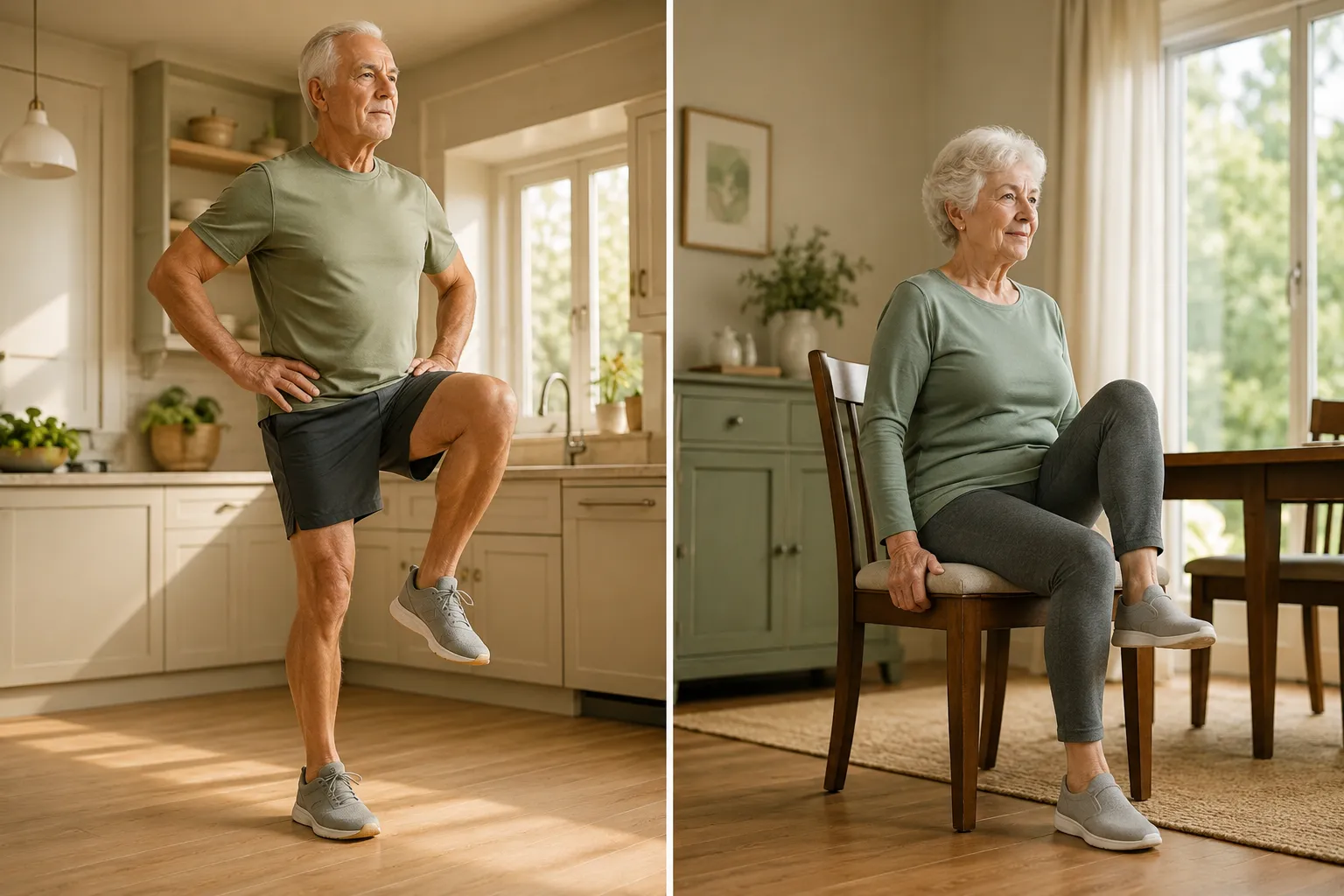
Fall Prevention Micro-Workouts: 5-Minute Routines You Can Do While Cooking or Watching TV

Fall Prevention Micro-Workouts: 5-Minute Routines You Can Do While Cooking or Watching TV

Last updated: August 30, 2026

Quick Answer

Fall Prevention Micro-Workouts are short, 3-5 minute bursts of balance, strength, and mobility drills you slot into activities you already do, like stirring pasta or watching the evening news. Done most days, they build the ankle strength, hip stability, and reaction time that keep you upright when you trip on a rug or miss a curb. You need no equipment beyond a sturdy counter or chair, and the science supports brief, frequent sessions over rare hour-long workouts [1][8].

Key Takeaways

  • Frequency beats duration. Two to three 5-minute sessions daily produce measurable balance gains within 6-12 weeks [8].
  • Habit stacking works. Anchor drills to existing routines: heel raises while the kettle boils, single-leg stands during commercial breaks.
  • Support is smart, not weak. A kitchen counter or high-backed chair lets you push closer to your balance limit safely.
  • Legs, ankles, and hips matter most. Weakness there is the top predictor of falls in adults over 65 [6].
  • Progress means less support, not harder moves. Move from two-hand to one-hand to fingertip to hands-free.
  • Micro-workouts fit almost everyone, including people with arthritis, Parkinson's, or walker use, with the right modifications [9].
  • Skip or modify if you have acute vertigo, recent surgery, or uncontrolled blood pressure without clearing it with your clinician.

What Causes Falls in Older Adults and How Can Exercise Help

Most falls in older adults come from a mix of muscle weakness, poor balance, slower reaction time, and reduced foot sensation, not a single dramatic event [6]. Exercise directly targets the first three, which is why national fall prevention guidelines rank it as the single most effective intervention.

As we age past 50, we lose roughly 1-2% of muscle mass per year if we're inactive, and the fast-twitch fibers that catch a stumble go first [8]. Balance also depends on three systems working together: vision, inner ear, and proprioception (the sense of where your joints are in space). All three dull over time, but all three respond to training.

What targeted exercise fixes:

  • Rebuilds hip and calf strength so you can catch yourself
  • Retrains the ankle strategy that corrects small sways
  • Sharpens reaction time when the floor surprises you
  • Improves posture and gaze stability

Fall Prevention Micro-Workouts work because they hit these systems repeatedly across the day, which is how the brain and body actually adapt.
What Causes Falls in Older Adults and How Can Exercise Help

Can You Really Prevent Falls With Just 5-Minute Exercises

Yes, if you do them consistently. Short, frequent balance and strength sessions have been shown in clinical settings to reduce fall risk, and Johns Hopkins and the Fall Prevention Foundation both endorse brief daily practice over infrequent long workouts [1][8].

The reason is simple: balance is a skill. Skills improve with repetition spread across many small sessions, not one heroic session per week. A pianist doesn't practice scales for three hours on Sunday. Neither should your ankles.

Decision rule: Choose micro-workouts if you struggle to get to a gym, dislike structured exercise, or have already tried and quit longer programs. Choose a formal class (like Tai Chi or a PT-led group) if you need supervision, have had a recent fall, or want social accountability.

Best Balance Exercises You Can Do Standing in One Spot

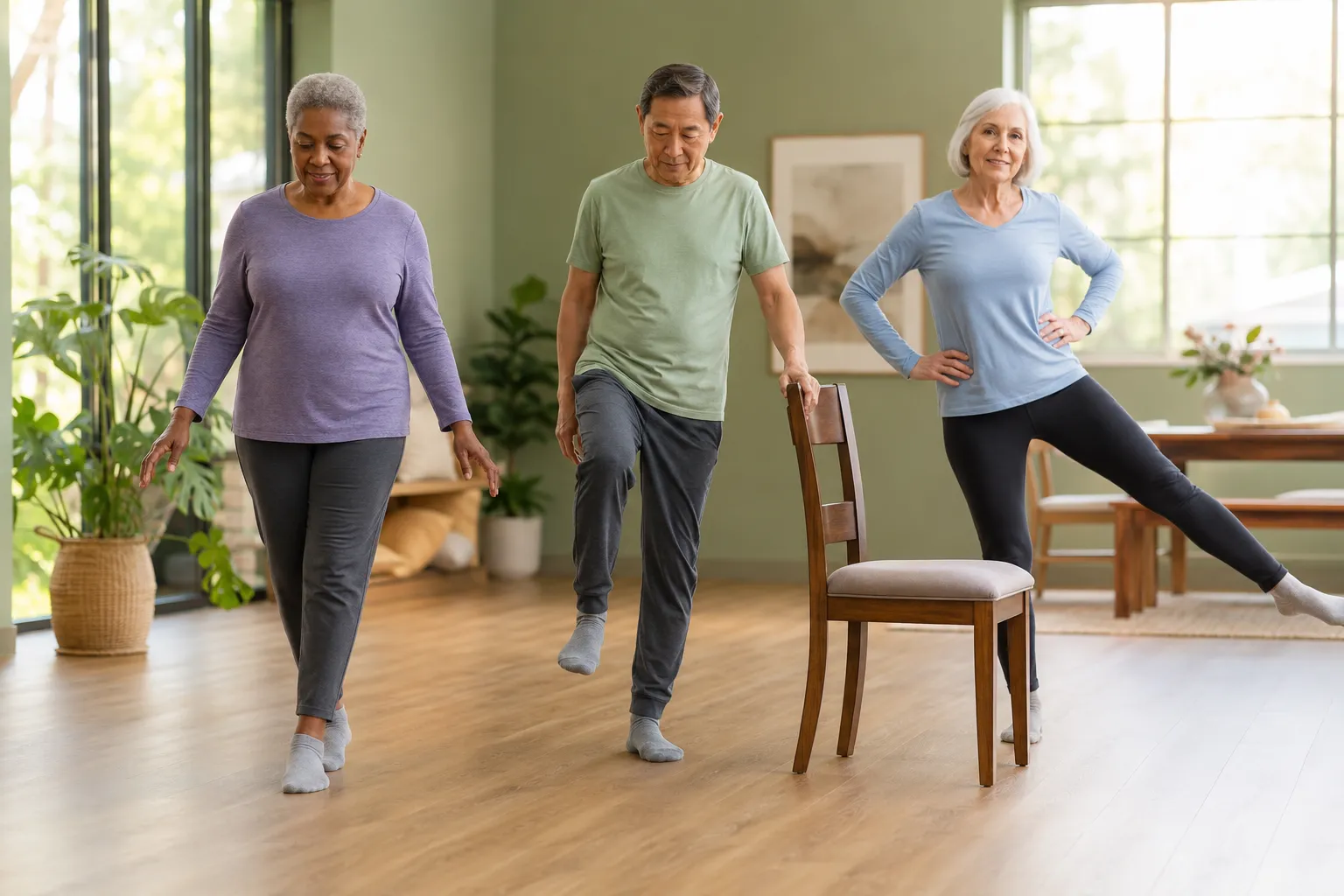
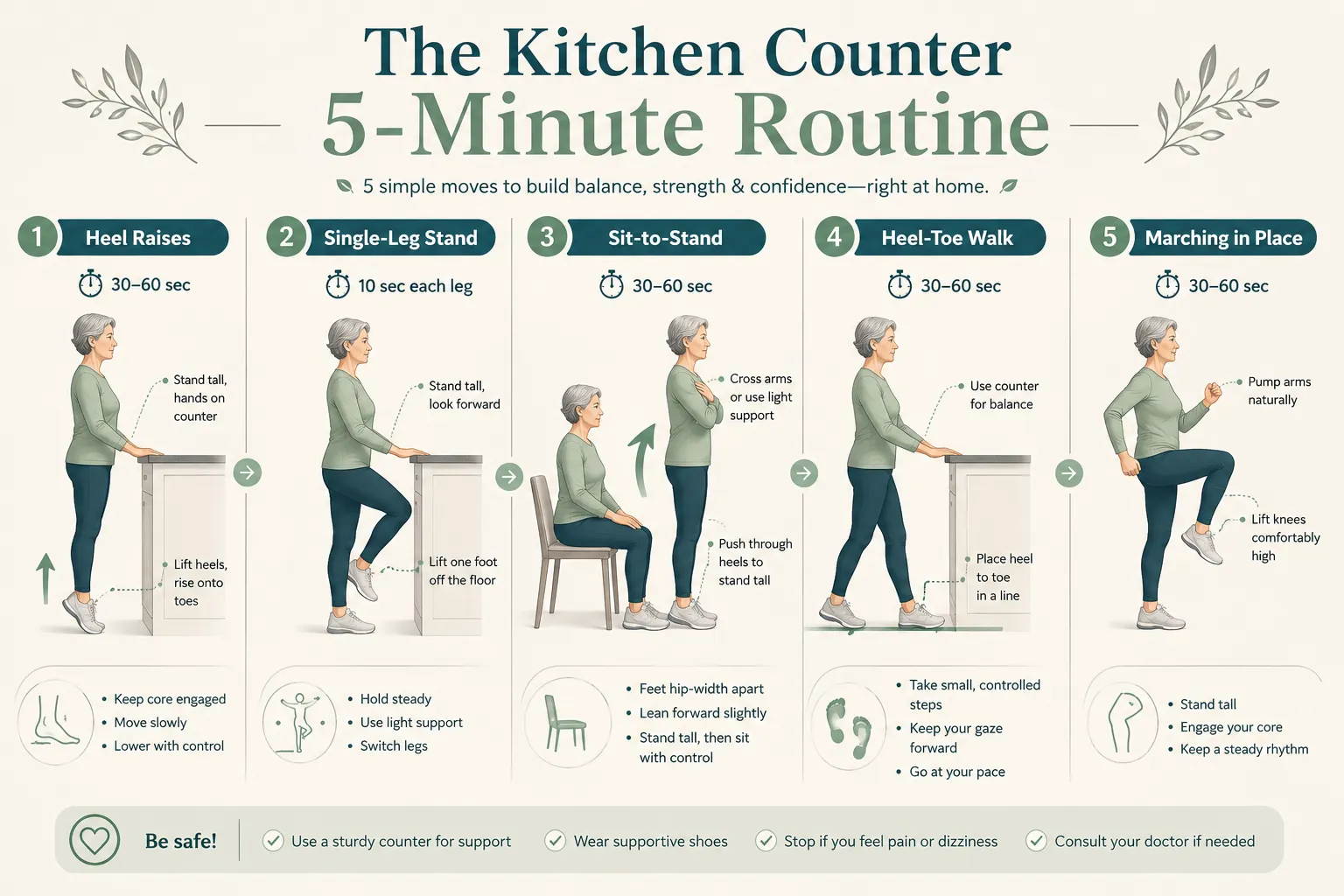
The best standing balance exercises for tight spaces are heel raises, single-leg stands, heel-to-toe stance, mini squats, and side leg lifts. Each takes 30-60 seconds and needs only a countertop for light support [1][3].

The Kitchen Counter 5-Minute Routine:

Exercise Time What It Trains
Heel raises (both feet) 45 sec Calf strength, ankle push-off
Single-leg stand, each side 30 sec × 2 Hip stabilizers, proprioception
Heel-to-toe stance 45 sec Narrow-base balance
Mini squats 45 sec Quad and glute strength
Side leg lifts, each side 30 sec × 2 Hip abductors (side stability)
Marching in place 45 sec Coordination, reaction

Do this while waiting for water to boil, coffee to brew, or the oven to preheat. Keep one hand loosely on the counter until you're steady.

How Often Should You Do Fall Prevention Workouts to See Results

Aim for balance work 5-7 days per week and strength-focused moves 2-3 days per week. Most people notice steadier walking within 4 weeks and meaningful fall-risk reduction within 8-12 weeks of consistent practice [8].

A realistic weekly pattern:

  • Every day: One 5-minute balance micro-session (kitchen or bathroom)
  • 3-4 days: One 5-minute strength micro-session (sit-to-stands, wall push-ups, calf raises)
  • 1-2 days: A longer walk, class, or Tai Chi session if you enjoy it

The biggest predictor of success isn't intensity, it's showing up. Two minutes done daily beats twenty minutes done occasionally.

Micro-Workouts While Cooking: Safety Tips So You Don't Actually Fall

Ironically, the biggest risk of a kitchen workout is the kitchen itself. Follow these rules to keep the practice safe [5][6]:

  1. Turn off the burner before balancing on one leg. Sharp knives and hot pans don't mix with wobble.
  2. Wear shoes or grippy socks. Bare feet on tile are fine; socks on tile are not.
  3. Keep one hand near the counter, not gripping it. Fingertip contact is enough for feedback.
  4. Clear the floor. No dropped utensils, water spills, or pet toys underfoot.
  5. Face the counter, not away. If you sway, you catch yourself on it, not fall backward.
  6. Skip balance drills if you're carrying anything hot or heavy. Wait until the pot is down.

Good anchor moments: water boiling, microwave running, toaster toasting, kettle heating. Bad anchor moments: anything involving open flame, sharp cutting, or lifting a full pot.

What's the Difference Between Fall Prevention and Regular Strength Training

Regular strength training builds bigger, stronger muscles. Fall prevention training builds the specific balance, reaction, and functional strength needed to stay upright. There's overlap, but the emphasis differs [8][10].

Key differences:

Regular Strength Training Fall Prevention Training
Focus on load and hypertrophy Focus on balance, reaction, coordination
Often seated or machine-based Standing, functional positions
Slow, controlled reps Includes quicker, catch-yourself movements
One big session per week works Frequent short sessions work better
Progress = heavier weight Progress = less support, harder balance

A bench press won't stop you from tripping on a curb. A single-leg stand while brushing your teeth might.
What's the Difference Between Fall Prevention and Regular Strength Training

Fall Prevention Exercises for People With Arthritis or Joint Pain

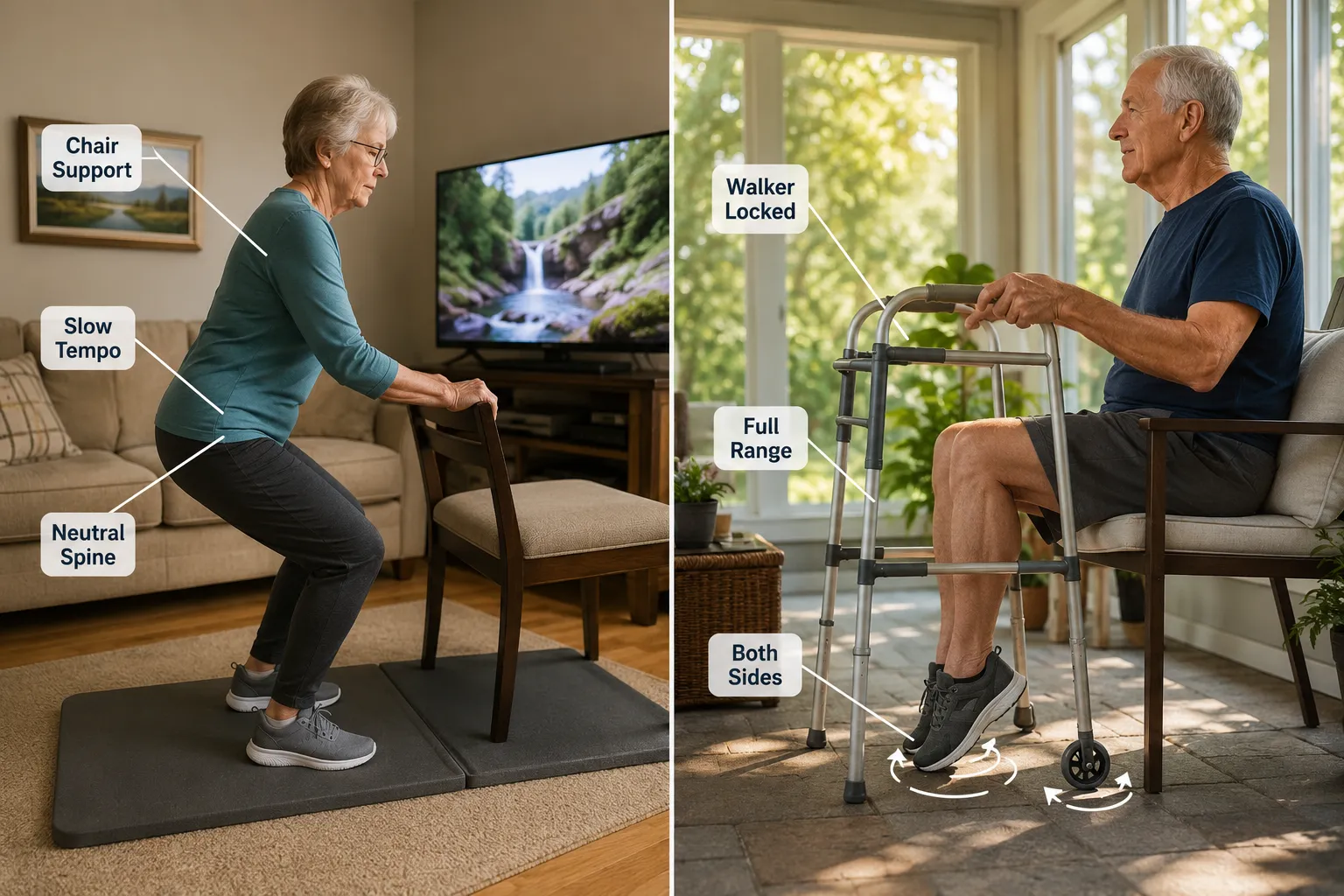
For arthritic joints, choose low-impact, supported versions: seated marching, chair-supported heel raises, gentle weight shifts, and slow sit-to-stands from a firm chair. Skip anything that causes sharp pain, and prioritize range of motion before load [1][9].

Arthritis-friendly 5-minute routine:

  • Seated marching: 60 seconds
  • Ankle circles, each direction: 30 seconds each
  • Chair-supported heel raises: 60 seconds
  • Slow sit-to-stands from a dining chair: 60 seconds (use armrests if needed)
  • Standing weight shifts side to side: 60 seconds, hands on counter

Warmth helps. Do these after a warm shower or later in the day when joints have loosened. If a joint hurts during an exercise (not just stiff), stop and modify.

Best Balance Exercises If You Have Limited Mobility or Use a Walker

If you use a walker or have significant mobility limits, focus on seated core work, supported standing time, and ankle mobility. The goal shifts from preventing trips to preserving the ability to stand, transfer, and catch yourself [3][9].

Walker-friendly micro-routine:

  • Seated marching with arm swings: 60 sec
  • Ankle pumps (heel-toe rocks) while seated: 60 sec
  • Walker-supported heel raises: 45 sec (lock the walker brakes first)
  • Walker-supported weight shifts: 45 sec
  • Seated leg extensions, alternating: 60 sec

Critical safety rule: brakes locked, walker on a non-slip surface, and never lean forward onto the walker with straight arms during heel raises. Keep elbows soft.

Do Fall Prevention Exercises Work for Younger People or Just Seniors

They work for everyone, and starting in your 40s or 50s gives the biggest long-term payoff. Balance and ankle strength decline silently long before falls become common, so training earlier means you never lose the buffer [4][8].

Younger adults, especially those who sit for work, often have the ankle mobility of someone twice their age. Athletes benefit too: better proprioception means fewer sprains and better performance. If you're under 60, you can also add gentle plyometric moves like small hops or step-ups to build reactive strength [4].

How to Tell If You're Doing Fall Prevention Exercises Correctly

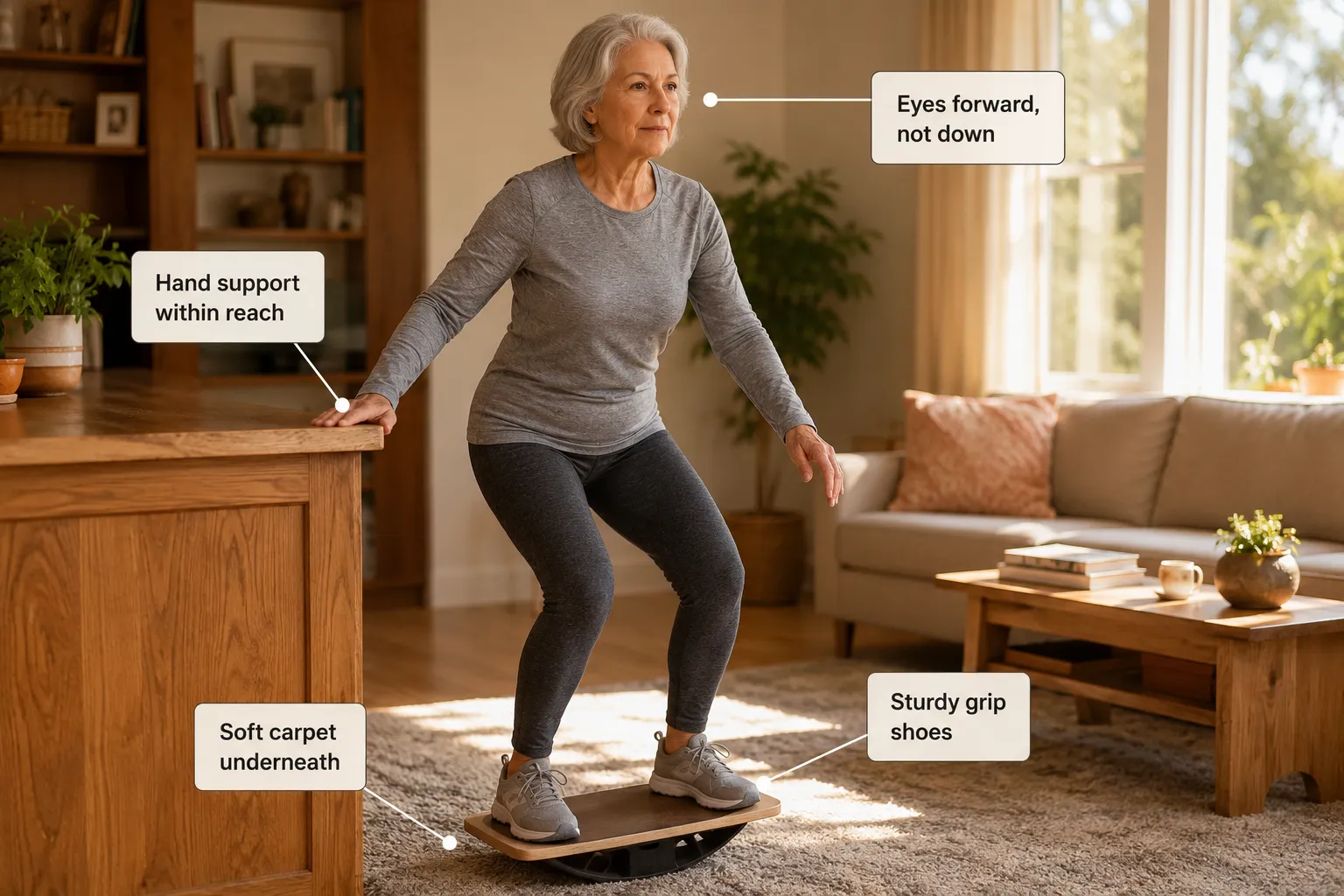
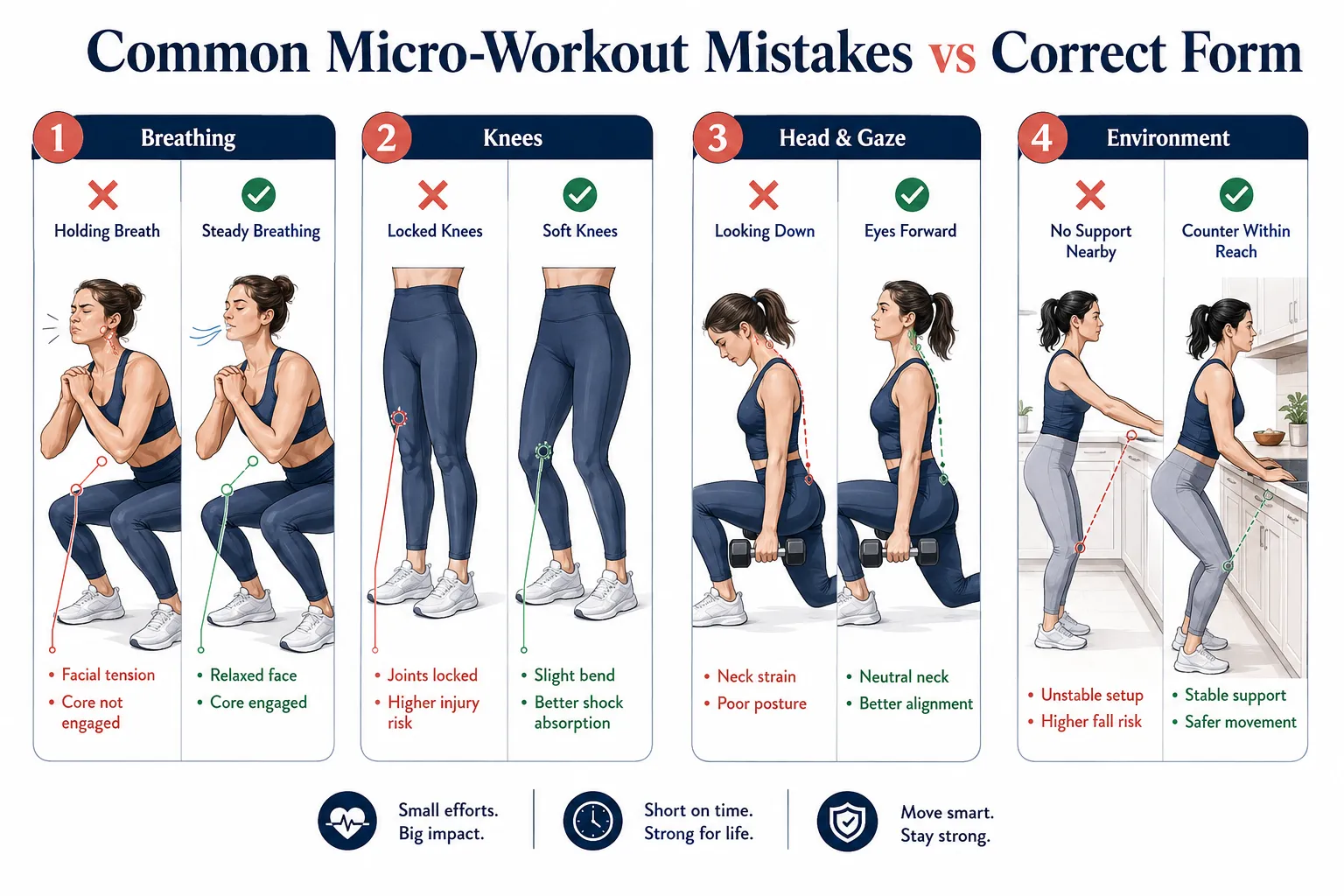
Correct form for balance work means: neutral spine, eyes forward (not down), steady breathing, and a slight sway that you control rather than fight. If you're gripping the counter white-knuckled or holding your breath, the drill is too hard [1][10].

Signs you're doing it right:

  • Small ankle and hip corrections, not big flails
  • Breathing evenly through the movement
  • Can hold the position for the target time without pain
  • Feel worked but not shaky-exhausted afterward

Signs to dial it back:

  • Death grip on the counter
  • Breath-holding
  • Sharp joint pain (dull muscle work is fine)
  • Actually losing balance more than once per session

Pull quote: "Progress in balance training isn't about doing harder tricks. It's about doing the same simple drill with less help."

Can You Do These Workouts If You Have Vertigo or Inner Ear Problems

Only with clearance from your doctor or a vestibular therapist. Some balance drills can trigger vertigo, while others are specifically prescribed to retrain the vestibular system. The difference matters, and self-prescribing can make symptoms worse [6].

If you have BPPV, Meniere's disease, or unexplained dizziness, book a vestibular assessment first. Once cleared, gaze-stabilization drills (focusing on a fixed point while turning your head slowly) and firm-surface balance work are usually the safest starting places. Skip head-tilting drills and eyes-closed balance until a professional says otherwise.

What Equipment Do You Need for 5-Minute Fall Prevention Routines

Almost nothing. A sturdy kitchen counter, a firm-seated chair, and non-slip footwear cover 95% of Fall Prevention Micro-Workouts [1][3]. Optional upgrades that help later:

  • Resistance band ($10): for seated leg strengthening
  • Foam pad or folded towel ($0-20): for advanced unstable-surface balance
  • Grab bar in bathroom ($15-40): for tooth-brushing balance drills
  • Timer or phone app: to keep sessions honest

Skip: wobble boards, BOSU balls, and expensive balance trainers until you've mastered the basics on firm ground. Fancy gear is the most common way people quit.

Common Mistakes People Make When Trying to Prevent Falls at Home

The biggest mistakes are doing exercises too rarely, gripping supports too hard, skipping the harder side, and confusing stretching with balance training [1][8].

Top mistakes to avoid:

  1. Only training the "good" leg. Your weaker side is where falls start.
  2. Holding the counter like a life raft. Feedback, not support.
  3. Doing balance work only during class, not daily. Skills need reps.
  4. Ignoring the ankles. Calf and ankle strength are underrated.
  5. Never progressing. If a drill feels easy for two weeks, make it harder.
  6. Rushing sit-to-stands. Slow negatives build more strength than fast reps.
  7. Wearing socks on hardwood. A fall waiting to happen.
Common Mistakes People Make When Trying to Prevent Falls at Home

Are There Fall Prevention Exercises You Should Avoid If You Have Certain Conditions

Yes. Certain conditions make specific drills risky. Avoid the following without clearance [6][9]:

  • Uncontrolled high blood pressure: skip breath-holding and rapid position changes
  • Recent joint replacement: avoid deep squats or crossed-leg stances until cleared
  • Osteoporosis (severe): avoid forward-bending, twisting, or high-impact moves
  • Peripheral neuropathy: avoid eyes-closed balance and unstable surfaces
  • Parkinson's disease: work with a specialist; some cueing methods are far more effective than others [9]
  • Recent stroke: get a PT assessment before starting standing balance work
  • Acute vertigo episode: rest until symptoms settle, then reassess

When in doubt, one phone call to your doctor or a physical therapist saves months of setbacks.

Frequently Asked Questions

How long until I notice a difference?
Most people feel steadier within 2-4 weeks and see meaningful improvement in fall risk indicators by 8-12 weeks of near-daily practice [8].

Can I do these if I've already fallen recently?
Yes, but get assessed first. A recent fall is a strong predictor of future falls, and a physical therapist can identify the specific weakness that caused it [6].

Are Fall Prevention Micro-Workouts safe during pregnancy?
Most balance drills are safe with counter support, but avoid single-leg stands with eyes closed and any move that strains the abdomen. Check with your provider.

What's better, Tai Chi or micro-workouts?
Both work. Tai Chi has strong evidence but requires a class. Micro-workouts win on convenience and daily frequency. Many people combine them.

Can I do these with grandkids around?
Yes, and it models healthy aging. Just clear the floor of toys first.

Do I need to warm up for a 5-minute session?
Not usually. The first exercise (like marching in place) serves as its own warm-up. For strength-focused sessions, spend 30 seconds walking first.

Will these help with stairs?
Directly, yes. Sit-to-stands, calf raises, and single-leg work all transfer to stair confidence.

What if I feel dizzy during a drill?
Sit down immediately, drink water, and note what triggered it. If it happens more than once, see your doctor before continuing.

Conclusion

Fall Prevention Micro-Workouts: 5-Minute Routines You Can Do While Cooking or Watching TV work because they solve the real problem, which isn't a lack of good exercises. It's the gap between knowing you should train balance and actually doing it week after week. Habit-stacking these drills onto boiling water, brewing coffee, and commercial breaks removes the friction that kills most exercise plans.

Your next steps this week:

  1. Pick one anchor activity (kettle, microwave, or TV commercial) and attach the Kitchen Counter routine to it starting tomorrow.
  2. Set a phone reminder for a second daily session.
  3. In week two, reduce your hand support from full grip to fingertips on one drill.
  4. If you've had a fall in the past year or have a condition on the caution list, book a PT assessment before advancing.

Small, frequent, and boringly consistent wins here. Your future self, still walking confidently at 85, will thank you.

References

[1] Fall Prevention Exercises – https://www.hopkinsmedicine.org/health/wellness-and-prevention/fall-prevention-exercises
[2] Watch – https://www.youtube.com/watch?v=BhRjlXNvpps
[3] Daily Mobility Micro Workouts Ten Two Minute Routines You Can Do Anywhere – https://seniorcenters.com/daily-mobility-micro-workouts-ten-two-minute-routines-you-can-do-anywhere/
[4] Best Plyometric Exercises Better Balance Preventing Falls – https://www.latimes.com/lifestyle/story/2026-08-18/best-plyometric-exercises-better-balance-preventing-falls
[5] Fall Prevention – https://www.unaliwear.com/senior-safety-101/fall-prevention/
[6] Art 20047358 – https://www.mayoclinic.org/healthy-lifestyle/healthy-aging/in-depth/fall-prevention/art-20047358
[7] Watch – https://www.youtube.com/watch?v=mUrQVL1MzSk
[8] Senior Strength Training For Fall Prevention 7 Essential Exercises To Build Stability And Confidence At Home – https://fallpreventionfoundation.org/2026/07/15/senior-strength-training-for-fall-prevention-7-essential-exercises-to-build-stability-and-confidence-at-home/
[9] Parkinsons Exercises For Balance And Strength A Safe At Home Fall Prevention Guide – https://fallpreventionfoundation.org/2026/07/29/parkinsons-exercises-for-balance-and-strength-a-safe-at-home-fall-prevention-guide/
[10] Strength Series Beginner Strength Cc6 – https://doctorjesss.substack.com/p/strength-series-beginner-strength-cc6

Best Balance Boards and Stability Tools for Older Adults: Improve Mobility and Prevent Falls

Best Balance Boards and Stability Tools for Older Adults: Improve Mobility and Prevent Falls

Last updated: August 16, 2026

Quick Answer

The best balance boards and stability tools for older adults are low-profile rocker boards, foam balance pads, and inflatable wobble cushions, used 5 to 10 minutes, three times per week, near a countertop or sturdy chair for hand support. Peer-reviewed research shows structured 4 to 9 week balance-board programs improve standing balance, mobility, and Timed Up and Go scores, and can cut fall risk by roughly 23 to 28 percent when combined with strength work.[1][5][10] Start with the most stable tool that still challenges you, and progress slowly over weeks, never days.

Key Takeaways

  • Foam pads and wobble cushions are the safest entry points; rocker boards suit intermediate users; multi-axis wobble boards are for confident, mobile seniors only.[4][11]
  • 10 minutes, 3 times per week is the evidence-supported dose for measurable balance gains on a wobble board.[9][10]
  • Structured 4 to 9 week programs improve Berg Balance Scale and Timed Up and Go scores in older adults.[1][13][15]
  • Multicomponent training (strength + aerobic + balance board) prevents falls better than any single tool.[3]
  • Always train near a countertop, sturdy chair, or grab rail, and skip balance boards entirely if you have active vertigo or a recent fall.[2][7]
  • A basic home kit (foam pad, wobble cushion, half-dome trainer, grab rail) typically runs $150 to $250.[14]
  • Consult a physician or physical therapist before starting if you have arthritis, neuropathy, or a history of falls.[7]

What Is a Balance Board and How Does It Help Older Adults?

A balance board is a flat platform mounted on an unstable base, a curved rocker, a rounded dome, or a spherical pivot, that forces small stabilizing muscles in the ankles, hips, and core to work continuously to keep the body upright. For older adults, this trains proprioception (the body's sense of position), reaction time, and postural control, all of which decline with age and are directly linked to fall risk.[1][15]

Peer-reviewed evidence shows that short, regular balance-board sessions improve standing balance, Timed Up and Go scores, and Berg Balance Scale results in seniors.[1][9][13] The Mayo Clinic notes these tools can enhance balance, coordination, and lower-limb strength, and may reduce fall risk when used correctly.[2]

What Is a Balance Board and How Does It Help Older Adults?

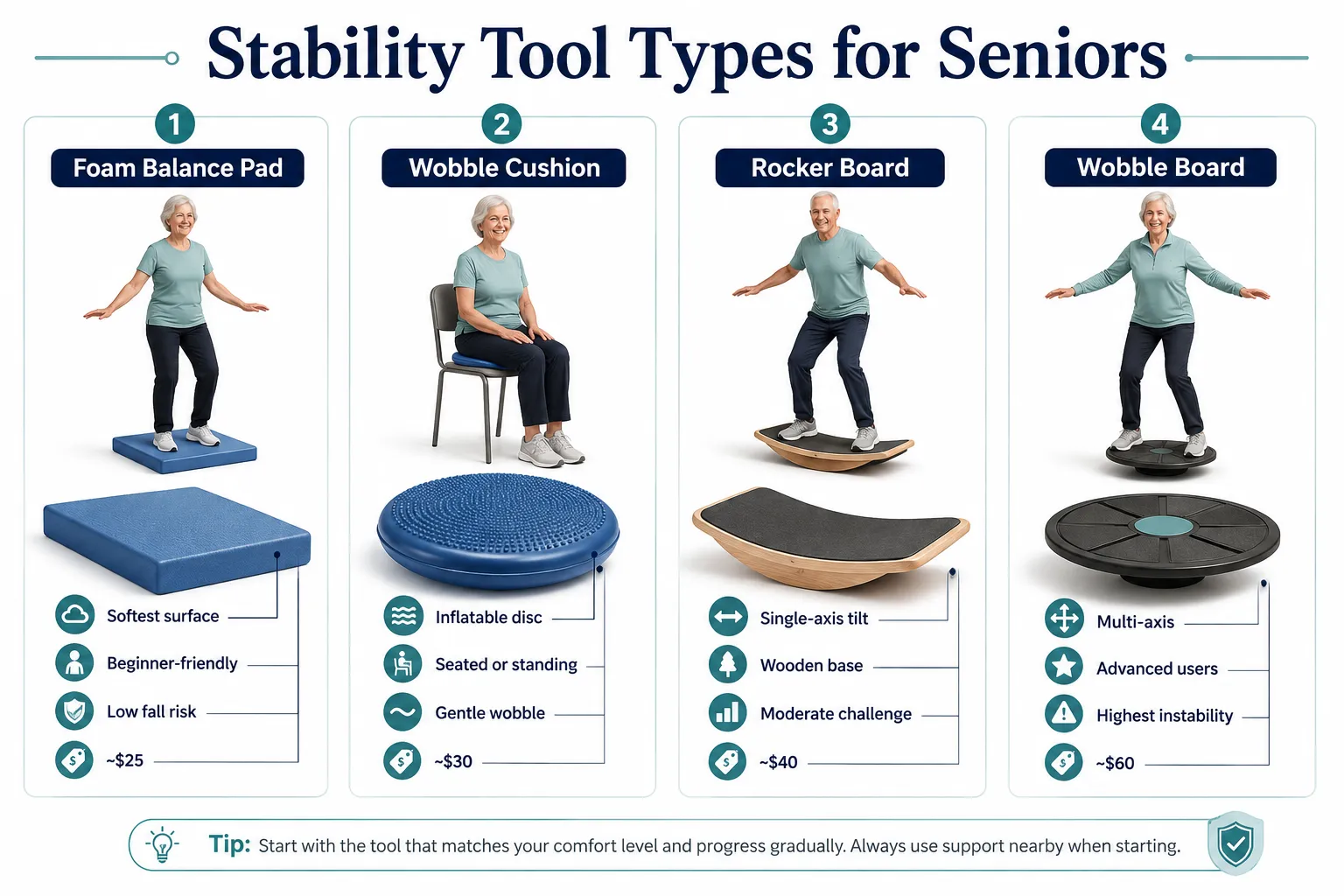
Types of stability tools covered in this guide:

Tool Instability level Best for Typical price
Foam balance pad Very low Beginners, arthritis, post-surgery $20,$35
Wobble cushion (disc) Low Seated core work, mild standing $25,$40
Rocker board (single-axis) Moderate Intermediate users $30,$55
Half-dome trainer (BOSU-type) Moderate, high Confident seniors $80,$130
Multi-axis wobble board High Advanced, no fall history $40,$70

Best Balance Boards for Seniors with Arthritis

For seniors with arthritis, the safest options are foam balance pads and inflatable wobble cushions, because they provide gentle instability without forcing sharp ankle or knee angles. A low-profile rocker board with a wide, non-slip surface is the next step up once joint pain is under control.

What to look for:

  • Wide platform (16 inches or more) so feet can sit shoulder-width apart
  • Low height (under 3 inches) to reduce the drop if balance is lost
  • Gentle curvature, steep rockers force painful ankle dorsiflexion
  • Non-slip textured top for bare or socked feet
  • Weight capacity clearly rated above your body weight

Avoid hard plastic multi-axis boards, small round wobble discs used standing, and any tool that requires deep knee bend to stabilize. Seated wobble-cushion work is an excellent arthritis-friendly starting point.[4][7]

Balance Board vs Stability Ball for Elderly Users

A balance board is generally safer and more practical than a stability ball for most older adults. Balance boards keep the feet on a stable floor and challenge ankle and hip stabilizers in a controlled range. Stability balls require sitting or lying on a large, rolling sphere, a setup with significantly higher fall risk for anyone with reduced grip strength, hip mobility, or reaction speed.

Use a balance board if the goal is standing balance and fall prevention. Use a stability ball only in seated form (as a chair alternative for core engagement) and only with a wall behind you or a chair frame around the ball. Never do bridges or supine exercises on a full-size stability ball without supervision.

How Often Should Older Adults Use Balance Boards?

Three sessions per week of 10 minutes each is the evidence-supported dose. A 2026 analysis of multi-axis Indo Balance Board training found this schedule produced significant Berg Balance Scale improvements in older adults.[9][10] A separate review recommends roughly 30-minute sessions 2 to 3 times weekly for at least 3 weeks to see measurable gains, aligning with American Geriatrics Society falls-prevention guidance.[10]

Sample weekly schedule:

  • Monday: 10 min balance board + 10 min chair squats
  • Wednesday: 10 min balance board + short walk
  • Friday: 10 min balance board + light resistance band work

Gains are typically maintained for at least three months after a structured program ends, but stopping entirely leads to gradual loss of balance improvements.[1][15]

Balance Board Exercises for Fall Prevention

Start every session near a countertop or sturdy chair. Do each exercise for 30 to 60 seconds, rest, and repeat two to three times.

  1. Two-foot static hold, stand on the board with feet shoulder-width, one hand on support, hold steady.
  2. Weight shifts, slowly rock side to side, then front to back, controlled.
  3. Mini squats, bend knees 15 to 20 degrees while keeping the board level.
  4. Single-hand support, progress from two hands to one hand to fingertip support.
  5. Head turns, while balanced, slowly turn head left and right to train vestibular integration.
  6. Heel-to-toe rock, deliberate small tilts to train ankle strategy.

Balance Board Exercises for Fall Prevention

Progression rule: advance only when the current exercise feels easy for a full week. Fall-prevention programs including wobble-board work have been associated with 23 to 28 percent lower fall risk when performed consistently.[5][3]

Can Balance Boards Help with Vertigo in Seniors?

Balance boards are generally not recommended as a self-treatment for active vertigo. Their intentionally unstable surface can worsen dizziness and increase fall risk in people with vestibular disorders.[2] Mayo Clinic-affiliated guidance is explicit: unstable-surface training may itself trigger falls in those with significant balance problems or dizziness.[2]

That said, a physical therapist may prescribe carefully progressed foam-pad exercises as part of vestibular rehabilitation once acute vertigo resolves. This should always be clinician-supervised, never self-directed. If you have BPPV, Meniere's, or unexplained dizzy spells, get medical clearance before touching any stability tool.[7]

Balance Boards for People with Limited Mobility

For seniors with limited mobility, seated stability training on a wobble cushion is the highest-value starting point. Place an inflatable disc on a sturdy dining chair and sit on it during daily activities, reading, meals, TV. This activates core stabilizers without any standing risk.

Options for limited mobility:

  • Wobble cushion on chair, passive core training, zero fall risk
  • Foam pad while holding parallel bars or a walker, supervised only
  • Seated foot-on-board work, sit in a chair, place feet on a rocker board, tilt slowly to train ankle mobility
  • Half-dome trainer flat side up, provides a slightly unstable but very controlled standing surface

A physical therapist can adapt any of these to wheelchair users or those recovering from hip or knee surgery.[13]

How Much Does a Good Balance Board Cost?

A quality senior-friendly balance board costs $30 to $70. Foam pads run $20 to $35, wobble cushions $25 to $40, rocker boards $30 to $55, and half-dome trainers $80 to $130. A complete home fall-prevention kit, foam pad, wobble cushion, half-dome trainer, and grab rail, typically totals $150 to $250.[14]

One 2026 industry analysis estimates such a kit can reduce fall risk by roughly 24 percent over 12 months when used at least 10 minutes daily, though this estimate reflects program outcomes rather than any single device.[14] Spending more than $100 on a single board rarely produces better outcomes for a senior beginner.

Are Balance Boards Safe for People Over 70?

Balance boards can be safe for people over 70, but only with the right tool, setup, and medical clearance. The Mayo Clinic notes the same instability that trains balance can also cause falls if misused.[2] A 2025 medical-alert advisory recommends consulting a physician or physical therapist first, avoiding boards after a recent fall, wearing sturdy shoes, and always training near a grab bar or countertop.[7]

Safety checklist before your first session:

  • Medical clearance obtained
  • Board placed on carpet or a non-slip mat
  • Sturdy countertop, chair back, or grab rail within arm's reach
  • Sturdy closed-toe shoes with grip soles
  • Someone else in the home during initial sessions
  • Session limited to 5 minutes on day one

Seniors with peripheral neuropathy, severe osteoporosis, or recent joint replacement should get therapist guidance before starting.[7]

Balance Board Alternatives for Seniors

Not every older adult needs, or should use, a balance board. Effective alternatives include:

  • Tai chi, strong evidence for fall reduction, no equipment needed
  • Standing yoga, chair-supported variations are widely accessible
  • Heel-to-toe walking along a hallway with wall support
  • Single-leg stands at a kitchen counter
  • Resistance band lower-body work, builds the strength that balance depends on
  • Aquatic exercise, low-fall-risk environment with resistance

The strongest evidence for fall prevention supports multicomponent programs combining strength, aerobic exercise, and balance challenge, not any single tool.[3]

Do Balance Boards Actually Prevent Falls?

Yes, when used in structured programs, but not on their own. Peer-reviewed evidence shows 4 to 9 week balance-board programs improve standing balance, functional mobility, and Timed Up and Go scores in older adults.[1][13][15] Fall-prevention programs incorporating wobble-board training report roughly 23 to 28 percent lower fall risk with consistent use.[5][3]

However, the most reliable falls-prevention effect comes from multicomponent training, strength, aerobic work, and proprioceptive challenge together.[3] A balance board alone, used sporadically, produces modest gains. A balance board used three times weekly alongside squats, walking, and resistance work produces measurable fall-risk reduction.

Best Balance Boards for Small Spaces

A round wobble cushion or a 15-inch square foam pad works in any room and stores under a couch. Rocker boards with a 16 to 18 inch footprint fit beside most dining chairs. Avoid large half-dome trainers (24 inches or wider) if floor space is tight.

Space-saving picks:

  • Inflatable wobble disc, 14 inches, deflates for travel
  • Square foam pad, stacks flat against a wall
  • Wooden rocker board, 17 x 6 inches, stores vertically
  • Small round pivot board, 15 inch diameter, but higher instability

Train in a doorway or beside a kitchen counter to combine hand support with a small footprint.

Balance Board Training Programs for Older Adults

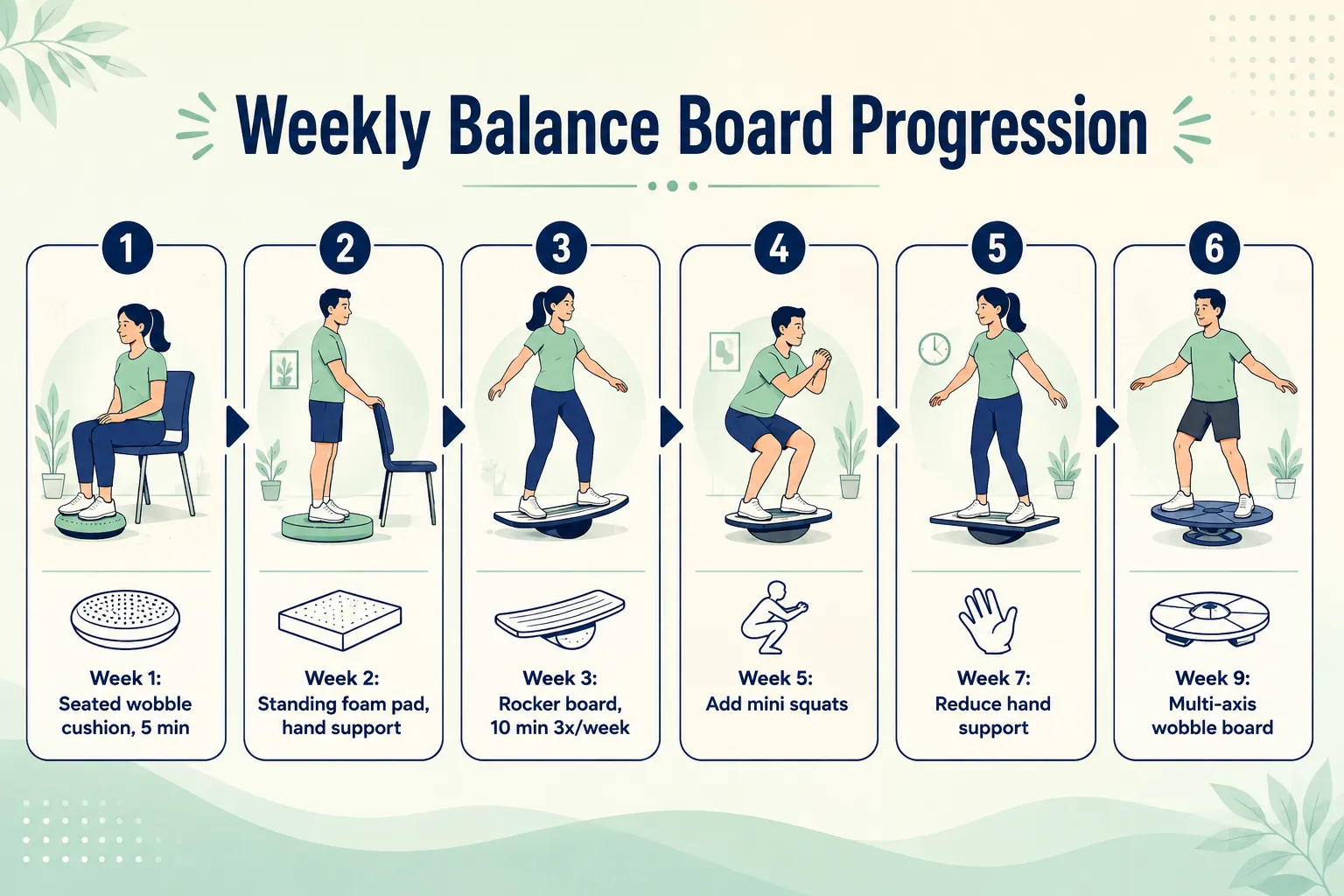
A structured program beats random practice. Below is an evidence-informed 9-week progression combining findings from wobble-board and multi-axis balance research.[1][9][10][13]

Balance Board Training Programs for Older Adults

Weeks 1-2: Seated wobble cushion, 5 minutes daily. Standing foam pad with two-hand support, 3 min, 3x/week.

Weeks 3-4: Rocker board with two-hand support, 10 min, 3x/week. Add slow weight shifts.

Weeks 5-6: Rocker board with one-hand support. Add mini squats and head turns.

Weeks 7-8: Reduce to fingertip support. Introduce 30-second single-leg attempts on a foam pad.

Week 9+: Consider a multi-axis board only if all prior weeks felt controlled. Continue 3x/week indefinitely, gains regress if training stops.[1][15]

Community centers, senior fitness classes, and physiotherapy clinics increasingly offer supervised versions of these programs.[6][15]

What to Avoid When Using a Balance Board as a Senior

The instability that makes a balance board effective is the same instability that can cause a serious fall. Respect the tool.

Avoid these mistakes:

  • Training alone during the first two weeks, have someone nearby
  • Barefoot on slippery hardwood, always use grip or a mat
  • Skipping hand support too early, progress support reduction over weeks
  • Long sessions, more than 15 minutes increases fatigue-related falls
  • Multi-axis boards as a beginner, start with foam or rocker
  • Training when tired, dizzy, or on new medication, postpone
  • Ignoring pain, sharp knee, hip, or ankle pain means stop
  • Using the board on stairs or near sharp furniture edges

Never use a balance board within 48 hours of a fall, and get clearance from a physician before restarting.[7]

Frequently Asked Questions

Can I use a balance board if I use a cane?
Only with therapist guidance. Cane users typically start with seated wobble-cushion work rather than standing on a board.[7]

How long until I see improvement?
Peer-reviewed programs show measurable gains at 4 to 9 weeks with 3 sessions per week.[1][13]

Should I close my eyes on the board?
Not as a beginner. Eyes-closed training is an advanced progression that should only be attempted with full hand support and after weeks of stable practice.

Are cheap balance boards safe?
Look for a weight rating well above your body weight, a non-slip surface, and a wide base. Inexpensive foam pads and rocker boards from reputable brands are generally safe.[11]

Can balance boards help after a hip replacement?
Only under a physical therapist's direction, and typically not within the first several months post-surgery.[7]

Do I need shoes on the board?
Sturdy closed-toe shoes with grip soles are recommended for standing work. Bare feet may be acceptable on foam pads with therapist approval.[5]

Will a balance board help with knee pain?
It can strengthen supporting muscles, but active knee pain should be evaluated first. Start with seated or very stable options.[4]

Is a BOSU ball better than a balance board?
Not for beginners. Half-dome trainers are moderately unstable and better suited to confident, mobile seniors. Start with a foam pad or rocker.

Can I use a balance board daily?
Yes, in short sessions. Most evidence supports 3 dedicated training days weekly, with light seated wobble-cushion use on other days.[9][10]

What if I feel dizzy on the board?
Stop immediately, sit down, and don't retry that day. Persistent dizziness needs medical evaluation before continuing.[2]

Conclusion

Balance boards and stability tools work, but only when matched to ability level and used consistently within a structured plan. Start with a foam pad or wobble cushion, train three times per week for 10 minutes near a countertop, and progress to a rocker board only when the basics feel controlled. Pair balance work with strength training and walking, get medical clearance if you have any fall history or vestibular issues, and treat every session with the respect an intentionally unstable device deserves.

Your next steps:

  1. Talk with your physician or physical therapist this week
  2. Order a low-profile foam pad or wobble cushion (under $40)
  3. Set up a safe training spot near a countertop or sturdy chair
  4. Follow the 9-week progression, three sessions per week
  5. Re-evaluate at week 4 and week 9 with your Timed Up and Go time or Berg score

Balance is trainable at any age. The tools are inexpensive, the time commitment is small, and the payoff, staying on your feet, independent, and mobile, is enormous.

References

[1] Balance Board Seniors Fall Prevention – https://www.bellenae.com/blogs/news/balance-board-seniors-fall-prevention
[2] Maintaining Equilibrium: The Benefits of Balance Boards – https://mcpress.mayoclinic.org/nutrition-fitness/maintaining-equilibrium-the-benefits-of-balance-boards/
[3] Physical Activity Programs for Balance and Fall Prevention in Elderly – https://pmc.ncbi.nlm.nih.gov/articles/PMC6635278/
[4] Balance Board For Seniors – https://neverleavetheplayground.com/balance-board-for-seniors/
[5] Fall Prevention Exercises – https://slides.neverleavetheplayground.com/fall-prevention-exercises.html
[6] Balance Boards For Seniors: A Fun And Effective Way To Improve Stability – https://fallpreventionfoundation.org/2025/02/07/balance-boards-for-seniors-a-fun-and-effective-way-to-improve-stability/
[7] Balance Boards For Seniors: Can They Reduce Fall Risk – https://www.medicalalertadvice.com/articles/balance-boards-for-seniors-can-they-reduce-fall-risk/
[8] Wobble-board training in older adults – https://pubmed.ncbi.nlm.nih.gov/10470668/
[9] Indo Balance Board Program in Older Adults – https://pmc.ncbi.nlm.nih.gov/articles/PMC6189151/
[10] Wobble-Board Training in Older Adults: Review – https://www.tandfonline.com/doi/full/10.1080/10833196.2021.1987042

10-Minute Daily Balance and Core Routine for Fall Prevention at Home (No Equipment)

10-Minute Daily Balance and Core Routine for Fall Prevention at Home (No Equipment)

Last updated: July 23, 2026

Quick Answer

A daily 10-minute balance and core routine can measurably reduce fall risk in active older adults by strengthening the deep trunk muscles, sharpening proprioception, and training the nervous system to react faster when footing shifts. The routine below blends standing balance drills, gentle flow transitions, and no-equipment core work, with chair-supported variations for every move. Do it 5 days a week, near a sturdy wall or chair, and expect noticeable stability gains within 4 to 8 weeks.

Quick Answer

Key Takeaways

  • 10 minutes daily beats 60 minutes once a week. Short, frequent sessions drive the neurological adaptations that prevent falls [7].
  • Balance and core work together. A strong core stabilizes the spine and hips so your feet can react to slips [3][6].
  • No equipment needed. A wall, a sturdy chair, and clear floor space are enough [8].
  • Chair-supported variations make the routine safe for people with arthritis, limited mobility, or a recent fall history.
  • Consistency matters more than intensity. Research suggests 3-5 sessions per week produce the best neurological gains [7].
  • Expect results in 4-8 weeks of steady practice, with balance and agility improving even without added muscle strength [1].
  • Pair the routine with home safety fixes, lighting, rugs, footwear, for the biggest fall-risk reduction.

What exercises improve balance and prevent falls at home

The most effective home balance exercises train three systems at once: the inner ear (vestibular), the eyes (visual), and the joint sensors (proprioceptive). Movements that shift your weight, narrow your base of support, or challenge your center of gravity force all three to work together.

Core moves that support fall prevention:

  • Single-leg stands (with fingertip touch on a wall or chair)
  • Heel-to-toe walks (tandem walking)
  • Standing marches with a slow knee lift
  • Weight shifts side-to-side and front-to-back
  • Sit-to-stands from a sturdy chair without using hands
  • Standing hip abductions (slow side leg lifts)
  • Dead bugs or modified seated leg extensions for core
  • Tai chi, style weight transfers for flow and control [5]

Choose exercises that feel challenging but not scary. If you can't hold the position for 10 seconds without wobbling wildly, regress to a chair-supported version.

How does a strong core help prevent falls in older adults

A strong core acts like a built-in stabilizer: it keeps your spine upright, controls how your weight shifts over your hips, and gives your legs a solid platform to react from when you trip. Without core strength, even quick legs can't save you, the trunk collapses and you go down.

The core isn't just the abs. It includes:

  • Transverse abdominis (deep belt-like muscle)
  • Obliques (side rotation and anti-rotation)
  • Multifidus (small spinal stabilizers)
  • Pelvic floor and diaphragm
  • Glutes and deep hip muscles

Strengthening these muscles improves posture, reduces back pain, and gives you the trunk control needed to recover from a stumble [3][6]. That's why every good fall-prevention routine pairs balance drills with targeted core work.

Pull quote: "Your legs catch the fall. Your core decides whether they get the chance."

Best 10 minute balance routine for seniors no equipment

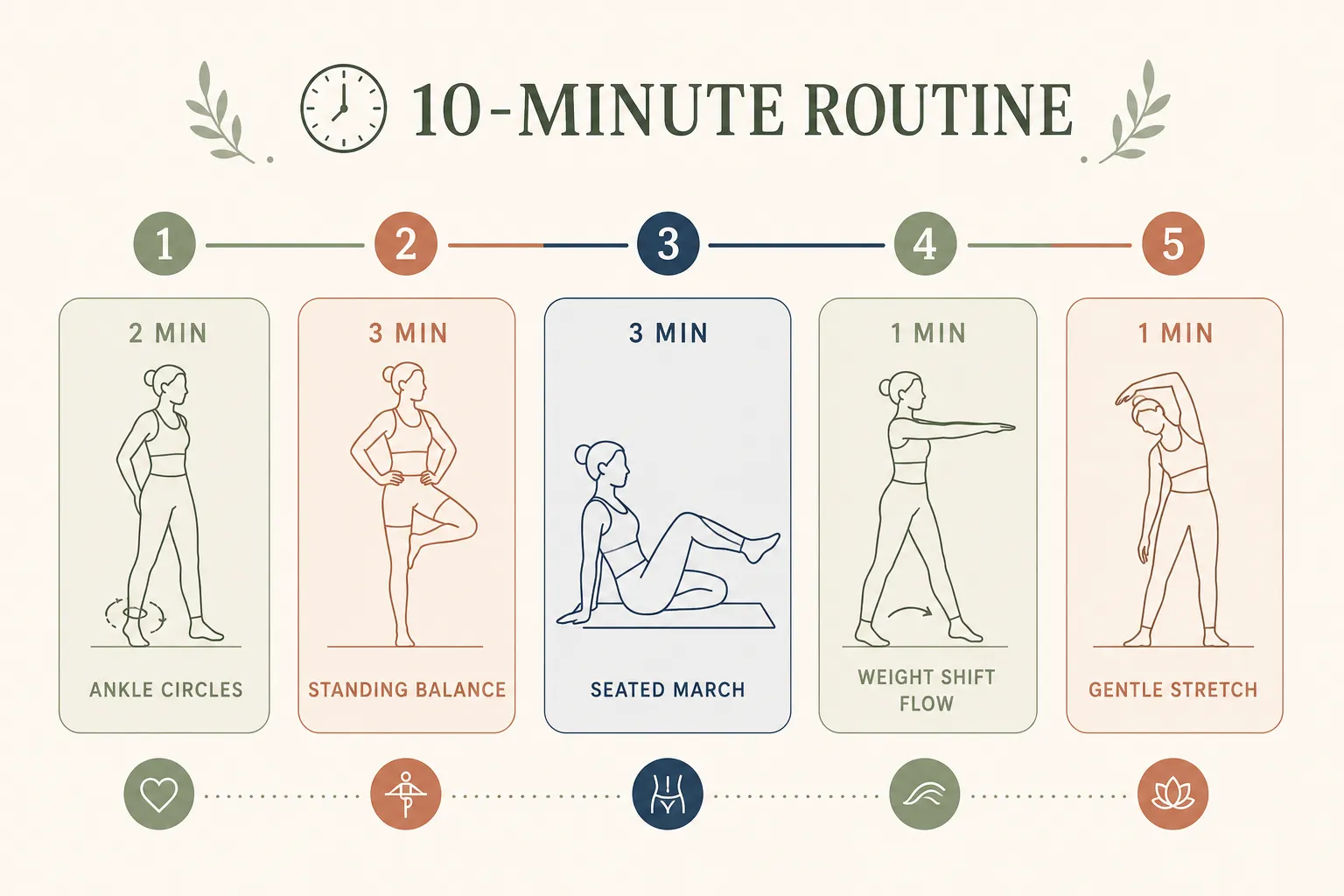
Here is the full 10-Minute Daily Balance and Core Routine for Fall Prevention at Home (No Equipment). Stand near a wall or the back of a sturdy chair. Wear grippy socks or bare feet. Clear a 6-foot square of floor.

Best 10 minute balance routine for seniors no equipment

Minute-by-minute breakdown

Minutes 0-2: Warm-up

  • Ankle circles (30 sec each foot)
  • Slow neck turns and shoulder rolls (30 sec)
  • Gentle standing weight shifts side-to-side (30 sec)

Minutes 2-5: Standing balance

  • Single-leg stand, right foot (30 sec, fingertip on chair)
  • Single-leg stand, left foot (30 sec)
  • Heel-to-toe walk, 10 steps forward, 10 back (60 sec)
  • Standing march with slow knee lift (30 sec)

Minutes 5-8: Core activation

  • Standing side leg lifts, 10 per side (60 sec)
  • Sit-to-stand from chair, no hands, 8 reps (60 sec)
  • Standing dead bug (opposite arm/leg reach), 10 total (60 sec)

Minutes 8-9: Flow transition

  • Slow tai chi, style weight transfer: shift forward, back, side to side with a smooth breath (60 sec) [5]

Minutes 9-10: Cool-down

  • Standing forward hinge with soft knees (30 sec)
  • Deep breathing with hands on belly (30 sec)

Chair-supported version

Do every standing move seated or with both hands on the chair back. Sit-to-stands become slow seated marches. Single-leg stands become seated heel and toe lifts. You still get the neuromuscular training [8].

Can you really prevent falls with daily exercises

Yes, the research is consistent. Daily balance training reduces fall risk in older adults, and even short sessions produce measurable gains. A Japanese study published in April 2026 found that a 10-minute daily floor-based routine significantly improved balance, agility, and trunk flexibility in participants, with researchers attributing the gains to better neuromuscular coordination rather than raw strength [1].

The key isn't intensity. It's frequency and specificity. Training the exact skills you need, standing on one leg, shifting weight, recovering from a wobble, teaches your nervous system to respond automatically when real life demands it [7].

What's the difference between balance and core strength training

Balance training teaches your body where it is in space and how to correct itself. Core training builds the muscular stability to hold posture and transmit force between upper and lower body. You need both, and they overlap.

Balance training: single-leg stands, tandem walks, weight shifts, eyes-closed drills. Trains proprioception, vestibular system, reflexes.

Core training: planks, dead bugs, sit-to-stands, standing marches. Trains trunk muscles, spinal stabilizers, posture.

Combined (this routine): standing dead bugs, tai-chi flows, sit-to-stands with pause. Trains both at once, the fastest path to fall prevention [3][6].

How often should i do balance exercises to see results

Daily is ideal. Three to five times per week is the minimum for meaningful change. Short daily sessions drive better neurological adaptation than one long weekly workout because balance is a nervous-system skill, it needs repeated exposure to consolidate [7].

A practical schedule:

  • Days 1-14: 10 minutes every morning, chair nearby
  • Weeks 3-4: progress to fingertip touch instead of full grip
  • Weeks 5-8: try single-leg stands without any support
  • After 8 weeks: add eyes-closed variations (only near wall)

Pair the routine with a daily habit, coffee brewing, brushing teeth, the morning news. Habit-stacking makes consistency automatic.

Is this routine safe for people with arthritis or joint pain

Yes, with modifications. Low-impact balance and core work often reduces joint pain by strengthening the muscles that support the knees, hips, and spine [6]. The chair-supported version of every exercise removes weight-bearing stress.

Is this routine safe for people with arthritis or joint pain

Rules for arthritic joints:

  • Never push through sharp pain. Dull ache is okay; stabbing is not.
  • Warm up longer, 3 minutes instead of 2 on cold or stiff days.
  • Slow the tempo. Take 4 seconds per rep instead of 2.
  • Skip deep sit-to-stands if knees flare; use a higher chair or cushion.
  • Talk to your doctor if you have hip or knee replacements before adding rotational moves.

What are common mistakes people make doing balance exercises at home

The biggest mistake is holding your breath. Balance requires a relaxed nervous system, and breath-holding tenses the trunk and blunts proprioception.

Other common errors:

  1. Looking down at feet. Look at a fixed point on the wall instead.
  2. Locking knees. Keep a soft micro-bend.
  3. Gripping the chair too hard. Fingertip touch is the goal, full grip means the exercise is too hard.
  4. Rushing. Balance is trained slowly. Sloppy fast reps don't teach the nervous system anything.
  5. Skipping the warm-up. Cold ankles wobble more.
  6. Doing it barefoot on slick floors. Grippy socks or a yoga mat prevent slips.
  7. Only training on the strong side. Always match reps left and right.

How do i know if i'm doing these exercises correctly

You're doing it right when the movement feels challenging but controlled, you can breathe steadily, and you finish without pain. Wobble is normal, it's the nervous system learning. Loss of balance requiring a catch means the exercise is too hard.

Quick self-check:

  • Posture: ears over shoulders over hips
  • Gaze: fixed on a point ahead, not the floor
  • Breath: steady in and out through the nose
  • Support: fingertip only (not a death grip)
  • Time: can you hold for 10+ seconds without a save?

Film yourself once a week on a phone. Watching a 30-second clip reveals posture drift you can't feel in the moment.

What if i have vertigo or inner ear problems can i still do this

Yes, but modify carefully and get medical clearance first. People with vertigo, BPPV, or Meniere's disease should start entirely seated, avoid head turns and eyes-closed drills, and progress only when a physical therapist confirms it's safe.

Safe starting points:

  • Seated marches and heel/toe lifts
  • Seated weight shifts (side to side)
  • Slow standing weight shifts with both hands on a chair
  • Gentle standing at a wall, feet apart, eyes open

Avoid until cleared: single-leg stands, tandem walks, head-turn drills, eyes-closed variations. Vestibular rehabilitation therapy (VRT) with a specialist is the gold standard for these conditions.

Are there modifications for people with limited mobility

Every exercise in this routine has a seated or chair-supported version. The neuromuscular training still happens, the brain doesn't require standing to learn coordination [8].

Modifications:

Standing move Seated modification
Single-leg stand Seated single-leg extension, 30 sec hold
Heel-to-toe walk Seated ankle taps (heel, toe, heel, toe)
Standing march Seated march with knee lift
Sit-to-stand (no hands) Sit-to-stand with hands, or hover 2 inches above seat
Standing side leg lift Seated side leg lift
Standing dead bug Seated opposite arm/leg reach
Tai chi weight shift Seated torso weight shift

How long before balance exercises reduce fall risk

Neurological gains begin within 2 weeks. Measurable balance improvement typically shows up at 4-8 weeks of consistent daily practice. Meaningful fall-risk reduction, the kind that changes real-world outcomes, usually takes 3-6 months [1][7].

Progression markers to watch for:

  • Week 2: less wobble on single-leg stand
  • Week 4: hold single-leg stand 20+ seconds
  • Week 8: sit-to-stand without hands, 10 clean reps
  • Month 3: confident heel-to-toe walk, eyes forward
  • Month 6: noticeably steadier on stairs, curbs, uneven ground

Should i do this routine if i've already had a fall

Yes, but start with the chair-supported version and consider one session with a physical therapist first. A recent fall raises the risk of another, and a professional can screen for underlying issues (blood pressure drops, medication side effects, vision problems, weakness patterns) that exercise alone won't fix.

Post-fall protocol:

  1. Get medical clearance. Rule out fracture, concussion, or cardiac cause.
  2. Ask for a PT referral. Even 2-3 sessions targets your specific weak links.
  3. Start seated for 2 weeks. Rebuild confidence before standing drills.
  4. Fall-proof the home (see next section) before returning to full mobility.
  5. Progress slowly, add one standing exercise per week.

What other things should i do besides exercises to prevent falls at home

Exercise is one leg of a three-legged stool. The other two are home environment and health management. Skip either and fall risk stays high no matter how strong your core gets.

Home safety essentials:

  • Remove throw rugs or secure with non-slip backing
  • Add grab bars in the bathroom (shower and toilet)
  • Install night lights in hallways and bathrooms
  • Keep walkways clear of cords and clutter
  • Use non-slip mats in the tub and kitchen
  • Wear supportive shoes indoors, not floppy slippers

Health management:

  • Annual vision and hearing checks
  • Medication review with your pharmacist (many drugs cause dizziness)
  • Vitamin D and calcium as advised by your doctor
  • Adequate hydration (dehydration causes lightheadedness)
  • Consistent sleep, fatigue wrecks balance

FAQ

How many days a week should I do this routine?
Aim for 5-7 days. Even 3 days beats none, but daily practice produces the fastest neurological gains [7].

Can I do this in the morning right after waking?
Yes, but add an extra minute of warm-up. Joints and inner-ear sensors are slower first thing.

Do I need to hold onto a chair the whole time?
No, start with fingertip support and progress to no support as balance improves. Always have the chair within arm's reach.

Is 10 minutes really enough?
Yes. A 2026 study found 10 daily minutes measurably improved balance and agility in older adults [1].

Should I feel sore afterward?
Mild muscle awareness is fine. Sharp joint pain or dizziness means back off and reassess.

Can I split it into two 5-minute sessions?
Yes. Morning balance drills and evening core work is a proven format [7].

What if I lose my balance during an exercise?
Grab the chair, reset, breathe, and continue. Wobbling is part of learning.

Are YouTube videos helpful?
Yes, beginner-friendly guided routines can help with pacing and form [9].

Should I combine this with walking?
Absolutely. A daily 20-minute walk plus this routine covers strength, endurance, and balance.

When should I see a doctor before starting?
If you have vertigo, recent surgery, a recent fall, uncontrolled blood pressure, or unexplained dizziness.

Conclusion

Ten minutes a day is a small deposit with an outsized return. The 10-Minute Daily Balance and Core Routine for Fall Prevention at Home (No Equipment) works because it trains the nervous system, not just the muscles, and it does so often enough for those gains to stick. Consistency beats intensity every time.

Your next steps:

  1. Today: Clear a 6-foot square near a sturdy chair. Practice the warm-up and one standing balance move.
  2. This week: Do the full 10-minute routine 5 days. Log wobbles and progress in a notebook.
  3. This month: Add home safety fixes, grab bars, night lights, secured rugs.
  4. Month 2: Progress from full grip to fingertip support. Try eyes-closed weight shifts at a wall.
  5. Month 3: Schedule a checkup, vision, medications, blood pressure, to close the last gaps in your fall-prevention plan.

Balance is a skill. Skills are trainable at any age. Start today, keep it short, and let the daily reps do the work.

References

[1] 10 Minute Daily Floor Based Workout Could Improve Balance Agility – https://www.medicalnewstoday.com/articles/10-minute-daily-floor-based-workout-could-improve-balance-agility?utm_source=openai
[2] Ab Workouts Dont Need To Be Long And Complicated This 5 Move 10 Minute Session Blasts The Whole Core And You Dont Need Any Equipment – https://www.tomsguide.com/wellness/workouts/ab-workouts-dont-need-to-be-long-and-complicated-this-5-move-10-minute-session-blasts-the-whole-core-and-you-dont-need-any-equipment?utm_source=openai
[3] Low Impact Core Workout – https://www.self.com/gallery/low-impact-core-workout?utm_source=openai
[4] Fall Prevention Balance Routine For Seniors – https://vitalspage.com/articles/fall-prevention-balance-routine-for-seniors?utm_source=openai
[5] Balance And Fall Prevention – https://taichi.help/balance-and-fall-prevention/?utm_source=openai
[6] 10 Minute Core Exercises For Seniors Simple Moves For A Stronger Body – https://www.hitonefitness.com/10-minute-core-exercises-for-seniors-simple-moves-for-a-stronger-body/?utm_source=openai
[7] Balance Exercises For Seniors 10 Routines To Reduce Fall Risk – https://homland.com/blogs/news/balance-exercises-for-seniors-10-routines-to-reduce-fall-risk?utm_source=openai
[8] Seniors Daily Balance Exercises – https://senmate.com/articles/seniors-daily-balance-exercises.html?utm_source=openai
[9] Watch – https://www.youtube.com/watch?v=XmRSGaAUitQ&utm_source=openai