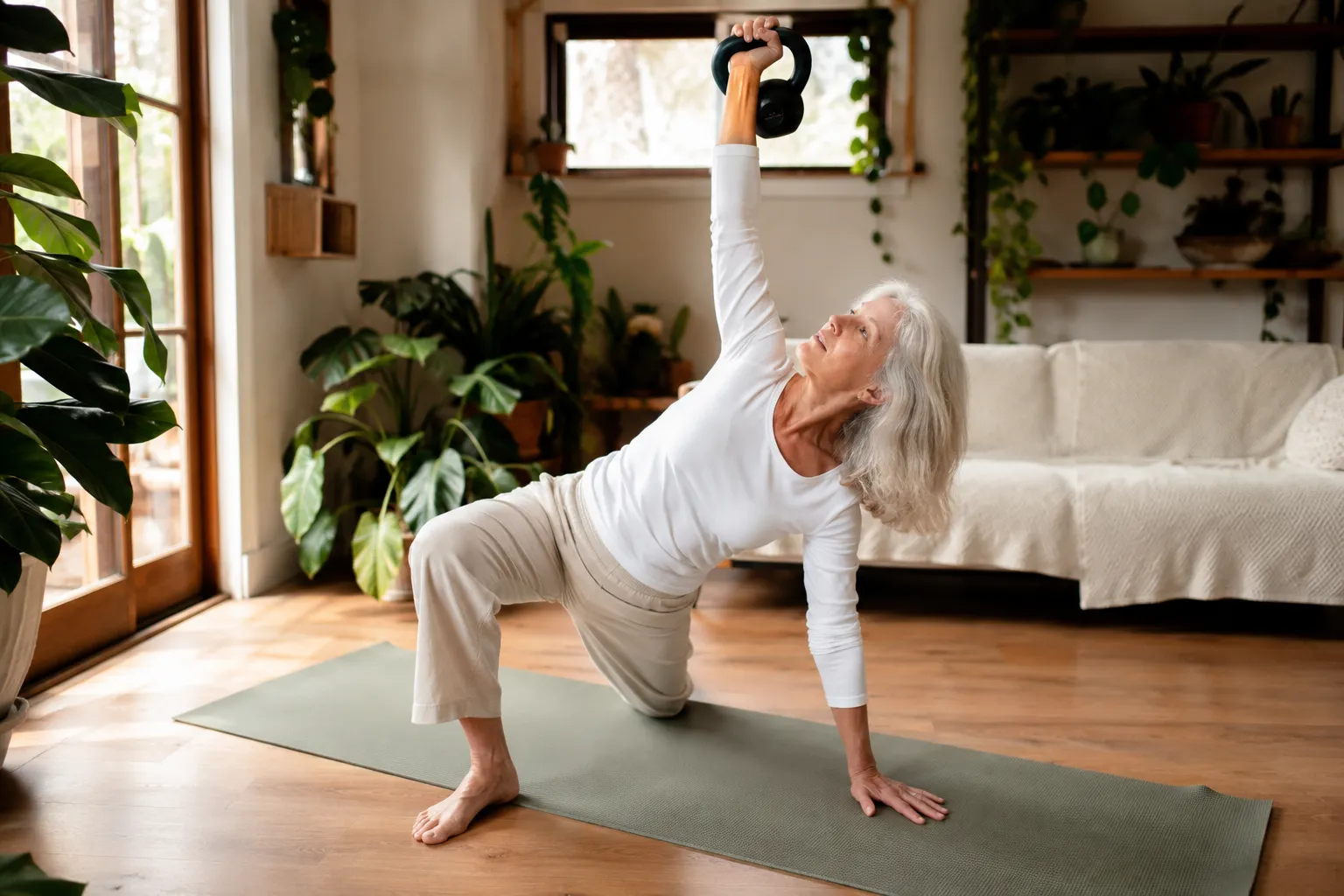
Yoga vs Pilates for Seniors: Which Is Better for Balance, Strength, and Mobility at Home?

Yoga vs Pilates for Seniors: Which Is Better for Balance, Strength, and Mobility at Home?

Last updated: August 4, 2026

Quick Answer

For most seniors training at home, yoga wins for flexibility and joint mobility, while Pilates wins for core strength and fall prevention. A hybrid routine, two yoga sessions and two Pilates sessions per week, usually delivers the best results for balance, strength, and mobility combined. Start with chair-based or gentle mat versions, get medical clearance if you have osteoporosis, joint replacements, or heart conditions, and progress slowly.
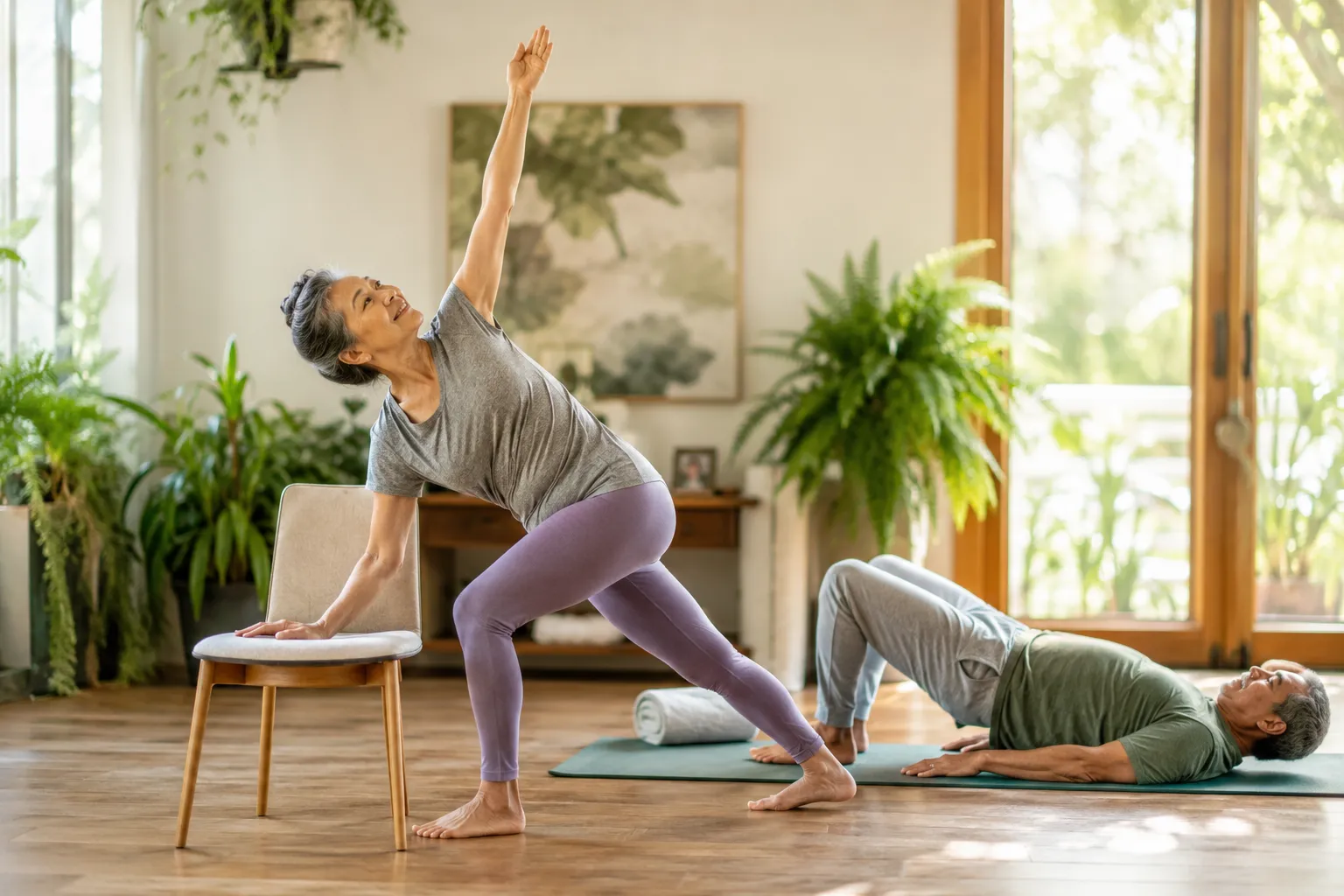
Quick Answer

Key Takeaways

  • Yoga improves flexibility, breathing, balance, and joint range of motion through held poses and stretches.
  • Pilates builds deep core strength, spinal stability, and controlled movement, highly effective for fall prevention.
  • For balance, both help, but Pilates tends to produce faster gains because it directly trains core and hip stabilizers.
  • For arthritis and stiff joints, gentle yoga (especially chair or Iyengar styles) is usually more comfortable.
  • 2-4 sessions per week, 20-40 minutes each, is the sweet spot for older adults.
  • Most seniors can start at home with just a mat; a sturdy chair, resistance band, and small pillow help.
  • A hybrid weekly routine covers strength, mobility, and balance better than either practice alone.
  • Skip poses that require deep spinal flexion or inversion if you have osteoporosis or uncontrolled blood pressure.

What's the difference between yoga and Pilates for older adults?

Yoga is a mind-body practice that combines held postures, breathing, and stretching to improve flexibility, balance, and calm. Pilates is a body-conditioning system built around controlled, precise movements that strengthen the deep core, spine, and hips.

The core distinction for seniors:

  • Yoga emphasizes holding positions, breath awareness, and lengthening tight muscles. Many styles have a meditative or spiritual element.
  • Pilates emphasizes moving with control through repetitions, focusing on core engagement, alignment, and muscular endurance.

Yoga typically feels slower and more restorative. Pilates feels more like a targeted strength workout, though it's low-impact. Both are gentle on joints when done correctly, and both can be adapted for limited mobility.

Choose yoga if you want more flexibility, stress relief, and gentle movement. Choose Pilates if you want more core strength, better posture, and stronger fall prevention.

Which is better for improving balance, yoga or Pilates?

Pilates has a slight edge for balance improvement in seniors, mainly because it directly trains the deep core, glutes, and hip stabilizers that keep you upright. However, yoga's single-leg standing poses (like tree pose or warrior III against a wall) also produce meaningful balance gains.

What the movement science suggests for older adults:

  • Pilates strengthens the transverse abdominis and pelvic floor, muscles central to postural control.
  • Yoga trains proprioception (your sense of where your body is in space) through held single-leg and shifting-weight poses.
  • Combining both gives you strength-based balance (Pilates) and reactive balance (yoga).

Decision rule: If your primary goal is preventing falls, lead with Pilates and add balance-focused yoga poses twice a week.

Can seniors do yoga at home safely without equipment?

Yes, seniors can safely do yoga at home with just a non-slip mat and a sturdy chair for support. Beginners should avoid inversions, deep twists, and unsupported balance poses until they've built confidence.

Safe starting points at home:

  1. Chair yoga, seated stretches, gentle twists, and standing poses using the chair for stability.
  2. Wall-supported poses, practice tree pose, warrior, and downward dog with a wall behind you.
  3. Floor-based restorative yoga, supported bridge, legs-up-the-wall, gentle spinal twists.
  4. Follow guided videos made specifically for seniors (see the free options section below).

Common safety rule: Never force a stretch. Mild tension is fine; sharp or radiating pain is a stop signal.

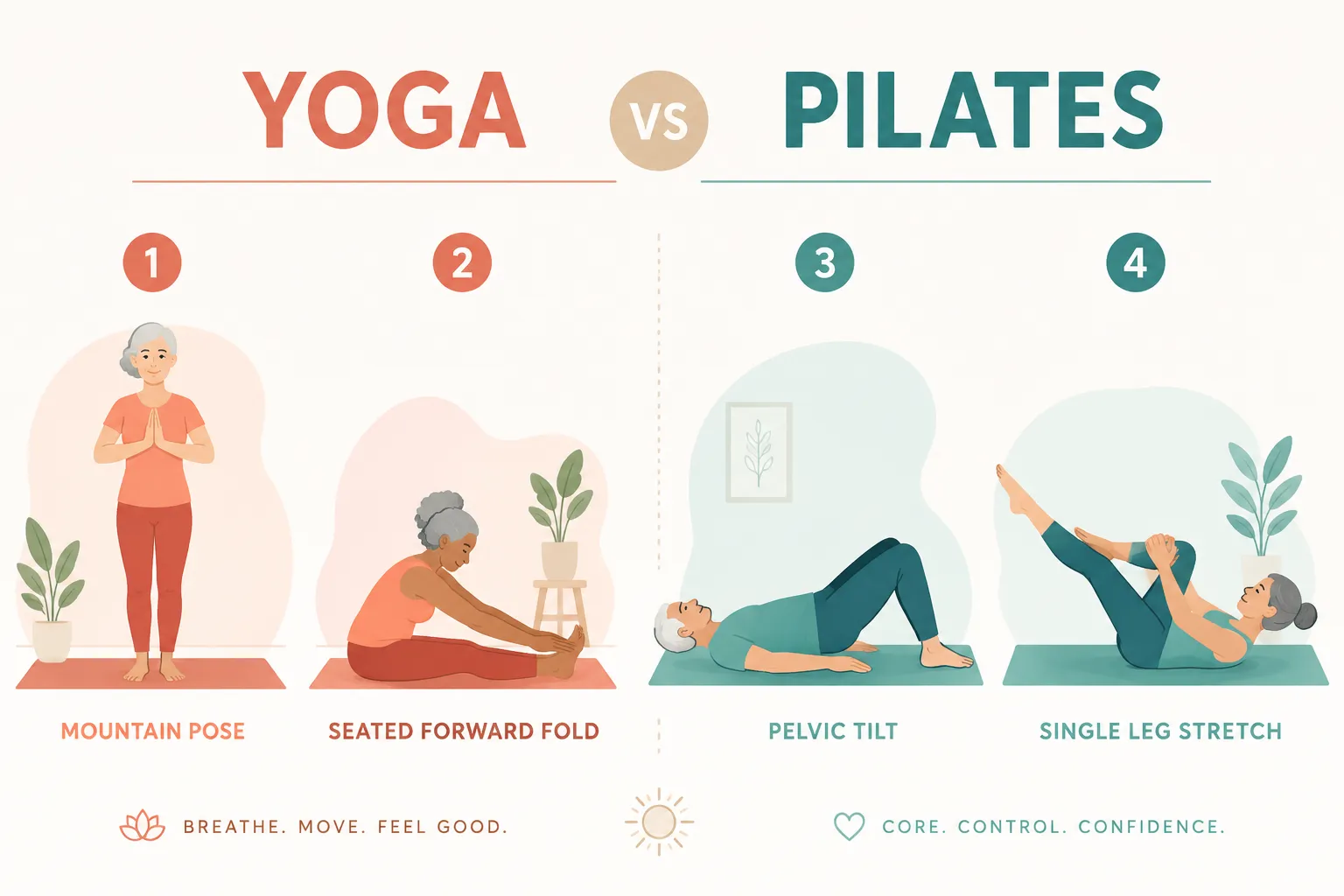
Pilates exercises for seniors to build core strength

Pilates is one of the safest ways for older adults to build core strength because most exercises are done lying down or seated, which protects the spine and joints. Start with 5-8 reps of each and build slowly.

Beginner-friendly Pilates moves for seniors:

  • Pelvic tilts, lying on your back, gently rock the pelvis to engage lower abs.
  • Single knee lifts (marching), lying down, lift one knee at a time while keeping the pelvis stable.
  • Bridge, press through the heels to lift the hips, engaging glutes and core.
  • Modified hundred, small arm pulses with knees bent, head down.
  • Seated spine twist, gentle rotation from a tall seated position.
  • Side-lying leg lifts, target hip stabilizers essential for balance.

Consistency matters more than intensity. Two to three 20-minute sessions weekly produce noticeable core improvements within 6-8 weeks for most beginners.
Pilates exercises for seniors to build core strength

Yoga for seniors with arthritis and joint pain

Gentle yoga can reduce arthritis stiffness, improve joint range of motion, and ease chronic pain when practiced consistently. Warm, slow styles like chair yoga, Iyengar (which uses props), and restorative yoga are ideal.

Best practices for arthritic joints:

  • Warm up first with 3-5 minutes of gentle movement or a warm shower before practicing.
  • Use props, blocks, bolsters, straps, and a chair, to reduce strain.
  • Avoid deep knee bends if you have knee osteoarthritis; modify with a chair or wall support.
  • Skip weight-bearing wrist poses (like plank or downward dog) if you have wrist arthritis; use forearms instead.
  • Move slowly between poses to protect inflamed joints.

Poses that tend to help arthritis: cat-cow, gentle seated twists, supported bridge, child's pose with a bolster, and legs-up-the-wall.

How often should seniors practice yoga or Pilates per week?

Most older adults see the best results with 2-4 sessions per week, 20-40 minutes each. Beginners should start with two sessions and add more as strength and stamina build.

A practical weekly schedule:

  • Total beginners: 2 sessions × 20 minutes.
  • Intermediate: 3-4 sessions × 30 minutes.
  • Experienced practitioners: 4-5 sessions × 30-45 minutes, mixing styles.

Rest days matter. Muscles adapt during recovery, not during the workout. Alternating yoga days with Pilates days is a smart way to work different systems without overtraining.

Best yoga poses for seniors with mobility issues

Seniors with limited mobility can safely practice yoga using a chair, wall, or bed as support. The goal is gentle movement through available range, not achieving picture-perfect poses.

Accessible poses worth learning:

  • Seated mountain pose, tall spine in a chair, feet flat, shoulders relaxed.
  • Seated cat-cow, arch and round the spine while seated.
  • Chair forward fold, hinge forward from the hips with hands on thighs.
  • Chair pigeon, cross one ankle over the opposite knee for gentle hip opening.
  • Standing wall push, palms on wall, step back, gently stretch shoulders and calves.
  • Supported warrior II, hold a chair back for balance while stepping into a wide stance.

"Range of motion is a use-it-or-lose-it system. Even five minutes of gentle daily movement can preserve mobility that would otherwise fade quickly after age 65."

Pilates reformer vs mat Pilates for seniors, which is easier?

Reformer Pilates is often easier on the body for seniors because the machine's springs provide adjustable support, making it easier to move without straining. Mat Pilates is cheaper and more accessible at home but requires more baseline core strength.

Quick comparison:

  • Reformer Pilates: Requires a studio or expensive home machine ($2,000+). Springs assist movement, reducing joint load. Excellent for seniors recovering from injury or with weak core muscles.
  • Mat Pilates: Needs only a mat. More challenging because gravity provides the only resistance. Best for seniors with reasonable baseline strength.

Choose reformer if you have joint issues, are recovering from surgery, or can access a studio with senior-friendly instructors. Choose mat if you're training at home on a budget and can start with modified exercises.

Can Pilates help prevent falls in older adults?

Yes, Pilates is one of the most effective non-medical interventions for fall prevention in seniors. It targets the exact muscle systems (deep core, glutes, hip abductors, ankle stabilizers) that keep older adults steady on their feet.

Why Pilates works for fall prevention:

  • Strengthens the posterior chain (glutes, back, hamstrings) that maintains upright posture.
  • Improves hip abductor strength, critical for single-leg balance and stair navigation.
  • Trains controlled deceleration, which helps you catch yourself during a stumble.
  • Enhances body awareness and alignment, reducing missteps.

For fall prevention specifically, aim for 2-3 Pilates sessions weekly, focused on standing exercises, bridges, and single-leg work as strength improves.

Yoga or Pilates, better for flexibility in seniors?

Yoga is more effective for improving flexibility in older adults. It uses longer-held stretches that gradually lengthen muscles and connective tissue, while Pilates focuses more on controlled strength than deep flexibility.

That said, Pilates does improve functional flexibility, the range you can actively control, which matters for daily tasks like reaching, bending, and turning. Yoga improves passive flexibility (how far you can stretch), while Pilates improves active flexibility (how much of that range you can use with strength).

Best combo: Do yoga for flexibility on two days and Pilates for strength on two days. This produces well-rounded mobility that transfers to real-world movement.

Senior yoga classes online, free or affordable options

Several trusted platforms offer free or low-cost yoga specifically for seniors. Always look for instructors certified in senior or adaptive yoga.

Reliable options as of 2026:

  • YouTube (free): Channels like Yoga with Adriene (gentle series), SilverSneakers, and Yoga with Kassandra offer senior-friendly content.
  • SilverSneakers: Free for many Medicare Advantage plan members; includes live and on-demand yoga.
  • Yoga International, Alo Moves, Gaia: Paid subscriptions ($10,$20/month) with curated senior-friendly libraries.
  • Local library or community center: Often offer free streaming yoga classes for seniors.
  • YMCA Y360: Included with many YMCA memberships; features senior yoga and Pilates.

Tip: Preview any class before following along. If the instructor doesn't offer modifications, choose another one.

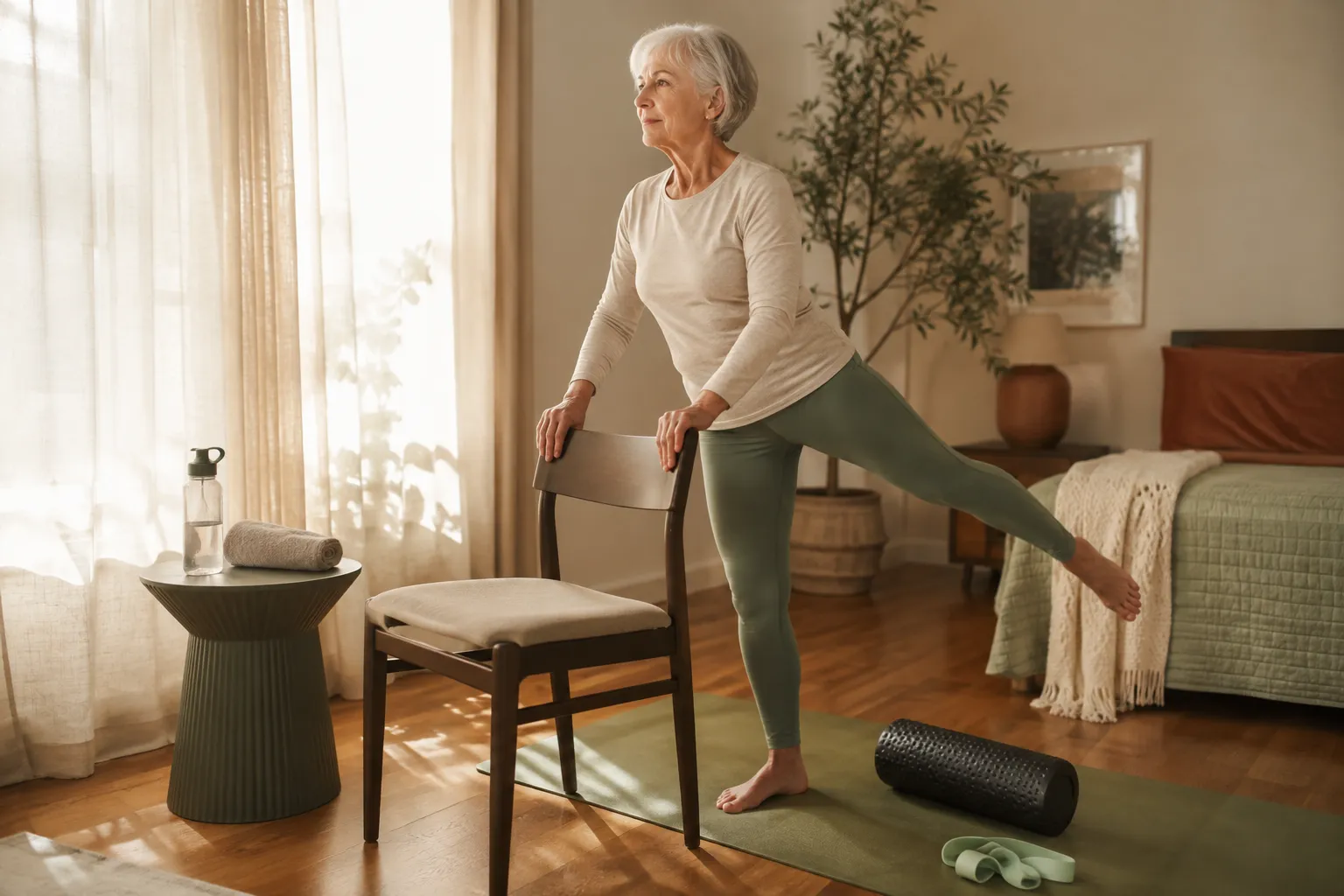
What equipment do I need to start Pilates at home?

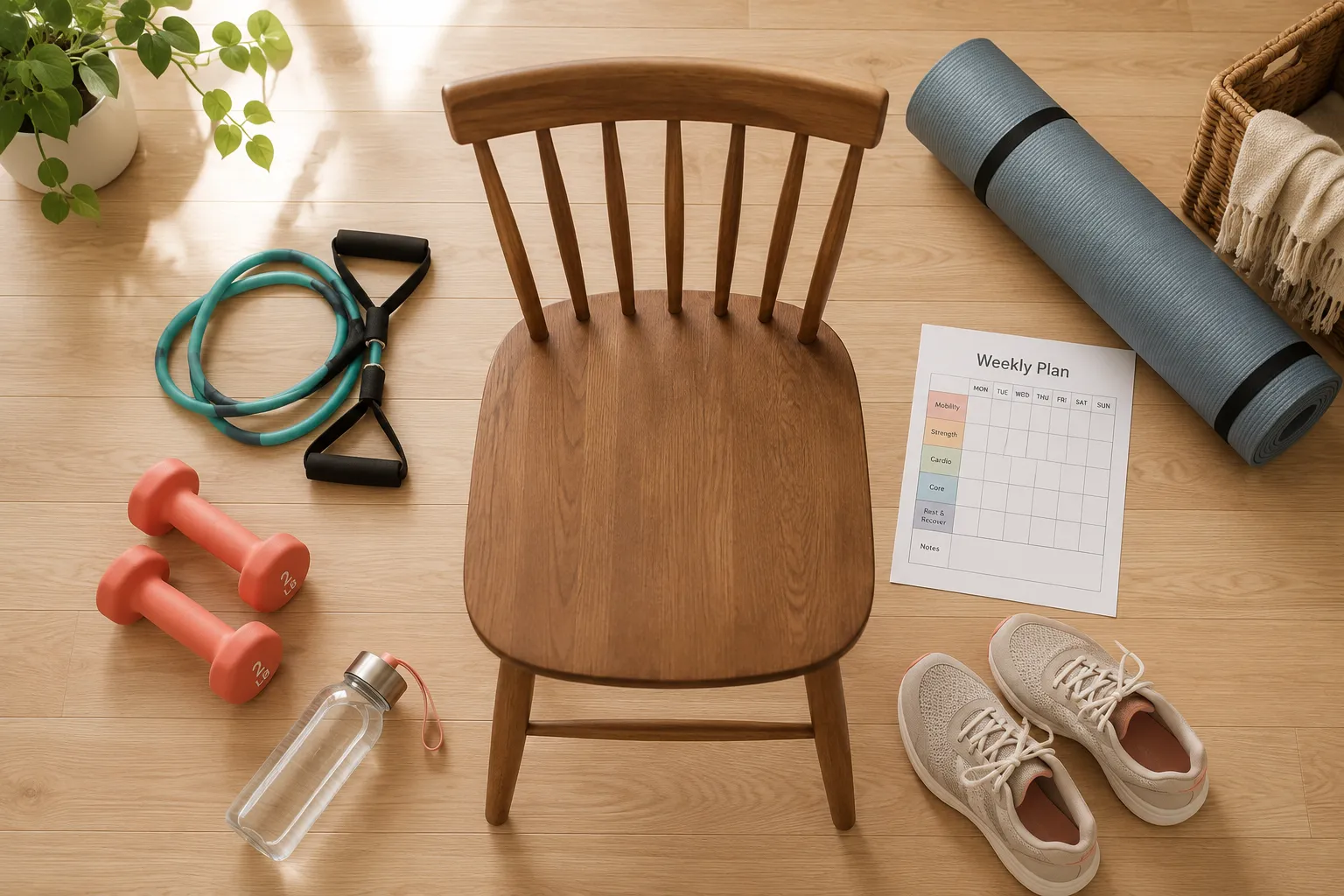
You can start Pilates at home with just a yoga or exercise mat and comfortable clothing. As you progress, a few inexpensive additions make workouts more effective.

Starter equipment checklist:

  • Non-slip mat ($20-40), thicker than a yoga mat for spine comfort.
  • Sturdy chair, free; used for support in many senior modifications.
  • Small pillow or towel ($0-10), for head or knee support.
  • Resistance band ($10-20), adds gentle resistance for arms and legs.
  • Small Pilates ball or rolled towel ($10-15), great for core engagement.
  • Optional: Foam roller ($20-30), for mobility and gentle self-massage.

Total starter cost: under $80. No expensive machines required.
What equipment do I need to start Pilates at home?

Is yoga or Pilates better for someone with bad knees?

Pilates is generally safer for seniors with knee problems because most exercises are done lying down or seated, keeping weight off the knees. Yoga can also work if you avoid deep knee bends and use props for support.

Knee-friendly guidelines:

  • In Pilates: Skip full squats and lunges; favor bridges, clamshells, and leg circles.
  • In yoga: Avoid deep warrior poses and hero pose; use a chair for lunges, and place a folded blanket under the knee in kneeling positions.
  • Always warm up with gentle joint circles before harder movements.
  • Never lock the knees in standing poses, keep a soft micro-bend.

If knee pain persists during any exercise, stop and consult a physical therapist. Some knee conditions require personalized modifications.

Common mistakes seniors make when starting yoga or Pilates

The most common mistakes come from doing too much too soon, skipping warmups, or following classes designed for younger, more flexible bodies.

Mistakes to avoid:

  • Going too fast, too soon, start with 2 short sessions weekly, not 5 long ones.
  • Following general classes instead of senior-specific ones.
  • Holding the breath during poses or reps, breath should flow steadily.
  • Ignoring pain signals, soreness is fine, sharp pain is not.
  • Skipping the warmup and cooldown, both matter more as we age.
  • Comparing yourself to the instructor, modifications are the goal, not a "failure."
  • Practicing on slippery floors, invest in a proper non-slip mat.
  • Skipping medical clearance if you have osteoporosis, joint replacements, cardiac issues, or balance disorders.

The case for a hybrid yoga and Pilates routine at home

For most seniors, the best answer to "yoga vs Pilates for seniors: which is better for balance, strength, and mobility at home?" isn't picking one, it's blending both. A hybrid routine covers every physical system that matters as we age.

A simple weekly hybrid schedule:

Day Practice Duration Focus
Monday Pilates 25 min Core, hips
Tuesday Rest or walking , Recovery
Wednesday Yoga 30 min Flexibility, breath
Thursday Rest or walking , Recovery
Friday Pilates 25 min Balance, glutes
Saturday Gentle yoga 20 min Restorative
Sunday Rest , Recovery

This structure builds strength, mobility, flexibility, and balance without overtraining. Adjust duration based on your energy and starting fitness.

FAQ

Is yoga or Pilates better for seniors over 70?
Both are safe and effective, but many seniors over 70 do best starting with chair yoga or beginner Pilates for the first month, then adding standing poses as strength returns.

Can I do yoga or Pilates with osteoporosis?
Yes, but avoid deep forward folds, spinal twists under load, and any flexion of the spine. Focus on extension-based poses and get clearance from your doctor first.

How long until I see results?
Most seniors notice better balance and less stiffness within 3-4 weeks of consistent practice. Strength and flexibility gains become clear at 8-12 weeks.

Do I need an instructor?
Not required, but at least one session with a certified senior fitness instructor is highly recommended to check your alignment and modifications before going solo.

Can I do both on the same day?
Yes, short sessions (15 minutes each) or one session using both styles works well. Just avoid two intense sessions back-to-back.

Is Pilates safe after hip or knee replacement?
Usually yes, but only after your surgeon clears you. A physical therapist can help you transition safely into either practice.

What should I wear?
Comfortable, breathable clothing that lets you move. Avoid slippery socks; either bare feet or grip socks work best.

Can yoga or Pilates replace strength training?
Pilates provides real strength gains, especially in the core and hips. Yoga does less for pure strength. For full-body strength, add light resistance training 1-2 times weekly.

Conclusion

Yoga and Pilates aren't rivals, they're complementary tools for aging well. Yoga gives you flexibility, calm, and better joint mobility. Pilates gives you core strength, stability, and stronger fall prevention. Together, they cover the full spectrum of what an older body needs to stay independent, upright, and pain-free.

Next steps:

  1. Get medical clearance if you have any joint, heart, or balance conditions.
  2. Buy a non-slip mat and set up a small practice space near a sturdy chair.
  3. Start with two 20-minute sessions per week, one gentle yoga, one beginner Pilates.
  4. Use a senior-specific instructor (SilverSneakers, YouTube senior channels, or a local class).
  5. Track how you feel after 4 weeks and adjust duration or frequency from there.

Consistency beats intensity every time. Fifteen minutes today is worth more than an hour planned for someday.
Chair and Standing Workouts for Seniors: Low-Impact Strength and Mobility When Getting Down Is Difficult

Chair and Standing Workouts for Seniors: Low-Impact Strength and Mobility When Getting Down Is Difficult

Last updated: July 30, 2026

Quick Answer

Chair and standing workouts for seniors are structured, low-impact routines that build strength, balance, and circulation without requiring you to get down to the floor. A safe weekly plan combines 2-3 seated strength sessions (leg extensions, seated marches, arm curls) with 2-3 supported standing sessions (calf raises, sit-to-stands, side leg lifts), each 15-30 minutes. Done consistently, these workouts improve posture, reduce fall risk, and preserve independence, even for adults with arthritis, balance problems, or limited mobility.[1][2][8]

Key Takeaways

  • Full-body training is possible from a chair. Seated routines can target legs, core, arms, and back with proper form and pain-free range of motion.[1]
  • Aim for 4-5 short sessions per week, mixing seated and supported-standing days for balance and strength.
  • A sturdy armless chair on a non-slip surface is the single most important piece of equipment.[1][9]
  • Supported standing exercises (holding a chair or counter) are the safest way to train balance if you're at risk of falls.[6][7]
  • Visible results appear in 4-8 weeks with consistent practice: easier sit-to-stand, better posture, less stiffness.[2]
  • Chair yoga focuses on flexibility and breath; chair aerobics raises heart rate, most seniors benefit from both.
  • Stop immediately if you feel chest pain, dizziness, or sharp joint pain, these are not "push through" workouts.

Key Takeaways

What Are Chair Exercises for Seniors With Limited Mobility?

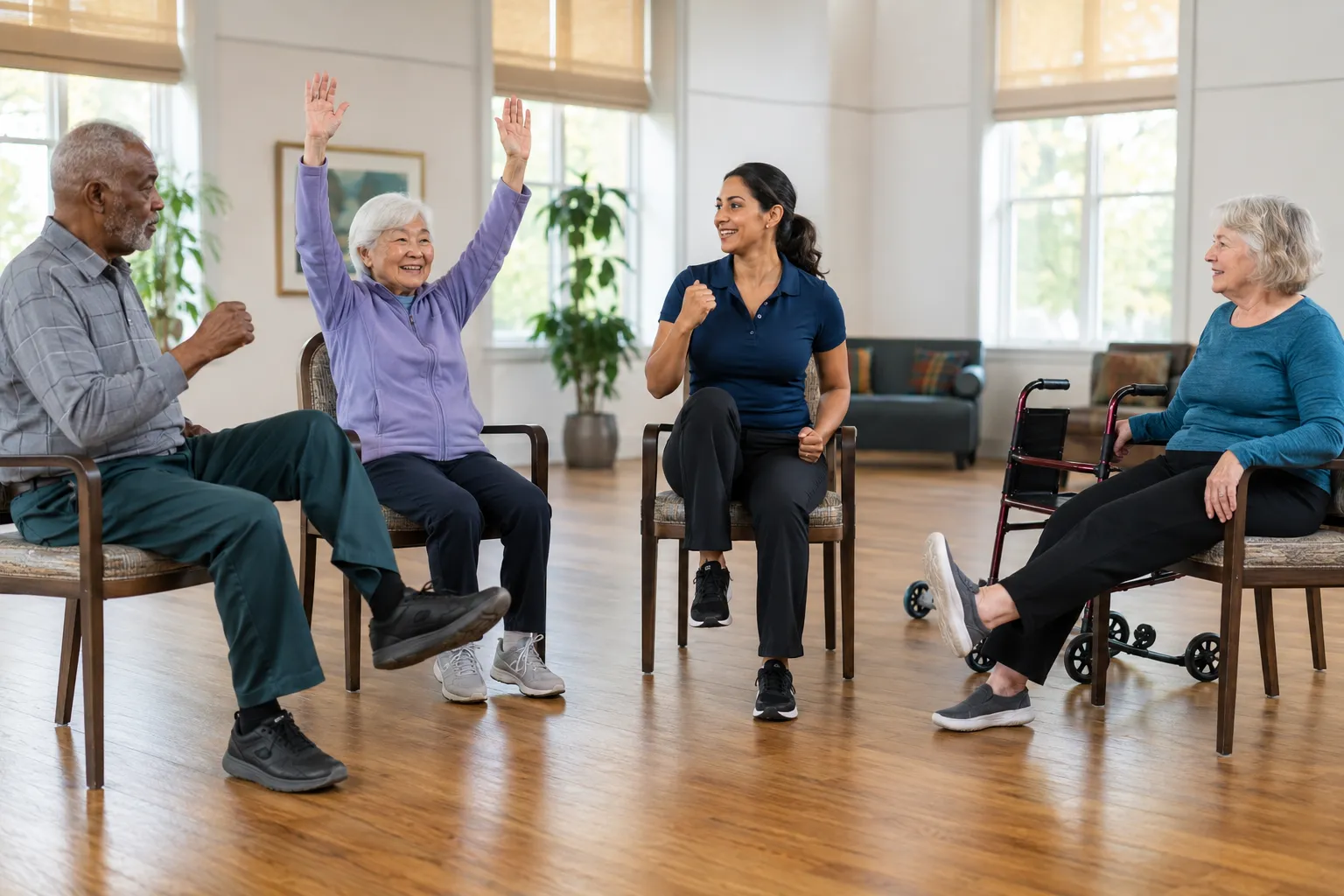
Chair exercises are strength, mobility, and cardio movements performed while seated in a sturdy chair, designed for older adults who can't safely get down to (or up from) the floor. They cover the same fitness pillars as standard workouts, muscle strength, joint mobility, cardiovascular endurance, and flexibility, just adapted so the chair provides stability and support.[1][2]

Common seated movements include:

  • Seated leg extensions, lift one leg until it's parallel to the floor, hold 2 seconds, lower slowly. 10-12 reps per leg.[1]
  • Seated marches, lift knees alternately as if walking. 30-60 seconds for a cardio burst.
  • Seated arm curls with light dumbbells or water bottles, 10-15 reps.
  • Seated trunk rotations, gentle twists to keep the spine mobile.[8]
  • Ankle circles and wrist circles, 8-12 per direction to keep joints lubricated.[8]

Choose chair-based workouts if you have knee replacements, severe arthritis, vertigo, recent surgery, or simply feel unsafe standing without support. They're also the right starting point after long periods of inactivity.

How Do You Do Standing Workouts Safely if You Have Balance Issues?

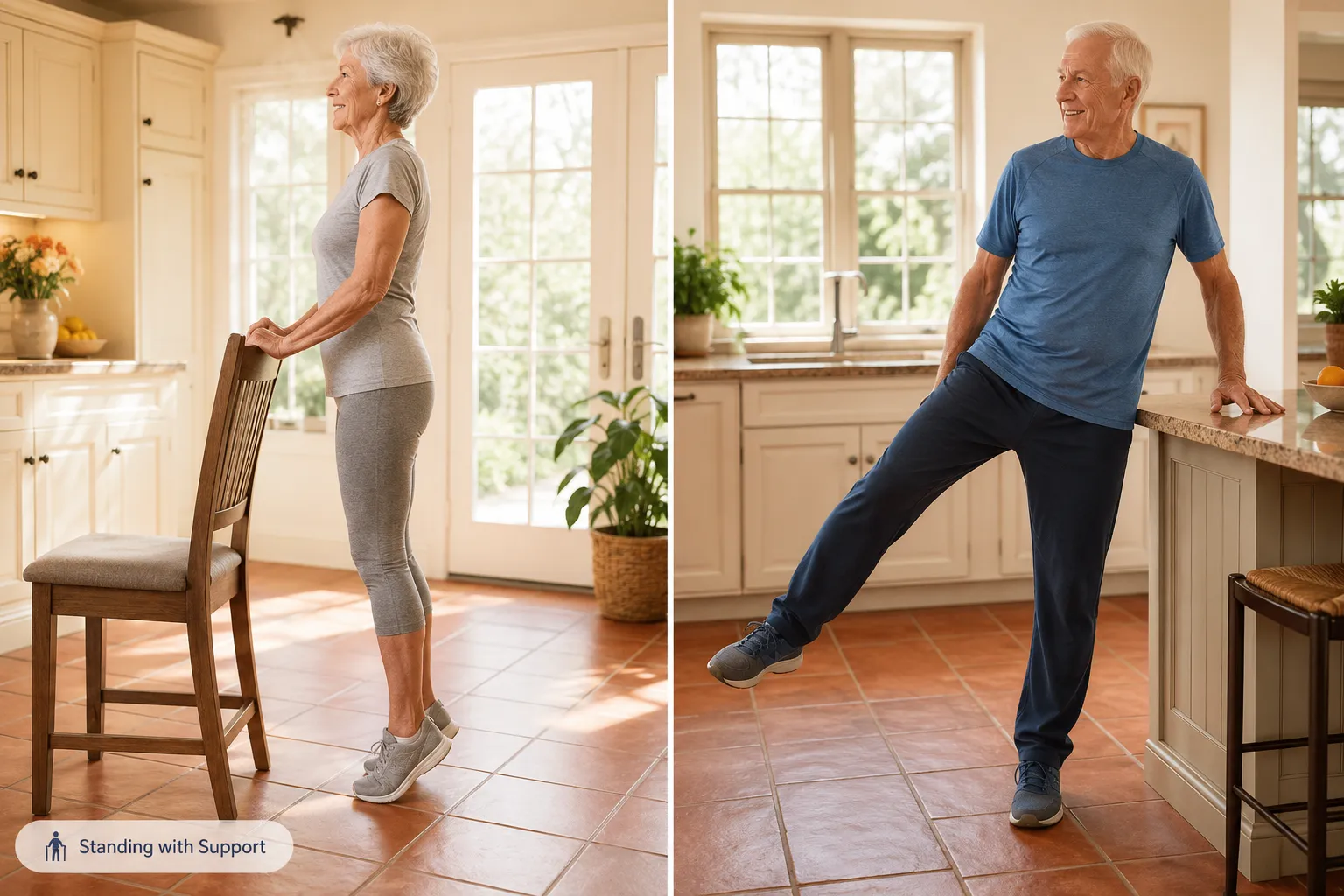
Always keep at least one hand on a sturdy anchor, the back of a heavy chair, a kitchen counter, or a wall bar, and never train standing exercises alone if you've fallen in the past year. Position yourself so you can sit down within one step at any moment.[6][7]

Safe setup checklist:

  1. Use a chair with a high back and no wheels, placed against a wall so it can't slide.
  2. Wear flat, closed-toe shoes with grip, no socks on hardwood.
  3. Clear a 3-foot radius of rugs, cords, and pets.
  4. Have water within reach and a phone nearby.
  5. Start with both hands on the chair back; progress to one hand, then fingertips, only when steady.

Beginner supported-standing moves:

  • Sit-to-stands, from a chair, stand up and sit down slowly. 8-10 reps. This is the single best predictor of independence in later life.
  • Standing calf raises, rise onto toes, lower with control. 10-15 reps.
  • Standing side leg lifts, lift one leg out to the side. 10 per side.
  • Standing marches, lift knees while holding the chair. 30 seconds.

Common mistake: Rushing to let go of support. Balance improves by degrees. Spend 2-4 weeks holding on with both hands before reducing support.

Can Seniors Build Muscle Strength From Chair Exercises Alone?

Yes, chair exercises can build meaningful strength, especially in the legs, core, shoulders, and arms, when they use enough resistance and are done 2-3 times per week. Muscle responds to challenge at any age, and Harvard Health confirms that seated resistance work improves strength, stamina, and daily function in older adults.[2]

To make chair work strength-building (not just movement):

  • Add resistance: light dumbbells (1-5 lb), resistance bands, or filled water bottles.
  • Slow the tempo: 2 seconds up, 2 seconds pause, 3 seconds down. Slow reps recruit more muscle.
  • Progress gradually: when 12 reps feel easy, add a set or increase weight by 1-2 lb.
  • Train opposing muscles: curls and presses, extensions and hamstring curls.

Edge case: If you have severe sarcopenia (age-related muscle loss), pair chair strength work with adequate protein, roughly 1.0-1.2 g per kg of body weight daily, or the muscle-building signal has nothing to work with.

Can Seniors Build Muscle Strength From Chair Exercises Alone?

Chair Yoga vs. Chair Aerobics: What's the Difference?

Chair yoga emphasizes slow stretching, breath control, and flexibility; chair aerobics emphasizes continuous movement to raise heart rate and improve cardiovascular fitness. Neither is "better", they train different systems, and most seniors benefit from doing both across the week.

Chair Yoga
Pace: slow · Focus: flexibility, breath, calm · Typical moves: seated cat-cow, chest openers, seated forward fold, neck stretches · Heart rate: low

Chair Aerobics
Pace: moderate to brisk · Focus: cardio, circulation, stamina · Typical moves: seated marches, punches, side taps, boxer shuffles · Heart rate: elevated

Choose chair yoga if stress, stiffness, or sleep is your main concern. Choose chair aerobics if endurance, energy, or heart health is the priority. Do both if you want a complete program.

Best Low-Impact Standing Exercises for Seniors With Arthritis

For arthritic joints, the best standing exercises use short lever arms, pain-free range, and constant chair support. Prioritize movements that strengthen muscles around the joint without loading it heavily, quad sets, hip abductions, and calf raises fit this profile.[7][10]

Arthritis-friendly standing routine (10 minutes):

  1. Warm-up marches at the counter, 60 seconds
  2. Mini sit-to-stands (halfway down only), 8 reps
  3. Standing calf raises, 12 reps
  4. Standing hip abductions (leg out to side), 10 per side
  5. Standing hamstring curls (heel toward glute), 10 per side
  6. Wall push-ups, 8-10 reps
  7. Cool-down: standing chest opener, hold 20 seconds

Rule of thumb: Pain during exercise should not exceed 3/10, and it should return to baseline within an hour of stopping. If it doesn't, reduce range or reps next session.

How Often Should Seniors Do Chair and Standing Workouts Per Week?

Aim for 4-5 sessions per week, typically 2-3 strength-focused days and 2-3 mobility or cardio days, with at least one full rest day. Sessions of 15-30 minutes are enough to produce measurable gains within two months.[2][8]

Sample weekly plan:

Day Focus Length
Monday Seated strength (legs + arms) 25 min
Tuesday Chair yoga / mobility 20 min
Wednesday Supported standing strength 20 min
Thursday Rest or gentle walk ,
Friday Seated aerobics 20 min
Saturday Supported standing balance 20 min
Sunday Chair yoga or full rest 15 min

Beginner adjustment: Start with 3 days a week for the first two weeks. Add a fourth day only when you're not sore the next morning.

Can You Lose Weight Doing Seated Exercises as a Senior?

Yes, modest weight loss is achievable with consistent seated workouts combined with dietary adjustments, but chair cardio alone burns fewer calories than walking, so the diet side matters more. Expect a slow, sustainable pace of 0.5-1 pound per week when both are aligned.

  • Calorie burn (seated aerobics): roughly 120-200 calories per 30-minute session, depending on intensity and body size.
  • Muscle mass matters: strength work raises resting metabolic rate, which helps long-term.
  • Diet lever: a 300-500 calorie daily reduction, paired with adequate protein, drives most senior weight loss.

Don't try aggressive calorie cuts. Rapid weight loss in older adults often strips muscle, which is exactly what chair workouts are trying to build.

What Equipment Do You Need for Chair Workouts at Home?

The minimum kit is a sturdy armless chair on a non-slip floor. Everything else is optional and cheap. Total starter cost: $0,$40.[1][9]

Essential:

  • Sturdy chair with a firm seat, no wheels, no arms (dining chair works)
  • Non-slip floor or yoga mat under the chair
  • Flat shoes with grip

Nice to have:

  • Light dumbbells (1, 2, 3, 5 lb set), ~$20
  • Resistance bands (light and medium), ~$10
  • Small pillow for lumbar support
  • Water bottles (double as improvised weights)

Skip: ankle weights heavier than 2 lb (they strain knees), unstable surfaces like balance discs (fall risk), and treadmill-style equipment unless supervised.

What Equipment Do You Need for Chair Workouts at Home?

How Do Chair Exercises Help With Fall Prevention in Seniors?

Chair exercises reduce fall risk by strengthening the exact muscles that catch you when you stumble, quads, glutes, hip abductors, and ankle stabilizers, and by training the sit-to-stand transition that causes many at-home falls.[1][6]

High-value fall-prevention moves:

  • Sit-to-stands, trains hip and knee power for getting out of chairs, cars, toilets.
  • Standing hip abductions, strengthens the side-hip muscles that keep you upright on one leg.
  • Heel-toe rocks (holding chair), trains ankle stability.
  • Seated marches with reach, trains hip flexors and core coordination.

Progress marker: If you can do 10 sit-to-stands in 30 seconds without using your hands, your fall risk is significantly lower than someone who can't.

Are Chair Workouts Effective for Improving Posture and Flexibility?

Yes. Regular chair-based mobility work counteracts the forward-hunched posture that develops from sitting and reduces stiffness in the shoulders, spine, and hips. The British Heart Foundation's 2026 chair mobility routine, shoulder shrugs, chest openers, and gentle trunk rotations, is specifically designed for this.[8]

Daily 5-minute posture reset:

  1. Seated shoulder rolls, 10 backward, 10 forward
  2. Chest opener (hands behind head, elbows wide), 3 breaths
  3. Seated trunk rotation, 8 per side
  4. Neck turns (chin to shoulder), 8 per side
  5. Seated cat-cow, 8 rounds

Consistency beats duration. Five minutes daily outperforms 30 minutes once a week.

What Should Seniors Avoid When Doing Standing Exercises?

Avoid unsupported balance work early on, holding your breath during strain, deep knee bends past 90 degrees, and any movement that causes sharp joint pain or dizziness. Also skip exercises done on soft surfaces (beds, thick rugs), they hide balance errors.[6][7]

Red flags, stop immediately if you feel:

  • Chest pain, tightness, or unusual shortness of breath
  • Dizziness, lightheadedness, or visual changes
  • Sharp joint pain (dull ache is usually fine)
  • Numbness or tingling down an arm or leg
  • Loss of bladder control or sudden weakness

Common mistakes to avoid:

  • Wearing socks instead of shoes
  • Locking knees at the top of standing moves
  • Rushing reps (speed hides poor control)
  • Skipping the warm-up
  • Training when severely fatigued or ill

Can Chair Exercises Help With Balance and Coordination Problems?

Yes, targeted chair-based drills improve balance by training the sensory and motor systems that keep you upright, even before you attempt full standing work. This is the safest entry point for anyone with vertigo, neuropathy, or recent falls.

Balance-building chair drills:

  • Seated weight shifts, shift weight side to side without lifting feet, 20 reps
  • Seated single-leg reaches, extend one leg and reach opposite arm forward, 8 per side
  • Head turns while marching, challenges the vestibular system, 30 seconds
  • Eyes-closed seated marches (only if steady), 20 seconds

Progress to supported standing balance work, heel raises, toe raises, tandem stance holding the chair, once seated drills feel easy.

How Long Does It Take to See Results From Senior Chair Workouts?

Most seniors notice easier daily movement within 2-3 weeks, measurable strength gains by 4-6 weeks, and clear improvements in balance and posture by 8-12 weeks of consistent training.[2]

Realistic timeline:

  • Week 1-2: less morning stiffness, better mood, slightly better sleep
  • Week 3-4: sit-to-stand feels easier, stairs less taxing
  • Week 6-8: noticeable arm and leg strength; posture improves
  • Week 12+: endurance, balance confidence, and often lower resting blood pressure

If you see nothing by week 6: you're probably under-loading (weights too light) or under-doing (fewer than 3 sessions weekly). Add resistance or a day, not more reps.

The Safest Way to Transition From Sitting to Standing During Exercise

Move slowly through three stages: scoot, plant, press. This sequence prevents the blood-pressure drop and dizziness that causes many exercise-related falls in older adults.

Step by step:

  1. Scoot to the front third of the chair seat.
  2. Plant both feet flat, hip-width apart, directly under or slightly behind your knees.
  3. Lean your chest forward over your toes ("nose over toes").
  4. Press through your heels and stand up, using the chair arms or thighs for a push if needed.
  5. Pause standing for 3-5 seconds before starting any movement, this lets blood pressure equalize.
  6. To sit: reverse the process. Feel the chair with the back of your legs before lowering.

Decision rule: If you feel dizzy standing up, sit back down immediately, breathe, and try again in 30 seconds. Never fight through lightheadedness.

Full-Body Chair and Standing Workouts for Seniors: Sample Routines

Here are two complete routines you can use today. Both are Chair and Standing Workouts for Seniors, Low-Impact Strength and Mobility When Getting Down Is Difficult in action.

Routine A: 20-Minute Seated Full-Body

  • Warm-up: seated marches + arm swings, 2 min
  • Seated leg extensions, 2 sets of 10 per leg[1]
  • Seated overhead press with light weights, 2 sets of 10
  • Seated bicep curls, 2 sets of 12
  • Seated trunk rotations, 2 sets of 10 per side[8]
  • Seated ankle circles + wrist circles, 8 each direction[8]
  • Cool-down: chest opener + slow breathing, 2 min

Routine B: 20-Minute Supported Standing

  • Warm-up: standing marches at chair, 2 min
  • Sit-to-stands, 2 sets of 8
  • Standing calf raises, 2 sets of 12
  • Standing side leg lifts, 2 sets of 10 per side
  • Standing hamstring curls, 2 sets of 10 per side
  • Wall push-ups, 2 sets of 8
  • Cool-down: standing chest opener + gentle sway, 2 min

Alternate A and B across the week for a balanced program.

FAQ

Q: Do I need a doctor's approval before starting?
A: Yes, if you have heart disease, uncontrolled blood pressure, recent surgery, or a history of falls. A quick clearance conversation is worth it.

Q: Can I do chair workouts if I use a wheelchair?
A: Absolutely. Most seated exercises transfer directly. Skip standing work and focus on resistance training and mobility.

Q: How heavy should my dumbbells be?
A: Start with 1-2 lb. If you can do 15 reps easily with perfect form, move up 1-2 lb. Most seniors work in the 2-8 lb range.

Q: Are YouTube chair workout videos safe?
A: Many are excellent, but confirm the instructor is certified in senior fitness (SilverSneakers, ACE Senior, or similar) and start with beginner-level content.[3][4]

Q: What if I get sore?
A: Mild soreness for 24-48 hours is normal for new exercisers. Sharp pain, swelling, or soreness lasting over 3 days means you overdid it, scale back.

Q: Can chair exercises replace walking?
A: They complement walking, not replace it. If you can walk safely, keep walking. Chair work fills gaps on bad-weather days or when joints flare.

Q: Is it too late to start at 80 or 90?
A: No. Strength gains have been documented in adults well into their 90s. Start smaller and progress slower, but start.

Q: How do I stay motivated?
A: Schedule sessions like appointments, track them on a paper calendar, and pair workouts with something you enjoy (music, a favorite show, a phone call).

Conclusion

Chair and standing workouts for seniors are one of the most reliable ways to preserve strength, balance, and independence when getting down to the floor isn't safe or realistic. The formula is simple: a sturdy chair, 4-5 short sessions per week, gradual added resistance, and supported standing work built in as balance improves.

Your next steps:

  1. Place a sturdy armless chair in a clear, well-lit space today.
  2. Do Routine A (seated full-body) this week, three times, 20 minutes each.
  3. Add Routine B (supported standing) in week two.
  4. Track progress with one simple metric: how many sit-to-stands you can do in 30 seconds.
  5. Reassess at week 6. Add weight, add a day, or add a new movement.

Consistency, not intensity, is what changes outcomes at this stage of life. Start smaller than you think you need to, and don't stop.

References

[1] Chair Exercises For Seniors – https://health.clevelandclinic.org/chair-exercises-for-seniors
[2] Chair Exercises For Seniors Boosting Strength Flexibility And Stamina – https://www.health.harvard.edu/exercise-and-fitness/chair-exercises-for-seniors-boosting-strength-flexibility-and-stamina
[3] Watch – https://www.youtube.com/watch?v=MmIpgD1hL30
[4] Watch – https://www.youtube.com/watch?v=mQLzNf8VOIc
[5] 7 Standing Exercises For Core Strength – https://www.silversneakers.com/blog/7-standing-exercises-for-core-strength/
[6] Standing Exercises For Seniors – https://eldercarealliance.org/blog/standing-exercises-for-seniors/
[7] Standing Exercises For Seniors – https://www.planetfitness.com/blog/articles/standing-exercises-for-seniors
[8] Chair Based Exercises – https://www.bhf.org.uk/informationsupport/heart-matters-magazine/activity/chair-based-exercises
[9] Chair Exercises For Seniors – https://www.lifeline.ca/en/resources/chair-exercises-for-seniors/
[10] Standing Exercises For Seniors – https://miravieseniorliving.com/lifestyle/standing-exercises-for-seniors/

Functional Fitness for Everyday Independence: How to Train Stair Climbing, Carrying, and Getting Off the Floor

Functional Fitness for Everyday Independence: How to Train Stair Climbing, Carrying, and Getting Off the Floor

Last updated: July 23, 2026

Adults who can't climb a flight of stairs without a handrail or rise from a chair without pushing off with their arms are flagged in research as being at higher risk of losing independent living [4]. The good news: every one of those tasks is trainable at any age. This guide maps the three activities of daily living (ADLs) that decide whether someone keeps their home life autonomous, stair climbing, carrying, and getting off the floor, to specific exercises you can start this week.

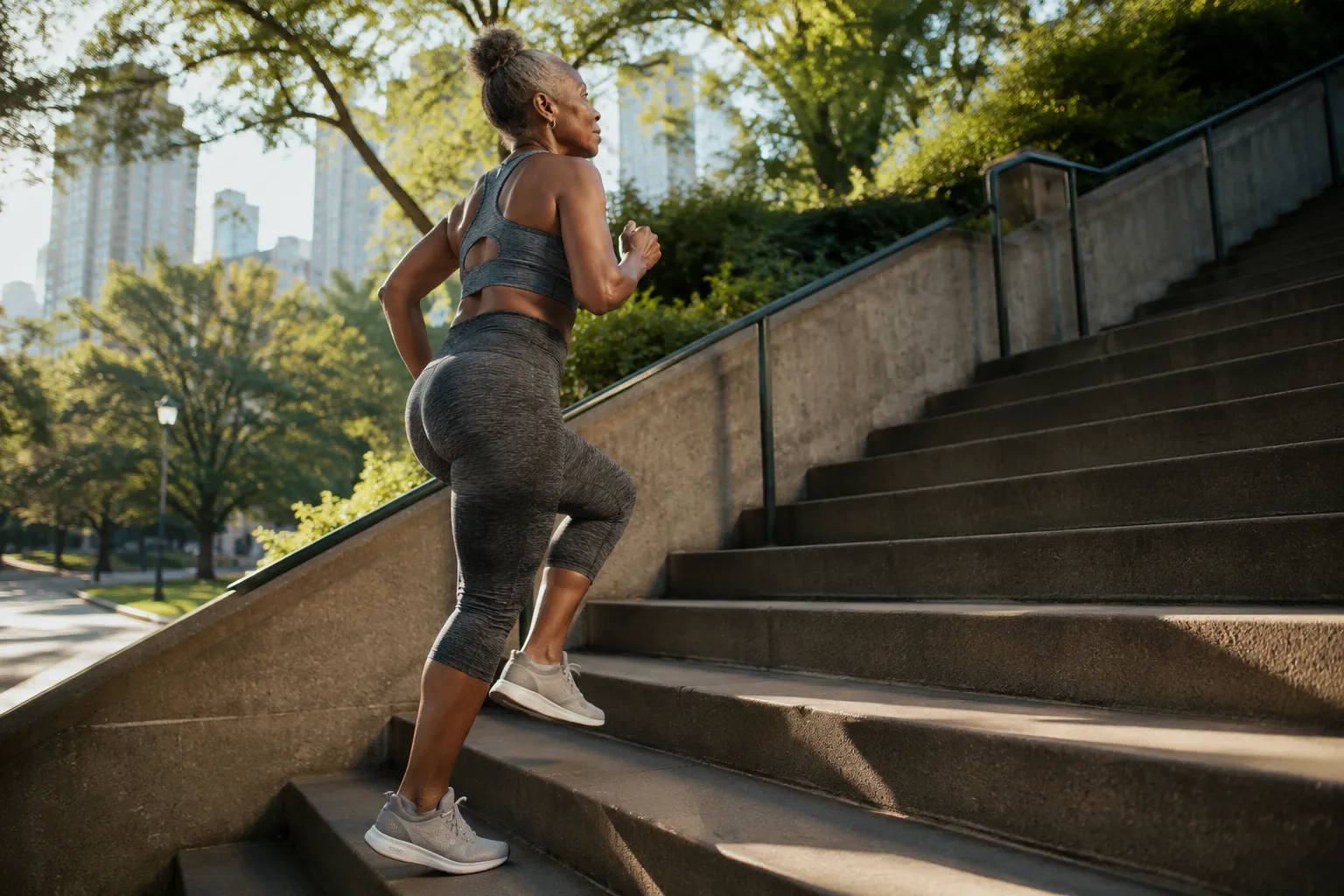
Editorial landscape photograph of a fit 60-year-old Black woman ascending a set of concrete park stairs two steps at a time,

Quick Answer

Functional fitness for everyday independence trains the exact movements you use at home, climbing stairs, carrying groceries, and getting up from the floor, instead of isolated gym machines. The most effective program combines single-leg strength (step-ups, split squats), loaded carries (farmer's walks), and floor-transfer drills (Turkish get-ups, sit-to-stands) done 2-3 times per week. Research on 80-year-olds identifies stair climbing without a handrail and rising from a chair without arm support as core markers of independent living [4].

Key Takeaways

  • Independence is measurable. Stair climbing without a rail and rising from a chair without arms are used in studies as objective markers of whether older adults can live alone [4].
  • Train the task, not just the muscle. Stair-specific training rivals machine-based training for older adults [12].
  • Three pillars matter most: legs that push (stairs), a braced core that carries (groceries), and hips that transfer (floor).
  • Frequency beats intensity. Two to three focused sessions per week produces meaningful gains within 8-12 weeks.
  • Falls are preventable. Regular floor-transfer practice reduces fear of falling and improves recovery if a fall happens [10].
  • Minimal equipment required. A sturdy step, two dumbbells or grocery bags, and floor space cover 90% of the program.

What Is Functional Fitness and Why Does It Matter for Daily Life

Functional fitness is training that mirrors real-world tasks, pushing, pulling, squatting, hinging, carrying, and getting up and down, so the strength you build transfers directly to daily life. It matters because the ability to perform tasks like stair climbing and rising from a chair without support is used by researchers to classify whether an older adult can live independently [4].

The difference is practical. A leg press machine strengthens your quads while you sit down. A step-up strengthens your quads and trains your balance, hip control, and coordination in the exact pattern you use on the staircase at home. When function fails, independence follows. When function is trained, independence is preserved.

Best Exercises to Improve Stair Climbing Ability

The best exercises for stair climbing are step-ups, split squats, and eccentric step-downs, because they train single-leg strength and knee control under load, the exact demands of ascending and descending stairs. Stair climbing is one of the top five tasks that becomes hardest with age, which is why some trials use stair-climbing exercise itself as a training protocol for older adults [12].

Core stair-climbing exercises:

  1. Step-ups (start with a 6-inch step, progress to 12-16 inches). 2 sets of 8 per leg. Drive through the heel, don't push off the bottom foot.
  2. Split squats (bodyweight, then holding light dumbbells). 2 sets of 8 per leg. Builds the strength needed to push up one step at a time.
  3. Eccentric step-downs (lower slowly for 3 seconds). 2 sets of 6 per leg. This trains descending stairs, the direction where most falls happen.
  4. Calf raises on a stair edge. 2 sets of 15. Ankle strength matters for stair push-off and balance.

Decision rule: If you currently need a handrail on both sides, start with 4-inch steps and hold a wall lightly. Progress step height before adding weight.

Common mistake: Rushing up. Slow, controlled reps build more usable strength than fast ones and reduce knee stress.

How to Train for Carrying Heavy Groceries and Objects Safely

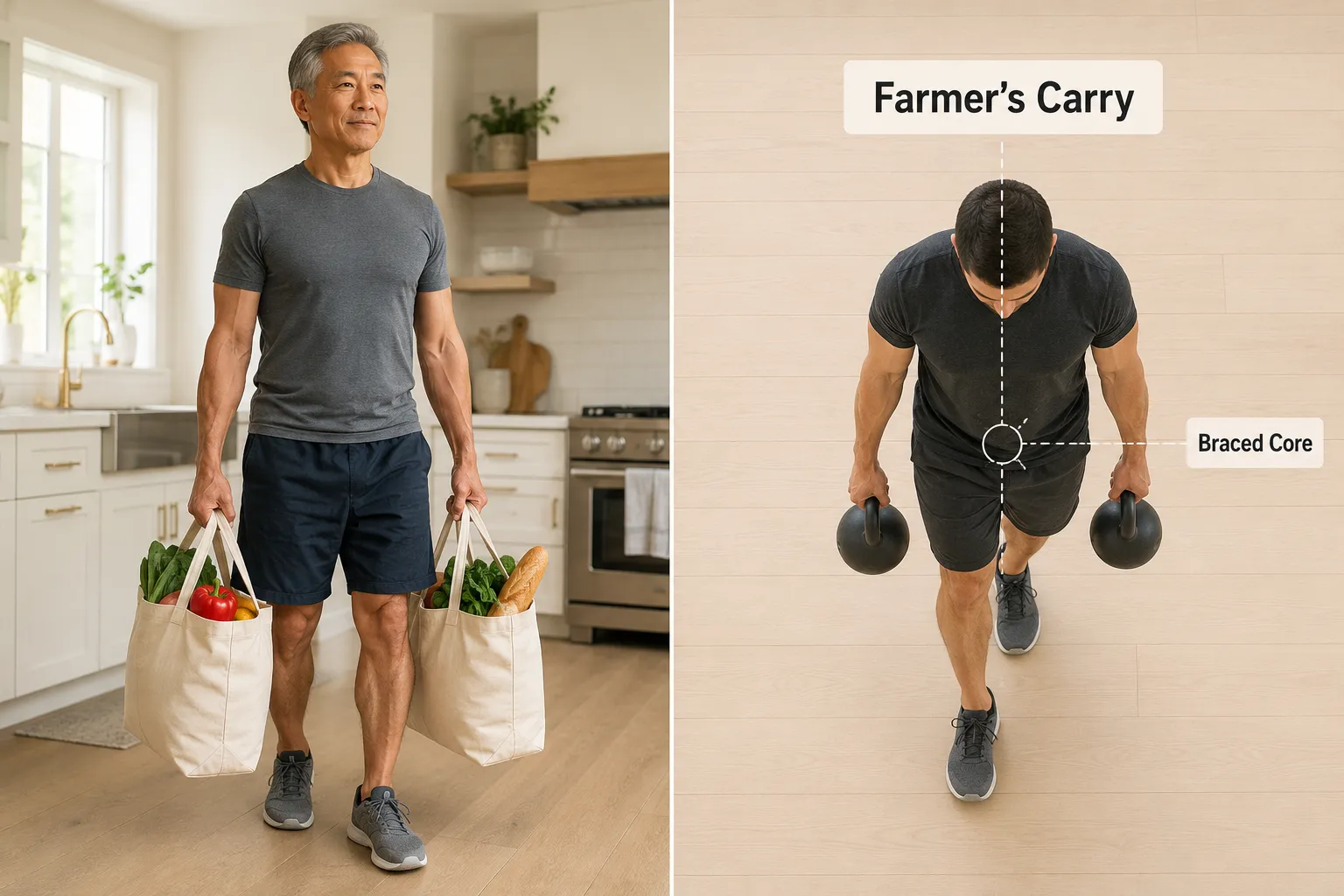
To carry heavy objects safely, train loaded carries, walking while holding weight in one or both hands, because they build grip, core bracing, and posture endurance simultaneously. Groceries, laundry baskets, and a grandchild all share the same demand: hold a load while your legs keep moving.

How to Train for Carrying Heavy Groceries and Objects Safely

Core carrying exercises:

  • Farmer's carry. Hold a dumbbell (or a jug of water) in each hand, walk 20-40 steps with tall posture. 2-3 rounds.
  • Suitcase carry. Same idea, but load only one side. This trains the obliques to keep you from tipping, the exact skill of carrying a single grocery bag.
  • Bear hug carry. Hug a heavy object (sandbag, laundry basket, weighted pillow) against your chest and walk. Mimics carrying a large box.
  • Deadlift to carry. Practice picking the load up from the floor with a hip hinge, then walking. Most injuries happen at the pick-up, not the carry.

Safe lifting checklist:

  • Feet close to the object
  • Hips back, chest up
  • Grip firmly, brace the core (like bracing for a light punch)
  • Stand up with the legs, not the low back
  • Look forward, not down, while walking

Exercises to Get Up Off the Floor Easier as You Age

The most effective exercises to get off the floor are the sit-to-stand, kneeling-to-standing drill, and modified Turkish get-up, because they rehearse the exact transitions of a floor transfer. Practicing the movement itself, slowly and often, is what trainers report works best for older clients [8][10].

A simple floor-transfer progression:

  1. Chair sit-to-stand. 2 sets of 10, no hands. Builds the base strength for standing up.
  2. Half-kneeling to standing. From one knee down, one foot forward, stand up without using hands. 5 per leg.
  3. Side sit to kneel. Sit sideways on the floor, roll to hands and knees, stand up. Practice both sides, most people are one-sided.
  4. Turkish get-up (unweighted). A slow, 6-step transition from lying on your back to standing. Even without a weight, it teaches every position of a controlled floor exit [2][3].

Frequency: Practice getting to the floor and back up 2-3 times per session, 3 sessions per week. Repetition is what makes the movement automatic [10].

Common mistake: Avoiding the floor entirely. The less you use it, the harder it gets. Sit on the floor for 5 minutes a day while watching TV to normalize the transition.

Functional Fitness vs Regular Gym Workouts: What's the Difference

Functional fitness trains multi-joint movements that mirror daily tasks; regular gym workouts often isolate single muscles on machines. Both build strength, but only functional training directly transfers to stairs, carrying, and floor transfers because it rehearses balance, coordination, and posture at the same time.

Machine workout: Leg extension → trains quads while seated, no balance demand.

Functional workout: Step-up with dumbbells → trains quads, glutes, balance, grip, and posture in one movement, same pattern as climbing stairs with groceries.

Choose functional training if your goal is daily-life capability, fall prevention, or aging in place. Choose traditional gym work if your goal is bodybuilding, isolated rehab, or you have a specific injury that requires machine-controlled loading. Most people benefit from a blend, with functional movements as the base.

How Often Should I Do Functional Fitness Training

Two to three sessions per week, 30-45 minutes each, is the sweet spot for most adults. This frequency allows enough recovery between sessions while providing the repeated exposure needed for neurological adaptation, the skill part of strength.

Sample weekly split:

Day Focus Time
Monday Legs and stairs (step-ups, split squats) 30 min
Wednesday Carries and core (farmer's walks, planks) 30 min
Friday Floor transfers and full-body (get-ups, sit-to-stands) 30 min
Daily 5-minute walk + 1 minute of floor sitting 6 min

Edge case: If you're brand new to exercise or recovering from an illness, start with two 20-minute sessions per week. Consistency for 6 weeks beats an ambitious plan you abandon in 10 days.

Can Functional Fitness Prevent Falls and Injuries at Home

Yes, functional fitness reduces fall risk by strengthening the muscles and reflexes that catch you before you fall and by teaching you how to get back up if you do. Programs that combine leg strength, balance, and floor-transfer practice consistently outperform strength-only programs for fall reduction in older adults [6][7].

The three-part fall-protection system:

  1. Prevention. Strong legs, good balance, and ankle mobility keep you upright.
  2. Reaction. Fast reflexes and grip strength let you catch yourself on a rail or counter.
  3. Recovery. Practiced floor transfers mean a fall is an inconvenience, not a hospital visit [10].

Most fall-related injuries happen at home during ordinary tasks, stepping off a curb, carrying laundry, reaching for something high. The training that prevents them is the training that mimics them.

Functional Fitness for Seniors and Older Adults

For seniors, functional fitness should prioritize sit-to-stands, assisted step-ups, and floor-transfer practice, because these directly correspond to the tasks used by researchers to assess independent-living capacity [4]. Even adults in their 80s and 90s show measurable strength gains within 8-12 weeks of consistent training.

Functional Fitness for Seniors and Older Adults

Senior-specific adjustments:

  • Begin with body weight only for 2-3 weeks before adding load
  • Use a sturdy chair or wall for balance assistance during single-leg work
  • Warm up longer, 5 to 10 minutes of easy walking or marching in place
  • Practice descending as often as ascending, going down is where balance fails
  • Include soft floor work on a rug or mat to reduce fear during transfers

Trainers working with older clients report that the biggest breakthrough often isn't strength but rehearsal: doing the movement enough times that it stops feeling risky [8].

Common Mistakes People Make When Training Functional Movements

The most common mistakes are skipping the descending/eccentric portion of exercises, avoiding the floor entirely, and using too much weight too soon. Each mistake reduces the transfer of training to real-world independence.

Top mistakes to avoid:

  1. Only training "up." Step-ups without step-downs skip the harder half of stair use.
  2. Machine-only workouts. They build muscle but not balance or coordination.
  3. Never practicing floor transfers. The skill disappears with disuse.
  4. Chasing weight instead of quality. A perfect body-weight split squat beats a wobbly loaded one.
  5. All bilateral, no single-leg. Real life happens one leg at a time (stairs, curbs, stepping over pets).
  6. Skipping grip work. Carrying groceries fails at the hands first.

What Equipment Do I Need for Functional Fitness at Home

You need very little: a sturdy step or bottom stair, two dumbbells or filled water jugs, a chair, and a soft floor space. That covers roughly 90% of the training that matters for daily independence.

Minimum home setup:

  • Sturdy chair (for sit-to-stands and balance support)
  • Step or bottom stair (for step-ups and step-downs)
  • Two hand weights (5-20 lb dumbbells, or two filled 1-gallon jugs at ~8 lb each)
  • Yoga mat or carpet (for floor transfers)
  • Wall space (for balance work and wall push-ups)

Nice to add later: a resistance band, a heavier kettlebell, and a taller step (12-16 inches).

How Long Does It Take to See Results from Functional Fitness

Most people notice improvements in 2-4 weeks (easier stairs, less fatigue with groceries) and measurable strength gains in 8-12 weeks. Neurological adaptations, balance, coordination, confidence, happen first; muscle changes follow.

Realistic timeline:

  • Week 1-2: Movements feel awkward; soreness after sessions is normal
  • Week 3-4: Daily tasks feel noticeably easier
  • Week 6-8: Strength gains visible in reps and load handled
  • Week 12+: Improvements in balance tests, walking speed, and floor-transfer ease [5][6]

The people who see the best results aren't the ones who train hardest, they're the ones who train the most consistently.

Is Functional Fitness Good for People with Mobility Issues

Yes, and it's often more effective than traditional exercise for people with mobility issues, because it can be scaled to any starting level and directly targets the tasks that mobility limits. Seated sit-to-stands, wall-supported step-ups, and floor-transfer drills all have easier versions.

Modifications for limited mobility:

  • Sit-to-stand with a higher chair or armrest push-off
  • Step-ups onto a 2-inch platform, holding a rail
  • Floor transfers practiced from a bed or sofa first, then a low chair, then the floor
  • Chair-supported single-leg balance for 10 seconds

If you have a specific condition (recent surgery, severe arthritis, neurological issues), start with a physical therapist for the first 4-6 weeks, then transition to home practice.

Functional Fitness Training for People Who Sit All Day

For desk workers, functional fitness should prioritize hip mobility, glute activation, and posture endurance, because prolonged sitting weakens the exact muscles that stairs and carrying demand. Ten minutes of daily movement plus two structured sessions per week is enough to reverse most sitting-related decline.

Daily desk-worker routine (10 minutes):

  • 20 sit-to-stands from your office chair
  • 10 step-ups on a low box or stair, each leg
  • 30-second wall sit
  • 30 seconds of standing hip circles per side
  • 10 slow squats with arms overhead

Twice-weekly session (30 minutes): Add loaded carries, split squats, and one floor transfer drill. This combination directly counteracts the postural patterns of desk work while building the strength daily life demands.

FAQ

How is functional fitness different from CrossFit?
Functional fitness borrows movement patterns from CrossFit but usually removes the high-intensity, competitive elements. The focus is real-life capability, not workout performance.

Can I do functional fitness every day?
Light movements (walking, mobility, sit-to-stands) can be daily. Loaded strength work should have a rest day between sessions.

Do I need a personal trainer?
Not required, but 2-4 sessions with a qualified trainer at the start can fix form issues before they become habits.

Is walking enough for functional fitness?
Walking is excellent cardio and helpful for legs but doesn't build enough strength for stairs, carrying, or floor transfers on its own. Combine walking with 2 strength sessions weekly.

What if I fall while training?
Train on a soft floor, near a wall or sturdy chair, with a phone nearby. Practicing controlled floor transfers actually reduces fall injury risk over time [10].

Can functional fitness help with knee pain?
Often yes, strengthening the muscles around the knee (quads, glutes, calves) reduces load on the joint. Start light and stop any exercise that causes sharp pain.

How old is too old to start?
There isn't an upper age limit. Adults in their 80s and 90s show meaningful gains when they start training consistently [4].

Should I stretch before or after?
A light dynamic warm-up (marching, arm circles) works best before. Static stretching is better after the session.

Conclusion

Independence at home rests on three trainable skills: climbing stairs, carrying loads, and getting off the floor. Every one of them responds to focused practice at any age. Pick one movement from each category, do them 2-3 times a week for the next 8 weeks, and measure your progress by how daily life feels, not how sore you are.

Your next steps:

  1. This week: Do 10 sit-to-stands, 10 step-ups per leg, and one floor transfer, three times.
  2. Week 2: Add a farmer's carry (20 steps with something moderately heavy).
  3. Week 4: Retest, can you get off the floor without using your hands? Climb stairs without a rail?
  4. Week 8: Add load, add reps, and start practicing the harder version of each movement.

Independence isn't given up all at once. It's traded away one skipped stair, one avoided floor sit, one grocery trip made in three trips instead of two. Reverse those trades, and the autonomy comes back.

References

[2] Exercises Getting Off Floor Easier After 65 – https://www.eatthis.com/exercises-getting-off-floor-easier-after-65/
[3] Getting Up From The Floor For Seniors – https://ferra.club/blog/getting-up-from-the-floor-for-seniors
[4] Paperinformation – https://www.scirp.org/journal/paperinformation?paperid=21937
[5] researchdirects – https://researchdirects.com/index.php/therapy/article/download/187/151
[6] Pmc11155611 – https://pmc.ncbi.nlm.nih.gov/articles/PMC11155611/
[7] Pmc6352105 – https://pmc.ncbi.nlm.nih.gov/articles/PMC6352105/
[8] What Helped My Senior Clients Get Off The Floor – https://www.reddit.com/r/SeniorFitness/comments/1lk2jm3/what_helped_my_senior_clients_get_off_the_floor/
[10] The Best Exercises To Help Older People Get Off The Floor – https://rangeofmotion.net.au/the-best-exercises-to-help-older-people-get-off-the-floor/