AI-Powered Fitness Apps for Seniors: How Movement Assessment Technology Personalizes Your Home Workouts

AI-Powered Fitness Apps for Seniors: How Movement Assessment Technology Personalizes Your Home Workouts

Last updated: August 22, 2026

Quick Answer

AI-powered fitness apps for seniors use your phone or tablet camera to watch how you move, then adjust each workout to match your strength, balance, and mobility. Movement assessment technology maps key joints in real time, flags risky form, and rebuilds your plan as you improve. For older adults exercising at home, this means safer sessions, fewer generic routines, and coaching that actually responds to a stiff hip or a shaky balance day.

Key Takeaways

  • Movement assessment technology uses pose estimation to track 17-33 body joints through a standard smartphone camera, no wearables required for most apps.
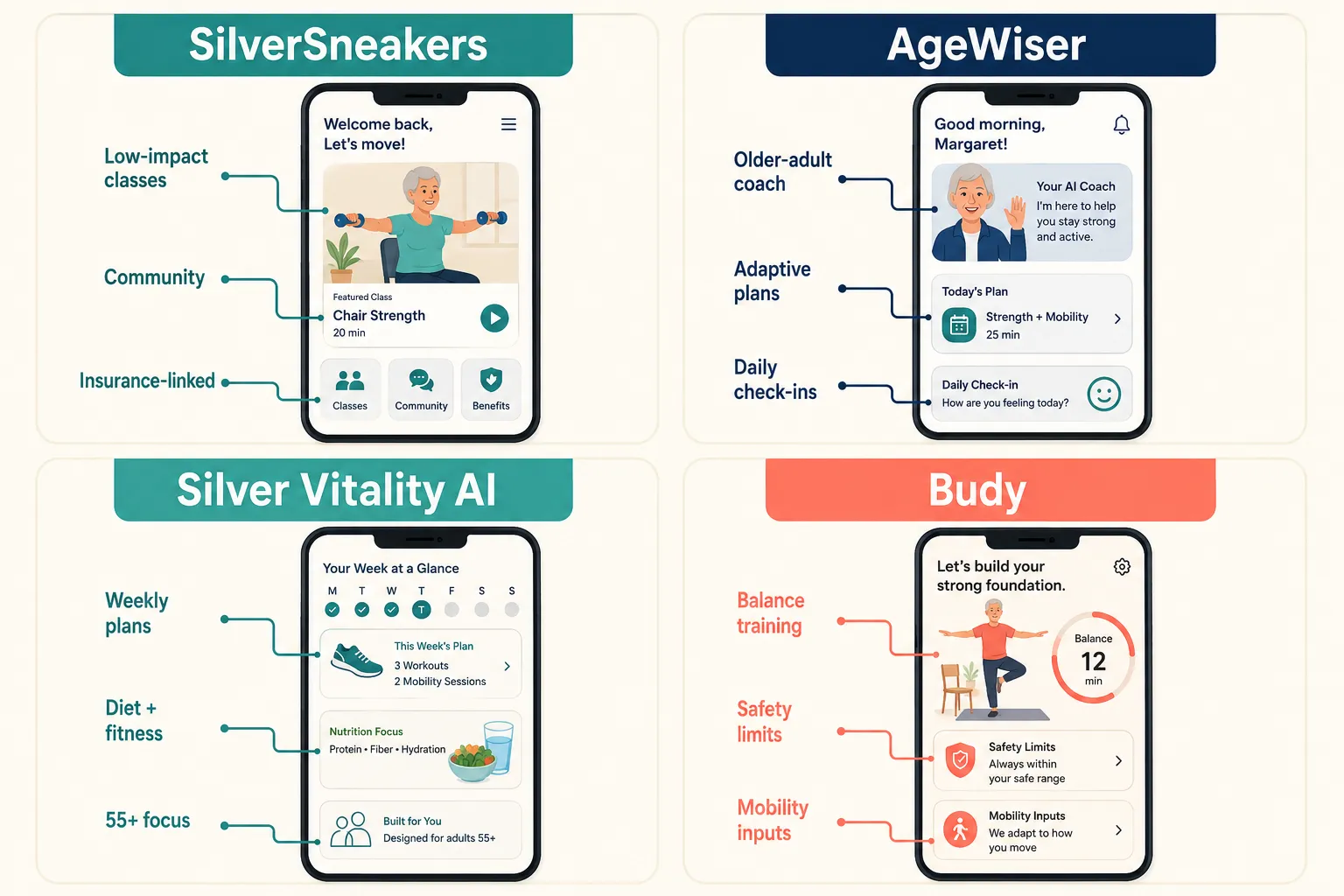
  • Senior-focused apps like AgeWiser, Silver Vitality AI, Budy, and SeniorFit build plans around age, mobility level, and balance status, not generic fitness scores [3][4][13][14].
  • AI form correction is helpful but not a replacement for a physical therapist, especially if you have a diagnosed condition or recent surgery.
  • Many quality options are free or under $15/month, including SilverSneakers (often covered by Medicare Advantage) and web-based tools like SeniorFit [1][13].
  • Apps with chair-based and low-impact modes (SitFit, Ageless Pilates, Tai Chi for Seniors) work well for arthritis, limited mobility, or balance concerns [1][2].
  • You need a phone or tablet with a working camera, roughly 6-8 feet of clear space, and steady lighting, that's it.
  • Best use case: general strength, balance, and mobility maintenance. Not appropriate for: post-op rehab, acute pain, or complex neurological conditions without a clinician's input.

What is movement assessment technology in fitness apps?

Movement assessment technology is computer vision software that watches you exercise through a camera and measures how your body moves in space. It identifies key points on your body, shoulders, hips, knees, ankles, wrists, and tracks how they shift frame by frame during a squat, a reach, or a balance hold.

The app then compares your movement pattern to a reference model and calculates things like:

  • Joint angles (is your knee bending to 90 degrees or only 60?)
  • Range of motion (how far can you rotate your shoulder?)
  • Tempo and symmetry (are both legs doing equal work?)
  • Stability (how much are you swaying during a single-leg stand?)

For seniors, the goal isn't athletic performance. It's catching compensations, like a hip that hikes up during a step-up, or a knee that collapses inward during a sit-to-stand, that predict falls or joint strain.
What is movement assessment technology in fitness apps?

How do AI fitness apps track your form and posture?

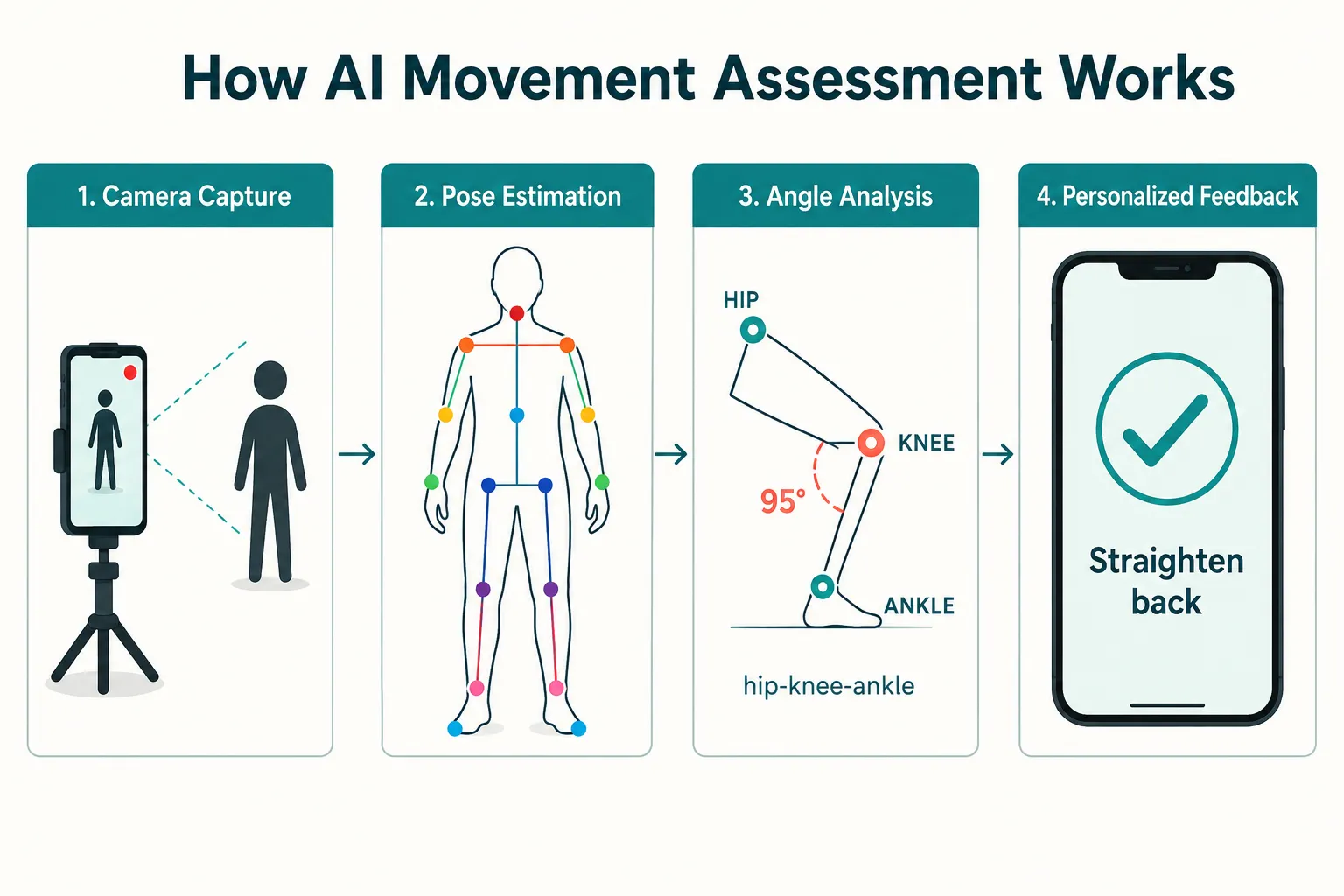
AI fitness apps track form using pose estimation models, the same family of computer vision tech behind gesture control and motion capture. Your phone camera captures 30 frames per second, and the model places digital "landmarks" on your joints in each frame.

Here's the simplified pipeline:

  1. Camera capture, a standard front or rear camera records you.
  2. Pose estimation, the AI locates 17 to 33 body keypoints in each frame.
  3. Angle and motion analysis, software calculates joint angles, velocity, and alignment.
  4. Rule-based or ML feedback, the app checks your numbers against safe ranges and delivers a cue like "straighten your back" or "hold for 2 more seconds."

Most senior-focused apps process this on-device, meaning video doesn't leave your phone. That matters for privacy, always check the app's data policy before use.

What's the difference between AI fitness apps and regular workout apps?

Regular workout apps show you a video and count reps. AI fitness apps watch you back and change what happens next based on how you moved.

Feature Regular Workout App AI-Powered Fitness App
Program design Fixed weekly plan Adaptive, adjusts to performance
Feedback None or manual logging Real-time form cues
Progression Preset weeks Based on your movement data
Injury awareness Generic warnings Flags risky patterns live
Cost Often free,$10/mo Free,$30/mo

For a 68-year-old with arthritic knees, the difference is meaningful. A regular app will keep prescribing lunges. An AI app notices the knee wobble on rep three, swaps to a supported split-squat, and shortens the range of motion automatically [14].

Best AI fitness apps for seniors with arthritis

For seniors with arthritis, the best AI fitness apps prioritize low-impact movement, joint-friendly ranges, and chair-based options. Top picks based on current 2026 offerings:

  • SilverSneakers, low-impact classes and personalized scheduling for older adults, often covered by Medicare Advantage plans [1].
  • Ageless Pilates, gentle mat and standing Pilates with age-appropriate progression [1].
  • SitFit, chair-based routines built for users with joint pain or limited standing tolerance [2].
  • Tai Chi for Seniors, slow, flowing movement that's easier on inflamed joints [1].
  • Reverse Health, adaptive plans for the 40+ and senior demographic with joint-friendly options [2].

Decision rule: If a movement causes sharp joint pain (not muscle fatigue), stop and switch to a seated or supported version. Most of these apps offer that swap built in.
Best AI fitness apps for seniors with arthritis

Can AI fitness apps prevent injury during workouts?

AI fitness apps can reduce injury risk, but they can't guarantee prevention. They help by catching common form errors in real time, rounded backs during hinges, knees caving during squats, holding breath during exertion, that lead to strains and falls over time.

What they do well:

  • Flag deteriorating form as you fatigue
  • Suggest scaled versions when a movement looks unstable
  • Enforce rest days when performance drops
  • Apply "conservative progression and safety boundaries" for older adults [14]

What they can't do:

  • Diagnose pain or medical conditions
  • Detect subtle neurological changes
  • Replace clinical judgment after surgery or injury
  • Sense pain you don't report

If you have a recent injury, hip or knee replacement, or a diagnosed balance disorder, use AI apps as a supplement to a physical therapist's plan, not a replacement.

How much do senior fitness apps with AI cost?

Senior AI fitness apps range from free to about $30 per month, with most quality options between $10 and $20 monthly. Some are covered by Medicare Advantage or supplemental insurance.

General pricing landscape (2026):

  • Free tiers: SeniorFit (web-based, home assessment), FitOn (ad-supported), Workout.cool [1][13]
  • Insurance-linked: SilverSneakers, free with many Medicare Advantage plans [1]
  • Low-cost subscriptions: Daily Yoga, Tai Chi for Seniors, Ageless Pilates, typically $10,$15/month [1]
  • Premium AI coaches: AgeWiser, Silver Vitality AI, Budy, usually $15,$25/month with annual discounts [3][4][14]

Annual billing usually cuts the price 30-50%. Most apps offer 7-day free trials, use them to check whether the interface actually works for you before committing.

Free AI fitness apps for older adults

Yes, several free AI fitness options exist for seniors. The tradeoff is usually fewer personalized features or ad interruptions, but the core movement tracking still works.

Notable free options:

  • SeniorFit, web-based AI assessment with personalized senior exercises, no equipment required [13].
  • FitOn, free classes with optional AI coaching upgrade, includes senior-appropriate categories [1].
  • SilverSneakers, free if your Medicare Advantage plan includes it (check with your insurer) [1].
  • Workout.cool, open catalog of free workouts with basic personalization [1].

Common mistake: Downloading five free apps at once. Pick one, use it for two weeks, then decide. Jumping between apps means none of them build enough movement data to actually personalize your plan.

Do I need special equipment for AI movement tracking?

No special equipment is required for most AI fitness apps beyond a smartphone or tablet with a working camera. That's the appeal, the phone in your pocket is the sensor.

Helpful but optional:

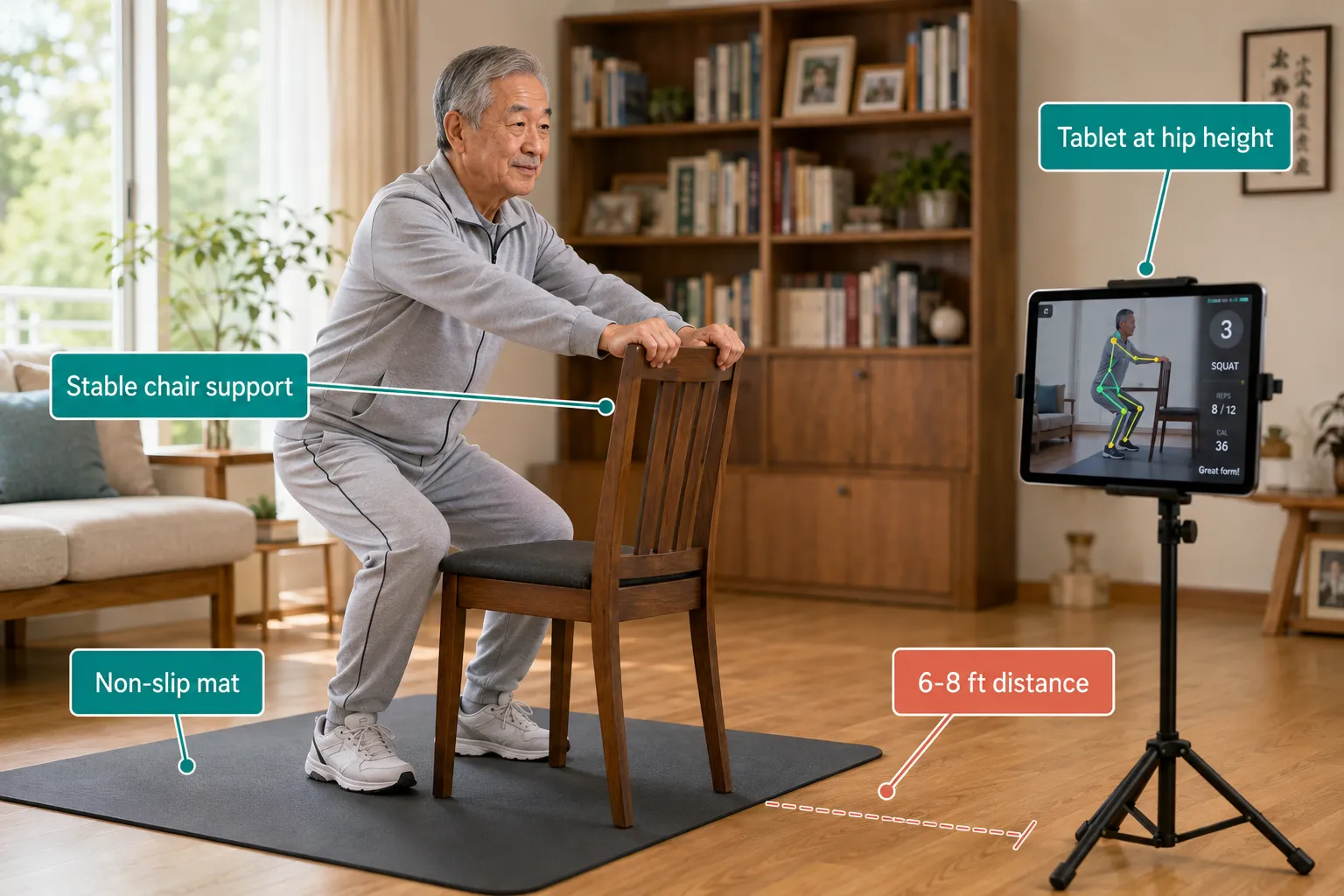
  • A phone stand or tripod ($15,$25) so you're not propping the phone against a book
  • A sturdy chair for supported exercises and balance work
  • A non-slip mat for floor exercises
  • Good lighting, a bright room or lamp facing you (backlighting confuses the camera)

Some premium apps integrate with Apple Watch, Fitbit, or Garmin for heart rate data, but wearables aren't required. Web-based tools like SeniorFit run in a browser without any app install [13].

How accurate is AI form correction for seniors?

AI form correction is reasonably accurate for gross movement patterns, squat depth, arm angle, whether you're leaning too far forward, but less accurate for subtle issues like scapular positioning or foot pronation. Accuracy also depends heavily on camera angle and lighting.

What affects accuracy:

  • Camera placement, hip height, 6-8 feet away, side view for most exercises
  • Lighting, even, front-facing light works best
  • Clothing, loose or matching-background clothing reduces accuracy
  • Body size and shape, pose estimation was historically trained on younger, average-sized bodies; newer models handle diverse bodies better

For seniors, treat AI cues as helpful reminders, not diagnostic verdicts. If the app says your knee is misaligned but you feel stable and pain-free, the cue might be a false positive. If it flags something and you also feel discomfort, listen to it.

Are AI fitness apps good for seniors with limited mobility?

Yes, several AI fitness apps are specifically built for limited mobility, offering chair-based routines, bed exercises, and supported standing options. Apps like SitFit, Ageless Pilates, and Tai Chi for Seniors provide seated variations tracked by AI [1][2].

Budy's app for older adults explicitly uses "mobility level, balance status, available equipment, and health notes" to build plans, meaning the AI knows to skip floor exercises if you can't get down safely [14]. Silver Vitality AI and AgeWiser take similar age-aware approaches [3][4].

Choose a chair-based AI app if you:

  • Use a walker, cane, or mobility aid
  • Have trouble getting up from the floor
  • Recover from surgery or a fall
  • Experience fatigue that limits standing time

Skip AI-only programs if you need hands-on physical assistance to move safely, those situations call for in-person care.

Can seniors use AI fitness apps without smartphones?

Yes, some AI fitness options run on tablets, smart TVs, or web browsers, so a smartphone isn't strictly required. SeniorFit is browser-based, meaning any laptop with a webcam will work [13]. Several apps also support Amazon Fire tablets and larger iPad screens, which many seniors find easier to see and tap.

Options without a smartphone:

  • Web browser + laptop webcam, SeniorFit and similar portals [13]
  • Tablet apps, most iOS and Android fitness apps also run on tablets
  • Smart TV apps, SilverSneakers and FitOn have TV apps for Roku, Apple TV, Fire TV
  • Voice assistants, Alexa and Google Assistant offer some senior workout routines, though without visual form tracking

A larger screen is often better for older adults regardless. A tablet propped on a stand shows form feedback more clearly than a small phone.

What happens if the app can't recognize your movements?

If the AI can't see you clearly, most apps pause the workout or show a "reposition camera" prompt. Common causes are poor lighting, being too close or too far from the camera, or clothing that blends with your background.

Quick fixes:

  • Move the camera 6-8 feet away at roughly hip height
  • Face a light source rather than a window behind you
  • Wear contrasting clothing (dark against light walls, or vice versa)
  • Clear the frame, no pets, family members, or clutter behind you

If the app repeatedly fails to track you, it may not have been trained on your body type, mobility aid, or environment. In that case, use the app's audio-only or video-only mode and skip the AI tracking. You'll still get a decent workout without the personalization layer.
What happens if the app can't recognize your movements?

How do I set up movement tracking in my home?

Setting up AI movement tracking takes about 10 minutes. Here's a clean checklist:

  1. Pick a room with at least 6 feet of clear space and even lighting.
  2. Place the camera at hip height, 6-8 feet from where you'll stand. A tripod or stack of books works.
  3. Angle the camera for a side view for most strength exercises, front view for balance work.
  4. Remove obstacles, rugs that slip, low tables, pet toys.
  5. Add a sturdy chair within arm's reach for balance backup.
  6. Wear contrasting clothing so the AI can find your outline.
  7. Do a test rep before starting, confirm the app draws the skeleton overlay on your body correctly.
  8. Enable audio cues so you can hear feedback without looking at the screen mid-exercise.

Once it's set up, leave the tripod in place. Consistency helps the AI build a movement baseline it can compare against week to week.

Is AI fitness technology safe for people with balance issues?

AI fitness apps can be safe for people with balance issues if the app is designed for that population and you have a sturdy chair or wall nearby. Apps like Budy include balance status as a planning input and apply "conservative progression and safety boundaries" specifically to protect fall-prone users [14].

Safety guidelines for balance issues:

  • Choose apps with explicit senior or balance-focused modes (Budy, AgeWiser, SilverSneakers, Tai Chi apps) [1][3][14]
  • Always exercise with a stable support, chair back, kitchen counter, or wall, within arm's reach
  • Start with seated or supported standing exercises before progressing to free-standing
  • Skip eyes-closed balance work unless cleared by a clinician
  • Have a phone within reach in case you need help

If you've fallen in the past year or been diagnosed with a balance disorder, talk to your doctor or physical therapist before starting any AI program. Bring the app on your phone to the appointment and show them what it prescribes.

Frequently Asked Questions

Do AI fitness apps work for seniors over 80?
Yes, especially chair-based and low-impact apps like SitFit, Tai Chi for Seniors, and AgeWiser [1][2][3]. Start with 10-minute sessions and prioritize apps that let you disable jumping, floor work, and fast transitions.

Can I use an AI fitness app after a hip or knee replacement?
Only with your surgeon's or physical therapist's clearance, and typically not for the first 6-12 weeks post-op. AI apps are for maintenance, not rehab.

Will the AI report my data to my doctor?
Most consumer apps don't share data with clinicians automatically. Some let you export summaries you can share manually. Check the app's privacy policy.

Does the app watch me all the time?
No. The camera activates only during workouts, and most apps process video on-device without uploading it. Confirm this in the app's privacy settings.

What if I get frustrated with the technology?
Start with one 10-minute session, three times a week. Use audio-only cues if the visual feedback feels overwhelming. Ask a family member for help with the first setup, after that, it's usually just tapping "start."

Are there AI apps specifically for seniors with dementia or cognitive decline?
Not many. Most AI fitness apps assume the user can follow multi-step verbal cues. For cognitive impairment, seated group classes with a live instructor generally work better than app-based coaching.

How long until I see results?
Most seniors notice better balance and easier daily movement (getting up from a chair, climbing stairs) in 4-6 weeks of consistent 3x weekly sessions. Strength gains take 8-12 weeks.

Can I use these apps if I've never exercised before?
Yes. Apps like Silver Vitality AI and AgeWiser build in beginner assessments and start conservatively [3][4]. Tell the app honestly about your fitness level, overstating it triggers harder workouts than your body is ready for.

Conclusion

AI-powered fitness apps for seniors have moved past gimmicks. Movement assessment technology now delivers something genuinely useful: home workouts that adapt to your stiff mornings, your good balance days, and the slow build of strength over months. The best apps in 2026, AgeWiser, Silver Vitality AI, Budy, SeniorFit, SilverSneakers, and chair-based options like SitFit, treat older bodies as the design center, not an afterthought [1][3][4][13][14].

Your next steps:

  1. Pick one app based on your primary goal (balance, arthritis, general fitness) and mobility level.
  2. Use the free trial for at least 7 days before paying.
  3. Set up a dedicated corner with a chair, tripod, and good lighting.
  4. Commit to three 15-minute sessions per week for a month before judging results.
  5. Check with your doctor if you have any diagnosed condition, recent surgery, or history of falls.

The technology is helpful. Your consistency is what makes it work.

References

[1] Ai Workout App For Seniors – https://aitoolsbakery.com/blog/ai-workout-app-for-seniors/
[2] Best Chair Yoga And Tai Chi Apps For Seniors In 2026 Tested Ranked – https://aijourn.com/best-chair-yoga-and-tai-chi-apps-for-seniors-in-2026-tested-ranked/
[3] AgeWiser on Google Play – https://play.google.com/store/apps/details?id=com.tgi.agewiser&hl=en-US
[4] Silver Vitality AI on App Store – https://apps.apple.com/us/app/silver-vitality-ai/id6758680602
[9] AgeWiser AI Senior Care App – https://apps.apple.com/us/app/agewiser-ai-senior-care-app/id6468810140
[13] SeniorFit – referenced via industry roundups [1]
[14] Budy AI Workout App for Older Adults – referenced via industry roundups [1]

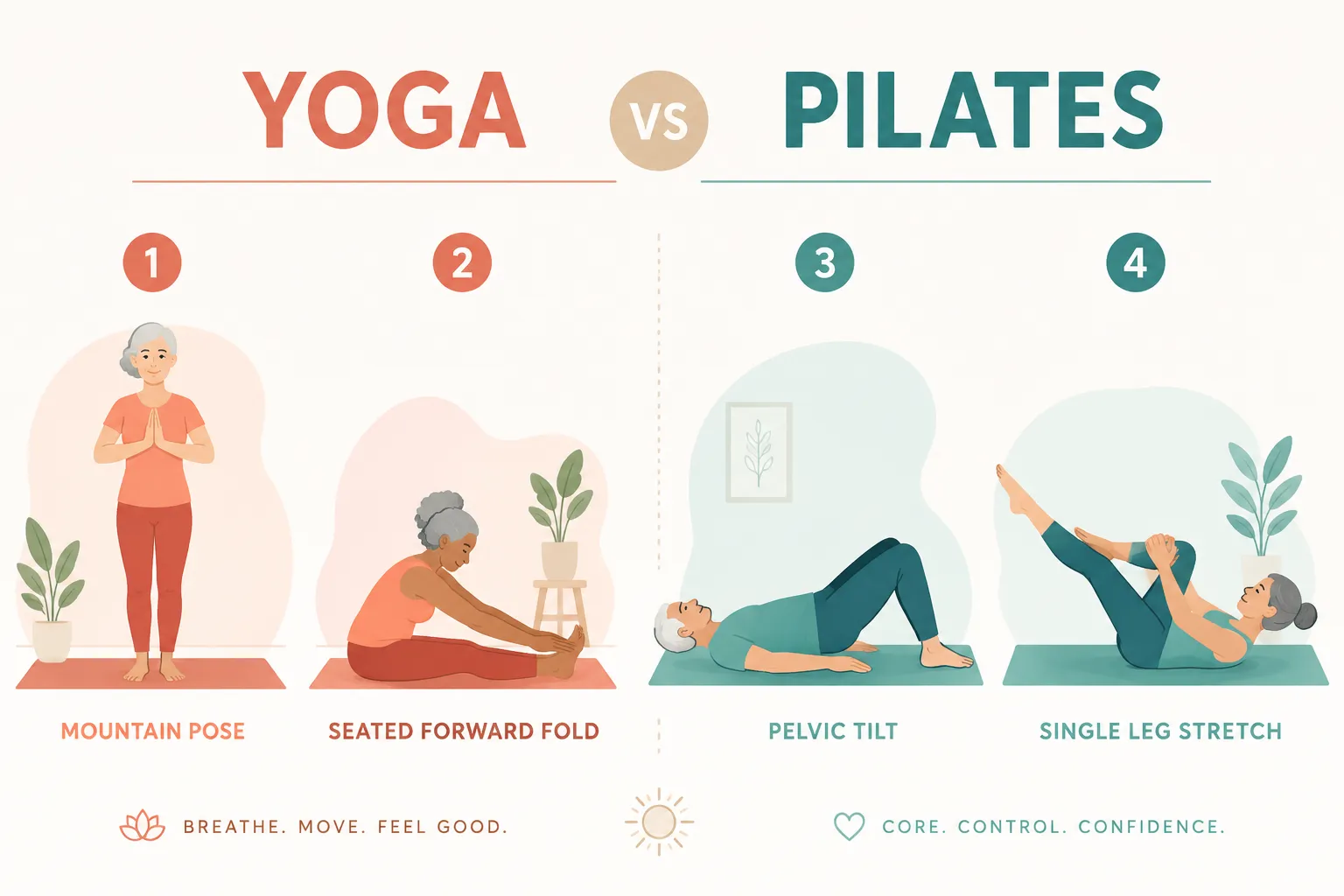
Yoga vs Pilates for Seniors: Which Is Better for Balance, Strength, and Mobility at Home?

Yoga vs Pilates for Seniors: Which Is Better for Balance, Strength, and Mobility at Home?

Last updated: August 4, 2026

Quick Answer

For most seniors training at home, yoga wins for flexibility and joint mobility, while Pilates wins for core strength and fall prevention. A hybrid routine, two yoga sessions and two Pilates sessions per week, usually delivers the best results for balance, strength, and mobility combined. Start with chair-based or gentle mat versions, get medical clearance if you have osteoporosis, joint replacements, or heart conditions, and progress slowly.

Quick Answer

Key Takeaways

  • Yoga improves flexibility, breathing, balance, and joint range of motion through held poses and stretches.
  • Pilates builds deep core strength, spinal stability, and controlled movement, highly effective for fall prevention.
  • For balance, both help, but Pilates tends to produce faster gains because it directly trains core and hip stabilizers.
  • For arthritis and stiff joints, gentle yoga (especially chair or Iyengar styles) is usually more comfortable.
  • 2-4 sessions per week, 20-40 minutes each, is the sweet spot for older adults.
  • Most seniors can start at home with just a mat; a sturdy chair, resistance band, and small pillow help.
  • A hybrid weekly routine covers strength, mobility, and balance better than either practice alone.
  • Skip poses that require deep spinal flexion or inversion if you have osteoporosis or uncontrolled blood pressure.

What's the difference between yoga and Pilates for older adults?

Yoga is a mind-body practice that combines held postures, breathing, and stretching to improve flexibility, balance, and calm. Pilates is a body-conditioning system built around controlled, precise movements that strengthen the deep core, spine, and hips.

The core distinction for seniors:

  • Yoga emphasizes holding positions, breath awareness, and lengthening tight muscles. Many styles have a meditative or spiritual element.
  • Pilates emphasizes moving with control through repetitions, focusing on core engagement, alignment, and muscular endurance.

Yoga typically feels slower and more restorative. Pilates feels more like a targeted strength workout, though it's low-impact. Both are gentle on joints when done correctly, and both can be adapted for limited mobility.

Choose yoga if you want more flexibility, stress relief, and gentle movement. Choose Pilates if you want more core strength, better posture, and stronger fall prevention.

Which is better for improving balance, yoga or Pilates?

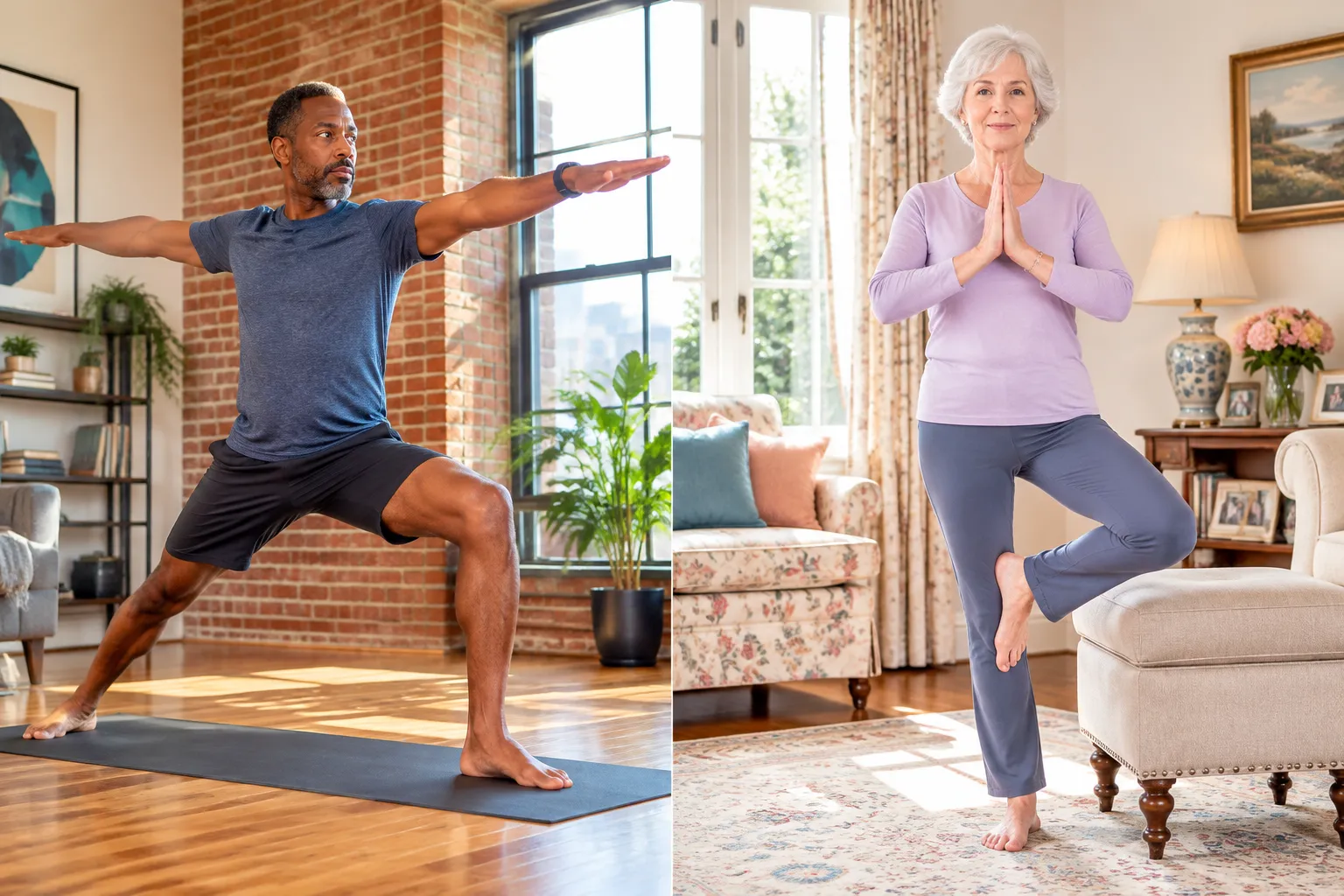
Pilates has a slight edge for balance improvement in seniors, mainly because it directly trains the deep core, glutes, and hip stabilizers that keep you upright. However, yoga's single-leg standing poses (like tree pose or warrior III against a wall) also produce meaningful balance gains.

What the movement science suggests for older adults:

  • Pilates strengthens the transverse abdominis and pelvic floor, muscles central to postural control.
  • Yoga trains proprioception (your sense of where your body is in space) through held single-leg and shifting-weight poses.
  • Combining both gives you strength-based balance (Pilates) and reactive balance (yoga).

Decision rule: If your primary goal is preventing falls, lead with Pilates and add balance-focused yoga poses twice a week.

Can seniors do yoga at home safely without equipment?

Yes, seniors can safely do yoga at home with just a non-slip mat and a sturdy chair for support. Beginners should avoid inversions, deep twists, and unsupported balance poses until they've built confidence.

Safe starting points at home:

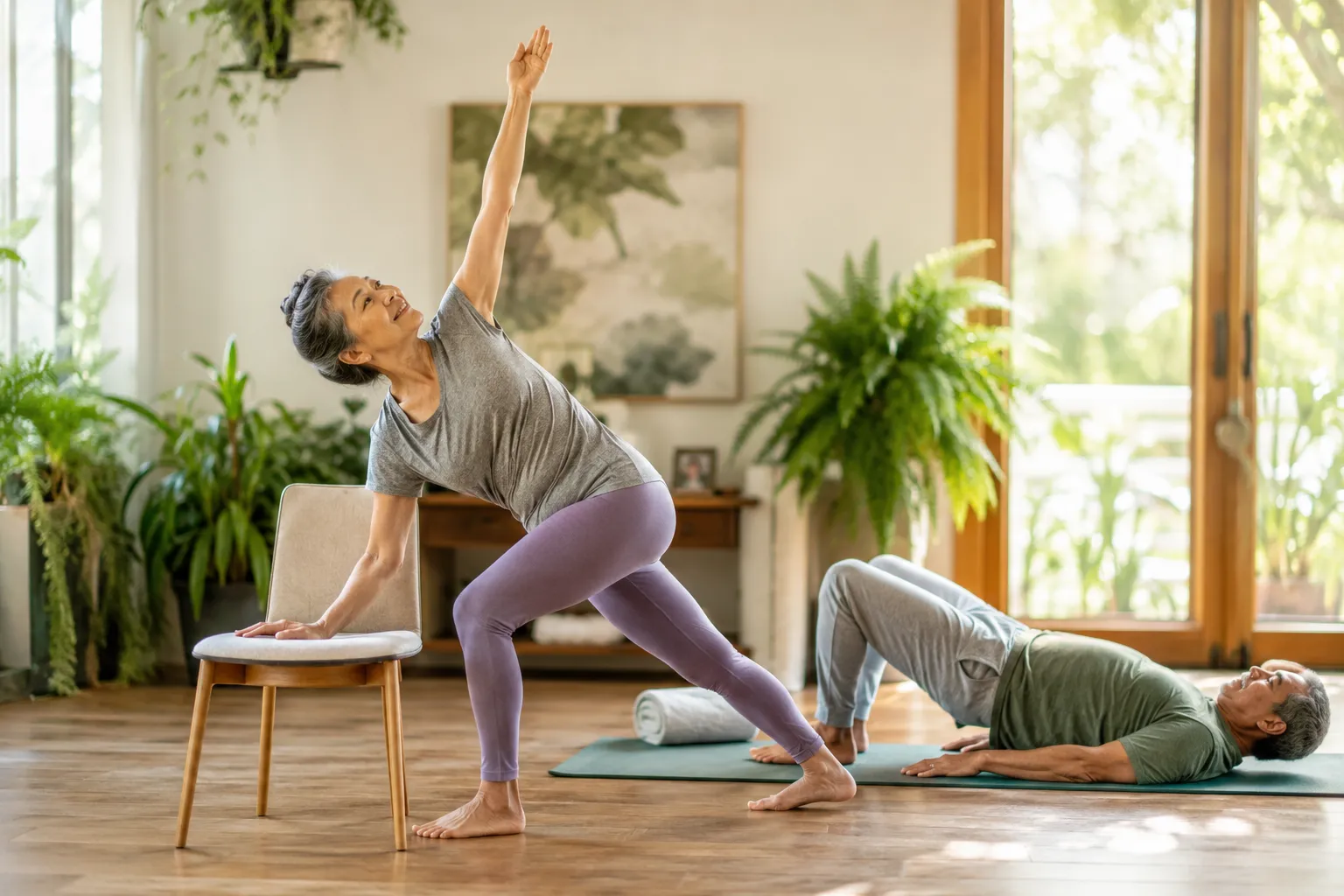
  1. Chair yoga, seated stretches, gentle twists, and standing poses using the chair for stability.
  2. Wall-supported poses, practice tree pose, warrior, and downward dog with a wall behind you.
  3. Floor-based restorative yoga, supported bridge, legs-up-the-wall, gentle spinal twists.
  4. Follow guided videos made specifically for seniors (see the free options section below).

Common safety rule: Never force a stretch. Mild tension is fine; sharp or radiating pain is a stop signal.

Pilates exercises for seniors to build core strength

Pilates is one of the safest ways for older adults to build core strength because most exercises are done lying down or seated, which protects the spine and joints. Start with 5-8 reps of each and build slowly.

Beginner-friendly Pilates moves for seniors:

  • Pelvic tilts, lying on your back, gently rock the pelvis to engage lower abs.
  • Single knee lifts (marching), lying down, lift one knee at a time while keeping the pelvis stable.
  • Bridge, press through the heels to lift the hips, engaging glutes and core.
  • Modified hundred, small arm pulses with knees bent, head down.
  • Seated spine twist, gentle rotation from a tall seated position.
  • Side-lying leg lifts, target hip stabilizers essential for balance.

Consistency matters more than intensity. Two to three 20-minute sessions weekly produce noticeable core improvements within 6-8 weeks for most beginners.

Pilates exercises for seniors to build core strength

Yoga for seniors with arthritis and joint pain

Gentle yoga can reduce arthritis stiffness, improve joint range of motion, and ease chronic pain when practiced consistently. Warm, slow styles like chair yoga, Iyengar (which uses props), and restorative yoga are ideal.

Best practices for arthritic joints:

  • Warm up first with 3-5 minutes of gentle movement or a warm shower before practicing.
  • Use props, blocks, bolsters, straps, and a chair, to reduce strain.
  • Avoid deep knee bends if you have knee osteoarthritis; modify with a chair or wall support.
  • Skip weight-bearing wrist poses (like plank or downward dog) if you have wrist arthritis; use forearms instead.
  • Move slowly between poses to protect inflamed joints.

Poses that tend to help arthritis: cat-cow, gentle seated twists, supported bridge, child's pose with a bolster, and legs-up-the-wall.

How often should seniors practice yoga or Pilates per week?

Most older adults see the best results with 2-4 sessions per week, 20-40 minutes each. Beginners should start with two sessions and add more as strength and stamina build.

A practical weekly schedule:

  • Total beginners: 2 sessions × 20 minutes.
  • Intermediate: 3-4 sessions × 30 minutes.
  • Experienced practitioners: 4-5 sessions × 30-45 minutes, mixing styles.

Rest days matter. Muscles adapt during recovery, not during the workout. Alternating yoga days with Pilates days is a smart way to work different systems without overtraining.

Best yoga poses for seniors with mobility issues

Seniors with limited mobility can safely practice yoga using a chair, wall, or bed as support. The goal is gentle movement through available range, not achieving picture-perfect poses.

Accessible poses worth learning:

  • Seated mountain pose, tall spine in a chair, feet flat, shoulders relaxed.
  • Seated cat-cow, arch and round the spine while seated.
  • Chair forward fold, hinge forward from the hips with hands on thighs.
  • Chair pigeon, cross one ankle over the opposite knee for gentle hip opening.
  • Standing wall push, palms on wall, step back, gently stretch shoulders and calves.
  • Supported warrior II, hold a chair back for balance while stepping into a wide stance.

"Range of motion is a use-it-or-lose-it system. Even five minutes of gentle daily movement can preserve mobility that would otherwise fade quickly after age 65."

Pilates reformer vs mat Pilates for seniors, which is easier?

Reformer Pilates is often easier on the body for seniors because the machine's springs provide adjustable support, making it easier to move without straining. Mat Pilates is cheaper and more accessible at home but requires more baseline core strength.

Quick comparison:

  • Reformer Pilates: Requires a studio or expensive home machine ($2,000+). Springs assist movement, reducing joint load. Excellent for seniors recovering from injury or with weak core muscles.
  • Mat Pilates: Needs only a mat. More challenging because gravity provides the only resistance. Best for seniors with reasonable baseline strength.

Choose reformer if you have joint issues, are recovering from surgery, or can access a studio with senior-friendly instructors. Choose mat if you're training at home on a budget and can start with modified exercises.

Can Pilates help prevent falls in older adults?

Yes, Pilates is one of the most effective non-medical interventions for fall prevention in seniors. It targets the exact muscle systems (deep core, glutes, hip abductors, ankle stabilizers) that keep older adults steady on their feet.

Why Pilates works for fall prevention:

  • Strengthens the posterior chain (glutes, back, hamstrings) that maintains upright posture.
  • Improves hip abductor strength, critical for single-leg balance and stair navigation.
  • Trains controlled deceleration, which helps you catch yourself during a stumble.
  • Enhances body awareness and alignment, reducing missteps.

For fall prevention specifically, aim for 2-3 Pilates sessions weekly, focused on standing exercises, bridges, and single-leg work as strength improves.

Yoga or Pilates, better for flexibility in seniors?

Yoga is more effective for improving flexibility in older adults. It uses longer-held stretches that gradually lengthen muscles and connective tissue, while Pilates focuses more on controlled strength than deep flexibility.

That said, Pilates does improve functional flexibility, the range you can actively control, which matters for daily tasks like reaching, bending, and turning. Yoga improves passive flexibility (how far you can stretch), while Pilates improves active flexibility (how much of that range you can use with strength).

Best combo: Do yoga for flexibility on two days and Pilates for strength on two days. This produces well-rounded mobility that transfers to real-world movement.

Senior yoga classes online, free or affordable options

Several trusted platforms offer free or low-cost yoga specifically for seniors. Always look for instructors certified in senior or adaptive yoga.

Reliable options as of 2026:

  • YouTube (free): Channels like Yoga with Adriene (gentle series), SilverSneakers, and Yoga with Kassandra offer senior-friendly content.
  • SilverSneakers: Free for many Medicare Advantage plan members; includes live and on-demand yoga.
  • Yoga International, Alo Moves, Gaia: Paid subscriptions ($10,$20/month) with curated senior-friendly libraries.
  • Local library or community center: Often offer free streaming yoga classes for seniors.
  • YMCA Y360: Included with many YMCA memberships; features senior yoga and Pilates.

Tip: Preview any class before following along. If the instructor doesn't offer modifications, choose another one.

What equipment do I need to start Pilates at home?

You can start Pilates at home with just a yoga or exercise mat and comfortable clothing. As you progress, a few inexpensive additions make workouts more effective.

Starter equipment checklist:

  • Non-slip mat ($20-40), thicker than a yoga mat for spine comfort.
  • Sturdy chair, free; used for support in many senior modifications.
  • Small pillow or towel ($0-10), for head or knee support.
  • Resistance band ($10-20), adds gentle resistance for arms and legs.
  • Small Pilates ball or rolled towel ($10-15), great for core engagement.
  • Optional: Foam roller ($20-30), for mobility and gentle self-massage.

Total starter cost: under $80. No expensive machines required.

What equipment do I need to start Pilates at home?

Is yoga or Pilates better for someone with bad knees?

Pilates is generally safer for seniors with knee problems because most exercises are done lying down or seated, keeping weight off the knees. Yoga can also work if you avoid deep knee bends and use props for support.

Knee-friendly guidelines:

  • In Pilates: Skip full squats and lunges; favor bridges, clamshells, and leg circles.
  • In yoga: Avoid deep warrior poses and hero pose; use a chair for lunges, and place a folded blanket under the knee in kneeling positions.
  • Always warm up with gentle joint circles before harder movements.
  • Never lock the knees in standing poses, keep a soft micro-bend.

If knee pain persists during any exercise, stop and consult a physical therapist. Some knee conditions require personalized modifications.

Common mistakes seniors make when starting yoga or Pilates

The most common mistakes come from doing too much too soon, skipping warmups, or following classes designed for younger, more flexible bodies.

Mistakes to avoid:

  • Going too fast, too soon, start with 2 short sessions weekly, not 5 long ones.
  • Following general classes instead of senior-specific ones.
  • Holding the breath during poses or reps, breath should flow steadily.
  • Ignoring pain signals, soreness is fine, sharp pain is not.
  • Skipping the warmup and cooldown, both matter more as we age.
  • Comparing yourself to the instructor, modifications are the goal, not a "failure."
  • Practicing on slippery floors, invest in a proper non-slip mat.
  • Skipping medical clearance if you have osteoporosis, joint replacements, cardiac issues, or balance disorders.

The case for a hybrid yoga and Pilates routine at home

For most seniors, the best answer to "yoga vs Pilates for seniors: which is better for balance, strength, and mobility at home?" isn't picking one, it's blending both. A hybrid routine covers every physical system that matters as we age.

A simple weekly hybrid schedule:

Day Practice Duration Focus
Monday Pilates 25 min Core, hips
Tuesday Rest or walking , Recovery
Wednesday Yoga 30 min Flexibility, breath
Thursday Rest or walking , Recovery
Friday Pilates 25 min Balance, glutes
Saturday Gentle yoga 20 min Restorative
Sunday Rest , Recovery

This structure builds strength, mobility, flexibility, and balance without overtraining. Adjust duration based on your energy and starting fitness.

FAQ

Is yoga or Pilates better for seniors over 70?
Both are safe and effective, but many seniors over 70 do best starting with chair yoga or beginner Pilates for the first month, then adding standing poses as strength returns.

Can I do yoga or Pilates with osteoporosis?
Yes, but avoid deep forward folds, spinal twists under load, and any flexion of the spine. Focus on extension-based poses and get clearance from your doctor first.

How long until I see results?
Most seniors notice better balance and less stiffness within 3-4 weeks of consistent practice. Strength and flexibility gains become clear at 8-12 weeks.

Do I need an instructor?
Not required, but at least one session with a certified senior fitness instructor is highly recommended to check your alignment and modifications before going solo.

Can I do both on the same day?
Yes, short sessions (15 minutes each) or one session using both styles works well. Just avoid two intense sessions back-to-back.

Is Pilates safe after hip or knee replacement?
Usually yes, but only after your surgeon clears you. A physical therapist can help you transition safely into either practice.

What should I wear?
Comfortable, breathable clothing that lets you move. Avoid slippery socks; either bare feet or grip socks work best.

Can yoga or Pilates replace strength training?
Pilates provides real strength gains, especially in the core and hips. Yoga does less for pure strength. For full-body strength, add light resistance training 1-2 times weekly.

Conclusion

Yoga and Pilates aren't rivals, they're complementary tools for aging well. Yoga gives you flexibility, calm, and better joint mobility. Pilates gives you core strength, stability, and stronger fall prevention. Together, they cover the full spectrum of what an older body needs to stay independent, upright, and pain-free.

Next steps:

  1. Get medical clearance if you have any joint, heart, or balance conditions.
  2. Buy a non-slip mat and set up a small practice space near a sturdy chair.
  3. Start with two 20-minute sessions per week, one gentle yoga, one beginner Pilates.
  4. Use a senior-specific instructor (SilverSneakers, YouTube senior channels, or a local class).
  5. Track how you feel after 4 weeks and adjust duration or frequency from there.

Consistency beats intensity every time. Fifteen minutes today is worth more than an hour planned for someday.

Core Strength and Balance Flow Sessions at Home to Boost Mobility and Prevent Falls

Core Strength and Balance Flow Sessions at Home to Boost Mobility and Prevent Falls

Last updated: August 1, 2026

Quick Answer

Quick Answer

Core strength and balance flow sessions at home to boost mobility and prevent falls combine gentle abdominal and hip work with slow, connected movement patterns borrowed from yoga, tai chi, and Pilates. Done 2-4 times a week for 20-30 minutes, this style of training has been shown in multiple clinical reviews (including the Cochrane 2019 falls-prevention meta-analysis) to cut fall risk in older adults by roughly 20-30%. No gym required, just a sturdy chair, a mat, and a wall.

Key Takeaways

  • Frequency matters more than intensity. Three sessions a week for 12 weeks is the sweet spot most research points to.
  • Flow beats isolated reps. Linking movements (like a cat-cow into a bird-dog into a side plank) trains the nervous system to react, which is what actually prevents falls.
  • A chair is the single most important tool. It doubles as support, a prop, and a resistance anchor.
  • Core weakness shows up as poor posture, back pain, and difficulty rising from a chair, not just a soft belly.
  • Static balance (holding still) and dynamic balance (moving through space) are different skills. You need both.
  • Younger adults benefit too. Balance flow work restores mobility lost to desk jobs and reduces injury risk in sport.
  • Most people notice improvements in 2-4 weeks; measurable fall-risk reduction typically appears by week 8-12.
  • You do not need a trainer to start, but a one-time video assessment can catch bad form early.

What is core strength and balance training, and why does it prevent falls?

Core strength and balance training is a category of exercise that strengthens the muscles wrapping your trunk, hips, and pelvis, while simultaneously challenging your body's ability to sense and correct its position in space. It prevents falls because most falls happen when the body loses balance mid-movement (stepping off a curb, turning quickly, reaching for something) and the core is too slow or too weak to catch the shift.

Three systems keep you upright: your inner ear (vestibular), your eyes (visual), and your body's position sensors (proprioceptive). Balance flow sessions train all three at once. When you slowly transition from a standing pose to a lunge with your eyes tracking your hand, you're forcing those systems to talk to each other, the exact skill that fails during a real-world stumble.

The core isn't just abs. It's the diaphragm on top, pelvic floor on the bottom, and deep abdominal and back muscles wrapping around like a corset. Weakness anywhere in this cylinder makes balance harder.

How often should I do balance and core exercises to see results?

Aim for 2-4 sessions per week, 20-30 minutes each, for at least 12 weeks. Research on older adults consistently shows this is the minimum "dose" needed to reduce fall risk meaningfully. Fewer than two sessions a week produces mood benefits but limited physical change.

A realistic weekly template:

Day Session Length
Monday Core + slow balance flow 25 min
Wednesday Tai-chi-inspired dynamic flow 20 min
Friday Pilates-based core + wall balance 30 min
Optional Sun Gentle mobility walk-through 15 min

Choose more frequency (4x) if: you're recovering from a fall, have osteoporosis, or are over 70.
Choose less (2x) if: you're active in other sports and using this as maintenance.

Best core strength exercises for seniors at home

The best exercises are low-impact, chair-optional, and build from stable to unstable positions. Start with these five:

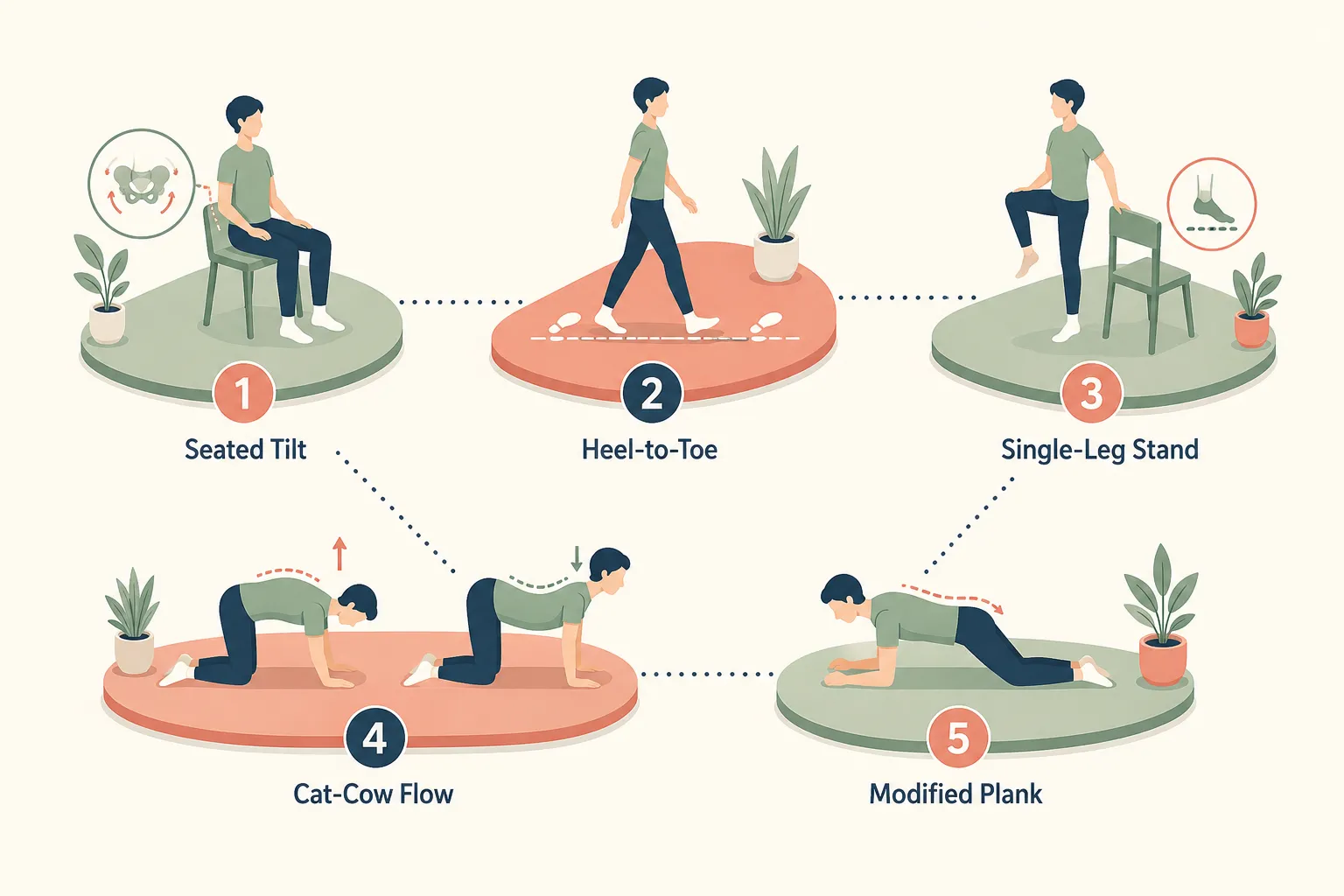
  1. Seated pelvic tilts, Sit tall, rock the pelvis forward and back 10 times. Wakes up the deep abdominal wall.
  2. Modified dead bug, Lie on your back, knees bent at 90°, lower one heel to tap the floor, alternate. 8 per side.
  3. Bird-dog (from hands and knees), Extend opposite arm and leg, hold 3 seconds. 6 per side.
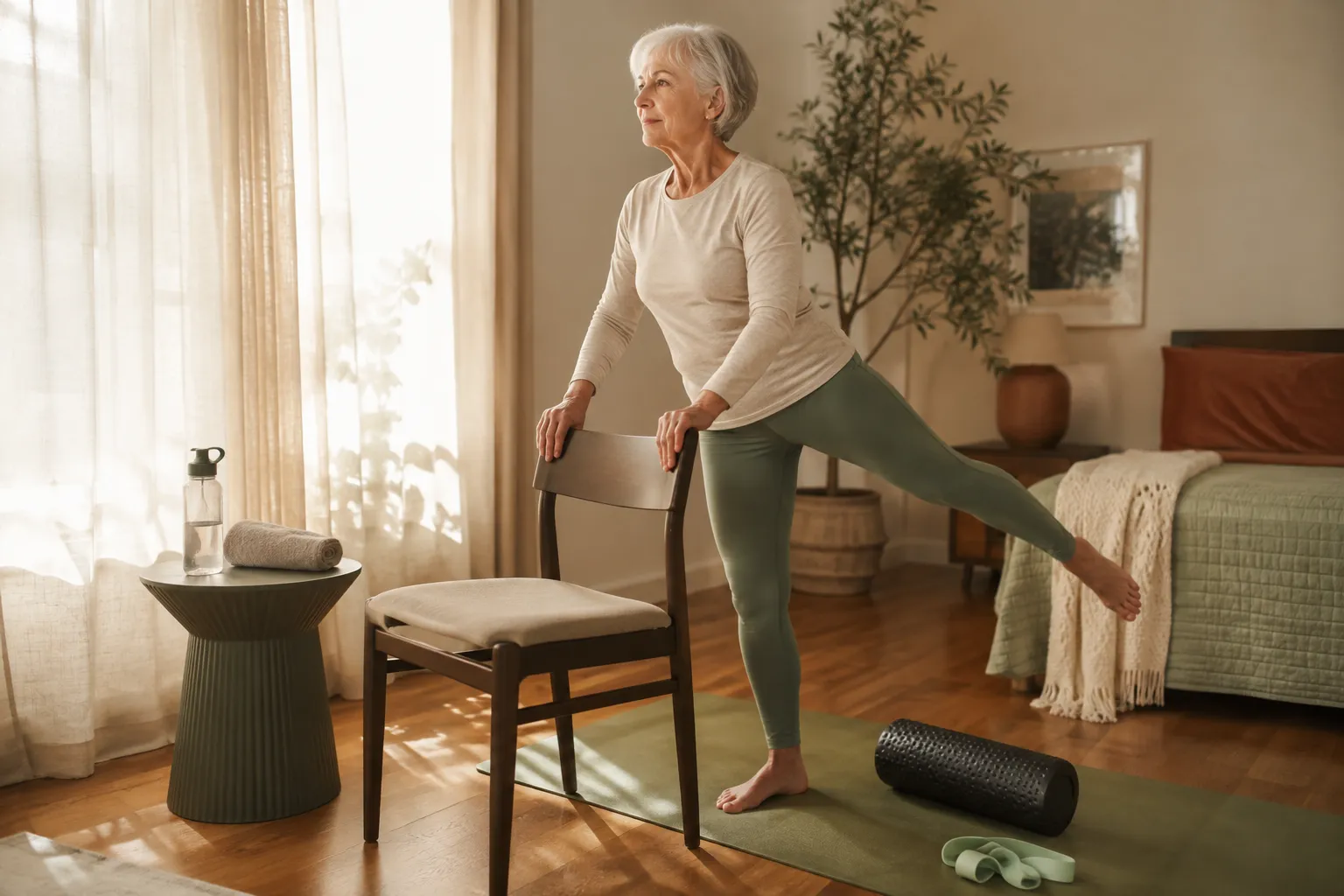
  4. Standing marches with chair support, Lift knee to hip height, pause, lower. 10 per side.
  5. Wall sit with breath focus, Slide down a wall to a shallow squat, hold 20-30 seconds while breathing slowly.

)

The trick with older adults: quality over quantity. Six slow, focused reps beat twenty sloppy ones every time.

Can balance training really prevent falls, or does it just help with stability?

Yes, it genuinely prevents falls, not just stability in the moment. The Cochrane systematic review of exercise for fall prevention (Sherrington et al., 2019) analyzed over 100 trials and found that balance and functional training reduced the rate of falls by about 24% in community-dwelling older adults. Tai chi specifically showed roughly a 20% reduction.

The mechanism isn't just stronger legs. Balance flow work:

  • Sharpens reaction time in the ankles and hips (the "ankle strategy" and "hip strategy" your brain uses to catch a stumble).
  • Improves proprioception, your unconscious sense of where your limbs are.
  • Reduces fear of falling, which itself is a major fall predictor. Fearful walkers shuffle, and shuffling causes falls.

Common mistake: People assume walking is enough. It isn't. Walking is linear and predictable; falls happen in unpredictable moments. You need training that mimics the chaos.

What equipment do I need for home balance and core workouts?

What equipment do I need for home balance and core workouts?

Very little. The five essentials:

  • A sturdy, non-rolling chair (dining chair, not office chair)
  • A yoga mat with grip
  • A clear wall space at least 4 feet wide
  • Comfortable, snug clothing (loose pants can trip you)
  • Bare feet or thin, flexible shoes, cushioned running shoes actually reduce balance feedback

Optional upgrades once you're 4-6 weeks in:

  • Balance pad or folded towel ($15-30) for unstable surface training
  • Resistance loop bands ($10) for hip strength
  • Light dumbbells (2-5 lb) for added core load

Skip: BOSU balls, wobble boards, and vibrating plates until you have a solid base. They're not beginner tools despite the marketing.

How long should a core and balance session be?

Twenty to thirty minutes is the sweet spot for most home practitioners. Shorter than 15 minutes and you can't cover warm-up, main work, and cool-down properly. Longer than 40 minutes and fatigue leads to sloppy form, which is when injuries happen.

A well-built session:

  • 5 minutes warm-up: joint circles, gentle spinal rolls, breath work
  • 10-15 minutes main flow: core activation → static balance → dynamic balance flow
  • 5 minutes cool-down: stretching, floor work, breathing

If you only have 10 minutes, keep the warm-up and cut the main flow in half. Never skip the warm-up before balance work.

Is balance training safe if I already have balance problems?

Yes, but start seated and near support. People with existing balance issues benefit the most from this training, they just need to scale entry appropriately.

Safe-start rules:

  1. First 2 weeks: do everything seated or with two hands on a chair back.
  2. Weeks 3-4: progress to one hand on chair.
  3. Weeks 5+: fingertips only, then hover, then hands free.

Talk to a doctor first if you have: recent surgery, uncontrolled vertigo, severe osteoporosis, Parkinson's-related instability, or you've fallen more than twice in the past year. A physical therapist can screen you and clear you for home practice.

Edge case: If you have inner ear disorders (BPPV, Meniere's), certain head-turning movements can trigger dizziness. Modify by keeping the gaze forward and moving slowly.

Static balance exercises vs. dynamic balance flow, what's the difference?

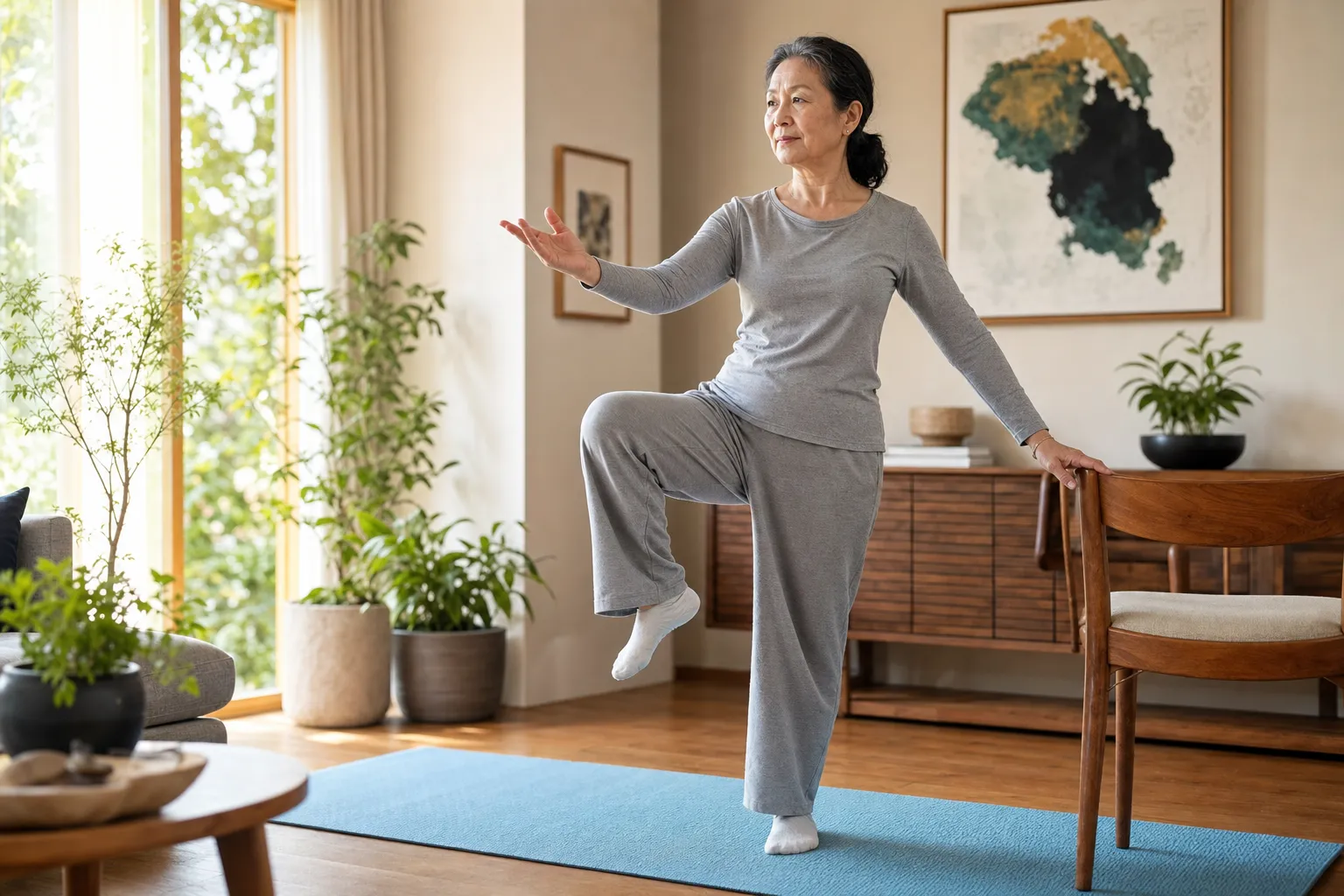
Static balance is holding still, standing on one foot, tree pose, a plank. Dynamic balance is maintaining control while moving, walking heel-to-toe, transitioning between yoga poses, tai chi weight shifts. You need both, but dynamic balance flow is what most closely mimics real-life fall situations.

Static Balance Dynamic Balance Flow
What it trains Postural muscles, endurance Reaction, coordination
Example Tree pose, single-leg stand Tai chi form, sun salutation
Best for Beginners, foundation Real-world fall prevention
Time to master 2-3 weeks 6-12 weeks

Rule of thumb: Spend the first month mostly static. Layer in dynamic flow once you can hold single-leg stands for 20 seconds without wobbling.

Online balance classes vs. in-person: what's the cost difference?

Online core and balance classes typically run $10-30 per month for unlimited access (SilverSneakers On-Demand, Yoga with Adriene's free library, GetActive, Bold, Nymbl). In-person classes at a studio or Y average $15-25 per class or $80-150 per month for unlimited. Physical therapy sessions run $75-200 each but often include insurance coverage.

)

Choose online if: you're self-motivated, have basic fitness experience, and want flexibility.
Choose in-person if: you need accountability, have specific medical concerns, or benefit from social exercise.
Choose PT (at least short-term) if: you've fallen recently or have a diagnosed condition. Get cleared first, then transition to home practice.

Can younger people benefit from balance flow, or is it just for older adults?

Can younger people benefit from balance flow, or is it just for older adults?

Balance flow benefits every age, it's marketed to seniors because they're the group with the highest fall risk, but adults in their 20s, 50s often have surprisingly poor balance from sedentary jobs. If you can't stand on one foot with eyes closed for 10 seconds, you're behind the curve.

For younger adults, balance flow specifically helps:

  • Runners and cyclists, improves single-leg stability, reduces knee and ankle injuries
  • Desk workers, reverses hip and thoracic stiffness
  • Parents, restores the core control lost during pregnancy or from years of one-sided carrying
  • Recreational athletes, sharpens agility and reaction time

The training just scales up: faster flows, less support, more single-leg work, added load.

How do I know if my core is weak and needs work?

Try these four quick self-tests. Struggling with two or more means your core needs attention:

  1. Sit-to-stand test: Rise from a chair without using your hands. Can you do it 5 times in under 15 seconds?
  2. Single-leg stand: Balance on one foot with eyes open. Under 20 seconds is a red flag if you're under 65.
  3. Plank hold: Forearm plank with a straight line from head to heels. Under 30 seconds signals weakness.
  4. Bend-and-reach: Bend to touch your toes and stand back up. Does your low back hurt or do you feel unstable?

Other signs: chronic low back pain, poor posture when tired, difficulty carrying groceries up stairs, needing hands to push off your thighs when standing.

What mistakes do people make starting balance training at home?

The five most common errors:

  1. Skipping the warm-up. Cold joints plus balance work equals sprained ankles. Always do 3-5 minutes of joint circles first.
  2. Progressing too fast. People see quick early gains and jump to advanced moves. The nervous system needs 4-6 weeks to consolidate before adding challenge.
  3. Holding the breath. Balance requires oxygen to the brain. Breath-holding is a top cause of dizziness during practice.
  4. Practicing on carpet. Deep pile carpet actually makes balance too unstable for beginners. Firm floor with a mat is better.
  5. Only training in one direction. Everyone does forward lunges and forgets side and rotational movement, but most real falls involve twisting or lateral shifts.

Do I need a trainer, or can I do core and balance flow on my own?

Most healthy adults can do this on their own using video classes and structured programs. But one or two sessions with a qualified trainer or physical therapist at the start will catch form errors that would otherwise become injuries or plateaus.

Consider a professional if:

  • You've fallen in the past year
  • You have osteoporosis, arthritis, or a joint replacement
  • You're recovering from surgery or a stroke
  • You feel dizzy or unstable doing basic moves
  • You've been sedentary for over a year

Otherwise, well-structured video programs from certified instructors (look for CPT, PT, or E-RYT credentials) work well. YouTube channels focused on senior fitness, Pilates, and gentle yoga are legitimate starting points.

How quickly will I notice improvements in mobility and balance?

Week 1-2: You'll feel more aware of your body. Balance itself may not improve yet, but posture usually does.
Week 3-4: Single-leg stands get noticeably steadier. Getting out of chairs feels easier.
Week 6-8: Mobility improvements become obvious, reaching, turning, and stair-climbing feel smoother.
Week 8-12: Measurable fall-risk reduction appears in objective tests (Berg Balance Scale, Timed Up and Go).
Week 12+: Gains consolidate. Stopping now means losing progress within 4-6 weeks.

The key: consistency beats intensity. Three 20-minute sessions a week for 12 weeks outperforms one 90-minute weekend session.

FAQ

Q: Can I do balance flow if I use a cane or walker?
A: Yes. Start entirely seated, then progress to standing with two hands on a sturdy surface. Many chair yoga and seated tai chi programs are designed exactly for this.

Q: Will core work flatten my belly?
A: It may improve posture and reduce the visual "pooch" from weak deep abdominals, but visible fat loss requires nutrition changes. Core training is for function first, aesthetics second.

Q: Is yoga or tai chi better for fall prevention?
A: Tai chi has more direct fall-prevention research behind it. Yoga builds more strength and flexibility. A blended flow session gets the best of both.

Q: Can I do this if I have knee pain?
A: Yes, with modifications. Avoid deep squats and kneeling positions; substitute chair-based versions. Knee pain often improves as hip and core strength develop.

Q: What time of day is best?
A: Morning for most people, joints warm up during the session and you gain balance benefits throughout the day. Avoid right before bed if practice energizes you.

Q: Do I need to warm up if the flow is already gentle?
A: Yes. Even gentle balance work challenges the nervous system, and cold muscles react slowly. Five minutes of joint circles is non-negotiable.

Q: Can I combine this with strength training?
A: Absolutely. Do balance flow on strength-training rest days, or as a 10-minute warm-up before lifting.

Q: Will I feel sore?
A: Mild soreness in the deep abdominals, hips, and small stabilizer muscles is normal for the first 2 weeks. Sharp pain is not.

Conclusion: Your Next Steps

Start this week. Not with a 90-minute masterclass, but with one 20-minute session. Set a chair on your mat, watch a beginner-level balance flow video, and commit to three sessions this week.

Concrete action plan:

  1. Today: Do the four self-assessment tests. Write down your numbers.
  2. This week: Complete three 20-minute sessions. Any beginner tai chi, chair yoga, or Pilates fundamentals video works.
  3. Week 2-4: Add one new balance challenge per week (eyes closed briefly, one hand off the chair, a longer hold).
  4. Week 6: Retest yourself. Compare to week 1.
  5. Week 12: Reassess. Adjust your program based on what improved most.

Core strength and balance flow sessions at home to boost mobility and prevent falls aren't a quick fix, they're a lifelong maintenance practice, like brushing your teeth. Twenty minutes, three times a week, for the rest of your life is the actual prescription. The payoff, staying independent, mobile, and unafraid of falling, is worth every session.

Chair and Standing Workouts for Seniors: Low-Impact Strength and Mobility When Getting Down Is Difficult

Chair and Standing Workouts for Seniors: Low-Impact Strength and Mobility When Getting Down Is Difficult

Last updated: July 30, 2026

Quick Answer

Chair and standing workouts for seniors are structured, low-impact routines that build strength, balance, and circulation without requiring you to get down to the floor. A safe weekly plan combines 2-3 seated strength sessions (leg extensions, seated marches, arm curls) with 2-3 supported standing sessions (calf raises, sit-to-stands, side leg lifts), each 15-30 minutes. Done consistently, these workouts improve posture, reduce fall risk, and preserve independence, even for adults with arthritis, balance problems, or limited mobility.[1][2][8]

Key Takeaways

  • Full-body training is possible from a chair. Seated routines can target legs, core, arms, and back with proper form and pain-free range of motion.[1]
  • Aim for 4-5 short sessions per week, mixing seated and supported-standing days for balance and strength.
  • A sturdy armless chair on a non-slip surface is the single most important piece of equipment.[1][9]
  • Supported standing exercises (holding a chair or counter) are the safest way to train balance if you're at risk of falls.[6][7]
  • Visible results appear in 4-8 weeks with consistent practice: easier sit-to-stand, better posture, less stiffness.[2]
  • Chair yoga focuses on flexibility and breath; chair aerobics raises heart rate, most seniors benefit from both.
  • Stop immediately if you feel chest pain, dizziness, or sharp joint pain, these are not "push through" workouts.

Key Takeaways

What Are Chair Exercises for Seniors With Limited Mobility?

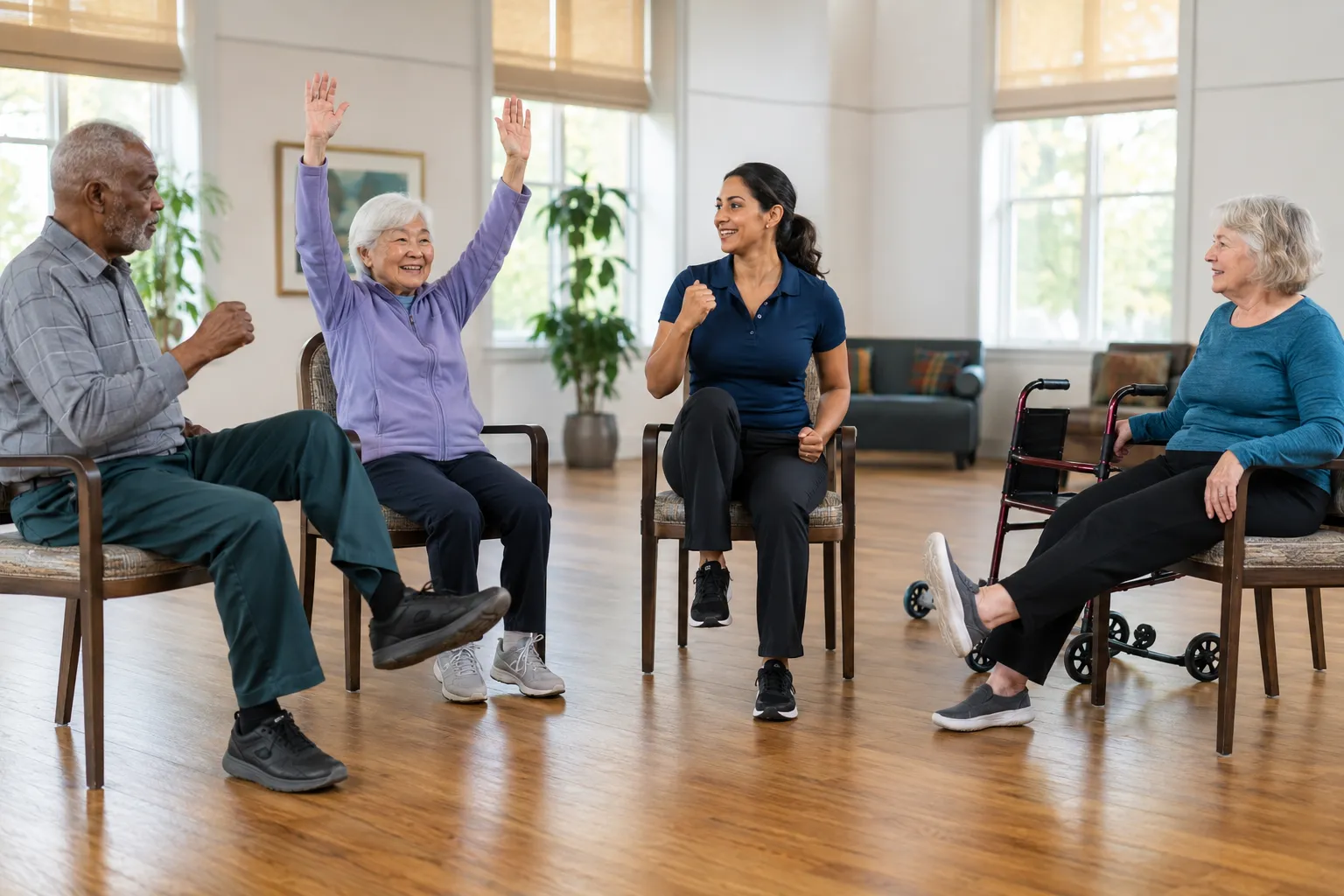
Chair exercises are strength, mobility, and cardio movements performed while seated in a sturdy chair, designed for older adults who can't safely get down to (or up from) the floor. They cover the same fitness pillars as standard workouts, muscle strength, joint mobility, cardiovascular endurance, and flexibility, just adapted so the chair provides stability and support.[1][2]

Common seated movements include:

  • Seated leg extensions, lift one leg until it's parallel to the floor, hold 2 seconds, lower slowly. 10-12 reps per leg.[1]
  • Seated marches, lift knees alternately as if walking. 30-60 seconds for a cardio burst.
  • Seated arm curls with light dumbbells or water bottles, 10-15 reps.
  • Seated trunk rotations, gentle twists to keep the spine mobile.[8]
  • Ankle circles and wrist circles, 8-12 per direction to keep joints lubricated.[8]

Choose chair-based workouts if you have knee replacements, severe arthritis, vertigo, recent surgery, or simply feel unsafe standing without support. They're also the right starting point after long periods of inactivity.

How Do You Do Standing Workouts Safely if You Have Balance Issues?

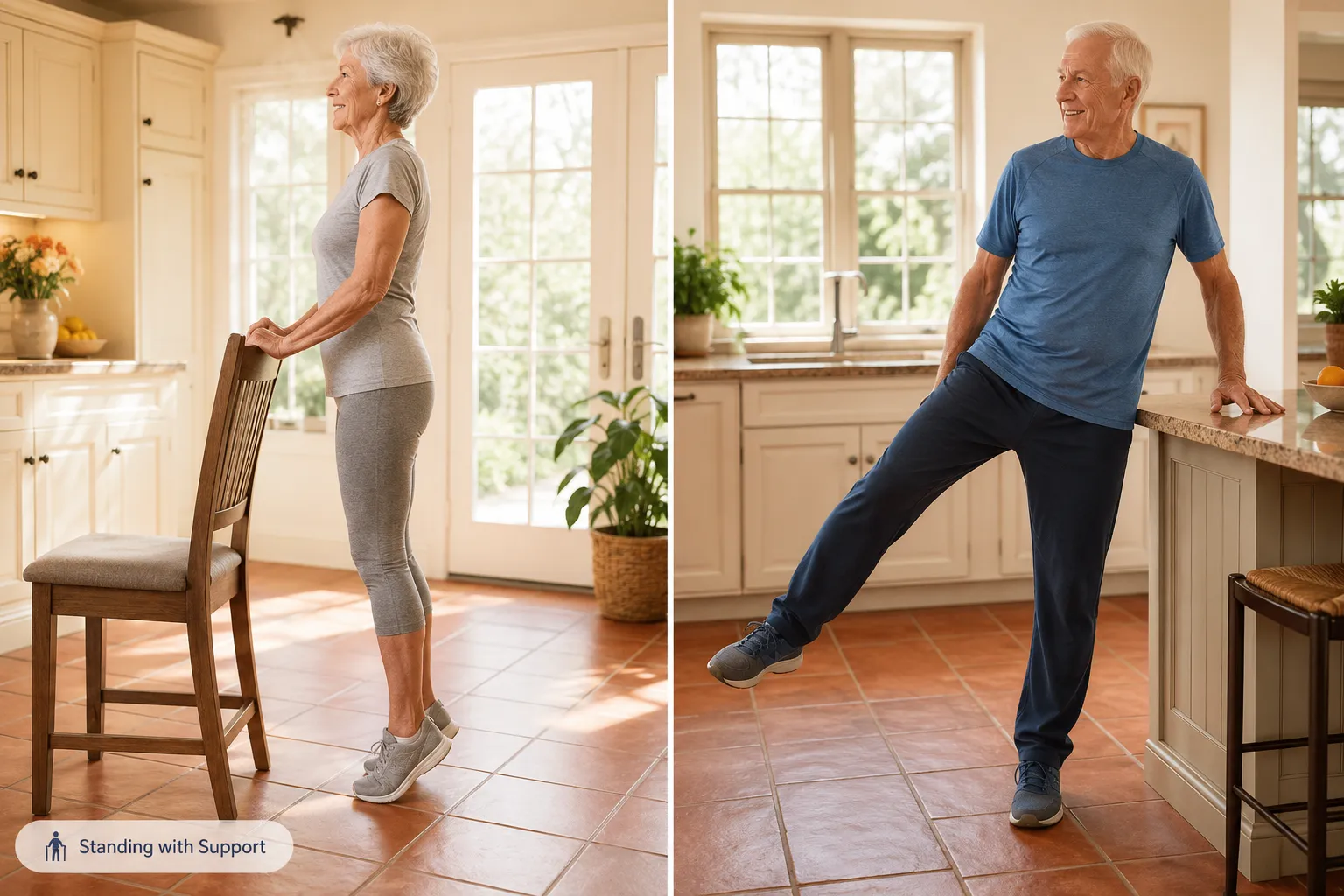
Always keep at least one hand on a sturdy anchor, the back of a heavy chair, a kitchen counter, or a wall bar, and never train standing exercises alone if you've fallen in the past year. Position yourself so you can sit down within one step at any moment.[6][7]

Safe setup checklist:

  1. Use a chair with a high back and no wheels, placed against a wall so it can't slide.
  2. Wear flat, closed-toe shoes with grip, no socks on hardwood.
  3. Clear a 3-foot radius of rugs, cords, and pets.
  4. Have water within reach and a phone nearby.
  5. Start with both hands on the chair back; progress to one hand, then fingertips, only when steady.

Beginner supported-standing moves:

  • Sit-to-stands, from a chair, stand up and sit down slowly. 8-10 reps. This is the single best predictor of independence in later life.
  • Standing calf raises, rise onto toes, lower with control. 10-15 reps.
  • Standing side leg lifts, lift one leg out to the side. 10 per side.
  • Standing marches, lift knees while holding the chair. 30 seconds.

Common mistake: Rushing to let go of support. Balance improves by degrees. Spend 2-4 weeks holding on with both hands before reducing support.

Can Seniors Build Muscle Strength From Chair Exercises Alone?

Yes, chair exercises can build meaningful strength, especially in the legs, core, shoulders, and arms, when they use enough resistance and are done 2-3 times per week. Muscle responds to challenge at any age, and Harvard Health confirms that seated resistance work improves strength, stamina, and daily function in older adults.[2]

To make chair work strength-building (not just movement):

  • Add resistance: light dumbbells (1-5 lb), resistance bands, or filled water bottles.
  • Slow the tempo: 2 seconds up, 2 seconds pause, 3 seconds down. Slow reps recruit more muscle.
  • Progress gradually: when 12 reps feel easy, add a set or increase weight by 1-2 lb.
  • Train opposing muscles: curls and presses, extensions and hamstring curls.

Edge case: If you have severe sarcopenia (age-related muscle loss), pair chair strength work with adequate protein, roughly 1.0-1.2 g per kg of body weight daily, or the muscle-building signal has nothing to work with.

Can Seniors Build Muscle Strength From Chair Exercises Alone?

Chair Yoga vs. Chair Aerobics: What's the Difference?

Chair yoga emphasizes slow stretching, breath control, and flexibility; chair aerobics emphasizes continuous movement to raise heart rate and improve cardiovascular fitness. Neither is "better", they train different systems, and most seniors benefit from doing both across the week.

Chair Yoga
Pace: slow · Focus: flexibility, breath, calm · Typical moves: seated cat-cow, chest openers, seated forward fold, neck stretches · Heart rate: low

Chair Aerobics
Pace: moderate to brisk · Focus: cardio, circulation, stamina · Typical moves: seated marches, punches, side taps, boxer shuffles · Heart rate: elevated

Choose chair yoga if stress, stiffness, or sleep is your main concern. Choose chair aerobics if endurance, energy, or heart health is the priority. Do both if you want a complete program.

Best Low-Impact Standing Exercises for Seniors With Arthritis

For arthritic joints, the best standing exercises use short lever arms, pain-free range, and constant chair support. Prioritize movements that strengthen muscles around the joint without loading it heavily, quad sets, hip abductions, and calf raises fit this profile.[7][10]

Arthritis-friendly standing routine (10 minutes):

  1. Warm-up marches at the counter, 60 seconds
  2. Mini sit-to-stands (halfway down only), 8 reps
  3. Standing calf raises, 12 reps
  4. Standing hip abductions (leg out to side), 10 per side
  5. Standing hamstring curls (heel toward glute), 10 per side
  6. Wall push-ups, 8-10 reps
  7. Cool-down: standing chest opener, hold 20 seconds

Rule of thumb: Pain during exercise should not exceed 3/10, and it should return to baseline within an hour of stopping. If it doesn't, reduce range or reps next session.

How Often Should Seniors Do Chair and Standing Workouts Per Week?

Aim for 4-5 sessions per week, typically 2-3 strength-focused days and 2-3 mobility or cardio days, with at least one full rest day. Sessions of 15-30 minutes are enough to produce measurable gains within two months.[2][8]

Sample weekly plan:

Day Focus Length
Monday Seated strength (legs + arms) 25 min
Tuesday Chair yoga / mobility 20 min
Wednesday Supported standing strength 20 min
Thursday Rest or gentle walk ,
Friday Seated aerobics 20 min
Saturday Supported standing balance 20 min
Sunday Chair yoga or full rest 15 min

Beginner adjustment: Start with 3 days a week for the first two weeks. Add a fourth day only when you're not sore the next morning.

Can You Lose Weight Doing Seated Exercises as a Senior?

Yes, modest weight loss is achievable with consistent seated workouts combined with dietary adjustments, but chair cardio alone burns fewer calories than walking, so the diet side matters more. Expect a slow, sustainable pace of 0.5-1 pound per week when both are aligned.

  • Calorie burn (seated aerobics): roughly 120-200 calories per 30-minute session, depending on intensity and body size.
  • Muscle mass matters: strength work raises resting metabolic rate, which helps long-term.
  • Diet lever: a 300-500 calorie daily reduction, paired with adequate protein, drives most senior weight loss.

Don't try aggressive calorie cuts. Rapid weight loss in older adults often strips muscle, which is exactly what chair workouts are trying to build.

What Equipment Do You Need for Chair Workouts at Home?

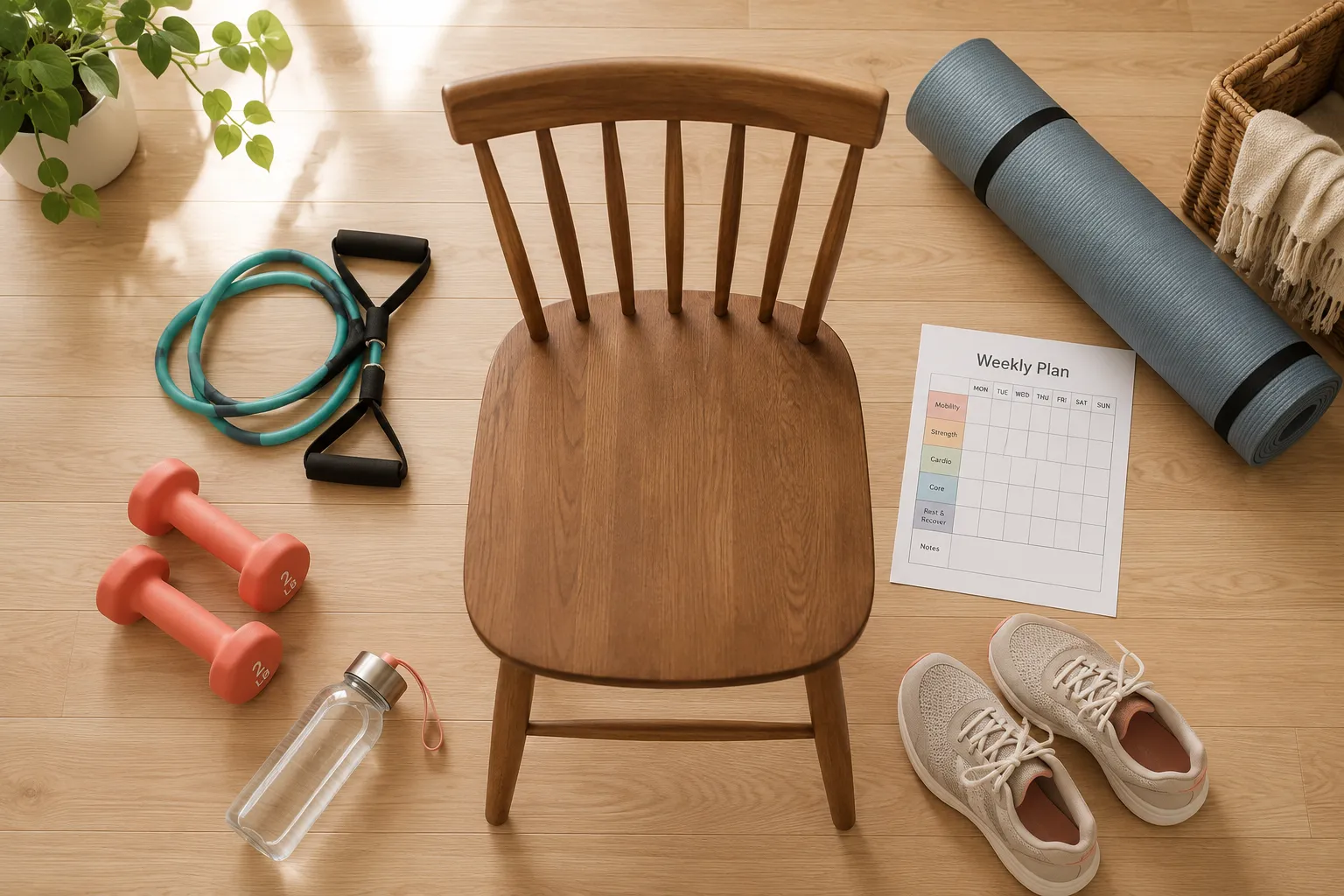
The minimum kit is a sturdy armless chair on a non-slip floor. Everything else is optional and cheap. Total starter cost: $0,$40.[1][9]

Essential:

  • Sturdy chair with a firm seat, no wheels, no arms (dining chair works)
  • Non-slip floor or yoga mat under the chair
  • Flat shoes with grip

Nice to have:

  • Light dumbbells (1, 2, 3, 5 lb set), ~$20
  • Resistance bands (light and medium), ~$10
  • Small pillow for lumbar support
  • Water bottles (double as improvised weights)

Skip: ankle weights heavier than 2 lb (they strain knees), unstable surfaces like balance discs (fall risk), and treadmill-style equipment unless supervised.

What Equipment Do You Need for Chair Workouts at Home?

How Do Chair Exercises Help With Fall Prevention in Seniors?

Chair exercises reduce fall risk by strengthening the exact muscles that catch you when you stumble, quads, glutes, hip abductors, and ankle stabilizers, and by training the sit-to-stand transition that causes many at-home falls.[1][6]

High-value fall-prevention moves:

  • Sit-to-stands, trains hip and knee power for getting out of chairs, cars, toilets.
  • Standing hip abductions, strengthens the side-hip muscles that keep you upright on one leg.
  • Heel-toe rocks (holding chair), trains ankle stability.
  • Seated marches with reach, trains hip flexors and core coordination.

Progress marker: If you can do 10 sit-to-stands in 30 seconds without using your hands, your fall risk is significantly lower than someone who can't.

Are Chair Workouts Effective for Improving Posture and Flexibility?

Yes. Regular chair-based mobility work counteracts the forward-hunched posture that develops from sitting and reduces stiffness in the shoulders, spine, and hips. The British Heart Foundation's 2026 chair mobility routine, shoulder shrugs, chest openers, and gentle trunk rotations, is specifically designed for this.[8]

Daily 5-minute posture reset:

  1. Seated shoulder rolls, 10 backward, 10 forward
  2. Chest opener (hands behind head, elbows wide), 3 breaths
  3. Seated trunk rotation, 8 per side
  4. Neck turns (chin to shoulder), 8 per side
  5. Seated cat-cow, 8 rounds

Consistency beats duration. Five minutes daily outperforms 30 minutes once a week.

What Should Seniors Avoid When Doing Standing Exercises?

Avoid unsupported balance work early on, holding your breath during strain, deep knee bends past 90 degrees, and any movement that causes sharp joint pain or dizziness. Also skip exercises done on soft surfaces (beds, thick rugs), they hide balance errors.[6][7]

Red flags, stop immediately if you feel:

  • Chest pain, tightness, or unusual shortness of breath
  • Dizziness, lightheadedness, or visual changes
  • Sharp joint pain (dull ache is usually fine)
  • Numbness or tingling down an arm or leg
  • Loss of bladder control or sudden weakness

Common mistakes to avoid:

  • Wearing socks instead of shoes
  • Locking knees at the top of standing moves
  • Rushing reps (speed hides poor control)
  • Skipping the warm-up
  • Training when severely fatigued or ill

Can Chair Exercises Help With Balance and Coordination Problems?

Yes, targeted chair-based drills improve balance by training the sensory and motor systems that keep you upright, even before you attempt full standing work. This is the safest entry point for anyone with vertigo, neuropathy, or recent falls.

Balance-building chair drills:

  • Seated weight shifts, shift weight side to side without lifting feet, 20 reps
  • Seated single-leg reaches, extend one leg and reach opposite arm forward, 8 per side
  • Head turns while marching, challenges the vestibular system, 30 seconds
  • Eyes-closed seated marches (only if steady), 20 seconds

Progress to supported standing balance work, heel raises, toe raises, tandem stance holding the chair, once seated drills feel easy.

How Long Does It Take to See Results From Senior Chair Workouts?

Most seniors notice easier daily movement within 2-3 weeks, measurable strength gains by 4-6 weeks, and clear improvements in balance and posture by 8-12 weeks of consistent training.[2]

Realistic timeline:

  • Week 1-2: less morning stiffness, better mood, slightly better sleep
  • Week 3-4: sit-to-stand feels easier, stairs less taxing
  • Week 6-8: noticeable arm and leg strength; posture improves
  • Week 12+: endurance, balance confidence, and often lower resting blood pressure

If you see nothing by week 6: you're probably under-loading (weights too light) or under-doing (fewer than 3 sessions weekly). Add resistance or a day, not more reps.

The Safest Way to Transition From Sitting to Standing During Exercise

Move slowly through three stages: scoot, plant, press. This sequence prevents the blood-pressure drop and dizziness that causes many exercise-related falls in older adults.

Step by step:

  1. Scoot to the front third of the chair seat.
  2. Plant both feet flat, hip-width apart, directly under or slightly behind your knees.
  3. Lean your chest forward over your toes ("nose over toes").
  4. Press through your heels and stand up, using the chair arms or thighs for a push if needed.
  5. Pause standing for 3-5 seconds before starting any movement, this lets blood pressure equalize.
  6. To sit: reverse the process. Feel the chair with the back of your legs before lowering.

Decision rule: If you feel dizzy standing up, sit back down immediately, breathe, and try again in 30 seconds. Never fight through lightheadedness.

Full-Body Chair and Standing Workouts for Seniors: Sample Routines

Here are two complete routines you can use today. Both are Chair and Standing Workouts for Seniors, Low-Impact Strength and Mobility When Getting Down Is Difficult in action.

Routine A: 20-Minute Seated Full-Body

  • Warm-up: seated marches + arm swings, 2 min
  • Seated leg extensions, 2 sets of 10 per leg[1]
  • Seated overhead press with light weights, 2 sets of 10
  • Seated bicep curls, 2 sets of 12
  • Seated trunk rotations, 2 sets of 10 per side[8]
  • Seated ankle circles + wrist circles, 8 each direction[8]
  • Cool-down: chest opener + slow breathing, 2 min

Routine B: 20-Minute Supported Standing

  • Warm-up: standing marches at chair, 2 min
  • Sit-to-stands, 2 sets of 8
  • Standing calf raises, 2 sets of 12
  • Standing side leg lifts, 2 sets of 10 per side
  • Standing hamstring curls, 2 sets of 10 per side
  • Wall push-ups, 2 sets of 8
  • Cool-down: standing chest opener + gentle sway, 2 min

Alternate A and B across the week for a balanced program.

FAQ

Q: Do I need a doctor's approval before starting?
A: Yes, if you have heart disease, uncontrolled blood pressure, recent surgery, or a history of falls. A quick clearance conversation is worth it.

Q: Can I do chair workouts if I use a wheelchair?
A: Absolutely. Most seated exercises transfer directly. Skip standing work and focus on resistance training and mobility.

Q: How heavy should my dumbbells be?
A: Start with 1-2 lb. If you can do 15 reps easily with perfect form, move up 1-2 lb. Most seniors work in the 2-8 lb range.

Q: Are YouTube chair workout videos safe?
A: Many are excellent, but confirm the instructor is certified in senior fitness (SilverSneakers, ACE Senior, or similar) and start with beginner-level content.[3][4]

Q: What if I get sore?
A: Mild soreness for 24-48 hours is normal for new exercisers. Sharp pain, swelling, or soreness lasting over 3 days means you overdid it, scale back.

Q: Can chair exercises replace walking?
A: They complement walking, not replace it. If you can walk safely, keep walking. Chair work fills gaps on bad-weather days or when joints flare.

Q: Is it too late to start at 80 or 90?
A: No. Strength gains have been documented in adults well into their 90s. Start smaller and progress slower, but start.

Q: How do I stay motivated?
A: Schedule sessions like appointments, track them on a paper calendar, and pair workouts with something you enjoy (music, a favorite show, a phone call).

Conclusion

Chair and standing workouts for seniors are one of the most reliable ways to preserve strength, balance, and independence when getting down to the floor isn't safe or realistic. The formula is simple: a sturdy chair, 4-5 short sessions per week, gradual added resistance, and supported standing work built in as balance improves.

Your next steps:

  1. Place a sturdy armless chair in a clear, well-lit space today.
  2. Do Routine A (seated full-body) this week, three times, 20 minutes each.
  3. Add Routine B (supported standing) in week two.
  4. Track progress with one simple metric: how many sit-to-stands you can do in 30 seconds.
  5. Reassess at week 6. Add weight, add a day, or add a new movement.

Consistency, not intensity, is what changes outcomes at this stage of life. Start smaller than you think you need to, and don't stop.

References

[1] Chair Exercises For Seniors – https://health.clevelandclinic.org/chair-exercises-for-seniors
[2] Chair Exercises For Seniors Boosting Strength Flexibility And Stamina – https://www.health.harvard.edu/exercise-and-fitness/chair-exercises-for-seniors-boosting-strength-flexibility-and-stamina
[3] Watch – https://www.youtube.com/watch?v=MmIpgD1hL30
[4] Watch – https://www.youtube.com/watch?v=mQLzNf8VOIc
[5] 7 Standing Exercises For Core Strength – https://www.silversneakers.com/blog/7-standing-exercises-for-core-strength/
[6] Standing Exercises For Seniors – https://eldercarealliance.org/blog/standing-exercises-for-seniors/
[7] Standing Exercises For Seniors – https://www.planetfitness.com/blog/articles/standing-exercises-for-seniors
[8] Chair Based Exercises – https://www.bhf.org.uk/informationsupport/heart-matters-magazine/activity/chair-based-exercises
[9] Chair Exercises For Seniors – https://www.lifeline.ca/en/resources/chair-exercises-for-seniors/
[10] Standing Exercises For Seniors – https://miravieseniorliving.com/lifestyle/standing-exercises-for-seniors/