{"cover":"Professional landscape format (1536×1024) editorial hero image with SHORT bold text overlay (≤42 chars): 'Progressive Overload After 40' in bold modern white sans-serif on a semi-transparent deep navy panel, centered on two balanced lines with 8% safe margins from every edge. Background: bright daylight gym photograph, a fit 45-year-old Black woman and a 50-year-old Asian man mid-set with moderate dumbbells near a sunlit window, chalk-dusted rack and rubber plates softly blurred behind them, warm natural light, teal and amber accent palette, high-contrast magazine cover polish. No price tables, no numbers grids, no checkmarks.","content":["Rich landscape format (1536×1024) labelled six-panel infographic titled 'Seven Overload Levers' in flat vector style on a clean off-white background, navy and teal palette with amber accents. Each panel shows a simple illustrated icon plus a short heading and 2-3 bullet labels: panel 1 'More Reps' (same load, add reps), panel 2 'Fuller Range' (deeper squat, full lockout), panel 3 'Slower Tempo' (3-second lowering), panel 4 'Add Pauses' (hold at bottom), panel 5 'Harder Leverage' (elevate feet, longer lever), panel 6 'More Density' (shorter rest, same work). Thin callout lines to each icon, labels 1-6 words, sharp and non-overlapping inside a 5% safe margin, editorial training-guide polish.","Annotated documentary-style landscape photograph (1536×1024) of a 55-year-old white man with silver hair performing a controlled goblet squat on a rubber gym floor in soft diffused daylight, mid-range side angle, shallow depth of field. Overlaid with 4 thin white callout lines and short labels pointing to concrete details: 'Knees tracking toes', 'Neutral spine', 'Controlled descent', 'Load close to chest'. Cool grey and teal color grade, crisp high-detail editorial sports photography, labels short and fully inside a 5% safe margin, no numbers grids.","Landscape format (1536×1024) numbered five-step horizontal process flow illustration on a pale sand background with deep green and rust accents, isometric vector style. Step cards reading 'Week 1 Baseline', 'Weeks 2-3 Add Reps', 'Week 4 Add Load', 'Week 5 Deload', 'Reassess RPE', each card with a tiny icon (clipboard, rep counter, dumbbell, feather, stopwatch) and one 2-4 word sub-label beneath. Connecting arrows between cards, a small side panel labelled 'Readiness Check' with bullet labels 'Sleep', 'Joint feel', 'Bar speed'. Clean, save-worthy editorial infographic polish, all labels sharp and inside a 5% safe margin."}
Last updated: October 28, 2026
Quick Answer
Progressive overload after 40 works best when you progress reps, range of motion, tempo, pauses, leverage, and training density before you add weight. Load still matters, but the weekly five-pound jump most lifters copy from their twenties is the fastest route to cranky joints and stalled training. A practical rule: earn the top of your rep range on every set with clean technique, then raise the load, often monthly rather than weekly. Research-backed programming for adults 40+ sits around 2-4 sessions per week at roughly 60-80% of one-rep max in 6-12 rep ranges [1][2][3].
Key Takeaways
- Progressive overload means gradually increasing the demand on a muscle. It does not mean adding weight every single week.
- Adults over 40 can safely train at 70-85% 1RM when progression is gradual and technique-led [1].
- Add reps before you add weight. Hit the top of your rep range on all sets, then bump the load 2.5-5%.
- Seven overload levers: reps, sets, range of motion, tempo, pauses, leverage, rest density, plus load.
- Recovery is part of the dose. Leave 48+ hours between sessions for the same muscle group and plan a lighter deload week every 4-8 weeks.
- Use RPE (rate of perceived exertion) and readiness checks instead of forcing a fixed number onto a bad day.
- Bodyweight-only overload absolutely works if you manipulate leverage, tempo, and range.
- Joint pain on heavier days usually signals load that outpaced tissue tolerance, not an end to lifting.
- No supplements or special equipment are required. Protein, sleep, and consistency do most of the work.
What is progressive overload and why does it matter after 40?
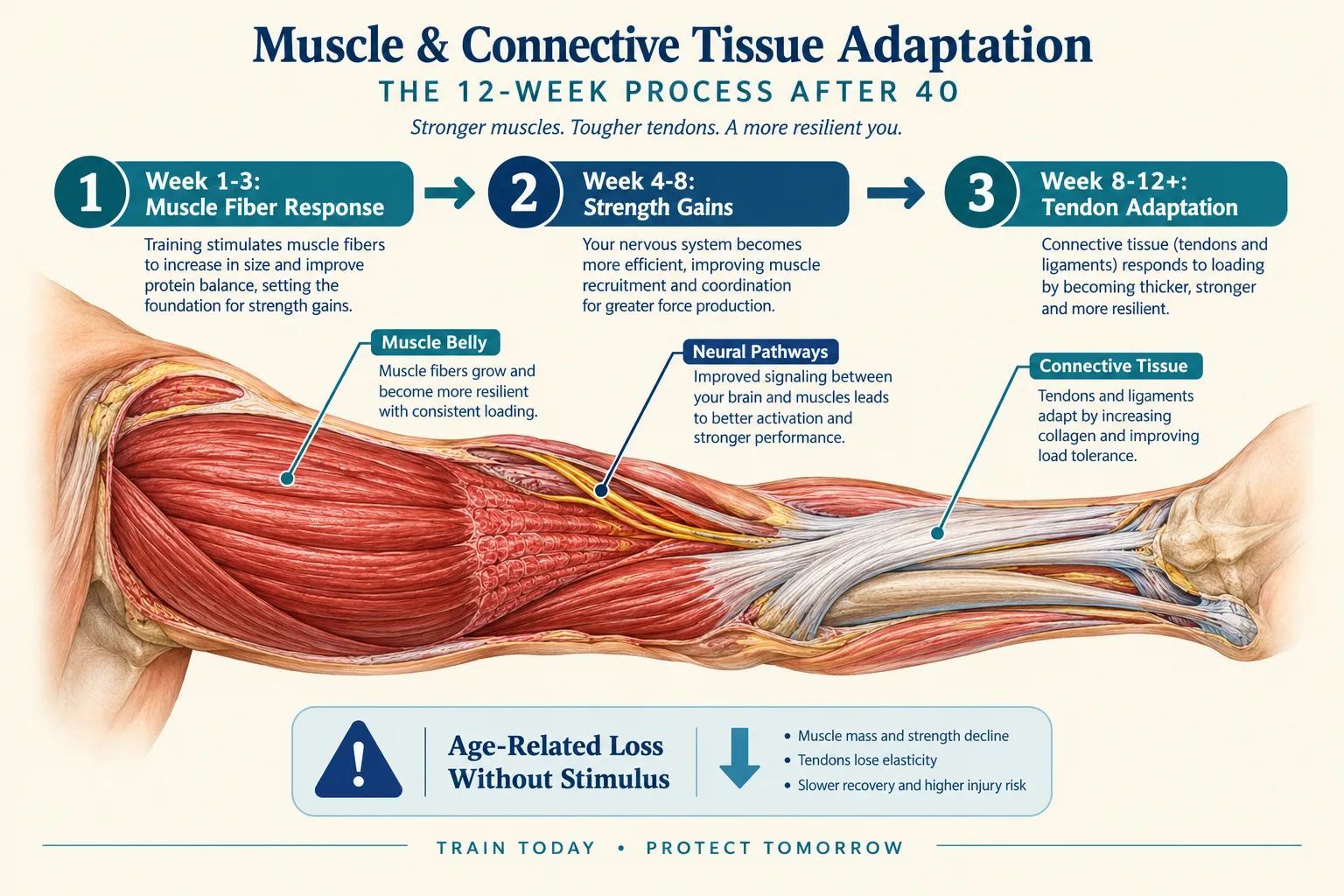
Progressive overload is the gradual increase of training demand so muscles and connective tissue keep adapting. After 40 it matters more, not less, because age-related loss of muscle mass and strength accelerates without a resistance stimulus, and resistance training is the primary countermeasure [1][4].
The variable people fixate on is barbell weight. But muscle responds to mechanical tension and effort, and both can rise without the plate changing. A set of 8 squats taken to a hard effort with a 3-second lowering phase is more demanding than 8 fast, bouncy reps at the same load.
What changes after 40 isn't your ability to adapt. It's your recovery margin, tendons, joints, and sleep quality tolerate less abrupt escalation.
Progressive overload after 40 is a system for making this month harder than last month, not every Tuesday harder than the last one.
Can you build muscle after 40 without gaining weight?
Yes. You can build muscle after 40 without gaining weight on the scale, because body recomposition, adding lean tissue while losing fat, is common in people returning to resistance training. Scale weight can stay flat while strength, waist measurement, and muscle definition all improve.
The practical implications:
- Judge progress by strength, reps completed, and tape measure, not scale weight alone.
- Protein intake supports it. Spread 25-40g of protein across 3-4 meals.
- Recomposition is slowest in long-term trained lifters and fastest in detrained beginners.
Decision rule: if the scale hasn't moved in 8 weeks but your working sets went from 8 reps to 12, you are building muscle. Keep going.
Ways to progressively overload without adding more weight
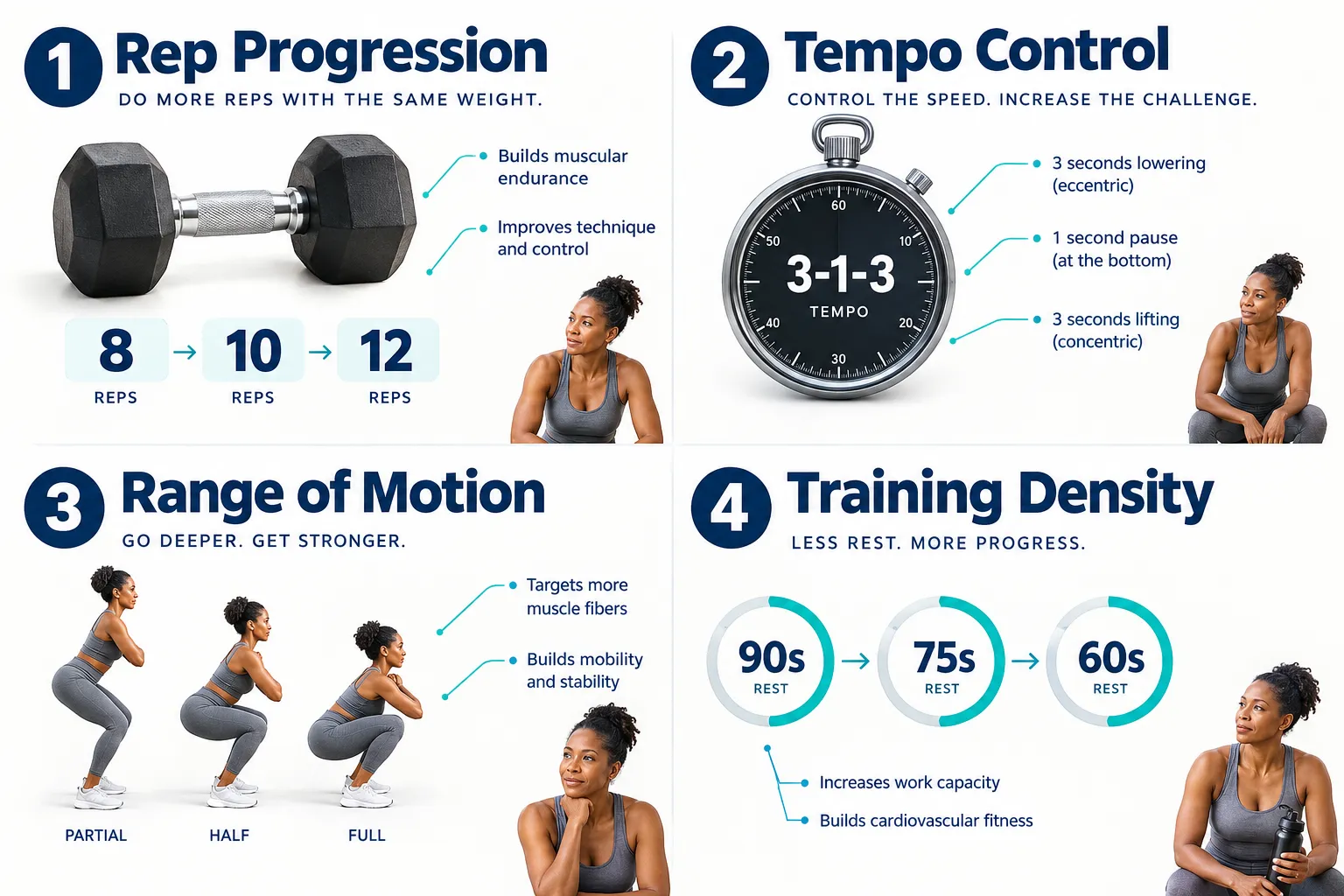
There are at least seven overload levers besides load, and most people over 40 should cycle through several before touching the plates. ACSM progression models explicitly include increasing reps, sets, frequency, and reducing rest as valid progression, not just intensity [2][3].
| Lever | How to apply it | Best for |
|---|---|---|
| Reps | 8 → 9 → 10 → 12 at same load | Everyone; the default first step |
| Range of motion | Deeper squat, full lockout, deficit push-up | Mobility gains, more tension per rep |
| Tempo | 3-4 second lowering phase | Sensitive joints, tendon health |
| Pauses | 2-second hold at the hardest point | Removing momentum, building control |
| Leverage | Elevate feet, longer lever arm, single-limb | Bodyweight-only training |
| Density | Same work, 30 seconds less rest | Conditioning, time-limited sessions |
| Sets / frequency | 3 sets → 4, or 2 days → 3 | Volume-driven muscle growth |
A quick example: a 48-year-old doing dumbbell bench press at 50 lb for 3×8 could spend six weeks progressing to 3×12, then add a 2-second pause at the chest, then finally move to 55 lb, three distinct overload cycles, one load change.
How often should I increase reps or weight when over 40?
Increase reps weekly or every other week, and increase load roughly every 3-6 weeks, when you can complete the top of your prescribed rep range on all working sets with clean form and roughly two reps still in reserve. Monthly load progression is a reasonable default for most lifters over 40.
A simple double progression:
- Pick a rep range (e.g., 6-10).
- Start at a load you can do for 6 clean reps on every set.
- Add 1 rep per set per session or week.
- When all sets hit 10, raise the load 2.5-5% and drop back to 6.
- Repeat.
Common mistake: adding load when only the first set hit the top of the range. Wait for all sets.
How is training progression different for people over 40, and what's the safest way to progress strength without injury?
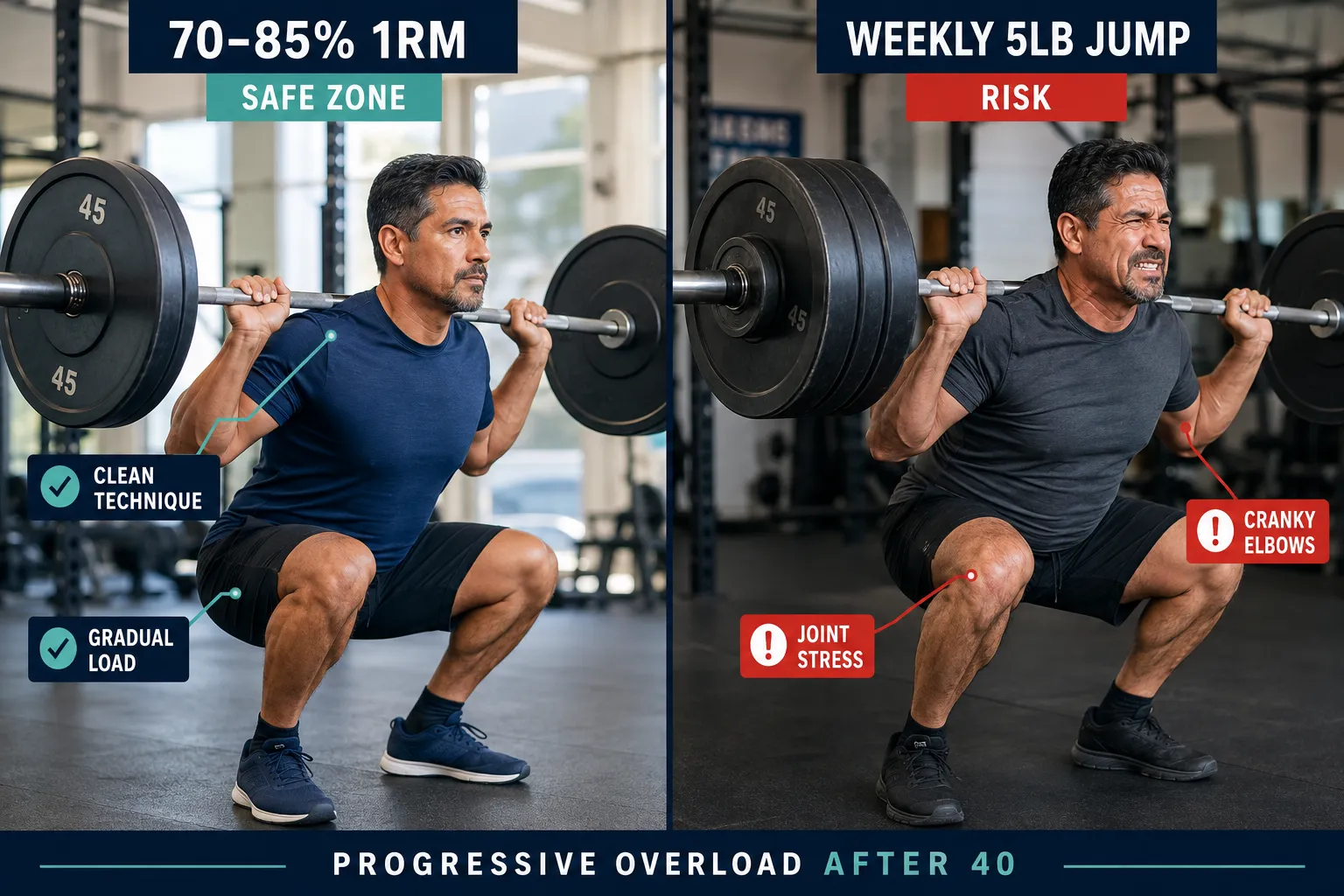
Progression after 40 is slower in timescale, more conservative in load jumps, and more dependent on recovery than progression in your twenties, but the exercises and intensity ranges are largely the same. The NSCA position statement on resistance training for older adults supports training up to 70-85% 1RM when progression is individualized and supervised appropriately [1].
Safest-progression checklist:
- Technique first. A rep that degrades is not a rep that counts.
- Smaller jumps. 2.5-5% load increases, or micro-plates, instead of 10 lb leaps.
- Warm up longer. 2-3 ramping sets before heavy work.
- Use RPE and the talk test rather than rigid prescribed loads; rehabilitation and geriatric exercise guidance favors perceived-effort regulation [5].
- Keep 1-3 reps in reserve on most sets. Save true limit efforts for rare test weeks.
Edge case: if you have uncontrolled hypertension, recent surgery, or a cardiac history, get clearance first. Primary-care guidance treats gradual, individualized progression as standard of care [6].
What happens if you add weight too fast after 40, and why do my joints hurt when I increase weight?
Adding load faster than your tendons, ligaments, and cartilage can adapt produces joint pain, tendinopathy, and stalled training. Muscle adapts to new loads in weeks; connective tissue takes considerably longer, which is why the pain shows up in elbows, knees, and shoulders rather than muscle bellies.
Typical warning signs:
- Pain that starts 12-24 hours after a session and lingers for days
- Sharp pain at a specific joint point rather than diffuse muscle soreness
- Strength dropping despite consistent training (a classic overreaching signal)
How to fix it:
- Hold the load for 2-3 weeks. Progress reps or tempo instead.
- Shorten the range to the pain-free portion, then slowly rebuild it.
- Swap the implement, dumbbells, cables, or machines often change the joint angle enough to be comfortable.
- Add slow eccentrics (3-4 second lowering), which tendons generally respond well to.
- If pain persists past 4 weeks or involves swelling or instability, see a clinician.
Best progressive overload methods for bad joints or arthritis
For arthritic or sensitive joints, progress tempo, range, pauses, and reps at moderate loads rather than chasing heavier weight, and favor machines, cables, and bodyweight variations that let you control the joint angle. Resistance training is recommended for older adults with osteoarthritis, not contraindicated [1][5].
Practical adjustments:
- Work in 10-15 rep ranges at lower loads, which public-health guidance already lists as a baseline for older adults [4].
- Use pain-free partial ranges and expand them over weeks.
- Train more often with less per session, three short sessions beat one punishing one.
- Keep a "traffic light" rule: discomfort up to about 3/10 during a set that settles within 24 hours is usually acceptable; sharp pain is a stop signal.
Choose machines if balance or grip limits your loading. Choose cables if you need a joint-friendly line of pull.
Can you do progressive overload with bodyweight exercises only?
Yes. Bodyweight-only progressive overload works when you change leverage, range, tempo, and unilateral load instead of external weight. The demand on the muscle rises even though your body mass stays the same.
A push-up progression ladder:
- Incline push-up (hands on bench)
- Standard push-up
- Slow 4-second lowering push-up
- Paused push-up (2 seconds at the bottom)
- Feet-elevated push-up
- Deficit push-up on parallettes (extra range)
- Archer or assisted one-arm push-up
The same logic applies to squats (box squat → full → split squat → Bulgarian split squat → pistol progression) and hinges (hip thrust → single-leg → sliding leg curl).
Limit to know: bodyweight progression eventually plateaus for large muscle groups like the back and legs. A pair of adjustable dumbbells or a resistance band set extends your runway considerably.
How much rest do I need for progressive overload to work at 40+?
Leave at least 48 hours between hard sessions for the same muscle group, train 2-4 days per week, and schedule a lighter deload week every 4-8 weeks. Adaptation happens during recovery, so under-recovered training produces no overload benefit regardless of effort.
Recovery essentials:
- Sleep 7-9 hours. Nothing on this list replaces it.
- Rest 2-3 minutes between heavy compound sets; shorter rest is a density tool, not a default.
- Deload by cutting volume 40-50% or load 10-20% for one week.
- Readiness check before each session: sleep quality, joint feel, bar speed on warm-ups. If two of three are poor, run the planned reps at a lighter load.
Progressive overload strategies for women over 40
Women over 40 follow the same overload principles, with added emphasis on bone-loading compound lifts, hip and shoulder strength, and managing perimenopausal recovery variability. Resistance training supports bone density and lean mass during and after the menopause transition, making load-bearing work a priority rather than an option [1][4].
Specific priorities:
- Include axial-loading movements (squat, deadlift variation, loaded carry, step-up) for bone stimulus.
- Expect cycle- or symptom-related fluctuations in strength and sleep; readiness-based autoregulation handles this better than a fixed spreadsheet.
- Push into challenging rep ranges (6-10), not endless light sets, to drive strength gains.
- Prioritize protein and resistance frequency over cardio volume if time is limited.
Common mistakes people make with progressive overload after 40
The biggest mistake is treating weekly load increases as the only valid progress, then quitting or getting hurt when that fails. The others:
- Ego lifting on compound movements, form breaks before the muscle does.
- Skipping warm-up ramps and jumping straight into working weight.
- Never deloading, then wondering why strength has slid for two months.
- Changing programs every three weeks, so no lever ever gets progressed far enough to matter.
- Not tracking anything. Without a log you cannot know whether you overloaded.
- Training through sharp joint pain instead of modifying the variation.
- Ignoring sleep and protein, then blaming age.
Do I need supplements or equipment to do progressive overload after 40?
No. Progressive overload after 40 requires a way to create resistance and a log to track it, nothing more. Bodyweight, bands, or a single pair of adjustable dumbbells will carry most people through their first year or two of progression.
If you do buy equipment, priority order:
- Adjustable dumbbells (widest exercise coverage)
- Resistance bands (joint-friendly, travel-friendly, scalable)
- A bench or sturdy box
- A barbell and plates, only if you enjoy barbell lifting
Supplements are optional support, not the mechanism. Protein powder is a convenience for hitting daily intake; creatine monohydrate is the most-studied strength supplement. Neither substitutes for progression, sleep, or consistency.
FAQ
How long does it take to get stronger after 40?
Most people see measurable strength gains within 4-8 weeks of consistent resistance training, with noticeable muscle change by 10-16 weeks.
Is it safe to lift heavy weights after 40?
Yes, with gradual progression and sound technique. Resistance training up to 70-85% 1RM is supported for older adults when individualized [1].
How many times a week should someone over 40 strength train?
Two to four sessions per week, with at least 48 hours between hard sessions for the same muscle group [2][3].
Should I add reps or weight first?
Reps. Reach the top of your rep range on all working sets with good form, then raise the load 2.5-5%.
What rep range is best for people over 40?
6-12 reps for strength and muscle; 10-15 reps works well for joint-sensitive lifters and older trainees [4].
Is soreness a sign of progressive overload?
No. Soreness reflects novelty, not progress. Logged increases in reps, load, range, or control are the real markers.
How often should I deload?
Every 4-8 weeks, or sooner if sleep, strength, and joint comfort all decline at once. Cut volume by roughly half for a week.
Can I still progress if I only train at home?
Yes. Leverage, tempo, pauses, and range changes provide years of progression with minimal equipment.
Conclusion
Progressive overload after 40 is about controlling the rate of progression, not abandoning it. Pick a rep range, master it with clean reps, use tempo and range to make the same load harder, and move the weight up when you've genuinely earned it, often monthly, not weekly.
Your next steps this week:
- Choose 4-6 exercises and record your current load and reps for each.
- Assign each a rep range (6-10 or 10-15 for sensitive joints).
- Add one rep per set per session until you top out, then add 2.5-5% load.
- Schedule 48 hours between repeat sessions and mark a deload week on week 6.
- Each session, run the readiness check: sleep, joint feel, warm-up bar speed. Adjust load, keep the reps.
Track it for twelve weeks. The log, not the scale, will tell you it worked.
References
- Resistance Training For Older Adults Position.1. journals.lww.com.
- Progression Models in Resistance Training for Healthy Adults Simplified. acsm.org.
- Progression Models in Resistance Training for Healthy Adults. acsm.org.
- Kravitzlifetimesm. unm.edu.
- Exercise in the Elderly Part Two Rehabilitation Management and Treatments. now.aapmr.org.
- E59.full. cmaj.ca.
