Last updated: October 23, 2026
Quick Answer
For most people over 40, resistance bands are the safer starting point and adjustable dumbbells are the better long-term investment. Bands win on joint comfort, portability, and cost; adjustable dumbbells win on loading ceiling, progression tracking, and visible muscle gains. When training volume and effort are matched, both tools build muscle effectively [1][2]. The strongest answer to "Adjustable Dumbbells vs Resistance Bands After 40" is usually both: bands for shoulders, hips, warm-ups, and recovery, dumbbells for the heavy compound work.
Key Takeaways
- Muscle growth is similar between bands and dumbbells when sets, effort, and progression are matched [1][2].
- Bands are gentler on joints because tension is lowest where joints are most vulnerable (the stretched position) [3][4].
- Adjustable dumbbells have a far higher loading ceiling, which matters for strength and bone density after 40 [5][6].
- Cost gap is wide: a full band kit typically runs a small fraction of an adjustable dumbbell pair.
- Start light: most 40+ beginners do well with roughly 5-15 lb per hand for upper body, heavier for legs.
- Frequency beats equipment, two to three strength sessions per week is the guideline that actually drives results [7].
- Bands excel for recovery, mobility, and rehab-style work; dumbbells excel for progressive overload.
- The hybrid setup (one band kit plus one adjustable dumbbell pair) covers nearly every home workout need.
What's the difference between adjustable dumbbells and resistance bands?
Adjustable dumbbells are fixed-weight free weights with a dial or pin that changes load, so resistance comes from gravity and stays constant through the whole range of motion. Resistance bands are elastic, so resistance increases as the band stretches and nearly disappears at the start of the movement.
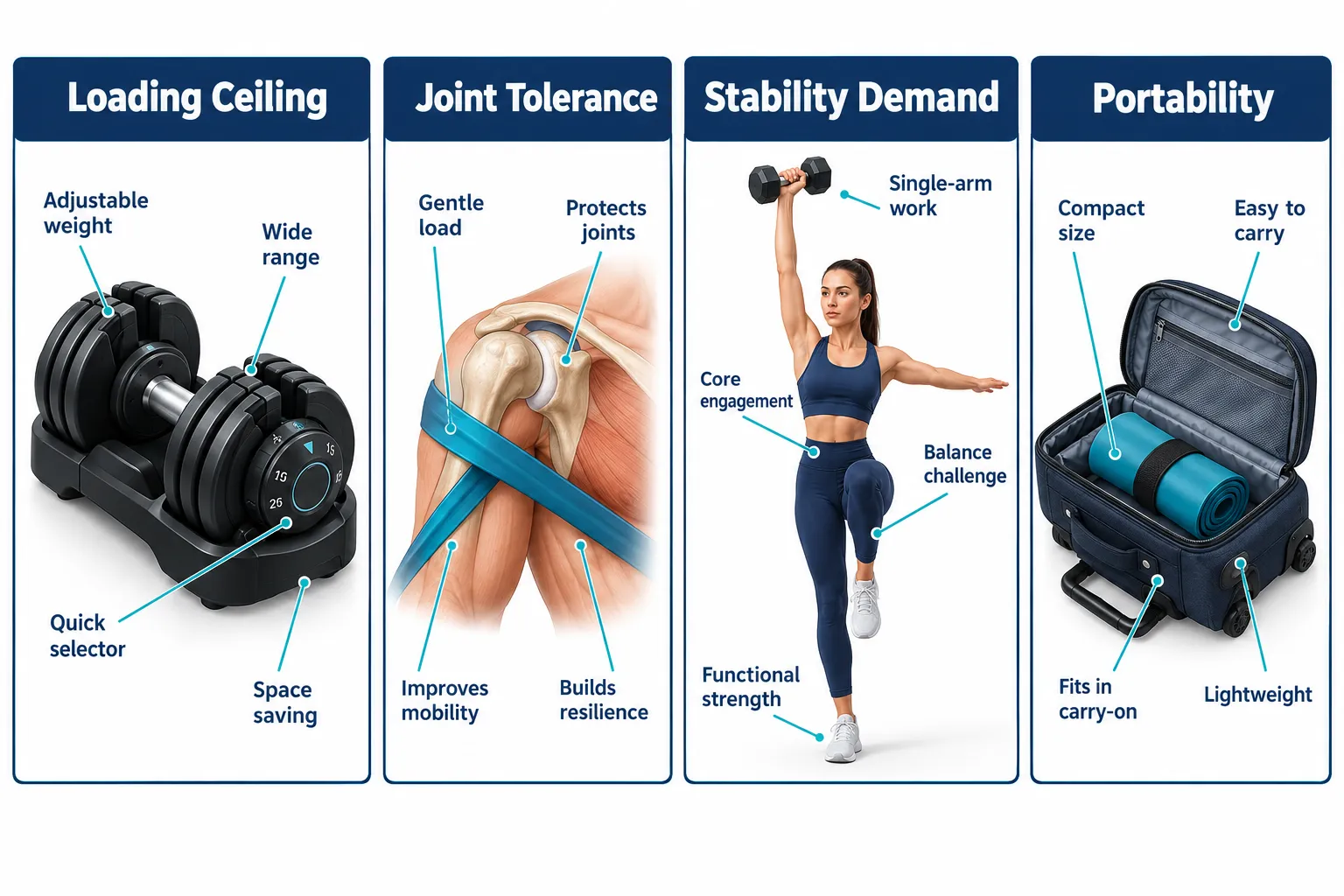
That single mechanical difference drives everything else:
)
| Factor | Adjustable dumbbells | Resistance bands |
|---|---|---|
| Resistance curve | Constant (gravity) | Ascending (stretch-dependent) |
| Loading ceiling | High, often 50-90 lb per hand | Moderate, hard to measure |
| Joint stress | Higher at stretched positions | Lowest at stretched positions |
| Stability demand | High (great for stabilizers) | Moderate, anchor-dependent |
| Exercise variety | Excellent for presses, rows, squats | Excellent for rotation, pull-aparts, abduction |
| Portability | Poor (heavy, fixed location) | Excellent (fits in a drawer) |
| Progression tracking | Precise and numbered | Vague (band color jumps) |
| Floor space | Needs a stand and clearance | Essentially none |
Decision rule: if you want a number to beat each week, choose dumbbells. If you want tension without joint compression, choose bands.
What's better for joint health, dumbbells or resistance bands after 40?
Resistance bands are better for sensitive joints after 40. Because band tension is lightest at the bottom of a movement, the shoulder, knee, or elbow isn't loaded heavily in its most compromised position [3][4]. That makes bands the default choice for anyone managing stiffness, old injuries, or arthritis-type discomfort.
Why bands feel kinder:
- No bottom-of-rep crush. A banded chest press has almost no load at the deep stretch; a dumbbell press has the most.
- No impact if dropped. A dropped 40 lb dumbbell is a real hazard at home; a dropped band is not.
- Angles are free. Bands let you pull at off-axis angles that match how your shoulder actually moves.
Dumbbells aren't the enemy, though. Loaded joints adapt, tendons and bone respond to progressive load, and that adaptation protects joints over the following decades [5][7]. The practical approach: use bands for the exercises that bother you and dumbbells for the ones that don't.
Joint pain after 40 is usually a dose problem, not an equipment problem. Reduce range, slow the tempo, or swap the tool, don't quit the lift.
Are resistance bands safe for shoulder and knee problems?
Yes, resistance bands are generally safe for shoulder and knee issues and are widely used in rehab-style programming for exactly that reason [3]. The caveat: bands can snap or slip off an anchor, so inspect them for nicks and never stretch one toward your face.
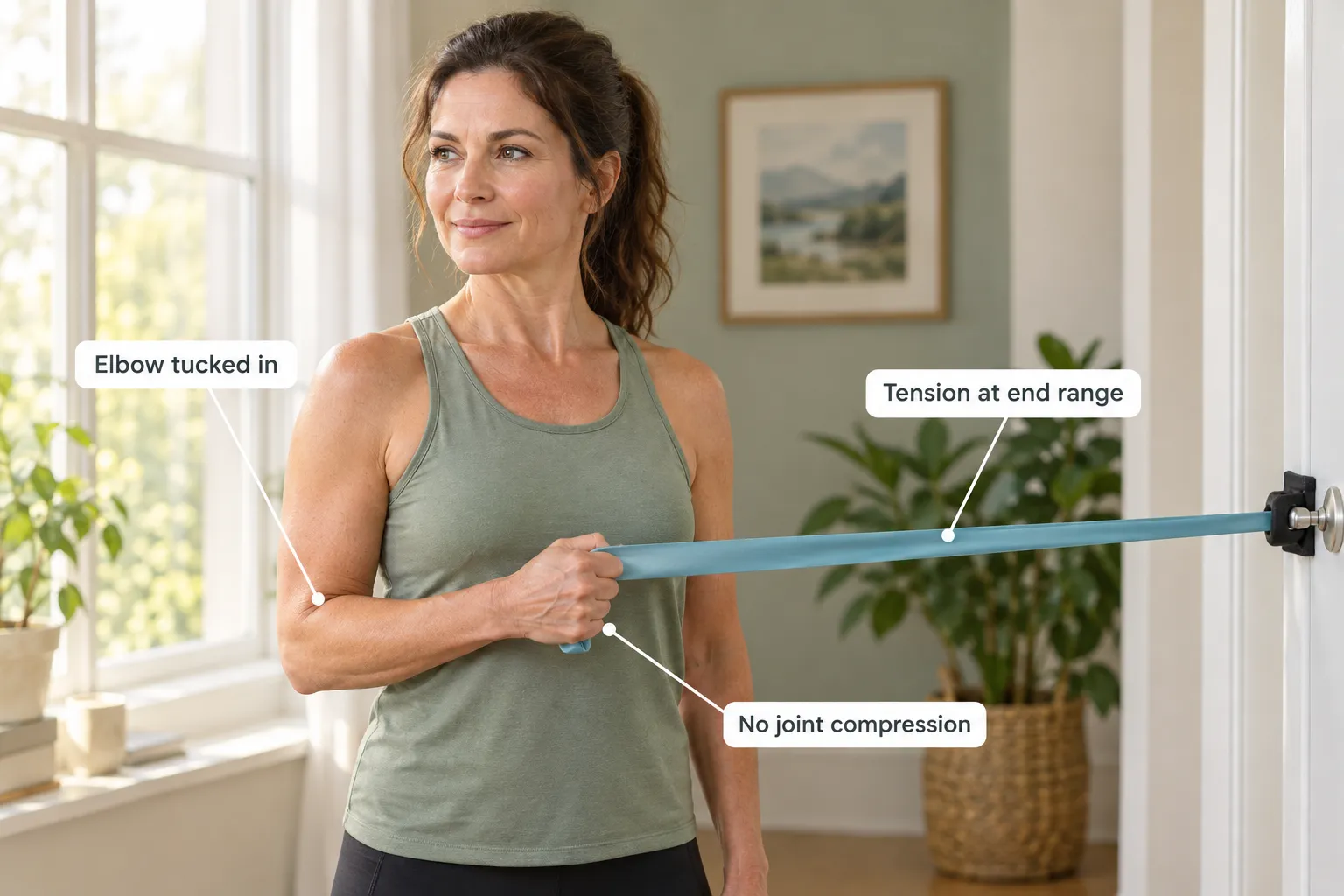
Shoulder-friendly band moves:
- Band pull-aparts (scapular health)
- External rotations at the side, elbow pinned
- Face pulls at chest height
- Banded wall slides
Knee-friendly band moves:
- Lateral band walks (glute medius)
- Banded terminal knee extensions
- Light banded leg curls
- Banded step-downs with assistance
Edge case: if a joint hurts more 24 hours later, the issue is total volume, not the band. Cut sets in half for a week before changing exercises. And if pain is sharp, radiating, or associated with swelling, get it assessed rather than training through it.
Can resistance bands build muscle as well as dumbbells?
Yes, for most people over 40, bands build comparable muscle when sets, reps, and closeness to failure are matched [1][2]. Muscle responds to mechanical tension and effort, and elastic tension counts. Where bands fall short is at the upper end: once you can do 15 hard reps against your heaviest band, meaningful progression becomes guesswork.
)
How to program bands effectively in midlife [3]:
- Shorten the lever or the anchor instead of jumping band colors, small distance changes equal small load changes.
- Use 8-20 reps per set and stop 1-3 reps shy of failure.
- Control the return. Three seconds lowering against band tension creates far more stimulus than snapping back.
- Add pauses at peak tension for 1-2 seconds.
- Train 2-3 days per week, full body [7].
Can you build serious muscle with just resistance bands?
You can build noticeable, functional muscle with bands alone, especially in the first 6-12 months of training. Building advanced size and maximal strength eventually requires heavier external load, which bands struggle to deliver predictably for the legs and back [5][6].
How much do adjustable dumbbells cost compared to resistance bands?
Resistance bands are dramatically cheaper. A complete loop-and-tube band kit with handles, door anchor, and ankle straps generally costs in the range of a single restaurant dinner, while a quality adjustable dumbbell pair is a several-hundred-dollar purchase [5][8]. Exact prices shift by brand and year, so treat these as general ranges, not quotes.
What that money buys:
- Bands: immediate variety, travel use, near-zero space, replaceable when worn.
- Adjustable dumbbells: 10-20 weight settings in one footprint, replacing an entire rack. Durable for a decade or more, which improves the cost per year considerably.
Decision rule: budget under $60 or unsure about consistency? Buy bands first. Already training consistently for three-plus months? Adjustable dumbbells are the better next purchase [4].
What's the best home gym equipment for people over 40?
The best home gym for people over 40 is a small, hybrid setup: one resistance band kit, one pair of adjustable dumbbells, a mat, and an adjustable bench or sturdy step [5][6]. That combination covers pushing, pulling, hinging, squatting, carrying, and rotation without needing a dedicated room.
A sensible build order:
- Band kit with door anchor (week 1)
- Yoga mat and a stable chair or step
- Adjustable dumbbells, light-to-mid range (month 3+)
- Adjustable bench
- A loop band set for hips and shoulders
Fitness coaches working with older adults consistently recommend bands plus dumbbells as core tools rather than machines [6][9].
Adjustable dumbbells vs kettlebells for people over 40
Adjustable dumbbells are the safer first buy for most people over 40 because they're symmetrical, easy to control, and work for presses, rows, and squats alike. Kettlebells shine for swings, carries, and hip power, but the swing has a steeper technique curve and a higher back-injury risk if learned alone. Choose a kettlebell as a second tool once form is solid, not as the only tool.
Do I need both dumbbells and bands, or just one?
Just one is enough to get strong, but owning both solves more problems than either alone. Bands handle the small stabilizers, warm-ups, and travel. Dumbbells handle the heavy, trackable work. If forced to pick one for a lifetime of home training, adjustable dumbbells have the higher ceiling; for a first 90 days after 40, bands win.
How to avoid joint pain when lifting weights after 40
Avoid joint pain by progressing load slowly, warming up with bands, and keeping reps in a moderate range rather than chasing maximal weight. Most midlife flare-ups come from adding too much too fast, not from lifting itself [4][7].
)
Safe progression rules that apply to both tools:
- Increase load no more than about 5-10% at a time, and only after you hit the top of your rep range on every set.
- Warm up 5-8 minutes with bands before touching dumbbells.
- Keep 1-3 reps in reserve on most sets; save true failure for isolation work.
- Take a lighter week every 6-8 weeks.
- Use a full but pain-free range, shorten the range before dropping the exercise.
- Train legs and upper body on separate days if recovery feels slow.
Common mistakes people make with dumbbells after 40
- Starting too heavy, then nursing a shoulder for six weeks.
- Skipping warm-up sets entirely.
- Doing only pressing and no pulling, which wrecks shoulder balance.
- Jumping weight by 10-15 lb per hand instead of 5.
- Training the same body part hard four days a week.
- Holding breath during the hardest rep.
What weight dumbbells should I start with at 40+?
Most beginners over 40 should start around 5-10 lb per hand for shoulder and arm work, 10-20 lb for chest presses and rows, and 15-25 lb per hand for goblet squats or Romanian deadlifts. The correct starting weight is the one that lets you complete 10-12 controlled reps with 2-3 left in the tank. Adjustable dumbbells that span roughly 5-50 lb per hand cover beginner through intermediate training.
Do resistance bands work if you're out of shape, and are they better for recovery?
Yes on both counts. Bands are ideal for deconditioned beginners because the load starts near zero and builds gradually, which allows pain-free practice of movement patterns before adding weight [3][4][7]. They're also the better recovery tool: light banded mobility work after a session helps restore range of motion without adding joint load.
For people returning after a long layoff:
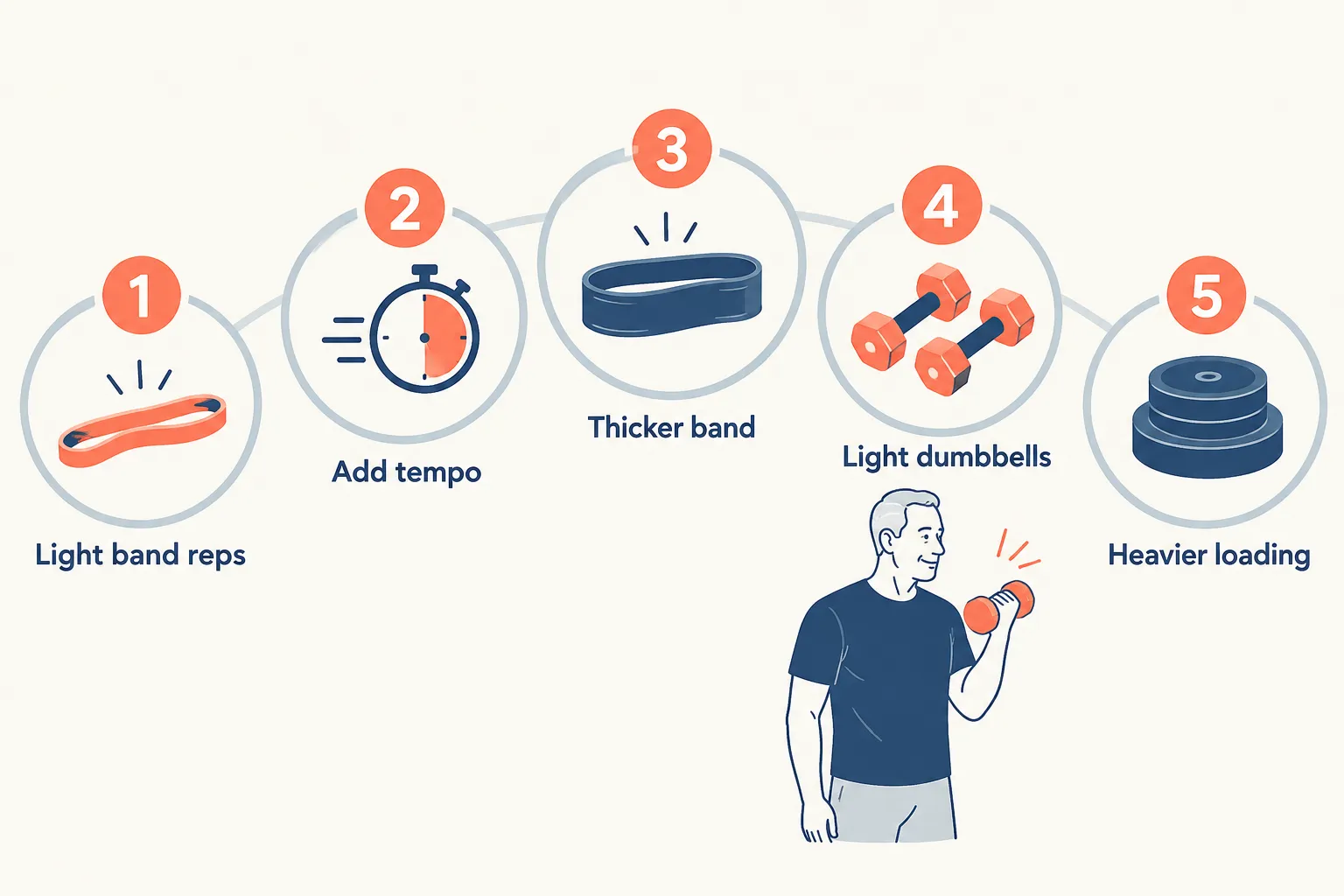
- Weeks 1-2: bands only, 2 sessions, full body, 2 sets per exercise.
- Weeks 3-6: add a third session, slow the tempo, add a set.
- Week 7+: introduce light dumbbells for squats, rows, and presses.
For recovery and flexibility, use bands for assisted stretching (hamstring, hip flexor, lat), banded shoulder dislocates, and low-tension pull-aparts on rest days. Bands make stretching active rather than passive, which tends to hold range better.
FAQ
Are resistance bands enough for someone over 50?
Yes for general health, muscle maintenance, and function. Adding some heavier dumbbell work improves bone density and strength further [5][7].
How many days per week should a 40+ person strength train?
Two to three non-consecutive days per week covering the whole body. Frequency matters more than which equipment you own [7].
Do bands or dumbbells build more muscle?
Neither, when effort and volume are equal [1][2]. Dumbbells pull ahead only once you outgrow your heaviest band.
What's the best adjustable dumbbell weight range to buy after 40?
A pair spanning about 5 to 50 lb per hand covers beginner through intermediate training for several years.
Can resistance bands replace a gym membership?
For maintenance and general fitness, yes. For serious strength or size goals, a band-only setup will plateau.
How long do resistance bands last?
Typically 6-18 months with regular use. Replace any band with nicks, cracking, or sticky patches immediately.
Are bands safe to anchor in a door?
Only with a proper door anchor on a door that opens away from you, and only if the door is latched.
Which is better for arthritis?
Bands, generally, because they reduce load in compressed joint positions and allow pain-free angle adjustments [3].
Conclusion
The honest verdict on Adjustable Dumbbells vs Resistance Bands After 40 is that the tools answer different problems. Bands solve joint sensitivity, space, budget, and travel. Adjustable dumbbells solve progression, strength, and bone loading. Most people over 40 get the best outcome by starting with bands, proving consistency for 8-12 weeks, then adding a dumbbell pair.
Next steps:
- Buy a band kit with a door anchor this week and do two full-body sessions.
- Log every session, exercise, sets, reps, band color or tempo.
- At week 8, if you've trained at least 16 sessions, buy adjustable dumbbells spanning 5-50 lb per hand.
- Keep bands for warm-ups, shoulder and hip work, travel, and recovery days.
- Add weight in small jumps and take a lighter week every 6-8 weeks.
References
- Dumbbells vs. Resistance Bands. sweatpicks.com.
- Resistance Bands vs. Dumbbells. fitsmarthealth.com.
- Resistance Band Workout for Midlife Muscle. bodymotionlab.com.
- Resistance Bands vs. Dumbbells Over 40. purehomefit.com.
- Strength Training Equipment for Older Adults. activeagingwearables.com.
- Fitness Coach Recommends 5 Strength Training Tools Every Older Adult Needs for Stronger Muscles. hindustantimes.com.
- Resistance Training Benefits for Seniors. seniorstrength.today.
- Best Home Fitness Gear. qz.com.
- Functional Strength. thehealthyagingguide.com.