
Last updated: August 8, 2026
Quick Answer
Hybrid home workouts combining strength, mobility, and recovery blend compound lifting, joint prep, and active recovery into one weekly plan, usually 3-5 focused sessions of 30-60 minutes. The goal is building muscle and staying pain-free without the burnout of daily high-intensity training. Most people need only a pair of adjustable dumbbells, a resistance band, and a mat to run a full program at home.[2][10]

Key Takeaways
- A standard hybrid week runs 3-5 strength days plus 1-2 mobility or active recovery sessions.[2][10]
- Sessions of 30-45 minutes are enough when programmed well, longer isn't better.[8]
- Mobility comes first as prep, foam rolling and stretching come after the strength block.[6]
- Minimal gear works: adjustable dumbbells, a band, and a mat cover 90% of hybrid programming.[4][5]
- Hybrid training beats CrossFit for joint health and sustainability, but CrossFit wins on community and pure intensity.[1]
- You can train daily only if you rotate intensity, hard/easy/mobility, not hard every day.[10]
- Beginners should start with 3 sessions a week for 4 weeks before adding volume.[4]
What's the Difference Between Hybrid Workouts and Regular Strength Training?
Regular strength training focuses on one goal, usually getting stronger or bigger, through lifting alone. Hybrid workouts fold in cardio conditioning, mobility drills, and recovery work inside the same weekly plan, so you build strength without losing endurance or joint range of motion.[1][10]
Traditional strength training looks like: bench, squat, deadlift, rows, 3-5 sets of 5-8 reps, rest days between. Nothing else.
Hybrid training looks like: those same lifts on 2-3 days, plus a conditioning day (kettlebell flows, sprints, tempo cardio), a dedicated mobility session, and one true recovery day. The point is a body that's strong, springy, and durable, not one that can only do one thing well.[10]
Choose hybrid if you want to lift heavy and hike, run, or play sports without feeling stiff. Choose pure strength if your only goal is maximum barbell numbers.
How Do You Combine Strength and Mobility Work in One Workout?
Put mobility at the start as targeted prep for the lifts you're about to do, then do strength, then finish with 5-10 minutes of static stretching or breathing. This sandwich structure warms tissue, loads it, then downshifts the nervous system.[6]
A clean 45-minute session looks like this:
- 5-8 min mobility prep, thoracic rotations, 90/90 hip switches, ankle rocks, band pull-aparts. Target the joints you're about to load.
- 25-30 min strength block, one main compound lift (squat, hinge, press, or pull) for 3-4 sets of 6-10 reps, then 2 accessory movements as a superset.
- 5-10 min finisher or conditioning, sled push, kettlebell swings, or bike sprints if you want conditioning; skip if it's a heavy day.
- 5 min cooldown, box breathing, hamstring stretch, hip flexor stretch, child's pose.
Common mistake: doing a 20-minute yoga flow before heavy squats. Long static stretching before lifting can temporarily reduce force output. Save the deep stretching for after.[6]
Best Hybrid Home Workout Routine for Beginners
Start with three full-body sessions a week on non-consecutive days (Mon/Wed/Fri), 35-45 minutes each. Each session includes mobility prep, two compound lifts, one carry or core drill, and a short cooldown.[4]
Beginner Week 1-4 template:
| Day | Focus | Structure |
|---|---|---|
| Monday | Lower + core | Goblet squat, Romanian deadlift, suitcase carry |
| Wednesday | Upper + mobility | Push-up, one-arm row, band pull-apart, thoracic flow |
| Friday | Full body | Kettlebell swing, split squat, plank, farmer carry |
| Tue/Thu/Sat | Optional | 20-min walk or gentle mobility flow |
| Sunday | Rest | Full off |
Use 3 sets of 8-10 reps for lifts, rest 60-90 seconds between sets. Add 2.5-5 lb every 1-2 weeks when the last set feels controlled. After four weeks, add a fourth training day.[4][10]
How Long Should a Hybrid Workout Be?
Most hybrid sessions should run 30-60 minutes, 30-45 for conditioning-heavy days, 45-60 for pure strength days. Anything under 25 minutes rarely leaves room for both mobility and quality lifting; anything over 75 tends to cut into recovery.[8]
A 2026 hybrid guide specifically recommends the 30-minute session as the sustainable sweet spot for busy adults: 5 minutes prep, 20 minutes work, 5 minutes cooldown.[8]
Decision rule: if you only have 30 minutes, drop the finisher and keep strength + mobility. Cutting the strength block to squeeze in cardio is the wrong trade.
Do I Need Equipment for Hybrid Home Workouts?
No, but a small kit dramatically expands what you can program. The minimum viable setup is a resistance band, one kettlebell or a pair of adjustable dumbbells, and a mat. That covers squats, hinges, presses, rows, carries, and every mobility drill.[4][5]
Tiered equipment list:
- Bare minimum ($0): bodyweight, a backpack loaded with books, a sturdy chair.
- Starter ($100-250): one 35-53 lb kettlebell, a mid-weight resistance band, a foam roller, a yoga mat.
- Complete home gym ($400-900): adjustable dumbbells (up to 50 lb per hand), a doorway pull-up bar, a set of mini bands, a foam roller, a lacrosse ball.
- Serious hybrid setup ($1,500+): power rack, barbell, plates, adjustable bench.
For most people, the starter tier runs a full hybrid program for years.[5]
Hybrid Workout vs CrossFit: Which Is Better?
Hybrid training and CrossFit share DNA, both mix strength and conditioning, but they diverge on intensity, structure, and injury risk. Hybrid is better for long-term joint health, sport carryover, and sustainable progress. CrossFit is better for community, competitive drive, and maximum conditioning.[1]
| Factor | Hybrid Training | CrossFit |
|---|---|---|
| Intensity | Moderate, high, controlled | Very high, often maximal |
| Session length | 30-60 min | 45-75 min |
| Injury risk | Lower | Higher (Olympic lifts under fatigue) |
| Progression | Linear, individualized | WOD-based, varied |
| Community | Solo or small group | Strong gym culture |
| Cost | Low (home) | $150-250/mo box fee |
Choose CrossFit if you thrive on competition and coached intensity. Choose hybrid if you want to train forever without wrecking your shoulders and knees.[1][10]
Common Mistakes People Make with Hybrid Workouts
The biggest mistake is treating every session like it should crush you. Hybrid training only works when hard days are actually hard and easy days are actually easy.[10]
Top mistakes to avoid:
- Turning mobility days into more cardio. Recovery days should feel restorative, not draining.
- Skipping the warm-up because "it's just a home workout." Cold tissue plus loaded squats equals injuries.
- Adding conditioning to every strength day. Two hard finishers a week is plenty.
- Chasing variety over progression. Random workouts feel productive but don't build strength. Repeat the same lifts for 4-6 weeks and add load.
- Ignoring sleep and food. Hybrid volume without 7+ hours of sleep and adequate protein produces fatigue, not results.[6][10]
"The point of hybrid isn't doing more, it's doing the right things in the right order so nothing breaks."
How Often Should You Do Hybrid Workouts Per Week?
Three to five sessions per week is the sweet spot for most adults, with at least one full rest day and one active recovery day. Beginners should stay at three; intermediate lifters do four; advanced athletes may run five with careful intensity rotation.[2][10]
Weekly frequency by level:
- Beginner: 3 sessions, 2 walking days, 2 rest days.
- Intermediate: 4 sessions (2 strength, 1 conditioning+mobility, 1 full-body power), 1 active recovery, 2 rest.
- Advanced: 5 sessions rotating heavy/light/conditioning/power/skill, 1 mobility, 1 rest.[2]
Best Recovery Exercises to Add to Strength Training
Recovery isn't just lying on the couch. Active recovery, light movement that boosts blood flow without adding fatigue, accelerates soreness relief and joint health. Add 10-20 minutes on non-lifting days.[6]
Top recovery exercises:
- Foam rolling, quads, glutes, thoracic spine, lats. 60 seconds per area.
- 90/90 hip switches, 2 sets of 8 per side. Restores hip rotation lost from sitting.
- Cat-cow and thoracic openers, spinal decompression, 8-10 reps.
- Deep breathing (box or 4-7-8), 5 minutes to downshift the nervous system.
- Zone 2 walking, 20-40 minutes at conversational pace. Aids circulation without eating into recovery.
- Banded distractions, hip and shoulder capsule mobility, 30 seconds per position.
Do these on rest days and the last 5 minutes of every strength session.[6]
Can You Do Hybrid Workouts Every Day?
Yes, but only if you rotate intensity, you can't do heavy strength and hard conditioning seven days a week. Daily training works when you alternate hard, easy, and mobility-only days.[10]
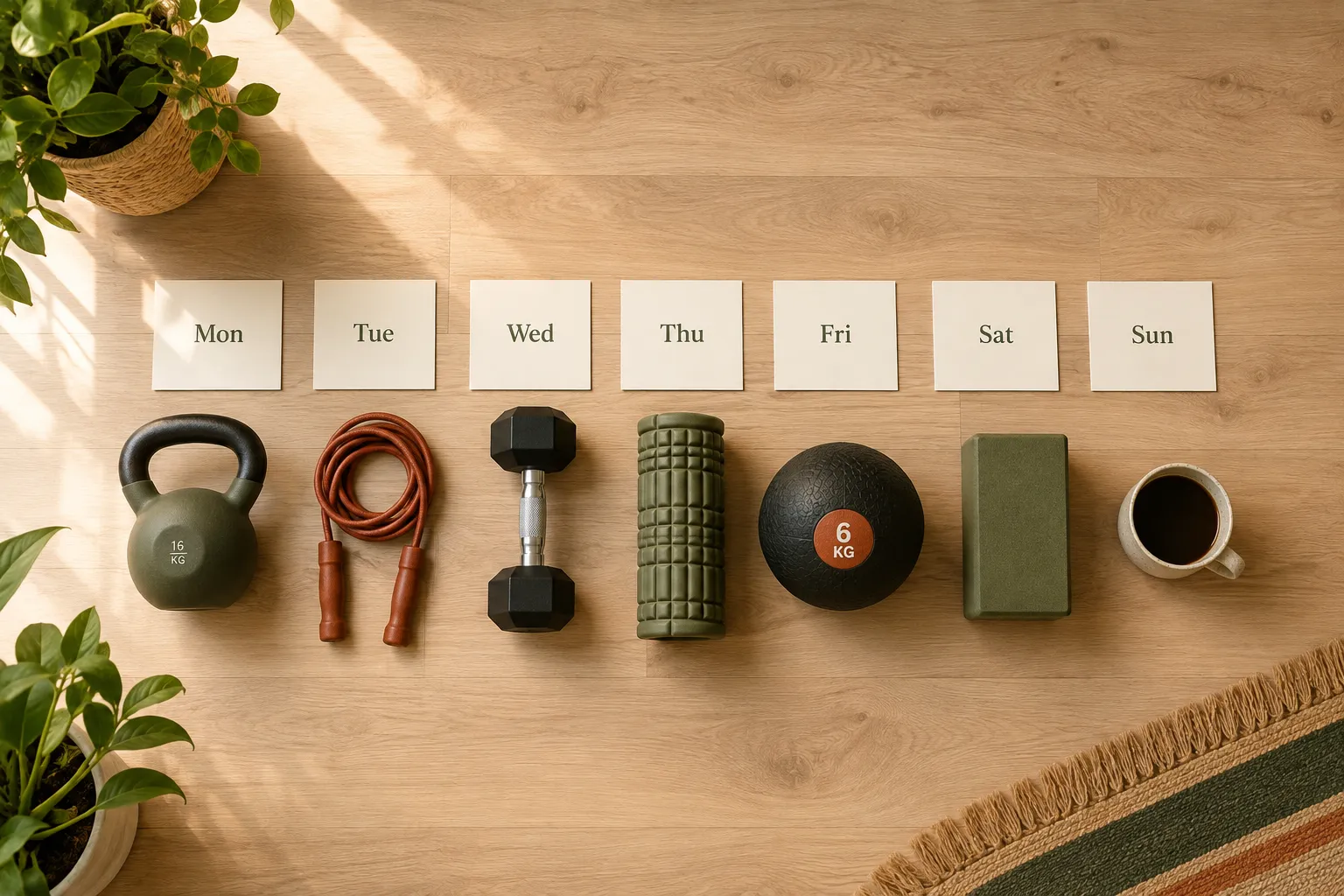
Sustainable 7-day rotation:
- Mon: Hard strength (lower)
- Tue: Easy conditioning + mobility
- Wed: Hard strength (upper)
- Thu: Active recovery (walk + foam roll)
- Fri: Full-body power + core
- Sat: Optional play (hike, sport, easy bike)
- Sun: Rest or gentle yoga
Edge case: if you're over 40, sleeping poorly, or dealing with high work stress, drop to 4 total sessions. Recovery capacity is finite.[6][10]
Hybrid Workouts for People with Limited Space
A 6-by-6-foot area is enough for a full hybrid program. You don't need a garage gym, you need one clear patch of floor, vertical space to press overhead, and a single anchor point (a door, a heavy couch leg) for band work.[5]
Space-efficient exercises that need almost no room:
- Goblet squats, split squats, reverse lunges
- Romanian deadlifts, single-leg deadlifts
- Push-ups, dumbbell floor presses, pike push-ups
- One-arm rows, banded rows, band pull-aparts
- Kettlebell swings (need ~6 ft of clearance in front)
- Plank variations, dead bugs, bird dogs
- Every mobility drill
Skip: barbell overhead work, box jumps, sled pushes. Everything else fits.
How to Structure a Week of Hybrid Training
The standard 2026 hybrid template alternates strength days with conditioning/mobility days and includes at least one active recovery day.[2]
Proven weekly structure (intermediate):
| Day | Session | Duration |
|---|---|---|
| Mon | Lower-body strength (squat + hinge focus) | 50 min |
| Tue | Conditioning + mobility (20-min HIIT or tempo cardio + 10-min flow) | 35 min |
| Wed | Upper-body strength (push + pull focus) | 50 min |
| Thu | Active recovery / LISS walk | 30 min |
| Fri | Full-body power + core (kettlebell, med ball, carries) | 45 min |
| Sat | Optional play or mobility | 20-40 min |
| Sun | Rest or gentle movement | , |
This template is the backbone of most 2026 hybrid programs and works for busy adults who want strength without losing conditioning.[2][10]

Mobility Work Before or After Strength Training?
Both, but with different purposes. Do dynamic, targeted mobility before lifting to prep the specific joints you'll load. Do static stretching and foam rolling after to help nervous system downshift and reduce next-day tightness.[6]
Before lifting (5-8 min):
- Leg swings, hip circles, thoracic rotations
- Band pull-aparts, scap push-ups
- 2 warm-up sets of the first lift at 40% and 60% load
After lifting (5-10 min):
- Foam roll worked muscles
- Static holds: hip flexors, hamstrings, chest doorway stretch (30-60 sec each)
- Deep nasal breathing
Common mistake: long yoga before lifting. Static holds over 60 seconds pre-workout can temporarily reduce power output. Save deep stretching for post-session or off-days.[6]
Hybrid Workout Apps or Programs Worth Buying
The best hybrid programs in 2026 offer structured progression, video demos, and adjustable equipment options. Look for ones that program strength, conditioning, and mobility, not just workout libraries.[10]
Categories worth paying for:
- Structured hybrid apps, Jefit, Ladder, Future, Fitbod. Give you weekly programming with mobility built in.[10]
- Coach-led hybrid programs, Inov8 hybrid plans, individual coaches on Trainerize. Higher cost, more personalized.[4]
- Mobility-specific apps, GOWOD, Pliability, Bodymotionlab routines pair well with any strength app.[6]
Decision rule: if you have to invent your own workouts, you'll stop in 6 weeks. Pay for programming.
FAQ
How long until I see results from hybrid training?
Strength gains show in 3-4 weeks; visible body changes in 8-12 weeks with consistent training and adequate protein.
Can hybrid training replace running for cardio?
Mostly, yes. Kettlebell flows, circuits, and Zone 2 walking cover general cardio. If you're training for a race, keep dedicated running.
Is hybrid training good for weight loss?
Yes. The combination of strength (preserves muscle) and conditioning (burns calories) with adequate protein is one of the most effective fat-loss approaches.
Do I need supplements?
No. Prioritize protein (0.7-1 g per pound of bodyweight), sleep, and creatine (5 g daily) if you want one add-on.
Should I train fasted?
Fine for short mobility or Zone 2 sessions. Eat something with protein and carbs 60-90 minutes before heavy lifting.
What if I miss a workout?
Skip it and continue with the next scheduled session. Don't double up, that spikes fatigue.
Can older adults do hybrid training?
Absolutely. Adults 50+ benefit most from the combination of strength (bone density) and mobility (fall prevention). Start with 3 sessions a week.
How much protein do I need?
Aim for 0.7-1 g per pound of bodyweight daily, split across 3-4 meals.
Conclusion
Hybrid home workouts combining strength, mobility, and recovery are the most sustainable way to build a body that lifts heavy, moves well, and doesn't fall apart at 45. The formula is boring on purpose: 3-5 focused sessions a week, mobility as prep, strength as the main course, recovery baked in.
Your next steps:
- Pick 3 days this week and commit to 40-minute sessions.
- Buy the starter kit, one kettlebell, a band, a mat, a foam roller.
- Run the beginner template above for 4 weeks. Don't change it.
- Track lifts in a notebook or app. Add 2.5-5 lb when the last set feels controlled.
- After 4 weeks, add a fourth day and one dedicated mobility session.
Consistency beats intensity. A 40-minute session done 3 times a week for a year will outperform a 90-minute killer session done twice before you quit.
References
[1] Hybrid Workouts Blending Strength And Mobility For Balanced Results – https://remix-fitness.com/blog/hybrid-workouts-blending-strength-and-mobility-for-balanced-results
[2] How To Build A Sustainable Hybrid Workout Routine Strength Cardio Mobility Recovery For Lasting Results – https://exerciseplease.com/how-to-build-a-sustainable-hybrid-workout-routine-strength-cardio-mobility-recovery-for-lasting-results/
[4] Hybrid Training For Beginners – https://www.inov8.com/us/blog/post/hybrid-training-for-beginners
[5] Hybrid Workouts How To Mix Strength Cardio And Mobility – https://fitnessworld.ca/blog/hybrid-workouts-how-to-mix-strength-cardio-and-mobility/
[6] Recovery Mobility Routine 2026 Strength Progress – https://bodymotionlab.com/blog/recovery-mobility-routine-2026-strength-progress
[8] Hybrid Training Strength Cardio 30 Minutes – https://runlovers.it/en/2026/hybrid-training-strength-cardio-30-minutes/
[10] Hybrid Training The Complete Guide To Combining Strength Cardio Mobility In 2026 – https://www.jefit.com/blog/hybrid-training-the-complete-guide-to-combining-strength-cardio-mobility-in-2026