
Last updated: July 25, 2026
Quick Answer
Active aging workout plans that combine strength, balance, mobility, and aerobic training can reduce falls in older adults by roughly 23-34% compared with no exercise or single-focus routines, according to recent Cochrane and 2025 meta-analyses [1][7]. The most effective programs run 2-3 sessions per week for at least 12 weeks, target the legs and trunk, and include progressive balance challenges. Home-based versions work when they follow the same structure as supervised programs.
Key Takeaways
- Multi-component programs beat single-focus workouts for fall prevention, especially when balance training is dosed at 3+ hours per week [1][5].
- Falls drop by about 23% in community-dwelling adults 65+ who follow structured exercise programs with balance and strength components [7].
- Three sessions per week, 45-60 minutes each, is the sweet spot for most older adults training at home.
- Improvements in balance and gait appear in 8-12 weeks; fall-rate reductions typically show at 6+ months [4].
- Frailty is not a disqualifier. Chair-based and seated-progression versions of active aging programs are safe for pre-frail and frail adults with clearance [6].
- Cost ranges from free (NIH Go4Life, CDC STEADI) to $15,$40/month for guided apps or community classes.
- The biggest mistakes are skipping the balance component, using weights that are too light, and stopping after 4-6 weeks before adaptations kick in.
What is active aging and why does it matter for older adults?
Active aging is a framework, endorsed by the WHO, that treats physical activity as the central lever for maintaining independence, cognition, and function after 60. It matters because falls are the leading cause of injury-related death in adults 65+, and roughly one in four older adults falls each year in the United States.
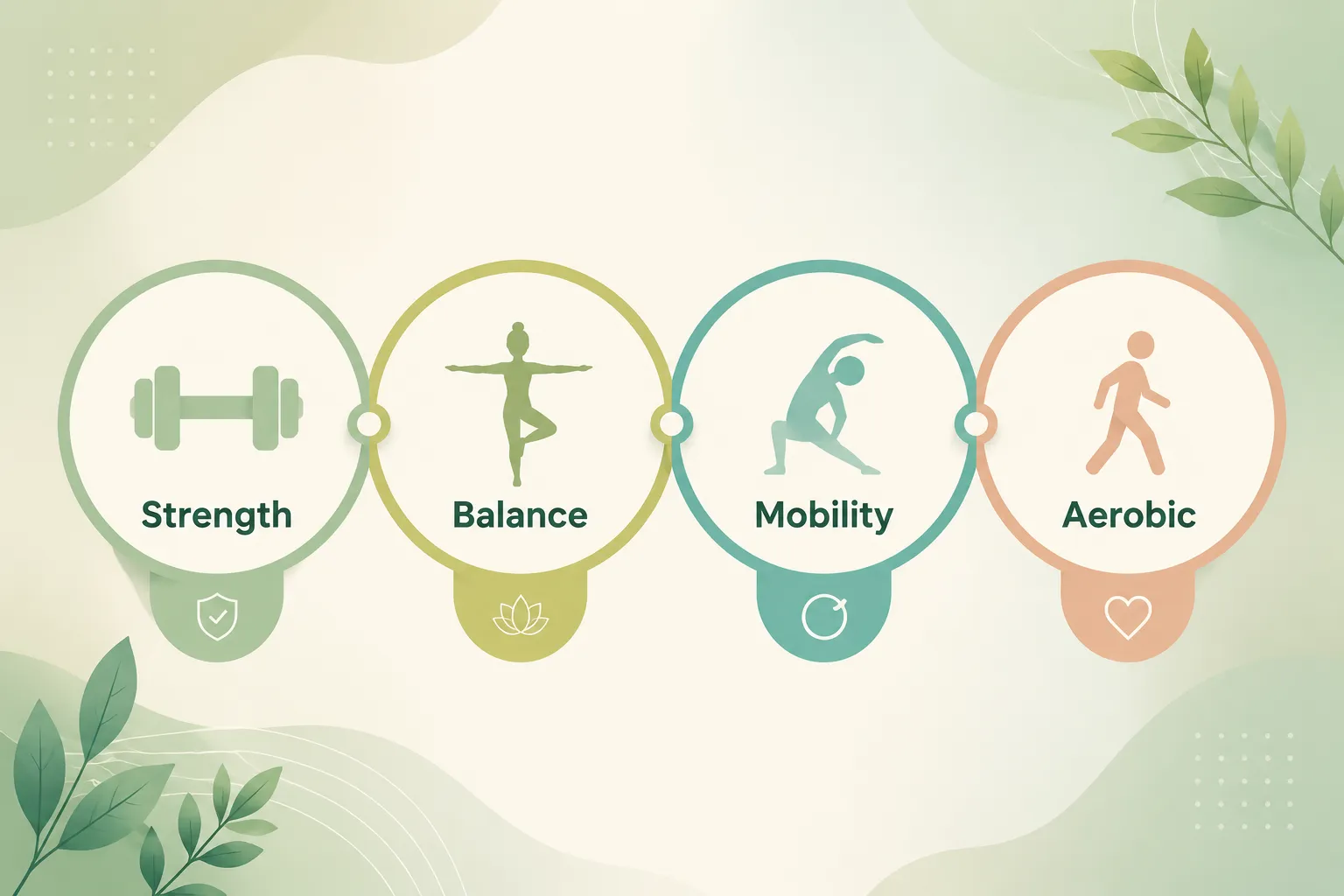
Multi-component active aging workout plans directly attack the modifiable risk factors: weak legs, poor balance, stiff hips and ankles, and slow reaction time. Unlike a walking-only routine, they train the neuromuscular systems that actually stop a stumble from becoming a fall [1].
Who benefits most: community-dwelling adults 60+, people recovering from a recent fall, adults with early sarcopenia, and anyone whose doctor has mentioned "deconditioning."
How do multi-component workout programs reduce fall risk?
Multi-component programs cut fall risk because they train the exact systems that fail during a near-fall: lower-body force production, single-leg stability, ankle mobility, and reactive stepping. A 2025 systematic review comparing multi-component vs. single-component training found multi-component programs consistently outperformed strength-only or balance-only interventions on fall rate and fall-related injuries [5].
The mechanism is layered:
- Strength work rebuilds the quadriceps, glutes, and calves that generate the force needed to catch yourself.
- Balance training sharpens the vestibular and proprioceptive reflexes that fire in the 200-400 milliseconds you have to recover from a trip.
- Mobility work restores ankle dorsiflexion and hip extension, so your foot actually clears the carpet edge.
- Aerobic conditioning keeps you from fatiguing on stairs or long walks, when most falls happen.
Cochrane-level evidence puts the fall reduction from well-designed exercise programs at around 23% for fall rate and 15% for the number of people who fall [7]. Programs that include 3+ hours per week of balance-focused work show the largest effect [1].
"Exercise is the single most effective single intervention for reducing falls in community-dwelling older adults.", summary finding, Cochrane review of exercise for fall prevention [7]
What exercises are included in active aging programs?
Effective active aging workout plans include four exercise categories, done in most sessions. Here's what each looks like in practice:
Strength (lower body priority)
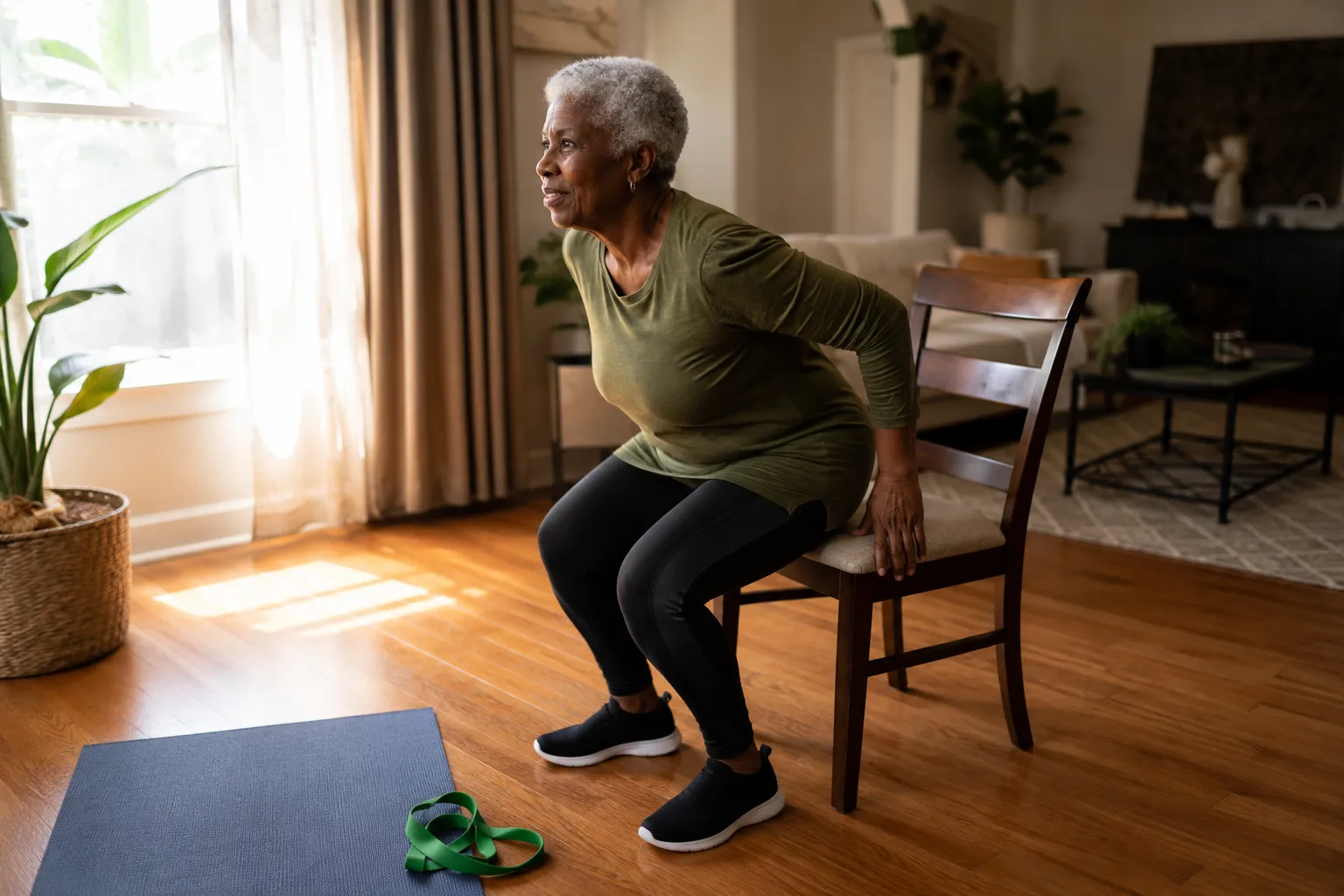
- Sit-to-stands from a chair (progress to one-legged)
- Step-ups onto a low platform
- Wall or counter push-ups
- Hip hinges with a light dumbbell or kettlebell
- Calf raises, then single-leg calf raises
Balance (progressive challenge)
- Feet-together stand → semi-tandem → tandem → single-leg
- Weight shifts and controlled reaches
- Heel-to-toe walking along a line
- Standing on a folded towel or foam pad (once safe)
- Reactive stepping drills (step in response to a cue)
Mobility and flexibility
- Ankle circles and calf stretches
- Hip flexor stretch (kneeling or supported)
- Thoracic rotations in a chair
- Cat-cow or seated cat-cow
Aerobic
- Brisk walking, 20-30 minutes
- Stationary cycling
- Water walking or aquatic classes
A typical 45-minute session covers all four, with roughly 20 minutes of strength, 15 minutes of balance, 5 minutes of mobility, and either a separate aerobic day or 10 minutes bolted onto the session.
How often should seniors do active aging workouts per week?
Most evidence supports 2-3 sessions per week of combined strength and balance work, plus 150 minutes per week of moderate aerobic activity, this matches WHO and ACSM guidance and is the dose used in the trials showing the biggest fall-risk reductions [4][7].
Sample weekly template for adults 60+ training at home
| Day | Focus | Duration |
|---|---|---|
| Monday | Strength + balance | 45 min |
| Tuesday | Brisk walk | 30 min |
| Wednesday | Balance + mobility | 30 min |
| Thursday | Brisk walk or cycling | 30 min |
| Friday | Strength + balance | 45 min |
| Saturday | Longer walk or aquatic class | 40 min |
| Sunday | Rest or gentle mobility | 15 min |
Decision rule: If you're brand new, start with 2 combined sessions plus 2 walks, then add the third session in week 3-4. If you've been sedentary for over a year, cut every session in half for the first two weeks.
Can I start active aging exercises if I'm already frail or injured?
Yes, in most cases, but the entry point changes. Frail and pre-frail adults still benefit from multi-component training. A 2024 review found that even in frail older adults, supervised or well-designed home programs improved physical function and reduced falls when programs started with seated and supported exercises before progressing to standing work [6].
If you're frail or recovering from injury, do this:
- Get medical clearance, especially after a recent hospitalization.
- Start with chair-based versions of every exercise.
- Work with a physical therapist for the first 4-6 weeks if possible, this is often covered by Medicare after a fall.
- Prioritize sit-to-stands and supported balance holds over aerobic volume.
- Progress by adding time under tension before adding weight.
Do not start unsupervised if you have: unstable cardiovascular disease, uncontrolled arrhythmia, severe osteoporosis with recent vertebral fracture, or acute joint injury.
Active aging workout plans vs regular gym routines for seniors
Active aging plans are structurally different from a standard gym routine. A regular gym program built around machines and steady-state cardio can improve strength but often skips the two ingredients that most directly prevent falls: dynamic balance and reactive stepping.
| Feature | Active Aging Plan | Standard Gym Routine |
|---|---|---|
| Balance training | Built in, progressive | Usually absent |
| Strength focus | Functional (sit-to-stand, step-up) | Isolated machines |
| Fall-risk impact | Direct, evidence-backed [1][7] | Indirect |
| Skill work (reactive stepping) | Included | Rarely |
| Session structure | Multi-component | Body-part split |
Choose an active aging plan if your goal is independence, fall prevention, or recovering function. A standard gym routine may be fine if you're already highly active and just want to preserve muscle, but bolt on 15 minutes of balance work twice a week.
Best active aging programs for people with arthritis or balance issues
For arthritis, the Arthritis Foundation's Walk With Ease and aquatic-based programs are strong entry points because water reduces joint load while still training balance and strength. Tai chi has some of the best evidence for adults with balance impairments, a 2024 analysis found tai chi reduced falls by roughly 20% in this group [9].
Program picks by condition:
- Knee or hip osteoarthritis: GLA:D program, aquatic multi-component classes, recumbent cycling paired with home strength work.
- Balance impairment or history of falls: Otago Exercise Programme (physiotherapist-designed, 17 exercises), tai chi (Yang or Sun style), CDC STEADI-aligned classes.
- Low back pain: McKenzie-informed mobility plus glute-focused strength; skip loaded flexion.
- Osteoporosis: LIFTMOR-style progressive resistance (with supervision), balance training, no forward-bending loaded work.
How long does it take to see fall risk improvement from these workouts?
Measurable improvements in balance and leg strength appear within 8-12 weeks of consistent training [4]. Actual reductions in fall rates, meaning fewer falls per year, usually show up in trials at 6 months and beyond [7].
Here's the rough timeline:
- Weeks 1-4: Neuromuscular adaptation. Exercises feel easier, coordination improves.
- Weeks 4-12: Measurable gains in sit-to-stand speed, gait speed, and single-leg balance time.
- Months 3-6: Meaningful strength gains, better stair climbing, reduced fear of falling.
- 6+ months: Statistically lower fall rate compared to non-exercisers.
The takeaway: stick with it for at least six months before judging whether the program "works."
What's the difference between active aging and physical therapy?
Physical therapy is clinical, short-term, and prescribed to treat a specific impairment. Active aging is a long-term lifestyle framework designed to maintain function and prevent decline. Both can use similar exercises, but the goals and delivery differ.
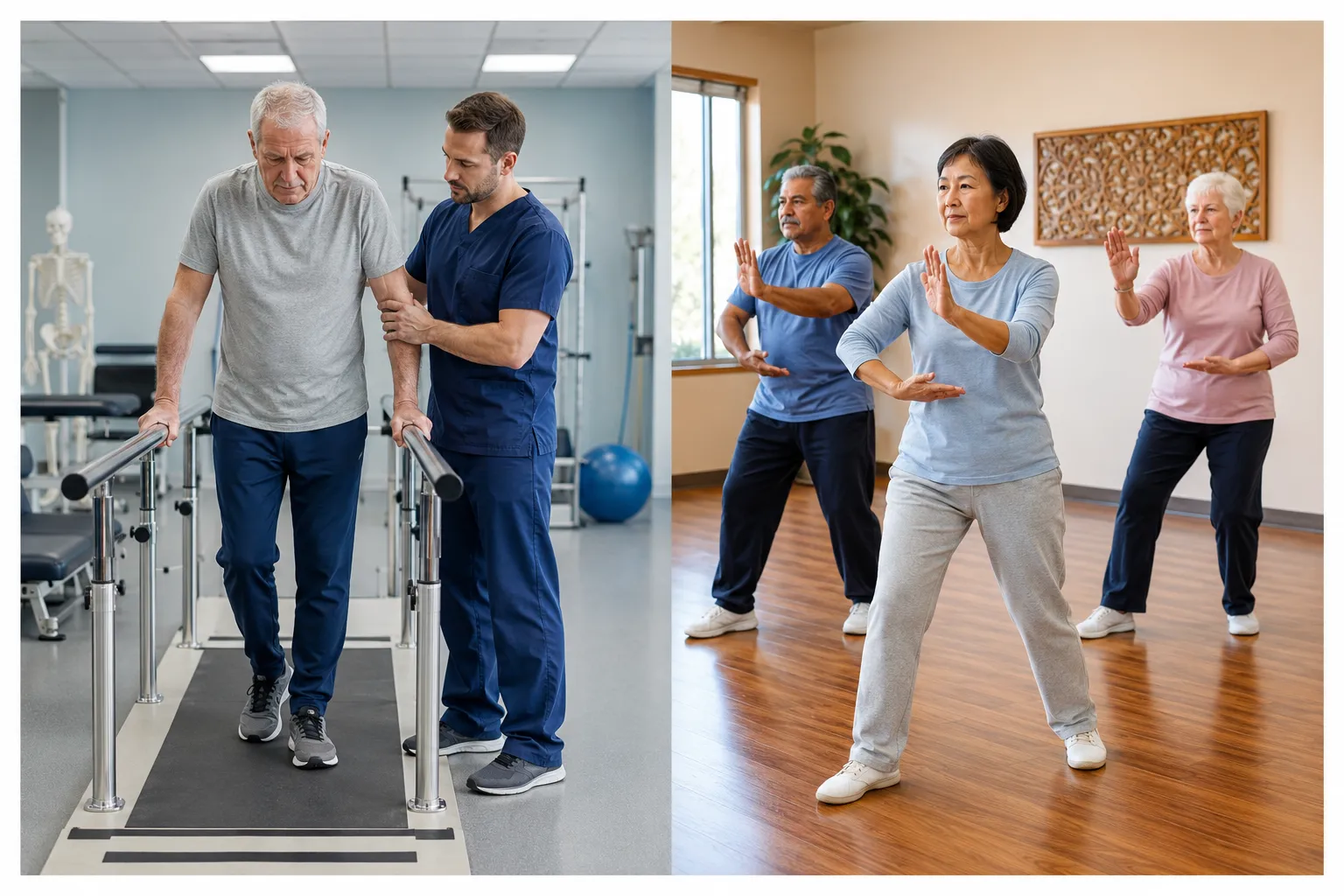
Physical therapy:
- Prescribed after injury, surgery, or a fall
- 1-on-1, usually covered by insurance for a limited number of visits
- Diagnostic and corrective
- Typically 6-12 weeks
Active aging:
- Ongoing (years to decades)
- Group class, app, or self-guided
- Preventive and performance-focused
- Life-long
Many older adults do PT first after a fall, then transition into an active aging program to keep the gains.
Active aging workout plan cost and where to find programs
Costs range from free to about $40 per month. You do not need an expensive gym membership to get the benefit.
Free or low-cost options:
- NIH Go4Life, free videos and printable plans
- CDC STEADI toolkit, free provider-facing fall-prevention resources with patient handouts
- Otago Exercise Programme, free protocol available online
- YMCA Enhanced Fitness, sliding-scale pricing
- SilverSneakers, free with many Medicare Advantage plans
Paid options ($15,$40/month):
- Bold, Mighty Health, and similar senior-focused fitness apps
- Community center active aging classes
- Small-group personal training (higher cost, but strong supervision)
Equipment you actually need at home:
- Sturdy chair
- Resistance band (medium)
- Two dumbbells (start with 3-8 lb; you'll outgrow them fast)
- Non-slip mat
- Wall or counter for balance support
Common mistakes older adults make when starting active aging exercises
The five biggest mistakes that either cause injury or waste effort:
- Skipping the balance component because it feels less like "real exercise." Balance is where the fall-risk reduction actually comes from.
- Using weights that are too light. If sit-to-stands with a 3-lb dumbbell feel easy after two weeks, add weight. Strength gains require progressive overload.
- Quitting at week 4-6 before the strength adaptations show up.
- Doing only walking. Walking maintains cardiovascular fitness but does not by itself lower fall risk meaningfully [1].
- Progressing balance work too slowly, staying on two feet forever. You need to challenge stability to improve it (safely, near a counter).
Is active aging safe for people with heart conditions or diabetes?
Yes, with medical clearance. Multi-component exercise is broadly recommended for stable cardiovascular disease and type 2 diabetes because it improves blood pressure, glycemic control, and functional capacity. The 2025 evidence continues to support supervised or well-structured programs for these groups [4][8].
Precautions:
- Heart disease: Get a clearance conversation with your cardiologist. Skip Valsalva-style straining. Use rate of perceived exertion (RPE) rather than heart rate if you're on beta-blockers.
- Type 2 diabetes: Check glucose before and after; carry a fast carb; watch feet for blisters.
- Uncontrolled hypertension (>160/100): Delay starting until managed.
- On anticoagulants: Emphasize balance safety; a fall carries higher bleeding risk.
Who should do active aging workouts and who shouldn't?
Should do:
- Adults 60+ who want to maintain independence
- Anyone with a fall in the past year
- Adults with early sarcopenia or noticeable strength loss
- People recently discharged from PT who want to keep their gains
- Caregivers and spouses (do it together, adherence doubles)
Should not start unsupervised:
- Anyone with unstable angina or a recent cardiac event (last 3 months)
- Adults with uncontrolled arrhythmia
- Acute joint injury or recent fracture without clearance
- Severe cognitive impairment without a supervising caregiver
- Uncontrolled severe hypertension
These groups should either delay or start with a physical therapist or clinical exercise physiologist.
How do I know if an active aging program is actually effective?
An effective program checks these boxes. Use it as a screening checklist before you commit.
- ✅ Includes all four components, strength, balance, mobility, aerobic
- ✅ Progressive, exercises get harder over weeks (harder balance positions, more weight, more reps)
- ✅ Balance work is dosed at 3+ hours weekly at some point in the program [1]
- ✅ Session length is 30-60 minutes, 2-3 times a week minimum
- ✅ Designed or reviewed by a PT, exercise physiologist, or certified specialist (NSCA-CSPS, ACE Senior Fitness, ACSM)
- ✅ Has an assessment, sit-to-stand test, timed up-and-go, or single-leg balance, so you can measure change
- ✅ Runs at least 12 weeks in the initial block
Programs missing three or more of these are unlikely to move fall risk meaningfully.
FAQ
Is 30 minutes a day enough for active aging?
Yes, if it's structured. Thirty minutes of combined strength and balance work, 3 days a week, plus daily walking, hits the effective dose used in most fall-prevention trials.
Can I do active aging workouts every day?
Yes for balance, mobility, and walking. No for heavy strength work, leave 48 hours between hard lower-body sessions.
Does walking count as fall prevention?
Walking alone does not meaningfully lower fall risk in high-risk older adults [1]. It must be paired with balance and strength work.
What's the single best exercise for fall prevention?
The sit-to-stand. It trains the exact leg strength and pattern used to catch yourself when you stumble.
Are group classes better than solo home workouts?
Adherence is usually higher in groups, and effect sizes are similar when programs are structured the same way. Choose whichever you'll actually do.
Do I need a doctor's clearance to start?
If you have any cardiovascular disease, uncontrolled diabetes, recent surgery, osteoporosis, or a fall in the last 6 months, yes. Otherwise, start conservatively.
Will active aging exercises help with fear of falling?
Yes. Tai chi and multi-component programs both reduce fear of falling in trials, which independently improves quality of life [9].
Can these programs reverse sarcopenia?
They can significantly slow it and often reverse early stages when combined with adequate protein (1.0-1.2 g/kg/day for older adults).
Conclusion
The evidence is settled: multi-component active aging workout plans are the most effective non-pharmaceutical intervention for cutting fall risk in adults 60+. The formula is not complicated, strength, balance, mobility, and aerobic training, 2-3 times a week, for at least 12 weeks, but each component has to actually be there. Programs that skip the balance work or stop before three months rarely move the needle.
Your next steps:
- This week: Do a baseline sit-to-stand test (count how many you can do in 30 seconds) and time how long you can stand on one leg.
- Pick a program: Start with Otago, SilverSneakers, or a free NIH Go4Life plan if you're new. Choose a paid app or class if you need structure.
- Commit to 12 weeks: Put the sessions on your calendar. Track them.
- Retest at week 12: Compare sit-to-stand and balance times. If numbers improved, keep going. If not, get a professional assessment.
- Progress deliberately: Add weight, harder balance positions, or longer walks every 2-3 weeks.
The goal is not to become an athlete. It's to still be climbing your own stairs, carrying your own groceries, and standing on one leg to pull on a sock at age 85. Multi-component training is how you get there.
References
[1] Effect of exercise for fall prevention in community-dwelling older adults – https://pmc.ncbi.nlm.nih.gov/articles/PMC12336026/
[2] Multicomponent exercise program on functional fitness in older adults – https://www.ijrrjournal.com/IJRR_Vol.12_Issue.12_December2025/IJRR-Abstract51.html
[3] Multicomponent training and fall risk in older adults – https://pubmed.ncbi.nlm.nih.gov/42176369/
[4] Exercise interventions and physical function in older adults – https://pmc.ncbi.nlm.nih.gov/articles/PMC12196961/
[5] A systematic review of multicomponent vs single-component training programs for fall prevention in older adults – https://www.bohrium.com/paper-details/a-systematic-review-of-multicomponent-vs-single-component-training-programs-for-fall-prevention-in-the-elderly-a-systematic-review/1152951217664557065-9083
[6] Multicomponent exercise in frail and pre-frail older adults – https://pmc.ncbi.nlm.nih.gov/articles/PMC10971002/
[7] Cochrane review: exercise for preventing falls in community-dwelling older people – https://pubmed.ncbi.nlm.nih.gov/39167923/
[8] Physical activity interventions in older adults with chronic conditions – https://pubmed.ncbi.nlm.nih.gov/39616365/
[9] Dual-task interventions and fall prevention in seniors – https://medicalxpress.com/news/2024-06-task-interventions-seniors-falls.html
[10] Balance and strength training outcomes in older adults – https://pubmed.ncbi.nlm.nih.gov/42237301/