
Last updated: September 6, 2026
Quick Answer
The best resistance bands for seniors are light-to-medium loop bands and tube bands with soft foam handles (typically 5-20 lb of resistance), used 2-3 times per week for 8-12 reps across 1-3 sets. Look for latex-free options if allergies are a concern, secure door anchors, and clearly color-coded tension levels. Bogi Fitness, TheraBand, Bodylastics, and Fit Simplify consistently rank well in 2026 buyer's guides for older adults [1][3][7].
Key Takeaways
- Start light. Choose a tension you can lift for 15 reps with 3-5 "reps in reserve", if you can't hit 10 clean reps, drop a level.
- Tube bands with handles are best for pressing and rowing; loop bands are best for hips, glutes, and knees.
- Latex-free bands (TPE or fabric) suit seniors with latex allergies or sensitive skin.
- Bands improve strength, balance, gait speed, and fall-related outcomes in older adults when used consistently [1][7].
- Anchor safely: use a door anchor with the door closing toward you, never a doorknob.
- Expect to spend $15,$60 for a quality senior-friendly set in 2026 [3][6].
- Progress slowly, add reps first, then tension, over 4-6 week cycles.
- Bands are safer than free weights for many seniors because there's no dropped-weight risk.
What Are Resistance Bands and How Do They Work for Seniors?
Resistance bands are elastic tools, loops, tubes, or flat therapy strips, that create tension when stretched, forcing muscles to work through a full range of motion. For seniors, they replace or complement dumbbells by delivering progressive resistance without heavy loads on joints [4].
The tension increases as the band stretches, which means the hardest point of the movement usually matches where the muscle is strongest. That's joint-friendly, especially for arthritic knees, shoulders, and hips.
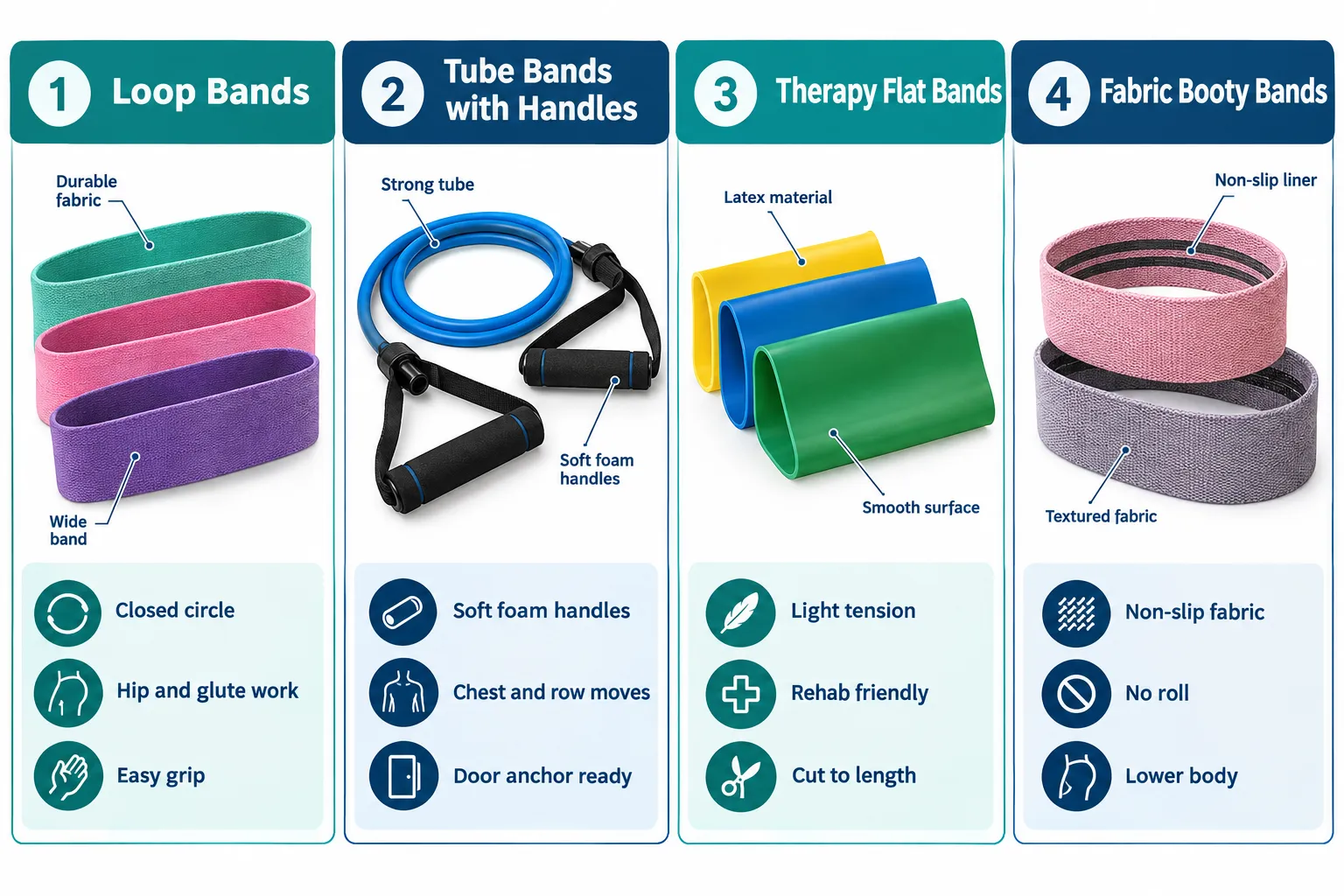
Three main types you'll see:
- Loop bands, closed circles, great for lower-body and glute work
- Tube bands with handles, best for upper-body pushing, pulling, and pressing
- Therapy flat bands, thin sheets (like TheraBand) used in physical therapy and rehab
Are Resistance Bands Safe for Older Adults with Arthritis?
Yes, resistance bands are generally one of the safest strength-training tools for arthritic seniors because they load muscles without joint impact and let you control tension moment-by-moment. Physical therapists routinely prescribe them for hip, knee, and shoulder osteoarthritis.
Three reasons they work well with arthritis:
- No dropped-weight risk. A band can't fall on your foot.
- Variable tension. You can shorten your grip or step closer to the anchor to reduce load on a flare-up day.
- Smooth resistance curve. No sudden loading spikes on inflamed joints.
Decision rule: If a movement causes sharp joint pain (not muscle fatigue), stop and reduce tension by 30-50%. Dull muscle burn is fine, sharp joint pain is not.
Common mistake: Using too much tension too fast because bands "feel light." The eccentric (returning) phase is where seniors most often overstretch a joint.
Best Resistance Bands for Seniors with Limited Mobility
For seniors with limited mobility, soft-handle tube bands with light tension (5-15 lb) and fabric loop bands are the top picks. They allow seated exercise, require minimal grip strength, and don't demand standing balance.
Top picks for limited-mobility users in 2026:
- TheraBand CLX / Loop bands, clinical standard, color-coded, latex and latex-free versions [3]
- Bogi Fitness Tube Set, foam handles reduce grip strain, comes with door anchor [7]
- Fit Simplify Loop Bands, inexpensive fabric loops, easy to slip on while seated [1][6]
- Bodylastics Snap-Guard Tubes, internal safety cord prevents snap-back injuries [3][7]
Look for chair-friendly length (48 inches or more for tube bands) and soft neoprene handles rather than hard plastic.
How to Use Resistance Bands Safely for Seniors: Step by Step
Safe use comes down to five habits: inspect, anchor, align, tempo, and reserve.
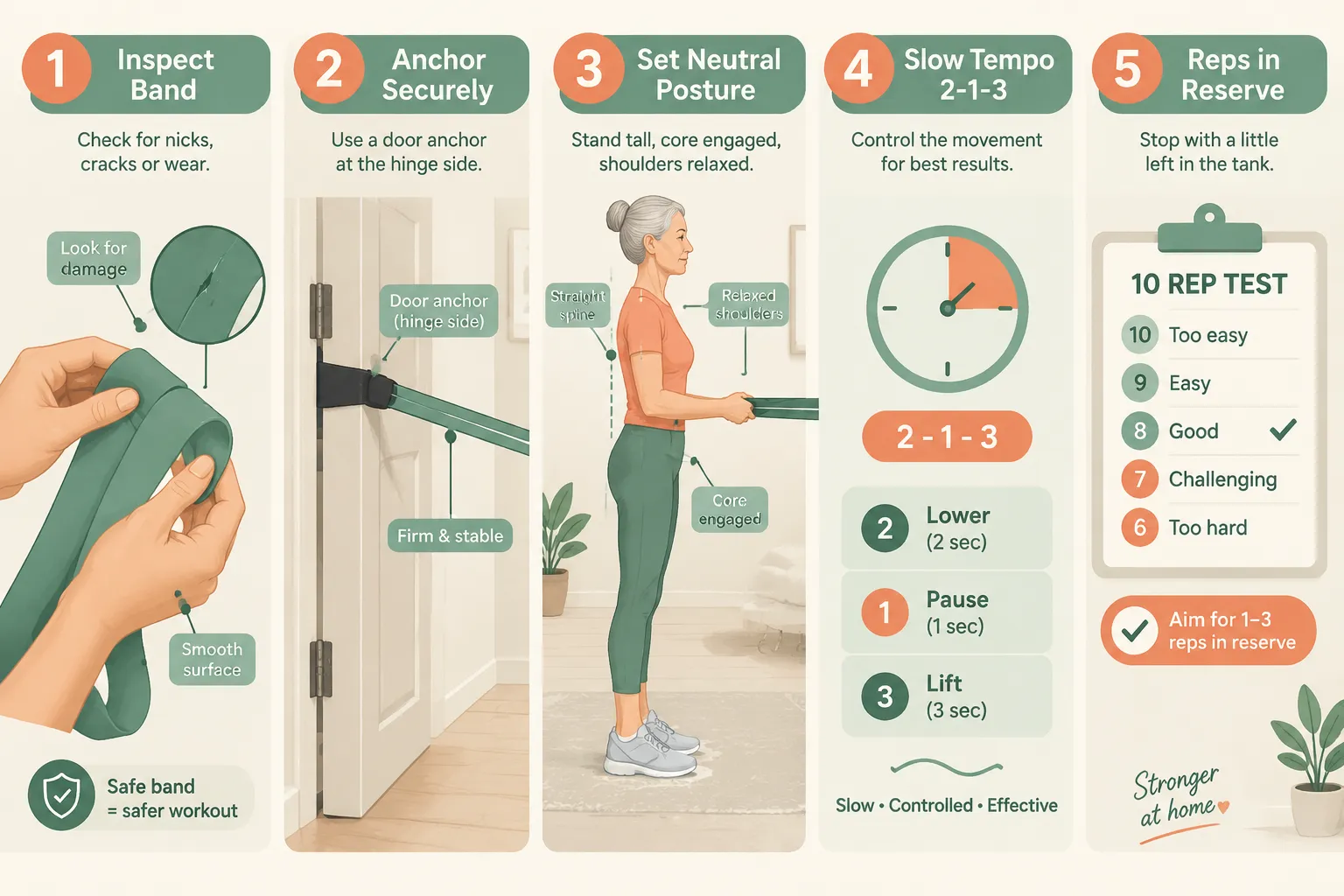
Step-by-step safe setup:
- Inspect the band for nicks, tears, or dry patches every session. Replace latex bands every 6-12 months with regular use [4].
- Anchor securely. Use a proper door anchor placed on the hinge side, with the door closing toward you. Never tie to a doorknob or furniture leg.
- Set neutral posture. Feet hip-width, knees soft, spine tall, ribs down. Sit if standing balance is a concern.
- Control the tempo. Aim for a 2-second lift, 1-second pause, 3-second return. The slow return is where strength (and safety) is built.
- Leave reps in reserve. Stop each set 2-3 reps before failure. Grinding out final reps is where form breaks down.
Eye safety note: Always keep your face out of the band's snap-back path. Wear glasses when anchoring overhead.
Resistance Bands vs Weights for Seniors: Which Is Better?
For most seniors, resistance bands are the safer starting point, while dumbbells become useful once baseline strength and confidence are built. Neither is universally better, they serve different goals.
| Factor | Resistance Bands | Dumbbells |
|---|---|---|
| Joint impact | Very low | Moderate |
| Dropped-weight risk | None | Real |
| Portability | Excellent | Poor |
| Cost for full range | $15,$60 | $150,$400 |
| Precise load tracking | Harder | Easy |
| Best for | Rehab, mobility, travel | Progressive overload past ~20 lb |
Choose bands if: You have arthritis, limited space, live alone, are recovering from surgery, or are new to strength training.
Choose weights if: You've been training 6+ months, want to build maximal strength, and have stable balance.
Most seniors do best with both, bands for daily maintenance and dumbbells 1-2x per week for progressive loading.
How Much Do Quality Resistance Bands for Seniors Cost?
Expect to pay $15,$60 for a complete senior-friendly set in 2026. Individual bands run $5,$15. Premium kits with door anchors, ankle straps, and carry bags top out around $80 [3][6].
What you're paying for at each tier:
- Under $20: Basic fabric loops or single tubes. Fine for light rehab; may lack anchors.
- $20,$40: Complete stackable tube sets with handles, door anchor, ankle straps, the sweet spot for most seniors [1][7].
- $40,$80: Premium brands (Bodylastics, TheraBand) with safety cords, latex-free options, and higher durability.
Avoid ultra-cheap sets under $10, the handles often detach, and the tension is inconsistent between bands.
Resistance Band Exercises for Seniors to Build Strength
A well-rounded senior program covers six movement patterns: squat, hinge, push, pull, carry, and rotation. Bands can train all six.
Core senior exercise list (2-3 sets, 8-12 reps each):
- Seated row (tube band, anchored low), upper back, posture
- Chest press (tube band, anchored behind you), chest, shoulders
- Banded sit-to-stand (loop above knees), glutes, quads, functional lower body
- Standing hip abduction (loop at ankles), hip stability, fall prevention
- Overhead pull-apart (light band between hands), shoulder health, posture
- Banded good morning (loop under feet, over shoulders), hamstrings, hips
- Farmer's carry substitute, hold band handles at sides, walk in place for 30 seconds
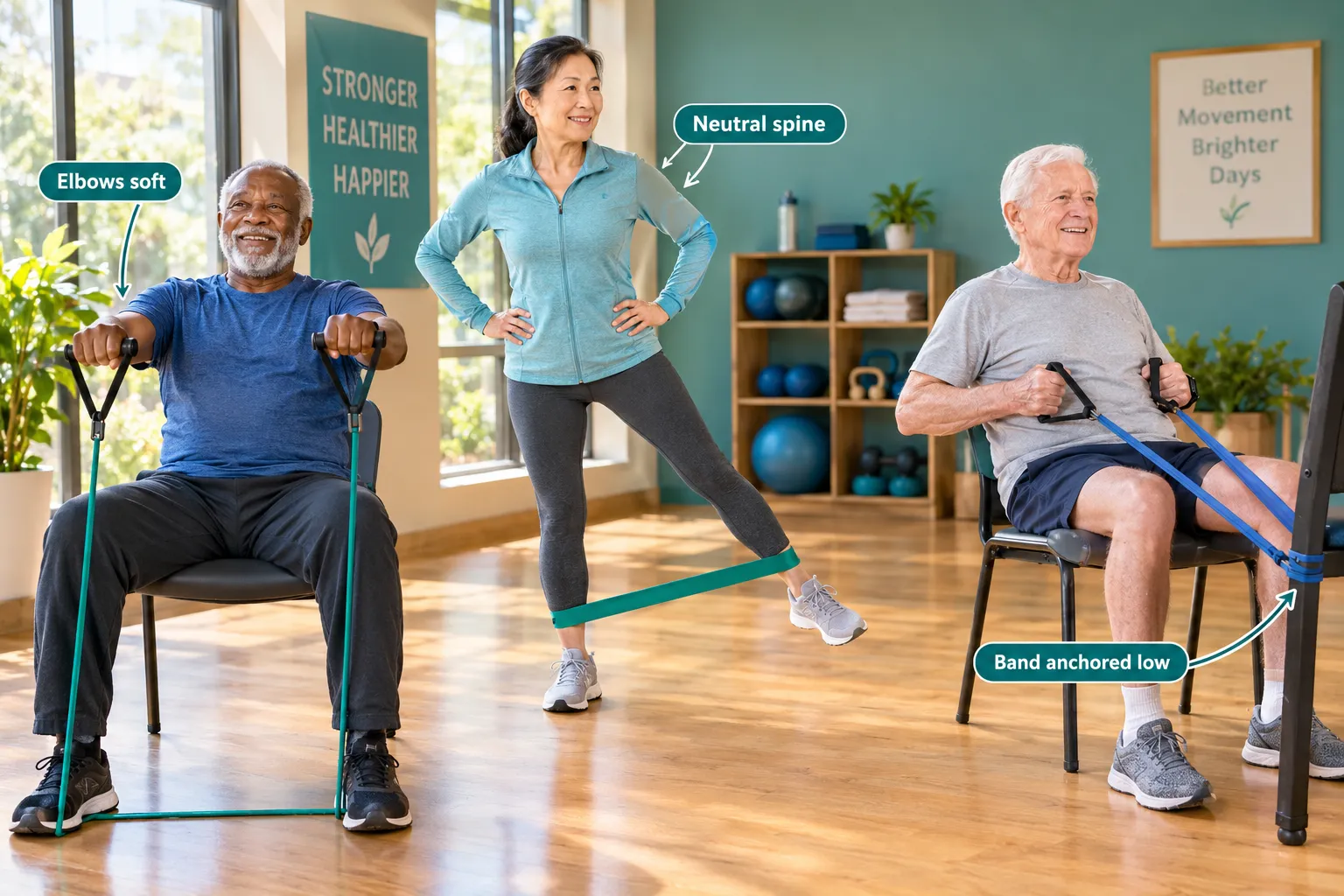
Weekly template: 2-3 sessions, 30-40 minutes each, with at least one rest day between. Add balance work (single-leg stands) between sets.
Can Seniors Use Resistance Bands After Surgery or Injury?
Yes, but only with medical clearance and typically starting with the lightest tension available (often yellow or peach in most color systems). Bands are so common in post-surgical rehab, knee replacements, rotator cuff repair, hip surgery, that many hospitals send patients home with them [4].
Guidelines for post-op band use:
- Get written clearance from your surgeon or PT before starting
- Begin with isometric holds (no movement, just tension) for 1-2 weeks
- Progress to full range of motion only when pain-free
- Follow your PT's specific protocol, don't self-prescribe
Red-flag conditions where you should not train with bands without clinical supervision: uncontrolled hypertension, recent cardiac event, active hernia, severe osteoporosis with recent fracture, retinal detachment risk, or acute joint inflammation.
Light Resistance Bands for Beginners vs Medium Resistance
Beginners should almost always start with light bands (typically 5-10 lb equivalent) for the first 2-4 weeks, then graduate to medium (10-20 lb) once form is dialed in and 12 reps feel easy.
Color-code reference (varies by brand, but common):
- Yellow / peach: Extra light (2-5 lb)
- Red / pink: Light (5-10 lb)
- Green: Medium (10-15 lb)
- Blue: Heavy (15-20 lb)
- Black / purple: Extra heavy (20-30+ lb)
The 10-rep test: Do a set of the exercise with a given band. If you can't hit 10 clean reps, the band is too heavy. If you could do more than 20, it's too light.
Resistance Band Set Brands Recommended for Older Adults
The most consistently recommended brands for seniors across 2026 buyer's guides:
- TheraBand, clinical gold standard, used in PT clinics worldwide [3]
- Bodylastics, internal safety cord, stackable tension, senior-friendly handles [3][7]
- Fit Simplify, affordable fabric loops, widely reviewed and durable [1][6]
- Bogi Fitness, foam-handled tube sets popular with older users [7]
- TRX, premium option for those wanting suspension-plus-band flexibility [3]
- Rogue Monster Bands, heavy-duty, best once you've progressed past starter tension [3]
Buyer's checklist:
- Color-coded tension levels
- Door anchor included
- Latex-free option available
- Foam or fabric handles (not hard plastic)
- Snap-guard or safety cord for tube bands
- Written warranty (6 months minimum)
How to Progress Resistance Band Workouts for Seniors Over Time
Progress bands using the "reps first, tension second" rule across 4-6 week cycles. Add one rep per set each week until you hit the top of your range, then jump to the next band color and drop back to the bottom of the range.
A simple 12-week progression:
| Weeks | Sets × Reps | Tension | Focus |
|---|---|---|---|
| 1-2 | 1 × 8 | Light | Form, range of motion |
| 3-4 | 2 × 10 | Light | Volume |
| 5-6 | 2 × 12 | Light, Medium | Tension bump |
| 7-8 | 3 × 10 | Medium | Volume + tension |
| 9-10 | 3 × 12 | Medium | Capacity |
| 11-12 | 3 × 8 | Medium, Heavy | New tension baseline |
Progression rule of thumb: If you can do 12 clean reps with 3 reps in reserve, it's time to bump tension.
Resistance Bands for Seniors with Weak Grip Strength
For seniors with weak grip, fabric loop bands, wrist-cuff attachments, and thick foam-handled tubes eliminate the grip bottleneck. Grip weakness shouldn't limit strength training for the rest of the body.
Grip-friendly solutions:
- Fabric loop bands, slip over wrists or ankles, no gripping required
- Ankle/wrist cuff attachments, Velcro straps that clip to tube-band carabiners
- Thick foam handles, reduce hand fatigue vs. thin rubber grips
- Figure-8 bands, natural handle shape that cradles the palm
Simple grip training also helps: squeeze a soft ball for 10-15 seconds, 3 sets, daily.
Do Resistance Bands Really Work for Building Muscle in Seniors?
Yes, resistance bands can produce measurable gains in strength, muscle size, functional capacity, and gait speed in older adults when used with sufficient tension and consistency [1][7]. Multiple 2026 buyer's guides reference clinical literature showing band-only training improves lower-limb strength, balance, and reduces frailty markers in seniors.
The catch: you have to push the tension. Doing 30 reps with a band that offers no challenge doesn't build muscle. Aim for that 8-12 rep range with 2-3 reps in reserve.
Realistic expectations at 3-6 months of consistent training:
- Sit-to-stand: 25-50% more repetitions in 30 seconds
- Grip strength: 5-15% improvement
- Gait speed: measurable improvement in a 6-minute walk test
- Fall confidence: meaningful subjective improvement
Common Mistakes Seniors Make with Resistance Band Training
The five most common band mistakes among older adults:
- Anchoring to a doorknob. It can slip off. Always use a proper door anchor.
- Skipping the eccentric. Snapping the band back on the return phase wastes 50% of the training effect and stresses joints.
- Starting too heavy. Ego-lifting with bands still causes shoulder and elbow strain.
- Ignoring band wear. A frayed band can snap mid-rep. Inspect before every session.
- Doing the same routine forever. Progression stops without new tension or new exercises.
Bonus mistake: Training in socks on slick floors. Wear grippy shoes or train barefoot on a mat.
FAQ
How often should seniors use resistance bands?
Two to three sessions per week, with at least one rest day between sessions. Sessions of 20-40 minutes are plenty [7].
Can I do resistance band exercises seated?
Yes, nearly every upper-body movement (rows, presses, curls, pull-aparts) can be done seated. Many hip and knee movements can too.
What's the difference between latex and TPE bands?
Latex bands are more durable and elastic; TPE (thermoplastic elastomer) bands are latex-free, better for allergies, but wear out faster.
How long do resistance bands last?
With regular use, 6-12 months for latex bands and 4-8 months for TPE. Inspect for cracks weekly [4].
Do I need a door anchor?
For tube bands with handles, yes, it unlocks 80% of the exercise library. Loop bands often don't need one.
Are resistance bands enough on their own for seniors?
For most older adults starting out, yes. Advanced trainees may add dumbbells for heavier lower-body work.
What tension should a 70-year-old woman start with?
Typically light (5-10 lb / red or pink) for upper body and light-to-medium (10-15 lb / green) for lower body, but adjust to the 10-rep test.
Can resistance bands help with osteoporosis?
They can support bone-loading through muscle pull, but heavier loading (weights, weight-bearing exercise) is more effective for bone density. Talk to a doctor about a combined plan.
Are fabric bands better than rubber for seniors?
For lower-body loop work, fabric bands don't roll or pinch skin, many seniors prefer them. For upper-body, rubber tubes with handles remain the standard.
What should I do if a band snaps during exercise?
Stop immediately, check for injury (especially eyes and face), and discard the band. Never repair with tape.
Conclusion
The best resistance bands for seniors combine light-to-medium tension, soft handles, secure anchoring, and clear progression rules. Start with a reputable set from brands like TheraBand, Bodylastics, Fit Simplify, or Bogi Fitness, budget $20,$40 for a complete kit, and commit to 2-3 sessions per week using the 10-rep test to guide your tension choices [1][3][7].
Your next steps:
- Order a color-coded set with a door anchor and latex-free option if needed
- Schedule three 30-minute sessions this week
- Start with 1 set of 8 reps per exercise, light tension
- Track your reps weekly and progress in 4-week cycles
- Add a balance move between every set
Consistency beats intensity every time. A senior who trains twice a week for a year will out-perform one who trains hard for three weeks and quits.
References
[1] Best Resistance Bands – https://www.nytimes.com/wirecutter/reviews/best-resistance-bands/
[2] Best Resistance Bands – https://www.womanandhome.com/health-wellbeing/best-resistance-bands/
[3] Best Resistance Bands – https://www.garagegymreviews.com/best-resistance-bands
[4] Resistance Bands Review – https://fitnessvolt.com/resistance-bands-review/
[5] Best Resistance Bands – https://homegymverdict.com/best/best-resistance-bands/
[6] Best Resistance Bands – https://www.womenshealthmag.com/fitness/g25418209/best-resistance-bands/
[7] Best Resistance Bands 2026 Tested Ranked – https://bodymotionlab.com/blog/best-resistance-bands-2026-tested-ranked
[8] Best Resistance Bands Workout Sets Home Training 2026 – https://www.theconsumers.guide/reviews/best-resistance-bands-workout-sets-home-training-2026
[9] Best Resistance Bands Exercise B2024776 – https://www.independent.co.uk/extras/indybest/outdoor-activity/sports-equipment-accessories/best-resistance-bands-exercise-b2024776.html
[10] Best Resistance Bands A1034688665 – https://www.consumerreports.org/health/resistance-bands/best-resistance-bands-a1034688665/