Last updated: October 19, 2026
Quick Answer
Strength Training for Bone Density After 40: A Safe Progressive Protocol for Hips and Spine works by loading the skeleton hard enough to trigger bone remodeling at the two sites that matter most for fracture risk: the lumbar spine and the proximal femur. Research in adults with low bone mass shows resistance training produces meaningful gains in bone mineral density (BMD) compared with no training, with the clearest effects at the lumbar spine and femoral neck.[5] A practical protocol uses five movement patterns, squat, hinge, press, row, carry, trained two to three times a week, with load added gradually over months and controlled impact added once technique is solid.[7] Most people should expect measurable BMD change on a DXA scan after about 9 to 12 months, not weeks.
Key Takeaways
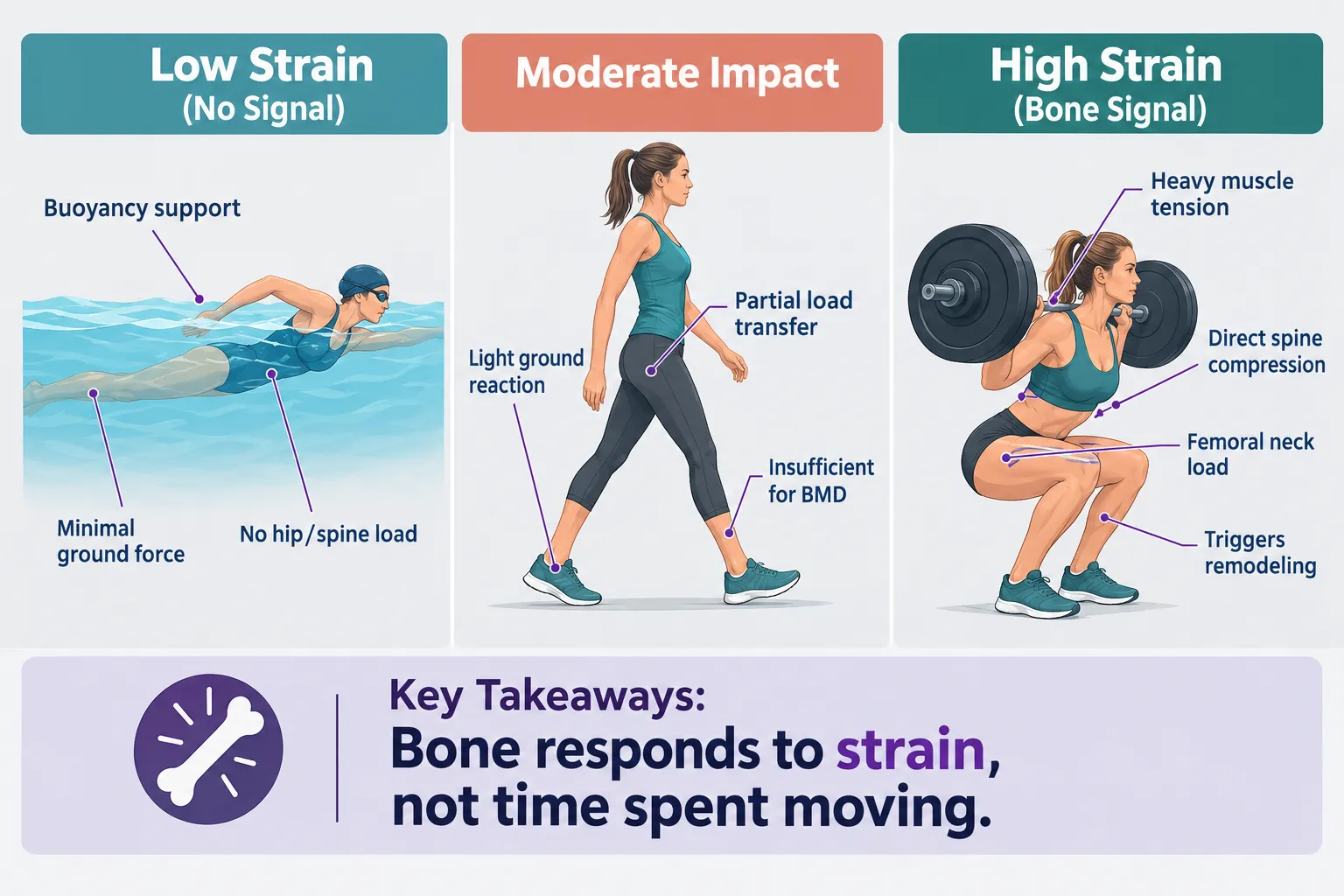
- Bone responds to strain, not time spent moving. Walking and swimming support general health but don’t load the hip and spine enough to drive new bone.[3]
- The spine and femoral neck respond best. Meta-analyses in both postmenopausal women and older men show significant BMD gains at the lumbar spine and femoral neck, while the total hip often shows little change.[5]
- Postmenopausal women gain the most. A 2025 review found significant BMD effects at the femoral neck and lumbar spine in postmenopausal women, but not in premenopausal women.[5]
- High intensity isn’t required for bone, but helps strength. High-intensity resistance training beat moderate loading for leg strength, with no significant BMD advantage at the spine or femoral neck.[8][10]
- Supervised high-intensity resistance and impact training (HiRIT) is safe and well tolerated even in women with osteoporosis or osteopenia.[7]
- Two to three sessions per week of progressive resistance training is the standard dose, ideally with weight-bearing impact on separate or combined days.[3][6]
- Exercise can slow, halt, and partially reverse bone loss, but it won’t restore a young skeleton. Think “meaningful percentage points,” not transformation.
- Food matters: adequate calcium, vitamin D, and protein let training translate into bone.[3]
- Get a DXA scan first if you’re over 50, postmenopausal, on long-term steroids, or have a fracture history.
What is bone density and why does it matter after 40?
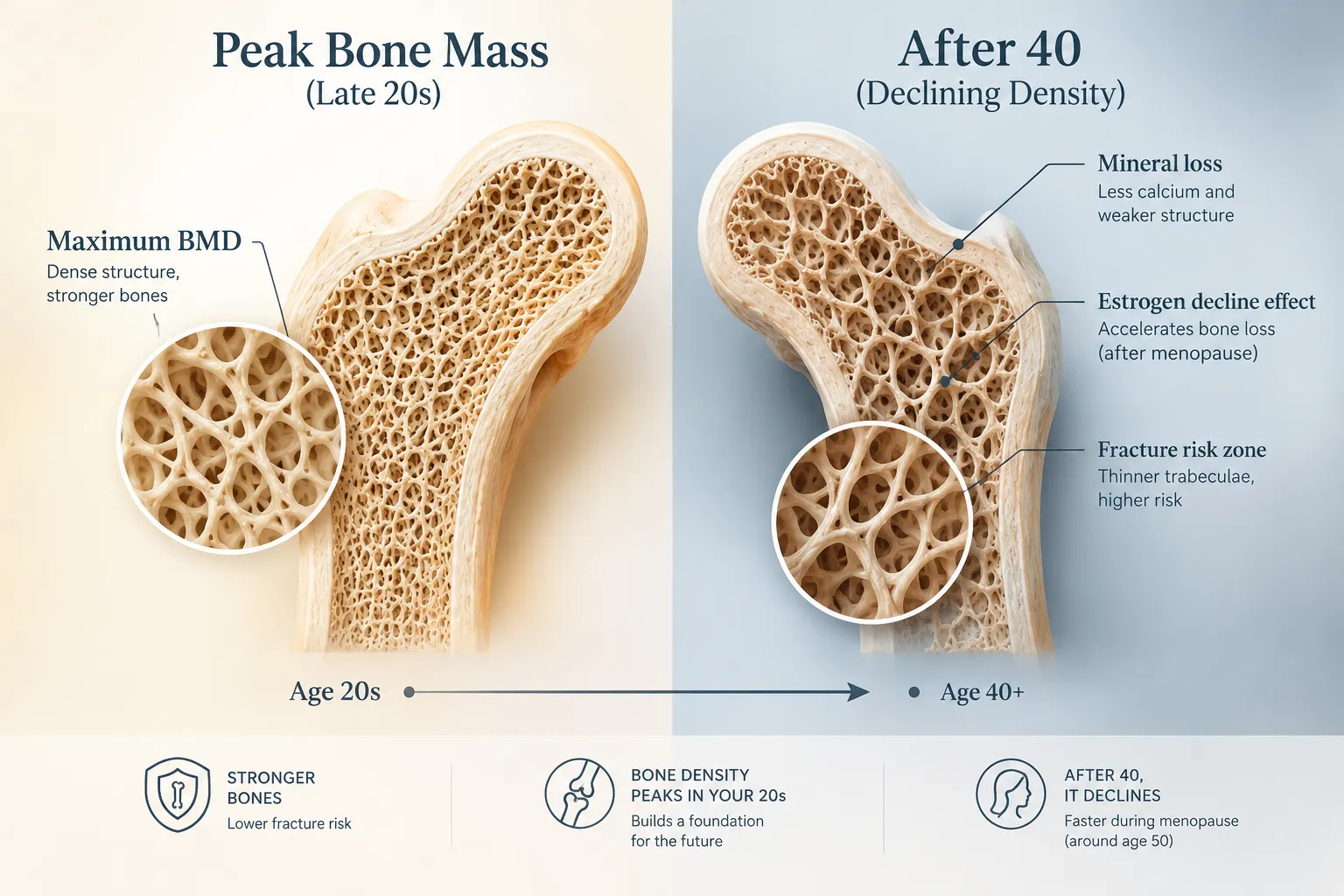
Bone density (measured as bone mineral density, or BMD) is the amount of mineral packed into a given area of bone. It matters after 40 because bone mass peaks in the late twenties and then slowly declines, with women losing bone rapidly in the years around menopause as estrogen falls.
Bone isn’t inert. It’s living tissue that constantly breaks down and rebuilds. After 40, the breakdown side starts to outpace the rebuilding side, so the internal scaffolding of the vertebrae and the hip thins out. The result is a skeleton that looks the same on the outside but fractures under forces it once shrugged off, a stumble, a hard sneeze, lifting a suitcase.
Two sites drive the clinical stakes:
- The lumbar spine, where trabecular (spongy) bone is dense and metabolically active, so it responds relatively quickly to both loss and loading.
- The proximal femur (femoral neck and total hip), where fractures carry the highest cost in independence and mortality.
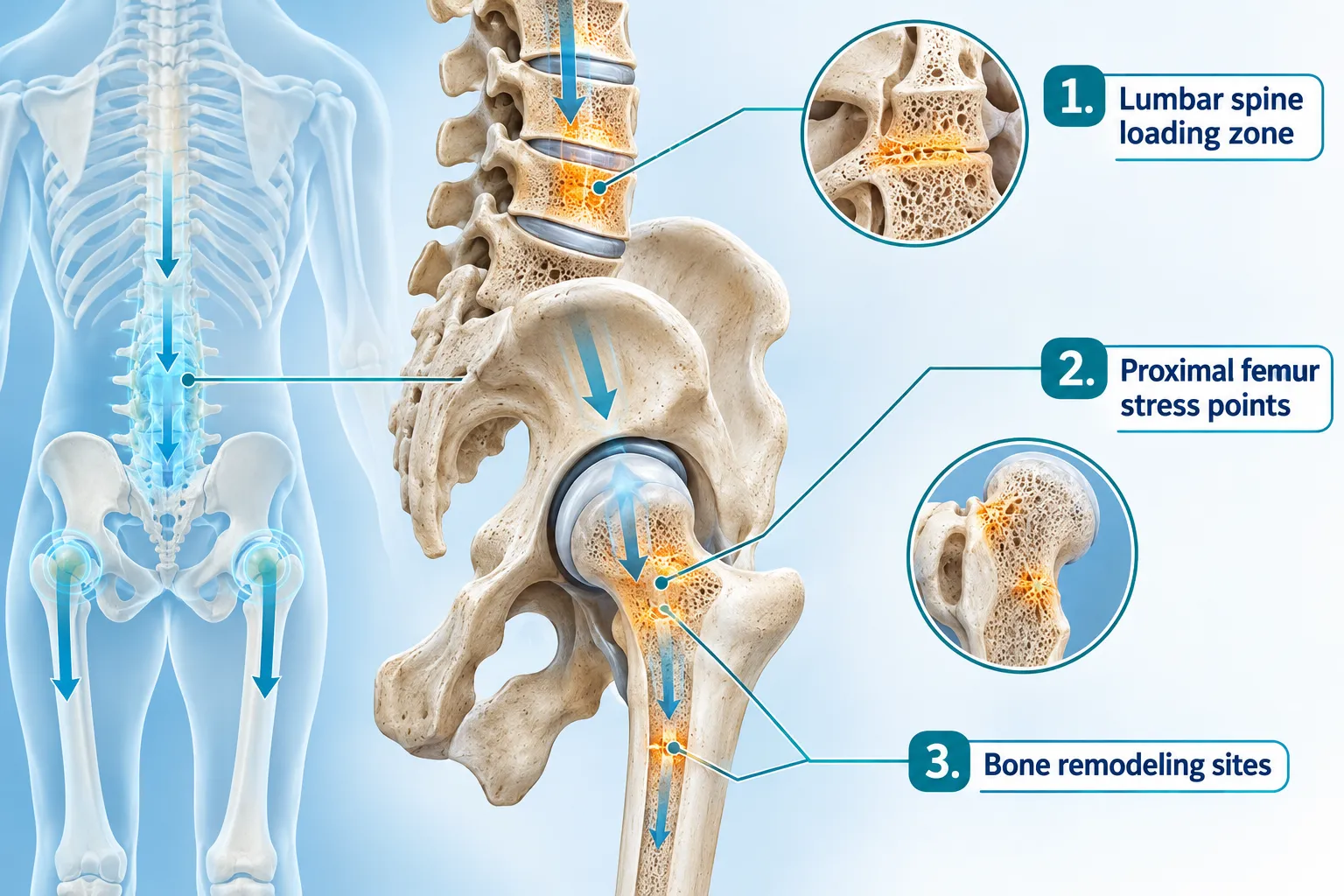
Why 40 is the cutoff worth caring about: it’s the last window where you’re building from a reasonably strong base, before accelerated loss makes the work defensive rather than constructive.
How does strength training improve bone density in older adults?
Strength training improves bone density because muscle pulling on bone, plus ground reaction force, creates strain that signals bone-forming cells to lay down new tissue at the loaded sites. No strain, no signal.
The mechanism has three parts:
- Muscle tension on the bone. A heavy squat drags the glutes and quads against the femur and pelvis. That pull is the single largest mechanical load most bones ever see.
- Compressive and impact loading. Carrying weight, jumping, or dropping onto the heels sends force up through the skeleton, which is why loaded carries and controlled impact belong in a bone protocol.[7]
- Site specificity. Bone only adapts where it’s loaded. Rows and presses won’t help the femoral neck; squats and hinges won’t help the wrist.
Bone adapts to the loads you actually apply to it. Loading the hip and spine directly is the entire point of the protocol, a general fitness routine is not a bone routine.
Common mistake: assuming cardio counts. Non-weight-bearing activity like swimming or cycling is excellent for the heart and almost useless for hip and spine BMD.[3]
What the evidence shows. A comparative effectiveness analysis in adults with low bone mass reported a large standardized mean difference (SMD 1.37, 95% CI 0.38-2.36) in BMD for resistance training versus control. A meta-analysis in middle-aged and older men found significant gains at the lumbar spine and femoral neck, with no clear improvement at total hip and other cortical-dominant sites. That pattern is consistent and worth planning around.
What are the best exercises for hip and spine bone density after 40?
The best exercises are loaded compound lifts that put force directly through the hip and spine: squats, hip hinges, overhead or incline presses, rows, and loaded carries, supplemented with controlled impact. These five patterns cover the skeleton’s highest-value targets with the fewest exercises.
| Pattern | Example lifts | Primary bone target | Starting cue |
|---|---|---|---|
| Squat | Goblet squat, box squat, back squat | Femoral neck, lumbar spine | Sit between the hips, neutral spine |
| Hinge | Trap-bar deadlift, Romanian deadlift, hip thrust | Femoral neck, total hip | Push hips back, ribs stacked over pelvis |
| Press | Overhead press, landmine press, incline press | Thoracic spine, wrist, humerus | Brace ribs down, don’t arch the low back |
| Row | Chest-supported row, one-arm dumbbell row | Thoracic/lumbar spine, posture | Pull elbow past ribs, no shrug |
| Carry | Suitcase carry, farmer’s walk | Axial spine, hip | Tall ribcage, slow steps |
Impact alternatives, scaled to tolerance:
- Heel drops, rise onto toes, drop sharply onto heels. 10-20 reps, the gentlest entry point.
- Step-downs and stomps, controlled, single-leg, low height.
- Hops and small jumps, only once squats and hinges are solid and pain-free.
Choose this if… you have diagnosed osteoporosis: start with heel drops and loaded carries, skip jumping, and add compound lifts under supervision.[7]
Avoid: loaded spinal flexion (weighted sit-ups, crunches, toe-touches with weight) and end-range twisting under load. These positions raise vertebral compression risk in a thinning spine.[6]
How often should I do strength training for bone density, and what weight should I lift?
Train the hip and spine with resistance two to three times per week on non-consecutive days, using loads heavy enough that the last two reps of a set feel genuinely difficult, typically a weight you could lift 6 to 12 times before form breaks.[3][6]
A workable intensity ladder:
- Weeks 1-4: 2-3 sets of 10-12 reps at roughly 50-60% effort. The goal is pattern quality, not load.
- Weeks 5-12: 3 sets of 8-10 reps, adding weight whenever all sets hit the top of the rep range with clean form.
- Month 4 onward: 3-5 sets of 5-8 reps on squats and hinges, with heavier loads under supervision if you’re training toward the HiRIT model.[7]
Does heavier mean more bone? Not necessarily. A 2025 meta-analysis found high-intensity resistance training produced substantially larger strength gains than low-to-moderate training (leg press SMD 0.95, 95% CI 0.48-1.43; leg extension SMD 0.63, 95% CI 0.09-1.17), but no significant BMD difference at the lumbar spine (SMD 0.28, 95% CI −0.02 to 0.58) or femoral neck (SMD 0.13, 95% CI −0.08 to 0.33).[8][10] Multiple intensity ranges can protect bone; higher intensity mainly buys strength, balance, and fall resistance, which also prevents fractures.
Edge case: if you’re on a joint-sparing plan after hip replacement, substitute machine-based leg press and hip thrust for deep squats and keep load high within a pain-free range.
Can you reverse bone loss after 40 with exercise, and how long does it take?
Exercise can slow, stop, and modestly reverse bone loss after 40, but it rarely restores peak young-adult density. Expect small, site-specific gains measurable on DXA after roughly 9 to 12 months of consistent training.
Realistic timelines:
- Weeks 2-8: strength, balance, and confidence improve. Bone has not changed yet.
- Months 3-6: bone remodeling is underway but below the detection threshold of a DXA scan.
- Months 9-12: first meaningful window for a repeat scan. Effect sizes in postmenopausal women have been reported around 0.47 at the femoral neck and 0.36 at the lumbar spine for high-intensity impact and strength training.[5]
- Years 2+: maintenance. Stopping reverses the gains, so this is permanent programming, not a cure.
Decision rule: don’t rescan before 12 months. Scan noise (±1-2%) can swamp a real 2% gain and lead to false discouragement.
What’s the difference between osteoporosis and osteopenia, and is training safe with low bone density?
Osteopenia means BMD is below normal but not yet in the fracture-risk danger zone (T-score between −1.0 and −2.5). Osteoporosis means BMD is at or below a T-score of −2.5. Progressive resistance training is safe in both, provided it’s supervised and avoids loaded spinal flexion.
| Osteopenia | Osteoporosis | |
|---|---|---|
| T-score | −1.0 to −2.5 | −2.5 or lower |
| Fracture risk | Elevated | High |
| Training approach | Full compound lifts, progressive load, light impact | Compound lifts with supervision, load progressed slowly, impact limited to heel drops/stomps initially |
| Hard no | Weighted spinal flexion | Weighted spinal flexion, twisting under load, unsupervised max lifts |
A clinical review on postmenopausal bone health reports that supervised progressive high-intensity resistance and impact training (HiRIT) increases lumbar spine BMD and is safe and well tolerated in women with osteoporosis or osteopenia.[7] That’s the key reframe: for higher-risk people, cautious low-load exercise is often less protective than properly supervised heavy training.
Should I get a bone density test before starting a strength program?
Get a DXA scan before starting if you’re a postmenopausal woman, a man over 50 with risk factors, on long-term corticosteroids, or have had a fragility fracture. Otherwise, a baseline scan is useful but not a prerequisite for starting squats and rows at moderate load.
The scan changes your program in two ways: it tells you whether impact work needs restricting, and it gives you a baseline to measure against in a year.
Can women after menopause improve bone density with strength training?
Yes, and postmenopausal women show the most consistent response. A 2025 systematic review found high-intensity impact and strength training produced significant BMD gains at the femoral neck and lumbar spine in postmenopausal women, but not in premenopausal women.[5]
The likely reason: premenopausal women are closer to their skeletal ceiling, so there’s less room to gain. The practical implication is that menopause is a reason to train harder, not more gently.
What mistakes do people make when training for bone health?
The biggest mistake is training too light for too long, staying at a comfortable load that builds confidence but never generates enough strain to trigger bone formation.
Frequent errors:
- Never progressing load. The same 10 lb dumbbells for two years do nothing for the femoral neck.
- Skipping the hinge. Deadlift-pattern work is the most direct loading of the proximal femur available. Avoiding it out of back fear forfeits the best tool.
- Loaded spinal flexion. Weighted crunches and rounded-back lifting in a thinning spine is the one genuinely risky choice.[6]
- Treating walking as the program. Useful for general health, insufficient for hip and spine BMD.[3]
- Rescanning too early, then quitting when the number hasn’t moved.
- Ignoring balance and fall prevention. Most fractures need both weak bone and a fall.
Do I need equipment, or can I do bodyweight exercises for bone density?
Bodyweight work alone is usually insufficient once you can perform 15+ clean reps, because the load stops being challenging. Some external resistance, dumbbells, kettlebells, bands, machines, or a barbell, is needed for continued progression.
Bodyweight options that still count early on: step-ups onto a high box, split squats, push-ups, heel drops, and hip thrusts. Once those become easy, add load. A pair of adjustable dumbbells and a sturdy box covers most of the protocol at home.
What should I eat to support bone density alongside strength training?
Training provides the signal; nutrition provides the raw materials. Without adequate calcium, vitamin D, and protein, the bone-building response to resistance training is blunted.[3]
Priorities, in order:
- Calcium from dairy, fortified plant milks, canned fish with bones, tofu set with calcium, and leafy greens. Food sources first, supplements if you fall short.
- Vitamin D, which governs calcium absorption. Limited sun exposure, darker skin, and northern latitudes all raise the case for testing and supplementing.
- Protein spread across meals, which supports both bone matrix and the muscle doing the pulling.
- Limits on heavy alcohol and smoking, both of which independently accelerate bone loss.
Quick example: Greek yogurt with almonds at breakfast, sardines or tofu at lunch, and a protein-forward dinner covers calcium and protein for most adults without supplements.
FAQ
Is it too late to start strength training at 60 or 70?
No. Meta-analyses of exercise interventions in older adults consistently show BMD gains at the lumbar spine and femoral neck, and strength and balance improvements reduce fall risk immediately.[8]
How many exercises do I need per session?
Four to six. One squat, one hinge, one press, one row, and one carry covers the hip and spine efficiently in 40-50 minutes.
Can I do strength training and walking on the same day?
Yes. Walking doesn’t interfere with strength adaptation. Just do the lifting first when you’re fresh.
Does yoga or Pilates build bone density?
They improve balance, posture, and mobility, which lowers fall risk, but most poses don’t load the hip and spine enough to raise BMD. Some forward-flexion poses should be modified if you have osteoporosis.
Will strength training make existing back pain worse?
Done with neutral spine positioning and progressive loading, it usually improves it. Sharp or radiating pain means stop and get assessed.
How heavy is “heavy enough”?
A load you could lift about 6 to 12 times before form degrades, with the last two reps clearly hard. If you could do 20, it’s too light for bone.
Do vibration plates work?
Evidence is mixed and far weaker than for progressive resistance training. Treat it as a supplement, not a substitute.
Should I stop if I have a diagnosed vertebral fracture?
Stop unsupervised training and get a clinician-guided program. Training is still indicated, but exercise selection changes significantly.
Conclusion
Strength Training for Bone Density After 40: A Safe Progressive Protocol for Hips and Spine comes down to a short list of decisions: load the hip and spine directly, train two to three times a week, add weight on a schedule, avoid loaded spinal flexion, and keep going long enough to measure the result. The research pattern is consistent, the lumbar spine and femoral neck respond, the total hip is stubborn, and postmenopausal women gain the most.[5]
Start here this week:
- Book a DXA scan if you’re postmenopausal, over 50 with risk factors, or have a fracture history.
- Pick one squat, one hinge, one press, one row, and one carry. Learn them at light load for four weeks.
- Add weight whenever all sets hit the top of the rep range cleanly.
- Add heel drops or step-downs at week 5 if cleared for impact.
- Check calcium, vitamin D, and protein intake.
- Rescan at 12 months, not before.
If you have osteoporosis, osteopenia, or a fracture history, get supervision from a physiotherapist or exercise physiologist experienced with HiRIT. Supervised heavy training has a better safety record in this group than cautious under-loading.[7]
References
[1] Exercises That Improve Bone Density 11940615 – https://www.verywellhealth.com/exercises-that-improve-bone-density-11940615
[2] The Bone Building Effects Of Exercise – https://www.sydney.edu.au/charles-perkins-centre/news-and-events/news/2025/10/31/the-bone-building-effects-of-exercise-.html
[3] Exercise Your Bone Health – https://www.niams.nih.gov/health-topics/exercise-your-bone-health
[4] Art 20046670 – https://www.mayoclinic.org/healthy-lifestyle/fitness/in-depth/strength-training/art-20046670
[5] repository.londonmet.ac.uk – https://repository.londonmet.ac.uk/11869/
[6] Exercise – https://www.racgp.org.au/clinical-resources/clinical-guidelines/key-racgp-guidelines/view-all-racgp-guidelines/osteoporosis/general-bone-health-maintenance/exercise
[7] S11914 025 00912 7 – https://link.springer.com/content/pdf/10.1007/s11914-025-00912-7.pdf
[8] onlinelibrary.wiley – https://onlinelibrary.wiley.com/doi/10.1111/ggi.70607
[9] Moves For Stronger Bones 12066485 – https://www.health.com/moves-for-stronger-bones-12066485
[10] onlinelibrary.wiley – https://onlinelibrary.wiley.com/doi/pdfdirect/10.1111/ggi.70607