Last updated: August 29, 2026
Quick Answer
For most older adults, TRX suspension trainers and elastic resistance bands deliver comparable gains in strength, mobility, and balance when programs are matched for effort. A 12-week randomized trial found no significant between-group differences on functional mobility, strength, or balance outcomes.[2][8] Choose TRX if you have a secure anchor, decent standing balance, and want whole-body functional movement with fine-tuned joint loading. Choose resistance bands if you're very deconditioned, have weak grip, live in a small space, or want the cheapest, most portable option.
Key Takeaways
- TRX and bands produce similar strength and balance gains in healthy seniors over 12 weeks.[2][8]
- TRX excels at core activation and functional whole-body work, but requires a secure anchor and baseline balance.[11][12]
- Bands are cheaper (typically $10,$40) versus TRX ($100,$200+), more portable, and safer for very deconditioned users.
- Both tools are joint-friendly because they let you scale load without heavy axial compression.[13]
- TRX shines for knee-sensitive squats and shoulder-friendly rows because body angle adjusts resistance instantly.[1][13]
- Bands are better for weak grip and seated exercise, especially loop bands you can wrap around limbs.
- You can, and often should, combine both tools in one program for the best joint-friendly coverage.
- No single tool prevents falls; balance-specific work must be programmed intentionally.[11]
What is TRX training and how does it work for seniors?
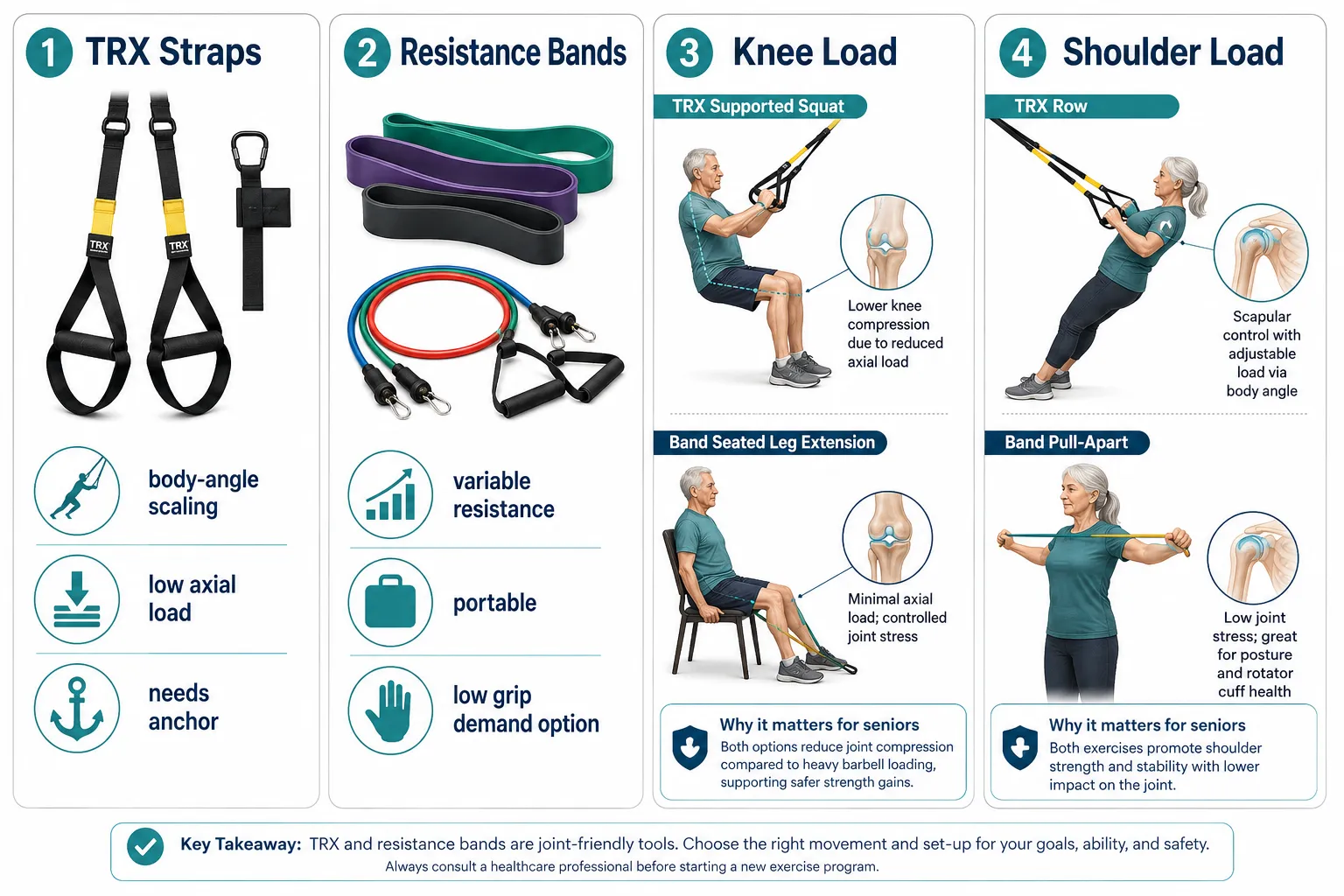
TRX is a suspension trainer: two adjustable straps with handles that anchor overhead, letting you use your body weight as resistance while you lean into or away from the anchor. For seniors, this means you can perform squats, rows, chest presses, and lunges with instant load adjustment by simply stepping closer or farther from the anchor point.[1][14]
A 2019 review in Frontiers in Physiology defines suspension training as attaching body segments to hanging straps to perform multi-joint, multi-planar exercises using body weight and instability.[12] In older adults, it can improve muscle strength, muscle mass, and functional performance.[12][15]
Why it works for older bodies:
- Body-angle scaling means less-than-bodyweight squats and push-ups are possible when full versions hurt.[1]
- The straps provide light hand support, which reduces fall anxiety during standing exercises.
- Multi-planar movement patterns train the stabilizing muscles used in daily tasks like getting out of a chair.
Decision rule: If you can stand from a chair unassisted and have a stable overhead anchor, TRX is a strong fit. If not, start with bands and progress later.
Are resistance bands safe for people with arthritis or joint pain?
Yes, resistance bands are among the safest strength tools for arthritic joints because they apply variable resistance across the range of motion with minimal axial (compressive) loading.[2][8] Unlike dumbbells, bands get progressively harder as you stretch them, meaning the weakest, most painful part of a joint's range gets the lightest load.
Why arthritic joints tolerate bands well:
- No gravity-loaded impact on knees, hips, or spine
- Resistance can be dialed in grip by grip on the band
- Seated variations remove weight-bearing entirely
- Easy to stop instantly if a movement provokes pain
Common mistake: Using a band that's too heavy and jerking through range. Slow, controlled tempo (3 seconds up, 3 seconds down) protects joints better than any single band choice.
TRX vs resistance bands: which is easier on knees and shoulders?
TRX generally wins for knees, because the straps let you offload body weight during squats and lunges, a benefit no free band can match. Bands often win for shoulders, especially for people with rotator cuff issues, because you can perform pain-free horizontal and diagonal patterns while seated with zero balance demand.
Coach-level guidance for adults over 50 highlights that TRX reduces stress on painful joints by letting you substitute suspension hamstring curls or supported squats for high-load knee-dominant exercises.[13]
| Joint concern | Better tool | Why |
|---|---|---|
| Knee osteoarthritis | TRX | Offloads body weight in squats/lunges |
| Rotator cuff pain | Bands | Precise light loading, seated options |
| Hip stiffness | TRX | Multi-planar step-back lunges |
| Wrist pain | Bands (loop) | No hand grip needed |
| Lower back pain | Bands | Seated rows without balance load |
How much do TRX straps cost compared to resistance bands?
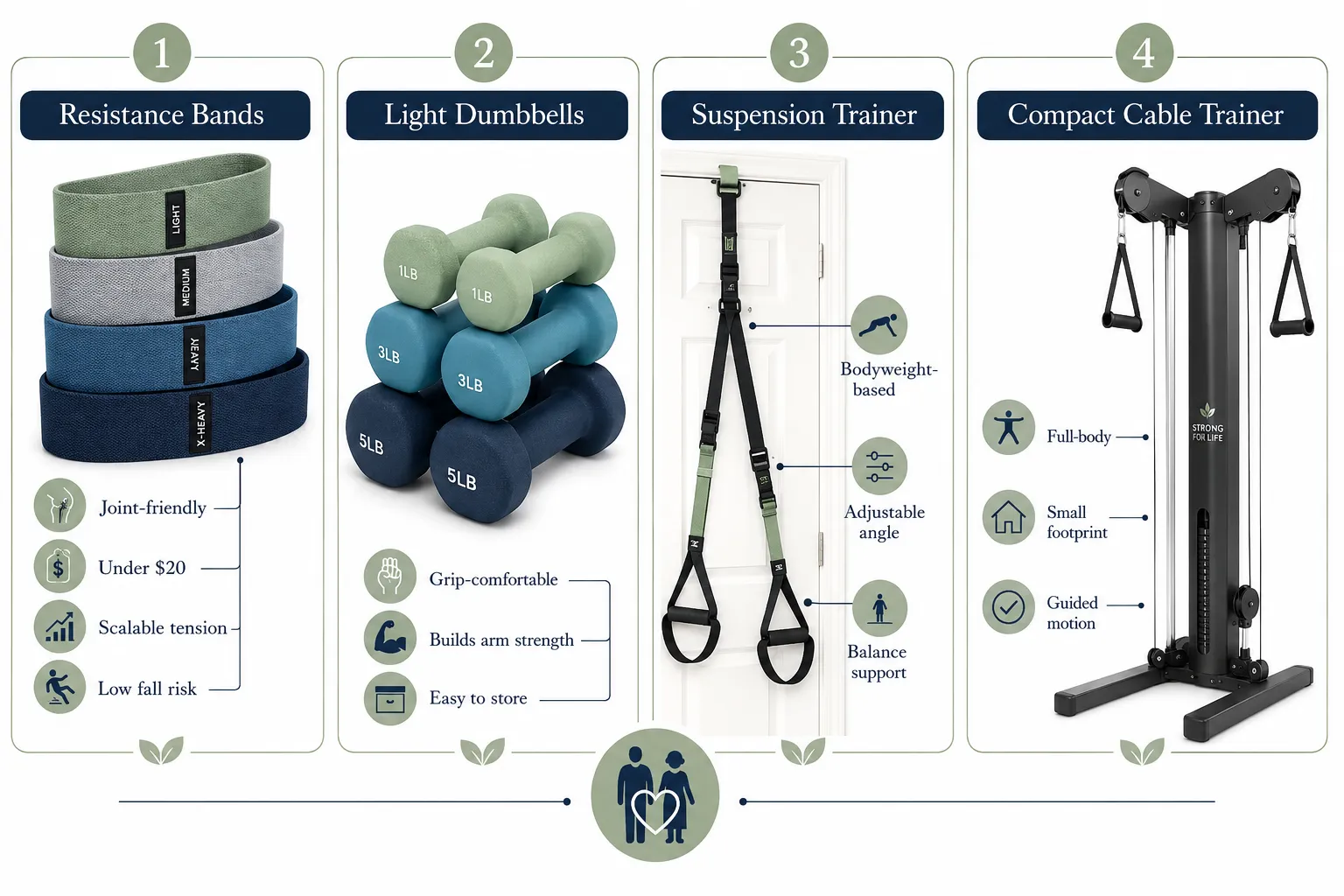
TRX suspension trainers typically cost $100,$200+ for the official brand, with generic suspension straps starting around $30,$50. A complete resistance band set (loop bands, tube bands with handles, door anchor) usually costs $15,$40. Bands are the clear winner on price by a factor of 5-10x.
What you actually need to spend:
- Bands starter kit: one light, one medium, one heavy loop band + a door anchor. Around $20,$30.
- TRX starter kit: the strap system plus a door anchor (included with most kits). Around $100,$180 for reputable brands, less for generics.
- Optional add-ons: exercise mat, sturdy chair (already owned), and grippy shoes.
For budget-constrained seniors or those testing the waters, bands are the lower-risk entry point.
Can seniors build muscle with resistance bands alone?
Yes. Seniors can build meaningful muscle and strength with resistance bands alone, provided the bands are heavy enough to reach near-failure in 8-15 reps and the program progresses over time. The 12-week CEJSSM trial showed band-based training improved functional mobility, strength, and balance to a similar extent as TRX.[2][8]
Requirements for band-only muscle building:
- Progressive overload, move to heavier bands or double them up as you get stronger.
- Multiple sets, 2-3 sets per exercise, 8-15 reps, close to muscular fatigue.
- Full-body coverage, press, pull, squat, hinge, and carry patterns.
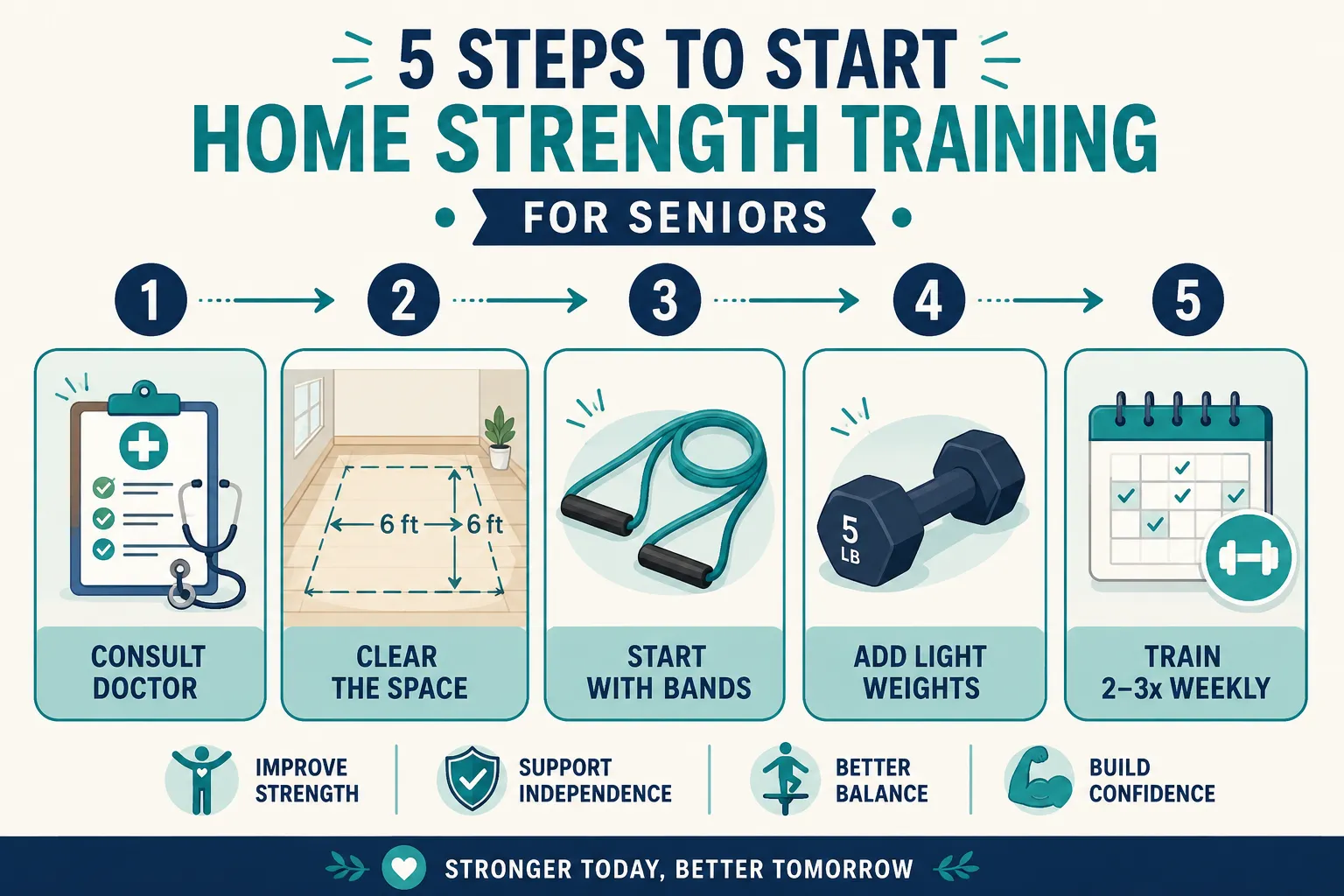
- Consistency, 2-3 sessions weekly, minimum, for 12+ weeks.
Edge case: Very strong older adults may outgrow bands for lower-body work. At that point, adding TRX, weighted squats, or a leg press becomes useful.
Best TRX exercises for seniors with limited mobility
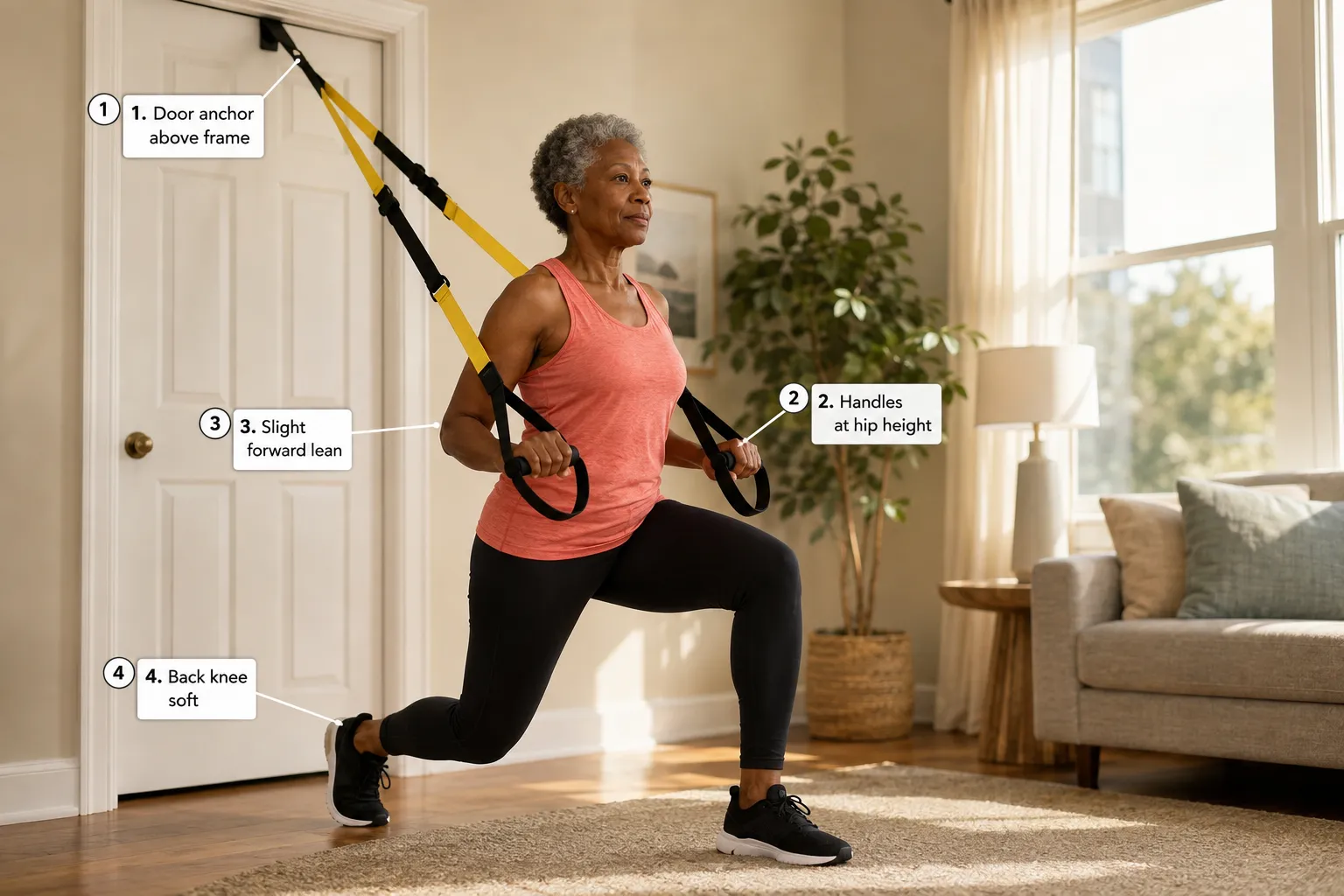
Start with five foundational TRX movements that scale easily by adjusting body angle: assisted squat, low row, chest press, hip hinge, and single-leg balance. Educational content for older adults shows that simply stepping closer or farther from the anchor makes each of these easier or harder.[1][14]
The starter five:
- TRX-assisted squat: Hold both handles, feet under anchor, lean back slightly and sit down. Straps take some weight off knees.
- TRX low row: Feet forward, lean back, pull chest to handles. Adjust angle for difficulty.
- TRX chest press: Face away from anchor, lean forward on straight arms, press back up. Easiest starting position: nearly upright.
- TRX hip hinge: Hold handles, hinge at hips like closing a car door with your rear. Great for glutes.
- TRX supported single-leg stance: Light fingertip contact on handles while balancing on one foot. Builds fall-prevention balance.
Common mistake: Starting too horizontal. Begin nearly upright, master the pattern, then progressively lean further.
Do I need a door anchor or pull-up bar to use TRX at home?
You need one secure overhead anchor point, most commonly a solid interior door with the included TRX door anchor, a ceiling mount, a pull-up bar, or a sturdy tree branch outdoors. Without a proper anchor, TRX is not safe to use.
Anchor options ranked by ease:
- TRX door anchor, included with most kits; slips over the top of a closed door. Best for renters. Door must open away from you.
- Ceiling or wall mount, most secure, requires drilling into a joist or stud. Best for permanent home setups.
- Pull-up bar in doorway, works if bar is rated for suspension use and installed correctly.
- Outdoor beam or tree, great for good weather; check strap wear from bark.
Never anchor to: a hollow door frame, a curtain rod, a drywall-only screw, or any furniture that isn't bolted down.
Resistance bands for seniors with weak grip strength
Weak grip is one of the strongest arguments for loop-style resistance bands over handled tube bands, because loops wrap around limbs and eliminate the need to squeeze. Weak grip also raises safety flags for TRX, since the entire system depends on holding the handles.
Grip-friendly band solutions:
- Loop bands around wrists or ankles for rows, presses, and lateral walks
- Bands with wrist cuffs for pulling movements
- Handled bands with padded grips for lighter squeeze demand
- Booty bands for seated leg exercises without any grip
A study reported in Nutrients comparing suspension training with a traditional resistance program in men averaging age 67 found the suspension group had greater hand-grip strength at the end.[3] So if grip is currently a weakness, bands are the safer start, and TRX can be phased in later as grip improves.
TRX training injuries and common mistakes seniors make
The most common TRX mistakes for seniors are anchoring incorrectly, starting too horizontal, and locking out joints under tension. Safety and feasibility studies of TRX-OldAge programs report good adherence and low adverse event rates when programs are supervised and scaled correctly.[8][12]
Top mistakes to avoid:
- Poor anchor check. Always tug-test the strap and door before every session.
- Too aggressive angle. Body too horizontal early on overloads shoulders and lower back.
- Locked elbows/knees. Keep a soft bend to protect joints under load.
- Ignoring pain. Sharp joint pain means stop, not push through.
- Skipping warm-up. Two to three minutes of band pull-aparts and mini-squats prepares tissue.
- No spotter or phone nearby. In case of a fall or dizziness during standing work.
Is TRX or resistance bands better for balance and fall prevention?
TRX has an edge for dynamic balance training because it demands active stabilization during standing exercises, while providing light hand support as a safety net. A 2025 study in the European Journal of Geriatrics and Gerontology found suspension training produced greater core muscle activation and improved functional performance versus traditional resistance training in adults 65-80.[11]
That said, neither tool alone prevents falls. Balance-specific exercises, single-leg stands, tandem walks, weight shifts, need to be part of any program regardless of tool choice.
Balance progression path:
- Seated band exercises → build baseline strength
- Standing band exercises with wall nearby → add postural demand
- TRX-supported single-leg work → introduce dynamic balance
- TRX exercises with lighter grip → increase stabilization demand
- Unsupported balance work → final progression
Can you use TRX and resistance bands together in one workout?
Absolutely, and combining them is often the smartest approach for joint-friendly senior training. Bands handle warm-ups, isolation work, and seated finishers; TRX handles compound standing movements.
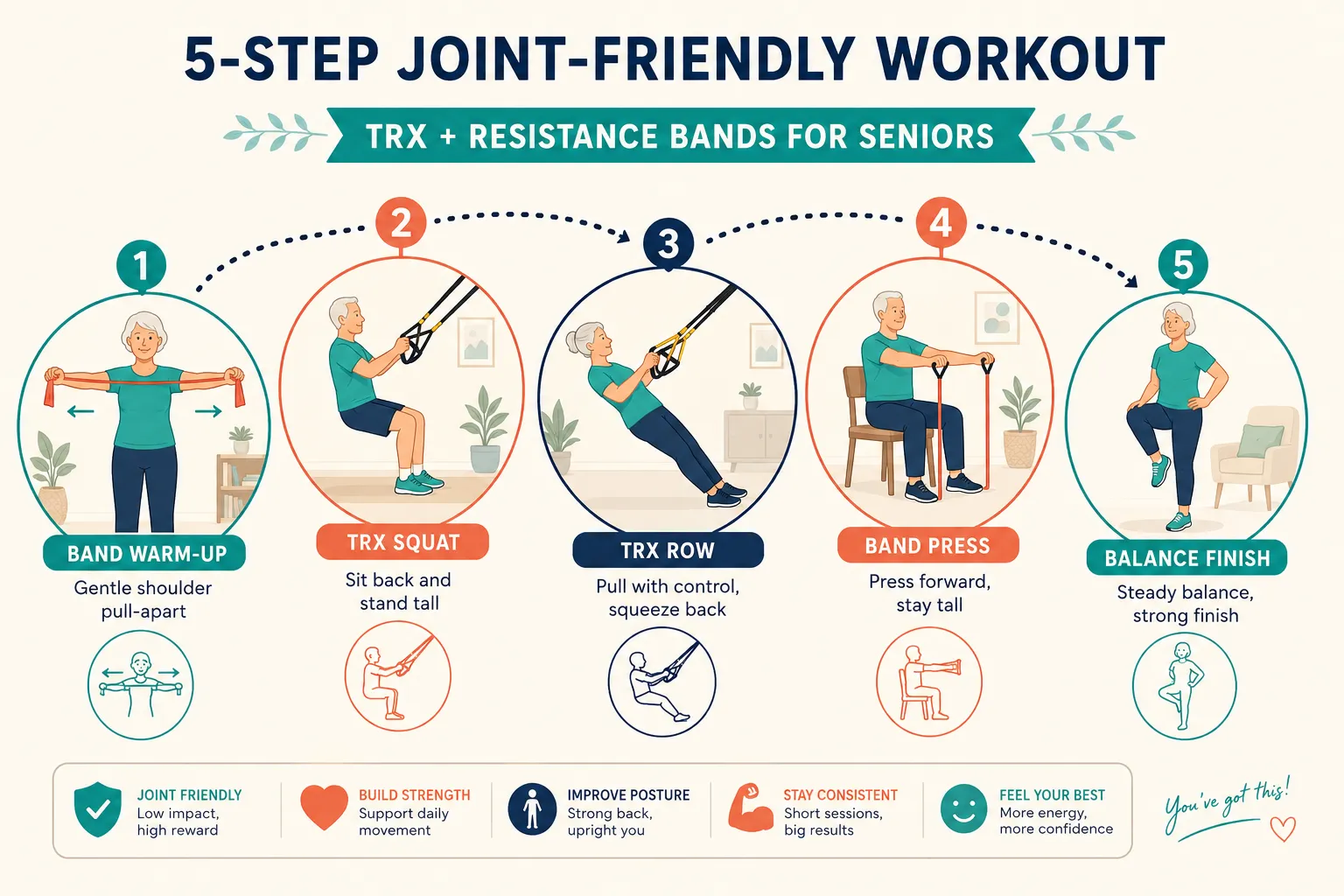
Sample 30-minute joint-friendly session:
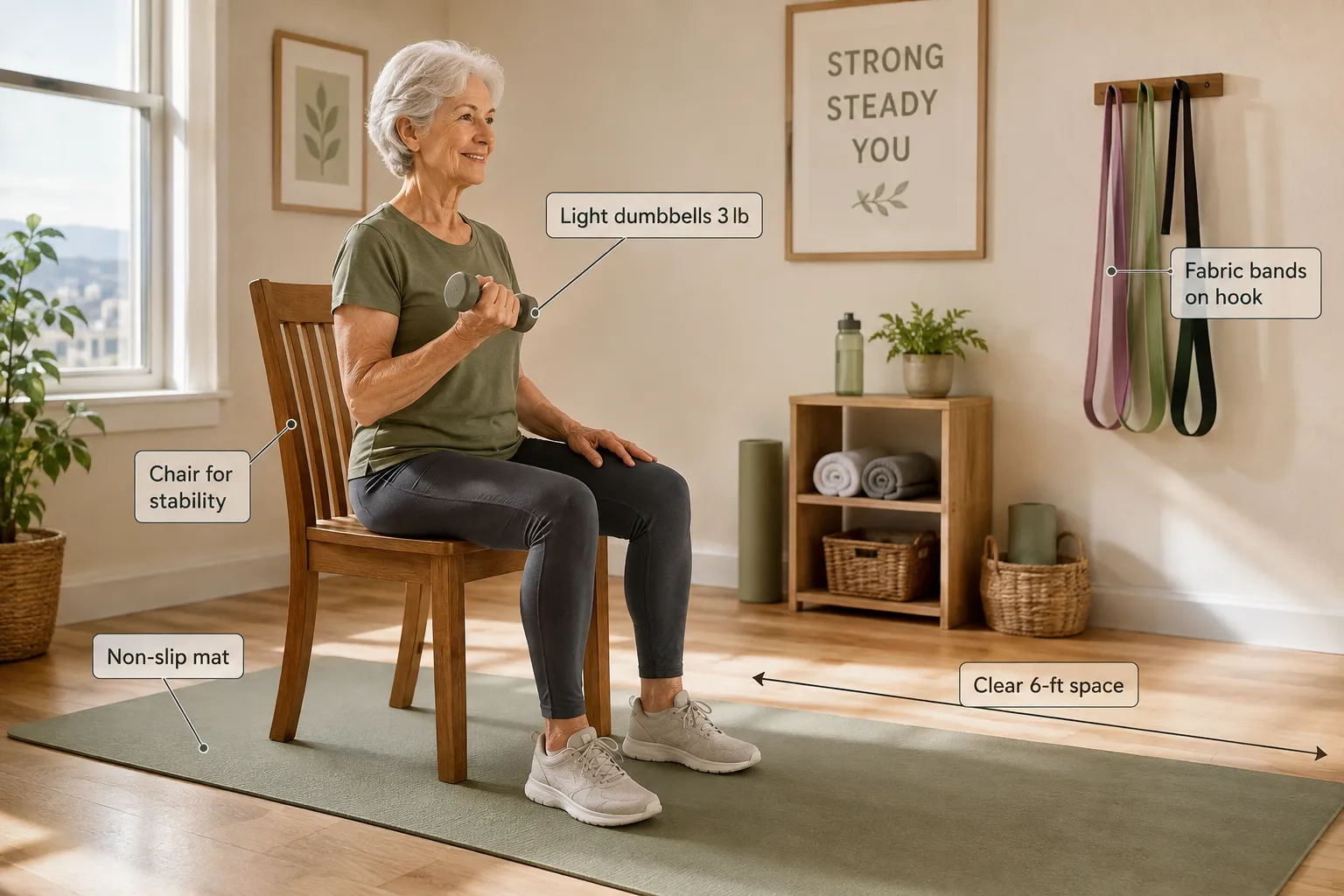
- Warm-up (5 min): Band pull-aparts, band shoulder circles, bodyweight mini-squats
- TRX squat, 2 x 10, lower body strength
- TRX low row, 2 x 10, upper back
- Band chest press seated, 2 x 12, chest without balance load
- TRX hip hinge, 2 x 10, glutes and hamstrings
- Band lateral walk, 2 x 10 steps each way, hip stability
- Cool-down (3 min): Band-assisted stretching
What weight resistance band should a senior start with?
Most seniors should start with a light band (roughly 5-15 lbs of resistance) for upper-body work and a medium band (15-25 lbs) for lower body. Color coding varies by brand, so go by feel: you should be able to complete 12-15 reps with good form and 2 reps left in reserve.
Starter kit recommendation:
- One light loop band (upper body, rehab-style movements)
- One medium loop band (rows, squats, hip work)
- One heavy loop band (glute bridges, deadlifts, heavier pulls)
- One long tube band with handles (chest press, overhead press)
Rule of thumb: If you can rip through 20 reps with no effort, size up. If you can't hit 8 clean reps, size down.
TRX alternatives for seniors who live in small spaces
Resistance bands are the top TRX alternative for small-space living because they store in a drawer and require no anchor. Other compact options include doorframe pull-up bars, sliding disc systems, and lightweight adjustable dumbbells.
Small-space strength options ranked:
- Resistance bands, smallest footprint, most versatile
- Suspension trainer (folded), small when stored, but needs a door for use
- Sliders/discs, great for core and lower body, tiny storage
- Adjustable dumbbells, compact but heavier, joint-loading
- Kettlebell (single), one tool, many exercises, needs floor clearance
Do seniors need a trainer to use TRX safely at home?
Not strictly required, but strongly recommended for the first 2-4 sessions. A qualified trainer, ideally one certified in senior fitness or the TRX for Seniors specialty, can check anchor safety, set body angles, screen for red-flag movements, and personalize progressions.
When professional guidance is essential:
- Existing joint replacements (hip, knee, shoulder)
- Recent falls or dizziness episodes
- Osteoporosis diagnosis
- Post-surgery return to exercise
- Balance concerns or use of a cane/walker
When self-guided is reasonable:
- Generally healthy, no diagnosed conditions
- Prior strength training experience
- Comfortable following video instruction
- Good communication with a physician who cleared exercise
Recent 2024-2026 senior-focused online programs increasingly integrate suspension trainers as joint-friendly tools, offering guided video content as a middle-ground option between fully DIY and one-on-one training.[1][4][9]
Pros and Cons Summary
TRX pros:
- Whole-body, functional movement
- Instant scaling by body angle
- Strong core and balance demand
- Light-to-moderate joint loading
TRX cons:
- Higher cost ($100,$200+)
- Requires secure overhead anchor
- Demands baseline standing balance and grip strength
- Steeper learning curve
Resistance band pros:
- Very affordable ($15,$40)
- Extremely portable
- Seated options for very deconditioned users
- Loop styles work without grip strength
Resistance band cons:
- Bands can snap if worn, inspect regularly
- Harder to precisely measure resistance
- Less demand on balance and core
- Very strong users may outgrow them
FAQ
Q: How many days a week should a senior strength train?
A: Two to three non-consecutive days per week is the standard recommendation for older adults, with 48 hours of rest between sessions targeting the same muscles.
Q: Are TRX workouts safe with a hip or knee replacement?
A: Generally yes, once cleared by your surgeon, because TRX reduces joint compression. Work with a physical therapist for the first several weeks.
Q: Can bands replace weights entirely for seniors?
A: For most seniors, yes, evidence shows bands produce comparable strength gains to traditional resistance in this age group.[2][8]
Q: How long until I notice results?
A: Most seniors feel stronger and more mobile within 4-6 weeks; measurable strength gains appear by 8-12 weeks with consistent training.
Q: Is TRX safe if I use a cane or walker?
A: Only under professional supervision. The balance demand may exceed current capacity, bands and seated exercises are safer starting points.
Q: Do bands or TRX build bone density?
A: Both can help maintain bone density through muscular tension on bones, but higher-load resistance (weights, machines) is stronger for bone building.
Q: What if I feel joint pain during an exercise?
A: Stop that exercise, reduce range of motion, or switch to a lighter version. Sharp or lingering pain warrants a call to your doctor or PT.
Q: Can I do TRX outdoors?
A: Yes, anchor to a sturdy tree branch, pergola, or playground beam rated for adult weight. Check straps for wear from bark or weather.
Conclusion
For joint-friendly home strength training in older adults, the best tool is the one you'll actually use consistently and safely. Evidence shows TRX and resistance bands produce comparable gains in strength, mobility, and balance when programs are well designed.[2][8][12] TRX offers whole-body functional movement and instant load scaling, ideal for seniors with baseline balance and a secure anchor. Bands offer unmatched affordability, portability, and accessibility, especially for very deconditioned or grip-limited users.
Your action steps:
- Assess honestly. Can you stand from a chair unassisted, grip firmly, and stand on one foot for 10 seconds? If yes, TRX is on the table. If no, start with bands.
- Start small. Buy a $20,$30 band starter kit and commit to 8 weeks, 2-3 sessions weekly, before investing in TRX.
- Book 2-4 sessions with a senior-certified trainer if you have any joint diagnoses, replacements, or balance concerns.
- Combine tools once you're comfortable with each individually, this covers the widest range of joint-friendly patterns.
- Track progress in a simple notebook: reps, band color, TRX angle. Progression is the engine of results.
The winner isn't TRX or bands. It's the consistent, well-scaled program you build around whichever tool fits your body, budget, and space today, with room to grow tomorrow.
References
[1] Watch – https://www.youtube.com/watch?v=5kXWcMuD_Uc
[2] 30021ad3af664701a19628237148bfcc – https://doaj.org/article/30021ad3af664701a19628237148bfcc
[3] Better Than Weights Suspension Trainers Are A Joint Friendly Way To Build Muscle In Older Adults – https://www.fitandwell.com/news/better-than-weights-suspension-trainers-are-a-joint-friendly-way-to-build-muscle-in-older-adults
[4] Watch – https://www.youtube.com/watch?v=Mzb9qjvW5z8
[8] wnus.usz.edu.pl – https://wnus.usz.edu.pl/cejssm/en/issue/120/article/1229/
[9] Watch – https://www.youtube.com/watch?v=imDxMpiIveE
[10] Suspension Trainer Exercises For The Whole Body – https://www.lifetimedaily.com/suspension-trainer-exercises-for-the-whole-body/
[11] European Journal of Geriatrics and Gerontology – suspension training vs traditional resistance training in adults 65-80
[12] Frontiers in Physiology (2019) – suspension training review in older adults
[13] Watch – https://www.youtube.com/watch?v=LA7Up35cOig
[14] Watch – https://www.youtube.com/watch?v=df_IfxLcClg
[15] Watch – https://www.youtube.com/watch?v=uyT_CsJtyCo&vl=nl-NL