Last updated: November 4, 2026
Quick Answer
The best doorway pull-up bars and anchor systems for strength training after 40 are leverage-style (over-door) bars with padded frame contact, rated around 250-300 lb, used in a door frame with at least 3-4 inches of solid trim. Tension-mounted bars that rely on friction alone are the weakest option and the most likely to slip. For anyone over 40 who wants band-assisted pulling, door anchors and stud-mounted bars expand the exercise menu far more cheaply than another machine. Expect to spend roughly $30,$120 for a quality doorway bar.
Key Takeaways
- Leverage bars beat tension bars for safety: they transfer load through the frame and molding rather than relying on friction [1].
- Measure first. Frame width, trim depth, and clear overhead space determine whether a bar fits at all.
- Weight capacity matters more after 40 because body weight plus dynamic load can briefly exceed static weight.
- A door anchor (nylon strap through a closed door) is the cheapest way to add rows, pull-aparts, and face pulls.
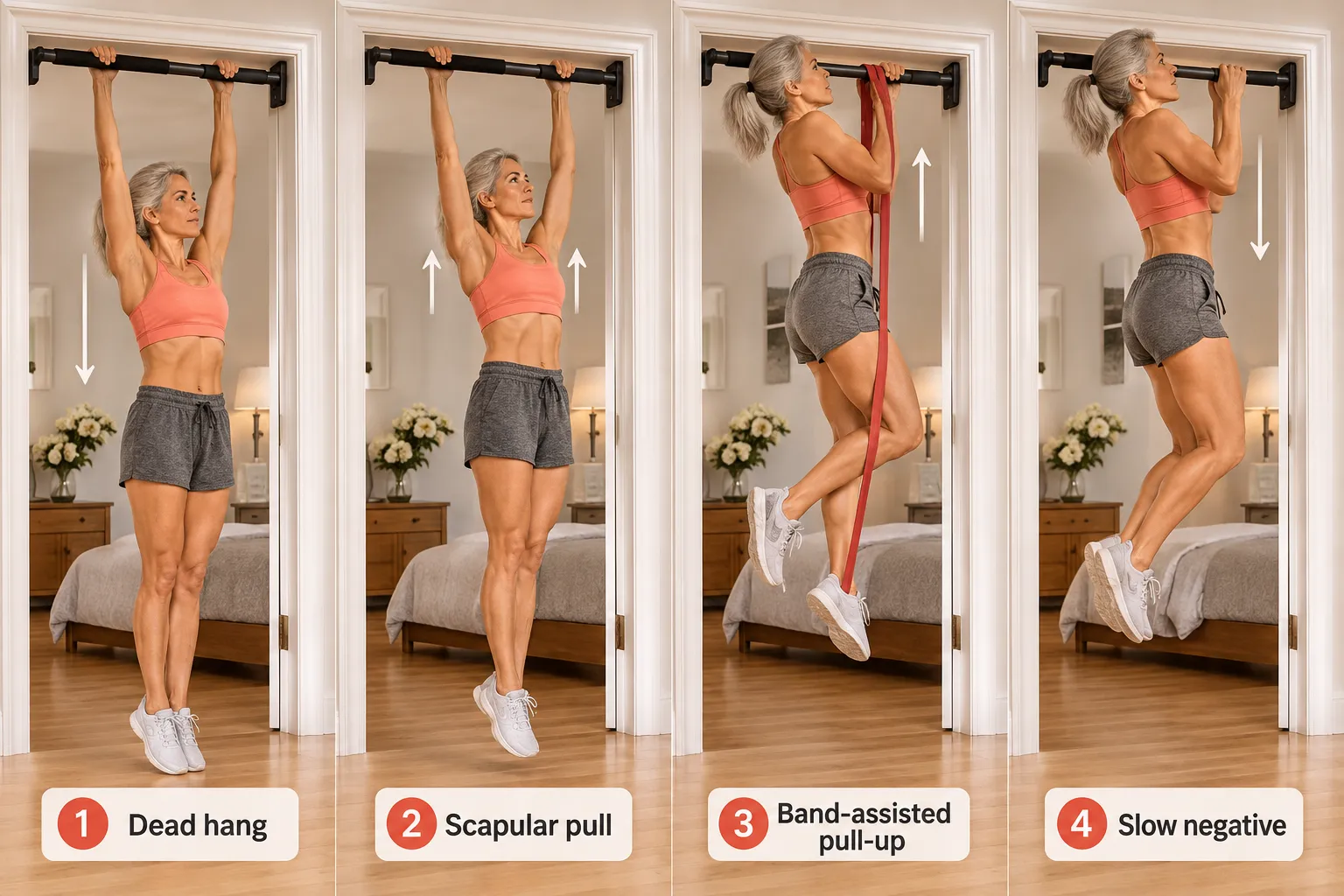
- Band-assisted pull-ups, dead hangs, scapular pulls, and slow negatives are the real starting point for most over-40 lifters [2].
- Padded contact points prevent most door frame damage; unpadded steel dents paint and soft trim.
- Slipping is almost always a fit problem, not a product defect.
- Renters: over-door leverage bars normally need no drilling and are typically lease-safe; screw-in bars are not.
- Realistic benchmark: several bodyweight pull-ups is a solid standard for men over 40, with lower expectations common for women; any clean reps are meaningful [3].
Are doorway pull-up bars safe for people over 40?
Yes, when the bar is correctly fitted to a solid frame and the user trains with controlled range of motion. The main risks after 40 aren't the bar failing but shoulder and elbow irritation from aggressive kipping, plus falls from a bar that shifts mid-set.
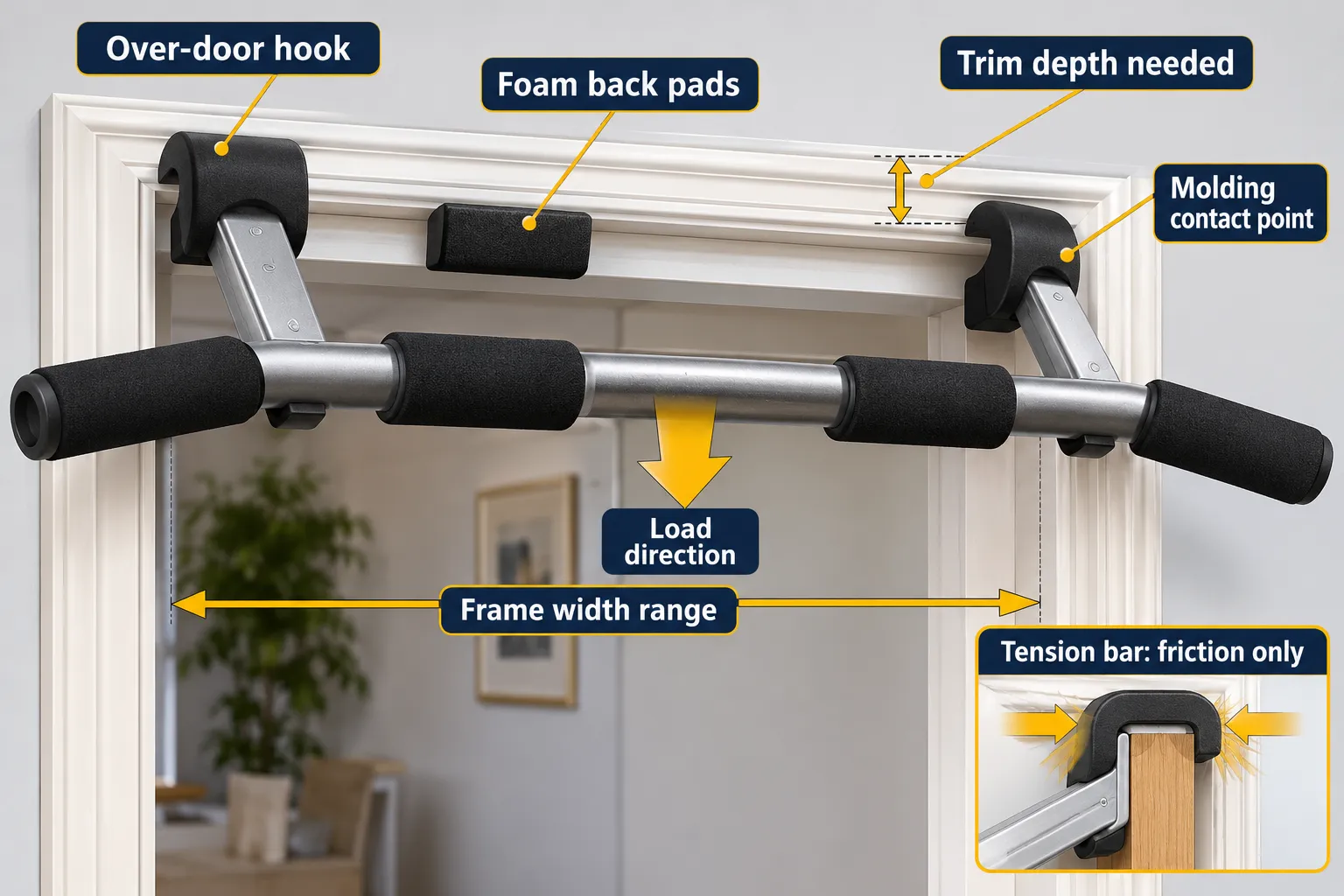
Three safety rules that matter most:
- Test static load before full hangs. Hang with feet still touching the floor, add load gradually, and check for movement or creaking.
- Use a padded leverage bar so force presses down through the frame, not sideways against paint [4].
- Clear a landing zone. Move furniture and lay down a mat if the floor is tile or hardwood.
Common mistake: jumping to grab the bar. The upward jolt spikes the load on both the frame and the shoulder joint. Step up from a chair or box instead.
Edge case: anyone with a repaired rotator cuff, cervical disc issue, or recent elbow tendinopathy should clear hanging with a clinician first and may do better with inverted rows from a door anchor.
How do you know if a doorway pull-up bar will fit your doorway?
Measure three things: inside frame width, trim depth, and the height of the molding above the opening. Most leverage bars fit frames roughly 24-36 inches wide with trim at least 3 inches deep and about 0.5-1 inch of projection for the hook to grip [1][5].
| Measurement | What to check | Typical requirement |
|---|---|---|
| Inside frame width | Jamb to jamb | ~24-36 in |
| Trim depth (top) | How far back the molding runs | 3-4 in minimum |
| Trim projection | How far trim sticks out | ~0.5-1 in |
| Overhead clearance | Ceiling above the bar | Enough to clear chin without hitting |
| Frame material | Solid wood vs hollow | Solid preferred |
Choose differently if: your trim is decorative, rounded, or glued-on MDF. That trim can shear off under load. In that case use a screw-in bar anchored to studs, or skip the doorway entirely.
Tension vs screw-in pull-up bars: which is better?
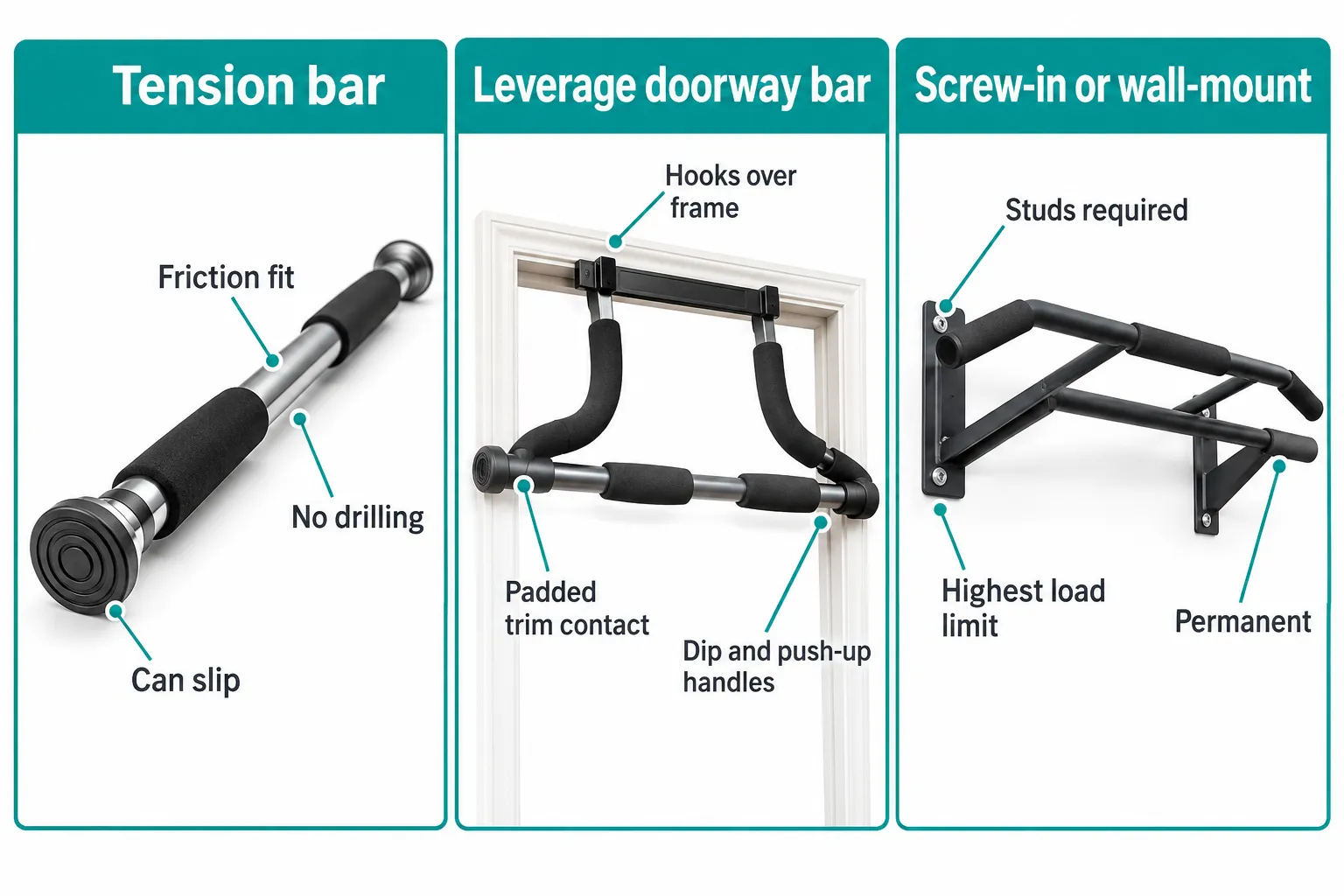
For strength training after 40, screw-in or stud-mounted bars are the safest and strongest, leverage doorway bars are the best balance for most homes, and tension bars are last. Tension bars hold by friction from a threaded expansion mechanism, so any dust, paint slickness, or lateral force can let them rotate loose [1].
- Tension bar: cheapest, fastest, no trim required. Limited capacity, prone to spinning. Fine for assisted work with feet down, poor for weighted or dynamic reps.
- Leverage doorway bar: hooks over the frame, padded contact, usually rated 250-300 lb, often includes dip and push-up handles [4][6]. No drilling, renter-friendly.
- Screw-in / wall or ceiling mount: highest load limit, zero wobble, wider grip options. Requires studs, drilling, and landlord permission [7].
A leverage bar is the default answer for anyone over 40 who rents, wants no drilling, and trains with body weight plus bands.
Best doorway pull-up bar for beginners who can't do a full pull-up yet
Pick a leverage bar with multiple grip positions, thick foam padding, and lower-mount capability so you can set it waist-high for inverted rows. The ability to mount the bar low in the frame is the single most useful beginner feature, because it lets you train rows and feet-assisted pull-ups from day one [2].
Beginner feature checklist:
- Neutral (parallel) grips, which are gentler on the shoulder than wide pronated grips
- Foam or rubber sleeves at least 1.25 in diameter for grip comfort
- Hooks or loops for attaching assistance bands
- Removable design so a doorway stays usable
Quick example: a 48-year-old who can't do one rep starts with 3 sets of 20-second dead hangs, 3 sets of 5 scapular pulls, and 3 sets of 8 inverted rows with the bar mounted low, three days a week.
What exercises can you do on a doorway pull-up bar besides pull-ups?
A doorway bar plus a door anchor and two bands covers most upper-body pulling and a good share of pressing. Expect 15+ usable exercises.
On the bar (mounted high): dead hangs, scapular pulls, chin-ups, neutral-grip pull-ups, negatives, knee raises, hanging leg raises, side-to-side hangs.
On the bar (mounted low): inverted rows, feet-elevated rows, supine pull-throughs, decline push-ups with feet on the bar.
On the floor frame or handles: push-ups on handles for wrist relief, dips on handle attachments, mountain climbers.
With a door anchor: banded rows, face pulls, lat pulldowns, triceps pushdowns, chest presses, pull-aparts, Pallof presses.
Pull-ups and rows both appear in standard over-40 strength frameworks because they maintain upper-back strength that counteracts desk posture [8].
How much does a good doorway pull-up bar cost?
Budget $30,$120. Basic tension bars run near the low end, well-reviewed leverage bars with multi-grip and padding sit around $35,$70, and premium doorway systems with dip handles and band attachments reach roughly $90,$120 [1][5][6]. Prices vary by retailer and year; treat these as current ballpark ranges, not fixed figures.
Add roughly $15,$30 for a door anchor and $20,$40 for a set of assistance bands. A full doorway pulling setup under $150 replaces a lat pulldown machine for most home training purposes.
Decision rule: if you're over 220 lb or plan weighted pull-ups, skip the cheap tiers and put the money toward a stud-mounted bar instead.
Will a doorway pull-up bar damage your door frame, and is it allowed in apartments?
Padded leverage bars rarely damage solid wood frames, but they can compress paint, dent soft pine, or mark trim over months of use. Over-door bars require no holes, so they're generally acceptable in rentals; screw-in and wall-mounted bars usually are not without written landlord approval.
How to protect the frame:
- Add a thin towel, felt pad, or rubber sheet between the bar's back plate and the trim
- Inspect the trim monthly for hairline cracks or lifting
- Remove the bar when not in use if your trim is delicate
- Never use a doorway bar on hollow-core or aluminum sliding frames
Edge case: painted trim on older buildings may be over lead-based layers. Flaking from compression is a reason to use a free-standing alternative.
Doorway pull-up bar keeps slipping: how to fix it
Slipping means the bar's contact geometry doesn't match your frame. Fix the fit before you train on it again.
- Re-seat the bar so the full back pad presses flat on the trim, not just one corner.
- Check that the hook is over the molding's thickest part, not resting on a decorative lip.
- For tension bars, clean both jambs with isopropyl alcohol and re-tighten; glossy paint is slick.
- Add high-friction rubber (an old yoga mat square) at each contact point.
- If it still shifts under a feet-down hang test, replace it with a stud-mounted bar.
Common mistake: over-tightening a tension bar to stop slipping. Excess pressure can crack drywall at the jamb without improving grip.
Can you use resistance bands with a doorway pull-up bar?
Yes, and for most over-40 trainees band assistance is the fastest route to a first clean pull-up. Loop a long band over the bar, place one knee or foot in the loop, and the band removes the hardest part of the rep at the bottom.
- Heavy band: removes the most weight; use for the first 4-6 weeks
- Medium band: transition phase once you hit 8 clean assisted reps
- Light band: final step before unassisted reps
- Always confirm the bar's rated capacity covers your weight, since band recoil adds brief dynamic load
Bands also work in reverse: anchor them under the bar for pushdowns, or loop them through a door anchor for seated rows.
Alternatives to doorway pull-up bars for home training
If your doorway can't take a bar, three alternatives cover the same movement patterns.
| Alternative | Load limit | Space | Best for |
|---|---|---|---|
| Door anchor + bands | Band-limited | Minimal | Rows, pulldowns, face pulls |
| Free-standing power tower | ~250-350 lb | Large footprint | Pull-ups, dips, knee raises |
| Wall/ceiling-mounted bar | Highest | Permanent | Weighted work, wide grips |
| Suspension trainer on door anchor | ~300 lb typical | Minimal | Inverted rows, scaled pulls |
Choose a suspension trainer if your trim is unsuitable and you mostly need rowing variations at adjustable angles.
How many pull-ups should someone over 40 be doing?
There's no single official standard, but commonly cited guidance puts a few clean bodyweight pull-ups in the solid range for men over 40, with 8 or more considered strong, and lower rep expectations for women reflecting differences in upper-body mass [3]. For most people over 40, the honest answer is that 1-5 strict reps already places you ahead of the average adult.
Program it conservatively: 2-3 pulling sessions weekly, 3-5 sets, stopping 1-2 reps short of failure. Over-40 recovery favors frequency over grinding.
Common mistakes people make with doorway pull-up bars
- Skipping the measurement step and forcing a bar onto shallow trim
- Jumping up to the bar instead of stepping up
- Kipping or thrashing to force reps, which loads the shoulder joint and the frame
- Leaving a tension bar installed for months without re-checking tightness
- Training only pull-ups and never the low-mounted row, which leaves the mid-back underdeveloped
- Ignoring grip diameter, then quitting because the hands fail before the back does
What if your doorway is too narrow or oddly shaped?
If your frame is under about 24 inches, arched, trimless, or built from hollow metal, no doorway bar is safe. Switch to a ceiling-mounted bar in a stud/joist, a free-standing tower, or a door anchor with bands and a suspension trainer.
Partial workaround: some adjustable leverage bars include extension brackets for wider frames, but none safely bridge arched openings, because the hook needs a flat horizontal bearing surface.
FAQ
Do doorway pull-up bars hold an adult's full weight?
Quality leverage bars are typically rated 250-300 lb, which covers most adults. Verify the manufacturer's rating and test with a feet-down hang first.
Is a chin-up easier than a pull-up after 40?
Yes. The underhand chin-up recruits more biceps and is usually easier, though the neutral grip is often the kindest to the shoulder.
Can I do dips on a doorway bar?
Only on models with dedicated dip handles, and only within the stated capacity. Standard round doorway bars aren't built for dipping.
How often should I check the bar for wear?
Inspect welds, foam, and frame contact points monthly; tension bars need tightness checks before each session.
Will a door anchor damage my door?
Rarely. Use it on an inward-opening door, close and latch it, and train on the hinge-opposite side so the door is pressed shut.
What grip width is safest for shoulders over 40?
Shoulder-width or neutral. Very wide pronated grips increase shoulder stress for limited added benefit.
Can beginners build to a pull-up with only a doorway bar?
Yes. Dead hangs, scapular pulls, inverted rows, band-assisted reps, and slow negatives are a complete progression.
Are wooden or steel bars better?
Steel with foam sleeves is standard and strongest for doorway use. Wood is mostly found on gymnastic-style mounted bars.
Conclusion
Doorway bars and door anchors are the most overlooked value in a home gym: for under $150 total, they restore vertical pulling, horizontal rowing, and banded pressing without a single machine. For strength training after 40, prioritize a padded leverage bar with multi-grip options on a solid frame over any friction-fit tension bar.
Next steps:
- Measure frame width, trim depth, and trim projection today.
- If trim is shallow or decorative, plan for a stud-mounted bar or door anchor instead.
- Buy a leverage bar rated at least 50 lb above your body weight, plus one heavy assistance band.
- Start with dead hangs, scapular pulls, and low-mount rows for four weeks before chasing full reps.
- Re-check hardware monthly and log your hang time and rep count.
References
- Best Pull Up Bars. nytimes.com.
- The Over 40 Pull Up Blueprint: Building Your Foundation First. bullbarfit.com.
- How Many Pull Ups Should You Do by Age. health.com.
- Doorway Pull Up Bar Review by John Sifferman. physicalliving.com.
- Best Doorframe Pull Up Bars 2026. theconsumers.guide.
- Pullup and Dip Doorway Bar. verdict-reviews.com.
- Best Pull Up Bar. techgearlab.com.
- 8 Exercises for Lifelong Strength After 40. menshealth.com.