Last updated: November 3, 2026
Quick Answer
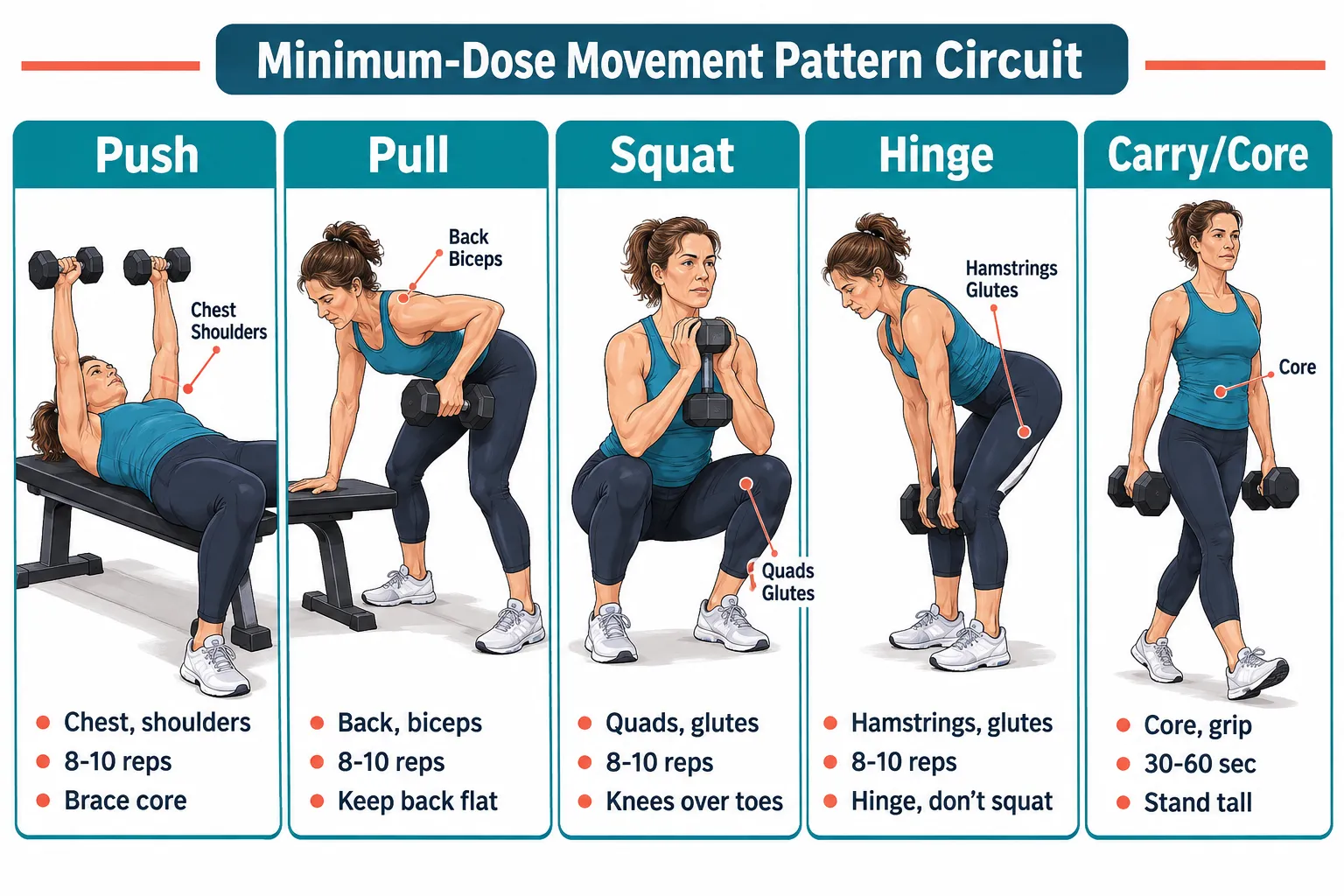
A 20-Minute Strength Workout After 40 for Days When Work and Family Take Over works best as one repeatable circuit built from five movement patterns: push, pull, squat, hinge, and carry or core. Do 2-3 sets of 8-12 reps per pattern with 30-60 seconds of rest, twice a week, using dumbbells, bands, or just bodyweight [1][2]. Coaches who work with over-40 clients agree a short, focused session with fewer sets and heavier loads still counts on chaotic days [3].
Key Takeaways
- Five patterns, one session. Push, pull, squat, hinge, carry/core covers the whole body in 20 minutes [1][4].
- Twice a week is the realistic floor. Two 20-minute sessions a week is the commonly recommended minimum dose for adults over 40 [1][4][5].
- Volume target: roughly 10-20 hard sets per muscle group per week when life allows; less is still useful [3].
- Equipment is optional. Bodyweight or light dumbbells give real benefits, especially for bone health in the hips and back [6][7].
- Rest smart. Time your rests (30-90 seconds) instead of scrolling between sets [3].
- Pair with walking. Many over-40 plans stack two short strength days with 25-30 minute easy walks [5][8].
- Joint pain isn't a stop sign. Swap range of motion, load, and tempo before you swap the exercise.
- Beginners included. Sit-to-stands, counter push-ups, and band rows are legitimate starting points [6][9].
Can you actually build muscle in just 20 minutes?
Yes, if the 20 minutes are dense. Muscle responds to hard sets taken near failure, not to clock time, so 10-15 quality sets spread across two weekly sessions can drive growth in untrained and lightly trained adults over 40 [1][3].
What makes a short session productive:
- Compound lifts only. Squats, rows, presses, and hinges each train several muscles at once [1][4].
- Effort near failure. Finish most sets with 1-3 reps left in the tank.
- Supersets. Pair a push with a pull so one muscle rests while the other works [1].
- Timed rest. 30-60 seconds between paired moves, 1-2 minutes between rounds.
Edge case: if you're already an experienced lifter chasing visible size gains, 20 minutes twice weekly will maintain and slowly build, not transform. Add a third session before you add length.
What's the best A 20-Minute Strength Workout After 40 for Days When Work and Family Take Over?
The best version is a five-pattern circuit you can run anywhere, with three rounds and no decisions to make. Pattern selection, not exercise variety, is what keeps a rushed workout complete.
)
| Pattern | Dumbbell version | Band version | Bodyweight version | Reps |
|---|---|---|---|---|
| Squat | Goblet squat | Band front squat | Sit-to-stand | 10-12 |
| Hinge | Romanian deadlift | Band pull-through | Hip bridge | 8-12 |
| Push | Floor press | Band chest press | Incline push-up | 8-10 |
| Pull | Bent-over row | Band row | Table/towel row | 8-10 |
| Carry/Core | Suitcase carry | Band anti-rotation press | Dead bug or plank | 30-40 sec |
Run it like this: 3 minutes warm-up, then three rounds of the five moves at 30-45 seconds rest between exercises and 60-90 seconds between rounds, finishing with 2 minutes of breathing and stretching. The structure mirrors the two-superset, full-body dumbbell templates recommended for over-40 lifters [1][4].
Do I need equipment, or can I use bodyweight? Dumbbells vs bodyweight for a quick session
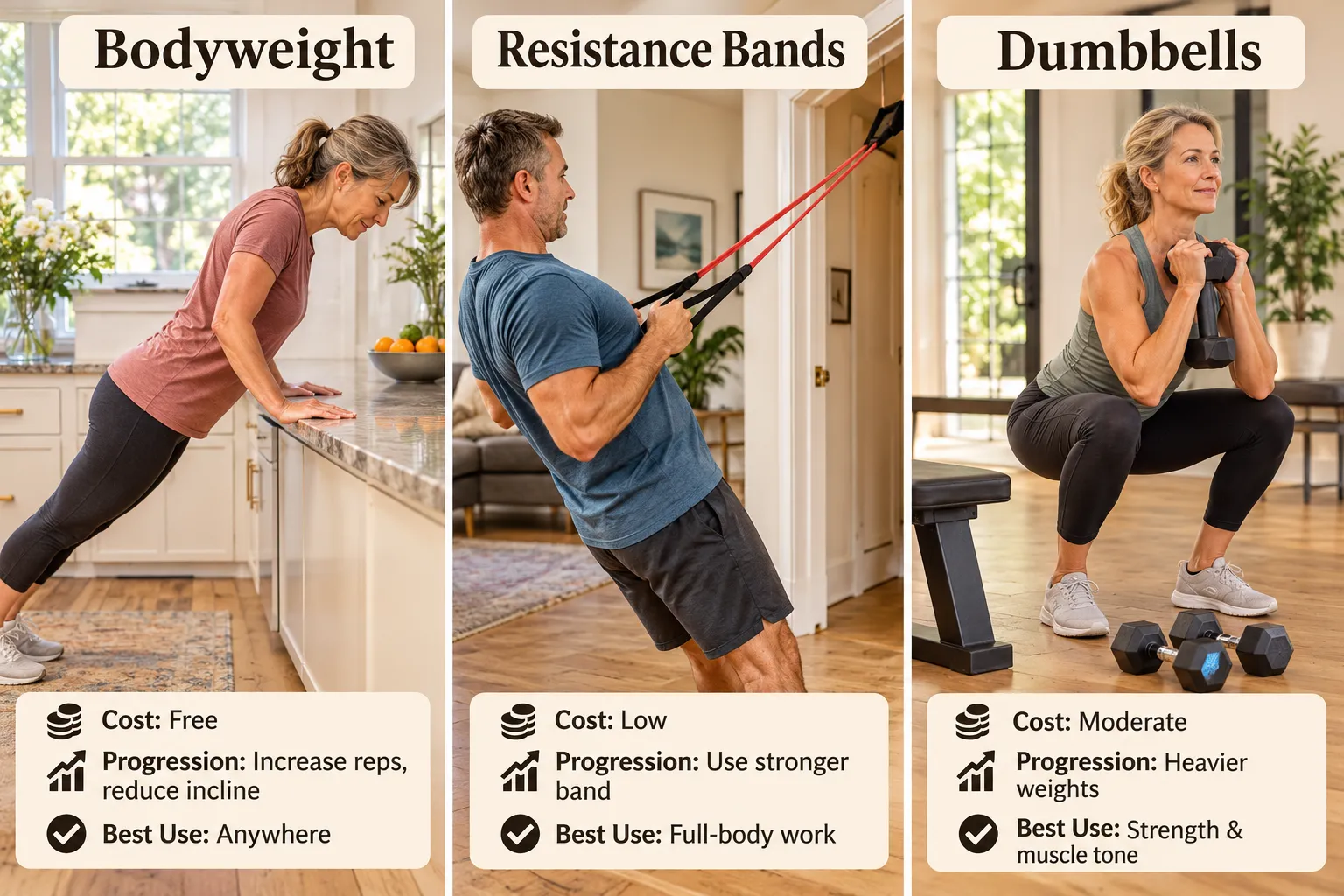
Bodyweight works, dumbbells work better for progression. Bodyweight and light dumbbells both produce meaningful strength and bone benefits, which matters most for beginners and for anyone training at home [6][7]. Dumbbells win when bodyweight squats and push-ups stop feeling hard by rep 12.
Choose bodyweight if you travel often, you're brand new, or your budget is zero. Progress by slowing the lowering phase, elevating feet, or moving to single-leg versions.
Choose bands if you need portability and joint-friendly resistance, especially for rows and presses.
Choose dumbbells if you want the simplest load progression. One adjustable pair (or a 15 lb and 30 lb set) covers the entire circuit. A minimalist three-move version needs only dumbbells plus a bench or box and takes 20-25 minutes.
Common mistake: buying one light pair, then never upgrading. If you can do 15 clean goblet squats, the weight is now a warm-up.
)
How often should I do 20-minute workouts, and is 20 minutes enough?
Twice a week is the working minimum for over-40 adults, three to four days is the target when schedules allow [1][3][5]. Twenty minutes is enough to maintain and build at the low end, and it's enough to protect bone density when sessions target the hips and back [6][7].
A realistic week, drawn from published over-40 plans [5][8]:
- Monday, 20-minute strength circuit
- Tuesday, 25-30 minute easy walk
- Wednesday, walk or rest
- Thursday, 20-minute strength circuit
- Friday, walk
- Weekend, one longer, easy session (hike, bike, swim)
Decision rule: add a third strength day before you lengthen any single session. Frequency beats duration for busy schedules.
Will I lose muscle if I only train 20 minutes a week, and what if I can only fit two days?
A single 20-minute session per week will mostly hold the line rather than build, but it's still far better than nothing and is a legitimate entry point when caregiving or work genuinely dominates [5][9]. Two sessions a week hits the commonly cited minimum effective dose [1][4].
To make a one- or two-day week count:
- Train close to failure on every set.
- Use the five-pattern circuit so nothing gets skipped.
- Keep protein intake steady across the day.
- Add "movement snacks": a set of squats before a shower, carries while hauling groceries.
Edge case: during a crisis week, do one round (about 7 minutes). Habit preservation is worth more than the missed sets [5][9].
What if I have joint pain or a past injury, and can beginners over 40 start here?
Yes to both, with modifications. Pain that stays below a 3/10 and settles within 24 hours generally means you can continue with reduced range or load; sharp, joint-line pain means stop and change the exercise. Beginners can start with bodyweight or light dumbbells and still get real benefit [6][7].
Swaps that usually solve the problem:
- Knee pain: box squat or sit-to-stand instead of a deep goblet squat.
- Low back pain: hip bridge or band pull-through instead of a loaded RDL.
- Shoulder pain: floor press or neutral-grip press instead of overhead work.
- Wrist pain: push-ups on dumbbell handles or a counter.
If pain is new, persistent, or radiating, get it assessed before loading it. Light-load methods such as blood-flow restriction training are also promoted for over-40 adults who can't tolerate heavy weights, producing stimulus in 15-20 minutes [13, not cited; see References]. Where heavier lifting is off the table, slow tempos and higher reps with light dumbbells are the simpler fix.
How do I warm up and cool down when time is tight?
Three minutes in, two minutes out. A rushed warm-up is the most common injury shortcut for over-40 lifters, and it's also the easiest to fix because the first set of each exercise can double as the warm-up.
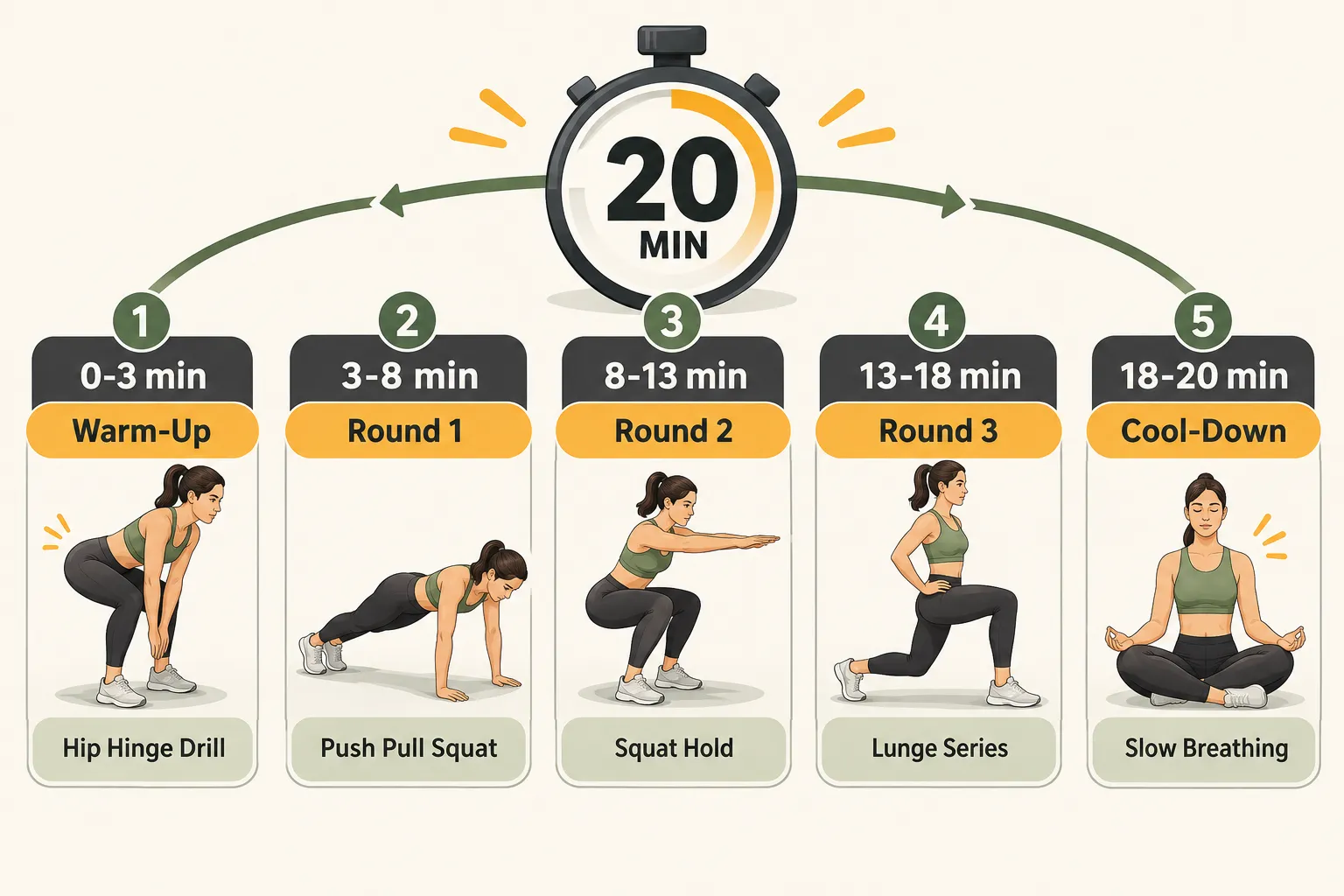
Warm-up (3 minutes): 30 seconds marching in place, 10 bodyweight squats, 10 hip hinges, 10 arm circles, 5 slow push-ups against a wall.
Cool-down (2 minutes): 60 seconds of slow nasal breathing, then a hip flexor and chest stretch, 30 seconds each side.
Quick example: on a truly compressed day, do round one of the circuit with half the weight and call it the warm-up. You lose nothing but a few pounds on the bar.
)
What are common mistakes with short strength workouts?
The biggest mistake is treating a 20-minute strength session like cardio, rushing reps, chasing breathlessness, and never increasing the weight. Short sessions need more intensity discipline, not less.
- Too many exercises. Five patterns, not twelve moves.
- Untimed rest. Phone scrolling turns 20 minutes into 40. Set a timer for 60-90 seconds [3].
- No progression. Add reps, then load, every 1-2 weeks.
- Skipping the pull. Rows protect posture and upper-back bone density [6][7].
- Form breakdown for speed. Slow the tempo, cut a rep.
- All-or-nothing thinking. A half session on a bad week still counts [3][9].
Should I do cardio too, or just strength training?
Do both, but strength is the non-negotiable after 40. Most published over-40 plans pair one or two short strength sessions with easy walking or cycling on the other days [5][8][9]. Walking is the lowest-friction way to add cardiovascular work around a job and a family.
Minimum sensible combination: two 20-minute strength sessions plus roughly 120-150 minutes of easy walking across the week, often done in 25-30 minute chunks [5][8]. If a day forces you to choose, pick strength, muscle and bone loss are the harder deficits to reverse.
How is this different from a traditional gym workout?
A 20-Minute Strength Workout After 40 for Days When Work and Family Take Over trades volume and variety for density and adherence. A gym session might run 60 minutes across 8-10 exercises with long rests; the home circuit compresses the same movement patterns into supersets with short rests [1][4].
| Factor | 20-minute home circuit | Traditional gym session |
|---|---|---|
| Duration | 20-25 min | 45-75 min |
| Exercises | 5 patterns | 8-12 |
| Rest | 30-90 sec | 2-3 min |
| Equipment | Dumbbells, bands, or none | Full racks and machines |
| Best for | Busy weeks, consistency | Max strength, specific goals |
Choose the gym version when you have two spare hours a week and a performance goal. Choose the circuit when the alternative is skipping entirely. Programs marketed as "micro-strength" for the over-40 group are built on exactly this trade-off [1][2][5].
FAQ
How many sets per muscle group each week should I aim for?
Roughly 10-20 hard sets per muscle group weekly is a commonly recommended range for over-40 lifters, with fewer sets and heavier loads acceptable on busy days [3].
What weight should I start with?
Pick a weight where rep 10 feels hard but your form stays clean. For most beginners that's a 10-20 lb dumbbell for goblet squats.
Can I do this workout every day?
Not the same circuit. Leave 48 hours between sessions hitting the same patterns; use walking or mobility on off days.
Is 20 minutes enough for weight loss?
Strength training preserves muscle during fat loss, but food intake and daily step count drive most of the result.
Do I need a bench?
No. Floor presses, hip bridges, and a kitchen counter cover every pattern. A bench or box simply adds options.
How long until I notice changes?
Strength usually improves within 2-4 weeks; visible changes typically take 8-12 weeks of consistent twice-weekly training.
What if I'm over 60, not 40?
The same five patterns apply, with sit-to-stands, band rows, and single-leg balance work added for fall prevention [5][9].
Should I train in the morning or evening?
Whichever one you'll actually do twice a week. Adherence outranks timing.
Conclusion
Build one 20-minute circuit and stop redesigning it. Push, pull, squat, hinge, carry, three rounds, timed rests, twice a week. That's the whole plan, and it's the version of training that survives deadlines, school pickups, and sick kids.
Next steps:
- Block two 20-minute slots this week and name them in your calendar.
- Write the five exercises on a sticky note by your dumbbells or band.
- Record weight and reps after each session so progression isn't guesswork.
- Add 25-30 minute walks on two non-lifting days [5][8].
- Reassess in four weeks: if every set hits 12 clean reps, increase the load.
References
- How to Build Muscle Over 40. ahumanweb.com.
- How to Structure Weekly Workout Routine After 40 Science Backed Schedule Women. transformfitai.com.
- Strength. warriorbabe.com.
- How to Get Stronger. ahumanweb.com.
- Most People Over 40 Say Conventional Workouts Feel Too Hard Take Too Long or Leave Them Injured This Routine Solves All Three Problems Says an Experienced Trainer. fitandwell.com.
- The 20 Minute Strength Routine Every Woman Over 40 Should Know. indulgexpress.com.
- The 20 Minute Strength Routine Every Woman Over 40 Should Know. indulgexpress.com.
- Exercise After 40. thehealthdesk.us.
- Training for Longevity. unitperformance.co.uk.