Last updated: November 2, 2026
Quick answer
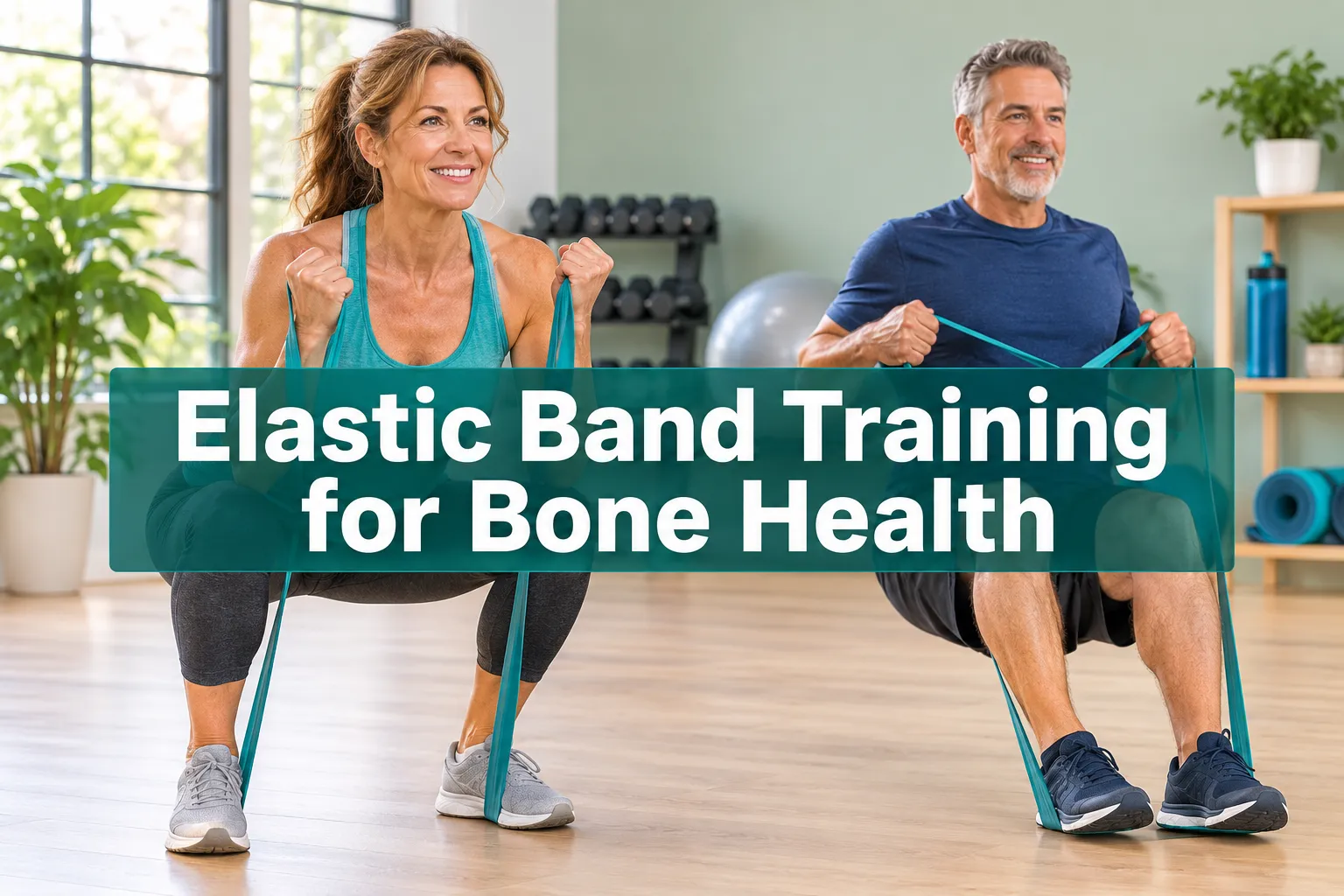
Elastic band training for bone health after 40 reliably builds muscle strength, balance, and bone turnover activity, but its direct effect on bone mineral density (BMD) is small. Meta-analytic data in older adults show 12-week band programs performed about three times weekly produce statistically significant but tiny BMD gains (mean difference around 0.01 g/cm²) [1][2], while several randomized trials found no significant DXA changes at all [2][3][4]. Bands are a strong starting point and a good joint-friendly option, but heavier loading and impact work generally produce larger bone benefits.
Key takeaways
- Bands improve strength, balance, and function in adults over 40 with low injury risk [5][6].
- Direct BMD gains from band-only programs are small or non-significant over 12 weeks [1][2][3].
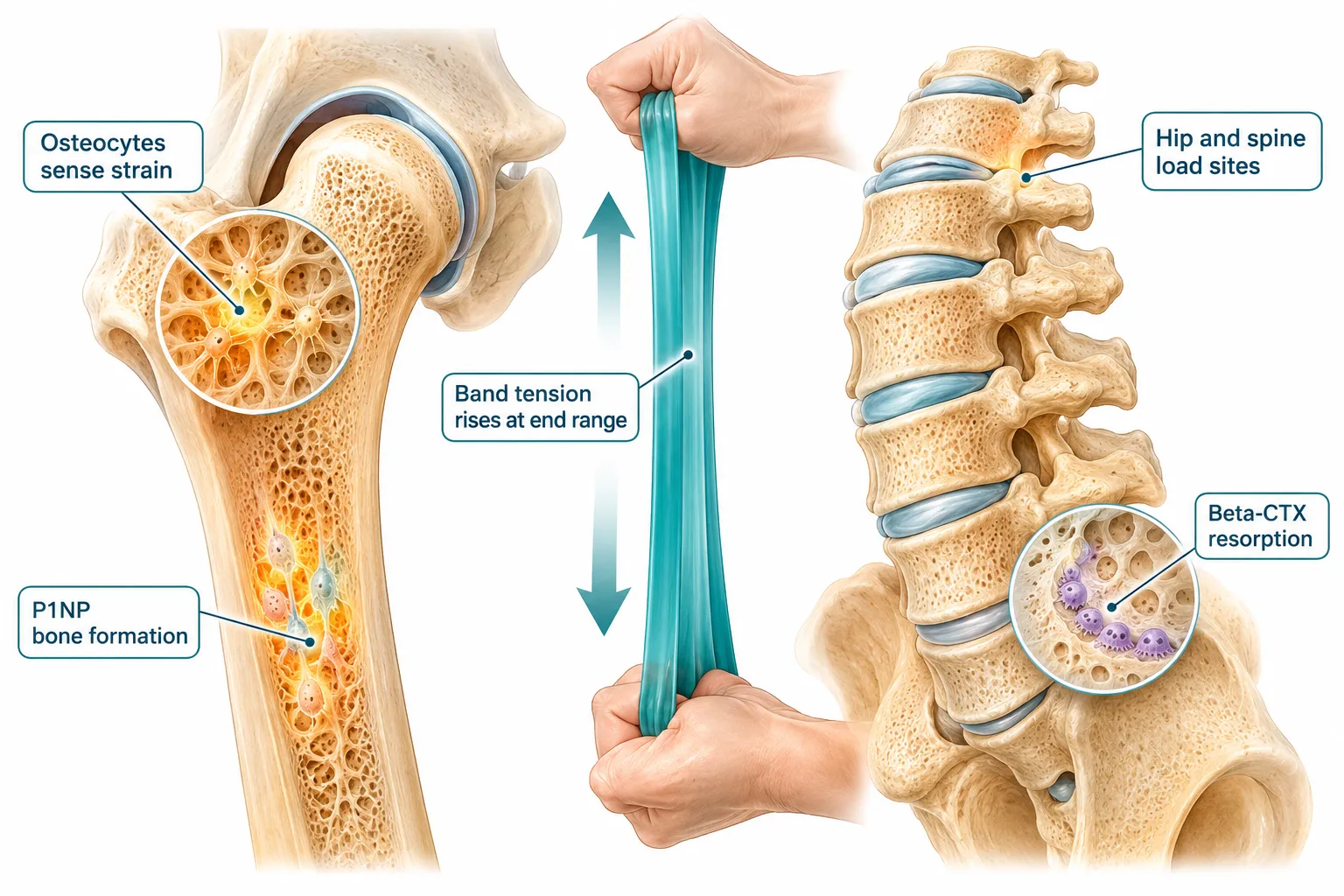
- Bone turnover markers (P1NP formation, β-CTX resorption) shift favorably after roughly 16 weeks of band training, suggesting active remodeling.
- Free weights, especially higher-load multi-joint lifts, show medium effect sizes on spine and hip BMD in postmenopausal women.
- Effective protocols: 2-3 sessions weekly, 45-60 minutes, 12+ weeks, progressive tension [1][2].
- Bands pair best with walking, impact work, and calcium/vitamin D [7].
- Band tension, movement velocity, and slow eccentrics all change the loading stimulus.
- People with established osteoporosis can usually use bands safely, but should avoid loaded spinal flexion and twisting.
Do resistance bands actually improve bone mineral density?
Slightly, yes, but don't expect dramatic numbers. Pooled analyses of elastic band resistance training (EB-RT) in older adults with osteosarcopenia found small but statistically significant BMD increases after 12-week programs done three times per week, alongside clearer gains in skeletal muscle mass and reductions in body fat [1][2]. A 2025 review in Aging and Disease also linked band training to improved BMD, serum vitamin D, and alkaline phosphatase in programs lasting at least 12 weeks [8].
The counter-evidence matters just as much. Trials in women aged 65-80 with osteosarcopenic obesity found only slight, non-significant changes in DXA-measured BMD, FRAX fracture scores, and markers like vitamin D and β-CTX [2][3][9]. Reviews of exercise and BMD conclude the absolute effect is low but clinically relevant, mainly because of falls prevention [9].
Bone responds to strain magnitude and rate. Bands deliver progressive load, but rarely the peak force of a heavy barbell or a landing.
Decision rule: choose bands as your primary tool if gym access, joint pain, or inexperience is the barrier. Add external load once technique is solid.
How effective are elastic bands vs weights for bone health after 40?
For muscle, roughly comparable. For bone, weights have the stronger evidence. A 2025 Nutrients trial comparing band training to conventional resistance training in older adults with osteosarcopenia found non-significant BMD changes in both groups (p=0.16 bands, p=0.11 traditional) but similar improvements in muscle mass, physical performance, and nutrition markers [4]. Meanwhile, dynamic resistance training in postmenopausal women shows medium effect sizes for lumbar spine BMD (SMD 0.54), total hip (0.48), and femoral neck (0.22), with the biggest gains from higher-load, multi-joint, longer programs.
Are resistance bands as effective as free weights for bone health?
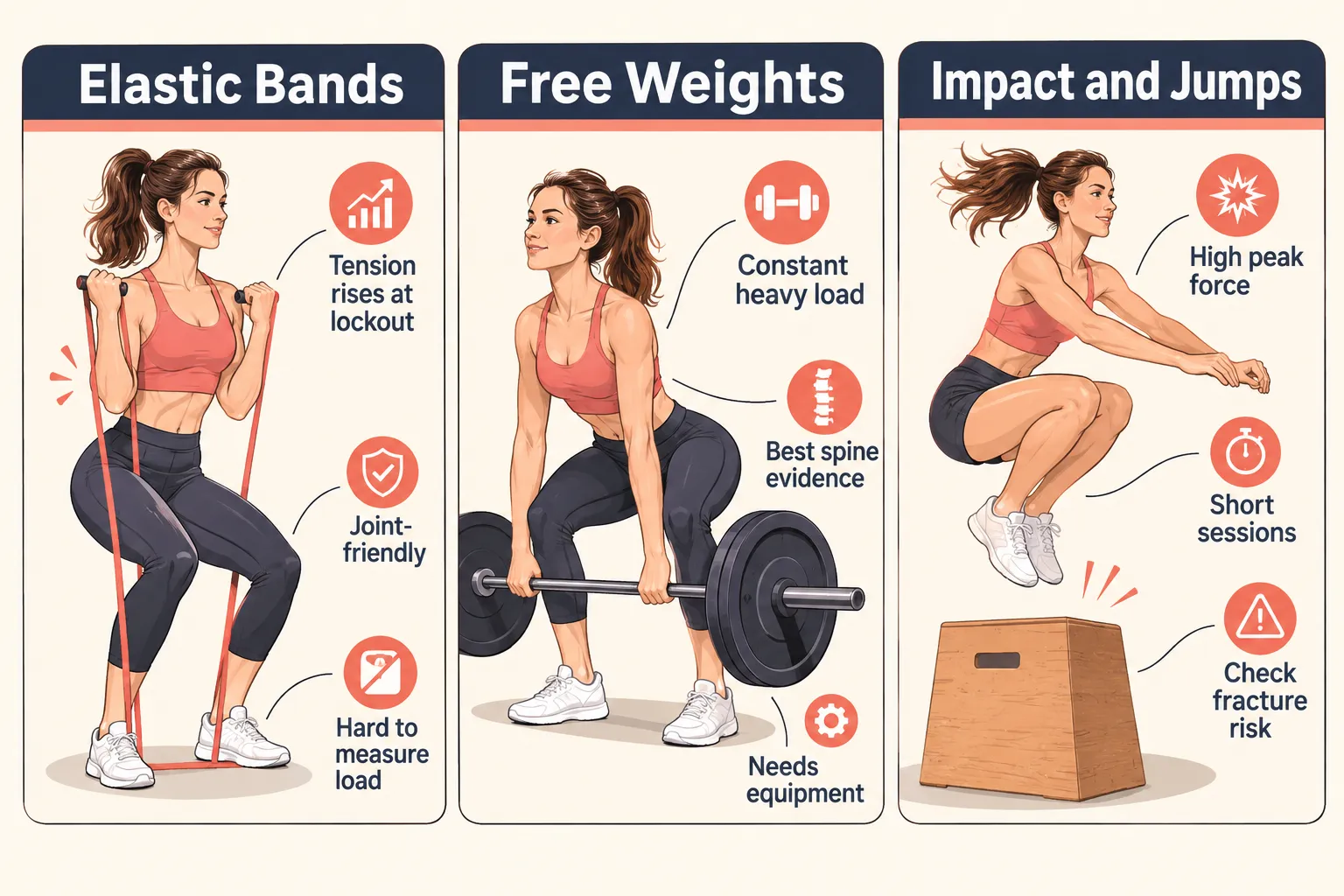
Not quite. The difference is mechanical, not magical:
| Factor | Elastic bands | Free weights |
|---|---|---|
| Load curve | Lightest at start, heaviest at lockout | Constant, often hardest mid-range |
| Peak force at hip/spine | Moderate | High with squats, deadlifts |
| Load measurement | Hard to quantify | Precise, easy to progress |
| Joint comfort | High | Moderate |
| Evidence for BMD gain | Small, inconsistent [1][2][3] | Medium effect sizes |
Can resistance band training help prevent osteoporosis?
It helps, mostly indirectly. Band training is recommended within osteoporosis management because it improves strength, balance, and falls risk even when BMD barely moves [9]. Since most fragility fractures happen after a fall, that matters clinically. A 2024 PLoS One systematic review found bands consistently improve upper and lower limb strength, flexibility, endurance, balance, cardiorespiratory fitness, and mental health in elderly participants, though evidence for substantial total BMD gain was rated low to moderate [5][10].
Edge case: someone with a T-score of −2.6 and a recent wrist fracture should treat bands as a bridge to loaded training and medication, not a substitute for either.
Can resistance band training actually reverse bone loss?
Band training alone is unlikely to reverse established bone loss, but it can slow it and shift remodeling in a favorable direction. A 2026 systematic review and meta-analysis of EB-RT in older adults reported moderate effects on bone turnover markers after about 16 weeks: the formation marker P1NP (g=1.08, p=0.005) and the resorption marker β-CTX (g=1.12, p<0.001) both improved, even when DXA BMD changes stayed small.
Combination approaches do better. A 24-week trial in older women combining resistance training (including bands), traditional Chinese exercise forms, and calcium/vitamin D supplementation produced significant lumbar spine BMD increases, higher PINP, and lower β-CTX [7]. Nutrition and multi-modal loading do a lot of the heavy lifting.
What type of resistance bands work best for building stronger bones?
Choose long looped bands or heavy tube bands with handles that let you load the hips, spine, and legs in multi-joint patterns. Thin therapy bands are fine for shoulders and rehab, but they rarely create enough tension to challenge large muscle groups.
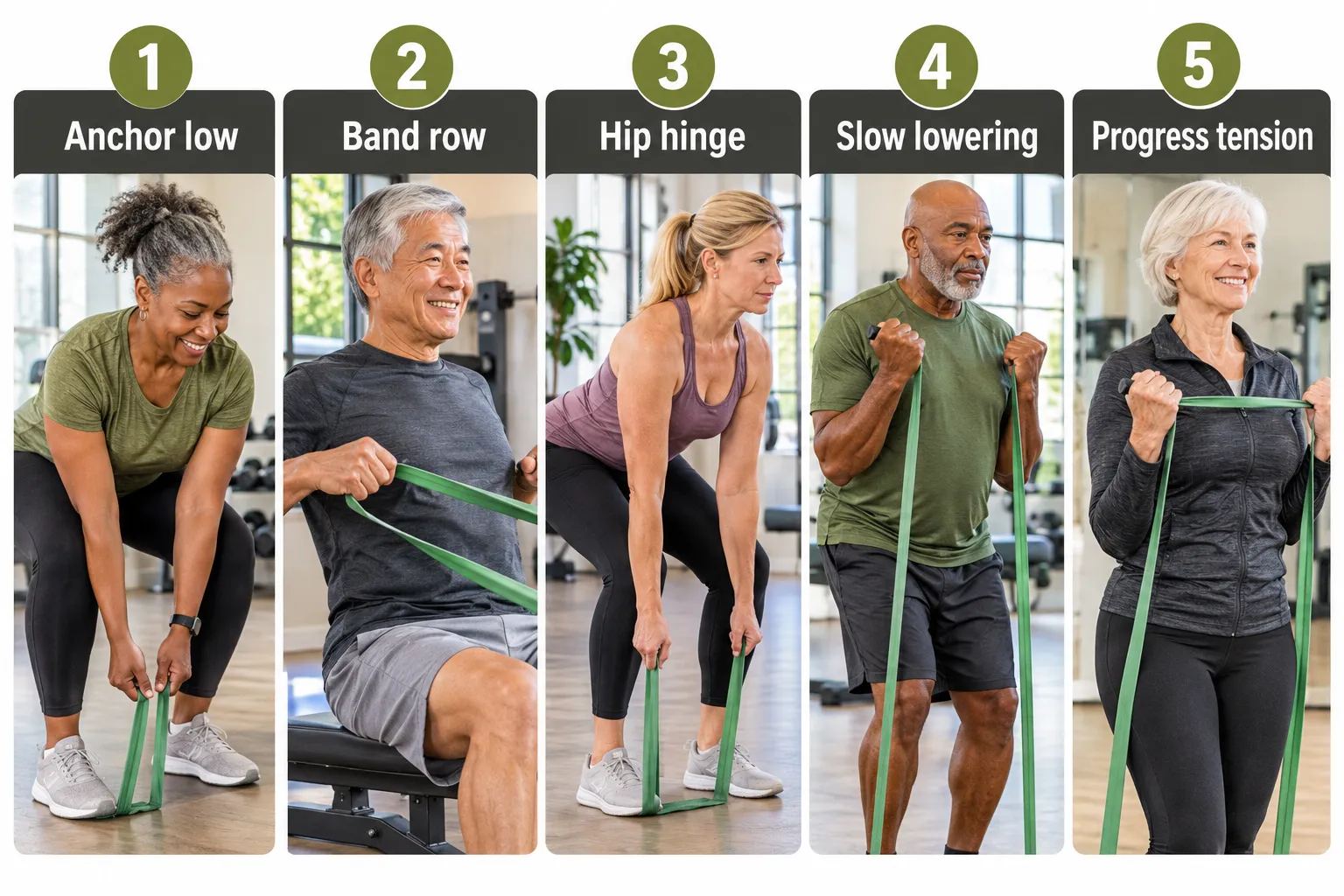
- Looped power bands (thick, 1-3 inch width): best for squats, hip hinges, rows, and presses. Allow real progression.
- Tube bands with door anchors: good for rows, pulldowns, and hip extension.
- Flat therapy bands: useful for warm-ups, wrists, rotator cuff.
- Progression set: own at least 3-4 tensions so you can increase resistance, not just reps.
Meta-analytic data indicate that higher band tension, progression over time, and longer duration are linked to better strength and small BMD outcomes [1][2][12, see [1]].
Band resistance, velocity, and eccentric emphasis
Three variables change what a band session does to bone and muscle:
- Resistance (tension): the band must feel genuinely hard by rep 8-12. Light bands produce endurance, not bone stimulus.
- Velocity: fast, intentional concentric speed recruits high-threshold motor units and raises strain rate, which bone cells respond to. Push out quickly, control the return.
- Eccentric emphasis: bands pull you back hard at the top of the range. Resisting that return over 3 seconds adds strain time and muscle tension, one of the few areas where bands have an advantage.
How long does it take to see bone density improvements from band training?
Expect 12 weeks for strength and balance, roughly 6-12 months before any measurable BMD change, and understand that DXA scans are usually repeated no sooner than one to two years apart. Most band trials showing small BMD gains ran 12 weeks at three sessions per week [1][2], and bone marker shifts appeared around 16 weeks. The larger BMD effects in the resistance training literature came from longer, heavier programs.
Measure the things that move faster: reps at a given band tension, sit-to-stand time, single-leg balance seconds, and stair comfort.
How often do you need to use resistance bands to improve bone density?
Two to three sessions per week, 45-60 minutes, for at least 12 weeks, targeting the hips, spine, and legs. That frequency is the most common protocol across effective elastic band studies in older adults [1][2]. Professional strength and conditioning guidance echoes the same principles, progressive overload, multi-joint movements, 2-3 weekly sessions, while noting bands are joint-friendly and accessible for people over 40 who can't tolerate heavy free weights [5][11, see [5]].
Is elastic band training alone enough for bone health, or do you need weights?
For most people over 40, bands alone are not optimal for bone, though they are far better than nothing. Bone adapts best to high-magnitude, high-rate loading, which heavier weights and impact supply more directly.
Choose bands only if: you're new to training, managing joint pain, traveling, or recovering from injury.
Add weights and impact if: you have low bone density, no pain limitations, and access to equipment.
What other exercises should you combine with elastic bands for bone strength?
- Weight-bearing impact: brisk walking, stair climbing, light hopping or heel drops (if fracture risk allows).
- Loaded multi-joint lifts: goblet squats, trap-bar deadlifts, loaded carries.
- Balance and tai-chi style practice: strongly supported for falls reduction [7].
- Calcium and vitamin D adequacy: combination trials with supplementation showed the clearest lumbar spine gains [7].
Can you use resistance bands if you already have osteoporosis or weak bones?
Usually yes, and bands are often the preferred first modality because tension is controlled and the lightest point of the curve is where joints are most vulnerable. Safety data across band studies in older populations show low adverse event rates alongside improvements in pain, stress, and functional capacity [5][6].
Avoid these with diagnosed osteoporosis:
- Loaded or repeated spinal flexion (band crunches, toe touches)
- Twisting under tension through the lumbar spine
- Jerky, uncontrolled snap-backs
- End-range stretching of the thoracic spine under load
Who should avoid elastic band training for bone health?
Get medical clearance first if you have a recent vertebral or hip fracture, unstable cardiovascular disease, uncontrolled hypertension, acute joint inflammation, advanced retinopathy, or severe balance impairment without supervision. Latex allergy means choosing latex-free bands.
What are the most common mistakes people make with resistance band training?
The biggest one is using bands that are too light and never progressing. That produces comfort, not adaptation.
- No progression, same band, same reps, for months.
- Letting the band snap back instead of controlling the eccentric.
- Only training arms and shoulders, skipping hips and legs.
- Poor anchoring (doors, furniture) causing slips or band recoil.
- Using worn, nicked bands that can fail under tension.
- Stopping at 8 weeks, before bone markers have had time to shift.
- Ignoring protein, calcium, and vitamin D [7].
How do you know if you're doing resistance band exercises correctly for bones?
Three checks: the last two reps of each set should feel hard; you should feel the target muscle (glutes, quads, mid-back), not the joint; and the band should stay under tension the whole rep. Film one set from the side every few weeks. If the band goes slack mid-rep, the anchor or the setup is wrong.
FAQ
Do resistance bands build bone density? Slightly. Studies show small, sometimes non-significant BMD increases after 12-week band programs, with clearer gains in muscle and balance [1][2][3].
How many times per week should I use bands for bone health? Two to three sessions weekly, 45-60 minutes, for 12 weeks or longer [1][2].
Are bands as good as weights for bones? No. Bands match weights for muscle gains in older adults but weights have stronger BMD evidence, especially for the lumbar spine [4].
Can bands reverse osteoporosis? No. Bands can slow loss and improve bone turnover markers, but reversal typically requires medication plus loaded exercise and nutrition [7].
Is band training safe with osteoporosis? Generally yes, with low adverse event rates reported, provided you avoid loaded spinal flexion and twisting [5][6].
What band strength should a beginner over 40 use? One that makes 10-12 reps genuinely hard, with at least three progressively heavier bands available.
How long until I notice anything? Strength and balance in 6-12 weeks; bone marker changes around 16 weeks; measurable BMD change typically a year or more.
Should I add impact exercise? Yes, if fracture risk permits. Walking, stairs, and small hops add the high-rate loading bands can't easily supply.
Conclusion
Elastic band training for bone health after 40 earns its place for three reasons: it builds strength, it sharply improves balance and falls risk, and it's tolerable for joints that reject heavy barbells [5][9]. What it won't do is deliver large BMD jumps on its own, the trial data are honest about that [2][3][4].
Next steps:
- Buy a set of three to four looped bands of increasing tension.
- Schedule three 45-minute sessions weekly, built around squats, hip hinges, rows, presses, and carries.
- Push the concentric fast, lower over 3 seconds, and move up a band when 12 reps feel easy.
- Add walking plus 2-3 minutes of heel drops or light hops, if cleared.
- Confirm calcium, vitamin D, and protein intake with your clinician [7].
- Reassess strength every 12 weeks; discuss DXA timing with your doctor.
References
- Pmc11018988. pmc.ncbi.nlm.nih.gov.
- S11657 022 01120 X. link.springer.com.
- Pmc8290586. ncbi.nlm.nih.gov.
- Nutrients 17 02852 T005. pmc.ncbi.nlm.nih.gov.
- pubmed.ncbi.nlm.nih.gov.
- pubmed.ncbi.nlm.nih.gov.
- 12906 2025 Article 4849. pmc.ncbi.nlm.nih.gov.
- Ad.2025.0866. aginganddisease.org.
- Download. ejcrim.com.
- File. journals.plos.org.
