Last updated: November 10, 2026
Quick Answer
The best adjustable kettlebells for strength training after 40 are the ones with a competition-style shape, a locking mechanism that doesn't rattle, and small weight jumps you can actually control. Across 2026 expert testing, the REP Fitness Adjustable Kettlebell is the strongest all-around pick (it replaces about five fixed bells and carries a lifetime warranty)[13 → see 5], the Bells of Steel Adjustable Competition Style Kettlebell wins for precise 0.5-1 kg progressions and all-steel durability[1], and the Bowflex SelectTech 840 is easiest for fast, lighter, joint-friendly circuits[2]. For most midlife lifters, one adjustable bell plus good technique beats a rack of cheap fixed bells.
Key Takeaways
- Adjustable kettlebells let you add weight in small steps, which matters more after 40 than lifting heavy fast.
- Look for three safety traits: a secure lock-up, a flat base, and a smooth, wide handle.
- Expect to spend roughly $150,$400 for a quality adjustable bell that lasts; bargain bells with plastic cores are where failures happen[2].
- Most people over 40 should start at 8-12 kg (18-26 lb) for two-hand swings and goblet squats, lighter for presses.
- Adjustable kettlebells do build muscle when you progress load and train 2-3 times per week.
- Skip high-rep snatches, max-effort jerks, and behind-the-neck work early on; swings, goblet squats, carries, and presses cover most needs.
- Get medical clearance first if you have osteoporosis, heart issues, or pelvic floor problems[15 → see Health guidance].
- All-steel internal-plate bells (Bells of Steel type) hold up longest; dial-based plastic housings are the usual first thing to crack[1][3].
What's the difference between adjustable and fixed kettlebells?
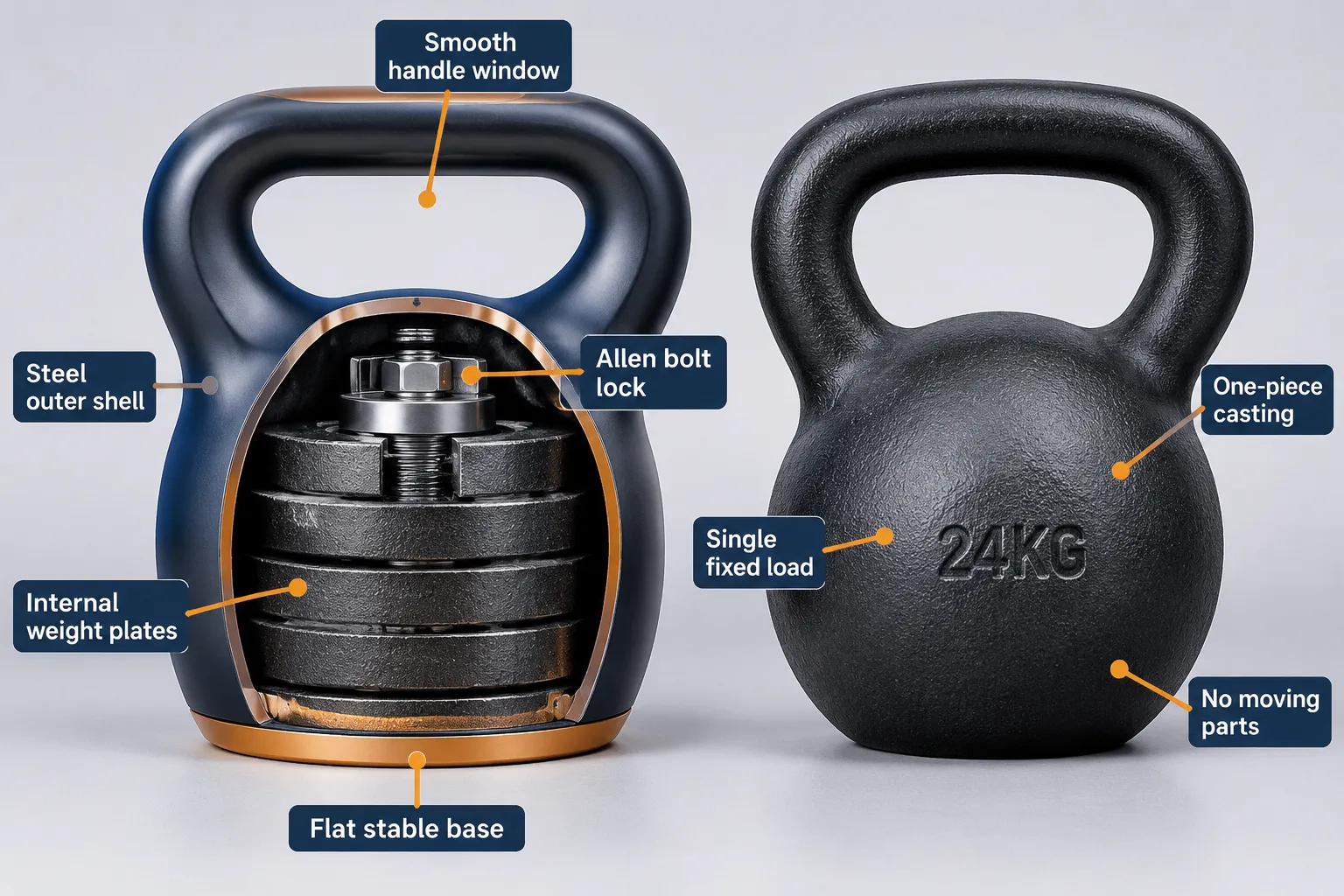
A fixed kettlebell is one solid cast piece at one weight. An adjustable kettlebell uses either a dial or internal plates locked inside a shell, so one unit covers a range of loads.
)
| Fixed kettlebell | Adjustable kettlebell | |
|---|---|---|
| Weight options | One | 4-18 settings |
| Space needed | A rack | One footprint |
| Feel | Perfectly balanced | Very good on steel models, odd on cheap ones |
| Swap speed | Instant | 5 seconds (dial) to 60 seconds (wrench) |
| Failure risk | Almost none | Depends on the lock |
Choose fixed if you only ever use one or two weights and have floor space. Choose adjustable if you're progressing month to month and training in a spare room or garage corner. Reviews from 2025-2026 consistently frame adjustable bells as the space-saving substitute for a full rack, replacing anywhere from 4 to 18 fixed bells[2][4][5].
Are adjustable kettlebells safe for people over 40?
Yes, when the lock is solid and the load is conservative. The risk with kettlebells after 40 isn't the adjustability, it's the ballistic movement combined with a weight you haven't earned yet.
Safety-relevant features that 2026 roundups repeatedly flag: flat stable bases for floor work, locking mechanisms that stop plates from shifting mid-swing, ergonomic handles that cut grip strain, and clear weight markings so you don't mis-load[2]. General kettlebell guidance also warns that adults with osteoporosis, cardiovascular conditions, or pelvic floor disorders face raised risk of strains, fractures, blood pressure spikes, and prolapse from aggressive kettlebell work, and should begin with light weight and controlled movements.
A kettlebell that rattles during a swing is telling you something. Stop, re-tighten, and check the lock before the next set.
Common mistake: buying an adjustable bell and never re-checking the bolt tension after the first month of use.
Best adjustable kettlebells for strength training after 40: safer home options compared
Here's the shortlist, based on 2026 testing from Garage Gym Reviews, Men's Journal, BarBend, and Women's Health.
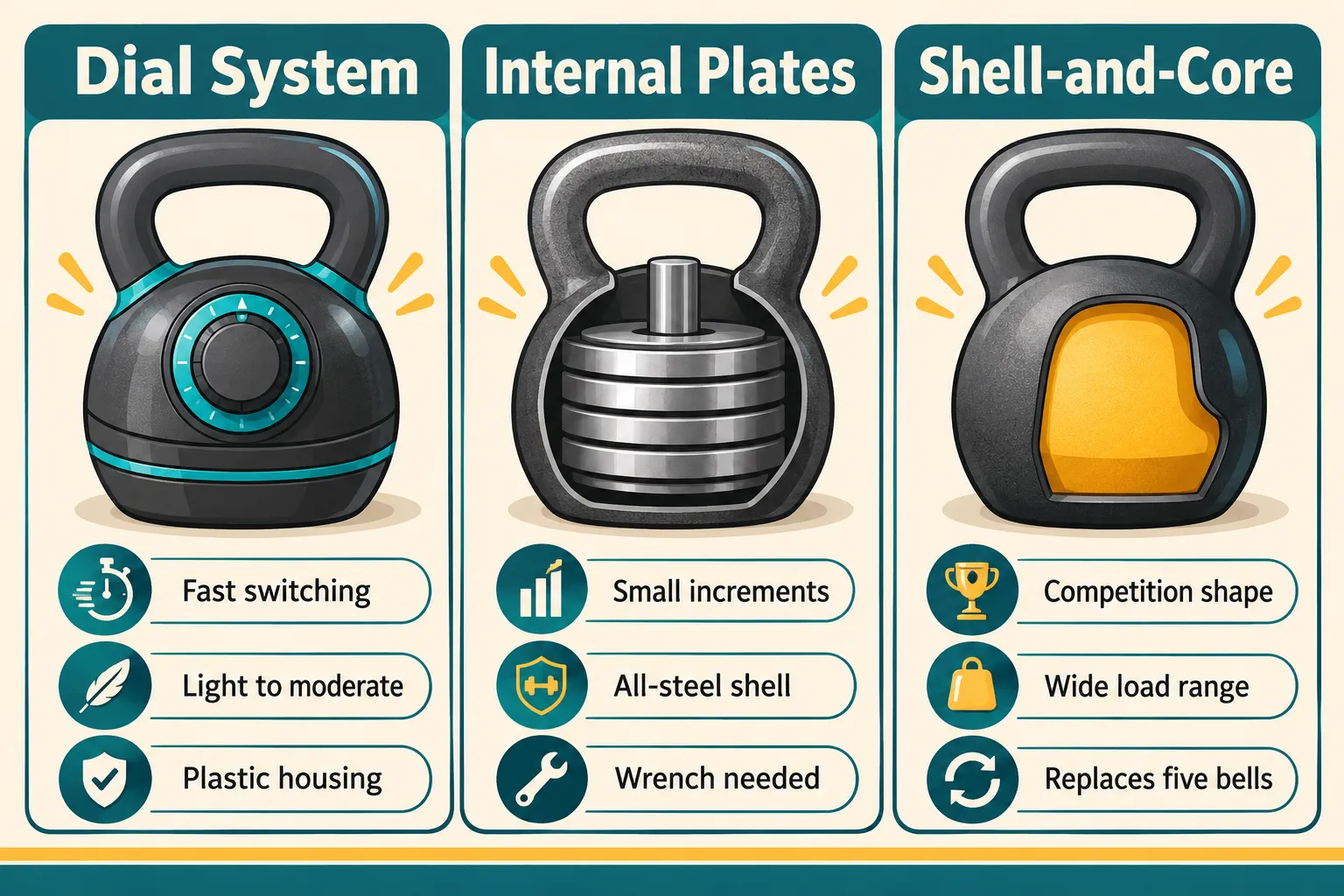
REP Fitness Adjustable Kettlebell, best overall. Men's Journal named it their top pick for 2026, citing solid construction and a balanced feel across both heavy swings and high-rep circuits[6]. Garage Gym Reviews found it feels close to a true competition bell, replaces roughly five fixed kettlebells, and ships with a lifetime warranty[2]. Women's Health called it sturdy and appropriate for beginners and experienced lifters alike, with a comfortable handle[7]. That combination (familiar shape, long warranty, forgiving handle) is exactly what a returning midlife lifter wants.
Bells of Steel Adjustable Competition Style Kettlebell, best for precise progression. Up to 18 internal increments from about 12 kg to 32 kg, with expansion kits reaching around 70 lb, giving 0.5-1 kg jumps[1][3][8]. All-steel shell, competition dimensions, and a non-wobbly internal plate system. Trade-off: adjustment needs an Allen wrench, so it suits deliberate strength sessions more than fast circuits[1]. A Canadian review notes roughly a 4.9-star average across 420+ customer reviews, with users praising the secure lock-up and lack of rattle[3].
Bowflex SelectTech 840, best for quick changes and lighter work. The dial moves from about 8 to 40 lb in seconds, which fits joint-friendly, higher-rep training and warm-ups[2][5]. The housing is bulkier and less kettlebell-shaped than steel competitors, and the ceiling is low for strong lifters.
Decision rule: pick REP if you want one bell to do everything; pick Bells of Steel if you plan to keep adding weight for years; pick Bowflex if speed of change and lighter loads matter most.
How much should I spend on a good adjustable kettlebell?
Plan on roughly $150 to $400. Under about $120, you're usually buying plastic shells and vinyl coatings that loosen, and that's where the lock-up problems start.
- $100,$150: entry dial bells, light loads only, shorter lifespan.
- $150,$250: the sweet spot, dial systems like the SelectTech 840 and mid-range plate bells.
- $250,$400: competition-style steel bells with wide ranges and long warranties (REP, Bells of Steel).
Cost per pound of usable weight is the honest metric. A $300 bell that replaces five fixed kettlebells plus the rack to hold them is cheaper than it looks, especially when it's backed by a lifetime warranty[2].
What weight should I start with as an older lifter, and how do I know if it's too heavy?
Most men over 40 start two-hand swings and goblet squats at 12-16 kg (26-35 lb); most women start at 8-12 kg (18-26 lb). Overhead presses and single-arm work should be noticeably lighter, often half that.
A kettlebell is too heavy if any of these show up:
- Your lower back rounds or your ribs flare during a hinge.
- You can't stop the bell smoothly at the top of a swing.
- Your grip fails before the target muscle does.
- You hold your breath to move it.
- Soreness lasts more than three days.
Quick test: if you can't do 10 clean reps with two perfect reps left in reserve, drop a setting. Adjustable bells make this easy, which is their real advantage after 40, the Bells of Steel 0.5 kg plates and the Bowflex ~5 lb dial steps both let you add load without a 4 kg leap[1][5].
Can adjustable kettlebells replace dumbbells, and do they actually build muscle?
They can cover most dumbbell work, and yes, they build muscle when load progresses over time. Muscle responds to tension and progressive overload, not to the shape of the handle.
Where kettlebells win: hinges, swings, goblet squats, loaded carries, single-arm presses, rows, and Turkish get-ups. Where dumbbells still win: bench pressing, heavy bilateral pressing, and some isolation work like curls and lateral raises, where the offset kettlebell load gets awkward.
Edge case: if hypertrophy of the chest and arms is your main goal, pair one adjustable kettlebell with a pair of adjustable dumbbells. For general strength, bone loading, and conditioning after 40, a single good kettlebell plus bodyweight covers a lot.
What kettlebell exercises should I avoid over 40, and what mistakes derail people?
Avoid high-rep snatches, max-effort jerks, behind-the-neck presses, and any ballistic move you can't demonstrate slowly first. These are the movements where technique breaks down and shoulders and lower backs pay for it.
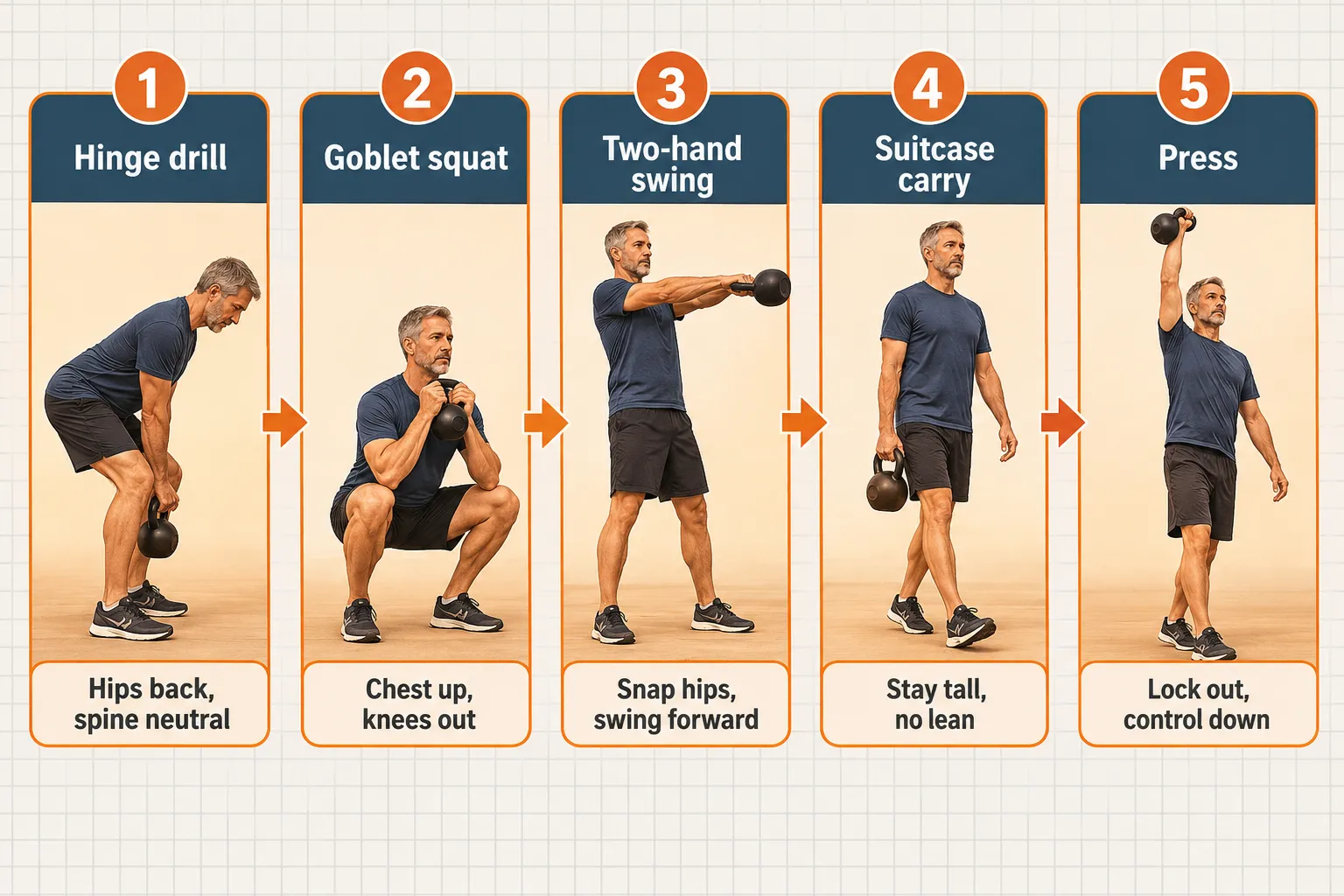
Build around this core instead: hip hinge drill, goblet squat, two-hand swing, suitcase carry, half-kneeling press, single-arm row.
Mistakes that show up most often:
- Squatting the swing instead of hinging at the hips.
- Yanking with the arms rather than letting the hips drive the bell.
- Jumping weight too fast because adjusting is easy.
- Skipping the lock check before ballistic sets.
- Training only swings and neglecting pressing, pulling, and carries.
- No warm-up for hips and shoulders, which matters more every decade.
Are adjustable kettlebells good for joint protection, and can I use them with lower back pain?
Adjustable kettlebells support joints indirectly: small increments and a comfortable handle let you build tendon and connective-tissue tolerance gradually instead of shocking it. The bell itself isn't therapeutic.
With lower back pain, get cleared by a physician or physical therapist first. Then start with non-ballistic work: goblet squats, suitcase carries, hip hinges with a dowel, and half-kneeling presses. Many people with back pain tolerate carries and hinges well once load is appropriate, and the swing can be added later with light weight and a strict hinge pattern.
Do not swing through sharp or radiating pain. Dull muscular fatigue is fine; nerve-type pain is a stop sign.
How often should you train with kettlebells for strength?
Two to three sessions per week, 20-40 minutes each, with at least one rest day between hard sessions. That frequency gives enough stimulus for strength while leaving recovery room that matters more after 40.
A simple weekly layout:
- Day 1: swings, goblet squats, rows.
- Day 2 (48h later): presses, carries, single-leg work.
- Day 3 (optional): lighter swings and mobility.
Progress load every two to four weeks, not every session.
Which adjustable kettlebell holds weight the longest without breaking?
All-steel internal-plate designs hold up best. The Bells of Steel Adjustable Competition Style Kettlebell is built around a steel shell with a wrench-tightened plate system that testers describe as stable and rattle-free, and users repeatedly cite secure lock-up across 420+ reviews[1][3]. The REP Fitness bell is the other durability standout, largely because of its lifetime warranty, if something does fail, replacement risk sits with the manufacturer, not you[2].
Dial-based bells with plastic housings are generally the first to show wear, especially if dropped on concrete. If you train on a hard floor, buy steel and a rubber mat.
FAQ
Are adjustable kettlebells worth it for a home gym?
Yes, if you plan to progress. One quality adjustable bell replaces 4-18 fixed bells and the rack to store them[2][4][5].
What's the best overall adjustable kettlebell in 2026?
The REP Fitness Adjustable Kettlebell, named best overall by Men's Journal and praised in independent testing for competition-like feel and a lifetime warranty[2][6].
Can beginners over 40 use kettlebells safely?
Yes, with light weight, controlled tempo, and ideally a few coaching sessions. Avoid ballistic lifts until the hip hinge is solid.
How long does it take to adjust the weight?
Dial bells like the Bowflex 840 take seconds; wrench-based bells like Bells of Steel take about a minute[1][2].
Do I need two kettlebells?
Not at first. One bell covers swings, squats, presses, carries, and rows. Add a second only for double-bell work.
Is a competition shape better than cast iron for older lifters?
Generally yes. Consistent dimensions and a smooth, wide handle reduce forearm bruising during cleans and racked work.
Can kettlebells help with bone density after 40?
Loaded, weight-bearing training supports bone health, but anyone with diagnosed osteoporosis should get medical clearance before ballistic lifting.
What if my bell rattles?
Stop the set, re-tighten the lock, and inspect the plates. A rattling bell should never be swung overhead.
Conclusion
Adjustable kettlebells solve a specific problem for lifters over 40: you need more progression than resistance bands offer, but you don't want a wall of fixed bells. The three picks that 2026 testing keeps returning to, REP Fitness for all-around quality, Bells of Steel for precise long-term loading, and Bowflex SelectTech 840 for quick lighter work, all share the traits that matter most: secure locks, flat bases, and handles that don't punish your grip.
Next steps:
- Get medical clearance if you have back, heart, bone, or pelvic floor concerns.
- Pick one bell based on the decision rule above, matched to your current strength and space.
- Start one setting lighter than you think you need.
- Learn the hinge before the swing, with video feedback.
- Train twice weekly and add one small increment every two to four weeks.
- Check the lock before every ballistic session.
References
- Bells of Steel Adjustable Competition Style Kettlebell Review. garagegymreviews.com.
- Best Adjustable Kettlebells. garagegymreviews.com.
- Bells of Steel Adjustable Kettlebell Review. ctvnews.ca.
- Best Kettlebells. gq.com.
- Best Kettlebells. self.com.
- Best Adjustable Kettlebells. mensjournal.com.
- REP Fitness Adjustable Kettlebell Review. womenshealthmag.com.
- Dropped, Swung, Abused: Top Adjustable Kettlebells. shopping.yahoo.com.
