Last updated: November 11, 2026
Quick Answer
Strength training after 40 with high blood pressure is not only safe for most people, it's recommended. Major guidelines, including the 2024 European Society of Cardiology hypertension guidelines, list resistance training as part of standard blood pressure management [1]. The rules that matter: skip breath-holding (the Valsalva maneuver), keep effort moderate rather than maximal, train 2-3 days a week, and get medical clearance first if your resting pressure is very high or you have heart disease, diabetes, or symptoms. Strength training after 40 with high blood pressure goes wrong mainly through max-effort straining, not through the weights themselves.
Key Takeaways
- Resistance training lowers resting blood pressure in adults, including older adults, and is endorsed alongside aerobic exercise [1][2].
- Breathe out on the hard part of every rep. Never hold your breath under load.
- Train 2-3 non-consecutive days per week, 8-10 exercises covering major muscle groups [2][3].
- Keep effort around RPE 5-7 out of 10, stopping 2-3 reps short of failure.
- If resting blood pressure is ≥180/110 mmHg, don't train that session; see a clinician first [2].
- Avoid heavy overhead presses, maximal attempts, inverted positions, and long isometric holds.
- Lighter weights with more reps can still build muscle and are a sensible entry point after 40.
- Aerobic exercise lowers BP slightly more on average, but the combination beats either alone.
- Progress in one variable at a time: reps first, then load, then sets.
Is it safe to lift weights if you have high blood pressure?
Yes, for the large majority of people with controlled or moderately elevated blood pressure. Resistance training is specifically recommended in current hypertension guidance as a complement to aerobic activity [1][2]. Risk concentrates in a narrow set of situations: untreated severe hypertension, unstable cardiac disease, and maximal straining efforts.
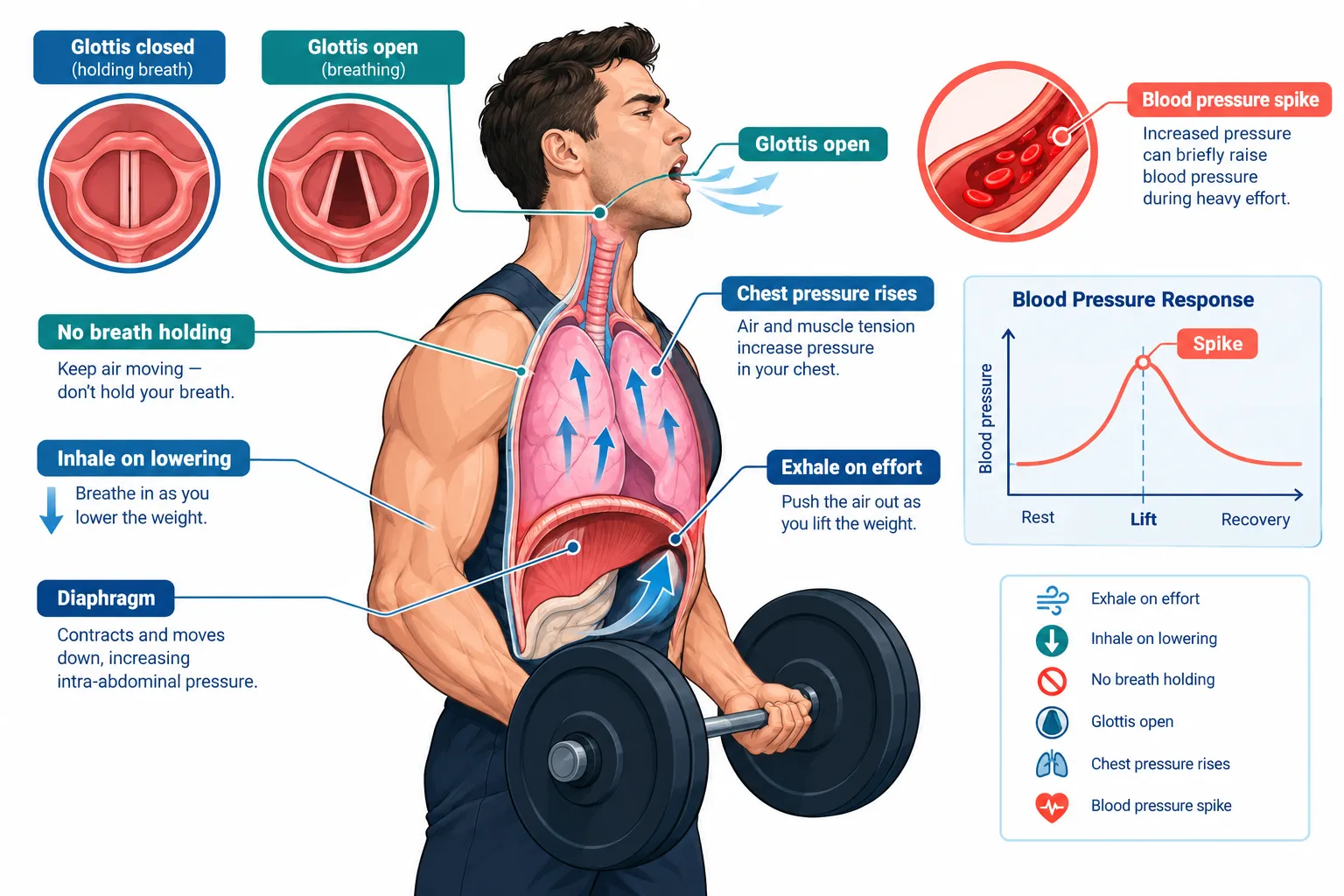
The reason weights got a bad reputation is the acute response. Blood pressure rises sharply during a hard set, especially with breath-holding and heavy loads. That transient spike is tolerated well by most people, but it's why guidelines emphasize submaximal loads and controlled breathing rather than all-out lifting [1][4].
Choose caution if: you've had a stroke, a recent cardiac event, retinopathy, an aortic aneurysm, or resting readings consistently above 160/100 mmHg.
What breathing technique should I use during strength training with hypertension?
Exhale during the effort phase, inhale during the easier phase, and never hold your breath. Professional guidance for hypertensive and older lifters consistently warns against the Valsalva maneuver, which drives chest pressure and arterial pressure up sharply [3][4].
Practical version:
- Set up and take a normal breath in.
- Exhale as you push, pull, or stand up (the hard part).
- Inhale as you lower the weight under control.
- Count "one-one-thousand" out loud on a rep if you're unsure. If you can't, you're holding your breath.
Common mistake: bracing like a powerlifter. Hard abdominal bracing with a closed throat is exactly the pattern to avoid. Brace lightly, keep the throat open, keep air moving.
If you can't speak a short word mid-rep, the load is too heavy or the breathing is wrong.
How do I know if my blood pressure is too high to exercise, and should I measure around workouts?
Don't start a session if resting blood pressure is 180/110 mmHg or higher, rest, recheck, and contact your clinician [2]. Between roughly 160/100 and 180/110, lighter machine-based work is usually fine if you're symptom-free and medicated, but confirm with your provider.
Measuring before and after sessions is useful for the first 4-8 weeks, then occasionally.
| When | What to do | What's expected |
|---|---|---|
| Before lifting | Sit 5 min, cuff on bare arm | Below 180/110 to proceed |
| Mid-session | Check only if symptoms appear | , |
| 30-60 min after | Sit and measure | Often lower than baseline (post-exercise hypotension) |
| Next morning | Normal routine reading | Trending down over weeks |
Edge case: diastolic pressure that climbs during a session rather than staying flat is worth reporting. Systolic normally rises with effort; a rising diastolic is less typical.
Can strength training actually help lower blood pressure?
Yes. Meta-analytic evidence shows resistance training produces meaningful reductions in resting systolic and diastolic pressure, including in older adults, and it's now part of mainstream hypertension exercise prescriptions [2][5][6]. Circuit-style resistance training appears particularly practical and effective for community-dwelling older adults [7][8].
Mechanisms that matter:
- Improved blood vessel function and nitric oxide availability
- Better insulin sensitivity and body composition
- Lower resting sympathetic nervous system drive
- Greater muscle mass, which supports day-to-day activity levels
Programs lasting at least 8 weeks with 2 or more sessions per week tend to show the clearest effects [6].
What's the difference between safe and unsafe exercise intensity with hypertension, and how hard should I push?
Safe intensity means moderate-to-vigorous load with submaximal effort. ACSM-style guidance for hypertensive adults points to roughly 60-70% of one-rep max for experienced lifters and 40-50% for novices and older beginners, with 8-12 repetitions per set [2][3].
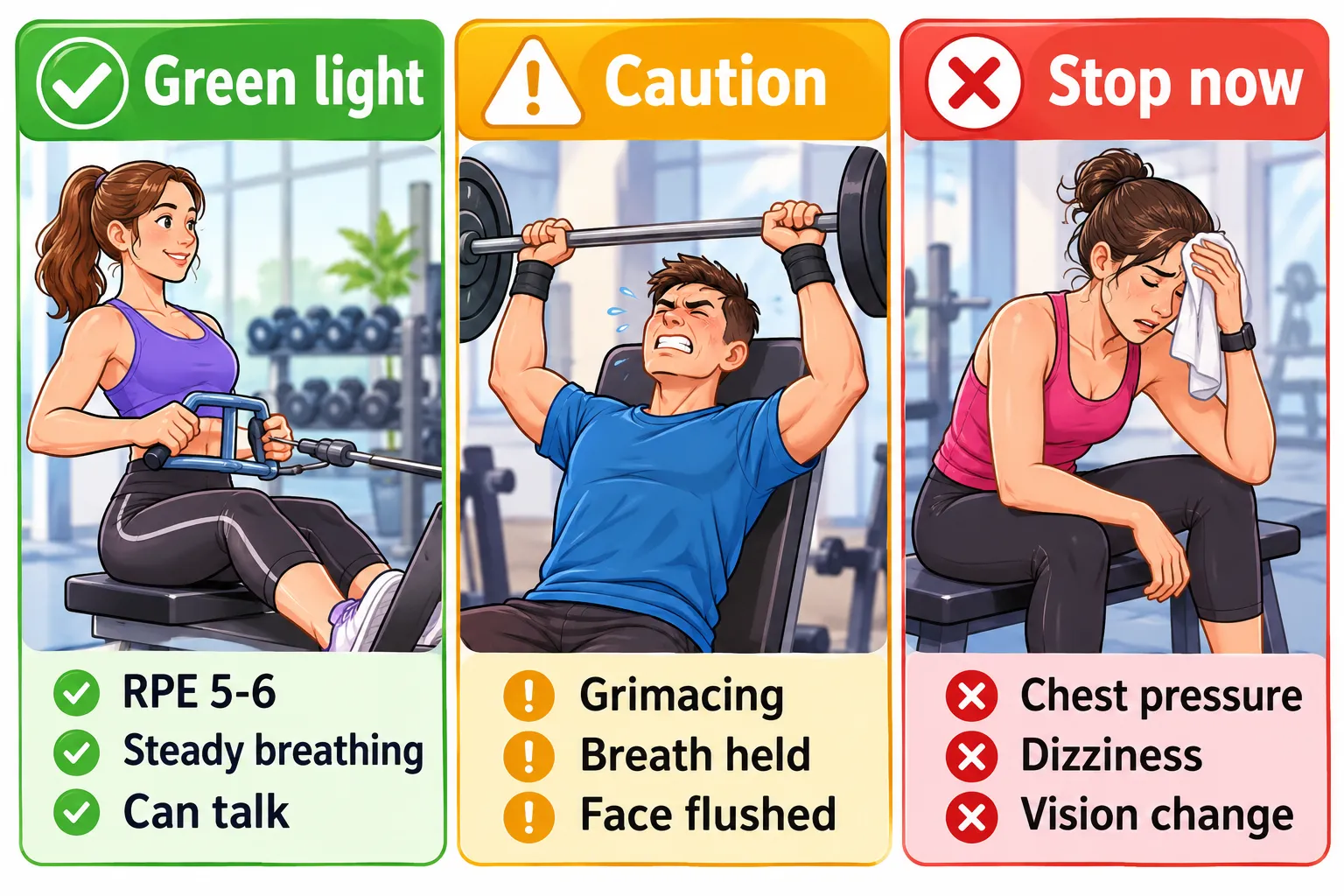
Use this decision rule:
- Choose 40-50% 1RM / RPE 4-5 if you're new to lifting, over 60, or recently diagnosed.
- Choose 60-70% 1RM / RPE 6-7 once you've trained 8+ weeks with stable readings.
- Never test a true one-rep max or train to muscular failure.
Unsafe looks like: grimacing, breath-holding, flushed face, trembling on the last rep, a spotter yanking the bar. Safe looks like steady breathing, controlled tempo, and finishing a set thinking you had 2-3 more reps available.
What exercises should I avoid when I have high blood pressure?
Avoid movements that combine heavy load, breath-holding, overhead or inverted positions, and sustained isometric effort. These create the biggest pressure spikes [3][4].
Generally limit or skip:
- Maximal or near-maximal barbell lifts (1RM testing, heavy singles)
- Heavy standing overhead presses with a loaded barbell
- Long planks, wall sits, and heavy static holds beyond ~30 seconds
- Inverted positions: headstands, decline benches, legs-overhead core work
- Heavy grip work like farmer's carries at near-max load
- Anything performed to failure
Safer swaps: seated chest press instead of heavy bench, cable or machine rows, goblet squats, leg press at moderate load, dumbbell shoulder raises instead of heavy barbell presses, step-ups, and band work.
What's the best way to progress strength training safely after 40 with high BP?
Change one variable at a time and hold it for at least two weeks. The sequence that works for strength training after 40 with high blood pressure is: technique → repetitions → load → sets.
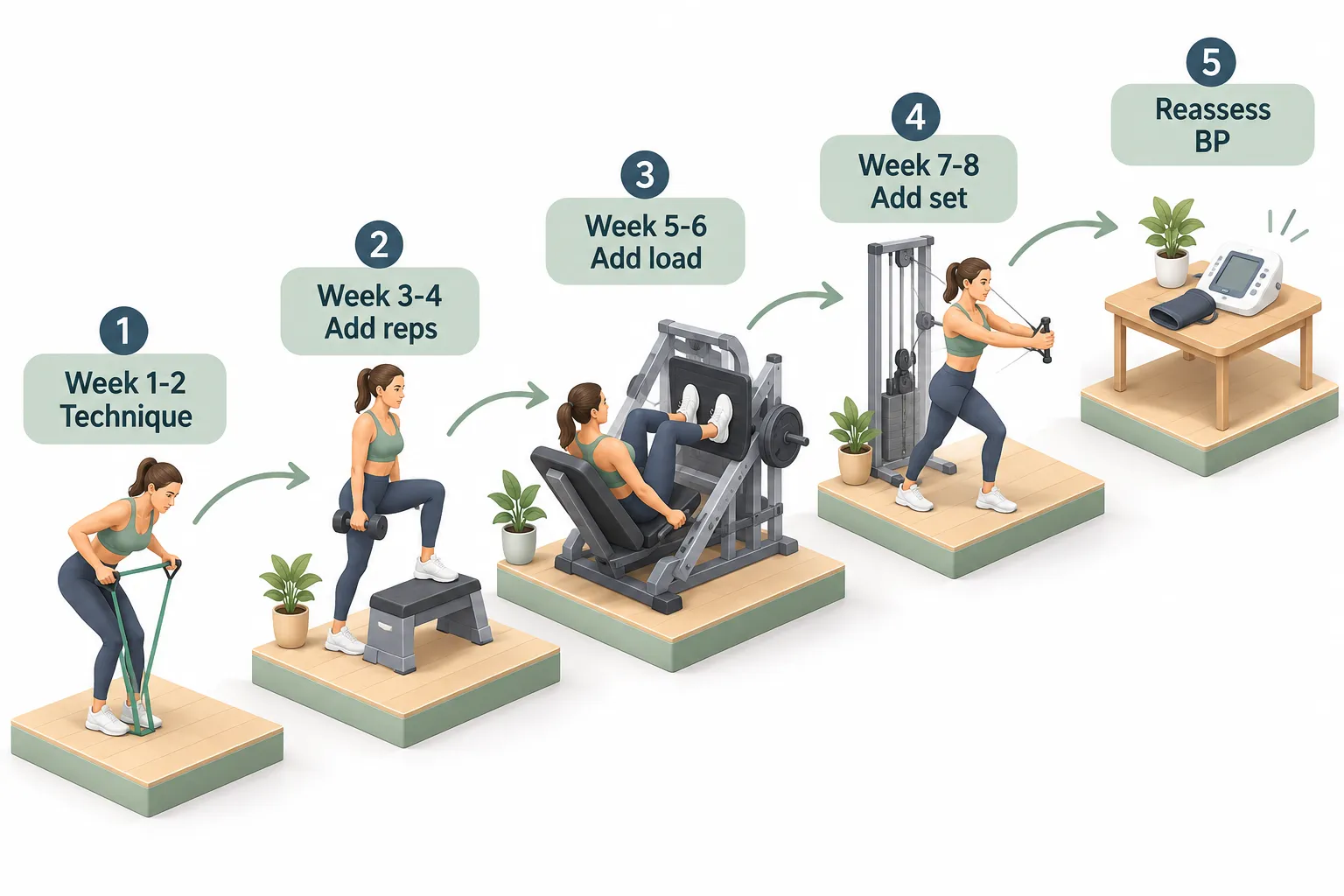
An eight-week template:
- Weeks 1-2: 1 set of 10-12 reps, 8 exercises, very light load. Focus on breathing pattern.
- Weeks 3-4: Same load, increase to 12-15 reps.
- Weeks 5-6: Add 5-10% load, drop back to 10-12 reps.
- Weeks 7-8: Add a second set to 3-4 key exercises.
- Week 9: Review BP log with your clinician, then repeat the cycle.
Always include a 5-10 minute warm-up (walking, light cycling, then a very light set of each lift) and a 5-minute cool-down. Stopping abruptly after a hard set can cause a pressure drop and dizziness, so walk it off.
Do I need clearance from my doctor before lifting weights with high blood pressure?
Get clearance if you have uncontrolled hypertension, known cardiovascular or kidney disease, diabetes, symptoms during exertion, or you're starting vigorous training after years of inactivity. Current guidelines stress individualized screening for older adults with very high resting pressure or comorbidities [1][4].
Light-to-moderate resistance training in a well-controlled, symptom-free adult generally doesn't require formal clearance. Bring three things to the appointment: a two-week home BP log, your medication list (beta blockers blunt heart rate, so use RPE instead), and the actual program you intend to follow.
What are the warning signs I'm exercising too intensely?
Stop immediately for chest pressure or pain, severe shortness of breath, dizziness, blurred vision, a pounding headache, irregular heartbeat, or nausea. These warrant medical attention, not a shorter rest period.
Softer signs that your intensity is too high:
- You can't speak a short sentence between reps
- Face feels hot and pounding during sets
- Readings trend upward over several weeks instead of down
- Sleep worsens, resting heart rate climbs, recovery drags
Edge case: dizziness right after standing from a leg press is often post-exercise hypotension plus medication, not danger. Sit, hydrate, and stand slowly next time.
How many sessions per week, and is cardio better than weights?
Aim for 2-3 resistance sessions per week on non-consecutive days, plus most days of moderate aerobic activity [2][3]. Some integrated prescriptions for older adults go up to three strength sessions weekly for functional benefit [4].
On the comparison: aerobic exercise has the larger single-modality evidence base for lowering blood pressure, but resistance training produces real reductions too, and combined programs deliver cardiovascular, metabolic, and functional gains that neither achieves alone [2][6][9].
| Factor | Aerobic | Resistance | Combined |
|---|---|---|---|
| Resting BP reduction | Strong | Moderate | Strong |
| Muscle and bone | Minimal | Strong | Strong |
| Fall and frailty risk | Modest | Strong | Strong |
| Time per week | 150 min | 2-3 sessions | ~200 min |
Choose combined unless time-limited. If you truly only have three hours a month, prioritize brisk walking and add two short circuit sessions.
Can you build muscle with lighter weights if you have high blood pressure?
Yes. Lighter loads taken to a moderately challenging point build muscle comparably to heavy loads, provided total work is similar. For hypertensive adults over 40, lighter weights with 12-20 reps are often the smarter default because they reduce the urge to strain and hold the breath [4].
Make lighter loads work by: slowing the lowering phase to 3 seconds, shortening rest to 60-90 seconds (circuit style), adding a set rather than more weight, and keeping 2-3 reps in reserve. Circuit-based resistance training in particular has shown good safety and BP outcomes in older community-dwelling adults [7][8].
FAQ
Is it safe to lift weights with high blood pressure?
Yes, for most people with controlled or moderately elevated readings, using submaximal loads and no breath-holding. Avoid training if resting pressure is 180/110 mmHg or above [2].
What breathing technique should I use?
Exhale on the exertion, inhale on the return, and never hold your breath. The Valsalva maneuver sharply raises arterial pressure [3][4].
How much can strength training lower blood pressure?
Meta-analyses report meaningful reductions in resting systolic and diastolic pressure, with the clearest effects after at least 8 weeks of training twice weekly or more [5][6].
Should I measure blood pressure before every workout?
For the first 4-8 weeks, yes. After that, check before heavier sessions and keep a weekly home log.
Do beta blockers change how I should train?
Yes. They blunt heart rate response, so use rate of perceived exertion (target 5-7 of 10) rather than heart rate zones.
Can I do deadlifts or squats?
Yes, at moderate loads with open-throat breathing. Skip maximal attempts and heavy single-rep work.
How long until I see changes?
Single sessions can lower pressure for hours afterward. Lasting resting reductions typically appear after 8-12 weeks of consistent training.
Is machine-based training safer than free weights?
For beginners with hypertension, yes. Machines reduce balance demands and make it easier to keep breathing controlled.
Can I train if my pressure is 150/95 today?
Usually yes if you're symptom-free and medicated, but keep intensity light that day and discuss the trend with your clinician.
Are isometrics bad?
Brief wall squats and handgrip protocols are actually studied for BP lowering, but long heavy static holds with breath-holding are not advisable. Follow a protocol, not improvisation [9].
Conclusion
Strength training after 40 with high blood pressure comes down to control, not avoidance. Keep loads submaximal, breathe out on effort, train two or three days a week, and progress one variable at a time.
Next steps this week:
- Take resting blood pressure, seated, three mornings in a row and write it down.
- Book a clinician conversation if any reading exceeds 160/100, or if you have cardiac, kidney, or diabetic history.
- Pick eight machine or dumbbell exercises covering legs, push, pull, and core.
- Run two sessions of one set each, 12 reps, light load, exhaling on every effort.
- Recheck 30 minutes post-session and after four weeks, then add reps before adding weight.
References
- Ehae178. hypertension.cz.
- Hyp.0000000000000249. ahajournals.org.
- Exercising Your Way to Lowering Your Blood Pressure Handout. acsm.org.
- Resistance Training For Older Adults Position.1. nsca.com.
- S41598 023 33873 X. link.springer.com.
- Pmc13068723. pmc.ncbi.nlm.nih.gov.
- Pmc13477928. pmc.ncbi.nlm.nih.gov.
- pubmed.ncbi.nlm.nih.gov.
- Hypertensionaha.124.24173. ahajournals.org.
