Last updated: November 12, 2026
Quick Answer
Strength training after 40 with a bad back is not only possible, it's one of the better things you can do for spinal health, as long as you swap heavy barbell squats and deadlifts for spine-sparing alternatives. Clinical guidance for people with spinal problems specifically advises avoiding squats, deadlifts, cleans, and snatches, and using weight machines that place less direct stress on the spine instead [1]. Machine leg presses, goblet squats, trap-bar or block deadlifts, hip thrusts, step-ups, cable rows, and bird-dogs give you nearly all the strength benefit with far less lumbar loading [2][3]. Train 2-3 days per week, progress load slowly, and treat sharp or radiating pain as a stop signal.
Key Takeaways
- You can build real muscle after 40 with back pain. A 2026 randomized trial of a 12-week whole-body strength program raised trunk extension strength from about 60.0 Nm to 74.4 Nm in people with chronic low back pain [4].
- Barbell back squats and conventional deadlifts are the two lifts most often linked to flare-ups in adults with existing spinal issues [1][3][5].
- Best squat swaps: machine leg press, goblet squat, box squat, Bulgarian split squat, low step-up, leg curl [2].
- Best deadlift swaps: trap-bar deadlift, block/rack pulls at knee height, one-arm dumbbell deadlift, barbell hip thrust, glute bridge, cable pull-through [3].
- Dosage: 2-3 sessions per week, 2-3 sets per major muscle group, working toward roughly 70-80% of 1RM on safe variations [6].
- Strength work reliably improves function and reduces fear of movement; pain relief is less predictable [7].
- Modify five variables before dropping an exercise: load, range of motion, stance, tempo, and body position.
- See a physical therapist first if you have radiating leg pain, numbness, weakness, or a prior disc or fracture diagnosis.
- Expect noticeable strength gains in 6-12 weeks, with the first 2-3 weeks largely about technique and tolerance.
What Strength Training Exercises Are Safe With a Bad Back?
The safest lifts keep your torso upright or supported, keep the load close to your center of mass, and avoid loaded spinal flexion. That means machines, front-loaded movements, and single-leg work rather than heavy bars across your shoulders.
A practical weekly core of exercises:
- Lower body: machine leg press, goblet squat (light), box squat to a bench, Bulgarian split squat, low step-up, reverse lunge, leg curl, leg extension [2][13-style coaching guidance aside, see 1 and 7].
- Hips and posterior chain: barbell or dumbbell hip thrust, floor glute bridge, cable pull-through, one-arm dumbbell deadlift [3].
- Upper body: seated cable row and lat pulldown instead of heavy bent-over barbell rows; chest-supported dumbbell row; incline press; seated shoulder press with back support.
- Trunk: bird-dog, drawing-in maneuver, side-lying leg raise, clamshell, modified superman, partial crunch [8][9].
Decision rule: if an exercise requires you to hold a heavy load with an unsupported, bent-over torso, pick a supported version instead. A chest-supported row trains the same muscles as a bent-over row with a fraction of the lumbar demand.
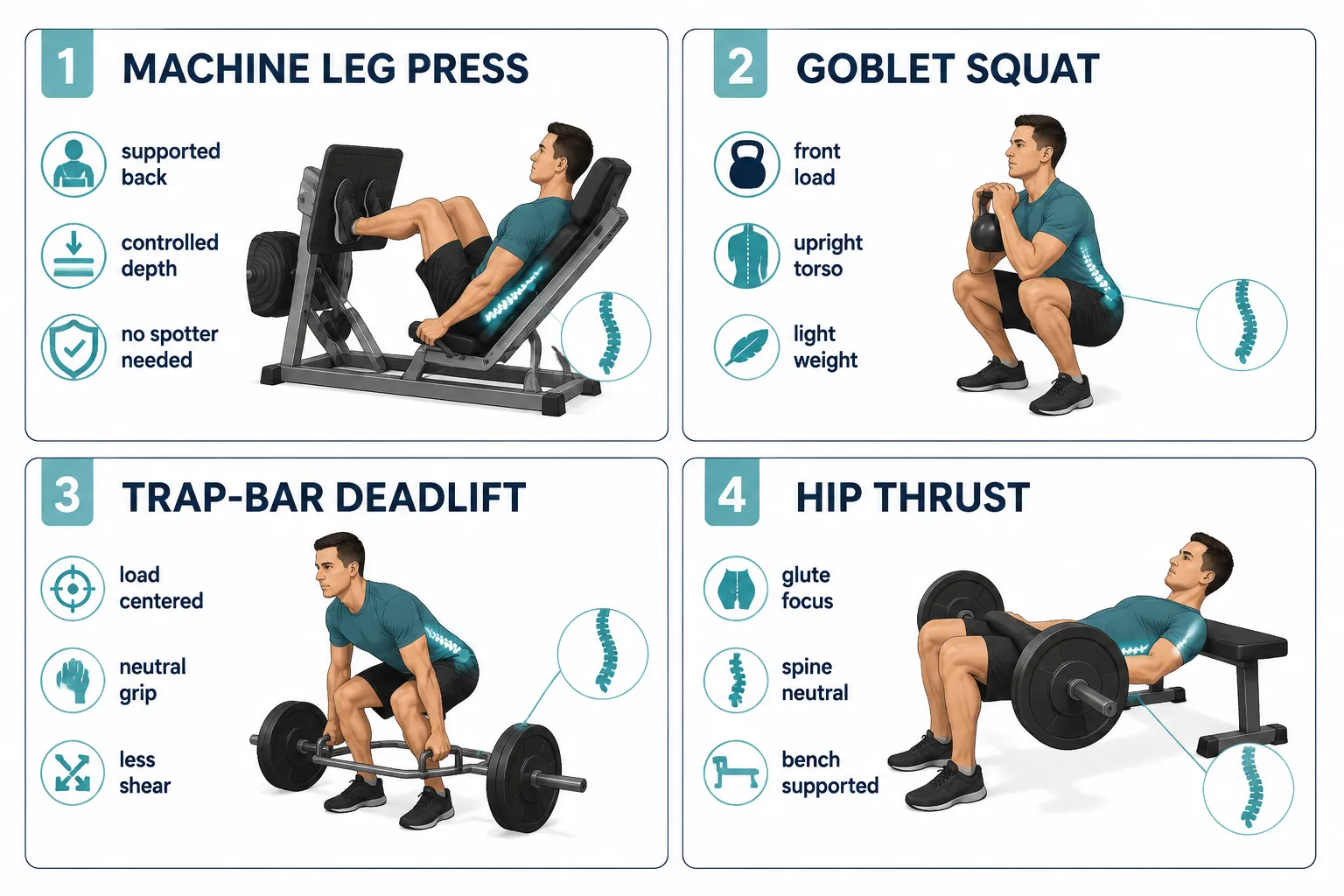
Common mistake: assuming "machines are for beginners." For a 48-year-old with a disc history, machines are the tool that lets you train near 70-80% of 1RM safely, which is exactly the intensity range the NSCA position statement recommends for older adults [6].
Can I Build Muscle After 40 With Back Pain?
Yes. Back pain limits exercise selection, not your ability to gain muscle and strength. Muscle responds to tension and progressive overload, and a leg press at a challenging load drives adaptation just as a barbell squat would.
A 2026 randomized controlled trial added 45 minutes of strength training plus 45 minutes of group training per week for 12 weeks in adults with chronic low back pain. Trunk extension strength rose from roughly 60.0 ± 23.7 to 74.4 ± 28.9 Nm and trunk flexion from 40.3 ± 16.9 to 48.5 ± 19.2 Nm [4]. That's a meaningful jump in exactly the muscles people with bad backs are told are "too weak."
Set expectations honestly, though. Evidence reviews published in October 2026 found strength training for chronic nonspecific low back pain consistently improves physical function, lumbar extensor endurance, and core strength, and reduces fear of movement, but effects on pain intensity and disability are inconsistent and often modest [7]. Train for function and capability first; pain relief often follows, but it isn't guaranteed.
Leg Press vs Squat for Lower Back Pain: Which Is Better?
For most people with lumbar pain, the leg press is the better starting choice because the backrest supports your torso, there's no axial load on your spine, and you can stop a set safely without a spotter [1]. The barbell squat is the better long-term goal only if your symptoms allow it.
| Factor | Machine leg press | Barbell back squat |
|---|---|---|
| Spinal compression | Low, torso supported | High, bar loads the spine |
| Balance demand | Minimal | High |
| Safety without spotter | Good [1] | Poor at heavy loads |
| Easy to load heavy | Yes | Yes, but riskier with back issues |
| Carryover to daily life | Moderate | High |
| Risk of hidden pelvic tuck | Real, if you press too deep | Real, at bottom range |
Edge case: the leg press can hurt backs too. Going too deep lets the pelvis tuck under and round the lumbar spine against the pad. Stop the sled before your hips lift, and set the seat so knees travel to roughly 90 degrees, not to your chest.
Choose the leg press if you're inside 8 weeks of a flare-up or still mapping your tolerance. Add goblet or box squats if the leg press has been symptom-free for a month and you want more real-world carryover.
Best Alternatives to Deadlifts for Back Safety
Replace conventional barbell deadlifts with variations that either shorten the range of motion or keep the load inside your base of support. The goal is to train hip extension hard without the shear forces of pulling a bar from the floor with a long lever arm.
Ranked from most conservative to most advanced:
- Floor glute bridge, bodyweight, no spinal load, good first week.
- Barbell or dumbbell hip thrust, heavy glute training with a near-neutral spine [3].
- Cable pull-through, teaches the hip hinge with the load pulling backward, not down.
- One-arm dumbbell deadlift, lighter total load, easier to keep the chest up [3].
- Rack pulls / block pulls at knee height, shortened range cuts the hardest part out [3].
- Trap-bar deadlift, handles sit beside you, load is centered, torso stays more upright [3].
- Glute-ham raise, strong lumbar extensor work once you tolerate volume.
Common mistake: jumping straight to the trap bar at a weight you used to deadlift ten years ago. Start at roughly half of what feels easy and add load over several weeks.
How to Tell if Exercise Is Making Your Back Pain Worse
Training discomfort and injury signals feel different. Muscular soreness is dull, spread across a region, shows up 12-48 hours later, and improves with movement. Warning signs are sharp, localized, or travel down a leg.
Keep going (likely fine):
- Dull muscle ache in glutes, quads, or lumbar erectors
- Stiffness the next morning that loosens with walking
- Pain that stays at or below the level it was before the session
Modify or stop immediately:
- Sharp, stabbing pain during a specific rep
- Pain radiating below the knee, pins and needles, or numbness
- New leg weakness, foot drop, or a foot that catches when you walk
- Pain that spikes that night and is still elevated 72 hours later
- Any bladder or bowel changes, this is an emergency, see a doctor the same day
Professional guidance updated in late 2026 emphasizes monitoring pain during and after sessions, and modifying or stopping any movement that provokes sharp or radiating pain [2][11-style guidance, see 1].
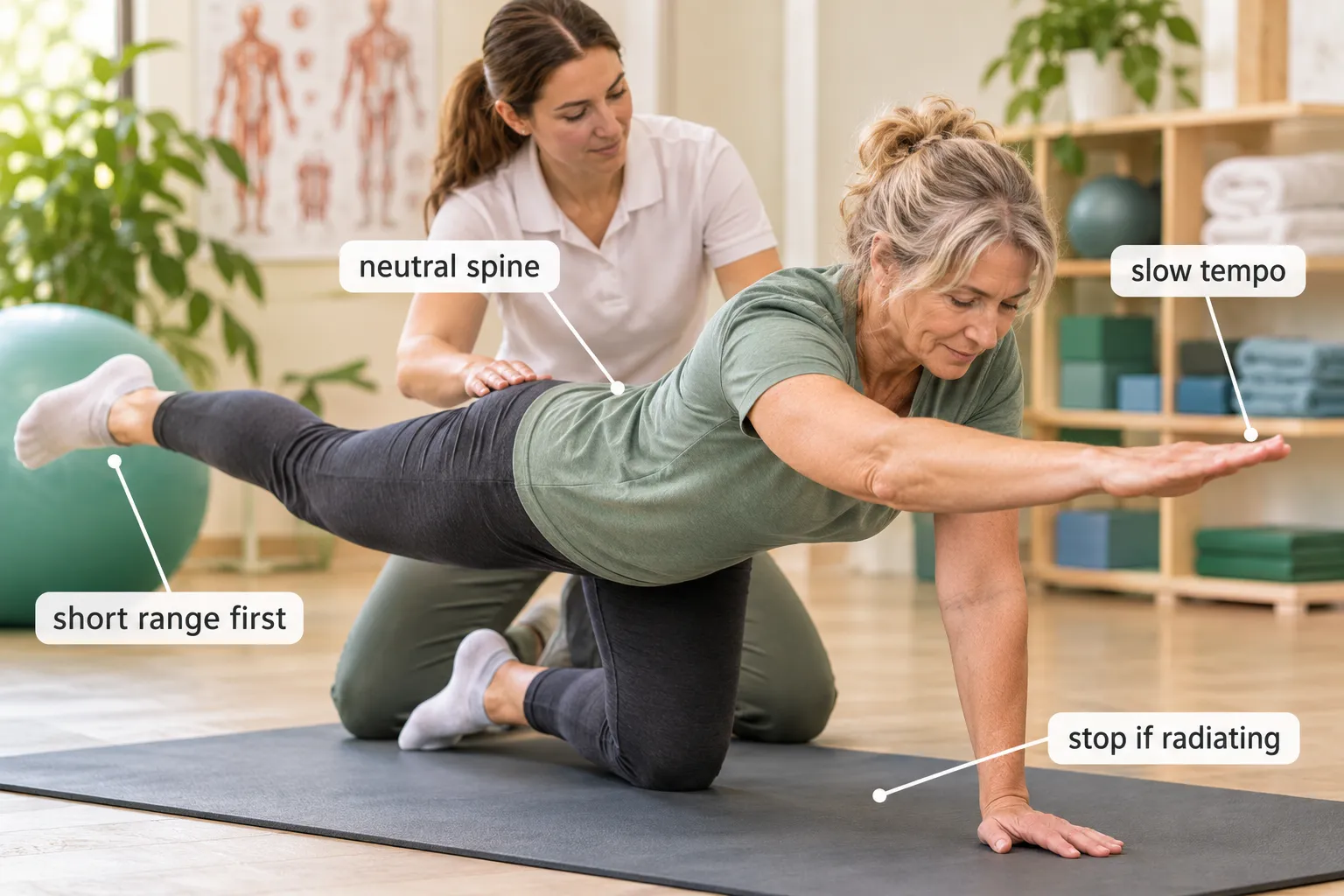
The five dials to turn before quitting an exercise: reduce load, shorten range of motion, widen or narrow stance, slow the tempo to a 3-second lowering, and change body position (supported instead of free-standing). Most "bad" exercises become tolerable after two of those adjustments.
Do I Need to See a Physical Therapist Before Lifting Weights With a Bad Back?
Not always, but strongly recommended if you have a diagnosis, radiating symptoms, or a flare-up in the last three months. A single assessment session usually tells you which directions of movement provoke your symptoms, which is the fastest shortcut to a safe program.
See a physical therapist or physician first if you have:
- Pain running below the knee, numbness, or weakness
- A known disc herniation, stenosis, spondylolisthesis, or vertebral fracture
- Osteoporosis or low bone density
- Back pain that wakes you at night or came with unexplained weight loss
- Any back pain following a fall or accident
You can likely start on your own if your pain is mild, mechanical, has been stable for months, and you have no leg symptoms, but still begin with bodyweight or very light loads and build up [2].
Can Swimming, Water Aerobics, Resistance Bands, or Light Weights Build Real Strength?
Water work and bands build real strength early on, but they plateau sooner than weights for muscle and bone. Use them as a bridge, not a permanent destination.
Swimming and water aerobics reduce spinal compression and are excellent for pain-free conditioning, trunk endurance, and confidence. They don't load bone meaningfully, so they won't deliver the bone-density benefits that resistance training at 50-85% of 1RM provides [10].
Resistance bands genuinely build strength for untrained or deconditioned lifters and are superb for hip abduction, rows, and pull-aparts. Their limit is that tension is lowest where muscles are strongest, and heavy bands become awkward to progress precisely.
Lighter weights with more reps versus avoiding exercises entirely: both tools, used differently. Lightening the load is the right answer for an exercise that's only mildly provocative. Full avoidance is the right answer for a movement that reliably reproduces nerve symptoms, no rep scheme fixes that. Sets of 10-20 reps taken close to failure build muscle well, so higher reps cost you little.
How Often Should Someone Over 40 With Back Issues Train, and How Fast Will Gains Come?
Train strength 2-3 days per week on non-consecutive days, with 2-3 sets of 1-2 multi-joint exercises per major muscle group, working toward roughly 70-85% of 1RM on the safe variations you've chosen [6]. Add light power work at 40-60% 1RM only once symptoms are stable [6].
A reasonable timeline:
| Weeks | Focus | What you'll notice |
|---|---|---|
| 1-2 | Bodyweight and very light loads, technique, tolerance testing [2] | Less stiffness, better confidence |
| 3-6 | Add load weekly, 2-3 sets | Early strength jumps (mostly neural) |
| 6-12 | Push toward 70-80% 1RM on safe lifts | Clear strength gains, visible muscle, better function [4] |
| 12+ | Structured progression, maybe reintroduce light hinging | Trunk strength measurably higher [4] |
Progression rule: add about 5% load only when you complete all prescribed reps with clean form and your back feels no worse 24 hours later. Otherwise repeat the same weight.
Common Mistakes People Make When Lifting With Back Injuries
The biggest mistake is testing a near-maximal load on a "good day" and undoing six weeks of progress. Flare-ups usually come from sudden spikes in load or volume, not from training itself.
Other frequent errors:
- Skipping the trunk work. Bird-dogs, drawing-in maneuvers, clamshells, and partial crunches aren't filler; they're the stability base for everything else [8][9].
- Holding your breath wrong, or bracing not at all. Take a breath and brace before the rep, not halfway through it.
- Jerky, bouncy reps. Low-impact, controlled movement is the consistent recommendation for lumbar symptoms [8][9].
- Training only legs and core. Pulling strength matters; use cable rows and pulldowns rather than heavy bent-over rows.
- Stretching aggressively into pain instead of building strength.
- Quitting entirely during a flare. Reduce to pain-free bodyweight work rather than stopping, then rebuild.
Modify the movement before you abandon the goal. Most people with bad backs don't need less training, they need different training.
Conclusion and Next Steps
Strength training after 40 with a bad back works when you accept one trade: give up the barbell back squat and conventional deadlift, and you gain the ability to train hard for decades. The research is clear that progressive resistance training measurably strengthens trunk muscles in people with chronic low back pain [4] and improves function and confidence in movement [7], even when pain relief is partial.
Start this week:
- Book a physical therapy assessment if you have any leg symptoms, a known diagnosis, or a recent flare.
- Pick six exercises: leg press, goblet or box squat, hip thrust, cable row, lat pulldown, bird-dog.
- Run 2 sessions in week one at a load that feels like a 5 out of 10, 2 sets of 10.
- Log your back symptoms the morning after each session.
- Add weight only when the prior week was clean. Reassess after six weeks.
FAQ
Is it safe to squat at all with a bad back?
Light front-loaded squats (goblet, box) are often fine. Heavy barbell back squats are specifically discouraged for people with spinal problems [1].
Are trap-bar deadlifts safer than conventional deadlifts?
Generally yes. The load sits beside your body rather than in front, which keeps the torso more upright and reduces shear on the lower back [3].
What core exercises strengthen the back without hurting it?
Bird-dogs, drawing-in maneuvers, floor bridges, side-lying leg raises, clamshells, modified supermans, and partial crunches [8][9].
Should I wear a lifting belt?
A belt can help on moderate loads, but it isn't a substitute for choosing spine-friendly exercises. If you need a belt to tolerate a lift, the lift is probably wrong for you right now.
Can I still get bone-density benefits without squats and deadlifts?
Yes. Resistance training 2-3 days per week at 50-85% of 1RM across major muscle groups supports bone health, and can be done with machines and front-loaded lifts [10].
How long should I rest between sets?
Two to three minutes on heavier lower-body and pulling work. Rushing rest degrades form, which is when backs get tweaked.
Is walking enough on non-lifting days?
Walking is excellent for recovery and symptom control, but it won't build strength. Keep it as the complement to lifting, not the replacement.
What if pain only shows up the next day?
Mild next-day stiffness is normal. If it's sharp, radiating, or still worse at 72 hours, cut the load by 30% and shorten the range on the suspect exercise.
References
- Squat Alternatives. nasm.org.
- Back Pain Exercise. huffpost.com.
- pubmed.ncbi.nlm.nih.gov.
- Back Exercise Safety. ucihealth.org.
- Resistance Training For Older Adults Position.1. nsca.com.
- Could Strength Training Help with Chronic Low Back Pain. savonia.fi.
- Exercises for Lower Back Pain 11684808. verywellhealth.com.
- Lower Back Exercises. healthline.com.
- Exercise. racgp.org.au.
