Last updated: November 16, 2026
Quick Answer
Strength training after 40 for joint health works best when you change the dose and range, not when you quit lifting. Most knees, shoulders, and hips tolerate resistance training well, and joint pain often improves with it: long-term strength training is linked to lower odds of frequent knee pain, and moderate-intensity loading (roughly 40-60% of one-rep max, 10-15 reps) is the standard starting point in knee osteoarthritis rehab[1]. Train each major muscle group at least twice weekly, use controlled tempo over maximal weight, and judge every exercise with a simple pain rule rather than guesswork[2][3].
Key Takeaways
- Lift, don't retire. Stronger muscles around a joint reduce the strain the joint absorbs[2][4].
- Moderate loads win. Knee osteoarthritis research supports loads near 43-47% of 1RM, with high-speed (fast-concentric) training showing the best results for pain and function.
- Frequency beats intensity. Two to three non-consecutive sessions per week per muscle group, not daily grinding[1][3].
- Range of motion is a dial, not a switch. Shorten depth before you drop the exercise.
- Tempo protects tendons. A 3-second lowering phase cuts peak joint stress at the same weight.
- Pain rule: 0-3/10 during the set, settled within 24 hours, no swelling. That's acceptable. Sharp, pinching, or next-morning worse is not.
- Low-load options exist. Blood-flow-restriction training can build strength with light weights when heavy loads aggravate knees.
- Combine, don't isolate. Strength plus balance and mobility work is more joint-friendly than strength alone[5][6].
Why does strength training get harder on joints after 40?
It gets harder because tendons stiffen, recovery slows, and muscle mass declines, not because joints "wear out" from lifting. The cushioning system around a joint depends on muscle doing its share of the work. When muscle mass drops, more force transfers to cartilage and tendons.
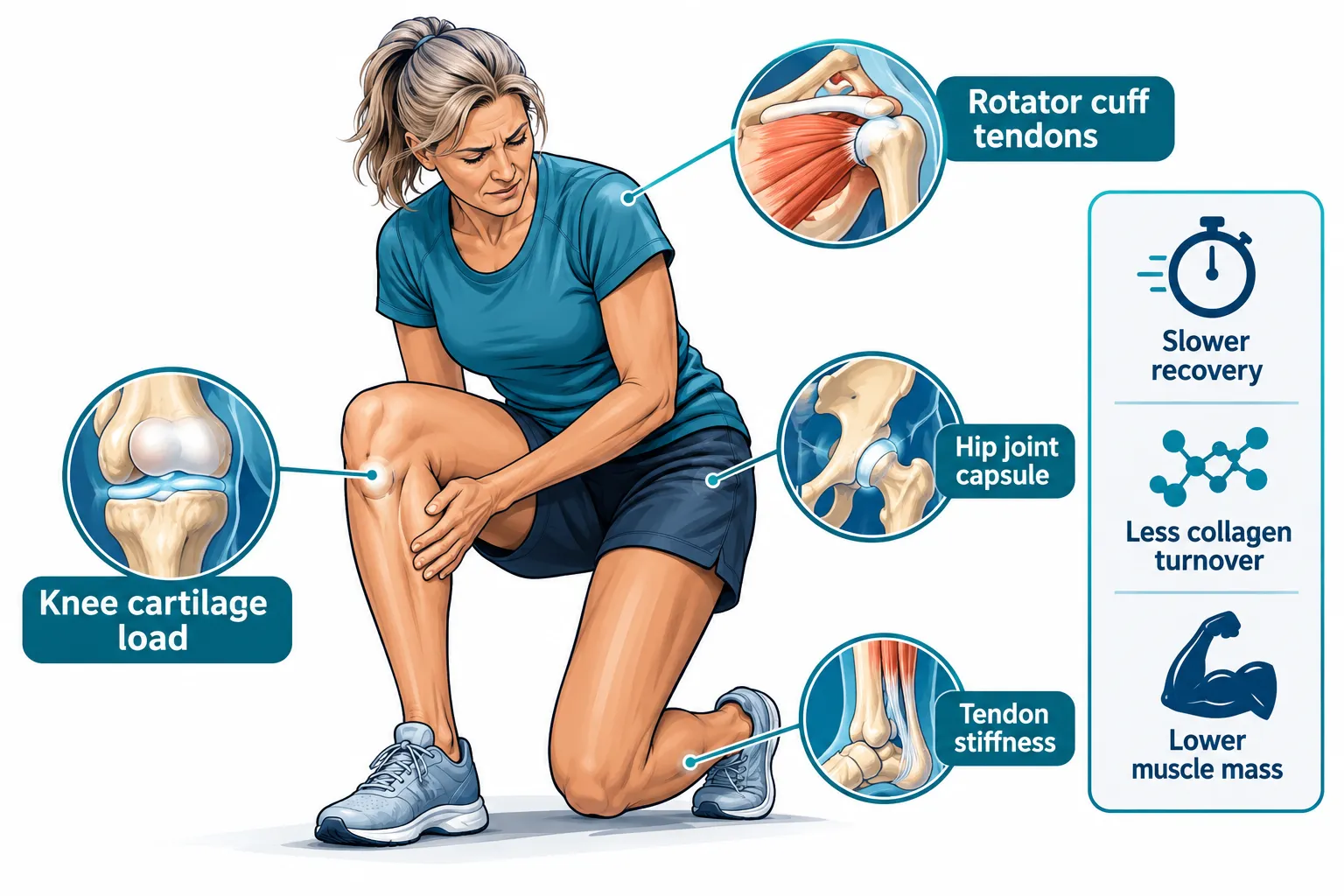
Three changes matter most after 40:
- Slower tissue recovery. Tendons and ligaments have poor blood supply, so they adapt slower than muscle. You can get strong faster than your connective tissue can keep up.
- Accumulated mileage. Old ankle sprains, a shoulder impingement from your thirties, a hip that clicks, these alter how you move under load.
- Less frequent loading. Many people in their 40s train in bursts, and abrupt jumps in load are a common source of tendon irritation[3][7].
)
The practical lesson from health-system guidance is consistent: emphasize controlled movement and progressive loading rather than maximal lifts, and work all major muscle groups at least twice weekly[2][3][4].
What exercises won't irritate my knees if I'm over 40?
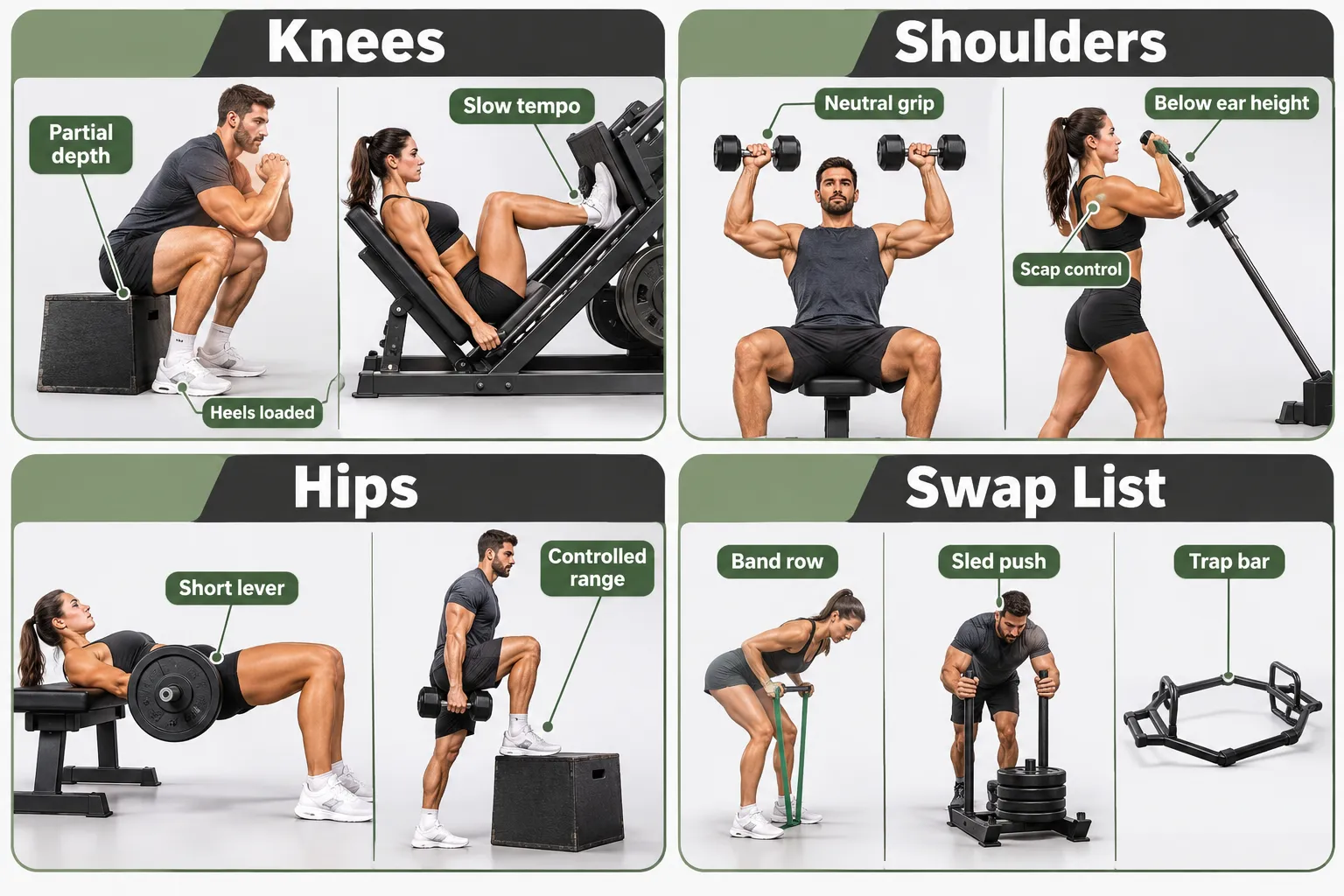
Knee-friendly lifts keep the shin relatively upright, limit deep flexion under heavy load, and let you control the descent. Most people over 40 tolerate these well:
- Box squats or goblet squats to a target (depth you control)
- Leg press with a moderate range (stop before the pelvis tucks)
- Step-ups and split squats with a shorter stride if the kneecap complains
- Romanian deadlifts and hip hinges (hip-dominant, low knee torque)
- Leg curls, calf raises, sled pushes
- Chair squats and wall sits for anyone starting from pain
Chair squats and quadriceps-focused work, combined with progressive walking (around 6,000+ steps daily), are specifically associated with better function and less chronic knee pain in mid-life.
Decision rule: If an exercise hurts at the bottom, cut the bottom third of the range for 3-4 weeks, then add it back an inch at a time.
Common mistake: blaming the squat. Usually it's the depth plus speed plus load combination, not the movement itself.
What's the best strength training program for 40-plus with bad shoulders?
For cranky shoulders, prioritize neutral-grip pressing, pull volume over push volume, and keep hands below ear height until symptoms calm. Lighter weights with higher repetitions and strict alignment are the standard clinical recommendation for shoulder irritation after 40[2].
A workable weekly shoulder-safe structure:
| Day | Focus | Joint-friendly picks |
|---|---|---|
| Day 1 | Push + legs | Neutral-grip dumbbell press, landmine press, goblet squat |
| Day 2 | Pull + hinge | Chest-supported row, lat pulldown (neutral grip), RDL |
| Day 3 | Full body | Cable press, half-kneeling row, step-up, carries |
Add 2-3 sets of external rotation and scapular work per week. Edge case: if overhead pressing is non-negotiable for you, earn it with a pain-free overhead reach test first, then start with an empty bar or 5 lb dumbbells.
How much weight should I lift at 40 to avoid joint pain?
Start lighter than you think and progress by small increments. Knee osteoarthritis rehab frameworks commonly begin near 10% of 1RM and progress to roughly 40-60% of 1RM as tolerated, using sets of 10-15 repetitions, 2-3 non-consecutive days per week[1]. Meta-analytic data point to around 43-47% of 1RM as an effective joint-friendly zone.
Practical translation if you don't test 1RM:
- Choose a weight you could lift 4-5 more times than you actually do (RIR 4-5) for the first two weeks.
- Progress to leaving 2-3 reps in reserve once form is clean.
- Add weight no more than once every 2-3 weeks on joint-sensitive lifts.
Very high-intensity resistance training can raise joint stress and worsen pain and adherence in people with knee osteoarthritis, a reason to stay in moderate territory when joints are symptomatic.
Can you build muscle after 40 without hurting your shoulders, knees, and hips?
Yes. Muscle growth responds to effort and volume, and sets taken near failure with moderate loads build muscle comparably to heavy loads. That's the whole basis for joint-friendly hypertrophy after 40.
)
Three levers that keep gains coming without joint cost:
- Tempo: 3 seconds down, 1 second up. Same weight, less peak force, more time under tension.
- Machines and cables for the irritable joint, free weights everywhere else.
- Blood-flow-restriction (BFR) training: a 2025 systematic review found low-load BFR can produce strength gains comparable to conventional high-load work with potentially less joint stress, useful for painful knees, best done with supervision.
Low-impact strength training vs regular lifting: what's actually different?
The difference is impact and peak joint force, not effort. Joint-friendly training removes jumping, bouncing, and end-range heavy loading while keeping the muscular challenge high.
| Joint-friendly training | Conventional lifting | |
|---|---|---|
| Load | ~40-60% 1RM, 10-15 reps[1] | 75-90% 1RM, 3-6 reps |
| Tempo | Controlled, often fast concentric / slow eccentric | Varied, often explosive both ways |
| Range | Pain-free range, sometimes partial | Full range by default |
| Impact | Low (no plyometrics) | Often includes jumps, drops |
| Progression | Reps and tempo first, load last | Load-first |
Note on speed: "low impact" doesn't mean slow. High-speed resistance training, moving moderate loads quickly on the lifting phase, is the most effective type for knee osteoarthritis pain, stiffness, and function.
Should you strength train if you already have joint pain?
Yes, in most cases, and this is where guidance has shifted hardest. Most joints tolerate regular exercise well, and activity typically eases osteoarthritis pain rather than worsening it when volume and intensity are appropriate[8]. Walking up to about 10,000 steps per day does not appear to accelerate knee osteoarthritis[8].
Pause and get assessed first if you have: joint swelling that won't settle, locking or giving way, pain that wakes you at night, or pain following a specific injury.
Expect modest, cumulative gains. Reviews of strengthening for knee osteoarthritis report real but limited average effect sizes, with better outcomes when the program has clear goals, is calibrated to individual tolerance, and is revisited over time[1][9].
Is physical therapy or strength training better for joint health at 40?
They're sequential, not competing. Physical therapy is better when you have a specific, symptomatic, or undiagnosed problem; strength training is what maintains the result for the next 40 years.
Choose PT first if: pain is above 4/10, you can't identify a pain-free version of a basic movement, or symptoms followed a distinct injury.
Go straight to strength training if: joints are only stiff or achy, symptoms settle with warm-up, and you have no swelling or instability.
Hospital and guideline resources increasingly frame the ideal as a multicomponent program, strength plus balance and mobility, rather than strength in isolation[5][6].
How often should you lift weights after 40 for muscle without injury?
Two to three strength sessions per week for each major muscle group, on non-consecutive days. National and WHO-aligned guidance sets muscle-strengthening for all major muscle groups on 2 or more days weekly, alongside 150-300 minutes of moderate aerobic activity[6][8]. For older adults and knee osteoarthritis specifically, analyses point to multicomponent strength and balance work at moderate or greater intensity on 3 or more days weekly[6].
Typical joint-safe prescription: 1-3 sets of 10-15 reps per exercise[1][5].
Avoid back-to-back heavy days for the same muscles, a specific recommendation for midlife exercisers[3][7]. Dose matters over months, not weeks: effective knee osteoarthritis programs in the research ran roughly 35-37 weeks at around 610-640 total repetitions per week[10].
What equipment protects hips and knees best?
Equipment that lets you load muscle without forcing a joint into its worst position. Ranked by joint-friendliness for most 40-plus lifters:
- Resistance bands, low peak force, easy to scale, ideal for rotator cuff and hip abductors.
- Cable machines, constant tension, adjustable angles, no balancing load.
- Trap bar, more upright torso than a straight-bar deadlift, less shear on hips and low back.
- Dumbbells with neutral grip, let shoulders rotate naturally.
- Leg press / chest-supported row, removes stabilization demand when a joint is flaring.
- Sled or incline treadmill push, leg strength with almost no eccentric knee load.
Body-weight and band training also support bone density and posture, which matters as much as muscle after 40[4].
Can you still do high-intensity training after 40 without damaging joints?
Yes, but intensity should be metabolic, not impact-based. Hard intervals on a bike, rower, sled, or ski erg raise your heart rate without repeated joint impact.
Rules for keeping intensity joint-safe:
- Cap high-intensity sessions at 1-2 per week, separated by 72 hours.
- Avoid technical barbell lifts for time or under fatigue.
- Drop plyometrics if joints are currently symptomatic; reintroduce with low-height step-downs.
Common mistake: using a HIIT class as a substitute for strength work. Classes rarely load muscles enough to build the mass that protects joints.
How do you know if an exercise is hurting your joints or just making muscles sore?
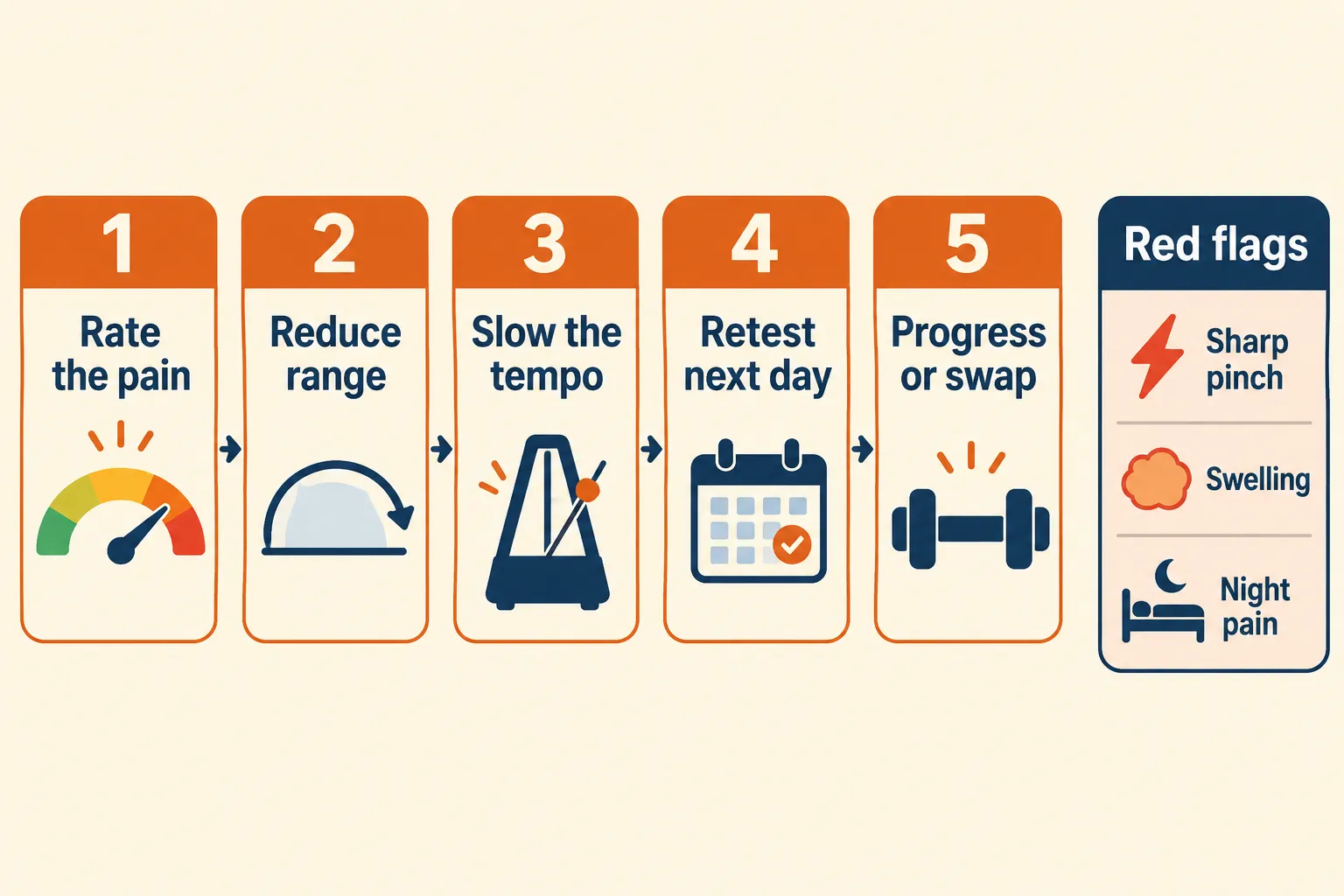
Use location, timing, and quality. Muscle soreness is diffuse, symmetrical, peaks 24-48 hours later, and improves with light movement. Joint irritation is pinpoint, often at the joint line or front of the shoulder, feels sharp or pinching during the set, and tends to be worse the next morning.
)
The 24-hour rule, a checklist you can use every session:
- Rate pain during the set (0-10). Stop above 4.
- Rate it two hours after. It should be the same or lower.
- Check the next morning. Worse means too much load, range, or volume.
- Reduce one variable, range first, then tempo, then load, and retest.
- Three failed retests means swap the exercise and get it assessed.
Soreness fades with movement. Joint irritation sharpens with it.
Common mistakes people make with strength training in their 40s
- Training like they're 25 after years off, loading too fast and skipping the base-building phase[3][7].
- Chasing one-rep maxes instead of controlled quality reps[2][3].
- Doing only "safe" machines and never progressing, so muscle never grows.
- Ignoring pull and posterior-chain volume, which leaves shoulders and hips unsupported.
- Skipping warm-ups, 5-8 minutes of general movement plus two ramp-up sets meaningfully reduces first-set irritation.
- Treating stretching as a substitute for strength. Mobility work complements loading; it doesn't replace it[5].
- Quitting during a flare instead of temporarily reducing range and load.
FAQ
Is it too late to start lifting at 45 or 50?
No. Strength training at any adult age improves joint stability, muscle mass, and independence when technique and progression are sound[2][4].
How long until joints feel better?
Expect 6-12 weeks for noticeable change, and remember that effective knee osteoarthritis programs in research ran 35+ weeks. Benefit accumulates.
Should I lift through knee pain?
Up to about 3/10 pain that settles within 24 hours and leaves no swelling is generally acceptable. Sharp, worsening, or morning-after-worse pain means reduce the load[1][8].
Are squats bad for knees after 40?
No. Depth, speed, and load determine knee stress, not the squat itself. Box squats and goblet squats are reasonable starting points.
How many sets per muscle group each week?
Start with 6-10 hard sets weekly per major muscle, spread over two sessions, then build slowly.
Do I need supplements for joint health?
No supplement replaces load management and muscle. Discuss any specific product with your clinician.
Is walking enough?
Walking supports knee function and chronic pain outcomes but doesn't build muscle. Pair it with 2-3 strength sessions weekly.
Can heavy lifting cause osteoarthritis?
Long-term strength training is associated with lower odds of frequent knee pain and radiographic progression, not higher.
Conclusion
Joint-friendly lifting after 40 is mostly a programming problem. Keep the effort, change the dose: moderate loads around 40-60% of 1RM, sets of 10-15, controlled tempo, pain-free range, and two to three sessions a week per muscle group[1].
Your next steps:
- Pick three joint-friendly compound lifts (goblet squat, chest-supported row, neutral-grip press) and run them twice weekly for four weeks at RIR 4-5.
- Log pain using the 24-hour rule after every session.
- Add one variable at a time, reps first, then range, then load.
- Add 5-10 minutes of balance and mobility work per session[5][6].
- If any joint fails three retests, book a physical therapy assessment before you push again.
References
- S40001 025 03083 4. link.springer.com.
- Art 20046670. mayoclinic.org.
- Gen X Athletes Injuries. franciscanhealth.org.
- What Are the Benefits of Strength Training After Age 40. ochsner.org.
- Ejercicio Fuerza Segun Edad Beneficios. riberasalud.com.
- Msc.70089. onlinelibrary.wiley.com.
- Tag:reuters.com,2026:newsml Mt1usdaynetn92371614007. rmb.reuters.com.
- Exercise After 40. thehealthdesk.us.
- Pmc13188083. pmc.ncbi.nlm.nih.gov.
- Pdf 218218 138312. wiadomoscilekarskie.pl.
