
Last updated: November 9, 2026
Quick Answer
Most adults over 40 should strength train two to three times per week, with three sessions being the default choice for building and holding onto muscle. The question of how often you should strength train after 40, choosing two, three, or four weekly sessions, comes down to training age, recovery capacity, and goals, not willpower. Two sessions is a legitimate floor for health and maintenance, three hits the sweet spot for most people, and four only makes sense for experienced lifters with good sleep and low life stress. Major guidelines for older adults consistently land on 2-3 sessions covering all major muscle groups [1][2].
Key Takeaways
- Three sessions per week is the default for adults 40+ who want to gain strength and muscle.
- Two sessions is enough to maintain muscle and get most health benefits if each session covers the whole body.
- Four sessions adds marginal benefit over three and raises recovery demands, so it's for advanced lifters only.
- Per-muscle frequency of 2-3 times weekly matters more than how many days you show up.
- Total weekly work (sets across the week) drives results more than adding extra days [1].
- 45-60 minutes per session is plenty; longer isn't better after 40.
- At least one rest day between sessions is wise for most people in their 40s and 50s.
- Joint pain or arthritis changes the exercises and loads, not the frequency.
- Beginners should start at two sessions for 6-8 weeks, then add a third.
- Pair strength work with moderate cardio and daily walking on off days.
What's the actual difference between training 2 vs 3 vs 4 times a week after 40?
The real difference is weekly volume and how much recovery each schedule demands. Two days means longer full-body sessions and slower progress. Three days spreads the same or more work across the week with better quality per set. Four days lets you split body parts, but it compresses recovery and crowds your calendar.
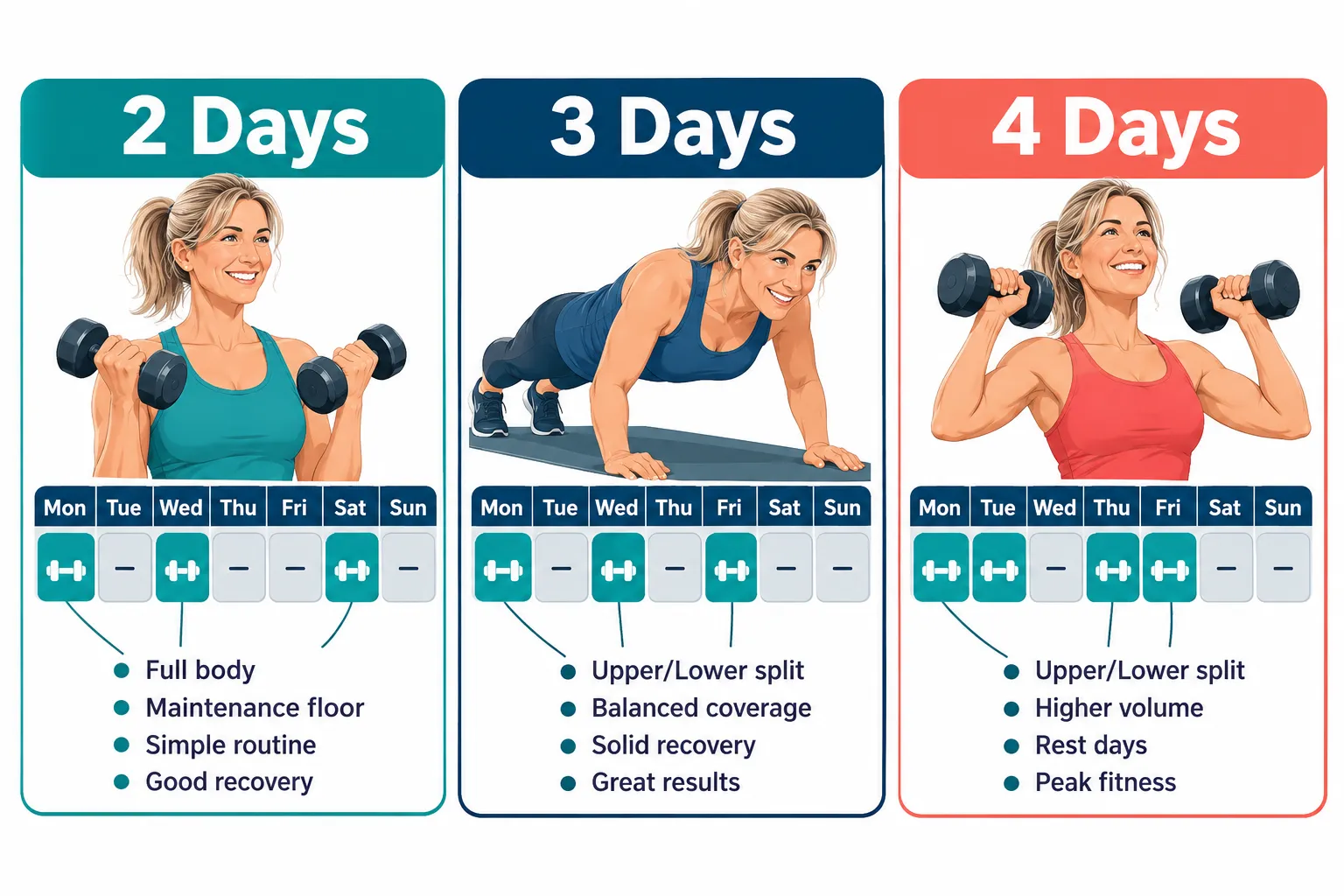
| Frequency | Best for | Typical structure | Session length | Recovery demand |
|---|---|---|---|---|
| 2x/week | Beginners, busy schedules, maintenance | Full body both days | 45-60 min | Low |
| 3x/week | Most adults 40+ wanting real gains | Full body, or upper/lower/full | 40-55 min | Moderate |
| 4x/week | Experienced lifters, specific goals | Upper/lower split, twice each | 35-50 min | High |
Decision rule: Choose two if you're new, sleeping poorly, or juggling heavy work stress. Choose three if you can recover well and want visible progress. Choose four only if you've trained consistently for a year-plus and your sleep averages 7+ hours.
A common edge case: people pick four days because it sounds serious, then skip two of them. Three consistent sessions beat four planned ones every time.
Can you build muscle with just 2 strength training sessions a week?
Yes. Two full-body sessions per week can build muscle in adults over 40, especially in the first year of training, as long as each muscle group gets trained both days with enough challenging sets. Research-informed guidance for older adults treats two sessions as the minimum effective dose, not a token effort [1][2].
The catch is that two days leaves less room for error. To make it work:
- Train every major muscle group each session (legs, hips, chest, back, shoulders, arms, core).
- Use compound lifts that cover several muscles at once.
- Take sets close enough to hard that the last 2-3 reps feel genuinely difficult.
- Progress load or reps steadily week to week.
Will two sessions maintain muscle, or do you need more? Two sessions reliably maintains muscle and strength in people 40 and over. For meaningful gains, especially after your first year, most people need the extra weekly volume that a third day provides. That's why guidance for women over 40 often recommends progressing from two sessions up to about three [3].
How long should each strength training workout be when you're over 40?
45 to 60 minutes of actual lifting is the sweet spot, plus 5-10 minutes of warm-up. Sessions beyond 75 minutes rarely add much after 40, because quality drops and recovery cost rises.
Practical structure for a 50-minute session:
- 6-8 minutes of easy cardio and joint mobility
- Two main compound lifts (a lower-body push or hinge, plus an upper-body push or pull)
- Two to three accessory exercises
- One core or balance movement
- 3-5 minutes of cooldown walking or easy stretching
If you only have 30 minutes, cut accessories, not the main lifts. Two hard compound movements done well beat a scattered hour.
Is 4 days a week too much and does it increase injury risk for older adults?
Four days isn't inherently too much, but it raises injury and overuse risk for adults over 40 when it's layered on top of poor sleep, high stress, or inadequate protein. The risk comes from cumulative fatigue, not the number on the calendar.
Four days is reasonable if all of these are true:
- You've trained consistently for 12+ months without major setbacks.
- You sleep 7-9 hours most nights.
- Soreness clears within 48 hours.
- You split the work (upper/lower) so no muscle group gets hammered four days straight.
- At least two of the four days are moderate rather than all-out.
Common mistake: adding a fourth day while keeping the same intensity on the other three. If you add a day, redistribute the volume, don't stack it.
Do you need a rest day between strength training sessions?
For most adults over 40, yes, leave at least one day between sessions that train the same muscles. Muscle protein synthesis and connective-tissue repair after resistance exercise typically need roughly 48 hours, and that window tends to lengthen with age [4].
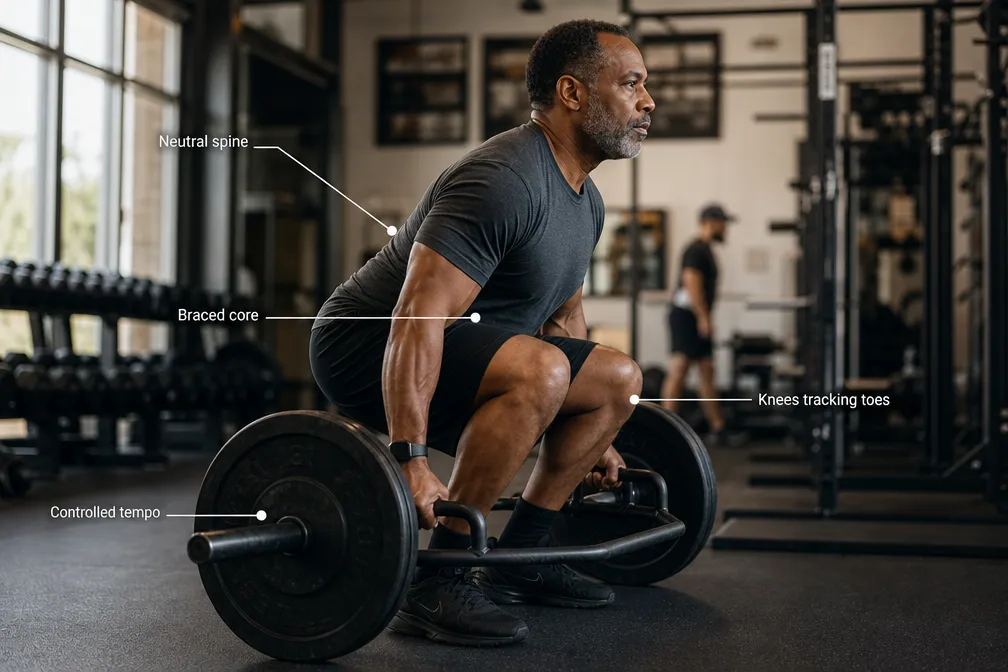
Back-to-back days are fine if you're using a split where Monday trains the lower body and Tuesday trains the upper body. Back-to-back full-body sessions are a bad idea after 40.
Rest days aren't lost days. They're when the training actually turns into muscle.
How much recovery time do you actually need in your 40s?
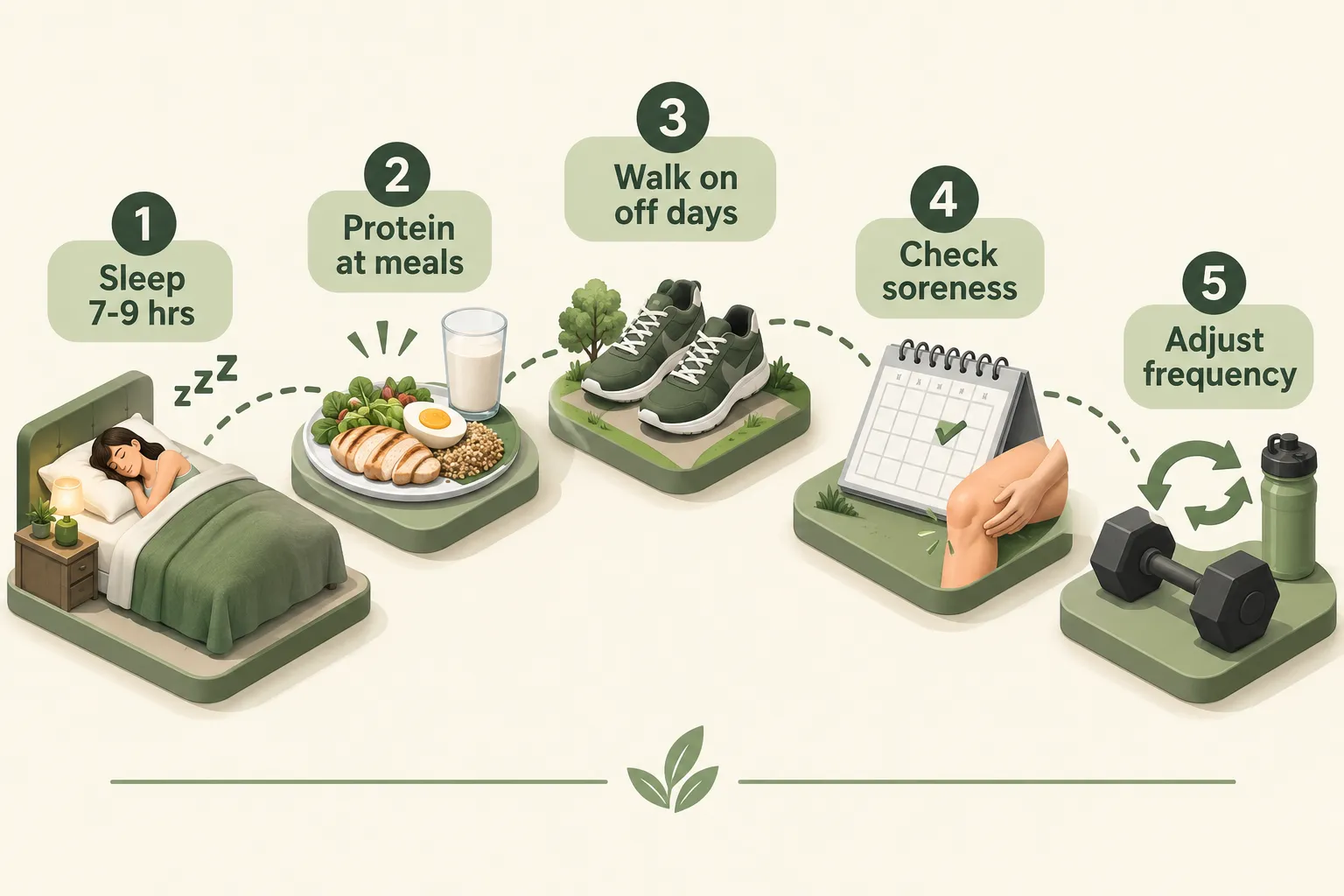
Plan on 48 hours between sessions hitting the same muscles, with occasional 72-hour gaps after very heavy work. Recovery capacity in your 40s is closer to your 30s than most people assume, but it's far more sensitive to sleep debt, alcohol, and under-eating protein [5].
Signs you need more recovery, not more training:
- Soreness lingering past 72 hours
- Strength dropping two sessions in a row
- Sleep getting worse, not better
- Nagging joint aches that warm up but never fully clear
- Losing motivation for workouts you normally enjoy
Edge case: shift workers and new caregivers should treat two sessions as their baseline until sleep stabilizes. Frequency should follow recovery, not the other way around.
Should you do full body workouts or splits after 40?
Full-body workouts win at two or three sessions per week; splits make sense at four. The reason is per-muscle frequency: training each muscle group 2-3 times weekly is the evidence-based target, and full-body sessions hit that automatically on a 2-3 day schedule [1][6].
- 2 days: full body, both days.
- 3 days: full body all three days, or two full-body plus one targeted day for weak points. A mixed-intensity approach, one heavier day, one moderate, one lighter, works better for adults over 40 than three maximal days.
- 4 days: upper/lower split, each half trained twice.
Avoid classic bodybuilding "one muscle per week" splits after 40. They leave each muscle group trained only once weekly, which is below the useful threshold.
What's the most common mistake people make with training frequency after 40?
The most common mistake is choosing frequency based on ambition instead of recovery, then abandoning the plan within a month. The second most common is assuming more days automatically means more muscle, when total weekly sets matter more than how they're spread out [1].
Other frequent errors:
- Jumping from zero to four days in week one
- Training hard on every single session with no moderate days
- Skipping lower body because it's uncomfortable
- Never progressing load, so three sessions become three identical workouts
- Counting a gym visit as a session when it was mostly machines at light weight
Can beginners in their 40s start with just 2 workouts a week?
Yes, and they should. Two full-body sessions per week for the first 6-8 weeks is the sensible on-ramp for anyone starting strength training in their 40s. It builds the habit, lets form settle, and keeps soreness manageable [7].
A simple progression plan:
- Weeks 1-2: two sessions, light loads, focus on movement patterns.
- Weeks 3-6: two sessions, add weight when you can complete all prescribed reps with good form.
- Weeks 7-8: keep two sessions, add one accessory exercise per session.
- Week 9+: add a third day if recovery is comfortable and sessions feel routine.
What if you're returning after years off? Treat yourself as a beginner for 4-6 weeks regardless of what you used to lift. Your nervous system remembers the movements faster than your tendons do. Start at two sessions, use roughly half the load you think you can handle, and expect noticeable soreness for the first two weeks. Strength tends to come back quickly after a layoff, which is exactly why people re-injure themselves by loading too fast.
How does strength training frequency change if you have joint pain or arthritis?
Joint pain usually changes what and how you train before it changes how often. Most people with osteoarthritis can keep two to three sessions per week by swapping painful exercises for joint-friendly alternatives, shortening the range of motion, and using slightly higher reps with moderate loads. Resistance training is generally recommended for arthritis rather than avoided [2][8].
Practical adjustments:
- Swap deep barbell squats for box squats, leg press, or split squats
- Replace overhead pressing with landmine or incline presses
- Use machines and cables where they reduce joint stress
- Extend warm-ups to 10-12 minutes
- Aim for discomfort that stays at or below 3/10 and settles within 24 hours
If pain spikes or swells after sessions, drop to two days and consult a physician or physiotherapist before changing load.
What should you do on non-strength training days, and how much cardio do you need?
On non-lifting days, stay active with walking, easy cycling, swimming, or mobility work, enough to move blood without adding fatigue. Pair your strength sessions with moderate cardio most weeks: general adult activity guidance points to roughly 150 minutes of moderate aerobic activity weekly, which fits comfortably alongside 2-3 lifting days [2].
A workable combined week:
- Strength: 3 sessions (Mon/Wed/Fri)
- Cardio: 2 moderate sessions of 25-35 minutes (Tue/Sat)
- Daily: 20-40 minutes of walking
- Sunday: full rest or gentle mobility
Do cardio after lifting or on separate days when strength is your priority. Hard intervals the day before a heavy leg session will cost you more than they give.
Sample weekly schedules
Two-day plan (beginner or maintenance)
Monday: full body A · Thursday: full body B · Other days: walking, one easy cardio session
Three-day plan (default for most adults 40+)
Monday: full body, heavier · Wednesday: full body, moderate · Friday: full body, lighter with more reps · Tuesday/Saturday: cardio · Sunday: rest
Four-day plan (advanced only)
Monday: lower · Tuesday: upper · Thursday: lower · Friday: upper · Wednesday/Saturday: easy cardio or mobility · Sunday: rest
FAQ
Is three times a week really better than two?
For gaining muscle and strength after 40, yes, three sessions allow more weekly volume at higher quality. For maintaining what you have, two is sufficient.
Can I strength train every day after 40?
Not with hard sessions. Daily training only works if most days are light and you rotate muscle groups, which most people over 40 won't recover from well.
How many sets per muscle group each week?
Most adults over 40 do well in the range of roughly 8-15 challenging sets per muscle group weekly, spread across 2-3 sessions.
Does lifting twice a week prevent muscle loss with age?
Two sessions per week covering all major muscle groups is widely recommended as the minimum for preserving muscle and bone as you age [1][2].
Should I train to failure after 40?
Rarely. Stopping 1-3 reps short of failure on most sets gives nearly the same results with far less recovery cost.
What if I can only train on weekends?
Two sessions on Saturday and Sunday is better than nothing, but leave 24 hours between them and consider a short midweek session if possible.
How long until I see results?
Strength usually improves within 3-4 weeks; visible muscle change typically takes 10-12 weeks of consistent training with adequate protein.
Do I need a deload week?
Most people training three or more days weekly benefit from a lighter week every 6-10 weeks, especially after 40.
Conclusion
Picking between two, three, or four weekly strength sessions after 40 is a recovery decision, not a motivation test. Three sessions is the default because it balances weekly volume with the 48-hour recovery window most midlife lifters need. Two is a real, defensible choice for beginners, maintenance phases, and high-stress seasons. Four is a narrow option for experienced lifters with solid sleep.
Next steps:
- Pick your frequency using the decision rule: beginner or stressed → two; recovering well and want gains → three; trained a year-plus with great sleep → four.
- Commit to that number for eight weeks before changing it.
- Make sure every muscle group gets trained 2-3 times weekly.
- Track loads and reps so each session actually progresses.
- Review soreness, sleep, and strength at week eight, then adjust up or down.
References
- Resistance Training for Older Adults Position. nsca.com.
- Aging. acsm.org.
- Strength Training for Women Over 40. anytimefitness.com.
- Physiol.00044.2018. journals.physiology.org.
- Strength Training Over 40: How Muscle Changes With Age And The Programming That Works. acibademinternational.com.
- Technical. healthspanner.org.
- How to Exercise After 40. blogs.bcm.edu.
- Strength Exercises for Older Adults. pabau.com.
