
Last updated: November 19, 2026
Quick Answer
Yes. Can you build muscle after 40 with light weights? How to make low loads challenging is mostly a question of effort, not iron. Research comparing low-load and high-load resistance training found similar muscle growth when sets were taken close to failure, with heavier loads winning on maximal strength [1][2]. Loads of roughly 30% of your one-rep max and above can build muscle if the set is hard, and even very light loading has triggered muscle-building signaling in older adults [3][4].
Key Takeaways
- Light loads grow muscle when sets end within about 0-2 reps of failure, which usually means 15-30+ reps.
- Heavy training still wins for maximal strength and likely for bone loading, so light-only plans have real limits.
- Tools that make low loads hard: slower tempo, full range of motion, pauses, unilateral work, shorter rests, and higher weekly volume.
- Two quality sessions per week is a realistic minimum effective dose after 40 [5][6].
- Muscle growth after 40 is slower than at 25 but far from blocked; recovery, not capacity, is the bigger limit.
- Resistance bands and bodyweight work count as resistance training when effort is high and progression is tracked.
- Expect visible change in 8-12 weeks; strength gains show up within 2-4 weeks.
- The biggest mistake over-40 lifters make with light weights is stopping sets too early.
Can you actually build muscle after 40?
Yes, adults over 40 build measurable muscle with resistance training, and so do adults in their 60s, 70s, and 80s. Age reduces the rate of growth, not the mechanism. Reviews of resistance training in older populations consistently show gains in muscle size and function when training is progressive and effort is high [5][7].
What changes with age is anabolic sensitivity: muscle responds a bit less to the same protein and the same stimulus. The fix is more stimulus quality (hard sets, full range) and more protein spread across meals, not abandoning the gym.
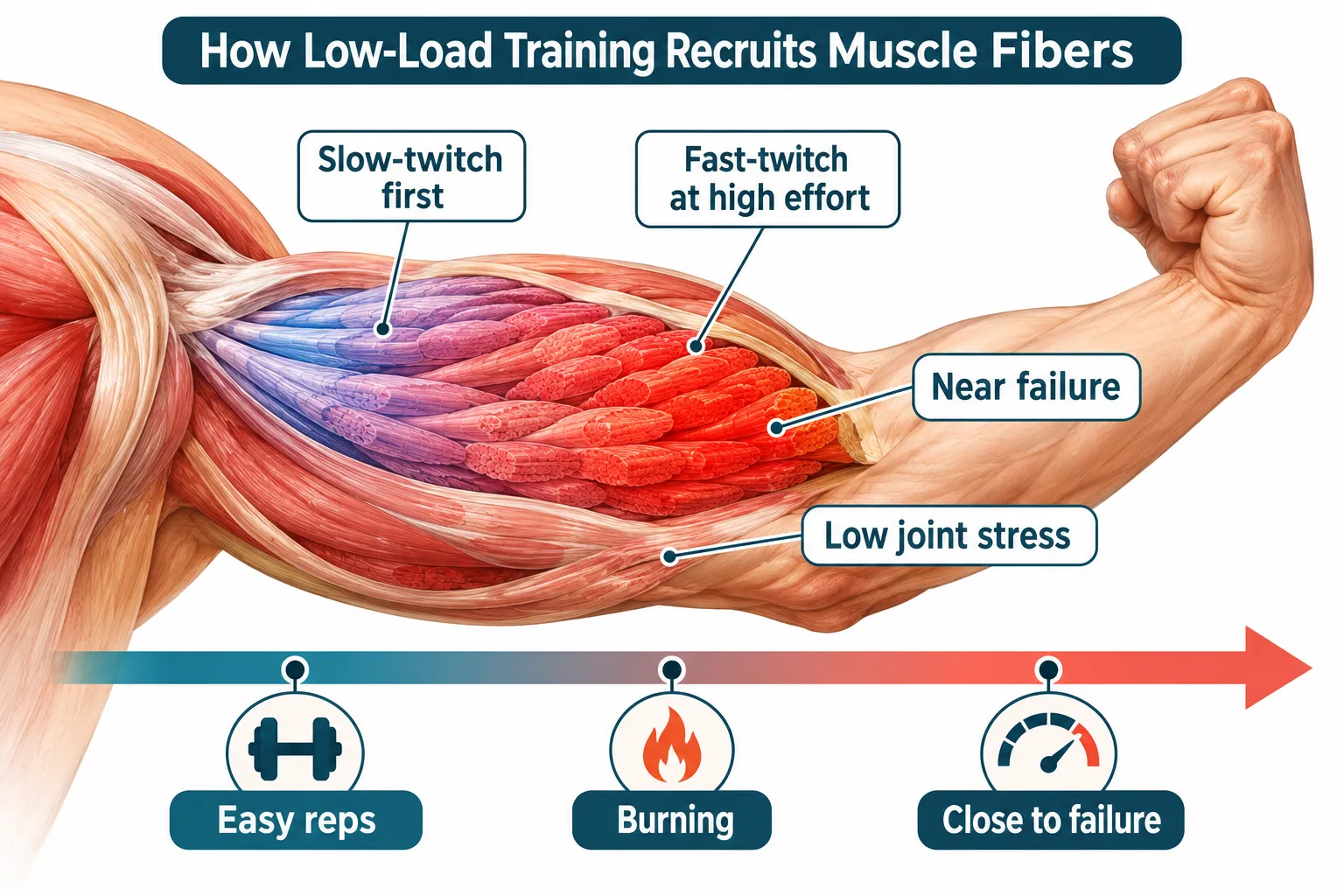
Decision rule: if a set leaves you unsure whether you could have done 5 more reps, it was too easy to count as a growth stimulus.
What counts as a light weight for muscle building?
A "light" load generally means roughly 30-50% of your one-rep max, which lands in the 15-30+ rep range. Loads at or above about 30% 1RM can produce hypertrophy when taken near failure; below that threshold, the stimulus drops off quickly unless effort is extreme or blood flow is restricted [3].
Practical translations:
| Load zone | % 1RM (approx) | Reps to failure | Best for |
|---|---|---|---|
| Heavy | 75-90% | 3-8 | Max strength, bone loading |
| Moderate | 60-75% | 8-15 | Balanced size and strength |
| Light | 30-50% | 15-30+ | Hypertrophy, joint-friendly volume |
| Very light | under 30% | 35+ | Rehab, signaling, endurance |
A 10 lb dumbbell is light for a row and genuinely heavy for a lateral raise. Judge load by reps-to-failure on that exercise, not by the number on the bell.
How do you make light weights more challenging?
Make the muscle work harder per rep instead of adding plates. Six levers do most of the job, and they stack.
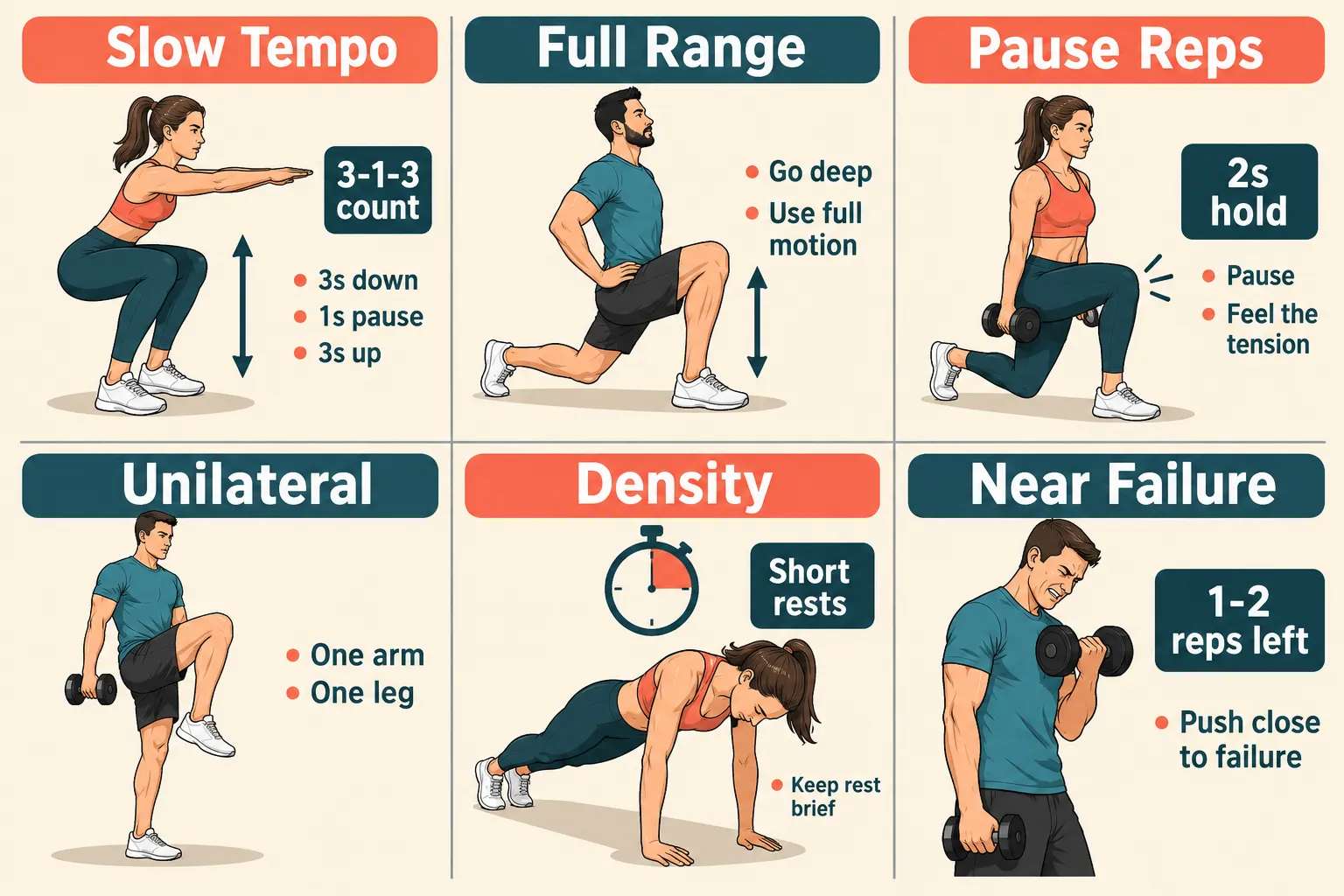
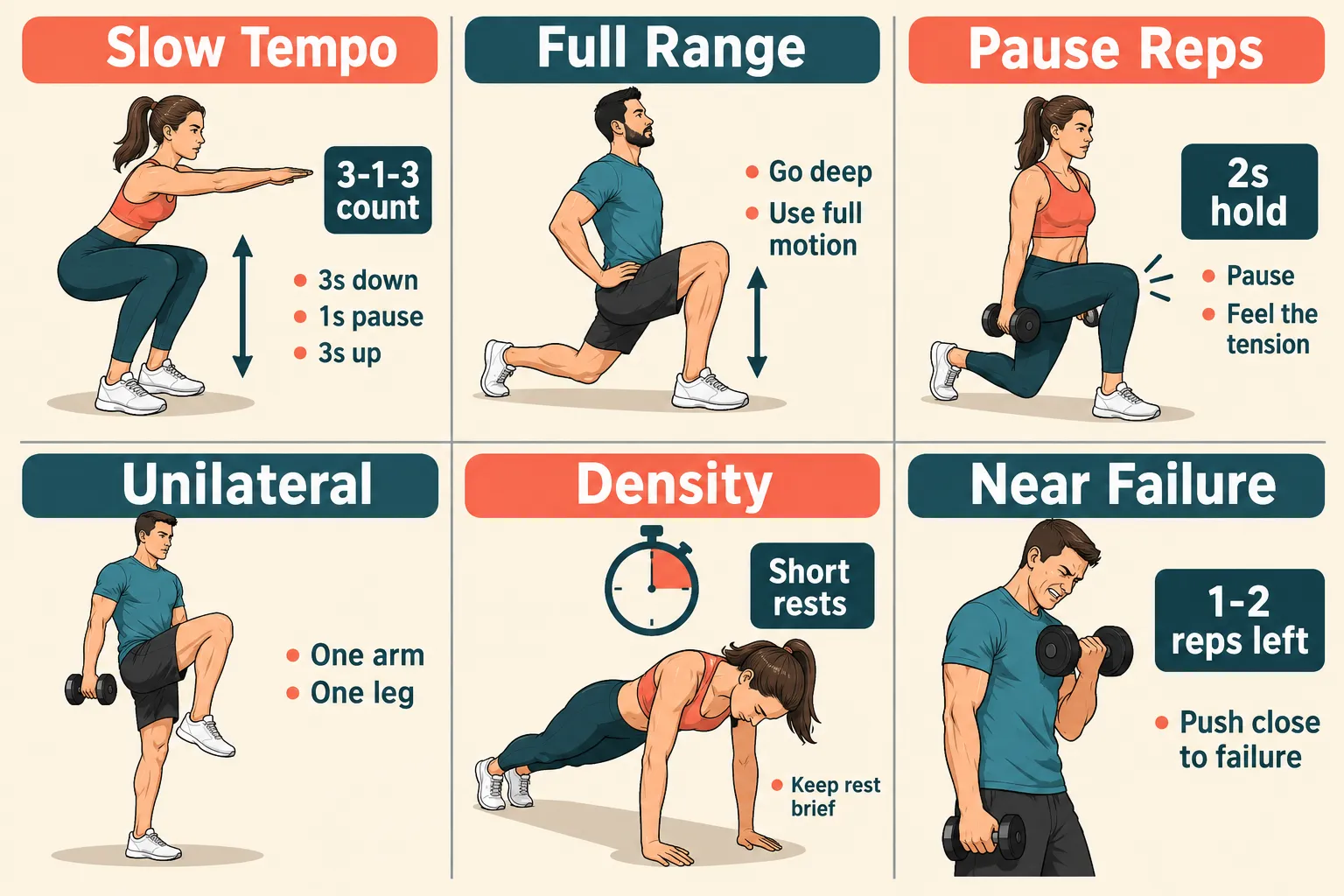
- Proximity to failure. Stop with 0-2 reps left, not when you get bored. This is the single biggest factor for low-load hypertrophy [1][2].
- Tempo. Lower for 3 seconds, lift for 1. Time under tension rises and momentum disappears.
- Full range of motion. Train the deep stretch position (deep split squat, full-stretch dumbbell fly) where loaded muscle growth is strongest.
- Pauses. A 2-second hold at the hardest point kills the stretch-reflex bounce.
- Unilateral work. One arm or one leg doubles the relative load, adds balance demand, and fixes side-to-side gaps.
- Density. Cut rest to 45-60 seconds, or add sets. More hard sets per week equals more growth, within recovery limits.
Common mistake: stacking all six at once. Pick two per block (for example, tempo plus pauses), then rotate.
Does high reps with light weights build muscle?
Yes, when high-rep sets end near failure. The 2017 low- vs high-load comparison in the Journal of Strength and Conditioning Research found comparable hypertrophy between load zones across roughly 9 weeks of training, with strength favoring heavier loads [1][2]. Popular coverage of lighter-load training has echoed the same point: effort, not load, drives most of the size response [8].
The catch is discomfort. A set of 25 near-failure goblet squats is genuinely unpleasant, and many lifters quit at the burn rather than at mechanical failure. That early exit, not the light dumbbell, is why high-rep programs often fail.
Do you build muscle slower after 40, and how long does it take?
Yes, growth is slower, and the first visible change usually takes 8-12 weeks of consistent training. Strength improves sooner, often within 2-4 weeks, because early gains come from the nervous system learning the movement.
Rough expectations for a previously untrained 40-something training twice weekly:
- Weeks 1-3: better coordination, less soreness, noticeable strength jump
- Weeks 4-8: firmer muscles, clothes fit differently, loads climb
- Weeks 9-16: measurable size change in arms, legs, shoulders
- Months 6-12: the bulk of realistic "newbie" muscle gain
Edge case: anyone returning after a long layoff regains muscle much faster than they first built it.
How often should you lift weights over 40, and does recovery take longer?
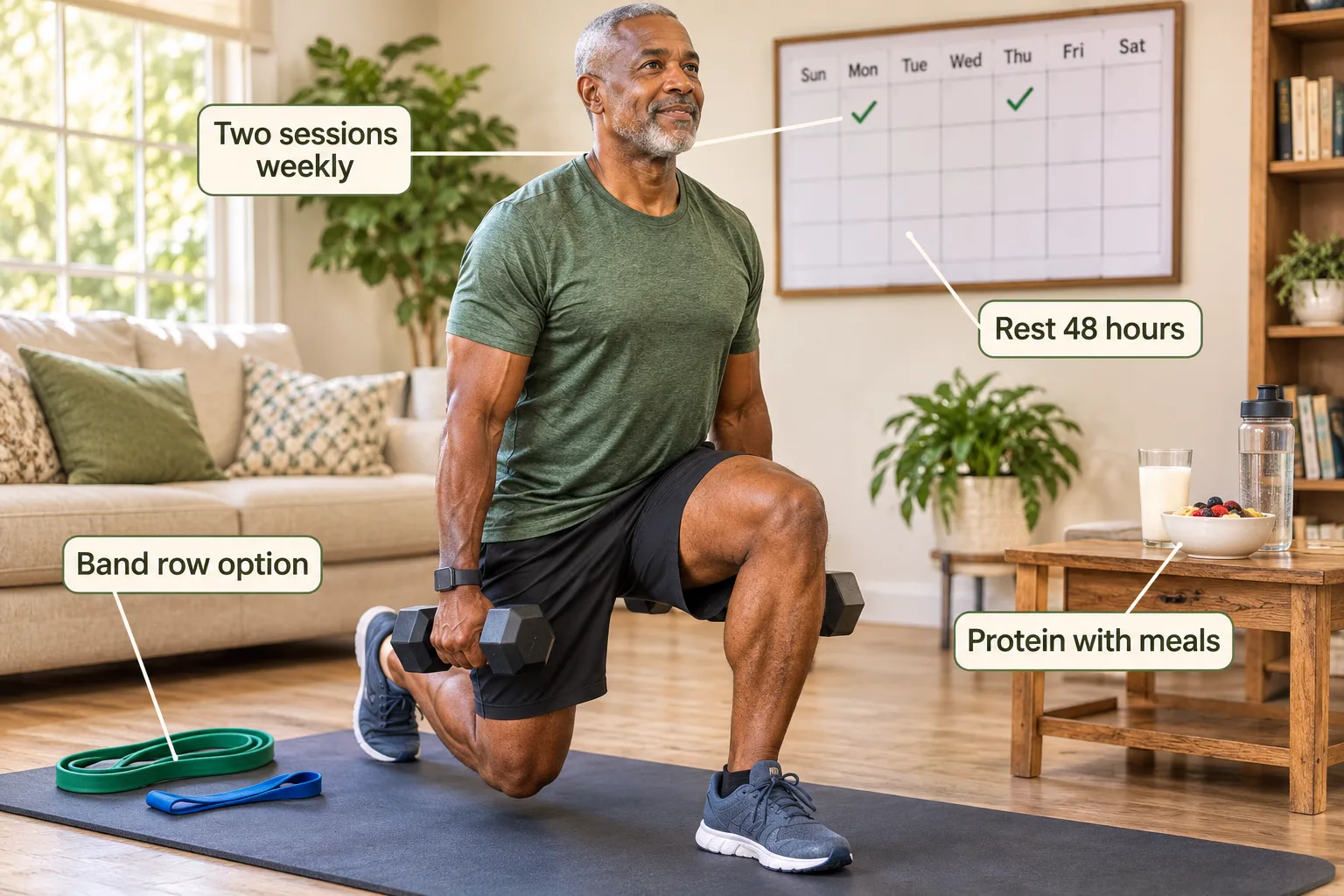
Two full-body sessions per week is the minimum effective dose and produces meaningful strength improvement; three is better if recovery allows. Professional position guidance for older adults supports training two to three days weekly, starting with lower loads and progressing gradually [5][6].
Recovery does lengthen with age, mostly in connective tissue and in the nervous system rather than in the muscle itself. Practical adjustments:
- Leave 48 hours between sessions that hit the same muscles.
- Keep 1-2 "hard to failure" sets per exercise, not every set.
- Deload every 6-8 weeks: same exercises, half the sets.
- Sleep and protein (roughly 1.6 g per kg bodyweight per day, spread across meals) do more for recovery over 40 than any supplement.
Does bodyweight training or resistance bands work after 40?
Both work, provided you can still progress and reach high effort. Bands and bodyweight count as resistance training; the limitation is loadability, not legitimacy.
Bands, good for: shoulders, upper back, hips, travel, joint-friendly pressing. Resistance rises through the range, so the hardest point is usually the top, not the stretch.
Bodyweight, good for: pushups, split squats, rows under a table, step-ups. Progress by changing leverage (elevate feet), adding a pause, or going single-limb.
Where both fall short: heavy hip hinge and squat loading, and high-impact bone stimulus. Light bands do little for bone mineral density compared with heavier loading and impact, so over-40 lifters concerned about bone health should add some heavier compound work or weight-bearing impact when medically cleared.
What's the difference between heavy and light weight training for muscle?
Heavy loads build maximal strength better; light loads build comparable size with less joint stress. Both grow muscle when sets are hard [1][2].
| Factor | Heavy (75-90% 1RM) | Light (30-50% 1RM) |
|---|---|---|
| Muscle size | Strong | Comparable if near failure |
| Max strength | Superior | Limited transfer |
| Joint stress | Higher | Lower |
| Bone loading | Stronger stimulus | Weaker |
| Discomfort | Short, sharp | Long, burning |
| Skill demand | High | Low |
Choose light if you have cranky shoulders, knees, or a back history, train at home, or are returning after time off. Choose heavy (or mixed) if strength or bone density is a priority. The practical answer for most over-40 lifters is both: moderate-to-heavy on 2-3 compound lifts, light and high-effort on everything else.
What exercises are best with light weights for muscle after 40?
The best light-load exercises are ones where leverage already makes the weight feel heavy, or where a single limb carries the load.
- Goblet squat and split squat (slow descent, 2-second pause)
- Dumbbell Romanian deadlift, one leg at a time
- Single-arm dumbbell row, full stretch at the bottom
- Lateral raise and rear-delt fly, light by nature, brutal near failure
- Pushup variations, feet elevated or tempo-controlled
- Banded face pull and band pull-apart for posture and shoulder health
- Dumbbell floor press, shoulder-friendly pressing
- Step-ups and calf raises, high reps, single leg
Quick example session (45 minutes, twice weekly): goblet squat 3×15, single-arm row 3×15/side, floor press 3×15, split squat 2×12/side, lateral raise 2×20, face pull 2×20. Last set of each taken to within 1-2 reps of failure.
Is building muscle after 40 different for women?
The training principles are identical; the context differs. Women respond to low-load, near-failure training the same way men do, and will not "bulk up" from light dumbbells.
Differences worth planning around:
- Perimenopause and menopause accelerate loss of muscle and bone, which makes resistance training more urgent, not less.
- Bone health argues for including some heavier or impact loading alongside light work.
- Protein intake is often the limiting factor; aiming for 25-35 g per meal helps.
- Upper-body strength starts from a lower base, so band-assisted and tempo pushups are better entry points than trying to force full reps.
What mistakes do older lifters make with light weights?
The top mistake is training far from failure, which turns a muscle-building session into a cardio session. Other frequent errors:
- No progression tracking. If reps, sets, or tempo don't change over months, neither will the muscle.
- Half range of motion to avoid discomfort, which skips the most productive part of the rep.
- Swinging the weight so momentum does the work.
- Too many exercises, too few hard sets. Ten easy movements beat nothing but lose to five hard ones.
- Skipping legs and hinge patterns because light dumbbells feel pointless there, use single-leg versions instead.
- Ignoring protein and sleep, then blaming age for a plateau.
- Never testing heavier. If joints allow, periodically working in the 8-12 rep range covers strength and bone bases that light loads don't.
Conclusion
Light weights build muscle after 40 when the sets are genuinely hard, taken near failure, through a full range, with progression recorded over weeks. Research comparing low and high loads supports similar hypertrophy, while reserving maximal strength for heavier work [1][2][3].
Next steps:
- Pick six exercises, two sessions a week, and write them down.
- Set tempo at 3 seconds down, 1 second up, with a 2-second pause on the last set.
- Take the final set of each exercise to within 1-2 reps of failure.
- Add reps weekly; when you hit 25-30 reps easily, add a little load or go single-limb.
- Reassess at 12 weeks, deload every 6-8, and add 1-2 heavier compound lifts if joints and medical clearance allow.
References
- Strength and Hypertrophy Adaptations Between Low vs. High Load Resistance Training. cka.ca.
- Strength And Hypertrophy Adaptations Between Low .31. journals.lww.com.
- Ajpendo.00164.2016. journals.physiology.org.
- Pmc6104111. pmc.ncbi.nlm.nih.gov.
- Nscapositionstand. unm.edu.
- Liftforlife. unm.edu.
- Pmc7927075. pmc.ncbi.nlm.nih.gov.
- Lift Lighter Weight Get Just as Strong. webmd.com.
