Last updated: November 25, 2026
Quick Answer
Strength Training After 40 for Osteopenia: A Progressive Plan for Muscle, Balance, and Fracture Risk means lifting progressively heavier loads 2-3 days per week, adding brief weight-bearing impact, and training balance almost daily. Low bone density is not a reason to lift light. Supervised, high-intensity resistance and impact training has been shown to be safe and effective in people with low bone mass [1][2]. Get medical clearance first, learn technique with light loads for 4-8 weeks, then build toward heavy compound lifts.
Key Takeaways
- Osteopenia is low bone mass, not a disease sentence. It sits between normal density and osteoporosis on a DXA scan.
- Most fractures happen to people with osteopenia, simply because far more people fall into that range than into osteoporosis.
- Progressive resistance training 2-3 days per week is the core clinical recommendation for bone health [3].
- Heavier loads beat light loads for bone. Bone responds to high strain, not high repetition [1][4].
- Balance and impact work are not optional. Preventing falls matters as much as building density.
- Expect 8-12 months before a repeat DXA scan shows measurable change.
- Technique and spinal safety matter more than avoiding weight. Loaded spinal flexion is the real risk, not the barbell.
- Home training works with bands, adjustable dumbbells, and step-ups, though a gym allows heavier progression.
- Protein, calcium, and vitamin D make the training stimulus count.
What is osteopenia, and how is it different from osteoporosis?
Osteopenia means bone mineral density is below normal but not low enough to be called osteoporosis. On a DXA scan it's a T-score between −1.0 and −2.5; osteoporosis is −2.5 or lower. The distinction is a statistical cutoff, not a biological wall.
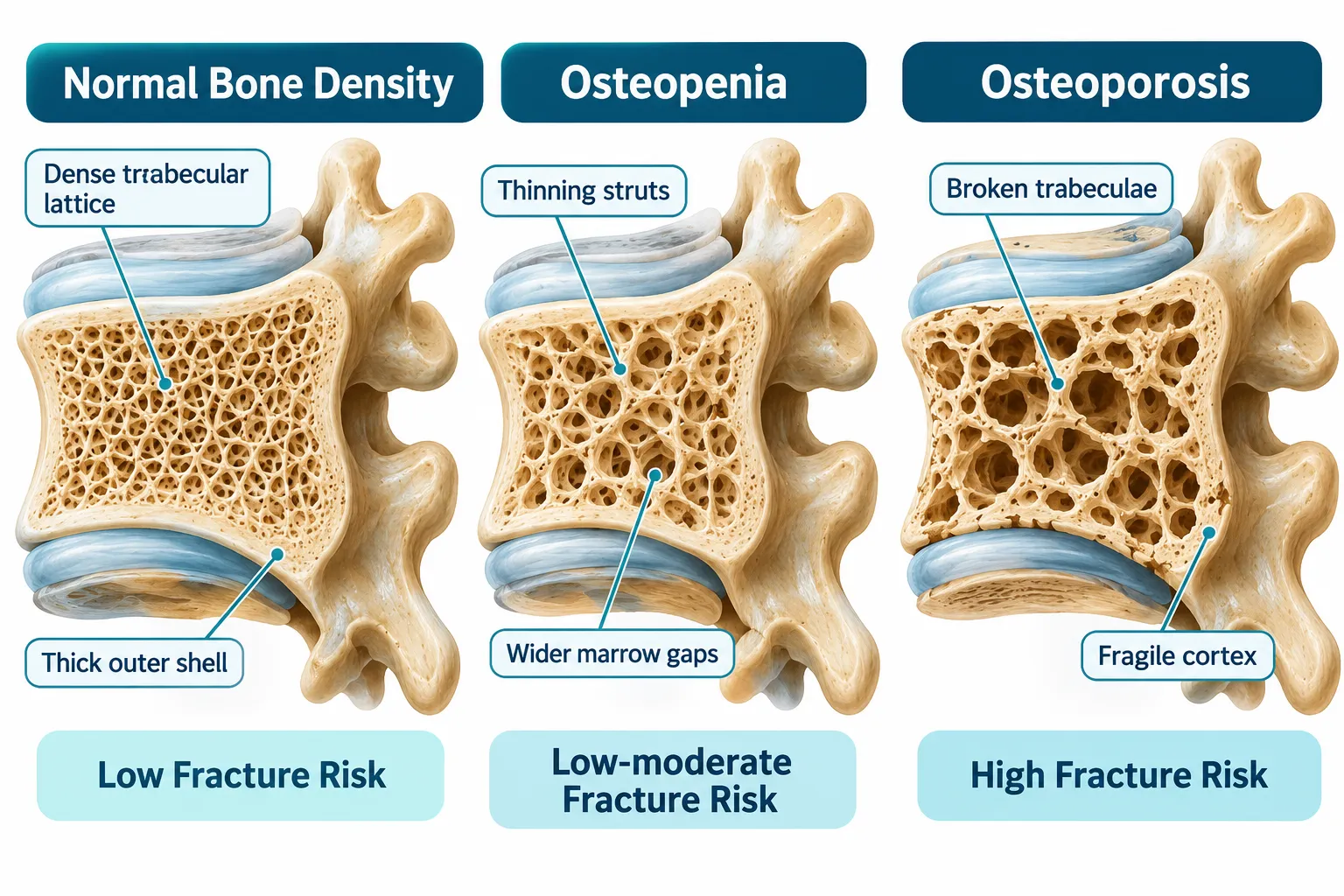
| Normal | Osteopenia | Osteoporosis | |
|---|---|---|---|
| T-score | −1.0 or above | −1.0 to −2.5 | −2.5 or lower |
| Typical approach | Maintain | Train hard, maybe supplement | Train with supervision, often medication |
| Fracture risk | Baseline | Mildly to moderately raised | High |
Here's what gets missed: because osteopenia is far more common than osteoporosis, a large share of fragility fractures occur in people in that middle range. Low risk per person, high numbers of people. That's why midlife is the window where training pays off most [5].
Can you reverse osteopenia with strength training alone?
Sometimes, partially. Resistance training can increase hip and spine bone mineral density by small percentages and reliably slows further loss, but it rarely moves a T-score from −2.0 back to normal on its own. For many people the realistic win is stopping decline and cutting fracture risk.
Choose this decision rule: if your T-score is between −1.0 and −1.5 with no other risk factors, training plus nutrition is often the whole plan. If you're at −2.3 with a family history of hip fracture, early menopause, or a previous low-trauma fracture, discuss medication with your doctor alongside training. Exercise and pharmacotherapy are complementary, not competing, and combining them is an active area of research [5].
Muscle and bone decline together, a pattern now called osteosarcopenia. Train for both, because stronger legs prevent the fall that would have broken the hip.
What are the best exercises for building bone density after 40?
Bone grows where it's loaded hard. The most effective exercises are heavy multi-joint lifts that load the hip and spine directly, plus short bursts of impact.
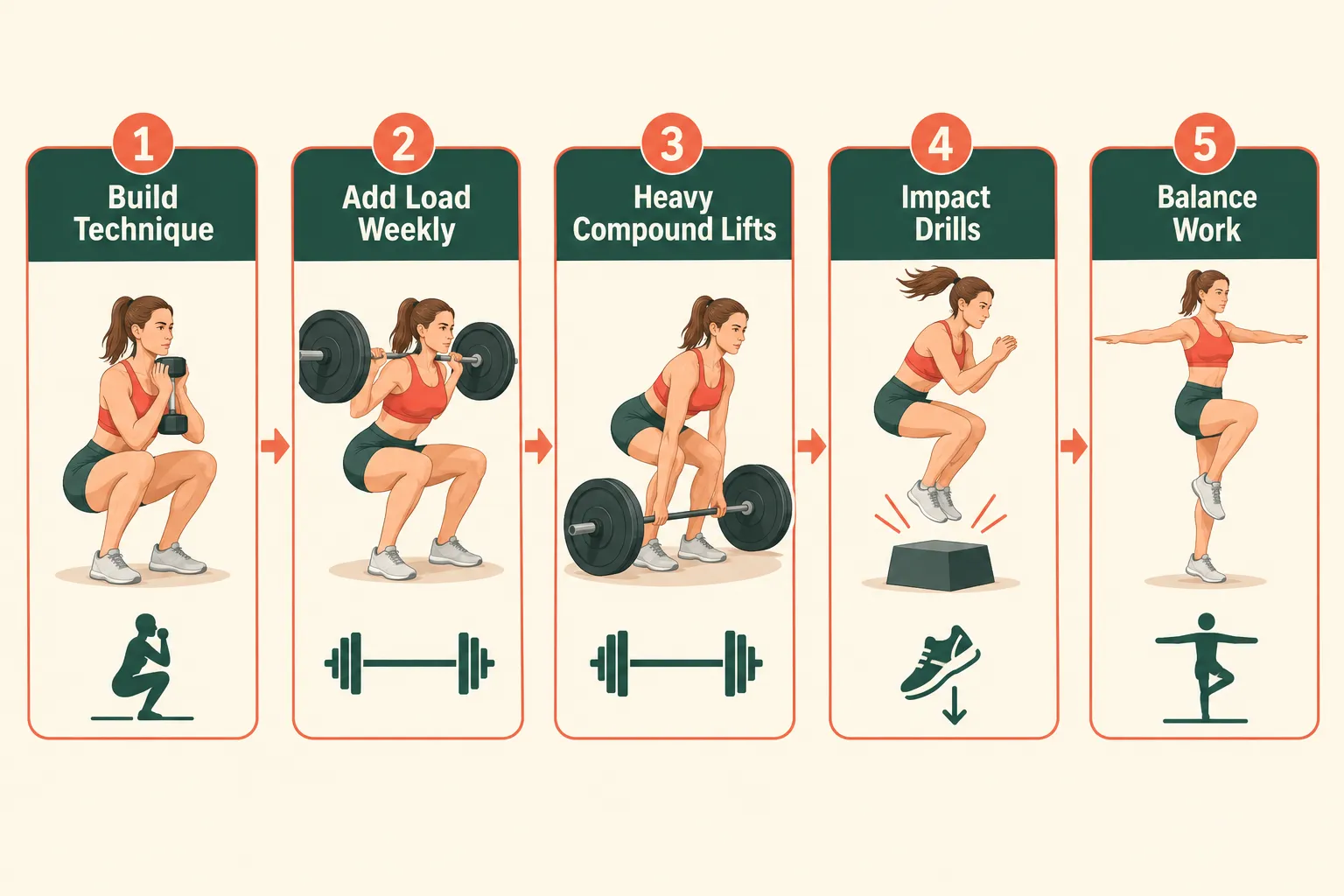
Core lifts (site-specific loading for hip and spine):
- Deadlift or trap-bar deadlift
- Back squat, goblet squat, or leg press
- Overhead press
- Loaded step-ups and split squats
- Rows and lat pulldowns for upper-back strength
Impact additions (30-50 reps total, 3-4 days/week):
- Heel drops from the toes
- Low box step-downs
- Light hopping or skipping, if joints tolerate it
- Brisk walking with brief stair intervals
High-intensity resistance and impact training programs built on exactly this combination have produced bone gains without raising injury rates in trials of adults with low bone mass [1][2].
Common mistake: spending the whole session on machines that load the arms and chest. Bone in the hip and spine only responds to hip and spine loading.
How often should you do strength training if you have osteopenia?
Two to three non-consecutive days per week of progressive resistance training, with balance work on most days. That frequency matches current clinical guidance for bone health maintenance [3].
A workable week:
- Monday: full-body lifting (45-55 min) + heel drops
- Tuesday: brisk walk + 10 min balance drills
- Thursday: full-body lifting + step-downs
- Saturday: lifting or a loaded hike, plus balance
- Daily: 2-3 minutes of single-leg stands while brushing teeth
Edge case: if you're also managing arthritis or recovering from surgery, two quality sessions beat three rushed ones. Bone responds to load magnitude, not session count.
How much weight should you be lifting with osteopenia?
Eventually, heavy enough that 5-8 reps is genuinely hard, roughly 80-85% of your one-rep max, once technique is solid. Heavier loading generally produces better bone outcomes than light, high-rep training [1][4].
The progression that keeps it safe:
- Weeks 1-6: learn patterns with light load, 10-12 reps, 2 sets. Focus entirely on neutral spine and hip hinge.
- Weeks 7-12: 8-10 reps, 3 sets, add a small amount of weight each week while form holds.
- Month 4 onward: 5-8 reps, 3-5 sets on main lifts, leaving one or two reps in reserve.
Never chase a number at the cost of rounding your lower back under load. That single technique fault, not the weight itself, is what expert consensus flags as the genuine hazard [5].
Can strength training make osteopenia worse or cause fractures?
Properly coached progressive training does not make osteopenia worse, and supervised high-intensity programs in this population have reported low adverse event rates [1][2]. The danger comes from specific movements and from poor progression, not from load per se.
Risky patterns to avoid or modify:
- Loaded or repeated spinal flexion, sit-ups, crunches, toe-touch stretches, weighted Russian twists
- End-range spinal rotation under load
- Sudden jumps in weight after weeks off
- Unsupervised plyometrics if you have poor balance or a prior fracture
- High fall-risk activities early on: slippery trail running, unstable surfaces, heavy loads without a rack or safety bars
Red flags to stop and call your doctor: new focal back pain, pain that wakes you at night, or sudden loss of height.
Do you need a gym, or can you train at home with osteopenia?
Home training works well for the first 3-6 months. Beyond that, a gym makes heavy progression far easier, because bone needs loads most home kits can't supply.
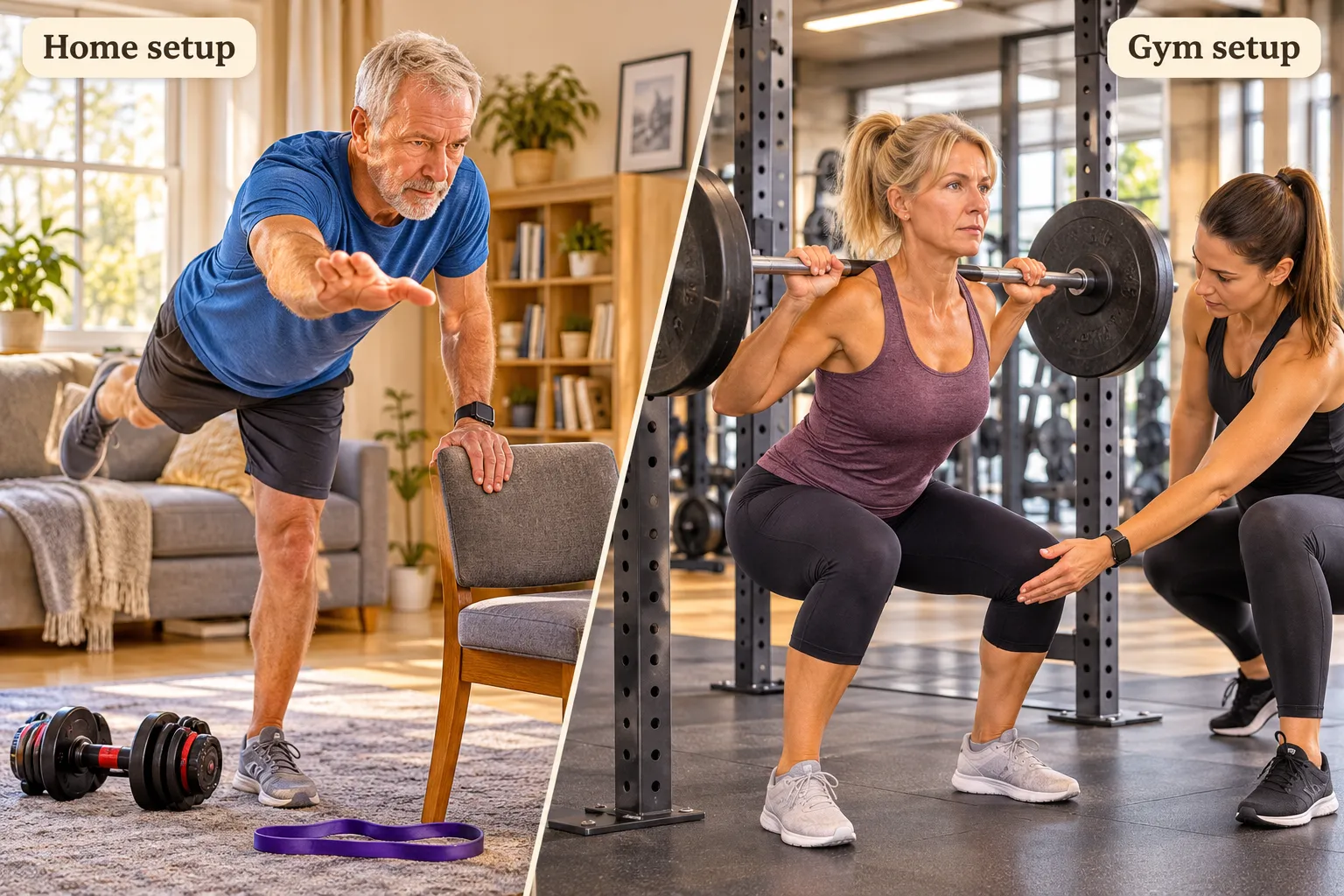
Minimum effective home kit: adjustable dumbbells or kettlebells (up to at least 20-25 kg), a sturdy step, resistance bands, and a chair for balance. Suspension trainers and blood-flow-restriction cuffs are useful lower-load options for people who can't tolerate heavy weight yet [6][7].
Choose a gym if: you can progress past your heaviest dumbbell, you want a squat rack and trap bar, or you'd benefit from a trainer watching your hinge pattern. Choose home if: travel, cost, or joint pain limit gym consistency. Consistent home training beats an unused membership.
Is strength training safe right after an osteopenia diagnosis, and how is it different from a normal routine?
Yes, usually within days, after your clinician confirms there's no vertebral fracture or other red flag. Start with a technique block rather than heavy loading.
How an osteopenia plan differs from a standard gym routine:
| Element | Typical general routine | Osteopenia-specific plan |
|---|---|---|
| Rep range | 8-15, moderate load | 5-8, heavy load on main lifts |
| Exercise choice | Aesthetic split, lots of isolation | Hip- and spine-loading compounds |
| Spinal flexion | Crunches common | Avoided under load; anti-flexion core instead |
| Impact | Incidental | Deliberate heel drops and step-downs |
| Balance | Rarely programmed | Programmed 4-7 days/week |
| Progression | Volume-driven | Load-driven, tracked weekly |
Can osteopenia strength training help with balance and fall prevention?
Yes, and it's arguably the fastest route to lower fracture risk. Bone density changes over months; balance and leg power improve within weeks, and most fragility fractures require a fall to happen.
Build a 10-minute balance block:
- Single-leg stand, 30 seconds each side (eyes open, then eyes closed near a wall)
- Tandem heel-to-toe walk, 10 metres
- Side step-overs across a low obstacle
- Sit-to-stand from a low chair, no hands, 10 reps
- Reactive step drills: step out and recover quickly in four directions
Virtual-reality and game-based balance training are emerging options that improve adherence for people who find drills tedious [4][6].
Do men and women over 40 need different osteopenia plans?
The exercise prescription is essentially the same: progressive resistance, impact, balance. What differs is screening, timing, and the hormonal context around bone loss.
- Women: bone loss accelerates sharply in perimenopause and the first years after menopause, so that's the highest-value window to begin heavy training. Discuss hormone therapy and calcium status with a clinician.
- Men: osteopenia is under-diagnosed and more often secondary to another cause, low testosterone, long-term steroids, alcohol, or coeliac disease. Ask for a cause workup, not just a density number [5].
How long before you see bone density improvements, and what should you eat?
Plan on 8-12 months before a repeat DXA shows change, since remodelling cycles take months and DXA can't detect small shifts reliably before then. Strength and balance improve in 4-8 weeks, which is the better short-term progress marker.
Nutrition that supports the training:
- Protein: roughly 1.2-1.6 g per kg body weight daily, spread across meals
- Calcium: about 1,000-1,200 mg daily, food first (dairy, tinned sardines, fortified plant milks, tofu set with calcium)
- Vitamin D: test levels; supplement if low, per your clinician
- Energy: don't train hard in a steep calorie deficit, which blunts both muscle and bone gains
- Limit: heavy alcohol and smoking, both independent bone risks
Track progress with these instead of waiting on the scan: weight lifted on your main lifts, 30-second sit-to-stand count, single-leg stand time, and grip strength.
FAQ
Is walking enough for osteopenia?
No. Walking supports general health and some hip loading, but it doesn't generate the strain needed to build bone. Pair it with resistance and impact training.
Can I do yoga or Pilates with osteopenia?
Yes, with modifications. Skip deep forward folds, spinal twists under load, and rolling-down-the-spine drills. Tell the instructor about your diagnosis.
Is a trap-bar deadlift safer than a conventional deadlift?
Generally yes for beginners, because the handles sit at your sides and reduce the forward lean, making a neutral spine easier to hold.
Should I take calcium supplements?
Only if your diet falls short. Food sources are preferred; excess supplemental calcium offers no extra bone benefit and may cause other issues.
How long should the beginner technique phase last?
Four to eight weeks for most adults. Move on once you can perform hinge and squat patterns with a neutral spine at moderate load without cueing.
Does running help bone density?
Running provides useful impact for the hip, but it does little for spine or upper-body bone and won't replace resistance training.
What if I already have a vertebral fracture?
That changes the plan. Work with a physiotherapist experienced in bone health before any loaded lifting.
Can blood-flow restriction training help if I can't lift heavy?
It can build muscle at low loads and is being studied in bone health contexts [6][7]. Use it as a bridge, not a permanent substitute for heavy loading.
Conclusion
Low bone density after 40 responds to load, and treating a DXA result as a reason to train cautiously forever is the most common and costly mistake. The plan is simple to state: medical clearance, 4-8 weeks of technique work, then 2-3 weekly sessions of progressively heavier compound lifts, 30-50 daily impact reps, and a short balance block most days.
Next steps this week:
- Book a clinician visit to rule out vertebral fracture and secondary causes.
- Note your current DXA T-score and the date, so you know when a repeat scan makes sense.
- Record a baseline: 30-second sit-to-stand count and single-leg stand time, both sides.
- Schedule two lifting sessions into your calendar before next Monday.
- Add one protein source to each meal.
References
- Pmc10345999. ncbi.nlm.nih.gov.
- pubmed.ncbi.nlm.nih.gov.
- Exercise. racgp.org.au.
- S41598 024 57358 7. nature.com.
- S11914 023 00777 8. link.springer.com.
- Ijcp. onlinelibrary.wiley.com.
- S12902 026 02194 1. link.springer.com.
