Last updated: November 26, 2026
Quick Answer
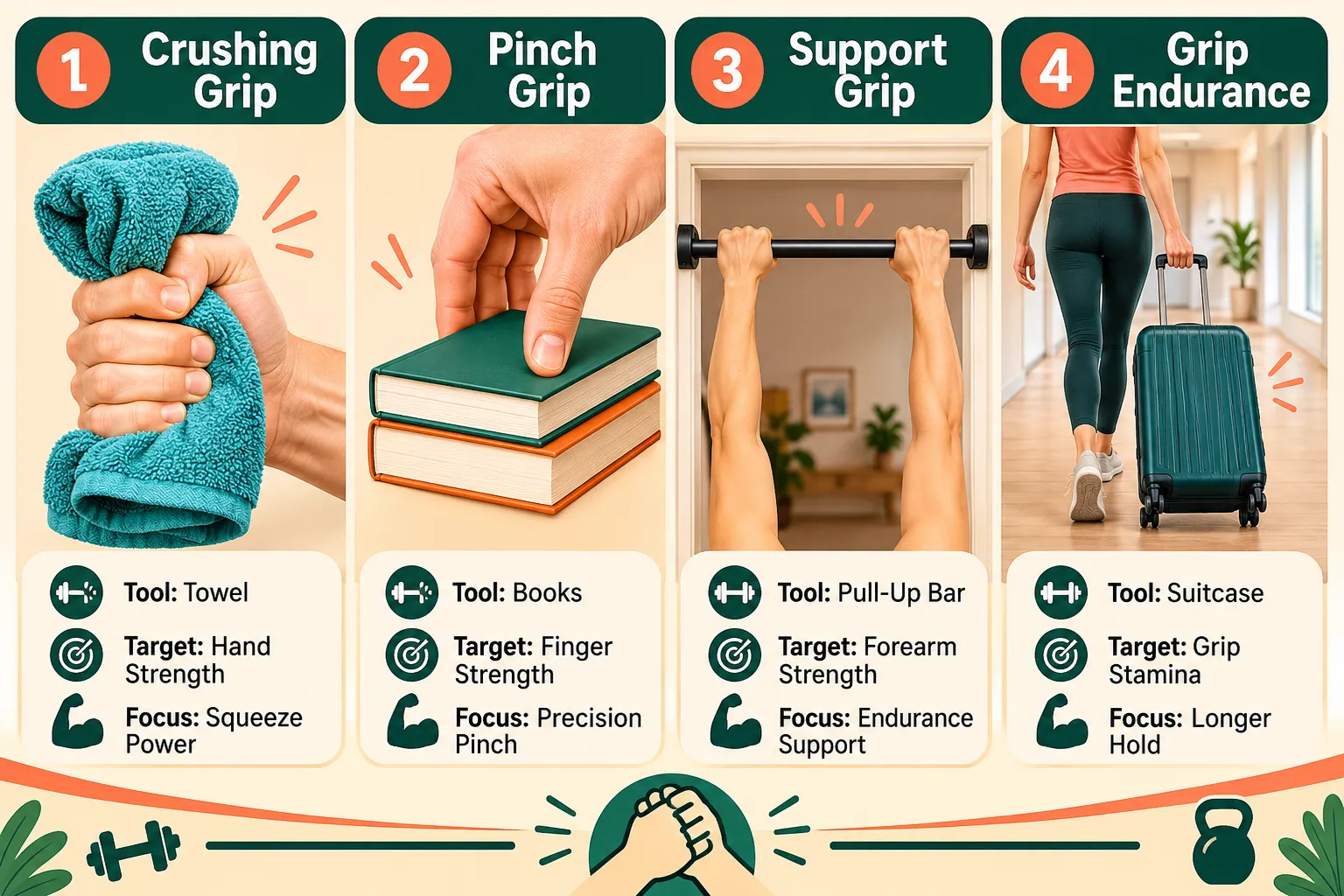
Learning how to improve grip strength after 40 with exercises for lifting, carrying, and everyday function comes down to training four distinct qualities: crushing grip (squeezing), pinch grip (thumb against fingers), support grip (holding on), and grip endurance (holding on for a long time). Two or three short sessions a week, using towels, resistance bands, loaded carries, and bar hangs, is enough for most adults. Research shows resistance training improves grip strength in older adults in a dose-responsive way [1], and focused 8-week hand and forearm programs raise both maximal grip and endurance [2]. Expect noticeable change in 4 to 8 weeks.
Key Takeaways
- Grip strength declines after 40 mainly from fast-twitch fiber loss, motor unit dropout, and stiffer tendons, not from "getting old" alone.
- Train all four grip types: crushing, pinch, support, and endurance. Most people only train one.
- Two to three sessions weekly, 10 to 15 minutes each, beats daily maxing out.
- Household items work: towels, grocery bags, a thick book, a doorway bar.
- Higher grip strength tracks with healthy aging, functional independence, and lower fall risk [3][4].
- Arthritis is not a reason to stop. It's a reason to modify (lighter loads, neutral wrist, longer warm-ups).
- Sharp joint pain means change the exercise. Muscle burn in the forearm is normal.
- Hand grippers help crushing strength but ignore pinch and support grip, so they're a supplement, not a program.
- Measurable gains usually appear in 4 to 8 weeks; strength keeps climbing for months.
- Protein intake, vitamin D status, and sleep patterns all influence grip trajectory [5].
Why does grip strength decline after 40?
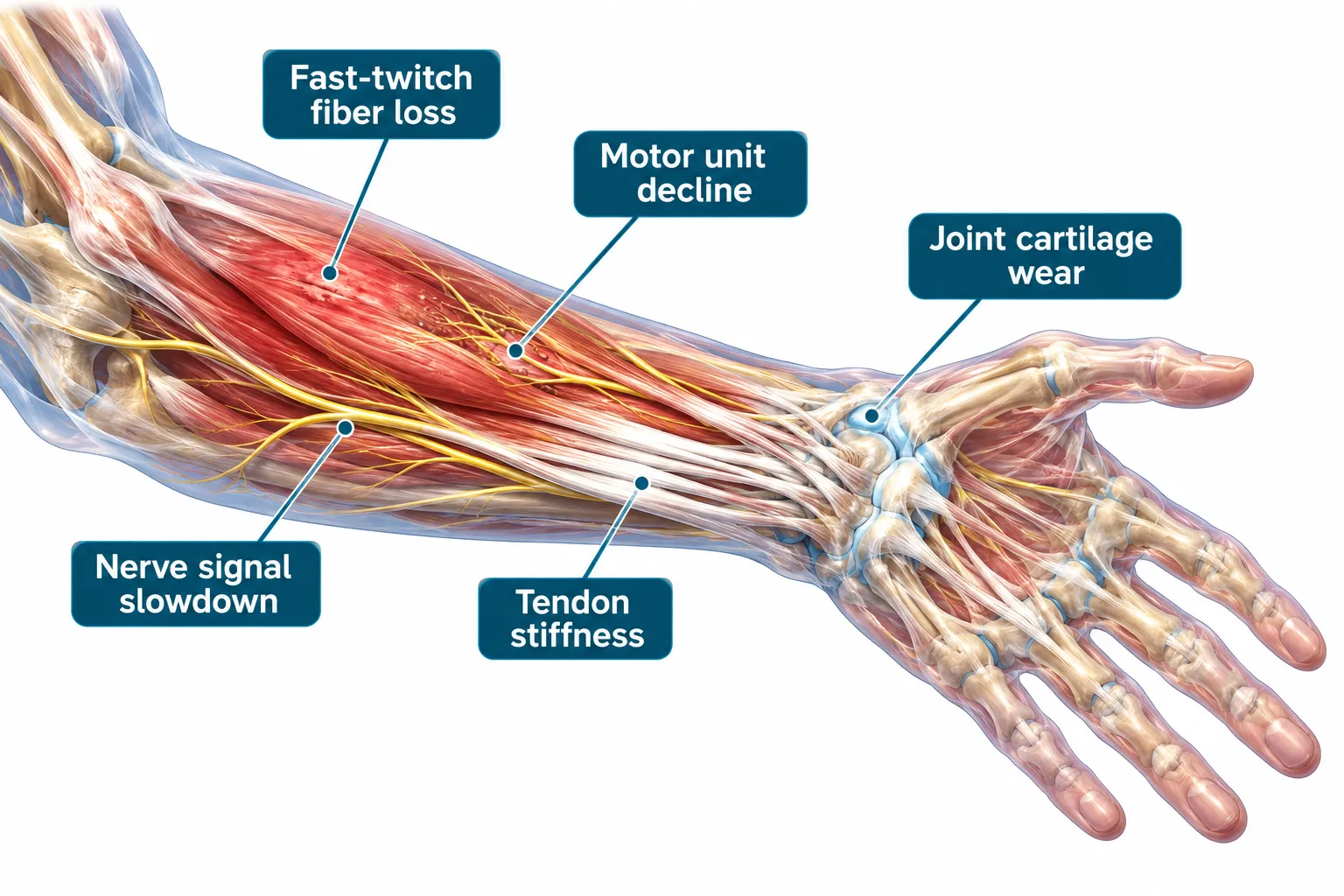
Grip strength declines after 40 because the hand and forearm lose fast-twitch muscle fibers and motor units faster than they lose slow-twitch fibers, while tendons and joint capsules stiffen. Combine that with less daily heavy handling (fewer buckets, bags, and tools) and the drop accelerates.
)
The main drivers:
- Motor unit loss. Nerves that drive forearm muscle fibers drop out with age, and surviving units fire less efficiently.
- Sarcopenia. Muscle mass declines roughly from the fourth decade onward, and the forearm is not spared.
- Disuse. Desk work, rolling luggage, and powered tools removed most of the heavy gripping from modern life.
- Joint and tendon changes. Osteoarthritis at the thumb base and stiffer flexor tendons reduce force transfer.
Low grip strength is common and clinically meaningful in older adults, which is exactly why training it from midlife matters [6]. It's also linked both ways with cognitive function, so maintaining grip may support brain health as well as hand function [4].
Grip strength is less a hand measurement than a whole-body health signal. Declines often show up alongside slowing gait, and the two together flag people at risk of rapid functional decline [7].
What's considered good grip strength for your age?
A practical functional benchmark: you should be able to hang from a bar for 30 seconds, carry half your bodyweight per hand for 30 seconds, and open any jar in your kitchen without a tool. Clinical cutoffs for low grip strength are measured with a hand dynamometer and vary by sex, population, and guideline, so use your own trend rather than chasing a single number.
Field tests you can run at home:
| Test | Solid for most adults 40+ | What it measures |
|---|---|---|
| Dead hang from a bar | 30 sec (women), 40 sec (men) | Support grip + endurance |
| Farmer carry, 2 bags/dumbbells | 50% bodyweight total, 40 m | Support grip under load |
| Pinch hold, two books, fingers only | 20 sec | Pinch grip |
| Towel wring (wet towel, both hands) | Can wring nearly dry | Crushing grip |
Decision rule: if you fail two or more of these, start at the beginner progression below rather than jumping into heavy carries. Where dynamometers aren't available, clinicians can also estimate grip from anthropometric measures to screen for weakness [8].
What are the best grip strength exercises for older adults at home?
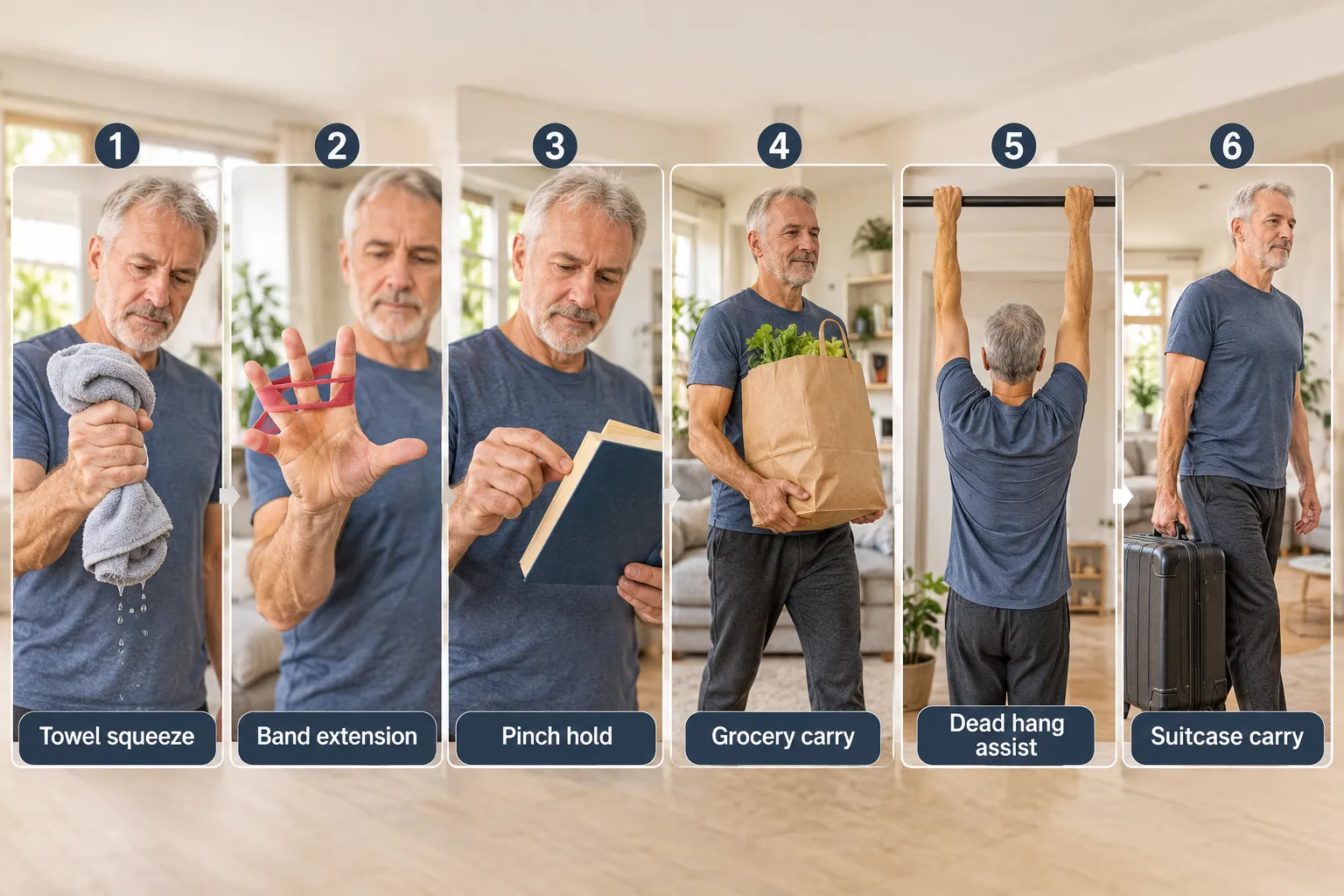
The best at-home grip exercises for adults over 40 are towel squeezes, rubber band finger extensions, pinch holds with books, suitcase carries with grocery bags, and assisted dead hangs. All four grip types get covered, and nothing requires a gym.
)
Crushing grip (squeezing a closing object)
- Rolled towel squeeze: 5 squeezes of 5 seconds, each hand.
- Wet towel wring: 3 rounds, both directions.
Pinch grip (thumb vs fingers)
- Two-book pinch hold: hold hardcovers by the covers, 15 to 30 seconds per hand.
- Plate pinch or chopping-board pinch: same idea, heavier.
Support grip (holding on without closing further)
- Suitcase carry: one heavy grocery bag, walk 20 to 40 metres, switch sides.
- Dead hang: feet lightly on a chair or step to offload as needed.
Grip endurance
- Farmer carries for time, not distance: two bags, 45 to 60 seconds.
- Band squeeze repeats: 30 fast squeezes of a soft ball or band loop.
Antagonist work (skip this and you'll get elbow pain)
- Rubber band finger extensions: band around all five fingertips, open against resistance, 20 reps.
A simple 15-minute session
- Wrist circles and finger flexion/extension, 60 seconds.
- Band finger extensions, 2 × 20.
- Towel squeezes, 3 × 5 seconds per hand.
- Pinch holds, 3 × 20 seconds per hand.
- Suitcase carries, 3 × 30 seconds per side.
- Dead hang (assisted if needed), 3 × max hold minus 5 seconds.
How often should you train grip strength, and is daily grip work bad?
Train grip two to three times a week with at least one full day between hard sessions. Daily heavy grip work is a common path to medial elbow pain and flexor tendon irritation, because tendons remodel more slowly than muscle.
Daily work is fine only if it's light: band finger extensions, gentle range-of-motion, or putty squeezing at low effort. Save hard holds, heavy carries, and near-maximal squeezes for the two or three dedicated days. Resistance training produces dose-responsive grip improvements in older adults [1], but the dose that works is weekly volume, not daily grinding.
Common mistake: squeezing a spring gripper for hundreds of reps every day. That builds a sore forearm and little else because the load never progresses.
Can you improve grip strength if you have arthritis?
Yes. People with osteoarthritis or rheumatoid arthritis can improve grip strength, but the programming changes: lighter loads, isometric holds instead of repeated crushing, a neutral wrist, and a longer warm-up.
Practical modifications:
- Replace hard crushing with soft therapy putty or a foam ball at 40 to 50% effort.
- Use thicker handles (wrap a towel around the bar) to spread pressure across the palm and reduce thumb-base load.
- Favour support grip carries over pinch grip if the thumb CMC joint is painful.
- Train on good days, back off during flares, and never push through joint swelling.
- Task-oriented, technology-assisted hand training has outperformed conventional exercise for grip strength in rehabilitation settings, so structured programs with feedback are worth asking a hand therapist about [9].
Edge case: if one hand is in a splint or recovering, train the other hand anyway. Unilateral resistance training of the unaffected limb still improves grip strength and helps maintain function in the compromised side [10].
What equipment do you actually need, and do hand grippers really work?
You need almost nothing: two bags or dumbbells, a towel, a resistance band, and something to hang from. Hand grippers do work for crushing grip specifically, but they train only one of the four grip qualities, so they're a supplement rather than a program.
| Tool | Trains | Worth buying? |
|---|---|---|
| Towel + grocery bags | Crushing, support, endurance | Free, start here |
| Resistance band (finger extension) | Antagonist/elbow health | Yes, cheap and essential |
| Doorway pull-up bar | Support grip, shoulders | Yes, high value |
| Adjustable hand gripper | Crushing only | Optional |
| Pinch blocks / plates | Pinch grip | Optional, books work |
| Hand dynamometer | Measurement | Only if you like data |
Choose a gripper if your crushing grip is the clear weak link (you can hang fine but can't open jars). Skip it if you already struggle to hold on to heavy objects, since carries will do more.
What's the difference between grip strength and forearm strength?
Grip strength is the force your hand produces when closing, pinching, or holding. Forearm strength is broader and includes wrist flexion, extension, pronation, and supination. Grip relies heavily on forearm flexors, but strong forearms don't guarantee a strong grip, and vice versa.
Why it matters practically: turning a stiff valve or a wrench is forearm rotation, not grip. Carrying a suitcase is grip. Train both by adding wrist curls, reverse wrist curls, and a towel-twist (wring) drill to your carries.
Does hand pain during grip training mean you're doing it wrong, and is it safe after injury?
Deep, burning fatigue in the forearm belly is normal. Sharp pain in a joint, tingling in the fingers, or pain that lingers more than 24 hours means the exercise, load, or hand position needs to change. Grip training after a wrist or hand injury is generally safe once cleared by a clinician, starting with pain-free isometrics.
Signal checklist:
- Green light: forearm burn, pump, mild next-day soreness.
- Yellow light: ache at the inner elbow. Reduce volume, add band finger extensions, widen the handle.
- Red light: numbness, night pain, clicking with swelling, or pain at the thumb base that worsens weekly. Stop and get assessed.
Post-injury progression: pain-free isometric squeeze (5 sec holds) → light support holds → short carries → longer carries → heavier carries. Add load only when the previous step is painless for a full week.
)
Can grip strength training help prevent falls?
Grip strength itself doesn't catch you, but it's one of the clearest markers of overall muscle and neural health, and both grip strength and how quickly grip fatigues are emerging as predictors of fall risk and mortality in older adults [7]. Training grip through loaded carries also builds trunk, shoulder, and hip stability, which directly affects balance.
There's a mechanical bonus: strong hands let you grab a handrail, a doorframe, or a counter and actually stop a fall in progress. Carries are the highest-value exercise here because they train grip and gait at the same time, and declining grip plus slowing gait is the combination that most reliably flags rapid functional decline [7].
How long before you notice improvements in grip strength?
Most people feel a difference in 2 to 3 weeks (neural adaptation) and measure a real increase in 4 to 8 weeks. Dedicated 8-week hand and forearm programs have produced significant gains in both maximal grip strength and grip endurance [2].
Realistic timeline:
- Weeks 1-2: better coordination, easier jar lids, no visible change.
- Weeks 3-4: longer hangs, heavier carries, less end-of-day hand fatigue.
- Weeks 5-8: measurable dynamometer gains, noticeably easier shopping and luggage.
- Months 3-6: structural gains in forearm muscle and tendon tolerance.
Localized vibration training applied to the upper arm has also enhanced arm and hand grip strength in early research, which may become a useful adjunct for people who can't load the hand directly [3].
Are there foods or supplements that boost grip strength?
No supplement builds grip on its own, but adequate protein, vitamin D, and overall energy intake support the muscle that training builds. Address deficiency first, then train.
- Protein: spread roughly 1.2 to 1.6 g per kg bodyweight across the day, with 25 to 40 g per meal, to support muscle retention after 40.
- Vitamin D: low status is associated with muscle weakness; test before supplementing.
- Creatine monohydrate: well-studied for strength gains alongside resistance training.
- Sleep: sleep patterns, especially long sleep duration, have been linked with later grip strength decline, making sleep a modifiable factor worth tracking [5].
Skip: collagen marketed for "hand strength," proprietary grip blends, and anything promising results without training.
FAQ
Is grip strength training safe every day?
Light daily work (band finger extensions, gentle putty) is safe. Heavy squeezes, hangs, and loaded carries need 48 hours between sessions to let tendons recover.
How many sets should I do per session?
Three to five working sets per grip type, 10 to 15 minutes total, two or three times a week.
Do hand grippers actually work?
Yes, for crushing grip. They don't train pinch, support, or endurance, so pair them with carries and hangs.
Can I train grip if I have carpal tunnel syndrome?
Only with clinician guidance. Avoid sustained heavy gripping with a flexed wrist, and stop if symptoms increase at night.
What's the single best grip exercise?
The farmer carry. It trains support grip, endurance, posture, and gait at once with minimal equipment.
Does grip strength predict how long you'll live?
Grip strength is consistently associated with healthy aging and is studied as a predictor of fall risk and mortality in older adults [3][7]. It's a marker, not a cause.
Should women over 40 train grip differently?
No. The exercises are identical; only the loads differ. Pinch grip and carries are equally valuable.
Will grip training make my hands bulky?
No. Forearms may thicken slightly, but hand size doesn't change meaningfully.
Do I need a dynamometer?
Not required. Timed dead hangs and carry distance track progress just as well for home training.
Conclusion
Grip strength after 40 responds fast to the right training, and the right training is unglamorous: squeeze things, pinch things, hang from things, and carry heavy things twice a week. The payoff goes well beyond a firmer handshake, since higher grip strength tracks with healthy aging, functional independence, and lower fall risk [3][4][7].
Start this week:
- Test yourself once: dead hang, two-book pinch hold, and one loaded carry. Write the numbers down.
- Schedule two 15-minute sessions on non-consecutive days.
- Add band finger extensions after every session to protect your elbows.
- Retest in 4 weeks. If nothing improved, add load, not reps.
- If joint pain (not muscle burn) shows up twice in a row, see a hand therapist before continuing.
References
- Resistance training dose-response for grip strength in older adults. pubmed.ncbi.nlm.nih.gov.
- Eight-week hand and forearm strength program outcomes. pubmed.ncbi.nlm.nih.gov.
- Localized vibration training and grip strength. ncbi.nlm.nih.gov.
- Grip strength and cognitive function. pmc.ncbi.nlm.nih.gov.
- Sleep duration and grip strength decline. pubmed.ncbi.nlm.nih.gov.
- Low grip strength in older adults. pubmed.ncbi.nlm.nih.gov.
- Grip strength, gait speed, fall risk and mortality. pubmed.ncbi.nlm.nih.gov.
- Anthropometric prediction of grip strength. pubmed.ncbi.nlm.nih.gov.
- Technology-assisted task-oriented hand training. ncbi.nlm.nih.gov.
- Unilateral resistance training and hand grip strength. pubmed.ncbi.nlm.nih.gov.
