Last updated: November 27, 2026
Quick answer
Rounded shoulders in desk workers over 40 are mostly a strength problem, not a stretching problem. The fix is a full-body program built around pulling (rows, band pull-aparts, face pulls), hip extension (bridges, hinges), and anti-flexion core work (planks, loaded carries), trained 2-3 days per week, plus short chest stretches and hourly desk microbreaks [1][2][3]. Most people notice less neck and upper-back tension within 2-4 weeks and visible shoulder position change in 8-12 weeks, as long as the desk setup changes too [4][5].
Key takeaways
- Rounded shoulders come from hours of hip flexion, chest shortening, and an under-used upper back, not from "bad genes."
- Age 40+ is not too late. Adults keep building strength and tissue tolerance well into later decades.
- Pulling volume matters most: aim for 2-3 pulls for every press you do.
- Train 2-3 days a week full-body, and add 1-2 minute desk drills every 60-90 minutes.
- Stretching the chest alone rarely holds. Strength is what keeps the new position.
- A door anchor, one long resistance band, and a pair of dumbbells cover the whole program.
- Shoulder pain or arthritis usually means modifying the range, not skipping strength work.
- Posture "comes back" when training stops or the desk setup stays bad, so keep both.
What causes rounded shoulders from sitting at a desk all day
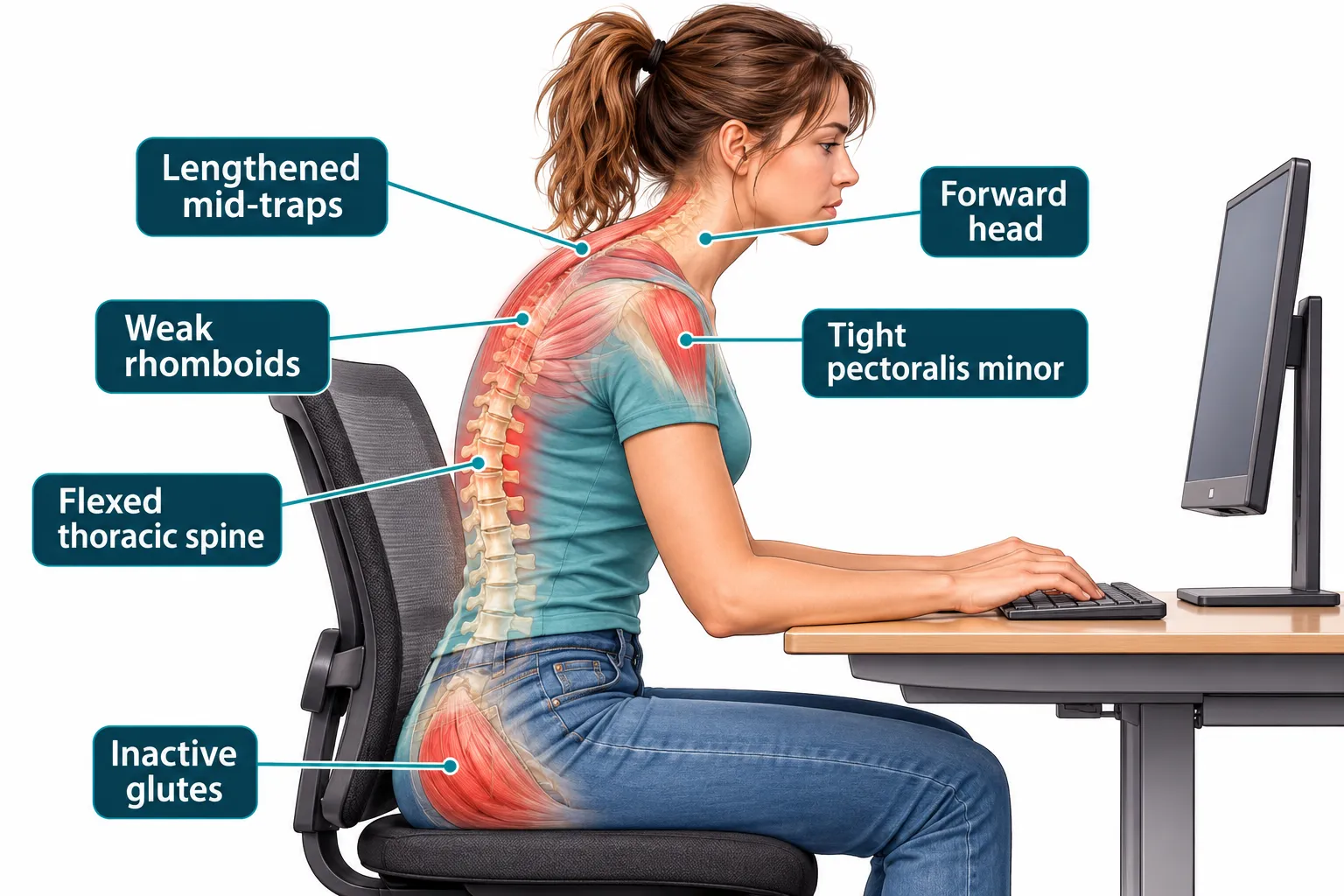
Rounded shoulders develop when the chest and front-of-shoulder tissues sit shortened for hours while the mid-back muscles that hold the shoulder blades back stay switched off. Reaching forward for a keyboard, looking down at a low monitor, and cradling a phone all push the shoulder blades into a forward, tilted position [1][5].
)
The chain usually looks like this:
- Pecs and front delts shorten from sustained forward reach.
- Rhomboids, mid-traps, and lower traps lengthen and lose the habit of firing.
- Thoracic spine stiffens into a flexed, rounded shape.
- Hip flexors tighten and glutes go quiet, which tips the pelvis and stacks the spine poorly from the ground up.
- Deep neck flexors weaken, so the head drifts forward and the upper traps overwork [6].
Common mistake: treating this as a shoulder-only issue. If the hips and trunk can't hold an upright stack, the upper back has no base to pull against.
Is it too late to fix my posture at 40 or older
No. Muscle responds to resistance training at every adult age, and joint and connective tissue adapt too, just a little slower than at 25. Resistance training after 40 reliably improves upper-back strength and reduces neck and back discomfort [3].
What actually changes after 40:
- Recovery takes longer, so 2-3 quality sessions beat 5 rushed ones.
- Warm-ups matter more (5 minutes, not 60 seconds).
- Progress is steadier with smaller jumps in load.
Choose a slower ramp if you're over 50, returning after years off, or managing arthritis. Choose standard progression if you've trained in the last year without pain.
Posture at 40 is less about flexibility you lost and more about strength you never built in the back of your body.
What strength exercises actually fix rounded shoulders
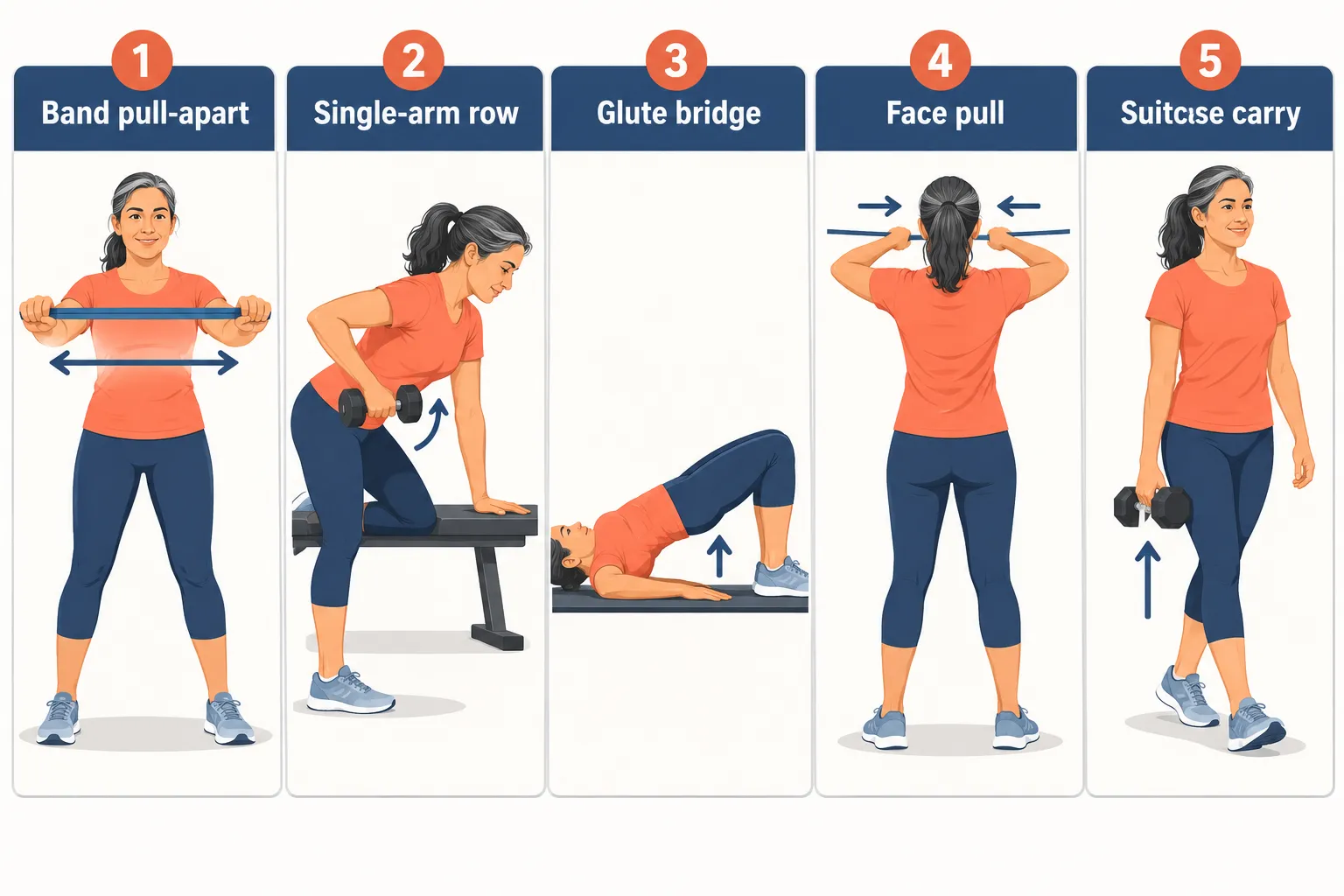
The highest-value exercises are horizontal and vertical pulls plus scapular control work: band pull-aparts, face pulls, single-arm dumbbell rows, lat pull-downs or band pull-downs, prone Y-T-W raises, and wall slides [1][2][7]. Pair them with chest-opening stretches like a doorway pec stretch [8].
)
| Movement | Why it matters | Easy home version |
|---|---|---|
| Band pull-apart | Wakes up rhomboids and mid-traps | Light band, 2×15-20 |
| Face pull | Trains external rotation and lower traps | Band at eye height, 2×12-15 |
| Single-arm row | Builds raw pulling strength | Dumbbell or band, 3×8-10 |
| Band pull-down | Trains lats and overhead control | Door anchor overhead, 2×12 |
| Prone Y-T-W | Endurance for scapular holders | Floor, no weight, 2×8 each |
| Glute bridge / hip hinge | Supports upright pelvis and spine | Bodyweight or dumbbell, 3×10 |
| Plank, suitcase carry | Anti-flexion trunk stability | 30-45s holds |
| Wall slide | Trains thoracic extension + overhead reach | 2×8 slow reps |
Quick example: a 3-day week might be Monday (rows, hinge, plank), Wednesday (pull-downs, bridges, carries), Friday (face pulls, Y-T-W, split squats), with band pull-aparts in every session.
Should I do strength training or yoga for better posture
Strength training changes shoulder position faster; yoga improves mobility, breathing, and body awareness. For rounded shoulders specifically, loaded pulling wins, because the mid-back needs resistance to build the endurance that holds posture through an 8-hour workday [3].
- Choose strength first if your shoulders round back easily when reminded but drift again within minutes. That's an endurance and strength gap.
- Add yoga or mobility if you physically can't reach overhead or flatten your upper back against a wall.
- Best combination: 2-3 strength days plus one mobility session, or 5 minutes of mobility as a warm-up before lifting.
How long does it take to fix rounded shoulders with exercise
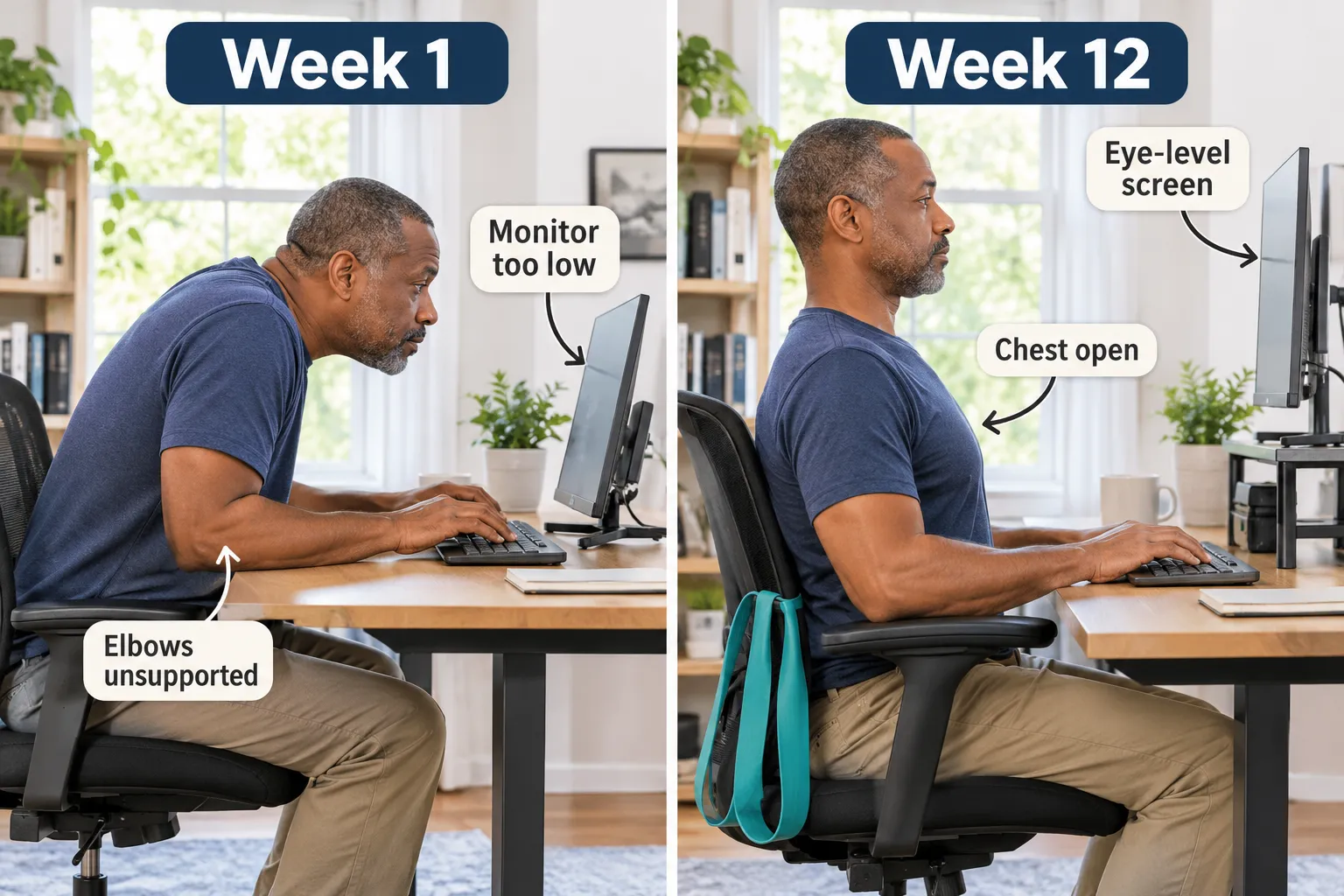
Expect less tension in 2-4 weeks, noticeable strength gains by week 6, and visible shoulder position change around 8-12 weeks of consistent training [4][5]. Daily short drills speed this up more than one long weekly session [9][10].
Rough timeline:
- Weeks 1-2: Learn positions, reduce stiffness, build the habit.
- Weeks 3-6: Add load. Neck and upper-back ache typically drop.
- Weeks 7-12: Shoulder blades sit flatter; shirts fit differently across the chest.
- Month 4+: Maintenance, usually 2 sessions a week.
Edge case: if you've had rounded posture for 20+ years with a stiff thoracic spine, add 4-8 weeks and expect partial, not total, change.
Why aren't my shoulders improving even though I'm exercising
The usual reasons are too little load, too much pressing, no desk changes, or inconsistent frequency. Band pull-aparts with a light band three times a month won't rebuild a mid-back that's been lengthened for a decade.
Run this checklist:
- Are you doing at least 2 pulls per press? Bench-heavy routines worsen forward shoulder drift [11-style programming, see 6][7].
- Are you progressing load or reps every 1-2 weeks?
- Are you training the lower traps and external rotators, not just lats?
- Did your monitor, chair, and keyboard change at all [5]?
- Are you taking microbreaks every 60-90 minutes [9]?
- Are you training hips and core, or only arms and shoulders [3]?
)
Can you permanently fix rounded shoulders, or does it come back
Rounded shoulders can be corrected durably, but not permanently in the "set and forget" sense. The posture returns if you stop training or go back to a desk that forces you forward [4][5]. Think of it like fitness: maintained with 2 short sessions a week, lost after a few months of nothing.
Two things make results stick:
- Ergonomics: monitor top at eye level, elbows supported, feet flat, keyboard close to the body [5].
- Minimum effective dose: two full-body sessions plus daily 2-minute band pull-apart sets.
Is physical therapy better than home posture exercises
Physical therapy is better when there's pain, numbness, a past injury, or no progress after 8-12 weeks of consistent home work. For a healthy desk worker with simple rounded shoulders, a well-built home program with bands and dumbbells is usually enough [1][2].
See a physio or qualified clinician if you have:
- Pain that wakes you at night or radiates down the arm
- Numbness, tingling, or weakness gripping objects
- A previous rotator cuff tear, dislocation, or neck surgery
- Diagnosed arthritis that limits daily tasks
Is strength training safe for someone over 40 with no gym experience
Yes, when you start with bodyweight and bands, keep reps in the 8-15 range, and stop 2-3 reps short of failure. Resistance guidance for adults 40+ centers on at least two full-body days per week with meaningful upper-back work [3].
A safe four-week on-ramp:
- Week 1: Bodyweight and band only. 2 sessions. 2 sets per exercise.
- Week 2: Add a third set. Keep load light.
- Week 3: Introduce dumbbells on rows and hinges.
- Week 4: Add a third weekly session or increase load ~5-10%.
What common mistakes do people make, and what should I avoid
The biggest mistakes are stretching without strengthening, shrugging during rows, forcing an exaggerated "chest out" stance, and chasing heavy loads before learning scapular control [1][2].
Avoid these specifically:
- Shrugging on rows and face pulls. Keep the neck long, drive elbows back.
- Arching the lower back to fake an upright chest. Ribs stay down.
- Overhead pressing heavy before you can do a clean wall slide.
- Stretch-only routines. Chest stretches help, but strength keeps the change [8].
- All-or-nothing scheduling. Two solid days beat one perfect week followed by three blank ones.
- Ignoring breathing. Holding your breath stiffens the upper back further.
What if I have shoulder pain or arthritis, can I still strengthen
Usually yes, with modified range and lighter load. Pain-free partial ranges, neutral-grip rows, and band work below shoulder height let most people keep training while the joint settles. Clear new or sharp pain with a clinician first.
Practical modifications:
- Swap overhead pull-downs for low-to-mid rows.
- Use a neutral grip (palms facing each other) on all pulling.
- Train in the range that scores 3/10 discomfort or less, never sharp pain.
- Choose isometric holds (10-20 seconds) on bad days instead of skipping.
How many times per week should I do posture exercises, and do I need equipment
Train strength 2-3 days per week and do short posture drills most days. You don't need a gym: one long resistance band with a door anchor, a light band, and one or two pairs of dumbbells cover every exercise in this program [1][9][10].
Sample week:
| Day | Focus | Time |
|---|---|---|
| Mon | Full body: rows, hinge, plank | 30 min |
| Tue | Desk drills only | 5 min |
| Wed | Full body: pull-downs, bridges, carries | 30 min |
| Thu | Desk drills only | 5 min |
| Fri | Full body: face pulls, Y-T-W, split squats | 30 min |
| Sat/Sun | Walk + doorway pec stretch | 10 min |
Desk drills, done hourly: 15 band pull-aparts, 5 wall slides, 3 slow chin tucks, stand and extend the hips for 20 seconds [9][10].
FAQ
Do posture braces work?
Braces give a short-term cue but don't build strength. Used alone, posture returns once the brace is off.
Can I fix rounded shoulders without any equipment?
Partly. Floor Y-T-W raises, wall slides, prone extensions, and glute bridges all help, but a band adds resistance that speeds results noticeably.
How long should each session be?
25-35 minutes is plenty for a full-body posture program, including a 5-minute warm-up.
Should I stretch before or after lifting?
Do light dynamic mobility (wall slides, arm circles) before, and hold static chest stretches after [8].
Is walking enough to fix posture?
No. Walking helps hips and circulation but doesn't load the mid-back muscles that hold shoulder blades in place.
Can rounded shoulders cause neck pain and headaches?
Forward head and rounded shoulders commonly overload the upper traps and neck extensors, which is often reported as tension-type neck ache [5][6].
How heavy should my rows be?
Heavy enough that reps 8-10 feel hard but your form and neck stay relaxed. If you can do 20, go heavier.
Will push-ups make rounded shoulders worse?
Only if pressing dominates your week. Keep a 2:1 pull-to-press ratio and push-ups are fine.
Conclusion
Rounded shoulders after 40 respond to load, not just stretching. Build the program around pulling, hip extension, and anti-flexion core work, run it 2-3 days a week, and change the desk that caused the problem in the first place.
Next steps:
- Buy one long resistance band and a door anchor this week.
- Schedule two 30-minute full-body sessions in your calendar.
- Raise your monitor to eye level today.
- Set an hourly reminder for 15 band pull-aparts.
- Re-check your shoulder position against a wall at week 4, 8, and 12.
References
- Rounded Shoulders Exercises. deskgym.app.
- Exercises for Rounded Shoulders. sportydoctor.com.
- Strength Training Over 40 Fitbod Playbook. fitbod.me.
- How to Fix Rounded Shoulders. sitapp.app.
- How to Fix Rounded Shoulders From Desk Work. spinalhaven.com.
- Shoulder Mobility Exercises Desk Workers. postureflowlab.com.
- Best Exercises to Fix Rounded Shoulders From a Desk Job a PR. visionssportweb.com.
- The Four Most Effective Stretches for Rounded Posture From Sitting at a Desk. fitandwell.com.
- Posture Exercises for Desk Workers. sitapp.app.
- Exercises Rounded Posture Office Desk. runlovers.it.
